B
INTRODUCTION
Background: Lucayan Indians inhabited the islands when Christopher COLUMBUS first set foot in the New World on San Salvador in 1492. British settlement of the islands began in 1647; the islands became a colony in 1783. Piracy thrived in the 17th and 18th centuries because of The Bahamas close proximity to shipping lanes. Since attaining independence from the UK in 1973, The Bahamas has prospered through tourism, international banking, and investment management, which comprise up to 85% of GDP. Because of its proximity to the US - the nearest Bahamian landmass being only 80 km (50 mi) from Florida - the country is a major transshipment point for illicit trafficking, particularly to the US mainland, as well as Europe. US law enforcement agencies cooperate closely with The Bahamas, and the US Coast Guard assists Bahamian authorities in maritime security and law enforcement through Operation Bahamas, Turks and Caicos, or OPBAT.
GEOGRAPHY
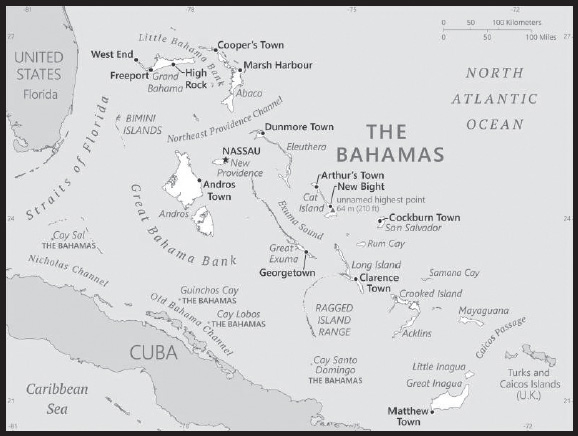
Location: chain of islands in the North Atlantic Ocean, southeast of Florida, northeast of Cuba; note - although The Bahamas does not border the Caribbean Sea, geopolitically it is often designated as a Caribbean nation
Geographic coordinates: 24 15 N, 76 00 W
Map references: Central America and the Caribbean
Area: total: 13,880 sq km
land: 10,010 sq km
water: 3,870 sq km
comparison ranking: total 160
Area - comparative: slightly smaller than Connecticut
Land boundaries: total: 0 km
Coastline: 3,542 km
Maritime claims: territorial sea: 12 nm
exclusive economic zone: 200 nm
Climate: tropical marine; moderated by warm waters of Gulf Stream
Terrain: long, flat coral formations with some low rounded hills
Elevation: highest point: 1.3 km NE of Old Bight on Cat Island 64 m
lowest point: Atlantic Ocean 0 m
Natural resources: salt, aragonite, timber, arable land
Land use: agricultural land: 1.4% (2018 est.)
arable land: 0.8% (2018 est.)
permanent crops: 0.4% (2018 est.)
permanent pasture: 0.2% (2018 est.)
forest: 51.4% (2018 est.)
other: 47.2% (2018 est.)
Irrigated land: 10 sq km (2012)
Population distribution: most of the population lives in urban areas, with two-thirds living on New Providence Island where Nassau is located
Natural hazards: hurricanes and other tropical storms cause extensive flood and wind damage
Geography - note: strategic location adjacent to US and Cuba; extensive island chain of which 30 are inhabited
PEOPLE AND SOCIETY
Population: 358,508 (2023 est.)
comparison ranking: 178
Nationality: noun: Bahamian(s)
adjective: Bahamian
Ethnic groups: African descent 90.6%, White 4.7%, mixed 2.1%, other 1.9%, unspecified 0.7% (2010 est.)
note: data represent population by racial group
Languages: English (official), Creole (among Haitian immigrants)
Religions: Protestant 69.9% (includes Baptist 34.9%, Anglican 13.7%, Pentecostal 8.9% Seventh Day Adventist 4.4%, Methodist 3.6%, Church of God 1.9%, Brethren 1.6%, other Protestant .9%), Roman Catholic 12%, other Christian 13% (includes Jehovah’s Witness 1.1%), other 0.6%, none 1.9%, unspecified 2.6% (2010 est.)
Age structure: 0-14 years: 21.37% (male 38,851/female 37,765)
15-64 years: 68.8% (male 122,134/female 124,530)
65 years and over: 9.83% (2023 est.) (male 13,922/female 21,306)
Dependency ratios: total dependency ratio: 39.3
youth dependency ratio: 27.3
elderly dependency ratio: 11.9
potential support ratio: 8.4 (2021 est.)
Median age: total: 32.8 years (2020)
male: 31.7 years
female: 34 years
comparison ranking: total 104
Population growth rate: 0.8% (2023 est.)
comparison ranking: 114
Birth rate: 14.49 births/1,000 population (2023 est.)
comparison ranking: 118
Death rate: 6.47 deaths/1,000 population (2023 est.)
comparison ranking: 137
Net migration rate: 0 migrant(s)/1,000 population (2023 est.)
comparison ranking: 88
Population distribution: most of the population lives in urban areas, with two-thirds living on New Providence Island where Nassau is located
Urbanization: urban population: 83.6% of total population (2023)
rate of urbanization: 1.02% annual rate of change (2020-25 est.)
Major urban areas - population: 280,000 NASSAU (capital) (2018)
Sex ratio: at birth: 1.03 male(s)/female
0-14 years: 1.03 male(s)/female
15-64 years: 0.98 male(s)/female
65 years and over: 0.65 male(s)/female
total population: 0.95 male(s)/female (2023 est.)
Maternal mortality ratio: 77 deaths/100,000 live births (2020 est.)
comparison ranking: 77
Infant mortality rate: total: 12.52 deaths/1,000 live births (2023 est.)
male: 12.96 deaths/1,000 live births
female: 12.06 deaths/1,000 live births
comparison ranking: total 111
Life expectancy at birth: total population: 76.38 years (2023 est.)
male: 73.47 years
female: 79.38 years
comparison ranking: total population 108
Total fertility rate: 1.97 children born/woman (2023 est.)
comparison ranking: 111
Gross reproduction rate: 0.97 (2023 est.)
Drinking water source: improved: total: 98.9% of population
unimproved: total: 1.1% of population (2017 est.)
Current health expenditure: 7.6% of GDP (2020)
Physicians density: 1.94 physicians/1,000 population (2017)
Hospital bed density: 3 beds/1,000 population (2017)
Sanitation facility access: improved: total: 98.2% of population
unimproved: total: 1.8% of population (2017 est.)
Obesity - adult prevalence rate: 31.6% (2016)
comparison ranking: 21
Alcohol consumption per capita: total: 9.48 liters of pure alcohol (2019 est.)
beer: 3.66 liters of pure alcohol (2019 est.)
wine: 1.43 liters of pure alcohol (2019 est.)
spirits: 4.08 liters of pure alcohol (2019 est.)
other alcohols: 0.31 liters of pure alcohol (2019 est.)
comparison ranking: total 29
Tobacco use: total: 10.6% (2020 est.)
male: 18.8% (2020 est.)
female: 2.4% (2020 est.)
comparison ranking: total 134
Currently married women (ages 15-49): 38.9% (2023 est.)
Education expenditures: 2.8% of GDP (2021 est.)
comparison ranking: 164
Youth unemployment rate (ages 15-24): total: 30.8% (2021 est.)
male: 27.5%
female: 35.6%
comparison ranking: total 35
ENVIRONMENT
Environment - current issues: coral reef decay; solid waste disposal
Environment - international agreements: party to: Biodiversity, Climate Change, Climate Change-Kyoto Protocol, Climate Change-Paris Agreement, Comprehensive Nuclear Test Ban, Desertification, Endangered Species, Hazardous Wastes, Law of the Sea, Nuclear Test Ban, Ozone Layer Protection, Ship Pollution, Wetlands
signed, but not ratified: none of the selected agreements
Climate: tropical marine; moderated by warm waters of Gulf Stream
Land use: agricultural land: 1.4% (2018 est.)
arable land: 0.8% (2018 est.)
permanent crops: 0.4% (2018 est.)
permanent pasture: 0.2% (2018 est.)
forest: 51.4% (2018 est.)
other: 47.2% (2018 est.)
Urbanization: urban population: 83.6% of total population (2023)
rate of urbanization: 1.02% annual rate of change (2020-25 est.)
Revenue from forest resources: 0.01% of GDP (2018 est.)
comparison ranking: 147
Revenue from coal: 0% of GDP (2018 est.)
comparison ranking: 154
Air pollutants: particulate matter emissions: 5.2 micrograms per cubic meter (2019 est.)
carbon dioxide emissions: 1.79 megatons (2016 est.)
methane emissions: 0.23 megatons (2020 est.)
Waste and recycling: municipal solid waste generated annually: 264,000 tons (2015 est.)
Total water withdrawal: municipal: 30 million cubic meters (2020 est.)
Total renewable water resources: 700 million cubic meters (2020 est.)
GOVERNMENT
Country name: conventional long form: Commonwealth of The Bahamas
conventional short form: The Bahamas
etymology: name derives from the Spanish “baha mar,” meaning “shallow sea,” which describes the shallow waters of the Bahama Banks
Government type: parliamentary democracy under a constitutional monarchy; a Commonwealth realm
Capital: name: Nassau
geographic coordinates: 25 05 N, 77 21 W
time difference: UTC-5 (same time as Washington, DC, during Standard Time)
daylight saving time: +1hr, begins second Sunday in March; ends first Sunday in November
etymology: named after William III (1650-1702), king of England, Scotland, and Ireland, who was a member of the House of Nassau
Administrative divisions: 31 districts; Acklins Islands, Berry Islands, Bimini, Black Point, Cat Island, Central Abaco, Central Andros, Central Eleuthera, City of Freeport, Crooked Island and Long Cay, East Grand Bahama, Exuma, Grand Cay, Harbour Island, Hope Town, Inagua, Long Island, Mangrove Cay, Mayaguana, Moore’s Island, North Abaco, North Andros, North Eleuthera, Ragged Island, Rum Cay, San Salvador, South Abaco, South Andros, South Eleuthera, Spanish Wells, West Grand Bahama
Independence: 10 July 1973 (from the UK)
National holiday: Independence Day, 10 July (1973)
Constitution: history: previous 1964 (preindependence); latest adopted 20 June 1973, effective 10 July 1973
amendments: proposed as an “Act” by Parliament; passage of amendments to articles such as the organization and composition of the branches of government requires approval by at least two-thirds majority of the membership of both houses of Parliament and majority approval in a referendum; passage of amendments to constitutional articles such as fundamental rights and individual freedoms, the powers, authorities, and procedures of the branches of government, or changes to the Bahamas Independence Act 1973 requires approval by at least three-fourths majority of the membership of both houses and majority approval in a referendum; amended many times, last in 2016
Legal system: common law system based on the English model
International law organization participation: has not submitted an ICJ jurisdiction declaration; non-party state to the ICCt
Citizenship: citizenship by birth: no
citizenship by descent only: at least one parent must be a citizen of The Bahamas
dual citizenship recognized: no
residency requirement for naturalization: 6-9 years
Suffrage: 18 years of age; universal
Executive branch: chief of state: King CHARLES III (since 8 September 2022); represented by Governor-General Cynthia A. PRATT (since 1 September 2023)
head of government: Prime Minister Philip DAVIS (since 17 September 2021)
cabinet: Cabinet appointed by governor-general on recommendation of prime minister
elections/appointments: the monarchy is hereditary; governor-general appointed by the monarch on the advice of the prime minister; following legislative elections, the leader of the majority party or majority coalition usually appointed prime minister by the governor-general; the prime minister recommends the deputy prime minister
Legislative branch: description: bicameral Parliament consists of:
Senate (16 seats; members appointed by the governor-general - 9 selected on the advice of the prime minister, 4 on the advice of the leader of the opposition party, and 3 on the advice of the prime minister in consultation with the opposition leader; members serve 5-year terms)
House of Assembly (39 seats; members directly elected in single-seat constituencies by simple majority vote to serve 5-year terms)
elections:
Senate - last appointments on 24 May 2017 (next appointments in 2022)
House of Assembly - last held on 16 September 2021 (next to be held by September 2026)
election results:
Senate - appointed; composition as of August 2023 - men 12, women 4, percent of women 25%
House of Assembly - percent of vote by party - PLP 52.5%, FNM 36.2%; seats by party - PLP 32, FNM 7; composition as of August 2023 - men 32, women 7, percent of women 18%; note - total Parliament percent of women 20%
note: the government may dissolve the parliament and call elections at any time
Judicial branch: highest court(s): Court of Appeal (consists of the court president and 4 justices, organized in 3-member panels); Supreme Court (consists of the chief justice and a maximum of 11 and a minimum of 2 justices)
judge selection and term of office: Court of Appeal president and Supreme Court chief justice appointed by the governor-general on the advice of the prime minister after consultation with the leader of the opposition party; other Court of Appeal and Supreme Court justices appointed by the governor general upon recommendation of the Judicial and Legal Services Commission, a 5-member body headed by the chief justice; Court of Appeal justices appointed for life with mandatory retirement normally at age 68 but can be extended until age 70; Supreme Court justices appointed for life with mandatory retirement normally at age 65 but can be extended until age 67
subordinate courts: Industrial Tribunal; Stipendiary and Magistrates’ Courts; Family Island Administrators
note: The Bahamas is a member of the 15-member Caribbean Community but is not party to the agreement establishing the Caribbean Court of Justice as its highest appellate court; the Judicial Committee of the Privy Council (in London) serves as the final court of appeal for The Bahamas
Political parties and leaders: Democratic National Alliance or DNA [Arinthia KOMOLAFE]
Free National Movement or FNM [Michael PINTARD]
Progressive Liberal Party or PLP [Philip “Brave” DAVIS]
International organization participation: ACP, AOSIS, C, Caricom, CDB, CELAC, FAO, G-77, IADB, IAEA, IBRD, ICAO, ICC (NGOs), ICRM, IDA, IFAD, IFC, IFRCS, ILO, IMF, IMO, IMSO, Interpol, IOC, IOM, ISO (correspondent), ITSO, ITU, LAES, MIGA, NAM, OAS, OPANAL, OPCW, Petrocaribe, UN, UNCTAD, UNESCO, UNIDO, UNWTO, UPU, WCO, WHO, WIPO, WMO, WTO (observer)
Diplomatic representation in the US: chief of mission: Ambassador Wendall Kermith JONES (since 19 April 2022)
chancery: 600 New Hampshire Ave NW, Suite 530, Washington, DC 20037
telephone: [1] (202) 319-2660
FAX: [1] (202) 319-2668
email address and website:
consulate(s) general: Atlanta, Miami, New York, Washington, DC
Diplomatic representation from the US: chief of mission: Ambassador (vacant); Charge d’ Affaires Usha E. PITTS (since 1 January 2021)
embassy: 42 Queen Street, Nassau
mailing address: 3370 Nassau Place, Washington, DC 20521-3370
telephone: [1] (242) 322-1181
FAX: [1] (242) 356-7174
email address and website:
Flag description: three equal horizontal bands of aquamarine (top), gold, and aquamarine, with a black equilateral triangle based on the hoist side; the band colors represent the golden beaches of the islands surrounded by the aquamarine sea; black represents the vigor and force of a united people, while the pointing triangle indicates the enterprise and determination of the Bahamian people to develop the rich resources of land and sea
National symbol(s): blue marlin, flamingo, Yellow Elder flower; national colors: aquamarine, yellow, black
National anthem: name: “March On, Bahamaland!”
lyrics/music: Timothy GIBSON
note: adopted 1973; as a Commonwealth country, in addition to the national anthem, “God Save the King” serves as the royal anthem (see United Kingdom)
ECONOMY
Economic overview: high-income tourism and financial services economy; major income inequality; strong US bilateral relations; several tax relief programs; targeted investment in agriculture, energy, light manufacturing, and technology industries
Real GDP (purchasing power parity): $12.323 billion (2021 est.)
$10.836 billion (2020 est.)
$14.225 billion (2019 est.)
note: data are in 2017 dollars
comparison ranking: 160
Real GDP growth rate: 13.72% (2021 est.)
-23.82% (2020 est.)
1.9% (2019 est.)
comparison ranking: 11
Real GDP per capita: $30,200 (2021 est.)
$26,700 (2020 est.)
$35,200 (2019 est.)
note: data are in 2017 dollars
comparison ranking: 71
GDP (official exchange rate): $12.16 billion (2017 est.)
Inflation rate (consumer prices): 2.9% (2021 est.)
0.04% (2020 est.)
2.49% (2019 est.)
comparison ranking: 124
Credit ratings: Moody’s rating: Ba2 (2020)
Standard & Poors rating: BB- (2020)
note: The year refers to the year in which the current credit rating was first obtained.
GDP - composition, by sector of origin: agriculture: 2.3% (2017 est.)
industry: 7.7% (2017 est.)
services: 90% (2017 est.)
comparison rankings: services 10; industry 211; agriculture 167
GDP - composition, by end use: household consumption: 68% (2017 est.)
government consumption: 13% (2017 est.)
investment in fixed capital: 26.3% (2017 est.)
investment in inventories: 0.7% (2017 est.)
exports of goods and services: 33.7% (2017 est.)
imports of goods and services: -41.8% (2017 est.)
Agricultural products: sugar cane, grapefruit, vegetables, bananas, tomatoes, poultry, tropical fruit, oranges, coconuts, mangoes/guavas
Industries: tourism, banking, oil bunkering, maritime industries, transshipment and logistics, salt, aragonite, pharmaceuticals
Industrial production growth rate: 8.51% (2021 est.)
comparison ranking: 45
Labor force: 224,400 (2021 est.)
comparison ranking: 174
Labor force - by occupation: agriculture: 3%
industry: 11%
services: 49%
tourism: 37% (2011 est.)
Unemployment rate: 13.24% (2021 est.)
13.32% (2020 est.)
10.06% (2019 est.)
comparison ranking: 49
Youth unemployment rate (ages 15-24): total: 30.8% (2021 est.)
male: 27.5%
female: 35.6%
comparison ranking: total 35
Population below poverty line: 9.3% (2010 est.)
Household income or consumption by percentage share: lowest 10%: 1%
highest 10%: 22% (2007 est.)
Budget: revenues: $2.087 billion (2020 est.)
expenditures: $2.899 billion (2020 est.)
Budget surplus (+) or deficit (-): -2.6% (of GDP) (2017 est.)
comparison ranking: 114
Public debt: 84.45% of GDP (2020 est.)
57.05% of GDP (2019 est.)
56.78% of GDP (2018 est.)
comparison ranking: 39
Taxes and other revenues: 19.16% (of GDP) (2020 est.)
comparison ranking: 97
Fiscal year: 1 July - 30 June
Current account balance: -$2.592 billion (2021 est.)
-$2.373 billion (2020 est.)
-$345.481 million (2019 est.)
comparison ranking: 166
Exports: $3.202 billion (2021 est.)
$1.65 billion (2020 est.)
$5.164 billion (2019 est.)
note: Data are in current year dollars and do not include illicit exports or re-exports.
comparison ranking: 144
Exports - partners: United States 26%, Germany 16%, Singapore 13%, Poland 13%, Thailand 9% (2021)
Exports - commodities: refined petroleum, ships, aluminum, lobsters and crawfish, styrene polymers (2021)
note: Bahamian cannabis production remains a significant illicit trade export
Imports: $4.924 billion (2021 est.) note: data are in current year dollars
$3.411 billion (2020 est.) note: data are in current year dollars
$4.84 billion (2019 est.) note: data are in current year dollars
comparison ranking: 144
Imports - partners: United States 37%, South Korea 12%, Germany 9%, China 7%, Russia 6% (2021)
Imports - commodities: refined petroleum, ships, aircraft, crude petroleum, floating docks (2021)
Reserves of foreign exchange and gold: $2.433 billion (31 December 2021 est.)
$2.382 billion (31 December 2020 est.)
$1.758 billion (31 December 2019 est.)
comparison ranking: 125
Debt - external: $17.56 billion (31 December 2013 est.)
$16.35 billion (31 December 2012 est.)
comparison ranking: 98
Exchange rates: Bahamian dollars (BSD) per US dollar -
Exchange rates: 1 (2021 est.)
1 (2020 est.)
1 (2019 est.)
ENERGY
Electricity access: electrification - total population: 100% (2021)
Electricity: installed generating capacity: 578,000 kW (2020 est.)
consumption: 2,103,248,000 kWh (2019 est.)
exports: 0 kWh (2019 est.)
imports: 0 kWh (2020 est.)
transmission/distribution losses: 245,000 kWh (2019 est.)
comparison rankings: imports 159; installed generating capacity 148; transmission/distribution losses 210; exports 145; consumption 146
Electricity generation sources: fossil fuels: 99.8% of total installed capacity (2020 est.)
solar: 0.2% of total installed capacity (2020 est.)
Petroleum: total petroleum production: 0 bbl/day (2021 est.)
refined petroleum consumption: 25,800 bbl/day (2019 est.)
crude oil estimated reserves: 0 barrels (2021 est.)
Refined petroleum products - production: 0 bbl/day (2015 est.)
comparison ranking: 209
Refined petroleum products - imports: 19,150 bbl/day (2015 est.)
comparison ranking: 123
Natural gas: production: 0 cubic meters (2021 est.)
consumption: 4.417 million cubic meters (2019 est.)
exports: 0 cubic meters (2021 est.)
imports: 4.417 million cubic meters (2019 est.)
proven reserves: 0 cubic meters (2021 est.)
Carbon dioxide emissions: 3.984 million metric tonnes of CO2 (2019 est.)
from coal and metallurgical coke: 0 metric tonnes of CO2 (2019 est.)
from petroleum and other liquids: 3.976 million metric tonnes of CO2 (2019 est.)
from consumed natural gas: 7,000 metric tonnes of CO2 (2019 est.)
comparison ranking: total emissions 142
Energy consumption per capita: 140.505 million Btu/person (2019 est.)
comparison ranking: 37
COMMUNICATIONS
Telephones - fixed lines: total subscriptions: 91,000 (2020 est.)
subscriptions per 100 inhabitants: 22 (2020 est.)
comparison ranking: total subscriptions 140
Telephones - mobile cellular: total subscriptions: 466,000 (2020 est.)
subscriptions per 100 inhabitants: 115 (2020 est.)
comparison ranking: total subscriptions 176
Telecommunication systems: general assessment: the telecom sector has seen a decline in subscriber numbers (particularly for prepaid mobile services the mainstay of short term visitors) and revenue; fixed and mobile broadband services are two areas that have benefited from the crisis as employees and students have resorted to working from home (2021)
domestic: 22 per 100 fixed-line, 115 per 100 mobile-cellular (2020)
international: country code - 1-242; landing points for the ARCOS-1, BICS, Bahamas 2-US, and BDSN fiber-optic submarine cables that provide links to South and Central America, parts of the Caribbean, and the US; satellite earth stations - 2; the Bahamas Domestic Submarine Network links all of the major islands; (2019)
Broadcast media: The Bahamas has 4 major TV providers that provide service to all major islands in the archipelago; 1 TV station is operated by government-owned, commercially run Broadcasting Corporation of the Bahamas (BCB) and competes freely with 4 privately owned TV stations; multi-channel cable TV subscription service is widely available; there are 32 licensed broadcast (radio) service providers, 31 are privately owned FM radio stations operating on New Providence, Grand Bahama Island, Abaco Island, and on smaller islands in the country; the BCB operates a multi-channel radio broadcasting network that has national coverage; the sector is regulated by the Utilities Regulation and Competition Authority (2019)
Internet country code: .bs
Internet users: total: 385,400 (2021 est.)
percent of population: 94% (2021 est.)
comparison ranking: total 173
Broadband - fixed subscriptions: total: 83,000 (2020 est.)
subscriptions per 100 inhabitants: 21 (2020 est.)
comparison ranking: total 130
TRANSPORTATION
National air transport system: number of registered air carriers: 5 (2020)
inventory of registered aircraft operated by air carriers: 35
annual passenger traffic on registered air carriers: 1,197,116 (2018)
annual freight traffic on registered air carriers: 160,000 (2018) mt-km
Civil aircraft registration country code prefix: C6
Airports: 54 (2021)
comparison ranking: total 87
Airports - with paved runways: 24
civil airports: 3
military airports: 0
joint use (civil-military) airports: 0
other airports: 21
note: paved runways have a concrete or asphalt surface but not all have facilities for refueling, maintenance, or air traffic control; the length of a runway required for aircraft to safely operate depends on a number of factors including the type of aircraft, the takeoff weight (including passengers, cargo, and fuel), engine types, flap settings, landing speed, elevation of the airport, and average maximum daily air temperature; paved runways can reach a length of 5,000 m (16,000 ft.), but the “typical” length of a commercial airline runway is between 2,500-4,000 m (8,000-13,000 ft.)
Airports - with unpaved runways: 37
note: unpaved runways have a surface composition such as grass or packed earth and are most suited to the operation of light aircraft; unpaved runways are usually short, often less than 1,000 m (3,280 ft.) in length; airports with unpaved runways often lack facilities for refueling, maintenance, or air traffic control
Heliports: 1 (2021)
Roadways: total: 2,700 km (2011)
paved: 1,620 km (2011)
unpaved: 1,080 km (2011)
comparison ranking: total 167
Merchant marine: total: 1,307 (2022)
by type: bulk carrier 337, container ship 40, general cargo 63, oil tanker 213, other 654
comparison ranking: total 18
Ports and terminals: major seaport(s): Freeport, Nassau, South Riding Point
cruise port(s): Freeport, Half Moon Cay, Nassau
container port(s) (TEUs): Freeport (1,642,780) (2021)
MILITARY AND SECURITY
Military and security forces: Royal Bahamas Defense Force (RBDF): includes land, air, maritime elements; Royal Bahamas Police Force (RBPF) (2023)
note: the RBPF maintains internal security; both the RBDF and the RBPF, as well as the Department of Corrections, report to the Minister of National Security
Military expenditures: 0.8% of GDP (2022 est.)
0.9% of GDP (2021)
0.9% of GDP (2020)
0.7% of GDP (2019)
0.7% of GDP (2018)
comparison ranking: 137
Military and security service personnel strengths: approximately 1,500 active RBDF personnel (2023)
Military equipment inventories and acquisitions: most of the RBDF’s major equipment inventory is supplied by the Netherlands (2023)
Military service age and obligation: 18-30 years of age for voluntary service for men and women (18-60 for Reserves); no conscription (2023)
Military - note: established in 1980; the RBDF’s primary responsibilities are disaster relief, maritime security, and counter-narcotics operations; it also provides security at a detention center for migrants and performs some domestic security functions, such as guarding embassies; the RBDF is a naval force, but includes a lightly-armed marine infantry/commando squadron for base and internal security, as well as a few light non-combat aircraft; the maritime element has coastal patrol craft and patrol boats; the RBDF maintains training relationships with the UK and the US (2023)
TRANSNATIONAL ISSUES
Disputes - international: The Bahamas-US (Maritime Boundary): In declaring its archipelagic waters and 200 nm EEZ in 1993 legislation, The Bahamas did not delimit the outer limits of the EEZ; but in areas where EEZs overlap with neighbors, The Bahamas agreed to equidistance as a line of separation. However, The Bahamas has yet to define maritime boundaries with any of its neighbors, including the United States, whose Florida coast lays about 70 nm from Grand Bahama Island.
Illicit drugs: a transit point for illegal drugs bound for the United States; small scale illicit production of marijuana continues
INTRODUCTION
Background: In 1783, the Sunni Al-KHALIFA family took power in Bahrain. In order to secure these holdings, it entered into a series of treaties with the UK during the 19th century that made Bahrain a British protectorate. The archipelago attained its independence in 1971. A steady decline in oil production and reserves since 1970 prompted Bahrain to take steps to diversify its economy, in the process developing petroleum processing and refining, aluminum production, and hospitality and retail sectors. It has also endeavored to become a leading regional banking center, especially with respect to Islamic finance. Bahrain’s small size, central location among Gulf countries, economic dependence on Saudi Arabia, and proximity to Iran require it to play a delicate balancing act in foreign affairs among its larger neighbors. Its foreign policy activities usually fall in line with Saudi Arabia and the UAE. In 2022, the United States designated Bahrain as a major non-NATO ally.
The Sunni royal family has long struggled to manage relations with its large Shia-majority population. In early 2011, amid Arab uprisings elsewhere in the region, the Bahraini Government confronted similar pro-democracy and reform protests at home with police and military action, including deploying Gulf Cooperation Council security forces to Bahrain. Failed political talks prompted opposition political societies to boycott 2014 legislative and municipal council elections. In 2018, a law preventing members of political societies dissolved by the courts from participating in elections effectively sidelined the majority of opposition figures from taking part in national elections. As a result, most members of parliament are independents. Ongoing dissatisfaction with the political status quo continues to factor into sporadic clashes between demonstrators and security forces. On 15 September 2020, Bahrain and the United Arab Emirates signed peace agreements (the Abraham Accords) with Israel – brokered by the US – in Washington DC. Bahrain and the UAE thus became the third and fourth Middle Eastern countries, along with Egypt and Jordan, to recognize Israel.
GEOGRAPHY
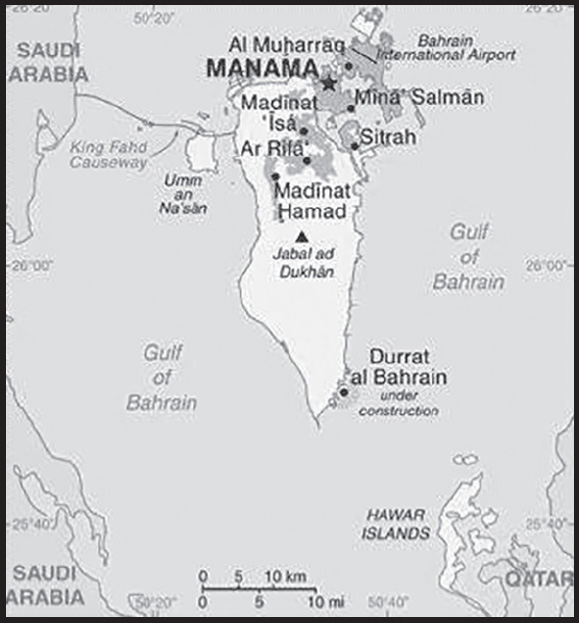
Location: Middle East, archipelago in the Persian Gulf, east of Saudi Arabia
Geographic coordinates: 26 00 N, 50 33 E
Map references: Middle East
Area: total: 760 sq km
land: 760 sq km
water: 0 sq km
comparison ranking: total 187
Area - comparative: 3.5 times the size of Washington, DC
Land boundaries: total: 0 km
Coastline: 161 km
Maritime claims: territorial sea: 12 nm
contiguous zone: 24 nm
continental shelf: extending to boundaries to be determined
Climate: arid; mild, pleasant winters; very hot, humid summers
Terrain: mostly low desert plain rising gently to low central escarpment
Elevation: highest point: Jabal ad Dukhan 135 m
lowest point: Persian Gulf 0 m
Natural resources: oil, associated and nonassociated natural gas, fish, pearls
Land use: agricultural land: 11.3% (2018 est.)
arable land: 2.1% (2018 est.)
permanent crops: 3.9% (2018 est.)
permanent pasture: 5.3% (2018 est.)
forest: 0.7% (2018 est.)
other: 88% (2018 est.)
Irrigated land: 40 sq km (2012)
Major aquifers: Arabian Aquifer System
Population distribution: smallest population of the Gulf States, but urbanization rate exceeds 90%; largest settlement concentration is found on the far northern end of the island in and around Manamah and Al Muharraq
Natural hazards: periodic droughts; dust storms
Geography - note: close to primary Middle Eastern petroleum sources; strategic location in Persian Gulf, through which much of the Western world’s petroleum must transit to reach open ocean
PEOPLE AND SOCIETY
Population: 1,553,886 (2023 est.)
note: immigrants make up approximately 45% of the total population, according to UN data (2019)
comparison ranking: 155
Nationality: noun: Bahraini(s)
adjective: Bahraini
Ethnic groups: Bahraini 47.4%, Asian 43.4%, other Arab 4.9%, African 1.4%, North American 1.1%, Gulf Co-operative countries 0.9%, European 0.8%, other 0.1% (2020 est.)
Languages: Arabic (official), English, Farsi, Urdu
major-language sample(s):

(Arabic)
Religions: Muslim 74.2%, other (includes Christian, Jewish, Hindu, Baha’i) 25.8% (2020 est.)
Age structure: 0-14 years: 18.14% (male 142,866/female 139,083)
15-64 years: 77.83% (male 759,539/female 449,848)
65 years and over: 4.03% (2023 est.) (male 32,162/female 30,388)
Dependency ratios: total dependency ratio: 31.3
youth dependency ratio: 26.8
elderly dependency ratio: 4.6
potential support ratio: 21.8 (2021 est.)
Median age: total: 32.9 years (2020)
male: 34.4 years
female: 30.3 years
comparison ranking: total 103
Population growth rate: 0.85% (2023 est.)
comparison ranking: 108
Birth rate: 12.3 births/1,000 population (2023 est.)
comparison ranking: 147
Death rate: 2.83 deaths/1,000 population (2023 est.)
comparison ranking: 226
Net migration rate: -0.99 migrant(s)/1,000 population (2023 est.)
comparison ranking: 147
Population distribution: smallest population of the Gulf States, but urbanization rate exceeds 90%; largest settlement concentration is found on the far northern end of the island in and around Manamah and Al Muharraq
Urbanization: urban population: 89.9% of total population (2023)
rate of urbanization: 1.99% annual rate of change (2020-25 est.)
Major urban areas - population: 709,000 MANAMA (capital) (2023)
Sex ratio: at birth: 1.03 male(s)/female
0-14 years: 1.03 male(s)/female
15-64 years: 1.69 male(s)/female
65 years and over: 1.06 male(s)/female
total population: 1.51 male(s)/female (2023 est.)
Maternal mortality ratio: 16 deaths/100,000 live births (2020 est.)
comparison ranking: 135
Infant mortality rate: total: 9.98 deaths/1,000 live births (2023 est.)
male: 11.65 deaths/1,000 live births
female: 8.26 deaths/1,000 live births
comparison ranking: total 136
Life expectancy at birth: total population: 80.13 years (2023 est.)
male: 77.87 years
female: 82.45 years
comparison ranking: total population 52
Total fertility rate: 1.66 children born/woman (2023 est.)
comparison ranking: 174
Gross reproduction rate: 0.82 (2023 est.)
Drinking water source: improved: total: 100% of population
unimproved: total: 0% of population (2020 est.)
Current health expenditure: 4.2% of GDP (2020)
Physicians density: 0.93 physicians/1,000 population (2015)
Hospital bed density: 1.7 beds/1,000 population (2017)
Sanitation facility access: improved: total: 100% of population
unimproved: total: 0% of population (2020 est.)
Obesity - adult prevalence rate: 29.8% (2016)
comparison ranking: 25
Alcohol consumption per capita: total: 1.18 liters of pure alcohol (2019 est.)
beer: 0.4 liters of pure alcohol (2019 est.)
wine: 0.11 liters of pure alcohol (2019 est.)
spirits: 0.66 liters of pure alcohol (2019 est.)
other alcohols: 0.01 liters of pure alcohol (2019 est.)
comparison ranking: total 148
Tobacco use: total: 14.9% (2020 est.)
male: 25.3% (2020 est.)
female: 4.5% (2020 est.)
comparison ranking: total 104
Currently married women (ages 15-49): 43.8% (2023 est.)
Education expenditures: 2.2% of GDP (2020 est.)
comparison ranking: 183
Literacy: definition: age 15 and over can read and write
total population: 97.5%
male: 99.9%
female: 94.9% (2018)
School life expectancy (primary to tertiary education): total: 16 years
male: 16 years
female: 17 years (2019)
Youth unemployment rate (ages 15-24): total: 9.9% (2021 est.)
male: 6.1%
female: 20.5%
comparison ranking: total 154
ENVIRONMENT
Environment - current issues: desertification resulting from the degradation of limited arable land, periods of drought, and dust storms; coastal degradation (damage to coastlines, coral reefs, and sea vegetation) resulting from oil spills and other discharges from large tankers, oil refineries, and distribution stations; lack of freshwater resources (groundwater and seawater are the only sources for all water needs); lowered water table leaves aquifers vulnerable to saline contamination; desalinization provides some 90% of the country’s freshwater
Environment - international agreements: party to: Biodiversity, Climate Change, Climate Change-Kyoto Protocol, Climate Change-Paris Agreement, Comprehensive Nuclear Test Ban, Desertification, Endangered Species, Hazardous Wastes, Law of the Sea, Ozone Layer Protection, Ship Pollution, Wetlands
signed, but not ratified: none of the selected agreements
Climate: arid; mild, pleasant winters; very hot, humid summers
Land use: agricultural land: 11.3% (2018 est.)
arable land: 2.1% (2018 est.)
permanent crops: 3.9% (2018 est.)
permanent pasture: 5.3% (2018 est.)
forest: 0.7% (2018 est.)
other: 88% (2018 est.)
Urbanization: urban population: 89.9% of total population (2023)
rate of urbanization: 1.99% annual rate of change (2020-25 est.)
Revenue from forest resources: 0% of GDP (2018 est.)
comparison ranking: 160
Revenue from coal: 0% of GDP (2018 est.)
comparison ranking: 69
Air pollutants: particulate matter emissions: 51.82 micrograms per cubic meter (2019 est.)
carbon dioxide emissions: 31.69 megatons (2016 est.)
methane emissions: 15.47 megatons (2020 est.)
Waste and recycling: municipal solid waste generated annually: 951,943 tons (2016 est.)
municipal solid waste recycled annually: 76,155 tons (2012 est.)
percent of municipal solid waste recycled: 8% (2012 est.)
Major aquifers: Arabian Aquifer System
Total water withdrawal: municipal: 280 million cubic meters (2020 est.)
industrial: 10 million cubic meters (2020 est.)
agricultural: 140 million cubic meters (2020 est.)
Total renewable water resources: 120 million cubic meters (2020 est.)
GOVERNMENT
Country name: conventional long form: Kingdom of Bahrain
conventional short form: Bahrain
local long form: Mamlakat al Bahrayn
local short form: Al Bahrayn
former: Dilmun, Tylos, Awal, Mishmahig, Bahrayn, State of Bahrain
etymology: the name means “the two seas” in Arabic and refers to the water bodies surrounding the archipelago
Government type: constitutional monarchy
Capital: name: Manama
geographic coordinates: 26 14 N, 50 34 E
time difference: UTC+3 (8 hours ahead of Washington, DC, during Standard Time)
etymology: name derives from the Arabic “al-manama” meaning “place of rest” or “place of dreams”
Administrative divisions: 4 governorates (muhafazat, singular - muhafazah); Asimah (Capital), Janubiyah (Southern), Muharraq, Shamaliyah (Northern)
note: each governorate administered by an appointed governor
Independence: 15 August 1971 (from the UK)
National holiday: National Day, 16 December (1971); note - 15 August 1971 was the date of independence from the UK, 16 December 1971 was the date of independence from British protection
Constitution: history: adopted 14 February 2002
amendments: proposed by the king or by at least 15 members of either chamber of the National Assembly followed by submission to an Assembly committee for review and, if approved, submitted to the government for restatement as drafts; passage requires a two-thirds majority vote by the membership of both chambers and validation by the king; constitutional articles on the state religion (Islam), state language (Arabic), and the monarchy and “inherited rule” cannot be amended; amended 2012, 2017
Legal system: mixed legal system of Islamic (sharia) law, English common law, Egyptian civil, criminal, and commercial codes; customary law
International law organization participation: has not submitted an ICJ jurisdiction declaration; non-party state to the ICCt
Citizenship: citizenship by birth: no
citizenship by descent only: the father must be a citizen of Bahrain
dual citizenship recognized: no
residency requirement for naturalization: 25 years; 15 years for Arab nationals
Suffrage: 20 years of age; universal
Executive branch: chief of state: King HAMAD bin Isa Al-Khalifa (since 6 March 1999); Crown Prince SALMAN bin Hamad Al-Khalifa (born 21 October 1969)
head of government: Prime Minister Crown Prince SALMAN bin Hamad Al-Khalifa (since 11 November 2020); Deputy Prime Minister and Minister for Infrastructure KHALID bin Abdallah Al Khalifa (since 13 June 2022)
cabinet: Cabinet appointed by the monarch
elections/appointments: the monarchy is hereditary; prime minister appointed by the monarch
Legislative branch: description: bicameral National Assembly consists of:
Consultative Council or Majlis al-Shura (40 seats; members appointed by the king)
Council of Representatives or Majlis al-Nuwab (40 seats; members directly elected in single-seat constituencies by absolute majority vote in 2 rounds if needed; members serve 4-year renewable terms)
elections:
Consultative Council - last appointments on 30 November 2022 (next appointments in 2026)
Council of Representatives - first round for 6 members held on 12 November 2022; second round for remaining 34 members held on 19 November 2022 (next to be held in November 2026)
election results:
Consultative Council - all members appointed; composition as of August 2023 - men 30, women 10, percent of women 25%
Council of Representatives - percent of vote by society - NA; seats by society - NA; composition as of August 2023 - men 32, women 8, percent of women 20%; note - total National Assembly percent of women 23%
Judicial branch: highest court(s): Court of Cassation (consists of the chairman and 3 judges); Supreme Court of Appeal (consists of the chairman and 3 judges); Constitutional Court (consists of the president and 6 members); High Sharia Court of Appeal (court sittings include the president and at least one judge)
judge selection and term of office: Court of Cassation judges appointed by royal decree and serve for a specified tenure; Constitutional Court president and members appointed by the Higher Judicial Council, a body chaired by the monarch and includes judges from the Court of Cassation, sharia law courts, and Civil High Courts of Appeal; members serve 9-year terms; High Sharia Court of Appeal member appointments by royal decree for a specified tenure
subordinate courts: Civil High Courts of Appeal; middle and lower civil courts; High Sharia Court of Appeal; Senior Sharia Court; Administrative Courts of Appeal; military courts
note: the judiciary of Bahrain is divided into civil law courts and sharia law courts; sharia courts (involving personal status and family law) are further divided into Sunni Muslim and Shia Muslim; the Courts are supervised by the Supreme Judicial Council.
Political parties and leaders: note: political parties are prohibited, but political societies were legalized under a July 2005 law
International organization participation: ABEDA, AFESD, AMF, CAEU, CICA, FAO, G-77, GCC, IAEA, IBRD, ICAO, ICC (national committees), ICRM, IDA, IDB, IFC, IFRCS, IHO, ILO, IMF, IMO, IMSO, Interpol, IOC, IOM (observer), IPU, ISO, ITSO, ITU, ITUC (NGOs), LAS, MIGA, NAM, OAPEC, OIC, OPCW, PCA, UN, UNCTAD, UNESCO, UNIDO, UNOOSA, UNWTO, UPU, WCO, WFTU (NGOs), WHO, WIPO, WMO, WTO
Diplomatic representation in the US: chief of mission: Ambassador Abdulla bin Rashed AL KHALIFA (since 21 July 2017)
chancery: 3502 International Drive NW, Washington, DC 20008
telephone: [1] (202) 342-1111
FAX: [1] (202) 362-2192
email address and website:
ambsecretary@bahrainembassy.org
https://www.mofa.gov.bh/Default.aspx?language=en-US&tabid=7702
consulate(s) general: New York
Diplomatic representation from the US: chief of mission: Ambassador Steven C. BONDY (since 9 February 2022)
embassy: Building 979, Road 3119 (next to Al-Ahli Sports Club), Block 331, Zinj District, P.O. Box 26431, Manama
mailing address: 6210 Manama Place, Washington DC 20521-6210
telephone: [973] 17-242700
FAX: [973] 17-272594
email address and website:
Flag description: red, the traditional color for flags of Persian Gulf states, with a white serrated band (five white points) on the hoist side; the five points represent the five pillars of Islam
note: until 2002, the flag had eight white points, but this was reduced to five to avoid confusion with the Qatari flag
National symbol(s): a red field surmounted by a white serrated band with five white points; national colors: red, white
National anthem: name: “Bahrainona” (Our Bahrain)
lyrics/music: unknown
note: adopted 1971; although Mohamed Sudqi AYYASH wrote the original lyrics, they were changed in 2002 following the transformation of Bahrain from an emirate to a kingdom
National heritage: total World Heritage Sites: 3 (all cultural)
selected World Heritage Site locales: Dilmun Burial Mounds; Qal’at al-Bahrain – Ancient Harbor and Capital of Dilmun; Bahrain Pearling Path
ECONOMY
Economic overview: growing, economically diverse Middle Eastern island economy; major recovery and balancing efforts to fulfill Economic Vision 2030; regional finance hub; increasing openness; high youth unemployment; water scarcity amid reservoir depletion
Real GDP (purchasing power parity): $72.267 billion (2021 est.)
$70.694 billion (2020 est.)
$74.364 billion (2019 est.)
note: data are in 2017 dollars
comparison ranking: 102
Real GDP growth rate: 2.23% (2021 est.)
-4.94% (2020 est.)
2.17% (2019 est.)
comparison ranking: 160
Real GDP per capita: $49,400 (2021 est.)
$47,800 (2020 est.)
$49,800 (2019 est.)
note: data are in 2017 dollars
comparison ranking: 32
GDP (official exchange rate): $38.472 billion (2019 est.)
Inflation rate (consumer prices): -0.61% (2021 est.)
-2.32% (2020 est.)
1.01% (2019 est.)
comparison ranking: 222
Credit ratings: Fitch rating: B+ (2020)
Moody’s rating: B2 (2018)
Standard & Poors rating: B+ (2017)
note: The year refers to the year in which the current credit rating was first obtained.
GDP - composition, by sector of origin: agriculture: 0.3% (2017 est.)
industry: 39.3% (2017 est.)
services: 60.4% (2017 est.)
comparison rankings: services 122; industry 33; agriculture 216
GDP - composition, by end use: household consumption: 45.8% (2017 est.)
government consumption: 15.5% (2017 est.)
investment in fixed capital: 26.1% (2017 est.)
investment in inventories: 0.4% (2017 est.)
exports of goods and services: 80.2% (2017 est.)
imports of goods and services: -67.9% (2017 est.)
Agricultural products: mutton, dates, milk, poultry, tomatoes, fruit, sheep offals, sheep skins, eggs, pumpkins
Industries: petroleum processing and refining, aluminum smelting, iron pelletization, fertilizers, Islamic and offshore banking, insurance, ship repairing, tourism
Industrial production growth rate: 0.4% (2021 est.)
comparison ranking: 155
Labor force: 819,100 (2021 est.)
note: excludes unemployed; 44% of the population in the 15-64 age group is non-national
comparison ranking: 151
Labor force - by occupation: agriculture: 1%
industry: 32%
services: 67% (2004 est.)
Unemployment rate: 1.87% (2021 est.)
1.78% (2020 est.)
1.2% (2019 est.)
note: official estimate; actual rate is higher
comparison ranking: 215
Youth unemployment rate (ages 15-24): total: 9.9% (2021 est.)
male: 6.1%
female: 20.5%
comparison ranking: total 154
Average household expenditures: on food: 13.2% of household expenditures (2018 est.)
on alcohol and tobacco: 0.4% of household expenditures (2018 est.)
Budget: revenues: $9.168 billion (2019 est.)
expenditures: $12.63 billion (2019 est.)
Budget surplus (+) or deficit (-): -10.1% (of GDP) (2017 est.)
comparison ranking: 212
Public debt: 88.5% of GDP (2017 est.)
81.4% of GDP (2016 est.)
comparison ranking: 33
Taxes and other revenues: 16.6% (of GDP) (2017 est.)
comparison ranking: 126
Fiscal year: calendar year
Current account balance: -$2.435 billion (2018 est.)
-$1.6 billion (2017 est.)
-$1.493 billion (2016 est.)
comparison ranking: 164
Exports: $35.235 billion (2021 est.)
$30.097 billion (2018 est.)
$26.732 billion (2017 est.)
note: Data are in current year dollars and do not include illicit exports or re-exports.
comparison ranking: 71
Exports - partners: United Arab Emirates 17%, Saudi Arabia 16%, United States 7%, Japan 7%, India 4% (2021)
Exports - commodities: refined petroleum, aluminum, iron ore and reductions, aluminum wiring, crude petroleum (2021)
Imports: $27.577 billion (2021 est.)
$27.187 billion (2018 est.)
$23.876 billion (2017 est.)
note: data are in current year dollars
comparison ranking: 77
Imports - partners: United Arab Emirates 24%, Saudi Arabia 15%, Brazil 12%, China 9%, India 6% (2021)
Imports - commodities: iron ore, jewelry, cars, floating platforms, refined petroleum, gold, broadcasting equipment (2021)
Reserves of foreign exchange and gold: $4.993 billion (31 December 2021 est.)
$2.523 billion (31 December 2020 est.)
$3.903 billion (31 December 2019 est.)
comparison ranking: 102
Debt - external: $52.15 billion (31 December 2017 est.)
$42.55 billion (31 December 2016 est.)
comparison ranking: 66
Exchange rates: Bahraini dinars (BHD) per US dollar -
Exchange rates: 0.376 (2021 est.)
0.376 (2020 est.)
0.376 (2019 est.)
0.376 (2018 est.)
0.376 (2017 est.)
ENERGY
Electricity access: electrification - total population: 100% (2021)
Electricity: installed generating capacity: 6.982 million kW (2020 est.)
consumption: 31,038,250,000 kWh (2019 est.)
exports: 447 million kWh (2019 est.)
imports: 652 million kWh (2019 est.)
transmission/distribution losses: 611 million kWh (2019 est.)
comparison rankings: installed generating capacity 79; transmission/distribution losses 125; imports 80; exports 76; consumption 62
Electricity generation sources: fossil fuels: 100% of total installed capacity (2020 est.)
Petroleum: total petroleum production: 185,300 bbl/day (2021 est.)
refined petroleum consumption: 73,200 bbl/day (2019 est.)
crude oil and lease condensate exports: 0 bbl/day (2018 est.)
crude oil and lease condensate imports: 228,800 bbl/day (2018 est.)
crude oil estimated reserves: 186.5 million barrels (2021 est.)
Refined petroleum products - production: 274,500 bbl/day (2015 est.)
comparison ranking: 45
Refined petroleum products - exports: 245,300 bbl/day (2015 est.)
comparison ranking: 30
Refined petroleum products - imports: 14,530 bbl/day (2015 est.)
comparison ranking: 136
Natural gas: production: 18,271,840,000 cubic meters (2019 est.)
consumption: 18,251,140,000 cubic meters (2019 est.)
exports: 0 cubic meters (2021 est.)
imports: 0 cubic meters (2021 est.)
proven reserves: 81.382 billion cubic meters (2021 est.)
Carbon dioxide emissions: 43.112 million metric tonnes of CO2 (2019 est.)
from coal and metallurgical coke: 0 metric tonnes of CO2 (2019 est.)
from petroleum and other liquids: 7.308 million metric tonnes of CO2 (2019 est.)
from consumed natural gas: 35.804 million metric tonnes of CO2 (2019 est.)
comparison ranking: total emissions 61
Energy consumption per capita: 547.976 million Btu/person (2019 est.)
comparison ranking: 3
COMMUNICATIONS
Telephones - fixed lines: total subscriptions: 266,741 (2021 est.)
subscriptions per 100 inhabitants: 18 (2021 est.)
comparison ranking: total subscriptions 114
Telephones - mobile cellular: total subscriptions: 1,923,443 (2021 est.)
subscriptions per 100 inhabitants: 131 (2021 est.)
comparison ranking: total subscriptions 153
Telecommunication systems: general assessment: Bahrain continues to develop its telecoms sector in a bid to develop its long-term Economic Vision 2030 strategy; this is a multi-faceted strategy aimed at developing a digital transformation across numerous sectors, including e-government, e-health, e-commerce, and e-banking; 5G services have become widely available since they were launched in 2020; Bahrain’s telecom sector by the Fourth National Telecommunications Plan (initiated in 2016) which focuses on fiber optic infrastructure deployment and establishing affordable prices for high-speed access (2022)
domestic: approximately 18 per 100 fixed-line and 131 per 100 mobile-cellular; modern fiber-optic integrated services; digital network with rapidly expanding mobile-cellular telephones (2021)
international: country code - 973; Bahrain’s Telecommunications Regulatory Authority (TRA) has made part of the C-band spectrum available for 5G private networks, in line with the goals outlined in its Workplan for the 2022-23 period (2023)
Broadcast media: state-run Bahrain Radio and Television Corporation (BRTC) operates 5 terrestrial TV networks and several radio stations; satellite TV systems provide access to international broadcasts; 1 private FM station directs broadcasts to Indian listeners; radio and TV broadcasts from countries in the region are available (2019)
Internet country code: .bh
Internet users: total: 1.5 million (2021 est.)
percent of population: 100% (2021 est.)
comparison ranking: total 144
Broadband - fixed subscriptions: total: 148,928 (2020 est.)
subscriptions per 100 inhabitants: 9 (2020 est.)
comparison ranking: total 123
TRANSPORTATION
National air transport system: number of registered air carriers: 6 (2020)
inventory of registered aircraft operated by air carriers: 42
annual passenger traffic on registered air carriers: 5,877,003 (2018)
annual freight traffic on registered air carriers: 420.98 million (2018) mt-km
Civil aircraft registration country code prefix: A9C
Airports: 4 (2021)
comparison ranking: total 184
Airports - with paved runways: 4
note: paved runways have a concrete or asphalt surface but not all have facilities for refueling, maintenance, or air traffic control; the length of a runway required for aircraft to safely operate depends on a number of factors including the type of aircraft, the takeoff weight (including passengers, cargo, and fuel), engine types, flap settings, landing speed, elevation of the airport, and average maximum daily air temperature; paved runways can reach a length of 5,000 m (16,000 ft.), but the “typical” length of a commercial airline runway is between 2,500-4,000 m (8,000-13,000 ft.)
Heliports: 1 (2021)
Pipelines: 20 km gas, 54 km oil (2013)
Roadways: total: 4,122 km (2010)
paved: 3,392 km (2010)
unpaved:730 km (2010)
comparison ranking: total 152
Merchant marine: total: 190 (2022)
by type: general cargo 11, oil tanker 3, other 176
comparison ranking: total 68
Ports and terminals: major seaport(s): Mina’ Salman, Sitrah
MILITARY AND SECURITY
Military and security forces: Bahrain Defense Force (BDF): Royal Bahraini Army (includes the Royal Guard), Royal Bahraini Navy, Royal Bahraini Air Force Ministry of Interior: National Guard, Special Security Forces Command (SSFC), Coast Guard (2023)
note 1: the Royal Guard is officially under the command of the Army, but exercises considerable autonomy
note 2: the Ministry of Interior is responsible for internal security and oversees police and specialized security units responsible for maintaining internal order; the National Guard’s primary mission is to guard critical infrastructure such as the airport and oil fields and is a back-up to the police; the Guard is under the Ministry of Interior but reports directly to the king
Military expenditures: 3.2% of GDP (2022 est.)
3.6% of GDP (2021 est.)
4.2% of GDP (2020 est.)
4% of GDP (2019 est.)
4% of GDP (2018 est.)
comparison ranking: 25
Military and security service personnel strengths: information varies; approximately 10,000 active personnel (7,500 Army; 1,000 Navy; 1,500 Air Force); approximately 3,000 National Guard (2023)
Military equipment inventories and acquisitions: the military’s inventory consists of a mix of equipment acquired from a wide variety of suppliers; in recent years, the US has been the leading supplier of arms to Bahrain (2023)
Military service age and obligation: 18 years of age for voluntary military service; 15 years of age for non-commissioned officers, technicians, and cadets; no conscription (2022)
note: the BDF hires foreign nationals, Sunni Muslims primarily from Arabic countries and Pakistan, to serve under contract; as of 2020, foreigners were estimated to comprise as much as 80% of the military; the policy has become a controversial issue with the primarily Shia population; during the 2011, the BDF reportedly deployed mostly foreign personnel against protesters
Military - note: the BDF is a small, but well-equipped military focused on territorial defense and support to internal security; its primary concern is Iran, both the conventional military threat and its support to regional terrorist groups; the BDF participates in multinational exercises and has conducted small deployments outside of the country; in 2015, for example, Bahrain joined the Saudi Arabia-led military intervention in Yemen, supplying a few hundred troops and combat aircraft; the Army’s primary combat units are an armored brigade and a mechanized brigade, plus battalions of royal guards and special forces; in a conflict, the Army would be supported by the paramilitary National Guard; the Navy’s principal warships are a US-provided secondhand frigate, 2 corvettes acquired from Germany, and a secondhand British offshore patrol vessel; the Air Force has small numbers of US-made combat aircraft and attack helicopters
Bahrain’s closest security partners are the US and Saudi Arabia; it hosts the US Naval Forces Central Command (USNAVCENT; established 1983), which includes the US 5th Fleet, several subordinate naval task forces, and the Combined Maritime Forces (established 2002), a coalition of more than 30 nations providing maritime security for regional shipping lanes; in 2003, the US granted Bahrain Major Non-NATO Ally status, a designation under US law that provides foreign partners with certain benefits in the areas of defense trade and security cooperation; Bahraini leaders have said that the security of Bahrain and Saudi Arabia are “indivisible”; Saudi Arabia sent forces to Bahrain to assist with internal security following the 2011 uprising; Bahrain also has close security ties to other Gulf Cooperation Council countries, particularly Kuwait and the United Arab Emirates, as well as the UK (2023)
SPACE
Space agency/agencies: Bahrain National Space Science Agency (NSSA; established 2014) (2023)
Space program overview: space program in nascent stages and is focused on developing the capabilities to build and operate satellites; the NSSA’s mission includes promoting space science, technology, and research, building capacity in the fields of satellite manufacturing, tracking, control, data processing and analysis, and remote sensing, developing space-related programs and space policy, and facilitating international cooperation; cooperates with a variety of foreign agencies and commercial entities, including those of India, Italy, Japan, Saudi Arabia, the UK, and the UAE; also a member of the Arab Space Coordination Group, established by the UAE in 2019 (2023)
note: further details about the key activities, programs, and milestones of the country’s space program, as well as government spending estimates on the space sector, appear in Appendix S
TERRORISM
Terrorist group(s): Terrorist group(s): al-Ashtar Brigades; Islamic Revolutionary Guard Corps/Qods Force
note 1: details about the history, aims, leadership, organization, areas of operation, tactics, targets, weapons, size, and sources of support of the group(s) appear(s) in Appendix-T
note 2: in addition to the al-Ashtar Brigades and the IRGC/Qods Force, Saraya al-Mukhtar (aka The Mukhtar Brigade) is an Iran-backed terrorist organization based in Bahrain, reportedly receiving financial and logistic support from the IRGC; Saraya al-Mukhtar’s self-described goal is to depose the Bahraini Government with the intention of paving the way for Iran to exert greater influence in Bahrain; the group was designated by the US as a Specially Designated Global Terrorist in Dec 2020
TRANSNATIONAL ISSUES
Disputes - international: none identified
INTRODUCTION
Background: The huge delta region formed at the confluence of the Ganges and Brahmaputra River systems - now referred to as Bangladesh - was a loosely incorporated outpost of various empires centered on the Gangetic plain for much of the first millennium A.D. Muslim conversions and settlement in the region began in the 10th century, primarily from Arab and Persian traders and preachers. Europeans established trading posts in the area in the 16th century. Eventually the area known as Bengal, primarily Hindu in the western section and mostly Muslim in the eastern half, became part of British India. Partition in 1947 resulted in an eastern wing of Pakistan in the Muslim-majority area, which became East Pakistan. Calls for greater autonomy and animosity between the eastern and western wings of Pakistan led to a Bengali independence movement. That movement, led by the Awami League (AL) and supported by India, won the independence war for Bangladesh in 1971.
The post-independence AL government faced daunting challenges and in 1975 it was overthrown by the military, triggering a series of military coups that resulted in a military-backed government and subsequent creation of the Bangladesh Nationalist Party (BNP) in 1978. That government also ended in a coup in 1981, followed by military-backed rule until democratic elections occurred in 1991. The BNP and AL have alternated in power since 1991, with the exception of a military-backed, emergency caretaker regime that suspended parliamentary elections planned for January 2007 in an effort to reform the political system and root out corruption. That government returned the country to fully democratic rule in December 2008 with the election of the AL and Prime Minister Sheikh HASINA. In January 2014, the incumbent AL won the national election by an overwhelming majority after the BNP boycotted the election, which extended HASINA’s term as prime minister. In December 2018, HASINA secured a third consecutive term (fourth overall) with the AL coalition securing 96% of available seats, amid widespread claims of election irregularities. With the help of international development assistance, Bangladesh has reduced the poverty rate from over half of the population to less than a third, achieved Millennium Development Goals for maternal and child health, and made great progress in food security since independence. The economy has grown at an annual average of about 6% for the last two decades. In 2021 the UN approved a resolution to allow Bangladesh to officially graduate from least-developed-country (LDC) status in 2026, based on World Bank criteria.
GEOGRAPHY
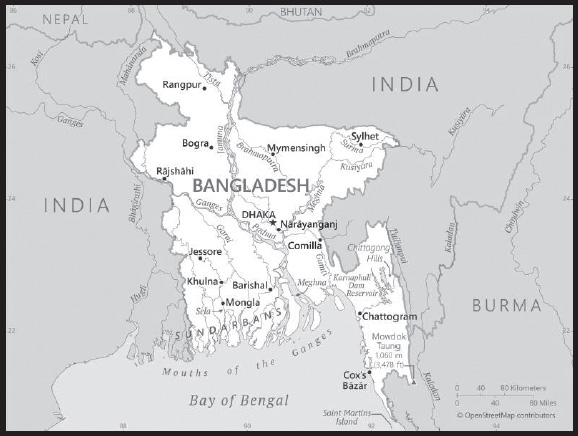
Location: Southern Asia, bordering the Bay of Bengal, between Burma and India
Geographic coordinates: 24 00 N, 90 00 E
Map references: Asia
Area: total: 148,460 sq km
land: 130,170 sq km
water: 18,290 sq km
comparison ranking: total 94
Area - comparative: slightly larger than Pennsylvania and New Jersey combined; slightly smaller than Iowa
Land boundaries: total: 4,413 km
border countries (2): Burma 271 km; India 4,142 km
Coastline: 580 km
Maritime claims: territorial sea: 12 nm
contiguous zone: 18 nm
exclusive economic zone: 200 nm
continental shelf: to the outer limits of the continental margin
Climate: tropical; mild winter (October to March); hot, humid summer (March to June); humid, warm rainy monsoon (June to October)
Terrain: mostly flat alluvial plain; hilly in southeast
Elevation: highest point: Mowdok Taung 1,060 m
lowest point: Indian Ocean 0 m
mean elevation: 85 m
Natural resources: natural gas, arable land, timber, coal
Land use: agricultural land: 70.1% (2018 est.)
arable land: 59% (2018 est.)
permanent crops: 6.5% (2018 est.)
permanent pasture: 4.6% (2018 est.)
forest: 11.1% (2018 est.)
other: 18.8% (2018 est.)
Irrigated land: 81,270 sq km (2020)
Major rivers (by length in km): Brahmaputra river mouth (shared with China [s] and India) - 3,969 km; Ganges river mouth (shared with India [s]) - 2,704 km
note – [s] after country name indicates river source; [m] after country name indicates river mouth
Major watersheds (area sq km): Indian Ocean drainage: Brahmaputra (651,335 sq km), Ganges (1,016,124 sq km)
Major aquifers: Indus-Ganges-Brahmaputra Basin
Natural hazards: droughts; cyclones; much of the country routinely inundated during the summer monsoon season
Geography - note: most of the country is situated on deltas of large rivers flowing from the Himalayas: the Ganges unites with the Jamuna (main channel of the Brahmaputra) and later joins the Meghna to eventually empty into the Bay of Bengal
PEOPLE AND SOCIETY
Population: 167,184,465 (2023 est.)
comparison ranking: 8
Nationality: noun: Bangladeshi(s)
adjective: Bangladeshi
Ethnic groups: Bengali at least 98.9%, other indigenous ethnic groups 1.1% (2011 est.)
note: Bangladesh’s government recognizes 27 indigenous ethnic groups under the 2010 Cultural Institution for Small Anthropological Groups Act; other sources estimate there are about 75 ethnic groups; critics of the 2011 census claim that it underestimates the size of Bangladesh’s ethnic population
Languages: Bangla 98.8% (official, also known as Bengali), other 1.2% (2011 est.)
major-language sample(s):

(Bangla)
Religions: Muslim 88.4%, other 11.6% (2020 est.)
Age structure: 0-14 years: 25.38% (male 21,587,699/female 20,846,378)
15-64 years: 67.09% (male 54,560,958/female 57,599,478)
65 years and over: 7.53% (2023 est.) (male 5,871,022/female 6,718,930)
Dependency ratios: total dependency ratio: 47.7
youth dependency ratio: 39.1
elderly dependency ratio: 8.6
potential support ratio: 11.6 (2021 est.)
Median age: total: 27.9 years (2020)
male: 27.1 years
female: 28.6 years
comparison ranking: total 144
Population growth rate: 0.91% (2023 est.)
comparison ranking: 99
Birth rate: 17.5 births/1,000 population (2023 est.)
comparison ranking: 85
Death rate: 5.5 deaths/1,000 population (2023 est.)
comparison ranking: 182
Net migration rate: -2.88 migrant(s)/1,000 population (2023 est.)
comparison ranking: 180
Urbanization: urban population: 40.5% of total population (2023)
rate of urbanization: 2.88% annual rate of change (2020-25 est.)
Major urban areas - population: 23.210 million DHAKA (capital), 5.380 million Chittagong, 955,000 Khulna, 962,000 Rajshahi, 964,000 Sylhet, 906,000 Bogra (2023)
Sex ratio: at birth: 1.04 male(s)/female
0-14 years: 1.04 male(s)/female
15-64 years: 0.95 male(s)/female
65 years and over: 0.87 male(s)/female
total population: 0.96 male(s)/female (2023 est.)
Mother’s mean age at first birth: 18.6 years (2017/18 est.)
note: data represents median age at first birth among women 20-49
Maternal mortality ratio: 123 deaths/100,000 live births (2020 est.)
comparison ranking: 63
Infant mortality rate: total: 29.58 deaths/1,000 live births (2023 est.)
male: 32.12 deaths/1,000 live births
female: 26.93 deaths/1,000 live births
comparison ranking: total 52
Life expectancy at birth: total population: 74.96 years (2023 est.)
male: 72.8 years
female: 77.21 years
comparison ranking: total population 133
Total fertility rate: 2.08 children born/woman (2023 est.)
comparison ranking: 93
Gross reproduction rate: 1.02 (2023 est.)
Contraceptive prevalence rate: 62.7% (2019)
Drinking water source: improved: urban: 99% of population
rural: 98.7% of population
total: 98.9% of population
unimproved: urban: 1% of population
rural: 1.3% of population
total: 1.1% of population (2020 est.)
Current health expenditure: 2.6% of GDP (2020)
Physicians density: 0.67 physicians/1,000 population (2020)
Hospital bed density: 0.8 beds/1,000 population (2016)
Sanitation facility access: improved: urban: 85.3% of population
rural: 73.5% of population
total: 78% of population
unimproved: urban: 14.7% of population
rural: 26.5% of population
total: 22% of population (2020 est.)
Major infectious diseases: degree of risk: high (2023)
food or waterborne diseases: bacterial and protozoal diarrhea, hepatitis A and E, and typhoid fever
vectorborne diseases: dengue fever and malaria are high risks in some locations
water contact diseases: leptospirosis
animal contact diseases: rabies
Obesity - adult prevalence rate: 3.6% (2016)
comparison ranking: 191
Alcohol consumption per capita: total: 0 liters of pure alcohol (2019 est.)
comparison ranking: total 187
Tobacco use: total: 34.7% (2020 est.)
male: 52.2% (2020 est.)
female: 17.1% (2020 est.)
comparison ranking: total 17
Children under the age of 5 years underweight: 22.6% (2019)
comparison ranking: 10
Currently married women (ages 15-49): 80.1% (2023 est.)
Child marriage: women married by age 15: 15.5%
women married by age 18: 51.4% (2019 est.)
Education expenditures: 2.1% of GDP (2021 est.)
comparison ranking: 186
Literacy: definition: age 15 and over can read and write
total population: 74.9%
male: 77.8%
female: 72% (2020)
School life expectancy (primary to tertiary education): total: 12 years
male: 12 years
female: 13 years (2020)
Youth unemployment rate (ages 15-24): total: 14.7% (2021 est.)
male: 12.5%
female: 19.6%
comparison ranking: total 119
ENVIRONMENT
Environment - current issues: many people are landless and forced to live on and cultivate flood-prone land; waterborne diseases prevalent in surface water; water pollution, especially of fishing areas, results from the use of commercial pesticides; ground water contaminated by naturally occurring arsenic; intermittent water shortages because of falling water tables in the northern and central parts of the country; soil degradation and erosion; deforestation; destruction of wetlands; severe overpopulation with noise pollution
Environment - international agreements: party to: Biodiversity, Climate Change, Climate Change-Kyoto Protocol, Climate Change-Paris Agreement, Comprehensive Nuclear Test Ban, Desertification, Endangered Species, Environmental Modification, Hazardous Wastes, Law of the Sea, Nuclear Test Ban, Ozone Layer Protection, Ship Pollution, Wetlands
signed, but not ratified: none of the selected agreements
Climate: tropical; mild winter (October to March); hot, humid summer (March to June); humid, warm rainy monsoon (June to October)
Land use: agricultural land: 70.1% (2018 est.)
arable land: 59% (2018 est.)
permanent crops: 6.5% (2018 est.)
permanent pasture: 4.6% (2018 est.)
forest: 11.1% (2018 est.)
other: 18.8% (2018 est.)
Urbanization: urban population: 40.5% of total population (2023)
rate of urbanization: 2.88% annual rate of change (2020-25 est.)
Food insecurity: severe localized food insecurity: due to economic constraints and high prices of important food items - food insecurity is expected to remain fragile, given persisting economic constraints; domestic prices of wheat flour and palm oil, important food items, were at high levels in January 2023; the result of elevated international prices of energy, fuel and food, having been transmitted to the domestic markets (2023)
Revenue from forest resources: 0.08% of GDP (2018 est.)
comparison ranking: 120
Revenue from coal: 0.02% of GDP (2018 est.)
comparison ranking: 43
Air pollutants: particulate matter emissions: 45.99 micrograms per cubic meter (2019 est.)
carbon dioxide emissions: 84.25 megatons (2016 est.)
methane emissions: 59.3 megatons (2020 est.)
Waste and recycling: municipal solid waste generated annually: 14,778,497 tons (2012 est.)
Major rivers (by length in km): Brahmaputra river mouth (shared with China [s] and India) - 3,969 km; Ganges river mouth (shared with India [s]) - 2,704 km
note – [s] after country name indicates river source; [m] after country name indicates river mouth
Major watersheds (area sq km): Indian Ocean drainage: Brahmaputra (651,335 sq km), Ganges (1,016,124 sq km)
Major aquifers: Indus-Ganges-Brahmaputra Basin
Total water withdrawal: municipal: 3.6 billion cubic meters (2020 est.)
industrial: 770 million cubic meters (2020 est.)
agricultural: 31.5 billion cubic meters (2020 est.)
Total renewable water resources: 1.23 trillion cubic meters (2020 est.)
GOVERNMENT
Country name: conventional long form: People’s Republic of Bangladesh
conventional short form: Bangladesh
local long form: Gana Prajatantri Bangladesh
local short form: Bangladesh
former: East Bengal, East Pakistan
etymology: the name - a compound of the Bengali words “Bangla” (Bengal) and “desh” (country) - means “Country of Bengal”
Government type: parliamentary republic
Capital: name: Dhaka
geographic coordinates: 23 43 N, 90 24 E
time difference: UTC+6 (11 hours ahead of Washington, DC, during Standard Time)
etymology: the origins of the name are unclear, but some sources state that the city’s site was originally called “dhakka,” meaning “watchtower,” and that the area served as a watch-station for Bengal rulers
Administrative divisions: 8 divisions; Barishal, Chattogram, Dhaka, Khulna, Mymensingh, Rajshahi, Rangpur, Sylhet
Independence: 16 December 1971 (from Pakistan)
National holiday: Independence Day, 26 March (1971); Victory Day, 16 December (1971); note - 26 March 1971 is the date of the Awami League’s declaration of an independent Bangladesh, and 16 December (Victory Day) memorializes the military victory over Pakistan and the official creation of the state of Bangladesh
Constitution: history: previous 1935, 1956, 1962 (preindependence); latest enacted 4 November 1972, effective 16 December 1972, suspended March 1982, restored November 1986
amendments: proposed by the House of the Nation; approval requires at least two-thirds majority vote of the House membership and assent of the president of the republic; amended many times, last in 2018
Legal system: mixed legal system of mostly English common law and Islamic law
International law organization participation: has not submitted an ICJ jurisdiction declaration; accepts ICCt jurisdiction
Citizenship: citizenship by birth: no
citizenship by descent only: at least one parent must be a citizen of Bangladesh
dual citizenship recognized: yes, but limited to select countries
residency requirement for naturalization: 5 years
Suffrage: 18 years of age; universal
Executive branch: chief of state: President Mohammad Shahabuddin CHUPPI (since 24 April 2023)
head of government: Prime Minister Sheikh HASINA Wazed (since 6 January 2009)
cabinet: Cabinet selected by the prime minister, appointed by the president
elections/appointments: president indirectly elected by the National Parliament for a 5-year term (eligible for a second term); election last held on 13 February 2023 (next to be held by 2028); the president appoints as prime minister the majority party leader in the National Parliament
election results: President Abdul HAMID (AL) reelected by the National Parliament unopposed for a second term; Sheikh HASINA reappointed prime minister as leader of the majority AL party following parliamentary election in 2023
Legislative branch: description: unicameral House of the Nation or Jatiya Sangsad (350 seats; 300 members in single-seat territorial constituencies directly elected by simple majority vote; 50 members - reserved for women only - indirectly elected by the House of the Nation membership by proportional representation vote using single transferable vote method; all members serve 5-year terms)
elections: last held on 30 December 2018 (next to be held in January 2024)
election results: percent of vote by party - NA; seats by party as of February 2022 - AL 299, JP 27, BNP 7, other 10, independent 7; composition - men 277, women 73, percent of women 20.9%
Judicial branch: highest court(s): Supreme Court of Bangladesh (organized into the Appellate Division with 7 justices and the High Court Division with 99 justices)
judge selection and term of office: chief justice and justices appointed by the president; justices serve until retirement at age 67
subordinate courts: civil courts include: Assistant Judge’s Court; Joint District Judge’s Court; Additional District Judge’s Court; District Judge’s Court; criminal courts include: Court of Sessions; Court of Metropolitan Sessions; Metropolitan Magistrate Courts; Magistrate Court; special courts/tribunals
Political parties and leaders: Awami League or AL [Sheikh HASINA]
Bangladesh Jamaat-i-Islami or JIB [Shafiqur RAHMAN]
Bangladesh Nationalist Front or BNF [S. M. Abul Kalam AZAD]
Bangladesh Nationalist Party or BNP [Tarique RAHMAN, acting chairperson; Khaleda ZIA]
Bangladesh Tariqat Federation or BTF [Syed Nozibul Bashar MAIZBHANDARI]
Jatiya Party or JP (Ershad faction) [Rowshan ERSHAD]
Jatiya Party or JP (Manju faction) [Anwar Hossain MANJU]
Liberal Democratic Party or LDP [Oli AHMED]
National Socialist Party (Jatiya Samajtantrik Dal) or JSD [Hasanul Haque INU]
Workers Party or WP [Rashed Khan MENON]
International organization participation: ADB, ARF, BIMSTEC, C, CD, CICA (observer), CP, D-8, FAO, G-77, IAEA, IBRD, ICAO, ICC (national committees), ICRM, IDA, IDB, IFAD, IFC, IFRCS, IHO, ILO, IMF, IMO, IMSO, Interpol, IOC, IOM, IPU, ISO, ITSO, ITU, ITUC (NGOs), MIGA, MINURSO, MINUSMA, MONUSCO, NAM, OIC, OPCW, PCA, SAARC, SACEP, UN, UNAMID, UNCTAD, UNESCO, UNHCR, UNIDO, UNISFA, UNIFIL, UNMIL, UNMISS, UNOCI, UNWTO, UPU, WCO, WFTU (NGOs), WHO, WIPO, WMO, WTO
Diplomatic representation in the US: chief of mission: Ambassador Muhammad IMRAN (since 12 December 2022)
chancery: 3510 International Drive NW, Washington, DC 20008
telephone: [1] (202) 244-0183
FAX: [1] (202) 244-2771
email address and website:
mission.washington@mofa.gov.bd
consulate(s) general: Los Angeles, New York
Diplomatic representation from the US: chief of mission: Ambassador Peter HAAS (since 15 March 2022)
embassy: Madani Avenue, Baridhara, Dhaka - 1212
mailing address: 6120 Dhaka Place, Washington DC 20521-6120
telephone: [880] (2) 5566-2000
FAX: [880] (2) 5566-2907
email address and website:
Flag description: green field with a large red disk shifted slightly to the hoist side of center; the red disk represents the rising sun and the sacrifice to achieve independence; the green field symbolizes the lush vegetation of Bangladesh
National symbol(s): Bengal tiger, water lily; national colors: green, red
National anthem: name: “Amar Shonar Bangla” (My Golden Bengal)
lyrics/music: Rabindranath TAGORE
note: adopted 1971; Rabindranath TAGORE, a Nobel laureate, also wrote India’s national anthem
National heritage: total World Heritage Sites: 3 (2 cultural, 1 natural)
selected World Heritage Site locales: Bagerhat Historic Mosque (c); Ruins of the Buddhist Vihara at Paharpur (c); Sundarbans (n)
ECONOMY
Economic overview: one of the fastest growing economies; significant poverty reduction; COVID-19 adversely impacted female labor force participation and undermined previously stable financial conditions; looking to diversify beyond clothing industry; fairly low government debt; new taxation law struggling to increase government revenues
Real GDP (purchasing power parity): $1.001 trillion (2021 est.)
$936.113 billion (2020 est.)
$904.912 billion (2019 est.)
note: data are in 2017 dollars
comparison ranking: 27
Real GDP growth rate: 6.94% (2021 est.)
3.45% (2020 est.)
7.88% (2019 est.)
comparison ranking: 59
Real GDP per capita: $5,900 (2021 est.)
$5,600 (2020 est.)
$5,500 (2019 est.)
note: data are in 2017 dollars
comparison ranking: 166
GDP (official exchange rate): $329.545 billion (2020 est.)
Inflation rate (consumer prices): 5.55% (2021 est.)
5.69% (2020 est.)
5.59% (2019 est.)
comparison ranking: 59
Credit ratings: Fitch rating: BB- (2014)
Moody’s rating: Ba3 (2012)
Standard & Poors rating: BB- (2010)
note: The year refers to the year in which the current credit rating was first obtained.
GDP - composition, by sector of origin: agriculture: 14.2% (2017 est.)
industry: 29.3% (2017 est.)
services: 56.5% (2017 est.)
comparison rankings: services 148; industry 83; agriculture 68
GDP - composition, by end use: household consumption: 68.7% (2017 est.)
government consumption: 6% (2017 est.)
investment in fixed capital: 30.5% (2017 est.)
investment in inventories: 1% (2017 est.)
exports of goods and services: 15% (2017 est.)
imports of goods and services: -20.3% (2017 est.)
Agricultural products: rice, potatoes, maize, sugar cane, milk, vegetables, onions, jute, mangoes/guavas, wheat
Industries: jute, cotton, garments, paper, leather, fertilizer, iron and steel, cement, petroleum products, tobacco, pharmaceuticals, ceramics, tea, salt, sugar, edible oils, soap and detergent, fabricated metal products, electricity, natural gas
Industrial production growth rate: 10.29% (2021 est.)
comparison ranking: 27
Labor force: 70.961 million (2021 est.)
note: extensive migration of labor to Saudi Arabia, Kuwait, UAE, Oman, Qatar, and Malaysia
comparison ranking: 8
Labor force - by occupation: agriculture: 42.7%
industry: 20.5%
services: 36.9% (2016 est.)
Unemployment rate: 5.23% (2021 est.)
5.41% (2020 est.)
4.44% (2019 est.)
note: about 40% of the population is underemployed; many persons counted as employed work only a few hours a week and at low wages
comparison ranking: 143
Youth unemployment rate (ages 15-24): total: 14.7% (2021 est.)
male: 12.5%
female: 19.6%
comparison ranking: total 119
Population below poverty line: 24.3% (2016 est.)
Gini Index coefficient - distribution of family income: 32.4 (2016 est.)
comparison ranking: 132
Average household expenditures: on food: 53.5% of household expenditures (2018 est.)
on alcohol and tobacco: 1.9% of household expenditures (2018 est.)
Household income or consumption by percentage share: lowest 10%: 4%
highest 10%: 27% (2010 est.)
Budget: revenues: $30.023 billion (2019 est.)
expenditures: $46.379 billion (2019 est.)
Budget surplus (+) or deficit (-): -3.2% (of GDP) (2017 est.)
comparison ranking: 136
Public debt: 33.1% of GDP (2017 est.)
33.3% of GDP (2016 est.)
comparison ranking: 163
Taxes and other revenues: 7% (of GDP) (2020 est.)
comparison ranking: 214
Fiscal year: 1 July - 30 June
Current account balance: -$15.563 billion (2021 est.)
$1.193 billion (2020 est.)
-$2.949 billion (2019 est.)
comparison ranking: 201
Exports: $49.386 billion (2021 est.)
$38.476 billion (2020 est.)
$44.961 billion (2019 est.)
note: Data are in current year dollars and do not include illicit exports or re-exports.
comparison ranking: 65
Exports - partners: United States 15%, Germany 14%, United Kingdom 8%, Spain 7%, France 7% (2019)
Exports - commodities: clothing, knitwear, leather footwear (2021)
Imports: $85.303 billion (2021 est.) note: data are in current year dollars
$56.776 billion (2020 est.) note: data are in current year dollars
$64.234 billion (2019 est.) note: data are in current year dollars
comparison ranking: 49
Imports - partners: China 31%, India 15%, Singapore 5% (2019)
Imports - commodities: refined petroleum, cotton, natural gas, scrap iron, wheat (2019)
Reserves of foreign exchange and gold: $46.166 billion (31 December 2021 est.)
$43.172 billion (31 December 2020 est.)
$32.697 billion (31 December 2019 est.)
comparison ranking: 46
Debt - external: $50.26 billion (31 December 2017 est.)
$41.85 billion (31 December 2016 est.)
comparison ranking: 68
Exchange rates: taka (BDT) per US dollar -
Exchange rates: 85.084 (2021 est.)
84.871 (2020 est.)
84.454 (2019 est.)
83.466 (2018 est.)
80.438 (2017 est.)
ENERGY
Electricity access: population without electricity: 11 million (2020)
electrification - total population: 98.9% (2021)
electrification - urban areas: 99.7% (2021)
electrification - rural areas: 98.5% (2021)
Electricity: installed generating capacity: 18.461 million kW (2020 est.)
consumption: 76,849,877,000 kWh (2019 est.)
exports: 0 kWh (2019 est.)
imports: 6.786 billion kWh (2019 est.)
transmission/distribution losses: 9.537 billion kWh (2019 est.)
comparison rankings: installed generating capacity 51; transmission/distribution losses 35; imports 34; exports 201; consumption 39
Electricity generation sources: fossil fuels: 98.6% of total installed capacity (2020 est.)
solar: 0.6% of total installed capacity (2020 est.)
hydroelectricity: 0.8% of total installed capacity (2020 est.)
Nuclear energy: Number of operational nuclear reactors: 0
Number of nuclear reactors under construction: 2 (2023)
Net capacity of operational nuclear reactors: 0 GW
Percent of total electricity production: 0%
Percent of total energy produced: 0%
Number of nuclear reactors permanently shut down: 0
Coal: production: 1.016 million metric tons (2020 est.)
consumption: 9.345 million metric tons (2020 est.)
exports: 0 metric tons (2020 est.)
imports: 8.329 million metric tons (2020 est.)
proven reserves: 293 million metric tons (2019 est.)
Petroleum: total petroleum production: 13,500 bbl/day (2021 est.)
refined petroleum consumption: 122,500 bbl/day (2019 est.)
crude oil and lease condensate exports: 0 bbl/day (2018 est.)
crude oil and lease condensate imports: 21,600 bbl/day (2018 est.)
crude oil estimated reserves: 28 million barrels (2021 est.)
Refined petroleum products - production: 26,280 bbl/day (2015 est.)
comparison ranking: 86
Refined petroleum products - exports: 901 bbl/day (2015 est.)
comparison ranking: 108
Refined petroleum products - imports: 81,570 bbl/day (2015 est.)
comparison ranking: 63
Natural gas: production: 28,629,927,000 cubic meters (2019 est.)
consumption: 31,268,968,000 cubic meters (2019 est.)
exports: 0 cubic meters (2021 est.)
imports: 2,639,041,000 cubic meters (2019 est.)
proven reserves: 126.293 billion cubic meters (2021 est.)
Carbon dioxide emissions: 96.18 million metric tonnes of CO2 (2019 est.)
from coal and metallurgical coke: 16.538 million metric tonnes of CO2 (2019 est.)
from petroleum and other liquids: 18.535 million metric tonnes of CO2 (2019 est.)
from consumed natural gas: 61.107 million metric tonnes of CO2 (2019 est.)
comparison ranking: total emissions 44
Energy consumption per capita: 9.917 million Btu/person (2019 est.)
comparison ranking: 155
COMMUNICATIONS
Telephones - fixed lines: total subscriptions: 587,476 (2021 est.)
subscriptions per 100 inhabitants: 0 (2021 est.) less than 1
comparison ranking: total subscriptions 85
Telephones - mobile cellular: total subscriptions: 181,021,227 (2021 est.)
subscriptions per 100 inhabitants: 107 (2021 est.)
comparison ranking: total subscriptions 10
Telecommunication systems: general assessment: Bangladesh’s economic resurgence over the last decade took a battering in 2020 and 2021 as a result of the Covid-19 pandemic; the country had been on track to move off the United Nation’s Least Developed Countries list by 2026, however the crisis may have pushed that back a few years; the telecommunications sector experienced a set of challenges, with mobile data usage exploding at the same time as many consumers were being forced to curb their spending in other areas; the demand on data grew so large and so rapidly that Bangladesh came close to running out of bandwidth; at the start of 2020, Bangladesh was consuming around 900Gb/s on average, well below the 2,642GB/s capacity of its submarine cables; this ballooned to over 2,300Gb/s during the pandemic; Bangladesh was looking forward to adding 7,200Gb/s capacity when the SEA-ME-WE-6 submarine cable goes into service in mid-2024, but the sudden upsurge in downloads is forcing state-run company Bangladesh Submarine Cable Company Limited (BSCCL) to scramble to find alternatives before the country’s internet supply is maxed out; the increased demand during the Covid-19 crisis also put pressure on the country’s existing mobile networks, already under strain as a result of strong growth in the mobile broadband market coupled with significant untapped potential for mobile services in general across the country; this led to premium prices being paid at auction for spectrum in the 1800MHz and 2100MHz bands, most of which will be used to enhance and expand LTE services; a 5G spectrum auction had been anticipated for 2020, but low interest from the MNOs in going down that path when there are still so many areas waiting for LTE access means that 5G will likely be deferred until 2023 (2021)
domestic: fixed-line teledensity remains less than 1 per 100 persons; mobile-cellular telephone subscribership has been increasing rapidly and now exceeds 107 per 100 persons; mobile subscriber growth is anticipated over the next five years to 2023 (2021)
international: country code - 880; landing points for the SeaMeWe-4 and SeaMeWe-5 fiber-optic submarine cable system that provides links to Europe, the Middle East, and Asia; satellite earth stations - 6; international radiotelephone communications and landline service to neighboring countries (2019)
Broadcast media: state-owned Bangladesh Television (BTV) broadcasts throughout the country. Some channels, such as BTV World, operate via satellite. The government also owns a medium wave radio channel and some private FM radio broadcast news channels. Of the 41 Bangladesh approved TV stations, 26 are currently being used to broadcast. Of those, 23 operate under private management via cable distribution. Collectively, TV channels can reach more than 50 million people across the country.
Internet country code: .bd
Internet users: total: 66.3 million (2021 est.)
percent of population: 39% (2021 est.)
comparison ranking: total 15
Broadband - fixed subscriptions: total: 10,052,819 (2020 est.)
subscriptions per 100 inhabitants: 6 (2020 est.)
comparison ranking: total 19
TRANSPORTATION
National air transport system: number of registered air carriers: 6 (2020)
inventory of registered aircraft operated by air carriers: 30
annual passenger traffic on registered air carriers: 5,984,155 (2018)
annual freight traffic on registered air carriers: 63.82 million (2018) mt-km
Civil aircraft registration country code prefix: S2
Airports: 18 (2021)
comparison ranking: total 137
Airports - with paved runways: 16
civil airports: 1
military airports: 2
joint use (civil-military) airports: 2
other airports: 11
note: paved runways have a concrete or asphalt surface but not all have facilities for refueling, maintenance, or air traffic control; the length of a runway required for aircraft to safely operate depends on a number of factors including the type of aircraft, the takeoff weight (including passengers, cargo, and fuel), engine types, flap settings, landing speed, elevation of the airport, and average maximum daily air temperature; paved runways can reach a length of 5,000 m (16,000 ft.), but the “typical” length of a commercial airline runway is between 2,500-4,000 m (8,000-13,000 ft.)
Airports - with unpaved runways: 2
note: unpaved runways have a surface composition such as grass or packed earth and are most suited to the operation of light aircraft; unpaved runways are usually short, often less than 1,000 m (3,280 ft.) in length; airports with unpaved runways often lack facilities for refueling, maintenance, or air traffic control
Heliports: 3 (2021)
Pipelines: 2,950 km gas (2013)
Railways: total: 2,460 km (2014)
narrow gauge: 1,801 km (2014) 1.000-m gauge
broad gauge: 659 km (2014) 1.676-m gauge
comparison ranking: total 66
Roadways: total: 369,105 km (2018)
paved: 110,311 km (2018)
unpaved: 258,794 km (2018)
comparison ranking: total 20
Waterways: 8,370 km (2011) (includes up to 3,060 km of main cargo routes; network reduced to 5,200 km in the dry season)
comparison ranking: 18
Merchant marine: total: 511 (2022)
by type: bulk carrier 56, container ship 10, general cargo 150, oil tanker 152, other 143
comparison ranking: total 41
Ports and terminals: major seaport(s): Chattogram (Chittagong)
container port(s) (TEUs): Chattogram (Chittagong) (3,214,548) (2021)
LNG terminal(s) (import): Moheshkhali (2 FSRU)
river port(s): Mongla Port (Sela River)
MILITARY AND SECURITY
Military and security forces: Armed Forces of Bangladesh (aka Bangladesh Defense Force): Bangladesh Army, Bangladesh Navy, Bangladesh Air Force
Ministry of Home Affairs: Border Guard Bangladesh (BGB), Bangladesh Coast Guard, Rapid Action Battalion (RAB), Ansars, Village Defense Party (VDP) (2023)
note 1: the Armed Forces of Bangladesh are jointly administered by the Ministry of Defense (MOD) and the Armed Forces Division (AFD), both under the Prime Minister’s Office; the AFD has ministerial status and parallel functions with MOD; the AFD is a joint coordinating headquarters for the three services and also functions as a joint command center during wartime; to coordinate policy, the prime minister and the president are advised by a six-member board, which includes the three service chiefs of staff, the principal staff officer of the AFD, and the military secretaries to the prime minister and president
note 2: the RAB, Ansars, and VDP are paramilitary organizations for internal security; the RAB is a joint task force founded in 2004 and composed of members of the police, Army, Navy, Air Force, and Border Guards seconded to the RAB from their respective units; its mandate includes internal security, intelligence gathering related to criminal activities, and government-directed investigations
Military expenditures: 1.1% of GDP (2022 est.)
1.2% of GDP (2021 est.)
1.3% of GDP (2020)
1.4% of GDP (2019)
1.4% of GDP (2018)
comparison ranking: 123
Military and security service personnel strengths: information varies; approximately 160,000 total active personnel (130,000 Army; 15,000 Navy; 15,000 Air Force) (2023)
Military equipment inventories and acquisitions: much of the military’s inventory is comprised of Chinese- and Russian-origin equipment; in recent years, China has been the leading provider of arms to Bangladesh (2023)
Military service age and obligation: 16-21 years of age for voluntary military service; Bangladeshi nationality and 10th grade education required; officers: 17-21 years of age, Bangladeshi nationality, and 12th grade education required (2023)
Military deployments: approximately 1,400 Central African Republic (MINUSCA); 1,650 Democratic Republic of the Congo (MONUSCO; plus about 200 police); 120 Lebanon (UNIFIL); 1,375 Mali (MINUSMA; plus about 280 police); 1,600 South Sudan (UNMISS); 150 Sudan (UNISFA) (2023)
Military - note: the military’s primary responsibility is external defense but it also has a domestic security role and has traditionally been a significant player in the country’s politics, as well as its economy; the military has a long history of participating in UN peacekeeping missions, which has provided operational experience and a source of funding; it runs an international institute for the training of peacekeepers; the military also conducts multinational and bilateral exercises with foreign partners, particularly India; it has commercial business interests in such areas as banking, food, hotels, manufacturing, real estate, and shipbuilding, and manages government infrastructure and construction projects
the Army is the dominant service and its primary combat forces are approximately 10 infantry divisions, complemented by several independent brigades and regiments of armor, artillery, and commandos; it maintains a large presence in the Chittagong Hills area where it conducted counterinsurgency operations against tribal guerrillas from the 1970s until the late 1990s; the Navy conducts both coastal and blue water operations and participates in UN and humanitarian missions and multinational exercises; its principal combat ships are a mix of approximately 15 frigates, corvettes, and large patrol ships, as well as a few attack submarines; the Air Force has about 50 mostly Chinese- and Russian-made combat aircraft organized into several squadrons (2023)
SPACE
Space agency/agencies: Bangladesh Space Research and Remote Sensing Organization (SPARRSO; established 1980) (2023)
Space program overview: has a modest space program focused on designing, building, and operating satellites, particularly those with remote sensing (RS) capabilities; researching a variety of other space-related capabilities and technologies; has a government-owned company for acquiring and operating satellites (Bangladesh Satellite Company Limited or BSCL, established in 2017); has relations with several foreign space agencies and commercial entities, including those of France, Japan, Russia, and the US (2023)
note: further details about the key activities, programs, and milestones of the country’s space program, as well as government spending estimates on the space sector, appear in Appendix S
TERRORISM
Terrorist group(s): Terrorist group(s): Harakat ul-Jihad-i-Islami/Bangladesh; Islamic State of Iraq and ash-Sham in Bangladesh (ISB); al-Qa’ida; al-Qa’ida in the Indian Subcontinent (AQIS)
note: details about the history, aims, leadership, organization, areas of operation, tactics, targets, weapons, size, and sources of support of the group(s) appear(s) in Appendix-T
TRANSNATIONAL ISSUES
Disputes - international: Bangladesh-Burma: the border area has historically been an area of conflict and instability; militants, particularly ethnic armed groups (EAGs) from Burma, continue to operate in the border region and conduct illegal crossings, and both countries maintain considerable numbers of security personnel along the border; Burmese military forces actively conduct operations against EAGs; in 2022, Burmese artillery struck Bangladesh territory several times during military operations against Arakan Army rebels inside Rakhine; as of 2017, Burmese border authorities had constructed about 130 miles of border fencing and had planned to fence off the remainder of the border
Bangladesh-India: Bangladesh referred its maritime boundary claims with Burma and India to the International Tribunal on the Law of the Sea; Indian Prime Minister Singh’s September 2011 visit to Bangladesh resulted in the signing of a Protocol to the 1974 Land Boundary Agreement between India and Bangladesh, which had called for the settlement of longstanding boundary disputes over un-demarcated areas and the exchange of territorial enclaves, but which had never been implemented
Refugees and internally displaced persons: refugees (country of origin): 967,842 (Burma) (2023)
IDPs: 427,000 (conflict, development, human rights violations, religious persecution, natural disasters) (2022)
stateless persons: 929,606 (2022)
Illicit drugs: transit country for illegal drugs produced in neighboring countries; does not manufacture precursor chemicals with the exception of sulphuric acid, hydrochloric acid, and toluene
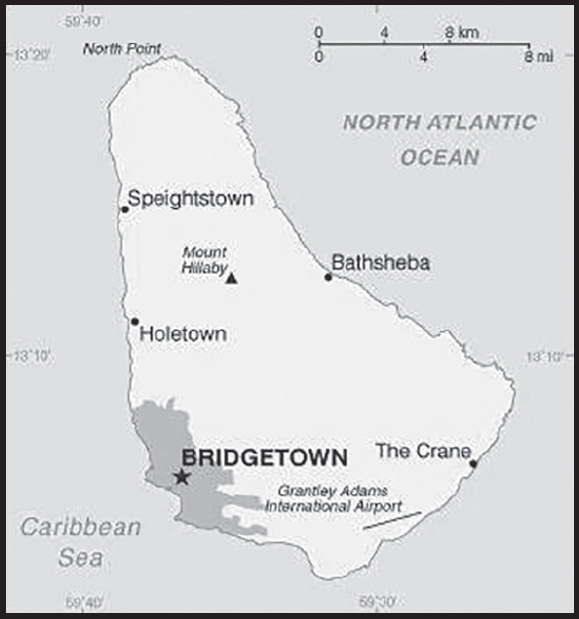
INTRODUCTION
Background: The island was uninhabited when first settled by the British in 1627. African slaves worked the sugar plantations established on the island, which initially dominated the Caribbean sugar industry. By 1720, Barbados was no longer a dominant force within the sugar industry, having been surpassed by the Leeward Islands and Jamaica. Slavery was abolished in 1834. The Barbadian economy remained heavily dependent on sugar, rum, and molasses production through most of the 20th century. The gradual introduction of social and political reforms in the 1940s and 1950s led to complete independence from the UK in 1966. In the 1990s, tourism and manufacturing surpassed the sugar industry in economic importance. Barbados became a republic on 30 November 2021, with the former Governor-General Sandra MASON elected as the first president. Barbados plans to create a new constitution in 2022.
GEOGRAPHY
Location: Caribbean, island in the North Atlantic Ocean, northeast of Venezuela
Geographic coordinates: 13 10 N, 59 32 W
Map references: Central America and the Caribbean
Area: total: 430 sq km
land: 430 sq km
water: 0 sq km
comparison ranking: total 201
Area - comparative: 2.5 times the size of Washington, DC
Land boundaries: total: 0 km
Coastline: 97 km
Maritime claims: territorial sea: 12 nm
exclusive economic zone: 200 nm
Climate: tropical; rainy season (June to October)
Terrain: relatively flat; rises gently to central highland region
Elevation: highest point: Mount Hillaby 336 m
lowest point: Atlantic Ocean 0 m
Natural resources: petroleum, fish, natural gas
Land use: agricultural land: 32.6% (2018 est.)
arable land: 25.6% (2018 est.)
permanent crops: 2.3% (2018 est.)
permanent pasture: 4.7% (2018 est.)
forest: 19.4% (2018 est.)
other: 48% (2018 est.)
Irrigated land: 50 sq km (2012)
Population distribution: most densely populated country in the eastern Caribbean; approximately one-third live in urban areas
Natural hazards: infrequent hurricanes; periodic landslides
Geography - note: easternmost Caribbean island
PEOPLE AND SOCIETY
Population: 303,431 (2023 est.)
comparison ranking: 180
Nationality: noun: Barbadian(s) or Bajan (colloquial)
adjective: Barbadian or Bajan (colloquial)
Ethnic groups: African descent 92.4%, mixed 3.1%, White 2.7%, East Indian 1.3%, other 0.2%, unspecified 0.3% (2010 est.)
Languages: English (official), Bajan (English-based creole language, widely spoken in informal settings)
Religions: Protestant 66.4% (includes Anglican 23.9%, other Pentecostal 19.5%, Adventist 5.9%, Methodist 4.2%, Wesleyan 3.4%, Nazarene 3.2%, Church of God 2.4%, Baptist 1.8%, Moravian 1.2%, other Protestant 0.9%), Roman Catholic 3.8%, other Christian 5.4% (includes Jehovah’s Witness 2.0%, other 3.4%), Rastafarian 1%, other 1.5%, none 20.6%, unspecified 1.2% (2010 est.)
Age structure: 0-14 years: 16.78% (male 25,456/female 25,465)
15-64 years: 67.56% (male 100,884/female 104,114)
65 years and over: 15.66% (2023 est.) (male 19,967/female 27,545)
Dependency ratios: total dependency ratio: 49
youth dependency ratio: 25.6
elderly dependency ratio: 23.4
potential support ratio: 4.3 (2021 est.)
Median age: total: 39.5 years (2020)
male: 38.4 years
female: 40.7 years
comparison ranking: total 55
Population growth rate: 0.24% (2023 est.)
comparison ranking: 172
Birth rate: 10.73 births/1,000 population (2023 est.)
comparison ranking: 176
Death rate: 8.03 deaths/1,000 population (2023 est.)
comparison ranking: 87
Net migration rate: -0.29 migrant(s)/1,000 population (2023 est.)
comparison ranking: 118
Population distribution: most densely populated country in the eastern Caribbean; approximately one-third live in urban areas
Urbanization: urban population: 31.4% of total population (2023)
rate of urbanization: 0.46% annual rate of change (2020-25 est.)
Major urban areas - population: 89,000 BRIDGETOWN (capital) (2018)
Sex ratio: at birth: 1.01 male(s)/female
0-14 years: 1 male(s)/female
15-64 years: 0.97 male(s)/female
65 years and over: 0.72 male(s)/female
total population: 0.93 male(s)/female (2023 est.)
Maternal mortality ratio: 39 deaths/100,000 live births (2020 est.)
comparison ranking: 106
Infant mortality rate: total: 9.79 deaths/1,000 live births (2023 est.)
male: 11.33 deaths/1,000 live births
female: 8.23 deaths/1,000 live births
comparison ranking: total 139
Life expectancy at birth: total population: 78.79 years (2023 est.)
male: 76.04 years
female: 81.57 years
comparison ranking: total population 69
Total fertility rate: 1.7 children born/woman (2023 est.)
comparison ranking: 167
Gross reproduction rate: 0.85 (2023 est.)
Contraceptive prevalence rate: 59.2% (2012)
Drinking water source: improved: total: 98.8% of population
unimproved: total: 2% of population (2020 est.)
Current health expenditure: 7.2% of GDP (2020)
Physicians density: 2.49 physicians/1,000 population (2017)
Hospital bed density: 6 beds/1,000 population (2017)
Sanitation facility access: improved:
total: 100% of population
unimproved: total: 0% of population (2020 est.)
Obesity - adult prevalence rate: 23.1% (2016)
comparison ranking: 69
Alcohol consumption per capita: total: 9.94 liters of pure alcohol (2019 est.)
beer: 3.66 liters of pure alcohol (2019 est.)
wine: 1.36 liters of pure alcohol (2019 est.)
spirits: 4.75 liters of pure alcohol (2019 est.)
other alcohols: 0.17 liters of pure alcohol (2019 est.)
comparison ranking: total 22
Tobacco use: total: 8.5% (2020 est.)
male: 15% (2020 est.)
female: 1.9% (2020 est.)
comparison ranking: total 144
Currently married women (ages 15-49): 57.1% (2023 est.)
Education expenditures: 6.5% of GDP (2021 est.)
comparison ranking: 31
Literacy: definition: age 15 and over can read and write
total population: 99.6%
male: 99.6%
female: 99.6% (2014)
Youth unemployment rate (ages 15-24): total: 30.6% (2021 est.)
male: 34.8%
female: 25.6%
comparison ranking: total 36
ENVIRONMENT
party to: Biodiversity, Climate Change, Climate Change-Kyoto Protocol, Climate Change-Paris Agreement, Comprehensive Nuclear Test Ban, Desertification, Endangered Species, Hazardous Wastes, Law of the Sea, Marine Dumping-London Convention, Marine Dumping-London Protocol, Ozone Layer Protection, Ship Pollution, Wetlands signed, but not ratified: none of the selected agreements
Climate: tropical; rainy season (June to October)
Land use: agricultural land: 32.6% (2018 est.)
arable land: 25.6% (2018 est.)
permanent crops: 2.3% (2018 est.)
permanent pasture: 4.7% (2018 est.)
forest: 19.4% (2018 est.)
other: 48% (2018 est.)
Urbanization: urban population: 31.4% of total population (2023)
rate of urbanization: 0.46% annual rate of change (2020-25 est.)
Revenue from forest resources: 0.01% of GDP (2018 est.)
comparison ranking: 158
Revenue from coal: 0% of GDP (2018 est.)
comparison ranking: 58
Air pollutants: particulate matter emissions: 9.79 micrograms per cubic meter (2019 est.)
carbon dioxide emissions: 1.28 megatons (2016 est.)
methane emissions: 2.35 megatons (2020 est.)
Waste and recycling: municipal solid waste generated annually: 174,815 tons (2011 est.)
municipal solid waste recycled annually: 15,733 tons (2015 est.)
percent of municipal solid waste recycled: 9% (2015 est.)
Total water withdrawal: municipal: 20 million cubic meters (2020 est.)
industrial: 10 million cubic meters (2020 est.)
agricultural: 5 million cubic meters (2020 est.)
Total renewable water resources: 80 million cubic meters (2020 est.)
GOVERNMENT
Country name: conventional long form: none
conventional short form: Barbados
etymology: the name derives from the Portuguese “as barbadas,” which means “the bearded ones” and can refer either to the long, hanging roots of the island’s bearded fig trees or to the alleged beards of the native Carib inhabitants
Government type: parliamentary republic; a Commonwealth realm
Capital: name: Bridgetown
geographic coordinates: 13 06 N, 59 37 W
time difference: UTC-4 (1 hour ahead of Washington, DC, during Standard Time)
etymology: named after a bridge constructed over the swampy area (known as the Careenage) around the Constitution River that flows through the center of Bridgetown
Administrative divisions: 11 parishes and 1 city*; Bridgetown*, Christ Church, Saint Andrew, Saint George, Saint James, Saint John, Saint Joseph, Saint Lucy, Saint Michael, Saint Peter, Saint Philip, Saint Thomas
Independence: 30 November 1966 (from the UK)
National holiday: Independence Day, 30 November (1966)
Constitution: history: adopted 22 November 1966, effective 30 November 1966; Constitution (Amendment) (No. 2) Bill, 2021 establishes Barbados as a republic and revokes the earlier Order in Council
amendments: proposed by Parliament; passage of amendments to constitutional sections such as citizenship, fundamental rights and freedoms, and the organization and authorities of the branches of government requires two-thirds majority vote by the membership of both houses of Parliament; passage of other amendments only requires a majority vote of both houses; amended several times, last in 2021
note: following the transition to a republic in November 2021, the Government of Barbados in February 2022 began the process of establishing a constitution commission to review a new draft constitution
Legal system: English common law; no judicial review of legislative acts
International law organization participation: accepts compulsory ICJ jurisdiction with reservations; accepts ICCt jurisdiction
Citizenship: citizenship by birth: yes
citizenship by descent only: yes
dual citizenship recognized: yes
residency requirement for naturalization: 5 years
Suffrage: 18 years of age; universal
Executive branch: chief of state: President Sandra MASON (since 30 November 2021)
head of government: Prime Minister Mia MOTTLEY (since 25 May 2018)
cabinet: Cabinet appointed by the president on the advice of the prime minister
elections/appointments: president elected by an electoral college of both Houses of Parliament for a 4-year renewable term; election last held on 20 October 2021; following legislative elections, the leader of the majority party or leader of the majority coalition usually appointed prime minister by the president; the prime minister recommends the deputy prime minister
election results: Sandra MASON elected as first president on 20 October 2021
Legislative branch: description: bicameral Parliament consists of:
Senate (21 seats statutory - 19 current; members appointed by the president - 12 on the advice of the prime minister, 2 on the advice of the opposition leader, and 7 at the discretion of the president; members serve 5-year terms)
House of Assembly (30 seats; members directly elected in single-seat constituencies by simple majority vote to serve 5-year terms)
elections:
Senate - last appointments on 4 February 2022 (next appointments in February 2027)
House of Assembly - last held on 19 January 2022 (next to be held in January 2027)
election results:
Senate - appointed; composition as of August 2023 - men 11, women 8, percent of women 42.1%
House of Assembly - percent of vote by party - BLP 69%, DLP 26.5%, other 4.5%; seats by party - BLP 30; composition as of August 2023 - men 22, women 8, percent of women 26.7%; note - total Parliament percent of women 32.7%
note: tradition dictates that the next election is held within 5 years of the last election, but constitutionally it is 5 years from the first seating of Parliament plus a 90-day grace period
Judicial branch: highest court(s): Supreme Court (consists of the High Court with 8 justices) and the Court of Appeal (consists of the High Court chief justice and president of the court and 4 justices; note - in 2005, Barbados acceded to the Caribbean Court of Justice as the final court of appeal, replacing that of the Judicial Committee of the Privy Council (in London)
judge selection and term of office: Supreme Court chief justice appointed by the president on the recommendation of the prime minister and opposition leader of Parliament; other justices appointed by the president on the recommendation of the Judicial and Legal Service Commission, a 5-member independent body consisting of the Supreme Court chief justice, the commission head, and presidential appointees recommended by the prime minister; justices serve until mandatory retirement at age 65
subordinate courts: Magistrates’ Courts
Political parties and leaders: Alliance Party for Progress or APP [Joseph ATHERLEY]
Barbados Labor Party or BLP [Mia MOTTLEY]
Democratic Labor Party or DLP [Ronnie YEARWOOD]
International organization participation: ACP, AOSIS, C, Caricom, CDB, CELAC, FAO, G-77, IADB, IBRD, ICAO, ICCt, ICRM, IDA, IFAD, IFC, IFRCS, ILO, IMF, IMO, Interpol, IOC, ISO, ITSO, ITU, ITUC (NGOs), LAES, MIGA, NAM, OAS, OPANAL, OPCW, UN, UNCTAD, UNESCO, UNHCR, UNIDO, UPU, WCO, WFTU (NGOs), WHO, WIPO, WMO, WTO
Diplomatic representation in the US: chief of mission: Ambassador Noel Anderson LYNCH (since 11 January 2019)
chancery: 2144 Wyoming Avenue NW, Washington, DC 20008
telephone: [1] (202) 939-9200
FAX: [1] (202) 332-7467
email address and website:
https://www.foreign.gov.bb/embassies-high-commissions-and-permanent-missions/
consulate(s) general: Miami, New York
Diplomatic representation from the US: chief of mission: Ambassador Linda S. TAGLIALATELA (since 1 February 2016) note - also accredited to Antigua and Barbuda, Dominica, Grenada, Saint Kitts and Nevis, Saint Lucia, and Saint Vincent and the Grenadines
embassy: Wildey Business Park, St. Michael BB 14006, Barbados, W.I.
mailing address: 3120 Bridgetown Place, Washington DC 20521-3120
telephone: (246) 227-4000
FAX: (246) 431-0179
email address and website:
Flag description: three equal vertical bands of ultramarine blue (hoist side), gold, and ultramarine blue with the head of a black trident centered on the gold band; the band colors represent the blue of the sea and sky and the gold of the beaches; the trident head represents independence and a break with the past (the colonial coat of arms contained a complete trident)
National symbol(s): Neptune’s trident, pelican, Red Bird of Paradise flower (also known as Pride of Barbados); national colors: blue, yellow, black
National anthem: name: “The National Anthem of Barbados”
lyrics/music: Irving BURGIE/C. Van Roland EDWARDS
note: adopted 1966; the anthem is also known as “In Plenty and In Time of Need”
National heritage: total World Heritage Sites: 1 (cultural)
selected World Heritage Site locales: Historic Bridgetown and its Garrison
ECONOMY
Economic overview: largest Eastern Caribbean economy; dependent on US imports and currency strength; high Human Development Index; key tourism and financial sectors; declining but still very high public debt; cost-of-living and cost competitiveness vulnerabilities
Real GDP (purchasing power parity): $3.868 billion (2021 est.)
$3.875 billion (2020 est.)
$4.47 billion (2019 est.)
note: data are in 2017 dollars
comparison ranking: 185
Real GDP growth rate: -0.19% (2021 est.)
-13.31% (2020 est.)
-0.13% (2019 est.)
comparison ranking: 194
Real GDP per capita: $13,800 (2021 est.)
$13,800 (2020 est.)
$16,000 (2019 est.)
note: data are in 2017 dollars
comparison ranking: 117
GDP (official exchange rate): $4.99 billion (2017 est.)
Inflation rate (consumer prices): 4.1% (2019 est.)
3.67% (2018 est.)
4.66% (2017 est.)
comparison ranking: 86
Credit ratings: Moody’s rating: Caa1 (2019)
Standard & Poors rating: B- (2019)
note: The year refers to the year in which the current credit rating was first obtained.
GDP - composition, by sector of origin: agriculture: 1.5% (2017 est.)
industry: 9.8% (2017 est.)
services: 88.7% (2017 est.)
comparison rankings: services 12; industry 208; agriculture 188
GDP - composition, by end use: household consumption: 84.2% (2017 est.)
government consumption: 13.4% (2017 est.)
investment in fixed capital: 17.6% (2017 est.)
investment in inventories: 0.2% (2017 est.)
exports of goods and services: 31.6% (2017 est.)
imports of goods and services: -47% (2017 est.)
Agricultural products: sugar cane, poultry, vegetables, milk, eggs, pork, coconuts, pulses, sweet potatoes, tropical fruit
Industries: tourism, sugar, light manufacturing, component assembly for export
Industrial production growth rate: -0.6% (2021 est.)
comparison ranking: 163
Labor force: 139,100 (2021 est.)
comparison ranking: 179
Labor force - by occupation: agriculture: 10%
industry: 15%
services: 75% (1996 est.)
Unemployment rate: 10.41% (2021 est.)
10.38% (2020 est.)
8.41% (2019 est.)
comparison ranking: 69
Youth unemployment rate (ages 15-24): total: 30.6% (2021 est.)
male: 34.8%
female: 25.6%
comparison ranking: total 36
Budget: revenues: $1.271 billion (2020 est.)
expenditures: $1.483 billion (2020 est.)
Budget surplus (+) or deficit (-): -4% (of GDP) (2017 est.)
comparison ranking: 156
Public debt: 146.93% of GDP (2016 est.)
149.1% of GDP (2016 est.)
comparison ranking: 5
Taxes and other revenues: 27.48% (of GDP) (2016 est.)
comparison ranking: 36
Fiscal year: 1 April - 31 March
Current account balance: -$296.396 million (2017 est.)
-$452.39 million (2016 est.)
comparison ranking: 108
Exports: $357 million (2021 est.)
$550 million (2017 est.)
$516.9 million (2016 est.)
note: Data are in current year dollars and do not include illicit exports or re-exports.
comparison ranking: 196
Exports - partners: United States 20%, Jamaica 12%, Guyana 8%, Trinidad and Tobago 7%, Italy 6% (2021)
Exports - commodities: rums and liquors, ships, packaged medicines, cement, paper labels (2021)
Imports: $2.12 billion (2021 est.)
$2.213 billion (2017 est.)
$1.541 billion (2016 est.)
comparison ranking: 172
Imports - partners: United States 33%, Guyana 13%, China 11%, Trinidad and Tobago 6%, United Kingdom 4% (2021)
Imports - commodities: refined petroleum, crude petroleum, shipping containers, cars, ships, packaged medicines (2021)
Reserves of foreign exchange and gold: $1.673 billion (31 December 2021 est.)
$1.358 billion (31 December 2020 est.)
$772.119 million (31 December 2019 est.)
comparison ranking: 134
Debt - external: $4.49 billion (2010 est.)
$668 million (2003 est.)
comparison ranking: 137
Exchange rates: Barbadian dollars (BBD) per US dollar -
Exchange rates: 2 (2021 est.)
2 (2020 est.)
2 (2019 est.)
2 (2018 est.)
2 (2017 est.)
note: the Barbadian dollar is pegged to the US dollar
ENERGY
Electricity access: electrification - total population: 100% (2021)
Electricity: installed generating capacity: 311,000 kW (2020 est.)
consumption: 1 billion kWh (2019 est.)
exports: 0 kWh (2019 est.)
imports: 0 kWh (2019 est.)
transmission/distribution losses: 20 million kWh (2019 est.)
comparison rankings: installed generating capacity 160; transmission/distribution losses 185; imports 174; exports 166;
consumption: 160
Electricity generation sources: fossil fuels: 95.9% of total installed capacity (2020 est.)
solar: 4.1% of total installed capacity (2020 est.)
Petroleum: total petroleum production: 1,000 bbl/day (2021 est.)
refined petroleum consumption: 10,800 bbl/day (2019 est.)
crude oil and lease condensate exports: 700 bbl/day (2018 est.)
crude oil and lease condensate imports: 0 bbl/day (2018 est.)
crude oil estimated reserves: 2 million barrels (2021 est.)
Refined petroleum products - production: 0 bbl/day (2015 est.)
comparison ranking: 175
Refined petroleum products - exports: 0 bbl/day (2015 est.)
comparison ranking: 183
Refined petroleum products - imports: 10,630 bbl/day (2015 est.)
comparison ranking: 147
Natural gas: production: 14.923 million cubic meters (2019 est.)
consumption: 20.954 million cubic meters (2019 est.)
exports: 0 cubic meters (2021 est.)
imports: 6.031 million cubic meters (2019 est.)
proven reserves: 113 million cubic meters (2021 est.)
Carbon dioxide emissions: 1.703 million metric tonnes of CO2 (2019 est.)
from coal and metallurgical coke: 0 metric tonnes of CO2 (2019 est.)
from petroleum and other liquids: 1.662 million metric tonnes of CO2 (2019 est.)
from consumed natural gas: 41,000 metric tonnes of CO2 (2019 est.)
comparison ranking: total emissions 163
Energy consumption per capita: 83.723 million Btu/person (2019 est.)
comparison ranking: 68
COMMUNICATIONS
Telephones - fixed lines: total subscriptions: 120,980 (2021 est.)
subscriptions per 100 inhabitants: 43 (2021 est.)
comparison ranking: total subscriptions 130
Telephones - mobile cellular: total subscriptions: 316,633 (2021 est.)
subscriptions per 100 inhabitants: 113 (2021 est.)
comparison ranking: total subscriptions 179
Telecommunication systems: general assessment: the telecom sector has seen a decline in subscriber numbers (particularly for prepaid mobile services the mainstay of short term visitors) and revenue; fixed and mobile broadband services are two areas that have benefited from the crisis as employees and students have resorted to working from home; one area of the telecom market that is not prepared for growth is 5G mobile; governments, regulators, and even the mobile network operators have shown that they have not been investing in 5G opportunities at the present time; network expansion and enhancements remain concentrated around improving LTE coverage (2021)
domestic: fixed-line teledensity of roughly 43 per 100 persons; mobile-cellular telephone density about 113 per 100 persons (2021)
international: country code - 1-246; landing points for the ECFS and Southern Caribbean Fiber submarine cable with links to 15 other islands in the eastern Caribbean extending from the British Virgin Islands to Trinidad and Puerto Ricco; satellite earth stations - 1 (Intelsat - Atlantic Ocean); tropospheric scatter to Trinidad and Saint Lucia (2019)
Broadcast media: government-owned Caribbean Broadcasting Corporation (CBC) operates the lone terrestrial TV station; CBC also operates a multi-channel cable TV subscription service; roughly a dozen radio stations, consisting of a CBC-operated network operating alongside privately owned radio stations (2019)
Internet country code: .bb
Internet users: total: 240,800 (2021 est.)
percent of population: 86% (2021 est.)
comparison ranking: total 177
Broadband - fixed subscriptions: total: 128,000 (2020 est.)
subscriptions per 100 inhabitants: 45 (2020 est.)
comparison ranking: total 125
TRANSPORTATION
Civil aircraft registration country code prefix: 8P
Airports: 1 (2021)
comparison ranking: total 211
Airports - with paved runways: 1
note: paved runways have a concrete or asphalt surface but not all have facilities for refueling, maintenance, or air traffic control; the length of a runway required for aircraft to safely operate depends on a number of factors including the type of aircraft, the takeoff weight (including passengers, cargo, and fuel), engine types, flap settings, landing speed, elevation of the airport, and average maximum daily air temperature; paved runways can reach a length of 5,000 m (16,000 ft.), but the “typical” length of a commercial airline runway is between 2,500-4,000 m (8,000-13,000 ft.)
Pipelines: 33 km gas, 64 km oil, 6 km refined products (2013)
Roadways: total: 1,700 km (2015)
paved: 1,700 km (2015)
comparison ranking: total 173
Merchant marine: total: 195 (2022)
by type: bulk carrier 61, general cargo 114, other 20
comparison ranking: total 67
Ports and terminals: major seaport(s): Bridgetown
MILITARY AND SECURITY
Military and security forces: Barbados Defense Force (BDF): The Barbados Regiment, The Barbados Coast Guard (2023)
note 1: the BDF also has a Youth Development Wing, which is comprised of the Barbados Cadet Corps and the Barbados Defense Force Sports Program
note 2: authority over the BDF is shared between the president and prime minister, with the president overseeing strategic direction and the prime minister responsible for operational leadership
note 3: the Barbados Police Service (TBPS) is the national police force; it is modeled after London’s Metropolitan Police Service and divided into three territorial divisions
Military expenditures: 0.8% of GDP (2022 est.)
0.9% of GDP (2021 est.)
0.9% of GDP (2020 est.)
0.8% of GDP (2019 est.) (approximately $35 million)
0.8% of GDP (2018 est.) (approximately $40 million)
comparison ranking: 136
Military and security service personnel strengths: approximately 600 active personnel (2022)
Military equipment inventories and acquisitions: the Netherlands provide the BDF’s major equipment inventory (maritime patrol boats) (2023)
Military service age and obligation: voluntary service only (men and women); 17 years, 9 months to 17 years, 11 months with letter of consent from a parent or guardian, or be in the age range of 18-25 years (18-30 for the Reserves) at the start of recruit training; citizens of Barbados by descent or naturalization (2023)
Military - note: formed in 1979, the Barbados Defense Force (BDF) is responsible for protecting national security, but it may also be called up to maintain internal public order in times of crisis, emergency, or other specific needs, such as special joint patrols with the police; it also provides humanitarian assistance and disaster response operations both domestically and regionally under the Caribbean Regional Security System (RSS); other duties include assisting with national development, such as through the training of the country’s youth with the units of the Barbados Cadet Corps
Barbados has been a member of the Caribbean RSS since its creation in 1982; RSS signatories (Antigua and Barbuda, Dominica, Grenada, Saint Kitts and Nevis, Saint Lucia, and Saint Vincent and the Grenadines) agreed to prepare contingency plans and assist one another, on request, in national emergencies, prevention of smuggling, search and rescue, immigration control, fishery protection, customs and excise control, maritime policing duties, protection of off-shore installations, pollution control, national and other disasters, and threats to national security; the RSS is headquartered in Barbados (2023)
TRANSNATIONAL ISSUES
Disputes - international: Barbados-Venezuela (Maritime Boundary): Barbados joins other Caribbean states and the United Kingdom to counter Venezuela’s claim that Aves Island, a large sandbar with some vegetation, sustains human habitation or economic life, the criteria under the UN Convention on the Law of the Sea (UNCLOS), Article 121, which would permit Venezuela to extend its EEZ/continental shelf over a large portion of the eastern Caribbean Sea; the dispute hampers hydrocarbon prospecting and creation of exploration blocks
Barbados-Trinidad and Tobago (Maritime Boundary): Barbados and Trinidad and Tobago abide by the April 2006 Permanent Court of Arbitration decision delimiting a maritime boundary and limiting catches of flying fish in Trinidad and Tobago’s exclusive economic zone
Illicit drugs: a transit point for cocaine and marijuana destined for North America, Europe, and elsewhere in the Caribbean; some local demand for cocaine and some use of synthetic drugs
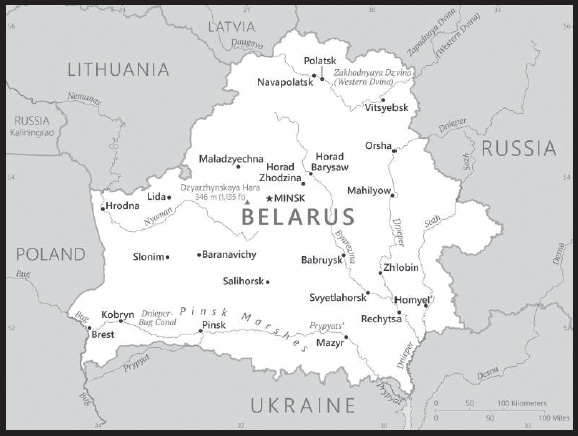
INTRODUCTION
Background: After seven decades as a constituent republic of the USSR, Belarus attained its independence in 1991. It has retained closer political and economic ties to Russia than have any of the other former Soviet republics, and since 2022 Belarus has facilitated Russia’s war in Ukraine, which was launched in part from Belarusian territory. Belarus and Russia signed a treaty on a two-state union on 8 December 1999 envisioning greater political and economic integration. Although Belarus agreed to a framework to carry out the accord, serious implementation has yet to take place and negotiations on further integration have been contentious. Since his election in July 1994 as the country’s first and only directly elected president, Alyaksandr LUKASHENKA has steadily consolidated his power through authoritarian means and a centralized economic system. Government restrictions on political and civil freedoms, freedom of speech and the press, peaceful assembly, and religion have remained in place. Restrictions on political freedoms have grown increasingly strained following the disputed presidential election in August 2020. The election results sparked largescale protests as members of the opposition and civil society criticized the election’s validity. Alyaksandr LUKASHENKA has remained in power as the disputed winner of the presidential election after quelling protests in late 2020.
GEOGRAPHY
Location: Eastern Europe, east of Poland
Geographic coordinates: 53 00 N, 28 00 E
Map references: Europe
Area: total: 207,600 sq km
land: 202,900 sq km
water: 4,700 sq km
comparison ranking: total 86
Area - comparative: slightly less than twice the size of Kentucky; slightly smaller than Kansas
Land boundaries: total: 3,599 km
border countries (5): Latvia 161 km; Lithuania 640 km; Poland 375 km; Russia 1,312 km; Ukraine 1,111 km
Coastline: 0 km (landlocked)
Maritime claims: none (landlocked)
Climate: cold winters, cool and moist summers; transitional between continental and maritime
Terrain: generally flat with much marshland
Elevation: highest point: Dzyarzhynskaya Hara 346 m
lowest point: Nyoman River 90 m
mean elevation: 160 m
Natural resources: timber, peat deposits, small quantities of oil and natural gas, granite, dolomitic limestone, marl, chalk, sand, gravel, clay
Land use: agricultural land: 43.7% (2018 est.)
arable land: 27.2% (2018 est.)
permanent crops: 0.6% (2018 est.)
permanent pasture: 15.9% (2018 est.)
forest: 42.7% (2018 est.)
other: 13.6% (2018 est.)
Irrigated land: 303 sq km (2020)
Major rivers (by length in km): Dnyapro (Dnieper) (shared with Russia [s] and Ukraine [m]) - 2,287 km
note – [s] after country name indicates river source; [m] after country name indicates river mouth
Major watersheds (area sq km): Atlantic Ocean drainage: (Black Sea) Dnieper (533,966 sq km)
Population distribution: a fairly even distribution throughout most of the country, with urban areas attracting larger and denser populations
Natural hazards: large tracts of marshy land
Geography - note: landlocked; glacial scouring accounts for the flatness of Belarusian terrain and for its 11,000 lakes
PEOPLE AND SOCIETY
Population: 9,383,853 (2023 est.)
comparison ranking: 96
Nationality: noun: Belarusian(s)
adjective: Belarusian
Ethnic groups: Belarusian 83.7%, Russian 8.3%, Polish 3.1%, Ukrainian 1.7%, other 2.4%, unspecified 0.9% (2009 est.)
Languages: Russian (official) 71.4%, Belarusian (official) 26%, other 0.3% (includes small Polish- and Ukrainian-speaking minorities), unspecified 2.3% (2009 est.)
major-language sample(s):

(Russian)
Religions: Orthodox 48.3%, Catholic 7.1%, other 3.5%, non-believers 41.1% (2011 est.)
Age structure: 0-14 years: 15.83% (male 764,281/female 721,632)
15-64 years: 66.81% (male 3,055,606/female 3,213,751)
65 years and over: 17.36% (2023 est.) (male 544,270/female 1,084,313)
Dependency ratios: total dependency ratio: 50.8
youth dependency ratio: 25.4
elderly dependency ratio: 25.4
potential support ratio: 3.9 (2021 est.)
Median age: total: 40.9 years (2020)
male: 38 years
female: 43.9 years
comparison ranking: total 48
Population growth rate: -0.32% (2023 est.)
comparison ranking: 216
Birth rate: 8.87 births/1,000 population (2023 est.)
comparison ranking: 202
Death rate: 12.81 deaths/1,000 population (2023 est.)
comparison ranking: 11
Net migration rate: 0.72 migrant(s)/1,000 population (2023 est.)
comparison ranking: 71
Population distribution: a fairly even distribution throughout most of the country, with urban areas attracting larger and denser populations
Urbanization: urban population: 80.7% of total population (2023)
rate of urbanization: 0.28% annual rate of change (2020-25 est.)
Major urban areas - population: 2.057 million MINSK (capital) (2023)
Sex ratio: at birth: 1.06 male(s)/female
0-14 years: 1.06 male(s)/female
15-64 years: 0.95 male(s)/female
65 years and over: 0.5 male(s)/female
total population: 0.87 male(s)/female (2023 est.)
Mother’s mean age at first birth: 26.8 years (2019 est.)
Maternal mortality ratio: 1 deaths/100,000 live births (2020 est.)
comparison ranking: 186
Infant mortality rate: total: 3.23 deaths/1,000 live births (2023 est.)
male: 3.69 deaths/1,000 live births
female: 2.76 deaths/1,000 live births
comparison ranking: total 203
Life expectancy at birth: total population: 74.54 years (2023 est.)
male: 69.2 years
female: 80.2 years
comparison ranking: total population 140
Total fertility rate: 1.52 children born/woman (2023 est.)
comparison ranking: 200
Gross reproduction rate: 0.74 (2023 est.)
Contraceptive prevalence rate: 52.6% (2019)
Drinking water source: improved: urban: 100% of population
rural: 99.6% of population
total: 99.9% of population
unimproved: urban: 0% of population
rural: 0.4% of population
total: 0.1% of population (2020 est.)
Current health expenditure: 6.4% of GDP (2020)
Physicians density: 4.54 physicians/1,000 population (2019)
Hospital bed density: 10.8 beds/1,000 population (2014)
Sanitation facility access: improved: urban: 99.9% of population
rural: 98.3% of population
total: 99.5% of population
unimproved: urban: 0.1% of population
rural: 1.7% of population
total: 0.5% of population (2020 est.)
Obesity - adult prevalence rate: 24.5% (2016)
comparison ranking: 58
Alcohol consumption per capita: total: 10.57 liters of pure alcohol (2019 est.)
beer: 2.26 liters of pure alcohol (2019 est.)
wine: 0.98 liters of pure alcohol (2019 est.)
spirits: 4.67 liters of pure alcohol (2019 est.)
other alcohols: 2.66 liters of pure alcohol (2019 est.)
comparison ranking: total 18
Tobacco use: total: 30.5% (2020 est.)
male: 47.4% (2020 est.)
female: 13.5% (2020 est.)
comparison ranking: total 30
Currently married women (ages 15-49): 66.6% (2023 est.)
Child marriage: women married by age 15: 0.1%
women married by age 18: 4.7%
men married by age 18: 1.6% (2019 est.)
Education expenditures: 4.7% of GDP (2021 est.)
comparison ranking: 86
Literacy: definition: age 15 and over can read and write
total population: 99.9%
male: 99.9%
female: 99.9% (2019)
School life expectancy (primary to tertiary education): total: 15 years
male: 15 years
female: 15 years (2021)
Youth unemployment rate (ages 15-24): total: 11.3% (2021 est.)
male: 14%
female: 8.4%
comparison ranking: total 143
ENVIRONMENT
Environment - current issues: soil pollution from pesticide use; southern part of the country contaminated with fallout from 1986 nuclear reactor accident at Chornobyl’ in northern Ukraine
Environment - international agreements: party to: Air Pollution, Air Pollution-Nitrogen Oxides, Air Pollution-Sulphur 85, Antarctic-Environmental Protection, Antarctic Treaty, Biodiversity, Climate Change, Climate Change-Kyoto Protocol, Climate Change-Paris Agreement, Comprehensive Nuclear Test Ban, Desertification, Endangered Species, Environmental Modification, Hazardous Wastes, Law of the Sea, Marine Dumping-London Convention, Nuclear Test Ban, Ozone Layer Protection, Ship Pollution, Wetlands
signed, but not ratified: none of the selected agreements
Climate: cold winters, cool and moist summers; transitional between continental and maritime
Land use: agricultural land: 43.7% (2018 est.)
arable land: 27.2% (2018 est.)
permanent crops: 0.6% (2018 est.)
permanent pasture: 15.9% (2018 est.)
forest: 42.7% (2018 est.)
other: 13.6% (2018 est.)
Urbanization: urban population: 80.7% of total population (2023)
rate of urbanization: 0.28% annual rate of change (2020-25 est.)
Revenue from forest resources: 1.02% of GDP (2018 est.)
comparison ranking: 52
Revenue from coal: 0% of GDP (2018 est.)
comparison ranking: 121
Air pollutants: particulate matter emissions: 15.48 micrograms per cubic meter (2019 est.)
carbon dioxide emissions: 58.28 megatons (2016 est.)
methane emissions: 17.19 megatons (2020 est.)
Waste and recycling: municipal solid waste generated annually: 4.28 million tons (2015 est.)
municipal solid waste recycled annually: 684,800 tons (2016 est.)
percent of municipal solid waste recycled: 16% (2016 est.)
Major rivers (by length in km): Dnyapro (Dnieper) (shared with Russia [s] and Ukraine [m]) - 2,287 km
note – [s] after country name indicates river source; [m] after country name indicates river mouth
Major watersheds (area sq km): Atlantic Ocean drainage: (Black Sea) Dnieper (533,966 sq km)
Total water withdrawal: municipal: 550 million cubic meters (2020 est.)
industrial: 410 million cubic meters (2020 est.)
agricultural: 370 million cubic meters (2020 est.)
Total renewable water resources: 57.9 billion cubic meters (2020 est.)
GOVERNMENT
Country name: conventional long form: Republic of Belarus
conventional short form: Belarus
local long form: Respublika Byelarus’ (Belarusian)/ Respublika Belarus’ (Russian)
local short form: Byelarus’ (Belarusian)/ Belarus’ (Russian)
former: Belorussian (Byelorussian) Soviet Socialist Republic
etymology: the name is a compound of the Belarusian words “bel” (white) and “Rus” (the Old East Slavic ethnic designation) to form the meaning White Rusian or White Ruthenian
Government type: presidential republic in name, although in fact a dictatorship
Capital: name: Minsk
geographic coordinates: 53 54 N, 27 34 E
time difference: UTC+2 (7 hours ahead of Washington, DC, during Standard Time)
etymology: the origin of the name is disputed; Minsk may originally have been located 16 km to the southwest, on the banks of Menka River; remnants of a 10th-century settlement on the banks of the Menka have been found
Administrative divisions: 6 regions (voblastsi, singular – voblasts’) and 1 municipality* (horad); Brest, Homyel’ (Gomel’), Horad Minsk* (Minsk City), Hrodna (Grodno), Mahilyow (Mogilev), Minsk, Vitsyebsk (Vitebsk)
note: administrative divisions have the same names as their administrative centers; Russian spelling provided for reference when different from Belarusian
Independence: 25 August 1991 (from the Soviet Union)
National holiday: Independence Day, 3 July (1944); note - 3 July 1944 was the date Minsk was liberated from German troops, 25 August 1991 was the date of independence from the Soviet Union
Constitution: history: several previous; latest drafted between late 1991 and early 1994, signed 15 March 1994
amendments: proposed by the president of the republic through petition to the National Assembly or by petition of least 150,000 eligible voters; approval required by at least two-thirds majority vote in both chambers or by simple majority of votes cast in a referendum; amended 1996, 2004
Legal system: civil law system; note - nearly all major codes (civil, civil procedure, criminal, criminal procedure, family, and labor) were revised and came into force in 1999 and 2000
International law organization participation: has not submitted an ICJ jurisdiction declaration; non-party state to the ICCt
Citizenship: citizenship by birth: no
citizenship by descent only: at least one parent must be a citizen of Belarus
dual citizenship recognized: no
residency requirement for naturalization: 7 years
Suffrage: 18 years of age; universal
Executive branch: chief of state: President Alyaksandr LUKASHENKA (since 20 July 1994)
head of government: Prime Minister Roman GOLOVCHENKO (since 4 June 2020); First Deputy Prime Minister Mikalay SNAPKOW (since 4 June 2020); Deputy Prime Ministers Ihar PETRYSHENKA (since 18 August 2018), Anatol SIVAK (since 1 September 2020), Leanid ZAYATS (since 21 March 2022), Petr PARKHOMCHYK (since 16 August 2022)
cabinet: Council of Ministers appointed by the president
elections/appointments: president directly elected by absolute majority popular vote in 2 rounds if needed for a 5-year term (no term limits); first election held on 23 June and 10 July 1994; according to the 1994 constitution, the next election should have been held in 1999; however, Alyaksandr LUKASHENKA extended his term to 2001 via a November 1996 referendum; subsequent election held on 9 September 2001; an October 2004 referendum ended presidential term limits and allowed the President LUKASHENKA to run and win a third term (19 March 2006); a fourth term (19 December 2010); a fifth term (11 October 2015); a sixth term (9 August 2020); next election to be held in 2025; prime minister and deputy prime ministers appointed by the president and approved by the National Assembly
election results: 2020: Alyaksandr LUKASHENKA reelected president (); percent of vote - Alyaksandr LUKASHENKA (independent) 80.1%, Svyatlana TSIKHANOWSKAYA (independent) 10.1%, other 9.8%; note - widespread street protests erupted following announcement of the election results amid allegations of voter fraud
2015: Alyaksandr LUKASHENKA president (); percent of vote - Alyaksandr LUKASHENKA (independent) 84.1%, Tatsyana KARATKEVICH 4.4%, Sergey GAYDUKEVICH 3.3%, other 8.2%.
Legislative branch: description: bicameral National Assembly or Natsyyalny Skhod consists of:
Council of the Republic or Savet Respubliki (64 seats statutory, current 60; 56 members indirectly elected by regional and Minsk city councils and 8 members appointed by the president; members serve 4-year terms)
House of Representatives or Palata Pradstawnikow (110 seats; members directly elected in single-seat constituencies by absolute majority vote in 2 rounds if needed; members serve 4-year terms)
elections:
Council of the Republic - indirect election last held on 7 November 2019
House of Representatives - last held on 17 November 2019 (next to be held on 25 February 2024); OSCE observers determined that the election was neither free nor impartial and that vote counting was problematic in a number of polling stations; pro-LUKASHENKA candidates won every seat; international observers determined that the previous elections - on 28 September 2008, 23 September 2012, and 11 September 2016 - also fell short of democratic standards, with pro-LUKASHENKA candidates winning every, or virtually every seat
election results:
Council of the Republic - percent of vote by party - NA; seats by party - NA; composition - as of August 2023 - men 45, women 15, percent of women 25%
House of Representatives - percent of vote by party - NA; seats by party - KPB 11, Republican Party of Labor and Justice 6, BPP 2, LDP 1, BAP 1, independent 89; composition as of August 2023 - men 66, women 44, percent of women 40%; note - total National Assembly percent of women 34.7%
note: the US does not recognize the legitimacy of the National Assembly
Judicial branch: highest court(s): Supreme Court (consists of the chairman and deputy chairman and organized into several specialized panels, including economic and military; number of judges set by the president of the republic and the court chairman); Constitutional Court (consists of 12 judges, including a chairman and deputy chairman)
judge selection and term of office: Supreme Court judges appointed by the president with the consent of the Council of the Republic; judges initially appointed for 5 years and evaluated for life appointment; Constitutional Court judges - 6 appointed by the president and 6 elected by the Council of the Republic; the presiding judge directly elected by the president and approved by the Council of the Republic; judges can serve for 11 years with an age limit of 70
subordinate courts: oblast courts; Minsk City Court; town courts; Minsk city and oblast economic courts
Political parties and leaders: pro-government parties:
Belarusian Agrarian Party or BAP [Mikhail RUSY]
Belarusian Patriotic Party or BPP [Mikalay ULAKHOVICH]
Belarusian Social Sport Party or BSSP [Uladzimir ALEKSANDROVICH]
Belaya Rus [Henadz DAVYDKA]
Communist Party of Belarus or KPB [Alyaksey SOKOL]
Liberal Democratic Party or LDP [Aleh GAYDUKEVICH]
Republican Party [Uladzimir BELAZOR]
Republican Party of Labor and Justice [Alyaksandr STSYAPANAW]
Social Democratic Party of Popular Accord [Syarhey YERMAK]
opposition parties:
Belarusian Christian Democracy Party [Paval SEVYARYNETS, Volha KAVALKOVA, Vital RYMASHEWSKI] (unregistered)
Belarusian Party of the Green [Dzimtry KUCHUK]
Belarusian Party of the Left “Just World” [Syarhey KALYAKIN]
Belarusian Social-Democratic Assembly of BSDH [Syarhey CHERACHEN]
Belarusian Social Democratic Party (“Assembly”) or BSDPH [Ihar BARYSAW]
Belarusian Social Democratic Party (People’s Assembly) or BSDP [Mikalay STATKEVICH] (unregistered)
BPF Party [Ryhor KASTUSYOW]
Christian Conservative Party-BPF [Zyanon PAZNYAK]
United Civic Party or UCP [Mikalay KAZLOW]
International organization participation: BSEC (observer), CBSS (observer), CEI, CIS, CSTO, EAEC, EAEU, EAPC, EBRD, FAO, GCTU, IAEA, IBRD, ICAO, ICC (NGOs), ICRM, IDA, IFC, IFRCS, ILO, IMF, IMSO, Interpol, IOC, IOM, IPU, ISO, ITU, ITUC (NGOs), MIGA, NAM, NSG, OPCW, OSCE, PCA, PFP, SCO (dialogue member), UN, UNCTAD, UNESCO, UNIDO, UNIFIL, UNWTO, UPU, WCO, WFTU (NGOs), WHO, WIPO, WMO, WTO (observer), ZC
Diplomatic representation in the US: chief of mission: Ambassador (vacant; recalled by Belarus in 2008); Chargé d’Affaires Pavel SHIDLOWSKI (since 9 August 2022)
chancery: 1619 New Hampshire Avenue NW, Washington, DC 20009
telephone: [1] (202) 986-1606
FAX: [1] (202) 986-1805
email address and website:
Diplomatic representation from the US: chief of mission: Ambassador (vacant); Chargé d’Affaires Peter KAUFMAN (since June 2023)
embassy: 46 Starovilenskaya Street, Minsk 220002
mailing address: 7010 Minsk Place, Washington DC 20521-7010
telephone: [375] (17) 210-12-83/217-73-47/217-73-48
FAX: [375] (17) 334-78-53
email address and website:
Flag description: red horizontal band (top) and green horizontal band one-half the width of the red band; a white vertical stripe on the hoist side bears Belarusian national ornamentation in red; the red band color recalls past struggles from oppression, the green band represents hope and the many forests of the country
National symbol(s): no clearly defined current national symbol, the mounted knight known as Pahonia (the Chaser) is the traditional
Belarusian symbol; national colors: green, red, white
National anthem: name: “My, Bielarusy” (We Belarusians)
lyrics/music: Mikhas KLIMKOVICH and Uladzimir KARYZNA/Nester SAKALOUSKI
note: music adopted 1955, lyrics adopted 2002; after the fall of the Soviet Union, Belarus kept the music of its Soviet-era anthem but adopted new lyrics; also known as “Dziarzauny himn Respubliki Bielarus” (State Anthem of the Republic of Belarus)
National heritage: total World Heritage Sites: 4 (3 cultural, 1 natural)
selected World Heritage Site locales: Bialowieza Forest (n); Mir Castle Complex (c); Architectural, Residential, and Cultural Complex of the Radziwill Family at Nesvizh (c)
ECONOMY
Economic overview: declining Russian energy subsidies will end in 2024; growing public debt; strong currency pressures have led to higher inflation; recent price controls on basic food and drugs; public sector wage increases and fragile private sector threaten household income gains and economic growth
Real GDP (purchasing power parity): $184.482 billion (2021 est.)
$180.335 billion (2020 est.)
$181.605 billion (2019 est.)
note: data are in 2017 dollars
comparison ranking: 70
Real GDP growth rate: 2.3% (2021 est.)
-0.7% (2020 est.)
1.4% (2019 est.)
comparison ranking: 157
Real GDP per capita: $19,800 (2021 est.)
$19,200 (2020 est.)
$19,300 (2019 est.)
note: data are in 2017 dollars
comparison ranking: 91
GDP (official exchange rate): $63.168 billion (2019 est.)
Inflation rate (consumer prices): 9.46% (2021 est.)
5.55% (2020 est.)
5.6% (2019 est.)
comparison ranking: 27
Credit ratings: Fitch rating: B (2018)
Moody’s rating: B3 (2018)
Standard & Poors rating: B (2017)
note: The year refers to the year in which the current credit rating was first obtained.
GDP - composition, by sector of origin: agriculture: 8.1% (2017 est.)
industry: 40.8% (2017 est.)
services: 51.1% (2017 est.)
comparison rankings: services 175; industry 27; agriculture 100
GDP - composition, by end use: household consumption: 54.8% (2017 est.)
government consumption: 14.6% (2017 est.)
investment in fixed capital: 24.9% (2017 est.)
investment in inventories: 5.7% (2017 est.)
exports of goods and services: 67% (2017 est.)
imports of goods and services: -67% (2017 est.)
Agricultural products: milk, potatoes, sugar beets, wheat, triticale, barley, maize, rye, rapeseed, poultry
Industries: metal-cutting machine tools, tractors, trucks, earthmovers, motorcycles, synthetic fibers, fertilizer, textiles, refrigerators, washing machines and other household appliances
Industrial production growth rate: 6.7% (2021 est.)
comparison ranking: 65
Labor force: 4.95 million (2021 est.)
comparison ranking: 86
Labor force - by occupation: agriculture: 9.7%
industry: 23.4%
services: 66.8% (2015 est.)
Unemployment rate: 4.74% (2021 est.)
4.77% (2020 est.)
4.16% (2019 est.)
note: official registered unemployed; large number of underemployed workers
comparison ranking: 160
Youth unemployment rate (ages 15-24): total: 11.3% (2021 est.)
male: 14%
female: 8.4%
comparison ranking: total 143
Population below poverty line: 5% (2019 est.)
Gini Index coefficient - distribution of family income: 24.4 (2020 est.)
comparison ranking: 175
Average household expenditures: on food: 32.3% of household expenditures (2018 est.)
on alcohol and tobacco: 7.2% of household expenditures (2018 est.)
Household income or consumption by percentage share: lowest 10%: 3.8%
highest 10%: 21.9% (2008)
Budget: revenues: $24.743 billion (2019 est.)
expenditures: $24.239 billion (2019 est.)
Budget surplus (+) or deficit (-): 2.9% (of GDP) (2017 est.)
comparison ranking: 14
Public debt: 33.24% of GDP (2019 est.)
37.1% of GDP (2018 est.)
39.88% of GDP (2017 est.)
comparison ranking: 161
Taxes and other revenues: 12.02% (of GDP) (2020 est.)
comparison ranking: 177
Fiscal year: calendar year
Current account balance: $2.153 billion (2021 est.)
-$178.4 million (2020 est.)
-$1.246 billion (2019 est.)
comparison ranking: 42
Exports: $49.425 billion (2021 est.)
$37.183 billion (2020 est.)
$41.975 billion (2019 est.)
note: Data are in current year dollars and do not include illicit exports or re-exports.
comparison ranking: 64
Exports - partners: Russia 42%, Ukraine 13%, United Kingdom 7% (2019)
Exports - commodities: fertilizers, refined petroleum, cheese, delivery trucks, lumber (2021)
Imports: $45.459 billion (2021 est.) note: data are in current year dollars
$35.236 billion (2020 est.) note: data are in current year dollars
$42.378 billion (2019 est.) note: data are in current year dollars
comparison ranking: 67
Imports - partners: Russia 57%, China 7%, Poland 5%, Germany 5%, Ukraine 5% (2019)
Imports - commodities: crude petroleum, natural gas, cars and vehicle parts, packaged medicines, broadcasting equipment (2019)
Reserves of foreign exchange and gold: $8.425 billion (31 December 2021 est.)
$7.468 billion (31 December 2020 est.)
$9.394 billion (31 December 2019 est.)
comparison ranking: 89
Debt - external: $39.847 billion (2019 est.)
$39.297 billion (2018 est.)
comparison ranking: 76
Exchange rates: Belarusian rubles (BYB/BYR) per US dollar -
Exchange rates: 2.539 (2021 est.)
2.44 (2020 est.)
2.092 (2019 est.)
2.038 (2018 est.)
1.932 (2017 est.)
ENERGY
Electricity access: electrification - total population: 100% (2021)
Electricity: installed generating capacity: 11.36 million kW (2020 est.)
consumption: 32,665,500,000 kWh (2019 est.)
exports: 4.777 billion kWh (2020 est.)
imports: 4.277 billion kWh (2020 est.)
transmission/distribution losses: 2.711 billion kWh (2019 est.)
comparison rankings: imports 44; exports 37; installed generating capacity 60; transmission/distribution losses 72; consumption 60
Electricity generation sources: fossil fuels: 95.8% of total installed capacity (2020 est.)
nuclear: 0.9% of total installed capacity (2020 est.)
solar: 0.5% of total installed capacity (2020 est.)
wind: 0.5% of total installed capacity (2020 est.)
hydroelectricity: 1.1% of total installed capacity (2020 est.)
tide and wave: 0% of total installed capacity (2020 est.)
geothermal: 0% of total installed capacity (2020 est.)
biomass and waste: 1.2% of total installed capacity (2020 est.)
Nuclear energy: Number of operational nuclear reactors: 2 (2023)
Number of nuclear reactors under construction: 0
Net capacity of operational nuclear reactors: 2.22GW (2023)
Percent of total electricity production: 14.1% (2021)
Percent of total energy produced: 40.8% (2021)
Number of nuclear reactors permanently shut down: 0
Coal: production: 0 metric tons (2020 est.)
consumption: 621,000 metric tons (2020 est.)
exports: 1.574 million metric tons (2020 est.)
imports: 2.117 million metric tons (2020 est.)
proven reserves: 0 metric tons (2019 est.)
Petroleum: total petroleum production: 34,300 bbl/day (2021 est.)
refined petroleum consumption: 134,600 bbl/day (2019 est.)
crude oil and lease condensate exports: 32,200 bbl/day (2018 est.)
crude oil and lease condensate imports: 383,200 bbl/day (2018 est.)
crude oil estimated reserves: 198 million barrels (2021 est.)
Refined petroleum products - production: 477,200 bbl/day (2015 est.)
comparison ranking: 34
Refined petroleum products - exports: 351,200 bbl/day (2015 est.)
comparison ranking: 25
Refined petroleum products - imports: 14,630 bbl/day (2015 est.)
comparison ranking: 135
Natural gas: production: 68.951 million cubic meters (2019 est.)
consumption: 18,639,590,000 cubic meters (2019 est.)
exports: 0 cubic meters (2021 est.)
imports: 18,673,429,000 cubic meters (2019 est.)
proven reserves: 2.832 billion cubic meters (2021 est.)
Carbon dioxide emissions: 54.695 million metric tonnes of CO2 (2019 est.)
from coal and metallurgical coke: 1.623 million metric tonnes of CO2 (2019 est.)
from petroleum and other liquids: 16.856 million metric tonnes of CO2 (2019 est.)
from consumed natural gas: 36.217 million metric tonnes of CO2 (2019 est.)
comparison ranking: total emissions 56
Energy consumption per capita: 102.558 million Btu/person (2019 est.)
comparison ranking: 56
COMMUNICATIONS
Telephones - fixed lines: total subscriptions: 4,332,754 (2021 est.)
subscriptions per 100 inhabitants: 45 (2021 est.)
comparison ranking: total subscriptions 32
Telephones - mobile cellular: total subscriptions: 11,760,087 (2021 est.)
subscriptions per 100 inhabitants: 123 (2021 est.)
comparison ranking: total subscriptions 84
Telecommunication systems: general assessment: the Government of Belarus has successfully promoted the migration to an all-IP platform as part of a wider effort towards a digital transformation for the economy; the state-supported infrastructure operator beCloud has built an extensive fiber network, which reaches all but the smallest settlements in the country; Belarus has the second-highest fiber subscription rate in Europe, behind only Iceland; LTE coverage is almost universal, while considerable progress has also been made in developing 5G services (2021)
domestic: fixed-line teledensity is improving although rural areas continue to be underserved, approximately 45 per 100 fixed-line; mobile-cellular teledensity now roughly 123 telephones per 100 persons (2021)
international: country code - 375; Belarus is landlocked and therefore a member of the Trans-European Line (TEL), Trans-Asia-Europe (TAE) fiber-optic line, and has access to the Trans-Siberia Line (TSL); 3 fiber-optic segments provide connectivity to Latvia, Poland, Russia, and Ukraine; worldwide service is available to Belarus through this infrastructure; additional analog lines to Russia; Intelsat, Eutelsat, and Intersputnik earth stations; almost 31,000 base stations in service in 2019 (2020)
Broadcast media: 7 state-controlled national TV channels; Polish and Russian TV broadcasts are available in some areas; state-run Belarusian Radio operates 5 national networks and an external service; Russian and Polish radio broadcasts are available (2019)
Internet country code: .by
Internet users: total: 8.352 million (2021 est.)
percent of population: 87% (2021 est.)
comparison ranking: total 69
Broadband - fixed subscriptions: total: 3,255,552 (2020 est.)
subscriptions per 100 inhabitants: 35 (2020 est.)
comparison ranking: total 44
TRANSPORTATION
National air transport system: number of registered air carriers: 2 (2020)
inventory of registered aircraft operated by air carriers: 30
annual passenger traffic on registered air carriers: 2,760,168 (2018)
annual freight traffic on registered air carriers: 1.9 million (2018) mt-km
Civil aircraft registration country code prefix: EW
Airports: 65 (2021)
comparison ranking: total 75
Airports - with paved runways: 33
note: paved runways have a concrete or asphalt surface but not all have facilities for refueling, maintenance, or air traffic control; the length of a runway required for aircraft to safely operate depends on a number of factors including the type of aircraft, the takeoff weight (including passengers, cargo, and fuel), engine types, flap settings, landing speed, elevation of the airport, and average maximum daily air temperature; paved runways can reach a length of 5,000 m (16,000 ft.), but the “typical” length of a commercial airline runway is between 2,500-4,000 m (8,000-13,000 ft.)
Airports - with unpaved runways: 32
note: unpaved runways have a surface composition such as grass or packed earth and are most suited to the operation of light aircraft; unpaved runways are usually short, often less than 1,000 m (3,280 ft.) in length; airports with unpaved runways often lack facilities for refueling, maintenance, or air traffic control
Heliports: 1 (2021)
Pipelines: 5,386 km gas, 1,589 km oil, 1,730 km refined products (2013)
Railways: total: 5,528 km (2014)
standard gauge: 25 km (2014) 1.435-m gauge
broad gauge: 5,503 km (2014) 1.520-m gauge (874 km electrified)
comparison ranking: total 34
Roadways: total: 86,600 km (2017)
paved: (2010)
unpaved: (2010)
comparison ranking: total 55
Waterways: 2,500 km (2011) (major rivers are the west-flowing Western Dvina and Neman Rivers and the south-flowing Dnepr River and its tributaries, the Berezina, Sozh, and Pripyat Rivers)
comparison ranking: 37
Merchant marine: total: 4 (2022)
by type: other 4
comparison ranking: total 169
Ports and terminals: river port(s): Mazyr (Prypyats’)
MILITARY AND SECURITY
Military and security forces: Belarus Armed Forces: Army, Air and Air Defense Force, Special Operations Force, Special Troops (electronic warfare, signals, engineers, biological/chemical/nuclear protection troops, etc)
Ministry of Interior: State Border Troops, Militia, Internal Troops (2023)
note: in early 2023, President LUKASHENKO ordered the formation of a new volunteer paramilitary territorial defense force to supplement the Army
Military expenditures: 1.1% of GDP (2022 est.)
1.2% of GDP (2021 est.)
1.5% of GDP (2020 est.)
1.5% of GDP (2019 est.) (approximately $2.11 billion)
1.5% of GDP (2018 est.) (approximately $2.05 billion)
comparison ranking: 120
Military and security service personnel strengths: approximately 45-50,000 active-duty troops; information on the individual services varies, but reportedly includes about 25-30,000 Army, 15,000 Air/Air Defense, and 5,000 Special Operations forces (2023)
Military equipment inventories and acquisitions: the military’s inventory is comprised mostly of Russian/Soviet-origin equipment, and in recent years Russia has continued to be the leading provider of arms; Belarus’s defense industry manufactures some equipment (mostly modernized Soviet designs), including vehicles, guided weapons, and electronic warfare systems (2023)
Military service age and obligation: 18-27 years of age for compulsory military or alternative service; conscript service obligation is 12-18 months, depending on academic qualifications, and 24-36 months for alternative service, also depending on academic qualifications; 17-year-olds are eligible to become cadets at military higher education institutes, where they are classified as military personnel (2023)
note: conscripts can be assigned to the military, to the Ministry of Interior as internal or border troops, or to the Ministry of Labor and Social Protection (alternative service); as of 2020, conscripts comprised an estimated 40% of the military
Military - note: the military of Belarus is responsible for territorial defense; it is a mixed force of conscripts and professionals that is equipped with Russian or Soviet-era weapons; the Army’s principal combat forces are divided into two geographically based commands, each with two mechanized brigades and an artillery brigade; there are also separate artillery and surface-to-surface missile brigades; the Special Operations Forces have three airborne, air assault, and special forces (spetsnaz) brigades, which serve as the military’s high-readiness units; the Air and Air Defense inventory includes about 100 combat aircraft and attack helicopters, as well as air defense brigades and regiments with surface-to-air missiles
Russia is the country’s closest security partner, a relationship that includes an integrated air and missile defense system and joint military training centers and exercises; Russia leases from Belarus a strategic ballistic missile defense site operated by Russian Aerospace Forces and a global communications facility for the Russian Navy; in 2020, the countries signed an agreement allowing for close security cooperation between the Belarusian Ministry of Interior and the Russian National Guard, including protecting public order and key government facilities and combating extremism and terrorism; in 2022, Belarus allowed Russian military forces to stage on its territory for their invasion of Ukraine and continues to supply arms and other aid to the Russian military, including logistical support, supply lines, medical care, and airfields for Russian combat aircraft; in 2023, Belarus agreed to permit Russia to deploy nuclear weapons on its soil
Belarus has been a member of the Collective Security Treaty Organization (CSTO) since 1994 and has committed an airborne brigade to CSTO’s rapid reaction force; the military trains regularly with other CSTO members (2023)
SPACE
Space agency/agencies: Belarus Space Agency (aka National Agency for Space Research; established 2009) (2023)
Space program overview: has a modest national space program focused on developing remote sensing (RS) satellites; jointly builds satellites with foreign partners; develops some space technologies and components for space equipment, including satellite payloads and associated technology, such as optics and imaging equipment; has cooperated with a variety of foreign space agencies and commercial entities, including those of Azerbaijan, China, Kazakhstan, Russia, and Ukraine; has a state-owned satellite company (2023)
note: further details about the key activities, programs, and milestones of the country’s space program, as well as government spending estimates on the space sector, appear in Appendix S
TRANSNATIONAL ISSUES
Disputes - international: Belarus-Latvia: Boundary demarcated with Latvia.
Belarus-Lithuania: Boundary demarcated with Lithuania.
Belarus-Poland: As a member state that forms part of the EU’s external border, Poland has implemented strict Schengen border rules to restrict illegal immigration and trade along its border with Belarus.
Refugees and internally displaced persons: refugees (country of origin): 32,435 (Ukraine) (as of 1 August 2023)
stateless persons: 5,626 (2022)
Trafficking in persons: tier rating: Tier 3 — Belarus does not fully meet the minimum standards for the elimination of trafficking and is not making significant efforts to do so, therefore Belarus was downgraded to Tier 3; nonetheless, the government took some steps to address trafficking, including conducting investigations and prosecutions and identifying and referring victims to services; however, the government did not report investigating, prosecuting, or convicting traffickers under its trafficking statute nor provide adequate protection to victims; officials reportedly returned many migrants and asylum seekers to their countries of origin without comprehensively screening them for trafficking; the government did not report conducting awareness activities, and its efforts to prevent labor trafficking remained inadequate; for the 5th consecutive year, Belarus did not report investigating or filing charges related to illegal recruitment of migrant workers (2022)
trafficking profile: human traffickers exploit domestic and foreign victims and exploit Belarusians abroad; the majority of trafficking victims are men subjected to forced labor, primarily in Russia; most Belarusian victims are trafficked in Belarus and Russia, but also in Poland, Turkey, and other European, Eurasian and Middle Eastern countries; some Belarusian women traveling for foreign employment in the adult entertainment and hotel industries are subjected to sex trafficking; most traffickers are Belarusian citizens, and traffickers increasingly use online methods to coerce victims into forced labor and sex trafficking (2022)
Illicit drugs: limited cultivation of opium poppy and cannabis, mostly for the domestic market; transshipment point for illicit drugs to and via Russia, and to the Baltics and Western Europe; a small and lightly regulated financial center; anti-money laundering legislation does not meet international standards and was weakened further when know-your-customer requirements were curtailed in 2008; few investigations or prosecutions of money-laundering activities
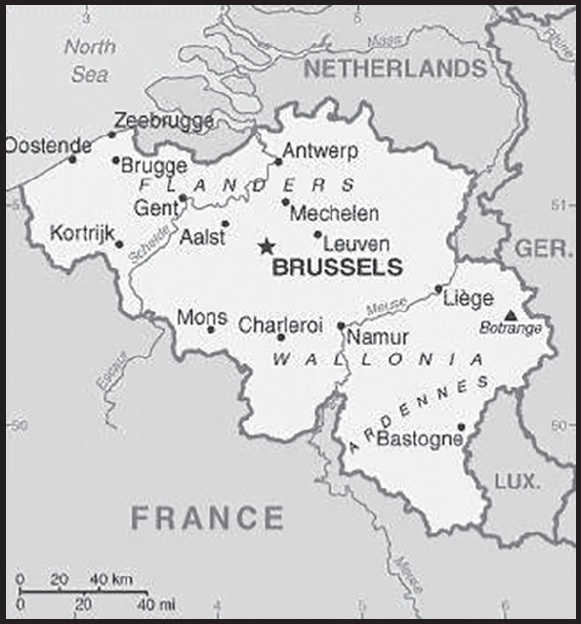
INTRODUCTION
Background: Belgium became independent from the Netherlands in 1830; it was occupied by Germany during World Wars I and II. The country prospered in the past half century as a modern, technologically advanced European state and member of NATO and the EU. In recent years, political divisions between the Dutch-speaking Flemish of the north and the French-speaking Walloons of the south have led to constitutional amendments granting these regions formal recognition and autonomy. The capital city of Brussels is home to numerous international organizations, including the EU and NATO.
GEOGRAPHY
Location: Western Europe, bordering the North Sea, between France and the Netherlands
Geographic coordinates: 50 50 N, 4 00 E
Map references: Europe
Area: total: 30,528 sq km
land: 30,278 sq km
water: 250 sq km
comparison ranking: total 140
Area - comparative: about the size of Maryland
Land boundaries: total: 1,297 km
border countries (4): France 556 km; Germany 133 km; Luxembourg 130 km; Netherlands 478 km
Coastline: 66.5 km
Maritime claims: territorial sea: 12 nm
contiguous zone: 24 nm
exclusive economic zone: geographic coordinates define outer limit
continental shelf: median line with neighbors
Climate: temperate; mild winters, cool summers; rainy, humid, cloudy
Terrain: flat coastal plains in northwest, central rolling hills, rugged mountains of Ardennes Forest in southeast
Elevation: highest point: Botrange 694 m
lowest point: North Sea 0 m
mean elevation: 181 m
Natural resources: construction materials, silica sand, carbonates, arable land
Land use: agricultural land: 44.1% (2018 est.)
arable land: 27.2% (2018 est.)
permanent crops: 0.8% (2018 est.)
permanent pasture: 16.1% (2018 est.)
forest: 22.4% (2018 est.)
other: 33.5% (2018 est.)
Irrigated land: 57 sq km (2013)
Major watersheds (area sq km): Atlantic Ocean drainage: Seine (78,919 sq km), Rhine-Maas (198,735 sq km)
Population distribution: most of the population concentrated in the northern two-thirds of the country; the southeast is more thinly populated; considered to have one of the highest population densities in the world; approximately 97% live in urban areas
Natural hazards: flooding is a threat along rivers and in areas of reclaimed coastal land, protected from the sea by concrete dikes
Geography - note: crossroads of Western Europe; most West European capitals are within 1,000 km of Brussels, the seat of both the EU and NATO
PEOPLE AND SOCIETY
Population: 11,913,633 (2023 est.)
comparison ranking: 82
Nationality: noun: Belgian(s)
adjective: Belgian
Ethnic groups: Belgian 75.2%, Italian 4.1%, Moroccan 3.7%, French 2.4%, Turkish 2%, Dutch 2%, other 10.6% (2012 est.)
Languages: Dutch (official) 60%, French (official) 40%, German (official) less than 1%
major-language sample(s): Het Wereld Feitenboek, een onmisbare bron van informatie. (Dutch)
The World Factbook, une source indispensable d’informations de base. (French)
Religions: Roman Catholic 57.1%, Protestant 2.3%, other Christian, 2.8%, Muslim 6.8%, other 1.7%, atheist 9.1%, nonbeliever/agnostic 20.2% (2018 est.)
Age structure: 0-14 years: 17.03% (male 1,038,921/female 990,288)
15-64 years: 63.06% (male 3,788,406/female 3,724,202)
65 years and over: 19.91% (2023 est.) (male 1,049,402/female 1,322,414)
Dependency ratios: total dependency ratio: 56.5
youth dependency ratio: 26.1
elderly dependency ratio: 30.4
potential support ratio: 3.3 (2021 est.)
Median age: total: 41.6 years (2020)
male: 40.4 years
female: 42.8 years
comparison ranking: total 44
Population growth rate: 0.55% (2023 est.)
comparison ranking: 149
Birth rate: 10.86 births/1,000 population (2023 est.)
comparison ranking: 170
Death rate: 9.57 deaths/1,000 population (2023 est.)
comparison ranking: 42
Net migration rate: 4.18 migrant(s)/1,000 population (2023 est.)
comparison ranking: 28
Population distribution: most of the population concentrated in the northern two-thirds of the country; the southeast is more thinly populated; considered to have one of the highest population densities in the world; approximately 97% live in urban areas
Urbanization: urban population: 98.2% of total population (2023)
rate of urbanization: 0.38% annual rate of change (2020-25 est.)
Major urban areas - population: 2.122 million BRUSSELS (capital), 1.057 million Antwerp (2023)
Sex ratio: at birth: 1.05 male(s)/female
0-14 years: 1.05 male(s)/female
15-64 years: 1.02 male(s)/female
65 years and over: 0.79 male(s)/female
total population: 0.97 male(s)/female (2023 est.)
Mother’s mean age at first birth: 29.2 years (2020 est.)
Maternal mortality ratio: 5 deaths/100,000 live births (2020 est.)
comparison ranking: 166
Infant mortality rate: total: 3.15 deaths/1,000 live births (2023 est.)
male: 3.58 deaths/1,000 live births
female: 2.69 deaths/1,000 live births
comparison ranking: total 207
Life expectancy at birth: total population: 82.06 years (2023 est.)
male: 79.47 years
female: 84.79 years
comparison ranking: total population 31
Total fertility rate: 1.77 children born/woman (2023 est.)
comparison ranking: 146
Gross reproduction rate: 0.86 (2023 est.)
Contraceptive prevalence rate: 66.7% (2018)
Drinking water source: improved: total: 100% of population
unimproved: total: 0% of population (2020 est.)
Current health expenditure: 11.1% of GDP (2020)
Physicians density: 6.08 physicians/1,000 population (2020)
Hospital bed density: 5.6 beds/1,000 population (2019)
Sanitation facility access: improved: urban: 100% of population
rural: 100% of population
total: 100% of population
unimproved: urban: 0% of population
rural: 0% of population
total: 0% of population (2020 est.)
Obesity - adult prevalence rate: 22.1% (2016)
comparison ranking: 82
Alcohol consumption per capita: total: 9.15 liters of pure alcohol (2019 est.)
beer: 4.35 liters of pure alcohol (2019 est.)
wine: 3.41 liters of pure alcohol (2019 est.)
spirits: 1.09 liters of pure alcohol (2019 est.)
other alcohols: 0.3 liters of pure alcohol (2019 est.)
comparison ranking: total 34
Tobacco use: total: 23.4% (2020 est.)
male: 25.8% (2020 est.)
female: 21% (2020 est.)
comparison ranking: total 61
Children under the age of 5 years underweight: 1% (2014/15)
comparison ranking: 117
Currently married women (ages 15-49): 43.2% (2023 est.)
Education expenditures: 6.7% of GDP (2020 est.)
comparison ranking: 25
School life expectancy (primary to tertiary education): total: 19 years
male: 18 years
female: 20 years (2020)
Youth unemployment rate (ages 15-24): total: 19.6% (2021 est.)
male: 18.9%
female: 20.4%
comparison ranking: total 85
ENVIRONMENT
Environment - current issues: intense pressures from human activities: urbanization, dense transportation network, industry, extensive animal breeding and crop cultivation; air and water pollution also have repercussions for neighboring countries
Environment - international agreements: party to: Air Pollution, Air Pollution-Heavy Metals, Air Pollution-Multi-effect Protocol, Air Pollution-Nitrogen Oxides, Air Pollution-Persistent Organic Pollutants, Air Pollution-Sulphur 85, Air Pollution-Sulphur 94, Air Pollution-Volatile Organic Compounds, Antarctic-Environmental Protection, Antarctic-Marine Living Resources, Antarctic Seals, Antarctic Treaty, Biodiversity, Climate Change, Climate Change-Kyoto Protocol, Climate Change-Paris Agreement, Comprehensive Nuclear Test Ban, Desertification, Endangered Species, Environmental Modification, Hazardous Wastes, Law of the Sea, Marine Dumping-London Convention, Marine Dumping-London Protocol, Marine Life Conservation, Nuclear Test Ban, Ozone Layer Protection, Ship Pollution, Tropical Timber 2006, Wetlands, Whaling
signed, but not ratified: none of the selected agreements
Climate: temperate; mild winters, cool summers; rainy, humid, cloudy
Land use: agricultural land: 44.1% (2018 est.)
arable land: 27.2% (2018 est.)
permanent crops: 0.8% (2018 est.)
permanent pasture: 16.1% (2018 est.)
forest: 22.4% (2018 est.)
other: 33.5% (2018 est.)
Urbanization: urban population: 98.2% of total population (2023)
rate of urbanization: 0.38% annual rate of change (2020-25 est.)
Revenue from forest resources: 0.02% of GDP (2018 est.)
comparison ranking: 143
Revenue from coal: 0% of GDP (2018 est.)
comparison ranking: 132
Air pollutants: particulate matter emissions: 11.26 micrograms per cubic meter (2019 est.)
carbon dioxide emissions: 96.89 megatons (2016 est.)
methane emissions: 7.78 megatons (2020 est.)
Waste and recycling: municipal solid waste generated annually: 4.708 million tons (2015 est.)
municipal solid waste recycled annually: 1,614,985 tons (2015 est.)
percent of municipal solid waste recycled: 34.3% (2015 est.)
Major watersheds (area sq km): Atlantic Ocean drainage: Seine (78,919 sq km), Rhine-Maas (198,735 sq km)
Total water withdrawal: municipal: 740 million cubic meters (2020 est.)
industrial: 3.47 billion cubic meters (2020 est.)
agricultural: 50 million cubic meters (2020 est.)
Total renewable water resources: 18.3 billion cubic meters (2020 est.)
GOVERNMENT
Country name: conventional long form: Kingdom of Belgium
conventional short form: Belgium
local long form: Royaume de Belgique (French)/Koninkrijk Belgie (Dutch)/Koenigreich Belgien (German)
local short form: Belgique/Belgie/Belgien
etymology: the name derives from the Belgae, an ancient Celtic tribal confederation that inhabited an area between the English Channel and the west bank of the Rhine in the first centuries B.C.
Government type: federal parliamentary democracy under a constitutional monarchy
Capital: name: Brussels
geographic coordinates: 50 50 N, 4 20 E
time difference: UTC+1 (6 hours ahead of Washington, DC, during Standard Time)
daylight saving time: +1hr, begins last Sunday in March; ends last Sunday in October
etymology: may derive from the Old Dutch bruoc/broek, meaning “marsh” and sella/zele/sel signifying “home” to express the meaning “home in the marsh”
Administrative divisions: regions (French: regions, singular - region; Dutch: gewesten, singular - gewest); Brussels-Capital Region, also known as Brussels Hoofdstedelijk Gewest (Dutch), Region de Bruxelles-Capitale (French long form), Bruxelles-Capitale (French short form); Flemish Region (Flanders), also known as Vlaams Gewest (Dutch long form), Vlaanderen (Dutch short form), Region Flamande (French long form), Flandre (French short form); Walloon Region (Wallonia), also known as Region Wallone (French long form), Wallonie (French short form), Waals Gewest (Dutch long form), Wallonie (Dutch short form)
note: as a result of the 1993 constitutional revision that furthered devolution into a federal state, there are now three levels of government (federal, regional, and linguistic community) with a complex division of responsibilities; the 2012 sixth state reform transferred additional competencies from the federal state to the regions and linguistic communities
Independence: 4 October 1830 (a provisional government declared independence from the Netherlands); 21 July 1831 (King LEOPOLD I ascended to the throne)
National holiday: Belgian National Day (ascension to the throne of King LEOPOLD I), 21 July (1831)
Constitution: history: drafted 25 November 1830, approved 7 February 1831, entered into force 26 July 1831, revised 14 July 1993 (creating a federal state)
amendments: “revisions” proposed as declarations by the federal government in accord with the king or by Parliament followed by dissolution of Parliament and new elections; adoption requires two-thirds majority vote of a two-thirds quorum in both houses of the next elected Parliament; amended many times, last in 2019
Legal system: civil law system based on the French Civil Code; note - Belgian law continues to be modified in conformance with the legislative norms mandated by the European Union; judicial review of legislative acts
International law organization participation: accepts compulsory ICJ jurisdiction with reservations; accepts ICCt jurisdiction
Citizenship: citizenship by birth: no
citizenship by descent only: at least one parent must be a citizen of Belgium
dual citizenship recognized: yes
residency requirement for naturalization: 5 years
Suffrage: 18 years of age; universal and compulsory
Executive branch: chief of state: King PHILIPPE (since 21 July 2013); Heir Apparent Princess ELISABETH (daughter of the monarch, born 25 October 2001)
head of government: Prime Minister Alexander DE CROO (since 1 October 2020); Deputy Prime Ministers Vincent Van QUICKENBORNE (since 1 October 2020), Vincent VAN PETEGHEM (since 1 October 2020), Frank VANDENBROUCKE (since 1 October 2020), Pierre-Yves DERMAGNE (since 1 October 2020), Petra DE SUTTER (since 1 October 2020), Georges GILKINET (since 1 October 2020), David CLARINVAL (since 15 July 2022)
cabinet: Council of Ministers formally appointed by the monarch
elections/appointments: the monarchy is hereditary and constitutional; following legislative elections, the leader of the majority party or majority coalition usually appointed prime minister by the monarch and approved by Parliament
Legislative branch: description: bicameral Parliament consists of:
Senate or Senaat (in Dutch), Senat (in French) (60 seats; 50 members indirectly elected by the community and regional parliaments based on their election results, and 10 elected by the 50 other senators; members serve 5-year terms) Chamber of Representatives or Kamer van Volksvertegenwoordigers (in Dutch), Chambre des Representants (in French) (150 seats; members directly elected in multi-seat constituencies by proportional representation vote; members serve 5-year terms)
elections:
Senate - last held 26 May 2019 (next to be held 0n 31 July 2024)
Chamber of Representatives - last held on 26 May 2019 (next to be held on 31 May 2024); note - elections coincided with the EU elections
election results:
Senate - percent of vote by party - N-VA 15%, VB 12%, PS 12%, MR 12%, CD&V 8.3%, Open VLD 8.3%, Ecolo 15%, SP.A 6.7%, CDH 3.3%, PVDA-PTB 8.3%; seats by party - N-VA 9, VB 7, PS 7, MR 7, CD&V 5, Open VLD 5, Ecolo 9, SP.A 4, CDH 2, PVDA-PTB 5; composition as of August 2023 - men 33, women 27, percent of women 45%
Chamber of Representatives - percent of vote by party - N-VA 16.7%, VB 12%, PS 13.3%, CD&V 8%, PVDA-PTB 8%, Open VLD 8%, MR 9.3%, SP.A 6%, Ecolo 8.7%, Green 5.3%, CDH 3.3%, Defi 1.3%; seats by party - N-VA 25, VB 18, PS 20, CD&V 12, PVDA+PTB 12, Open VLD 12, MR 14, SP.A 9, Ecolo 13, Green 8, CDH 5, Defi 2; composition as of August 2023 - men 86, women 64, percent of women 42.7%; note - total Parliament percent of women 43.3%
note: the 1993 constitutional revision that further devolved Belgium into a federal state created three levels of government (federal, regional, and linguistic community) with a complex division of responsibilities; this reality leaves six governments, each with its own legislative assembly; changes above occurred since the sixth state reform
Judicial branch: highest court(s): Constitutional Court or Grondwettelijk Hof (in Dutch) and Cour Constitutionelle (in French) (consists of 12 judges - 6 Dutch-speaking and 6 French-speaking); Supreme Court of Justice or Hof van Cassatie (in Dutch) and Cour de Cassation (in French) (court organized into 3 chambers: civil and commercial; criminal; social, fiscal, and armed forces; each chamber includes a Dutch division and a French division, each with a chairperson and 5-6 judges)
judge selection and term of office: Constitutional Court judges appointed by the monarch from candidates submitted by Parliament; judges appointed for life with mandatory retirement at age 70; Supreme Court judges appointed by the monarch from candidates submitted by the High Council of Justice, a 44-member independent body of judicial and non-judicial members; judges appointed for life
subordinate courts: Courts of Appeal; regional courts; specialized courts for administrative, commercial, labor, immigration, and audit issues; magistrate’s courts; justices of the peace
Political parties and leaders: Flemish parties:
Christian Democratic and Flemish or CD&V [Sammy MAHDI]
Forward [Conner ROUSSEAU] (formerly Social Progressive Alternative or SP.A)
Groen or Green [Nadia NAJI and Jeremie VANEECKHOUT] (formerly AGALEV, Flemish Greens)
New Flemish Alliance or N-VA [Bart DE WEVER]
Open Flemish Liberals and Democrats or Open VLD [Egbert LACHAERT]
Vlaams Belang (Flemish Interest) or VB [Tom VAN GRIEKEN]
Francophone parties: Ecolo (Francophone Greens) [Jean-Marc NOLLET and Rajae MAOUANE]
Francophone Federalist Democrats or Defi [Francois DE SMET]
Les Engages [Maxime PREVOT] (formerly Humanist and Democratic Center or CDH)
Reform Movement or MR [George-Louis BOUCHEZ]
Socialist Party or PS [Paul MAGNETTE]
Workers’ Party or PVDA-PTB [Raoul HEDEBOUW]
International organization participation: ADB (nonregional members), AfDB (nonregional members), Australia Group, Benelux, BIS, CD, CE, CERN, EAPC, EBRD, ECB, EIB, EITI (implementing country), EMU, ESA, EU, FAO, FATF, G-9, G-10, IADB, IAEA, IBRD, ICAO, ICC (national committees), ICCt, ICRM, IDA, IEA, IFAD, IFC, IFRCS, IGAD (partners), IHO, ILO, IMF, IMO, IMSO, Interpol, IOC, IOM, IPU, ISO, ITSO, ITU, ITUC (NGOs), MIGA, MONUSCO, NATO, NEA, NSG, OAS (observer), OECD, OIF, OpCw, OSCE, Pacific Alliance (observer), Paris Club, PCA, Schengen Convention, SELEC (observer), UN, UNCTAD, UNESCO, UNHCR, UNIDO, UNIFIL, UNRWA, UNTSO, UPU, Wassenaar Arrangement, WCO, WHO, WIPO, WMO, WTO, ZC
Diplomatic representation in the US: chief of mission: Ambassador Jean-Arthur REGIBEAU (since 17 September 2020)
chancery: 1430 K Street NW, Washington DC 20005
telephone: [1] (202) 333-6900
FAX: [1] (202) 338-4960
email address and website:
https://unitedstates.diplomatie.belgium.be/en
consulate(s) general: Atlanta, Los Angeles, New York
Diplomatic representation from the US: chief of mission: Ambassador Michael ADLER (since 15 March 2022)
embassy: 27 Boulevard du Regent [Regentlaan], B-1000 Brussels
mailing address: 7600 Brussels Place, Washington DC 20521-7600
telephone: [32] (2) 811-4000
FAX: [32] (2) 811-4500
email address and website:
Flag description: three equal vertical bands of black (hoist side), yellow, and red; the vertical design was based on the flag of France; the colors are those of the arms of the duchy of Brabant (yellow lion with red claws and tongue on a black field)
National symbol(s): golden rampant lion; national colors: red, black, yellow
National anthem: name: “La Brabanconne” (The Song of Brabant)
lyrics/music: Louis-Alexandre DECHET [French] and Victor CEULEMANS [Dutch]/Francois VAN CAMPENHOUT
note: adopted 1830; according to legend, Louis-Alexandre DECHET, an actor at the theater in which the revolution against the Netherlands began, wrote the lyrics with a group of young people in a Brussels cafe
National heritage: total World Heritage Sites: 15 (14 cultural, 1 natural)
selected World Heritage Site locales: Belfries of Belgium (c); Historic Brugge (c); The Grand Place, Brussels (c); Major Town Houses of Victor Horta (c); Notre-Dame Cathedral, Tournai (c); Spa, Liege (c); Primeval Beech Forests - Sonian Wood (n); Stoclet Palace (c)
ECONOMY
Economic overview: high income economy with strong but moderate growth; high public debt; aging labor force; low labor force participation of low-skilled, migrant, and older workers; strong welfare system; high congestion; complex business permitting and judicial systems
Real GDP (purchasing power parity): $599.814 billion (2021 est.)
$565.149 billion (2020 est.)
$597.165 billion (2019 est.)
note: data are in 2017 dollars
comparison ranking: 36
Real GDP growth rate: 6.13% (2021 est.)
-5.36% (2020 est.)
2.24% (2019 est.)
comparison ranking: 71
Real GDP per capita: $51,700 (2021 est.)
$49,000 (2020 est.)
$52,000 (2019 est.)
note: data are in 2017 dollars
comparison ranking: 28
GDP (official exchange rate): $533.028 billion (2019 est.)
Inflation rate (consumer prices): 2.44% (2021 est.)
0.74% (2020 est.)
1.44% (2019 est.)
comparison ranking: 139
Credit ratings: Fitch rating: AA- (2016)
Moody’s rating: Aa3 (2011)
Standard & Poors rating: AA (2011)
note: The year refers to the year in which the current credit rating was first obtained.
GDP - composition, by sector of origin: agriculture: 0.7% (2017 est.)
industry: 22.1% (2017 est.)
services: 77.2% (2017 est.)
comparison rankings: services 41; industry 131; agriculture 207
GDP - composition, by end use: household consumption: 51.2% (2017 est.)
government consumption: 23.4% (2017 est.)
investment in fixed capital: 23.3% (2017 est.)
investment in inventories: 1.3% (2017 est.)
exports of goods and services: 85.1% (2017 est.)
imports of goods and services: -84.4% (2017 est.)
Agricultural products: sugar beets, milk, potatoes, wheat, pork, lettuce, poultry, maize, barley, pears
Industries: engineering and metal products, motor vehicle assembly, transportation equipment, scientific instruments, processed food and beverages, chemicals, pharmaceuticals, base metals, textiles, glass, petroleum
Industrial production growth rate: 1.28% (2021 est.)
comparison ranking: 145
Labor force: 5.24 million (2021 est.)
comparison ranking: 80
Labor force - by occupation: agriculture: 1.3%
industry: 18.6%
services: 80.1% (2013 est.)
Unemployment rate: 6.42% (2021 est.)
5.55% (2020 est.)
5.36% (2019 est.)
comparison ranking: 122
Youth unemployment rate (ages 15-24): total: 19.6% (2021 est.)
male: 18.9%
female: 20.4%
comparison ranking: total 85
Population below poverty line: 14.8% (2018 est.)
Gini Index coefficient - distribution of family income: 27.2 (2019 est.)
comparison ranking: 167
Average household expenditures: on food: 13.4% of household expenditures (2018 est.)
on alcohol and tobacco: 4.3% of household expenditures (2018 est.)
Household income or consumption by percentage share: lowest 10%: 3.4%
highest 10%: 28.4% (2006)
Budget: revenues: $267.105 billion (2019 est.)
expenditures: $277.492 billion (2019 est.)
Budget surplus (+) or deficit (-): -1% (of GDP) (2017 est.)
comparison ranking: 79
Public debt: 119.43% of GDP (2020 est.)
103.38% of GDP (2019 est.)
101.39% of GDP (2018 est.)
note: data cover general government debt and include debt instruments issued (or owned) by government entities other than the treasury; the data include treasury debt held by foreign entities; the data include debt issued by subnational entities, as well as intra-governmental debt; intra-governmental debt consists of treasury borrowings from surpluses in the social funds, such as for retirement, medical care, and unemployment; debt instruments for the social funds are not sold at public auctions; general government debt is defined by the Maastricht definition and calculated by the National Bank of Belgium as consolidated gross debt; the debt is defined in European Regulation EC479/2009 concerning the implementation of the protocol on the excessive deficit procedure annexed to the Treaty on European Union (Treaty of Maastricht) of 7 February 1992; the sub-sectors of consolidated gross debt are: federal government, communities and regions, local government, and social security funds
comparison ranking: 16
Taxes and other revenues: 21.97% (of GDP) (2020 est.)
comparison ranking: 71
Fiscal year: calendar year
Current account balance: $2.917 billion (2021 est.)
$5.702 billion (2020 est.)
$507.275 million (2019 est.)
comparison ranking: 38
Exports: $515.625 billion (2021 est.)
$417.222 billion (2020 est.)
$441.566 billion (2019 est.)
note: Data are in current year dollars and do not include illicit exports or re-exports.
comparison ranking: 18
Exports - partners: Germany 17%, France 14%, Netherlands 13%, United Kingdom 8%, United States 6%, Italy 5% (2019)
Exports - commodities: vaccines and cultures, cars, packaged medicines, refined petroleum, diamonds, natural gas (2021)
note: Belgian amphetamine production and MDMA (ecstasy) production remain significant illicit trade commodities
Imports: $509.018 billion (2021 est.) note: data are in current year dollars
$408.343 billion (2020 est.) note: data are in current year dollars
$438.221 billion (2019 est.) note: data are in current year dollars
comparison ranking: 15
Imports - partners: Netherlands 16%, Germany 13%, France 10%, United States 8%, Ireland 5%, China 5% (2019)
Imports - commodities: cars, refined petroleum, packaged medicines, medical cultures/vaccines, diamonds, natural gas (2019)
Reserves of foreign exchange and gold: $41.872 billion (31 December 2021 est.)
$33.296 billion (31 December 2020 est.)
$28.97 billion (31 December 2019 est.)
comparison ranking: 49
Debt - external: $1,317,513,000,000 (2019 est.)
$1,332,358,000,000 (2018 est.)
comparison ranking: 17
Exchange rates: euros (EUR) per US dollar -
Exchange rates: 0.845 (2021 est.)
0.876 (2020 est.)
0.893 (2019 est.)
0.847 (2018 est.)
0.885 (2017 est.)
ENERGY
Electricity access: electrification - total population: 100% (2021)
Electricity: installed generating capacity: 26.929 million kW (2020 est.)
consumption: 81,171,300,000 kWh (2020 est.)
exports: 14.053 billion kWh (2020 est.)
imports: 13.394 billion kWh (2020 est.)
transmission/distribution losses: 3.444 billion kWh (2020 est.)
comparison rankings: transmission/distribution losses 59; imports 17; exports 16; consumption 36; installed generating capacity 39
Electricity generation sources: fossil fuels: 33.1% of total installed capacity (2020 est.)
nuclear: 38.1% of total installed capacity (2020 est.)
solar: 5.8% of total installed capacity (2020 est.)
wind: 15% of total installed capacity (2020 est.)
hydroelectricity: 0.3% of total installed capacity (2020 est.)
tide and wave: 0% of total installed capacity (2020 est.)
geothermal: 0% of total installed capacity (2020 est.)
biomass and waste: 7.7% of total installed capacity (2020 est.)
Nuclear energy: Number of operational nuclear reactors: 5 (2023)
Number of nuclear reactors under construction: 0
Net capacity of operational nuclear reactors: 3.93GW (2023)
Percent of total electricity production: 50.8% (2021)
Percent of total energy produced: 71% (2021)
Number of nuclear reactors permanently shut down: 2
Coal: production: 1.105 million metric tons (2020 est.)
consumption: 4.167 million metric tons (2020 est.)
exports: 504,000 metric tons (2020 est.)
imports: 3.467 million metric tons (2020 est.)
proven reserves: 0 metric tons (2019 est.)
Petroleum: total petroleum production: 11,400 bbl/day (2021 est.)
refined petroleum consumption: 642,300 bbl/day (2019 est.)
crude oil and lease condensate exports: 0 bbl/day (2018 est.)
crude oil and lease condensate imports: 666,700 bbl/day (2018 est.)
crude oil estimated reserves: 0 barrels (2021 est.)
Refined petroleum products - production: 731,700 bbl/day (2017 est.)
comparison ranking: 25
Refined petroleum products - exports: 680,800 bbl/day (2017 est.)
comparison ranking: 12
Refined petroleum products - imports: 601,400 bbl/day (2017 est.)
comparison ranking: 14
Natural gas: production: 0 cubic meters (2021 est.)
consumption: 18.17 billion cubic meters (2019 est.)
exports: 3.943 billion cubic meters (2019 est.)
imports: 22.61 billion cubic meters (2019 est.)
proven reserves: 0 cubic meters (2021 est.)
Carbon dioxide emissions: 128.247 million metric tonnes of CO2 (2019 est.)
from coal and metallurgical coke: 10.301 million metric tonnes of CO2 (2019 est.)
from petroleum and other liquids: 83.474 million metric tonnes of CO2 (2019 est.)
from consumed natural gas: 34.472 million metric tonnes of CO2 (2019 est.)
comparison ranking: total emissions 37
Energy consumption per capita: 234.216 million Btu/person (2019 est.)
comparison ranking: 17
COMMUNICATIONS
Telephones - fixed lines: total subscriptions: 3,293,420 (2021 est.)
subscriptions per 100 inhabitants: 28 (2021 est.)
comparison ranking: total subscriptions 37
Telephones - mobile cellular: total subscriptions: 11,740,118 (2021 est.)
subscriptions per 100 inhabitants: 101 (2021 est.)
comparison ranking: total subscriptions 85
Telecommunication systems: general assessment: mobile networks have been upgraded to support growing mobile data use among subscribers, with near-comprehensive LTE coverage; operators have also trialed 5G in preparation for launching services; the auction of 5G-suitable spectrum has been delayed to the beginning of 2022, while the onerous restrictions on radiation have meant that some 5G trials have been suspended; there is effective competition in Belgium between the DSL and cable platforms, while in recent years government support has also encouraged investment in fiber networks; in a bid to encourage investment in under served areas, the regulator in 2018 amended the conditions by which market players grant wholesale access to copper and fiber infrastructure; in May 2019 it opened a further consultation on cost models for access to the networks of cablecos and fiber infrastructure (2021)
domestic: about 28 per 100 fixed-line and 101 per 100 mobile-cellular; nationwide mobile-cellular telephone system; extensive cable network; limited microwave radio relay network (2021)
international: country code - 32; landing points for Concerto, UK-Belgium, Tangerine, and SeaMeWe-3, submarine cables that provide links to Europe, the Middle East, Australia, and Asia; satellite earth stations - 7 (Intelsat - 3) (2019)
Broadcast media: a segmented market with the three major communities (Flemish, French, and German speaking) each having responsibility for their own broadcast media; multiple TV channels exist for each community; additionally, in excess of 90% of households are connected to cable and can access broadcasts of TV stations from neighboring countries; each community has a public radio network coexisting with private broadcasters
Internet country code: .be
Internet users: total: 10.92 million (2021 est.)
percent of population: 91% (2021 est.)
comparison ranking: total 56
Broadband - fixed subscriptions: total: 4,734,210 (2020 est.)
subscriptions per 100 inhabitants: 41 (2020 est.)
comparison ranking: total 34
TRANSPORTATION
National air transport system: number of registered air carriers: 7 (2020)
inventory of registered aircraft operated by air carriers: 117
annual passenger traffic on registered air carriers: 13,639,487 (2018)
annual freight traffic on registered air carriers: 1,285,340,000 (2018) mt-km
Civil aircraft registration country code prefix: OO
Airports: 41 (2021)
comparison ranking: total 103
Airports - with paved runways: 26
civil airports: 5
military airports: 5
joint use (civil-military) airports: 2
other airports: 14
note: paved runways have a concrete or asphalt surface but not all have facilities for refueling, maintenance, or air traffic control; the length of a runway required for aircraft to safely operate depends on a number of factors including the type of aircraft, the takeoff weight (including passengers, cargo, and fuel), engine types, flap settings, landing speed, elevation of the airport, and average maximum daily air temperature; paved runways can reach a length of 5,000 m (16,000 ft.), but the “typical” length of a commercial airline runway is between 2,500-4,000 m (8,000-13,000 ft.)
Airports - with unpaved runways: 15
note: unpaved runways have a surface composition such as grass or packed earth and are most suited to the operation of light aircraft; unpaved runways are usually short, often less than 1,000 m (3,280 ft.) in length; airports with unpaved runways often lack facilities for refueling, maintenance, or air traffic control
Heliports: 1 (2021)
Pipelines: 3,139 km gas, 154 km oil, 535 km refined products (2013)
Railways: total: 3,602 km (2020) 3,160 km electrified
comparison ranking: total 54
Roadways: total: 118,414 km (2015)
paved: 118,414 km (2015) (includes 1,747 km of expressways)
unpaved: (2010)
comparison ranking: total 41
Waterways: 2,043 km (2012) (1,528 km in regular commercial use)
comparison ranking: 43
Merchant marine: total: 199 (2022)
by type: bulk carrier 18, container ship 3, general cargo 15, oil tanker 23, other 140
comparison ranking: total 66
Ports and terminals: major seaport(s): Oostende, Zeebrugge
container port(s) (TEUs): Antwerp (12,020,000) (2021)
LNG terminal(s) (import): Zeebrugge
river port(s): Antwerp, Gent (Schelde River)
Brussels (Senne River) Liege (Meuse River)
MILITARY AND SECURITY
Military and security forces: Belgian Armed Forces (Defensie or La Défense): Land Component, Marine (Naval) Component, Air Component, Medical Component (2023)
note: the Belgian Federal Police is the national police force and responsible for internal security and nationwide law and order, including migration and border enforcement; the force reports to the ministers of interior and justice
Military expenditures: 1.13% of GDP (2023 est.)
1.2% of GDP (2022 est.)
1.1% of GDP (2021)
1% of GDP (2020)
0.9% of GDP (2019)
comparison ranking: 117
Military and security service personnel strengths: approximately 25,000 active-duty personnel (10,000 Land Component; 1,500 Marine Component; 5,000 Air Force Component; 1,500 Medical Component; 7,000 other, including joint staff, support, and training schools) (2023)
Military equipment inventories and acquisitions: the armed forces have a mix of weapons systems from European countries, Israel, and the US; Belgium has an export-focused defense industry that focuses on components and subcontracting (2023)
Military service age and obligation: 18 years of age for voluntary military service for men and women; conscription abolished in 1995 (2023)
note 1: in 2023, women comprised nearly 11% of the military’s full-time personnel
note 2: foreign nationals 18-34 years of age who speak Dutch or French and are citizens of EU countries, Iceland, Lichtenstein, Norway, and Switzerland may apply to join the military
Military deployments: 125 France (EuroCorps); 325 Eastern Europe (NATO); 100 Middle East; 325 Niger (2023)
note: in response to Russia’s 2022 invasion of Ukraine, some NATO countries, including Belgium, have sent additional troops and equipment to the battlegroups deployed in NATO territory in eastern Europe
Military - note: the Belgian military’s responsibilities include territorial defense, humanitarian/disaster relief, assistance to the police if required, international peacekeeping missions, and support to its NATO and EU security commitments, which Belgium considers vital components of its national security policy; outside of the country, the military operates almost always within an international organization or a coalition, such as its ongoing deployments to Africa for the EU and UN, eastern Europe as part of NATO’s Enhanced Forward Presence mission, and the Middle East with an international coalition to combat the Islamic State of Iraq and ash-Sham; Belgium was one of the original 12 countries to sign the North Atlantic Treaty (also known as the Washington Treaty) establishing NATO in 1949; it hosts the NATO headquarters in Brussels; Belgium also cooperates with neighboring countries, such as Luxembourg and the Netherlands, in conducting joint patrols of their respective air spaces and in a composite combined special operations command with Denmark and the Netherlands
the Belgian military is a small, professional, and all-volunteer force equipped with modern Western equipment; the Land Component’s combat forces are a motorized brigade and a special operations regiment; the Marine Component is a compact but active force that conducts a variety of missions ranging from territorial water patrols to humanitarian and counterpiracy operations, as well as support to multinational security operations; it has two frigates, which are supported by several patrol boats and mine warfare vessels; the Air Component has about 50 US-made F-16 fighter aircraft, which are slated to be replaced by US F-35 stealth multirole fighter aircraft by 2025 (2023)
SPACE
Space agency/agencies: Royal Belgian Institute for Space Aeronomy-Interfederal Space Agency of Belgium (BIRA-IASB; established 1964; IASB added 2017); Belgium Federal Science Policy Office (BELSPO) (2023)
Space program overview: founding member of the European Space Agency (ESA), which acts as the de facto Belgian space agency as most programs are carried out under the ESA or bi-laterally with its member states; builds satellites, particularly research/science/technology and remote sensing (RS) platforms; also researches, develops, and produces a wide variety of other space technologies, including telecommunications, optics, robotics, scientific instruments, and space launch vehicle (SLV) components; supports the ESA’s SLV program with economic assistance (6% of the funding for the Ariane-5 SLV, for example), as well as legal, scientific, and technological expertise; hosts the European Space Security and Education Center (established 1968); participates in international astronomy efforts, particularly through the European Southern Observatory (ESO); participates in multiple ESA and EU space-related programs and research efforts; in addition to the ESA and EU, has cooperated with a variety foreign space agencies and commercial entities, including those of Argentina, China, India, Russia, South Africa, UAE, Vietnam, and the US (2023)
note: further details about the key activities, programs, and milestones of the country’s space program, as well as government spending estimates on the space sector, appear in Appendix S
TERRORISM
Terrorist group(s): Terrorist group(s): Islamic Revolutionary Guard Corps/Qods Force; Islamic State of Iraq and ash-Sham (ISIS)
note: details about the history, aims, leadership, organization, areas of operation, tactics, targets, weapons, size, and sources of support of the group(s) appear(s) in Appendix-T
TRANSNATIONAL ISSUES
Disputes - international: none identified
Refugees and internally displaced persons: refugees (country of origin): 20,086 (Syria), 7,049 (Afghanistan), 5,769 (Iraq) (mid-year 2022); 73,095 (Ukraine) (as of 22 August 2023)
stateless persons: 1,190 (2022)
Illicit drugs: a transit point for precursor chemicals from China and India destined for clandestine synthetic drug laboratories in the Netherlands and to some labs in Belgium; a primary entry point for cocaine into Europe; one of the top methamphetamine producers in Europe; a major source of precursor or essential chemicals used in the producAtion of illicit narcotics