INTRODUCTION
Background: The lands that today comprise Croatia were part of the Austro-Hungarian Empire until the close of World War I. In 1918, the Croats, Serbs, and Slovenes formed a kingdom known after 1929 as Yugoslavia. Following World War II, Yugoslavia became a federal independent communist state consisting of six socialist republics under the strong hand of Marshal Josip Broz, aka TITO. Although Croatia declared its independence from Yugoslavia in 1991, it took four years of sporadic, but often bitter, fighting before Yugoslav forces were cleared from Croatian lands, along with a majority of Croatia’s ethnic Serb population. Under UN supervision, the last Serb-held enclave in eastern Slavonia was returned to Croatia in 1998. The country joined NATO in April 2009 and the EU in July 2013. In January 2023, Croatia further integrated into the EU by joining the Eurozone and the Schengen Area.
GEOGRAPHY
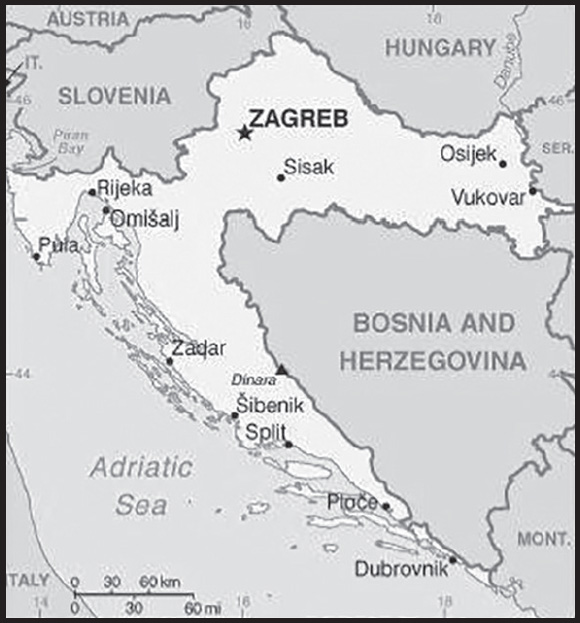
Location: Southeastern Europe, bordering the Adriatic Sea, between Bosnia and Herzegovina and Slovenia
Geographic coordinates: 45 10 N, 15 30 E
Map references: Europe
Area: total: 56,594 sq km
land: 55,974 sq km
water: 620 sq km
comparison ranking: total 127
Area - comparative: slightly smaller than West Virginia
Land boundaries: total: 2,237 km
border countries (5): Bosnia and Herzegovina 956 km; Hungary 348 km; Montenegro 19 km; Serbia 314 km; Slovenia 600 km
Coastline: 5,835 km (mainland 1,777 km, islands 4,058 km)
Maritime claims: territorial sea: 12 nm
continental shelf: 200-m depth or to the depth of exploitation
Climate: Mediterranean and continental; continental climate predominant with hot summers and cold winters; mild winters, dry summers along coast
Terrain: geographically diverse; flat plains along Hungarian border, low mountains and highlands near Adriatic coastline and islands
Elevation: highest point: Dinara 1,831 m
lowest point: Adriatic Sea 0 m
mean elevation: 331 m
Natural resources: oil, some coal, bauxite, low-grade iron ore, calcium, gypsum, natural asphalt, silica, mica, clays, salt, hydropower
Land use: agricultural land: 23.7% (2018 est.)
arable land: 16% (2018 est.)
permanent crops: 1.5% (2018 est.)
permanent pasture: 6.2% (2018 est.)
forest: 34.4% (2018 est.)
other: 41.9% (2018 est.)
Irrigated land: 171 sq km (2020)
Major rivers (by length in km): Dunav (Danube) (shared with Germany [s], Austria, Slovakia, Czechia, Hungary, Serbia, Bulgaria, Ukraine, Moldova, and Romania [m]) - 2,888 km
note – [s] after country name indicates river source; [m] after country name indicates river mouth
Major watersheds (area sq km): Atlantic Ocean drainage: (Black Sea) Danube (795,656 sq km)
Population distribution: more of the population lives in the northern half of the country, with approximately a quarter of the populace residing in and around the capital of Zagreb; many of the islands are sparsely populated
Natural hazards: destructive earthquakes
Geography - note: controls most land routes from Western Europe to Aegean Sea and Turkish Straits; most Adriatic Sea islands lie off the coast of Croatia - some 1,200 islands, islets, ridges, and rocks
PEOPLE AND SOCIETY
Population: 4,169,239 (2023 est.)
comparison ranking: 129
Nationality: noun: Croat(s), Croatian(s)
adjective: Croatian
note: the French designation of “Croate” to Croatian mercenaries in the 17th century eventually became “Cravate” and later came to be applied to the soldiers’ scarves - the cravat; Croatia celebrates Cravat Day every 18 October
Ethnic groups: Croat 90.4%, Serb 4.4%, other 4.4% (including Bosniak, Hungarian, Slovene, Czech, and Romani), unspecified 0.8% (2011 est.)
Languages: Croatian (official) 95.6%, Serbian 1.2%, other 3% (including Hungarian, Czech, Slovak, and Albanian), unspecified 0.2% (2011 est.)
major-language sample(s):
Knjiga svjetskih činjenica, nužan izvor osnovnih informacija. (Croatian)
Religions: Roman Catholic 86.3%, Orthodox 4.4%, Muslim 1.5%, other 1.5%, unspecified 2.5%, not religious or atheist 3.8% (2011 est.)
Age structure: 0-14 years: 13.98% (male 300,575/female 282,165)
15-64 years: 63.39% (male 1,319,878/female 1,322,953)
65 years and over: 22.63% (2023 est.) (male 391,632/female 552,036)
Dependency ratios: total dependency ratio: 56.5
youth dependency ratio: 22.1
elderly dependency ratio: 34.4
potential support ratio: 2.9 (2021 est.)
Median age: total: 43.9 years (2020)
male: 42 years
female: 45.9 years
comparison ranking: total 19
Population growth rate: -0.47% (2023 est.)
comparison ranking: 222
Birth rate: 8.6 births/1,000 population (2023 est.)
comparison ranking: 208
Death rate: 12.98 deaths/1,000 population (2023 est.)
comparison ranking: 9
Net migration rate: -0.26 migrant(s)/1,000 population (2023 est.)
comparison ranking: 115
Population distribution: more of the population lives in the northern half of the country, with approximately a quarter of the populace residing in and around the capital of Zagreb; many of the islands are sparsely populated
Urbanization: urban population: 58.6% of total population (2023)
rate of urbanization: 0.05% annual rate of change (2020-25 est.)
Major urban areas - population: 684,000 ZAGREB (capital) (2023)
Sex ratio: at birth: 1.06 male(s)/female
0-14 years: 1.01 male(s)/female
15-64 years: 1.02 male(s)/female
65 years and over: 0.82 male(s)/female
total population: 1.01 male(s)/female (2023 est.)
Mother’s mean age at first birth: 29 years (2020 est.)
Maternal mortality ratio: 5 deaths/100,000 live births (2020 est.)
comparison ranking: 169
Infant mortality rate: total: 8.58 deaths/1,000 live births (2023 est.)
male: 8.36 deaths/1,000 live births
female: 8.81 deaths/1,000 live births
comparison ranking: total 143
Life expectancy at birth: total population: 77.47 years (2023 est.)
male: 74.37 years
female: 80.76 years
comparison ranking: total population 91
Total fertility rate: 1.46 children born/woman (2023 est.)
comparison ranking: 209
Gross reproduction rate: 0.71 (2023 est.)
Drinking water source: improved:
total: 100% of population
unimproved: total: 0% of population (2020 est.)
Current health expenditure: 7.8% of GDP (2020)
Physicians density: 3.47 physicians/1,000 population (2019)
Hospital bed density: 5.5 beds/1,000 population (2017)
Sanitation facility access: improved: urban: 99.5% of population
rural: 98.4% of population
total: 99% of population
unimproved: urban: 0.5% of population
rural: 1.6% of population
total: 1% of population (2020 est.)
Major infectious diseases: degree of risk: intermediate (2023)
vectorborne diseases: tickborne encephalitis
Obesity - adult prevalence rate: 24.4% (2016)
comparison ranking: 59
Alcohol consumption per capita: total: 9.64 liters of pure alcohol (2019 est.)
beer: 4.75 liters of pure alcohol (2019 est.)
wine: 3.52 liters of pure alcohol (2019 est.)
spirits: 1.37 liters of pure alcohol (2019 est.)
other alcohols: 0.36 liters of pure alcohol (2019 est.)
comparison ranking: total 25
Tobacco use: total: 36.9% (2020 est.)
male: 37.6% (2020 est.)
female: 36.1% (2020 est.)
comparison ranking: total 11
Currently married women (ages 15-49): 50.8% (2023 est.)
Education expenditures: 5.5% of GDP (2020 est.)
comparison ranking: 60
Literacy: definition: age 15 and over can read and write
total population: 99.4%
male: 99.7%
female: 99.2% (2021)
School life expectancy (primary to tertiary education): total: 15 years
male: 14 years
female: 16 years (2020)
Youth unemployment rate (ages 15-24): total: 23.6% (2021 est.)
male: 21.8%
female: 26.3%
comparison ranking: total 67
ENVIRONMENT
Environment - current issues: air pollution improving but still a concern in urban settings and in emissions arriving from neighboring countries; surface water pollution in the Danube River Basin
Environment - international agreements: party to: Air Pollution, Air Pollution-Heavy Metals, Air Pollution-Multi-effect Protocol, Air Pollution-Nitrogen Oxides, Air Pollution-Persistent Organic Pollutants, Air Pollution-Sulphur 94, Air Pollution-Volatile Organic Compounds, Biodiversity, Climate Change, Climate Change-Kyoto Protocol, Climate Change-Paris Agreement, Comprehensive Nuclear Test Ban, Desertification, Endangered Species, Hazardous Wastes, Law of the Sea, Marine Dumping-London Convention, Nuclear Test Ban, Ozone Layer Protection, Ship Pollution, Tropical Timber 2006, Wetlands, Whaling
signed, but not ratified: none of the selected agreements
Climate: Mediterranean and continental; continental climate predominant with hot summers and cold winters; mild winters, dry summers along coast
Land use: agricultural land: 23.7% (2018 est.)
arable land: 16% (2018 est.)
permanent crops: 1.5% (2018 est.)
permanent pasture: 6.2% (2018 est.)
forest: 34.4% (2018 est.)
other: 41.9% (2018 est.)
Urbanization: urban population: 58.6% of total population (2023)
rate of urbanization: 0.05% annual rate of change (2020-25 est.)
Revenue from forest resources: 0.26% of GDP (2018 est.)
comparison ranking: 87
Revenue from coal: 0% of GDP (2018 est.)
comparison ranking: 129
Air pollutants: particulate matter emissions: 15.29 micrograms per cubic meter (2019 est.)
carbon dioxide emissions: 17.49 megatons (2016 est.)
methane emissions: 3.98 megatons (2020 est.)
Waste and recycling: municipal solid waste generated annually: 1.654 million tons (2015 est.)
municipal solid waste recycled annually: 269,933 tons (2015 est.)
percent of municipal solid waste recycled: 16.3% (2015 est.)
Major rivers (by length in km): Dunav (Danube) (shared with Germany [s], Austria, Slovakia, Czechia, Hungary, Serbia, Bulgaria, Ukraine, Moldova, and Romania [m]) - 2,888 km
note – [s] after country name indicates river source; [m] after country name indicates river mouth
Major watersheds (area sq km): Atlantic Ocean drainage: (Black Sea) Danube (795,656 sq km)
Total water withdrawal: municipal: 460 million cubic meters (2020 est.)
industrial: 700 million cubic meters (2020 est.)
agricultural: 80 million cubic meters (2020 est.)
Total renewable water resources: 105.5 billion cubic meters (2020 est.)
GOVERNMENT
Country name: conventional long form: Republic of Croatia
conventional short form: Croatia
local long form: Republika Hrvatska
local short form: Hrvatska
former: People’s Republic of Croatia, Socialist Republic of Croatia
etymology: name derives from the Croats, a Slavic tribe who migrated to the Balkans in the 7th century A.D.
Government type: parliamentary republic
Capital: name: Zagreb
geographic coordinates: 45 48 N, 16 00 E
time difference: UTC+1 (6 hours ahead of Washington, DC, during Standard Time)
daylight saving time: +1hr, begins last Sunday in March; ends last Sunday in October
etymology: the name seems to be related to “digging”; archeologists suggest that the original settlement was established beyond a water-filled hole or graba and that the name derives from this; za in Slavic means “beyond”; the overall meaning may be “beyond the trench (fault, channel, ditch)”
Administrative divisions: 20 counties (zupanije, zupanija - singular) and 1 city* (grad - singular) with special county status; Bjelovarsko-Bilogorska (Bjelovar-Bilogora), Brodsko-Posavska (Brod-Posavina), Dubrovacko-Neretvanska (Dubrovnik-Neretva), Istarska (Istria), Karlovacka (Karlovac), Koprivnicko-Krizevacka (Koprivnica-Krizevci), Krapinsko-Zagorska (Krapina-Zagorje), Licko-Senjska (Lika-Senj), Medimurska (Medimurje), Osjecko-Baranjska (Osijek-Baranja), Pozesko-Slavonska (Pozega-Slavonia), Primorsko-Goranska (Primorje-Gorski Kotar), Sibensko-Kninska (Sibenik-Knin), Sisacko-Moslavacka (Sisak-Moslavina), Splitsko-Dalmatinska (Split-Dalmatia), Varazdinska (Varazdin), Viroviticko-Podravska (Virovitica-Podravina), Vukovarsko-Srijemska (Vukovar-Syrmia), Zadarska (Zadar), Zagreb*, Zagrebacka (Zagreb county)
Independence: 25 June 1991 (from Yugoslavia); note - 25 June 1991 was the day the Croatian parliament voted for independence; following a three-month moratorium to allow the European Community to solve the Yugoslav crisis peacefully, parliament adopted a decision on 8 October 1991 to sever constitutional relations with Yugoslavia; notable earlier dates: ca. 925 (Kingdom of Croatia established); 1 December 1918 (Kingdom of Serbs, Croats, and Slovenes (Yugoslavia) established)
National holiday: Statehood Day (National Day), 30 May (1990); note - marks the day in 1990 that the first modern multi-party Croatian parliament convened
Constitution: history: several previous; latest adopted 22 December 1990
amendments: proposed by at least one fifth of the Assembly membership, by the president of the republic, by the Government of Croatia, or through petition by at least 10% of the total electorate; proceedings to amend require majority vote by the Assembly; passage requires two-thirds majority vote by the Assembly; passage by petition requires a majority vote in a referendum and promulgation by the Assembly; amended several times, last in 2014
Legal system: civil law system influenced by legal heritage of Austria-Hungary; note - Croatian law was fully harmonized with the European Community acquis as of the June 2010 completion of EU accession negotiations
International law organization participation: has not submitted an ICJ jurisdiction declaration; accepts ICCt jurisdiction
Citizenship: citizenship by birth: no
citizenship by descent only: at least one parent must be a citizen of Croatia
dual citizenship recognized: yes
residency requirement for naturalization: 5 years
Suffrage: 18 years of age; universal
Executive branch: chief of state: President Zoran MILANOVIC (since 18 February 2020)
head of government: Prime Minister Andrej PLENKOVIC (since 19 October 2016); Deputy Prime Ministers Tomo MEDVED (since 23 July 2020), Davor BOZINOVIC (since 12 July 2019), Oleg BUTKOVIC (since 15 July 2022), Branko BACIC (since 17 January 2023), Anja SIMPRAG (since 29 April 2022)
cabinet: Council of Ministers named by the prime minister and approved by the Assembly
elections/appointments: president directly elected by absolute majority popular vote in 2 rounds if needed for a 5-year term (eligible for a second term); election last held on 22 December 2019 with a runoff on 5 January 2020 (next to be held in 2024); the leader of the majority party or majority coalition usually appointed prime minister by the president and approved by the Assembly
election results:
2019: Zoran MILANOVIC elected president in second round; percent of vote in second round - Zoran MILANOVIC (SDP) 52.7%, Kolinda GRABAR-KITAROVIC (HDZ) 47.3%
2015: Kolinda GRABAR-KITAROVIC elected president in second round; percent of vote in second round - Kolinda GRABAR-KITAROVIC (HDZ) 50.7%, Ivo JOSIPOVIC (Forward Croatia Progressive Alliance) 49.3%
Legislative branch: description: unicameral Assembly or Hrvatski Sabor (151 seats; 140 members in 10 multi-seat constituencies and 3 members in a single constituency for Croatian diaspora directly elected by proportional representation vote using the D’Hondt method with a 5% threshold; an additional 8 members elected from a nationwide constituency by simple majority by voters belonging to minorities recognized by Croatia; the Serb minority elects 3 Assembly members, the Hungarian and Italian minorities elect 1 each, the Czech and Slovak minorities elect 1 jointly, and all other minorities elect 2; all members serve 4-year terms
elections: early election held on 5 July 2020 (next to be held by 2024)
election results: percent of vote by coalition/party - HDZ-led coalition 37.3%, Restart coalition 24.9%, DPMS-led coalition 10.9%, MOST 7.4%, Green-Left coalition 7%, P-F-SSIP 4%, HNS-LD 1.3%, NS-R 1%, other 6.2%; number of seats by coalition/party - HDZ-led coalition 66, Restart coalition 41, DPMS-led coalition 16, MOST 8, Green-Left coalition 7, P-F-SSIP 3, HNS-LD 1, NS-R 1, national minorities 8; composition as of January 2021 - men 103, women 48, percent of women 31.8%
note: seats by party as of March 2021 - HDZ 62, SDP 33, DP 9, Most 6, Croatian Sovereignists 4, We Can! 4, IDS 3, SDSS 3, HSS 2, HSLS 2, BZH 1, Center 1, FOKUS 1, GLAS 1, HDS 1, HSU 1, NL 1, Reformists 1, SSIP 1, RF 1, independent 12
Judicial branch: highest court(s): Supreme Court (consists of the court president and vice president, 25 civil department justices, and 16 criminal department justices)
judge selection and term of office: president of Supreme Court nominated by the president of Croatia and elected by the Sabor for a 4-year term; other Supreme Court justices appointed by the National Judicial Council; all judges serve until age 70
subordinate courts: Administrative Court; county, municipal, and specialized courts; note - there is an 11-member Constitutional Court with jurisdiction limited to constitutional issues but is outside of the judicial system
Political parties and leaders: Bloc for Croatia or BLOK or BZH [Zlatko HASANBEGOVIC]
The Bridge or Most [Bozo PETROV] (formerly the Bridge of Independent Lists)
Center or Centar [Ivica PULJAK] (formerly Pametno and Party with a First and Last Name or SSIP)
Civic Liberal Alliance or GLAS [Ankar Mrak TARITAS]
Croatian Demochristian Party or HDS [Goran DODIG]
Croatian Democratic Alliance of Slavonia and Baranja or HDSSB [Branimir GLAVAS]
Croatian Democratic Union or HDZ [Andrej PLENKOVIC]
Croatian Democratic Union-led coalition (includes HSLS, HDS, HDSSB)
Croatian Party of Pensioners or HSU [Veselko GABRICEVIC]
Croatian Peasant Party or HSS [Kreso BELJAK]
Croatian People’s Party - Liberal Democrats or HNS-LD [Mirko KOROTAJ, acting]
Croatian Social Liberal Party or HSLS [Dario HREBAK]
Croatian Sovereignists or HS [Marijan PAVLICEK]
Focus on the Important or Focus [Davor NADI]
Green-Left coalition [collective leadership] (includes MOZEMO!, NL)
Homeland Movement or DP [Ivan PENAVA] (also known as Miroslav Škoro Homeland Movement or DPMS)
Independent Democratic Serb Party or SDSS [Milorad PUPOVAC]
Istrian Democratic Assembly or IDS [Dalibor PAUS]
New Left or NL [Ivana KEKIN]
People’s Party - Reformists or NS-R [Radimir CACIC]
Restart Coalition (includes SDP, HSS, HSU, GLAS, IDS, NS-R)
Social Democratic Party of Croatia or SDP [Peda GRBIN]
We Can! or Mozemo! [collective leadership]
Workers’ Front or RF [collective leadership]
International organization participation: Australia Group, BIS, BSEC (observer), CD, CE, CEI, EAPC, EBRD, ECB, EMU, EU, FAO, G-11, IADB, IAEA, IBRD, ICAO, ICC (national committees), ICCt, ICRM, IDA, IFAD, IFC, IFRCS, IHO, ILO, IMF, IMO, IMSO, Interpol, IOC, IOM, IPU, ISO, ITSO, ITU, ITUC (NGOs), MIGA, MINURSO, NAM (observer), NATO, NSG, OAS (observer), OIF (observer), OPCW, OSCE, PCA, Schengen Convention, SELEC, UN, UNCTAD, UNESCO, UNFICYP, UNHCR, UNIDO, UNIFIL, UNMIL, UNMOGIP, UNWTO, UPU, Wassenaar Arrangement, WCO, WHO, WIPO, WMO, WTO, ZC
Diplomatic representation in the US: chief of mission: Ambassador Pjer SIMUNOVIC (since 8 September 2017)
chancery: 2343 Massachusetts Avenue NW, Washington, DC 20008
telephone: [1] (202) 588-5899
FAX: [1] (202) 588-8937
email address and website:
https://mvep.gov.hr/embassy-114969/114969
consulate(s) general: Chicago, Los Angeles, New York, Seattle (WA), Washington, DC
consulate(s): Anchorage (AL), Houston, Kansas City (MO), New Orleans, Pittsburgh (PA)
Diplomatic representation from the US: chief of mission: Ambassador (vacant); Chargé d’Affaires Mark FLEMING (since May 2021)
embassy: Ulica Thomasa Jeffersona 2, 10010 Zagreb
mailing address: 5080 Zagreb Place, Washington DC 20521-5080
telephone: [385] (1) 661-2200
FAX: [385] (1) 661-8933
email address and website:
Flag description: three equal horizontal bands of red (top), white, and blue - the Pan-Slav colors - superimposed by the Croatian coat of arms; the coat of arms consists of one main shield (a checkerboard of 13 red and 12 silver (white) fields) surmounted by five smaller shields that form a crown over the main shield; the five small shields represent five historic regions (from left to right): Croatia, Dubrovnik, Dalmatia, Istria, and Slavonia
note: the Pan-Slav colors were inspired by the 19th-century flag of Russia
National symbol(s): red-white checkerboard; national colors: red, white, blue
National anthem: name: “Lijepa nasa domovino” (Our Beautiful Homeland)
lyrics/music: Antun MIHANOVIC/Josip RUNJANIN
note: adopted in 1972 while still part of Yugoslavia; “Lijepa nasa domovino,” whose lyrics were written in 1835, served as an unofficial anthem beginning in 1891
National heritage: total World Heritage Sites: 10 (8 cultural, 2 natural)
selected World Heritage Site locales: Plitvice Lakes National Park (n); Historic Split (c); Old City of Dubrovnik (c); Euphrasian Basilica; Historic Trogir (c); Šibenik Cathedral (c); Stari Grad Plain (c); Zadar and Fort St. Nikola Venetian Defense Works (c); Primeval Beech Forests (n); Stećci Medieval Tombstones Graveyards (c)
ECONOMY
Economic overview: tourism-based economy that was one of the hardest hit by COVID-19 economic disruptions; newest euro user since 2023, helping recover from a 6-year recession; public debt increases due to COVID-19 and stimulus packages; weak exports; continuing emigration; new liquefied natural gas import terminal
Real GDP (purchasing power parity): $123.348 billion (2021 est.)
$109.088 billion (2020 est.)
$119.327 billion (2019 est.)
note: data are in 2017 dollars
comparison ranking: 85
Real GDP growth rate: 13.07% (2021 est.)
-8.58% (2020 est.)
3.42% (2019 est.)
comparison ranking: 14
Real GDP per capita: $31,600 (2021 est.)
$27,000 (2020 est.)
$29,400 (2019 est.)
note: data are in 2017 dollars
comparison ranking: 68
GDP (official exchange rate)
$60.687 billion (2019 est.)
Inflation rate (consumer prices): 2.55% (2021 est.)
0.15% (2020 est.)
0.77% (2019 est.)
comparison ranking: 132
Credit ratings: Fitch rating: BBB- (2019)
Moody’s rating: Ba1 (2020)
Standard & Poors rating: BBB- (2019)
note: The year refers to the year in which the current credit rating was first obtained.
GDP - composition, by sector of origin
agriculture: 3.7% (2017 est.)
industry: 26.2% (2017 est.)
services: 70.1% (2017 est.)
comparison rankings: services 69; industry 107; agriculture 143
GDP - composition, by end use
household consumption: 57.3% (2017 est.)
government consumption: 19.5% (2017 est.)
investment in fixed capital: 20% (2017 est.)
investment in inventories: 0% (2017 est.)
exports of goods and services: 51.1% (2017 est.)
imports of goods and services: -48.8% (2017 est.)
Agricultural products: maize, wheat, sugar beet, milk, barley, soybeans, potatoes, pork, grapes, sunflower seed
Industries: chemicals and plastics, machine tools, fabricated metal, electronics, pig iron and rolled steel products, aluminum, paper, wood products, construction materials, textiles, shipbuilding, petroleum and petroleum refining, food and beverages, tourism
Industrial production growth rate: 9.11% (2021 est.)
comparison ranking: 37
Labor force: 1.742 million (2021 est.)
comparison ranking: 128
Labor force - by occupation: agriculture: 1.9%
industry: 27.3%
services: 70.8% (2017 est.)
Unemployment rate: 8.68% (2021 est.)
7.51% (2020 est.)
6.62% (2019 est.)
comparison ranking: 85
Youth unemployment rate (ages 15-24): total: 23.6% (2021 est.)
male: 21.8%
female: 26.3%
comparison ranking: total 67
Population below poverty line: 18.3% (2018 est.)
Gini Index coefficient - distribution of family income: 28.9 (2019 est.)
comparison ranking: 159
Average household expenditures: on food: 23% of household expenditures (2018 est.)
on alcohol and tobacco: 2.3% of household expenditures (2018 est.)
Household income or consumption by percentage share: lowest 10%: 2.7%
highest 10%: 23% (2015 est.)
Budget: revenues: $212.81 billion (2019 est.)
expenditures: $211.069 billion (2019 est.)
Budget surplus (+) or deficit (-): 0.8% (of GDP) (2017 est.)
comparison ranking: 36
Public debt: 104.89% of GDP (2020 est.)
87.08% of GDP (2019 est.)
89.45% of GDP (2018 est.)
comparison ranking: 19
Taxes and other revenues: 20.6% (of GDP) (2020 est.)
comparison ranking: 86
Fiscal year: calendar year
Current account balance: $2.082 billion (2021 est.)
-$184.775 million (2020 est.)
$1.7 billion (2019 est.)
comparison ranking: 44
Exports: $35.308 billion (2021 est.)
$24.007 billion (2020 est.)
$31.504 billion (2019 est.)
note: Data are in current year dollars and do not include illicit exports or re-exports.
comparison ranking: 70
Exports - partners: Italy 13%, Germany 13%, Slovenia 10%, Bosnia and Herzegovina 9%, Austria 6%, Serbia 5% (2019)
Exports - commodities: refined petroleum, crude petroleum, packaged medicines, electricity, electrical transformers (2021)
Imports: $36.331 billion (2021 est.) note: data are in current year dollars
$27.954 billion (2020 est.) note: data are in current year dollars
$31.793 billion (2019 est.) note: data are in current year dollars
comparison ranking: 71
Imports - partners: Italy 14%, Germany 14%, Slovenia 11%, Hungary 7%, Austria 6% (2019)
Imports - commodities: crude petroleum, cars, refined petroleum, packaged medicines, electricity (2019)
Reserves of foreign exchange and gold: $28.309 billion (31 December 2021 est.)
$23.254 billion (31 December 2020 est.)
$20.771 billion (31 December 2019 est.)
comparison ranking: 61
Debt - external: $48.263 billion (2019 est.)
$51.176 billion (2018 est.)
comparison ranking: 70
Exchange rates: euros (EUR) per US dollar -
Exchange rates:: 0.845 (2021 est.)
0.876 (2020 est.)
0.893 (2019 est.)
0.847 (2018 est.)
0.885 (2017 est.)
note: Prior to 1 January 2023, Croatia used the kuna as its currency, and it is currently accepting both currencies until 15 January 2023. However, kuna users will receive change in euros, and the exchange rate has been fixed at 7.53450 kuna to 1 euro. Persons may exchange currencies at Croatian post offices until 30 June 2023, free-of-charge, and at any Croatian bank until 31 December 2023.
ENERGY
Electricity access: electrification - total population: 100% (2021)
Electricity: installed generating capacity: 4.94 million kW (2020 est.)
consumption: 16,790,680,000 kWh (2019 est.)
exports: 5.852 billion kWh (2020 est.)
imports: 10.491 billion kWh (2020 est.)
transmission/distribution losses: 1.659 billion kWh (2019 est.)
comparison rankings: imports 23; exports 34; installed generating capacity 88; transmission/distribution losses 93; consumption 76
Electricity generation sources: fossil fuels: 41% of total installed capacity (2020 est.)
solar: 0.9% of total installed capacity (2020 est.)
wind: 16.1% of total installed capacity (2020 est.)
hydroelectricity: 31.8% of total installed capacity (2020 est.)
geothermal: 0.9% of total installed capacity (2020 est.)
biomass and waste: 9.3% of total installed capacity (2020 est.)
Coal: production: 0 metric tons (2020 est.)
consumption: 643,000 metric tons (2020 est.)
exports: 2,000 metric tons (2020 est.)
imports: 644,000 metric tons (2020 est.)
proven reserves: 0 metric tons (2019 est.)
Petroleum: total petroleum production: 12,200 bbl/day (2021 est.)
refined petroleum consumption: 71,500 bbl/day (2019 est.)
crude oil and lease condensate exports: 0 bbl/day (2018 est.)
crude oil and lease condensate imports: 65,200 bbl/day (2018 est.)
crude oil estimated reserves: 71 million barrels (2021 est.)
Refined petroleum products - production: 74,620 bbl/day (2015 est.)
comparison ranking: 70
Refined petroleum products - exports: 40,530 bbl/day (2015 est.)
comparison ranking: 58
Refined petroleum products - imports: 35,530 bbl/day (2015 est.)
comparison ranking: 94
Natural gas: production: 851.005 million cubic meters (2020 est.)
consumption: 3,009,113,000 cubic meters (2020 est.)
exports: 34.462 million cubic meters (2020 est.)
imports: 2,131,802,000 cubic meters (2020 est.)
proven reserves: 24.919 billion cubic meters (2021 est.)
Carbon dioxide emissions: 16.752 million metric tonnes of CO2 (2019 est.)
from coal and metallurgical coke: 1.674 million metric tonnes of CO2 (2019 est.)
from petroleum and other liquids: 9.4 million metric tonnes of CO2 (2019 est.)
from consumed natural gas: 5.678 million metric tonnes of CO2 (2019 est.)
comparison ranking: total emissions 93
Energy consumption per capita: 89.733 million Btu/person (2019 est.)
comparison ranking: 64
COMMUNICATIONS
Telephones - fixed lines: total subscriptions: 1,268,941 (2021 est.)
subscriptions per 100 inhabitants: 31 (2021 est.)
comparison ranking: total subscriptions 66
Telephones - mobile cellular: total subscriptions: 4,402,213 (2021 est.)
subscriptions per 100 inhabitants: 108 (2021 est.)
comparison ranking: total subscriptions 128
Telecommunication systems: general assessment: the mobile market is served by three MNOs, supplemented by a number of MVNOs; the network operators have focused on improving ARPU by encouraging prepaid subscribers to migrate to postpaid plans, and on developing revenue from mobile data services; 5G services are widely available, though the sector will only show its full potential later in 2021 following the award of licenses in several bands; this will contribute towards the government’s national broadband plan to 2027, which is tied to the EC’s two allied projects aimed at providing gigabit connectivity by the end of 2025; the broadband sector benefits from effective competition between the DSL and cable platforms, while there are also numerous fiber deployments in urban areas; the number of FttP subscribers broached 134,000 in March 2021. (2021)
domestic: fixed-line teledensity 31 per 100 persons; mobile-cellular telephone subscriptions are 108 per 100 (2021)
international: country code - 385; the ADRIA-1 submarine cable provides connectivity to Albania and Greece; digital international service is provided through the main switch in Zagreb; Croatia participates in the Trans-Asia-Europe fiber-optic project, which consists of 2 fiber-optic trunk connections with Slovenia and a fiber-optic trunk line from Rijeka to Split and Dubrovnik (2019)
Broadcast media: the national state-owned public broadcaster, Croatian Radiotelevision, operates 4 terrestrial TV networks, a satellite channel that rebroadcasts programs for Croatians living abroad, and 6 regional TV centers; 2 private broadcasters operate national terrestrial networks; 29 privately owned regional TV stations; multi-channel cable and satellite TV subscription services are available; state-owned public broadcaster operates 4 national radio networks and 23 regional radio stations; 2 privately owned national radio networks and 117 local radio stations (2019)
Internet country code: .hr
Internet users: total: 3.321 million (2021 est.)
percent of population: 81% (2021 est.)
comparison ranking: total 114
Broadband - fixed subscriptions: total: 1,030,973 (2020 est.)
subscriptions per 100 inhabitants: 25 (2020 est.)
comparison ranking: total 73
TRANSPORTATION
National air transport system: number of registered air carriers: 2 (2020)
inventory of registered aircraft operated by air carriers: 18
annual passenger traffic on registered air carriers: 2,093,577 (2018)
annual freight traffic on registered air carriers: 530,000 (2018) mt-km
Civil aircraft registration country code prefix: 9A
Airports: 69 (2021)
comparison ranking: total 71
Airports - with paved runways: 24
note: paved runways have a concrete or asphalt surface but not all have facilities for refueling, maintenance, or air traffic control; the length of a runway required for aircraft to safely operate depends on a number of factors including the type of aircraft, the takeoff weight (including passengers, cargo, and fuel), engine types, flap settings, landing speed, elevation of the airport, and average maximum daily air temperature; paved runways can reach a length of 5,000 m (16,000 ft.), but the “typical” length of a commercial airline runway is between 2,500-4,000 m (8,000-13,000 ft.)
Airports - with unpaved runways: 45
note: unpaved runways have a surface composition such as grass or packed earth and are most suited to the operation of light aircraft; unpaved runways are usually short, often less than 1,000 m (3,280 ft.) in length; airports with unpaved runways often lack facilities for refueling, maintenance, or air traffic control
Heliports: 1 (2021)
Pipelines: 2,410 km gas, 610 km oil (2011)
Railways: total: 2,617 km (2020) 980 km electrified
comparison ranking: total 63
Roadways: total: 26,958 km (2015) (includes 1,416 km of expressways)
comparison ranking: total 100
Waterways: 4,714 km (2022) Danube 2,859 km, Sava 562 km, Drava 505 km, Neretva 20 km, Bosut 151 km, Kupa 296 km, Mura 53 km, Korana 134 km, Lonja 134 km
comparison ranking: 25
Merchant marine: total: 376 (2022)
by type: bulk carrier 12, general cargo 33, oil tanker 14, other 317
comparison ranking: total 49
Ports and terminals: major seaport(s): Ploce, Rijeka, Sibenik, Split
oil terminal(s): Omisalj
LNG terminal(s) (import): Krk Island
river port(s): Vukovar (Danube)
MILITARY AND SECURITY
Military and security forces: Armed Forces of the Republic of Croatia (Oruzane Snage Republike Hrvatske, OSRH): Ground Forces (Hrvatska Kopnena Vojska, HKoV), Naval Forces (Hrvatska Ratna Mornarica, HRM; includes Coast Guard), Air Force and Air Defense Forces; Military Police Force (2023)
note: the Ministry of the Interior is responsible for internal security, including law enforcement (Croatia Police) and border security
Military expenditures: 1.8% of GDP (2023 est.)
1.8% of GDP (2022 est.)
2% of GDP (2021)
1.7% of GDP (2020)
1.6% of GDP (2019)
comparison ranking: 69
Military and security service personnel strengths: approximately 15,000 active-duty personnel (10,000 Army; 1,500 Navy; 1,500 Air force; 2,000 joint/other) (2023)
Military equipment inventories and acquisitions: the majority of the military’s inventory consists of Soviet-era equipment, although in recent years Croatia has acquired some limited numbers of more modern weapon systems from Western suppliers, including France, Germany, and the US (2023)
Military service age and obligation: 18-27 years of age for voluntary military service; conscription abolished in 2008 (2023)
note: as of 2021, women comprised nearly 15% of the military’s full-time personnel
Military deployments: 150 Kosovo (KFOR/NATO) (2023)
note: in response to Russia’s 2022 invasion of Ukraine, some NATO countries have sent additional troops and equipment to the battlegroups deployed in NATO territory in eastern Europe
Military - note: the Armed Forces of Croatia (OSRH) are responsible for the defense of Croatia’s sovereignty and territory, contributing to international humanitarian, peacekeeping, and security missions, and providing assistance to civil authorities for such missions as responding to disasters, search and rescue, anti-terrorism, and internal security in times of crisis if called upon by the prime minister or the president; Croatia joined NATO in 2009, and the OSRH participates in NATO missions, including its peacekeeping force in Kosovo and the Enhanced Forward Presence mission in Eastern Europe; it also contributes to EU and UN missions; the OSRH trains regularly with NATO and regional partners
the OSRH was established in 1991 from the Croatian National Guard during the Croatian War of Independence (1991-95); during the war, the ground forces grew to as many as 60 brigades and dozens of independent battalions, and a single military offensive against Serbian forces in 1995 included some 100,000 Croatian troops; in 2000, Croatia initiated an effort to modernize and reform the OSRH into a small, professional military capable of meeting the challenges of NATO membership; the current 15,000-strong military’s principal combat forces are two mechanized infantry brigades, a small joint service special operations command, a flotilla of missile boats and coastal patrol vessels, and a squadron of Soviet-era fighter aircraft that are in the process of being replaced by more modern French aircraft (2023)
TRANSNATIONAL ISSUES
Disputes - international: dispute remains with Bosnia and Herzegovina over several small sections of the boundary related to maritime access that hinders ratification of the 1999 border agreement; since the breakup of Yugoslavia in the early 1990s, Croatia and Slovenia have each claimed sovereignty over Piranski Bay and four villages, and Slovenia has objected to Croatia’s claim of an exclusive economic zone in the Adriatic Sea; in 2009, however Croatia and Slovenia signed a binding international arbitration agreement to define their disputed land and maritime borders, which led to Slovenia lifting its objections to Croatia joining the EU; Croatia joined the Schengen Zone on 1 January 2023
Refugees and internally displaced persons: refugees (country of origin): 23,855 (Ukraine) (as of 3 November 2023)
stateless persons: 2,889 (2022)
note: 843,010 estimated refugee and migrant arrivals (January 2015-September 2023)
Illicit drugs: drug trafficking groups are major players in the procurement and transportation of of large quantities of cocaine destined for European markets
INTRODUCTION
Background: The native Amerindian population of Cuba began to decline after the arrival of Christopher COLUMBUS in 1492 and following its development as a Spanish colony during the next several centuries. Large numbers of African slaves were imported to work the coffee and sugar plantations, and Havana became the launching point for the annual treasure fleets bound for Spain from Mexico and Peru. Spanish rule eventually provoked an independence movement and occasional rebellions were harshly suppressed. US intervention during the Spanish-American War in 1898 assisted the Cubans in overthrowing Spanish rule. The Treaty of Paris established Cuban independence from Spain in 1898 and, following three-and-a-half years of subsequent US military rule, Cuba became an independent republic in 1902 after which the island experienced a string of governments mostly dominated by the military and corrupt politicians. Fidel CASTRO led a rebel army to victory in 1959; his authoritarian rule held the subsequent regime together for nearly five decades. He handed off the presidency in February 2008 to his younger brother Raul CASTRO. Cuba’s communist revolution, with Soviet support, was exported throughout Latin America and Africa during the 1960s, 1970s, and 1980s. Miguel DIAZ-CANEL Bermudez, hand-picked by Raul CASTRO to succeed him, was approved as president by the National Assembly and took office on 19 April 2018. DIAZ-CANEL was appointed First Secretary of the Communist Party on 19 April 2021 following the retirement of Raul CASTRO, and continues to serve as both president and first secretary.
Cuba traditionally and consistently portrays the US embargo, in place since 1961, as the source of its difficulties. As a result of efforts begun in December 2014 to reestablish diplomatic relations with the Cuban Government, which were severed in January 1961, the US and Cuba reopened embassies in their respective countries in July 2015. The embargo remains in place, and the relationship between the US and Cuba remains tense.
Illicit migration of Cuban nationals to the US via maritime and overland routes has been a longstanding challenge. On 12 January 2017, the US and Cuba signed a Joint Statement ending the so-called “wet-foot, dry-foot” policy – by which Cuban nationals who reached US soil were permitted to stay. Irregular Cuban maritime migration has dropped significantly since FY 2016, when migrant interdictions at sea topped 5,000, but land border crossings continue. In FY 2022, the US Coast Guard interdicted almost 10,000 Cuban nationals at sea. Also in FY 2022, 230,000 Cuban nationals presented themselves at various land border ports of entry throughout the US.
GEOGRAPHY
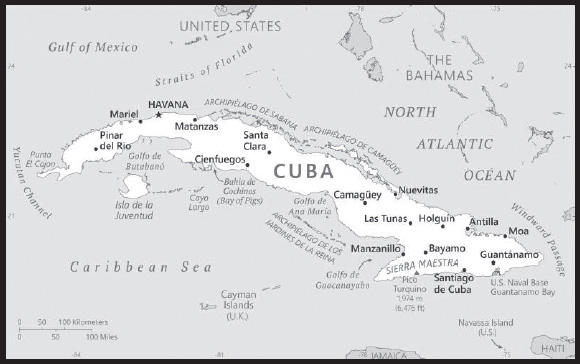
Location: Caribbean, island between the Caribbean Sea and the North Atlantic Ocean, 150 km south of Key West, Florida
Geographic coordinates: 21 30 N, 80 00 W
Map references: Central America and the Caribbean
Area: total: 110,860 sq km
land: 109,820 sq km
water: 1,040 sq km
comparison ranking: total 106
Area - comparative: slightly smaller than Pennsylvania
Land boundaries: total: 28.5 km
border countries (1): US Naval Base at Guantanamo Bay 28.5 km
note: Guantanamo Naval Base is leased by the US and remains part of Cuba
Coastline: 3,735 km
Maritime claims: territorial sea: 12 nm
contiguous zone: 24 nm
exclusive economic zone: 200 nm
Climate: tropical; moderated by trade winds; dry season (November to April); rainy season (May to October)
Terrain: mostly flat to rolling plains, with rugged hills and mountains in the southeast
Elevation: highest point: Pico Turquino 1,974 m
lowest point: Caribbean Sea 0 m
mean elevation: 108 m
Natural resources: cobalt, nickel, iron ore, chromium, copper, salt, timber, silica, petroleum, arable land
Land use: agricultural land: 60.3% (2018 est.)
arable land: 33.8% (2018 est.)
permanent crops: 3.6% (2018 est.)
permanent pasture: 22.9% (2018 est.)
forest: 27.3% (2018 est.)
other: 12.4% (2018 est.)
Irrigated land: 8,700 sq km (2012)
Population distribution: large population clusters found throughout the country, the more significant ones being in the larger towns and cities, particularly the capital of Havana
Natural hazards: the east coast is subject to hurricanes from August to November (in general, the country averages about one hurricane every other year); droughts are common
Geography - note: largest country in Caribbean and westernmost island of the Greater Antilles
PEOPLE AND SOCIETY
Population: 10,985,974 (2023 est.)
comparison ranking: 85
Nationality: noun: Cuban(s)
adjective: Cuban
Ethnic groups: White 64.1%, Mulatto or mixed 26.6%, Black 9.3% (2012 est.)
note: data represent racial self-identification from Cuba’s 2012 national census
Languages: Spanish (official)
major-language sample(s):
La Libreta Informativa del Mundo, la fuente indispensable de información básica. (Spanish)
Religions: Christian 58.9%, folk religion 17.6%, Buddhist <1%, Hindu <1%, Jewish <1%, Muslim <1%, other <1%, none 23.2% (2020 est.)
note: folk religions include religions of African origin, spiritualism, and others intermingled with Catholicism or Protestantism; data is estimative because no authoritative source on religious affiliation exists for Cuba
Age structure: 0-14 years: 16.39% (male 926,457/female 874,347)
15-64 years: 66.81% (male 3,692,573/female 3,647,316)
65 years and over: 16.8% (2023 est.) (male 835,005/female 1,010,276)
Dependency ratios: total dependency ratio: 45.9
youth dependency ratio: 23.1
elderly dependency ratio: 22.9
potential support ratio: 4.4 (2021 est.)
Median age: total: 42.1 years (2020)
male: 40.2 years
female: 43.8 years
comparison ranking: total 37
Population growth rate: -0.19% (2023 est.)
comparison ranking: 210
Birth rate: 9.99 births/1,000 population (2023 est.)
comparison ranking: 187
Death rate: 9.37 deaths/1,000 population (2023 est.)
comparison ranking: 48
Net migration rate: -2.53 migrant(s)/1,000 population (2023 est.)
comparison ranking: 174
Population distribution: large population clusters found throughout the country, the more significant ones being in the larger towns and cities, particularly the capital of Havana
Urbanization: urban population: 77.5% of total population (2023)
rate of urbanization: 0.19% annual rate of change (2020-25 est.)
Major urban areas - population: 2.149 million HAVANA (capital) (2023)
Sex ratio: at birth: 1.06 male(s)/female
0-14 years: 1.07 male(s)/female
15-64 years: 1 male(s)/female
65 years and over: 0.71 male(s)/female
total population: 0.93 male(s)/female (2023 est.)
Maternal mortality ratio: 39 deaths/100,000 live births (2020 est.)
comparison ranking: 105
Infant mortality rate: total: 4.07 deaths/1,000 live births (2023 est.)
male: 4.58 deaths/1,000 live births
female: 3.52 deaths/1,000 live births
comparison ranking: total 187
Life expectancy at birth: total population: 79.87 years (2023 est.)
male: 77.53 years
female: 82.35 years
comparison ranking: total population 59
Total fertility rate: 1.71 children born/woman (2023 est.)
comparison ranking: 166
Gross reproduction rate: 0.83 (2023 est.)
Contraceptive prevalence rate: 69% (2019)
Drinking water source: improved: urban: 98.9% of population
rural: 97% of population
total: 98.5% of population
unimproved: urban: 1.1% of population
rural: 3% of population
total: 1.5% of population (2020 est.)
Current health expenditure: 12.5% of GDP (2020)
Physicians density: 8.42 physicians/1,000 population (2018)
Hospital bed density: 5.3 beds/1,000 population (2017)
Sanitation facility access: improved: urban: 94.8% of population
rural: 87% of population
total: 93% of population
unimproved: urban: 5.2% of population
rural: 13% of population
total: 7% of population (2017 est.)
Major infectious diseases: degree of risk: intermediate (2023)
food or waterborne diseases: bacterial diarrhea and hepatitis A
vectorborne diseases: dengue fever
Obesity - adult prevalence rate: 24.6% (2016)
comparison ranking: 56
Alcohol consumption per capita: total: 4.7 liters of pure alcohol (2019 est.)
beer: 1.77 liters of pure alcohol (2019 est.)
wine: 0.23 liters of pure alcohol (2019 est.)
spirits: 2.69 liters of pure alcohol (2019 est.)
other alcohols: 0.01 liters of pure alcohol (2019 est.)
comparison ranking: total 85
Tobacco use: total: 17.9% (2020 est.)
male: 25.5% (2020 est.)
female: 10.3% (2020 est.)
comparison ranking: total 92
Children under the age of 5 years underweight: 2.4% (2019)
comparison ranking: 99
Currently married women (ages 15-49): 58% (2023 est.)
Child marriage: women married by age 15: 4.8%
women married by age 18: 29.4%
men married by age 18: 5.9% (2019 est.)
Literacy: definition: age 15 and over can read and write
total population: 99.7%
male: 99.6%
female: 99.7% (2021)
School life expectancy (primary to tertiary education): total: 14 years
male: 13 years
female: 15 years (2021)
Youth unemployment rate (ages 15-24): total: 7.4% (2021 est.)
male: 7.6%
female: 7%
comparison ranking: total 173
People - note: illicit emigration is a continuing problem; Cubans attempt to depart the island and enter the US using homemade rafts, alien smugglers, direct flights, or falsified visas; Cubans also use non-maritime routes to enter the US including direct flights to Miami and overland via the southwest border; the number of Cubans migrating to the US surged after the announcement of normalization of US-Cuban relations in late December 2014 but has decreased since the end of the so-called “wet-foot, dry-foot” policy on 12 January 2017
ENVIRONMENT
Environment - current issues: soil degradation and desertification (brought on by poor farming techniques and natural disasters) are the main environmental problems; biodiversity loss; deforestation; air and water pollution
Environment - international agreements: party to: Antarctic Treaty, Biodiversity, Climate Change, Climate Change-Kyoto Protocol, Climate Change-Paris Agreement, Comprehensive Nuclear Test Ban, Desertification, Endangered Species, Environmental Modification, Hazardous Wastes, Law of the Sea, Marine Dumping-London Convention, Ozone Layer Protection, Ship Pollution, Wetlands
signed, but not ratified: Marine Life Conservation
Climate: tropical; moderated by trade winds; dry season (November to April); rainy season (May to October)
Land use: agricultural land: 60.3% (2018 est.)
arable land: 33.8% (2018 est.)
permanent crops: 3.6% (2018 est.)
permanent pasture: 22.9% (2018 est.)
forest: 27.3% (2018 est.)
other: 12.4% (2018 est.)
Urbanization: urban population: 77.5% of total population (2023)
rate of urbanization: 0.19% annual rate of change (2020-25 est.)
Revenue from forest resources: 0.06% of GDP (2018 est.)
comparison ranking: 125
Revenue from coal: 0% of GDP (2018 est.)
comparison ranking: 60
Air pollutants: particulate matter emissions: 13.32 micrograms per cubic meter (2019 est.)
carbon dioxide emissions: 28.28 megatons (2016 est.)
methane emissions: 9.3 megatons (2020 est.)
Waste and recycling: municipal solid waste generated annually: 2,692,692 tons (2007 est.)
municipal solid waste recycled annually: 255,536 tons (2015 est.)
percent of municipal solid waste recycled: 9.5% (2015 est.)
Total water withdrawal: municipal: 1.7 billion cubic meters (2020 est.)
industrial: 740 million cubic meters (2020 est.)
agricultural: 4.52 billion cubic meters (2020 est.)
Total renewable water resources: 38.12 billion cubic meters (2020 est.)
GOVERNMENT
Country name: conventional long form: Republic of Cuba
conventional short form: Cuba
local long form: República de Cuba
local short form: Cuba
etymology: name derives from the Taino Indian designation for the island “coabana” meaning “great place”
Government type: communist state
Capital: name: Havana
geographic coordinates: 23 07 N, 82 21 W
time difference: UTC-5 (same time as Washington, DC, during Standard Time)
daylight saving time: +1hr, begins second Sunday in March; ends first Sunday in November; note - Cuba has been known to alter the schedule of DST on short notice in an attempt to conserve electricity for lighting
etymology: the sites of Spanish colonial cities often retained their original Taino names; Habana, the Spanish name for the city, may be based on the name of a local Taino chief, HABAGUANEX
Administrative divisions: 15 provinces (provincias, singular - provincia) and 1 special municipality* (municipio especial); Artemisa, Camaguey, Ciego de Avila, Cienfuegos, Granma, Guantanamo, Holguin, Isla de la Juventud*, La Habana (Havana), Las Tunas, Matanzas, Mayabeque, Pinar del Rio, Sancti Spiritus, Santiago de Cuba, Villa Clara
Independence: 20 May 1902 (from Spain 10 December 1898; administered by the US from 1898 to 1902); not acknowledged by the Cuban Government as a day of independence
National holiday: Triumph of the Revolution (Liberation Day), 1 January (1959)
Constitution: history: several previous; latest drafted 14 July 2018, approved by the National Assembly 22 December 2018, approved by referendum 24 February 2019
amendments: proposed by the National Assembly of People’s Power; passage requires approval of at least two-thirds majority of the National Assembly membership; amendments to constitutional articles on the authorities of the National Assembly, Council of State, or any rights and duties in the constitution also require approval in a referendum; constitutional articles on the Cuban political, social, and economic system cannot be amended
Legal system: civil law system based on Spanish civil code
International law organization participation: has not submitted an ICJ jurisdiction declaration; non-party state to the ICCt
Citizenship: citizenship by birth: yes
citizenship by descent only: yes
dual citizenship recognized: no
residency requirement for naturalization: unknown
Suffrage: 16 years of age; universal
Executive branch: chief of state: President Miguel DIAZ-CANEL Bermudez (since 19 April 2018); Vice President Salvador Antonio VALDES Mesa (since 10 October 2019)
head of government: Prime Minister Manuel MARRERO Cruz (since 21 December 2019); Deputy Prime Ministers Ramiro VALDES Menendez, Ines Maria CHAPMAN Waugh, Jorge Luis TAPIA Fonseca, Alejandro GIL Fernandez, Ricardo CABRISAS Ruiz (since 21 December 2019), and Jorge Luis PERDOMO DI-LELLA (since 20 April 2021)
cabinet: Council of Ministers proposed by the president and appointed by the National Assembly
elections/appointments: president and vice president indirectly elected by the National Assembly for a 5-year term (eligible for a second term); election last held on 19 April 2023 (next to be held NA)
election results:
2023: Miguel DIAZ-CANEL Bermudez (PCC) reelected president; percent of National Assembly vote - 97.7%; Salvador Antonio VALDES Mesa (PCC) reelected vice president; percent of National Assembly vote - 93.4%
2019: Miguel DIAZ-CANEL Bermudez (PCC) reelected president; percent of National Assembly vote - 98.8%; Salvador Antonio VALDES Mesa (PCC) elected vice president; percent of National Assembly vote - 98.1%
note - on 19 April 2018, DIAZ-CANEL succeeded Raul CASTRO as president of the Councils of State and Ministers; on 10 October 2019 he was elected to the newly created position of President of the Republic, which replaced the position of President of the Councils of State and Ministers
Legislative branch: description: unicameral National Assembly of People’s Power or Asamblea Nacional del Poder Popular (605 seats; (586 seats filled in 2021); members directly elected by absolute majority vote; members serve 5-year terms); note 1 - the National Candidature Commission submits a slate of approved candidates; to be elected, candidates must receive more than 50% of valid votes otherwise the seat remains vacant or the Council of State can declare another election; note 2 - in July 2019, the National Assembly passed a law which reduces the number of members from 605 to 474, effective with the 2023 general election
elections: last held on 26 March 2023 (next to be held in early 2028)
election results:
Cuba’s Communist Party is the only legal party, and officially sanctioned candidates run unopposed; composition (as of June 2021) - men 273, women 313, percent of women 53.4%
Judicial branch: highest court(s): People’s Supreme Court (consists of court president, vice president, 41 professional justices, and NA lay judges); organization includes the State Council, criminal, civil, administrative, labor, crimes against the state, and military courts)
judge selection and term of office: professional judges elected by the National Assembly are not subject to a specific term; lay judges nominated by workplace collectives and neighborhood associations and elected by municipal or provincial assemblies; lay judges appointed for 5-year terms and serve up to 30 days per year
subordinate courts: People’s Provincial Courts; People’s Regional Courts; People’s Courts
Political parties and leaders: Cuban Communist Party or PCC [Miguel DIAZ-CANEL Bermudez]
International organization participation: ACP, ALBA, AOSIS, CELAC, EAEU (observer), FAO, G-77, IAEA, ICAO, ICC (national committees), ICRM, IFAD, IFRCS, IHO, ILO, IMO, IMSO, Interpol, IOC, IOM (observer), IPU, ISO, ITSO, ITU, LAES, LAIA, NAM, OAS (excluded from formal participation since 1962), OPANAL, OPCW, PCA, Petrocaribe, PIF (partner), UN, UNCTAD, UNESCO, UNHRC, UNIDO, Union Latina, UNWTO, UPU, WCO, WFTU (NGOs), WHO, WIPO, WMO, WTO
Diplomatic representation in the US: chief of mission: Ambassador (vacant); Chargé d’Affaires Lianys TORRES RIVERA (since 14 January 2021)
chancery: 2630 16th Street NW, Washington, DC 20009
telephone: [1] (202) 797-8515
FAX: [1] (202) 797-8521
email address and website:
https://misiones.cubaminrex.cu/en/usa/embassy-cuba-usa
Diplomatic representation from the US: chief of mission: Ambassador (vacant); Chargé d’Affaires Benjamin G. ZIFF (since 14 July 2022)
embassy: Calzada between L & M Streets, Vedado, Havana
mailing address: 3200 Havana Place, Washington DC 20521-3200
telephone: [53] (7) 839-4100
FAX: [53] (7) 839-4247
email address and website:
Flag description: five equal horizontal bands of blue (top, center, and bottom) alternating with white; a red equilateral triangle based on the hoist side bears a white, five-pointed star in the center; the blue bands refer to the three old divisions of the island: central, occidental, and oriental; the white bands describe the purity of the independence ideal; the triangle symbolizes liberty, equality, and fraternity, while the red color stands for the blood shed in the independence struggle; the white star, called La Estrella Solitaria (the Lone Star) lights the way to freedom and was taken from the flag of Texas
note: design similar to the Puerto Rican flag, with the colors of the bands and triangle reversed
National symbol(s): royal palm; national colors: red, white, blue
National anthem: name: “La Bayamesa” (The Bayamo Song)
lyrics/music: Pedro FIGUEREDO
note: adopted 1940; Pedro FIGUEREDO first performed “La Bayamesa” in 1868 during the Ten Years War against the Spanish; a leading figure in the uprising, FIGUEREDO was captured in 1870 and executed by a firing squad; just prior to the fusillade he is reputed to have shouted, “Morir por la Patria es vivir” (To die for the country is to live), a line from the anthem
National heritage: total World Heritage Sites: 9 (7 cultural, 2 natural)
selected World Heritage Site locales: Old Havana (c); Trinidad and the Valley de los Ingenios (c); San Pedro de la Roca Castle (c); Desembarco del Granma National Park (n); Viñales Valley (c); Archaeological Landscape of the First Coffee Plantations (c); Alejandro de Humboldt National Park (n); Historic Cienfuegos (c); Historic Camagüey (c)
ECONOMY
Economic overview: still largely state-run planned economy, although privatization increasing under new constitution; widespread protests due to lack of basic necessities and electricity; massive foreign investment increases recently; known tobacco exporter; unique oil-for-doctors relationship with Venezuela; widespread corruption
Real GDP (purchasing power parity): $137 billion (2017 est.)
$134.8 billion (2016 est.)
$134.2 billion (2015 est.)
note: data are in 2016 US dollars
comparison ranking: 81
Real GDP growth rate: 1.25% (2021 est.)
-10.95% (2020 est.)
-0.16% (2019 est.)
comparison ranking: 180
Real GDP per capita: $12,300 (2016 est.)
$12,200 (2015 est.)
$12,100 (2014 est.)
note: data are in 2016 US dollars
comparison ranking: 128
GDP (official exchange rate)
$93.79 billion (2017 est.)
note: data are in Cuban Pesos at 1 CUP = 1 US$; official exchange rate
Inflation rate (consumer prices): 5.5% (2017 est.)
4.5% (2016 est.)
comparison ranking: 60
Credit ratings: Moody’s rating: Caa2 (2014)
note: The year refers to the year in which the current credit rating was first obtained.
GDP - composition, by sector of origin
agriculture: 4% (2017 est.)
industry: 22.7% (2017 est.)
services: 73.4% (2017 est.)
comparison rankings: services 58; industry 126; agriculture 138
GDP - composition, by end use
household consumption: 57% (2017 est.)
government consumption: 31.6% (2017 est.)
investment in fixed capital: 9.6% (2017 est.)
investment in inventories: 0% (2017 est.)
exports of goods and services: 14.6% (2017 est.)
imports of goods and services: -12.7% (2017 est.)
Agricultural products: sugar cane, cassava, vegetables, plantains, sweet potatoes, tomatoes, milk, pumpkins, mangoes/guavas, rice
Industries: petroleum, nickel, cobalt, pharmaceuticals, tobacco, construction, steel, cement, agricultural machinery, sugar
Industrial production growth rate: -6.75% (2021 est.)
comparison ranking: 192
Labor force: 5.135 million (2021 est.)
note: state sector 72.3%, non-state sector 27.7%
comparison ranking: 82
Labor force - by occupation: agriculture: 18%
industry: 10%
services: 72% (2016 est.)
Unemployment rate: 2.76% (2021 est.)
2.62% (2020 est.)
1.74% (2019 est.)
note: data are official rates; unofficial estimates are about double
comparison ranking: 200
Youth unemployment rate (ages 15-24): total: 7.4% (2021 est.)
male: 7.6%
female: 7%
comparison ranking: total 173
Budget: revenues: $54.52 billion (2017 est.)
expenditures: $64.64 billion (2017 est.)
Budget surplus (+) or deficit (-): -10.8% (of GDP) (2017 est.)
comparison ranking: 214
Public debt: 47.7% of GDP (2017 est.)
42.7% of GDP (2016 est.)
comparison ranking: 115
Taxes and other revenues: 58.1% (of GDP) (2017 est.)
comparison ranking: 4
Fiscal year: calendar year
Current account balance: $985.4 million (2017 est.)
$2.008 billion (2016 est.)
comparison ranking: 52
Exports: $2.63 billion (2017 est.)
$2.546 billion (2016 est.)
note: Data are in current year dollars and do not include illicit exports or re-exports.
comparison ranking: 150
Exports - partners: China 38%, Spain 11%, Netherlands 5%, Germany 5% (2019)
Exports - commodities: cigars, nickel, sugar, rum, zinc (2021)
Imports: $11.06 billion (2017 est.)
$10.28 billion (2016 est.)
comparison ranking: 107
Imports - partners: Spain 19%, China 15%, Italy 6%, Canada 5%, Russia 5%, United States 5%, Brazil 5% (2019)
Imports - commodities: poultry meat, wheat, soybean products, corn, concentrated milk (2019)
Reserves of foreign exchange and gold: $11.35 billion (31 December 2017 est.)
$12.3 billion (31 December 2016 est.)
comparison ranking: 77
Debt - external: $30.06 billion (31 December 2017 est.)
$29.89 billion (31 December 2016 est.)
comparison ranking: 83
Exchange rates: Cuban pesos (CUP) per US dollar -
Exchange rates:: 1 (2017 est.)
1 (2016 est.)
1 (2015 est.)
1 (2014 est.)
22.7 (2013 est.)
ENERGY
Electricity access: electrification - total population: 100% (2021)
Electricity: installed generating capacity: 7.479 million kW (2020 est.)
consumption: 16,097,460,000 kWh (2019 est.)
exports: 0 kWh (2020 est.)
imports: 0 kWh (2020 est.)
transmission/distribution losses: 3.429 billion kWh (2019 est.)
comparison rankings: imports 167; exports 159; installed generating capacity 75; transmission/distribution losses 60; consumption 79
Electricity generation sources: fossil fuels: 95.5% of total installed capacity (2020 est.)
solar: 1.4% of total installed capacity (2020 est.)
wind: 0.1% of total installed capacity (2020 est.)
hydroelectricity: 0.3% of total installed capacity (2020 est.)
biomass and waste: 2.7% of total installed capacity (2020 est.)
Coal: production: 0 metric tons (2020 est.)
consumption: 4,000 metric tons (2020 est.)
exports: 0 metric tons (2020 est.)
imports: 4,000 metric tons (2020 est.)
proven reserves: 0 metric tons (2019 est.)
Petroleum: total petroleum production: 38,400 bbl/day (2021 est.)
refined petroleum consumption: 164,100 bbl/day (2019 est.)
crude oil and lease condensate exports: 0 bbl/day (2018 est.)
crude oil and lease condensate imports: 48,500 bbl/day (2018 est.)
crude oil estimated reserves: 124 million barrels (2021 est.)
Refined petroleum products - production: 104,100 bbl/day (2015 est.)
comparison ranking: 67
Refined petroleum products - exports: 24,190 bbl/day (2015 est.)
comparison ranking: 69
Refined petroleum products - imports: 52,750 bbl/day (2015 est.)
comparison ranking: 78
Natural gas: production: 976.023 million cubic meters (2019 est.)
consumption: 976.023 million cubic meters (2019 est.)
proven reserves: 70.792 billion cubic meters (2021 est.)
Carbon dioxide emissions: 16.478 million metric tonnes of CO2 (2019 est.)
from coal and metallurgical coke: 28,000 metric tonnes of CO2 (2019 est.)
from petroleum and other liquids: 14.636 million metric tonnes of CO2 (2019 est.)
from consumed natural gas: 1.814 million metric tonnes of CO2 (2019 est.)
comparison ranking: total emissions 94
Energy consumption per capita: 32.785 million Btu/person (2019 est.)
comparison ranking: 119
COMMUNICATIONS
Telephones - fixed lines: total subscriptions: 1,539,269 (2021 est.)
subscriptions per 100 inhabitants: 14 (2021 est.)
comparison ranking: total subscriptions 61
Telephones - mobile cellular: total subscriptions: 7,103,296 (2021 est.)
subscriptions per 100 inhabitants: 63 (2021 est.)
comparison ranking: total subscriptions 110
Telecommunication systems: general assessment: internet availability has increased substantially over the past few years, but only about 64 percent of Cubans have Internet access, and even fewer Cubans--about 60 percent of the population--have access to cell phone service; in 2021 the Cuban Government passed a decree that strengthened its authority to censor Internet and telephonic communications; state control of the telecom sector hinders development; Cuba has the lowest mobile phone and Internet subscription rates in the region; fixed-line density is also very low; thaw of US-Cuba relations encouraged access to services, such as Wi-Fi hot spots; access to sites is controlled and censored; DSL and Internet are available in Havana, though costs are too high for most Cubans; international investment and agreement to improve Internet access through cost-free and direct connection between networks (2021)
domestic: fixed-line density remains low at a little over 14 per 100 inhabitants; mobile-cellular service has expanded to about 63 per 100 persons (2021)
international: country code - 53; the ALBA-1, GTMO-1, and GTMO-PR fiber-optic submarine cables link Cuba, Jamaica, and Venezuela; satellite earth station - 1 Intersputnik (Atlantic Ocean region) (2019)
Broadcast media: government owns and controls all broadcast media: eight national TV channels (Cubavision, Cubavision Plus, Tele Rebelde, Multivision, Educational Channel 1 and 2, Canal Clave, Canal Habana), two international channels (Cubavision Internacional and Canal Caribe), multiple regional TV stations, 7 national radio networks, and multiple regional stations; the Cuban Government beams over the Radio-TV Marti signal; although private ownership of electronic media is prohibited, several online independent news sites exist; those that are not openly critical of the government are often tolerated; the others are blocked by the government; there are no independent TV channels, but several outlets have created strong audiovisual content (El Toque, for example); a community of young Youtubers is also growing, mostly with channels about sports, technology and fashion; Christian denominations are creating original video content to distribute via social media (2023)
Internet country code: .cu
Internet users: total: 7.81 million (2021 est.)
percent of population: 71% (2021 est.)
note: private citizens are prohibited from buying computers or accessing the Internet without special authorization; foreigners may access the Internet in large hotels but are subject to firewalls; some Cubans buy illegal passwords on the black market or take advantage of public outlets to access limited email and the government-controlled “intranet”; issues relating to COVID-19 impact research into internet adoption, so actual internet user figures may be different than published numbers suggest
comparison ranking: total 76
Broadband - fixed subscriptions: total: 231,654 (2020 est.)
subscriptions per 100 inhabitants: 2 (2020 est.)
comparison ranking: total 115
TRANSPORTATION
National air transport system: number of registered air carriers: 4 (2020)
inventory of registered aircraft operated by air carriers: 18
annual passenger traffic on registered air carriers: 560,754 (2018)
annual freight traffic on registered air carriers: 17.76 million (2018) mt-km
Civil aircraft registration country code prefix: CU
Airports: 133 (2021)
comparison ranking: total 41
Airports - with paved runways: 64
civil airports: 7
military airports: 3
joint use (civil-military) airports: 2
other airports: 52
note: paved runways have a concrete or asphalt surface but not all have facilities for refueling, maintenance, or air traffic control; the length of a runway required for aircraft to safely operate depends on a number of factors including the type of aircraft, the takeoff weight (including passengers, cargo, and fuel), engine types, flap settings, landing speed, elevation of the airport, and average maximum daily air temperature; paved runways can reach a length of 5,000 m (16,000 ft.), but the “typical” length of a commercial airline runway is between 2,500-4,000 m (8,000-13,000 ft.)
Airports - with unpaved runways: 69
note: unpaved runways have a surface composition such as grass or packed earth and are most suited to the operation of light aircraft; unpaved runways are usually short, often less than 1,000 m (3,280 ft.) in length; airports with unpaved runways often lack facilities for refueling, maintenance, or air traffic control
Pipelines: 41 km gas, 230 km oil (2013)
Railways: total: 8,367 km (2017)
standard gauge: 8,195 km (2017) 1.435-m gauge (124 km electrified)
narrow gauge: 172 km (2017) 1.000-m gauge
note: As of 2013, 70 km of standard gauge and 12 km of narrow gauge track were not for public use
comparison ranking: total 26
Roadways: total: 60,000 km (2015)
paved: 20,000 km (2001)
unpaved: 40,000 km (2001)
comparison ranking: total 75
Waterways: 240 km (2011) (almost all navigable inland waterways are near the mouths of rivers)
comparison ranking: 103
Merchant marine: total: 64 (2022)
by type: general cargo 13, oil tanker 10, other 41
comparison ranking: total 111
Ports and terminals: major seaport(s): Antilla, Cienfuegos, Guantanamo, Havana, Matanzas, Mariel, Nuevitas Bay, Santiago de Cuba
MILITARY AND SECURITY
Military and security forces: Revolutionary Armed Forces (Fuerzas Armadas Revolucionarias, FAR): Revolutionary Army (Ejercito Revolucionario, ER), Revolutionary Navy (Marina de Guerra Revolucionaria, MGR, includes Marine Corps), Revolutionary Air and Air Defense Forces (Defensas Anti-Aereas y Fuerza Aerea Revolucionaria, DAAFAR); Paramilitary forces: Youth Labor Army (Ejercito Juvenil del Trabajo, EJT), Territorial Militia Troops (Milicia de Tropas de Territoriales, MTT), Civil Defense Force
Ministry of Interior: Border Guards, State Security, National Revolutionary Police (2023)
Military expenditures: 4.2% of GDP (2020 est.)
3.2% of GDP (2019 est.)
2.9% of GDP (2018 est.)
2.9% of GDP (2017 est.)
3.1% of GDP (2016 est.)
comparison ranking: 15
Military and security service personnel strengths: limited available information; estimated 50,000 active personnel, including approximately 40,000 Army (2023)
Military equipment inventories and acquisitions: the military’s inventory is comprised of aging Russian and Soviet-era equipment (2023)
Military service age and obligation: 17-28 years of age for compulsory (men) and voluntary (men and women) military service; conscripts serve for 24 months (2023)
Military - note: the Revolutionary Armed Forces (FAR) are a central pillar of the Cuban regime and viewed as the guardian of the Cuban revolution; it has a large role in the country’s politics and economy; many senior government posts are held by military officers, and a FAR-controlled umbrella enterprise known as the Armed Forces Business Group (Grupo de Administración Empresarial or GAESA) has interests in banking and finance, construction, import/export, ports, real estate, retail, shipping, transportation, and tourism
the FAR is largely focused on protecting territorial integrity and the state, and perceives the US as its primary threat; the fall of the Soviet Union in 1991 and the subsequent end of Soviet military aid had far-reaching consequences for the FAR, transforming it from one of the largest and most capable militaries in the region, as well as one that was heavily involved in foreign missions during the Cold War, particularly in Africa, into a much smaller, home-based and defensive force with limited capabilities; the Army, once over 200,000 strong, but now estimated to have about 40,000 troops, is a conscript-based force armed with Soviet-era weapons and equipment and reportedly organized into 3 regional commands or armies, each with an undetermined number of divisional headquarters and brigades of artillery, light infantry, mechanized infantry, and tanks; the Army also has a special forces brigade, an airborne brigade, and a security brigade that faces the US naval base at Guantanamo Bay; the Navy once boasted several Soviet-made frigates and attack submarines but now maintains a small combat force of aging coastal patrol and mine warfare craft, as well as a midget attack submarine; its largest vessels are two former fishing trawlers that were converted into warships in the late 1970s; the Border Guards also have patrol vessels; the Air Defense force has surface-to-air missiles and hundreds of air defense artillery guns, while the Air Force has a few dozen operational Soviet-era fighter aircraft attack helicopters (2023)
TRANSNATIONAL ISSUES
Disputes - international: US Naval Base at Guantanamo Bay is leased to US and only mutual agreement or US abandonment of the facility can terminate the lease
Trafficking in persons: tier rating:
Tier 3 — Cuba does not fully meet the minimum standards for the elimination of trafficking and is not making significant efforts to do so; the government made some efforts to investigate, prosecute, and convict sex traffickers, and identify victims; however, there was a government policy or pattern to profit from labor export programs with strong indications of forced labor, particularly in its foreign medical missions program; the government continued to deploy Cuban workers to foreign countries using deceptive and coercive tactics, and failed to address an increasing number of allegations from credible NGOs and foreign governments of labor violations and trafficking, and of Cuban officials’ involvement in abuses; Cuban law did not explicitly prohibit labor trafficking as defined in international law (2022)
trafficking profile: human traffickers exploit domestic and foreign victims in Cuba and Cubans abroad; individuals are forced or coerced into participating and threatened to stay in labor export programs, most notably foreign medical missions; sex trafficking and sex tourism, including child victims, occur within Cuba; traffickers exploit Cubans in sex trafficking and forced labor in Africa, Asia, the Caribbean, the Mediterranean, Latin America, and the United States; foreigners from Africa and Asia are subject to sex trafficking and forced labor in Cuba to pay off travel debts; officials identified children, young women, elderly, and disabled persons as the most vulnerable to trafficking; the government uses high school students in some rural areas to harvest crops without pay, claiming that the work is voluntary (2022)
Illicit drugs: Cuba is not a major consumer, producer, or transshipment point for illicit drugs; domestic production and consumption curbed by aggressive policing; prescription drug abuse remains low
INTRODUCTION
Background: The original Arawak Indian settlers who arrived on the island from South America in about A.D. 1000, were largely enslaved by the Spanish early in the 16th century and forcibly relocated to other colonies where labor was needed. Curacao was seized by the Dutch from the Spanish in 1634. Once the center of the Caribbean slave trade, Curacao was hard hit economically by the Dutch abolition of slavery in 1863. Its prosperity (and that of neighboring Aruba) was restored in the early 20th century with the construction of the Isla Refineria to service the newly discovered Venezuelan oilfields. In 1954, Curacao and several other Dutch Caribbean colonies were reorganized as the Netherlands Antilles, part of the Kingdom of the Netherlands. In referenda in 2005 and 2009, the citizens of Curacao voted to become a self-governing country within the Kingdom of the Netherlands. The change in status became effective in October 2010 with the dissolution of the Netherlands Antilles.
GEOGRAPHY
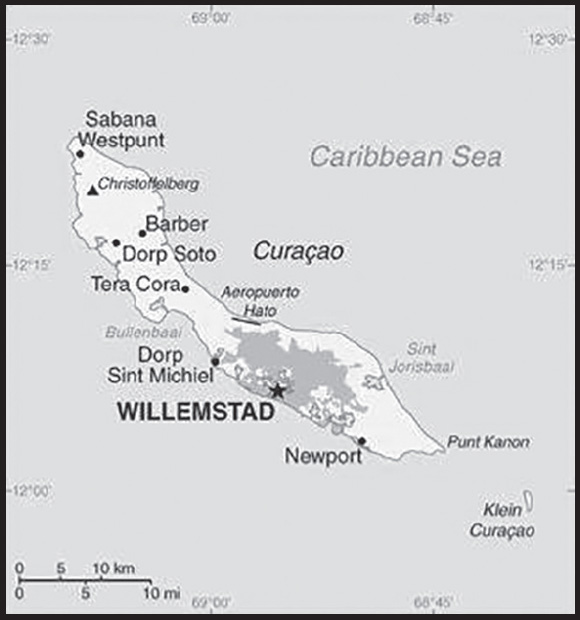
Location: Caribbean, an island in the Caribbean Sea, 55 km off the coast of Venezuela
Geographic coordinates: 12 10 N, 69 00 W
Map references: Central America and the Caribbean
Area: total: 444 sq km
land: 444 sq km
water: 0 sq km
comparison ranking: total 199
Area - comparative: more than twice the size of Washington, DC
Land boundaries: 0
Coastline: 364 km
Maritime claims: territorial sea: 12 nm
exclusive economic zone: 200 nm
Climate: tropical marine climate, ameliorated by northeast trade winds, results in mild temperatures; semiarid with average rainfall of 60 cm/year
Terrain: generally low, hilly terrain
Elevation: highest point: Mt. Christoffel 372 m
lowest point: Caribbean Sea 0 m
Natural resources: calcium phosphates, protected harbors, hot springs
Land use: agricultural land: 10% (2018 est.)
arable land: 10% (2018)
other: 90% (2018 est.)
Population distribution: largest concentration on the island is Willemstad; smaller settlements near the coast can be found throughout the island, particularly in the northwest
Natural hazards: Curacao is south of the Caribbean hurricane belt and is rarely threatened
Geography - note: Curacao is a part of the Windward Islands (southern) group in the Lesser Antilles
PEOPLE AND SOCIETY
Population: 152,849 (2023 est.)
comparison ranking: 187
Nationality: noun: Curacaoan
adjective: Curacaoan; Dutch
Ethnic groups: Curacaoan 75.4%, Dutch 6%, Dominican 3.6%, Colombian 3%, Bonairean, Sint Eustatian, Saban 1.5%, Haitian 1.2%, Surinamese 1.2%, Venezuelan 1.1%, Aruban 1.1%, other 5%, unspecified 0.9% (2011 est.)
Languages: Papiamento (official) (a creole language that is a mixture of Portuguese, Spanish, Dutch, English, and, to a lesser extent, French, as well as elements of African languages and the language of the Arawak) 80%, Dutch (official) 8.8%, Spanish 5.6%, English (official) 3.1%, other 2.3%, unspecified 0.3% (2011 est.)
note: data represent most spoken language in household
Religions: Roman Catholic 72.8%, Pentecostal 6.6%, Protestant 3.2%, Adventist 3%, Jehovah’s Witness 2%, Evangelical 1.9%, other 3.8%, none 6%, unspecified 0.6% (2011 est.)
Age structure: 0-14 years: 19.3% (male 15,107/female 14,390)
15-64 years: 62.7% (male 47,299/female 48,538)
65 years and over: 18% (2023 est.) (male 11,096/female 16,419)
Dependency ratios: total dependency ratio: 47
youth dependency ratio: 25.6
elderly dependency ratio: 21.4
potential support ratio: 4.7 (2021 est.)
Median age: total: 36.7 years (2020)
male: 34.4 years
female: 39.5 years
comparison ranking: total 77
Population growth rate: 0.3% (2023 est.)
comparison ranking: 167
Birth rate: 13.07 births/1,000 population (2023 est.)
comparison ranking: 137
Death rate: 8.78 deaths/1,000 population (2023 est.)
comparison ranking: 67
Net migration rate: -1.31 migrant(s)/1,000 population (2023 est.)
comparison ranking: 154
Population distribution: largest concentration on the island is Willemstad; smaller settlements near the coast can be found throughout the island, particularly in the northwest
Urbanization: urban population: 89% of total population (2023)
rate of urbanization: 0.57% annual rate of change (2020-25 est.)
Major urban areas - population: 144,000 WILLEMSTAD (capital) (2018)
Sex ratio: at birth: 1.05 male(s)/female
0-14 years: 1.06 male(s)/female
15-64 years: 1.01 male(s)/female
65 years and over: 0.83 male(s)/female
total population: 0.99 male(s)/female (2023 est.)
Infant mortality rate: total: 7.7 deaths/1,000 live births (2023 est.)
male: 8.5 deaths/1,000 live births
female: 6.87 deaths/1,000 live births
comparison ranking: total 153
Life expectancy at birth: total population: 79.65 years (2023 est.)
male: 77.33 years
female: 82.09 years
comparison ranking: total population 62
Total fertility rate: 1.97 children born/woman (2023 est.)
comparison ranking: 112
Gross reproduction rate: 0.96 (2023 est.)
Drinking water source: improved: total: 100% of population
unimproved: total: 0% of population (2017)
Sanitation facility access: improved: total: 100% of population
unimproved: total: 0% of population (2017)
Currently married women (ages 15-49): 49.7% (2023 est.)
Education expenditures: 7.4% of GDP (2020 est.)
comparison ranking: 16
School life expectancy (primary to tertiary education): total: 17 years
male: 18 years
female: 18 years (2013)
Youth unemployment rate (ages 15-24): total: 42.2% (2020 est.)
male: 38.1%
female: 47.1%
comparison ranking: total 8
ENVIRONMENT
Environment - current issues: problems in waste management that threaten environmental sustainability on the island include pollution of marine areas from domestic sewage, inadequate sewage treatment facilities, industrial effluents and agricultural runoff, the mismanagement of toxic substances, and ineffective regulations; the refinery in Sint Anna Bay, at the eastern edge of Willemstad’s large natural harbor, processes heavy crude oil from Venezuela; it has caused significant environmental damage to the surrounding area because of neglect and a lack of strict environmental controls; the release of noxious fumes and potentially hazardous particles causes schools downwind to regularly close
Climate: tropical marine climate, ameliorated by northeast trade winds, results in mild temperatures; semiarid with average rainfall of 60 cm/year
Land use: agricultural land: 10% (2018 est.)
arable land: 10% (2018)
other: 90% (2018 est.)
Urbanization: urban population: 89% of total population (2023)
rate of urbanization: 0.57% annual rate of change (2020-25 est.)
Revenue from forest resources: 0% of GDP (2018 est.)
comparison ranking: 182
Revenue from coal: 0% of GDP (2018 est.)
comparison ranking: 116
Air pollutants: carbon dioxide emissions: 5.39 megatons (2016 est.)
Waste and recycling: municipal solid waste generated annually: 24,704 tons (2013 est.)
municipal solid waste recycled annually: 494 tons (2013 est.)
percent of municipal solid waste recycled: 2% (2013 est.)
GOVERNMENT
Country name: conventional long form: Country of Curacao
conventional short form: Curacao
local long form: Land Curacao (Dutch)/ Pais Korsou (Papiamento)
local short form: Curacao (Dutch)/ Korsou (Papiamento)
former: Netherlands Antilles; Curacao and Dependencies
etymology: the most plausible name derivation is that the island was designated Isla de la Curacion (Spanish meaning “Island of the Cure” or “Island of Healing”) or Ilha da Curacao (Portuguese meaning the same) to reflect the locale’s function as a recovery stop for sick crewmen
Government type: parliamentary democracy
Dependency status: constituent country within the Kingdom of the Netherlands; full autonomy in internal affairs granted in 2010; Dutch Government responsible for defense and foreign affairs
Capital: name: Willemstad
geographic coordinates: 12 06 N, 68 55 W
time difference: UTC-4 (1 hour ahead of Washington, DC, during Standard Time)
etymology: named after Prince WILLIAM II of Orange (1626-1650), who served as stadtholder (Dutch head of state) from 1647 to 1650, shortly after the the Dutch captured Curacao from the Spanish in 1634
Administrative divisions: none (part of the Kingdom of the Netherlands)
note: Curacao is one of four constituent countries of the Kingdom of the Netherlands; the other three are the Netherlands, Aruba, and Sint Maarten
Independence: none (part of the Kingdom of the Netherlands)
National holiday: King’s Day (birthday of King WILLEM-ALEXANDER), 27 April (1967); note - King’s or Queen’s Day are observed on the ruling monarch’s birthday; celebrated on 26 April if 27 April is a Sunday
Constitution: history: previous 1947, 1955; latest adopted 5 September 2010, entered into force 10 October 2010 (regulates governance of Curacao but is subordinate to the Charter for the Kingdom of the Netherlands); note - in October 2010, with the dissolution of the Netherlands Antilles, Curacao became a semi-autonomous entity within the Kingdom of the Netherlands
Legal system: based on Dutch civil law
Citizenship: see the Netherlands
Suffrage: 18 years of age; universal
Executive branch: chief of state: King WILLEM-ALEXANDER of the Netherlands (since 30 April 2013); represented by Governor Lucille A. GEORGE-WOUT (since 4 November 2013)
head of government: Prime Minister Gilmar PISAS (since 14 June 2021)
cabinet: Cabinet sworn-in by the governor
elections/appointments: the monarch is hereditary; governor appointed by the monarch; following legislative elections, the leader of the majority party usually elected prime minister by the Parliament of Curacao; last election held on 19 March 2021 (next to be held in 2025)
Legislative branch: description: unicameral Parliament of Curacao (21 seats; members directly elected by party-list proportional representation vote to serve 4-year terms)
elections: last held on 19 March 2021 (next to be held in 2025)
election results: percent of vote by party - MFK 28.1%, PAR 14.1%, PNP 12.6%, MAN 6.5%, KEM 5.4%, TPK 5.3%; seats by party - MFK 9, PAR 4, PNP 4, MAN 2, KEM 1, TPK 1; composition - NA
Judicial branch: highest court(s): Joint Court of Justice of Aruba, Curacao, Sint Maarten, and of Bonaire, Sint Eustatius and Saba or “Joint Court of Justice” (sits as a 3-judge panel); final appeals heard by the Supreme Court, in The Hague, Netherlands
judge selection and term of office: Joint Court judges appointed by the monarch for life
subordinate courts: first instance courts, appeals court; specialized courts
Political parties and leaders: Korsou di Nos Tur or KdnT [Amparo dos SANTOS]
Korsou Esun Miho or KEM [Michelangelo MARTINES]
Movementu Futuro Korsou or MFK [Gilmar PISAS]
Movementu Progresivo or MP [Marylin MOSES]
Movishon Antia Nobo or MAN [Hensley KOEIMAN]
Partido Antia Restruktura or PAR [Eugene RHUGGENAATH]
Partido Inovashon Nashonal or PIN [Suzanne CAMELIA-ROMER]
Partido Nashonal di Pueblo or PNP [Ruthmilda LARMONIE-CECILIA]
Pueblo Soberano or PS [Ben WHITEMAN]
Trabou pa Kòrsou or TPK [Rennox CALMES]
Un Korsou Hustu [Omayra LEEFLANG]
International organization participation: Caricom (observer), FATF, ILO, ITU, UNESCO (associate), UPU
Diplomatic representation in the US: none (represented by the Kingdom of the Netherlands)
Diplomatic representation from the US: chief of mission: Consul General Margy BOND (since 20 January 2022); note - also accredited to Aruba and Sint Maarten
embassy: P.O. Box 158, J.B. Gorsiraweg 1
mailing address: 3160 Curacao Place, Washington DC 20521-3160
telephone: [599] (9) 461-3066
FAX: [599] (9) 461-6489
email address and website:
Flag description: on a blue field a horizontal yellow band somewhat below the center divides the flag into proportions of 5:1:2; two five-pointed white stars - the smaller above and to the left of the larger - appear in the canton; the blue of the upper and lower sections symbolizes the sky and sea respectively; yellow represents the sun; the stars symbolize Curacao and its uninhabited smaller sister island of Klein Curacao; the five star points signify the five continents from which Curacao’s people derive
National symbol(s): laraha (citrus tree); national colors: blue, yellow, white
National anthem: name: “Himmo di Korsou” (Anthem of Curacao)
lyrics/music: Guillermo ROSARIO, Mae HENRIQUEZ, Enrique MULLER, Betty DORAN/Frater Candidus NOWENS, Errol “El Toro” COLINA
note: adapted 1978; the lyrics, originally written in 1899, were rewritten in 1978 to make them less colonial in nature
National heritage: total World Heritage Sites: 1 (cultural); note - excerpted from the Netherlands entry
selected World Heritage Site locales: Historic Willemstad
ECONOMY
Economic overview: high-income island economy; developed infrastructure; tourism and financial services-based economy; investing in information technology incentives; oil refineries service Venezuela and China; unique COVID-19 stimulus support applied to government debts rather than household support
Real GDP (purchasing power parity): $3.167 billion (2021 est.) note: data are in 2017 dollars
$3.038 billion (2020 est.) note: data are in 2017 dollars
$3.725 billion (2019 est.)
comparison ranking: 191
Real GDP growth rate: 4.23% (2021 est.)
-18.44% (2020 est.)
-3.37% (2019 est.)
comparison ranking: 113
Real GDP per capita: $20,800 (2021 est.) note: data are in 2017 dollars
$19,600 (2020 est.) note: data are in 2017 dollars
$23,700 (2019 est.)
comparison ranking: 89
GDP (official exchange rate)
$5.6 billion (2012 est.)
Inflation rate (consumer prices): 2.62% (2019 est.)
2.58% (2018 est.)
1.59% (2017 est.)
comparison ranking: 128
GDP - composition, by sector of origin
agriculture: 0.7% (2012 est.)
industry: 15.5% (2012 est.)
services: 83.8% (2012 est.)
comparison rankings: services 22; industry 177; agriculture 204
GDP - composition, by end use
household consumption: 66.9% (2016 est.)
government consumption: 33.6% (2016 est.)
investment in fixed capital: 19.4% (2016 est.)
investment in inventories: 0% (2016 est.)
exports of goods and services: 17.5% (2016 est.)
imports of goods and services: -37.5% (2016 est.)
Agricultural products: aloe, sorghum, peanuts, vegetables, tropical fruit
Industries: tourism, petroleum refining, petroleum transshipment, light manufacturing, financial and business services
Labor force: 73,010 (2013)
comparison ranking: 187
Labor force - by occupation: agriculture: 1.2%
industry: 16.9%
services: 81.8% (2008 est.)
Unemployment rate: 13% (2013 est.)
9.8% (2011 est.)
comparison ranking: 52
Youth unemployment rate (ages 15-24): total: 42.2% (2020 est.)
male: 38.1%
female: 47.1%
comparison ranking: total 8
Budget surplus (+) or deficit (-): -0.4% (of GDP) (2012 est.)
comparison ranking: 57
Public debt: 33.2% of GDP (2012 est.)
40.6% of GDP (2011 est.)
comparison ranking: 162
Taxes and other revenues: 16.6% (of GDP) (2012 est.)
comparison ranking: 124
Current account balance: -$596.437 million (2021 est.)
-$688.805 million (2020 est.)
-$540.731 million (2019 est.)
comparison ranking: 123
Exports: $1.28 billion (2021 est.)
$1.014 billion (2020 est.)
$1.775 billion (2019 est.)
note: Data are in current year dollars and do not include illicit exports or re-exports.
comparison ranking: 170
Exports - partners: Switzerland 27%, United States 17%, Spain 14%, Ecuador 7%, India 7%, Antigua and Barbuda 5% (2019)
Exports - commodities: refined petroleum, crude petroleum, petroleum coke, frozen fish, fishing ships (2021)
Imports: $1.915 billion (2021 est.) note: data are in current year dollars
$1.709 billion (2020 est.) note: data are in current year dollars
$2.331 billion (2019 est.)
comparison ranking: 175
Imports - partners: United States 35%, Netherlands 24%, China 5% (2019)
Imports - commodities: refined petroleum, cars, crude petroleum, packaged medicines, perfumes (2019)
Reserves of foreign exchange and gold: $0 (31 December 2017 est.)
comparison ranking: 197
Exchange rates: Netherlands Antillean guilders (ANG) per US dollar -
Exchange rates:: 1.79 (2021 est.)
1.79 (2020 est.)
1.79 (2019 est.)
1.79 (2018 est.)
1.79 (2017 est.)
ENERGY
Electricity access: electrification - total population: 100% (2020)
Refined petroleum products - production: 189,800 bbl/day (2015 est.)
comparison ranking: 53
Refined petroleum products - exports: 167,500 bbl/day (2015 est.)
comparison ranking: 33
Refined petroleum products - imports: 45,800 bbl/day (2015 est.)
comparison ranking: 85
COMMUNICATIONS
Telephones - fixed lines: total subscriptions: 53,000 (2021 est.)
subscriptions per 100 inhabitants: 28 (2021 est.)
comparison ranking: total subscriptions 155
Telephones - mobile cellular: total subscriptions: 170,000 (2021 est.)
subscriptions per 100 inhabitants: 88 (2021 est.)
comparison ranking: total subscriptions 187
Telecommunication systems: general assessment: fully automatic modern telecommunications system; telecom sector across the Caribbean region continues to be one of the growth areas; given the lack of economic diversity in the region, with a high dependence on tourism and activities such as fisheries and offshore financial services the telecom sector contributes greatly to the GDP (2020)
domestic: roughly 28 per 100 users for fixed-line and 88 per 100 users for cellular-mobile (2021)
international: country code - +599, PCCS submarine cable system to US, Caribbean and Central and South America (2019)
Broadcast media: government-run TeleCuracao operates a TV station and a radio station; 2 other privately owned TV stations and several privately owned radio stations (2019)
Internet country code: .cw
Internet users: total: 111,956 (2021 est.)
percent of population: 68.1% (2021 est.)
comparison ranking: total 186
Broadband - fixed subscriptions: total: 55,000 (2020 est.)
subscriptions per 100 inhabitants: 34 (2020 est.)
comparison ranking: total 141
TRANSPORTATION
National air transport system: number of registered air carriers: 2 (2020)
inventory of registered aircraft operated by air carriers: 11
Civil aircraft registration country code prefix: PJ
Airports: 1 (2021)
comparison ranking: total 223
Airports - with paved runways: 1
note: paved runways have a concrete or asphalt surface but not all have facilities for refueling, maintenance, or air traffic control; the length of a runway required for aircraft to safely operate depends on a number of factors including the type of aircraft, the takeoff weight (including passengers, cargo, and fuel), engine types, flap settings, landing speed, elevation of the airport, and average maximum daily air temperature; paved runways can reach a length of 5,000 m (16,000 ft.), but the “typical” length of a commercial airline runway is between 2,500-4,000 m (8,000-13,000 ft.)
Roadways: total: 550 km
comparison ranking: total 194
Merchant marine: total: 59 (2022)
by type: general cargo 5, oil tanker 1, other 53
comparison ranking: total 114
Ports and terminals: major seaport(s): Willemstad
oil terminal(s): Bullen Baai (Curacao Terminal)
cruise port(s): Willemstad
bulk cargo port(s): Fuik Bay (phosphate rock)
MILITARY AND SECURITY
Military and security forces: no regular military forces; Curaçao Militia (CURMIL) (2023)
Military - note: defense is the responsibility of the Kingdom of the Netherlands; the Dutch Government controls foreign and defense policy; the Dutch Caribbean Coast Guard (DCCG) provides maritime security (2022)
TRANSNATIONAL ISSUES
Refugees and internally displaced persons: refugees (country of origin): 14,200 (Venezuela) (2021)
Trafficking in persons: tier rating: Tier 3 — Curacao does not fully meet the minimum standards for the elimination of trafficking and is not making significant efforts to do so, therefore Curacao was downgraded to Tier 3; the government took some steps to address trafficking, including providing pre-trial support to three victims participating in legal proceedings against traffickers, awarding restitution to two victims, and extending the national action plan that expired in December 2021; however, authorities did not convict any traffickers or identify any victims, and continued to condition assistance to foreign victims on their cooperation with law enforcement in cases against traffickers; officials conflated trafficking with migrant smuggling, and the lack of funding remained a primary obstacle to anti-trafficking efforts; limited judiciary familiarity with trafficking contributed to frequent acquittals in trafficking cases (2022)
trafficking profile: human traffickers exploit domestic and foreign victims in Curacao; undocumented migrants, especially the substantial population of Venezuelans, are vulnerable to sex and labor trafficking; traffickers exploit women and girls, particularly from Curacao, Dominican Republic, and Venezuela, in sex trafficking; migrants from other Caribbean countries, South America, China, and India are subject to forced labor in construction, domestic servitude, landscaping, minimarkets, retail, and restaurants (2022)
Illicit drugs: northbound transshipment points for cocaine from Colombia and Venezuela; cocaine is transported to the United States, other Caribbean islands, Africa, and Europe
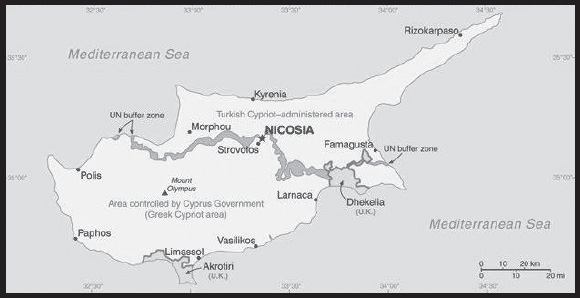
INTRODUCTION
Background: A former British colony, Cyprus became independent in 1960 following years of resistance to British rule. Tensions between the Greek Cypriot majority and Turkish Cypriot minority communities came to a head in December 1963, when violence broke out in the capital of Nicosia. Despite the deployment of UN peacekeepers in 1964, sporadic intercommunal violence continued, forcing most Turkish Cypriots into enclaves throughout the island. In 1974, a Greek Government-sponsored attempt to overthrow the elected president of Cyprus was met by military intervention from Turkey, which soon controlled more than a third of the island. In 1983, the Turkish Cypriot administered area declared itself the “Turkish Republic of Northern Cyprus” (“TRNC”), but it is recognized only by Turkey. An UN-mediated agreement, the Annan Plan, failed to win approval by both communities in 2004. In February 2014, after a hiatus of nearly two years, the leaders of the two communities resumed formal discussions under UN auspices aimed at reuniting the divided island. The most recent round of negotiations to reunify the island were suspended in July 2017 after failure to achieve a breakthrough. The entire island entered the EU on 1 May 2004, although the EU acquis - the body of common rights and obligations - applies only to the areas under the internationally recognized government, and is suspended in the “TRNC.” However, individual Turkish Cypriots able to document their eligibility for Republic of Cyprus citizenship legally enjoy the same rights accorded to other citizens of EU states.
GEOGRAPHY
Location: Middle East, island in the Mediterranean Sea, south of Turkey; note - Cyprus views itself as part of Europe; geopolitically, it can be classified as falling within Europe, the Middle East, or both
Geographic coordinates: 35 00 N, 33 00 E
Map references: Middle East
Area: total: 9,251 sq km (of which 3,355 sq km are in north Cyprus)
land: 9,241 sq km
water: 10 sq km
comparison ranking: total 169
Area - comparative: about 0.6 times the size of Connecticut
Land boundaries: total: 156 km
border sovereign base areas: Akrotiri 48 km; Dhekelia 108 km
Coastline: 648 km
Maritime claims: territorial sea: 12 nm
contiguous zone: 24 nm
continental shelf: 200-m depth or to the depth of exploitation
Climate: temperate; Mediterranean with hot, dry summers and cool winters
Terrain: central plain with mountains to north and south; scattered but significant plains along southern coast
Elevation: highest point: Mount Olympus 1,951 m
lowest point: Mediterranean Sea 0 m
mean elevation: 91 m
Natural resources: copper, pyrites, asbestos, gypsum, timber, salt, marble, clay earth pigment
Land use: agricultural land: 13.4% (2018 est.)
arable land: 9.8% (2018 est.)
permanent crops: 3.2% (2018 est.)
permanent pasture: 0.4% (2018 est.)
forest: 18.8% (2018 est.)
other: 67.8% (2018 est.)
Irrigated land: 268 sq km (2020)
Population distribution: population concentrated in central Nicosia and in the major cities of the south: Paphos, Limassol, and Larnaca
Natural hazards: moderate earthquake activity; droughts
Geography - note: the third largest island in the Mediterranean Sea (after Sicily and Sardinia); several small Cypriot enclaves exist within the Dhekelia Sovereign Base Area
PEOPLE AND SOCIETY
Population: 1,308,120 (2023 est.)
comparison ranking: 159
Nationality: noun: Cypriot(s)
adjective: Cypriot
Ethnic groups: Greek 98.8%, other 1% (includes Maronite, Armenian, Turkish-Cypriot), unspecified 0.2% (2011 est.)
note: data represent only the Greek-Cypriot citizens in the Republic of Cyprus
Languages: Greek (official) 80.9%, Turkish (official) 0.2%, English 4.1%, Romanian 2.9%, Russian 2.5%, Bulgarian 2.2%, Arabic 1.2%, Filipino 1.1%, other 4.3%, unspecified 0.6%; note - data represent only the Republic of Cyprus (2011 est.)
major-language sample(s):
Το Παγκόσμιο Βιβλίο Δεδομένων, η απαραίτητη πηγή βασικών πληροφοριών. (Greek)
Religions: Eastern Orthodox Christian 89.1%, Roman Catholic 2.9%, Protestant/Anglican 2%, Muslim 1.8%, Buddhist 1%, other (includes Maronite Catholic, Armenian Apostolic, Hindu) 1.4%, unknown 1.1%, none/atheist 0.6% (2011 est.)
note: data represent only the government-controlled area of Cyprus
Age structure: 0-14 years: 15.63% (male 104,950/female 99,515)
15-64 years: 70.36% (male 484,087/female 436,271)
65 years and over: 14.01% (2023 est.) (male 79,897/female 103,400)
Dependency ratios: total dependency ratio: 43.8
youth dependency ratio: 23
elderly dependency ratio: 20.8
potential support ratio: 4.8 (2021 est.)
note: data represent the whole country
Median age: total: 37.9 years (2020)
male: 36.7 years
female: 39.4 years
comparison ranking: total 65
Population growth rate: 1% (2023 est.)
comparison ranking: 93
Birth rate: 10.37 births/1,000 population (2023 est.)
comparison ranking: 180
Death rate: 6.99 deaths/1,000 population (2023 est.)
comparison ranking: 118
Net migration rate: 6.65 migrant(s)/1,000 population (2023 est.)
comparison ranking: 13
Population distribution: population concentrated in central Nicosia and in the major cities of the south: Paphos, Limassol, and Larnaca
Urbanization: urban population: 67% of total population (2023)
rate of urbanization: 0.76% annual rate of change (2020-25 est.)
Major urban areas - population: 269,000 NICOSIA (capital) (2018)
Sex ratio: at birth: 1.05 male(s)/female
0-14 years: 1.05 male(s)/female
15-64 years: 0.97 male(s)/female
65 years and over: 0.68 male(s)/female
total population: 0.93 male(s)/female (2023 est.)
Mother’s mean age at first birth: 30 years (2020 est.)
note: data represents only government-controlled areas
Maternal mortality ratio: 68 deaths/100,000 live births (2020 est.)
comparison ranking: 89
Infant mortality rate: total: 8.2 deaths/1,000 live births (2023 est.)
male: 9.87 deaths/1,000 live births
female: 6.46 deaths/1,000 live births
comparison ranking: total 145
Life expectancy at birth: total population: 79.96 years (2023 est.)
male: 77.18 years
female: 82.89 years
comparison ranking: total population 56
Total fertility rate: 1.48 children born/woman (2023 est.)
comparison ranking: 206
Gross reproduction rate: 0.72 (2023 est.)
Drinking water source: improved: urban: 99.7% of population
rural: 99.8% of population
total: 99.8% of population
unimproved: urban: 0.3% of population
rural: 0.2% of population
total: 0.2% of population (2020 est.)
Current health expenditure: 8.1% of GDP (2020)
Physicians density: 3.14 physicians/1,000 population (2019)
Hospital bed density: 3.4 beds/1,000 population (2017)
Sanitation facility access: improved: urban: 99.7% of population
rural: 98.8% of population
total: 99.4% of population
unimproved: urban: 0.3% of population
rural: 1.2% of population
total: 0.6% of population (2020 est.)
Obesity - adult prevalence rate: 21.8% (2016)
comparison ranking: 84
Alcohol consumption per capita: total: 9.59 liters of pure alcohol (2019 est.)
beer: 2.85 liters of pure alcohol (2019 est.)
wine: 2.72 liters of pure alcohol (2019 est.)
spirits: 4.02 liters of pure alcohol (2019 est.)
other alcohols: 0 liters of pure alcohol (2019 est.)
comparison ranking: total 26
Tobacco use: total: 35.1% (2020 est.)
male: 47% (2020 est.)
female: 23.2% (2020 est.)
comparison ranking: total 14
Currently married women (ages 15-49): 54.5% (2023 est.)
Education expenditures: 6.1% of GDP (2020 est.)
comparison ranking: 39
Literacy: definition: age 15 and over can read and write
total population: 99.4%
male: 99.6%
female: 99.2% (2021)
School life expectancy (primary to tertiary education): total: 16 years
male: 16 years
female: 16 years (2020)
Youth unemployment rate (ages 15-24): total: 11.8% (2021 est.)
male: 9.2%
female: 14.9%
comparison ranking: total 138
People - note: demographic data for Cyprus represent the population of the government-controlled area and the area administered by Turkish Cypriots, unless otherwise indicated
ENVIRONMENT
Environment - current issues: water resource problems (no natural reservoir catchments, seasonal disparity in rainfall, sea water intrusion to island’s largest aquifer, increased salination in the north); water pollution from sewage, industrial wastes, and pesticides; coastal degradation; erosion; loss of wildlife habitats from urbanization
Environment - international agreements: party to: Air Pollution, Air Pollution-Heavy Metals, Air Pollution-Multi-effect Protocol, Air Pollution-Nitrogen Oxides, Air Pollution-Persistent Organic Pollutants, Air Pollution-Sulphur 94, Biodiversity, Climate Change, Climate Change-Kyoto Protocol, Climate Change-Paris Agreement, Comprehensive Nuclear Test Ban, Desertification, Endangered Species, Environmental Modification, Hazardous Wastes, Law of the Sea, Marine Dumping-London Convention, Nuclear Test Ban, Ozone Layer Protection, Ship Pollution, Tropical Timber 2006, Wetlands, Whaling
signed, but not ratified: none of the selected agreements
Climate: temperate; Mediterranean with hot, dry summers and cool winters
Land use: agricultural land: 13.4% (2018 est.)
arable land: 9.8% (2018 est.)
permanent crops: 3.2% (2018 est.)
permanent pasture: 0.4% (2018 est.)
forest: 18.8% (2018 est.)
other: 67.8% (2018 est.)
Urbanization: urban population: 67% of total population (2023)
rate of urbanization: 0.76% annual rate of change (2020-25 est.)
Revenue from forest resources: 0% of GDP (2018 est.)
comparison ranking: 194
Revenue from coal: 0% of GDP (2018 est.)
comparison ranking: 147
Air pollutants: particulate matter emissions: 14.52 micrograms per cubic meter (2019 est.)
carbon dioxide emissions: 6.63 megatons (2016 est.)
methane emissions: 0.86 megatons (2020 est.)
Waste and recycling: municipal solid waste generated annually: 541,000 tons (2015 est.)
municipal solid waste recycled annually: 72,007 tons (2015 est.)
percent of municipal solid waste recycled: 13.3% (2015 est.)
Total water withdrawal: municipal: 100 million cubic meters (2020 est.)
industrial: 20 million cubic meters (2020 est.)
agricultural: 170 million cubic meters (2020 est.)
Total renewable water resources: 780 million cubic meters (2020 est.)
GOVERNMENT
Country name: conventional long form: Republic of Cyprus
conventional short form: Cyprus
local long form: Kypriaki Dimokratia (Greek)/ Kibris Cumhuriyeti (Turkish)
local short form: Kypros (Greek)/ Kibris (Turkish)
etymology: the derivation of the name “Cyprus” is unknown, but the extensive mining of copper metal on the island in antiquity gave rise to the Latin word “cuprum” for copper
note: the Turkish Cypriot community, which administers the northern part of the island, refers to itself as the “Turkish Republic of Northern Cyprus” or “TRNC” (“Kuzey Kibris Turk Cumhuriyeti” or “KKTC”)
Government type: Republic of Cyprus - presidential republic; self-declared “Turkish Republic of Northern Cyprus” (TRNC) - parliamentary republic with enhanced presidency
note: a separation of the two main ethnic communities inhabiting the island began following the outbreak of communal strife in 1963; this separation was further solidified when a Greek military-junta-supported coup attempt prompted the Turkish military intervention in July 1974 that gave the Turkish Cypriots de facto control in the north; Greek Cypriots control the only internationally recognized government on the island; on 15 November 1983, then Turkish Cypriot “President” Rauf DENKTAS declared independence and the formation of the “TRNC,” which is recognized only by Turkey
Capital: name: Nicosia (Lefkosia/Lefkosa)
geographic coordinates: 35 10 N, 33 22 E
time difference: UTC+2 (7 hours ahead of Washington, DC, during Standard Time)
daylight saving time: +1hr, begins last Sunday in March; ends last Sunday in October
etymology: a mispronunciation of the city’s Greek name Lefkosia and its Turkish name Lefkosa, both of which mean “White City”; the Greek name may derive from the Greek phrase “leuke ousia” (“white estate”)
Administrative divisions: 6 districts; Ammochostos (Famagusta; all but a small part located in the Turkish Cypriot community), Keryneia (Kyrenia; the only district located entirely in the Turkish Cypriot community), Larnaka (Larnaca; with a small part located in the Turkish Cypriot community), Lefkosia (Nicosia; a small part administered by Turkish Cypriots), Lemesos (Limassol), Pafos (Paphos); note - the 5 “districts” of the “Turkish Republic of Northern Cyprus” are Gazimagusa (Famagusta), Girne (Kyrenia), Guzelyurt (Morphou), Iskele (Trikomo), Lefkosa (Nicosia)
Independence: 16 August 1960 (from the UK); note - Turkish Cypriots proclaimed self-rule on 13 February 1975 and independence in 1983, but these proclamations are recognized only by Turkey
National holiday: Independence Day, 1 October (1960); note - Turkish Cypriots celebrate 15 November (1983) as “Republic Day”
Constitution: history: ratified 16 August 1960; note - in 1963, the constitution was partly suspended as Turkish Cypriots withdrew from the government; Turkish-held territory in 1983 was declared the “Turkish Republic of Northern Cyprus” (“TRNC”); in 1985, the “TRNC” approved its own constitution
amendments: constitution of the Republic of Cyprus - proposed by the House of Representatives; passage requires at least two-thirds majority vote of the total membership of the “Greek Community” and the “Turkish Community”; however, all seats of Turkish Cypriot members have remained vacant since 1964; amended many times, last in 2020; constitution of the “Turkish Republic of Northern Cyprus” - proposed by at least 10 members of the “Assembly of the Republic”; passage requires at least two-thirds majority vote of the total Assembly membership and approval by referendum; amended 2014
Legal system: mixed legal system of English common law and civil law with European law supremacy
International law organization participation: accepts compulsory ICJ jurisdiction with reservations; accepts ICCt jurisdiction
Citizenship: citizenship by birth: no
citizenship by descent only: at least one parent must be a citizen of Cyprus
dual citizenship recognized: yes
residency requirement for naturalization: 7 years
Suffrage: 18 years of age; universal
Executive branch: chief of state: President Nikos CHRISTODOULIDIS (since 28 February 2023); the president is both chief of state and head of government; note - vice presidency reserved for a Turkish Cypriot, but vacant since 1974 because Turkish Cypriots do not participate in the Republic of Cyprus Government
head of government: President Nikos CHRISTODOULIDIS (since 28 February 2023)
cabinet: Council of Ministers appointed by the president; note - under the 1960 constitution, 3 of the ministerial posts reserved for Turkish Cypriots, appointed by the vice president; positions currently filled by Greek Cypriots
elections/appointments: president directly elected by absolute majority popular vote in 2 rounds if needed for a 5-year term (limited to 2 consecutive terms); election last held on held 5 February 2023 with a runoff on 12 February 2023 (next to be held in 2028)
election results:
2023: Nikos CHRISTODOULIDIS elected president in second round; percent of vote in first round - Nikos CHRISTODOULIDIS (independent) 32%, Andreas MAVROGIIANNIS (independent) 29.6%, Averof NEOFYTOU (DISY) 26.1%, Christos CHRISTOU (ELAM) 6%, other 6.3%; percent of vote in second round - Nikos CHRISTODOULIDS 52%, Andreas MAVROGIANNIS 48%
2018: Nikos ANASTASIADIS reelected president in second round; percent of vote in first round - Nikos ANASTASIADIS (DISY) 35.5%, Stavros MALAS (AKEL) 30.2%, Nicolas PAPADOPOULOS (DIKO) 25.7%, other 8.6%; percent of vote in second round - Nikos ANASTASIADIS 56%, Stavros MALAS 44%
note: the first round of the TRNC presidential election, originally scheduled for 26 April 2020, was postponed to 11 October 2020 due to the COVID-19 pandemic; the second round was held on 18 October 2020; percent of vote in the first round - Ersin TATAR (UBP) 32.4%, Mustafa AKINCI (independent) 29.8%, Tufan ERHURMAN (RTP) 21.7%, Kudret OZERSAY (independent) 5.7%, Erhan ARIKLI (YDP) 5.4%, Serdar DENKTAS (independent) 4.2%, other 0.8%; percent of vote in the second round - Ersin TATAR 51.7%, Mustafa AKINCI 48.3%
Legislative branch: description: area under government control: unicameral House of Representatives or Vouli Antiprosopon (80 seats; 56 assigned to Greek Cypriots, 24 to Turkish Cypriots, but only those assigned to Greek Cypriots are filled; members directly elected by both proportional representation and preferential vote; members serve 5-year terms; note - 3 seats each are reserved for the Latin, Maronite, and Armenian religious groups;
area administered by Turkish Cypriots: unicameral “Assembly of the Republic” or Cumhuriyet Meclisi (50 seats; members directly elected in multi-seat constituencies by proportional representation vote using a hybrid d’Hondt method with voter preference for individual candidates
elections: area under government control; last held on 30 May 2021 (next to be held in 2026); area administered by Turkish Cypriots: last held on 23 January 2022 (next to be held in 2027)
election results: area under government control: House of Representatives - percent of vote by party/coalition - DISY 27.8%, AKEL 22.3%, DIKO 11.3%, ELAM 6.8%, EDEK-SP 6.7%, DIPA 6.1%, Movement of Ecologists - Citizens’ Cooperation 4.4%, other 14.6%; seats by party/coalition - DISY 17, AKEL 15, DIKO 9, ELAM 4, EDEK-SP 4, DIPA 4, Movement of Ecologists - Citizens’ Cooperation 3; composition - men 48, women 8, percent of women 14.3%; area administered by Turkish Cypriots - “Assembly of the Republic” - percent of vote by party - UBP 39.5%, CTP 32%, DP 7.4%, HP 6.7%, YDP 6.4%, other 8%; seats by party - UBP 24, CTP 18, DP 3, HP 3, YDP 2; composition NA
Judicial branch: highest court(s): Supreme Court of Cyprus (consists of 13 judges, including the court president); note - the highest court in the “TRNC” is the “Supreme Court” (consists of 8 “judges,” including the “court president”)
judge selection and term of office: Republic of Cyprus Supreme Court judges appointed by the president of the republic upon the recommendation of the Supreme Court judges; judges can serve until age 68; “TRNC Supreme Court” judges appointed by the “Supreme Council of Judicature,” a 12-member body of judges, the attorney general, appointees by the president of the “TRNC,” and by the “Legislative Assembly,” and members elected by the bar association; judge tenure NA
subordinate courts: Republic of Cyprus district courts; Assize Courts; Administrative Court; specialized courts for issues relating to family, industrial disputes, the military, and rent control; “TRNC Assize Courts”; “district and family courts”
Political parties and leaders: area under government control:
Citizens’ Alliance or SP [Giorgos LILLIKAS] (dissolved 2 December 2021)
Democratic Front or DIPA [Marios GAROYIAN]
Democratic Party or DIKO [Nikolas PAPADOPOULOS]
Democratic Rally or DISY [Annita DIMITRIOU]
Movement of Ecologists - Citizens’ Alliance [Charalambos THEOPEMPTOU]
Movement of Social Democrats EDEK [Marinos SIZOPOULOS]
National Popular Front or ELAM [Christos CHRISTOU]
Progressive Party of the Working People or AKEL (Communist Party) [Stefanos STEFANOU]
Solidarity Movement [Eleni THEOCHAROUS]
area administered by Turkish Cypriots:
Communal Democracy Party or TDP [Mine ATLI]
Communal Liberation Party - New Forces or TKP-YG [Mehmet CAKICI]
Cyprus Socialist Party or KSP [Mehmet BIRINCI]
Democratic Party or DP [Fikri ATAOGLU]
National Democratic Party or NDP [Buray BUSKUVUTCU]
National Unity Party or UBP [Faiz SUCUOGLU]
New Cyprus Party or YKP [Murat KANATLI]
People’s Party or HP [Kudret OZERSAY]
Rebirth Party or YDP [Erhan ARIKLI]
Republican Turkish Party or CTP [Tufan ERHURMAN]
United Cyprus Party or BKP [Izzet IZCAN]
International organization participation: Australia Group, C, CD, CE, EBRD, ECB, EIB, EMU, EU, FAO, IAEA, IBRD, ICAO, ICC (national committees), ICCt, ICRM, IDA, IFAD, IFC, IFRCS, IHO, ILO, IMF, IMO, IMSO, Interpol, IOC, IOM, IPU, ISO, ITSO, ITU, ITUC (NGOs), MIGA, NAM, NSG, OAS (observer), OIF, OPCW, OSCE, PCA, UN, UNCTAD, UNESCO, UNHCR, UNIDO, UNIFIL, UNWTO, UPU, WCO, WFTU (NGOs), WHO, WIPO, WMO, WTO
Diplomatic representation in the US: chief of mission: Ambassador Evangelos SAVVA (since 15 September 2023)
chancery: 2211 R Street NW, Washington, DC 20008
telephone: [1] (202) 462-5772
FAX: [1] (202) 483-6710
email address and website:
https://www.cyprusembassy.net/
consulate(s) general: New York
honorary consulate(s): Atlanta, Chicago, Houston, Kirkland (WA), Los Angeles, New Orleans, San Francisco
note: representative of the Turkish Cypriot community in the US is Mustafa LAKADAMYALI; office at 1667 K Street NW, Washington, DC; telephone [1] (202) 887-6198
Diplomatic representation from the US: chief of mission: Ambassador Julie D. FISHER (since 21 February 2023)
embassy: Metochiou and Ploutarchou Street, 2407, Engomi, Nicosia
mailing address: 5450 Nicosia Place, Washington DC 20521-5450
telephone: [357] (22) 393939
FAX: [357] (22) 780944
email address and website:
Flag description: centered on a white field is a copper-colored silhouette of the island (the island has long been famous for its copper deposits) above two olive-green-colored, crossed olive branches; the branches symbolize the hope for peace and reconciliation between the Greek and Turkish communities
note: one of only two national flags that uses a map as a design element; the flag of Kosovo is the other
note: the “Turkish Republic of Northern Cyprus” flag retains the white field of the Cyprus national flag but displays narrow horizontal red stripes positioned a small distance from the top and bottom edges between which are centered a red crescent and a red five-pointed star; the banner is modeled after the Turkish national flag but with the colors reversed
National symbol(s): Cypriot mouflon (wild sheep), white dove; national colors: blue, white
National anthem: name: “Ymnos eis tin Eleftherian” (Hymn to Liberty)
lyrics/music: Dionysios SOLOMOS/Nikolaos MANTZAROS
note: adopted 1960; Cyprus adopted the Greek national anthem as its own; the Turkish Cypriot community in Cyprus uses the anthem of Turkey
National heritage: total World Heritage Sites: 3 (all cultural)
selected World Heritage Site locales: Paphos; Painted Churches in the Troodos Region; Choirokoitia
ECONOMY
Economic overview: services-based, high-income EU island economy; heavy tourism; sustained growth between recovery of national banking system and COVID-19 trade restrictions; high living standards; a known financial hub, its stock exchange functions as an investment bridge between EU-and EEU-member countries
Real GDP (purchasing power parity): $37.546 billion (2021 est.)
$35.209 billion (2020 est.)
$36.819 billion (2019 est.)
note: data are in 2017 dollars
comparison ranking: 128
Real GDP growth rate: 6.64% (2021 est.)
-4.37% (2020 est.)
5.53% (2019 est.)
comparison ranking: 65
Real GDP per capita: $41,700 (2021 est.)
$39,500 (2020 est.)
$41,700 (2019 est.)
note: data are in 2017 dollars
comparison ranking: 46
GDP (official exchange rate)
$24.946 billion (2019 est.)
Inflation rate (consumer prices): 2.45% (2021 est.)
-0.64% (2020 est.)
0.25% (2019 est.)
comparison ranking: 138
Credit ratings: Fitch rating: BBB- (2018)
Moody’s rating: Ba2 (2018)
Standard & Poors rating: BBB- (2018)
note: The year refers to the year in which the current credit rating was first obtained.
GDP - composition, by sector of origin
agriculture: 2% (2017 est.)
industry: 12.5% (2017 est.)
services: 85.5% (2017 est.)
comparison rankings: services 19; industry 198; agriculture 174
GDP - composition, by end use
household consumption: 68.7% (2017 est.)
government consumption: 14.9% (2017 est.)
investment in fixed capital: 21.1% (2017 est.)
investment in inventories: -0.7% (2017 est.)
exports of goods and services: 63.8% (2017 est.)
imports of goods and services: -67.8% (2017 est.)
Agricultural products: milk, potatoes, pork, sheep milk, goat milk, barley, wheat, poultry, olives, tangerines/mandarins
Industries: tourism, food and beverage processing, cement and gypsum, ship repair and refurbishment, textiles, light chemicals, metal products, wood, paper, stone and clay products
Industrial production growth rate: 8.1% (2021 est.)
comparison ranking: 51
Labor force: 655,100 (2021 est.)
comparison ranking: 156
Labor force - by occupation: agriculture: 3.8%
industry: 15.2%
services: 81% (2014 est.)
Unemployment rate: 6.13% (2021 est.)
7.59% (2020 est.)
7.07% (2019 est.)
comparison ranking: 127
Youth unemployment rate (ages 15-24): total: 11.8% (2021 est.)
male: 9.2%
female: 14.9%
comparison ranking: total 138
Population below poverty line: 14.7% (2018 est.)
Gini Index coefficient - distribution of family income: 31.2 (2019 est.)
comparison ranking: 140
Household income or consumption by percentage share: lowest 10%: 3.3%
highest 10%: 28.8% (2014)
Budget: revenues: $10.362 billion (2019 est.)
expenditures: $9.996 billion (2019 est.)
Budget surplus (+) or deficit (-): 1.8% (of GDP) (2017 est.)
comparison ranking: 17
Public debt: 97.5% of GDP (2017 est.)
106.6% of GDP (2016 est.)
note: data cover general government debt and include debt instruments issued (or owned) by government entities other than the treasury; the data include treasury debt held by foreign entities; the data exclude debt issued by subnational entities, as well as intragovernmental debt; intragovernmental debt consists of treasury borrowings from surpluses in the social funds, such as for retirement, medical care, and unemployment
comparison ranking: 28
Taxes and other revenues: 22.42% (of GDP) (2020 est.)
comparison ranking: 67
Fiscal year: calendar year
Current account balance: -$1.957 billion (2021 est.)
-$2.523 billion (2020 est.)
-$1.445 billion (2019 est.)
comparison ranking: 156
Exports: $24.551 billion (2021 est.)
$20.379 billion (2020 est.)
$19.835 billion (2019 est.)
note: Data are in current year dollars and do not include illicit exports or re-exports.
comparison ranking: 80
Exports - partners: India 9%, Greece 9%, Libya 8%, United Kingdom 7% (2019)
Exports - commodities: ships, refined petroleum, packaged medicines, cheese, recreational boats (2021)
Imports: $23.748 billion (2021 est.) note: data are in current year dollars
$20.711 billion (2020 est.) note: data are in current year dollars
$19.575 billion (2019 est.) note: data are in current year dollars
comparison ranking: 83
Imports - partners: Greece 16%, Italy 10%, Turkey 8%, Russia 5%, Germany 5%, United Kingdom 5%, China 5% (2019)
Imports - commodities: refined petroleum, ships, cars, coal tar oil, packaged medicines (2019)
Reserves of foreign exchange and gold: $1.611 billion (31 December 2021 est.)
$1.237 billion (31 December 2020 est.)
$1.033 billion (31 December 2019 est.)
comparison ranking: 135
Debt - external: $213.19 billion (2019 est.)
$231.885 billion (2018 est.)
comparison ranking: 37
Exchange rates: euros (EUR) per US dollar -
Exchange rates:: 0.845 (2021 est.)
0.876 (2020 est.)
0.893 (2019 est.)
0.847 (2018 est.)
0.885 (2017 est.)
Economy of the area administered by Turkish Cypriots: Economy - overview: Even though the whole of the island is part of the EU, implementation of the EU “acquis communautaire” has been suspended in the area administered by Turkish Cypriots, known locally as the “Turkish Republic of Northern Cyprus” (“TRNC”), until political conditions permit the reunification of the island. The market-based economy of the “TRNC” is roughly one-fifth the size of its southern neighbor and is likewise dominated by the service sector with a large portion of the population employed by the government. In 2012 - the latest year for which data are available - the services sector, which includes the public sector, trade, tourism, and education, contributed 58.7% to economic output. In the same year, light manufacturing and agriculture contributed 2.7% and 6.2%, respectively. Manufacturing is limited mainly to food and beverages, furniture and fixtures, construction materials, metal and non-metal products, textiles and clothing. The “TRNC” maintains few economic ties with the Republic of Cyprus outside of trade in construction materials. Since its creation, the “TRNC” has heavily relied on financial assistance from Turkey, which supports the “TRNC” defense, telecommunications, water and postal services. The Turkish Lira is the preferred currency, though foreign currencies are widely accepted in business transactions. The “TRNC” remains vulnerable to the Turkish market and monetary policy because of its use of the Turkish Lira. The “TRNC” weathered the European financial crisis relatively unscathed - compared to the Republic of Cyprus - because of the lack of financial sector development, the health of the Turkish economy, and its separation from the rest of the island. The “TRNC” economy experienced growth estimated at 2.8% in 2013 and 2.3% in 2014 and is projected to grow 3.8% in 2015.;
GDP (purchasing power parity): $1.829 billion (2007 est.);
GDP - real growth rate: 2.3% (2014 est.);
2.8% (2013 est.);
GDP - per capita: $11,700 (2007 est.);
GDP - composition by sector: agriculture: 6.2%,; industry: 35.1%,; services: 58.7% (2012 est.);
Labor force: 95,030 (2007 est.);
Labor force - by occupation: agriculture: 14.5%,; industry: 29%,; services: 56.5% (2004);
Unemployment rate: 9.4% (2005 est.);
Inflation rate: 11.4% (2006);
Budget: revenues: $2.5 billion,; expenditures: $2.5 billion (2006);
Agriculture - products: citrus fruit, dairy, potatoes, grapes, olives, poultry, lamb;
Industries: foodstuffs, textiles, clothing, ship repair, clay, gypsum, copper, furniture;
Industrial production growth rate: -0.3% (2007 est.);
Electricity production: 998.9 million kWh (2005);
Electricity consumption: 797.9 million kWh (2005);
Exports: $68.1 million, f.o.b. (2007 est.);
Export - commodities: citrus, dairy, potatoes, textiles;
Export - partners: Turkey 40%; direct trade between the area administered by Turkish Cypriots and the area under government control remains limited;
Imports: $1.2 billion, f.o.b. (2007 est.);
Import - commodities: vehicles, fuel, cigarettes, food, minerals, chemicals, machinery;
Import - partners: Turkey 60%; direct trade between the area administered by Turkish Cypriots and the area under government control remains limited;
Currency (code): Turkish new lira (YTL);
Exchange rates: Turkish new lira per US dollar:; 1.9 (2013); 1.8 (2012); 1.668 (2011); 1.5026 (2010); 1.55 (2009);
ENERGY
Electricity access: electrification - total population: 100% (2021)
Electricity: installed generating capacity: 1.881 million kW (2020 est.)
consumption: 4.733 billion kWh (2019 est.)
exports: 0 kWh (2019 est.)
imports: 0 kWh (2019 est.)
transmission/distribution losses: 184 million kWh (2019 est.)
comparison rankings: installed generating capacity 121; transmission/distribution losses 148; imports 176; exports 167; consumption 127
Electricity generation sources: fossil fuels: 86.8% of total installed capacity (2020 est.)
solar: 6.9% of total installed capacity (2020 est.)
wind: 5.1% of total installed capacity (2020 est.)
biomass and waste: 1.3% of total installed capacity (2020 est.)
Petroleum: total petroleum production: 0 bbl/day (2021 est.)
refined petroleum consumption: 54,400 bbl/day (2019 est.)
Refined petroleum products - exports: 500 bbl/day (2015 est.)
comparison ranking: 110
Refined petroleum products - imports: 49,240 bbl/day (2015 est.)
comparison ranking: 84
Carbon dioxide emissions: 8.024 million metric tonnes of CO2 (2019 est.)
from petroleum and other liquids: 8.024 million metric tonnes of CO2 (2019 est.)
comparison ranking: total emissions 113
Energy consumption per capita: 133.92 million Btu/person (2019 est.)
comparison ranking: 40
COMMUNICATIONS
Telephones - fixed lines: total subscriptions: 304,581 (2021 est.)
subscriptions per 100 inhabitants: 34 (2021 est.)
comparison ranking: total subscriptions 108
Telephones - mobile cellular: total subscriptions: 1,320,794 (2021 est.)
subscriptions per 100 inhabitants: 149 (2021 est.)
comparison ranking: total subscriptions 161
Telecommunication systems: general assessment: Cyprus suffered from the effects of the pandemic in 2020 and 2021, when the tourism sector was essentially closed; during 2022, there were adverse effects caused by Russia’s invasion of Ukraine, which has resulted in a dramatic drop in the number of Russian tourists entering the country; the mobile market is served by four mobile network operators; the number of mobile subscribers fell in 2020, largely the result of subscribers scaling back on multiple SIM cards as an economic measure; the broadband market continues to develop steadily, providing the country with one of the highest broadband penetration rates in the region; DSL remains the dominant access platform, accounting for about two-thirds of fixed broadband connections; although fiber infrastructure in Cyprus is minimal (supported by the government and regulator) to extend an FttP service to about 200,000 premises; as a result, the number of DSL subscribers is set to fall steadily in coming years as customers are migrated to the fiber platform (2023)
domestic: fixed-line about 34 per 100 and about 149 per 100 for mobile-cellular teledensity (2021)
international: country code - 357 (area administered by Turkish Cypriots uses the country code of Turkey - 90); a number of submarine cables, including the SEA-ME-WE-3, CADMOS, MedNautilus Submarine System, POSEIDON, TE North/TGN-Eurasia/SEACOM/Alexandros/Medes, UGARIT, Aphrodite2, Hawk, Lev Submarine System, and Tamares combine to provide connectivity to Europe, the Middle East, Africa, Asia, Australia, and Southeast Asia; Turcyos-1 and Turcyos-2 submarine cable in Turkish North Cyprus link to Turkey; tropospheric scatter; satellite earth stations - 8 (3 Intelsat - 1 Atlantic Ocean and 2 Indian Ocean, 2 Eutelsat, 2 Intersputnik, and 1 Arabsat) (2019)
Broadcast media: mixture of state and privately run TV and radio services; the public broadcaster operates 2 TV channels and 4 radio stations; 6 private TV broadcasters, satellite and cable TV services including telecasts from Greece and Turkey, and a number of private radio stations are available; in areas administered by Turkish Cypriots, there are 2 public TV stations, 4 public radio stations, and 7 privately owned TV and 21 radio broadcast stations plus 6 radio and 4 TV channels of local universities, plus 1 radio station of military, security forces and 1 radio station of civil defense cooperation, as well as relay stations from Turkey (2019)
Internet country code: .cy
Internet users: total: 809,900 (2021 est.)
percent of population: 91% (2021 est.)
comparison ranking: total 154
Broadband - fixed subscriptions: total: 332,080 (2020 est.)
subscriptions per 100 inhabitants: 37 (2020 est.)
comparison ranking: total 103
TRANSPORTATION
National air transport system: number of registered air carriers: 2 (2020)
inventory of registered aircraft operated by air carriers: 6
annual passenger traffic on registered air carriers: 401,408 (2018)
annual freight traffic on registered air carriers: 20,000 (2018) mt-km
Civil aircraft registration country code prefix: 5B
Airports: 15 (2021)
comparison ranking: total 145
Airports - with paved runways: 13
note: paved runways have a concrete or asphalt surface but not all have facilities for refueling, maintenance, or air traffic control; the length of a runway required for aircraft to safely operate depends on a number of factors including the type of aircraft, the takeoff weight (including passengers, cargo, and fuel), engine types, flap settings, landing speed, elevation of the airport, and average maximum daily air temperature; paved runways can reach a length of 5,000 m (16,000 ft.), but the “typical” length of a commercial airline runway is between 2,500-4,000 m (8,000-13,000 ft.)
Airports - with unpaved runways: 2
note: unpaved runways have a surface composition such as grass or packed earth and are most suited to the operation of light aircraft; unpaved runways are usually short, often less than 1,000 m (3,280 ft.) in length; airports with unpaved runways often lack facilities for refueling, maintenance, or air traffic control
Heliports: 9 (2021)
Roadways: total: 12,901 km (2016)
government control: 12,901 km (2016) (includes 272 km of expressways)
paved: 8,631 km (2016)
unpaved: 4,270 km (2016)
Turkish Cypriot control: 7,000 km (2011)
comparison ranking: total 128
Merchant marine: total: 1,030 (2022)
by type: bulk carrier 255, container ship 169, general cargo 200, oil tanker 61, other 345
comparison ranking: total 24
Ports and terminals: major seaport(s): area under government control: Larnaca, Limassol, Vasilikos
area administered by Turkish Cypriots: Famagusta, Kyrenia
MILITARY AND SECURITY
Military and security forces: Republic of Cyprus: Cypriot National Guard (Ethniki Froura, EF; includes Army Land Forces, Naval Command, Air Command) (2023)
Military expenditures: 2% of GDP (2022 est.)
2% of GDP (2021)
1.8% of GDP (2020)
1.6% of GDP (2019)
1.8% of GDP (2018)
comparison ranking: 61
Military and security service personnel strengths: approximately 15,000 total active-duty personnel (2023)
Military equipment inventories and acquisitions: the military’s inventory is a mix of mostly Soviet-era weapons and equipment along with some more modern systems from several countries, including France, Israel, Russia, and Serbia (2023)
Military service age and obligation: Cypriot National Guard (CNG): 18-50 years of age for compulsory military service for all Greek Cypriot males; 17 years of age for voluntary service; 14-month service obligation (2023)
note: the CNG accepts all foreign nationals of at least partial Cypriot descent under age 32 as volunteers; dual citizenship Cypriot origin citizens, who were born in Cyprus or abroad, have the obligation to serve in the CNG on repatriation, regardless of whether or not they possess a foreign citizenship; a person is considered as having Cypriot origin where a grandparent or parent was/is a Cypriot citizen
Military - note: established in 1964, the National Guard (EF) is responsible for ensuring Cyprus’s territorial integrity and sovereignty; its primary focus is Turkey, which invaded Cyprus in 1974 and maintains a large military presence in the unrecognized Turkish Republic of Northern Cyprus; the EF also participates in some internal missions, such as providing assistance during natural disasters; Greece is its main security partner and maintains about 1,000 troops on Cyprus; the EF has conducted training exercises with other militaries including France, Israel, and the US; since Cyprus joined the EU in 2004, the EF has actively participated in the EU’s Common Security and Defense Policy and has sent small numbers of personnel to some EU and missions; Cyprus is also part of the Organization for Security and Cooperation in Europe
the EF, particularly the Army, would rely heavily on the mobilization of approximately 50,000 available reserves during a crisis; the majority of the active Army is deployed along the “Green Line” that separates the Greek Cypriots from the Turkish Cypriots; its principal combat forces are five infantry brigades, an armored brigade, and regiments of artillery, light infantry, and special forces; the Navy has a small number of coastal patrol craft and boats, as well as a special operations unit, while the Air Force has a few combat helicopters and ground-based air defense units (2023)
TERRORISM
Terrorist group(s): Terrorist group(s): Islamic State of Iraq and ash-Sham (ISIS)
note: details about the history, aims, leadership, organization, areas of operation, tactics, targets, weapons, size, and sources of support of the group(s) appear(s) in Appendix-T
TRANSNATIONAL ISSUES
Disputes - international: hostilities in 1974 divided the island into two de facto autonomous entities, the internationally recognized Cypriot Government and a Turkish-Cypriot community (north Cyprus); the 1,000-strong UN Peacekeeping Force in Cyprus (UNFICYP) has served in Cyprus since 1964 and maintains the buffer zone between north and south; on 1 May 2004, Cyprus entered the EU still divided, with the EU’s body of legislation and standards (acquis communitaire) suspended in the north; has had maritime/economic exclusion zone disputes with Turkey, particularly over energy exploration
Refugees and internally displaced persons: refugees (country of origin): 10,869 (Syria) (mid-year 2022); 19,345 (Ukraine) (as of 5 November 2023)
IDPs: 246,000 (both Turkish and Greek Cypriots; many displaced since 1974) (2022)
stateless persons: 74 (2022)
note: 55,098 estimated refugee and migrant arrivals (January 2015-August 2023)
Illicit drugs: the ROC financial system is vulnerable to money laundering by domestic and foreign criminals; proceeds generated by illicit activity abroad pose a greater threat; primary sources of illicit proceeds are investment fraud, corruption, advance fee fraud, tax evasion, illegal drugs, and tobacco smuggling. Additionally, cybercrime, especially phishing, e-mail hacking, and ransomware use, continues to increase. Criminals have reportedly used ROC banks to launder proceeds, particularly from Russian and Ukrainian illicit activity.
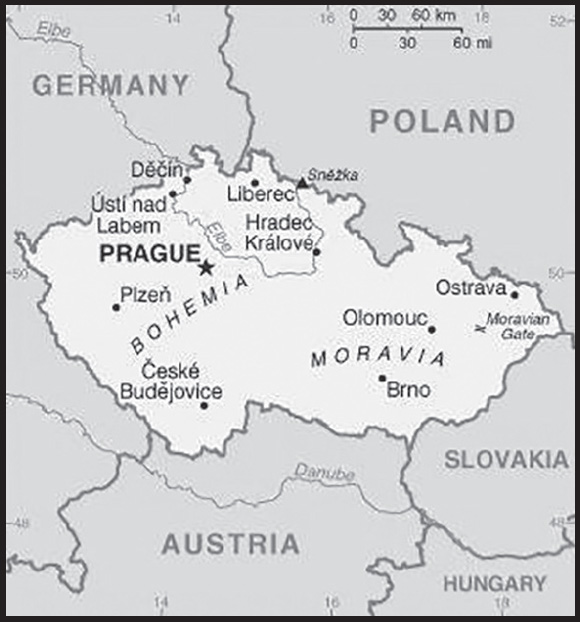
INTRODUCTION
Background: At the close of World War I, the Czechs and Slovaks of the former Austro-Hungarian Empire merged to form Czechoslovakia, a parliamentarian democracy. During the interwar years, having rejected a federal system, the new country’s predominantly Czech leaders were frequently preoccupied with meeting the increasingly strident demands of other ethnic minorities within the republic, most notably the Slovaks, the Sudeten Germans, and the Ruthenians (Ukrainians). On the eve of World War II, Nazi Germany occupied the territory that today comprises Czechia, and Slovakia became an independent state allied with Germany. After the war, a reunited but truncated Czechoslovakia (less Ruthenia) fell within the Soviet sphere of influence when the pro-Soviet Communist party staged a coup in February 1948. In 1968, an invasion by fellow Warsaw Pact troops ended the efforts of the country’s leaders to liberalize communist rule and create “socialism with a human face,” ushering in a period of repression known as “normalization.” The peaceful “Velvet Revolution” swept the Communist Party from power at the end of 1989 and inaugurated a return to democratic rule and a market economy. On 1 January 1993, the country underwent a nonviolent “velvet divorce” into its two national components, the Czech Republic and Slovakia. The Czech Republic joined NATO in 1999 and the European Union in 2004. The country formally added the short-form name Czechia in 2016, while also continuing to use the full form name, the Czech Republic.
GEOGRAPHY
Location: Central Europe, between Germany, Poland, Slovakia, and Austria
Geographic coordinates: 49 45 N, 15 30 E
Map references: Europe
Area: total: 78,867 sq km
land: 77,247 sq km
water: 1,620 sq km
comparison ranking: total 116
Area - comparative: about two-thirds the size of Pennsylvania; slightly smaller than South Carolina
Land boundaries: total: 2,046 km
border countries (4): Austria 402 km; Germany 704 km; Poland 699 km; Slovakia 241 km
Coastline: 0 km (landlocked)
Maritime claims: none (landlocked)
Climate: temperate; cool summers; cold, cloudy, humid winters
Terrain: Bohemia in the west consists of rolling plains, hills, and plateaus surrounded by low mountains; Moravia in the east consists of very hilly country
Elevation: highest point: Snezka 1,602 m
lowest point: Labe (Elbe) River 115 m
mean elevation: 433 m
Natural resources: hard coal, soft coal, kaolin, clay, graphite, timber, arable land
Land use: agricultural land: 54.8% (2018 est.)
arable land: 41% (2018 est.)
permanent crops: 1% (2018 est.)
permanent pasture: 12.8% (2018 est.)
forest: 34.4% (2018 est.)
other: 10.8% (2018 est.)
Irrigated land: 220 sq km (2020)
Major rivers (by length in km): Dunaj (Danube) (shared with Germany [s], Austria, Slovakia, Hungary, Croatia, Serbia, Bulgaria, Ukraine, Moldova, and Romania [m]) - 2,888 km; Labe (Elbe) river source (shared with Germany [m]) - 1,252 km
note – [s] after country name indicates river source; [m] after country name indicates river mouth
Major watersheds (area sq km): Atlantic Ocean drainage: (Black Sea) Danube (795,656 sq km)
Population distribution: a fairly even distribution throughout most of the country, but the northern and eastern regions tend to have larger urban concentrations
Natural hazards: flooding
Geography - note: note 1: landlocked; strategically located astride some of oldest and most significant land routes in Europe; Moravian Gate is a traditional military corridor between the North European Plain and the Danube in central Europe
note 2: the Hranice Abyss in Czechia is the world’s deepest surveyed underwater cave at 404 m (1,325 ft); its survey is not complete and it could end up being some 800-1,200 m deep
PEOPLE AND SOCIETY
Population: 10,706,242 (2023 est.)
comparison ranking: 87
Nationality: noun: Czech(s)
adjective: Czech
Ethnic groups: Czech 57.3%, Moravian 3.4%, other 7.7%, unspecified 31.6% (2021 est.)
note: includes only persons with one ethnicity
Languages: Czech (official) 88.4%, Slovak 1.5%, other 2.6%, unspecified 7.2%
note: includes only persons with one mother tongue (2021 est.)
major-language sample(s):
World Fackbook, nepostradatelný zdroj základních informací. (Czech)
Religions: Roman Catholic 7%, other believers belonging to a church or religious society 6% (includes Evangelical United Brethren Church and Czechoslovak Hussite Church), believers unaffiliated with a religious society 9.1%, none 47.8%, unspecified 30.1% (2021 est.)
Age structure: 0-14 years: 14.68% (male 808,583/female 763,540)
15-64 years: 64.18% (male 3,514,664/female 3,356,764)
65 years and over: 21.13% (2023 est.) (male 954,139/female 1,308,552)
Dependency ratios: total dependency ratio: 57.4
youth dependency ratio: 25.2
elderly dependency ratio: 32.2
potential support ratio: 3.1 (2021 est.)
Median age: total: 43.3 years (2020)
male: 42 years
female: 44.7 years
comparison ranking: total 28
Population growth rate: 0% (2023 est.)
comparison ranking: 195
Birth rate: 8.43 births/1,000 population (2023 est.)
comparison ranking: 212
Death rate: 10.77 deaths/1,000 population (2023 est.)
comparison ranking: 25
Net migration rate: 2.32 migrant(s)/1,000 population (2023 est.)
comparison ranking: 45
Population distribution: a fairly even distribution throughout most of the country, but the northern and eastern regions tend to have larger urban concentrations
Urbanization: urban population: 74.6% of total population (2023)
rate of urbanization: 0.2% annual rate of change (2020-25 est.)
Major urban areas - population: 1.323 million PRAGUE (capital) (2023)
Sex ratio: at birth: 1.05 male(s)/female
0-14 years: 1.05 male(s)/female
15-64 years: 1.11 male(s)/female
65 years and over: 0.77 male(s)/female
total population: 1.05 male(s)/female (2023 est.)
Mother’s mean age at first birth: 28.5 years (2020 est.)
Maternal mortality ratio: 3 deaths/100,000 live births (2020 est.)
comparison ranking: 182
Infant mortality rate: total: 2.37 deaths/1,000 live births (2023 est.)
male: 2.57 deaths/1,000 live births
female: 2.16 deaths/1,000 live births
comparison ranking: total 218
Life expectancy at birth: total population: 79.96 years (2023 est.)
male: 77.04 years
female: 83.03 years
comparison ranking: total population 55
Total fertility rate: 1.5 children born/woman (2023 est.)
comparison ranking: 204
Gross reproduction rate: 0.73 (2023 est.)
Drinking water source: improved: urban: 99.9% of population
rural: 99.8% of population
total: 99.9% of population
unimproved: urban: 0.1% of population
rural: 0.2% of population
total: 0.1% of population (2020 est.)
Current health expenditure: 9.2% of GDP (2020)
Physicians density: 4.15 physicians/1,000 population (2020)
Hospital bed density: 6.6 beds/1,000 population (2018)
Sanitation facility access: improved: urban: 100% of population
rural: 100% of population
total: 100% of population
unimproved: urban: 0% of population
rural: 0% of population
total: 0% of population (2020 est.)
Obesity - adult prevalence rate: 26% (2016)
comparison ranking: 46
Alcohol consumption per capita: total: 12.73 liters of pure alcohol (2019 est.)
beer: 6.77 liters of pure alcohol (2019 est.)
wine: 2.73 liters of pure alcohol (2019 est.)
spirits: 3.24 liters of pure alcohol (2019 est.)
other alcohols: 0 liters of pure alcohol (2019 est.)
comparison ranking: total 3
Tobacco use: total: 30.7% (2020 est.)
male: 35% (2020 est.)
female: 26.4% (2020 est.)
comparison ranking: total 29
Currently married women (ages 15-49): 48.4% (2023 est.)
Education expenditures: 5.1% of GDP (2020 est.)
comparison ranking: 71
Literacy: definition: NA
total population: 99%
male: 99%
female: 99% (2011)
School life expectancy (primary to tertiary education): total: 16 years
male: 16 years
female: 17 years (2020)
Youth unemployment rate (ages 15-24): total: 7.6% (2021 est.)
male: 6.9%
female: 8.7%
comparison ranking: total 172
ENVIRONMENT
Environment - current issues: air and water pollution in areas of northwest Bohemia and in northern Moravia around Ostrava present health risks; acid rain damaging forests; land pollution caused by industry, mining, and agriculture
Environment - international agreements: party to: Air Pollution, Air Pollution-Heavy Metals, Air Pollution-Multi-effect Protocol, Air Pollution-Nitrogen Oxides, Air Pollution-Persistent Organic Pollutants, Air Pollution-Sulphur 85, Air Pollution-Sulphur 94, Air Pollution-Volatile Organic Compounds, Antarctic-Environmental Protection, Antarctic Treaty, Biodiversity, Climate Change, Climate Change-Kyoto Protocol, Climate Change-Paris Agreement, Comprehensive Nuclear Test Ban, Desertification, Endangered Species, Environmental Modification, Hazardous Wastes, Law of the Sea, Nuclear Test Ban, Ozone Layer Protection, Ship Pollution, Tropical Timber 2006, Wetlands, Whaling
signed, but not ratified: none of the selected agreements
Climate: temperate; cool summers; cold, cloudy, humid winters
Land use: agricultural land: 54.8% (2018 est.)
arable land: 41% (2018 est.)
permanent crops: 1% (2018 est.)
permanent pasture: 12.8% (2018 est.)
forest: 34.4% (2018 est.)
other: 10.8% (2018 est.)
Urbanization: urban population: 74.6% of total population (2023)
rate of urbanization: 0.2% annual rate of change (2020-25 est.)
Revenue from forest resources: 0.17% of GDP (2017 est.)
comparison ranking: 97
Revenue from coal: 0.14% of GDP (2018 est.)
comparison ranking: 23
Air pollutants: particulate matter emissions: 14.34 micrograms per cubic meter (2019 est.)
carbon dioxide emissions: 102.22 megatons (2016 est.)
methane emissions: 13.11 megatons (2020 est.)
Waste and recycling: municipal solid waste generated annually: 3.337 million tons (2015 est.)
municipal solid waste recycled annually: 850,935 tons (2015 est.)
percent of municipal solid waste recycled: 25.5% (2015 est.)
Major rivers (by length in km): Dunaj (Danube) (shared with Germany [s], Austria, Slovakia, Hungary, Croatia, Serbia, Bulgaria, Ukraine, Moldova, and Romania [m]) - 2,888 km; Labe (Elbe) river source (shared with Germany [m]) - 1,252 km
note – [s] after country name indicates river source; [m] after country name indicates river mouth
Major watersheds (area sq km): Atlantic Ocean drainage: (Black Sea) Danube (795,656 sq km)
Total water withdrawal: municipal: 630 million cubic meters (2020 est.)
industrial: 700 million cubic meters (2020 est.)
agricultural: 40 million cubic meters (2020 est.)
Total renewable water resources: 13.5 billion cubic meters (2020 est.)
GOVERNMENT
Country name: conventional long form: Czech Republic
conventional short form: Czechia
local long form: Ceska republika
local short form: Cesko
etymology: name derives from the Czechs, a West Slavic tribe who rose to prominence in the late 9th century A.D.; the country officially adopted the English short-form name of Czechia on 1 July 2016
Government type: parliamentary republic
Capital: name: Prague
geographic coordinates: 50 05 N, 14 28 E
time difference: UTC+1 (6 hours ahead of Washington, DC, during Standard Time)
daylight saving time: +1hr, begins last Sunday in March; ends last Sunday in October
etymology: the name may derive from an old Slavic root “praga” or “prah”, meaning “ford”, and refer to the city’s origin at a crossing point of the Vltava (Moldau) River
Administrative divisions: 13 regions (kraje, singular - kraj) and 1 capital city* (hlavni mesto); Jihocesky (South Bohemia), Jihomoravsky (South Moravia), Karlovarsky (Karlovy Vary), Kralovehradecky (Hradec Kralove), Liberecky (Liberec), Moravskoslezsky (Moravia-Silesia), Olomoucky (Olomouc), Pardubicky (Pardubice), Plzensky (Pilsen), Praha (Prague)*, Stredocesky (Central Bohemia), Ustecky (Usti), Vysocina (Highlands), Zlinsky (Zlin)
Independence: 1 January 1993 (Czechoslovakia split into the Czech Republic and Slovakia); note - although 1 January is the day the Czech Republic came into being, the Czechs commemorate 28 October 1918, the day the former Czechoslovakia declared its independence from the Austro-Hungarian Empire, as their independence day
National holiday: Czechoslovak Founding Day, 28 October (1918)
Constitution: history: previous 1960; latest ratified 16 December 1992, effective 1 January 1993
amendments: passage requires at least three-fifths concurrence of members present in both houses of Parliament; amended several times, last in 2021
Legal system: new civil code enacted in 2014, replacing civil code of 1964 - based on former Austro-Hungarian civil codes and socialist theory - and reintroducing former Czech legal terminology
International law organization participation: has not submitted an ICJ jurisdiction declaration; accepts ICCt jurisdiction
Citizenship: citizenship by birth: no
citizenship by descent only: at least one parent must be a citizen of Czechia
dual citizenship recognized: no
residency requirement for naturalization: 5 years
Suffrage: 18 years of age; universal
Executive branch: chief of state: President Petr PAVEL (since 9 March 2023)
head of government: Prime Minister Petr FIALA (since 17 December 2021); First Deputy Prime Minister Vit RAKUSAN (since 17 December 2021), Deputy Prime Ministers Marian JURECKA, Ivan BARTOS, Vlastimil VALEK (all since 17 December 2021)
cabinet: Cabinet appointed by the president on the recommendation of the prime minister
elections/appointments: president directly elected by absolute majority popular vote in 2 rounds if needed for a 5-year term (limited to 2 consecutive terms); elections last held on 27-28 January 2023 the second round and 13-14 January 2023 for the 1st round; prime minister appointed by the president for a 4-year term
election results: 2023; 2nd Round Petr PAVEL 58.3%, Andrej BABIS 41.6%; 1st Round Petr PAVEL 35.4%, Andrej BABIS 35%, Danuse NERUDOVA 13.9%, Pavel FISCHER 6.8%
2018: Milos ZEMAN reelected president in the second round; percent of vote - Milos ZEMAN (SPO) 51.4%, Jiri DRAHOS (independent) 48.6%
Legislative branch: description: bicameral Parliament or Parlament consists of:
Senate or Senat (81 seats; members directly elected in single-seat constituencies by absolute majority vote in 2 rounds if needed; members serve 6-year terms with one-third of the membership renewed every 2 years)
Chamber of Deputies or Poslanecka Snemovna (200 seats; members directly elected in 14 multi-seat constituencies by proportional representation vote with a 5% threshold required to fill a seat; members serve 4-year terms)
elections: Senate - last held in 2 rounds on 23-24 September and 30 September and 1 October 2022 (next to be held in October 2024)
Chamber of Deputies - last held on 8-9 October 2021 (next to be held by October 2025)
election results: Senate - percent of vote by party NA; - seats by party - ODS 23, STAN 15, KDU-CSL 12, TOP 09 6, ANO 5, SEN 21 4, other 15, independent 1
Chamber of Deputies - percent of vote by party – SPOLU 27.8%, ANO 27.1%, Pirates and STAN 15.6%, SPD 9.6%, other 19.9%; seats by party - ANO 72, SPOLU 71, Pirates and STAN 37, SPD 20
Judicial branch: highest court(s): Supreme Court (organized into Civil Law and Commercial Division, and Criminal Division each with a court chief justice, vice justice, and several judges); Constitutional Court (consists of 15 justices); Supreme Administrative Court (consists of 36 judges, including the court president and vice president, and organized into 6-, 7-, and 9-member chambers)
judge selection and term of office: Supreme Court judges proposed by the Chamber of Deputies and appointed by the president; judges appointed for life; Constitutional Court judges appointed by the president and confirmed by the Senate; judges appointed for 10-year, renewable terms; Supreme Administrative Court judges selected by the president of the Court; unlimited terms
subordinate courts: High Court; regional and district courts
Political parties and leaders: Christian Democratic Union-Czechoslovak People’s Party or KDU-CSL [Marian JURECKA]
Civic Democratic Party or ODS [Petr FIALA]
Communist Party of Bohemia and Moravia or KSCM [Katerina KONECNA]
Czech Social Democratic Party or CSSD [Michal SMARDA]
Freedom and Direct Democracy or SPD [Tomio OKAMURA]
Mayors and Independents or STAN [Vit RAKUSAN]
Mayors for the Liberec Region [Martin PUTA]
Action of Dissatisfied Citizens or ANO (Akce nespokojených občanů) [Andrej BABIS]
Party of Free Citizens Svobodni [Libor VONDRACEK]
Pirate Party or Pirates [Ivan BARTOS]
Senator 21 [Vaclav LASKA]
Tradition Responsibility Prosperity 09 or TOP 09 [Marketa PEKAROVA ADAMOVA]
International organization participation: Australia Group, BIS, BSEC (observer), CD, CE, CEI, CERN, EAPC, EBRD, ECB, EIB, ESA, EU, FAO, IAEA, IBRD, ICAO, ICC (national committees), ICCt, ICRM, IDA, IEA, IFC, IFRCS, ILO, IMF, IMO, IMSO, Interpol, IOC, IOM, IPU, ISO, ITSO, ITU, ITUC (NGOs), MIGA, MONUSCO, NATO, NEA, NSG, OAS (observer), OECD, OIF (observer), OPCW, OSCE, PCA, Schengen Convention, SELEC, UN, UNCTAD, UNESCO, UNHCR, UNHRC, UNIDO, UNWTO, UPU, Wassenaar Arrangement, WCO, WFTU (NGOs), WHO, WIPO, WMO, WTO, ZC
Diplomatic representation in the US: chief of mission: Ambassador Miloslav STASEK (since 16 September 2022)
chancery: 3900 Spring of Freedom Street NW, Washington, DC 20008-3803
telephone: [1] (202) 274-9100
FAX: [1] (202) 966-8540
email address and website:
https://www.mzv.cz/washington/
consulate(s) general: Chicago, Los Angeles, New York
Diplomatic representation from the US: chief of mission: Ambassador Bijan SABET (since 15 February 2023)
embassy: Trziste 15, 118 01 Praha 1 - Mala Strana
mailing address: 5630 Prague Place, Washington DC 20521-5630
telephone: [420] 257-022-000
FAX: [420] 257-022-809
email address and website:
Flag description: two equal horizontal bands of white (top) and red with a blue isosceles triangle based on the hoist side
note: combines the white and red colors of Bohemia with blue from the arms of Moravia; is identical to the flag of the former Czechoslovakia
National symbol(s): silver (or white), double-tailed, rampant lion; national colors: white, red, blue
National anthem: name: “Kde domov muj?” (Where is My Home?)
lyrics/music: Josef Kajetan TYL/Frantisek Jan SKROUP
note: adopted 1993; the anthem was originally written as incidental music to the play “Fidlovacka” (1834), it soon became very popular as an unofficial anthem of the Czech nation; its first verse served as the official Czechoslovak anthem beginning in 1918, while the second verse (Slovak) was dropped after the split of Czechoslovakia in 1993
National heritage: total World Heritage Sites: 17 (all cultural)
selected World Heritage Site locales: Historic Prague; Historic Telč; Historic Český Krumlov; Lednice-Valtice Cultural Landscape; Historic Kutná Hora; Holy Trinity Column, Olomouc; Karlovy Vary Spa; Zatec and the Landscape of Saaz Hops
ECONOMY
Economic overview: high income, diversified EU economy; advanced services and automotive exporter; mostly intra-EU trader; low unemployment; usually maintains a positive trade balance; large investments in systems innovation and information technologies
Real GDP (purchasing power parity): $428.016 billion (2021 est.)
$413.365 billion (2020 est.)
$437.437 billion (2019 est.)
note: data are in 2017 dollars
comparison ranking: 46
Real GDP growth rate: 3.54% (2021 est.)
-5.5% (2020 est.)
3.03% (2019 est.)
comparison ranking: 134
Real GDP per capita: $40,700 (2021 est.)
$38,600 (2020 est.)
$41,000 (2019 est.)
note: data are in 2017 dollars
comparison ranking: 48
GDP (official exchange rate)
$250.631 billion (2019 est.)
Inflation rate (consumer prices): 3.84% (2021 est.)
3.16% (2020 est.)
2.85% (2019 est.)
comparison ranking: 99
Credit ratings: Fitch rating: AA- (2018)
Moody’s rating: Aa3 (2019)
Standard & Poors rating: AA- (2011)
note: The year refers to the year in which the current credit rating was first obtained.
GDP - composition, by sector of origin
agriculture: 2.3% (2017 est.)
industry: 36.9% (2017 est.)
services: 60.8% (2017 est.)
comparison rankings: services 116; industry 41; agriculture 169
GDP - composition, by end use
household consumption: 47.4% (2017 est.)
government consumption: 19.2% (2017 est.)
investment in fixed capital: 24.7% (2017 est.)
investment in inventories: 1.1% (2017 est.)
exports of goods and services: 79.9% (2017 est.)
imports of goods and services: -72.3% (2017 est.)
Agricultural products: wheat, sugar beet, milk, barley, rapeseed, potatoes, maize, pork, triticale, poultry
Industries: motor vehicles, metallurgy, machinery and equipment, glass, armaments
Industrial production growth rate: 3.3% (2021 est.)
comparison ranking: 118
Labor force: 5.266 million (2021 est.)
comparison ranking: 78
Labor force - by occupation: agriculture: 2.8%
industry: 38%
services: 59.2% (2015)
Unemployment rate: 2.89% (2021 est.)
2.55% (2020 est.)
2.01% (2019 est.)
comparison ranking: 198
Youth unemployment rate (ages 15-24): total: 7.6% (2021 est.)
male: 6.9%
female: 8.7%
comparison ranking: total 172
Population below poverty line: 10.1% (2018 est.)
Gini Index coefficient - distribution of family income: 25.3 (2019 est.)
comparison ranking: 172
Average household expenditures: on food: 16.3% of household expenditures (2018 est.)
on alcohol and tobacco: 8% of household expenditures (2018 est.)
Household income or consumption by percentage share: lowest 10%: 4.1%
highest 10%: 21.7% (2015 est.)
Budget: revenues: $103.838 billion (2019 est.)
expenditures: $103.167 billion (2019 est.)
Budget surplus (+) or deficit (-): 1.6% (of GDP) (2017 est.)
comparison ranking: 19
Public debt: 34.7% of GDP (2017 est.)
36.8% of GDP (2016 est.)
comparison ranking: 155
Taxes and other revenues: 14.34% (of GDP) (2020 est.)
comparison ranking: 152
Fiscal year: calendar year
Current account balance: -$2.282 billion (2021 est.)
$4.967 billion (2020 est.)
$898.074 million (2019 est.)
comparison ranking: 163
Exports: $204.785 billion (2021 est.)
$172.837 billion (2020 est.)
$186.545 billion (2019 est.)
note: Data are in current year dollars and do not include illicit exports or re-exports.
comparison ranking: 34
Exports - partners: Germany 31%, Slovakia 7%, Poland 6%, France 5% (2019)
Exports - commodities: cars and vehicle parts, computers, broadcasting equipment, office machinery and parts, insulated wiring (2021)
Imports: $196.243 billion (2021 est.) note: data are in current year dollars
$156.129 billion (2020 est.) note: data are in current year dollars
$171.429 billion (2019 est.) note: data are in current year dollars
comparison ranking: 34
Imports - partners: Germany 27%, China 12%, Poland 9%, Slovakia 5% (2019)
Imports - commodities: broadcasting equipment, cars and vehicle parts, office machinery/parts, computers, packaged medicines (2019)
Reserves of foreign exchange and gold: $173.618 billion (31 December 2021 est.)
$166.126 billion (31 December 2020 est.)
$149.856 billion (31 December 2019 est.)
comparison ranking: 20
Debt - external: $191.871 billion (2019 est.)
$200.197 billion (2018 est.)
comparison ranking: 40
Exchange rates: koruny (CZK) per US dollar -
Exchange rates:: 21.678 (2021 est.)
23.21 (2020 est.)
22.932 (2019 est.)
21.73 (2018 est.)
23.376 (2017 est.)
ENERGY
Electricity access: electrification - total population: 100% (2021)
Electricity: installed generating capacity: 22.485 million kW (2020 est.)
consumption: 60.814 billion kWh (2020 est.)
exports: 23.521 billion kWh (2020 est.)
imports: 13.368 billion kWh (2020 est.)
transmission/distribution losses: 4.117 billion kWh (2020 est.)
comparison rankings: transmission/distribution losses 54; imports 18; exports 9; consumption 45; installed generating capacity 42
Electricity generation sources: fossil fuels: 47% of total installed capacity (2020 est.)
nuclear: 37.6% of total installed capacity (2020 est.)
solar: 3% of total installed capacity (2020 est.)
wind: 0.9% of total installed capacity (2020 est.)
hydroelectricity: 4.5% of total installed capacity (2020 est.)
biomass and waste: 7% of total installed capacity (2020 est.)
Nuclear energy: Number of operational nuclear reactors: 6 (2023)
Number of nuclear reactors under construction: 0
Net capacity of operational nuclear reactors: 3.93GW (2023)
Percent of total electricity production: 36.7% (2021)
Percent of total energy produced: 38.3% (2021)
Number of nuclear reactors permanently shut down: 0
Coal: production: 33.806 million metric tons (2020 est.)
consumption: 37.212 million metric tons (2020 est.)
exports: 1.885 million metric tons (2020 est.)
imports: 3.795 million metric tons (2020 est.)
proven reserves: 2.927 billion metric tons (2019 est.)
Petroleum: total petroleum production: 6,300 bbl/day (2021 est.)
refined petroleum consumption: 219,500 bbl/day (2019 est.)
crude oil and lease condensate exports: 400 bbl/day (2018 est.)
crude oil and lease condensate imports: 150,200 bbl/day (2018 est.)
crude oil estimated reserves: 15 million barrels (2021 est.)
Refined petroleum products - production: 177,500 bbl/day (2017 est.)
comparison ranking: 56
Refined petroleum products - exports: 52,200 bbl/day (2017 est.)
comparison ranking: 54
Refined petroleum products - imports: 83,860 bbl/day (2017 est.)
comparison ranking: 60
Natural gas: production: 189.185 million cubic meters (2020 est.)
consumption: 8,815,133,000 cubic meters (2020 est.)
exports: 0 cubic meters (2020 est.)
imports: 7,590,318,000 cubic meters (2020 est.)
proven reserves: 3.964 billion cubic meters (2021 est.)
Carbon dioxide emissions: 99.533 million metric tonnes of CO2 (2019 est.)
from coal and metallurgical coke: 57.268 million metric tonnes of CO2 (2019 est.)
from petroleum and other liquids: 25.526 million metric tonnes of CO2 (2019 est.)
from consumed natural gas: 16.739 million metric tonnes of CO2 (2019 est.)
comparison ranking: total emissions 43
Energy consumption per capita: 161.972 million Btu/person (2019 est.)
comparison ranking: 30
COMMUNICATIONS
Telephones - fixed lines: total subscriptions: 1,294,806 (2021 est.)
subscriptions per 100 inhabitants: 12 (2021 est.)
comparison ranking: total subscriptions 65
Telephones - mobile cellular: total subscriptions: 13,129,905 (2021 est.)
subscriptions per 100 inhabitants: 125 (2021 est.)
comparison ranking: total subscriptions 76
Telecommunication systems: general assessment: the telecom market has attracted investment from among the key regional telcos; telcos in the Czech Republic have become multi-service providers, offering a full range of fixed and mobile services; this has enabled the reach of their 5G networks; this process has also been assisted by them closing down 3G networks and reforming spectrum for 5G and LTE use (2023)
domestic: roughly 12 fixed-telephone subscriptions per 100 inhabitants and mobile telephone usage of 125 per 100 inhabitants (2021)
international: country code - 420; satellite earth stations - 6 (2 Intersputnik - Atlantic and Indian Ocean regions, 1 Intelsat, 1 Eutelsat, 1 Inmarsat, 1 Globalstar) (2019)
Broadcast media: 22 TV stations operate nationally, with 17 of them in private hands; publicly operated Czech Television has 5 national channels; throughout the country, there are some 350 TV channels in operation, many through cable, satellite, and IPTV subscription services; 63 radio broadcasters are registered, operating over 80 radio stations, including 7 multiregional radio stations or networks; publicly operated broadcaster Czech Radio operates 4 national, 14 regional, and 4 Internet stations; both Czech Radio and Czech Television are partially financed through a license fee (2019)
Internet country code: .cz
Internet users: total: 9.13 million (2021 est.)
percent of population: 83% (20201 est.)
comparison ranking: total 63
Broadband - fixed subscriptions: total: 3,845,426 (2020 est.)
subscriptions per 100 inhabitants: 36 (2020 est.)
comparison ranking: total 39
TRANSPORTATION
National air transport system: number of registered air carriers: 4 (2020)
inventory of registered aircraft operated by air carriers: 48
annual passenger traffic on registered air carriers: 5,727,200 (2018)
annual freight traffic on registered air carriers: 25.23 million (2018) mt-km
Civil aircraft registration country code prefix: OK
Airports: 128 (2021)
comparison ranking: total 45
Airports - with paved runways: 41
note: paved runways have a concrete or asphalt surface but not all have facilities for refueling, maintenance, or air traffic control; the length of a runway required for aircraft to safely operate depends on a number of factors including the type of aircraft, the takeoff weight (including passengers, cargo, and fuel), engine types, flap settings, landing speed, elevation of the airport, and average maximum daily air temperature; paved runways can reach a length of 5,000 m (16,000 ft.), but the “typical” length of a commercial airline runway is between 2,500-4,000 m (8,000-13,000 ft.)
Airports - with unpaved runways: 87
note: unpaved runways have a surface composition such as grass or packed earth and are most suited to the operation of light aircraft; unpaved runways are usually short, often less than 1,000 m (3,280 ft.) in length; airports with unpaved runways often lack facilities for refueling, maintenance, or air traffic control
Heliports: 1 (2021)
Pipelines: 7,160 km gas, 675 km oil, 94 km refined products (2016)
Railways: total: 9,548 km (2020) 3,242 km electrified
comparison ranking: total 24
Roadways: total: 55,744 km (2019) (includes urban and category I, II, III roads)
paved: 55,744 km (2019) (includes 1,252 km of expressways)
comparison ranking: total 81
Waterways: 664 km (2010) (principally on Elbe, Vltava, Oder, and other navigable rivers, lakes, and canals)
comparison ranking: 84
Ports and terminals: river port(s): Prague (Vltava)
Decin, Usti nad Labem (Elbe)
MILITARY AND SECURITY
Military and security forces: Czech Armed Forces: Land Forces, Air Forces, Cyber Forces, Special Forces (2023)
Military expenditures: 1.5% of GDP (2023 est.)
1.3% of GDP (2022 est.)
1.4% of GDP (2021)
1.3% of GDP (2020)
1.2% of GDP (2019)
comparison ranking: 92
Military and security service personnel strengths: approximately 27,000 active personnel (21,000 Army; 6,000 Air Force) (2023)
Military equipment inventories and acquisitions: the Czech military has a mix of Soviet-era and more modern equipment, mostly of Western European origin from such suppliers as Austria, Germany, and Spain; Czechia has a considerable domestic defense industry; during the Cold War, Czechoslovakia was a major producer of tanks, armored personnel carriers, military trucks, and trainer aircraft (2023)
note: in 2019, Czechia announced a modernization plan to acquire more Western equipment that was compliant with NATO standards, including aircraft and armored vehicles
Military service age and obligation: 18-28 years of age for voluntary military service for men and women; conscription abolished 2004 (2023)
note: as of 2020, women comprised about 13% of the military’s full-time personnel
Military deployments: up to 130 Lithuania (NATO); 130 Slovakia (NATO) (2023)
note: in response to Russia’s invasion of Ukraine, some NATO countries have sent additional troops and equipment to the battlegroups deployed in NATO territory in eastern Europe
Military - note: the Czech military is a professional force responsible for national and territorial defense, assisting civil authorities during natural disasters or other emergencies, boosting border security alongside the police, participating in international peacekeeping operations, and supporting its collective security commitments to the EU and NATO, both of which Czechia considers pillars of its national security strategy; Czechia is a member of the Organization for Security and Cooperation in Europe, contributes to UN peacekeeping operations, and actively participates in EU military and security missions under the EU Common Security and Defense Policy; the Czech military has been an active member of NATO since the country joined in 2009 and participates in a variety of NATO’s collective defense missions, including contributing to the Enhanced Forward Presence in Eastern Europe, Baltic Air Policing operations, and NATO’s rapid response forces; it also participates in NATO operations in Kosovo and exercises regularly with NATO partners; the Czech military also maintains close bilateral ties to a number of militaries, particularly partner members of the Visegrad Group (Hungary, Poland, and Slovakia) and Germany
the military has commands for its land, air, cyber/information operations, and territorial forces, as well as a joint operations command and a special forces directorate; the principal combat forces under the Land Force Command include two mechanized brigades, an airborne regiment, and regiments of artillery, reconnaissance, and electronic warfare forces; the Air Force Command is responsible for securing Czech airspace and has about 30 Czech- and Swedish-made light multirole combat fighter aircraft organized in two squadrons, as well as small squadron of Soviet-era attack helicopters; the Territorial Command is responsible for the active reserves and regional military commands that align with each of Czechia’s 13 regions and the capital, Prague (2023)
TRANSNATIONAL ISSUES
Disputes - international: none
Refugees and internally displaced persons: refugees (country of origin): 368,685 (Ukraine) (as of 12 November 2023)
stateless persons: 1,625 (2022)
Illicit drugs: main country of origin of methamphetamine in European markets; manufacture of methamphetamine continues to be mostly based on pseudoephedrine from Poland or Turkey