D
INTRODUCTION
Background: Once the seat of Viking raiders and later a major north European power, Denmark has evolved into a modern, prosperous nation that is participating in the general political and economic integration of Europe. It joined NATO in 1949 and the EEC (now the EU) in 1973. However, the country has opted out of certain elements of the EU’s Maastricht Treaty, including the European Economic and Monetary Union, and justice and home affairs issues.
GEOGRAPHY
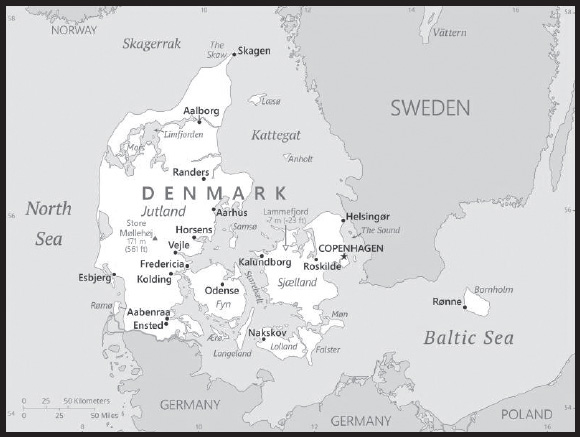
Location: Northern Europe, bordering the Baltic Sea and the North Sea, on a peninsula north of Germany (Jutland); also includes several major islands (Sjaelland, Fyn, and Bornholm)
Geographic coordinates: 56 00 N, 10 00 E
Map references: Europe
Area: total: 43,094 sq km
land: 42,434 sq km
water: 660 sq km
note: includes the island of Bornholm in the Baltic Sea and the rest of metropolitan Denmark (the Jutland Peninsula, and the major islands of Sjaelland and Fyn) but excludes the Faroe Islands and Greenland
comparison ranking: total 133
Area - comparative: slightly less than twice the size of Massachusetts; about two-thirds the size of West Virginia
Land boundaries: total: 141 km
border countries: Germany 140 km; Canada 1.3 km
Coastline: 7,314 km
Maritime claims: territorial sea: 12 nm
contiguous zone: 24 nm
exclusive economic zone: 200 nm
continental shelf: 200-m depth or to the depth of exploitation
Climate: temperate; humid and overcast; mild, windy winters and cool summers
Terrain: low and flat to gently rolling plains
Elevation: highest point: Store Mollehoj 171 m
lowest point: Lammefjord -7 m
mean elevation: 34 m
Natural resources: petroleum, natural gas, fish, arable land, salt, limestone, chalk, stone, gravel and sand
Land use: agricultural land: 63.4% (2018 est.)
arable land: 58.9% (2018 est.)
permanent crops: 0.1% (2018 est.)
permanent pasture: 4.4% (2018 est.)
forest: 12.9% (2018 est.)
other: 23.7% (2018 est.)
Irrigated land: 2,360 sq km (2020)
Population distribution: with excellent access to the North Sea, Skagerrak, Kattegat, and the Baltic Sea, population centers tend to be along coastal areas, particularly in Copenhagen and the eastern side of the country’s mainland
Natural hazards: flooding is a threat in some areas of the country (e.g., parts of Jutland, along the southern coast of the island of Lolland) that are protected from the sea by a system of dikes
Geography - note: composed of the Jutland Peninsula and a group of more than 400 islands (Danish Archipelago); controls Danish Straits (Skagerrak and Kattegat) linking Baltic and North Seas; about one-quarter of the population lives in greater Copenhagen
PEOPLE AND SOCIETY
Population: 5,946,984 (2023 est.)
comparison ranking: 114
Nationality: noun: Dane(s)
adjective: Danish
Ethnic groups: Danish (includes Greenlandic (who are predominantly Inuit) and Faroese) 85.6%, Turkish 1.1%, other 13.3% (largest groups are Polish, Syrian, Romanian, German, and Iraqi) (2022 est.)
note: data represent population by ancestry
Languages: Danish, Faroese, Greenlandic (an Inuit dialect), German (small minority); note - English is the predominant second language
major-language sample(s):
Verdens Faktabog, den uundværlig kilde til grundlæggende oplysninger. (Danish)
Religions: Evangelical Lutheran (official) 74.7%, Muslim 5.5%, other/none/unspecified (denominations of less than 1% each in descending order of size include Roman Catholic, Jehovah’s Witness, Serbian Orthodox Christian, Jewish, Baptist, Buddhist, Church of Jesus Christ, Pentecostal, and nondenominational Christian) 19.8% (2019 est.)
Demographic profile: Modern immigration to Denmark began in the 1960s and 1970s, although immigration, primarily from the Nordic countries and Western Europe, has earlier roots. Dutch migrants came in the 16th century and Germans in the 18th, in both cases to work in agriculture. Between the late 19th century and World War I, Denmark absorbed unskilled Polish, German, and Swedish labor migrants in significant numbers, sometimes at the request of the Danish Government. Between the two World Wars, Denmark received many Eastern European, Jewish, and German migrants. It wasn’t until after World War II, that refugees began seeking sanctuary in Demark, including a large number of German refugees and later Hungarians, Czechs, and Polish Jews. Denmark also imported foreign labor during the 1960s, mainly from Turkey, the former Yugoslavia, and Pakistan. Although the “guest worker” program was halted in 1973, immigrants continued to arrive to be reunited with family members who were already in Denmark as refugees or as guest workers. Non-European refugees came from Chile, Uganda, and Vietnam. In the 1990s, Denmark began receiving migrants and refugees from new places, including Russia, Hungary, Bosnia, Iran, Iraq, and Lebanon. Despite raising more restrictions on immigration, in the 2000s, Denmark continued to receive asylum seekers, particularly from Afghanistan, Iraq, Somalia, and the former Yugoslavia, as well as labor migrants from new EU member states.
In more recent years, Denmark has severely limited its refugee intake, aiming to accept as few refugees outside of the UN resettlement program as possible. In the mid-2010s, Denmark passed legislation enabling it to withdraw temporary protective status as soon as conditions in the home country, as determined by Denmark, have improved. This policy has lead Denmark, to deem Damascus and other areas in Syria safe for return, making it the only country in Europe to do so. Consequently, some Syrian refugees have had their residency status revoked, and they are detained in deportation centers because Denmark does not have diplomatic relations with Syria and, therefore, cannot send them back. Copenhagen hopes its stricter policies will discourage asylum seekers, particularly those from non-Western countries.
Age structure: 0-14 years: 16.24% (male 495,887/female 469,976)
15-64 years: 63.13% (male 1,900,182/female 1,854,222)
65 years and over: 20.63% (2023 est.) (male 566,363/female 660,354)
Dependency ratios: total dependency ratio: 57.3
youth dependency ratio: 25.4
elderly dependency ratio: 31.9
potential support ratio: 3.1 (2021 est.)
Median age: total: 42 years (2020)
male: 40.9 years
female: 43.1 years
comparison ranking: total 38
Population growth rate: 0.44% (2023 est.)
comparison ranking: 157
Birth rate: 11.25 births/1,000 population (2023 est.)
comparison ranking: 164
Death rate: 9.55 deaths/1,000 population (2023 est.)
comparison ranking: 43
Net migration rate: 2.71 migrant(s)/1,000 population (2023 est.)
comparison ranking: 41
Population distribution: with excellent access to the North Sea, Skagerrak, Kattegat, and the Baltic Sea, population centers tend to be along coastal areas, particularly in Copenhagen and the eastern side of the country’s mainland
Urbanization: urban population: 88.5% of total population (2023)
rate of urbanization: 0.54% annual rate of change (2020-25 est.)
Major urban areas - population: 1.381 million COPENHAGEN (capital) (2023)
Sex ratio: at birth: 1.07 male(s)/female
0-14 years: 1.06 male(s)/female
15-64 years: 1.02 male(s)/female
65 years and over: 0.86 male(s)/female
total population: 0.99 male(s)/female (2023 est.)
Mother’s mean age at first birth: 29.8 years (2020 est.)
Maternal mortality ratio: 5 deaths/100,000 live births (2020 est.)
comparison ranking: 167
Infant mortality rate: total: 3 deaths/1,000 live births (2023 est.)
male: 3.44 deaths/1,000 live births
female: 2.53 deaths/1,000 live births
comparison ranking: total 212
Life expectancy at birth: total population: 81.87 years (2023 est.)
male: 79.95 years
female: 83.91 years
comparison ranking: total population 37
Total fertility rate: 1.77 children born/woman (2023 est.)
comparison ranking: 149
Gross reproduction rate: 0.86 (2023 est.)
Drinking water source: improved:
total: 100% of population
unimproved: total: 0% of population (2020 est.)
Current health expenditure: 10.5% of GDP (2020)
Physicians density: 4.23 physicians/1,000 population (2018)
Hospital bed density: 2.6 beds/1,000 population (2019)
Sanitation facility access: improved:
total: 100% of population
unimproved: total: 0% of population (2020 est.)
Obesity - adult prevalence rate: 19.7% (2016)
comparison ranking: 109
Alcohol consumption per capita: total: 9.16 liters of pure alcohol (2019 est.)
beer: 3.42 liters of pure alcohol (2019 est.)
wine: 4.08 liters of pure alcohol (2019 est.)
spirits: 1.66 liters of pure alcohol (2019 est.)
other alcohols: 0 liters of pure alcohol (2019 est.)
comparison ranking: total 33
Tobacco use: total: 17.5% (2020 est.)
male: 17.8% (2020 est.)
female: 17.1% (2020 est.)
comparison ranking: total 97
Currently married women (ages 15-49): 59.6% (2023 est.)
Child marriage: women married by age 18: 0.7% (2021 est.)
Education expenditures: 6.4% of GDP (2020 est.)
comparison ranking: 32
School life expectancy (primary to tertiary education): total: 19 years
male: 18 years
female: 19 years (2020)
Youth unemployment rate (ages 15-24): total: 10.1% (2021 est.)
male: 9.7%
female: 10.6%
comparison ranking: total 151
ENVIRONMENT
Environment - current issues: air pollution, principally from vehicle and power plant emissions; nitrogen and phosphorus pollution of the North Sea; drinking and surface water becoming polluted from animal wastes and pesticides; much of country’s household and industrial waste is recycled
Environment - international agreements: party to: Air Pollution, Air Pollution-Heavy Metals, Air Pollution-Multi-effect Protocol, Air Pollution-Nitrogen Oxides, Air Pollution-Persistent Organic Pollutants, Air Pollution-Sulphur 85, Air Pollution-Sulphur 94, Air Pollution-Volatile Organic Compounds, Antarctic Treaty, Biodiversity, Climate Change, Climate Change-Kyoto Protocol, Climate Change-Paris Agreement, Comprehensive Nuclear Test Ban, Desertification, Endangered Species, Environmental Modification, Hazardous Wastes, Law of the Sea, Marine Dumping-London Convention, Marine Dumping-London Protocol, Marine Life Conservation, Nuclear Test Ban, Ozone Layer Protection, Ship Pollution, Tropical Timber 2006, Wetlands, Whaling
signed, but not ratified: Antarctic-Environmental Protection
Climate: temperate; humid and overcast; mild, windy winters and cool summers
Land use: agricultural land: 63.4% (2018 est.)
arable land: 58.9% (2018 est.)
permanent crops: 0.1% (2018 est.)
permanent pasture: 4.4% (2018 est.)
forest: 12.9% (2018 est.)
other: 23.7% (2018 est.)
Urbanization: urban population: 88.5% of total population (2023)
rate of urbanization: 0.54% annual rate of change (2020-25 est.)
Revenue from forest resources: 0.02% of GDP (2018 est.)
comparison ranking: 140
Revenue from coal: 0% of GDP (2018 est.)
comparison ranking: 108
Air pollutants: particulate matter emissions: 9.66 micrograms per cubic meter (2019 est.)
carbon dioxide emissions: 31.79 megatons (2016 est.)
methane emissions: 6.54 megatons (2020 est.)
Waste and recycling: municipal solid waste generated annually: 4.485 million tons (2015 est.)
municipal solid waste recycled annually: 1,223,060 tons (2015 est.)
percent of municipal solid waste recycled: 27.3% (2015 est.)
Total water withdrawal: municipal: 400 million cubic meters (2020 est.)
industrial: 50 million cubic meters (2020 est.)
agricultural: 530 million cubic meters (2020 est.)
Total renewable water resources: 6 billion cubic meters (2020 est.)
GOVERNMENT
Country name: conventional long form: Kingdom of Denmark
conventional short form: Denmark
local long form: Kongeriget Danmark
local short form: Danmark
etymology: the name derives from the words “Dane(s)” and “mark”; the latter referring to a march (borderland) or forest
Government type: parliamentary constitutional monarchy
Capital: name: Copenhagen
geographic coordinates: 55 40 N, 12 35 E
time difference: UTC+1 (6 hours ahead of Washington, DC, during Standard Time)
daylight saving time: +1hr, begins last Sunday in March; ends last Sunday in October; note - applies to continental Denmark only, not to its North Atlantic components
etymology: name derives from the city’s Danish appellation Kobenhavn, meaning “Merchant’s Harbor”
Administrative divisions: metropolitan Denmark - 5 regions (regioner, singular - region); Hovedstaden (Capital), Midtjylland (Central Jutland), Nordjylland (North Jutland), Sjaelland (Zealand), Syddanmark (Southern Denmark)
Independence: ca. 965 (unified and Christianized under Harald I GORMSSON); 5 June 1849 (became a parliamentary constitutional monarchy)
National holiday: Constitution Day, 5 June (1849); note - closest equivalent to a national holiday
Constitution: history: several previous; latest adopted 5 June 1953
amendments: proposed by the Folketing with consent of the government; passage requires approval by the next Folketing following a general election, approval by simple majority vote of at least 40% of voters in a referendum, and assent of the chief of state; changed several times, last in 2009 (Danish Act of Succession)
Legal system: civil law; judicial review of legislative acts
International law organization participation: accepts compulsory ICJ jurisdiction with reservations; accepts ICCt jurisdiction
Citizenship: citizenship by birth: no
citizenship by descent only: at least one parent must be a citizen of Denmark
dual citizenship recognized: yes
residency requirement for naturalization: 7 years
Suffrage: 18 years of age; universal
Executive branch: chief of state: Queen MARGRETHE II (since 14 January 1972); Heir Apparent Crown Prince FREDERIK (elder son of the monarch, born on 26 May 1968)
head of government: Prime Minister Mette FREDERIKSEN (since 27 June 2019)
cabinet: Council of State appointed by the monarch
elections/appointments: the monarchy is hereditary; following legislative elections, the leader of the majority party or majority coalition usually appointed prime minister by the monarch
Legislative branch: description: unicameral People’s Assembly or Folketing (179 seats, including 2 each representing Greenland and the Faroe Islands; members directly elected in multi-seat constituencies by party-list proportional representation vote; members serve 4-year terms unless the Folketing is dissolved earlier)
elections: last held on 1 November 2022 (next to be held on 31 October 2026)
election results:
1 November 2022: percent of vote by party - SDP 27.5%, V 13.3%, M 9.3%, SF 8.3%, E 8.1%, LA 8.1%, C 5.5%, EL 5.1%, SLP 3.8%, AP 3.3%, NB 3.3%, DF 2.6%; seats by party - SDP 50, V 23, M 16, SF 15, E 14, LA 14, C 10, EL 9, SLP 7, AP 6, NB 6, DF 5; composition - men 101, women 78, percent of women 43.6%
Judicial branch: highest court(s): Supreme Court (consists of the court president and 18 judges)
judge selection and term of office: judges appointed by the monarch upon the recommendation of the Minister of Justice, with the advice of the Judicial Appointments Council, a 6-member independent body of judges and lawyers; judges appointed for life with retirement at age 70
subordinate courts: Special Court of Indictment and Revision; 2 High Courts; Maritime and Commercial Court; county courts
Political parties and leaders: The Alternative or AP [Franciska ROSENKILDE]
Conservative People’s Party or DKF or C [Soren PAPE POULSEN]
Danish People’s Party or DF or O [Morten MESSERSCHMIDT]
Denmark Democrats or E [Inger STOJBERG]
Green Left or SF or F [Pia OLSEN DYHR] (formerly Socialist People’s Party or SF or F)
Liberal Alliance or LA or I [Alex VANOPSLAGH]
Liberal Party (Venstre) or V [Jakob ELLEMANN-JENSEN]
Moderates or M [Lars Lokke RASMUSSEN]
New Right Party or NB or D [Ann Pernille VERMUND TVEDE]
Red-Green Alliance (Unity List) or EL [collective leadership, Mai VILLADSEN, spokesperson]
Social Democrats or SDP or A [Mette FREDERIKSEN]
Social Liberal Party or SLP or B [Martin LIDEGAARD]
International organization participation: ADB (nonregional member), AfDB (nonregional member), Arctic Council, Australia Group, BIS, CBSS, CD, CE, CERN, EAPC, EBRD, ECB, EIB, EITI (implementing country), ESA, EU, FAO, FATF, G-9, IADB, IAEA, IBRD, ICAO, ICC (national committees), ICCt, ICRM, IDA, IEA, IFAD, IFC, IFRCS, IGAD (partners), IHO, ILO, IMF, IMO, IMSO, Interpol, IOC, IOM, IPU, ISO, ITSO, ITU, ITUC (NGOs), MIGA, MINUSMA, NATO, NC, NEA, NIB, NSG, OAS (observer), OECD, OPCW, OSCE, Paris Club, PCA, Schengen Convention, UN, UNCTAD, UNESCO, UNHCR, UNIDO, UNMIL, UNMISS, UNRWA, UNTSO, UPU, Wassenaar Arrangement, WCO, WHO, WIPO, WMO, WTO, ZC
Diplomatic representation in the US: chief of mission: Ambassador Jesper Møller SØRENSEN (since 15 September 2023)
chancery: 3200 Whitehaven Street NW, Washington, DC 20008
telephone: [1] (202) 234-4300
FAX: [1] (202) 328-1470
email address and website:
consulate(s) general: Chicago, Houston, New York, Silicon Valley (CA)
Diplomatic representation from the US: chief of mission: Ambassador Alan LEVENTHAL (since 1 July 2022)
embassy: Dag Hammarskjolds Alle 24, 2100 Kobenhavn 0
mailing address: 5280 Copenhagen Place, Washington DC 20521-5280
telephone: [45] 33-41-71-00
FAX: [45] 35-43-02-23
email address and website:
Flag description: red with a white cross that extends to the edges of the flag; the vertical part of the cross is shifted to the hoist side; the banner is referred to as the Dannebrog (Danish flag) and is one of the oldest national flags in the world; traditions as to the origin of the flag design vary, but the best known is a legend that the banner fell from the sky during an early-13th century battle; caught up by the Danish king before it ever touched the earth, this heavenly talisman inspired the royal army to victory; in actuality, the flag may derive from a crusade banner or ensign
note: the shifted cross design element was subsequently adopted by the other Nordic countries of Finland, Iceland, Norway, and Sweden, as well as by the Faroe Islands
National symbol(s): lion, mute swan; national colors: red, white
National anthem: name: “Der er et yndigt land” (There is a Lovely Country); “Kong Christian” (King Christian)
lyrics/music: Adam Gottlob OEHLENSCHLAGER/Hans Ernst KROYER; Johannes EWALD/unknown
note: Denmark has two national anthems with equal status; “Der er et yndigt land,” adopted 1844, is a national anthem, while “Kong Christian,” adopted 1780, serves as both a national and royal anthem; “Kong Christian” is also known as “Kong Christian stod ved hojen mast” (King Christian Stood by the Lofty Mast) and “Kongesangen” (The King’s Anthem); within Denmark, the royal anthem is played only when royalty is present and is usually followed by the national anthem; when royalty is not present, only the national anthem is performed; outside Denmark, the royal anthem is played, unless the national anthem is requested
National heritage: total World Heritage Sites: 11 (8 cultural, 3 natural); note - includes three sites in Greenland
selected World Heritage Site locales: Denmark: Mounds, Runic Stones, and Church at Jelling (c); Roskilde Cathedral (c); Kronborg Castle (c); Wadden Sea (n); Stevns Klint (n); Christiansfeld, Moravian Church Settlement (c); Par force hunting landscape, North Zealand (c); Greenland: Ilulissat Icefjord (n); Kujataa, Norse and Inuit Farming (c); Aasivissuit–Nipisat, Inuit Hunting Ground (c); Viking-Age Ring Fortresses (c)
ECONOMY
Economic overview: diversified EU trade-based economy; environmental regulatory innovator; dominant services sector; increased government spending but retaining budget surpluses; currently high inflation; unique “flexicurity” labor market
Real GDP (purchasing power parity): $352.436 billion (2022 est.)
$339.472 billion (2021 est.)
$323.751 billion (2020 est.)
note: data are in 2017 dollars
comparison ranking: 52
Real GDP growth rate: 3.8% (2022 est.)
4.86% (2021 est.)
-1.99% (2020 est.)
comparison ranking: 126
Real GDP per capita: $59,700 (2022 est.)
$58,000 (2021 est.)
$55,500 (2020 est.)
note: data are in 2017 dollars
comparison ranking: 19
GDP (official exchange rate): $350.037 billion (2019 est.)
Inflation rate (consumer prices): 1.85% (2021 est.)
0.42% (2020 est.)
0.76% (2019 est.)
comparison ranking: 163
Credit ratings: Fitch rating: AAA (2003)
Moody’s rating: Aaa (1999)
Standard & Poors rating: AAA (2001)
note: The year refers to the year in which the current credit rating was first obtained.
GDP - composition, by sector of origin
agriculture: 1.3% (2017 est.)
industry: 22.9% (2017 est.)
services: 75.8% (2017 est.)
comparison rankings: services 43; industry 124; agriculture 190
GDP - composition, by end use
household consumption: 48% (2017 est.)
government consumption: 25.2% (2017 est.)
investment in fixed capital: 20% (2017 est.)
investment in inventories: -0.2% (2017 est.)
exports of goods and services: 54.5% (2017 est.)
imports of goods and services: -47.5% (2017 est.)
Agricultural products: milk, wheat, barley, potatoes, sugar beets, pork, rye, rapeseed, oats, poultry
Industries: wind turbines, pharmaceuticals, medical equipment, shipbuilding and refurbishment, iron, steel, nonferrous metals, chemicals, food processing, machinery and transportation equipment, textiles and clothing, electronics, construction, furniture and other wood products
Industrial production growth rate: 5.25% (2021 est.)
comparison ranking: 85
Labor force: 3.051 million (2021 est.)
comparison ranking: 104
Labor force - by occupation: agriculture: 2.4%
industry: 18.3%
services: 79.3% (2016 est.)
Unemployment rate: 4.8% (2021 est.)
5.64% (2020 est.)
5.02% (2019 est.)
comparison ranking: 157
Youth unemployment rate (ages 15-24): total: 10.1% (2021 est.)
male: 9.7%
female: 10.6%
comparison ranking: total 151
Population below poverty line: 12.5% (2018 est.)
Gini Index coefficient - distribution of family income: 27.7 (2019 est.)
comparison ranking: 163
Average household expenditures: on food: 11.5% of household expenditures (2018 est.)
on alcohol and tobacco: 3.4% of household expenditures (2018 est.)
Household income or consumption by percentage share: lowest 10%: 9%
highest 10%: 23.4% (2016 est.)
Budget: revenues: $185.645 billion (2019 est.)
expenditures: $172.408 billion (2019 est.)
Budget surplus (+) or deficit (-): 1.1% (of GDP) (2017 est.)
comparison ranking: 30
Public debt: 35.3% of GDP (2017 est.)
37.9% of GDP (2016 est.)
note: data cover general government debt and include debt instruments issued (or owned) by government entities other than the treasury; the data include treasury debt held by foreign entities; the data include debt issued by subnational entities, as well as intra-governmental debt; intragovernmental debt consists of treasury borrowings from surpluses in the social funds, such as for retirement, medical care, and unemployment; debt instruments for the social funds are not sold at public auctions
comparison ranking: 153
Taxes and other revenues: 34.07% (of GDP) (2020 est.)
comparison ranking: 21
Fiscal year: calendar year
Current account balance: $32.465 billion (2021 est.)
$28.952 billion (2020 est.)
$30.55 billion (2019 est.)
comparison ranking: 18
Exports: $234.262 billion (2021 est.) note: data are in current year dollars
$195.729 billion (2020 est.) note: data are in current year dollars
$205.019 billion (2019 est.) note: data are in current year dollars
comparison ranking: 33
Exports - partners: Germany 14%, United States 10%, Sweden 10%, China 6%, Norway 5% (2021)
Exports - commodities: packaged medicines, pork, refined petroleum, electric generators, cheese (2021)
Imports: $208.121 billion (2021 est.) note: data are in current year dollars
$172.868 billion (2020 est.) note: data are in current year dollars
$179.356 billion (2019 est.) note: data are in current year dollars
comparison ranking: 33
Imports - partners: Germany 21%, Sweden 12%, China 9%, Netherlands 8%, Poland 4% (2021)
Imports - commodities: cars, packaged medicines, refined petroleum, crude petroleum, broadcasting equipment, computers (2021)
Reserves of foreign exchange and gold: $82.236 billion (31 December 2021 est.)
$72.823 billion (31 December 2020 est.)
$66.836 billion (31 December 2019 est.)
comparison ranking: 33
Debt - external: $504.808 billion (2019 est.)
$517.972 billion (2018 est.)
comparison ranking: 24
Exchange rates: Danish kroner (DKK) per US dollar -
Exchange rates:: 6.287 (2021 est.)
6.542 (2020 est.)
6.669 (2019 est.)
6.315 (2018 est.)
6.603 (2017 est.)
ENERGY
Electricity access: electrification - total population: 100% (2021)
Electricity: installed generating capacity: 17.655 million kW (2020 est.)
consumption: 33.081 billion kWh (2020 est.)
exports: 12.694 billion kWh (2020 est.)
imports: 18.891 billion kWh (2020 est.)
transmission/distribution losses: 1.573 billion kWh (2020 est.)
comparison rankings: transmission/distribution losses 98; imports 14; exports 18; consumption 59; installed generating capacity 52
Electricity generation sources: fossil fuels: 14.8% of total installed capacity (2020 est.)
solar: 4.2% of total installed capacity (2020 est.)
wind: 57.5% of total installed capacity (2020 est.)
hydroelectricity: 0.1% of total installed capacity (2020 est.)
biomass and waste: 23.5% of total installed capacity (2020 est.)
Coal: production: 0 metric tons (2020 est.)
consumption: 1.249 million metric tons (2020 est.)
exports: 194,000 metric tons (2020 est.)
imports: 1.122 million metric tons (2020 est.)
proven reserves: 0 metric tons (2019 est.)
Petroleum: total petroleum production: 69,000 bbl/day (2021 est.)
refined petroleum consumption: 165,400 bbl/day (2019 est.)
crude oil and lease condensate exports: 56,700 bbl/day (2018 est.)
crude oil and lease condensate imports: 95,200 bbl/day (2018 est.)
crude oil estimated reserves: 441 million barrels (2021 est.)
Refined petroleum products - production: 183,900 bbl/day (2017 est.)
comparison ranking: 55
Refined petroleum products - exports: 133,700 bbl/day (2017 est.)
comparison ranking: 38
Refined petroleum products - imports: 109,700 bbl/day (2017 est.)
comparison ranking: 51
Natural gas: production: 1.315 billion cubic meters (2020 est.)
consumption: 2.188 billion cubic meters (2020 est.)
exports: 1.701 billion cubic meters (2020 est.)
imports: 2.646 billion cubic meters (2020 est.)
proven reserves: 29.534 billion cubic meters (2021 est.)
Carbon dioxide emissions: 33.85 million metric tonnes of CO2 (2019 est.)
from coal and metallurgical coke: 3.455 million metric tonnes of CO2 (2019 est.)
from petroleum and other liquids: 24.621 million metric tonnes of CO2 (2019 est.)
from consumed natural gas: 5.775 million metric tonnes of CO2 (2019 est.)
comparison ranking: total emissions 73
Energy consumption per capita: 124.163 million Btu/person (2019 est.)
comparison ranking: 43
COMMUNICATIONS
Telephones - fixed lines: total subscriptions: 706,604 (2021 est.)
subscriptions per 100 inhabitants: 12 (2021 est.)
comparison ranking: total subscriptions 81
Telephones - mobile cellular: total subscriptions: 7,287,875 (2021 est.)
subscriptions per 100 inhabitants: 124 (2021 est.)
comparison ranking: total subscriptions 107
Telecommunication systems: general assessment: Denmark has one of the highest broadband subscription rates globally, with a near universal availability of super-fast connections; extensive cable and DSL infrastructure has been supported by a progressive regulatory regime which has encouraged operator access to both copper and fiber networks; fiber networks have a fast-growing footprint, while a number of community and metropolitan schemes have supplemented their own commitments to build out fiber nationally; a number of wholesale fiber schemes have also added to the wider availability of fiber broadband; the reach of LTE infrastructure is comprehensive, while the Mobile Network Operators by mid-2021 had also provided about 90% population coverage with 5G; services based on 5G were initially launched using trial 3.5GHz licenses; the multi-spectrum auction held in April 2021 has enabled them to improve the resilience and capacity of 5G; all MNOs are engaged in closing down their 3G networks and repurposing spectrum for LTE and 5G use (2021)
domestic: fixed-line roughly 12 per 100 and about 124 per 100 for mobile-cellular subscriptions (2021)
international: country code - 45; landing points for the NSC, COBRAcable, CANTAT-3, DANICE, Havfrue/AEC-2, TAT-14m Denmark-Norway-5 & 6, Skagenfiber West & East, GC1, GC2, GC3, GC-KPN, Kattegat 1 & 2 & 3, Energinet Lyngsa-Laeso, Energinet Laeso-Varberg, Fehmarn Balt, Baltica, German-Denmark 2 & 3, Ronne-Rodvig, Denmark-Sweden 15 & 16 & 17 & 18, IP-Only Denmark-Sweden, Scandinavian South, Scandinavian Ring North, Danica North, 34 series of fiber-optic submarine cables link Denmark with Canada, Faroe Islands, Germany, Iceland, Netherlands, Norway, Poland, Russia, Sweden, US, and UK; satellite earth stations - 18 (6 Intelsat, 10 Eutelsat, 1 Orion, 1 Inmarsat (Blaavand-Atlantic-East)); note - the Nordic countries (Denmark, Finland, Iceland, Norway, and Sweden) share the Danish earth station and the Eik, Norway, station for worldwide Inmarsat access (2019)
Broadcast media: strong public-sector TV presence with state-owned Danmarks Radio (DR) operating 6 channels and publicly owned TV2 operating roughly a half-dozen channels; broadcasts of privately owned stations are available via satellite and cable feed; DR operates 4 nationwide FM radio stations, 10 digital audio broadcasting stations, and 14 web-based radio stations; 140 commercial and 187 community (non-commercial) radio stations (2019)
Internet country code: .dk
Internet users: total: 5.841 million (2021 est.)
percent of population: 99% (2021 est.)
comparison ranking: total 81
Broadband - fixed subscriptions: total: 2,590,282 (2020 est.)
subscriptions per 100 inhabitants: 45 (2020 est.)
comparison ranking: total 51
TRANSPORTATION
National air transport system: number of registered air carriers: 10 (2020)
inventory of registered aircraft operated by air carriers: 76
annual passenger traffic on registered air carriers: 582,011 (2015)
annual freight traffic on registered air carriers: mt-km
Civil aircraft registration country code prefix: OY
Airports: 80 (2021)
comparison ranking: total 68
Airports - with paved runways: 28
note: paved runways have a concrete or asphalt surface but not all have facilities for refueling, maintenance, or air traffic control; the length of a runway required for aircraft to safely operate depends on a number of factors including the type of aircraft, the takeoff weight (including passengers, cargo, and fuel), engine types, flap settings, landing speed, elevation of the airport, and average maximum daily air temperature; paved runways can reach a length of 5,000 m (16,000 ft.), but the “typical” length of a commercial airline runway is between 2,500-4,000 m (8,000-13,000 ft.)
Airports - with unpaved runways: 52
note: unpaved runways have a surface composition such as grass or packed earth and are most suited to the operation of light aircraft; unpaved runways are usually short, often less than 1,000 m (3,280 ft.) in length; airports with unpaved runways often lack facilities for refueling, maintenance, or air traffic control
Pipelines: 1,536 km gas, 330 km oil (2015)
Railways: total: 2,682 km (2020) 876 km electrified
comparison ranking: total 61
Roadways: total: 74,558 km (2017)
paved: 74,558 km (2017) (includes 1,205 km of expressways)
comparison ranking: total 65
Waterways: 400 km (2010)
comparison ranking: 96
Merchant marine: total: 731 (2022)
by type: bulk carrier 13, container ship 137, general cargo 70, oil tanker 118, other 393
comparison ranking: total 32
Ports and terminals: major seaport(s): Baltic Sea - Aarhus, Copenhagen, Fredericia, Kalundborg
cruise port(s): Copenhagen
river port(s): Aalborg (Langerak)
dry bulk cargo port(s): Ensted (coal)
North Sea - Esbjerg,
Transportation - note: Denmark operates icebreakers in the Baltic Sea and Danish Straits; currently operating three PC 5 or 6 class light icebreakers
note - PC indicates a Polar Class vessel: PC 5 - year-round operation in medium first-year ice which may include old ice inclusions (ice thickness up to 70-120 cm); PC 6 - summer/autumn operation in medium first-year ice which may include old ice inclusions (ice thickness up to 30-70 cm)
MILITARY AND SECURITY
Military and security forces: Danish Armed Forces (Forsvaret): Royal Danish Army, Royal Danish Navy, Royal Danish Air Force, Danish Home Guard (Reserves) (2023)
note: the Danish military maintains a joint service Arctic Command with the mission of protecting the sovereignty of the Kingdom of Denmark in the Arctic Region, including the Faroe Islands and Greenland; the command also conducts maritime pollution prevention, environmental monitoring, fishery inspections, search and rescue, hydrographical surveys, and provides support to governmental science missions
Military expenditures: 1.7% of GDP (2023 est.)
1.4% of GDP (2022 est.)
1.4% of GDP (2021)
1.4% of GDP (2020)
1.3% of GDP (2019)
comparison ranking: 80
Military and security service personnel strengths: approximately 17,000 active-duty personnel (10,000 Army; 3,500 Navy; 3,500 Air Force) (2023)
Military equipment inventories and acquisitions: the Danish military inventory is comprised of a mix of modern European, US, and domestically produced equipment; the US has been the largest supplier of military equipment to Denmark in recent years; the Danish defense industry is active in the production of naval vessels, defense electronics, and subcomponents of larger weapons systems, such as the US F-35 fighter aircraft (2023)
Military service age and obligation: 18 years of age for compulsory and voluntary military service; conscripts serve an initial training period that varies from 4 to 12 months depending on specialization; former conscripts are assigned to mobilization units; women eligible to volunteer for military service; in addition to full time employment, the Danish military offers reserve contracts in all three branches (2023)
note 1: women have been able serve in all military occupations, including combat arms, since 1988; as of 2022, they made up about 9% of the military’s full-time personnel; conscientious objectors can choose to instead serve 6 months in a non-military position, for example in Beredskabsstyrelsen (dealing with non-military disasters like fires, flood, pollution, etc.) or overseas foreign aid work
note 2: foreigners who have lived in Denmark for at least 1 year or in another EU country for 6 years may apply to join the armed forces, provided they are fluent in Danish
note 2: Denmark has had compulsory military service since 1849
Military deployments: approximately 225 Estonia (NATO); approximately 800 Latvia (NATO) (2023)
note: in response to Russia’s 2022 invasion of Ukraine, some NATO countries, including Denmark, have sent additional troops and equipment to the battlegroups deployed in NATO territory in eastern Europe
Military - note: the Danish Armed Forces (Forsvaret) are a professional military with a variety of missions, including enforcing the country’s sovereignty, monitoring Danish waters and airspace, search and rescue, environmental protection, host nation support for alliance partners, international peacekeeping, fulfilling Denmark’s commitments to NATO, and providing assistance to the police for border control, guard tasks, air surveillance, and during national disasters and other emergencies
NATO has been a cornerstone of Danish security and defense police since it joined in 1949 as one of the organization’s original members under the North Atlantic Treaty (also known as the Washington Treaty); the Forsvaret regularly exercises with NATO allies and participates in a number of NATO missions, including its Enhanced Forward Presence in Eastern Europe, air policing in the Baltics, naval operations in the Baltic Sea and North Atlantic, and an advisory mission in Iraq; the Forsvaret leads NATO’s Multinational Division – North (inaugurated 2019), a headquarters based in Latvia that supports the defense planning of Estonia, Latvia, and Lithuania, and the coordination of regional military activities, including NATO’s forward deployed forces; it also takes part in other international missions for Europe and the UN ranging from peacekeeping in Africa to protecting Europe’s external borders by patrolling the Mediterranean Sea in support of the European Border and Coast Guard Agency; Denmark is a member of the EU and voted to join the EU’s Common Defense and Security Policy in a June 2022 referendum; the Forsvaret cooperates closely with the militaries of other Nordic countries through the Nordic Defense Cooperation (NORDEFCO; established 2009), which consists of Denmark, Finland, Iceland, Norway, and Sweden in such areas as armaments, training and exercises, and operations; it also has a joint composite special operations command with Belgium and the Netherlands
the Defense Command is Denmark’s overall military command authority for land, air, and naval operations, although the Army, Air Force, and Navy also have their own individual service commands; an Arctic Command protects the sovereignty of Denmark in the Arctic region, including the Faroe Islands and Greenland, and conducts maritime pollution prevention, environmental monitoring, fishery inspections, search and rescue, and hydrographical surveys, plus support to governmental science missions; there is also a joint service Special Operations Command, which includes the Sirius Dog Sled Patrol, an elite unit that patrols the most remote parts of northeast Greenland
established in 1614, the Royal Danish Army’s combat forces consist of two mechanized brigades; the Air Force (established in 1950) has two fighter squadrons comprised of more than 30 US-made F-16 aircraft, which are being replaced by US-origin F-35 stealth multirole fighter aircraft; the Navy was founded in the early 1500s, but Denmark has a long maritime tradition going back to the time of the Vikings; the modern Navy’s principal warships are nine frigates, three offshore patrol ships, and several other coastal patrol vessels of varying size and capabilities (2023)
SPACE
Space agency/agencies: no formal space agency; the Ministry of Higher Education and Science has responsibility for coordinating Danish space activities managing international cooperation; the Danish Space Research Institute (Dansk Rumforskningsinstitut (DRKI) was the country’s space agency from 1966-2005; DTU Space, National Space Institute, is Denmark’s national space institute (2023)
Space program overview: a member of the European Space Agency (ESA) and fully integrated within its structure; participates in ESA programs, particularly those linked to human spaceflight and satellite-based remote sensing activities, as well as technology programs involving telecommunications and navigation; independently builds and operates satellites, particularly those with meteorological, science, technology, and signal/traffic monitoring capabilities; in addition to cooperating with the ESA and EU, as well as bi-laterally with member states, it has relations with the space agencies and industries of Canada, India, Japan, and the US (2023)
note: further details about the key activities, programs, and milestones of the country’s space program, as well as government spending estimates on the space sector, appear in Appendix S
TERRORISM
Terrorist group(s): Terrorist group(s): Islamic State of Iraq and ash-Sham (ISIS); Islamic Revolutionary Guard Corps/Qods Force
note: details about the history, aims, leadership, organization, areas of operation, tactics, targets, weapons, size, and sources of support of the group(s) appear(s) in Appendix-T
TRANSNATIONAL ISSUES
Disputes - international: Iceland, the UK, and Ireland dispute Denmark’s claim that the Faroe Islands’ continental shelf extends beyond 200 nm; in 2019, Denmark signed continental shelf delimitation agreements with Iceland and Norway to parts of the continental shelf in the Ægir Basin, which is located north of the Faroe Islands
Refugees and internally displaced persons: refugees (country of origin): 19,424 (Syria), 5,885 (Eritrea) (mid-year 2022); 39,680 (Ukraine) (as of 12 November 2023)
stateless persons: 11,644 (2022)
INTRODUCTION
Background: By terms of the 1960 Treaty of Establishment that created the independent Republic of Cyprus, the UK retained full sovereignty and jurisdiction over two areas of almost 254 square kilometers - Akrotiri and Dhekelia. The larger of these is the Dhekelia Sovereign Base Area, which is also referred to as the Eastern Sovereign Base Area.
GEOGRAPHY
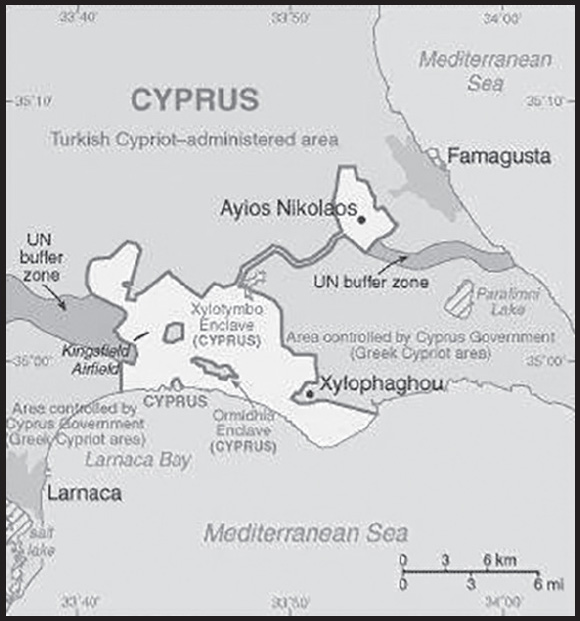
Location: Eastern Mediterranean, on the southeast coast of Cyprus near Famagusta
Geographic coordinates: 34 59 N, 33 45 E
Map references: Middle East
Area: total: 131 sq km
note: area surrounds three Cypriot enclaves
comparison ranking: total 222
Area - comparative: about three-quarters the size of Washington, DC
Land boundaries: total: 108 km
border countries (1): Cyprus 108 km
Coastline: 27.5 km
Climate: temperate; Mediterranean with hot, dry summers and cool winters
Geography - note: British extraterritorial rights also extended to several small off-post sites scattered across Cyprus; several small Cypriot enclaves exist within the Sovereign Base Area (SBA); of the SBA land, 60% is privately owned and farmed, 20% is owned by the Ministry of Defense, and 20% is SBA Crown land
PEOPLE AND SOCIETY
Population: approximately 15,500 on the Sovereign Base Areas of Akrotiri and Dhekelia including 9,700 Cypriots and 5,800 Service and UK-based contract personnel and dependents
Languages: English, Greek
major-language sample(s):
Το Παγκόσμιο Βιβλίο Δεδομένων, η απαραίτητη πηγή βασικών πληροφοριών. (Greek)
ENVIRONMENT
Environment - current issues: netting and trapping of small migrant songbirds in the spring and autumn
Climate: temperate; Mediterranean with hot, dry summers and cool winters
GOVERNMENT
Country name: conventional long form: none
conventional short form: Dhekelia
Dependency status: a special form of UK overseas territory; administered by an administrator who is also the Commander, British Forces Cyprus
Capital: name: Episkopi Cantonment (base administrative center for Akrotiri and Dhekelia); located in Akrotiri
geographic coordinates: 34 40 N, 32 51 E
time difference: UTC+2 (7 hours ahead of Washington, DC, during Standard Time)
daylight saving time: +1hr, begins last Sunday in March; ends last Sunday in October
etymology: “Episkopi” means “episcopal” in Greek and stems from the fact that the site previously served as the bishop’s seat of an Orthodox diocese
Constitution: history: presented 3 August 1960, effective 16 August 1960 (The Sovereign Base Areas of Akrotiri and Dhekelia Order in Council 1960, serves as a basic legal document); amended 1966
Legal system: laws applicable to the Cypriot population are, as far as possible, the same as the laws of the Republic of Cyprus; note - the Sovereign Base Area Administration has its own court system to deal with civil and criminal matters
Executive branch: chief of state: King CHARLES III (since 8 September 2022)
head of government: Administrator Air Vice-Marshal Peter J.M. SQUIRES (since 1 September 2022); note - the administrator reports to the British Ministry of Defense and is also Commander, British Forces Cyprus (BFC); the chief officer, an appointed civilian, is responsible for the day-to-day running of the civil government of the Sovereign Base Areas
elections/appointments: the monarchy is hereditary; administrator appointed by the monarch on the advice of the Ministry of Defense
Judicial branch: highest court(s): Senior Judges’ Court (consists of several visiting judges from England and Wales)
judge selection and term of office: see entry for United Kingdom
subordinate courts: Resident Judges’ Court; military courts
Diplomatic representation in the US: none (overseas territory of the UK)
Diplomatic representation from the US: none (overseas territory of the UK)
Flag description: the flag of the UK is used
National anthem: note: as a United Kingdom area of special sovereignty, “God Save the King” is official (see United Kingdom)
ECONOMY
Industries: none
Exchange rates: note: uses the euro
COMMUNICATIONS
Broadcast media: British Forces Broadcast Service (BFBS) provides multi-channel satellite TV service as well as BFBS radio broadcasts to the Dhekelia Sovereign Base
MILITARY AND SECURITY
Military - note: defense of Dhekelia (aka Eastern Sovereign Base Area) is the responsibility of the UK; includes Dhekelia Garrison and Ayios Nikolaos Station connected by a roadway
INTRODUCTION
Background: The region of present-day Djibouti was the site of the medieval Ifat and Adal Sultanates. In the late 19th century, treaties signed by the Afar sultans with the French allowed the latter to establish the colony of French Somaliland in 1862. The French signed additional treaties with the ethnic Somali in 1885.
Tension between the ethnic Afar and Somali populations increased over time, as the ethnic Somalis perceived that the French unfairly favored the Afar and gave them disproportionate influence in local governance. In 1958, the French held a referendum that provided residents of French Somaliland the option to either continue their association with France or to join neighboring Somalia as it established its independence. The ethnic Somali protested the vote, because French colonial leaders did not recognize many Somali as residents, which gave the Afar outsized influence in the decision to uphold ties with France. After a second referendum in 1967, the French changed the territory’s name to the French Territory of the Afars and the Issas, in part to underscore their relationship with the ethnic Afar and downplay the significance of the ethnic Somalis. A final referendum in 1977 established Djibouti as an independent nation and granted ethnic Somalis Djiboutian nationality, formally resetting the balance of power between the majority ethnic Somalis and minority ethnic Afar residents. Upon independence, the country was named after its capital city of Djibouti. Hassan Gouled APTIDON, an ethnic Somali leader, installed an authoritarian one-party state and proceeded to serve as president until 1999. Unrest between the Afar minority and Somali majority culminated in a civil war during the 1990s that ended in 2001 with a peace accord between Afar rebels and the Somali Issa-dominated government. In 1999, Djibouti’s first multiparty presidential election resulted in the election of Ismail Omar GUELLEH as president; he was reelected to a second term in 2005 and extended his tenure in office via a constitutional amendment, which allowed him to serve his third and fourth terms, and to begin a fifth term in 2021.
Djibouti occupies a strategic geographic location at the intersection of the Red Sea and the Gulf of Aden. Its ports handle 95% of Ethiopia’s trade. Djibouti’s ports also service transshipments between Europe, the Middle East, and Asia. The government holds longstanding ties to France, which maintains a military presence in the country, as does the US, Japan, Italy, Germany, Spain, and China.
GEOGRAPHY
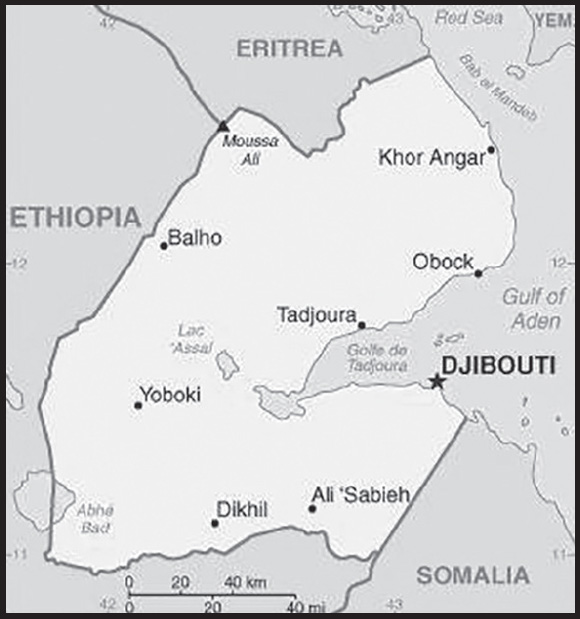
Location: Eastern Africa, bordering the Gulf of Aden and the Red Sea, between Eritrea and Somalia
Geographic coordinates: 11 30 N, 43 00 E
Map references: Africa
Area: total: 23,200 sq km
land: 23,180 sq km
water: 20 sq km
comparison ranking: total 150
Area - comparative: slightly smaller than New Jersey
Land boundaries: total: 528 km
border countries (3): Eritrea 125 km; Ethiopia 342 km; Somalia 61 km
Coastline: 314 km
Maritime claims: territorial sea: 12 nm
contiguous zone: 24 nm
exclusive economic zone: 200 nm
Climate: desert; torrid, dry
Terrain: coastal plain and plateau separated by central mountains
Elevation: highest point: Moussa Ali 2,021 m
lowest point: Lac Assal -155 m
mean elevation: 430 m
Natural resources: potential geothermal power, gold, clay, granite, limestone, marble, salt, diatomite, gypsum, pumice, petroleum
Land use: agricultural land: 73.4% (2018 est.)
arable land: 0.1% (2018 est.)
permanent crops: 0% (2018 est.)
permanent pasture: 73.3% (2018 est.)
forest: 0.2% (2018 est.)
other: 26.4% (2018 est.)
Irrigated land: 10 sq km (2012)
Major lakes (area sq km): salt water lake(s): Abhe Bad/Abhe Bid Hayk (shared with Ethiopia) - 780 sq km
Population distribution: most densely populated areas are in the east; the largest city is Djibouti, with a population over 600,000; no other city in the country has a total population over 50,000 as shown in this population distribution map
Natural hazards: earthquakes; droughts; occasional cyclonic disturbances from the Indian Ocean bring heavy rains and flash floods
volcanism: experiences limited volcanic activity; Ardoukoba (298 m) last erupted in 1978; Manda-Inakir, located along the Ethiopian border, is also historically active
Geography - note: strategic location near world’s busiest shipping lanes and close to Arabian oilfields; terminus of rail traffic into Ethiopia; mostly wasteland; Lac Assal (Lake Assal) is the lowest point in Africa and the saltiest lake in the world
PEOPLE AND SOCIETY
Population: 976,143 (2023 est.)
comparison ranking: 162
Nationality: noun: Djiboutian(s)
adjective: Djiboutian
Ethnic groups: Somali 60%, Afar 35%, other 5% (mostly Yemeni Arab, also French, Ethiopian, and Italian)
Languages: French (official), Arabic (official), Somali, Afar
Religions: Sunni Muslim 94% (nearly all Djiboutians), other 6% (mainly foreign-born residents - Shia Muslim, Christian, Hindu, Jewish, Baha’i, and atheist)
Demographic profile: Djibouti is a poor, predominantly urban country, characterized by high rates of illiteracy, unemployment, and childhood malnutrition. Approximately 70% of the population lives in cities and towns (predominantly in the capital, Djibouti). The rural population subsists primarily on nomadic herding. Prone to droughts and floods, the country has few natural resources and must import more than 80% of its food from neighboring countries or Europe. Health care, particularly outside the capital, is limited by poor infrastructure, shortages of equipment and supplies, and a lack of qualified personnel. More than a third of health care recipients are migrants because the services are still better than those available in their neighboring home countries. The nearly universal practice of female genital cutting reflects Djibouti’s lack of gender equality and is a major contributor to obstetrical complications and its high rates of maternal and infant mortality. A 1995 law prohibiting the practice has never been enforced.
Because of its political stability and its strategic location at the confluence of East Africa and the Gulf States along the Gulf of Aden and the Red Sea, Djibouti is a key transit point for migrants and asylum seekers heading for the Gulf States and beyond. Each year some 100,000 people, mainly Ethiopians and some Somalis, journey through Djibouti, usually to the port of Obock, to attempt a dangerous sea crossing to Yemen. However, with the escalation of the ongoing Yemen conflict, Yemenis began fleeing to Djibouti in March 2015, with almost 20,000 arriving by August 2017. Most Yemenis remain unregistered and head for Djibouti City rather than seeking asylum at one of Djibouti’s three spartan refugee camps. Djibouti has been hosting refugees and asylum seekers, predominantly Somalis and lesser numbers of Ethiopians and Eritreans, at camps for 20 years, despite lacking potable water, food shortages, and unemployment.
Age structure: 0-14 years: 28.65% (male 140,365/female 139,299)
15-64 years: 67.21% (male 284,488/female 371,529)
65 years and over: 4.15% (2023 est.) (male 17,757/female 22,705)
Dependency ratios: total dependency ratio: 50.6
youth dependency ratio: 47.5
elderly dependency ratio: 6.9
potential support ratio: 14.4 (2021 est.)
Median age: total: 24.9 years (2020)
male: 23 years
female: 26.4 years
comparison ranking: total 163
Population growth rate: 1.93% (2023 est.)
comparison ranking: 43
Birth rate: 22.03 births/1,000 population (2023 est.)
comparison ranking: 57
Death rate: 7.08 deaths/1,000 population (2023 est.)
comparison ranking: 116
Net migration rate: 4.37 migrant(s)/1,000 population (2023 est.)
comparison ranking: 25
Population distribution: most densely populated areas are in the east; the largest city is Djibouti, with a population over 600,000; no other city in the country has a total population over 50,000 as shown in this population distribution map
Urbanization: urban population: 78.6% of total population (2023)
rate of urbanization: 1.56% annual rate of change (2020-25 est.)
Major urban areas - population: 600,000 DJIBOUTI (capital) (2023)
Sex ratio: at birth: 1.03 male(s)/female
0-14 years: 1.01 male(s)/female
15-64 years: 0.77 male(s)/female
65 years and over: 0.78 male(s)/female
total population: 0.83 male(s)/female (2023 est.)
Maternal mortality ratio: 234 deaths/100,000 live births (2020 est.)
comparison ranking: 39
Infant mortality rate: total: 46.02 deaths/1,000 live births (2023 est.)
male: 53.12 deaths/1,000 live births
female: 38.71 deaths/1,000 live births
comparison ranking: total 25
Life expectancy at birth: total population: 65.61 years (2023 est.)
male: 63.04 years
female: 68.25 years
comparison ranking: total population 202
Total fertility rate: 2.13 children born/woman (2023 est.)
comparison ranking: 90
Gross reproduction rate: 1.05 (2023 est.)
Contraceptive prevalence rate: 19% (2012)
Drinking water source: improved: urban: 99.7% of population
rural: 59.3% of population
total: 90.8% of population
unimproved: urban: 0.3% of population
rural: 40.7% of population
total: 9.2% of population (2020 est.)
Current health expenditure: 2% of GDP (2020)
Physicians density: 0.22 physicians/1,000 population (2014)
Hospital bed density: 1.4 beds/1,000 population (2017)
Sanitation facility access: improved: urban: 87.7% of population
rural: 24.2% of population
total: 73.8% of population
unimproved: urban: 12.3% of population
rural: 75.8% of population
total: 26.2% of population (2020 est.)
Major infectious diseases: degree of risk: high (2023)
food or waterborne diseases: bacterial and protozoal diarrhea, hepatitis A, and typhoid fever
vectorborne diseases: dengue fever
Obesity - adult prevalence rate: 13.5% (2016)
comparison ranking: 131
Alcohol consumption per capita: total: 0.21 liters of pure alcohol (2019 est.)
beer: 0.05 liters of pure alcohol (2019 est.)
wine: 0.02 liters of pure alcohol (2019 est.)
spirits: 0.14 liters of pure alcohol (2019 est.)
other alcohols: 0 liters of pure alcohol (2019 est.)
comparison ranking: total 172
Children under the age of 5 years underweight: 16.2% (2019)
comparison ranking: 31
Currently married women (ages 15-49): 50.6% (2023 est.)
Child marriage: women married by age 15: 1.4%
women married by age 18: 6.5% (2019 est.)
Education expenditures: 3.6% of GDP (2018 est.)
comparison ranking: 136
School life expectancy (primary to tertiary education): total: 7 years
male: 7 years
female: 7 years (2011)
Youth unemployment rate (ages 15-24): total: 79.9% (2021 est.)
male: 78.6%
female: 82.2%
comparison ranking: total 1
ENVIRONMENT
Environment - current issues: inadequate supplies of potable water; water pollution; limited arable land; deforestation (forests threatened by agriculture and the use of wood for fuel); desertification; endangered species
Environment - international agreements: party to: Biodiversity, Climate Change, Climate Change-Kyoto Protocol, Climate Change-Paris Agreement, Comprehensive Nuclear Test Ban, Desertification, Endangered Species, Hazardous Wastes, Law of the Sea, Ozone Layer Protection, Ship Pollution, Wetlands
signed, but not ratified: none of the selected agreements
Climate: desert; torrid, dry
Land use: agricultural land: 73.4% (2018 est.)
arable land: 0.1% (2018 est.)
permanent crops: 0% (2018 est.)
permanent pasture: 73.3% (2018 est.)
forest: 0.2% (2018 est.)
other: 26.4% (2018 est.)
Urbanization: urban population: 78.6% of total population (2023)
rate of urbanization: 1.56% annual rate of change (2020-25 est.)
Food insecurity: widespread lack of access: due to unfavorable weather and high food prices - about 250,000 people were estimated to have faced acute food insecurity between March and June 2023, mainly due to the lingering impact of a prolonged and severe drought between late 2020 and early 2023, and high food prices (2023)
Revenue from forest resources: 0.26% of GDP (2018 est.)
comparison ranking: 85
Revenue from coal: 0% of GDP (2018 est.)
comparison ranking: 62
Air pollutants: particulate matter emissions: 19.98 micrograms per cubic meter (2019 est.)
carbon dioxide emissions: 0.62 megatons (2016 est.)
methane emissions: 0.52 megatons (2020 est.)
Waste and recycling: municipal solid waste generated annually: 114,997 tons (2002 est.)
Major lakes (area sq km): salt water lake(s): Abhe Bad/Abhe Bid Hayk (shared with Ethiopia) - 780 sq km
Total water withdrawal: municipal: 20 million cubic meters (2020 est.)
industrial: 0 cubic meters (2017 est.)
agricultural: 3 million cubic meters (2017 est.)
Total renewable water resources: 300 million cubic meters (2020 est.)
GOVERNMENT
Country name: conventional long form: Republic of Djibouti
conventional short form: Djibouti
local long form: Republique de Djibouti (French)/ Jumhuriyat Jibuti (Arabic)
local short form: Djibouti (French)/ Jibuti (Arabic)
former: French Somaliland, French Territory of the Afars and Issas
etymology: the country name derives from the capital city of Djibouti
Government type: presidential republic
Capital: name: Djibouti
geographic coordinates: 11 35 N, 43 09 E
time difference: UTC+3 (8 hours ahead of Washington, DC, during Standard Time)
etymology: the origin of the name is disputed; multiple descriptions, possibilities, and theories have been proposed
Administrative divisions: 6 districts (cercles, singular - cercle); Ali Sabieh, Arta, Dikhil, Djibouti, Obock, Tadjourah
Independence: 27 June 1977 (from France)
National holiday: Independence Day, 27 June (1977)
Constitution: history: approved by referendum 4 September 1992
amendments: proposed by the president of the republic or by the National Assembly; Assembly consideration of proposals requires assent of at least one third of the membership; passage requires a simple majority vote by the Assembly and approval by simple majority vote in a referendum; the president can opt to bypass a referendum if adopted by at least two-thirds majority vote of the Assembly; constitutional articles on the sovereignty of Djibouti, its republican form of government, and its pluralist form of democracy cannot be amended; amended 2006, 2008, 2010
Legal system: mixed legal system based primarily on the French civil code (as it existed in 1997), Islamic religious law (in matters of family law and successions), and customary law
International law organization participation: accepts compulsory ICJ jurisdiction with reservations; accepts ICCt jurisdiction
Citizenship: citizenship by birth: no
citizenship by descent only: the mother must be a citizen of Djibouti
dual citizenship recognized: no
residency requirement for naturalization: 10 years
Suffrage: 18 years of age; universal
Executive branch: chief of state: President Ismail Omar GUELLEH (since 8 May 1999)
head of government: Prime Minister Abdoulkader Kamil MOHAMED (since 1 April 2013)
cabinet: Council of Ministers appointed by the prime minister
elections/appointments: president directly elected by absolute majority popular vote in 2 rounds if needed for a 5-year term; election last held on 9 April 2021 (next to be held in April 2026); prime minister appointed by the president
election results:
2021: Ismail Omar GUELLEH reelected president for a fifth term; percent of vote - Ismail Omar GUELLEH (RPP) 97.4%, Zakaria Ismael FARAH (MDEND) 2.7%
2016: Ismail Omar GUELLEH reelected president for a fourth term; percent of vote - Ismail Omar GUELLEH (RPP) 87%, Omar Elmi KHAIREH (CDU) 7.3%, other 5.6%
Legislative branch: description: unicameral National Assembly or Assemblee Nationale, formerly the Chamber of Deputies (65 seats; members directly elected in multi-seat constituencies by party-list proportional representation vote using the D’Hondt method; members serve 5-year terms)
elections: last held on 24 February 2023 (next to be held in February 2028)
election results: percent of vote by party - NA; seats by party - UMP 58, UDJ 7; composition - men 48, women 17, percent of women 26.2%
Judicial branch: highest court(s): Supreme Court or Cour Supreme (consists of NA magistrates); Constitutional Council (consists of 6 magistrates)
judge selection and term of office: Supreme Court magistrates appointed by the president with the advice of the Superior Council of the Magistracy (CSM), a 10-member body consisting of 4 judges, 3 members (non parliamentarians and judges) appointed by the president, and 3 appointed by the National Assembly president or speaker; magistrates appointed for life with retirement at age 65; Constitutional Council magistrate appointments - 2 by the president of the republic, 2 by the president of the National Assembly, and 2 by the CSM; magistrates appointed for 8-year, non-renewable terms
subordinate courts: High Court of Appeal; 5 Courts of First Instance; customary courts; State Court (replaced sharia courts in 2003)
Political parties and leaders: Front for Restoration of Unity and Democracy (Front pour la Restauration de I’Unite Democratique) or FRUD [Ali Mohamed DAOUD]
National Democratic Party or PND [Aden Robleh AWALEH]
People’s Rally for Progress or RPP [Ismail Omar GUELLEH] (governing party)
Peoples Social Democratic Party or PPSD [Hasna Moumin BAHDON]
Union for Democracy and Justice or UDJ [Ilya Ismail GUEDI Hared]
Union for the Presidential Majority coalition or UMP [collective leadership] (electoral coalition includes FRUD, PND, RPP, PPSD, and UPR)
Union of Reform Partisans or UPR [Ibrahim Daoud CHEHEM]
note: only parties with seats in the National Assembly included
International organization participation: ACP, AfDB, AFESD, AMF, ATMIS, AU, CAEU (candidates), COMESA, FAO, G-77, IBRD, ICAO, ICCt, ICRM, IDA, IDB, IFAD, IFC, IFRCS, IGAD, ILO, IMF, IMO, Interpol, IOC, IOM, IPU, ITU, ITUC (NGOs), LAS, MIGA, MINURSO, NAM, OIC, OIF, OPCW, UN, UNCTAD, UNESCO, UNHCR, UNIDO, UNWTO, UPU, WCO, WFTU (NGOs), WHO, WIPO, WMO, WTO
Diplomatic representation in the US: chief of mission: Ambassador Mohamed Siad DOUALEH (28 January 2016)
chancery: 1156 15th Street NW, Suite 515, Washington, DC 20005
telephone: [1] (202) 331-0270
FAX: [1] (202) 331-0302
email address and website:
https://www.djiboutiembassyus.org/
Diplomatic representation from the US: chief of mission: Ambassador (vacant); Chargé d’Affaires Mario FERNANDEZ (since 10 June 2023)
embassy: Lot 350-B Haramouss, B.P. 185
mailing address: 2150 Djibouti Place, Washington DC 20521-2150
telephone: [253] 21-45-30-00
FAX: [253] 21-45-31-29
email address and website:
Flag description: two equal horizontal bands of light blue (top) and light green with a white isosceles triangle based on the hoist side bearing a red five-pointed star in the center; blue stands for sea and sky and the Issa Somali people; green symbolizes earth and the Afar people; white represents peace; the red star recalls the struggle for independence and stands for unity
National symbol(s): red star; national colors: light blue, green, white, red
National anthem: name: “Jabuuti” (Djibouti)
lyrics/music: Aden ELMI/Abdi ROBLEH
note: adopted 1977
ECONOMY
Economic overview: food import-dependent Horn of Africa economy driven by various national military bases and port-based trade; fairly resilient from COVID-19 disruptions; major re-exporter; increasing Ethiopian and Chinese trade relations; investing in infrastructure
Real GDP (purchasing power parity): $5.432 billion (2021 est.)
$5.182 billion (2020 est.)
$5.121 billion (2019 est.)
note: data are in 2017 dollars
comparison ranking: 177
Real GDP growth rate: 4.81% (2021 est.)
1.2% (2020 est.)
5.55% (2019 est.)
comparison ranking: 94
Real GDP per capita: $4,900 (2021 est.)
$4,800 (2020 est.)
$4,800 (2019 est.)
note: data are in 2017 dollars
comparison ranking: 177
GDP (official exchange rate): $3.323 billion (2019 est.)
Inflation rate (consumer prices): 1.78% (2020 est.)
3.32% (2019 est.)
0.15% (2018 est.)
comparison ranking: 167
GDP - composition, by sector of origin
agriculture: 2.4% (2017 est.)
industry: 17.3% (2017 est.)
services: 80.2% (2017 est.)
comparison rankings: services 31; industry 170; agriculture 166
GDP - composition, by end use
household consumption: 56.5% (2017 est.)
government consumption: 29.2% (2017 est.)
investment in fixed capital: 41.8% (2017 est.)
investment in inventories: 0.3% (2017 est.)
exports of goods and services: 38.6% (2017 est.)
imports of goods and services: -66.4% (2017 est.)
Agricultural products: vegetables, milk, beef, camel milk, lemons, limes, goat meat, mutton, beans, tomatoes
Industries: construction, agricultural processing, shipping
Industrial production growth rate: -4.43% (2020 est.)
comparison ranking: 187
Labor force: 240,500 (2021 est.)
comparison ranking: 171
Labor force - by occupation: agriculture: NA
industry: NA
services: NA
Unemployment rate: 28.39% (2021 est.)
28.39% (2020 est.)
26.36% (2019 est.)
comparison ranking: 6
Youth unemployment rate (ages 15-24): total: 79.9% (2021 est.)
male: 78.6%
female: 82.2%
comparison ranking: total 1
Population below poverty line: 21.1% (2017 est.)
Gini Index coefficient - distribution of family income: 41.6 (2017 est.)
comparison ranking: 45
Household income or consumption by percentage share: lowest 10%: 2.4%
highest 10%: 30.9% (2002)
Budget: revenues: $725 million (2019 est.)
expenditures: $754 million (2019 est.)
Budget surplus (+) or deficit (-): -9% (of GDP) (2017 est.)
comparison ranking: 205
Public debt: 31.8% of GDP (2017 est.)
33.7% of GDP (2016 est.)
comparison ranking: 167
Taxes and other revenues: 35.3% (of GDP) (2017 est.)
comparison ranking: 18
Fiscal year: calendar year
Current account balance: -$225.106 million (2021 est.)
$366.358 million (2020 est.)
$563.976 million (2019 est.)
comparison ranking: 102
Exports: $5.16 billion (2021 est.) note: data are in current year dollars
$3.695 billion (2020 est.) note: data are in current year dollars
$5.15 billion (2019 est.)
comparison ranking: 129
Exports - partners: Saudi Arabia 42%, India 15%, China 14%, Egypt 5%, South Korea 5% (2019)
Exports - commodities: palm oil, chlorides, sheep and goats, kidney beans, industrial fatty acids/oils, coffee (2021)
Imports: $5.483 billion (2021 est.) note: data are in current year dollars
$3.425 billion (2020 est.) note: data are in current year dollars
$4.764 billion (2019 est.)
comparison ranking: 140
Imports - partners: China 43%, United Arab Emirates 15%, India 7%, Turkey 5% (2019)
Imports - commodities: refined petroleum, fertilizers, iron sheeting, cars, palm oil (2019)
Reserves of foreign exchange and gold: $588.418 million (31 December 2021 est.)
$686.339 million (31 December 2020 est.)
$501.858 million (31 December 2019 est.)
comparison ranking: 165
Debt - external: $1.954 billion (31 December 2017 est.)
$1.519 billion (31 December 2016 est.)
comparison ranking: 153
Exchange rates: Djiboutian francs (DJF) per US dollar -
Exchange rates:: 177.721 (2021 est.)
177.721 (2020 est.)
177.721 (2019 est.)
177.721 (2018 est.)
177.721 (2017 est.)
ENERGY
Electricity access: population without electricity: (2020) less than 1 million
electrification - total population: 65.4% (2021)
electrification - urban areas: 73.4% (2019)
electrification - rural areas: 36.5% (2021)
Electricity: installed generating capacity: 130,000 kW (2020 est.)
consumption: -62.6 million kWh (2019 est.)
exports: 0 kWh (2019 est.)
imports: 0 kWh (2019 est.)
transmission/distribution losses: 120 million kWh (2019 est.)
comparison rankings: installed generating capacity 179; transmission/distribution losses 158; imports 144; exports 127; consumption 212
Electricity generation sources: fossil fuels: 98.2% of total installed capacity (2020 est.)
solar: 1.8% of total installed capacity (2020 est.)
Petroleum: total petroleum production: 0 bbl/day (2021 est.)
refined petroleum consumption: 4,300 bbl/day (2019 est.)
Refined petroleum products - exports: 403 bbl/day (2015 est.)
comparison ranking: 112
Refined petroleum products - imports: 6,692 bbl/day (2015 est.)
comparison ranking: 161
Carbon dioxide emissions: 610,000 metric tonnes of CO2 (2019 est.)
from petroleum and other liquids: 610,000 metric tonnes of CO2 (2019 est.)
comparison ranking: total emissions 185
Energy consumption per capita: 8.869 million Btu/person (2019 est.)
comparison ranking: 158
COMMUNICATIONS
Telephones - fixed lines: total subscriptions: 27,326 (2021 est.)
subscriptions per 100 inhabitants: 2 (2021 est.)
comparison ranking: total subscriptions 167
Telephones - mobile cellular: total subscriptions: 489,339 (2021 est.)
subscriptions per 100 inhabitants: 44 (2021 est.)
comparison ranking: total subscriptions 174
Telecommunication systems: general assessment: Djibouti remains one of the last bastions where the national telco has a monopoly on all telecom services, including fixed lines, mobile, internet, and broadband; despite the country benefiting from its location as a hub for international submarine cables, prices for telecom services remain relatively high, and out of reach for a number of customers, weighing on market advancement; the Djibouti government is aiming to sell a minority stake in the incumbent telco (retaining some control of decisions) while securing the financial backing and the management acumen of a foreign operator; this is part of a larger plan to modernize the country’s economy more generally; the state expects to conduct a sale of up to 40% of the company to an international investor (2023)
domestic: about 2 per 100 fixed-line teledensity and nearly 44 per 100 mobile-cellular (2021)
international: country code - 253; landing points for the SEA-ME-WE-3 & 5, EASSy, Aden-Djibouti, Africa-1, DARE-1, EIG, MENA, Bridge International, PEACE Cable, and SEACOM fiber-optic submarine cable systems providing links to Asia, the Middle East, Europe, Southeast Asia, Australia and Africa; satellite earth stations - 2 (1 Intelsat - Indian Ocean and 1 Arabsat) (2019)
Broadcast media: state-owned Radiodiffusion-Television de Djibouti operates the sole terrestrial TV station, as well as the only 2 domestic radio networks; no private TV or radio stations; transmissions of several international broadcasters are available (2019)
Internet country code: .dj
Internet users: total: 759,000 (2021 est.)
percent of population: 69% (2021 est.)
comparison ranking: total 157
Broadband - fixed subscriptions: total: 25,053 (2020 est.)
subscriptions per 100 inhabitants: 3 (2020 est.)
comparison ranking: total 159
TRANSPORTATION
National air transport system: number of registered air carriers: 2 (2020)
inventory of registered aircraft operated by air carriers: 4
Civil aircraft registration country code prefix: J2
Airports: 13 (2021)
comparison ranking: total 151
Airports - with paved runways: 3
note: paved runways have a concrete or asphalt surface but not all have facilities for refueling, maintenance, or air traffic control; the length of a runway required for aircraft to safely operate depends on a number of factors including the type of aircraft, the takeoff weight (including passengers, cargo, and fuel), engine types, flap settings, landing speed, elevation of the airport, and average maximum daily air temperature; paved runways can reach a length of 5,000 m (16,000 ft.), but the “typical” length of a commercial airline runway is between 2,500-4,000 m (8,000-13,000 ft.)
Airports - with unpaved runways: 10
note: unpaved runways have a surface composition such as grass or packed earth and are most suited to the operation of light aircraft; unpaved runways are usually short, often less than 1,000 m (3,280 ft.) in length; airports with unpaved runways often lack facilities for refueling, maintenance, or air traffic control
Railways: total: 97 km (2017) (Djibouti segment of the 756 km Addis Ababa-Djibouti railway)
standard gauge: 97 km (2017) 1.435-m gauge
comparison ranking: total 128
Roadways: total: 2,893 km (2013)
paved: (2000)
unpaved: (2000)
comparison ranking: total 164
Merchant marine: total: 42 (2022)
by type: bulk carrier 1, container ship 1, general cargo 4, oil tanker 15, other 21 comparison ranking: total 124
Ports and terminals: major seaport(s): Djibouti
MILITARY AND SECURITY
Military and security forces: Djibouti Armed Forces (Force Armée Djiboutienne or FAD): Army, Navy, Air Force; Djibouti Coast Guard
Ministry of Interior: National Gendarmerie, National Police (2023)
note: the National Police is responsible for security within Djibouti City and has primary control over immigration and customs procedures for all land border-crossing points, while the National Gendarmerie is responsible for all security outside of Djibouti City, as well as for protecting critical infrastructure within the city, such as the international airport
Military expenditures: 3.5% of GDP (2019 est.)
3.5% of GDP (2018 est.)
3.3% of GDP (2017 est.)
2.7% of GDP (2016 est.)
2.5% of GDP (2015 est.)
comparison ranking: 23
Military and security service personnel strengths: approximately 10,000 active-duty military personnel; approximately 2,000 Gendarmerie (2023)
Military equipment inventories and acquisitions: the FAD’s inventory includes mostly older French and Soviet-era weapons systems, although in recent years it has received limited amounts of more modern, but largely secondhand equipment from a variety of other countries, including China, the Netherlands, and the US (2023)
Military service age and obligation: 18 years of age for voluntary military service for men and women; 16-25 years of age for voluntary military training; no conscription (2021)
Military deployments: approximately 960 Somalia (ATMIS; note - ATMIS troop contingents are drawing down towards a final exit in December 2024); Djibouti has about 200 police deployed to the Central African Republic under MINUSCA (2023)
Military - note: Djibouti’s military forces are largely focused on border, coastal, and internal security duties, including counterterrorism; China, France, Italy, Japan, and the US maintain bases in Djibouti for regional military missions, including counter-terrorism, counter-piracy, crisis response, and security assistance (note – France has multiple bases and hosts troop contingents from Germany and Spain); the EU and NATO also maintain a presence to support multinational naval counter-piracy operations and maritime training efforts (2023)
TERRORISM
Terrorist group(s): Terrorist group(s): al-Shabaab
note: details about the history, aims, leadership, organization, areas of operation, tactics, targets, weapons, size, and sources of support of the group(s) appear(s) in Appendix-T
TRANSNATIONAL ISSUES
Disputes - international: Djibouti-Somalia: Djibouti maintains economic ties and border accords with “Somaliland” leadership while maintaining some political ties to various factions in Somalia
Djibouti-Eritrea: in 2008, Eritrean troops moved across the border on Ras Doumera peninsula and occupied Doumera Island with undefined sovereignty in the Red Sea, sparking a brief conflict; Qatar mediated and provided peacekeepers until 2017; Djibouti accused Eritrea of reoccupying the area in 2017 after Qatari troops were withdrawn; Djibouti and Eritrea agreed to normalize relations in 2018
Djibouti-Ethiopia: the Ethiopia-Djibouti relationship has been relatively harmonious, and there have been no major disputes along their shared border
Refugees and internally displaced persons: refugees (country of origin): 13,329 (Somalia) (2023); 6,518 (Yemen) (mid-year 2022)
Trafficking in persons: tier rating: Tier 2 Watch List — Djibouti does not fully meet the minimum standards for the elimination of trafficking but is making significant efforts to do so; Djibouti partnered with international experts to expand training, formalized standard operating procedures for victim identification, enhanced a partnership with an international organization to develop victim referral procedures for transiting migrants, appointed a government focal point and inter-ministerial task force to combat human trafficking, and conducted awareness campaigns; however, the government did not demonstrate overall increasing efforts to improve its anti-trafficking capacity; the government did not convict any traffickers for the fifth consecutive year, and judges continue to use outdated versions of the penal code that do not include the 2016 anti-trafficking law; officials did not identify any trafficking victims for the third consecutive year and lacked formal services for victims; despite training, some front-line officials’ limited understanding of trafficking continued to inhibit law enforcement and victim identification; for the seventh consecutive year, the government only partially implemented its 2015-2022 national action plan; therefore, Djibouti remained on Tier 2 Watch List for the second consecutive year (2022)
trafficking profile: human traffickers exploit domestic and foreign victims in Djibouti, and to a lesser extent, traffickers exploit victims from Djibouti abroad; adults and children, primarily undocumented economic migrants from Ethiopia and Somalia, transit Djibouti en route to Yemen and other locations in the Middle East, particularly Saudi Arabia; a number of these migrants are exploited in forced labor and sex trafficking at their intended destinations, and they are also vulnerable to trafficking at various transit points, particularly Yemen; economic migrants who transit Djibouti to return to their home countries are vulnerable to trafficking; Djibouti—with a population of less than one million—hosts more than 35,000 refugees and asylum-seekers, and many of them have endured and remained vulnerable to trafficking; Djiboutian and migrant women and children living in the streets face exploitation in sex trafficking or forced labor; traffickers, including family members, may exploit local and migrant children in forced begging; foreign workers—including Ethiopians, Yemenis, Indians, Pakistanis, and Filipinos—may be exploited in forced labor in domestic servitude, construction, and food service sectors; Cuban medical professionals in Djibouti may have been forced to work by the Cuban government (2022)
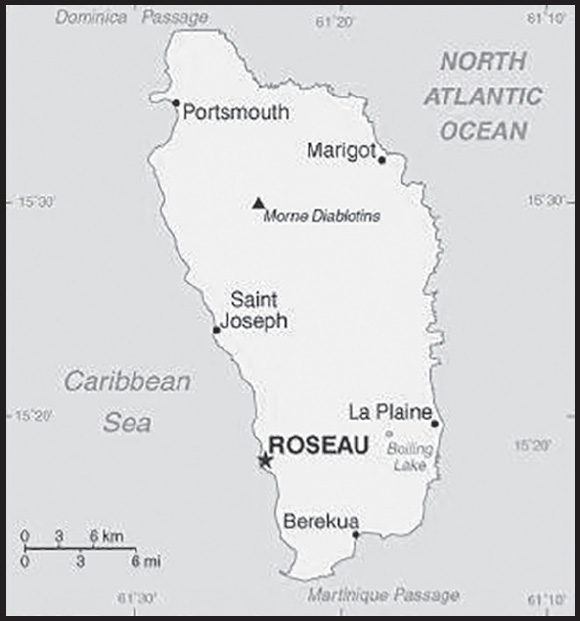
INTRODUCTION
Background: Dominica was the last of the Caribbean islands to be colonized by Europeans due chiefly to the fierce resistance of the native Caribs. France ceded possession to Great Britain in 1763, which colonized the island in 1805. Slavery ended in 1833 and in 1835 the first three men of African descent were elected to the legislative assembly of Dominica. In 1871, Dominica became part first of the British Leeward Islands and then the British Windward Islands until 1958. In 1967, Dominica became an associated state of the UK, and formally took responsibility for its internal affairs. In 1980, two years after independence, Dominica’s fortunes improved when a corrupt and tyrannical administration was replaced by that of Mary Eugenia CHARLES, the first female prime minister in the Caribbean, who remained in office for 15 years. On 18 September 2017, Hurricane Maria passed over the island, causing extensive damage to structures, roads, communications, and the power supply, and largely destroying critical agricultural areas.
GEOGRAPHY
Location: Caribbean, island between the Caribbean Sea and the North Atlantic Ocean, about halfway between Puerto Rico and Trinidad and Tobago
Geographic coordinates: 15 25 N, 61 20 W
Map references: Central America and the Caribbean
Area: total: 751 sq km
land: 751 sq km
water: NEGL
comparison ranking: total 188
Area - comparative: slightly more than four times the size of Washington, DC
Land boundaries: total: 0 km
Coastline: 148 km
Maritime claims: territorial sea: 12 nm
contiguous zone: 24 nm
exclusive economic zone: 200 nm
Climate: tropical; moderated by northeast trade winds; heavy rainfall
Terrain: rugged mountains of volcanic origin
Elevation: highest point: Morne Diablotins 1,447 m
lowest point: Caribbean Sea 0 m
Natural resources: timber, hydropower, arable land
Land use: agricultural land: 34.7% (2018 est.)
arable land: 8% (2018 est.)
permanent crops: 24% (2018 est.)
permanent pasture: 2.7% (2018 est.)
forest: 59.2% (2018 est.)
other: 6.1% (2018 est.)
Population distribution: population is mosly clustered along the coast, with roughly a third living in the parish of St. George, in or around the capital of Roseau; the volcanic interior is sparsely populated
Natural hazards: flash floods are a constant threat; destructive hurricanes can be expected during the late summer months
volcanism: Dominica was the last island to be formed in the Caribbean some 26 million years ago, it lies in the middle of the volcanic island arc of the Lesser Antilles that extends from the island of Saba in the north to Grenada in the south; of the 16 volcanoes that make up this arc, five are located on Dominica, more than any other island in the Caribbean: Morne aux Diables (861 m), Morne Diablotins (1,430 m), Morne Trois Pitons (1,387 m), Watt Mountain (1,224 m), which last erupted in 1997, and Morne Plat Pays (940 m); the two best known volcanic features on Dominica, the Valley of Desolation and the Boiling Lake thermal areas, lie on the flanks of Watt Mountain and both are popular tourist destinations
Geography - note: known as “The Nature Island of the Caribbean” due to its spectacular, lush, and varied flora and fauna, which are protected by an extensive natural park system; the most mountainous of the Lesser Antilles, its volcanic peaks are cones of lava craters and include Boiling Lake, the second-largest, thermally active lake in the world
PEOPLE AND SOCIETY
Population: 74,656 (2023 est.)
comparison ranking: 201
Nationality: noun: Dominican(s)
adjective: Dominican
Ethnic groups: African descent 84.5%, mixed 9%, Indigenous 3.8%, other 2.1%, unspecified 0.6% (2011 est.)
Languages: English (official), French patois
Religions: Roman Catholic 52.7%, Protestant 29.7% (includes Seventh Day Adventist 6.7%, Pentecostal 6.1%, Baptist 5.2%, Christian Union Church 3.9%, Methodist 2.6%, Gospel Mission 2.1%, other Protestant 3.1%), Jehovah’s Witness 1.3%, Rastafarian 1.1%, other 4.3%, none 9.4%, unspecified 1.4% (2011 est.)
Age structure: 0-14 years: 20.82% (male 7,954/female 7,592)
15-64 years: 65.82% (male 25,085/female 24,053)
65 years and over: 13.36% (2023 est.) (male 4,712/female 5,260)
Dependency ratios: total dependency ratio: 41.2
youth dependency ratio: 28
elderly dependency ratio: 13.2
potential support ratio: 7.6 (2021)
Median age: total: 34.9 years (2020)
male: 34.4 years
female: 35.5 years
comparison ranking: total 87
Population growth rate: 0.02% (2023 est.)
comparison ranking: 190
Birth rate: 13.64 births/1,000 population (2023 est.)
comparison ranking: 130
Death rate: 8.12 deaths/1,000 population (2023 est.)
comparison ranking: 84
Net migration rate: -5.3 migrant(s)/1,000 population (2023 est.)
comparison ranking: 206
Population distribution: population is mosly clustered along the coast, with roughly a third living in the parish of St. George, in or around the capital of Roseau; the volcanic interior is sparsely populated
Urbanization: urban population: 72% of total population (2023)
rate of urbanization: 0.84% annual rate of change (2020-25 est.)
Major urban areas - population: 15,000 ROSEAU (capital) (2018)
Sex ratio: at birth: 1.05 male(s)/female
0-14 years: 1.05 male(s)/female
15-64 years: 1.04 male(s)/female
65 years and over: 0.9 male(s)/female
total population: 1.02 male(s)/female (2023 est.)
Infant mortality rate: total: 11 deaths/1,000 live births (2023 est.)
male: 14.89 deaths/1,000 live births
female: 6.91 deaths/1,000 live births
comparison ranking: total 127
Life expectancy at birth: total population: 78.45 years (2023 est.)
male: 75.51 years
female: 81.53 years
comparison ranking: total population 76
Total fertility rate: 2.01 children born/woman (2023 est.)
comparison ranking: 104
Gross reproduction rate: 0.98 (2023 est.)
Drinking water source: improved: urban: 95.7% of population
unimproved: urban: 4.3% of population
Current health expenditure: 5.7% of GDP (2020)
Physicians density: 1.1 physicians/1,000 population (2018)
Hospital bed density: 3.8 beds/1,000 population
Obesity - adult prevalence rate: 27.9% (2016)
comparison ranking: 34
Alcohol consumption per capita: total: 6.32 liters of pure alcohol (2019 est.)
beer: 1.64 liters of pure alcohol (2019 est.)
wine: 0.29 liters of pure alcohol (2019 est.)
spirits: 4.39 liters of pure alcohol (2019 est.)
other alcohols: 0 liters of pure alcohol (2019 est.)
comparison ranking: total 67
Currently married women (ages 15-49): 40.3% (2023 est.)
Education expenditures: 5.5% of GDP (2021 est.)
comparison ranking: 57
People - note: 3,000-3,500 Kalinago (Carib) still living on Dominica are the only pre-Columbian population remaining in the Caribbean; only 70-100 may be “pure” Kalinago because of years of integration into the broader population
ENVIRONMENT
Environment - current issues: water shortages a continuing concern; pollution from agrochemicals and from untreated sewage; forests endangered by the expansion of farming; soil erosion; pollution of the coastal zone by agricultural and industrial chemicals, and untreated sewage
Environment - international agreements: party to: Biodiversity, Climate Change, Climate Change-Kyoto Protocol, Climate Change-Paris Agreement, Desertification, Endangered Species, Environmental Modification, Hazardous Wastes, Law of the Sea, Ozone Layer Protection, Ship Pollution, Whaling
signed, but not ratified: none of the selected agreements
Climate: tropical; moderated by northeast trade winds; heavy rainfall
Land use: agricultural land: 34.7% (2018 est.)
arable land: 8% (2018 est.)
permanent crops: 24% (2018 est.)
permanent pasture: 2.7% (2018 est.)
forest: 59.2% (2018 est.)
other: 6.1% (2018 est.)
Urbanization: urban population: 72% of total population (2023)
rate of urbanization: 0.84% annual rate of change (2020-25 est.)
Revenue from forest resources: 0.03% of GDP (2018 est.)
comparison ranking: 135
Revenue from coal: 0% of GDP (2018 est.)
comparison ranking: 162
Air pollutants: particulate matter emissions: 8.22 micrograms per cubic meter (2019 est.)
carbon dioxide emissions: 0.18 megatons (2016 est.)
methane emissions: 0.04 megatons (2020 est.)
Waste and recycling: municipal solid waste generated annually: 13,176 tons (2013 est.)
Total water withdrawal: municipal: 20 million cubic meters (2020 est.)
industrial: 0 cubic meters (2017 est.)
agricultural: 1 million cubic meters (2017 est.)
Total renewable water resources: 200 million cubic meters (2020 est.)
GOVERNMENT
Country name: conventional long form: Commonwealth of Dominica
conventional short form: Dominica
etymology: the island was named by explorer Christopher COLUMBUS for the day of the week on which he spotted it, Sunday (“Domingo” in Latin), 3 November 1493
Government type: parliamentary republic
Capital: name: Roseau
geographic coordinates: 15 18 N, 61 24 W
time difference: UTC-4 (1 hour ahead of Washington, DC, during Standard Time)
etymology: the name is French for “reed”; the first settlement was named after the river reeds that grew in the area
Administrative divisions: 10 parishes; Saint Andrew, Saint David, Saint George, Saint John, Saint Joseph, Saint Luke, Saint Mark, Saint Patrick, Saint Paul, Saint Peter
Independence: 3 November 1978 (from the UK)
National holiday: Independence Day, 3 November (1978)
Constitution: history: previous 1967 (preindependence); latest presented 25 July 1978, entered into force 3 November 1978
amendments: proposed by the House of Assembly; passage of amendments to constitutional sections such as fundamental rights and freedoms, the government structure, and constitutional amendment procedures requires approval by three fourths of the Assembly membership in the final reading of the amendment bill, approval by simple majority in a referendum, and assent of the president; amended several times, last in 2015
Legal system: common law based on the English model
International law organization participation: accepts compulsory ICJ jurisdiction; accepts ICCt jurisdiction
Citizenship: citizenship by birth: yes
citizenship by descent only: yes
dual citizenship recognized: yes
residency requirement for naturalization: 5 years
Suffrage: 18 years of age; universal
Executive branch: chief of state: President Sylvanie BURTON (since 2 October 2023)
head of government: Prime Minister Roosevelt SKERRIT (since 8 January 2004)
cabinet: Cabinet appointed by the president on the advice of the prime minister
elections/appointments: president nominated by the prime minister and leader of the opposition party and elected by the House of Assembly for a 5-year term (eligible for a second term); election last held on 27 September 2023 (next to be held in October 2028); prime minister appointed by the president
election results: 27 September 2023, parliament elects Sylvanie BURTON (DLP) with 20 votes for and five against; assumed office on 2 October 2023
Legislative branch: description: unicameral House of Assembly (32 seats; 21 representatives directly elected in single-seat constituencies by simple majority vote, 9 senators appointed by the president - 5 on the advice of the prime minister, and 4 on the advice of the leader of the opposition party, plus 2 ex-officio members - the house speaker and the attorney general; members serve 5-year terms)
elections: last held on 6 December 2022 (next to be held in 2027); note - tradition dictates that the election is held within 5 years of the last election, but technically it is 5 years from the first seating of parliament plus a 90-day grace period
election results: percent of vote by party - DLP 82.3%, independent 16.9%; (elected) seats by party - DLP 19, independent 2; (Assembly) composition - men 20, women 12, percent of women 37.5%
Judicial branch: highest court(s): the Eastern Caribbean Supreme Court (ECSC) is the superior court of the Organization of Eastern Caribbean States; the ECSC - headquartered on St. Lucia - consists of the Court of Appeal - headed by the chief justice and 4 judges - and the High Court with 18 judges; the Court of Appeal is itinerant, traveling to member states on a schedule to hear appeals from the High Court and subordinate courts; High Court judges reside in the member states, with 2 in Dominica; note - in 2015, Dominica acceded to the Caribbean Court of Justice as final court of appeal, replacing that of the Judicial Committee of the Privy Council, in London
judge selection and term of office: chief justice of Eastern Caribbean Supreme Court appointed by the Her Majesty, Queen ELIZABETH II; other justices and judges appointed by the Judicial and Legal Services Commission, an independent body of judicial officials; Court of Appeal justices appointed for life with mandatory retirement at age 65; High Court judges appointed for life with mandatory retirement at age 62
subordinate courts: Court of Summary Jurisdiction; magistrates’ courts
Political parties and leaders: Dominica Freedom Party or DFP [Bernard HURTAULT]
Dominica Labor Party or DLP [Roosevelt SKERRIT]
Dominica United Workers Party or UWP [Lennox LINTON]
International organization participation: ACP, AOSIS, C, Caricom, CD, CDB, CELAC, Commonwealth of Nations, ECCU, FAO, G-77, IAEA, IBRD, ICCt, ICRM, IDA, IFAD, IFC, IFRCS, ILO, IMF, IMO, Interpol, IOC, ISO (correspondent), ITU, ITUC (NGOs), MIGA, NAM, OAS, OECS, OIF, OPANAL, OPCW, Petrocaribe, UN, UNCTAD, UNESCO, UNIDO, UPU, WFTU, WHO, WIPO, WMO, WTO
Diplomatic representation in the US: chief of mission: Ambassador Steve FERROL (since 15 September 2023)
chancery: 3216 New Mexico Ave NW Washington, DC 20016
telephone: [1] (202) 364-6781
FAX: [1] (202) 364-6791
email address and website:
consulate(s) general: New York
Diplomatic representation from the US: embassy: the US does not have an embassy in Dominica; the US Ambassador to Barbados is accredited to
Flag description: green with a centered cross of three equal bands - the vertical part is yellow (hoist side), black, and white and the horizontal part is yellow (top), black, and white; superimposed in the center of the cross is a red disk bearing a Sisserou parrot, unique to Dominica, encircled by 10 green, five-pointed stars edged in yellow; the 10 stars represent the 10 administrative divisions (parishes); green symbolizes the island’s lush vegetation; the triple-colored cross represents the Christian Trinity; the yellow color denotes sunshine, the main agricultural products (citrus and bananas), and the native Carib Indians; black is for the rich soil and the African heritage of most citizens; white signifies rivers, waterfalls, and the purity of aspirations; the red disc stands for social justice
National symbol(s): Sisserou parrot, Carib Wood flower; national colors: green, yellow, black, white, red
National anthem: name: “Isle of Beauty”
lyrics/music: Wilfred Oscar Morgan POND/Lemuel McPherson CHRISTIAN
note: adopted 1967
National heritage: total World Heritage Sites: 1 (natural)
selected World Heritage Site locales: Pitons Management Area
ECONOMY
Economic overview: highly agrarian OECS island economy; ECCU-member state; large banana exporter; improved oversight of its citizenship-by-investment program; emerging ecotourism, information and communications, and education industries
Real GDP (purchasing power parity): $787.7 million (2021 est.)
$738.364 million (2020 est.)
$885.38 million (2019 est.)
note: data are in 2017 dollars
comparison ranking: 210
Real GDP growth rate: 6.68% (2021 est.)
-16.6% (2020 est.)
5.5% (2019 est.)
comparison ranking: 64
Real GDP per capita: $10,900 (2021 est.)
$10,300 (2020 est.)
$12,400 (2019 est.)
note: data are in 2017 dollars
comparison ranking: 138
GDP (official exchange rate): $557 million (2017 est.)
Inflation rate (consumer prices): -0.73% (2020 est.)
1.5% (2019 est.)
0.99% (2018 est.)
comparison ranking: 223
GDP - composition, by sector of origin
agriculture: 22.3% (2017 est.)
industry: 12.6% (2017 est.)
services: 65.1% (2017 est.)
comparison rankings: services 95; industry 197; agriculture 39
GDP - composition, by end use
household consumption: 60.6% (2017 est.)
government consumption: 26.2% (2017 est.)
investment in fixed capital: 21.5% (2017 est.)
investment in inventories: 0% (2017 est.)
exports of goods and services: 54.4% (2017 est.)
imports of goods and services: -62.7% (2017 est.)
Agricultural products: bananas, yams, grapefruit, taro, milk, coconuts, oranges, yautia, plantains, sugar cane
note: forest and fishery potential not exploited
Industries: soap, coconut oil, tourism, copra, furniture, cement blocks, shoes
Industrial production growth rate: 5.01% (2021 est.)
comparison ranking: 90
Labor force: 25,000 (2000 est.)
comparison ranking: 208
Labor force - by occupation: agriculture: 40%
industry: 32%
services: 28% (2002 est.)
Unemployment rate: 23% (2000 est.)
comparison ranking: 14
Population below poverty line: 29% (2009 est.)
Budget: revenues: $180 million (2021 est.)
expenditures: $184 million (2021 est.)
Budget surplus (+) or deficit (-): -5.9% (of GDP) (2017 est.)
comparison ranking: 181
Public debt: 82.7% of GDP (2017 est.)
71.7% of GDP (2016 est.)
comparison ranking: 41
Taxes and other revenues: 40.9% (of GDP) (2017 est.)
comparison ranking: 10
Fiscal year: 1 July - 30 June
Current account balance: -$178.763 million (2021 est.)
-$147.521 million (2020 est.)
-$210.115 million (2019 est.)
comparison ranking: 99
Exports: $104.959 million (2021 est.) note: data are in current year dollars
$94.823 million (2020 est.)
$211.175 million (2019 est.)
comparison ranking: 209
Exports - partners: Saudi Arabia 28%, France 6%, United States 5%, Grenada 5%, China 4% (2021)
Exports - commodities: medical instruments, low-voltage protection equipment, sutures, soap, bandages (2021)
Imports: $302 million (2021 est.) note: data are in current year dollars
$279 million (2020 est.)
$415 million (2019 est.)
comparison ranking: 207
Imports - partners: United States 75%, China 5%, Trinidad and Tobago 4%, United Kingdom 2%, Italy 2% (2021)
Imports - commodities: refined petroleum, natural gas, crude petroleum, recreational boats, cars (2021)
Reserves of foreign exchange and gold: $190.843 million (31 December 2021 est.)
$165.824 million (31 December 2020 est.)
$155.172 million (31 December 2019 est.)
comparison ranking: 185
Debt - external: $280.4 million (31 December 2017 est.)
$314.2 million (31 December 2015 est.)
comparison ranking: 186
Exchange rates: East Caribbean dollars (XCD) per US dollar -
Exchange rates:: 2.7 (2021 est.)
2.7 (2020 est.)
2.7 (2019 est.)
2.7 (2018 est.)
2.7 (2017 est.)
ENERGY
Electricity access: electrification - total population: 100% (2021)
Electricity: installed generating capacity: 42,000 kW (2020 est.)
consumption: 82.078 million kWh (2019 est.)
exports: 0 kWh (2019 est.)
imports: 0 kWh (2019 est.)
transmission/distribution losses: 8.1 million kWh (2019 est.)
comparison rankings: installed generating capacity 195; transmission/distribution losses 197; imports 136; exports 119; consumption 197
Electricity generation sources: fossil fuels: 74.8% of total installed capacity (2020 est.)
solar: 0.1% of total installed capacity (2020 est.)
wind: 0.6% of total installed capacity (2020 est.)
hydroelectricity: 24.5% of total installed capacity (2020 est.)
Petroleum: total petroleum production: 0 bbl/day (2021 est.)
refined petroleum consumption: 1,200 bbl/day (2019 est.)
Refined petroleum products - imports: 1,237 bbl/day (2015 est.)
comparison ranking: 198
Carbon dioxide emissions: 182,000 metric tonnes of CO2 (2019 est.)
from petroleum and other liquids: 182,000 metric tonnes of CO2 (2019 est.)
comparison ranking: total emissions 203
Energy consumption per capita: 37.513 million Btu/person (2019 est.)
comparison ranking: 111
COMMUNICATIONS
Telephones - fixed lines: total subscriptions: 7,500 (2021 est.)
subscriptions per 100 inhabitants: 10 (2021 est.)
comparison ranking: total subscriptions 194
Telephones - mobile cellular: total subscriptions: 62,000 (2021 est.)
subscriptions per 100 inhabitants: 86 (2021 est.)
comparison ranking: total subscriptions 203
Telecommunication systems: general assessment: the telecom sector has seen a decline in subscriber numbers (particularly for prepaid mobile services the mainstay of short term visitors) and revenue; fixed and mobile broadband services are two areas that have benefited from the crisis as employees and students have resorted to working from home; one area of the telecom market that is not prepared for growth is 5G mobile; governments, regulators, and even the mobile network operators have shown that they have not been investing in 5G opportunities at the present time; network expansion and enhancements remain concentrated around improving LTE coverage (2021)
domestic: 10 fixed-line connections per 100 persons; mobile-cellular subscriptions are about 86 per 100 persons (2021)
international: country code - 1-767; landing points for the ECFS and the Southern Caribbean Fiber submarine cables providing connectivity to other islands in the eastern Caribbean extending from the British Virgin Islands to Trinidad and to the US; microwave radio relay and SHF radiotelephone links to Martinique and Guadeloupe; VHF and UHF radiotelephone links to Saint Lucia (2019)
Broadcast media: no terrestrial TV service available; subscription cable TV provider offers some locally produced programming plus channels from the US, Latin America, and the Caribbean; state-operated radio broadcasts on 6 stations; privately owned radio broadcasts on about 15 stations (2019)
Internet country code: .dm
Internet users: total: 58,320 (2021 est.)
percent of population: 81% (2021 est.)
comparison ranking: total 198
Broadband - fixed subscriptions: total: 16,000 (2020 est.)
subscriptions per 100 inhabitants: 22 (2020 est.)
comparison ranking: total 172
TRANSPORTATION
Civil aircraft registration country code prefix: J7
Airports: 2 (2021)
comparison ranking: total 201
Airports - with paved runways: 2
note: paved runways have a concrete or asphalt surface but not all have facilities for refueling, maintenance, or air traffic control; the length of a runway required for aircraft to safely operate depends on a number of factors including the type of aircraft, the takeoff weight (including passengers, cargo, and fuel), engine types, flap settings, landing speed, elevation of the airport, and average maximum daily air temperature; paved runways can reach a length of 5,000 m (16,000 ft.), but the “typical” length of a commercial airline runway is between 2,500-4,000 m (8,000-13,000 ft.)
Roadways: total: 1,512 km (2018)
paved: 762 km (2018)
unpaved:750 km (2018)
comparison ranking: total 174
Merchant marine: total: 84 (2022)
by type: general cargo 31, oil tanker 13, other 40
comparison ranking: total 99
Ports and terminals: major seaport(s): Portsmouth, Roseau
MILITARY AND SECURITY
Military and security forces: no regular military forces; Commonwealth of Dominica Police Force (includes Coast Guard) under the Ministry of Justice, Immigration, and National Security (2023)
Military - note: Dominica has been a member of the Caribbean Regional Security System (RSS) since its creation in 1982; RSS signatories (Antigua and Barbuda, Barbados, Grenada, St. Kitts, St. Lucia, and St. Vincent and the Grenadines) agreed to prepare contingency plans and assist one another, on request, in national emergencies, prevention of smuggling, search and rescue, immigration control, fishery protection, customs and excise control, maritime policing duties, protection of off-shore installations, pollution control, national and other disasters, and threats to national security (2023)
TRANSNATIONAL ISSUES
Disputes - international: Dominica is the only Caribbean state to challenge Venezuela’s sovereignty claim over Aves Island and joins the other island nations in challenging whether the feature sustains human habitation, a criterion under the UN Convention on the Law of the Sea, which permits Venezuela to extend its EEZ and continental shelf claims over a large portion of the eastern Caribbean Sea
Illicit drugs: a transit point for cocaine and marijuana destined for North America, Europe, and elsewhere in the Caribbean; some local demand for cocaine and some use of synthetic drugs
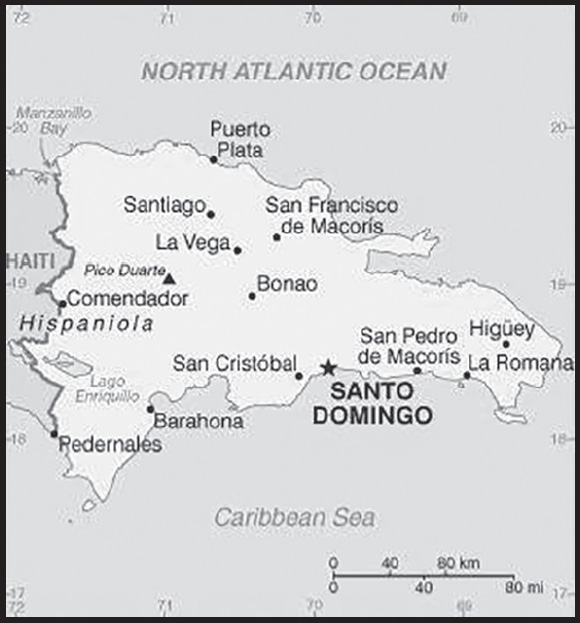
INTRODUCTION
Background: The Taino - indigenous inhabitants of Hispaniola prior to the arrival of Europeans - divided the island into five chiefdoms and territories. Christopher COLUMBUS explored and claimed the island on his first voyage in 1492; it became a springboard for Spanish conquest of the Caribbean and the American mainland. In 1697, Spain recognized French dominion over the western third of the island, which in 1804 became Haiti. The remainder of the island, by then known as Santo Domingo, sought to gain its own independence in 1821 but was conquered and ruled by the Haitians for 22 years; it finally attained independence as the Dominican Republic in 1844. In 1861, the Dominicans voluntarily returned to the Spanish Empire, but two years later they launched a war that restored independence in 1865. A legacy of unsettled, mostly non-representative rule followed, capped by the dictatorship of Rafael Leonidas TRUJILLO from 1930 to 1961. Juan BOSCH was elected president in 1962 but was deposed in a military coup in 1963. In 1965, the US led an intervention in the midst of a civil war sparked by an uprising to restore BOSCH. In 1966, Joaquin BALAGUER defeated BOSCH in the presidential election. BALAGUER maintained a tight grip on power for most of the next 30 years when international reaction to flawed elections forced him to curtail his term in 1996. Since then, regular competitive elections have been held in which opposition candidates have won the presidency. Former President Leonel FERNANDEZ Reyna (first term 1996-2000) won election to a new term in 2004 following a constitutional amendment allowing presidents to serve more than one term, and was later reelected to a second consecutive term. Following the two-term presidency of Danilo MEDINA Sanchez (2012-2020), Luis Rodolfo ABINADER Corona was elected president in July 2020.
GEOGRAPHY
Location: Caribbean, eastern two-thirds of the island of Hispaniola, between the Caribbean Sea and the North Atlantic Ocean, east of Haiti
Geographic coordinates: 19 00 N, 70 40 W
Map references: Central America and the Caribbean
Area: total: 48,670 sq km
land: 48,320 sq km
water: 350 sq km
comparison ranking: total 131
Area - comparative: slightly more than twice the size of New Jersey
Land boundaries: total: 376 km
border countries (1): Haiti 376 km
Coastline: 1,288 km
Maritime claims: territorial sea: 12 nm
contiguous zone: 24 nm
exclusive economic zone: 200 nm
continental shelf: 200 nm or to the edge of the continental margin measured from claimed archipelagic straight baselines
Climate: tropical maritime; little seasonal temperature variation; seasonal variation in rainfall
Terrain: rugged highlands and mountains interspersed with fertile valleys
Elevation: highest point: Pico Duarte 3,098 m
lowest point: Lago Enriquillo -46 m
mean elevation: 424 m
Natural resources: nickel, bauxite, gold, silver, arable land
Land use: agricultural land: 51.5% (2018 est.)
arable land: 16.6% (2018 est.)
permanent crops: 10.1% (2018 est.)
permanent pasture: 24.8% (2018 est.)
forest: 40.8% (2018 est.)
other: 7.7% (2018 est.)
Irrigated land: 2,980 sq km (2018)
Major lakes (area sq km): salt water lake(s): Lago de Enriquillo - 500 sq km
Population distribution: coastal development is significant, especially in the southern coastal plains and the Cibao Valley, where population density is highest; smaller population clusters exist in the interior mountains (Cordillera Central)
Natural hazards: lies in the middle of the hurricane belt and subject to severe storms from June to October; occasional flooding; periodic droughts
Geography - note: shares island of Hispaniola with Haiti (eastern two-thirds makes up the Dominican Republic, western one-third is Haiti); the second largest country in the Antilles (after Cuba); geographically diverse with the Caribbean’s tallest mountain, Pico Duarte, and lowest elevation and largest lake, Lago Enriquillo
PEOPLE AND SOCIETY
Population: 10,790,744 (2023 est.)
comparison ranking: 86
Nationality: noun: Dominican(s)
adjective: Dominican
Ethnic groups: mixed 70.4% (Mestizo/Indio 58%, Mulatto 12.4%), Black 15.8%, White 13.5%, other 0.3% (2014 est.)
note: respondents self-identified their race; the term “indio” in the Dominican Republic is not associated with people of indigenous ancestry but people of mixed ancestry or skin color between light and dark
Languages: Spanish (official)
major-language sample(s):
La Libreta Informativa del Mundo, la fuente indispensable de información básica. (Spanish)
Religions: Roman Catholic 44.3%, Evangelical 13%, Protestant 7.9%, Adventist 1.4%, other 1.8%, atheist 0.2%, none 29.4%, unspecified 2% (2018 est.)
Age structure: 0-14 years: 25.92% (male 1,422,186/female 1,374,991)
15-64 years: 67.09% (male 3,675,934/female 3,563,597)
65 years and over: 6.99% (2023 est.) (male 355,069/female 398,967)
Dependency ratios: total dependency ratio: 53.8
youth dependency ratio: 42.2
elderly dependency ratio: 11.6
potential support ratio: 8.6 (2021 est.)
Median age: total: 27.9 years (2020)
male: 27.8 years
female: 28.1 years
comparison ranking: total 143
Population growth rate: 0.88% (2023 est.)
comparison ranking: 105
Birth rate: 17.8 births/1,000 population (2023 est.)
comparison ranking: 81
Death rate: 6.31 deaths/1,000 population (2023 est.)
comparison ranking: 144
Net migration rate: -2.66 migrant(s)/1,000 population (2023 est.)
comparison ranking: 175
Population distribution: coastal development is significant, especially in the southern coastal plains and the Cibao Valley, where population density is highest; smaller population clusters exist in the interior mountains (Cordillera Central)
Urbanization: urban population: 84.4% of total population (2023)
rate of urbanization: 1.64% annual rate of change (2020-25 est.)
Major urban areas - population: 3.524 million SANTO DOMINGO (capital) (2023)
Sex ratio: at birth: 1.04 male(s)/female
0-14 years: 1.03 male(s)/female
15-64 years: 1.03 male(s)/female
65 years and over: 0.89 male(s)/female
total population: 1.02 male(s)/female (2023 est.)
Mother’s mean age at first birth: 20.9 years (2013 est.)
note: data represents median age at first birth among women 25-49
Maternal mortality ratio: 107 deaths/100,000 live births (2020 est.)
comparison ranking: 67
Infant mortality rate: total: 20.68 deaths/1,000 live births (2023 est.)
male: 22.95 deaths/1,000 live births
female: 18.33 deaths/1,000 live births
comparison ranking: total 78
Life expectancy at birth: total population: 72.84 years (2023 est.)
male: 71.15 years
female: 74.6 years
comparison ranking: total population 153
Total fertility rate: 2.2 children born/woman (2023 est.)
comparison ranking: 85
Gross reproduction rate: 1.08 (2023 est.)
Contraceptive prevalence rate: 62.8% (2019)
Drinking water source: improved: urban: 98.3% of population
rural: 91.7% of population
total: 97.2% of population
unimproved: urban: 1.7% of population
rural: 8.3% of population
total: 2.8% of population (2020 est.)
Current health expenditure: 4.9% of GDP (2020)
Physicians density: 1.45 physicians/1,000 population (2019)
Hospital bed density: 1.6 beds/1,000 population (2017)
Sanitation facility access: improved: urban: 97.4% of population
rural: 91.3% of population
total: 96.3% of population
unimproved: urban: 2.6% of population
rural: 8.7% of population
total: 3.7% of population (2020 est.)
Major infectious diseases: degree of risk: high (2023)
food or waterborne diseases: bacterial diarrhea, hepatitis A, and typhoid fever
vectorborne diseases: dengue fever
Obesity - adult prevalence rate: 27.6% (2016)
comparison ranking: 37
Alcohol consumption per capita: total: 5.56 liters of pure alcohol (2019 est.)
beer: 3.15 liters of pure alcohol (2019 est.)
wine: 0.17 liters of pure alcohol (2019 est.)
spirits: 2.18 liters of pure alcohol (2019 est.)
other alcohols: 0.06 liters of pure alcohol (2019 est.)
comparison ranking: total 78
Tobacco use: total: 10.6% (2020 est.)
male: 14.6% (2020 est.)
female: 6.5% (2020 est.)
comparison ranking: total 135
Children under the age of 5 years underweight: 3% (2019)
comparison ranking: 89
Currently married women (ages 15-49): 52.1% (2023 est.)
Child marriage: women married by age 15: 9.4%
women married by age 18: 31.5% (2019 est.)
Education expenditures: 4.6% of GDP (2020 est.)
comparison ranking: 93
Literacy: definition: age 15 and over can read and write
total population: 95.2%
male: 95.1%
female: 95.3% (2021)
School life expectancy (primary to tertiary education): total: 14 years
male: 13 years
female: 15 years (2017)
Youth unemployment rate (ages 15-24): total: 20.6% (2021 est.)
male: 16.6%
female: 27.9%
comparison ranking: total 78
ENVIRONMENT
Environment - current issues: water shortages; soil eroding into the sea damages coral reefs; deforestation
Environment - international agreements: party to: Biodiversity, Climate Change, Climate Change-Kyoto Protocol, Climate Change-Paris Agreement, Comprehensive Nuclear Test Ban, Desertification, Endangered Species, Hazardous Wastes, Law of the Sea, Marine Dumping-London Convention, Marine Life Conservation, Nuclear Test Ban, Ozone Layer Protection, Ship Pollution, Wetlands, Whaling
signed, but not ratified: none of the selected agreements
Climate: tropical maritime; little seasonal temperature variation; seasonal variation in rainfall
Land use: agricultural land: 51.5% (2018 est.)
arable land: 16.6% (2018 est.)
permanent crops: 10.1% (2018 est.)
permanent pasture: 24.8% (2018 est.)
forest: 40.8% (2018 est.)
other: 7.7% (2018 est.)
Urbanization: urban population: 84.4% of total population (2023)
rate of urbanization: 1.64% annual rate of change (2020-25 est.)
Revenue from forest resources: 0.03% of GDP (2018 est.)
comparison ranking: 133
Revenue from coal: 0% of GDP (2018 est.)
comparison ranking: 176
Air pollutants: particulate matter emissions: 7.59 micrograms per cubic meter (2019 est.)
carbon dioxide emissions: 25.26 megatons (2016 est.)
methane emissions: 8.1 megatons (2020 est.)
Waste and recycling: municipal solid waste generated annually: 4,063,910 tons (2015 est.)
municipal solid waste recycled annually: 333,241 tons (2015 est.)
percent of municipal solid waste recycled: 8.2% (2015 est.)
Major lakes (area sq km): salt water lake(s): Lago de Enriquillo - 500 sq km
Total water withdrawal: municipal: 860 million cubic meters (2020 est.)
industrial: 660 million cubic meters (2020 est.)
agricultural: 7.56 billion cubic meters (2020 est.)
Total renewable water resources: 23.5 billion cubic meters (2020 est.)
GOVERNMENT
Country name: conventional long form: Dominican Republic
conventional short form: The Dominican
local long form: República Dominicana
local short form: La Dominicana
former: Santo Domingo (the capital city’s name formerly applied to the entire country)
etymology: the country name derives from the capital city of Santo Domingo (Saint Dominic)
Government type: presidential republic
Capital: name: Santo Domingo
geographic coordinates: 18 28 N, 69 54 W
time difference: UTC-4 (1 hour ahead of Washington, DC, during Standard Time)
etymology: named after Saint Dominic de GUZMAN (1170-1221), founder of the Dominican Order
Administrative divisions: 10 regions (regiones, singular - region); Cibao Nordeste, Cibao Noroeste, Cibao Norte, Cibao Sur, El Valle, Enriquillo, Higuamo, Ozama, Valdesia, Yuma
Independence: 27 February 1844 (from Haiti)
National holiday: Independence Day, 27 February (1844)
Constitution: history: many previous (38 total); latest proclaimed 13 June 2015
amendments: proposed by a special session of the National Congress called the National Revisory Assembly; passage requires at least two-thirds majority approval by at least one half of those present in both houses of the Assembly; passage of amendments to constitutional articles, such as fundamental rights and guarantees, territorial composition, nationality, or the procedures for constitutional reform, also requires approval in a referendum
Legal system: civil law system based on the French civil code; Criminal Procedures Code modified in 2004 to include important elements of an accusatory system
International law organization participation: accepts compulsory ICJ jurisdiction; accepts ICCt jurisdiction
Citizenship: citizenship by birth: no
citizenship by descent only: at least one parent must be a citizen of the Dominican Republic
dual citizenship recognized: yes
residency requirement for naturalization: 2 years
Suffrage: 18 years of age; universal and compulsory; married persons regardless of age can vote; note - members of the armed forces and national police by law cannot vote
Executive branch: chief of state: President Luis Rodolfo ABINADER Corona (since 16 August 2020); Vice President Raquel PENA de Antuna (since 16 August 2020); note - the president is both chief of state and head of government
head of government: President Luis Rodolfo ABINADER Corona (since 16 August 2020); Vice President Raquel PENA de Antuna (since 16 August 2020); note - the president is both chief of state and head of government
cabinet: Cabinet nominated by the president
elections/appointments: president and vice president directly elected on the same ballot by absolute vote in 2 rounds if needed for a 4-year term (eligible for a maximum of two consecutive terms); election last held on 5 July 2020 (next to be held in 2024); note - the 2020 election was rescheduled from 17 May to 5 July 2020 due to COVID-19 pandemic
election results:
2020: Luis Rodolfo ABINADER Corona elected president in first round; percent of vote - Luis Rodolfo ABINADER Corona (PRM) 52.5%, Gonzalo CASTILLO Terrero (PLD) 37.5%, Leonel Antonio FERNANDEZ Reyna (FP) 8.9% other 1.1%
2016: Danilo MEDINA Sanchez reelected president; percent of vote - Danilo MEDINA Sanchez (PLD) 61.7%, Luis Rodolfo ABINADER Corona (PRM) 35%, other 3.3%; Margarita CEDENO DE FERNANDEZ (PLD) reelected vice president
Legislative branch: description: bicameral National Congress or Congreso Nacional consists of:
Senate or Senado (32 seats; 26 members directly elected in single-seat constituencies by simple majority vote, and 6 members indirectly elected based upon province-wide party plurality votes for its candidates to the Chamber of Deputies; all members serve 4-year terms; note - in 2019, the Central Election Commission changed the electoral system for seats in26 constituencies to direct simple majority but retained indirect election for the remaining 6 constituencies; previously all 32 members were indirectly elected; the change had been challenged by the ruling and opposition parties)
House of Representatives or Camara de Diputados (190 seats; 178 members directly elected in multi-seat constituencies by closed party-list proportional representation vote using the D’Hondt method, 5 members in a nationwide constituency and 7 diaspora members directly elected by simple majority vote; members serve 4-year terms)
elections:
Senate - last held on 5 July 2020 (next to be held 2024)
House of Representatives - last held on 5 July 2020 (next to be held in 2024); note - the 2020 election was rescheduled from 17 May to 5 July 2020 due to COVID-19 pandemic
election results:
Senate - percent of vote by party - NA; seats by party - PRM 17, PLD 6, PRSC 6, BIS 1, DXC 1, FP 1; composition - men 28, women 4, percent of women 12.5%
House of Representatives - percent of vote by party - NA; seats by party - PRM 86, PLD 75, PRSC 6, PRD 4, Broad Front 3, FP 3, AP 2, APD 2, BIS 2, DXC 2, other 5; composition - men 137, women 53, percent of women 27.9%; note - total National Congress percent of women 25.7%
Judicial branch: highest court(s): Supreme Court of Justice or Suprema Corte de Justicia (consists of a minimum of 16 magistrates); Constitutional Court or Tribunal Constitucional (consists of 13 judges); note - the Constitutional Court was established in 2010 by constitutional amendment
judge selection and term of office: Supreme Court and Constitutional Court judges appointed by the National Council of the Judiciary comprised of the president, the leaders of both chambers of congress, the president of the Supreme Court, and a non-governing party congressional representative; Supreme Court judges appointed for 7-year terms; Constitutional Court judges appointed for 9-year terms
subordinate courts: courts of appeal; courts of first instance; justices of the peace; special courts for juvenile, labor, and land cases; Contentious Administrative Court for cases filed against the government
Political parties and leaders: Alliance for Democracy or APD
Broad Front (Frente Amplio) [Fidel SANTANA]
Country Alliance or AP [Guillermo Antonio MORENO Garcia]
Dominican Liberation Party or PLD [Danilo MEDINA Sánchez]
Dominican Revolutionary Party or PRD [Miguel VARGAS Maldonado]
Dominicans For Change or DXC [Manuel OVIEDO Estrada]
Institutional Social Democratic Bloc or BIS
Liberal Reformist Party or PRL (formerly the Liberal Party of the Dominican Republic or PLRD)
Modern Revolutionary Party or PRM [Luis ABINADER]
National Progressive Front or FNP [Vinicio CASTILLO, Pelegrin CASTILLO]
People’s Force or FP [Leonel FERNANDEZ Reyna]
Social Christian Reformist Party or PRSC [Federico Augusto “Quique” ANTUN Batile]
International organization participation: ACP, AOSIS, BCIE, Caricom (observer), CD, CELAC, FAO, G-77, IADB, IAEA, IBRD, ICAO, ICC (national committees), ICCt, ICRM, IDA, IFAD, IFC, IFRCS, IHO, ILO, IMF, IMO, Interpol, IOC, IOM, IPU, ISO (correspondent), ITSO, ITU, ITUC (NGOs), LAES, LAIA, MIGA, MINUSMA, NAM, OAS, OIF (observer), OPANAL, OPCW, Pacific Alliance (observer), PCA, Petrocaribe, SICA (associated member), UN, UNCTAD, UNESCO, UNIDO, Union Latina, UNWTO, UPU, WCO, WFTU (NGOs), WHO, WIPO, WMO, WTO
Diplomatic representation in the US: chief of mission: Ambassador Sonia GUZMÁN DE HERNÁNDEZ (since 18 January 2021)
chancery: 1715 22nd Street NW, Washington, DC 20008
telephone: [1] (202) 332-6280
FAX: [1] (202) 265-8057
email address and website:
consulate(s) general: Boston, Chicago, Glendale (CA), Mayaguez (Puerto Rico), Miami, New Orleans, New York, San Juan (Puerto Rico)
consulate(s): San Francisco
Diplomatic representation from the US: chief of mission: Ambassador (vacant); Chargé d’Affaires Alexander TITOLO
embassy: Av. Republica de Colombia #57, Santo Domingo
mailing address: 3470 Santo Domingo Place, Washington DC 20521-3470
telephone: (809) 567-7775
email address and website:
Flag description: a centered white cross that extends to the edges divides the flag into four rectangles - the top ones are ultramarine blue (hoist side) and vermilion red, and the bottom ones are vermilion red (hoist side) and ultramarine blue; a small coat of arms featuring a shield supported by a laurel branch (left) and a palm branch (right) is at the center of the cross; above the shield a blue ribbon displays the motto, DIOS, PATRIA, LIBERTAD (God, Fatherland, Liberty), and below the shield, REPUBLICA DOMINICANA appears on a red ribbon; in the shield a bible is opened to a verse that reads “Y la verdad nos hara libre” (And the truth shall set you free); blue stands for liberty, white for salvation, and red for the blood of heroes
National symbol(s): palmchat (bird); national colors: red, white, blue
National anthem: name: “Himno Nacional” (National Anthem)
lyrics/music: Emilio PRUD’HOMME/Jose REYES
note: adopted 1934; also known as “Quisqueyanos valientes” (Valient Sons of Quisqueye); the anthem never refers to the people as Dominican but rather calls them “Quisqueyanos,” a reference to the indigenous name of the island
National heritage: total World Heritage Sites: 1 (cultural)
selected World Heritage Site locales: Colonial City of Santo Domingo
ECONOMY
Economic overview: surging middle-income tourism, construction, mining, and telecommunications OECS economy; major foreign US direct investment and free-trade zones; developing local financial markets; improving debt management; declining poverty
Real GDP (purchasing power parity): $207.082 billion (2021 est.)
$184.447 billion (2020 est.)
$197.735 billion (2019 est.)
note: data are in 2017 dollars
comparison ranking: 66
Real GDP growth rate: 12.27% (2021 est.)
-6.72% (2020 est.)
5.05% (2019 est.)
comparison ranking: 17
Real GDP per capita: $18,600 (2021 est.)
$16,800 (2020 est.)
$18,200 (2019 est.)
note: data are in 2017 dollars
comparison ranking: 97
GDP (official exchange rate): $88.956 billion (2019 est.)
Inflation rate (consumer prices): 8.24% (2021 est.)
3.78% (2020 est.)
1.81% (2019 est.)
comparison ranking: 35
Credit ratings: Fitch rating: BB- (2016)
Moody’s rating: Ba3 (2017)
Standard & Poors rating: BB- (2015)
note: The year refers to the year in which the current credit rating was first obtained.
GDP - composition, by sector of origin
agriculture: 5.6% (2017 est.)
industry: 33% (2017 est.)
services: 61.4% (2017 est.)
comparison rankings: services 111; industry 57; agriculture 124
GDP - composition, by end use
household consumption: 69.3% (2017 est.)
government consumption: 12.2% (2017 est.)
investment in fixed capital: 21.9% (2017 est.)
investment in inventories: -0.1% (2017 est.)
exports of goods and services: 24.8% (2017 est.)
imports of goods and services: -28.1% (2017 est.)
Agricultural products: sugar cane, bananas, papayas, rice, plantains, milk, avocados, fruit, pineapples, coconuts
Industries: tourism, sugar processing, gold mining, textiles, cement, tobacco, electrical components, medical devices
Industrial production growth rate: 15.89% (2021 est.)
comparison ranking: 13
Labor force: 5.027 million (2021 est.)
comparison ranking: 83
Labor force - by occupation: agriculture: 14.4%
industry: 20.8% (2014)
services: 64.7% (2014 est.)
Unemployment rate: 8.5% (2021 est.)
6.13% (2020 est.)
6.36% (2019 est.)
comparison ranking: 90
Youth unemployment rate (ages 15-24): total: 20.6% (2021 est.)
male: 16.6%
female: 27.9%
comparison ranking: total 78
Population below poverty line: 21% (2019 est.)
Gini Index coefficient - distribution of family income: 39.6 (2020 est.)
comparison ranking: 58
Average household expenditures: on food: 26.8% of household expenditures (2018 est.)
on alcohol and tobacco: 3.8% of household expenditures (2018 est.)
Household income or consumption by percentage share: lowest 10%: 1.9%
highest 10%: 37.4% (2013 est.)
Budget: revenues: $12.804 billion (2019 est.)
expenditures: $14.511 billion (2019 est.)
Budget surplus (+) or deficit (-): -3% (of GDP) (2017 est.)
comparison ranking: 130
Public debt: 37.2% of GDP (2017 est.)
34.6% of GDP (2016 est.)
comparison ranking: 144
Taxes and other revenues: 12.39% (of GDP) (2020 est.)
comparison ranking: 173
Fiscal year: calendar year
Current account balance: -$2.689 billion (2021 est.)
-$1.337 billion (2020 est.)
-$1.188 billion (2019 est.)
comparison ranking: 167
Exports: $20.509 billion (2021 est.) note: data are in current year dollars
$14.889 billion (2020 est.) note: data are in current year dollars
$20.509 billion (2019 est.) note: data are in current year dollars
comparison ranking: 85
Exports - partners: United States 51%, Haiti 7%, Switzerland 7%, India 5%, Netherlands 3% (2021)
Exports - commodities: gold, medical instruments, cigars, low-voltage protection equipment, iron alloys, clothing (2021)
Imports: $28.541 billion (2021 est.) note: data are in current year dollars
$20.302 billion (2020 est.) note: data are in current year dollars
$24.526 billion (2019 est.) note: data are in current year dollars
comparison ranking: 75
Imports - partners: United States 42%, China 19%, Spain 3%, Brazil 3%, Mexico 3% (2021)
Imports - commodities: refined petroleum, cars, natural gas, jewelry, vaccines and cultures (2021)
Reserves of foreign exchange and gold: $13.125 billion (31 December 2021 est.)
$10.845 billion (31 December 2020 est.)
$8.871 billion (31 December 2019 est.)
comparison ranking: 76
Debt - external: $23.094 billion (2019 est.)
$21.198 billion (2018 est.)
comparison ranking: 90
Exchange rates: Dominican pesos (DOP) per US dollar -
Exchange rates:: 57.221 (2021 est.)
56.525 (2020 est.)
51.295 (2019 est.)
49.51 (2018 est.)
47.534 (2017 est.)
ENERGY
Electricity access: population without electricity: (2020) less than 1 million
electrification - total population: 98.1% (2021)
electrification - urban areas: 98.7% (2021)
electrification - rural areas: 94.8% (2021)
Electricity: installed generating capacity: 5.674 million kW (2020 est.)
consumption: 16,330,980,000 kWh (2019 est.)
exports: 0 kWh (2019 est.)
imports: 0 kWh (2019 est.)
transmission/distribution losses: 2.576 billion kWh (2019 est.)
comparison rankings: installed generating capacity 82; transmission/distribution losses 74; imports 198; exports 197; consumption 78
Electricity generation sources: fossil fuels: 93.4% of total installed capacity (2020 est.)
solar: 1.5% of total installed capacity (2020 est.)
wind: 3.2% of total installed capacity (2020 est.)
hydroelectricity: 0.7% of total installed capacity (2020 est.)
biomass and waste: 1.2% of total installed capacity (2020 est.)
Coal: production: 0 metric tons (2020 est.)
consumption: 1.791 million metric tons (2020 est.)
exports: 0 metric tons (2020 est.)
imports: 2.359 million metric tons (2020 est.)
proven reserves: 0 metric tons (2019 est.)
Petroleum: total petroleum production: 0 bbl/day (2021 est.)
refined petroleum consumption: 148,200 bbl/day (2019 est.)
crude oil and lease condensate exports: 0 bbl/day (2018 est.)
crude oil and lease condensate imports: 24,900 bbl/day (2018 est.)
crude oil estimated reserves: 0 barrels (2021 est.)
Refined petroleum products - production: 16,060 bbl/day (2015 est.)
comparison ranking: 92
Refined petroleum products - exports: 0 bbl/day (2015 est.)
comparison ranking: 206
Refined petroleum products - imports: 108,500 bbl/day (2015 est.)
comparison ranking: 52
Natural gas: production: 0 cubic meters (2021 est.)
consumption: 1,602,759,000 cubic meters (2019 est.)
exports: 28.657 million cubic meters (2019 est.)
imports: 1,586,449,000 cubic meters (2019 est.)
proven reserves: 0 cubic meters (2021 est.)
Carbon dioxide emissions: 26.808 million metric tonnes of CO2 (2019 est.)
from coal and metallurgical coke: 4.713 million metric tonnes of CO2 (2019 est.)
from petroleum and other liquids: 18.951 million metric tonnes of CO2 (2019 est.)
from consumed natural gas: 3.144 million metric tonnes of CO2 (2019 est.)
comparison ranking: total emissions 77
Energy consumption per capita: 39.016 million Btu/person (2019 est.)
comparison ranking: 109
COMMUNICATIONS
Telephones - fixed lines: total subscriptions: 1,154,670 (2021 est.)
subscriptions per 100 inhabitants: 10 (2021 est.)
comparison ranking: total subscriptions 70
Telephones - mobile cellular: total subscriptions: 9,735,351 (2021 est.)
subscriptions per 100 inhabitants: 88 (2021 est.)
comparison ranking: total subscriptions 94
Telecommunication systems: general assessment: the Dominican Republic’s telecom sector continued its solid form throughout 2020 and into 2021, shrugging off the economic turmoil unleashed by the Covid-19 pandemic to maintain a decade-long run of low but positive growth across all areas of the market; the Dominican Republic remains behind most of its counterparts in the Latin American region, especially in terms of fixed-line network coverage; mobile subscriptions are on par with the regional average, but at subscription levels of around 88% there is still ample opportunity for growth; in terms of growth, the standout winner was once again the mobile broadband segment; the market is expected to see close to 8% growth in 2021, building further on the gains it already made in 2020 when lock downs and work-from-home rules encouraged many people to find ways to upgrade their internet access and performance; the limited coverage of fixed-line broadband networks makes mobile the first, if not only, choice for most people in the country (2021)
domestic: fixed-line teledensity is about 10 per 100 persons; mobile cellular subscriptions 88 per 100 persons (2021)
international: country code - 1-809; 1-829; 1-849; landing point for the ARCOS-1, Antillas 1, AMX-1, SAm-1, East-West, Deep Blue Cable and the Fibralink submarine cables that provide links to South and Central America, parts of the Caribbean, and US; satellite earth station - 1 Intelsat (Atlantic Ocean) (2019)
Broadcast media: combination of state-owned and privately owned broadcast media; 1 state-owned TV network and a number of private TV networks; networks operate repeaters to extend signals throughout country; combination of state-owned and privately owned radio stations with more than 300 radio stations operating (2019)
Internet country code: .do
Internet users: total: 9.35 million (2021 est.)
percent of population: 85% (2021 est.)
comparison ranking: total 61
Broadband - fixed subscriptions: total: 1,031,858 (2020 est.)
subscriptions per 100 inhabitants: 10 (2020 est.)
comparison ranking: total 72
TRANSPORTATION
National air transport system: number of registered air carriers: 1 (2020)
inventory of registered aircraft operated by air carriers: 6
Civil aircraft registration country code prefix: HI
Airports: 36 (2021)
comparison ranking: total 109
Airports - with paved runways: 16
note: paved runways have a concrete or asphalt surface but not all have facilities for refueling, maintenance, or air traffic control; the length of a runway required for aircraft to safely operate depends on a number of factors including the type of aircraft, the takeoff weight (including passengers, cargo, and fuel), engine types, flap settings, landing speed, elevation of the airport, and average maximum daily air temperature; paved runways can reach a length of 5,000 m (16,000 ft.), but the “typical” length of a commercial airline runway is between 2,500-4,000 m (8,000-13,000 ft.)
Airports - with unpaved runways: 20
note: unpaved runways have a surface composition such as grass or packed earth and are most suited to the operation of light aircraft; unpaved runways are usually short, often less than 1,000 m (3,280 ft.) in length; airports with unpaved runways often lack facilities for refueling, maintenance, or air traffic control
Heliports: 1 (2021)
Pipelines: 27 km gas, 103 km oil (2013)
Railways: total: 496 km (2014)
standard gauge: 354 km (2014) 1.435-m gauge
narrow gauge: 142 km (2014) 0.762-m gauge
comparison ranking: total 113
Roadways: total: 19,705 km (2002)
paved: 9,872 km (2002)
unpaved: 9,833 km (2002)
comparison ranking: total 114
Merchant marine: total: 38 (2022)
by type: container ship 1, general cargo 2, oil tanker 1, other 34
comparison ranking: total 126
Ports and terminals: major seaport(s): Puerto Haina, Puerto Plata, Santo Domingo
oil terminal(s): Punta Nizao oil terminal
cruise port(s): La Romana
container port(s) (TEUs): Caucedo (1,265,459); Haina (495,243)
LNG terminal(s) (import): Andres LNG terminal (Boca Chica)
MILITARY AND SECURITY
Military and security forces: Armed Forces of the Dominican Republic: Army of the Dominican Republic (Ejercito de la Republica Dominicana, ERD), Navy (Armada de República Dominicana or ARD; includes naval infantry), Dominican Air Force (Fuerza Aerea Dominicana, FAD) (2023)
note 1: in addition to the military, the Ministry of Armed Forces directs the Airport Security Authority and Civil Aviation (CESAC), Port Security Authority (CESEP), the Tourist Security Corps (CESTUR), and Border Security Corps (CESFRONT); these specialized corps are made up of military and civilian personnel and assist the National Police, which is under the Ministry of Interior
Military expenditures: 0.7% of GDP (2022 est.)
0.7% of GDP (2021 est.)
0.8% of GDP (2020 est.)
0.7% of GDP (2019 est.)
0.7% of GDP (2018 est.)
comparison ranking: 140
Military and security service personnel strengths: information varies; approximately 60,000 active personnel (30,000 Army; 13,000 Navy; 17,000 Air Force); approximately 30,000 National Police (2023)
Military equipment inventories and acquisitions: the military is lightly armed with an inventory consisting mostly of older US equipment (2023)
Military service age and obligation: 16-23 years of age for voluntary military service for men and women (ages vary slightly according to military service; under 18 admitted with permission of parents); recruits must have completed primary school and be Dominican Republic citizens (2023)
note: as of 2022, women made up approximately 22% of the active duty military
Military - note: the military is responsible for defending the independence, integrity, and sovereignty of the Dominican Republic; it also has an internal security role, which includes assisting with airport, border, port, tourism, and urban security, supporting the police in maintaining or restoring public order, countering transnational crime, and providing disaster or emergency relief/management; a key area of focus is securing the country’s 217-mile (350-kilometer) long border with Haiti; the Army in recent years, for example, has assigned 3 of its 6 infantry brigades and some 10-12,000 troops to assist with security along the Haitian border; these forces complement the approximately 700 troops of the Border Security Corps permanently deployed along the border; the Air Force and Navy also provide support to the Haitian border mission; the Army has a brigade dedicated to managing and providing relief during natural disasters; the military also contributes personnel to the National Drug Control Directorate, and both the Air Force and Navy devote assets to detecting and interdicting narcotics trafficking; the Navy conducts regular bilateral maritime interdiction exercises with the US Navy (2023)
TRANSNATIONAL ISSUES
Disputes - international: unauthorized migration and smuggling from impoverished and unstable Haiti has led to occasional border tensions and increased security by the Dominican Republic, including the construction of a fence and the deployment of military troops
Refugees and internally displaced persons: refugees (country of origin): 115,283 (Venezuela) (economic and political crisis; includes Venezuelans who have claimed asylum or have received alternative legal stay) (2021)
stateless persons: 133,770 (2016); note - a September 2013 Constitutional Court ruling revoked the citizenship of those born after 1929 to immigrants without proper documentation, even though the constitution at the time automatically granted citizenship to children born in the Dominican Republic and the 2010 constitution provides that constitutional provisions cannot be applied retroactively; the decision overwhelmingly affected people of Haitian descent whose relatives had come to the Dominican Republic since the 1890s as a cheap source of labor for sugar plantations; a May 2014 law passed by the Dominican Congress regularizes the status of those with birth certificates but will require those without them to prove they were born in the Dominican Republic and to apply for naturalization; the government has issued documents to thousands of individuals who may claim citizenship under this law, but no official estimate has been released
Trafficking in persons: tier rating: Tier 2 Watch List — the Dominican Republic does not fully meet the minimum standards for the elimination of trafficking but is making significant efforts to do so; more traffickers were convicted, two police officers were investigated for trafficking crimes, and cooperation with international law enforcement increased; officials identified more victims and implemented new protections for vulnerable domestic workers; however, the government did not demonstrate overall increasing efforts, compared with the previous reporting period, to expand its anti-trafficking capacity; the government systemically and persistently failed to screen vulnerable migrant or undocumented populations, failed to refer victims to services, and did not provide these groups with justice in trafficking crimes; officials investigated and prosecuted fewer traffickers, did not adequately investigate labor trafficking cases involving migrants and children, and did not identify victims; the government did not adopt draft amendments to improve anti-trafficking laws, did not adequately fund or provide resources to anti-trafficking efforts, and did not complete a new National Action Plan; therefore, the Dominican Republic was downgraded to Tier 2 Watch List (2023)
trafficking profile: human traffickers exploit domestic and foreign victims in the Dominican Republic, and victims from the Dominican Republic are exploited abroad; Dominican women and children, particularly from impoverished areas, were victims of sex trafficking throughout the Dominican Republic, the Caribbean, South and Central America, Europe, the Middle East, and the US; a 2022 study found family networks, social media recruiting, domestic servitude, inequality, gender-based violence, lack of information and education, and corruption were the primary causes of trafficking of Dominican women and girls in Costa Rica, Spain, and Switzerland; foreign victims, especially from Colombia, Haiti, Venezuela, other parts of the Caribbean and Latin America, and Asia, were trafficked in the Dominican Republic; the Dominican Republic is a destination for sex tourists – primarily from North America and Europe – for child sex trafficking; traffickers increased recruiting of Colombian and Venezuelan women to dance in strip clubs and later coerce them into sex trafficking; children are forced into domestic service, street vending, begging, agricultural work, construction, robbery gangs, and movement of illicit narcotics; traffickers reportedly operate along the Haitian-Dominican border, sometimes with assistance of corrupt government officials who accept bribes to allow undocumented crossings; LGBTQI+ individuals face high levels of violence, which may increase vulnerability to trafficking (2023)
Illicit drugs: major transshipment point for cocaine shipments to the United States and Europe in the Caribbean; some drugs are consumed locally.