INTRODUCTION
Background: After centuries of Danish, Swedish, German, and Russian rule, Estonia attained independence in 1918. Forcibly incorporated into the USSR in 1940 - an action never recognized by the US and many other countries - it regained its freedom in 1991 with the collapse of the Soviet Union. Since the last Russian troops left in 1994, Estonia has been free to promote economic and political ties with the West. It joined both NATO and the EU in the spring of 2004, formally joined the OECD in late 2010, and adopted the euro as its official currency on 1 January 2011.
GEOGRAPHY
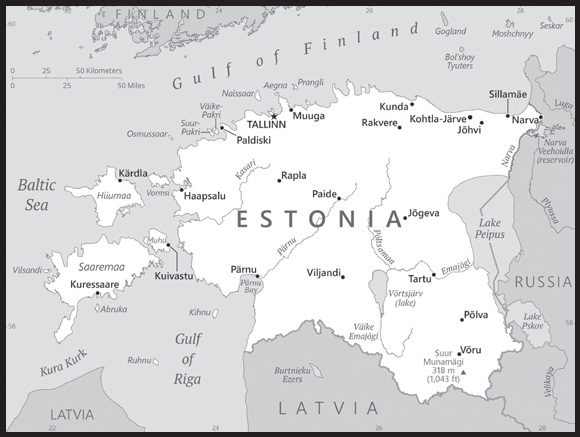
Location: Eastern Europe, bordering the Baltic Sea and Gulf of Finland, between Latvia and Russia
Geographic coordinates: 59 00 N, 26 00 E
Map references: Europe
Area: total: 45,228 sq km
land: 42,388 sq km
water: 2,840 sq km
note: includes 1,520 islands in the Baltic Sea
comparison ranking: total 132
Area - comparative: about twice the size of New Jersey
Land boundaries: total: 657 km
border countries (2): Latvia 333 km; Russia 324 km
Coastline: 3,794 km
Maritime claims: territorial sea: 12 nm
exclusive economic zone: limits as agreed to by Estonia, Finland, Latvia, Sweden, and Russia
Climate: maritime; wet, moderate winters, cool summers
Terrain: marshy, lowlands; flat in the north, hilly in the south
Elevation: highest point: Suur Munamagi 318 m
lowest point: Baltic Sea 0 m
mean elevation: 61 m
Natural resources: oil shale, peat, rare earth elements, phosphorite, clay, limestone, sand, dolomite, arable land, sea mud
Land use: agricultural land: 22.2% (2018 est.)
arable land: 14.9% (2018 est.)
permanent crops: 0.1% (2018 est.)
permanent pasture: 7.2% (2018 est.)
forest: 52.1% (2018 est.)
other: 25.7% (2018 est.)
Irrigated land: 20 sq km (2016)
Major lakes (area sq km): fresh water lake(s): Lake Peipus - 4,300 sq km (shared with Russia); Lake Võrtsjärv - 270 sq km
Population distribution: a fairly even distribution throughout most of the country, with urban areas attracting larger and denser populations
Natural hazards: sometimes flooding occurs in the spring
Geography - note: the mainland terrain is flat, boggy, and partly wooded; offshore lie more than 1,500 islands
PEOPLE AND SOCIETY
Population: 1,202,762 (2023 est.)
comparison ranking: 160
Nationality: noun: Estonian(s)
adjective: Estonian
Ethnic groups: Estonian 68.7%, Russian 24.8%, Ukrainian 1.7%, Belarusian 1%, Finn 0.6%, other 1.6%, unspecified 1.6% (2011 est.)
Languages: Estonian (official) 68.5%, Russian 29.6%, Ukrainian 0.6%, other 1.2%, unspecified 0.1% (2011 est.)
Religions: Orthodox 16.2%, Lutheran 9.9%, other Christian (including Methodist, Seventh Day Adventist, Roman Catholic, Pentecostal) 2.2%, other 0.9%, none 54.1%, unspecified 16.7% (2011 est.)
Age structure: 0-14 years: 15.56% (male 95,732/female 91,384)
15-64 years: 62.27% (male 376,599/female 372,380)
65 years and over: 22.17% (2023 est.) (male 94,291/female 172,376)
Dependency ratios: total dependency ratio: 58.3
youth dependency ratio: 26.1
elderly dependency ratio: 32.3
potential support ratio: 3.1 (2021 est.)
Median age: total: 43.7 years (2020)
male: 40.4 years
female: 47 years
comparison ranking: total 20
Population growth rate: -0.74% (2023 est.)
comparison ranking: 228
Birth rate: 8.48 births/1,000 population (2023 est.)
comparison ranking: 211
Death rate: 13.13 deaths/1,000 population (2023 est.)
comparison ranking: 8
Net migration rate: -2.73 migrant(s)/1,000 population (2023 est.)
comparison ranking: 178
Population distribution: a fairly even distribution throughout most of the country, with urban areas attracting larger and denser populations
Urbanization: urban population: 69.8% of total population (2023)
rate of urbanization: -0.03% annual rate of change (2020-25 est.)
Major urban areas - population: 454,000 TALLINN (capital) (2023)
Sex ratio: at birth: 1.05 male(s)/female
0-14 years: 1.05 male(s)/female
15-64 years: 1.01 male(s)/female
65 years and over: 0.55 male(s)/female
total population: 0.89 male(s)/female (2023 est.)
Mother’s mean age at first birth: 28.2 years (2020 est.)
Maternal mortality ratio: 5 deaths/100,000 live births (2020 est.)
comparison ranking: 164
Infant mortality rate: total: 3.38 deaths/1,000 live births (2023 est.)
male: 3.26 deaths/1,000 live births
female: 3.5 deaths/1,000 live births
comparison ranking: total 200
Life expectancy at birth: total population: 78.12 years (2023 est.)
male: 73.52 years
female: 82.94 years
comparison ranking: total population 84
Total fertility rate: 1.62 children born/woman (2023 est.)
comparison ranking: 181
Gross reproduction rate: 0.79 (2023 est.)
Drinking water source: improved: urban: 100% of population
total: 99.6% of population
unimproved: urban: 0% of population
total: 0.4% of population (2020 est.)
Current health expenditure: 7.8% of GDP (2020)
Physicians density: 3.47 physicians/1,000 population (2019)
Hospital bed density: 4.6 beds/1,000 population (2018)
Sanitation facility access: improved: urban: 99.8% of population
rural: 100% of population
total: 99.8% of population
unimproved: urban: 0.2% of population
rural: 0% of population
total: 0.2% of population (2020 est.)
Major infectious diseases: degree of risk: intermediate (2020)
vectorborne diseases: tickborne encephalitis
Obesity - adult prevalence rate: 21.2% (2016)
comparison ranking: 93
Alcohol consumption per capita: total: 11.65 liters of pure alcohol (2019 est.)
beer: 4 liters of pure alcohol (2019 est.)
wine: 1.92 liters of pure alcohol (2019 est.)
spirits: 4.6 liters of pure alcohol (2019 est.)
other alcohols: 1.13 liters of pure alcohol (2019 est.)
comparison ranking: total 7
Tobacco use: total: 29.7% (2020 est.)
male: 36.3% (2020 est.)
female: 23% (2020 est.)
comparison ranking: total 32
Children under the age of 5 years underweight: 0.4% (2013/15)
comparison ranking: 126
Currently married women (ages 15-49): 52.3% (2023 est.)
Education expenditures: 6.6% of GDP (2020 est.)
comparison ranking: 29
Literacy: definition: age 15 and over can read and write
total population: 99.9%
male: 99.9%
female: 99.9% (2021)
School life expectancy (primary to tertiary education): total: 16 years
male: 15 years
female: 17 years (2020)
Youth unemployment rate (ages 15-24): total: 17.1% (2021 est.)
male: 16.5%
female: 17.8%
comparison ranking: total 101
ENVIRONMENT
Environment - current issues: air polluted with sulfur dioxide from oil-shale burning power plants in northeast; however, the amounts of pollutants emitted into the air have fallen dramatically and the pollution load of wastewater at purification plants has decreased substantially due to improved technology and environmental monitoring; Estonia has more than 1,400 natural and manmade lakes, the smaller of which in agricultural areas need to be monitored; coastal seawater is polluted in certain locations
Environment - international agreements: party to: Air Pollution, Air Pollution-Heavy Metals, Air Pollution-Nitrogen Oxides, Air Pollution-Persistent Organic Pollutants, Air Pollution-Sulphur 85, Air Pollution-Volatile Organic Compounds, Antarctic Treaty, Biodiversity, Climate Change, Climate Change-Kyoto Protocol, Climate Change-Paris Agreement, Comprehensive Nuclear Test Ban, Desertification, Endangered Species, Environmental Modification, Hazardous Wastes, Law of the Sea, Marine Dumping-London Protocol, Ozone Layer Protection, Ship Pollution, Tropical Timber 2006, Wetlands, Whaling
signed, but not ratified: none of the selected agreements
Climate: maritime; wet, moderate winters, cool summers
Land use: agricultural land: 22.2% (2018 est.)
arable land: 14.9% (2018 est.)
permanent crops: 0.1% (2018 est.)
permanent pasture: 7.2% (2018 est.)
forest: 52.1% (2018 est.)
other: 25.7% (2018 est.)
Urbanization: urban population: 69.8% of total population (2023)
rate of urbanization: -0.03% annual rate of change (2020-25 est.)
Revenue from forest resources: 0.85% of GDP (2018 est.)
comparison ranking: 56
Revenue from coal: 0% of GDP (2018 est.)
comparison ranking: 156
Air pollutants: particulate matter emissions: 6.35 micrograms per cubic meter (2019 est.)
carbon dioxide emissions: 16.59 megatons (2016 est.)
methane emissions: 0.99 megatons (2020 est.)
Waste and recycling: municipal solid waste generated annually: 473,000 tons (2015 est.)
municipal solid waste recycled annually: 117,020 tons (2015 est.)
percent of municipal solid waste recycled: 24.7% (2015 est.)
Major lakes (area sq km): fresh water lake(s): Lake Peipus - 4,300 sq km (shared with Russia); Lake Võrtsjärv - 270 sq km
Total water withdrawal: municipal: 60 million cubic meters (2020 est.)
industrial: 790 million cubic meters (2020 est.)
agricultural: 4.5 million cubic meters (2017 est.)
Total renewable water resources: 12.81 billion cubic meters (2020 est.)
GOVERNMENT
Country name: conventional long form: Republic of Estonia
conventional short form: Estonia
local long form: Eesti Vabariik
local short form: Eesti
former: Estonian Soviet Socialist Republic (while occupied by the USSR)
etymology: the country name may derive from the Aesti, an ancient people who lived along the eastern Baltic Sea in the first centuries A.D.
Government type: parliamentary republic
Capital: name: Tallinn
geographic coordinates: 59 26 N, 24 43 E
time difference: UTC+2 (7 hours ahead of Washington, DC, during Standard Time)
daylight saving time: +1hr, begins last Sunday in March; ends last Sunday in October
etymology: the Estonian name is generally believed to be derived from “Taani-linn” (originally meaning “Danish castle”, now “Danish town”) after a stronghold built in the area by the Danes; it could also have come from “tali-linn” (“winter castle” or “winter town”) or “talu-linn” (“home castle” or “home town”)
Administrative divisions: 15 urban municipalities (linnad, singular - linn), 64 rural municipalities (vallad, singular vald)
urban municipalities: Haapsalu, Keila, Kohtla-Jarve, Loksa, Maardu, Narva, Narva-Joesuu, Paide, Parnu, Rakvere, Sillamae, Tallinn, Tartu, Viljandi, Voru
rural municipalities: Alutaguse, Anija, Antsla, Elva, Haademeeste, Haljala, Harku, Hiiumaa, Jarva, Joelahtme, Jogeva, Johvi, Kadrina, Kambja, Kanepi, Kastre, Kehtna, Kihnu, Kiili, Kohila, Kose, Kuusalu, Laane-Harju, Laane-Nigula, Laaneranna, Luganuse, Luunja, Marjamaa, Muhu, Mulgi, Mustvee, Noo, Otepaa, Peipsiaare, Pohja-Parnumaa, Pohja- Sakala, Poltsamaa, Polva, Raasiku, Rae, Rakvere, Räpina, Rapla, Rouge, Ruhnu, Saarde, Saaremaa, Saku, Saue, Setomaa, Tapa, Tartu, Toila, Tori, Torva, Turi, Vaike-Maarja, Valga, Viimsi, Viljandi, Vinni, Viru-Nigula, Vormsi, Voru
Independence: 24 February 1918 (from Soviet Russia); 20 August 1991 (declared from the Soviet Union); 6 September 1991 (recognized by the Soviet Union)
National holiday: Independence Day, 24 February (1918); note - 24 February 1918 was the date Estonia declared its independence from Soviet Russia and established its statehood; 20 August 1991 was the date it declared its independence from the Soviet Union restoring its statehood
Constitution: history: several previous; latest adopted 28 June 1992, entered into force 3 July 1992
amendments: proposed by at least one-fifth of Parliament members or by the president of the republic; passage requires three readings of the proposed amendment and a simple majority vote in two successive memberships of Parliament; passage of amendments to the “General Provisions” and “Amendment of the Constitution” chapters requires at least three-fifths majority vote by Parliament to conduct a referendum and majority vote in a referendum; amended several times, last in 2015
Legal system: civil law system
International law organization participation: accepts compulsory ICJ jurisdiction with reservations; accepts ICCt jurisdiction
Citizenship: citizenship by birth: no
citizenship by descent only: at least one parent must be a citizen of Estonia
dual citizenship recognized: no
residency requirement for naturalization: 5 years
Suffrage: 18 years of age; universal; age 16 for local elections
Executive branch: chief of state: President Alar KARIS (since 11 October 2021)
head of government: Prime Minister Kaja KALLAS (since 26 January 2021)
cabinet: Cabinet appointed by the prime minister, approved by Parliament
elections/appointments:
president indirectly elected by Parliament for a 5-year term (eligible for a second term); if a candidate does not secure two thirds of the votes after 3 rounds of balloting, then an electoral college consisting of Parliament members and local council members elects the president, choosing between the 2 candidates with the highest number of votes; if a president is still not elected, the process begins again; election last held on 30-31 August 2021 (next to be held in 2026); prime minister nominated by the president and approved by Parliament
election results:
2021: Alar KARIS (independent) elected president; second round of voting in parliament with 72 of 101 votes
2016: Kersti KALJULAID elected president with 81 of 98 votes in parliament (17 ballots blank) in the sixth round of voting; KALJULAID sworn in on 10 October - first female head of state of Estonia
Legislative branch: description: unicameral Parliament or Riigikogu (101 seats; members directly elected in multi-seat constituencies by open- list proportional representation vote to serve 4-year terms)
elections: last held on 5 March 2023; next elections 7 March 2027
election results:
2023: percent of vote by party - Reform 31.2%, EKRE 16.1%, Center 15.3%, E200 13.3%, SDE 9.3%, Pro Patria 8.2%, Left 2.4%, Right 2.3%, Greens 1.0%; seats by party - Reform 37, EKRE 17, Center 16, E200 14, SDE 9, Pro Patria 8; composition - men 71, women 30, percent of women 29.7%
Judicial branch: highest court(s): Supreme Court (consists of 19 justices, including the chief justice, and organized into civil, criminal, administrative, and constitutional review chambers)
judge selection and term of office: the chief justice is proposed by the president of the republic and appointed by the Riigikogu; other justices proposed by the chief justice and appointed by the Riigikogu; justices appointed for life
subordinate courts: circuit (appellate) courts; administrative, county, city, and specialized courts
Political parties and leaders: Center Party of Estonia (Keskerakond) or K [Juri RATAS]
Estonia 200 [Kristina KALLAS]
Estonian Conservative People’s Party (Konservatiivne Rahvaerakond) or EKRE [Martin HELME]
Estonian Greens (Greens/EFA) [Marko KAASIK & Johanna Maria TOUGU]
Estonian Reform Party (Reformierakond) or RE [Kaja KALLAS]
Pro Patria (Isamaa) [Helir-Valdor SEEDER]
Social Democratic Party or SDE [Lauri LAANEMETS]
International organization participation: Australia Group, BA, BIS, CBSS, CD, CE, EAPC, EBRD, ECB, EIB, EMU, ESA (cooperating state), EU, FAO, IAEA, IBRD, ICAO, ICC (national committees), ICCt, ICRM, IDA, IEA, IFAD, IFC, IFRCS, IHO, ILO, IMF, IMO, Interpol, IOC, IOM, IPU, ISO, ITSO, ITU, ITUC (NGOs), MIGA, MINUSMA, NATO, NIB, NSG, OAS (observer), OECD, OIF (observer), OPCW, OSCE, PCA, Schengen Convention, UN, UNCTAD, UNESCO, UNHCR, UNTSO, UPU, Wassenaar Arrangement, WCO, WHO, WIPO, WMO, WTO
Diplomatic representation in the US: chief of mission: Ambassador Kristjan PRIKK (since 7 July 2021)
chancery: 2131 Massachusetts Ave, NW
Washington, DC, 20008
telephone: [1] (202) 588-0101
FAX: [1] (202) 588-0108
email address and website:
consulate(s) general: New York, San Francisco
Diplomatic representation from the US: chief of mission: Ambassador George P. KENT (since 21 February 2023)
embassy: Kentmanni 20, 15099 Tallinn
mailing address: 4530 Tallinn Place, Washington DC 20521-4530
telephone: [372] 668-8100
FAX: [372] 668-8265
email address and website:
Flag description: three equal horizontal bands of blue (top), black, and white; various interpretations are linked to the flag colors; blue represents faith, loyalty, and devotion, while also reminiscent of the sky, sea, and lakes of the country; black symbolizes the soil of the country and the dark past and suffering endured by the Estonian people; white refers to the striving towards enlightenment and virtue, and is the color of birch bark and snow, as well as summer nights illuminated by the midnight sun
National symbol(s): barn swallow, cornflower; national colors: blue, black, white
National anthem: name: “Mu isamaa, mu onn ja room” (My Native Land, My Pride and Joy)
lyrics/music: Johann Voldemar JANNSEN/Fredrik PACIUS
note: adopted 1920, though banned between 1940 and 1990 under Soviet occupation; the anthem, used in Estonia since 1869, shares the same melody as Finland’s but has different lyrics
National heritage: total World Heritage Sites: 2 (both cultural)
selected World Heritage Site locales: Historic Center (Old Town) of Tallinn; Struve Geodetic Arc
ECONOMY
Economic overview: advanced service-based EU and OECD economy; regional trade and telecommunications leader; recently rejected Baltic sea rail tunnel from Tallinn to Helsinki; flat income taxation; substantial welfare system; balanced budget culture; business-friendly climate
Real GDP (purchasing power parity): $51.531 billion (2021 est.)
$47.708 billion (2020 est.)
$47.972 billion (2019 est.)
note: data are in 2017 dollars
comparison ranking: 112
Real GDP growth rate: 8.01% (2021 est.)
-0.55% (2020 est.)
3.74% (2019 est.)
comparison ranking: 40
Real GDP per capita: $38,700 (2021 est.)
$35,900 (2020 est.)
$36,200 (2019 est.)
note: data are in 2017 dollars
comparison ranking: 53
GDP (official exchange rate)
$31.461 billion (2019 est.)
Inflation rate (consumer prices): 4.65% (2021 est.)
-0.44% (2020 est.)
2.28% (2019 est.)
comparison ranking: 74
Credit ratings: Fitch rating: AA- (2018)
Moody’s rating: A1 (2002)
Standard & Poors rating: AA- (2011)
note: The year refers to the year in which the current credit rating was first obtained.
GDP - composition, by sector of origin
agriculture: 2.8% (2017 est.)
industry: 29.2% (2017 est.)
services: 68.1% (2017 est.)
comparison rankings: services 80; industry 84; agriculture 156
GDP - composition, by end use
household consumption: 50.3% (2017 est.)
government consumption: 20.4% (2017 est.)
investment in fixed capital: 24% (2017 est.)
investment in inventories: 2.2% (2017 est.)
exports of goods and services: 77.2% (2017 est.)
imports of goods and services: -74% (2017 est.)
Agricultural products: wheat, milk, barley, rapeseeds, rye, oats, peas, potatoes, pork, triticale
Industries: food, engineering, electronics, wood and wood products, textiles; information technology, telecommunications
Industrial production growth rate: 7.13% (2021 est.)
comparison ranking: 60
Labor force: 704,700 (2021 est.)
comparison ranking: 154
Labor force - by occupation: agriculture: 2.7%
industry: 20.5%
services: 76.8% (2017 est.)
Unemployment rate: 6.33% (2021 est.)
6.8% (2020 est.)
4.45% (2019 est.)
comparison ranking: 125
Youth unemployment rate (ages 15-24): total: 17.1% (2021 est.)
male: 16.5%
female: 17.8%
comparison ranking: total 101
Population below poverty line: 21.7% (2018 est.)
Gini Index coefficient - distribution of family income: 30.8 (2019 est.)
comparison ranking: 142
Average household expenditures: on food: 20.3% of household expenditures (2018 est.)
on alcohol and tobacco: 7.8% of household expenditures (2018 est.)
Household income or consumption by percentage share: lowest 10%: 2.3%
highest 10%: 25.6% (2015)
Budget: revenues: $12.282 billion (2019 est.)
expenditures: $12.269 billion (2019 est.)
Budget surplus (+) or deficit (-): -0.3% (of GDP) (2017 est.)
comparison ranking: 54
Public debt: 23.77% of GDP (2020 est.)
14.05% of GDP (2019 est.)
13.46% of GDP (2018 est.)
note: data cover general government debt and include debt instruments issued (or owned) by government entities, including sub-sectors of central government, state government, local government, and social security funds
comparison ranking: 181
Taxes and other revenues: 20.69% (of GDP) (2020 est.)
comparison ranking: 84
Fiscal year: calendar year
Current account balance: -$709.328 million (2021 est.)
-$370.205 million (2020 est.)
$735.796 million (2019 est.)
comparison ranking: 127
Exports: $29.056 billion (2021 est.) note: data are in current year dollars
$21.769 billion (2020 est.) note: data are in current year dollars
$22.962 billion (2019 est.) note: data are in current year dollars
comparison ranking: 75
Exports - partners: Finland 12%, United States 9%, Latvia 9%, Sweden 8%, Russia 6% (2021)
Exports - commodities: broadcasting equipment, coal tar oil, refined petroleum, cars, prefabricated buildings, lumber (2021)
Imports: $29.234 billion (2021 est.) note: data are in current year dollars
$21.813 billion (2020 est.) note: data are in current year dollars
$21.712 billion (2019 est.) note: data are in current year dollars
comparison ranking: 73
Imports - partners: Russia 15%, Finland 10%, Germany 10%, Latvia 7%, Lithuania 6% (2021)
Imports - commodities: refined petroleum, cars, coal tar oil, electricity, lumber, broadcasting equipment (2021)
Reserves of foreign exchange and gold: $2.371 billion (31 December 2021 est.)
$1.997 billion (31 December 2020 est.)
$1.426 billion (31 December 2019 est.)
comparison ranking: 126
Debt - external: $23.944 billion (2019 est.)
$23.607 billion (2018 est.)
comparison ranking: 89
Exchange rates: euros (EUR) per US dollar -
Exchange rates: 0.845 (2021 est.)
0.876 (2020 est.)
0.893 (2019 est.)
0.847 (2018 est.)
0.885 (2017 est.)
ENERGY
Electricity access: electrification - total population: 100% (2021)
Electricity: installed generating capacity: 3.03 million kW (2020 est.)
consumption: 9.172 billion kWh (2020 est.)
exports: 3.722 billion kWh (2020 est.)
imports: 7.367 billion kWh (2020 est.)
transmission/distribution losses: 375 million kWh (2020 est.)
comparison rankings: transmission/distribution losses 136; imports 32; exports 41; consumption 104; installed generating capacity 107
Electricity generation sources: fossil fuels: 55.8% of total installed capacity (2020 est.)
solar: 2% of total installed capacity (2020 est.)
wind: 14.3% of total installed capacity (2020 est.)
hydroelectricity: 0.7% of total installed capacity (2020 est.)
biomass and waste: 27.2% of total installed capacity (2020 est.)
Coal: production: 0 metric tons (2020 est.)
consumption: 3,000 metric tons (2020 est.)
exports: 0 metric tons (2020 est.)
imports: 3,000 metric tons (2020 est.)
proven reserves: 0 metric tons (2019 est.)
Petroleum: total petroleum production: 21,800 bbl/day (2021 est.)
refined petroleum consumption: 27,500 bbl/day (2019 est.)
Refined petroleum products - exports: 27,150 bbl/day (2017 est.)
comparison ranking: 64
Refined petroleum products - imports: 35,520 bbl/day (2017 est.)
comparison ranking: 95
Natural gas: production: 0 cubic meters (2021 est.)
consumption: 417.106 million cubic meters (2020 est.)
exports: 0 cubic meters (2021 est.)
imports: 417.276 million cubic meters (2020 est.)
proven reserves: 0 cubic meters (2021 est.)
Carbon dioxide emissions: 4.924 million metric tonnes of CO2 (2019 est.)
from coal and metallurgical coke: 44,000 metric tonnes of CO2 (2019 est.)
from petroleum and other liquids: 3.979 million metric tonnes of CO2 (2019 est.)
from consumed natural gas: 901,000 metric tonnes of CO2 (2019 est.)
comparison ranking: total emissions 135
Energy consumption per capita: 76.329 million Btu/person (2019 est.)
comparison ranking: 80
COMMUNICATIONS
Telephones - fixed lines: total subscriptions: 296,620 (2021 est.)
subscriptions per 100 inhabitants: 22 (2021 est.)
comparison ranking: total subscriptions 111
Telephones - mobile cellular: total subscriptions: 1,980,838 (2021 est.)
subscriptions per 100 inhabitants: 149 (2021 est.)
comparison ranking: total subscriptions 150
Telecommunication systems: general assessment: the competitive telecom market continues to progress with a range of regulatory measures which have enabled alternative operators to chip away at the fixed-line market share; fixed-line infrastructure upgrades have been focused on fiber, and the legacy DSL network has gradually been replaced; limited commercial 5G deployments have been made though an expansion of service availability awaits the delayed auction of spectrum in the 3.5GHz band, which is expected to be held later in 2021 (2021)
domestic: 22 per 100 for fixed-line subscribership and approximately 149 per 100 for mobile-cellular (2021)
international: country code - 372; landing points for the EE-S-1, EESF-3, Baltic Sea Submarine Cable, FEC and EESF-2 fiber-optic submarine cables to other Estonia points, Finland, and Sweden; 2 international switches are located in Tallinn (2019)
Broadcast media: the publicly owned broadcaster, Eesti Rahvusringhaaling (ERR), operates 3 TV channels and 5 radio networks; growing number of private commercial radio stations broadcasting nationally, regionally, and locally; fully transitioned to digital television in 2010; national private TV channels expanding service; a range of channels are aimed at Russian-speaking viewers; in 2016, there were 42 on-demand services available in Estonia, including 19 pay TVOD and SVOD services; roughly 85% of households accessed digital television services
Internet country code: .ee
Internet users: total: 1.183 million (2021 est.)
percent of population: 91% (2021 est.)
comparison ranking: total 147
Broadband - fixed subscriptions: total: 415,610 (2020 est.)
subscriptions per 100 inhabitants: 31 (2020 est.)
comparison ranking: total 96
TRANSPORTATION
National air transport system: number of registered air carriers: 3 (2020)
inventory of registered aircraft operated by air carriers: 14
annual passenger traffic on registered air carriers: 31,981 (2018)
Civil aircraft registration country code prefix: ES
Airports: 18 (2021)
comparison ranking: total 140
Airports - with paved runways: 13
note: paved runways have a concrete or asphalt surface but not all have facilities for refueling, maintenance, or air traffic control; the length of a runway required for aircraft to safely operate depends on a number of factors including the type of aircraft, the takeoff weight (including passengers, cargo, and fuel), engine types, flap settings, landing speed, elevation of the airport, and average maximum daily air temperature; paved runways can reach a length of 5,000 m (16,000 ft.), but the “typical” length of a commercial airline runway is between 2,500-4,000 m (8,000-13,000 ft.)
Airports - with unpaved runways: 5
note: unpaved runways have a surface composition such as grass or packed earth and are most suited to the operation of light aircraft; unpaved runways are usually short, often less than 1,000 m (3,280 ft.) in length; airports with unpaved runways often lack facilities for refueling, maintenance, or air traffic control
Heliports: 1 (2021)
Pipelines: 2,360 km gas (2016)
Railways: total: 1,441 km (2020) 225 km electrified
comparison ranking: total 83
Roadways: total: 58,412 km (2011) (includes urban roads)
paved: 10,427 km (2011) (includes 115 km of expressways)
unpaved: 47,985 km (2011)
comparison ranking: total 78
Waterways: 335 km (2011) (320 km are navigable year-round)
comparison ranking: 99
Merchant marine: total: 70 (2022)
by type: general cargo 2, oil tanker 3, other 65
comparison ranking: total 109
Ports and terminals: major seaport(s): Kuivastu, Kunda, Muuga, Parnu Reid, Sillamae, Tallinn
Transportation - note: Estonia operates two PC 5 or 6 class icebreakers in the Baltic Sea
note - PC indicates a Polar Class vessel: PC 5 - year-round operation in medium first-year ice which may include old ice inclusions (ice thickness up to 70-120 cm); PC 6 - summer/autumn operation in medium first-year ice which may include old ice inclusions (ice thickness up to 30-70 cm)
MILITARY AND SECURITY
Military and security forces: Estonian Defense Forces: Land Forces, Navy, Air Force, Estonian Defense League (Reserves)
Ministry of Interior: Police, Border Guard Board, Internal Security Service (2023)
Military expenditures: 2.7% of GDP (2023 est.)
2.2% of GDP (2022 est.)
2% of GDP (2021)
2.3% of GDP (2020)
2% of GDP (2019)
comparison ranking: 36
Military and security service personnel strengths: approximately 7,000 active-duty personnel; approximately 15,000 Defense League (2023)
note: the Estonian Defense Forces rely largely on reservists who have completed compulsory conscription in the previous 10 years to fill out its active duty and Territorial Defense units during a crisis; there are more than 40,000 trained reservists and approximately 230,000 Estonians are enrolled in the mobilization registry
Military equipment inventories and acquisitions: the Estonian military has a mix of Soviet-era and some more modern equipment, mostly from western European suppliers, as well as Israel, South Korea, and the US (2023)
Military service age and obligation: 18-27 for compulsory military or governmental service for men; conscript service requirement 8-11 months depending on education; non-commissioned officers, reserve officers, and specialists serve 11 months; women can volunteer, and as of 2018 could serve in any military branch (2023)
note 1: conscripts comprise approximately 3,000-3,300 of the Estonian military’s 7,000 active-duty personnel and serve in all branches, except for the Air Force; after conscript service, reservists are called up for training every 5 years; Estonia has had conscription since 1991
note 2: in 2020, women comprised about 10% of the full-time professional military force; the National Defense League includes a Women’s Voluntary Defense Organization of about 3,000 members
Military - note: the Estonian military is a compact force that relies heavily on conscripts and reservists and the support of its NATO allies; Estonia’s defense policy aims to guarantee the country’s independence and sovereignty, protect its territorial integrity, including waters and airspace, and preserve constitutional order; Estonia’s main defense goals are developing and maintaining a credible deterrent to outside aggression and ensuring the Estonian Defense Forces (EDF) can fulfill their commitments to NATO and interoperate with the armed forces of NATO and EU member states; the EDF’s primary external focus is Russia; since Russia’s full-scale invasion of Ukraine in 2022, Estonia has boosted defense spending, sent arms to Ukraine, and sought to boost the EDF’s capabilities in such areas as air defense, artillery, personnel readiness, and surveillance
Estonia has been a member of NATO since 2004 and is fully integrated within the NATO structure; since 2017, Estonia has hosted a UK-led multinational NATO ground force battlegroup as part of the Alliance’s Enhanced Forward Presence initiative; as the EDF Air Force does not have any combat aircraft, NATO has provided airspace protection for Estonia since 2004 through its Baltic Air Policing mission; NATO member countries that possess air combat capabilities voluntarily contribute to the mission on four-month rotations; NATO fighter aircraft have been hosted at Estonia’s Ämari Air Base since 2014; Estonia also hosts a NATO cyber security center; it cooperates closely with the EU on defense issues through the EU Common Security and Defense Policy and is a member of the UK-led Joint Expeditionary Force, a pool of high-readiness military forces from 10 Baltic and Scandinavian countries designed to respond to a wide range of contingencies in the North Atlantic, Baltic Sea, and High North regions; Estonia also has close defense ties with its Baltic neighbors and has bilateral military agreements with a number of European countries, as well as Canada and the US
the Estonian Army features a divisional headquarters, two infantry brigades, and an artillery battalion, plus supporting units; it would rely heavily on mobilized reserves during a crisis, which would be used to fill out active-duty units and staff territorial defense units; the Estonian Navy features a mine warfare flotilla; the EDF also has a special operations command (2023)
TRANSNATIONAL ISSUES
Disputes - international: Russia and Estonia in May 2005 signed a technical border agreement, but Russia in June 2005 recalled its signature after the Estonian parliament added to its domestic ratification act a historical preamble referencing the Soviet occupation and Estonia’s pre-war borders under the 1920 Treaty of Tartu; Russia contends that the preamble allows Estonia to make territorial claims on Russia in the future, while Estonian officials deny that the preamble has any legal impact on the treaty text; Russia demands better treatment of the Russian-speaking population in Estonia; as a member state that forms part of the EU’s external border, Estonia implements strict Schengen border rules with Russia
Refugees and internally displaced persons: refugees (country of origin): 50,450 (Ukraine) (as of 5 November 2023)
stateless persons: 70,604 (2022); note - following independence in 1991, automatic citizenship was restricted to those who were Estonian citizens prior to the 1940 Soviet occupation and their descendants; thousands of ethnic Russians remained stateless when forced to choose between passing Estonian language and citizenship tests or applying for Russian citizenship; one reason for demurring on Estonian citizenship was to retain the right of visa-free travel to Russia; stateless residents can vote in local elections but not general elections; stateless parents who have been lawful residents of Estonia for at least five years can apply for citizenship for their children before they turn 15 years old
Illicit drugs: producer of synthetic drugs; important transshipment zone for cannabis, cocaine, opiates, and synthetic drugs since joining the European Union and the Schengen Accord; potential money laundering related to organized crime and drug trafficking is a concern, as is possible use of the gambling sector to launder funds; major use of opiates and ecstasy
INTRODUCTION
Background: A Swazi kingdom was founded in the mid-18th century and ruled by a series of kings including MSWATI II, a 19th century ruler whose appellation was adopted to become the name of the country and its predominant ethnic group. The kingdom’s modern borders were defined by European countries during the late-19th century and Swaziland (as it became known) was administered as a UK high commission territory from 1903 until its independence in 1968. A new constitution came into effect in 2006, which included provisions for a more independent parliament and judiciary, but the legal status of political parties remains unclear, and the kingdom is still considered an absolute monarchy. King MSWATI III renamed the country from Swaziland to Eswatini in 2018 to reflect the name most commonly used by its citizens. In 2021, MSWATI III used security forces to suppress prodemocracy protests and established a national dialogue on political reforms. Despite its classification as a lower-middle income country, Eswatini suffers from severe poverty, corruption, and high unemployment. Eswatini has the world’s highest HIV/AIDS prevalence rate, although recent years have shown marked declines in new infections. Eswatini is the only country in Africa that recognizes Taiwan.
GEOGRAPHY
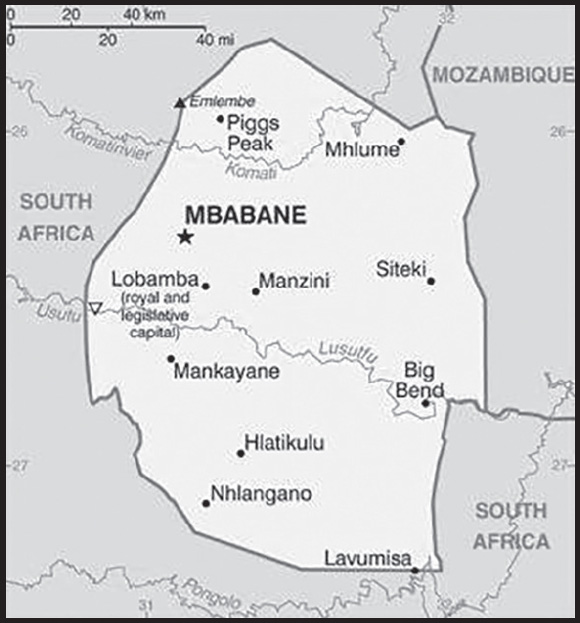
Location: Southern Africa, between Mozambique and South Africa
Geographic coordinates: 26 30 S, 31 30 E
Map references: Africa
Area: total: 17,364 sq km
land: 17,204 sq km
water: 160 sq km
comparison ranking: total 158
Area - comparative: slightly smaller than New Jersey
Land boundaries: total: 546 km
border countries (2): Mozambique 108 km; South Africa 438 km
Coastline: 0 km (landlocked)
Maritime claims: none (landlocked)
Climate: varies from tropical to near temperate
Terrain: mostly mountains and hills; some moderately sloping plains
Elevation: highest point: Emlembe 1,862 m
lowest point: Great Usutu River 21 m
mean elevation: 305 m
Natural resources: asbestos, coal, clay, cassiterite, hydropower, forests, small gold and diamond deposits, quarry stone, and talc
Land use: agricultural land: 68.3% (2018 est.)
arable land: 9.8% (2018 est.)
permanent crops: 0.8% (2018 est.)
permanent pasture: 57.7% (2018 est.)
forest: 31.7% (2018 est.)
other: 0% (2018 est.)
Irrigated land: 500 sq km (2012)
Population distribution: because of its mountainous terrain, the population distribution is uneven throughout the country, concentrating primarily in valleys and plains as shown in this population distribution map
Natural hazards: drought
Geography - note: landlocked; almost completely surrounded by South Africa
PEOPLE AND SOCIETY
Population: 1,130,043 (2023 est.)
comparison ranking: 161
Nationality: noun: liSwati (singular), emaSwati (plural); note - former term, Swazi(s), still used among English speakers
adjective: Swati; note - former term, Swazi, still used among English speakers
Ethnic groups: predominantly Swazi; smaller populations of other African ethnic groups, including the Zulu, as well as people of European ancestry
Languages: English (official, used for government business), siSwati (official)
Religions: Christian 90% (Zionist - a blend of Christianity and traditional African religions - 40%, Roman Catholic 20%, other Christian 30% - includes Anglican, Methodist, Church of Jesus Christ, Jehovah’s Witness), Muslim 2%, other 8% (includes Baha’i, Buddhist, Hindu, indigenous, Jewish) (2015 est.)
Demographic profile: Eswatini, a small, predominantly rural, landlocked country surrounded by South Africa and Mozambique, suffers from severe poverty and the world’s highest HIV/AIDS prevalence rate. A weak and deteriorating economy, high unemployment, rapid population growth, and an uneven distribution of resources all combine to worsen already persistent poverty and food insecurity, especially in rural areas. Erratic weather (frequent droughts and intermittent heavy rains and flooding), overuse of small plots, the overgrazing of cattle, and outdated agricultural practices reduce crop yields and further degrade the environment, exacerbating Eswatini’s poverty and subsistence problems. Eswatini’s extremely high HIV/AIDS prevalence rate – nearly 28% of adults have the disease – compounds these issues. Agricultural production has declined due to HIV/AIDS, as the illness causes households to lose manpower and to sell livestock and other assets to pay for medicine and funerals.
Swazis, mainly men from the country’s rural south, have been migrating to South Africa to work in coal, and later gold, mines since the late 19th century. Although the number of miners abroad has never been high in absolute terms because of Eswatini’s small population, the outflow has had important social and economic repercussions. The peak of mining employment in South Africa occurred during the 1980s. Cross-border movement has accelerated since the 1990s, as increasing unemployment has pushed more Swazis to look for work in South Africa (creating a “brain drain” in the health and educational sectors); southern Swazi men have continued to pursue mining, although the industry has downsized. Women now make up an increasing share of migrants and dominate cross-border trading in handicrafts, using the proceeds to purchase goods back in Eswatini. Much of today’s migration, however, is not work-related but focuses on visits to family and friends, tourism, and shopping.
Age structure: 0-14 years: 32.16% (male 181,886/female 181,491)
15-64 years: 63.88% (male 336,243/female 385,599)
65 years and over: 3.97% (2023 est.) (male 16,654/female 28,170)
Dependency ratios: total dependency ratio: 64
youth dependency ratio: 57.4
elderly dependency ratio: 6.5
potential support ratio: 15.3 (2021 est.)
Median age: total: 23.7 years (2020)
male: 22.5 years
female: 24.7 years
comparison ranking: total 174
Population growth rate: 0.72% (2023 est.)
comparison ranking: 124
Birth rate: 22.83 births/1,000 population (2023 est.)
comparison ranking: 50
Death rate: 9.53 deaths/1,000 population (2023 est.)
comparison ranking: 45
Net migration rate: -6.07 migrant(s)/1,000 population (2023 est.)
comparison ranking: 209
Population distribution: because of its mountainous terrain, the population distribution is uneven throughout the country, concentrating primarily in valleys and plains as shown in this population distribution map
Urbanization: urban population: 24.8% of total population (2023)
rate of urbanization: 2.42% annual rate of change (2020-25 est.)
Major urban areas - population: 68,000 MBABANE (capital) (2018)
Sex ratio: at birth: 1.03 male(s)/female
0-14 years: 1 male(s)/female
15-64 years: 0.87 male(s)/female
65 years and over: 0.59 male(s)/female
total population: 0.9 male(s)/female (2023 est.)
Maternal mortality ratio: 437 deaths/100,000 live births (2017 est.)
comparison ranking: 22
Infant mortality rate: total: 38.12 deaths/1,000 live births (2023 est.)
male: 42.27 deaths/1,000 live births
female: 33.85 deaths/1,000 live births
comparison ranking: total 34
Life expectancy at birth: total population: 60.22 years (2023 est.)
male: 58.17 years
female: 62.33 years
comparison ranking: total population 219
Total fertility rate: 2.41 children born/woman (2023 est.)
comparison ranking: 71
Gross reproduction rate: 1.19 (2023 est.)
Contraceptive prevalence rate: 66.1% (2014)
Drinking water source: improved: urban: 97.5% of population
rural: 74.8% of population
total: 80.3% of population
unimproved: urban: 2.5% of population
rural: 25.2% of population
total: 19.7% of population (2020 est.)
Current health expenditure: 6.5% of GDP (2020)
Physicians density: 0.14 physicians/1,000 population (2020)
Hospital bed density: 2.1 beds/1,000 population (2011)
Sanitation facility access: improved: urban: 92.3% of population
rural: 83.9% of population
total: 85.9% of population
unimproved: urban: 7.7% of population
rural: 16.1% of population
total: 14.1% of population (2020 est.)
Major infectious diseases: degree of risk: intermediate (2023)
food or waterborne diseases: bacterial diarrhea, hepatitis A, and typhoid fever
vectorborne diseases: malaria
water contact diseases: schistosomiasis
Obesity - adult prevalence rate: 16.5% (2016)
comparison ranking: 124
Alcohol consumption per capita: total: 7.68 liters of pure alcohol (2019 est.)
beer: 2.45 liters of pure alcohol (2019 est.)
wine: 0.06 liters of pure alcohol (2019 est.)
spirits: 0 liters of pure alcohol (2019 est.)
other alcohols: 5.17 liters of pure alcohol (2019 est.)
comparison ranking: total 50
Tobacco use: total: 9.2% (2020 est.)
male: 16.5% (2020 est.)
female: 1.8% (2020 est.)
comparison ranking: total 138
Children under the age of 5 years underweight: 5.8% (2014)
comparison ranking: 70
Currently married women (ages 15-49): 37.1% (2023 est.)
Education expenditures: 5% of GDP (2021 est.)
comparison ranking: 75
Literacy: definition: age 15 and over can read and write
total population: 88.4%
male: 88.3%
female: 88.5% (2018)
School life expectancy (primary to tertiary education): total: 13 years
male: 13 years
female: 12 years (2013)
Youth unemployment rate (ages 15-24): total: 50.9% (2021 est.)
male: 47.7%
female: 54.1%
comparison ranking: total 3
ENVIRONMENT
Environment - current issues: limited supplies of potable water; wildlife populations being depleted because of excessive hunting; population growth, deforestation, and overgrazing lead to soil erosion and soil degradation
Environment - international agreements: party to: Biodiversity, Climate Change, Climate Change-Kyoto Protocol, Climate Change-Paris Agreement, Comprehensive Nuclear Test Ban, Desertification, Endangered Species, Hazardous Wastes, Law of the Sea, Nuclear Test Ban, Ozone Layer Protection, Wetlands
signed, but not ratified: none of the selected agreements
Climate: varies from tropical to near temperate
Land use: agricultural land: 68.3% (2018 est.)
arable land: 9.8% (2018 est.)
permanent crops: 0.8% (2018 est.)
permanent pasture: 57.7% (2018 est.)
forest: 31.7% (2018 est.)
other: 0% (2018 est.)
Urbanization: urban population: 24.8% of total population (2023)
rate of urbanization: 2.42% annual rate of change (2020-25 est.)
Food insecurity: severe localized food insecurity: due to higher staple food prices - the price of maize meal, the key food staple, increased in the first five months of 2022 and, as of May 2022, were 3 percent higher on a yearly basis; wheat flour prices were also at record highs in May 2022; this mainly reflects the elevated global prices and the country’s high dependence on imported wheat to satisfy national consumption needs (2022)
Revenue from forest resources: 2.25% of GDP (2018 est.)
comparison ranking: 30
Revenue from coal: 0.1% of GDP (2018 est.)
comparison ranking: 26
Air pollutants: particulate matter emissions: 15.07 micrograms per cubic meter (2019 est.)
carbon dioxide emissions: 1.16 megatons (2016 est.)
methane emissions: 1.9 megatons (2020 est.)
Waste and recycling: municipal solid waste generated annually: 218,199 tons (2016 est.)
Total water withdrawal: municipal: 40 million cubic meters (2020 est.)
industrial: 20 million cubic meters (2020 est.)
agricultural: 1.01 billion cubic meters (2020 est.)
Total renewable water resources: 4.51 billion cubic meters (2020 est.)
GOVERNMENT
Country name: conventional long form: Kingdom of Eswatini
conventional short form: Eswatini
local long form: Umbuso weSwatini
local short form: eSwatini
former: Swaziland
etymology: the country name derives from 19th century King MSWATI II, under whose rule Swati territory was expanded and unified
note: pronounced ay-swatini or eh-swatini
Government type: absolute monarchy
Capital: name: Mbabane (administrative capital); Lobamba (royal and legislative capital)
geographic coordinates: 26 19 S, 31 08 E
time difference: UTC+2 (7 hours ahead of Washington, DC, during Standard Time)
etymology: named after a Swati chief, Mbabane KUNENE, who lived in the area at the onset of British settlement
Administrative divisions: 4 regions; Hhohho, Lubombo, Manzini, Shiselweni
Independence: 6 September 1968 (from the UK)
National holiday: Independence Day (Somhlolo Day), 6 September (1968)
Constitution: history: previous 1968, 1978; latest signed by the king 26 July 2005, effective 8 February 2006
amendments: proposed at a joint sitting of both houses of Parliament; passage requires majority vote by both houses and/or majority vote in a referendum, and assent of the king; passage of amendments affecting “specially entrenched” constitutional provisions requires at least three-fourths majority vote by both houses, passage by simple majority vote in a referendum, and assent of the king; passage of “entrenched” provisions requires at least two-thirds majority vote of both houses, passage in a referendum, and assent of the king
Legal system: mixed legal system of civil, common, and customary law
International law organization participation: accepts compulsory ICJ jurisdiction with reservations; non-party state to the ICCt
Citizenship: citizenship by birth: no
citizenship by descent only: both parents must be citizens of Eswatini
dual citizenship recognized: no
residency requirement for naturalization: 5 years
Suffrage: 18 years of age
Executive branch: chief of state: King MSWATI III (since 25 April 1986)
head of government: Prime Minister Ambrose Mandvulo Dlamini (since 3 November 2023)
cabinet: Cabinet recommended by the prime minister, confirmed by the monarch; at least one-half of the cabinet membership must be appointed from among elected members of the House of Assembly
elections/appointments: the monarchy is hereditary; prime minister appointed by the monarch from among members of the House of Assembly
Legislative branch: description: bicameral Parliament (Libandla) consists of:
Senate (30 seats; 20 members appointed by the monarch and 10 indirectly elected by simple majority vote by the House of Assembly; members serve 5-year terms)
House of Assembly (70 seats statutory, current 70; 59 members directly elected in single-seat constituencies or tinkhundla by absolute majority vote in 2 rounds if needed, 10 members appointed by the monarch, 4 women elected by the members if representation of elected women is less than 30%, and 1 ex-officio member - the attorney general; members serve 5-year terms)
elections:
Senate - last held on 23 October 2018 (next to be held on 31 October 2023)
House of Assembly - last held on 29 September 2023 (next to be held in 2028)
election results:
Senate - percent of seats by party - NA; seats by party - NA; composition - men 18, women 12, percent of women 40% House of Assembly - percent of vote by party - NA; seats by party - independent 59; composition - men 58, women 12, percent of women 17.14%; note - total Parliament percent of women 4.1%
Judicial branch: highest court(s): Supreme Court (consists of the chief justice and at least 4 justices) and the High Court (consists of the chief justice - ex officio - and 4 justices); note - the Supreme Court has jurisdiction in all constitutional matters
judge selection and term of office: justices of the Supreme Court and High Court appointed by the monarch on the advice of the Judicial Service Commission (JSC), a judicial advisory body consisting of the Supreme Court Chief Justice, 4 members appointed by the monarch, and the chairman of the Civil Service Commission; justices of both courts eligible for retirement at age 65 with mandatory retirement at age 75
subordinate courts: magistrates’ courts; National Swazi Courts for administering customary/traditional laws (jurisdiction restricted to customary law for Swazi citizens)
Political parties and leaders: political parties exist but conditions for their operations, particularly in elections, are undefined, legally unclear, or culturally restricted; the following are considered political associations:
African United Democratic Party or AUDP [Stanley S. MALINDZISA]
Ngwane National Liberatory Congress or NNLC [Sibongile MAZIBUKO]
People’s United Democratic Movement or PUDEMO [Mlungisi MAKHANYA]
Swazi Democratic Party or SWADEPA [Jan SITHOLE]
International organization participation: ACP, AfDB, AU, C, COMESA, FAO, G-77, IAEA, IBRD, ICAO, ICRM, IDA, IFAD, IFC, IFRCS, ILO, IMF, IMO, Interpol, IOC, IOM, ISO (correspondent), ITSO, ITU, ITUC (NGOs), MIGA, NAM, OPCW, PCA, SACU, SADC, UN, UNCTAD, UNESCO, UNIDO, UNWTO, UPU, WCO, WHO, WIPO, WMO, WTO
Diplomatic representation in the US: chief of mission: Ambassador Kennedy Fitzgerald GROENING (7 June 2022)
chancery: 1712 New Hampshire Avenue NW, Washington, DC 20009
telephone: [1] (202) 234-5002
FAX: [1] (202) 234-8254
email address and website:
embassy@eswatini-usa.com; swaziland@compuserve.com
Diplomatic representation from the US: chief of mission: Ambassador (vacant) Charges d’Affaires Earl R. MILLER (since 27 January 2023)
embassy: Corner of MR 103 and Cultural Center Drive, Ezulwini, P.O. Box D202, The Gables, H106
mailing address: 2350 Mbabane Place, Washington DC 20521-2350
telephone: (268) 2417-9000
FAX: [268] 2416-3344
email address and website:
Flag description: three horizontal bands of blue (top), red (triple width), and blue; the red band is edged in yellow; centered in the red band is a large black and white shield covering two spears and a staff decorated with feather tassels, all placed horizontally; blue stands for peace and stability, red represents past struggles, and yellow the mineral resources of the country; the shield, spears, and staff symbolize protection from the country’s enemies, while the black and white of the shield are meant to portray black and white people living in peaceful coexistence
National symbol(s): lion, elephant; national colors: blue, yellow, red
National anthem: name: “Nkulunkulu Mnikati wetibusiso temaSwati” (Oh God, Bestower of the Blessings of the Swazi)
lyrics/music: Andrease Enoke Fanyana SIMELANE/David Kenneth RYCROFT
note: adopted 1968; uses elements of both ethnic Swazi and Western music styles
ECONOMY
Economic overview: landlocked southern African economy; South African trade dependent and currency pegging; CMA and SACU member state; COVID-19 economic slowdown; growing utilities inflation; persistent poverty and unemployment; HIV/AIDS labor force disruptions
Real GDP (purchasing power parity): $10.56 billion (2021 est.)
$9.788 billion (2020 est.)
$9.943 billion (2019 est.)
note: data are in 2017 dollars
comparison ranking: 161
Real GDP growth rate: 7.88% (2021 est.)
-1.56% (2020 est.)
2.7% (2019 est.)
comparison ranking: 43
Real GDP per capita: $8,900 (2021 est.)
$8,300 (2020 est.)
$8,500 (2019 est.)
note: data are in 2017 dollars
comparison ranking: 150
GDP (official exchange rate)
$4.484 billion (2019 est.)
Inflation rate (consumer prices): 2.6% (2019 est.)
4.82% (2018 est.)
6.22% (2017 est.)
comparison ranking: 130
Credit ratings: Moody’s rating: B3 (2020)
note: The year refers to the year in which the current credit rating was first obtained.
GDP - composition, by sector of origin
agriculture: 6.5% (2017 est.)
industry: 45% (2017 est.)
services: 48.6% (2017 est.)
comparison rankings: services 185; industry 17; agriculture 117
GDP - composition, by end use
household consumption: 64% (2017 est.)
government consumption: 21.3% (2017 est.)
investment in fixed capital: 13.4% (2017 est.)
investment in inventories: -0.1% (2017 est.)
exports of goods and services: 47.9% (2017 est.)
imports of goods and services: -46.3% (2017 est.)
Agricultural products: sugar cane, maize, roots/tubers nes, grapefruit, oranges, milk, beef, potatoes, vegetables, bananas
Industries: soft drink concentrates, coal, forestry, sugar processing, textiles, and apparel
Industrial production growth rate: 15.38% (2021 est.)
comparison ranking: 14
Labor force: 383,500 (2021 est.)
comparison ranking: 162
Labor force - by occupation: agriculture: 10.7%
industry: 30.4%
services: 58.9% (2014 est.)
Unemployment rate: 25.76% (2021 est.)
25.51% (2020 est.)
22.84% (2019 est.)
comparison ranking: 7
Youth unemployment rate (ages 15-24): total: 50.9% (2021 est.)
male: 47.7%
female: 54.1%
comparison ranking: total 3
Population below poverty line: 58.9% (2016 est.)
Gini Index coefficient - distribution of family income: 54.6 (2016 est.)
comparison ranking: 5
Household income or consumption by percentage share: lowest 10%: 1.7%
highest 10%: 40.1% (2010 est.)
Budget: revenues: $1.131 billion (2020 est.)
expenditures: $1.454 billion (2020 est.)
Budget surplus (+) or deficit (-): -8.5% (of GDP) (2017 est.)
comparison ranking: 201
Public debt: 28.4% of GDP (2017 est.)
25.5% of GDP (2016 est.)
comparison ranking: 173
Taxes and other revenues: 28.6% (of GDP) (2017 est.)
comparison ranking: 33
Fiscal year: 1 April - 31 March
Current account balance: $124.463 million (2021 est.)
$270.942 million (2020 est.)
$176.144 million (2019 est.)
comparison ranking: 67
Exports: $2.132 billion (2021 est.) note: data are in current year dollars
$1.808 billion (2020 est.) note: data are in current year dollars
$2.048 billion (2019 est.) note: data are in current year dollars
comparison ranking: 158
Exports - partners: South Africa 94% (2017)
Exports - commodities: carbonated drink mixtures, sugar, gold, industrial additives, clothing, lumber (2021)
Imports: $2.173 billion (2021 est.) note: data are in current year dollars
$1.686 billion (2020 est.) note: data are in current year dollars
$1.924 billion (2019 est.) note: data are in current year dollars
comparison ranking: 170
Imports - partners: South Africa 81.6%, China 5.2% (2017)
Imports - commodities: motor vehicles, machinery, transport equipment, foodstuffs, petroleum products, chemicals
Reserves of foreign exchange and gold: $572,281,500 (31 December 2021 est.)
$545,564,200 (31 December 2020 est.)
$440,314,200 (31 December 2019 est.)
comparison ranking: 166
Debt - external: $535 million (2019 est.)
$456 million (2018 est.)
comparison ranking: 178
Exchange rates: emalangeni per US dollar -
Exchange rates: 14.783 (2021 est.)
16.47 (2020 est.)
14.452 (2019 est.)
13.234 (2018 est.)
13.324 (2017 est.)
ENERGY
Electricity access: population without electricity: (2020) less than 1 million
electrification - total population: 82.9% (2021)
electrification - urban areas: 94.5% (2021)
electrification - rural areas: 79.1% (2021)
Electricity: installed generating capacity: 286,000 kW (2020 est.)
consumption: 1,448,308,000 kWh (2019 est.)
exports: 0 kWh (2019 est.)
imports: 942 million kWh (2019 est.)
transmission/distribution losses: 154.7 million kWh (2019 est.)
comparison rankings: installed generating capacity 162; transmission/distribution losses 153; imports 74; exports 174; consumption 153
Electricity generation sources: fossil fuels: 44.1% of total installed capacity (2020 est.)
solar: 0.2% of total installed capacity (2020 est.)
hydroelectricity: 24.8% of total installed capacity (2020 est.)
biomass and waste: 31% of total installed capacity (2020 est.)
Coal: production: 108,000 metric tons (2020 est.)
consumption: 169,000 metric tons (2020 est.)
exports: 163,000 metric tons (2020 est.)
imports: 135,000 metric tons (2020 est.)
proven reserves: 144 million metric tons (2019 est.)
Petroleum: total petroleum production: 0 bbl/day (2021 est.)
refined petroleum consumption: 6,000 bbl/day (2019 est.)
Refined petroleum products - imports: 5,279 bbl/day (2015 est.)
comparison ranking: 169
Carbon dioxide emissions: 1.224 million metric tonnes of CO2 (2019 est.)
from coal and metallurgical coke: 350,000 metric tonnes of CO2 (2019 est.)
from petroleum and other liquids: 875,000 metric tonnes of CO2 (2019 est.)
comparison ranking: total emissions 169
Energy consumption per capita: 19.371 million Btu/person (2019 est.)
comparison ranking: 136
COMMUNICATIONS
Telephones - fixed lines: total subscriptions: 46,000 (2021 est.)
subscriptions per 100 inhabitants: 4 (2021 est.)
comparison ranking: total subscriptions 159
Telephones - mobile cellular: total subscriptions: 1.4 million (2021 est.)
subscriptions per 100 inhabitants: 120 (2021 est.)
comparison ranking: total subscriptions 160
Telecommunication systems: general assessment: Eswatini was one of the last countries in the world to open up its telecom market to competition; until 2011 the state-owned Eswatini Posts and Telecommunications also acted as the industry regulator and had a stake in the country’s sole mobile network; a new independent regulatory authority was established in late 2013 and has since embarked on significant changes to the sector; mobile market subscriptions have been affected by the common use among subscribers when they use SIM cards from different networks in order to access cheaper on-net calls; subscriber growth has slowed in recent years, but was expected to have reached 8% in 2021, as people adapted to the changing needs for connectivity caused by the pandemic; the internet sector has been open to competition with a small number of licensed ISPs; DSL services were introduced in 2008, development of the sector has been hampered by the limited fixed-line infrastructure and by a lack of competition in the access and backbone networks; Eswatini is landlocked and so depends on neighboring countries for international bandwidth; this has meant that access pricing is relatively high, and market subscriptions remains relatively low; prices have fallen recently in line with greater bandwidth availability resulting from several new submarine cable systems which have reached the region in recent years; in September 2020 a terrestrial cable linked Mozambique with Eswatini and South Africa (2022)
domestic: fixed-line stands at nearly 4 per 100 and mobile-cellular teledensity roughly 120 telephones per 100 persons (2021)
international: country code - 268; satellite earth station - 1 Intelsat (Atlantic Ocean)
Broadcast media: 1 state-owned TV station; satellite dishes are able to access South African providers; state-owned radio network with 3 channels; 1 private radio station (2019)
Internet country code: .sz
Internet users: total: 708,000 (2021 est.)
percent of population: 59% (2021 est.)
comparison ranking: total 160
Broadband - fixed subscriptions: total: 12,000 (2020 est.)
subscriptions per 100 inhabitants: 1 (2020 est.)
comparison ranking: total 178
TRANSPORTATION
Civil aircraft registration country code prefix: 3DC
Airports: 14 (2021)
comparison ranking: total 148
Airports - with paved runways: 2
note: paved runways have a concrete or asphalt surface but not all have facilities for refueling, maintenance, or air traffic control; the length of a runway required for aircraft to safely operate depends on a number of factors including the type of aircraft, the takeoff weight (including passengers, cargo, and fuel), engine types, flap settings, landing speed, elevation of the airport, and average maximum daily air temperature; paved runways can reach a length of 5,000 m (16,000 ft.), but the “typical” length of a commercial airline runway is between 2,500-4,000 m (8,000-13,000 ft.)
Airports - with unpaved runways: 12
note: unpaved runways have a surface composition such as grass or packed earth and are most suited to the operation of light aircraft; unpaved runways are usually short, often less than 1,000 m (3,280 ft.) in length; airports with unpaved runways often lack facilities for refueling, maintenance, or air traffic control
Railways: total: 301 km (2014)
narrow gauge: 301 km (2014) 1.067-m gauge
comparison ranking: total 123
Roadways: total: 3,769 km (2019)
comparison ranking: total 157
MILITARY AND SECURITY
Military and security forces: Umbutfo Eswatini Defense Force (UEDF): Army (includes a small air wing); the Royal Eswatini Police Service (REPS) (2023)
Military expenditures: 1.7% of GDP (2021 est.)
1.8% of GDP (2020 est.)
1.9% of GDP (2019 est.)
2.1% of GDP (2018 est.)
2.1% of GDP (2017 est.)
comparison ranking: 74
Military and security service personnel strengths: approximately 3,000 active duty personnel (2022)
Military equipment inventories and acquisitions: the UEDF is lightly armed with mostly older equipment from Europe, South Africa, and the US (2023)
Military service age and obligation: 18-30 years of age for voluntary military service for men and women; no conscription (2021)
Military - note: the UEDF’s primary mission is external security but it also has domestic security responsibilities, including protecting members of the royal family; the king is the UEDF commander in chief and holds the position of minister of defense, although the UEDF reports to the Army commander and principal undersecretary of defense for day-to-day operations; the Royal Eswatini Police Service (REPS) is responsible for maintaining internal security as well as migration and border crossing enforcement; it is under the prime minister, although the king is the force’s titular commissioner in chief; the UEDF was originally created in 1973 as the Royal Swaziland Defense Force (2023)
TRANSNATIONAL ISSUES
Disputes - international: in 2006, Swati king advocated resorting to ICJ to claim parts of Mpumalanga and KwaZulu-Natal from South Africa
Trafficking in persons: tier rating: Tier 2 Watch List — Eswatini does not fully meet the minimum standards for the elimination of trafficking but is making significant efforts to do so; Eswatini established multi-agency emergency response teams to respond to trafficking victim identification; however, the government did not demonstrate overall increasing efforts, compared with the previous year, to expand its anti-trafficking capacity; the lack of government coordination and leadership of the Prevention of People Trafficking and Smuggling Secretariat continued to hinder efforts; the government did not allocate funding for the Prevention of People Trafficking and People Smuggling Task Force to coordinate anti-trafficking efforts; the lack of specialized training for front-line officers continued to hamper efforts; serious allegations of trafficking and victim abuse by senior government officials have remained pending for multiple years; the first shelter for victims refurbished in collaboration with foreign donor support remained inoperative for the second consecutive year; therefore, Eswatini remained on Tier 2 Watch List for the second consecutive year (2023)
trafficking profile: human traffickers exploit domestic and foreign victims in Eswatini, and traffickers exploit victims from Eswatini abroad; traffickers target vulnerable communities, particularly those with high HIV/AIDS prevalence rates; Swati girls, particularly orphans, are exploited in sex trafficking and domestic servitude, primarily in Eswatini and South Africa; some Swati girls in forced domestic work are physically and sexually abused by their employers, and sex traffickers exploit orphaned girls in exchange for food and money; Swati boys and foreign children are forced into labor in agriculture, cattle herding, and market vending within Eswatini; some Mozambican boys who migrate to Eswatini for work are exploited by traffickers in forced labor; Cuban nationals on medical missions in Eswatini may have been forced to work by the Cuban government; traffickers use Eswatini as a transit country to move foreign victims, primarily Mozambicans, to South Africa for forced labor; some Mozambican women reportedly are forced into commercial sex in Eswatini or transported to South Africa; some Swati people, including orphaned girls and girls from poor families who voluntarily migrate in search of work—particularly in South Africa—are exploited in sex trafficking; Swati men recruited in border communities are exploited in forced labor in South Africa’s timber industry (2023)
INTRODUCTION
Background: The area that is modern-day Ethiopia is rich in cultural and religious diversity with more than 80 ethnic groups. The oldest hominid yet found comes from Ethiopia, and Ethiopia was the second country to officially adopt Christianity in the 4th century A.D. A series of monarchies ruled the area that is now Ethiopia from 980 B.C. to 1855, when the Amhara kingdoms of northern Ethiopia united in an empire under Tewodros II. Many Ethiopians still speak reverently about the Battle of Adwa in 1896, when they defeated Italian forces and thus retained their freedom from colonial rule.
Emperor Haile SELASSIE became an internationally renowned figure in 1935, when he unsuccessfully appealed to the League of Nations to prevent Italy from occupying Ethiopia from 1936 to 1941. SELASSIE survived an attempted coup in 1960, annexed modern-day Eritrea in 1962, and played a leading role in establishing the Organization of African Unity in 1963. However, in 1974, a military junta, the Derg, deposed him and established a socialist state. Torn by bloody coups, uprisings, drought, and massive displacement, the Derg regime was toppled in 1991 by a coalition of opposing forces, the Ethiopian People’s Revolutionary Democratic Front (EPRDF). The EPRDF became an ethno-federalist political coalition that ruled Ethiopia from 1991 until its dissolution in 2019. Ethiopia adopted its constitution in 1994 and held its first multiparty elections in 1995.
A two-and-a-half-year border war with Eritrea in the late 1990s ended with a peace treaty in December 2000. Ethiopia subsequently rejected the 2007 Eritrea-Ethiopia Boundary Commission demarcation. This intransigence resulted in more than a decade of a tense “no peace, no war” stalemate between the two countries. In 2012, longtime leader Prime Minister MELES Zenawi died in office and was replaced by his Deputy Prime Minister HAILEMARIAM Desalegn, marking the first peaceful transition of power in decades. Following a wave of popular dissent and anti-government protest that began in 2015, HAILEMARIAM resigned in 2018 and ABIY Ahmed Ali took office the same year as Ethiopia’s first ethnic Oromo prime minister. In 2018, ABIY promoted a rapprochement between Ethiopia and Eritrea that was marked with a peace agreement and a reopening of their shared border. In November 2019, Ethiopia’s nearly 30-year ethnic-based ruling coalition, the EPRDF, merged into a single unity party called the Prosperity Party; however, the lead coalition party, the Tigray People’s Liberation Front (TPLF), declined to join. In November 2020, a military conflict erupted between forces aligned with the TPLF and the Ethiopian military. The conflict - which was marked by atrocities committed by all parties - ended in November 2022 with a cessation of hostilities agreement between the Tigrayan leaders and the Ethiopian Government. However, Ethiopia continues to experience ethnic-based violence as other groups - including the Oromo Liberation Army (OLA) and Amhara militias - seek concessions from the Ethiopian Government.
GEOGRAPHY
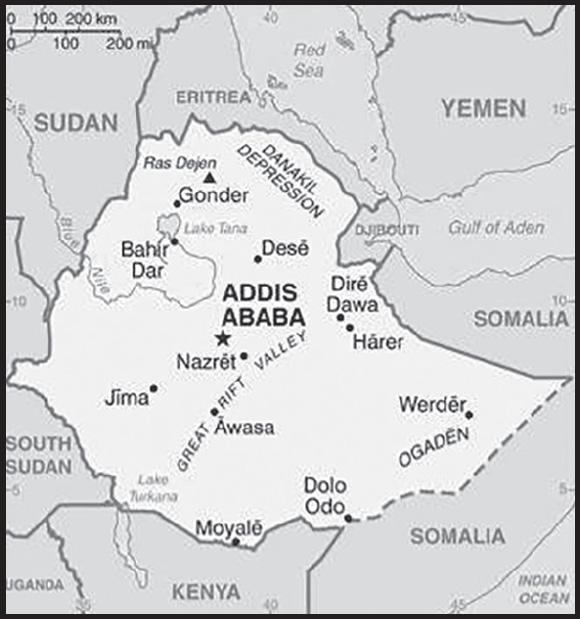
Location: Eastern Africa, west of Somalia
Geographic coordinates: 8 00 N, 38 00 E
Map references: Africa
Area: total: 1,104,300 sq km
land: 1,096,570 sq km
water: 7,730 sq km
note: area numbers are approximate since a large portion of the Ethiopia-Somalia border is undefined comparison ranking: total 28
Area - comparative: slightly less than twice the size of Texas
Land boundaries: total: 5,925 km
border countries (6): Djibouti 342 km; Eritrea 1,033 km; Kenya 867 km; Somalia 1,640 km; South Sudan 1,299 km; Sudan 744 km
Coastline: 0 km (landlocked)
Maritime claims: none (landlocked)
Climate: tropical monsoon with wide topographic-induced variation
Terrain: high plateau with central mountain range divided by Great Rift Valley
Elevation: highest point: Ras Dejen 4,550 m
lowest point: Danakil Depression -125 m
mean elevation: 1,330 m
Natural resources: small reserves of gold, platinum, copper, potash, natural gas, hydropower
Land use: agricultural land: 36.3% (2018 est.)
arable land: 15.2% (2018 est.)
permanent crops: 1.1% (2018 est.)
permanent pasture: 20% (2018 est.)
forest: 12.2% (2018 est.)
other: 51.5% (2018 est.)
Irrigated land: 1,813 sq km (2020)
Major lakes (area sq km): fresh water lake(s): Lake Tana - 3,600 sq km; Abaya Hayk - 1,160 sq km; Ch’amo Hayk - 550 sq km
salt water lake(s): Lake Turkana (shared with Kenya) - 6,400 sq km; Abhe Bid Hayk/Abhe Bad (shared with Djibouti) - 780 sq km;
Major rivers (by length in km): Blue Nile river source (shared with Sudan [m]) - 1,600 km
note – [s] after country name indicates river source; [m] after country name indicates river mouth
Major watersheds (area sq km): Atlantic Ocean drainage: (Mediterranean Sea) Nile (3,254,853 sq km)
Major aquifers: Ogaden-Juba Basin, Sudd Basin (Umm Ruwaba Aquifer)
Population distribution: highest density is found in the highlands of the north and middle areas of the country, particularly around the centrally located capital city of Addis Ababa; the far east and southeast are sparsely populated as shown in this population distribution map
Natural hazards: geologically active Great Rift Valley susceptible to earthquakes, volcanic eruptions; frequent droughts
volcanism: volcanic activity in the Great Rift Valley; Erta Ale (613 m), which has caused frequent lava flows in recent years, is the country’s most active volcano; Dabbahu became active in 2005, forcing evacuations; other historically active volcanoes include Alayta, Dalaffilla, Dallol, Dama Ali, Fentale, Kone, Manda Hararo, and Manda-Inakir
Geography - note: note 1: landlocked - entire coastline along the Red Sea was lost with the de jure independence of Eritrea on 24 May 1993; Ethiopia is, therefore, the most populous landlocked country in the world; the Blue Nile, the chief headstream of the Nile by water volume, rises in T’ana Hayk (Lake Tana) in northwest Ethiopia
note 2: three major crops may have originated in Ethiopia: coffee (almost certainly), grain sorghum, and castor bean
PEOPLE AND SOCIETY
Population: 116,462,712 (2023 est.)
comparison ranking: 12
Nationality: noun: Ethiopian(s)
adjective: Ethiopian
Ethnic groups: Oromo 35.8%, Amhara 24.1%, Somali 7.2%, Tigray 5.7%, Sidama 4.1%, Guragie 2.6%, Welaita 2.3%, Afar 2.2%, Silte 1.3%, Kefficho 1.2%, other 13.5% (2022 est.)
Languages: Oromo (official working language of Oromia Regional State) 33.8%, Amharic (official national language) 29.3%, Somali (official working language of Somali Regional State) 6.2%, Tigrigna (Tigrinya) (official working language of Tigray Regional State) 5.9%, Sidamo 4%, Wolaytta 2.2%, Gurage 2%, Afar (official working language of Afar Regional State) 1.7%, Hadiyya 1.7%, Gamo 1.5%, Gedeo 1.3%, Opuuo 1.2%, Kafa 1.1%, other 8.1%, English (major foreign language taught in schools), Arabic (2007 est.)
major-language sample(s):
Kitaaba Addunyaa Waan Qabataamaatiif - Kan Madda Odeeffannoo bu’uraawaatiif baay’ee barbaachisaa ta’e. (Oromo)

(Amharic)
Religions: Ethiopian Orthodox 43.8%, Muslim 31.3%, Protestant 22.8%, Catholic 0.7%, traditional 0.6%, other 0.8% (2016 est.)
Demographic profile: Ethiopia is a predominantly agricultural country – nearly 80% of the population lives in rural areas – that is in the early stages of demographic transition. Infant, child, and maternal mortality have fallen sharply over the past decade, but the total fertility rate has declined more slowly and the population continues to grow. The rising age of marriage and the increasing proportion of women remaining single have contributed to fertility reduction. While the use of modern contraceptive methods among married women has increased significantly from 6 percent in 2000 to 27 percent in 2012, the overall rate is still quite low.
Ethiopia’s rapid population growth is putting increasing pressure on land resources, expanding environmental degradation, and raising vulnerability to food shortages. With about 40 percent of the population below the age of 15 and a fertility rate of 4 children per woman (and even higher in rural areas), Ethiopia will have to make further progress in meeting its family planning needs if it is to achieve the age structure necessary for reaping a demographic dividend in the coming decades.
Poverty, drought, political repression, and forced government resettlement have driven Ethiopia’s internal and external migration since the 1960s. Before the 1974 revolution, only small numbers of the Ethiopian elite went abroad to study and then returned home, but under the brutal Derg regime thousands fled the country, primarily as refugees. Between 1982 and 1991 there was a new wave of migration to the West for family reunification. Since the defeat of the Derg in 1991, Ethiopians have migrated to escape violence among some of the country’s myriad ethnic groups or to pursue economic opportunities. Internal and international trafficking of women and children for domestic work and prostitution is a growing problem.
Age structure: 0-14 years: 38.91% (male 22,821,026/female 22,498,331)
15-64 years: 57.55% (male 33,345,764/female 33,672,933)
65 years and over: 3.54% (2023 est.) (male 1,887,831/female 2,236,827)
Dependency ratios: total dependency ratio: 75.7
youth dependency ratio: 70.2
elderly dependency ratio: 5.5
potential support ratio: 18.1 (2021 est.)
Median age: total: 19.8 years (2020)
male: 19.6 years
female: 20.1 years
comparison ranking: total 198
Population growth rate: 2.42% (2023 est.)
comparison ranking: 25
Birth rate: 29.97 births/1,000 population (2023 est.)
comparison ranking: 29
Death rate: 5.6 deaths/1,000 population (2023 est.)
comparison ranking: 175
Net migration rate: -0.19 migrant(s)/1,000 population (2023 est.)
comparison ranking: 108
Population distribution: highest density is found in the highlands of the north and middle areas of the country, particularly around the centrally located capital city of Addis Ababa; the far east and southeast are sparsely populated as shown in this population distribution map
Urbanization: urban population: 23.2% of total population (2023)
rate of urbanization: 4.4% annual rate of change (2020-25 est.)
Major urban areas - population: 5.461 million ADDIS ABABA (capital) (2023)
Sex ratio: at birth: 1.03 male(s)/female
0-14 years: 1.01 male(s)/female
15-64 years: 0.99 male(s)/female
65 years and over: 0.84 male(s)/female
total population: 0.99 male(s)/female (2023 est.)
Mother’s mean age at first birth: 19.3 years (2019 est.)
note: data represents median age at first birth among women 20-49
Maternal mortality ratio: 267 deaths/100,000 live births (2020 est.)
comparison ranking: 32
Infant mortality rate: total: 32.44 deaths/1,000 live births (2023 est.)
male: 37.13 deaths/1,000 live births
female: 27.6 deaths/1,000 live births
comparison ranking: total 43
Life expectancy at birth: total population: 68.59 years (2023 est.)
male: 66.43 years
female: 70.81 years
comparison ranking: total population 184
Total fertility rate: 3.92 children born/woman (2023 est.)
comparison ranking: 28
Gross reproduction rate: 1.93 (2023 est.)
Contraceptive prevalence rate: 37.7% (2020)
Drinking water source: improved: urban: 98.5% of population
rural: 70.2% of population
total: 76.4% of population
unimproved: urban: 1.5% of population
rural: 29.8% of population
total: 23.6% of population (2020 est.)
Current health expenditure: 3.5% of GDP (2020)
Physicians density: 0.11 physicians/1,000 population (2020)
Hospital bed density: 0.3 beds/1,000 population (2016)
Sanitation facility access: improved: urban: 52.5% of population
rural: 8.1% of population
total: 17.7% of population
unimproved: urban: 47.5% of population
rural: 91.9% of population
total: 82.3% of population (2020 est.)
Major infectious diseases: degree of risk: very high (2023)
food or waterborne diseases: bacterial and protozoal diarrhea, hepatitis A, and typhoid fever
vectorborne diseases: malaria and dengue fever
water contact diseases: schistosomiasis
animal contact diseases: rabies
respiratory diseases: meningococcal meningitis
Obesity - adult prevalence rate: 4.5% (2016)
comparison ranking: 185
Alcohol consumption per capita: total: 1.16 liters of pure alcohol (2019 est.)
beer: 0.92 liters of pure alcohol (2019 est.)
wine: 0 liters of pure alcohol (2019 est.)
spirits: 0.2 liters of pure alcohol (2019 est.)
other alcohols: 0.03 liters of pure alcohol (2019 est.)
comparison ranking: total 149
Tobacco use: total: 5.1% (2020 est.)
male: 8.8% (2020 est.)
female: 1.3% (2020 est.)
comparison ranking: total 161
Children under the age of 5 years underweight: 21.1% (2019)
comparison ranking: 12
Currently married women (ages 15-49): 67.5% (2023 est.)
Child marriage: women married by age 15: 14.1%
women married by age 18: 40.3%
men married by age 18: 5% (2016 est.)
Education expenditures: 4.5% of GDP (2019 est.)
comparison ranking: 101
Literacy: definition: age 15 and over can read and write
total population: 51.8%
male: 57.2%
female: 44.4% (2017)
School life expectancy (primary to tertiary education): total: 9 years
male: 8 years
female: 8 years (2012)
Youth unemployment rate (ages 15-24): total: 5.7% (2021 est.)
male: 4.4%
female: 7.2%
comparison ranking: total 183
ENVIRONMENT
Environment - current issues: deforestation; overgrazing; soil erosion; desertification; loss of biodiversity; water shortages in some areas from water-intensive farming and poor management; industrial pollution and pesticides contribute to air, water, and soil pollution
Environment - international agreements: party to: Biodiversity, Climate Change, Climate Change-Kyoto Protocol, Climate Change-Paris Agreement, Comprehensive Nuclear Test Ban, Desertification, Endangered Species, Hazardous Wastes, Ozone Layer Protection
signed, but not ratified: Environmental Modification, Law of the Sea, Nuclear Test Ban
Climate: tropical monsoon with wide topographic-induced variation
Land use: agricultural land: 36.3% (2018 est.)
arable land: 15.2% (2018 est.)
permanent crops: 1.1% (2018 est.)
permanent pasture: 20% (2018 est.)
forest: 12.2% (2018 est.)
other: 51.5% (2018 est.)
Urbanization: urban population: 23.2% of total population (2023)
rate of urbanization: 4.4% annual rate of change (2020-25 est.)
Food insecurity: widespread lack of access: due to conflict in Tigray Region, drought conditions in southeastern areas, high food prices - The difficult and worsening food security situation is the result of multiple shocks affecting food availability and access including: the conflict in northern Tigray Region and in adjacent areas of Amhara and Afar regions, which began in November 2020; in Tigray region alone, 5.3 million people are estimated to be severely food insecure; the failure of the March-May 2022 “Gu-Genna” rains in southern pastoral areas of southern Oromiya Region and southern Somali Region, exacerbated drought conditions prevailing since late 2020, causing severe crop and livestock losses; severe macroeconomic challenges including insufficient foreign currency reserves and the continuous depreciation of the national currency, as a result, inflation is at very high levels, with the year-on-year food inflation rate estimated at 35.5 percent in July, one the highest of the last decade; these difficulties are exacerbated by the ripple effects of the Ukraine war, which triggered hikes in international prices of wheat, fuel, and fertilizers (2023)
Revenue from forest resources: 5.81% of GDP (2018 est.)
comparison ranking: 11
Revenue from coal: 0% of GDP (2018 est.)
comparison ranking: 118
Air pollutants: particulate matter emissions: 21.8 micrograms per cubic meter (2019 est.)
carbon dioxide emissions: 14.87 megatons (2016 est.)
methane emissions: 114.21 megatons (2020 est.)
Waste and recycling: municipal solid waste generated annually: 6,532,787 tons (2015 est.)
Major lakes (area sq km): fresh water lake(s): Lake Tana - 3,600 sq km; Abaya Hayk - 1,160 sq km; Ch’amo Hayk - 550 sq km
salt water lake(s): Lake Turkana (shared with Kenya) - 6,400 sq km; Abhe Bid Hayk/Abhe Bad (shared with Djibouti) - 780 sq km;
Major rivers (by length in km): Blue Nile river source (shared with Sudan [m]) - 1,600 km
note – [s] after country name indicates river source; [m] after country name indicates river mouth
Major watersheds (area sq km): Atlantic Ocean drainage: (Mediterranean Sea) Nile (3,254,853 sq km)
Major aquifers: Ogaden-Juba Basin, Sudd Basin (Umm Ruwaba Aquifer)
Total water withdrawal: municipal: 810 million cubic meters (2020 est.)
industrial: 50 million cubic meters (2020 est.)
agricultural: 9.69 billion cubic meters (2020 est.)
Total renewable water resources: 122 billion cubic meters (2020 est.)
GOVERNMENT
Country name: conventional long form: Federal Democratic Republic of Ethiopia
conventional short form: Ethiopia
local long form: Ityop’iya Federalawi Demokrasiyawi Ripeblik
local short form: Ityop’iya
former: Abyssinia, Italian East Africa
abbreviation: FDRE
etymology: the country name derives from the Greek word “Aethiopia,” which in classical times referred to lands south of Egypt in the Upper Nile region
Government type: federal parliamentary republic
Capital: name: Addis Ababa
geographic coordinates: 9 02 N, 38 42 E
time difference: UTC+3 (8 hours ahead of Washington, DC, during Standard Time)
etymology: the name in Amharic means “new flower” and was bestowed on the city in 1889, three years after its founding
Administrative divisions: 12 ethnically based regional states (kililoch, singular - kilil) and 2 chartered cities* (astedader akabibiwach, singular - astedader akabibi); Adis Abeba* (Addis Ababa), Afar, Amara (Amhara), Binshangul Gumuz, Dire Dawa*, Gambela Hizboch (Gambela), Hareri Hizb (Harari), Oromia, Sidama, Somali, Tigray, YeDebub Biheroch Bihereseboch na Hizboch (Southern Nations, Nationalities and Peoples), YeDebub M’irab Ityop’iya Hizboch (Southwest Ethiopia Peoples), Southern Ethiopia Peoples
Independence: oldest independent country in Africa and one of the oldest in the world - at least 2,000 years (may be traced to the Aksumite Kingdom, which coalesced in the first century B.C.)
National holiday: Derg Downfall Day (defeat of MENGISTU regime), 28 May (1991)
Constitution: history: several previous; latest drafted June 1994, adopted 8 December 1994, entered into force 21 August 1995
amendments: proposals submitted for discussion require two-thirds majority approval in either house of Parliament or majority approval of one-third of the State Councils; passage of amendments other than constitutional articles on fundamental rights and freedoms and the initiation and amendment of the constitution requires two-thirds majority vote in a joint session of Parliament and majority vote by two thirds of the State Councils; passage of amendments affecting rights and freedoms and amendment procedures requires two-thirds majority vote in each house of Parliament and majority vote by all the State Councils
Legal system: civil law system
International law organization participation: has not submitted an ICJ jurisdiction declaration; non-party state to the ICCt
Citizenship: citizenship by birth: no
citizenship by descent only: at least one parent must be a citizen of Ethiopia
dual citizenship recognized: no
residency requirement for naturalization: 4 years
Suffrage: 18 years of age; universal
Executive branch: chief of state: President SAHLE-WORK Zewde (since 25 October 2018)
head of government: Prime Minister ABIY Ahmed Ali (since April 2018); Deputy Prime Minister and Minister of Foreign Affairs DEMEKE Mekonnen Hassen (since 29 November 2012)
cabinet: Council of Ministers selected by the prime minister and approved by the House of People’s Representatives
elections/appointments: president indirectly elected by both chambers of Parliament for a 6-year term (eligible for a second term); election held on 21 June 2021 and 30 September 2021 (the scheduled 29 August 2020 election was postponed by Prime Minister ABIY due to the COVID-19 pandemic); prime minister designated by the majority party following legislative elections
election results:
2021: SAHLE-WORK Zewde elected president during joint session of Parliament, vote - 659 (unanimous); ABIY confirmed Prime Minister by House of Peoples’ Representatives (4 October 2021)
2018: SAHLE-WORK Zewde elected president during joint session of Parliament, vote - 659 (unanimous); note - snap election held on 25 October 2018 due to resignation of President MULATA Teshome
note: SAHLE-WORK Zewde is the first female elected head of state in Ethiopia; she is currently the only female president in Africa.
Legislative branch: description: bicameral Parliament consists of:
House of Federation or Yefedereshein Mikir Bete (153 seats maximum; 144 seats current; members indirectly elected by state assemblies to serve 5-year terms)
House of People’s Representatives or Yehizb Tewokayoch Mekir Bete (547 seats maximum; 470 seats current; members directly elected in single-seat constituencies by simple majority vote; 22 seats reserved for minorities; all members serve 5-year terms)
elections:
House of Federation - last held 4 October 2021 (next expected in October 2026)
House of People’s Representatives - last held in two parts on 21 June 2021 and 30 September 2021 (next expected in June 2026)
election results: House of Federation - percent of vote by coalition/party - NA; seats by coalition/party - NA; composition - men 100, women 44, percent of women 30.6%
House of Representatives - percent of vote by coalition/party - NA; seats by coalition/party - Prosperity Party 454, NAMA 5, EZEMA 4, Gedeo People’s Democratic organization 2, Kucha People Democratic Party 1, independent 4; composition - men 275, women 195, percent of women 41.5%; note - total Parliament percent of women 38.9%
notes: House of Federation is responsible for interpreting the constitution and federal-regional issues and the House of People’s Representatives is responsible for passing legislation; percent of vote percentages are calculated on the number of members actually seated versus on the constitutional maximums
Judicial branch: highest court(s): Federal Supreme Court (consists of 11 judges); note - the House of Federation has jurisdiction for all constitutional issues
judge selection and term of office: president and vice president of Federal Supreme Court recommended by the prime minister and appointed by the House of People’s Representatives; other Supreme Court judges nominated by the Federal Judicial Administrative Council (a 10-member body chaired by the president of the Federal Supreme Court) and appointed by the House of People’s Representatives; judges serve until retirement at age 60
subordinate courts: federal high courts and federal courts of first instance; state court systems (mirror structure of federal system); sharia courts and customary and traditional courts
Political parties and leaders: House of People’s Representatives:
Ethiopian Citizens for Social Justice and Democracy or EZEMA [BERHANU Nega]
Gedeo People’s Democratic Party
Independent [n/a]
Kucha People Democratic Party
National Movement of Amhara or NAMA [BELETE Molla]
Prosperity Party or PP [ABIY Ahmed Ali]
note: Ethiopia has over fifty national-level and regional-level political parties. The ruling party, the Prosperity Party, was created by Prime Minister ABIY in November 2019 from member parties of the former Ethiopian People’s Revolutionary Democratic Front (EPRDF), which included the Amhara Democratic Party (ADP), Oromo Democratic Party (ODP), Southern Ethiopian People’s Democratic Movement (SEPDM), plus other EPRDF-allied parties such as the Afar National Democratic Party (ANDP), Benishangul Gumuz People’s Democratic Party (BGPDP), Gambella People’s Democratic Movement (GPDM), Somali People’s Democratic Party (SPDP), and the Harari National League (HNL). Once the Prosperity Party was created, the various ethnically-based parties that comprised or were affiliated with the EPRDF were subsequently disbanded; in January 2021, the Ethiopian electoral board de-registered the Tigray People’s Liberation Front or TPLF; national level parties are qualified to register candidates in multiple regions across Ethiopia; regional parties can register candidates for both national and regional parliaments, but only in one region of Ethiopia
International organization participation: ACP, AfDB, ATMIS, AU, COMESA, EITI, FAO, G-24, G-77, IAEA, IBRD, ICAO, ICRM, IDA, IFAD, IFC, IFRCS, IGAD, ILO, IMF, IMO, Interpol, IOC, IOM, IPU, ISO, ITSO, ITU, ITUC (NGOs), MIGA, NAM, OPCW, PCA, UN, UNCTAD, UNESCO, UNHCR, UNIDO, UNMISS, UNOOSA, UNWTO, UPU, WCO, WFTU (NGOs), WHO, WIPO, WMO, WTO (accession candidate)
Diplomatic representation in the US: chief of mission: Ambassador SELESHI Bekele Awulachew (since 7 June 2022)
chancery: 3506 International Drive NW, Washington, DC 20008
telephone: [1] (202) 364-1200
FAX: [1] (202) 587-0195
email address and website:
consulate(s) general: Los Angeles
consulate(s): New York
Diplomatic representation from the US: chief of mission: Ambassador (vacant); Chargé d’Affaires Ambassador Tracey Ann JACOBSON (since 25 February 2022)
embassy: Entoto Street, P.O. Box 1014, Addis Ababa
mailing address: 2030 Addis Ababa Place, Washington DC 20521-2030
telephone: [251] 111-30-60-00
FAX: [251] 111-24-24-01
email address and website:
Flag description: three equal horizontal bands of green (top), yellow, and red, with a yellow pentagram and single yellow rays emanating from the angles between the points on a light blue disk centered on the three bands; green represents hope and the fertility of the land, yellow symbolizes justice and harmony, while red stands for sacrifice and heroism in the defense of the land; the blue of the disk symbolizes peace and the pentagram represents the unity and equality of the nationalities and peoples of Ethiopia
note: Ethiopia is the oldest independent country in Africa, and the three main colors of her flag (adopted ca. 1895) were so often appropriated by other African countries upon independence that they became known as the Pan-African colors; the emblem in the center of the current flag was added in 1996
National symbol(s): Abyssinian lion (traditional), yellow pentagram with five rays of light on a blue field (promoted by current government); national colors: green, yellow, red
National anthem: name: “Whedefit Gesgeshi Woud Enat Ethiopia” (March Forward, Dear Mother Ethiopia)
lyrics/music: DEREJE Melaku Mengesha/SOLOMON Lulu
note: adopted 1992
National heritage: total World Heritage Sites: 11 (9 cultural, 2 natural)
selected World Heritage Site locales: Rock-Hewn Churches, Lalibela (c); Simien National Park (n); Fasil Ghebbi, Gondar Region (c); Axum (c); Lower Valley of the Awash (c); Lower Valley of the Omo (c); Tiya (c); Harar Jugol, the Fortified Historic Town (c); Konso Cultural Landscape (c); Gedeo Cultural Landscape (c)
ECONOMY
Economic overview: growing Horn of Africa construction- and services-based economy; port access via Djibouti and Eritrea; widespread but declining poverty; COVID-19, locust invasion, and Tigray crisis disruptions; public investment increases; second largest African labor force
Real GDP (purchasing power parity): $278.945 billion (2021 est.)
$264.059 billion (2020 est.)
$248.972 billion (2019 est.)
note: data are in 2017 dollars
comparison ranking: 58
Real GDP growth rate: 5.64% (2021 est.)
6.06% (2020 est.)
8.36% (2019 est.)
comparison ranking: 79
Real GDP per capita: $2,300 (2021 est.)
$2,300 (2020 est.)
$2,200 (2019 est.)
note: data are in 2017 dollars
comparison ranking: 205
GDP (official exchange rate)
$92.154 billion (2019 est.)
Inflation rate (consumer prices): 26.84% (2021 est.)
20.36% (2020 est.)
15.81% (2019 est.)
comparison ranking: 10
Credit ratings: Fitch rating: B (2014)
Moody’s rating: B2 (2020)
Standard & Poors rating: B (2014)
note: The year refers to the year in which the current credit rating was first obtained.
GDP - composition, by sector of origin
agriculture: 34.8% (2017 est.)
industry: 21.6% (2017 est.)
services: 43.6% (2017 est.)
comparison rankings: services 200; industry 134; agriculture 12
GDP - composition, by end use
household consumption: 69.6% (2017 est.)
government consumption: 10% (2017 est.)
investment in fixed capital: 43.5% (2017 est.)
investment in inventories: -0.1% (2017 est.)
exports of goods and services: 8.1% (2017 est.)
imports of goods and services: -31.2% (2017 est.)
Agricultural products: maize, cereals, wheat, sorghum, milk, barley, sweet potatoes, roots/tubers nes, sugar cane, millet
Industries: food processing, beverages, textiles, leather, garments, chemicals, metals processing, cement
Industrial production growth rate: 7.26% (2021 est.)comparison ranking: 58
Labor force: 56.664 million (2021 est.)
comparison ranking: 11
Labor force - by occupation: agriculture: 72.7%
industry: 7.4%
services: 19.9% (2013 est.)
Unemployment rate: 3.69% (2021 est.)
3.24% (2020 est.)
2.33% (2019 est.)
comparison ranking: 184
Youth unemployment rate (ages 15-24): total: 5.7% (2021 est.)
male: 4.4%
female: 7.2%
comparison ranking: total 183
Population below poverty line: 23.5% (2015 est.)
Gini Index coefficient - distribution of family income: 35 (2015 est.)
comparison ranking: 100
Average household expenditures: on food: 56.6% of household expenditures (2018 est.)
on alcohol and tobacco: 3.8% of household expenditures (2018 est.)
Household income or consumption by percentage share: lowest 10%: 4.1%
highest 10%: 25.6% (2005)
Budget: revenues: $11.308 billion (2020 est.)
expenditures: $13.979 billion (2020 est.)
Budget surplus (+) or deficit (-): -3.2% (of GDP) (2017 est.)
comparison ranking: 139
Public debt: 31.45% of GDP (2019 est.)
32.53% of GDP (2018 est.)
30.1% of GDP (2017 est.)
comparison ranking: 169
Taxes and other revenues: 6.2% (of GDP) (2020 est.)
comparison ranking: 217
Fiscal year: 8 July - 7 July
Current account balance: -$4.507 billion (2021 est.)
-$2.719 billion (2020 est.)
-$5.025 billion (2019 est.)
comparison ranking: 183
Exports: $9.496 billion (2021 est.) note: data are in current year dollars
$7.715 billion (2020 est.)
$7.588 billion (2019 est.)
comparison ranking: 108
Exports - partners: China 17%, United States 16%, United Arab Emirates 8%, Saudi Arabia 6%, South Korea 5%, Germany 5% (2019)
Exports - commodities: coffee, gold, sesame seeds, vegetables, cut flowers, aircraft parts (2021)
Imports: $20.859 billion (2021 est.) note: data are in current year dollars
$17.17 billion (2020 est.)
$19.227 billion (2019 est.)
comparison ranking: 91
Imports - partners: China 27%, India 9%, United Arab Emirates 9%, France 9%, United Kingdom 7% (2019)
Imports - commodities: aircraft, gas turbines, packaged medicines, electric filament, cars (2019)
Reserves of foreign exchange and gold: $3.046 billion (31 December 2020 est.)
$2.993 billion (31 December 2019 est.)
$3.987 billion (31 December 2018 est.)
comparison ranking: 118
Debt - external: $27.27 billion (2019 est.)
$26.269 billion (2018 est.)
comparison ranking: 87
Exchange rates: birr (ETB) per US dollar -
Exchange rates: 43.734 (2021 est.)
34.927 (2020 est.)
29.07 (2019 est.)
27.429 (2018 est.)
23.866 (2017 est.)
ENERGY
Electricity access: population without electricity: 59 million (2020)
electrification - total population: 54.1% (2021)
electrification - urban areas: 94.3% (2019)
electrification - rural areas: 42.7% (2021)
Electricity: installed generating capacity: 4.856 million kW (2020 est.)
consumption: 9,778,100,000 kWh (2019 est.)
exports: 1 billion kWh (2019 est.)
imports: 0 kWh (2019 est.)
transmission/distribution losses: 3.374 billion kWh (2019 est.)
comparison rankings: installed generating capacity 89; transmission/distribution losses 62; imports 201; exports 61; consumption 102
Electricity generation sources: solar: 0.1% of total installed capacity (2020 est.)
wind: 3.8% of total installed capacity (2020 est.)
hydroelectricity: 95.8% of total installed capacity (2020 est.)
biomass and waste: 0.3% of total installed capacity (2020 est.)
Coal: production: 0 metric tons (2020 est.)
consumption: 689,000 metric tons (2020 est.)
exports: 0 metric tons (2020 est.)
imports: 528,000 metric tons (2020 est.)
proven reserves: 0 metric tons (2019 est.)
Petroleum: total petroleum production: 0 bbl/day (2021 est.)
refined petroleum consumption: 107,900 bbl/day (2019 est.)
crude oil estimated reserves: 400,000 barrels (2021 est.)
Refined petroleum products - imports: 69,970 bbl/day (2015 est.)
comparison ranking: 67
Natural gas: proven reserves: 24.919 billion cubic meters (2021 est.)
Carbon dioxide emissions: 16.798 million metric tonnes of CO2 (2019 est.)
from coal and metallurgical coke: 1.474 million metric tonnes of CO2 (2019 est.)
from petroleum and other liquids: 15.324 million metric tonnes of CO2 (2019 est.)
from consumed natural gas: 0 metric tonnes of CO2 (2019 est.)
comparison ranking: total emissions 92
Energy consumption per capita: 3.219 million Btu/person (2019 est.)
comparison ranking: 181
COMMUNICATIONS
Telephones - fixed lines: total subscriptions: 890,000 (2021 est.)
subscriptions per 100 inhabitants: (2021 est.) less than 1
comparison ranking: total subscriptions 72
Telephones - mobile cellular: total subscriptions: 65 million (2021 est.)
subscriptions per 100 inhabitants: 54 (2021 est.)
comparison ranking: total subscriptions 27
Telecommunication systems: general assessment: Ethio telecom is the major provider, but no longer has a complete monopoly on all telecom services; the World Bank in early 2021 provided a $200 million loan to help develop the country’s digital transformation, while the government has embarked on its 2020-2030 program as well as its Digital Ethiopia 2025 strategy, both aimed at making better use of digital technologies to promote socioeconomic development (2023)
domestic: fixed-line subscriptions less than 1 per 100 while mobile-cellular stands at a little over 54 per 100 people (2021)
international: country code - 251; open-wire to Sudan and Djibouti; microwave radio relay to Kenya and Djibouti; 2 domestic satellites provide the national trunk service; satellite earth stations - 3 Intelsat (1 Atlantic Ocean and 2 Pacific Ocean) (2016)
Broadcast media: 6 public TV stations broadcasting nationally and 10 public radio broadcasters; 7 private radio stations and 19 community radio stations (2017)
Internet country code: .et
Internet users: total: 20.4 million (2021 est.)
percent of population: 17% (2021 est.)
comparison ranking: total 43
Broadband - fixed subscriptions: total: 212,000 (2020 est.)
subscriptions per 100 inhabitants: 0.2 (2020 est.)
comparison ranking: total 118
TRANSPORTATION
National air transport system: number of registered air carriers: 1 (2020)
inventory of registered aircraft operated by air carriers: 75
annual passenger traffic on registered air carriers: 11,501,244 (2018)
annual freight traffic on registered air carriers: 2,089,280,000 (2018) mt-km
Civil aircraft registration country code prefix: ET
Airports: 57 (2021)
comparison ranking: total 83
Airports - with paved runways: 17
note: paved runways have a concrete or asphalt surface but not all have facilities for refueling, maintenance, or air traffic control; the length of a runway required for aircraft to safely operate depends on a number of factors including the type of aircraft, the takeoff weight (including passengers, cargo, and fuel), engine types, flap settings, landing speed, elevation of the airport, and average maximum daily air temperature; paved runways can reach a length of 5,000 m (16,000 ft.), but the “typical” length of a commercial airline runway is between 2,500-4,000 m (8,000-13,000 ft.)
Airports - with unpaved runways: 40
note: unpaved runways have a surface composition such as grass or packed earth and are most suited to the operation of light aircraft; unpaved runways are usually short, often less than 1,000 m (3,280 ft.) in length; airports with unpaved runways often lack facilities for refueling, maintenance, or air traffic control
Railways: total: 659 km (2017) (Ethiopian segment of the 756 km Addis Ababa-Djibouti railroad)
standard gauge: 659 km (2017) 1.435-m gauge
note: electric railway with redundant power supplies; under joint control of Djibouti and Ethiopia and managed by a Chinese contractor
comparison ranking: total 104
Roadways: total: 120,171 km (2018)
paved: (2018)
unpaved: (2015)
comparison ranking: total 40
Merchant marine: total: 12 (2022)
by type: general cargo 10, oil tanker 2
comparison ranking: total 153
Ports and terminals: Ethiopia is landlocked and uses the ports of Djibouti in Djibouti and Berbera in Somalia
MILITARY AND SECURITY
Military and security forces: Ethiopian National Defense Force (ENDF): Ground Forces, Ethiopian Air Force (Ye Ityopya Ayer Hayl, ETAF) (2023)
note 1: national and regional police forces are responsible for law enforcement and maintenance of order, with the ENDF sometimes providing internal security support; the Ethiopian Federal Police (EFP) report to the Prime Minister’s Office
note 2: the regional governments control regional security forces, including “special” paramilitary forces, which generally operate independently from the federal government and in some cases operate as regional defense forces maintaining national borders; local militias also operate across the country in loose and varying coordination with these regional security and police forces, the ENDF, and the EFP; in April 2023, the federal government ordered the integration of these regional special forces into the EFP or ENDF
note 3: in 2020 the Ethiopian Government announced it had re-established a navy, which had been disbanded in 1996; in March 2019, Ethiopia signed a defense cooperation agreement with France which stipulated that France would support the establishment of an Ethiopian navy, which would reportedly be based out of Djibouti; in 2018, Ethiopia established a Republican Guard military unit responsible to the Prime Minister for protecting senior officials.
Military expenditures: 1.7% of GDP (2022 est.)
0.5% of GDP (2021 est.)
0.5% of GDP (2020 est.)
0.6% of GDP (2019 est.)
0.6% of GDP (2018 est.)
comparison ranking: 78
Military and security service personnel strengths: information varies; prior to the 2020-2022 Tigray conflict, approximately 150,000 active-duty troops (2023)
Military equipment inventories and acquisitions: the ENDF’s inventory is comprised mostly of Russian and Soviet-era equipment; in recent years, the ENDF has received arms from a variety of countries, including China, Israel, Russia, Turkey, Ukraine, and the United Arab Emirates; Ethiopia has a modest industrial defense base centered on small arms and production of armored vehicles (2023)
Military service age and obligation: 18-22 years of age for voluntary military service (although the military may, when necessary, recruit a person more than 22 years old); no compulsory military service, but the military can conduct callups when necessary and compliance is compulsory (2023)
Military deployments: approximately 5-8,000 in Somalia (up to 4,000 for ATMIS; the remainder under a bilateral agreement with the Somali Government; note - foreign troop contingents in Somalia under ATMIS are drawing down towards a final withdrawal in December 2024); 1,450 South Sudan (UNMISS) (2023)
Military - note: the ENDF has traditionally been one of sub-Saharan Africa’s largest, most experienced, and best equipped militaries, but it suffered heavy casualties and equipment losses during the 2020-2022 Tigray conflict; the Ground Forces are estimated to have more than 20 infantry divisions, including several that are mechanized, along with at least one division of commandos/special forces; the Air Force has combat squadrons of multipurpose fighter aircraft, attack helicopters, and armed unmanned aerial vehicles; ENDF operations are often supported by sizeable regional state paramilitary units
the ENDF is focused on both external threats emanating from its neighbors and internal threats from multiple internal armed groups; since 1998, the ENDF has engaged in several conventional and counterinsurgency operations, including border wars with Eritrea (1998-2000) and Somalia (2006-2008) and internal conflicts with the Tigray regional state (2020-2022), several insurgent groups and ethnic militias (including the ethnonationalist Amhara Fano), and the al- -Shabaab terrorist group (see Appendix T); the ENDF is currently conducting counterinsurgency operations against anti-government militants in several states, including in Oromya (Oromia) against the Oromo Liberation Army (OLA), an insurgent group that claims to be fighting for greater autonomy for the Oromo, Ethiopia’s largest ethnic group; in 2022, militants from the Somalia-based al-Shabaab terrorist group launched an incursion into Ethiopia’s Somali (Sumale) regional state, attacking villages and security forces; the Ethiopian Government claimed that regional security forces killed hundreds of al-Shabaab fighters and subsequently deployed additional ENDF troops into Somalia’s Gedo region to prevent further incursions (2023)
SPACE
Space agency/agencies: Ethiopian Space Science and Geospatial Institute (ESSGI; formed in 2022 from the joining of the Ethiopian Space Science and Technology Institute or ESSTI and the Ethiopian Geospatial Information Institute or EGII) (2023)
Space program overview: has a small space program with a focus on acquiring and operating satellites, as well as research and astronomy; jointly builds satellites with foreign partners and operates and exploits remote sensing (RS) satellites; developing the ability to manufacture satellites and their associated payloads; involved in astronomy and in the construction of space observatories; cooperates on space-related issues with a variety of countries, including China, France, India, Russia, and multiple African countries, particularly Kenya, Rwanda, Sudan, Tanzania, and Uganda; shares RS data with neighboring countries (2023)
note: further details about the key activities, programs, and milestones of the country’s space program, as well as government spending estimates on the space sector, appear in Appendix S
TERRORISM
Terrorist group(s): Terrorist group(s): al-Shabaab; Islamic Revolutionary Guard Corps (IRGC)/Qods Force
note: details about the history, aims, leadership, organization, areas of operation, tactics, targets, weapons, size, and sources of support of the group(s) appear(s) in Appendix-T
TRANSNATIONAL ISSUES
Disputes - international: Ethiopia-Eritrea: Eritrea and Ethiopia agreed to abide by the 2002 Eritrea-Ethiopia Boundary Commission’s (EEBC) delimitation decision, but neither party responded to the revised line detailed in the November 2006 EEBC Demarcation Statement
Ethiopia-Somalia: While border clashes continue in the al-Fashqa (Fashaga) area, the US views the 1902 boundary treaty between Ethiopia and Sudan as being in force; the undemarcated former British administrative line has little meaning as a political separation to rival clans within Ethiopia’s Ogaden and southern Somalia’s Oromo region; Ethiopian forces invaded southern Somalia and routed Islamist courts from Mogadishu in January 2007; “Somaliland” secessionists provide port facilities in Berbera and trade ties to landlocked Ethiopia;
Ethiopia-Sudan: Ethiopia’s construction of a large dam (the Grand Ethiopian Renaissance Dam) on the Blue Nile in northern Ethiopia since 2011 has become a focal point of relations with Egypt and Sudan; Egypt has described the giant hydroelectric project as an existential threat because of its potential to control the flow of the river that is a key source of water for the country; Ethiopia completed filling the dam in 2023
Refugees and internally displaced persons: refugees (country of origin): 417,478 (South Sudan), 308,068 (Somalia), 167,391 (Eritrea), 25,463 (Sudan) (refugees since 15 April 2023) (2023)
IDPs: 4.385 million (includes conflict- and climate-induced IDPs, excluding unverified estimates from the Amhara region; border war with Eritrea from 1998-2000; ethnic clashes; and ongoing fighting between the Ethiopian military and separatist rebel groups in the Somali and Oromia regions; natural disasters; intercommunal violence; most IDPs live in Sumale state) (2023)
Illicit drugs: transit hub for heroin originating in Southwest and Southeast Asia and destined for Europe, as well as cocaine destined for markets in southern Africa; cultivates qat (khat) for local use and regional export, principally to Djibouti and Somalia (legal in all three countries); the lack of a well-developed financial system limits the country’s utility as a money laundering center
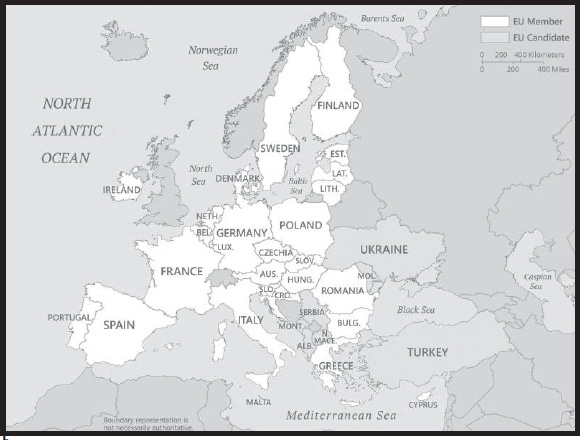
INTRODUCTION
Preliminary statement: The evolution of what is today the European Union (EU) from a regional economic agreement among six neighboring states in 1951 to today’s hybrid intergovernmental and supranational organization of 27 countries across the European continent stands as an unprecedented phenomenon in the annals of history. Dynastic unions for territorial consolidation were long the norm in Europe; on a few occasions even country-level unions were arranged - the Polish-Lithuanian Commonwealth and the Austro-Hungarian Empire were examples. For such a large number of nation-states to cede some of their sovereignty to an overarching entity is unique.
Although the EU is not a federation in the strict sense, it is far more than a free-trade association such as ASEAN or Mercosur, and it has certain attributes associated with independent nations: its own flag, currency (for some members), and law-making abilities, as well as diplomatic representation and a common foreign and security policy in its dealings with external partners.
Thus, inclusion of basic intelligence on the EU has been deemed appropriate as a separate entity in The World Factbook.
Background: In the aftermath and devastation of the two World Wars, a number of far-sighted European leaders in the late 1940s sought to respond to the overwhelming desire for peace and reconciliation on the continent. In 1950, the French Foreign Minister Robert SCHUMAN proposed pooling the production of coal and steel in Western Europe, which would bring France and West Germany together and be open to other countries as well. The following year, the European Coal and Steel Community (ECSC) was set up when six members - Belgium, France, West Germany, Italy, Luxembourg, and the Netherlands - signed the Treaty of Paris.
Within a few years, the ECSC was so successful that member states decided to further integrate their economies. In 1957, envisioning an “ever closer union,” the Treaties of Rome were signed creating the European Economic Community (EEC) and the European Atomic Energy Community (Euratom), eliminating trade barriers among the six member states to create a common market. In 1967, the institutions of all three communities were formally merged into the European Community (EC), creating a single Commission, a single Council of Ministers, and a legislative body known today as the European Parliament. Members of the European Parliament were initially selected by national parliaments, but in 1979 the first direct elections were undertaken and have been held every five years since.
In 1973, the first enlargement of the EC took place with the addition of Denmark, Ireland, and the UK. The 1980s saw further membership expansion with Greece joining in 1981 and Spain and Portugal in 1986. The 1992 Treaty of Maastricht laid the basis for further cooperation in the fields of foreign and defense policy, judicial and internal affairs, and the creation of an economic and monetary union - including a common currency. The Maastricht Treaty created the European Union (EU), at the time standing alongside the EC. In 1995, Austria, Finland, and Sweden joined the EU/EC, raising the total number of member states to 15. On 1 January 1999, a new currency, the euro, was launched in world markets and became the unit of exchange for all EU member states except Denmark, Sweden, and the UK. In 2002, citizens of the 12 participating member states began using euro banknotes and coins.
Ten new countries joined the EU in 2004 - Cyprus, the Czech Republic, Estonia, Hungary, Latvia, Lithuania, Malta, Poland, Slovakia, and Slovenia. Bulgaria and Romania joined in 2007 and Croatia in 2013. UK citizens on 23 June 2016 narrowly voted to leave the EU; the formal exit took place on 31 January 2020. The EU and the UK negotiated a Withdrawal Agreement that included a status quo transition period through December 2020, when the follow-on EU-UK Trade and Cooperation Agreement was concluded. Current membership stands at 27. (Eight of the newer member states - Croatia, Cyprus, Estonia, Latvia, Lithuania, Malta, Slovakia, and Slovenia - have now adopted the euro, bringing total euro-zone membership to 20.)
In an effort to ensure that the EU could function efficiently with an expanded membership, the Treaty of Nice in 2000 set forth rules to streamline the size and procedures of the EU’s institutions. An effort to establish a “Constitution for Europe,” growing out of a Convention held in 2002-2003, foundered when it was rejected in referenda in France and the Netherlands in 2005. A subsequent effort in 2007 incorporated many of the features of the rejected draft Constitutional Treaty, while also making a number of substantive as well as symbolic changes. The new treaty, referred to as the Treaty of Lisbon, sought to amend existing treaties rather than replace them. The treaty was approved at a conference of member states held in Lisbon in December 2007, after which the process of national ratifications began. After all member states ratified, the Lisbon Treaty came into force on 1 December 2009, and the EU officially replaced and succeeded the EC.
GEOGRAPHY
Location: Europe between the North Atlantic Ocean in the west and Russia, Belarus, and Ukraine to the east
Map references: Europe
Area: total: 4,236,351 sq km
rank by area (sq km):
1. France (includes five overseas regions) 643,801
2. Spain 505,370
3. Sweden 450,295
4. Germany 357,022
5. Finland 338,145
6. Poland 312,685
7. Italy 301,340
8. Romania 238,391
9. Greece 131,957
10. Bulgaria 110,879
11. Hungary 93,028
12. Portugal 92,090
13. Austria 83,871
14. Czechia 78,867
15. Ireland 70,273
16. Lithuania 65,300
17. Latvia 64,589
18. Croatia 56,594
19. Slovakia 49,035
20. Estonia 45,228
21. Denmark 43,094
22. Netherlands 41,543
23. Belgium 30,528
24. Slovenia 20,273
25. Cyprus 9,251
26. Luxembourg 2,586
27. Malta 316
Area - comparative: less than one half the size of the United States
Land boundaries: total: 13,770 km
border countries (20): Albania 212 km; Andorra 118 km; Belarus 1,176 km; Bosnia and Herzegovina 956 km; Holy See 3 km; Liechtenstein 34 km; North Macedonia 396 km; Moldova 683 km; Monaco 6 km; Montenegro 19 km; Norway 2,375 km; Russia 2,435 km; San Marino 37 km; Serbia 1,353 km; Switzerland 1,729 km; Turkey 415 km; United Kingdom 499 km; Ukraine 1,324 km; note - the Brexit Withdrawal Agreement (2020) commits the United Kingdom (UK) to maintain an open border in Ireland, so the border between Northern Ireland (UK) and the Republic of Ireland is only de jure and is not a hard border; the de facto border is the Irish Sea between the islands of Ireland and Great Britain
note: data for European continent only
Coastline: 53,563.9 km
Climate: cold temperate; potentially subarctic in the north to temperate; mild wet winters; hot dry summers in the south
Terrain: fairly flat along Baltic and Atlantic coasts; mountainous in the central and southern areas
Elevation: highest point: Mont Blanc, France 4,810 m
lowest point: Zuidplaspolder, Netherlands -7 m
Natural resources: iron ore, natural gas, petroleum, coal, copper, lead, zinc, bauxite, uranium, potash, salt, hydropower, arable land, timber, fish
Irrigated land: 154,539.82 sq km (2011 est.)
Population distribution: population distribution varies considerably from country to country but tends to follow a pattern of coastal and river settlement, with urban agglomerations forming large hubs facilitating large scale housing, industry, and commerce; the area in and around the Netherlands, Belgium, and Luxembourg (known collectively as Benelux), is the most densely populated area in the EU
Natural hazards: flooding along coasts; avalanches in mountainous area; earthquakes in the south; volcanic eruptions in Italy; periodic droughts in Spain; ice floes in the Baltic Sea region
PEOPLE AND SOCIETY
Population: (July 2022 est.) 450,858,381
rank by population:
1 Germany - 84,316,622;
2 France - 68,305,148;
3 Italy - 61,095,551;
4 Spain - 47,163,418;
5 Poland - 38,093,101;
6 Romania - 18,519,899;
7 Netherlands - 17,400,824;
8 Belgium - 11,847,338;
9 Czechia - 10,705,384;
10 Greece - 10,533,871;
11 Sweden - 10,483,647;
12 Portugal - 10,242,081;
13 Hungary - 9,699,577;
14 Austria - 8,913,088;
15 Bulgaria - 6,873,253;
16 Denmark - 5,920,767;
17 Finland - 5,601,547;
18 Slovakia - 5,431,252;
19 Ireland - 5,275,004;
20 Croatia - 4,188,853;
21 Lithuania - 2,683,546;
22 Slovenia - 2,101,208;
23 Latvia - 1,842,226;
24 Cyprus - 1,295,102;
25 Estonia - 1,211,524;
26 Luxembourg - 650,364;
27 Malta - 464,186 (July 2022 est.)
Languages: Bulgarian, Croatian, Czech, Danish, Dutch, English, Estonian, Finnish, French, German, Greek, Hungarian, Irish, Italian, Latvian, Lithuanian, Maltese, Polish, Portuguese, Romanian, Slovak, Slovene, Spanish, Swedish
note: only the 24 official languages are listed; German, the major language of Germany and Austria, is the most widely spoken mother tongue - about 16% of the EU population; English is the most widely spoken foreign language - about 29% of the EU population is conversant with it; English is an official language in Ireland and Malta and thus remained an official EU language after the UK left the bloc (2020)
Religions: Roman Catholic 41%, Orthodox 10%, Protestant 9%, other Christian 4%, Muslim 2%, other 4% (includes Jewish, Sikh, Buddhist, Hindu), atheist 10%, non-believer/agnostic 17%, unspecified 3% (2019 est.)
Age structure: 0-14 years: 15.05% (male 34,978,216/female 33,217,600)
15-64 years: 10.39% (male 24,089,260/female 22,990,579)
65 years and over: 20.5% (male 39,834,507/female 53,020,673) (2020 est.)
Median age: total: 44 years (2020)
male: 42.6 years
female: 45.5 years
Population growth rate: (2021 est.) 0.10%
Birth rate: (2020 est.) 9.5 births/1,000 population
Death rate: (2021 est.) 10.7 deaths/1,000 population
Net migration rate: -2.85 migrant(s)/1,000 population
Population distribution: population distribution varies considerably from country to country but tends to follow a pattern of coastal and river settlement, with urban agglomerations forming large hubs facilitating large scale housing, industry, and commerce; the area in and around the Netherlands, Belgium, and Luxembourg (known collectively as Benelux), is the most densely populated area in the EU
Sex ratio: at birth: 1.06 male(s)/female
0-14 years: 1.05 male(s)/female
15-64 years: 1.05 male(s)/female
65 years and over: 0.75 male(s)/female
total population: 0.95 male(s)/female (2020 est.)
Infant mortality rate: total: 3.47 deaths/1,000 live births (2021)
male: 3.32 deaths/1,000 live births
female: 3.62 deaths/1,000 live births
Life expectancy at birth: total population: 77.63 years (2021)
male: 72.98 years
female: 82.51 years
Total fertility rate: (2021 est.) 1.62 children born/woman
Education expenditures: 5% of GDP (2020 est.)
Youth unemployment rate (ages 15-24): total: 19.5% (2021 est.)
male: 18.9%
female: 20.4%
ENVIRONMENT
Environment - current issues: various forms of air, soil, and water pollution; see individual country entries
Environment - international agreements: party to: Air Pollution, Air Pollution-Heavy Metals, Air Pollution-Multi-effect Protocol, Air Pollution-Nitrogen Oxides, Air Pollution-Persistent Organic Pollutants, Air Pollution-Sulphur 94, Antarctic-Marine Living Resources, Biodiversity, Climate Change, Climate Change-Kyoto Protocol, Climate Change-Paris Agreement, Desertification, Endangered Species, Hazardous Wastes, Law of the Sea, Ozone Layer Protection, Tropical Timber 2006
signed, but not ratified: Air Pollution-Volatile Organic Compounds
Climate: cold temperate; potentially subarctic in the north to temperate; mild wet winters; hot dry summers in the south
Revenue from forest resources: 0.05% of GDP (2018 est.)
Revenue from coal: 0.02% of GDP (2018 est.)
Air pollutants: carbon dioxide emissions: 2,881.62 megatons (2016 est.)
Total renewable water resources: 1.7 trillion cubic meters (2019)
GOVERNMENT
Union name: conventional long form: European Union
abbreviation: EU
Political structure: a hybrid and unique intergovernmental and supranational organization
Capital: name: Brussels (Belgium), Strasbourg (France), Luxembourg, Frankfurt (Germany); note - the European Council, a gathering of member-state heads of state and/or government, and the Council of the European Union, a gathering of member-state cabinet ministers, meet in Brussels, Belgium, except for Council of the EU meetings held in Luxembourg in April, June, and October; the European Parliament meets in Brussels and Strasbourg, France, and has administrative offices in Luxembourg; the Court of Justice of the European Union is located in Luxembourg; and the European Central Bank is located in Frankfurt, Germany
geographic coordinates: (Brussels) 50 50 N, 4 20 E
time difference: UTC+1 (6 hours ahead of Washington, DC, during Standard Time)
daylight saving time: +1hr, begins last Sunday in March; ends last Sunday in October
time zone note: the 27 European Union member states spread across three time zones; a proposal has been put forward to do away with daylight savings time in all EU member states
Member states: 27 countries: Austria, Belgium, Bulgaria, Croatia, Cyprus, Czechia, Denmark, Estonia, Finland, France, Germany, Greece, Hungary, Ireland, Italy, Latvia, Lithuania, Luxembourg, Malta, Netherlands, Poland, Portugal, Romania, Slovakia, Slovenia, Spain, Sweden; note - 8 candidate countries: Albania, Bosnia and Herzegovina, Moldova, Montenegro, North Macedonia, Serbia, Turkey, Ukraine
there are 13 overseas countries and territories (OCTs) (1 with Denmark [Greenland], 6 with France [French Polynesia, French Southern and Antarctic Lands, New Caledonia, Saint Barthelemy, Saint Pierre and Miquelon, Wallis and Futuna], and 6 with the Netherlands [Aruba, Bonaire, Curacao, Saba, Sint Eustatius, Sint Maarten]), all are part of the Overseas Countries and Territories Association (OCTA)
note: there are non-European OCTs having special relations with Denmark, France, and the Netherlands (list is annexed to the Treaty on the Functioning of the European Union), that are associated with the EU to promote their economic and social development; member states apply to their trade with OCTs the same treatment as they accord each other pursuant to the treaties; OCT nationals are in principle EU citizens, but these countries are neither part of the EU, nor subject to the EU
Independence: 7 February 1992 (Maastricht Treaty signed establishing the European Union); 1 November 1993 (Maastricht Treaty entered into force)
note: the Treaties of Rome, signed on 25 March 1957 and subsequently entered into force on 1 January 1958, created the European Economic Community and the European Atomic Energy Community; a series of subsequent treaties have been adopted to increase efficiency and transparency, to prepare for new member states, and to introduce new areas of cooperation - such as a single currency; the Treaty of Lisbon, signed on 13 December 2007 and entered into force on 1 December 2009 is the most recent of these treaties and is intended to make the EU more democratic, more efficient, and better able to address global problems with one voice
National holiday: Europe Day (also known as Schuman Day), 9 May (1950); note - the day in 1950 that Robert SCHUMAN proposed the creation of what became the European Coal and Steel Community, the progenitor of today’s European Union, with the aim of achieving a united Europe
Constitution: history: none; note - the EU legal order relies primarily on two consolidated texts encompassing all provisions as amended from a series of past treaties: the Treaty on European Union (TEU) and the Treaty on the Functioning of the EU (TFEU); The TEU as modified by the 2009 Lisbon Treaty states in Article 1 that “the HIGH CONTRACTING PARTIES establish among themselves a EUROPEAN UNION ... on which the Member States confer competences to attain objectives they have in common”; Article 1 of the TEU states further that the EU is “founded on the present Treaty and on the Treaty on the Functioning of the European Union (hereinafter referred to as ‘the Treaties’),” both possessing the same legal value; Article 6 of the TEU provides that a separately adopted Charter of Fundamental Rights of the European Union “shall have the same legal value as the Treaties”
amendments: European Union treaties can be amended in several ways: 1) Ordinary Revision Procedure (for key amendments to the treaties); initiated by an EU member state, by the European Parliament, or by the European Commission; following adoption of the proposal by the European Council, a convention is formed of national government representatives to review the proposal and a conference of government representatives subsequently reviews the proposal; passage requires ratification by all EU member states; 2) Simplified Revision Procedure (for amendment of EU internal policies and actions); passage of a proposal requires unanimous European Council vote following European Council consultation with the European Commission, the European Parliament, and the European Central Bank (if the amendment concerns monetary matters) and requires ratification by all EU member states; 3) Passerelle Clause (allows the alteration of a legislative procedure without a formal amendment of the treaties); 4) Flexibility Clause (permits the EU to decide in subject areas where EU competences have not been explicitly granted in the Treaties but are necessary to the attainment of the objectives set out in the Treaty); note - the Treaty of Lisbon (signed in December 2007 and effective in December 2009) amended the two treaties that formed the EU - the Maastricht Treaty (1992), also known as the TEU, and the Treaty of Rome (1957), known in updated form as the TFEU
Legal system: unique supranational system of laws in which, according to an interpretive declaration of member-state governments appended to the Treaty of Lisbon, “the Treaties and the law adopted by the Union on the basis of the Treaties have primacy over the law of Member States” under conditions laid down in the case law of the Court of Justice; key principles of EU jurisprudence include universal rights as guaranteed by the Charter of Fundamental Rights and as resulting from constitutional traditions common to the EU’s 27 member states; EU law is divided into ‘primary’ and ‘secondary’ legislation; primary legislation is derived from the consolidated versions of the Treaty on European Union and the Treaty on the Functioning of the European Union and are the basis for all EU action; secondary legislation - which includes directives, regulations, and decisions - is derived from the principles and objectives set out in the treaties
Suffrage: 18 years of age (16 years in Austria); universal; voting for the European Parliament is permitted in each member state
Executive branch: under the EU treaties there are three distinct institutions, each of which conducts functions that may be regarded as executive in nature:
European Council - brings together member-state heads of state or government, along with the president of the European Commission, and meets at least four times a year; its aim is to provide the impetus for the development of the Union and to issue general policy guidance; the Treaty of Lisbon established the position of “permanent” (full-time) president of the European Council; leaders of the EU member states appoint the president for a 2 1/2 year term, renewable once; the president’s responsibilities include chairing European Council meetings and providing policy and organizational continuity; the current president is Charles MICHEL (Belgium), since 1 December 2019, who succeeded Donald TUSK (Poland; 2014 - 2019)
Council of the European Union - consists of gatherings of member-state officials, ranging from working-level diplomats to cabinet ministers in a given policy field, such as foreign affairs, agriculture, or economy; it conducts policymaking and coordinating functions as well as legislative functions; representatives from one member state chair meetings of the Council of the EU, based on a 6-month rotating presidency except for the meetings of EU Foreign Ministers in the Foreign Affairs Council that are chaired by the High Representative for Foreign Affairs and Security Policy
European Commission - headed by a College of Commissioners comprised of 27 members (one from each member state) including the president; each commissioner is responsible for one or more policy areas; the Commission has the sole right to initiate EU legislation (except for foreign and security/defense policy), and is also responsible for promoting the general interest of the EU, acting as “guardian of the Treaties” by monitoring the application of EU law, implementing/executing the EU budget, managing programs, negotiating on the EU’s behalf in policy areas where the member states have conferred sole competency, such as trade, and ensuring the Union’s external representation in some policy areas; its current president is Ursula VON DER LEYEN (Germany) elected on 16 July 2019 (took office on 1 December 2019); the president of the European Commission is nominated by the European Council and confirmed by the European Parliament; the Commission president allocates specific responsibilities among the members of the College (appointed by common accord of the member-state governments in consultation with the president-elect); the European Parliament confirms the entire Commission for a 5-year term.
note: for external representation and foreign policy making, member-state leaders appointed Joseph BORRELL (Spain) as the High Representative of the Union for Foreign Affairs and Security Policy; BORRELL took office on 1 December 2019, succeeding Federica MOGHERINI (Italy (2014 - 2019); the High Representative’s concurrent appointment as Vice President of the European Commission was meant to bring more coherence to the EU’s foreign policy (including policies managed by the Commission that are particularly relevant for EU external relations, such as trade, humanitarian aid and crisis management, neighborhood policy and enlargement, as well as between member-state capitals and the EU); the High Representative helps develop and implement the EU’s Common Foreign and Security Policy and Common Security and Defense Policy components, chairs the Council of the EU’s meetings of member-state foreign ministers, called the Foreign Affairs Council, represents and acts for the Union in many international contexts, and oversees the European External Action Service, the diplomatic corps of the EU, established on 1 December 2010
Legislative branch: description: two legislative bodies consisting of the Council of the European Union (27 seats; ministers representing the 27 member states) and the European Parliament (705 seats; seats allocated among member states roughly in proportion to population size; members elected by proportional representation to serve 5-year terms); note - the European Parliament President, Roberta METSOLA, was elected in January 2022 by a majority of fellow members of the European Parliament (MEPs) and represents the Parliament within the EU and internationally; the Council of the EU and the MEPs share responsibilities for adopting the bulk of EU legislation; the two bodies must come to agreement for a commission proposal to become law, after negotiations in which they reconcile differences in each body’s text of the proposal, except in the area of Common Foreign and Security Policy, which is governed by consensus of the EU member-state governments)
elections: last held on 23-26 May 2019 (next to be held in May 2024)
election results: percent of vote - NA; seats by party (as of 13 April 2023) - EPP 175, S&D 144, RE 101, Greens/EFA 72, ECR 66, ID 62, GUE-NGL 38, non-attached 47; Parliament composition - men 428, women 277, percent of women 39.3%; note - composition of the European Council - men 23, women 4, percent of women 14.8%; total Council and Parliament percent of women 38.4%
Judicial branch: highest court(s): Court of Justice of the European Union, which includes the Court of Justice (informally known as the European Court of Justice or ECJ) and the General Court (consists of 27 judges, one drawn from each member state); the ECJ includes 11 Advocates General while the General Court can include additional judges; both the ECJ and the General Court may sit in a “Grand Chamber” of 15 judges in special cases but usually in chambers of 3 to 5 judges
judge selection and term of office: judges appointed by the common consent of the member states to serve 6-year renewable terms
note: the ECJ is the supreme judicial authority of the EU; it ensures that EU law is interpreted and applied uniformly throughout the EU, resolves disputes among EU institutions and member states, and reviews issues and opinions regarding questions of EU law referred by member state courts
Political parties and leaders: European United Left-Nordic Green Left or GUE/NGL [Manon AUBRY and Martin SCHIRDEWAN]
European Conservatives and Reformists or ECR [Raffaele FITTO and Ryszard LEGUTKO]
European Greens/European Free Alliance or Greens/EFA [Ska KELLER and Philippe LAMBERTS]
European People’s Party or EPP [Manfred WEBER]Identity and Democracy Party or ID [Marco ZANNI]
Progressive Alliance of Socialists and Democrats or S&D [Iratxe GARCIA]
Renew Europe or RE [Stephane SEJOURNE] (successor to Alliance of Liberals and Democrats for Europe or ALDE)
International organization participation: ARF, ASEAN (dialogue member), Australian Group, BIS, BSEC (observer), CBSS, CERN, EBRD, FAO, FATF, G-7, G-10, G-20, IDA, IEA, IGAD (partners), LAIA (observer), NSG (observer), OAS (observer), OECD, PIF (partner), SAARC (observer), SICA (observer), UN (observer), UNRWA (observer), WCO, WTO, ZC (observer)
Diplomatic representation in the US: chief of mission: Ambassador Stavros LAMBRINIDIS (since 8 April 2019)
chancery: 2175 K Street NW, Washington, DC 20037
telephone: [1] (202) 862-9500
FAX: [1] (202) 429-1766
email address and website:
delegation-usa-info@eeas.europa.eu
Delegation of the European Union to the United States of America l EEAS (europa.eu)
Diplomatic representation from the US: chief of mission: Ambassador Mark GITENSTEIN (since 24 January 2022)
embassy: Zinnerstraat - 13 - Rue Zinner, B-1000 Brussels
mailing address: use embassy street address
telephone: [32] (2) 811-4100
email address and website:
Flag description: a blue field with 12 five-pointed gold stars arranged in a circle in the center; blue represents the sky of the Western world, the stars are the peoples of Europe in a circle, a symbol of unity; the number of stars is fixed
National symbol(s): a circle of 12, five-pointed, golden yellow stars on a blue field; union colors: blue, yellow
National anthem: name: “Ode to Joy”
lyrics/music: no lyrics/Ludwig VAN BEETHOVEN, arranged by Herbert VON KARAJAN
note: official EU anthem since 1985; the anthem is meant to represent all of Europe rather than just the organization, conveying ideas of peace, freedom, and unity
ECONOMY
Real GDP (purchasing power parity): $19.739 trillion (2021 est.)
$18.716 trillion (2020 est.)
$19.847 trillion (2019 est.)
note: data are in 2017 dollars
Real GDP growth rate: 5.39% (2021 est.)
-5.68% (2020 est.)
1.81% (2019 est.)
Real GDP per capita: $44,100 (2021 est.)
$41,800 (2020 est.)
$44,400 (2019 est.)
note: data are in 2017 dollars
GDP (official exchange rate)
$17.11 trillion (2017 est.)
Inflation rate (consumer prices): 2.55% (2021 est.)
0.5% (2020 est.)
1.63% (2019 est.)
Credit ratings: Fitch rating: AAA (2010)
Moody’s rating: Aaa (2014)
Standard & Poors rating: AA (2016)
note: The year refers to the year in which the current credit rating was first obtained.
GDP - composition, by sector of origin
agriculture: 1.6% (2017 est.)
industry: 25.1% (2017 est.)
services: 70.9% (2017 est.)
GDP - composition, by end use
household consumption: 54.4% (2016 est.)
government consumption: 20.4% (2016 est.)
investment in fixed capital: 19.8% (2016 est.)
investment in inventories: 0.4% (2016 est.)
exports of goods and services: 43.9% (2016 est.)
imports of goods and services: -40.5% (2016 est.)
Agricultural products: wheat, barley, oilseeds, sugar beets, wine, grapes, dairy products, cattle, sheep, pigs, poultry, fish
Industries: among the world’s largest and most technologically advanced regions, the EU industrial base includes: ferrous and non-ferrous metal production and processing, metal products, petroleum, coal, cement, chemicals, pharmaceuticals, aerospace, rail transportation equipment, passenger and commercial vehicles, construction equipment, industrial equipment, shipbuilding, electrical power equipment, machine tools and automated manufacturing systems, electronics and telecommunications equipment, fishing, food and beverages, furniture, paper, textiles
Industrial production growth rate: 6.43% (2021 est.)
Labor force: 217.042 million (2021 est.)
Labor force - by occupation: agriculture: 5%
industry: 21.9%
services: 73.1% (2014 est.)
Unemployment rate: 7.05% (2021 est.)
7.05% (2020 est.)
6.69% (2019 est.)
Youth unemployment rate (ages 15-24): total: 19.5% (2021 est.)
male: 18.9%
female: 20.4%
Population below poverty line: 9.8% (2013 est.)
note: see individual country entries of member states
Gini Index coefficient - distribution of family income: 30.8 (2016 est.)
Household income or consumption by percentage share: lowest 10%: 2.8%
highest 10%: 23.8% (2016 est.)
Budget surplus (+) or deficit (-): -3% (of GDP) (2014)
Public debt: 86.8% of GDP (2014)
85.5% of GDP (2013)
Taxes and other revenues: 19.41% (of GDP) (2020 est.)
Current account balance: $404.9 billion (2017 est.)
$359.7 billion (2016 est.)
Exports: $8.705 trillion (2021 est.)
$7.175 trillion (2020 est.)
$7.765 trillion (2019 est.)
note: external exports, excluding intra-EU trade
Exports - partners: United States 18%, United Kingdom 13%, China 10%, Switzerland 7%, Russia 4% (2021)
Exports - commodities: cars and vehicle parts, packaged medicines, vaccines and cultures, refined petroleum, aircraft, integrated circuits, medical instruments, gas turbines (2021)
Imports: $8.037 trillion (2021 est.)
$6.6 trillion (2020 est.)
$7.18 trillion (2019 est.)
note: external imports, excluding intra-EU trade
Imports - partners: China 22%, United States 11%, United Kingdom 8%, Russia 7%, Switzerland 6% (2021)
Imports - commodities: crude petroleum, natural gas, refined petroleum, cars, broadcasting equipment, vaccines and cultures, computers (2021)
Reserves of foreign exchange and gold: $740.9 billion (31 December 2014 est.)
$746.9 billion (31 December 2013)
note: data are for the European Central Bank
Debt - external: $29.27 trillion (31 December 2016 est.)
$28.68 trillion (31 December 2015 est.)
Exchange rates: euros per US dollar -
Exchange rates: 0.885 (2017 est.)
0.903 (2016 est.)
0.9214 (2015 est.)
0.885 (2014 est.)
0.7634 (2013 est.)
ENERGY
Electricity access: electrification - total population: 99.9% (2021)
electrification - urban areas: 99.9% (2021)
electrification - rural areas: 99.9% (2021)
Refined petroleum products - production: 11.66 million bbl/day (2016 est.)
Refined petroleum products - exports: 2.196 million bbl/day (2017 est.)
Refined petroleum products - imports: 8.613 million bbl/day (2017 est.)
Carbon dioxide emissions: 3.475 billion metric tonnes of CO2 (2015 est.)
COMMUNICATIONS
Telephones - fixed lines: total subscriptions: 160,149,025 (2020 est.)
subscriptions per 100 inhabitants: 36 (2020 est.)
Telephones - mobile cellular: total subscriptions: 540,557,924 (2020 est.)
subscriptions per 100 inhabitants: 121 (2020 est.)
Telecommunication systems: note - see individual country entries of member states
Internet country code: .eu; note - see country entries of member states for individual country codes
Internet users: total: 389,063,826 (2021 est.)
percent of population: 87% (2021 est.)
Broadband - fixed subscriptions: total: 163,772,540 (2020 est.)
subscriptions per 100 inhabitants: 37 (2020 est.)
TRANSPORTATION
National air transport system: annual passenger traffic on registered air carriers: 636,860,155 (2018)
annual freight traffic on registered air carriers: 31,730,660,000 (2018)
Airports - with paved runways: 1,882
note: paved runways have a concrete or asphalt surface but not all have facilities for refueling, maintenance, or air traffic control; the length of a runway required for aircraft to safely operate depends on a number of factors including the type of aircraft, the takeoff weight (including passengers, cargo, and fuel), engine types, flap settings, landing speed, elevation of the airport, and average maximum daily air temperature; paved runways can reach a length of 5,000 m (16,000 ft.), but the “typical” length of a commercial airline runway is between 2,500-4,000 m (8,000-13,000 ft.)
Airports - with unpaved runways: 1,244
note: unpaved runways have a surface composition such as grass or packed earth and are most suited to the operation of light aircraft; unpaved runways are usually short, often less than 1,000 m (3,280 ft.) in length; airports with unpaved runways often lack facilities for refueling, maintenance, or air traffic control
Heliports: (2021)90
Railways: total: 4,894,173 km (2019)
Roadways: total: 4,894,173 km (2019) 4,894,173
Waterways: 42,000 km (2017) 42,000 km
Ports and terminals: major port(s): Antwerp (Belgium), Barcelona (Spain), Braila (Romania), Bremen (Germany), Burgas (Bulgaria), Constanta (Romania), Copenhagen (Denmark), Galati (Romania), Gdansk (Poland), Hamburg (Germany), Helsinki (Finland), Las Palmas (Canary Islands, Spain), Le Havre (France), Lisbon (Portugal), Marseille (France), Naples (Italy), Peiraiefs or Piraeus (Greece), Riga (Latvia), Rotterdam (Netherlands), Split (Croatia), Stockholm (Sweden), Talinn (Estonia), Tulcea (Romania), Varna (Bulgaria)
MILITARY AND SECURITY
Military and security forces: the EU’s Common Security and Defense Policy (CSDP) provides the civilian, military, and political structures for EU crisis management and security issues; the highest bodies are:
the Political and Security Committee (PSC), which meets at the ambassadorial level as a preparatory body for the Council of the EU; it assists with defining policies and preparing a crisis response
the European Union Military Committee (EUMC) is the EU’s highest military body; it is composed of the chiefs of defense (CHODs) of the Member States, who are regularly represented by their permanent Military Representatives; the EUMC provides the PSC with advice and recommendations on all military matters within the EU
the Committee for Civilian Aspects of Crisis Management (CIVCOM) provides advice and recommendations to the PSC in parallel with the EUMC on civilian aspects of crisis management
the Politico-Military Group (PMG) provides advice and recommendations to the PSC on political aspects of EU military and civil-military issues, including concepts, capabilities and operations and missions, and monitors implementation
other bodies set up under the CSDP include the Security and Defense Policy Directorate (SECDEFPOL), the Integrated approach for Security and Peace Directorate (ISP), the EU Military Staff (EUMS), the Civilian Planning and Conduct Capability (CPCC), the Military Planning and Conduct Capability (MPCC), the European Defense Agency, the European Security and Defense College (ESDC), the EU Institute for Security Studies, and the EU Satellite Center (2023)
(2023)
note 1: Frontex is the European Border and Coast Guard Agency that supports EU Member States and Schengen-associated countries in the management of the EU’s external borders and the fight against cross-border crime; it has a standing corps of uniformed border guard officers directly employed by Frontex as staff members and regularly deployed to border guarding missions, plus thousands of other officers seconded by EU member states
note 2: in 2017, the EU set up the Permanent Structured Cooperation on Defense (PESCO), a mechanism for deepening defense cooperation amongst member states through binding commitments and collaborative programs on a variety of military-related capabilities such as cyber, maritime surveillance, medical support, operational readiness, procurement, and training; similar efforts to promote collaboration and cooperation that same year amongst members included the Military Planning and Conduct Capability (MPCC), the Coordinated Annual Review on Defense (CARD), and the European Defense Fund (EDF)
Military expenditures: 1.6% of GDP (2022 est.)
1.6% of GDP (2021)
1.6% of GDP (2020)
1.4% of GDP (2019)
1.4% of GDP (2018)
note 1: the European Defense Fund (EDF) has a budget of approximately $8 billion for 2021-2027; about $2.7 billion is devoted to funding collaborative defense research while about $5.3 billion is allocated for collaborative capability development projects that complement national contributions; EDF “categories for action” include areas such as information air and missile defense, cyber and information security, digital transformation, force protection, medical services, space, training, and air, ground, and naval combat capabilities
note 2: NATO is resourced through the direct and indirect contributions of its members; NATO’s common funds are direct contributions to collective budgets, capabilities and programs, which equate to only 0.3% of total NATO defense spending (approximately $3.3 billion for 2023) to develop capabilities and run NATO, its military commands, capabilities, and infrastructure; NATO’s 2014 Defense Investment Pledge called for NATO members to meet the 2% of Gdp guideline for defense spending and the 20% of annual defense expenditure on major new equipment by 2024; since Russia’s full-scale invasion of Ukraine in February 2022, a majority of the NATO countries have committed to investing more in defense and at a more rapid pace
Military and security service personnel strengths: the 27 EU countries have a cumulative total of approximately 1.34 million active-duty troops; the largest EU country military forces belong to France, Germany, and Italy (2023)
note: the combined forces of NATO have approximately 3.3 million active duty personnel
Military deployments: since 2003, the EU has launched more than 30 civilian and military crisis-management, advisory, and training missions in Africa, Asia, Europe, and the Middle East, as well as counter-piracy operations off the coast of Somalia and a naval operation in the Mediterranean to disrupt human smuggling and trafficking networks and prevent the loss of life at sea (2023)
note: in response to the 2022 Russian invasion of Ukraine, the EU announced that it would develop a rapid deployment force consisting of up to 5,000 troops by 2025
Military - note: the EU partners with the North Atlantic Treaty Organization (NATO); NATO is an alliance of 31 countries from North America and Europe; its role is to safeguard the security of its member countries by political and military means; NATO conducts crisis management and peacekeeping missions; member countries that participate in the military aspect of the Alliance contribute forces and equipment, which remain under national command and control until a time when they are required by NATO for a specific purpose (i.e., conflict or crisis, peacekeeping); NATO, however, does possess some common capabilities owned and operated by the Alliance, such as some early warning radar aircraft; relations between NATO and the EU were institutionalized in the early 2000s, building on steps taken during the 1990s to promote greater European responsibility in defense matters; cooperation and coordination covers a broad array of issues, including crisis management, defense and political consultations, civil preparedness, capacity building, military capabilities, maritime security, planning, cyber defense, countering hybrid threats, information sharing, logistics, defense industry, counterterrorism, etc.; since Russia’s invasion of Ukraine in February 2022, the EU and NATO have intensified their work and cooperation; NATO and the EU have 22 member countries in common
there are no permanent standing EU forces, but Europe has a variety of multinational military organizations that may be deployed through the EU, in a NATO environment, upon the mandate of the participating countries, or upon the mandate of other international organizations, such as the UN or OSCE including:
EU Battlegroups (BGs) are rapid reaction multinational army units that form a key part of the EU’s capacity to respond to crises and conflicts; their deployment is subject to a unanimous decision by the European Council; BGs typically consists of 1,500-2,000 troops organized around an infantry battalion depending on the mission; the troops and equipment are drawn from EU member states and under the direction of a lead nation; two BGs are always on standby for a period of 6 months; the BGs were declared operational in 2007 but have never been used operationally due to political and financial obstacles
the European Corps (Eurocorps) is an independent multinational land force corps headquarters composed of personnel from six framework nations and five associated nations; the corps has no standing operational units; during a crisis, units would be drawn from participating states, and the corps would be placed at the service of the EU and NATO; Eurocorps was established in 1992 by France and Germany; Belgium (1993), Spain (1994), and Luxembourg (1996) joined over the next few years; Greece and Turkey (since 2002), Italy, Romania, and Austria (since 2009, 2016, and 2021 respectively) participate as associated nations; Poland joined in 2022; Eurocorps is headquartered in France
the European Gendarmerie Force (EURGENDFOR) is an operational, pre-organized, and rapidly deployable European gendarmerie/police force; it is not established at the EU level, but is capable of performing police tasks, including law enforcement, stability operations, and training in support of the EU, the UN, OSCE, NATO, and other international organizations or ad hoc coalitions; member state gendarmeries include those of France, Italy, the Netherlands, Poland, Portugal, Romania, and Spain; the Lithuanian Public Security Service is a partner, while Turkey’s Gendarmerie is an observer force
the European Medical Corps (EMC) was set up in the aftermath of the Ebola crisis in West Africa in 2014 to enable the deployment of teams and equipment from EU member states to provide medical assistance and public health expertise in response to emergencies inside and outside the EU; as of 2023, 12 European states had committed teams and equipment to the EMC
the European Medical Command (EMC) was formed to provide a standing EU medical capability, increase medical operational readiness, and improve interoperability amongst the 18 participating EU members; it operates closely with the NATO Framework Nations Concept’s Multinational Medical Coordination Center (MMCC) under a single administrative and infrastructural framework (MMCC/EMC); the EMC was declared operational in May 2022
the European Air Transport Command (EATC) is a single multinational command for more than 150 military air mobility assets from seven member states, including transport, air-to-air refueling, and aeromedical evacuation; the EATC headquarters is located in the Netherlands, but the air assets remain located at member national air bases; the EATC was established in 2010
the European Air Group (EAG) is an independent organization formed by the air forces of its seven member nations (Belgium, France, Germany, Italy, Netherlands, Spain, and the UK) that is focused on improving interoperability between the air forces of EAG members and its 14 partner and associate nations; it was established in the late 1990s and is headquartered in the UK
the European Maritime Force (EUROMARFOR or EMF) is a four-nation (France, Italy, Portugal, and Spain), non-standing naval force with the ability to carry out naval, air, and amphibious operations; EUROMARFOR was formed in 1995 to conduct missions such as crisis response, humanitarian missions, peacekeeping, peace enforcement, and sea control; it can deploy under EU, NATO, or UN mandate, but also as long as the four partner nations agree
the Combined Joint Expeditionary Force (CJEF) is a deployable, combined French-UK military force of up to 10,000 personnel for use in a wide range of crisis scenarios, up to and including high intensity combat operations; the CJEF has no standing forces but would be available at short notice for French-UK bilateral, NATO, EU, UN, or other operations; it was established in 2010 and declared operational in 2020
the 1st German/Netherlands (Dutch) Corps is a combined army corps headquarters that has the ability to conduct operations under the command and control of Germany and the Netherlands, NATO, or the EU; in peacetime, approximately 1,100 Dutch and German soldiers are assigned, but during a crisis up to 80,000 troops may be assigned; it was formed in 1995 and is headquartered in Germany
the Lithuanian-Polish-Ukrainian Brigade (LITPOLUKRBRIG) is comprised of an international staff, three battalions, and specialized units; units affiliated with the multinational brigade remain within the structures of the armed forces of their respective countries until the brigade is activated for participation in an international operation; it was formed in 2014 and is headquartered in Poland
in 2022, the EU approved a new defense strategy (Strategic Compass) designed to increase the bloc’s capacity to act, including setting up a Rapid Deployment Capacity (EU RDC) consisting of up to 5,000 troops by 2025 (2023)
SPACE
Space agency/agencies: the only EU agency dedicated to space is the EU Agency for the Space Program (EUSPA; established in 2021); the EUSPA originated with the Galileo Joint Undertaking (GJU) set up in 2002 by the European Community (EC) and the European Space Agency (ESA) to manage the development phase of Europe’s Galileo satellite navigation program; the GJU’s responsibilities were assumed by the European Global Navigation Satellite System Supervisory Authority (GSA) in 2007
the ESA (established 1975 from the European Launcher Development Organization and the European Space Research Organization, which were established in the early 1960s) is an independent organization although it maintains close ties with the EU through an ESA/EC Framework Agreement; the ESA and EC share a joint European Strategy for Space and have together developed a European Space Policy
the ESA has 22 member states; the national bodies responsible for space in these countries sit on ESA’s governing Council: Austria, Belgium, Czechia, Denmark, Estonia, Finland, France, Germany, Greece, Hungary, Ireland, Italy, Luxembourg, the Netherlands, Norway, Poland, Portugal, Romania, Spain, Sweden, Switzerland, and the UK; Canada also sits on the Council and takes part in some projects under a Cooperation Agreement; Slovenia, Latvia, and Lithuania are Associate Members; Bulgaria, Croatia, Cyprus, Malta, and Slovakia have cooperation agreements with ESA; ESA has established formal cooperation with all member states of the EU that are not ESA members (2023)
Space launch site(s): ESA’s spaceport is located in Kourou, French Guiana; Europe also has or is developing commercial space ports in Italy, Norway, Sweden, and the UK, as well as maritime launch capabilities with a logistics base in Germany (2023)
Space program overview: the EUSPA’s mission is to provide a link between European users and space technologies and capabilities, including remote sensing (RS), satellite navigation, and telecommunications; it is responsible for the operational management of the European Geostationary Navigation Overlay Service (EGNOS) and Galileo satellite navigation programs; the EU has a space strategy, which includes encouraging investment in and the use of space services and data, fostering competition and innovation, developing space technologies, and reinforcing Europe’s autonomy in accessing space
the ESA is a comprehensive space agency and active across all areas of the space sector outside of launching humans into space, including producing and operating satellites with a full spectrum of capabilities (communications, multipurpose, navigational, RS, science/technology), satellite launch vehicles (SLVs), space launches, human space flight (has an astronaut training program), space transportation/automated transfer vehicles, re-usable spacecraft, space station modules, spacecraft components, robotic space labs, lunar/planetary surface rovers, interplanetary space probes and exploration, space telescopes, research, science, technology development, etc.; ESA also participates in international space programs such as the International Space Station and works closely with Europe’s commercial space industry; it also cooperates with a broad range of space agencies and industries of non-member countries, including China, Japan, Russia, and the US; many of its programs are conducted jointly, particularly with the US space program
Europe has a large and advanced commercial space sector capable of developing and producing a full range of capabilities and technologies; a key focus for both the ESA and EUSPA is encouraging the European commercial space sector; Europe is a global leader in satellite-based communications and hosts the headquarters of three of the world’s major satellite communications companies; in 2020, the European space economy, including manufacturing and services, employed over 230,000 professionals and was valued at more than 20% of the global space sector (2023)
note: further details about the key activities, programs, and milestones of the country’s space program, as well as government spending estimates on the space sector, appear in Appendix S
TERRORISM
Terrorist group(s): Terrorist group(s): see individual EU member states
TRANSNATIONAL ISSUES
Disputes - international: as a political union, the EU has no border disputes with neighboring countries, but Estonia has no land boundary agreements with Russia, Slovenia disputes its land and maritime boundaries with Croatia, and Spain has territorial and maritime disputes with Morocco and with the UK over Gibraltar; the EU has set up a Schengen area - consisting of 23 EU member states that have signed the convention implementing the Schengen agreements or “acquis” (1985 and 1990) on the free movement of persons and the harmonization of border controls in Europe; these agreements became incorporated into EU law with the implementation of the 1997 Treaty of Amsterdam on 1 May 1999; in addition, non-EU states Iceland and Norway (as part of the Nordic Union) have been included in the Schengen area since 1996 (full members in 2001), Switzerland since 2008, and Liechtenstein since 2011 bringing the total current membership to 27; the UK (since 2000) and Ireland (since 2002) take part in only some aspects of the Schengen area, especially with respect to police and criminal matters; nine of the 13 new member states that joined the EU since 2004 joined Schengen on 21 December 2007; EU member state Croatia joined on 1 January 2023; of the three remaining EU states, Romania and Bulgaria are obligated to eventually join, while Cyprus’ entry is held up by the ongoing Cyprus dispute
note: three of Europe’s microstates - Monaco, San Marino, and the Holy See (Vatican City) - maintain open borders for passenger traffic with their neighbors and are thus de facto members of the Schengen Area, since it is impossible to travel to or from them without transiting another Schengen member country