H
INTRODUCTION
Background: The native Taino - who inhabited the island of Hispaniola when Christopher COLUMBUS first landed on it in 1492 - were virtually wiped out by Spanish settlers within 25 years. In the early 17th century, the French established a presence on Hispaniola. In 1697, Spain ceded to the French the western third of the island, which later became Haiti. The French colony, based on forestry and sugar-related industries, became one of the wealthiest in the Caribbean but relied heavily on the forced labor of enslaved Africans and environmentally degrading practices. In the late 18th century, Toussaint L’OUVERTURE led a revolution of Haiti’s nearly half a million slaves that ended France’s rule on the island. After a prolonged struggle, and under the leadership of Jean-Jacques DESSALINES, Haiti became the first country in the world led by former slaves after declaring its independence in 1804, but it was forced to pay an indemnity of 100 million francs (equivalent to $22 billion USD in March 2023) to France for more than a century and was shunned by other countries for nearly 40 years. On 12 July 1862, the US officially recognized Haiti, but foreign economic influence and internal political instability induced the US to occupy Haiti from 1915-1934. Subsequently, Francois “Papa Doc” DUVALIER and then his son Jean-Claude “Baby Doc” DUVALIER led repressive and corrupt regimes that ruled Haiti in 1957-1971 and 1971-1986, respectively. President Jovenel MOISE was assassinated on 7 July 2021, leading the country further into an extra-constitutional governance structure and contributing to the country’s growing fragility. On 20 July 2021, the Government of Haiti installed Ariel HENRY - whom President MOISE had nominated shortly before his death - as prime minister. As of March 2023, Haiti had no sitting elected officials. The country has long been plagued by natural disasters. In January 2010, a major 7.0 magnitude earthquake struck Haiti with an epicenter about 25 km (15 mi) west of the capital, Port-au-Prince. Estimates are that over 300,000 people were killed and some 1.5 million left homeless. The earthquake was assessed as the worst in this region over the last 200 years. A 7.2 magnitude earthquake hit Haiti’s southern peninsula in August 2021, causing well over 2,000 deaths; an estimated 500,000 required emergency humanitarian aid. Haiti is the poorest country in the Western Hemisphere, as well as one of the most unequal in wealth distribution.
GEOGRAPHY
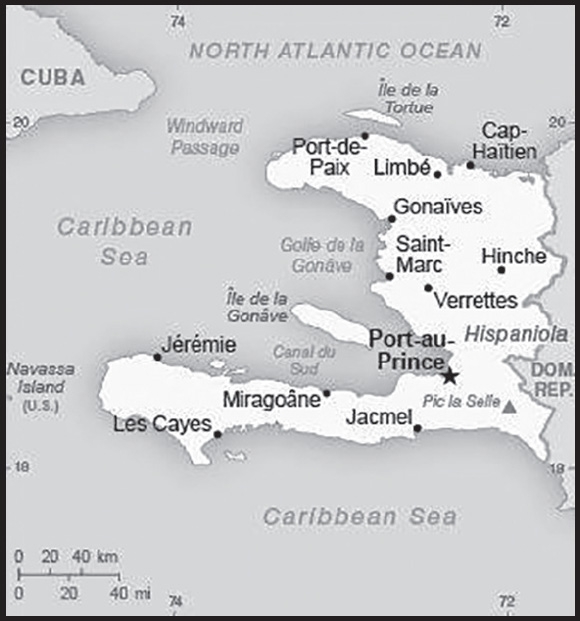
Location: Caribbean, western one-third of the island of Hispaniola, between the Caribbean Sea and the North Atlantic Ocean, west of the Dominican Republic
Geographic coordinates: 19 00 N, 72 25 W
Map references: Central America and the Caribbean
Area: total: 27,750 sq km
land: 27,560 sq km
water: 190 sq km
comparison ranking: total 147
Area - comparative: slightly smaller than Maryland
Land boundaries: total: 376 km
border countries (1): Dominican Republic 376 km
Coastline: 1,771 km
Maritime claims: territorial sea: 12 nm
contiguous zone: 24 nm
exclusive economic zone: 200 nm
continental shelf: to depth of exploitation
Climate: tropical; semiarid where mountains in east cut off trade winds
Terrain: mostly rough and mountainous
Elevation: highest point: Pic la Selle 2,674 m
lowest point: Caribbean Sea 0 m
mean elevation: 470 m
Natural resources: bauxite, copper, calcium carbonate, gold, marble, hydropower, arable land
Land use: agricultural land: 66.4% (2018 est.)
arable land: 38.5% (2018 est.)
permanent crops: 10.2% (2018 est.)
permanent pasture: 17.7% (2018 est.)
forest: 3.6% (2018 est.)
other: 30% (2018 est.)
Irrigated land: 800 sq km (2013)
Population distribution: fairly even distribution; largest concentrations located near coastal areas
Natural hazards: lies in the middle of the hurricane belt and subject to severe storms from June to October; occasional flooding and earthquakes; periodic droughts
Geography - note: shares island of Hispaniola with Dominican Republic (western one-third is Haiti, eastern two-thirds is the Dominican Republic); it is the most mountainous nation in the Caribbean
PEOPLE AND SOCIETY
Population: 11,470,261 (2023 est.)
comparison ranking: 83
Nationality: noun: Haitian(s)
adjective: Haitian
Ethnic groups: Black 95%, mixed and White 5%
Languages: French (official), Creole (official)
major-language sample(s): The World Factbook, une source indispensable d’informations de base. (French)
The World Factbook, sous endispansab pou enfomasyon debaz. (Haitian Creole)
Religions: Catholic 55%, Protestant 29%, Vodou 2.1%, other 4.6%, none 10% (2018 est.)
note: 50-80% of Haitians incorporate some elements of Vodou culture or practice in addition to another religion, most often Roman Catholicism; Vodou was recognized as an official religion in 2003
Age structure: 0-14 years: 29.68% (male 1,695,357/female 1,709,344)
15-64 years: 65.76% (male 3,733,899/female 3,808,453)
65 years and over: 4.56% (2023 est.) (male 228,800/female 294,408)
Dependency ratios: total dependency ratio: 58.3
youth dependency ratio: 51.2
elderly dependency ratio: 7.1
potential support ratio: 14.1 (2021 est.)
Median age: total: 24.1 years (2020)
male: 23.8 years
female: 24.3 years
comparison ranking: total 169
Population growth rate: 1.18% (2023 est.)
comparison ranking: 77
Birth rate: 20.81 births/1,000 population (2023 est.)
comparison ranking: 64
Death rate: 7.17 deaths/1,000 population (2023 est.)
comparison ranking: 114
Net migration rate: -1.86 migrant(s)/1,000 population (2023 est.)
comparison ranking: 169
Population distribution: fairly even distribution; largest concentrations located near coastal areas
Urbanization: urban population: 59.7% of total population (2023)
rate of urbanization: 2.47% annual rate of change (2020-25 est.)
Major urban areas - population: 2.987 million PORT-AU-PRINCE (capital) (2023)
Sex ratio: at birth: 1.01 male(s)/female
0-14 years: 0.99 male(s)/female
15-64 years: 0.98 male(s)/female
65 years and over: 0.78 male(s)/female
total population: 0.97 male(s)/female (2023 est.)
Mother’s mean age at first birth: 22.4 years (2016/7 est.)
note: data represents median age at first birth among women 25-49
Maternal mortality ratio: 350 deaths/100,000 live births (2020 est.)
comparison ranking: 27
Infant mortality rate: total: 38.78 deaths/1,000 live births (2023 est.)
male: 44.36 deaths/1,000 live births
female: 33.14 deaths/1,000 live births
comparison ranking: total 32
Life expectancy at birth: total population: 66.3 years (2023 est.)
male: 63.6 years
female: 69.04 years
comparison ranking: total population 198
Total fertility rate: 2.39 children born/woman (2023 est.)
comparison ranking: 72
Gross reproduction rate: 1.19 (2023 est.)
Contraceptive prevalence rate: 34.3% (2016/17)
Drinking water source: improved: urban: 91.9% of population
rural: 56.1% of population
total: 76.5% of population
unimproved: urban: 8.1% of population
rural: 43.9% of population
total: 23.5% of population (2020 est.)
Current health expenditure: 3.3% of GDP (2020)
Physicians density: 0.23 physicians/1,000 population (2018)
Hospital bed density: 0.7 beds/1,000 population (2013)
Sanitation facility access: improved: urban: 82.9% of population
rural: 42.6% of population
total: 65.6% of population
unimproved: urban: 17.1% of population
rural: 57.4% of population
total: 34.4% of population (2020 est.)
Major infectious diseases: degree of risk: very high (2023)
food or waterborne diseases: bacterial and protozoal diarrhea, hepatitis A, and typhoid fever
vectorborne diseases: dengue fever and malaria
Obesity - adult prevalence rate: 22.7% (2016)
comparison ranking: 72
Alcohol consumption per capita: total: 2.85 liters of pure alcohol (2019 est.)
beer: 0.55 liters of pure alcohol (2019 est.)
wine: 0.03 liters of pure alcohol (2019 est.)
spirits: 2.26 liters of pure alcohol (2019 est.)
other alcohols: 0 liters of pure alcohol (2019 est.)
comparison ranking: total 118
Tobacco use: total: 7.7% (2020 est.)
male: 12.2% (2020 est.)
female: 3.1% (2020 est.)
comparison ranking: total 152
Children under the age of 5 years underweight: 9.5% (2016/17)
comparison ranking: 58
Currently married women (ages 15-49): 51.4% (2023 est.)
Child marriage: women married by age 15: 2.1%
women married by age 18: 14.9%
men married by age 18: 1.6% (2017 est.)
Education expenditures: 1.4% of GDP (2020 est.)
comparison ranking: 192
Literacy: definition: age 15 and over can read and write
total population: 61.7%
male: 65.3%
female: 58.3% (2016)
Youth unemployment rate (ages 15-24): total: 35.7% (2021 est.)
male: 28.1%
female: 45.6%
comparison ranking: total 24
ENVIRONMENT
Environment - current issues: extensive deforestation (much of the remaining forested land is being cleared for agriculture and used as fuel); soil erosion; overpopulation leads to inadequate supplies of potable water and a lack of sanitation; natural disasters
Environment - international agreements: party to: Biodiversity, Climate Change, Climate Change-Kyoto Protocol, Climate Change-Paris Agreement, Desertification, Hazardous Wastes, Law of the Sea, Marine Dumping-London Convention, Marine Life Conservation, Ozone Layer Protection
signed, but not ratified: Nuclear Test Ban
Climate: tropical; semiarid where mountains in east cut off trade winds
Land use: agricultural land: 66.4% (2018 est.)
arable land: 38.5% (2018 est.)
permanent crops: 10.2% (2018 est.)
permanent pasture: 17.7% (2018 est.)
forest: 3.6% (2018 est.)
other: 30% (2018 est.)
Urbanization: urban population: 59.7% of total population (2023)
rate of urbanization: 2.47% annual rate of change (2020-25 est.)
Food insecurity: severe localized food insecurity: due to high food prices, natural disasters, and worsening civil insecurity - about 4.9 million people are estimated to face severe acute food insecurity and were in need of urgent food assistance between March and June 2023; the high levels of food insecurity are the result of sustained economic downturn, reducing domestic food production, elevated food prices, fuel shortage and frequent natural disasters; the situation is exacerbated by worsening insecurity, which has limited access to essential services, including markets, caused population displacements and hampered delivery of humanitarian assistance (2023)
Revenue from forest resources: 0.68% of GDP (2018 est.)
comparison ranking: 60
Revenue from coal: 0% of GDP (2018 est.)
comparison ranking: 78
Air pollutants: particulate matter emissions: 9.69 micrograms per cubic meter (2019 est.)
carbon dioxide emissions: 2.98 megatons (2016 est.)
methane emissions: 6.12 megatons (2020 est.)
Waste and recycling: municipal solid waste generated annually: 2,309,852 tons (2015 est.)
Total water withdrawal: municipal: 190 million cubic meters (2020 est.)
industrial: 50 million cubic meters (2020 est.)
agricultural: 1.21 billion cubic meters (2020 est.)
Total renewable water resources: 14.02 billion cubic meters (2020 est.)
GOVERNMENT
Country name: conventional long form: Republic of Haiti
conventional short form: Haiti
local long form: Republique d’Haiti (French)/ Repiblik d Ayiti (Haitian Creole)
local short form: Haiti (French)/ Ayiti (Haitian Creole)
etymology: the native Taino name means “Land of High Mountains” and was originally applied to the entire island of Hispaniola
Government type: semi-presidential republic
Capital: name: Port-au-Prince
geographic coordinates: 18 32 N, 72 20 W
time difference: UTC-5 (same time as Washington, DC, during Standard Time)
daylight saving time: +1hr, begins second Sunday in March; ends first Sunday in November
etymology: according to tradition, in 1706, a Captain de Saint-Andre named the bay and its surrounding area after his ship Le Prince; the name of the town that grew there means, “the Port of The Prince”
Administrative divisions: 10 departments (departements, singular - departement); Artibonite, Centre, Grand’Anse, Nippes, Nord, Nord-Est, Nord-Ouest, Ouest, Sud, Sud-Est
Independence: 1 January 1804 (from France)
National holiday: Independence Day, 1 January (1804)
Constitution: history: many previous; latest adopted 10 March 1987, with substantial revisions in June 2012; note – the constitution is commonly referred to as the “amended 1987 constitution”
amendments: proposed by the executive branch or by either the Senate or the Chamber of Deputies; consideration of proposed amendments requires support by at least two-thirds majority of both houses; passage requires at least two-thirds majority of the membership present and at least two-thirds majority of the votes cast; approved amendments enter into force after installation of the next president of the republic; constitutional articles on the democratic and republican form of government cannot be amended; amended many times, last in 2012
Legal system: civil law system strongly influenced by Napoleonic Code
International law organization participation: accepts compulsory ICJ jurisdiction; non-party state to the ICCt
Citizenship: citizenship by birth: no
citizenship by descent only: at least one parent must be a native-born citizen of Haiti
dual citizenship recognized: yes
residency requirement for naturalization: 5 years
Suffrage: 18 years of age; universal
Executive branch: chief of state: President (vacant); note - Prime Minister Ariel HENRY assumed executive responsibilities, including naming Cabinet members, following the assassination of President MOISE on 7 July 2021; new elections have not yet been scheduled
head of government: Prime Minister Ariel HENRY (since 20 July 2021)
cabinet: Cabinet chosen by the prime minister in consultation with the president; parliament must ratify the Cabinet and Prime Minister’s governing policy
elections/appointments: president directly elected by absolute majority popular vote in 2 rounds if needed for a 5-year term (eligible for a single non-consecutive term); last election had been originally scheduled for 9 October 2016 but was postponed until 20 November 2016 due to Hurricane Matthew
election results:
2016: Jovenel MOISE elected president in first round; percent of vote - Jovenel MOISE (PHTK) 55.6%, Jude CELESTIN (LAPEH) 19.6%, Jean-Charles MOISE (PPD) 11%, Maryse NARCISSE (FL) 9%; other 4.8%
2011: Michel MARTELLY elected president in second round; percent of vote - Michel MARTELLY (Peasant’s Response) 68%, Mirlande MANIGAT (RDNP) 32%
Legislative branch: description: bicameral legislature or le Corps legislatif ou le Parlement consists of:
Senate or le Sénat de la République (30 seats; 0 filled as of January 2023); members directly elected in multi-seat constituencies by absolute majority vote in 2 rounds if needed; members serve 6-year terms (2-term limit) with one-third of the membership renewed every 2 years)
Chamber of Deputies or Chambre des députés (119 seats; 0 filled as of January 2023; members directly elected in single-seat constituencies by absolute majority vote in 2 rounds if needed; members serve 4-year terms; no term limits); note - when the 2 chambers meet collectively it is known as the National Assembly or L’Assemblée nationale and is convened for specific purposes spelled out in the constitution
elections: Senate - last held on 20 November 2016 with runoff on 29 January 2017 (next originally scheduled for 27 October 2019 but postponed until political and civil society actors agree to a consensual process)
Chamber of Deputies - last held on 9 August 2015 with runoff on 25 October 2015 and 20 November 2016 (next originally scheduled for 27 October 2019 but postponed until political and civil society actors agree to a consensual process)
election results: Senate - percent of vote by party - NA; seats by party - NA; composition - men 10, women 0, percent of women 0% Chamber of Deputies - percent of vote by party - NA; seats by party - NA; composition - NA
note: the Senate and Chamber of Deputies as of January 2023 was not functional
Judicial branch: highest court(s): Supreme Court or Cour de cassation (currently 11 of 12 judges as prescribed by the constitution, 8 of whom were appointed in March 2023); note - Haiti is a member of the Caribbean Court of Justice; Constitutional Court, called for in the 1987 constitution but not yet established; High Court of Justice, for trying high government officials - currently not functional
judge selection and term of office: judges appointed by the president from candidate lists submitted by the Senate of the National Assembly; note - Article 174 of Haiti’s constitution states that judges of the Supreme Court are appointed for 10 years, whereas Article 177 states that judges of the Supreme Court are appointed for life
subordinate courts: Courts of Appeal; Courts of First Instance; magistrate’s courts; land, labor, and children’s courts
note: the Superior Council of the Judiciary or Conseil Superieur du Pouvoir Judiciaire is a 9-member body charged with the administration and oversight of the judicial branch of government
Political parties and leaders: Alternative League for Haitian Progress and Emancipation (Ligue Alternative pour le Progres et l’Emancipation Haitienne) or LAPEH [Jude CELESTIN]
Christian Movement for a New Haiti or MCNH or Mochrenha [Luc MESADIEU]
Christian National Movement for the Reconstruction of Haiti or UNCRH [Jean Chavannes JEUNE]
Combat of Peasant Workers to Liberate Haiti (Konbit Travaye Peyizan Pou Libere Ayiti) or Kontra Pep La [Jean William JEANTY]
Convention for Democratic Unity or KID [Evans PAUL]
Cooperative Action to Rebuild Haiti or KONBA [Jean William JEANTY]
December 16 Platform or Platfom 16 Desanm [Dr. Gerard BLOT]
Democratic Alliance Party or ALYANS [Evans PAUL] (coalition includes KID and PPRH)
Democratic Centers’ National Council or CONACED [Osner FEVRY]
Democratic and Popular Sector (Secteur Democratique et Populaire) or SDP [Nenel CASSY, Andre MICHEL, and Marjorie MICHEL]
Democratic Unity Convention (Konvansyon Inite Demokratik) or KID [Enold JOSEPH]
Dessalinian Patriotic and Popular Movement or MOPOD [Jean Andre VICTOR]
Effort and Solidarity to Create an Alternative for the People or ESKAMP [Joseph JASME]
Fanmi Lavalas or FL [Maryse NARCISSE and former President Jean Bertrand ARISTIDE]
Forward (En Avant) [Jerry TARDIEU]
Fusion of Haitian Social Democrats (Fusion Des Sociaux-Démocrates Haïtiens) or FHSD [Edmonde Supplice BEAUZILE]
G18 Policy Platform (Plateforme Politique G18) [Joseph WUILSON]
Haiti in Action (Ayiti An Aksyon Haiti’s Action) or AAA [Youri LATORTUE]
Haitian Tet Kale Party (Parti Haitien Tet Kale) or PHTK [Line Sainphaar BALTHAZAR]
Independent Movement for National Reconciliation or MIRN [Luc FLEURINORD]
Lavni Organization or LAVNI [Yves CRISTALIN]
Lod Demokratik [Jean Renel SENATUS]
Love Haiti (Renmen Ayiti) or RA [Jean Henry CEANT]
MTV Ayiti [Reginald BOULOS]
National Consortium of Haitian Political Parties (Consortium National des Partis Politiques Haitiens) or CNPPH [Jeantel JOSEPH]
National Shield Network (Reseau Bouclier National) [Victor PROPHANE and Garry BODEAU]
Organization of the People’s Struggle (Oganizasyon Pep Kap Lite) or OPL [Edgard LEBLANC]
Patriotic Unity (Inite Patriyotik) or Inite [Sorel YACinthe and Levaillant Louis JEUNE]
Platform Pitit Desalin (Politik Pitit Dessalines) or PPD [Jean-Charles MOISE]
Political Party for Us All or Bridge (Pont) or Pou Nou Tout [Jean Marie CHERESTAL]
Popular Patriotic Dessalinien Movement (Mouvement Patriotique Populaire Dessalinien) or MOPOD [Jean Andre VICTOR]
Rally of Progressive National Democrats (Rassemblement des Democrates Nationaux Progressistes) or RDNP [Eric JEAN-BAPTISTE]
Respe (Respect) [Charles Henry BAKER]
Women and Families Political Parties (Defile Pati Politik Fanm Ak Fanmi) [Marie Rebecca GUILLAUME]
International organization participation: ACP, AOSIS, Caricom, CD, CDB, CELAC, FAO, G-77, IADB, IAEA, IBRD, ICAO, ICC (NGOs), ICRM, IDA, IFAD, IFC, IFRCS, ILO, IMF, IMO, Interpol, IOC, IOM, IPU, ITSO, ITU, ITUC (NGOs), LAES, MIGA, NAM, OAS, OIF, OPANAL, OPCW, PCA, Petrocaribe, UN, UNCTAD, UNESCO, UNIDO, Union Latina, UNWTO, UPU, WCO, WFTU (NGOs), WHO, WIPO, WMO, WTO
Diplomatic representation in the US: chief of mission: Ambassador (vacant); Chargé d’Affaires Louis Harold JOSEPH (since 15 May 2023)
chancery: 2311 Massachusetts Avenue NW, Washington, DC 20008
telephone: [1] (202) 332-4090
FAX: [1] (202) 745-7215
email address and website:
consulate(s) general: Atlanta, Boston, Chicago, Miami, Orlando (FL), New York, San Juan (Puerto Rico)
Diplomatic representation from the US: chief of mission: Ambassador (vacant); Chargé d’Affaires Patricia AGUILERA (since 28 September 2023)
embassy: Tabarre 41, Route de Tabarre, Port-au-Prince
mailing address: 3400 Port-au-Prince Place, Washington, DC 20521-3400
telephone: [011] (509) 2229-8000
FAX: [011] (509) 2229-8027
email address and website:
Flag description: two equal horizontal bands of blue (top) and red with a centered white rectangle bearing the coat of arms, which contains a palm tree flanked by flags and two cannons above a scroll bearing the motto L’UNION FAIT LA FORCE (Union Makes Strength); the colors are taken from the French Tricolor and represent the union of blacks and mulattoes
National symbol(s): Hispaniolan trogon (bird), hibiscus flower; national colors: blue, red
National anthem: name: “La Dessalinienne” (The Dessalines Song)
lyrics/music: Justin LHERISSON/Nicolas GEFFRARD
note: adopted 1904; named for Jean-Jacques DESSALINES, a leader in the Haitian Revolution and first ruler of an independent Haiti
National heritage: total World Heritage Sites: 1 (cultural)
selected World Heritage Site locales: National History Park – Citadel, Sans Souci, Ramiers
ECONOMY
Economic overview: small Caribbean island economy and OECS-member state; extreme poverty and inflation; enormous income inequality; ongoing civil unrest due to recent presidential assassination; US preferential market access; very open to foreign direct investment
Real GDP (purchasing power parity): $32.856 billion (2021 est.)
$33.458 billion (2020 est.)
$34.615 billion (2019 est.)
note: data are in 2017 dollars
comparison ranking: 135
Real GDP growth rate: -1.8% (2021 est.)
-3.34% (2020 est.)
-1.68% (2019 est.)
comparison ranking: 202
Real GDP per capita: $2,900 (2021 est.)
$3,000 (2020 est.)
$3,100 (2019 est.)
note: data are in 2017 dollars
comparison ranking: 197
GDP (official exchange rate): $8.608 billion (2017 est.)
Inflation rate (consumer prices): 16.84% (2021 est.)
22.8% (2020 est.)
18.7% (2019 est.)
comparison ranking: 18
GDP - composition, by sector of origin
agriculture: 22.1% (2017 est.)
industry: 20.3% (2017 est.)
services: 57.6% (2017 est.)
comparison rankings: services 138; industry 146; agriculture 41
GDP - composition, by end use
household consumption: 99.1% (2017 est.)
government consumption: 10% (2016 est.)
investment in fixed capital: 32.6% (2016 est.)
investment in inventories: -1.4% (2017 est.)
exports of goods and services: 20% (2017 est.)
imports of goods and services: -60.3% (2017 est.)
note: figure for household consumption also includes government consumption
Agricultural products: sugar cane, cassava, mangoes/guavas, plantains, bananas, yams, avocados, maize, rice, vegetables
Industries: textiles, sugar refining, flour milling, cement, light assembly using imported parts
Industrial production growth rate: -2.48% (2021 est.)
comparison ranking: 178
Labor force: 5.01 million (2021 est.)
note: shortage of skilled labor; unskilled labor abundant
comparison ranking: 84
Labor force - by occupation: agriculture: 38.1%
industry: 11.5%
services: 50.4% (2010)
Unemployment rate: 15.73% (2021 est.)
15.45% (2020 est.)
13.91% (2019 est.)
note: widespread unemployment and underemployment; more than two-thirds of the labor force do not have formal jobs
comparison ranking: 33
Youth unemployment rate (ages 15-24): total: 35.7% (2021 est.)
male: 28.1%
female: 45.6%
comparison ranking: total 24
Population below poverty line: 58.5% (2012 est.)
Gini Index coefficient - distribution of family income: 41.1 (2012 est.)
comparison ranking: 49
Household income or consumption by percentage share: lowest 10%: 0.7%
highest 10%: 47.7% (2001)
Budget: revenues: $1.179 billion (2020 est.)
expenditures: $1.527 billion (2020 est.)
Budget surplus (+) or deficit (-): -1% (of GDP) (2017 est.)
comparison ranking: 80
Public debt: 31.1% of GDP (2017 est.)
33.9% of GDP (2016 est.)
comparison ranking: 170
Taxes and other revenues: 18.2% (of GDP) (2017 est.)
comparison ranking: 110
Fiscal year: 1 October - 30 September
Current account balance: $141.371 million (2021 est.)
$216.157 million (2020 est.)
-$168.76 million (2019 est.)
comparison ranking: 65
Exports: $1.241 billion (2021 est.) note: data are in current year dollars
$1.014 billion (2020 est.) note: data are in current year dollars
$1.733 billion (2019 est.)
comparison ranking: 171
Exports - partners: United States 83%, Canada 4%, Mexico 3%, India 1%, Hong Kong 1% (2021)
Exports - commodities: clothing and apparel, essential oils, eels, mangoes, scrap iron (2021)
Imports: $5.222 billion (2021 est.) note: data are in current year dollars
$4.206 billion (2020 est.) note: data are in current year dollars
$5.161 billion (2019 est.)
comparison ranking: 142
Imports - partners: United States 26%, Dominican Republic 23%, China 19%, Turkey 3%, Indonesia 3% (2021)
Imports - commodities: refined petroleum, rice, clothing and apparel, poultry, palm oil (2021)
Reserves of foreign exchange and gold: $2.759 billion (31 December 2021 est.)
$2.59 billion (31 December 2020 est.)
$2.355 billion (31 December 2019 est.)
comparison ranking: 122
Debt - external: $2.762 billion (31 December 2017 est.)
$2.17 billion (31 December 2016 est.)
comparison ranking: 146
Exchange rates: gourdes (HTG) per US dollar -
Exchange rates: 89.227 (2021 est.)
93.51 (2020 est.)
88.815 (2019 est.)
68.032 (2018 est.)
64.77 (2017 est.)
ENERGY
Electricity access: population without electricity: 7 million (2020)
electrification - total population: 47.1% (2021)
electrification - urban areas: 81.8% (2021)
electrification - rural areas: 3% (2020)
Electricity: installed generating capacity: 3.453 million kW (2020 est.)
consumption: 339 million kWh (2019 est.)
exports: 0 kWh (2019 est.)
imports: 0 kWh (2019 est.)
transmission/distribution losses: 643 million kWh (2019 est.)
comparison rankings: installed generating capacity 103; transmission/distribution losses 123; imports 121; exports 101; consumption 178
Electricity generation sources: fossil fuels: 85.8% of total installed capacity (2020 est.)
solar: 0.3% of total installed capacity (2020 est.)
hydroelectricity: 13.9% of total installed capacity (2020 est.)
Petroleum: total petroleum production: 0 bbl/day (2021 est.)
refined petroleum consumption: 21,100 bbl/day (2019 est.)
Refined petroleum products - imports: 20,030 bbl/day (2015 est.)
comparison ranking: 122
Natural gas: production: 0 cubic meters (2021 est.)
consumption: 3.341 million cubic meters (2020 est.)
exports: 0 cubic meters (2021 est.)
imports: 3.341 million cubic meters (2020 est.)
proven reserves: 0 cubic meters (2021 est.)
Carbon dioxide emissions: 3.139 million metric tonnes of CO2 (2019 est.)
from petroleum and other liquids: 3.137 million metric tonnes of CO2 (2019 est.)
from consumed natural gas: 2,000 metric tonnes of CO2 (2019 est.)
comparison ranking: total emissions 148
Energy consumption per capita: 3.97 million Btu/person (2019 est.)
comparison ranking: 175
COMMUNICATIONS
Telephones - fixed lines: total subscriptions: 6,000 (2021 est.)
subscriptions per 100 inhabitants: 64 (2021 est.) less than 1
comparison ranking: total subscriptions 204
Telephones - mobile cellular: total subscriptions: 7.3 million (2021 est.)
subscriptions per 100 inhabitants: 64 (2021 est.)
comparison ranking: total subscriptions 106
Telecommunication systems: general assessment: Haiti is in desperate need of maintaining effective communication services to enable it to keep going through the countless natural disasters, the country’s telecoms sector is really only surviving on the back of international goodwill to repair and replace the systems destroyed in the latest upheaval; Haiti’s fixed-line infrastructure is now practically non-existent, having been torn apart by Hurricane Matthew in 2016; what aid and additional investment has been forthcoming has been directed towards mobile solutions; over half of the country can afford a mobile handset or the cost of a monthly subscription; and mobile broadband subscriptions is half of that again – an estimated 28% in 2022; international aid continues to flow in to try and help the country’s telecoms sector recover – the World Bank has released a further $120 million to go on top of the $60 million grant provided after the last major 7.2 earthquake in August 2021 (2022)
domestic: fixed-line is less than 1 per 100; mobile-cellular teledensity is nearly 64 per 100 persons (2021)
international: country code - 509; landing points for the BDSNi and Fibralink submarine cables to 14 points in the Bahamas and Dominican Republic; satellite earth station - 1 Intelsat (Atlantic Ocean) (2019)
Broadcast media: per 2019 data released by Haitian telecommunications regulator CONATEL (Conseil National des Télécommunications), there are 398 legal sound broadcasting stations on the territory, including about 60 community radio stations, and 7 radio stations on the AM band; the FM band in Haiti is oversaturated by 158 percent; most radio stations broadcast 17 to 19 hours a day; there are 105 television stations operating in Haiti, including 36 TV stations in Port- au- Prince, 41 others in the provinces, and more than 40 radio-television stations; a large number of broadcasting stations operate irregularly and some stations operate with technical parameters that do not comply with established standards, thus causing harmful interference to existing telecommunications systems; VOA Creole Service broadcasts daily on 30 affiliate stations (2019)
Internet country code: .ht
Internet users: total: 4.29 million (2021 est.)
percent of population: 39% (2021 est.)
comparison ranking: total 107
Broadband - fixed subscriptions: total: 31,000 (2020 est.)
subscriptions per 100 inhabitants: 0.3 (2020 est.)
comparison ranking: total 152
TRANSPORTATION
National air transport system: number of registered air carriers: 1 (2020)
inventory of registered aircraft operated by air carriers: 1
Civil aircraft registration country code prefix: HH
Airports: 14 (2021)
comparison ranking: total 149
Airports - with paved runways: 4
note: paved runways have a concrete or asphalt surface but not all have facilities for refueling, maintenance, or air traffic control; the length of a runway required for aircraft to safely operate depends on a number of factors including the type of aircraft, the takeoff weight (including passengers, cargo, and fuel), engine types, flap settings, landing speed, elevation of the airport, and average maximum daily air temperature; paved runways can reach a length of 5,000 m (16,000 ft.), but the “typical” length of a commercial airline runway is between 2,500-4,000 m (8,000-13,000 ft.)
Airports - with unpaved runways: 10
note: unpaved runways have a surface composition such as grass or packed earth and are most suited to the operation of light aircraft; unpaved runways are usually short, often less than 1,000 m (3,280 ft.) in length; airports with unpaved runways often lack facilities for refueling, maintenance, or air traffic control
Roadways: total: 4,102 km (2011)
paved: 600 km (2011)
unpaved: 3,502 km (2011)
comparison ranking: total 153
Merchant marine: total: 4 (2022)
by type: general cargo 3, other 1
comparison ranking: total 167
Ports and terminals: major seaport(s): Cap-Haitien, Gonaives, Jacmel, Port-au-Prince
MILITARY AND SECURITY
Military and security forces: the Haitian Armed Forces (FAdH), disbanded in 1995, began to be reconstituted in 2017; it established an Army command in 2018
Ministry of Justice and Public Security: Haitian National Police (Police Nationale d’Haïti or PNH) (2023)
note: the PNH is responsible for maintaining public security; it includes police, corrections, fire, emergency response, airport security, port security, and coast guard functions; its units include a presidential guard and a paramilitary rapid-response Motorized Intervention Unit or BIM
Military and security service personnel strengths: up to 2,000 military troops (the force is planned to eventually have around 5,000 personnel); estimates for the National Police range from a low of 9,000 to a high of about 13,000 (2023)
Military service age and obligation: not available
Military - note: Haiti’s military was disbanded in 1995 after it participated in multiple coups and was accused of other political interference and human rights violations; the military was reinstated by former President MOISE in 2017 after the UN ended its peacekeeping operation in Haiti; the reconstituted military established an Army command in 2018 and has received training assistance from Argentina, Colombia, Ecuador, and Mexico; the military’s stated mission is to assist with natural disaster relief, border security, and combating transnational crime; in 2023, Prime Minister HENRY called upon the military to assist the National Police (PNH) in combating armed gangs, which have overwhelmed the PNH, killed hundreds of Haitians, and seized control of much of the capital Port-au-Prince since the assassination of President MOISE in 2021; in 2023, an estimated 200 armed gangs were operating in Haiti
the UN Stabilization Mission in Haiti (MINUSTAH) operated in Haiti from 2004 until 2017; its mission was to help restore stability after President Bertrand ARISTIDE fled the country, including assisting with the political process, strengthening government institutions, and promoting and protecting human rights; following the completion of MINUSTAH’s mandate in 2017, a smaller peacekeeping mission, the UN Mission for Justice Support in Haiti (MINUJUSTH), operated until 2019; its mission was to assist with the further development and strengthening of the national police, as well as Haiti’s justice and prison systems, and to promote and protect human rights; in 2019, the UN established the UN Integrated Office in Haiti (BINUH) with the political mission of advising the Haiti Government in elections, governance, and security; BINUH’s current mandate last until July 2023 (2023)
TRANSNATIONAL ISSUES
Disputes - international: Haiti-Dominican Republic: the Dominican Republic has increased security along the Haitian border to prevent unauthorized migration and smuggling, including constructing a fence and deploying military troops; some disputes over border limits, particularly along the Massacre River
Haiti-US: Haiti claims US-administered Navassa Island
Refugees and internally displaced persons: IDPs: 171,000 (violence among armed gangs in the metropolitan area os Port-au-Prince) (2022)
stateless persons: 2,992 (2018); note - individuals without a nationality who were born in the Dominican Republic prior to January 2010
Trafficking in persons: tier rating: Tier 2 Watch List — Haiti does not fully meet the minimum standards for the elimination of trafficking but is making significant efforts to do so; officials initiated two prosecutions under the anti-trafficking law and assigned investigative judges in two additional high-profile cases; the government also identified and provided services to 11 adult trafficking victims, and also provided support to an unknown number of child victims and conducted an audit of judicial and child protection cases; however, the government did not demonstrate overall increasing efforts, compared with the previous year, to expand its anti-trafficking capacity; impunity and complicity, particularly in high-profile cases, remained problems; Haiti lacked sustained law enforcement efforts and did not pursue investigations following victim identification; improvements in law enforcement or victim protection efforts were unclear because the government did not disaggregate information on anti-trafficking law enforcement or victim protection efforts; anti-trafficking agencies did not cooperate effectively, and the government did not make sufficient efforts to combat child domestic servitude; because the government has devoted sufficient resources to a written plan that, if implemented, would constitute significant efforts to meet the minimum standards, Haiti was granted a waiver per the Trafficking Victims Protection Act from an otherwise required downgrade to Tier 3; therefore, Haiti remained on Tier 2 Watch List for the third consecutive year (2023)
trafficking profile: human traffickers exploit domestic and foreign victims in Haiti, as well as Haitians abroad; in 2023, officials estimated three million Haitians were at risk of trafficking; during the reporting period, Haiti suffered multiple crises, including gang violence, fuel shortages, irregular migration outflows, internal population displacements, a cholera epidemic, the breakdown of basic infrastructure, and the government’s inability to provide basic services—all of which increased vulnerability to trafficking and reduced government capacity to address it; most of Haiti’s trafficking cases involve children in forced labor and sex trafficking in domestic service; NGOs estimate that between 150,000 and 300,000 children work in domestic servitude, of which about two-thirds are girls and one-third boys—mostly victims of sex trafficking and labor trafficking, respectively; female foreign nationals, especially citizens of the Dominican Republic and Venezuela, are particularly at risk for sex and labor trafficking in Haiti; commercial sex typically takes place in upscale neighborhoods and resort areas to cater to foreigners; NGOs report child sex tourism occurs in Haiti, with most sex tourists coming from Canada, the US, and Europe; traffickers target Haitian children in private or NGO-sponsored residential care centers, children working in construction, agriculture, fisheries, domestic work, begging, and street vending, IDPs including those displaced by natural disasters, stateless people, LGBTQI+ youth, and those affected by gang violence; risks to migrants remained high, including from migrant smugglers who exploit migrant women in commercial sex to repay alleged debts; among all Haitian migrant groups, those traversing the Dominican Republic-Haiti border seeking economic opportunities were the largest and most vulnerable to trafficking; cross-border trafficking of Haitians include forced labor in the Dominican construction, service, and agricultural industries and sex trafficking in the Dominican tourism industry; Haitian adults and children also are at risk of fraudulent recruitment and forced labor in other Caribbean countries, South America, and the US; Cuban medical workers in Haiti may have been forced to work by the Cuban government (2023)
Illicit drugs: a transit point for cocaine from South America and marijuana from Jamaica en route to the United States; not a producer or large consumer of illicit drugs; some cultivation of cannabis for local consumption
HEARD ISLAND AND MCDONALD ISLANDS
INTRODUCTION
Background: American sailor John HEARD discovered Heard Island in 1853 and thought it was a glacier that had broken away from Antarctica. Fellow American William MCDONALD discovered the McDonald Islands the following year. Starting in 1855, sealers lived on the islands harvesting elephant seal oil; by the time the practice was ended in 1877, most of the islands’ seals were killed. The UK formally claimed the islands in 1910 and Australian explorer Douglas MAWSON visited Heard Island in 1929. In 1947, the UK transferred the islands to Australia for its Antarctica research, but Australia closed the research station on Heard Island in 1954 when it opened a new research station on the Antarctic continent. McDonald Island has been an active volcano since it emerged from dormancy in 1992, and the island doubled in size after an eruption in 1996. In 1997, the islands were named a UNESCO World Heritage Site. Populated by a large number of bird species, seals, and penguins, the islands are primarily used for research with limited fishing being permitted in the surrounding waters.
GEOGRAPHY
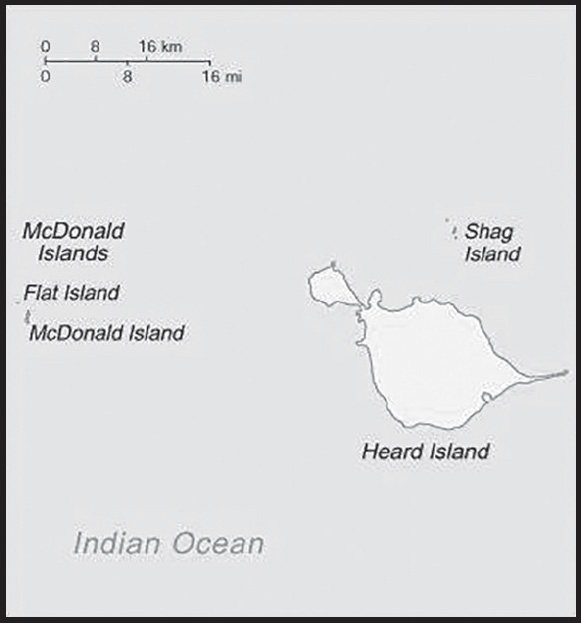
Location: islands in the Indian Ocean, about two-thirds of the way from Madagascar to Antarctica
Geographic coordinates: 53 06 S, 72 31 E
Map references: Antarctic Region
Area: total: 412 sq km
land: 412 sq km
water: 0 sq km
comparison ranking: total 202
Area - comparative: slightly more than two times the size of Washington, DC
Land boundaries: total: 0 km
Coastline: 101.9 km
Maritime claims: territorial sea: 12 nm
exclusive fishing zone: 200 nm
Climate: antarctic
Terrain: Heard Island - 80% ice-covered, bleak and mountainous, dominated by a large massif (Big Ben) and an active volcano (Mawson Peak); McDonald Islands - small and rocky
Elevation: highest point: Mawson Peak on Big Ben volcano 2,745 m
lowest point: Indian Ocean 0 m
Natural resources: fish
Land use: agricultural land: 0% (2011 est.)
other: 100% (2018 est.)
Natural hazards: Mawson Peak, an active volcano, is on Heard Island
Geography - note: Mawson Peak on Heard Island is the highest Australian mountain (at 2,745 meters, it is taller than Mt. Kosciuszko in Australia proper), and one of only two active volcanoes located in Australian territory, the other being McDonald Island; in 1992, McDonald Island broke its dormancy and began erupting; it has erupted several times since, most recently in 2005
PEOPLE AND SOCIETY
Population: uninhabited
ENVIRONMENT
Environment - current issues: none; uninhabited and mostly ice covered
Climate: antarctic
Land use: agricultural land: 0% (2011 est.)
other: 100% (2018 est.)
GOVERNMENT
Country name: conventional long form: Territory of Heard Island and McDonald Islands
conventional short form: Heard Island and McDonald Islands
abbreviation: HIMI
etymology: named after American Captain John HEARD, who sighted the island on 25 November 1853, and American Captain William McDONALD, who discovered the islands on 4 January 1854
Dependency status: territory of Australia; administered from Canberra by the Department of Agriculture, Water and the Environment (Australian Antarctic Division)
Legal system: the laws of Australia apply where applicable
Diplomatic representation in the US: none (territory of Australia)
Diplomatic representation from the US: embassy: none (territory of Australia)
Flag description: the flag of Australia is used
National heritage: total World Heritage Sites: 1 (natural); note - excerpted from the Australia entry
selected World Heritage Site locales: Heard Island and McDonald Islands
COMMUNICATIONS
Internet country code: .hm
TRANSPORTATION
Ports and terminals: none; offshore anchorage only
MILITARY AND SECURITY
Military - note: defense is the responsibility of Australia; Australia conducts fisheries patrols
TRANSNATIONAL ISSUES
Disputes - international: none identified
Illicit drugs: NA
INTRODUCTION
Background: Popes in their secular role ruled portions of the Italian peninsula for more than a thousand years until the mid-19th century, when many of the Papal States were seized by the newly united Kingdom of Italy. In 1870, the pope’s holdings were further circumscribed when Rome itself was annexed. Disputes between a series of “prisoner” popes and Italy were resolved in 1929 by three Lateran Treaties, which established the independent state of Vatican City and granted Roman Catholicism special status in Italy. In 1984, a concordat between the Holy See and Italy modified certain of the earlier treaty provisions, including the primacy of Roman Catholicism as the Italian state religion. Present concerns of the Holy See include religious freedom, threats against minority Christian communities in Africa and the Middle East, the plight of refugees and migrants, sexual misconduct by clergy, international development, interreligious dialogue and reconciliation, and the application of church doctrine in an era of rapid change and globalization. About 1.3 billion people worldwide profess Catholicism - the world’s largest Christian faith.
GEOGRAPHY
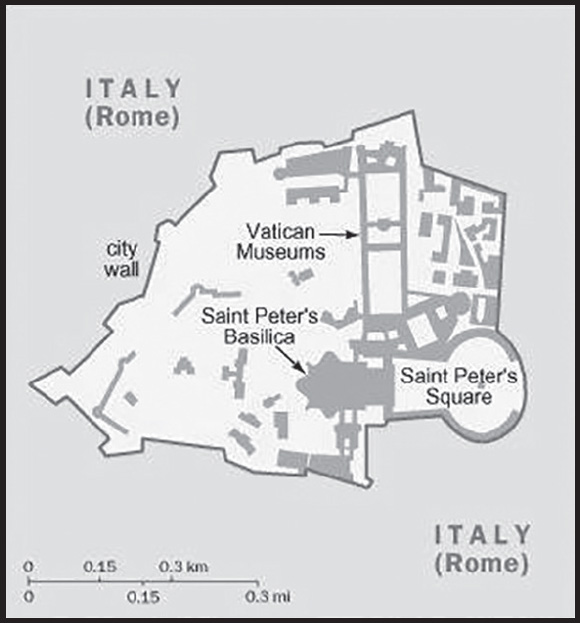
Location: Southern Europe, an enclave of Rome (Italy)
Geographic coordinates: 41 54 N, 12 27 E
Map references: Europe
Area: total: 0 sq km
land: 0.44 sq km
water: 0 sq km
comparison ranking: total 257
Area - comparative: about 0.7 times the size of the National Mall in Washington, DC
Land boundaries: total: 3.4 km
border countries (1): Italy 3.4 km
Coastline: 0 km (landlocked)
Maritime claims: none (landlocked)
Climate: temperate; mild, rainy winters (September to May) with hot, dry summers (May to September)
Terrain: urban; low hill
Elevation: highest point: Vatican Gardens (Vatican Hill) 78 m
lowest point: Saint Peter’s Square 19 m
Natural resources: None
Land use: agricultural land: 0% (2018 est.)
other: 100% (2018 est.)
Natural hazards: occasional earthquakes
Geography - note: landlocked; an enclave in Rome, Italy; world’s smallest state; beyond the territorial boundary of Vatican City, the Lateran Treaty of 1929 grants the Holy See extraterritorial authority over 23 sites in Rome and five outside of Rome, including the Pontifical Palace at Castel Gandolfo (the Pope’s summer residence)
PEOPLE AND SOCIETY
Population: 1,000 (2022 est.)
comparison ranking: 235
Nationality: noun: none
adjective: none
Ethnic groups: Italian, Swiss, Argentinian, and other nationalities from around the world (2017)
Languages: Italian, Latin, French, various other languages
major-language sample(s): L’Almanacco dei fatti del mondo, l’indispensabile fonte per le informazioni di base. (Italian)
Religions: Roman Catholic
Age structure: 0-14 years: NA
15-64 years: NA
65 years and over: NA
Dependency ratios: total dependency ratio: NA
youth dependency ratio: NA
elderly dependency ratio: NA
potential support ratio: NA
Population growth rate: 0% (2014 est.)
comparison ranking: 194
Urbanization: urban population: 100% of total population (2023)
rate of urbanization: 0% annual rate of change (2020-25 est.)
Major urban areas - population: 1,000 VATICAN CITY (capital) (2018)
Drinking water source: improved: total: 100% of population
unimproved: total: 0% of population (2017 est.)
Children under the age of 5 years underweight
ENVIRONMENT
Environment - current issues: some air pollution from the surrounding city of Rome
Environment - international agreements: party to: Comprehensive Nuclear Test Ban, Ozone Layer Protection
signed, but not ratified: Air Pollution, Environmental Modification
Climate: temperate; mild, rainy winters (September to May) with hot, dry summers (May to September)
Land use: agricultural land: 0% (2018 est.)
other: 100% (2018 est.)
Urbanization: urban population: 100% of total population (2023)
rate of urbanization: 0% annual rate of change (2020-25 est.)
Air pollutants: methane emissions: 0 megatons (2020 est.)
Total renewable water resources: 0 cubic meters (2017 est.)
GOVERNMENT
Country name: conventional long form: The Holy See (Vatican City State)
conventional short form: Holy See (Vatican City)
local long form: La Santa Sede (Stato della Citta del Vaticano)
local short form: Santa Sede (Citta del Vaticano)
etymology: “holy” comes from the Greek word “hera” meaning “sacred”; “see” comes from the Latin word “sedes” meaning “seat,” and refers to the episcopal chair; the term “Vatican” derives from the hill Mons Vaticanus on which the Vatican is located and which comes from the Latin “vaticinari” (to prophesy), referring to the fortune tellers and soothsayers who frequented the area in Roman times
Government type: ecclesiastical elective monarchy; self-described as an “absolute monarchy”
Capital: name: Vatican City
geographic coordinates: 41 54 N, 12 27 E
time difference: UTC+1 (6 hours ahead of Washington, DC, during Standard Time)
daylight saving time: +1hr, begins last Sunday in March; ends last Sunday in October etymology: the term “Vatican” derives from the hill Mons Vaticanus on which the Vatican is located and which comes from the Latin “vaticinari” (to prophesy), referring to the fortune tellers and soothsayers who frequented the area in Roman times
Administrative divisions: none
Independence: 11 February 1929; note - the three treaties signed with Italy on 11 February 1929 acknowledged, among other things, the full sovereignty of the Holy See and established its territorial extent; however, the origin of the Papal States, which over centuries varied considerably in extent, may be traced back to A.D. 754
National holiday: Election Day of Pope FRANCIS, 13 March (2013)
Constitution: history: previous 1929, 1963; latest promulgated November 2000, effective 22 February 2001 (Fundamental Law of Vatican City State, the main governing document of the Vatican’s civil entities); the Roman Curia is the administrative apparatus – the departments and ministries – used by the pontiff in governing the church; note - Pope Francis in October 2013, instituted a 9-member Council of Cardinal Advisers to reform the Roman Curia to include writing a new constitution; in June 2018, Pope Francis approved the Council of Cardinals’ first draft of the new apostolic constitution, Predicate Evangelium (Preach the Gospel); it became effective 5 June 2022, replacing Pastor Bonus, the previous governing document of the Roman Curia
amendments: note - although the Fundamental Law of Vatican City State makes no mention of amendments, Article Four (drafting laws), states that this legislative responsibility resides with the Pontifical Commission for Vatican City State; draft legislation is submitted through the Secretariat of State and considered by the pope
Legal system: religious legal system based on canon (religious) law
International law organization participation: has not submitted an ICJ jurisdiction declaration; non-party state to the ICCt
Citizenship: citizenship by birth: no
citizenship by descent only: no
dual citizenship recognized: no
residency requirement for naturalization: not applicable
note: in the Holy See, citizenship is acquired by law, ex iure, or by adminstrative decision; in the first instance, citizenship is a function of holding office within the Holy See as in the case of cardinals resident in Vatican City or diplomats of the Holy See; in the second instance, citizenship may be requested in a limited set of circumstances for those who reside within Vatican City under papal authorization, as a function of their office or service, or as the spouses and children of current citizens; citizenship is lost once an individual no longer permanently resides in Vatican City, normally reverting to the citizenship previously held
Suffrage: election of the pope is limited to cardinals less than 80 years old
Executive branch: chief of state: Pope FRANCIS (since 13 March 2013)
head of government: President of the Pontifical Commission for the State of Vatican City and President of the Governorate of the Vatican City State is Fernando VERGEZ ALZAGA (since 1 October 2021)
cabinet: Pontifical Commission for the State of Vatican City appointed by the pope
elections/appointments: pope elected by the College of Cardinals, usually for life or until voluntary resignation; election last held on 13 March 2013 (next to be held after the death or resignation of the current pope); Secretary of State appointed by the pope
election results: Jorge Mario BERGOGLIO, former Archbishop of Buenos Aires, elected Pope FRANCIS
Legislative branch: description: unicameral Pontifical Commission for the State of Vatican City or Pontificia Commissione per lo Stato della Citta del Vaticano (7 seats; the president of the Governorate of Vatican City State and 6 cardinals appointed by the pope to serve 5-year terms)
elections: last held on 11 July 2018
election results: composition - men 7, women 0
Judicial branch: highest court(s): Supreme Court or Supreme Tribunal of the Apostolic Signatura (consists of the cardinal prefect, who serves as ex-officio president of the court, and 2 other cardinals of the Prefect Signatura); note - judicial duties were established by the Motu Proprio, papal directive, of Pope PIUS XII on 1 May 1946; most Vatican City criminal matters are handled by the Republic of Italy courts
judge selection and term of office: cardinal prefect appointed by the pope; the other 2 cardinals of the court appointed by the cardinal prefect on a yearly basis
subordinate courts: Appellate Court of Vatican City; Tribunal of Vatican City
Political parties and leaders: none
International organization participation: CE (observer), IAEA, Interpol, IOM, ITSO, ITU, ITUC (NGOs), OAS (observer), OPCW, OSCE, Schengen Convention (de facto member), SICA (observer), UN (observer), UNCTAD, UNHCR, Union Latina (observer), UNWTO (observer), UPU, WIPO, WTO (observer)
Diplomatic representation in the US: chief of mission: Apostolic Nuncio Archbishop Christophe PIERRE (since 27 June 2016) chancery: 3339 Massachusetts Avenue NW, Washington, DC 20008
telephone: [1] (202) 333-7121
FAX: [1] (202) 337-4036
email address and website:
Diplomatic representation from the US: chief of mission: Ambassador Joe DONNELLY (since 11 April 2022)
embassy: Via Sallustiana, 49, 00187 Rome
mailing address: 5660 Holy See Place, Washington DC 20521-5660
telephone: [39] (06) 4674-1
FAX: [39] (06) 4674-3411
email address and website:
Flag description: two vertical bands of yellow (hoist side) and white with the arms of the Holy See, consisting of the crossed keys of Saint Peter surmounted by the three-tiered papal tiara, centered in the white band; the yellow color represents the pope’s spiritual power, the white his worldly power
National symbol(s): crossed keys beneath a papal tiara; national colors: yellow, white
National anthem: name: “Inno e Marcia Pontificale” (Hymn and Pontifical March); often called The Pontifical Hymn
lyrics/music: Raffaello LAVAGNA/Charles-Francois GOUNOD
note: adopted 1950
National heritage: total World Heritage Sites: 2 (both cultural)
selected World Heritage Site locales: Historic Center of Rome, the Properties of the Holy See in that City Enjoying Extraterritorial Rights and San Paolo Fuori le Mura; Vatican City
ECONOMY
Economic overview: limited, tourism-based economy; euro user but issues commemorative stamps and coins; solar energy producer; some printing industry to support museums and religious needs
Industries: printing; production of coins, medals, postage stamps; mosaics, staff uniforms; worldwide banking and financial activities
Labor force: 4,822 (2016)
comparison ranking: 221
Labor force - by occupation: note: essentially services with a small amount of industry; nearly all dignitaries, priests, nuns, guards, and the approximately 3,000 lay workers live outside the Vatican
Population below poverty line: NA
Budget: revenues: $315 million (2013)
expenditures: $348 million (2013)
Fiscal year: calendar year
Exchange rates: euros (EUR) per US dollar -
Exchange rates: 0.885 (2017 est.)
0.903 (2016 est.)
0.9214 (2015 est.)
0.885 (2014 est.)
0.7634 (2013 est.)
note: while not an EU member state, the Holy See, has a 2000 monetary agreement with Italy and the EU to produce limited euro coinage—but not banknotes—that began enforcement in January 2002
ENERGY
Electricity access: electrification - total population: 100% (2021)
COMMUNICATIONS
Telecommunication systems: general assessment: the Vatican’s interior telecommunication system is composed of two strongly integrated subsystem: fixed infrastructure and mobile infrastructure; it is important to note that the mobile communication system has been designed to be capable of using satellite connections so that it is possible to ensure the telecommunication services whenever needed, following the Pastoral travels of the Pope; the telephone system operates through an automatic digital exchange (2020)
domestic: the telephone system operates through an automatic digital exchange (2020)
international: country code - 39; uses Italian system
Broadcast media: the Vatican Television Center (CTV) transmits live broadcasts of the Pope’s Sunday and Wednesday audiences, as well as the Pope’s public celebrations; CTV also produces documentaries; Vatican Radio is the Holy See’s official broadcasting service broadcasting via shortwave, AM and FM frequencies, and via satellite and Internet connections; Vatican News website partners with Vatican Radio and provides Catholic news provided by the Vatican (2021)
Internet country code: .va
Internet users: total: 383 (2021 est.)
percent of population: 75% (2021 est.)
comparison ranking: total 232
Communications - note: the Vatican Apostolic Library is one of the world’s oldest libraries, formally established in 1475, but actually much older; it holds a significant collection of historic texts including 1.1 million printed books and 75,000 codices (manuscript books with handwritten contents); it serves as a research library for history, law, philosophy, science, and theology; the library’s collections have been described as “the world’s greatest treasure house of the writings at the core of Western tradition”
MILITARY AND SECURITY
Military and security forces: the Pontifical Swiss Guard Corps (Corpo della Guardia Svizzera Pontificia) serves as the de facto military force of Vatican City; the Gendarmerie Corps of Vatican City (Corpo della Gendarmeriais) is a police force that helps augment the Pontifical Swiss Guard Corps during the Pope’s appearances, as well as providing general security, traffic direction, and investigative duties for the Vatican City State (2023)
note: the Swiss Guard Corps has protected the Pope and his residence since 1506
Military service age and obligation: Pontifical Swiss Guard Corps: 19-30 years of age for voluntary military service; no conscription; must be a single Roman Catholic male with Swiss citizenship who has completed basic training with the Swiss military and can obtain a certificate of good conduct; qualified candidates must apply to serve; the service contract is between 2 and 25 years (2023)
Military - note: defense is the responsibility of Italy
TRANSNATIONAL ISSUES
Disputes - international: none identified
Illicit drugs: NA
INTRODUCTION
Background: Once part of Spain’s vast empire in the New World, Honduras became an independent nation in 1821. After two and a half decades of mostly military rule, a freely elected civilian government came to power in 1982. During the 1980s, Honduras proved a haven for anti-Sandinista contras fighting the Marxist Nicaraguan Government and an ally to Salvadoran Government forces fighting leftist guerrillas. The country was devastated by Hurricane Mitch in 1998, which killed about 5,600 people and caused approximately $2 billion in damage. Since then, the economy has slowly rebounded, despite COVID and severe storm-related setbacks in 2020 and 2021.
GEOGRAPHY
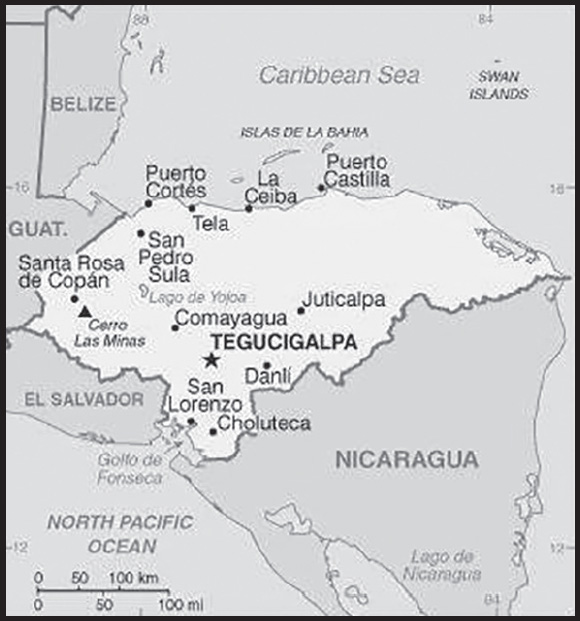
Location: Central America, bordering the Caribbean Sea, between Guatemala and Nicaragua and bordering the Gulf of Fonseca (North Pacific Ocean), between El Salvador and Nicaragua
Geographic coordinates: 15 00 N, 86 30 W
Map references: Central America and the Caribbean
Area: total: 112,090 sq km
land: 111,890 sq km
water: 200 sq km
comparison ranking: total 103
Area - comparative: slightly larger than Tennessee
Land boundaries: total: 1,575 km
border countries (3): Guatemala 244 km; El Salvador 391 km; Nicaragua 940 km
Coastline: 823 km (Caribbean Sea 669 km, Gulf of Fonseca 163 km)
Maritime claims: territorial sea: 12 nm
contiguous zone: 24 nm
exclusive economic zone: 200 nm
continental shelf: natural extension of territory or to 200 nm
Climate: subtropical in lowlands, temperate in mountains
Terrain: mostly mountains in interior, narrow coastal plains
Elevation: highest point: Cerro Las Minas 2,870 m
lowest point: Caribbean Sea 0 m
mean elevation: 684 m
Natural resources: timber, gold, silver, copper, lead, zinc, iron ore, antimony, coal, fish, hydropower
Land use: agricultural land: 28.8% (2018 est.)
arable land: 9.1% (2018 est.)
permanent crops: 4% (2018 est.)
permanent pasture: 15.7% (2018 est.)
forest: 45.3% (2018 est.)
other: 25.9% (2018 est.)
Irrigated land: 900 sq km (2012)
Major lakes (area sq km): salt water lake(s): Laguna de Caratasca - 1,110 sq km
Population distribution: most residents live in the mountainous western half of the country; unlike other Central American nations, Honduras is the only one with an urban population that is distributed between two large centers - the capital of Tegucigalpa and the city of San Pedro Sula; the Rio Ulua valley in the north is the only densely populated lowland area
Natural hazards: frequent, but generally mild, earthquakes; extremely susceptible to damaging hurricanes and floods along the Caribbean coast
Geography - note: has only a short Pacific coast but a long Caribbean shoreline, including the virtually uninhabited eastern Mosquito Coast
PEOPLE AND SOCIETY
Population: 9,571,352 (2023 est.)
comparison ranking: 95
Nationality: noun: Honduran(s)
adjective: Honduran
Ethnic groups: Mestizo (mixed Amerindian and European) 90%, Amerindian 7%, African descent 2%, White 1%
Languages: Spanish (official), Amerindian dialects
major-language sample(s): La Libreta Informativa del Mundo, la fuente indispensable de información básica. (Spanish)
Religions: Evangelical/Protestant 48%, Roman Catholic 34%, other 1%, none 17% (2020 est.)
Demographic profile: Honduras is one of the poorest countries in Latin America and has one of the world’s highest murder rates. More than half of the population lives in poverty and per capita income is one of the lowest in the region. Poverty rates are higher among rural and indigenous people and in the south, west, and along the eastern border than in the north and central areas where most of Honduras’ industries and infrastructure are concentrated. The increased productivity needed to break Honduras’ persistent high poverty rate depends, in part, on further improvements in educational attainment. Although primary-school enrollment is near 100%, educational quality is poor, the drop-out rate and grade repetition remain high, and teacher and school accountability is low.
Honduras’ population growth rate has slowed since the 1990s and is now 1.2% annually with a birth rate that averages 2.1 children per woman and more among rural, indigenous, and poor women. Honduras’ young adult population - ages 15 to 29 - is projected to continue growing rapidly for the next three decades and then stabilize or slowly shrink. Population growth and limited job prospects outside of agriculture will continue to drive emigration. Remittances represent about a fifth of GDP.
Age structure: 0-14 years: 27.92% (male 1,352,581/female 1,319,338)
15-64 years: 66.18% (male 3,050,008/female 3,283,949)
65 years and over: 5.91% (2023 est.) (male 249,241/female 316,235)
Dependency ratios: total dependency ratio: 53.3
youth dependency ratio: 46.9
elderly dependency ratio: 6.4
potential support ratio: 15.5 (2021 est.)
Median age: total: 24.4 years (2020)
male: 23.5 years
female: 25.2 years
comparison ranking: total 165
Population growth rate: 1.16% (2023 est.)
comparison ranking: 79
Birth rate: 17.64 births/1,000 population (2023 est.)
comparison ranking: 84
Death rate: 4.69 deaths/1,000 population (2023 est.)
comparison ranking: 204
Net migration rate: -1.32 migrant(s)/1,000 population (2023 est.)
comparison ranking: 155
Population distribution: most residents live in the mountainous western half of the country; unlike other Central American nations, Honduras is the only one with an urban population that is distributed between two large centers - the capital of Tegucigalpa and the city of San Pedro Sula; the Rio Ulua valley in the north is the only densely populated lowland area
Urbanization: urban population: 60.2% of total population (2023)
rate of urbanization: 2.48% annual rate of change (2020-25 est.)
Major urban areas - population: 1.568 million TEGUCIGALPA (capital), 982,000 San Pedro Sula (2023)
Sex ratio: at birth: 1.03 male(s)/female
0-14 years: 1.03 male(s)/female
15-64 years: 0.93 male(s)/female
65 years and over: 0.79 male(s)/female
total population: 0.95 male(s)/female (2023 est.)
Mother’s mean age at first birth: 20.3 years (2011/12 est.)
note: data represents median age a first birth among women 25-49
Maternal mortality ratio: 72 deaths/100,000 live births (2020 est.)
comparison ranking: 85
Infant mortality rate: total: 14.77 deaths/1,000 live births (2023 est.)
male: 16.88 deaths/1,000 live births
female: 12.59 deaths/1,000 live births
comparison ranking: total 99
Life expectancy at birth: total population: 75.43 years (2023 est.)
male: 71.91 years
female: 79.06 years
comparison ranking: total population 128
Total fertility rate: 1.98 children born/woman (2023 est.)
comparison ranking: 108
Gross reproduction rate: 0.97 (2023 est.)
Contraceptive prevalence rate: 69.4% (2019)
Drinking water source: improved: urban: 100% of population
rural: 90.7% of population
total: 96.1% of population
unimproved: urban: 0% of population
rural: 9.3% of population
total: 3.9% of population (2020 est.)
Current health expenditure: 9% of GDP (2020)
Physicians density: 0.5 physicians/1,000 population (2020)
Hospital bed density: 0.6 beds/1,000 population (2017)
Sanitation facility access: improved: urban: 96.7% of population
rural: 87.9% of population
total: 93% of population
unimproved: urban: 3.3% of population
rural: 12.1% of population
total: 7% of population (2020 est.)
Major infectious diseases: degree of risk: high (2023)
food or waterborne diseases: bacterial diarrhea, hepatitis A, and typhoid fever
vectorborne diseases: dengue fever
Obesity - adult prevalence rate: 21.4% (2016)
comparison ranking: 89
Alcohol consumption per capita: total: 2.73 liters of pure alcohol (2019 est.)
beer: 1.6 liters of pure alcohol (2019 est.)
wine: 0.04 liters of pure alcohol (2019 est.)
spirits: 1.09 liters of pure alcohol (2019 est.)
other alcohols: 0 liters of pure alcohol (2019 est.)
comparison ranking: total 119
Children under the age of 5 years underweight: 7.1% (2019)
comparison ranking: 65
Currently married women (ages 15-49): 53.5% (2023 est.)
Child marriage: women married by age 15: 9.2%
women married by age 18: 34%
men married by age 18: 10% (2019 est.)
Education expenditures: 6.4% of GDP (2020 est.)
comparison ranking: 34
Literacy: definition: age 15 and over can read and write
total population: 88.5%
male: 88.2%
female: 88.7% (2019)
School life expectancy (primary to tertiary education): total: 10 years
male: 10 years
female: 11 years (2019)
Youth unemployment rate (ages 15-24): total: 15.5% (2021 est.)
male: 11.4%
female: 24.6%
comparison ranking: total 112
ENVIRONMENT
Environment - current issues: urban population expanding; deforestation results from logging and the clearing of land for agricultural purposes; further land degradation and soil erosion hastened by uncontrolled development and improper land use practices such as farming of marginal lands; mining activities polluting Lago de Yojoa (the country’s largest source of fresh water), as well as several rivers and streams, with heavy metals
Environment - international agreements: party to: Biodiversity, Climate Change, Climate Change-Kyoto Protocol, Climate Change-Paris Agreement, Comprehensive Nuclear Test Ban, Desertification, Endangered Species, Environmental Modification, Hazardous Wastes, Law of the Sea, Marine Dumping-London Convention, Nuclear Test Ban, Ozone Layer Protection, Ship Pollution, Tropical Timber 2006, Wetlands
signed, but not ratified: none of the selected agreements
Climate: subtropical in lowlands, temperate in mountains
Land use: agricultural land: 28.8% (2018 est.)
arable land: 9.1% (2018 est.)
permanent crops: 4% (2018 est.)
permanent pasture: 15.7% (2018 est.)
forest: 45.3% (2018 est.)
other: 25.9% (2018 est.)
Urbanization: urban population: 60.2% of total population (2023)
rate of urbanization: 2.48% annual rate of change (2020-25 est.)
Revenue from forest resources: 0.91% of GDP (2018 est.)
comparison ranking: 54
Revenue from coal: 0% of GDP (2018 est.)
comparison ranking: 172
Air pollutants: particulate matter emissions: 18.93 micrograms per cubic meter (2019 est.)
carbon dioxide emissions: 9.81 megatons (2016 est.)
methane emissions: 7.72 megatons (2020 est.)
Waste and recycling: municipal solid waste generated annually: 2,162,028 tons (2016 est.)
Major lakes (area sq km): salt water lake(s): Laguna de Caratasca - 1,110 sq km
Total water withdrawal: municipal: 320 million cubic meters (2020 est.)
industrial: 111 million cubic meters (2020 est.)
agricultural: 1.18 billion cubic meters (2020 est.)
Total renewable water resources: 92.16 billion cubic meters (2020 est.)
GOVERNMENT
Country name: conventional long form: Republic of Honduras
conventional short form: Honduras
local long form: República de Honduras
local short form: Honduras
etymology: the name means “depths” in Spanish and refers to the deep anchorage in the northern Bay of Trujillo
Government type: presidential republic
Capital: name: Tegucigalpa; note - article eight of the Honduran constitution states that the twin cities of Tegucigalpa and Comayaguela, jointly, constitute the capital of the Republic of Honduras; however, virtually all governmental institutions are on the Tegucigalpa side, which in practical terms makes Tegucigalpa the capital
geographic coordinates: 14 06 N, 87 13 W
time difference: UTC-6 (1 hour behind Washington, DC during Standard Time)
etymology: while most sources agree that Tegucigalpa is of Nahuatl derivation, there is no consensus on its original meaning
Administrative divisions: 18 departments (departamentos, singular - departamento); Atlantida, Choluteca, Colon, Comayagua, Copan, Cortes, El Paraiso, Francisco Morazan, Gracias a Dios, Intibuca, Islas de la Bahia, La Paz, Lempira, Ocotepeque, Olancho, Santa Barbara, Valle, Yoro
Independence: 15 September 1821 (from Spain)
National holiday: Independence Day, 15 September (1821)
Constitution: history: several previous; latest approved 11 January 1982, effective 20 January 1982
amendments: proposed by the National Congress with at least two-thirds majority vote of the membership; passage requires at least two-thirds majority vote of Congress in its next annual session; constitutional articles, such as the form of government, national sovereignty, the presidential term, and the procedure for amending the constitution, cannot be amended; amended several times, last in 2021
Legal system: civil law system
International law organization participation: accepts compulsory ICJ jurisdiction with reservations; accepts ICCt jurisdiction
Citizenship: citizenship by birth: yes
citizenship by descent only: yes
dual citizenship recognized: yes
residency requirement for naturalization: 1 to 3 years
Suffrage: 18 years of age; universal and compulsory
Executive branch: chief of state: President Iris Xiomara CASTRO de Zelaya (since 27 January 2022); Vice Presidents Salvador NASRALLA, Doris GUTIÉRREZ, and Renato FLORENTINO (since 27 January 2022); note - the president is both chief of state and head of government; CASTRO is Honduras’ first female president
head of government: President Iris Xiomara CASTRO de Zelaya (since 27 January 2022); Vice Presidents Salvador NASRALLA, Doris GUTIÉRREZ, and Renato FLORENTINO (since 27 January 2022)
cabinet: Cabinet appointed by president
elections/appointments: president directly elected by simple majority popular vote for a 4-year term; election last held on 28 November 2021 (next to be held on 30 November 2025); note - in 2015, the Constitutional Chamber of the Honduran Supreme Court struck down the constitutional provisions on presidential term limits
election results: 2021: Iris Xiomara CASTRO de Zelaya elected president; percent of vote - Iris Xiomara CASTRO de Zelaya (LIBRE) 51.1%, Nasry Juan ASFURA Zablah (PNH) 36.9%, Yani Benjamin ROSENTHAL Hidalgo (PL) 10%, other 2%
2017: Juan Orlando HERNANDEZ Alvarado reelected president; percent of vote - Juan Orlando HERNANDEZ Alvarado (PNH) 43%, Salvador NASRALLA (Alianza de Oposicion contra la Dictadura) 41.4%, Luis Orlando ZELAYA Medrano (PL) 14.7%, other 0.9%
Legislative branch: description: unicameral National Congress or Congreso Nacional (128 seats; members directly elected in 18 multi-seat constituencies by closed party-list proportional representation vote; members serve 4-year terms)
elections: last held on 28 November 2021 (next to be held on 30 November 2025)
election results: percent of vote by party - LIBRE 39.8%, PNH 31.3%, PL 16.4%, PSH 10.9%, DC 0.8%, PAC 0.8%; seats by bloc or party - LIBRE 51, PNH 40, PL 21, PSH 14, DC 1, PAC 1; composition - men 93, women 35, percent of women 27.3%
note: seats by bloc or party as of 1 May 2022 - LIBRE 50, PNH 44, PL 22, PSH 10, DC 1, PAC 1
Judicial branch: highest court(s): Supreme Court of Justice or Corte Suprema de Justicia (15 principal judges, including the court president, and 6 alternates; court organized into civil, criminal, constitutional, and labor chambers); note - the court has both judicial and constitutional jurisdiction
judge selection and term of office: court president elected by his peers; judges elected by the National Congress from candidates proposed by the Nominating Board, a diverse 7-member group of judicial officials and other government and non-government officials nominated by each of their organizations; judges elected by Congress for renewable, 7-year terms
subordinate courts: courts of appeal; courts of first instance; justices of the peace
Political parties and leaders: Anti-Corruption Party or PAC [Marlene ALVARENGA]
Christian Democratic Party or DC [Carlos PORTILLO]
Democratic Liberation of Honduras or Liderh [Lempira VIANA]
Democratic Unification Party or UD [Alfonso DIAZ Narvaez]
The Front or El Frente [Kelin PEREZ]
Honduran Patriotic Alliance or AP [Romeo VASQUEZ Velasquez]
Innovation and Unity Party or PINU [Guillermo VALLE]
Liberal Party or PL [Yani Benjamin ROSENTHAL Hidalgo]
Liberty and Refoundation Party or LIBRE [Jose Manuel ZELAYA Rosales]
National Party of Honduras or PNH [Juan Nasry ASFURA]
New Route or NR [Esdras Amado LOPEZ]
Opposition Alliance against the Dictatorship or Alianza de Oposicion contra la Dictadura [Salvador NASRALLA] (electoral coalition)
Savior Party of Honduras or PSH [Salvador Alejandro Cesar NASRALLA Salum]
Vamos or Let’s Go [Jose COTO]
We Are All Honduras (Todos Somos Honduras) or TSH [Marlon Oniel ESCOTO Valerio]
International organization participation: BCIE, CACM, CD, CELAC, EITI (candidate country), FAO, G-11, G-77, IADB, IAEA, IBRD, ICAO, ICCt, ICRM, IDA, IFAD, IFC, IFRCS, ILO, IMF, IMO, Interpol, IOC (suspended), IOM, IPU, ISO (subscriber), ITSO, ITU, ITUC (NGOs), LAES, LAIA (observer), MIGA, MINURSO, MINUSTAH, NAM, OAS, OPANAL, OPCW, Pacific Alliance (observer), PCA, Petrocaribe, SICA, UN, UNCTAD, UNHRC, UNESCO, UNIDO, Union Latina, UNWTO, UPU, WCO (suspended), WFTU (NGOs), WHO, WIPO, WMO, WTO
Diplomatic representation in the US: chief of mission: Ambassador Javier Efrain BU SOTO (since 12 December 2022)
chancery: 1220 19th Street NW, Suite #320, Washington, DC 20036
telephone: [1] (202) 966-7702
FAX: [1] (202) 966-9751
email address and website:
consulate(s) general: Atlanta, Chicago, Houston, Los Angeles, Miami, New Orleans, New York, San Francisco
consulate(s): Dallas, McAllen (TX)
Diplomatic representation from the US: chief of mission: Ambassador Laura F. DOGU (since 12 April 2022)
embassy: Avenida La Paz, Tegucigalpa M.D.C.
mailing address: 3480 Tegucigalpa Place, Washington DC 20521-3480
telephone: [504] 2236-9320,
FAX: [504] 2236-9037
email address and website:
Flag description: three equal horizontal bands of cerulean blue (top), white, and cerulean blue, with five cerulean, five-pointed stars arranged in an X pattern centered in the white band; the stars represent the members of the former Federal Republic of Central America: Costa Rica, El Salvador, Guatemala, Honduras, and Nicaragua; the blue bands symbolize the Pacific Ocean and the Caribbean Sea; the white band represents the land between the two bodies of water and the peace and prosperity of its people
note: similar to the flag of El Salvador, which features a round emblem encircled by the words REPUBLICA DE EL SALVADOR EN LA AMERICA CENTRAL centered in the white band; also similar to the flag of Nicaragua, which features a triangle encircled by the words REPUBLICA DE NICARAGUA on top and AMERICA CENTRAL on the bottom, centered in the white band
National symbol(s): scarlet macaw, white-tailed deer; national colors: blue, white
National anthem: name: “Himno Nacional de Honduras” (National Anthem of Honduras)
lyrics/music: Augusto Constancio COELLO/Carlos HARTLING
note: adopted 1915; the anthem’s seven verses chronicle Honduran history; on official occasions, only the chorus and last verse are sung
National heritage: total World Heritage Sites: 2 (1 cultural, 1 natural)
selected World Heritage Site locales: Maya Site of Copan (c); Río Plátano Biosphere Reserve (n)
ECONOMY
Economic overview: second-fastest-growing Central American economy; COVID-19 and two hurricanes crippled activity; high poverty and inequality; declining-but-still-high violent crime disruption; systemic corruption; coffee and banana exporter; enormous remittances
Real GDP (purchasing power parity): $57.273 billion (2021 est.)
$50.894 billion (2020 est.)
$55.905 billion (2019 est.)
note: data are in 2017 dollars
comparison ranking: 111
Real GDP growth rate: 12.53% (2021 est.)
-8.96% (2020 est.)
2.65% (2019 est.)
comparison ranking: 15
Real GDP per capita: $5,600 (2021 est.)
$5,000 (2020 est.)
$5,600 (2019 est.)
note: data are in 2017 dollars
comparison ranking: 167
GDP (official exchange rate): $25.145 billion (2019 est.)
Inflation rate (consumer prices): 4.48% (2021 est.)
3.47% (2020 est.)
4.37% (2019 est.)
comparison ranking: 77
Credit ratings: Moody’s rating: B1 (2017)
Standard & Poors rating: BB- (2017)
note: The year refers to the year in which the current credit rating was first obtained.
GDP - composition, by sector of origin
agriculture: 14.2% (2017 est.)
industry: 28.8% (2017 est.)
services: 57% (2017 est.)
comparison rankings: services 142; industry 86; agriculture 67
GDP - composition, by end use
household consumption: 77.7% (2017 est.)
government consumption: 13.8% (2017 est.)
investment in fixed capital: 23.1% (2017 est.)
investment in inventories: 0.7% (2017 est.)
exports of goods and services: 43.6% (2017 est.)
imports of goods and services: -58.9% (2017 est.)
Agricultural products: sugarcane, oil palm fruit, milk, bananas, maize, coffee, melons, oranges, poultry, beans
Industries: sugar processing, coffee, woven and knit apparel, wood products, cigars
Industrial production growth rate: 20.05% (2021 est.)
comparison ranking: 7
Labor force: 4.314 million (2021 est.)
comparison ranking: 93
Labor force - by occupation: agriculture: 39.2%
industry: 20.9%
services: 39.8% (2005 est.)
Unemployment rate: 8.51% (2021 est.)
8.37% (2020 est.)
5.7% (2019 est.)
note: about one-third of the people are underemployed
comparison ranking: 89
Youth unemployment rate (ages 15-24): total: 15.5% (2021 est.)
male: 11.4%
female: 24.6%
comparison ranking: total 112
Population below poverty line: 48.3% (2018 est.)
Gini Index coefficient - distribution of family income: 48.2 (2019 est.)
comparison ranking: 18
Average household expenditures: on food: 32.8% of household expenditures (2018 est.)
on alcohol and tobacco: 4.7% of household expenditures (2018 est.)
Household income or consumption by percentage share: lowest 10%: 1.2%
highest 10%: 38.4% (2014)
Budget: revenues: $6.476 billion (2019 est.)
expenditures: $6.454 billion (2019 est.)
Budget surplus (+) or deficit (-): -2.7% (of GDP) (2017 est.)
comparison ranking: 120
Public debt: 39.5% of GDP (2017 est.)
38.5% of GDP (2016 est.)
comparison ranking: 136
Taxes and other revenues: 14.77% (of GDP) (2020 est.)
comparison ranking: 150
Fiscal year: calendar year
Current account balance: -$1.222 billion (2021 est.)
$676.895 million (2020 est.)
-$661.552 million (2019 est.)
comparison ranking: 141
Exports: $7.941 billion (2021 est.) note: data are in current year dollars
$6.269 billion (2020 est.) note: data are in current year dollars
$7.243 billion (2019 est.)
comparison ranking: 115
Exports - partners: United States 53%, El Salvador 8%, Guatemala 5%, Nicaragua 5% (2019)
Exports - commodities: clothing and apparel, coffee, insulated wiring, palm oil, shrimp, gold, bananas (2021)
Imports: $14.495 billion (2021 est.) note: data are in current year dollars
$9.928 billion (2020 est.) note: data are in current year dollars
$11.825 billion (2019 est.)
comparison ranking: 100
Imports - partners: United States 42%, China 10%, Guatemala 8%, El Salvador 8%, Mexico 6% (2019)
Imports - commodities: refined petroleum, clothing and apparel, packaged medicines, broadcasting equipment, insulated wiring (2019)
Reserves of foreign exchange and gold: $8.138 billion (31 December 2020 est.)
$5.744 billion (31 December 2019 est.)
$4.769 billion (31 December 2018 est.)
comparison ranking: 91
Debt - external: $9.137 billion (2019 est.)
$8.722 billion (2018 est.)
comparison ranking: 116
Exchange rates: lempiras (HNL) per US dollar -
Exchange rates: 24.017 (2021 est.)
24.582 (2020 est.)
24.509 (2019 est.)
23.903 (2018 est.)
23.487 (2017 est.)
ENERGY
Electricity access: population without electricity: 1 million (2020)
electrification - total population: 94.1% (2021)
electrification - urban areas: 100% (2021)
electrification - rural areas: 85.6% (2021)
Electricity: installed generating capacity: 3.991 million kW (2020 est.)
consumption: 8,140,480,000 kWh (2019 est.)
exports: 540 million kWh (2019 est.)
imports: 787 million kWh (2019 est.)
transmission/distribution losses: 3.16 billion kWh (2019 est.)
comparison rankings: installed generating capacity 97; transmission/distribution losses 65; imports 78; exports 74; consumption 108
Electricity generation sources: fossil fuels: 46.7% of total installed capacity (2020 est.)
solar: 10.3% of total installed capacity (2020 est.)
wind: 7.5% of total installed capacity (2020 est.)
hydroelectricity: 24.7% of total installed capacity (2020 est.)
geothermal: 2.7% of total installed capacity (2020 est.)
biomass and waste: 8.1% of total installed capacity (2020 est.)
Coal: production: 0 metric tons (2020 est.)
consumption: 25,000 metric tons (2020 est.)
exports: 0 metric tons (2020 est.)
imports: 25,000 metric tons (2020 est.)
proven reserves: 0 metric tons (2019 est.)
Petroleum: total petroleum production: 0 bbl/day (2021 est.)
refined petroleum consumption: 66,800 bbl/day (2019 est.)
Refined petroleum products - exports: 12,870 bbl/day (2015 est.)
comparison ranking: 77
Refined petroleum products - imports: 56,120 bbl/day (2015 est.)
comparison ranking: 75
Carbon dioxide emissions: 8.523 million metric tonnes of CO2 (2019 est.)
from coal and metallurgical coke: 61,000 metric tonnes of CO2 (2019 est.)
from petroleum and other liquids: 8.462 million metric tonnes of CO2 (2019 est.)
comparison ranking: total emissions 109
Energy consumption per capita: 19.8 million Btu/person (2019 est.)
comparison ranking: 134
COMMUNICATIONS
Telephones - fixed lines: total subscriptions: 465,521 (2021 est.)
subscriptions per 100 inhabitants: 5 (2021 est.)
comparison ranking: total subscriptions 97
Telephones - mobile cellular: total subscriptions: 7,560,710 (2021 est.)
subscriptions per 100 inhabitants: 74 (2021 est.)
comparison ranking: total subscriptions 104
Telecommunication systems: general assessment:
Honduras is among the poorest countries in Central America and has long been plagued by an unstable political framework which has rendered telecom sector reform difficult; this has created real difficulties for telcos as well as consumers; fixed-line teledensity, at only 4.9%, is significantly lower than the Latin American and Caribbean average; poor fixed-line infrastructure has been exacerbated by low investment and topographical difficulties which have made investment in rural areas unattractive or uneconomical; the internet has been slow to develop; DSL and cable modem technologies are available but are relatively expensive, while higher speed services are largely restricted to the major urban centers; the demand for broadband is steadily increasing and there has been some investment in network upgrades to fiber-based infrastructure
(2022)
domestic: fixed-line teledensity of 5 per 100; mobile-cellular subscribership is roughly 74 per 100 persons (2021)
international: country code - 504; landing points for both the ARCOS and the MAYA-1 fiber-optic submarine cable systems that together provide connectivity to South and Central America, parts of the Caribbean, and the US; satellite earth stations - 2 Intelsat (Atlantic Ocean); connected to Central American Microwave System (2019)
Broadcast media: multiple privately owned terrestrial TV networks, supplemented by multiple cable TV networks; Radio Honduras is the lone government-owned radio network; roughly 300 privately owned radio stations (2019)
Internet country code: .hn
Internet users: total: 4.8 million (2021 est.)
percent of population: 48% (2021 est.)
comparison ranking: total 98
Broadband - fixed subscriptions: total: 396,916 (2020)
subscriptions per 100 inhabitants: 4 (2020 est.)
comparison ranking: total 97
TRANSPORTATION
National air transport system: number of registered air carriers: 4 (2020)
inventory of registered aircraft operated by air carriers: 26
annual passenger traffic on registered air carriers: 251,149 (2018)
annual freight traffic on registered air carriers: 450,000 (2018) mt-km
Civil aircraft registration country code prefix: HR
Airports: 103 (2021)
comparison ranking: total 53
Airports - with paved runways: 13
note: paved runways have a concrete or asphalt surface but not all have facilities for refueling, maintenance, or air traffic control; the length of a runway required for aircraft to safely operate depends on a number of factors including the type of aircraft, the takeoff weight (including passengers, cargo, and fuel), engine types, flap settings, landing speed, elevation of the airport, and average maximum daily air temperature; paved runways can reach a length of 5,000 m (16,000 ft.), but the “typical” length of a commercial airline runway is between 2,500-4,000 m (8,000-13,000 ft.)
Airports - with unpaved runways: 90
note: unpaved runways have a surface composition such as grass or packed earth and are most suited to the operation of light aircraft; unpaved runways are usually short, often less than 1,000 m (3,280 ft.) in length; airports with unpaved runways often lack facilities for refueling, maintenance, or air traffic control
Railways: total: 699 km (2014)
narrow gauge: 164 km (2014) 1.067-m gauge
115 km 1.057-mm gauge
420 km 0.914-mm gauge
comparison ranking: total 100
Roadways: total: 14,742 km (2012)
paved: 3,367 km (2012)
unpaved: 11,375 km (2012) (1,543 km summer only)
note: an additional 8,951 km of non-official roads used by the coffee industry
comparison ranking: total 125
Waterways: 465 km (2012) (most navigable only by small craft)
comparison ranking: 92
Merchant marine: total: 505 (2022)
by type: general cargo 246, oil tanker 82, other 177
comparison ranking: total 42
Ports and terminals: major seaport(s): La Ceiba, Puerto Cortes, San Lorenzo, Tela
MILITARY AND SECURITY
Military and security forces: Honduran Armed Forces (Fuerzas Armadas de Honduras, FFAA): Army (Ejercito), Honduran Naval Force (FNH; includes marines), Honduran Air Force (Fuerza Aerea Hondurena, FAH), Honduran Military Police of Public Order (Policía Militar del Orden Público or PMOP) (2023)
note 1: the Honduran National Police (HNP) are under the Secretariat of Security and responsible for internal security; some larger cities have police forces that operate independently of the national police and report to municipal authorities
note 2: the PMOP supports the HNP against narcotics trafficking and organized crime; it is subordinate to the Secretariat of Defense/FFAA, but conducts operations sanctioned by civilian security officials as well as by military leaders
note 3: the National Interinstitutional Security Force is an interagency command that coordinates the overlapping responsibilities of the HNP, PMOP, and other security organizations such as the National Intelligence Directorate and the Public Ministry (public prosecutor), but exercises coordination, command, and control responsibilities only during interagency operations involving those forces
Military expenditures: 1.4% of GDP (2022 est.)
1.5% of GDP (2021 est.)
1.6% of GDP (2020 est.)
1.6% of GDP (2019 est.)
1.6% of GDP (2018 est.)
comparison ranking: 94
Military and security service personnel strengths: approximately 16,000 active personnel (7,500 Army; 1,500 Navy, including about 1,000 marines; 2,000 Air Force; 5,000 Military Police of Public Order); approximately 18,000 National Police (2023)
Military equipment inventories and acquisitions: the FFAA’s inventory is comprised of mostly older imported equipment from Israel, the UK, and the US; in recent years, it has received limited amounts of military equipment from several countries, including Colombia and Israel (2023)
Military service age and obligation: 18-22 years of age for voluntary military service for men and women; 24-36 month service obligation; no conscription (2023)
note: as of 2023, women made up about 9% of the active duty military
Military - note: the Honduran Armed Forces (FFAA) are responsible for maintaining the country’s territory, defending its sovereignty, providing emergency/humanitarian assistance, and supporting the National Police (HNP); the FFAA’s primary focus is internal and border security, and since 2011 a considerable portion of it has been deployed to support the HNP in combating narcotics trafficking and organized crime; military support to domestic security included the creation of the Military Police of Public Order (PMOP) in 2013 to provide security in areas controlled by street gangs to combat crime and make arrests; the PMOP also has sent personnel to reinforce security operations along the country’s border as part of a tri-national security task force with El Salvador and Guatemala; the FFAA has received military equipment, training, humanitarian, and technical assistance from the US military; the US military maintains a joint service task force co-located with the FFAA at Soto Cano Air Base
the Army’s combat forces include 5 infantry brigades, a special operations group, and approximately 8 military police battalions; the Navy is a small force focused on coastal and riverine security that operates an ocean-going patrol vessel acquired in 2019 and supported by flotillas of small coastal and riverine patrol boats, as well as a small naval infantry force; the Air Force has a handful of older US-made jet fighters and light ground attack aircraft (2023)
TRANSNATIONAL ISSUES
Disputes - international: Honduras-El Salvador: International Court of Justice (ICJ) ruled on the delimitation of “bolsones” (disputed areas) along the El Salvador-Honduras border in 1992 with final settlement by the parties in 2006 after an Organization of American States survey and a further ICJ ruling in 2003; the 1992 ICJ ruling advised a tripartite resolution to a maritime boundary in the Gulf of Fonseca with consideration of Honduran access to the Pacific; El Salvador continues to claim tiny Conejo Island, not mentioned in the ICJ ruling, off Honduras in the Gulf of Fonseca.
Honduras-Belize: Honduras claims the Belizean-administered Sapodilla Cays off the coast of Belize in its constitution; in 2022, Belize instituted proceedings against Honduras concerning sovereignty over the Sapodilla Cayes
Refugees and internally displaced persons: IDPs: 247,000 (violence, extortion, threats, forced recruitment by urban gangs between 2004 and 2018) (2023)
Illicit drugs: transshipment point for cocaine destined for the United States and precursor chemicals used to produce illicit drugs; some small-scale coca cultivation
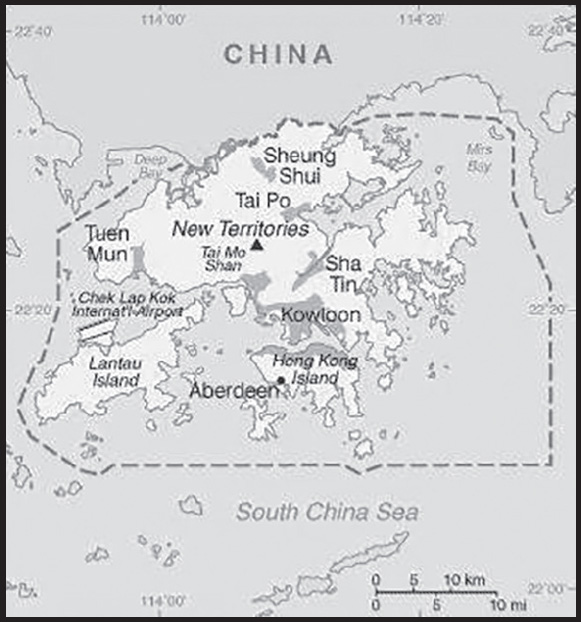
INTRODUCTION
Background: Seized by the UK in 1841, Hong Kong was formally ceded by China the following year at the end of the First Opium War; the Kowloon Peninsula was added in 1860 at the end of the Second Opium War, and was further extended when Britain obtained a 99-year lease of the New Territories in 1898. Pursuant to an agreement signed by China and the UK on 19 December 1984, Hong Kong became the Hong Kong Special Administrative Region (HKSAR) of the People’s Republic of China on 1 July 1997. In this agreement, China promised that, under its “one country, two systems” formula, China’s socialist economic and strict political system would not be imposed on Hong Kong and that Hong Kong would enjoy a “high degree of autonomy” in all matters except foreign and defense affairs for the subsequent 50 years.
Since the turnover, Hong Kong has continued to enjoy success as an international financial center. However, dissatisfaction with the Hong Kong Government and growing Chinese political influence has been a central issue and led to considerable civil unrest, including large-scale pro-democracy demonstrations in 2019 after the HKSAR attempted to revise a local ordinance to allow extraditions to mainland China. In response, the governments of the HKSAR and China took several actions that reduced the city’s autonomy and placed new restrictions on the rights of Hong Kong residents, moves that were widely criticized to be in direct contravention of obligations under the Hong Kong Basic Law and the Sino-British Joint Declaration. Chief among these actions was a sweeping national security law for Hong Kong imposed by the Chinese Government in June 2020 that criminalized acts such as those interpreted as secession, subversion, terrorism, and collusion with foreign or external forces. The law ushered in a widespread crackdown on public protests, criticism of authorities, and freedom of speech, and was used by authorities to target pro-democracy activists, organizations, and media companies. Democratic lawmakers and political figures were arrested, while others fled abroad. At the same time, dozens of civil society groups and several independent media outlets were closed or have disbanded. In March 2021, Beijing imposed a more restrictive electoral system, including restructuring the Legislative Council (LegCo) and allowing only government-approved candidates to run for office, claiming it was to ensure a system of “patriots” governed Hong Kong. The changes ensured that virtually all seats in the December 2021 LegCo election were won by pro-establishment candidates and effectively ended political opposition to Beijing in the territory.
GEOGRAPHY
Location: Eastern Asia, bordering the South China Sea and China
Geographic coordinates: 22 15 N, 114 10 E
Map references: Southeast Asia
Area: total: 1,108 sq km
land: 1,073 sq km
water: 35 sq km
comparison ranking: total 183
Area - comparative: six times the size of Washington, DC
Land boundaries: total: 33 km
regional borders (1): China 33 km
Coastline: 733 km
Maritime claims: territorial sea: 12 nm
Climate: subtropical monsoon; cool and humid in winter, hot and rainy from spring through summer, warm and sunny in fall
Terrain: hilly to mountainous with steep slopes; lowlands in north
Elevation: highest point: Tai Mo Shan 958 m
lowest point: South China Sea 0 m
Natural resources: outstanding deepwater harbor, feldspar
Land use: agricultural land: 5% (2018 est.)
arable land: 3.2% (2018 est.)
permanent crops: 0.9% (2018 est.)
permanent pasture: 0.9% (2018 est.)
forest: 0% (2018 est.)
other: 95% (2018 est.)
Irrigated land: 10 sq km (2012)
Population distribution: population fairly evenly distributed
Natural hazards: occasional typhoons
Geography - note: consists of a mainland area (the New Territories) and more than 200 islands
PEOPLE AND SOCIETY
Population: 7,288,167 (2023 est.)
comparison ranking: 105
Nationality: noun: Chinese/Hong Konger
adjective: Chinese/Hong Kong
Ethnic groups: Chinese 92%, Filipino 2.5%, Indonesian 2.1%, other 3.4% (2016 est.)
Languages: Cantonese (official) 88.9%, English (official) 4.3%, Mandarin (official) 1.9%, other Chinese dialects 3.1%, other 1.9% (2016 est.)
major-language sample(s):

(Cantonese)
Religions: Buddhist or Taoist 27.9%, Protestant 6.7%, Roman Catholic 5.3%, Muslim 4.2%, Hindu 1.4%, Sikh 0.2%, other or none 54.3% (2016 est.)
note: many people practice Confucianism, regardless of their religion or not having a religious affiliation
Age structure: 0-14 years: 13.04% (male 495,977/female 454,723)
15-64 years: 66.02% (male 2,164,667/female 2,646,774)
65 years and over: 20.94% (2023 est.) (male 706,761/female 819,265)
Dependency ratios: total dependency ratio: 46.6
youth dependency ratio: 17.8
elderly dependency ratio: 28.7
potential support ratio: 3.5 (2021 est.)
Median age: total: 45.6 years (2020)
male: 44.2 years
female: 46.5 years
comparison ranking: total 7
Population growth rate: 0.15% (2023 est.)
comparison ranking: 181
Birth rate: 7.85 births/1,000 population (2023 est.)
comparison ranking: 218
Death rate: 8.03 deaths/1,000 population (2023 est.)
comparison ranking: 88
Net migration rate: 1.65 migrant(s)/1,000 population (2023 est.)
comparison ranking: 54
Population distribution: population fairly evenly distributed
Urbanization: urban population: 100% of total population (2023)
rate of urbanization: 0.58% annual rate of change (2020-25 est.)
Major urban areas - population: 7.685 million Hong Kong (2023)
Sex ratio: at birth: 1.06 male(s)/female
0-14 years: 1.09 male(s)/female
15-64 years: 0.82 male(s)/female
65 years and over: 0.86 male(s)/female
total population: 0.86 male(s)/female (2023 est.)
Mother’s mean age at first birth: 29.8 years (2008 est.)
Infant mortality rate: total: 2.52 deaths/1,000 live births (2023 est.)
male: 2.79 deaths/1,000 live births
female: 2.23 deaths/1,000 live births
comparison ranking: total 215
Life expectancy at birth: total population: 83.8 years (2023 est.)
male: 81.12 years
female: 86.63 years
comparison ranking: total population 8
Total fertility rate: 1.23 children born/woman (2023 est.)
comparison ranking: 224
Gross reproduction rate: 0.6 (2023 est.)
Contraceptive prevalence rate: 66.7% (2017)
Drinking water source: improved: total: 100% of population
unimproved: total: 0% of population (2020)
Physicians density: 2.04 physicians/1,000 population (2020)
Hospital bed density: 4.9 beds/1,000 population (2020)
Sanitation facility access: improved: total: 96.4% of population
unimproved: total: 3.6% of population (2017)
Currently married women (ages 15-49): 47.7% (2023 est.)
Education expenditures: 4% of GDP (2021 est.)
comparison ranking: 115
School life expectancy (primary to tertiary education): total: 17 years
male: 17 years
female: 17 years (2021)
Youth unemployment rate (ages 15-24): total: 15% (2021 est.)
male: 16.3%
female: 13.6%
comparison ranking: total 117
ENVIRONMENT
Environment - current issues: air and water pollution from rapid urbanization; urban waste pollution; industrial pollution
Climate: subtropical monsoon; cool and humid in winter, hot and rainy from spring through summer, warm and sunny in fall
Land use: agricultural land: 5% (2018 est.)
arable land: 3.2% (2018 est.)
permanent crops: 0.9% (2018 est.)
permanent pasture: 0.9% (2018 est.)
forest: 0% (2018 est.)
other: 95% (2018 est.)
Urbanization: urban population: 100% of total population (2023)
rate of urbanization: 0.58% annual rate of change (2020-25 est.)
Revenue from forest resources: 0% of GDP (2018 est.)
comparison ranking: 179
Revenue from coal: 0% of GDP (2018 est.)
comparison ranking: 177
Air pollutants: carbon dioxide emissions: 43.64 megatons (2016 est.)
Waste and recycling: municipal solid waste generated annually: 5,679,816 tons (2015 est.)
municipal solid waste recycled annually: 1,931,138 tons (2016 est.)
percent of municipal solid waste recycled: 34% (2016 est.)
GOVERNMENT
Country name: conventional long form: Hong Kong Special Administrative Region
conventional short form: Hong Kong
local long form: Heung Kong Takpit Hangching Ku (Eitel/Dyer-Ball)
local short form: Heung Kong (Eitel/Dyer-Ball)
abbreviation: HK
etymology: probably an imprecise phonetic rendering of the Cantonese name meaning “fragrant harbor”
Government type: presidential limited democracy; a special administrative region of the People’s Republic of China
Dependency status: special administrative region of the People’s Republic of China
Administrative divisions: none (special administrative region of the People’s Republic of China)
Independence: none (special administrative region of China)
National holiday: National Day (Anniversary of the Founding of the People’s Republic of China), 1 October (1949); note - 1 July (1997) is celebrated as Hong Kong Special Administrative Region Establishment Day
Constitution: history: several previous (governance documents while under British authority); latest drafted April 1988 to February 1989, approved March 1990, effective 1 July 1997 (Basic Law of the Hong Kong Special Administrative Region of the People’s Republic of China serves as the constitution); note - since 1990, China’s National People’s Congress has interpreted specific articles of the Basic Law
amendments: proposed by the Standing Committee of the National People’s Congress (NPC), the People’s Republic of China State Council, or the Special Administrative Region of Hong Kong; submittal of proposals to the NPC requires two-thirds majority vote by the Legislative Council of Hong Kong, approval by two thirds of Hong Kong’s deputies to the NPC, and approval by the Hong Kong chief executive; final passage requires approval by the NPC
Legal system: mixed legal system of common law based on the English model and Chinese customary law (in matters of family and land tenure); PRC imposition of National Security Law incorporates elements of Chinese civil law
Citizenship: see China
Suffrage: 18 years of age in direct elections for 20 of the 90 Legislative Council seats and all of the seats in 18 district councils; universal for permanent residents living in the territory of Hong Kong for the past 7 years; note - in indirect elections, suffrage is limited to about 220,000 members of functional constituencies for the other 70 legislature seats and a 1,500-member election committee for the chief executive drawn from broad sectoral groupings, central government bodies, municipal organizations, and elected Hong Kong officials
Executive branch: chief of state: President of China XI Jinping (since 14 March 2013)
head of government: Chief Executive John LEE Ka-chieu (since 1 July 2022)
cabinet: Executive Council or ExCo appointed by the chief executive
elections/appointments: president indirectly elected by National People’s Congress for a 5-year term (eligible for a second term); election last held on 10 March 2023 (next to be held in March 2028); chief executive indirectly elected by the Election Committee and appointed by the PRC Government for a 5-year term (eligible for a second term); election last held on 8 May 2022 (next to be held in 2027)
election results: 2022: John LEE was the only candidate and won with over 99% of the vote by the Election Committee
2017: Election Committee vote - Carrie LAM (non-partisan) 777, John TSANG (non-partisan) 365, WOO Kwok-hing (non-partisan) 21, 23 ballots rejected (1,186 votes cast)
note: electoral changes that Beijing imposed in March 2021 expanded the Election Committee to 1,500 members
Legislative branch: description: unicameral Legislative Council or LegCo (90 seats); 20 members directly elected in 2-seat constituencies, 30 indirectly elected by the approximately 220,000 members of various functional constituencies based on a variety of methods, and 50 indirectly elected by the 1,500-member Election Committee; members serve 4-year terms; note - in March 2021, China’s National People’s Congress amended the electoral rules and system for the LegCo; the total number of seats increased from 70 to 90, directly elected geographical constituencies were reduced from 35 to 20 seats, while trade-based indirectly elected functional constituencies remained at 30; an additional 40 seats were elected by the 1,500-member Election Commission; all political candidates are evaluated by the Candidate Eligibility Review Committee (CERC), established in April 2022; the CERC consists of the chairperson, 2-4 official members, and 1-3 non-official members, all appointed by the chief executive
elections: last held on 19 Dec 2021 (next to be held in 2025)
election results: percent of vote by bloc: pro-Beijing 93%, non-establishment 7%; seats by block/party - pro-Beijing 89 (DAB 19, FTU 8, BPA 7, NPP 5, Liberal Party 4, FEW 2, FLU 2, other 46), non-establishment 1 (Third Side); composition - men 73, women 17, percent of women 18.9%; note - Hong Kong’s leading pro-democracy political parties boycotted the 2021 election
note: in July 2023, Hong Kong lawmakers reduced the proportion of directly elected seats on local district councils from some 90% to about 20%; under the new law, the majority of the 470 seats would be filled by members appointed by the chief executive, rural committee chairpersons, and others elected by local committees that are packed with pro-establishment figures
Judicial branch: highest court(s): Court of Final Appeal (consists of the chief justice, 3 permanent judges, and 20 non-permanent judges); note - a sitting bench consists of the chief justice, 3 permanent judges, and 1 non-permanent judge
judge selection and term of office: all judges appointed by the Hong Kong Chief Executive upon the recommendation of the Judicial Officers Recommendation Commission, an independent body consisting of the Secretary for Justice, other judges, and judicial and legal professionals; permanent judges serve until normal retirement at age 65, but term can be extended; non-permanent judges appointed for renewable 3-year terms without age limit
subordinate courts: High Court (consists of the Court of Appeal and Court of First Instance); District Courts (includes Family and Land Courts); magistrates’ courts; specialized tribunals
Political parties and leaders: Bauhinia Party or BP [WONG Chau-chi and LI Shan]
Business and Professionals Alliance for Hong Kong or BPA [LO Wai-kwok]
Concern Group for Tseung Kwan O People’s Livelihood or CGPLTKO [N/A]
Democratic Alliance for the Betterment and Progress of Hong Kong or DAB [Starry LEE Wai-king]
Democratic Party [LO Kin-hei]
Federation of Hong Kong and Kowloon Labour Unions or HKFLU [Lam Chun-sing]
Hong Kong Association for Democracy and People’s Livelihood of ADPL [Bruce LIU]
Hong Kong Federation of Education Workers or HKFEW [LAU Chi-pang]
Hong Kong Federation of Trade Unions or HKFTU [labor and political group presided over by NG Chau-pei and chaired by WONG Kwok]
Kowloon West New Dynamic or KWND [Priscilla LEUNG]
Labor Party [Steven KWOK Wing-kin; arrested in 2020]
League of Social Democrats or LSD [CHAN Po-ying]
Liberal Party or LP [led by Tommy CHEUNG; chaired by Peter SHIU]
Neighborhood and Workers Service Center or NWSC [LEUNG Yui-chung]
New Century Forum [MA Fung-kwak]
New People’s Party or NPP [Regina IP]
New Prospect for Hong Kong [Gary ZHANG Xinyu]
New Territories Association of Societies or NTAS [CHAN Yung]
Path of Democracy [Ronny TONG] (think tank)
People Power or PP [LEUNG Ka-shing]
Professional Power [Christine FONG Kwok Shan]
Roundtable [Michael TIEN Puk-sun]
Tai Po Democratic Alliance or TPDA [N/A]
Third Side or TS [TIK Chi-yeun]
note 1: there is no political party ordinance, so there are no registered political parties; politically active groups register as societies or companies
note 2: by the end of 2021, the leading pro-democracy figures in Hong Kong had been effectively removed from the political arena under the provisions of Beijing’s 2021 electoral changes or via charges under the 2020 national security law; in addition, dozens of pro-democracy organizations, including political parties, unions, churches, civil rights groups, and media organizations have disbanded or closed; as of 2023, nearly all politically active groups were pro-Beijing
International organization participation: ADB, APEC, BIS, FATF, ICC (national committees), IHO, IMF, IMO (associate), Interpol (subbureau), IOC, ISO (correspondent), ITUC (NGOs), UNWTO (associate), UPU, WCO, WMO, WTO
Diplomatic representation in the US: chief of mission: none (Special Administrative Region of China); Hong Kong Economic and Trade Office (HKETO) carries out normal liaison activities and communication with the US Government and other US entities; Eddie MAK Takwai (since 3 July 2018) is the Hong Kong Commissioner to the US Government of the Hong Kong Special Administrative Region; address: 1520 18th Street NW, Washington, DC 20036; telephone: [1] (202) 331-8947; FAX: [1] (202) 331-8958;
email: hketo@hketowashington.gov.hk; website:
https://www.hketowashington.gov.hk/
HKETO offices: New York, San Francisco
Diplomatic representation from the US: chief of mission: Consul General Gregory MAY (since September 2022); note - also accredited to Macau
embassy: 26 Garden Road, Central, Hong Kong
mailing address: 8000 Hong Kong Place, Washington DC 20521-8000
telephone: [852] 2523-9011
FAX: [852] 2845-1598
email address and website:
Flag description: red with a stylized, white, five-petal Bauhinia flower in the center; each petal contains a small, red, five-pointed star in its middle; the red color is the same as that on the Chinese flag and represents the motherland; the fragrant Bauhinia - developed in Hong Kong the late 19th century - has come to symbolize the region; the five stars echo those on the flag of China
National symbol(s): orchid tree flower; national colors: red, white
National anthem: note: as a Special Administrative Region of China, “Yiyongjun Jinxingqu” is the official anthem (see China)
ECONOMY
Economic overview: high-income tourism- and services-based economy; global financial hub; COVID-19 and political protests fueled recent recession; ongoing recovery but lower-skilled unemployment remains high; investing in job-reskilling programs
Real GDP (purchasing power parity): $444.624 billion (2021 est.)
$418.103 billion (2020 est.)
$447.385 billion (2019 est.)
note: data are in 2017 dollars
comparison ranking: 45
Real GDP growth rate: 6.34% (2021 est.)
-6.55% (2020 est.)
-1.68% (2019 est.)
comparison ranking: 67
Real GDP per capita: $60,000 (2021 est.)
$55,900 (2020 est.)
$59,600 (2019 est.)
note: data are in 2017 dollars
comparison ranking: 18
GDP (official exchange rate): $365.753 billion (2019 est.)
Inflation rate (consumer prices): 1.57% (2021 est.)
0.25% (2020 est.)
2.88% (2019 est.)
comparison ranking: 175
Credit ratings: Fitch rating: AA- (2020)
Moody’s rating: Aa3 (2020)
Standard & Poors rating: AA+ (2017)
note: The year refers to the year in which the current credit rating was first obtained.
GDP - composition, by sector of origin
agriculture: 0.1% (2017 est.)
industry: 7.6% (2017 est.)
services: 92.3% (2017 est.)
comparison rankings: services 6; industry 213; agriculture 219
GDP - composition, by end use
household consumption: 67% (2017 est.)
government consumption: 9.9% (2017 est.)
investment in fixed capital: 21.8% (2017 est.)
investment in inventories: 0.4% (2017 est.)
exports of goods and services: 188% (2017 est.)
imports of goods and services: -187.1% (2017 est.)
Agricultural products: pork, poultry, spinach, vegetables, pork offals, game meat, fruit, lettuce, green onions, pig fat
Industries: trading and logistics, financial services, professional services, tourism, cultural and creative, clothing and textiles, shipping, electronics, toys, clocks and watches
Industrial production growth rate: 2.08% (2021 est.)
comparison ranking: 133
Labor force: 3.842 million (2021 est.)
comparison ranking: 98
Labor force - by occupation: agriculture: 3.8% (2013 est.)
industry: 2% (2016 est.)
services: 54.5% (2016 est.)
industry and services: 12.5% (2013 est.)
agriculture/fishing/forestry/mining: 10.1% (2013)
manufacturing: 17.1% (2013 est.)
note: above data exclude public sector
Unemployment rate: 5.32% (2021 est.)
5.83% (2020 est.)
2.93% (2019 est.)
comparison ranking: 141
Youth unemployment rate (ages 15-24): total: 15% (2021 est.)
male: 16.3%
female: 13.6%
comparison ranking: total 117
Population below poverty line: 19.9% (2016 est.)
Gini Index coefficient - distribution of family income: 53.9 (2016 est.)
comparison ranking: 8
Average household expenditures: on food: 14.7% of household expenditures (2018 est.)
on alcohol and tobacco: 1.2% of household expenditures (2018 est.)
Household income or consumption by percentage share: lowest 10%: 1.8%
highest 10%: 38.1% (2016)
Budget: revenues: $70.124 billion (2020 est.)
expenditures: $105.849 billion (2020 est.)
Budget surplus (+) or deficit (-): 5.2% (of GDP) (2017 est.)
comparison ranking: 6
Public debt: 0.1% of GDP (2017 est.)
0.1% of GDP (2016 est.)
comparison ranking: 208
Taxes and other revenues: 23.2% (of GDP) (2017 est.)
comparison ranking: 63
Fiscal year: 1 April - 31 March
Current account balance: $41.712 billion (2021 est.)
$24.092 billion (2020 est.)
$21.23 billion (2019 est.)
comparison ranking: 15
Exports: $751.26 billion (2021 est.)
$608.159 billion (2020 est.)
$645.007 billion (2019 est.)
note: data are in current year dollars
comparison ranking: 9
Exports - partners: China 23%, India 14%, Netherlands 6%, United Kingdom 5% (2019)
Exports - commodities: gold, integrated circuits, gas turbines, broadcasting equipment, silver, diamonds, telephones (2021)
Imports: $733.459 billion (2021 est.) note: data are in current year dollars
$601.528 billion (2020 est.) note: data are in current year dollars
$639.363 billion (2019 est.) note: data are in current year dollars
comparison ranking: 8
Imports - partners: China 46%, Taiwan 7%, Singapore 7%, South Korea 5%, United States 5%, Japan 5% (2019)
Imports - commodities: integrated circuits, broadcasting equipment, office machinery, telephones, diamonds (2019)
Reserves of foreign exchange and gold: $496.867 billion (31 December 2021 est.)
$491.776 billion (31 December 2020 est.)
$441.35 billion (31 December 2019 est.)
comparison ranking: 7
Debt - external: $1,648,409,000,000 (2019 est.)
$1,670,919,000,000 (2018 est.)
comparison ranking: 15
Exchange rates: Hong Kong dollars (HKD) per US dollar -
Exchange rates: 7.773 (2021 est.)
7.757 (2020 est.)
7.836 (2019 est.)
7.839 (2018 est.)
7.793 (2017 est.)
ENERGY
Electricity access: electrification - total population: 100% (2021)
Electricity: installed generating capacity: 14.168 million kW (2020 est.)
consumption: 44,183,900,000 kWh (2020 est.)
exports: 0 kWh (2020 est.)
imports: 12.7 billion kWh (2020 est.)
transmission/distribution losses: 1.622 billion kWh (2020 est.)
comparison rankings: transmission/distribution losses 95; imports 20; exports 110; consumption 55; installed generating capacity 56
Electricity generation sources: fossil fuels: 99.6% of total installed capacity (2020 est.)
biomass and waste: 0.4% of total installed capacity (2020 est.)
Coal: production: 0 metric tons (2020 est.)
consumption: 5.485 million metric tons (2020 est.)
exports: 0 metric tons (2020 est.)
imports: 5.485 million metric tons (2020 est.)
proven reserves: 0 metric tons (2019 est.)
Petroleum: total petroleum production: 100 bbl/day (2021 est.)
refined petroleum consumption: 404,600 bbl/day (2019 est.)
Refined petroleum products - exports: 13,570 bbl/day (2015 est.)
comparison ranking: 76
Refined petroleum products - imports: 402,100 bbl/day (2015 est.)
comparison ranking: 22
Natural gas: production: 0 cubic meters (2021 est.)
consumption: 4,913,021,000 cubic meters (2020 est.)
exports: 0 cubic meters (2021 est.)
imports: 4,913,021,000 cubic meters (2020 est.)
proven reserves: 0 cubic meters (2021 est.)
Carbon dioxide emissions: 92.493 million metric tonnes of CO2 (2019 est.)
from coal and metallurgical coke: 23.557 million metric tonnes of CO2 (2019 est.)
from petroleum and other liquids: 62.451 million metric tonnes of CO2 (2019 est.)
from consumed natural gas: 6.484 million metric tonnes of CO2 (2019 est.)
comparison ranking: total emissions 46
Energy consumption per capita: 172.009 million Btu/person (2019 est.)
comparison ranking: 27
COMMUNICATIONS
Telephones - fixed lines: total subscriptions: 3,856,180 (2021 est.)
subscriptions per 100 inhabitants: 51 (2021 est.)
comparison ranking: total subscriptions 33
Telephones - mobile cellular: total subscriptions: 23,939,650 (2021 est.)
subscriptions per 100 inhabitants: 319 (2021 est.)
comparison ranking: total subscriptions 53
Telecommunication systems: general assessment: Hong Kong’s telecommunications sector continues to stay near the top of world rankings for the industry; it has kept its #1 spot in the Asian region in terms of the maturity of its telecom market – a reflection of the high penetration rates across mobile, mobile broadband, and fixed broadband; even fixed-line teledensity in Hong Kong is impressive at over 50%, although it too has started a gradual decline in keeping with most other telecom markets around the world, as consumers slowly transition over to the mobile platform for all of their communication needs (2022)
domestic: fixed-line is over 51 per 100 and mobile-cellular is 319 subscriptions per 100 (2021)
international: country code - 852; landing points for the AAE-1, AAG, APCN-2, APG, ASE, FEA, FNAL, RNAL, H2HE, SeaMeWe-3, SJC and TGN-IA submarine cables that provide connections to Asia, US, Australia, the Middle East, and Europe; satellite earth stations - 3 Intelsat (1 Pacific Ocean and 2 Indian Ocean); coaxial cable to Guangzhou, China (2022)
Broadcast media: 34 commercial terrestrial TV networks each with multiple stations; multi-channel satellite and cable TV systems available; 3 licensed broadcasters of terrestrial radio, one of which is government funded, operate about 12 radio stations; note - 4 digital radio broadcasters operated in Hong Kong from 2010 to 2017, but all digital radio services were terminated in September 2017 due to weak market demand (2019)
Internet country code: .hk
Internet users: total: 6.975 million (2021 est.)
percent of population: 93% (2021 est.)
comparison ranking: total 80
Broadband - fixed subscriptions: total: 2,885,586 (2020 est.)
subscriptions per 100 inhabitants: 39 (2020 est.)
comparison ranking: total 47
TRANSPORTATION
National air transport system: number of registered air carriers: 12 (2020) (registered in China)
inventory of registered aircraft operated by air carriers: 275 (registered in China)
annual passenger traffic on registered air carriers: 47,101,822 (2018)
annual freight traffic on registered air carriers: 12,676,720,000 (2018) mt-km
Civil aircraft registration country code prefix: B-H
Airports: 2 (2021)
comparison ranking: total 208
Airports - with paved runways: 2
note: paved runways have a concrete or asphalt surface but not all have facilities for refueling, maintenance, or air traffic control; the length of a runway required for aircraft to safely operate depends on a number of factors including the type of aircraft, the takeoff weight (including passengers, cargo, and fuel), engine types, flap settings, landing speed, elevation of the airport, and average maximum daily air temperature; paved runways can reach a length of 5,000 m (16,000 ft.), but the “typical” length of a commercial airline runway is between 2,500-4,000 m (8,000-13,000 ft.)
Heliports: 9 (2021)
Roadways: total: 2,193 km (2021)
paved: 2,193 km (2021)
comparison ranking: total 170
Merchant marine: total: 2,661 (2022)
by type: bulk carrier 1,135, container ship 558, general cargo 155, oil tanker 394, other 419
comparison ranking: total 9
Ports and terminals: major seaport(s): Hong Kong
container port(s) (TEUs): Hong Kong (17,798,000) (2021)
MILITARY AND SECURITY
Military and security forces: no regular indigenous military forces; Hong Kong Police Force (specialized units include the Police Counterterrorism Response Unit, the Explosive Ordnance Disposal Bureau, the Special Duties Unit, the Airport Security Unit, and the VIP Protection Unit) (2023)
note: the Hong Kong garrison of China’s People’s Liberation Army (PLA) includes elements of the PLA Army, PLA Navy, and PLA Air Force; these forces are under the direct leadership of the Central Military Commission in Beijing and under administrative control of the adjacent Southern Theater Command
Military - note: defense is the responsibility of China
TRANSNATIONAL ISSUES
Disputes - international: the Frontier Closed Area was established in 1951 as a buffer zone between Hong Kong and mainland China to prevent illegal migration and the smuggling of goods
Illicit drugs: modern banking system provides conduit for money laundering; groups involved in money laundering range from local street organizations to sophisticated international syndicates involved in assorted criminal activities, including drug trafficking; major source of precursor chemicals used in the production of illicit narcotics
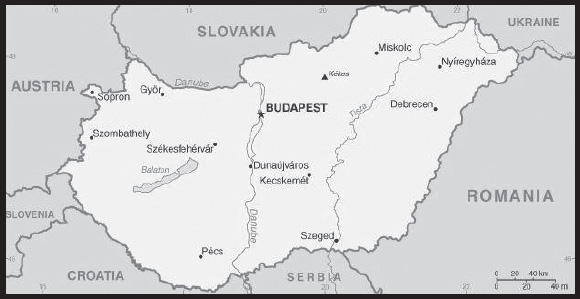
INTRODUCTION
Background: Hungary became a Christian kingdom in A.D. 1000 and for many centuries served as a bulwark against Ottoman Turkish expansion in Europe. The kingdom eventually became part of the polyglot Austro-Hungarian Empire, which collapsed during World War I. The country fell under communist rule following World War II. In 1956, a revolt and an announced withdrawal from the Warsaw Pact were met with a massive military intervention by Moscow. Under the leadership of Janos KADAR in 1968, Hungary began liberalizing its economy, introducing so-called “Goulash Communism.” Hungary held its first multiparty elections in 1990 and initiated a free market economy. It joined NATO in 1999 and the EU five years later.
GEOGRAPHY
Location: Central Europe, northwest of Romania
Geographic coordinates: 47 00 N, 20 00 E
Map references: Europe
Area: total: 93,028 sq km
land: 89,608 sq km
water: 3,420 sq km
comparison ranking: total 110
Area - comparative: slightly smaller than Virginia; about the same size as Indiana
Land boundaries: total: 2,106 km
border countries (7): Austria 321 km; Croatia 348 km; Romania 424 km; Serbia 164 km; Slovakia 627 km; Slovenia 94 km; Ukraine 128 km
Coastline: 0 km (landlocked)
Maritime claims: none (landlocked)
Climate: temperate; cold, cloudy, humid winters; warm summers
Terrain: mostly flat to rolling plains; hills and low mountains on the Slovakian border
Elevation: highest point: Kekes 1,014 m
lowest point: Tisza River 78 m
mean elevation: 143 m
Natural resources: bauxite, coal, natural gas, fertile soils, arable land
Land use: agricultural land: 58.9% (2018 est.)
arable land: 48.5% (2018 est.)
permanent crops: 2% (2018 est.)
permanent pasture: 8.4% (2018 est.)
forest: 22.5% (2018 est.)
other: 18.6% (2018 est.)
Irrigated land: 1,010 sq km (2019)
Major lakes (area sq km): fresh water lake(s): Lake Balaton - 590 sq km
Major rivers (by length in km): Duna (Danube) (shared with Germany [s], Austria, Slovakia, Croatia, Serbia, Bulgaria, Ukraine, Moldova, and Romania [m]) - 2,888 km
note – [s] after country name indicates river source; [m] after country name indicates river mouth
Major watersheds (area sq km): Atlantic Ocean drainage: (Black Sea) Danube (795,656 sq km)
Population distribution: a fairly even distribution throughout most of the country, with urban areas attracting larger and denser populations
Geography - note: landlocked; strategic location astride main land routes between Western Europe and Balkan Peninsula as well as between Ukraine and Mediterranean basin; the north-south flowing Duna (Danube) and Tisza Rivers divide the country into three large regions
PEOPLE AND SOCIETY
Population: 9,670,009 (2023 est.)
comparison ranking: 94
Nationality: noun: Hungarian(s)
adjective: Hungarian
Ethnic groups: Hungarian 85.6%, Romani 3.2%, German 1.9%, other 2.6%, unspecified 14.1% (2011 est.)
note: percentages add up to more than 100% because respondents were able to identify more than one ethnic group; Romani populations are usually underestimated in official statistics and may represent 5–10% of Hungary’s population
Languages: Hungarian (official) 99.6%, English 16%, German 11.2%, Russian 1.6%, Romanian 1.3%, French 1.2%, other 4.2%; note - shares sum to more than 100% because some respondents gave more than one answer on the census; Hungarian is the mother tongue of 98.9% of Hungarian speakers (2011 est.)
major-language sample(s): A World Factbook nélkülözhetetlen forrása az alapvető információnak. (Hungarian)
Religions: Catholic 30.1% (Roman Catholic 27.5%, Greek Catholic 1.7%, other Catholic 0.9%), Calvinist 9.8%, Lutheran 1.8%, other Christian (includes Orthodox) 1.6%, other 0.4%, none 16.1%, no answer 40.1% (2022 est.)
Age structure: 0-14 years: 14.24% (male 709,089/female 668,143)
15-64 years: 63.97% (male 3,091,384/female 3,094,515)
65 years and over: 21.79% (2023 est.) (male 812,063/female 1,294,815)
Dependency ratios: total dependency ratio: 53.8
youth dependency ratio: 22.4
elderly dependency ratio: 31.4
potential support ratio: 3.2 (2021 est.)
Median age: total: 43.6 years (2020)
male: 41.5 years
female: 45.5 years
comparison ranking: total 23
Population growth rate: -0.31% (2023 est.)
comparison ranking: 215
Birth rate: 8.58 births/1,000 population (2023 est.)
comparison ranking: 209
Death rate: 12.89 deaths/1,000 population (2023 est.)
comparison ranking: 10
Net migration rate: 1.21 migrant(s)/1,000 population (2023 est.)
comparison ranking: 60
Population distribution: a fairly even distribution throughout most of the country, with urban areas attracting larger and denser populations
Urbanization: urban population: 72.9% of total population (2023)
rate of urbanization: 0.05% annual rate of change (2020-25 est.)
Major urban areas - population: 1.778 million BUDAPEST (capital) (2023)
Sex ratio: at birth: 1.06 male(s)/female
0-14 years: 1.06 male(s)/female
15-64 years: 1 male(s)/female
65 years and over: 0.63 male(s)/female
total population: 0.91 male(s)/female (2023 est.)
Mother’s mean age at first birth: 28.4 years (2020 est.)
Maternal mortality ratio: 15 deaths/100,000 live births (2020 est.)
comparison ranking: 137
Infant mortality rate: total: 4.55 deaths/1,000 live births (2023 est.)
male: 4.88 deaths/1,000 live births
female: 4.2 deaths/1,000 live births
comparison ranking: total 180
Life expectancy at birth: total population: 77.44 years (2023 est.)
male: 73.82 years
female: 81.28 years
comparison ranking: total population 92
Total fertility rate: 1.49 children born/woman (2023 est.)
comparison ranking: 205
Gross reproduction rate: 0.72 (2023 est.)
Drinking water source: improved: total: 100% of population
unimproved: total: 0% of population (2020 est.)
Current health expenditure: 7.3% of GDP (2020)
Physicians density: 6.06 physicians/1,000 population (2020)
Hospital bed density: 7 beds/1,000 population (2018)
Sanitation facility access: improved: total: 100% of population
unimproved: total: 0% of population (2020 est.)
Major infectious diseases: degree of risk: intermediate (2016)
vectorborne diseases: tickborne encephalitis (2016)
Obesity - adult prevalence rate: 26.4% (2016)
comparison ranking: 42
Alcohol consumption per capita: total: 10.79 liters of pure alcohol (2019 est.)
beer: 3.96 liters of pure alcohol (2019 est.)
wine: 3.33 liters of pure alcohol (2019 est.)
spirits: 3.5 liters of pure alcohol (2019 est.)
other alcohols: 0 liters of pure alcohol (2019 est.)
comparison ranking: total 16
Tobacco use: total: 31.8% (2020 est.)
male: 35.8% (2020 est.)
female: 27.8% (2020 est.)
comparison ranking: total 22
Currently married women (ages 15-49): 51.4% (2023 est.)
Education expenditures: 4.8% of GDP (2020 est.)
comparison ranking: 84
Literacy: definition: age 15 and over can read and write
total population: 99.1%
male: 99.1%
female: 99.1% (2021)
School life expectancy (primary to tertiary education): total: 15 years
male: 15 years
female: 15 years (2020)
Youth unemployment rate (ages 15-24): total: 13.5% (2021 est.)
male: 11.5%
female: 16.2%
comparison ranking: total 130
ENVIRONMENT
Environment - current issues: air and water pollution are some of Hungary’s most serious environmental problems; water quality in the Hungarian part of the Danube has improved but is still plagued by pollutants from industry and large-scale agriculture; soil pollution
Environment - international agreements: party to: Air Pollution, Air Pollution-Heavy Metals, Air Pollution-Multi-effect Protocol, Air Pollution-Nitrogen Oxides, Air Pollution-Persistent Organic Pollutants, Air Pollution-Sulphur 85, Air Pollution-Sulphur 94, Air Pollution-Volatile Organic Compounds, Antarctic Treaty, Biodiversity, Climate Change, Climate Change-Kyoto Protocol, Climate Change-Paris Agreement, Comprehensive Nuclear Test Ban, Desertification, Endangered Species, Environmental Modification, Hazardous Wastes, Law of the Sea, Marine Dumping-London Convention, Nuclear Test Ban, Ozone Layer Protection, Ship Pollution, Tropical Timber 2006, Wetlands, Whaling
signed, but not ratified: Antarctic-Environmental Protection
Climate: temperate; cold, cloudy, humid winters; warm summers
Land use: agricultural land: 58.9% (2018 est.)
arable land: 48.5% (2018 est.)
permanent crops: 2% (2018 est.)
permanent pasture: 8.4% (2018 est.)
forest: 22.5% (2018 est.)
other: 18.6% (2018 est.)
Urbanization: urban population: 72.9% of total population (2023)
rate of urbanization: 0.05% annual rate of change (2020-25 est.)
Revenue from forest resources: 0.1% of GDP (2018 est.)
comparison ranking: 112
Revenue from coal: 0.01% of GDP (2018 est.)
comparison ranking: 49
Air pollutants: particulate matter emissions: 14.24 micrograms per cubic meter (2019 est.)
carbon dioxide emissions: 45.54 megatons (2016 est.)
methane emissions: 7.25 megatons (2020 est.)
Waste and recycling: municipal solid waste generated annually: 3.712 million tons (2015 est.)
municipal solid waste recycled annually: 962,893 tons (2015 est.)
percent of municipal solid waste recycled: 25.9% (2015 est.)
Major lakes (area sq km): fresh water lake(s): Lake Balaton - 590 sq km
Major rivers (by length in km): Duna (Danube) (shared with Germany [s], Austria, Slovakia, Croatia, Serbia, Bulgaria, Ukraine, Moldova, and Romania [m]) - 2,888 km
note – [s] after country name indicates river source; [m] after country name indicates river mouth
Major watersheds (area sq km): Atlantic Ocean drainage: (Black Sea) Danube (795,656 sq km)
Total water withdrawal: municipal: 660 million cubic meters (2020 est.)
industrial: 3.45 billion cubic meters (2020 est.)
agricultural: 550 million cubic meters (2020 est.)
Total renewable water resources: 104 billion cubic meters (2020 est.)
GOVERNMENT
Country name: conventional long form: none
conventional short form: Hungary
local long form: none
local short form: Magyarorszag
former: Kingdom of Hungary, Hungarian People’s Republic, Hungarian Soviet Republic, Hungarian Republic
etymology: the Byzantine Greeks refered to the tribes that arrived on the steppes of Eastern Europe in the 9th century as the “Oungroi,” a name that was later Latinized to “Ungri” and which became “Hungari”; the name originally meant an “[alliance of] ten tribes”; the Hungarian name “Magyarorszag” means “Country of the Magyars”; the term may derive from the most prominent of the Hungarian tribes, the Megyer
Government type: parliamentary republic
Capital: name: Budapest
geographic coordinates: 47 30 N, 19 05 E
time difference: UTC+1 (6 hours ahead of Washington, DC, during Standard Time)
daylight saving time: +1hr, begins last Sunday in March; ends last Sunday in October
etymology: the Hungarian capital city was formed in 1873 from the merger of three cities on opposite banks of the Danube: Buda and Obuda (Old Buda) on the western shore and Pest on the eastern; the origins of the original names are obscure, but according to the second century A.D. geographer, Ptolemy, the settlement that would become Pest was called “Pession” in ancient times; “Buda” may derive from either a Slavic or Turkic personal name
Administrative divisions: 19 counties (megyek, singular - megye), 23 cities with county rights (megyei jogu varosok, singular - megyei jogu varos), and 1 capital city (fovaros)
counties: Bacs-Kiskun, Baranya, Bekes, Borsod-Abauj-Zemplen, Csongrad-Csanad, Fejer, Gyor-Moson-Sopron, Hajdu-Bihar, Heves, Jasz-Nagykun-Szolnok, Komarom-Esztergom, Nograd, Pest, Somogy, Szabolcs-Szatmar-Bereg, Tolna, Vas, Veszprem, Zala
cities with county rights: Bekescsaba, Debrecen, Dunaujvaros, Eger, Erd, Gyor, Hodmezovasarhely, Kaposvar, Kecskemet, Miskolc, Nagykanizsa, Nyiregyhaza, Pecs, Salgotarjan, Sopron, Szeged, Szekesfehervar, Szekszard, Szolnok, Szombathely, Tatabanya, Veszprem, Zalaegerszeg
capital city: Budapest
Independence: 16 November 1918 (republic proclaimed); notable earlier dates: 25 December 1000 (crowning of King STEPHEN I, traditional founding date); 30 March 1867 (Austro-Hungarian dual monarchy established)
National holiday: Saint Stephen’s Day, 20 August (1083); note - commemorates his canonization and the transfer of his remains to Buda (now Budapest) in 1083
Constitution: history: previous 1949 (heavily amended in 1989 following the collapse of communism); latest approved 18 April 2011, signed 25 April 2011, effective 1 January 2012
amendments: proposed by the president of the republic, by the government, by parliamentary committee, or by Parliament members; passage requires two-thirds majority vote of Parliament members and approval by the president; amended several times, last in 2018
Legal system: civil legal system influenced by the German model
International law organization participation: accepts compulsory ICJ jurisdiction with reservations; accepts ICC jurisdiction
Citizenship: citizenship by birth: no
citizenship by descent only: at least one parent must be a citizen of Hungary
dual citizenship recognized: yes
residency requirement for naturalization: 8 years
Suffrage: 18 years of age, 16 if married and marriage is registered in Hungary; universal
Executive branch: chief of state: President Katalin NOVAK (since 10 May 2022)
head of government: Prime Minister Viktor ORBAN (since 29 May 2010)
cabinet: Cabinet of Ministers proposed by the prime minister and appointed by the president
elections/appointments: president indirectly elected by the National Assembly with two-thirds majority vote in first round or simple majority vote in second round for a 5-year term (eligible for a second term); election last held on 11 March 2022 (next to be held spring 2027); prime minister elected by the National Assembly on the recommendation of the president; election last held on 3 April 2022 (next to be held April or May 2027)
election results: 2022: Katalin NOVAK (Fidesz) elected president; National Assembly vote - 137 to 51
2017: Janos ADER (Fidesz) reelected president; National Assembly vote - 131 to 39
Legislative branch: description: unicameral National Assembly or Orszaggyules (199 seats; 106 members directly elected in single-member constituencies by simple majority vote and 93 members directly elected in a single nationwide constituency by party-list proportional representation vote, using the D’Hondt method; members serve 4-year terms)
elections: last held on 3 April 2022 (next to be held in April 2026)
election results: percent of vote by party list - Fidesz-KDNP 54.1%, United for Hungary 34.5%, Mi Hazank 5.9%, other 5.5%; seats by party list - Fidesz-KDNP 135, United for Hungary 57, Mi Hazank 6, independent 1; composition as of June 2023 - men 171, women 28, percent of women 14.1%
Judicial branch: highest court(s): Curia or Supreme Judicial Court (consists of the president, vice president, department heads, and has a maximum of 113 judges, and is organized into civil, criminal, and administrative-labor departments; Constitutional Court (consists of 15 judges, including the court president and vice president)
judge selection and term of office: Curia president elected by the National Assembly on the recommendation of the president of the republic; other Curia judges appointed by the president upon the recommendation of the National Judicial Council, a separate 15-member administrative body; judge tenure based on interim evaluations until normal retirement at age 62; Constitutional Court judges, including the president of the court, elected by the National Assembly; court vice president elected by the court itself; members serve 12-year terms with mandatory retirement at age 62
subordinate courts: 5 regional courts of appeal; 19 regional or county courts (including Budapest Metropolitan Court); 20 administrative-labor courts; 111 district or local courts
Political parties and leaders: Christian Democratic People’s Party or KDNP [Zsolt SEMJEN]
Democratic Coalition or DK [Ferenc GYURCSANY]
Dialogue for Hungary (Parbeszed) or PM [Bence TORDAI, Rebeka SZABO]
Fidesz-Hungarian Civic Alliance or Fidesz [Viktor ORBAN]
Hungarian Socialist Party or MSZP [Bertalan TOTH, Agnes KUNHALMI]
LMP-Hungary’s Green Party [Peter UNGAR, Erzsebet SCHMUCK]
Mi Hazank (Our Homeland Movement) or MHM [Laszlo TOROCZKAI]
Momentum Movement (Momentum Mozgalom) [Ferenc GELENCSER]
Movement for a Better Hungary or Jobbik [Marton GYONGYOSI]
National Self-Government of Germans in Hungary or LdU [Ibolya HOCK-ENGLENDER]
United for Hungary (a coalition of Jobbik, MSZP, Dialogue, DK, LMP, and Momentum)
International organization participation: Australia Group, BIS, CD, CE, CEI, CERN, EAPC, EBRD, ECB, EIB, ESA (cooperating state), EU, FAO, G-9, IAEA, IBRD, ICAO, ICC (national committees), ICCt, ICRM, IDA, IEA, IFAD, IFC, IFRCS, ILO, IMF, IMO, IMSO, Interpol, IOC, IOM, IPU, ISO, ITSO, ITU, ITUC (NGOs), MIGA, MINURSO, NATO, NEA, NSG, OAS (observer), OECD, OIF (observer), OPCW, OSCE, PCA, Schengen Convention, SELEC, UN, UNCTAD, UNESCO, UNFICYP, UNHCR, UNIDO, UNIFIL, UNOOSA, UNWTO, UPU, Wassenaar Arrangement, WCO, WFTU (NGOs), WHO, WIPO, WMO, WTO, ZC
Diplomatic representation in the US: chief of mission: Ambassador Szabolcs Ferenc TAKACS (since 23 December 2020)
chancery: 1500 Rhode Island Avenue, N.W.
Washington, D.C. 20005
telephone: [1] (202) 362-6730
FAX: [1] (202) 966-8135
email address and website:
https://washington.mfa.gov.hu/eng
consulate(s) general: Chicago, Los Angeles, New York
Diplomatic representation from the US: chief of mission: Ambassador David PRESSMAN (since 14 September 2022)
embassy: Szabadsag ter 12, H-1054 Budapest
mailing address: 5270 Budapest Place, US Department of State, Washington, DC 20521-5270
telephone: [36] (1) 475-4400
FAX: [36] (1) 475-4248
email address and website:
Flag description: three equal horizontal bands of red (top), white, and green; the flag dates to the national movement of the 18th and 19th centuries, and fuses the medieval colors of the Hungarian coat of arms with the revolutionary tricolor form of the French flag; folklore attributes virtues to the colors: red for strength, white for faithfulness, and green for hope; alternatively, the red is seen as being for the blood spilled in defense of the land, white for freedom, and green for the pasturelands that make up so much of the country
National symbol(s): Holy Crown of Hungary (Crown of Saint Stephen); national colors: red, white, green
National anthem: name: “Himnusz” (Hymn)
lyrics/music: Ferenc KOLCSEY/Ferenc ERKEL
note: adopted 1844
National heritage: total World Heritage Sites: 8 (7 cultural, 1 natural)
selected World Heritage Site locales: Budapest, including the Banks of the Danube, the Buda Castle Quarter, and Andrássy Avenue (c); Old Village of Hollókő and its Surroundings (c); Caves of Aggtelek Karst and Slovak Karst (n); Millenary Benedictine Abbey of Pannonhalma and its Natural Environment (c); Hortobágy National Park - the Puszta (c); Early Christian Necropolis of Pécs (Sopianae) (c); Fertö / Neusiedlersee Cultural Landscape (c); Tokaj Wine Region Historic Cultural Landscape (c)
ECONOMY
Economic overview: high-income EU and OECD economy; decreasing government spending; increasing judicial independence concerns; flat income taxation; increasingly dependent on energy imports; strong tourism and automotive manufacturing
Real GDP (purchasing power parity): $326.186 billion (2021 est.)
$304.513 billion (2020 est.)
$319.019 billion (2019 est.)
note: data are in 2017 dollars
comparison ranking: 54
Real GDP growth rate: 7.12% (2021 est.)
-4.55% (2020 est.)
4.86% (2019 est.)
comparison ranking: 54
Real GDP per capita: $33,600 (2021 est.)
$31,200 (2020 est.)
$32,600 (2019 est.)
note: data are in 2017 dollars
comparison ranking: 64
GDP (official exchange rate): $163.251 billion (2019 est.)
Inflation rate (consumer prices): 5.11% (2021 est.)
3.33% (2020 est.)
3.34% (2019 est.)
comparison ranking: 64
Credit ratings: Fitch rating: BBB (2019)
Moody’s rating: Baa3 (2016)
Standard & Poors rating: BBB (2019)
note: The year refers to the year in which the current credit rating was first obtained.
GDP - composition, by sector of origin
agriculture: 3.9% (2017 est.)
industry: 31.3% (2017 est.)
services: 64.8% (2017 est.)
comparison rankings: services 96; industry 69; agriculture 141
GDP - composition, by end use
household consumption: 49.6% (2017 est.)
government consumption: 20% (2017 est.)
investment in fixed capital: 21.6% (2017 est.)
investment in inventories: 1% (2017 est.)
exports of goods and services: 90.2% (2017 est.)
imports of goods and services: -82.4% (2017 est.)
Agricultural products: maize, wheat, milk, sunflower seed, barley, rapeseed, sugar beets, apples, pork, grapes
Industries: mining, metallurgy, construction materials, processed foods, textiles, chemicals (especially pharmaceuticals), motor vehicles
Industrial production growth rate: 6.64% (2021 est.)
comparison ranking: 66
Labor force: 4.91 million (2021 est.)
comparison ranking: 88
Labor force - by occupation: agriculture: 4.9%
industry: 30.3%
services: 64.5% (2015 est.)
Unemployment rate: 4.12% (2021 est.)
4.25% (2020 est.)
3.42% (2019 est.)
comparison ranking: 171
Youth unemployment rate (ages 15-24): total: 13.5% (2021 est.)
male: 11.5%
female: 16.2%
comparison ranking: total 130
Population below poverty line: 12.3% (2018 est.)
Gini Index coefficient - distribution of family income: 30 (2019 est.)
comparison ranking: 149
Average household expenditures: on food: 18.2% of household expenditures (2018 est.)
on alcohol and tobacco: 7.3% of household expenditures (2018 est.)
Household income or consumption by percentage share: lowest 10%: 3.3%
highest 10%: 22.4% (2015)
Budget: revenues: $70.83 billion (2019 est.)
expenditures: $74.127 billion (2019 est.)
Budget surplus (+) or deficit (-): -2% (of GDP) (2017 est.)
comparison ranking: 103
Public debt: 96.11% of GDP (2020 est.)
83.29% of GDP (2019 est.)
86.55% of GDP (2018 est.)
note: general government gross debt is defined in the Maastricht Treaty as consolidated general government gross debt at nominal value, outstanding at the end of the year in the following categories of government liabilities: currency and deposits, securities other than shares excluding financial derivatives, and national, state, and local government and social security funds.
comparison ranking: 30
Taxes and other revenues: 22.87% (of GDP) (2020 est.)
comparison ranking: 64
Fiscal year: calendar year
Current account balance: -$7.173 billion (2021 est.)
-$1.603 billion (2020 est.)
-$1.231 billion (2019 est.)
comparison ranking: 193
Exports: $148.229 billion (2021 est.) note: data are in current year dollars
$124.111 billion (2020 est.) note: data are in current year dollars
$133.736 billion (2019 est.) note: data are in current year dollars
comparison ranking: 37
Exports - partners: Germany 27%, Romania 5%, Italy 5%, Slovakia 5% (2019)
Exports - commodities: cars and vehicle parts, electric batteries, video displays, packaged medicines, spark-ignition engines, broadcasting equipment (2021)
Imports: $147.577 billion (2021 est.) note: data are in current year dollars
$121.016 billion (2020 est.) note: data are in current year dollars
$129.901 billion (2019 est.) note: data are in current year dollars
comparison ranking: 36
Imports - partners: Germany 25%, China 6%, Poland 6%, Austria 6%, Czechia 5%, Slovakia 5%, Italy 5%, Netherlands 5% (2019)
Imports - commodities: cars and vehicle parts, integrated circuits, packaged medicines, broadcasting equipment, crude petroleum (2019)
Reserves of foreign exchange and gold: $43.483 billion (31 December 2021 est.)
$41.349 billion (31 December 2020 est.)
$31.831 billion (31 December 2019 est.)
comparison ranking: 47
Debt - external: $123.256 billion (2019 est.)
$125.29 billion (2018 est.)
comparison ranking: 49
Exchange rates: forints (HUF) per US dollar -
Exchange rates: 303.141 (2021 est.)
307.997 (2020 est.)
290.66 (2019 est.)
270.212 (2018 est.)
274.433 (2017 est.)
ENERGY
Electricity access: electrification - total population: 100% (2021)
Electricity: installed generating capacity: 10.873 million kW (2020 est.)
consumption: 41.533 billion kWh (2020 est.)
exports: 7.498 billion kWh (2020 est.)
imports: 19.176 billion kWh (2020 est.)
transmission/distribution losses: 3.139 billion kWh (2020 est.)
comparison rankings: transmission/distribution losses 66; imports 13; exports 24; consumption 57; installed generating capacity 62
Electricity generation sources: fossil fuels: 36.1% of total installed capacity (2020 est.)
nuclear: 46% of total installed capacity (2020 est.)
solar: 7.4% of total installed capacity (2020 est.)
wind: 2% of total installed capacity (2020 est.)
hydroelectricity: 0.7% of total installed capacity (2020 est.)
tide and wave: 0.5% of total installed capacity (2020 est.)
geothermal: 0.1% of total installed capacity (2020 est.)
biomass and waste: 7.3% of total installed capacity (2020 est.)
Nuclear energy: Number of operational nuclear reactors: 4 (2023)
Number of nuclear reactors under construction: 0
Net capacity of operational nuclear reactors: 1.92GW (2023)
Percent of total electricity production: 46.8% (2021)
Percent of total energy produced: 44% (2021)
Number of nuclear reactors permanently shut down: 0
Coal: production: 6.956 million metric tons (2020 est.)
consumption: 8.079 million metric tons (2020 est.)
exports: 230,000 metric tons (2020 est.)
imports: 1.395 million metric tons (2020 est.)
proven reserves: 2.909 billion metric tons (2019 est.)
Petroleum: total petroleum production: 35,200 bbl/day (2021 est.)
refined petroleum consumption: 180,600 bbl/day (2019 est.)
crude oil and lease condensate exports: 8,000 bbl/day (2018 est.)
crude oil and lease condensate imports: 134,800 bbl/day (2018 est.)
crude oil estimated reserves: 12.1 million barrels (2021 est.)
Refined petroleum products - production: 152,400 bbl/day (2017 est.)
comparison ranking: 59
Refined petroleum products - exports: 58,720 bbl/day (2017 est.)
comparison ranking: 50
Refined petroleum products - imports: 82,110 bbl/day (2017 est.)
comparison ranking: 62
Natural gas: production: 1.685 billion cubic meters (2020 est.)
consumption: 10.545 billion cubic meters (2020 est.)
exports: 3.758 billion cubic meters (2020 est.)
imports: 11.678 billion cubic meters (2020 est.)
proven reserves: 3.738 billion cubic meters (2021 est.)
Carbon dioxide emissions: 48.589 million metric tonnes of CO2 (2019 est.)
from coal and metallurgical coke: 7.501 million metric tonnes of CO2 (2019 est.)
from petroleum and other liquids: 21.568 million metric tonnes of CO2 (2019 est.)
from consumed natural gas: 19.52 million metric tonnes of CO2 (2019 est.)
comparison ranking: total emissions 58
Energy consumption per capita: 108.212 million Btu/person (2019 est.)
comparison ranking: 50
COMMUNICATIONS
Telephones - fixed lines: total subscriptions: 2,955,979 (2021 est.)
subscriptions per 100 inhabitants: 30 (2021 est.)
comparison ranking: total subscriptions 44
Telephones - mobile cellular: total subscriptions: 10,248,653 (2021 est.)
subscriptions per 100 inhabitants: 106 (2021 est.)
comparison ranking: total subscriptions 92
Telecommunication systems: general assessment: Hungary benefits from having a developed telecom infrastructure, with a focus among operators to develop the 5G sector and upgrade fixed networks to provide a 1Gb/s service; services based on 5G have been supported by the January 2021 multi-spectrum auction for spectrum in the 900MHz and 1800MHz bands; the number of fixed-lines continues to fall as subscribers migrate to the mobile platform for voice and data services; operators have looked to bundled packages to boost revenue and retain subscribers; the broadband market has effective infrastructure-based competition, with an extensive cable network competing against DSL services and a vibrant and rapidly expanding fiber sector; the regulator has also introduced a number of measures aimed at promoting market competition, which is pushing the drive for higher speed platforms and encouraging operators to invest in technology upgrades; as a result, Hungary now has the highest fixed broadband penetration rate in Eastern Europe; the number of super fast broadband connections (above 30Mb/s) accounted for 78% of all fixed broadband connections (2022)
domestic: fixed-line connections, with 30 fixed per 100 persons and 106 mobile-cellular subscriptions per 100 (2021)
international: country code - 36; Hungary has fiber-optic cable connections with all neighboring countries; the international switch is in Budapest; satellite earth stations - 2 Intelsat (Atlantic Ocean and Indian Ocean regions), 1 Inmarsat, 1 (very small aperture terminal) VSAT system of ground terminals
Broadcast media: mixed system of state-supported public service broadcast media and private broadcasters; the 5 publicly owned TV channels and the 2 main privately owned TV stations are the major national broadcasters; a large number of special interest channels; highly developed market for satellite and cable TV services with about two-thirds of viewers utilizing their services; 4 state-supported public-service radio networks; a large number of local stations including commercial, public service, nonprofit, and community radio stations; digital transition completed at the end of 2013; government-linked businesses have greatly consolidated ownership in broadcast and print media (2019)
Internet country code: .hu
Internet users: total: 8.633 million (2021 est.)
percent of population: 89% (2021 est.)
comparison ranking: total 66
Broadband - fixed subscriptions total: 3,382,136 (2021 est.)
subscriptions per 100 inhabitants: 34.83 (2021 est.)
comparison ranking: total 42
TRANSPORTATION
National air transport system: number of registered air carriers: 5 (2020)
inventory of registered aircraft operated by air carriers: 145
annual passenger traffic on registered air carriers: 31,226,848 (2018)
Civil aircraft registration country code prefix: HA
Airports: 41 (2021)
comparison ranking: total 102
Airports - with paved runways: 20
note: paved runways have a concrete or asphalt surface but not all have facilities for refueling, maintenance, or air traffic control; the length of a runway required for aircraft to safely operate depends on a number of factors including the type of aircraft, the takeoff weight (including passengers, cargo, and fuel), engine types, flap settings, landing speed, elevation of the airport, and average maximum daily air temperature; paved runways can reach a length of 5,000 m (16,000 ft.), but the “typical” length of a commercial airline runway is between 2,500-4,000 m (8,000-13,000 ft.)
Airports - with unpaved runways: 21
note: unpaved runways have a surface composition such as grass or packed earth and are most suited to the operation of light aircraft; unpaved runways are usually short, often less than 1,000 m (3,280 ft.) in length; airports with unpaved runways often lack facilities for refueling, maintenance, or air traffic control
Heliports: 3 (2021)
Pipelines: 5,874 km gas (high-pressure transmission system), 83,732 km gas (low-pressure distribution network), 850 km oil, 1,200 km refined products (2018)
Railways: total: 7,687 km (2020) 3,111 km electrified
comparison ranking: total 28
Roadways: total: 203,601 km (2014)
paved: 77,087 km (2014) (includes 1,582 km of expressways)
unpaved: 126,514 km (2014)
comparison ranking: total 27
Waterways: 1,622 km (2011) (most on Danube River)
comparison ranking: 49
Merchant marine total: 1 (2022)
by type: other 1
comparison ranking: total 186
Ports and terminals: river port(s): Baja, Csepel (Budapest), Dunaujvaros, Gyor-Gonyu, Mohacs (Danube)
MILITARY AND SECURITY
Military and security forces: Hungarian Defense Forces (HDF or Magyar Honvédség): the HDF is organized as a joint force under a general staff with commands for land, air, cyber, special operations, territorial defense, and support forces (2023)
note: the National Police are under the Ministry of Interior and responsible for maintaining order nationwide; the Ministry of Interior also has the Counterterrorism Center, a special police force responsible for protecting the president and the prime minister and for preventing, uncovering, and detecting terrorist acts
Military expenditures: 2.4% of GDP (2023 est.)
1.8% of GDP (2022 est.)
1.7% of GDP (2021)
1.8% of GDP (2020)
1.4% of GDP (2019)
comparison ranking: 45
Military and security service personnel strengths: approximately 25,000 active-duty troops (20,000 Army; 5,000 Air Force) (2023)
note: in 2017, Hungary announced plans to increase the number of active soldiers to around 37,000 but did not give a timeline
Military equipment inventories and acquisitions: the military’s inventory consists largely of Soviet-era weapons, with a smaller mix of more modern European and US equipment; in recent years, Germany has been the top supplier of military hardware to Hungary (2023)
Military service age and obligation: 18-25 years of age for voluntary military service; no conscription (abolished 2005); 6-month service obligation (2023)
note: as of 2021, women comprised over 20% of Hungary’s full-time military personnel
Military deployments: 150 Bosnia-Herzegovina (EUFOR stabilization force); 150 Iraq (NATO); 430 Kosovo (NATO/KFOR) (2023)
Military - note: the Hungarian Defense Forces (HDF) are a professional military responsible for ensuring the defense of the country’s sovereignty, territorial integrity, and citizens, and fulfilling Hungary’s commitments to the EU and NATO, as well as contributing to other international peacekeeping efforts under the UN; the HDF is also responsible for some aspects of domestic security, crisis management, and disaster response, and since 2015, under a declared state of emergency prompted by mass migration, it may assist law enforcement forces in border protection and handling mass migration situations; Hungary’s most recent national security strategy addressed migration as an important security concern, alongside other issues, such as great power competition and cyber security; modernizing the HDF by replacing Sovietera equipment with Western systems and building up Hungary’s defense industrial capacity has been a priority over the past decade
Hungary has been a member of NATO since 1999 and considers the collective defense ensured within the Alliance as a cornerstone of the country’s security; NATO membership is complemented by Hungary’s ties to the EU under the EU’s Common Security and Defense Policy; the HDF has participated in multiple NATO-led security missions, including in Afghanistan, Iraq, and Kosovo, as well as EU-led missions in Bosnia and Herzegovina and Mali; it hosts a NATO battlegroup comprised of troops from Croatia, Hungary, Italy, and the US, and NATO’s Multinational Division Center, a headquarters capable of commanding a division-sized force (typically 15-20,000 troops) in a crisis; both organizations were established as a result of Russian aggression against Ukraine; Hungary also hosts NATO’s Center of Excellence for Military Medicine; Hungary is a member of the Visegrad Group, a regional platform that brings together Czechia, Hungary, Poland, and Slovakia to discuss cultural, defense, and political cooperation
the HDF is organized as a joint force under a general staff with commands for land, air, cyber, special operations, territorial defense, and support forces; the combat units of the HDF’s Land Command have recently been reorganized and currently consists of three combined arms brigades, plus a reconnaissance regiment; one of the brigades has a joint Hungarian-Romanian peacekeeping battalion; the Special Operations Command includes a special purpose brigade; the Air Command’s combat forces are a squadron of Swedish-made fighter aircraft, an attack helicopter battalion, and an air defense missile regiment; the Territorial Defense Forces Command has volunteer operational reservists to backfill regular units on occasion and non-deployable volunteer territorial reservists that are organized into local defense units (typically battalions) spread throughout the country (2023)
SPACE
Space agency/agencies: Hungarian Space Office (HSO; established 1992) (2023)
Space program overview: has a history of involvement in space activities going back to the Soviet era; growing a modern space program focused on acquiring satellites and contributing to the European Space Agency (ESA); has a national space strategy; builds and operates satellites; researches and develops space technologies, including communications, navigation, and subsystems for satellites; has an astronaut corps; in addition to being an ESA member and cooperating with individual ESA and EU member states, particularly France, has relations with a variety of other foreign space agencies and industries, including those of Brazil, Israel, Russia, Singapore, Turkey, the UAE, and the US; national space strategy included the goals of fostering innovation and increasing Hungary’s competitiveness in the commercial space sector (2023)
note: further details about the key activities, programs, and milestones of the country’s space program, as well as government spending estimates on the space sector, appear in Appendix S
TERRORISM
Terrorist group(s): Terrorist group(s): Islamic State of Iraq and ash-Sham (ISIS)
note: details about the history, aims, leadership, organization, areas of operation, tactics, targets, weapons, size, and sources of support of the group(s) appear(s) in Appendix-T
TRANSNATIONAL ISSUES
Disputes - international: Hungary and Slovakia have a long-running dispute over the implementation of a 1970s soviet-era hydropower project on the Danube, the Gabčíkovo-Nagymaros project
Refugees and internally displaced persons: refugees (country of origin): 53,375 (Ukraine) (as of 5 November 2023)
stateless persons: 130 (2022)
Illicit drugs: transshipment point for Southwest Asian heroin and cannabis and for South American cocaine destined for Western Europe; limited producer of precursor chemicals, particularly for amphetamine and methamphetamine; efforts to counter money laundering, related to organized crime and drug trafficking are improving but remain vulnerable; significant consumer of ecstasy