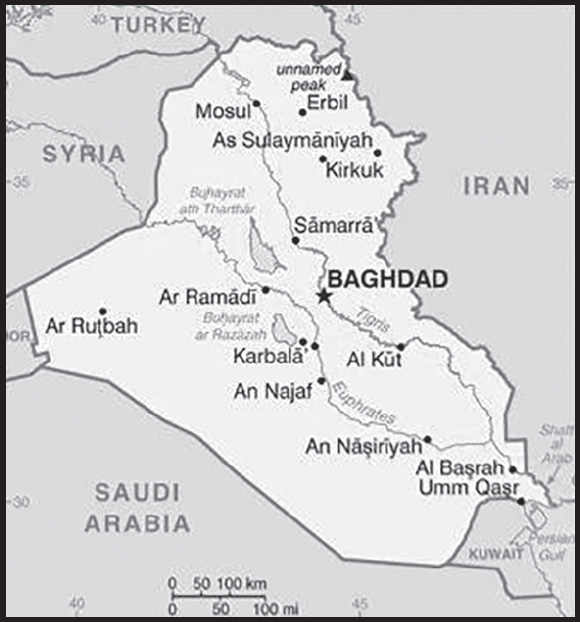
INTRODUCTION
Background: Formerly part of the Ottoman Empire, Iraq was occupied by the United Kingdom during World War I and was declared a League of Nations mandate under UK administration in 1920. Iraq attained its independence as a kingdom in 1932. It was proclaimed a “republic” in 1958 after a coup overthrew the monarchy, but in actuality, a series of strongmen ruled the country until 2003. The last was SADDAM Husayn from 1979 to 2003. Territorial disputes with Iran led to an inconclusive and costly eight-year war (1980-88). In August 1990, Iraq seized Kuwait but was expelled by US-led UN coalition forces during the Gulf War of January-February 1991. After Iraq’s expulsion, the UN Security Council (UNSC) required Iraq to scrap all weapons of mass destruction and long-range missiles and to allow UN verification inspections. Continued Iraqi noncompliance with UNSC resolutions led to the Second Gulf War in March 2003 and the ouster of the SADDAM Husayn regime by US-led forces.
In October 2005, Iraqis approved a constitution in a national referendum and, pursuant to this document, elected a 275-member Council of Representatives (COR) in December 2005. The COR approved most cabinet ministers in May 2006, marking the transition to Iraq’s first constitutional government in nearly a half century. Iraq’s constitution also established the Kurdistan Regional Government (KRG), a semi-autonomous region that administers the governorates of Erbil, Dahuk, and As Sulaymaniyah. Iraq has held four national legislative elections since 2006, most recently in October 2021 when 329 legislators were elected to the COR. Following these elections and Iraq’s longest government formation process in the post-SADDAM era, the COR approved Muhammad Shia’ al-SUDANI as prime minister in October 2022. Iraq has repeatedly postponed separate elections for provincial councils - last held in 2013 - and since 2019 the prime minister has had the authority to appoint governors rather than provincial councils. In early 2023, the COR voted to hold provincial elections by the end of the year.
Between 2014 and 2017, Iraq fought a military campaign against the Islamic State of Iraq and ash-Sham (ISIS) to recapture territory the group seized in 2014. In December 2017, then-Prime Minister Haydar al-ABADI publicly declared victory against ISIS, although military operations against the group continue in rural areas. Also in late 2017, Baghdad forcefully seized disputed territories across central and northern Iraq from the KRG, following a non-binding Kurdish independence referendum.
GEOGRAPHY
Location: Middle East, bordering the Persian Gulf, between Iran and Kuwait
Geographic coordinates: 33 00 N, 44 00 E
Map references: Middle East
Area: total: 438,317 sq km
land: 437,367 sq km
water: 950 sq km
comparison ranking: total 60
Area - comparative: slightly more than three times the size of New York state
Land boundaries: total: 3,809 km
border countries (6): Iran 1,599 km; Jordan 179 km; Kuwait 254 km; Saudi Arabia 811 km; Syria 599 km; Turkey 367 km
Coastline: 58 km
Maritime claims: territorial sea: 12 nm
continental shelf: not specified
Climate: mostly desert; mild to cool winters with dry, hot, cloudless summers; northern mountainous regions along Iranian and Turkish borders experience cold winters with occasionally heavy snows that melt in early spring, sometimes causing extensive flooding in central and southern Iraq
Terrain: mostly broad plains; reedy marshes along Iranian border in south with large flooded areas; mountains along borders with Iran and Turkey
Elevation: highest point: Cheekha Dar (Kurdish for “Black Tent”) 3,611 m
lowest point: Persian Gulf 0 m
mean elevation: 312 m
Natural resources: petroleum, natural gas, phosphates, sulfur
Land use: agricultural land: 18.1% (2018 est.)
arable land: 8.4% (2018 est.)
permanent crops: 0.5% (2018 est.)
permanent pasture: 9.2% (2018 est.)
forest: 1.9% (2018 est.)
other: 80% (2018 est.)
Irrigated land: 35,250 sq km (2012)
Major lakes (area sq km): fresh water lake(s): Lake Hammar - 1,940 sq km
Major rivers (by length in km): Euphrates river mouth (shared with Turkey[s], Syria, and Iran) - 3,596 km; Tigris river mouth (shared with Turkey[s], Syria, and Iran) - 1,950 km; the Tigris and Euphrates join to form the Shatt al Arab
note – [s] after country name indicates river source; [m] after country name indicates river mouth
Major watersheds (area sq km): Indian Ocean drainage: (Persian Gulf) Tigris and Euphrates (918,044 sq km)
Major aquifers: Arabian Aquifer System
Population distribution: population is concentrated in the north, center, and eastern parts of the country, with many of the larger urban agglomerations found along extensive parts of the Tigris and Euphrates Rivers; much of the western and southern areas are either lightly populated or uninhabited
Natural hazards: dust storms; sandstorms; floods
Geography - note: strategic location on Shatt al Arab waterway and at the head of the Persian Gulf
PEOPLE AND SOCIETY
Population: 41,266,109 (2023 est.)
comparison ranking: 36
Nationality: noun: Iraqi(s)
adjective: Iraqi
Ethnic groups: Arab 75-80%, Kurdish 15-20%, other 5% (includes Turkmen, Yezidi, Shabak, Kaka’i, Bedouin, Romani, Assyrian, Circassian, Sabaean-Mandaean, Persian)
note: data is a 1987 government estimate; no more recent reliable numbers are available
Languages: Arabic (official), Kurdish (official); Turkmen (a Turkish dialect) and Syriac (Neo-Aramaic) are recognized as official languages where native speakers of these languages are present; Iraqis have the right to be educated in their native language
major-language sample(s):

(Arabic)

(Kurdish)
Religions: Muslim (official) 95-98% (Shia 61-64%, Sunni 29-34%), Christian 1% (includes Catholic, Orthodox, Protestant, Assyrian Church of the East), other 1-4% (2015 est.)
note: the last census in Iraq was in 1997; while there has been voluntary relocation of many Christian families to northern Iraq, the overall Christian population has decreased at least 50% and perhaps as much as 90% since 2003, according to US Embassy estimates, with many fleeing to Syria, Jordan, and Lebanon
Age structure: 0-14 years: 35.24% (male 7,428,445/female 7,113,723)
15-64 years: 61.17% (male 12,692,897/female 12,548,936)
65 years and over: 3.59% (2023 est.) (male 658,844/female 823,264)
Dependency ratios: total dependency ratio: 71
youth dependency ratio: 65.2
elderly dependency ratio: 5.8
potential support ratio: 17.1 (2021 est.)
Median age: total: 21.2 years (2020)
male: 20.8 years
female: 21.6 years
comparison ranking: total 185
Population growth rate: 1.94% (2023 est.)
comparison ranking: 42
Birth rate: 24.22 births/1,000 population (2023 est.)
comparison ranking: 46
Death rate: 3.88 deaths/1,000 population (2023 est.)
comparison ranking: 217
Net migration rate: -0.98 migrant(s)/1,000 population (2023 est.)
comparison ranking: 146
Population distribution: population is concentrated in the north, center, and eastern parts of the country, with many of the larger urban agglomerations found along extensive parts of the Tigris and Euphrates Rivers; much of the western and southern areas are either lightly populated or uninhabited
Urbanization: urban population: 71.6% of total population (2023)
rate of urbanization: 2.91% annual rate of change (2020-25 est.)
Major urban areas - population: 7.711 million BAGHDAD (capital), 1.792 million Mosul, 1.448 million Basra, 1.075 million Kirkuk, 958,000 Najaf, 897,000 Erbil (2023)
Sex ratio: at birth: 1.05 male(s)/female
0-14 years: 1.04 male(s)/female
15-64 years: 1.01 male(s)/female
65 years and over: 0.8 male(s)/female
total population: 1.01 male(s)/female (2023 est.)
Maternal mortality ratio: 76 deaths/100,000 live births (2020 est.)
comparison ranking: 78
Infant mortality rate: total: 19.17 deaths/1,000 live births (2023 est.)
male: 20.85 deaths/1,000 live births
female: 17.42 deaths/1,000 live births
comparison ranking: total 83
Life expectancy at birth: total population: 73.45 years (2023 est.)
male: 71.58 years
female: 75.42 years
comparison ranking: total population 149
Total fertility rate: 3.17 children born/woman (2023 est.)
comparison ranking: 45
Gross reproduction rate: 1.55 (2023 est.)
Contraceptive prevalence rate: 52.8% (2018)
Drinking water source: improved: urban: 100% of population
rural: 97.4% of population
total: 99.3% of population
unimproved: urban: 0% of population
rural: 2.6% of population
total: 0.7% of population (2020 est.)
Current health expenditure: 5.1% of GDP (2020)
Physicians density: 0.97 physicians/1,000 population (2020)
Hospital bed density: 1.3 beds/1,000 population (2017)
Sanitation facility access: improved:
total: 100% of population
unimproved: total: 0% of population (2020 est.)
Major infectious diseases: degree of risk: intermediate (2023)
food or waterborne diseases: bacterial diarrhea, hepatitis A, and typhoid fever
Obesity - adult prevalence rate: 30.4% (2016)
comparison ranking: 23
Alcohol consumption per capita: total: 0.16 liters of pure alcohol (2019 est.)
beer: 0.11 liters of pure alcohol (2019 est.)
wine: 0 liters of pure alcohol (2019 est.)
spirits: 0.04 liters of pure alcohol (2019 est.)
other alcohols: 0 liters of pure alcohol (2019 est.)
comparison ranking: total 174
Tobacco use: total: 18.5% (2020 est.)
male: 35.1% (2020 est.)
female: 1.8% (2020 est.)
comparison ranking: total 91
Children under the age of 5 years underweight: 3.9% (2018)
comparison ranking: 80
Currently married women (ages 15-49): 65.5% (2023 est.)
Child marriage: women married by age 15: 7.2%
women married by age 18: 27.9% (2018 est.)
Education expenditures: 4.7% of GDP (2016)
comparison ranking: 87
Literacy: definition: age 15 and over can read and write
total population: 85.6%
male: 91.2%
female: 79.9% (2017)
Youth unemployment rate (ages 15-24): total: 27.2% (2021 est.)
male: 23.5%
female: 65.2%
comparison ranking: total 50
ENVIRONMENT
Environment - current issues: government water control projects drained most of the inhabited marsh areas east of An Nasiriyah by drying up or diverting the feeder streams and rivers; a once sizable population of Marsh Arabs, who inhabited these areas for thousands of years, has been displaced; furthermore, the destruction of the natural habitat poses serious threats to the area’s wildlife populations; inadequate supplies of potable water; soil degradation (salination) and erosion; desertification; military and industrial infrastructure has released heavy metals and other hazardous substances into the air, soil, and groundwater; major sources of environmental damage are effluents from oil refineries, factory and sewage discharges into rivers, fertilizer and chemical contamination of the soil, and industrial air pollution in urban areas
Environment - international agreements: party to: Biodiversity, Climate Change, Climate Change-Kyoto Protocol, Comprehensive Nuclear Test Ban, Desertification, Endangered Species, Hazardous Wastes, Law of the Sea, Nuclear Test Ban, Ozone Layer Protection, Ship Pollution, Wetlands
signed, but not ratified: Climate Change-Paris Agreement, Environmental Modification
Climate: mostly desert; mild to cool winters with dry, hot, cloudless summers; northern mountainous regions along Iranian and Turkish borders experience cold winters with occasionally heavy snows that melt in early spring, sometimes causing extensive flooding in central and southern Iraq
Land use: agricultural land: 18.1% (2018 est.)
arable land: 8.4% (2018 est.)
permanent crops: 0.5% (2018 est.)
permanent pasture: 9.2% (2018 est.)
forest: 1.9% (2018 est.)
other: 80% (2018 est.)
Urbanization: urban population: 71.6% of total population (2023)
rate of urbanization: 2.91% annual rate of change (2020-25 est.)
Food insecurity: severe localized food insecurity: due to civil conflict and economic slowdown - the 2022 Humanitarian Needs Overview identified 2.5 million people in need of humanitarian assistance, of which 960,000 have acute humanitarian needs; while the number of people in need remained similar to the previous year, the severity of those needs increased, largely due to the impact of the COVID-19 pandemic on top of an existing humanitarian crisis, leading to a 35% increase in the number of people in acute need; more than half of these are concentrated in the governorates of Nineveh and Anbar; the number of severely food insecure people is estimated at about 435,000, while 731,000 are vulnerable to food insecurity (2022)
Revenue from forest resources: 0% of GDP (2018 est.)
comparison ranking: 188
Revenue from coal: 0% of GDP (2018 est.)
comparison ranking: 136
Air pollutants: particulate matter emissions: 39.29 micrograms per cubic meter (2019 est.)
carbon dioxide emissions: 190.06 megatons (2016 est.)
methane emissions: 17.44 megatons (2020 est.)
Waste and recycling: municipal solid waste generated annually: 13.14 million tons (2015 est.)
Major lakes (area sq km): fresh water lake(s): Lake Hammar - 1,940 sq km
Major rivers (by length in km): Euphrates river mouth (shared with Turkey[s], Syria, and Iran) - 3,596 km; Tigris river mouth (shared with Turkey[s], Syria, and Iran) - 1,950 km; the Tigris and Euphrates join to form the Shatt al Arab
note – [s] after country name indicates river source; [m] after country name indicates river mouth
Major watersheds (area sq km): Indian Ocean drainage: (Persian Gulf) Tigris and Euphrates (918,044 sq km)
Major aquifers: Arabian Aquifer System
Total water withdrawal: municipal: 6.9 billion cubic meters (2020 est.)
industrial: 5.49 billion cubic meters (2020 est.)
agricultural: 44.23 billion cubic meters (2020 est.)
Total renewable water resources: 89.86 billion cubic meters (2020 est.)
GOVERNMENT
Country name: conventional long form: Republic of Iraq
conventional short form: Iraq
local long form: Jumhuriyat al-Iraq/Komar-i Eraq
local short form: Al Iraq/Eraq
former: Mesopotamia, Mandatory Iraq, Hashemite Kingdom of Iraq
etymology: the name probably derives from “Uruk” (Biblical “Erech”), the ancient Sumerian and Babylonian city on the Euphrates River
Government type: federal parliamentary republic
Capital: name: Baghdad
geographic coordinates: 33 20 N, 44 24 E
time difference: UTC+3 (8 hours ahead of Washington, DC, during Standard Time)
etymology: although the origin of the name is disputed, it likely has compound Persian roots with bagh and dad meaning “god” and “given” respectively to create the meaning of “bestowed by God”
Administrative divisions: 18 governorates (muhafazat, singular - muhafazah (Arabic); parezgakan, singular - parezga (Kurdish)); ‘Al Anbar; Al Basrah; Al Muthanna; Al Qadisiyah (Ad Diwaniyah); An Najaf; Arbil (Erbil) (Arabic), Hewler (Kurdish); As Sulaymaniyah (Arabic), Slemani (Kurdish); Babil; Baghdad; Dahuk (Arabic), Dihok (Kurdish); Dhi Qar; Diyala; Karbala’; Kirkuk; Maysan; Ninawa; Salah ad Din; Wasit
note: Iraq’s Kurdistan Regional Government administers Arbil, Dahuk, and As Sulaymaniyah (as Hewler, Dihok, and Slemani respectively)
Independence: 3 October 1932 (from League of Nations mandate under British administration); note - on 28 June 2004 the Coalition Provisional Authority transferred sovereignty to the Iraqi Interim Government
National holiday: Independence Day, 3 October (1932); Republic Day, 14 July (1958)
Constitution: history: several previous; latest adopted by referendum 15 October 2005
amendments: proposed by the president of the republic and the Council of Minsters collectively, or by one fifth of the Council of Representatives members; passage requires at least two-thirds majority vote by the Council of Representatives, approval by referendum, and ratification by the president; passage of amendments to articles on citizen rights and liberties requires two-thirds majority vote of Council of Representatives members after two successive electoral terms, approval in a referendum, and ratification by the president
Legal system: mixed legal system of civil and Islamic law
International law organization participation: has not submitted an ICJ jurisdiction declaration; non-party state to the ICCt
Citizenship: citizenship by birth: no
citizenship by descent only: at least one parent must be a citizen of Iraq
dual citizenship recognized: yes
residency requirement for naturalization: 10 years
Suffrage: 18 years of age; universal
Executive branch: chief of state: President Latif RASHID (since 13 October 2022; vice presidents (vacant)
head of government: Prime Minister Mohammed Shia al-SUDANI (since 27 October 2022)
cabinet: Council of Ministers proposed by the prime minister, approved by Council of Representatives (COR)
elections/appointments: president indirectly elected by COR to serve a 4-year term (eligible for a second term); COR parliamentary election for president last held on 13 October 2022 (next to be held NA)
election results:
2022: Latif RASHID elected president in second round; COR vote in first round - Latif RASHID (PUK) 157, Barham SALIH (PUK) 99; COR vote in second round - Latif RASHID 167, Barham SALIH 99; Mohammed Shia’ Al-Sudani approved as prime minister
2018: Barham SALIH elected president in second round; COR vote in first round - Barham SALIH (PUK) 165, Fuad HUSAYN (KDP) 90; COR vote in second round - Barham SALIH 219, Fuad HUSAYN 22; Adil ABD AL-MAHDI approved as prime minister
Legislative branch: description: unicameral Council of Representatives of Iraq (COR) or Majlis an-Nuwwab al-Iraqiyy (329 seats; 320 members directly elected in 83 multi-seat constituencies by single nontransferable vote, 9 seats elected by religious minorities - 5 by Christians, 1 each by Sabaean-Mandaeans, Yazidis, Shabaks andFayli Kurds, and 25% of seats allocated to women; members serve 4-year terms)
elections: last held on 10 October 2021 (next to be held in 2025)
election results: percent of vote by party/coalition - NA; seats by party -Taqadum 47, State of Law Coalition 43, Al Fatah Alliance 37, Kurdistan Democratic Party 31, Kurdistan Coalition 18, Azm Alliance 16, Imtidad 16, State Forces Alliance 11, Ishraqat Kanun 10, New Generation Movement 9, National Contract Party 8, Tasmim Alliance 7, Babiliyun Movement 3, other 73; composition - men 234, women 95, percent of women 28.9%
note – seat counts reflect updated numbers after the Sadrist Trend withdrew from government formation and its 73 seats were reallocated to other parties
Judicial branch: highest court(s): Federal Supreme Court or FSC (consists of 9 judges); note - court jurisdiction limited to constitutional issues, application of federal laws, ratification of election results for the COR, judicial competency disputes, and disputes between regions or governorates and the central government; Court of Cassation (consists of a court president, 5 vice presidents, and at least 24 judges)
judge selection and term of office: Federal Supreme Court (FSC) judges nominated by the High Judicial Council (HJC) president, the FSC chief justice, the public prosecutor’s office chief, and the head of the Judicial Oversight Commission; FSC members required to retire at age 72; Court of Cassation judges appointed by the HJC and confirmed by the Council of Representatives to serve until retirement, nominally at age 63, but can be extended to age 66 by the HJC
subordinate courts: Courts of Appeal (governorate level); civil courts, including first instance, personal status, labor, and customs; criminal courts including felony, misdemeanor, investigative, major crimes, juvenile, and traffic courts
Political parties and leaders: Al Fatah Alliance [Hadi al-AMIRI]
Azm Alliance [Khamis al-KHANJAR]
Babiliyun Movement [Rayan al-KILDANI]
Imtidad [Ala al-RIKABI]
Ishraqat Konun [Jaafar AZIZ]
Kurdistan Democratic Party F [Masud BARZANI]
National Contract Party [Falih al-FAYYAD]
New Generation Movement [SHASWAR Abd al-Wahid Qadir]
Patriotic Union of Kurdistan [Bafel TALABANI]
Sadrist Bloc [Muqtada al-SADR]
State Forces Alliance [Haydar al-ABADI]
State of Law Coalition [Nuri al-MALIKI]
Taqadum [Muhammad al-HALBUSI]
Tasmim Alliance [Asad al-IDANI]
numerous smaller independent, religious, local, tribal, and minority parties
International organization participation: ABEDA, AFESD, AMF, CAEU, CICA, EITI (compliant country), FAO, G-77, IAEA, IBRD, ICAO, ICRM, IDA, IDB, IFAD, IFC, IFRCS, ILO, IMF, IMO, IMSO, Interpol, IOC, IPU, ISO, ITSO, ITU, LAS, MIGA, NAM, OAPEC, OIC, OPCW, OPEC, PCA, UN, UNCTAD, UNESCO, UNIDO, UNWTO, UPU, WCO, WFTU (NGOs), WHO, WIPO, WMO, WTO (observer)
Diplomatic representation in the US: chief of mission: Ambassador Nazar Issa Abdulhadi AL-KHIRULLAH (since 30 June 2023)
chancery: 1801 P Street NW, Washington, DC 20036
telephone: [1] (202) 483-7500
FAX: [1] (202) 462-8815
email address and website:
consulate(s) general: Detroit, Los Angeles
Diplomatic representation from the US: chief of mission: Ambassador Alina L. ROMANOWSKI (since 2 June 2022)
embassy: Al-Kindi Street, International Zone, Baghdad; note - consulate in Al Basrah closed as of 28 September 2018
mailing address: 6060 Baghdad Place, Washington DC 20521-6060
telephone: 0760-030-3000
email address and website:
Flag description: three equal horizontal bands of red (top), white, and black; the Takbir (Arabic expression meaning “God is great”) in green Arabic script is centered in the white band; the band colors derive from the Arab Liberation flag and represent oppression (black), overcome through bloody struggle (red), to be replaced by a bright future (white); the Council of Representatives approved this flag in 2008 as a compromise replacement for the Ba’thist SADDAM-era flag
note: similar to the flag of Syria, which has two stars but no script; Yemen, which has a plain white band; and that of Egypt, which has a golden Eagle of Saladin centered in the white band
National symbol(s): golden eagle; national colors: red, white, black
National anthem: name: “Mawtini” (My Homeland)
lyrics/music: Ibrahim TOUQAN/Mohammad FLAYFEL
note: adopted 2004; following the ouster of SADDAM Husayn, Iraq adopted “Mawtini,” a popular folk song throughout the Arab world; also serves as an unofficial anthem of the Palestinian people
National heritage: total World Heritage Sites: 6 (5 cultural, 1 mixed)
selected World Heritage Site locales: Ashur (Qal’at Sherqat) (c); Babylon (c); Erbil Citadel (c); Hatra (c); Samarra Archaeological City (c); The Ahwar (Marshland) of Southern Iraq: Refuge of Biodiversity and the Relict Landscape of the Mesopotamian Cities (m)
ECONOMY
Economic overview: oil-dependent Middle Eastern economy; COVID-19 disruption and domestic economy fragility post-US presence; poverty increases; currency devaluation leading to inflation; import-dependent for most sectors; evaluating fiscal and monetary restructuring
Real GDP (purchasing power parity): $390.165 billion (2021 est.)
$379.6 billion (2020 est.)
$428.076 billion (2019 est.)
note: data are in 2017 dollars
comparison ranking: 49
Real GDP growth rate: 2.78% (2021 est.)
-11.32% (2020 est.)
5.51% (2019 est.)
comparison ranking: 147
Real GDP per capita: $9,000 (2021 est.)
$8,900 (2020 est.)
$10,300 (2019 est.)
note: data are in 2017 dollars
comparison ranking: 149
GDP (official exchange rate): $231.994 billion (2019 est.)
Inflation rate (consumer prices): 6.04% (2021 est.)
0.57% (2020 est.)
-0.2% (2019 est.)
comparison ranking: 52
Credit ratings: Fitch rating: B- (2015)
Moody’s rating: Caa1 (2017)
Standard & Poors rating: B- (2015)
note: The year refers to the year in which the current credit rating was first obtained.
GDP - composition, by sector of origin: agriculture: 3.3% (2017 est.)
industry: 51% (2017 est.)
services: 45.8% (2017 est.)
comparison rankings: services 196; industry 10; agriculture 147
GDP - composition, by end use: household consumption: 50.4% (2013 est.)
government consumption: 22.9% (2016 est.)
investment in fixed capital: 20.6% (2016 est.)
investment in inventories: 0% (2016 est.)
exports of goods and services: 32.5% (2016 est.)
imports of goods and services: -40.9% (2016 est.)
Agricultural products: wheat, barley, dates, tomatoes, rice, maize, grapes, potatoes, rice, watermelons
Industries: petroleum, chemicals, textiles, leather, construction materials, food processing, fertilizer, metal fabrication/processing
Industrial production growth rate: -1.14% (2021 est.)
comparison ranking: 171
Labor force: 11.184 million (2021 est.)
comparison ranking: 52
Labor force - by occupation: agriculture: 21.6%
industry: 18.7%
services: 59.8% (2008 est.)
Unemployment rate: 14.19% (2021 est.)
14.09% (2020 est.)
12.86% (2019 est.)
comparison ranking: 42
Youth unemployment rate (ages 15-24): total: 27.2% (2021 est.)
male: 23.5%
female: 65.2%
comparison ranking: total 50
Population below poverty line: 23% (2014 est.)
Gini Index coefficient - distribution of family income: 29.5 (2012 est.)
comparison ranking: 152
Average household expenditures: on food: 30.1% of household expenditures (2018 est.)
on alcohol and tobacco: 4.2% of household expenditures (2018 est.)
Household income or consumption by percentage share: lowest 10%: 3.6%
highest 10%: 25.7% (2007 est.)
Budget: revenues: $51.534 billion (2020 est.)
expenditures: $85.546 billion (2020 est.)
Budget surplus (+) or deficit (-): -4.2% (of GDP) (2017 est.)
comparison ranking: 159
Public debt: 27.44% of GDP (2018 est.)
35.86% of GDP (2017 est.)
29.48% of GDP (2016 est.)
comparison ranking: 175
Taxes and other revenues: 1.34% (of GDP) (2019 est.)
comparison ranking: 220
Fiscal year: calendar year
Current account balance: $24.563 billion (2021 est.)
-$6.198 billion (2020 est.)
$15.763 billion (2019 est.)
comparison ranking: 21
Exports: $78.261 billion (2021 est.) note: data are in current year dollars
$50.632 billion (2020 est.) note: data are in current year dollars
$88.903 billion (2019 est.) note: data are in current year dollars
comparison ranking: 52
Exports - partners: China 26%, India 24%, South Korea 9%, United States 8%, Italy 6%, Greece 6% (2019)
Exports - commodities: crude petroleum, refined petroleum, gold, petroleum coke, natural gas (2021)
Imports: $50.707 billion (2021 est.) note: data are in current year dollars
$54.722 billion (2020 est.) note: data are in current year dollars
$72.283 billion (2019 est.) note: data are in current year dollars
comparison ranking: 60
Imports - partners: United Arab Emirates 28%, Turkey 21%, China 19% (2019)
Imports - commodities: refined petroleum, broadcasting equipment, cars, jewelry, cigarettes (2019)
Reserves of foreign exchange and gold: $64.231 billion (31 December 2021 est.)
$54.424 billion (31 December 2020 est.)
$68.018 billion (31 December 2019 est.)
comparison ranking: 37
Debt - external: $73.02 billion (31 December 2017 est.)
$64.16 billion (31 December 2016 est.)
comparison ranking: 61
Exchange rates: Iraqi dinars (IQD) per US dollar -
Exchange rates: 1,450 (2021 est.)
1,192 (2020 est.)
1,182 (2019 est.)
1,182.75 (2018 est.)
1,184 (2017 est.)
ENERGY
Electricity access: electrification - total population: 100% (2021)
Electricity: installed generating capacity: 28.369 million kW (2020 est.)
consumption: 46.493 billion kWh (2019 est.)
exports: 0 kWh (2019 est.)
imports: 14.18 billion kWh (2019 est.)
transmission/distribution losses: 58.502 billion kWh (2019 est.)
comparison rankings: installed generating capacity 37; transmission/distribution losses 6; imports 16; exports 132; consumption 53
Electricity generation sources: fossil fuels: 97.8% of total installed capacity (2020 est.)
solar: 0.1% of total installed capacity (2020 est.)
hydroelectricity: 2.1% of total installed capacity (2020 est.)
Petroleum: total petroleum production: 4.162 million bbl/day (2021 est.)
refined petroleum consumption: 863,300 bbl/day (2019 est.)
crude oil and lease condensate exports: 3.976 million bbl/day (2018 est.)
crude oil and lease condensate imports: 0 bbl/day (2018 est.)
crude oil estimated reserves: 145.019 billion barrels (2021 est.)
Refined petroleum products - production: 398,000 bbl/day (2015 est.)
comparison ranking: 37
Refined petroleum products - exports: 8,284 bbl/day (2015 est.)
comparison ranking: 86
Refined petroleum products - imports: 255,100 bbl/day (2015 est.)
comparison ranking: 28
Natural gas: production: 10.711 billion cubic meters (2019 est.)
consumption: 18.014 billion cubic meters (2019 est.)
exports: 0 cubic meters (2021 est.)
imports: 7.303 billion cubic meters (2019 est.)
proven reserves: 3.729 trillion cubic meters (2021 est.)
Carbon dioxide emissions: 143.479 million metric tonnes of CO2 (2019 est.)
from coal and metallurgical coke: 0 metric tonnes of CO2 (2019 est.)
from petroleum and other liquids: 108.14 million metric tonnes of CO2 (2019 est.)
from consumed natural gas: 35.339 million metric tonnes of CO2 (2019 est.)
comparison ranking: total emissions 35
Energy consumption per capita: 63.174 million Btu/person (2019 est.)
comparison ranking: 88
COMMUNICATIONS
Telephones - fixed lines: total subscriptions: 3,048,736 (2021 est.)
subscriptions per 100 inhabitants: 7 (2021 est.)
comparison ranking: total subscriptions 40
Telephones - mobile cellular: total subscriptions: 37,649,112 (2021 est.)
subscriptions per 100 inhabitants: 86 (2021 est.)
comparison ranking: total subscriptions 42
Telecommunication systems: general assessment: civil stability has made it easier for mobile and fixed-line operators to rebuild telecom services and infrastructure damaged during previous periods of violence; the government extended the licenses held by the MNOs for an additional three years to compensate for the chaos and destruction caused between 2014 and 2017 when Islamic State controlled many areas of the country; the companies have struggled to develop LTE services; most services are still based on GSM and 3G, except in Iraq’s Kurdistan region where LTE is more widely available (2022)
domestic: about 7 per 100 for fixed-line and 86 per 100 for mobile-cellular subscriptions (2021)
international: country code - 964; landing points for FALCON, and GBICS/MENA submarine cables providing connections to the Middle East, Africa and India; satellite earth stations - 4 (2 Intelsat - 1 Atlantic Ocean and 1 Indian Ocean, 1 Intersputnik - Atlantic Ocean region, and 1 Arabsat (inoperative)); local microwave radio relay connects border regions to Jordan, Kuwait, Syria, and Turkey (2019)
Broadcast media: the number of private radio and TV stations has increased rapidly since 2003; government-owned TV and radio stations are operated by the publicly funded Iraqi Media Network; private broadcast media are mostly linked to political, ethnic, or religious groups; satellite TV is available to an estimated 70% of viewers and many of the broadcasters are based abroad; transmissions of multiple international radio broadcasters are accessible (2019)
Internet country code: .iq
Internet users: total: 21.56 million (2021 est.)
percent of population: 49% (2021 est.)
comparison ranking: total 40
Broadband - fixed subscriptions: total: 6,254,099 (2020 est.)
subscriptions per 100 inhabitants: 16 (2020 est.)
comparison ranking: total 30
TRANSPORTATION
National air transport system: number of registered air carriers: 4 (2020)
inventory of registered aircraft operated by air carriers: 34
annual passenger traffic on registered air carriers: 2,075,065 (2018)
annual freight traffic on registered air carriers: 16.2 million (2018) mt-km
Civil aircraft registration country code prefix: YI
Airports: 102 (2021)
comparison ranking: total 55
Airports - with paved runways: 72
note: paved runways have a concrete or asphalt surface but not all have facilities for refueling, maintenance, or air traffic control; the length of a runway required for aircraft to safely operate depends on a number of factors including the type of aircraft, the takeoff weight (including passengers, cargo, and fuel), engine types, flap settings, landing speed, elevation of the airport, and average maximum daily air temperature; paved runways can reach a length of 5,000 m (16,000 ft.), but the “typical” length of a commercial airline runway is between 2,500-4,000 m (8,000-13,000 ft.)
Airports - with unpaved runways: 30
note: unpaved runways have a surface composition such as grass or packed earth and are most suited to the operation of light aircraft; unpaved runways are usually short, often less than 1,000 m (3,280 ft.) in length; airports with unpaved runways often lack facilities for refueling, maintenance, or air traffic control
Heliports: 16 (2021)
Pipelines: 2,455 km gas, 913 km liquid petroleum gas, 5,432 km oil, 1,637 km refined products (2013)
Railways: total: 2,272 km (2014)
standard gauge: 2,272 km (2014) 1.435-m gauge
comparison ranking: total 68
Roadways: total: 59,623 km (2012)
paved: 59,623 km (2012) (includes Kurdistan region)
comparison ranking: total 76
Waterways: 5,279 km (2012) (the Euphrates River (2,815 km), Tigris River (1,899 km), and Third River (565 km) are the principal waterways)
comparison ranking: 24
Merchant marine: total: 75 (2022)
by type: general cargo 1, oil tanker 7, other 67
comparison ranking: total 103
Ports and terminals: river port(s): Al Basrah (Shatt al Arab); Khawr az Zubayr, Umm Qasr (Khawr az Zubayr waterway)
MILITARY AND SECURITY
Military and security forces: Ministry of Defense: Iraqi Army, Army Aviation Command, Iraqi Navy, Iraqi Air Force, Iraqi Air Defense Command, Special Forces Command, Special Security Division (Green Zone protection)
National-Level Security Forces: Iraqi Counterterrorism Service (CTS; reports to the Prime Minister), Prime Minister’s Special Forces Division, Presidential Brigades
Ministry of Interior: Federal Police Forces Command, Border Guard Forces Command, Federal Intelligence and Investigations Agency, Emergency Response Division, Facilities Protection Directorate, and Provincial Police
Ministry of Oil: Energy Police Directorate
Popular Mobilization Committee (PMC): Popular Mobilization Forces (PMF), Tribal Mobilization Forces (TMF); the PMF and TMF are a collection of more than 50 militias of widely varied sizes and political interests
the federal constitution provides the Kurdistan Regional Government (KRG) the right to maintain its own military/militia (peshmerga) and security forces, but the two main Kurdish political parties, the Kurdistan Democratic Party (KDP) and the Patriotic Union of Kurdistan (PUK), each maintain their own forces:
KRG Ministry of Peshmerga: Regional Guard Brigades; Unit (or Division) 70 Forces and Counter Terrorism Group (CTG) of the PUK; Unit (or Division) 80 Forces and Counterterrorism Directorate (CTD) of the KDP
KRG Ministry of Interior: both the KDP and PUK maintain separate police, emergency response, and internal security/intelligence (Asayish) services under nominal Ministry of Interior control (2023)
Military expenditures: 2.1% of GDP (2022 est.)
3.7% of GDP (2021 est.)
4.1% of GDP (2020 est.)
3.8% of GDP (2019 est.)
4.5% of GDP (2018 est.)
comparison ranking: 53
Military and security service personnel strengths: information varies; approximately 200,000 personnel under the Ministry of Defense (190,000 Army/Aviation Command/Special Forces; 5,000 Navy; 5,000 Air/Air Defense Forces); approximately 25,000 National-Level Security Forces; estimated 100-160,000 Popular Mobilization Forces
Ministry of Peshmerga: approximately 150,000 (45-50,000 Regional Guard Brigades; 40-45,000 Unit 70 Forces; 65-70,000 Unit 80 Forces) (2023)
Military equipment inventories and acquisitions: the Iraqi military’s inventory includes a mix of equipment from a wide variety of sources, including Europe, South Africa, South Korea, Russia, and the US; in recent years, Russia and the US have been the leading suppliers of military hardware to Iraq (2023)
Military service age and obligation: 18-40 years of age for voluntary military service; no conscription (2022)
note: service in the armed forces was mandatory in Iraq from 1935 up until 2003; in 2021, the Iraqi cabinet approved a draft law to reinstate compulsory military service and referred the proposed law, called the “Service Under the Flag Law,” to the Iraqi parliament
Military - note: Iraqi security forces (ISF), including conventional air and ground forces, are primarily focused on internal security duties; they are actively conducting counterinsurgency and counterterrorism operations against the Islamic State of Iraq and ash-Sham (ISIS) terrorist group, particularly in northern and western Iraq; the Counter Terrorism Service (CTS), a highly regarded force comprised of three special forces brigades, is the ISF’s principal operational unit against ISIS
Kurdish Security Forces (KSF, aka Peshmerga) also conducted operations against ISIS; the KSF were formally recognized as a legitimate Iraqi military force under the country’s constitution and have operated jointly with the Iraqi military against ISIS militants, but they also operate outside of Iraqi military command structure; since 2021, the ISF and the KSF have conducted joint counter-ISIS operations in an area known as the Kurdish Coordination Line (KCL), a swath of disputed territory in northern Iraq claimed by both the Kurdistan Regional Government and the central Iraqi Government; the KSF/Peshmerga report to the Kurdistan Regional Government or Kurdistan Democratic Party and Patriotic Union of Kurdistan parties instead of the Iraqi Ministry of Defense
Popular Mobilization Commission and Affiliated Forces (PMF or PMC), also known as Popular Mobilization Units (PMU, or al-Hashd al-Sha’abi in Arabic), tribal militia units have fought alongside the Iraqi military against ISIS since 2014, but the majority of these forces continue to largely ignore the 2016 Law of the Popular Mobilization Authority, which mandated that armed militias must be regulated in a fashion similar to Iraq’s other security forces and act under the Iraqi Government’s direct control; the Iraqi Government funds the PMF, and the prime minister legally commands it, but many of the militia units take orders from associated political parties and/or other government officials, including some with ties to the Iranian Revolutionary Guard Corps (IRGC) and some that have been designated as terrorist organizations by the US; the PMF/PMU is an umbrella organization comprised of many different militias, the majority of which are Shia:
--Shia militias backed by Iran; they are considered the most active and capable, and include such groups as the Badr Organization (Saraya al-Sala), Asaib Ahl al-Haq, and Kataib Hizballah
--Shia militias affiliated with Shia political parties, but not aligned with Iran, such as the Peace Brigades (Saray al-Salam)
--Shia militias not connected with political parties, but affiliated with the Najaf-based Grand Ayatollah Ali al-SISTANI (Iraq’s supreme Shia cleric), such as the Hawza militias
--other PMF/PMU militias include Sunni Tribal Mobilization militias, or Hashd al-Asha’iri; some of these militias take orders from the ISF and local authorities while others respond to orders from the larger Shia PMU militias; still other militias include Yazidi and Christian militias and the Turkmen brigades; the links of these forces to the PMU is not always clear-cut and may be loosely based on financial, legal, or political incentives
at the request of the Iraqi government, NATO agreed to establish an advisory, training and capacity-building mission for the Iraqi military in October 2018; as of 2022, the NATO Mission Iraq (NMI) had about 500 troops; in December 2021, the task force that leads the defeat ISIS mission in Iraq, Combined Joint Task Force – Operation Inherent Resolve (CJTF-OIR), transitioned from a combat role to an advise, assist, and enable role (2023)
SPACE
Space agency/agencies: announced in 2019 that the Iraqi Ministry of Communication was working with France to create a national space agency (2023)
Space program overview: stated purpose of current program is to acquire satellites for security, economic, agricultural, industrial, environmental and military purposes; status unclear (2023)
note: further details about the key activities, programs, and milestones of the country’s space program, as well as government spending estimates on the space sector, appear in Appendix S
TERRORISM
Terrorist group(s): Terrorist group(s): Ansar al-Islam; Asa’ib Ahl al-Haq; Islamic Revolutionary Guard Corps (IRGC)/Qods Force; Islamic State of Iraq and ash-Sham (ISIS); Jaysh Rijal al-Tariq al-Naqshabandi; Kata’ib Hizballah; Kurdistan Workers’ Party (PKK)
note: details about the history, aims, leadership, organization, areas of operation, tactics, targets, weapons, size, and sources of support of the group(s) appear(s) in Appendix-T
TRANSNATIONAL ISSUES
Disputes - international: Iraq-Iran: Iraq’s lack of a maritime boundary with Iran prompts jurisdiction disputes beyond the mouth of the Shatt al Arab in the Persian Gulf
Iraq-Turkey: Turkey has expressed concern over the autonomous status of Kurds in Iraq
Refugees and internally displaced persons: refugees (country of origin): 7,864 (West Bank and Gaza Strip) (mid-year 2022); 272,165 (Syria), 8,575 (Iran), 8,091 (Turkey) (2023)
IDPs: 1.142 million (displacement in central and northern Iraq since January 2014) (2023)
stateless persons: 47,253 (2022); note - in the 1970s and 1980s under SADDAM Husayn’s regime, thousands of Iraq’s Faili Kurds, followers of Shia Islam, were stripped of their Iraqi citizenship, had their property seized by the government, and many were deported; some Faili Kurds had their citizenship reinstated under the 2006 Iraqi Nationality Law, but others lack the documentation to prove their Iraqi origins; some Palestinian refugees persecuted by the SADDAM regime remain stateless
Trafficking in persons: tier rating: Tier 2 Watch List — Iraq does not fully meet the minimum standards for the elimination of trafficking but is making significant efforts to do so; more traffickers were convicted and officials improved oversight of recruitment agencies in Iraqi Kurdistan Region (IKR); Iraq implemented an action plan to address recruitment or use of children in armed conflict and developed another action plan to prevent recruitment or use of children by the Popular Mobilization Forces (PMF); however, the government did not demonstrate overall increasing efforts, compared with the previous reporting period, to expand its anti-trafficking capacity; officials identified fewer trafficking victims and the Kurdistan Regional Government did not report any enforcement or victim data; deficient procedures, and some officials’ limited understanding of trafficking, continued to prevent some victims from receiving protection services; some victims continued to receive inappropriate punishment for unlawful acts committed as a direct result of being trafficked; the government lacked adequate protection services for victims of all forms of trafficking and did not have shelters for adult males or LBGTQI+ victims; therefore, Iraq was downgraded to Tier 2 Watch List (2023)
trafficking profile: human traffickers exploit domestic and foreign victims in Iraq, as well as Iraqi’s abroad; insecurity throughout Iraq increased the population’s vulnerability to trafficking; more than a million Iraqis remained internally displaced as a result of ISIS, and as of March 2023, more than 260,000 Syrian refugees were displaced in Iraq; refugees and IDPs face heightened risk of forced labor and sex trafficking, and women and girls in IDP camps with family ties to ISIS faced potential sexual exploitation, sex trafficking, and abuse by security and military officials; criminal gangs continued to force women into prostitution and children to beg and sell and transport drugs and weapons; Iraqi refugees in Jordan are vulnerable to labor trafficking; thousands of women and children who escaped ISIS captivity in 2015-2019 remain highly vulnerable to exploitation; children remain vulnerable to forcible recruitment or use by armed groups operating in Iraq, including ISIS, tribal forces, the Kurdistan Workers’ Party, and non-PMF Iran-backed militias; Iraqi, Iranian, and Syrian women and girls, as well as LGBTQI+ persons in the IKR and federal Iraq are particularly vulnerable to sex trafficking; traditional practices, including fasliya—the exchange of family members to settle tribal disputes—and forced child and “temporary” marriages also place women and girls at increased risk of trafficking within Iraq; some men and women from Asia and Africa who migrate—both legally and illegally—to Iraq are subjected to forced labor as construction workers, security guards, cleaners, handymen, and domestic workers; the IKR continued to be a destination for trafficking victims primarily from South Asia, sub-Saharan Africa, the Philippines, and neighboring countries; some foreign migrants recruited for work in other countries in the region are forced, coerced, or deceived into working in Iraq and the IKR (2023)
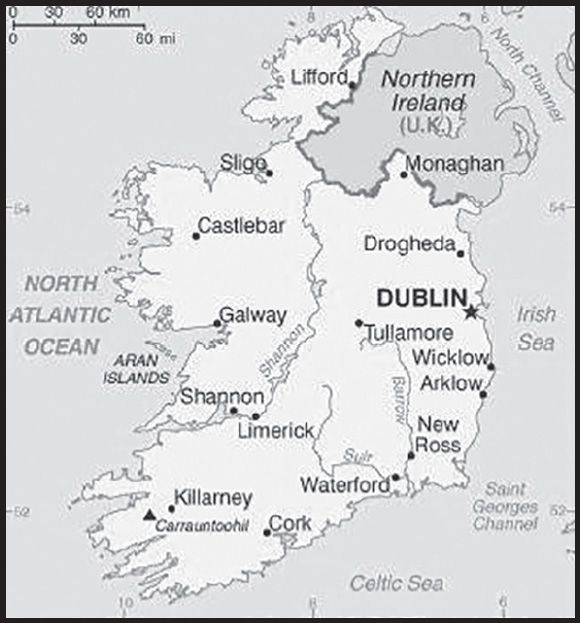
INTRODUCTION
Background: Celtic tribes arrived on the island between 600 and 150 B.C. Invasions by Norsemen that began in the late 8th century were finally ended when King Brian BORU defeated the Danes in 1014. Norman invasions began in the 12th century and set off more than seven centuries of Anglo-Irish struggle marked by fierce rebellions and harsh repressions. The Irish famine of the mid-19th century was responsible for a drop in the island’s population by more than one quarter through starvation, disease, and emigration. For more than a century afterward, the population of the island continued to fall, only to begin growing again in the 1960s. Over the last 50 years, Ireland’s high birthrate has made it demographically one of the youngest populations in the EU.
The modern Irish state traces its origins to the failed 1916 Easter Monday Uprising that galvanized nationalist sentiment and fostered a guerrilla war resulting in independence from the UK in 1921 with the signing of the Anglo-Irish Treaty and the creation of the Irish Free State. The treaty was deeply controversial in Ireland, in part because it helped solidify the partition of Ireland, with six of the island’s 32 counties remaining in the UK as Northern Ireland. The split between pro-Treaty and anti-Treaty partisans led to the Irish Civil War (1922-23). The traditionally dominant political parties in Ireland, Fine Gael and Fianna Fail, are de facto descendants of the opposing sides of the treaty debate. Ireland formally left the British Dominion in 1949 when Ireland declared itself a republic.
Deep sectarian divides between the Catholic and Protestant populations and systemic discrimination in Northern Ireland erupted into years of violence known as the “Troubles” that began in the 1960s. In 1998, the governments of Ireland and the UK, along with most political parties in Northern Ireland, reached the Belfast/Good Friday Agreement with the support of the US. This agreement helped end the Troubles and initiated a new phase of cooperation between the Irish and British Governments.
Ireland was neutral in World War II and continues its policy of military neutrality. Ireland joined the European Community in 1973 and the euro-zone currency union in 1999. The economic boom years of the Celtic Tiger (1995-2007) saw rapid economic growth, which came to an abrupt end in 2008 with the meltdown of the Irish banking system. As a small, open economy, Ireland has excelled at courting foreign direct investment, especially from US multi-nationals, which helped the economy recover from the financial crisis and insulated it somewhat from the economic shocks of the COVID-19 pandemic.
GEOGRAPHY
Location: Western Europe, occupying five-sixths of the island of Ireland in the North Atlantic Ocean, west of Great Britain
Geographic coordinates: 53 00 N, 8 00 W
Map references: Europe
Area: total: 70,273 sq km
land: 68,883 sq km
water: 1,390 sq km
comparison ranking: total 120
Area - comparative: slightly larger than West Virginia
Land boundaries: total: 490 km
border countries (1): UK 490 km
Coastline: 1,448 km
Maritime claims: territorial sea: 12 nm
exclusive fishing zone: 200 nm
Climate: temperate maritime; modified by North Atlantic Current; mild winters, cool summers; consistently humid; overcast about half the time
Terrain: mostly flat to rolling interior plain surrounded by rugged hills and low mountains; sea cliffs on west coast
Elevation: highest point: Carrauntoohil 1,041 m
lowest point: Atlantic Ocean 0 m
mean elevation: 118 m
Natural resources: natural gas, peat, copper, lead, zinc, silver, barite, gypsum, limestone, dolomite
Land use: agricultural land: 66.1% (2018 est.)
arable land: 15.4% (2018 est.)
permanent crops: 0% (2018 est.)
permanent pasture: 50.7% (2018 est.)
forest: 10.9% (2018 est.)
other: 23% (2018 est.)
Irrigated land: 0 sq km (2022)
Population distribution: population distribution is weighted to the eastern side of the island, with the largest concentration being in and around Dublin; populations in the west are small due to mountainous land, poorer soil, lack of good transport routes, and fewer job opportunities
Natural hazards: rare extreme weather events
Geography - note: strategic location on major air and sea routes between North America and northern Europe; over 40% of the population resides within 100 km of Dublin
PEOPLE AND SOCIETY
Population: 5,323,991 (2023 est.)
comparison ranking: 123
Nationality: noun: Irishman(men), Irishwoman (women), Irish (collective plural)
adjective: Irish
Ethnic groups: Irish 76.6%, Irish travelers 0.6%, other White 9.9%, Asian 3.3%, Black 1.5%, other (includes Arab, Roma, and persons of mixed backgrounds) 2%, unspecified 2.6% (2022 est.)
Languages: English (official, the language generally used), Irish (Gaelic or Gaeilge) (official, spoken by approximately 39.8% of the population as of 2016; mainly spoken in areas along Ireland’s western coast known as gaeltachtai, which are officially recognized regions where Irish is the predominant language)
Religions: Roman Catholic 68.3%, Protestant 3.8% (Church of Ireland/Church of England/Anglican/Episcopalian 2.4%, other Protestant 1.4%), Orthodox 2%, other Christian 0.9%, Muslim 1.4%, other 1.6%, none 15.4%, unspecified 6.6% (2022 est.)
Age structure: 0-14 years: 20.39% (male 556,057/female 529,454)
15-64 years: 65.04% (male 1,741,527/female 1,720,989)
65 years and over: 14.57% (2023 est.) (male 360,476/female 415,488)
Dependency ratios: total dependency ratio: 53.2
youth dependency ratio: 30.5
elderly dependency ratio: 22.7
potential support ratio: 4.4 (2021 est.)
Median age: total: 37.8 years (2020)
male: 37.4 years
female: 38.2 years
comparison ranking: total 66
Population growth rate: 0.91% (2023 est.)
comparison ranking: 101
Birth rate: 12.08 births/1,000 population (2023 est.)
comparison ranking: 152
Death rate: 6.74 deaths/1,000 population (2023 est.)
comparison ranking: 127
Net migration rate: 3.76 migrant(s)/1,000 population (2023 est.)
comparison ranking: 31
Population distribution: population distribution is weighted to the eastern side of the island, with the largest concentration being in and around Dublin; populations in the west are small due to mountainous land, poorer soil, lack of good transport routes, and fewer job opportunities
Urbanization: urban population: 64.5% of total population (2023)
rate of urbanization: 1.15% annual rate of change (2020-25 est.)
Major urban areas - population: 1.270 million DUBLIN (capital) (2023)
Sex ratio: at birth: 1.06 male(s)/female
0-14 years: 1.05 male(s)/female
15-64 years: 1.01 male(s)/female
65 years and over: 0.87 male(s)/female
total population: 1 male(s)/female (2023 est.)
Mother’s mean age at first birth: 30.9 years (2020 est.)
Maternal mortality ratio: 5 deaths/100,000 live births (2020 est.)
comparison ranking: 163
Infant mortality rate: total: 3.41 deaths/1,000 live births (2023 est.)
male: 3.84 deaths/1,000 live births
female: 2.96 deaths/1,000 live births
comparison ranking: total 197
Life expectancy at birth: total population: 81.87 years (2023 est.)
male: 79.57 years
female: 84.3 years
comparison ranking: total population 36
Total fertility rate: 1.91 children born/woman (2023 est.)
comparison ranking: 121
Gross reproduction rate: 0.93 (2023 est.)
Drinking water source: improved: urban: 97% of population
rural: 98.1% of population
total: 97.4% of population
unimproved: urban: 3% of population
rural: 1.9% of population
total: 2.6% of population (2020 est.)
Current health expenditure: 7.1% of GDP (2020)
Physicians density: 3.49 physicians/1,000 population (2020)
Hospital bed density: 3 beds/1,000 population (2018)
Sanitation facility access: improved: urban: 97.8% of population
rural: 99.1% of population
total: 98.3% of population
unimproved: urban: 2.2% of population
rural: 0.9% of population
total: 1.7% of population (2020 est.)
Obesity - adult prevalence rate: 25.3% (2016)
comparison ranking: 51
Alcohol consumption per capita: total: 10.91 liters of pure alcohol (2019 est.)
beer: 4.92 liters of pure alcohol (2019 est.)
wine: 2.88 liters of pure alcohol (2019 est.)
spirits: 2.29 liters of pure alcohol (2019 est.)
other alcohols: 0.82 liters of pure alcohol (2019 est.)
comparison ranking: total 15
Tobacco use: total: 20.8% (2020 est.)
male: 22.5% (2020 est.)
female: 19% (2020 est.)
comparison ranking: total 81
Currently married women (ages 15-49): 52.1% (2023 est.)
Education expenditures: 3.1% of GDP (2020 est.)
comparison ranking: 156
School life expectancy (primary to tertiary education): total: 19 years
male: 18 years
female: 19 years (2020)
Youth unemployment rate (ages 15-24): total: 17.4% (2021 est.)
male: 16.1%
female: 18.8%
comparison ranking: total 98
ENVIRONMENT
Environment - current issues: water pollution, especially of lakes, from agricultural runoff; acid rain kills plants, destroys soil fertility, and contributes to deforestation
Environment - international agreements: party to: Air Pollution, Air Pollution-Nitrogen Oxides, Air Pollution-Persistent Organic Pollutants, Air Pollution-Sulphur 94, Biodiversity, Climate Change, Climate Change-Kyoto Protocol, Climate Change-Paris Agreement, Comprehensive Nuclear Test Ban, Desertification, Endangered Species, Environmental Modification, Hazardous Wastes, Law of the Sea, Marine Dumping-London Convention, Marine Dumping-London Protocol, Nuclear Test Ban, Ozone Layer Protection, Ship Pollution, Tropical Timber 2006, Wetlands, Whaling
signed, but not ratified: Air Pollution-Heavy Metals, Air Pollution-Multi-effect Protocol, Marine Life Conservation
Climate: temperate maritime; modified by North Atlantic Current; mild winters, cool summers; consistently humid; overcast about half the time
Land use: agricultural land: 66.1% (2018 est.)
arable land: 15.4% (2018 est.)
permanent crops: 0% (2018 est.)
permanent pasture: 50.7% (2018 est.)
forest: 10.9% (2018 est.)
other: 23% (2018 est.)
Urbanization: urban population: 64.5% of total population (2023)
rate of urbanization: 1.15% annual rate of change (2020-25 est.)
Revenue from forest resources: 0.01% of GDP (2018 est.)
comparison ranking: 157
Revenue from coal: 0% of GDP (2018 est.)
comparison ranking: 128
Air pollutants: particulate matter emissions: 8.2 micrograms per cubic meter (2019 est.)
carbon dioxide emissions: 37.71 megatons (2016 est.)
methane emissions: 13.67 megatons (2020 est.)
Waste and recycling: municipal solid waste generated annually: 2,692,537 tons (2012 est.)
municipal solid waste recycled annually: 888,537 tons (2012 est.)
percent of municipal solid waste recycled: 33% (2012 est.)
Total water withdrawal: municipal: 990 million cubic meters (2020 est.)
industrial: 520 million cubic meters (2020 est.)
agricultural: 40 million cubic meters (2020 est.)
Total renewable water resources: 52 billion cubic meters (2020 est.)
GOVERNMENT
Country name: conventional long form: none
conventional short form: Ireland
local long form: none
local short form: Eire
etymology: the modern Irish name “Eire” evolved from the Gaelic “Eriu,” the name of the matron goddess of Ireland (goddess of the land); the names “Ireland” in English and “Eire” in Irish are direct translations of each other
Government type: parliamentary republic
Capital: name: Dublin
geographic coordinates: 53 19 N, 6 14 W
time difference: UTC 0 (5 hours ahead of Washington, DC, during Standard Time)
daylight saving time: +1hr, begins last Sunday in March; ends last Sunday in October
etymology: derived from Irish dubh and lind meaning respectively “black, dark” and “pool” and which referred to the dark tidal pool where the River Poddle entered the River Liffey; today the area is the site of the castle gardens behind Dublin Castle
Administrative divisions: 28 counties and 3 cities*; Carlow, Cavan, Clare, Cork, Cork*, Donegal, Dublin*, Dun Laoghaire-Rathdown, Fingal, Galway, Galway*, Kerry, Kildare, Kilkenny, Laois, Leitrim, Limerick, Longford, Louth, Mayo, Meath, Monaghan, Offaly, Roscommon, Sligo, South Dublin, Tipperary, Waterford, Westmeath, Wexford, Wicklow
Independence: 6 December 1921 (from the UK by the Anglo-Irish Treaty, which ended British rule); 6 December 1922 (Irish Free State established); 18 April 1949 (Republic of Ireland Act enabled)
National holiday: Saint Patrick’s Day, 17 March; note - marks the traditional death date of Saint Patrick, patron saint of Ireland, during the latter half of the fifth century A.D. (most commonly cited years are c. 461 and c. 493); although Saint Patrick’s feast day was celebrated in Ireland as early as the ninth century, it only became an official public holiday in Ireland in 1903
Constitution: history: previous 1922; latest drafted 14 June 1937, adopted by plebiscite 1 July 1937, effective 29 December 1937
amendments: proposed as bills by Parliament; passage requires majority vote by both the Senate and House of Representatives, majority vote in a referendum, and presidential signature; amended many times, last in 2019
Legal system: common law system based on the English model but substantially modified by customary law; judicial review of legislative acts by Supreme Court
International law organization participation: accepts compulsory ICJ jurisdiction with reservations; accepts ICCt jurisdiction
Citizenship: citizenship by birth: no, unless a parent of a child born in Ireland has been legally resident in Ireland for at least three of the four years prior to the birth of the child
citizenship by descent only: yes
dual citizenship recognized: yes
residency requirement for naturalization: 4 of the previous 8 years
Suffrage: 18 years of age; universal
Executive branch: chief of state: President Michael D. HIGGINS (since 11 November 2011)
head of government: Taoiseach (Prime Minister) Leo VARADKAR (since 16 December 2022)
cabinet: Cabinet nominated by the prime minister, appointed by the president, approved by the Dali Eireann (lower house of Parliament)
elections/appointments: president directly elected by majority popular vote for a 7-year term (eligible for a second term); election last held on 26 October 2018 (next to be held no later than November 2025); taoiseach (prime minister) nominated by the House of Representatives (Dail Eireann), appointed by the president
election results:
2018: Michael D. HIGGINS reelected president; percent of vote - Michael D. HIGGINS (independent) 55.8%, Peter CASEY (independent) 23.3%, Sean GALLAGHER (independent) 6.4%, Liadh NI RIADA (Sinn Fein) 6.4%, Joan FREEMAN (independent) 6%, Gavin DUFFY (independent) 2.2%
2011: Michael D. HIGGINS elected president in second round; percent of vote in first round - Michael D. HIGGINS (Labor) 39.6%, Sean GALLAGHER (independent) 28.5%, Martin McGuinness (Sinn Féin) 13.7%, Gay Mitchell (Fine Gael) 6.4%, David Norris (independent) 6.2%, Mary DAVIS (independent) 2.7%; percent of vote in second round - Michael D. HIGGINS 56.8%, Sean GALLAGHER 35.5%
Legislative branch: description: bicameral Parliament or Oireachtas consists of:
Senate or Seanad Eireann (60 seats; 49 members indirectly elected from 5 vocational panels of nominees by an electoral college, 11 appointed by the prime minister
House of Representatives or Dail Eireann (160 seats; members directly elected in multi-seat constituencies by proportional representation vote; all Parliament members serve 5-year terms)
elections: Senate - last held early on 21-30 May 2020 (next to be held in March 2025)
House of Representatives - last held on 8 February 2020 (next to be held no later than March 2025)
election results:
Senate - percent of vote by party - Fianna Fail 35%, Fine Gael 26.7%, Green Party 6.7%, Labor Party 6.7%, Sinn Fein 6.7%, other 1.6%, independent 16.7%; seats by party - Fianna Fail 21, Fine Gael 16, Green Party 4, Labor Party 4, Sinn Fein 4, other 1, independent 10; composition - men 36, women 24, percent of women 40%
House of Representatives - percent of vote by party - Fianna Fail 23.8%, Sinn Fein 23.1%, Fine Gael 21.9%, Green Party 7.5%, other 11.8%, independent 11.9%; seats by party - Fianna Fail 38, Sinn Fein 37, Fine Gael 35, Green Party 12, Labor Party 6, Social Democrats 6, PBPS 5, other 2, independent 19; composition as of March 2022 - men 123, women 37, percent of women 23.1%; note - total Parliament percent of women 27.7%
Judicial branch: highest court(s): Supreme Court of Ireland (consists of the chief justice, 9 judges, 2 ex-officio members - the presidents of the High Court and Court of Appeal - and organized in 3-, 5-, or 7-judge panels, depending on the importance or complexity of an issue of law)
judge selection and term of office: judges nominated by the prime minister and Cabinet and appointed by the president; chief justice serves in the position for 7 years; judges can serve until age 70
subordinate courts: High Court, Court of Appeal; circuit and district courts; criminal courts
Political parties and leaders: Aontu [Peadar TOIBIN]
Solidarity-People Before Profit or PBPS [collective leadership]
Fianna Fail [Micheal MARTIN]
Fine Gael [Leo VARADKAR]
Green Party [Eamon RYAN]
Human Dignity Alliance [Ronan MULLEN]
Labor (Labour) Party Ivana BACIK]
Right to Change or RTC [Joan COLLINS]
Sinn Fein [Mary Lou McDONALD]
Social Democrats [Holly CAIRNS]
Socialist Party [collective leadership]
The Workers’ Party [collective leadership]
International organization participation: ADB (nonregional member), Australia Group, BIS, CD, CE, EAPC, EBRD, ECB, EIB, EMU, ESA, EU, FAO, FATF, IAEA, IBRD, ICAO, ICC (national committees), ICCt, ICRM, IDA, IEA, IFAD, IFC, IFRCS, IGAD (partners), IHO, ILO, IMF, IMO, Interpol, IOC, IOM, IPU, ISO, ITSO, ITU, ITUC (NGOs), MIGA, MINURSO, MONUSCO, NEA, NSG, OAS (observer), OECD, OPCW, OSCE, Paris Club, PCA, PFP, UN, UNCTAD, UNDOF, UNESCO, UNHCR, UNIDO, UNIFIL, UNOCI, UNRWA, UNTSO, UPU, Wassenaar Arrangement, WCO, WHO, WIPO, WMO, WTO, ZC
Diplomatic representation in the US: chief of mission: Ambassador Geraldine Byrne NASON (since 16 September 2022)
chancery: 2234 Massachusetts Avenue NW, Washington, DC 20008
telephone: [1] (202) 462-3939
FAX: [1] (202) 232-5993
email address and website:
https://www.dfa.ie/irish-embassy/usa/
consulate(s) general: Atlanta, Austin (TX), Boston, Chicago, New York, San Francisco
Diplomatic representation from the US: chief of mission: Ambassador Claire D. CRONIN (since 10 February 2022)
embassy: 42 Elgin Road, Ballsbridge, Dublin 4
mailing address: 5290 Dublin Place, Washington DC 20521-5290
telephone: [353] (1) 668-8777
FAX: [353] (1) 688-8056
email address and website:
Flag description: three equal vertical bands of green (hoist side), white, and orange; officially the flag colors have no meaning, but a common interpretation is that the green represents the Irish nationalist (Gaelic) tradition of Ireland; orange represents the Orange tradition (minority supporters of William of Orange); white symbolizes peace (or a lasting truce) between the green and the orange
note: similar to the flag of Cote d’Ivoire, which is shorter and has the colors reversed - orange (hoist side), white, and green; also similar to the flag of Italy, which is shorter and has colors of green (hoist side), white, and red National symbol(s) harp, shamrock (trefoil); national colors: blue, green
National symbol(s): harp, shamrock (trefoil); national colors: blue, green
National anthem: name: “Amhran na bhFiann” (The Soldier’s Song)
lyrics/music: Peadar KEARNEY [English], Liam O RINN [Irish]/Patrick HEENEY and Peadar KEARNEY
note: adopted 1926; instead of “Amhran na bhFiann,” the song “Ireland’s Call” is often used at athletic events where citizens of Ireland and Northern Ireland compete as a unified team
National heritage: total World Heritage Sites: 2 (both cultural)
selected World Heritage Site locales: Brú na Bóinne - Archaeological Ensemble of the Bend of the Boyne; Sceilg Mhichíl
ECONOMY
Economic overview: strong, export-based EU economy; multinational-business-friendly environment known for resilience, even amid COVID-19 disruptions; real wage growth beyond other OECD members; high livings standards; strong social equity and cohesion; aging labor force
Real GDP (purchasing power parity): $515.88 billion (2021 est.)
$454.167 billion (2020 est.)
$427.715 billion (2019 est.)
note: data are in 2017 dollars
comparison ranking: 40
Real GDP growth rate: 13.59% (2021 est.)
6.18% (2020 est.)
5.44% (2019 est.)
comparison ranking: 12
Real GDP per capita: $102,500 (2021 est.)
$91,100 (2020 est.)
$86,700 (2019 est.)
note: data are in 2017 dollars
comparison ranking: 5
GDP (official exchange rate): $398.476 billion (2019 est.)
Inflation rate (consumer prices): 2.36% (2021 est.)
-0.33% (2020 est.)
0.94% (2019 est.)
comparison ranking: 142
Credit ratings: Fitch rating: A+ (2017)
Moody’s rating: A2 (2017)
Standard & Poors rating: AA- (2019)
note: The year refers to the year in which the current credit rating was first obtained.
GDP - composition, by sector of origin: agriculture: 1.2% (2017 est.)
industry: 38.6% (2017 est.)
services: 60.2% (2017 est.)
comparison rankings: services 124; industry 37; agriculture 194
GDP - composition, by end use: household consumption: 34% (2017 est.)
government consumption: 10.1% (2017 est.)
investment in fixed capital: 23.4% (2017 est.)
investment in inventories: 1.2% (2017 est.)
exports of goods and services: 119.9% (2017 est.)
imports of goods and services: -89.7% (2017 est.)
Agricultural products: milk, barley, beef, wheat, potatoes, pork, oats, poultry, mushrooms/truffles, mutton
Industries: pharmaceuticals, chemicals, computer hardware and software, food products, beverages and brewing; medical devices
Industrial production growth rate: 20.33% (2021 est.)
comparison ranking: 6
Labor force: 2.518 million (2021 est.)
comparison ranking: 115
Labor force - by occupation: agriculture: 5%
industry: 11%
services: 84% (2015 est.)
Unemployment rate: 6.63% (2021 est.)
5.62% (2020 est.)
4.95% (2019 est.)
comparison ranking: 118
Youth unemployment rate (ages 15-24): total: 17.4% (2021 est.)
male: 16.1%
female: 18.8%
comparison ranking: total 98
Population below poverty line: 13.1% (2018 est.)
Gini Index coefficient - distribution of family income: 30.6 (2018 est.)
comparison ranking: 146
Average household expenditures: on food: 9% of household expenditures (2018 est.)
on alcohol and tobacco: 5.8% of household expenditures (2018 est.)
Household income or consumption by percentage share: lowest 10%: 2.9%
highest 10%: 27.2% (2000)
Budget: revenues: $99.784 billion (2019 est.)
expenditures: $97.713 billion (2019 est.)
Budget surplus (+) or deficit (-): -0.3% (of GDP) (2017 est.)
comparison ranking: 55
Public debt: 71.58% of GDP (2020 est.)
69.7% of GDP (2019 est.)
75.19% of GDP (2018 est.)
note: data cover general government debt and include debt instruments issued (or owned) by government entities other than the treasury; the data include treasury debt held by foreign entities; the data include debt issued by subnational entities, as well as intragovernmental debt; intragovernmental debt consists of treasury borrowings from surpluses in the social funds, such as for retirement, medical care, and unemployment; debt instruments for the social funds are not sold at public auctions
comparison ranking: 57
Taxes and other revenues: 16.51% (of GDP) (2020 est.)
comparison ranking: 128
Fiscal year: calendar year
Current account balance: $72.22 billion (2021 est.)
-$27.412 billion (2020 est.)
-$44.934 billion (2019 est.)
comparison ranking: 7
Exports: $677.028 billion (2021 est.) note: data are in current year dollars
$569.061 billion (2020 est.) note: data are in current year dollars
$502.313 billion (2019 est.)
comparison ranking: 12
Exports - partners: United States 28%, Belgium 10%, Germany 10%, UK 9%, China 5%, Netherlands 5% (2019)
Exports - commodities: vaccines and cultures, packaged medicines, nitrogen compounds, integrated circuits, scented mixtures, medical instruments (2021)
Imports: $477.544 billion (2021 est.) note: data are in current year dollars
$486.946 billion (2020 est.) note: data are in current year dollars
$452.979 billion (2019 est.)
comparison ranking: 17
Imports - partners: United Kingdom 31%, United States 16%, Germany 10%, Netherlands 5%, France 5% (2019)
Imports - commodities: aircraft, computers, packaged medicines, refined petroleum, medical cultures/vaccines (2019)
Reserves of foreign exchange and gold: $13.247 billion (31 December 2021 est.)
$7.463 billion (31 December 2020 est.)
$5.733 billion (31 December 2019 est.)
comparison ranking: 75
Debt - external: $2.829 trillion (2019 est.)
$2.759 trillion (2018 est.)
comparison ranking: 9
Exchange rates: euros (EUR) per US dollar -
Exchange rates: 0.845 (2021 est.)
0.876 (2020 est.)
0.893 (2019 est.)
0.847 (2018 est.)
0.885 (2017 est.)
ENERGY
Electricity access: electrification - total population: 100% (2021)
Electricity: installed generating capacity: 11.43 million kW (2020 est.)
consumption: 30.627 billion kWh (2020 est.)
exports: 1.913 billion kWh (2020 est.)
imports: 1.761 billion kWh (2020 est.)
transmission/distribution losses: 2.309 billion kWh (2020 est.)
comparison rankings: transmission/distribution losses 80; imports 59; exports 52; consumption 64; installed generating capacity 59
Electricity generation sources: fossil fuels: 57.8% of total installed capacity (2020 est.)
solar: 0.2% of total installed capacity (2020 est.)
wind: 34.8% of total installed capacity (2020 est.)
hydroelectricity: 3.7% of total installed capacity (2020 est.)
biomass and waste: 3.6% of total installed capacity (2020 est.)
Coal: production: 0 metric tons (2020 est.)
consumption: 351,000 metric tons (2020 est.)
exports: 132,000 metric tons (2020 est.)
imports: 408,000 metric tons (2020 est.)
proven reserves: 14 million metric tons (2019 est.)
Petroleum: total petroleum production: 600 bbl/day (2021 est.)
refined petroleum consumption: 159,100 bbl/day (2019 est.)
crude oil and lease condensate exports: 0 bbl/day (2018 est.)
crude oil and lease condensate imports: 60,300 bbl/day (2018 est.)
crude oil estimated reserves: 0 barrels (2021 est.)
Refined petroleum products - production: 64,970 bbl/day (2017 est.)
comparison ranking: 76
Refined petroleum products - exports: 37,040 bbl/day (2017 est.)
comparison ranking: 59
Refined petroleum products - imports: 126,600 bbl/day (2017 est.)
comparison ranking: 47
Natural gas: production: 2.652 billion cubic meters (2019 est.)
consumption: 5.492 billion cubic meters (2019 est.)
exports: 0 cubic meters (2021 est.)
imports: 2.847 billion cubic meters (2019 est.)
proven reserves: 9.911 billion cubic meters (2021 est.)
Carbon dioxide emissions: 35.475 million metric tonnes of CO2 (2019 est.)
from coal and metallurgical coke: 1.43 million metric tonnes of CO2 (2019 est.)
from petroleum and other liquids: 23.08 million metric tonnes of CO2 (2019 est.)
from consumed natural gas: 10.965 million metric tonnes of CO2 (2019 est.)
comparison ranking: total emissions 71
Energy consumption per capita: 133.674 million Btu/person (2019 est.)
comparison ranking: 41
COMMUNICATIONS
Telephones - fixed lines: total subscriptions: 1,595,061 (2021 est.)
subscriptions per 100 inhabitants: 32 (2021 est.)
comparison ranking: total subscriptions 60
Telephones - mobile cellular: total subscriptions: 5,373,865 (2021 est.)
subscriptions per 100 inhabitants: 108 (2021 est.)
comparison ranking: total subscriptions 122
Telecommunication systems: general assessment: Ireland’s telecom market has rebounded from a long period in which fiscal constraints inhibited investment in the sector; significant infrastructure projects are underway, including the NBN which aims to deliver a fiber-based service of at least 150Mb/s nationally by the end of 2022; the renewed optimism has been seen in company investment in extending fiber-based networks providing 1Gb/s services; the mobile sector is preparing for a multi-frequency availability later in 2021 which will greatly increase the amount of frequencies available, and provide a boost for 5G services; the MNOs are rapidly expanding the reach of 5G (2021)
domestic: fixed-line 32 per 100 and mobile-cellular 108 per 100 subscriptions. (2021)
international: country code - 353; landing point for the AEConnect -1, Celtic-Norse, Havfrue/AEC-2, GTT Express, Celtic, ESAT-1, IFC-1, Solas, Pan European Crossing, ESAT-2, CeltixConnect -1 & 2, GTT Atlantic, Sirius South, Emerald Bridge Fibres and Geo Eirgrid submarine cable with links to the US, Canada, Norway, Isle of Man and UK; satellite earth stations - 81 (2019)
Broadcast media: publicly owned broadcaster Radio Telefis Eireann (RTE) operates 4 TV stations; commercial TV stations are available; about 75% of households utilize multi-channel satellite and TV services that provide access to a wide range of stations; RTE operates 4 national radio stations and has launched digital audio broadcasts on several stations; a number of commercial broadcast stations operate at the national, regional, and local levels (2019)
Internet country code: .ie
Internet users: total: 4.75 million (2021 est.)
percent of population: 95% (2021 est.)
comparison ranking: total 100
Broadband - fixed subscriptions: total: 1,516,473 (2020 est.)
subscriptions per 100 inhabitants: 31 (2020 est.)
comparison ranking: total 65
TRANSPORTATION
National air transport system: number of registered air carriers: 9 (2020)
inventory of registered aircraft operated by air carriers: 450
annual passenger traffic on registered air carriers: 1.676 million (2018)
annual freight traffic on registered air carriers: 168.71 million (2018) mt-km
Civil aircraft registration country code prefix: EI
Airports: 40 (2021)
comparison ranking: total 105
Airports - with paved runways: 16
note: paved runways have a concrete or asphalt surface but not all have facilities for refueling, maintenance, or air traffic control; the length of a runway required for aircraft to safely operate depends on a number of factors including the type of aircraft, the takeoff weight (including passengers, cargo, and fuel), engine types, flap settings, landing speed, elevation of the airport, and average maximum daily air temperature; paved runways can reach a length of 5,000 m (16,000 ft.), but the “typical” length of a commercial airline runway is between 2,500-4,000 m (8,000-13,000 ft.)
Airports - with unpaved runways: 24
note: unpaved runways have a surface composition such as grass or packed earth and are most suited to the operation of light aircraft; unpaved runways are usually short, often less than 1,000 m (3,280 ft.) in length; airports with unpaved runways often lack facilities for refueling, maintenance, or air traffic control
Pipelines: 2,427 km gas (2017)
Railways: total: 1,688 km (2020) 53 km electrified
comparison ranking: total 78
Roadways: total: 99,830 km (2018)
paved: 99,830 km (2018) (includes 2,717 km of expressways)
comparison ranking: total 47
Waterways: 956 km (2010) (pleasure craft only)
comparison ranking: 73
Merchant marine: total: 96 (2022)
by type: bulk carrier 12, general cargo 34, oil tanker 1, other 49
comparison ranking: total 92
Ports and terminals: major seaport(s): Dublin, Shannon Foynes
cruise port(s): Cork (250,000), Dublin (359,966) (2020)
container port(s) (TEUs): Dublin (529,563) (2016)
river port(s): Cork (Lee), Waterford (Suir)
MILITARY AND SECURITY
Military and security forces: Irish Defense Forces (Oglaigh na h-Eireannn): Army, Air Corps, Naval Service, Reserve Defense Forces (2023)
note: An Garda Siochana (or Garda) is the national police force and maintains internal security under the auspices of the Department of Justice
Military expenditures: 0.3% of GDP (2022)
0.3% of GDP (2021)
0.3% of GDP (2020)
0.3% of GDP (2019)
0.3% of GDP (2018)
comparison ranking: 165
Military and security service personnel strengths: approximately 8,000 active-duty personnel (2023)
Military equipment inventories and acquisitions: the Irish Defense Forces have a small inventory of imported weapons systems from a variety of mostly European countries, particularly the UK (2023)
Military service age and obligation: 18-25 years of age for male and female voluntary military service recruits to the Defence Forces (18-27 years of age for the Naval Service); 18-26 for cadetship (officer) applicants; 12-year service (5 active, 7 reserves) (2023)
note: as of 2023, women made up about 7% of the military’s full-time personnel
note 2: the Defense Forces are open to refugees under the Refugee Act of 1996 and nationals of the European Economic Area, which include EU member states, Iceland, Liechtenstein, and Norway
Military deployments: 130 Golan Heights (UNDOF); 325 Lebanon (UNIFIL) (2023)
Military - note: Ireland has a long-standing policy of military neutrality; however, it participates in multinational peacekeeping and humanitarian operations, as well as crisis management; Ireland is a signatory of the EU’s Common Security and Defense Policy and has committed a battalion of troops to the EU’s Rapid Reaction Force; Ireland is not a member of NATO but has a relationship with it going back to 1997, when it deployed personnel in support of the NATO-led peacekeeping operation in Bosnia and Herzegovina; Ireland joined NATO’s Partnership for Peace program in 1999; it has been active in UN peacekeeping operations since the 1950s
the Irish Defense Forces (IDF) trace their origins back to the Irish Volunteers, a unit established in 1913 which took part in the 1916 Easter Rising and the Irish War of Independence (1919-1921); today, the IDF is comprised of an Army, an Air Corps, a Naval Service, and the Reserve Defense Forces (RDF); the Army has two combined arms combat brigades, one responsible for military operations in the south of the country, the other in the north; the Army’s primary mission is national defense, but elements have deployed on overseas humanitarian and peacekeeping operations, and at times have assisted civil authorities and the national police by providing security at airports, foreign embassies, government facilities, and ports; the Air Corps operates a range of non-combat fixed-wing aircraft and helicopters for a variety of missions, including air ambulance, civil assistance, maritime patrol, reconnaissance and surveillance, search and rescue, support to the Army, and transport; the Naval Service’s warships are six large or offshore patrol vessels, and its roles include defending territorial seas, deterrence, maritime surveillance, protecting marine assets, and supporting Army operations; the RDF was established in 2005 and has both an Army and a Naval Service Reserve; the RDF takes its lineage from the Volunteer Reserve Force, which was established in 1929 (2023)
TERRORISM
Terrorist group(s): Terrorist group(s): Continuity Irish Republican Army; New Irish Republican Army; Islamic State of Iraq and ash-Sham (ISIS)
note: details about the history, aims, leadership, organization, areas of operation, tactics, targets, weapons, size, and sources of support of the group(s) appear(s) in Appendix-T
TRANSNATIONAL ISSUES
Disputes - international: Ireland-Denmark: Ireland, Iceland, and the UK dispute Denmark’s claim that the Faroe Islands’ continental shelf extends beyond 200 nm; Iceland, Norway, and the Faroe Islands signed an agreement in 2019 extending the Faroe Islands’ northern continental shelf area
Refugees and internally displaced persons: refugees (country of origin): 97,505 (Ukraine) (as of 29 October 2023)
stateless persons: 7 (2022)
Illicit drugs: transshipment point for and consumer of hashish from North Africa to the UK and Netherlands and of European-produced synthetic drugs; increasing consumption of South American cocaine; minor transshipment point for heroin and cocaine destined for Western Europe; despite recent legislation, narcotics-related money laundering - using bureaux de change, trusts, and shell companies involving the offshore financial community - remains a concern
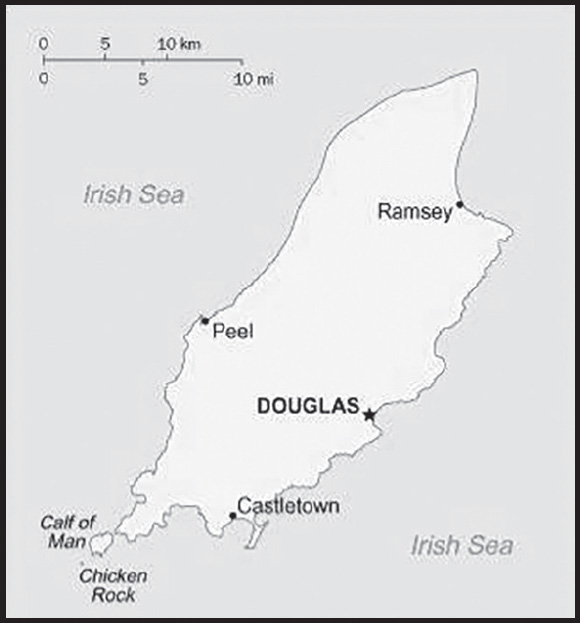
INTRODUCTION
Background: Part of the Norwegian Kingdom of the Hebrides until the 13th century when it was ceded to Scotland, the isle came under English lordship in the 14th century before being purchased by the British Government in 1765. Current concerns include reviving the almost extinct Manx Gaelic language. The Isle of Man is a British Crown dependency, which makes it a self-governing possession of the British Crown that is not part of the UK. The UK Government, however, remains constitutionally responsible for its defense and international representation.
GEOGRAPHY
Location: Western Europe, island in the Irish Sea, between Great Britain and Ireland
Geographic coordinates: 54 15 N, 4 30 W
Map references: Europe
Area: total: 572 sq km
land: 572 sq km
water: 0 sq km
comparison ranking: total 193
Area - comparative: slightly more than three times the size of Washington, DC
Land boundaries: total: 0 km
Coastline: 160 km
Maritime claims: territorial sea: 12 nm
exclusive fishing zone: 12 nm
Climate: temperate; cool summers and mild winters; overcast about a third of the time
Terrain: hills in north and south bisected by central valley
Elevation: highest point: Snaefell 621 m
lowest point: Irish Sea 0 m
Natural resources: none
Land use: agricultural land: 74.7% (2018 est.)
arable land: 43.8% (2018 est.)
permanent crops: 0% (2018 est.)
permanent pasture: 30.9% (2018 est.)
forest: 6.1% (2018 est.)
other: 19.2% (2018 est.)
Population distribution: most people concentrated in cities and large towns of which Douglas, in the southeast, is the largest
Natural hazards: occasional high winds and rough seas
Geography - note: one small islet, the Calf of Man, lies to the southwest and is a bird sanctuary
PEOPLE AND SOCIETY
Population: 91,840 (2023 est.)
comparison ranking: 198
Nationality: noun: Manxman (men), Manxwoman (women)
adjective: Manx
Ethnic groups: White 94.7%, Asian 3.1%, Mixed 1%, Black 0.6%, other 0.4% (2021 est.)
note: data represent population by nationality
Languages: English, Manx Gaelic (about 2% of the population has some knowledge)
Religions: Christian 54.7%, Muslim 0.5%, Buddhist 0.5%, Hindu 0.4%, Jewish 0.2%, none 43.8% (2021 est.)
Age structure: 0-14 years: 16.15% (male 7,715/female 7,114)
15-64 years: 62.09% (male 28,978/female 28,044)
65 years and over: 21.77% (2023 est.) (male 9,408/female 10,581)
Dependency ratios: total dependency ratio: 58.6
youth dependency ratio: 23.6
elderly dependency ratio: 34.9
potential support ratio: 2.9 (2021)
Median age: total: 44.6 years (2020)
male: 43.6 years
female: 45.6 years
comparison ranking: total 12
Population growth rate: 0.48% (2023 est.)
comparison ranking: 154
Birth rate: 10.49 births/1,000 population (2023 est.)
comparison ranking: 179
Death rate: 10.17 deaths/1,000 population (2023 est.)
comparison ranking: 33
Net migration rate: 4.52 migrant(s)/1,000 population (2023 est.)
comparison ranking: 23
Population distribution: most people concentrated in cities and large towns of which Douglas, in the southeast, is the largest
Urbanization: urban population: 53.5% of total population (2023)
rate of urbanization: 0.97% annual rate of change (2020-25 est.)
Major urban areas - population: 27,000 DOUGLAS (capital) (2018)
Sex ratio: at birth: 1.08 male(s)/female
0-14 years: 1.08 male(s)/female
15-64 years: 1.03 male(s)/female
65 years and over: 0.89 male(s)/female
total population: 1.01 male(s)/female (2023 est.)
Infant mortality rate: total: 4.16 deaths/1,000 live births (2023 est.)
male: 4.51 deaths/1,000 live births
female: 3.78 deaths/1,000 live births
comparison ranking: total 185
Life expectancy at birth: total population: 82.25 years (2023 est.)
male: 80.44 years
female: 84.2 years
comparison ranking: total population 29
Total fertility rate: 1.88 children born/woman (2023 est.)
comparison ranking: 130
Gross reproduction rate: 0.91 (2023 est.)
Drinking water source: improved:
total: 99.1% of population
unimproved: total: 0.9% of population (2020)
Youth unemployment rate (ages 15-24): total: 10.1% (2011 est.)
male: 11.8%
female: 8.2%
comparison ranking: total 150
ENVIRONMENT
Environment - current issues: air pollution, marine pollution; waste disposal (both household and industrial)
Climate: temperate; cool summers and mild winters; overcast about a third of the time
Land use: agricultural land: 74.7% (2018 est.)
arable land: 43.8% (2018 est.)
permanent crops: 0% (2018 est.)
permanent pasture: 30.9% (2018 est.)
forest: 6.1% (2018 est.)
other: 19.2% (2018 est.)
Urbanization: urban population: 53.5% of total population (2023)
rate of urbanization: 0.97% annual rate of change (2020-25 est.)
Revenue from forest resources: 0% of GDP (2017 est.)
comparison ranking: 181
Waste and recycling: municipal solid waste generated annually: 50,551 tons (2011 est.)
municipal solid waste recycled annually: 25,276 tons (2011 est.)
percent of municipal solid waste recycled: 50% (2011 est.)
GOVERNMENT
Country name: conventional long form: none
conventional short form: Isle of Man
abbreviation: I.O.M.
etymology: the name “man” may be derived from the Celtic word for “mountain”
Government type: parliamentary democracy (Tynwald)
Dependency status: British crown dependency
Capital: name: Douglas
geographic coordinates: 54 09 N, 4 29 W
time difference: UTC 0 (5 hours ahead of Washington, DC, during Standard Time)
daylight saving time: +1hr, begins last Sunday in March; ends last Sunday in October
etymology: name derives from the Dhoo and Glass Rivers, which flow through the valley in which the town is located and which in Manx mean the “dark” and the “light” rivers respectively
Administrative divisions: none; there are no first-order administrative divisions as defined by the US Government, but there are 24 local authorities each with its own elections
Independence: none (British Crown dependency)
National holiday: Tynwald Day, 5 July (1417); date Tynwald Day was first recorded
Constitution: history: development of the Isle of Man constitution dates to at least the 14th century
amendments: proposed as a bill in the House of Keys, by the “Government,” by a “Member of the House,” or through petition to the House or Legislative Council; passage normally requires three separate readings and approval of at least 13 House members; following both House and Council agreement, assent is required by the lieutenant governor on behalf of the Crown; the constitution has been expanded and amended many times, last in 2020
Legal system: the laws of the UK apply where applicable and include Manx statutes
Citizenship: see United Kingdom
Suffrage: 16 years of age; universal
Executive branch: chief of state: Lord of Mann King CHARLES III (since 8 September 2022); represented by Lieutenant Governor Sir John LORIMER (since 29 September 2021)
head of government: Chief Minister Alfred CANNAN (since 12 October 2021)
cabinet: Council of Ministers appointed by the lieutenant governor
elections/appointments: the monarchy is hereditary; lieutenant governor appointed by the monarch; chief minister indirectly elected by the Tynwald for a 5-year term (eligible for second term); election last held on 23 September 2021 (next to be held in 2026)
election results: 2021: Alfred CANNAN (independent) elected chief minister; Tynwald House of Keys vote - 21 of 24
2016: Howard QUAYLE elected chief minister; Tynwald House of Keys vote - 21 of 33
Legislative branch: description: bicameral Tynwald or the High Court of Tynwald consists of:
Legislative Council (11 seats; includes the President of Tynwald, 2 ex-officio (non-voting) members - the Lord Bishop of Sodor and Man and the attorney general - and 8 members indirectly elected by the House of Keys with renewal of 4 members every 2 years; elected members serve 4-year terms)
House of Keys (24 seats; 2 members each from 12 constituencies directly elected by simple majority vote to serve 5-year terms)
elections:
Legislative Council - last held 14 March 2023 (next to be held by March 2028)
House of Keys - last held on 23 September 2021 (next to be held on 24 September 2026)
election results:
Legislative Council - composition (as of 2022) - men 7, women 3, 1 vacancy; percent of women 30%
House of Keys - percent of vote by party - Liberal Vannin 5.3%, Manx Labour Party 5.1%, Green Party 3.3% independent 86.3%; seats by party - independent 21; Manx Labour Party 2, Liberal Vannin 1; composition – men 14, women 10, percent of women 41.7%; note - total Tynwald percent of women 37.1%
Judicial branch: highest court(s): Isle of Man High Court of Justice (consists of 3 permanent judges or “deemsters” and 1 judge of appeal; organized into the Staff of Government Division or Court of Appeal and the Civil Division); the Court of General Gaol Delivery is not formally part of the High Court but is administered as though part of the High Court and deals with serious criminal cases; note - appeals beyond the Court of Appeal are referred to the Judicial Committee of the Privy Council (in London)
judge selection and term of office: deemsters appointed by the Lord Chancellor of England on the nomination of the lieutenant governor; deemsters can serve until age 70
subordinate courts: High Court; Court of Summary Gaol Delivery; Summary Courts; Magistrate’s Court; specialized courts
Political parties and leaders: Green Party [Andrew LANGAN-NEWTON]
Liberal Vannin Party or LVP [Lawrie HOOPER]
Manx Labor Party [Joney FARAGHER]
Mec Vannin [Mark KERMODE] (sometimes referred to as the Manx Nationalist Party)
note: most members sit as independents
International organization participation: UPU
Diplomatic representation in the US: none (British crown dependency)
Diplomatic representation from the US: embassy: none (British crown dependency)
Flag description: red with the Three Legs of Man emblem (triskelion), in the center; the three legs are joined at the thigh and bent at the knee; in order to have the toes pointing clockwise on both sides of the flag, a two-sided emblem is used; the flag is based on the coat of arms of the last recognized Norse King of Mann, MAGNUS III (r. 1252-65); the triskelion has its roots in an early Celtic sun symbol
National symbol(s): triskelion (a motif of three legs); national colors: red, white
National anthem: name: “Arrane Ashoonagh dy Vannin” (O Land of Our Birth)
lyrics/music: William Henry GILL [English], John J. KNEEN [Manx]/traditional
note: adopted 2003, in use since 1907; serves as a local anthem; as a British Crown dependency, “God Save the King” is official (see United Kingdom) and is played when the sovereign, members of the royal family, or the lieutenant governor are present
ECONOMY
Economic overview: high-income British island economy; known financial services and tourism industries; taxation incentives for technology and financial firms to operate; historic fishing and agriculture industries are declining; major online gambling and film industry locale
Real GDP (purchasing power parity): $6.792 billion (2015 est.)
$7.428 billion (2014 est.)
$6.298 billion (2013 est.)
note: data are in 2014 US dollars
comparison ranking: 171
Real GDP growth rate: 0.25% (2019 est.)
2.21% (2018 est.)
4.69% (2017 est.)
comparison ranking: 192
Real GDP per capita: $84,600 (2014 est.)
$86,200 (2013 est.)
$73,700 (2012 est.)
comparison ranking: 7
GDP (official exchange rate): $6.792 billion (2015 est.)
Inflation rate (consumer prices): 4.1% (2017 est.)
1% (2016 est.)
comparison ranking: 87
Credit ratings: Moody’s rating: Aa3 (2020)
Standard & Poors rating: N/A
GDP - composition, by sector of origin: agriculture: 1% (FY12/13 est.)
industry: 13% (FY12/13 est.)
services: 86% (FY12/13 est.)
comparison rankings: services 17; industry 194; agriculture 199
Agricultural products: cereals, vegetables; cattle, sheep, pigs, poultry
Industries: financial services, light manufacturing, tourism
Industrial production growth rate: -5.1% (2019 est.)
comparison ranking: 188
Labor force: 41,790 (2006)
comparison ranking: 196
Labor force - by occupation: manufacturing: 5% (2006 est.)
construction: 8% (2006 est.)
tourism: 1% (2006 est.)
transport and communications: 9% (2006 est.)
agriculture, forestry, and fishing: 2% (2006 est.)
gas, electricity, and water: 1% (2006 est.)
wholesale and retail distribution: 11% (2006 est.)
professional and scientific services: 20% (2006 est.)
public administration: 7% (2006 est.)
banking and finance: 23% (2006 est.)
entertainment and catering: 5% (2006 est.)
miscellaneous services: 8% (2006 est.)
Unemployment rate: 1.1% (2017 est.)
2% (April 2011 est.)
comparison ranking: 211
Youth unemployment rate (ages 15-24): total: 10.1% (2011 est.)
male: 11.8%
female: 8.2%
comparison ranking: total 150
Budget: revenues: $965 million (FY05/06 est.)
expenditures: $943 million (FY05/06 est.)
Budget surplus (+) or deficit (-): 0.3% (of GDP) (FY05/06 est.)
comparison ranking: 42
Taxes and other revenues: 14.2% (of GDP) (FY05/06 est.)
comparison ranking: 158
Fiscal year: 1 April - 31 March
Exports - partners: almost entirely United Kingdom (2022)
Exports - commodities: crude petroleum, artwork, vegetables, fruits, whiskies (2022)
Imports - partners: almost entirely United Kingdom (2022)
Imports - commodities: ships, delivery trucks (2022)
Exchange rates: Manx pounds (IMP) per US dollar -
Exchange rates: 0.727 (2021 est.)
0.78 (2020 est.)
0.783 (2019 est.)
0.75 (2018 est.)
0.777 (2017 est.)
ENERGY
Electricity access: electrification - total population: 100% (2021)
COMMUNICATIONS
Telecommunication systems: general assessment: the Isle of Man has an extensive communications infrastructure consisting of telephone cables, submarine cables, and an array of television and mobile phone transmitters and towers (2022)
domestic: landline, telefax, mobile cellular telephone system
international: country code - 44; fiber-optic cable, microwave radio relay, satellite earth station, submarine cable
Broadcast media: national public radio broadcasts over 3 FM stations and 1 AM station; 2 commercial broadcasters operating with 1 having multiple FM stations; receives radio and TV services via relays from British TV and radio broadcasters
Internet country code: .im
TRANSPORTATION
Civil aircraft registration country code prefix: M
Airports: 1 (2021)
comparison ranking: total 217
Airports - with paved runways: 1
note: paved runways have a concrete or asphalt surface but not all have facilities for refueling, maintenance, or air traffic control; the length of a runway required for aircraft to safely operate depends on a number of factors including the type of aircraft, the takeoff weight (including passengers, cargo, and fuel), engine types, flap settings, landing speed, elevation of the airport, and average maximum daily air temperature; paved runways can reach a length of 5,000 m (16,000 ft.), but the “typical” length of a commercial airline runway is between 2,500-4,000 m (8,000-13,000 ft.)
Railways: total: 63 km (2008)
narrow gauge: 6 km (2008) 1.076-m gauge (6 km electrified)
57 0.914-mm gauge (29 km electrified)
note: primarily summer tourist attractions
comparison ranking: total 131
Roadways: total: 1,107 km (2022)
paved: 1,107 km
comparison ranking: total 183
Ports and terminals: major seaport(s): Douglas, Ramsey
MILITARY AND SECURITY
Military - note: defense is the responsibility of the UK
TRANSNATIONAL ISSUES
Disputes - international: none identified
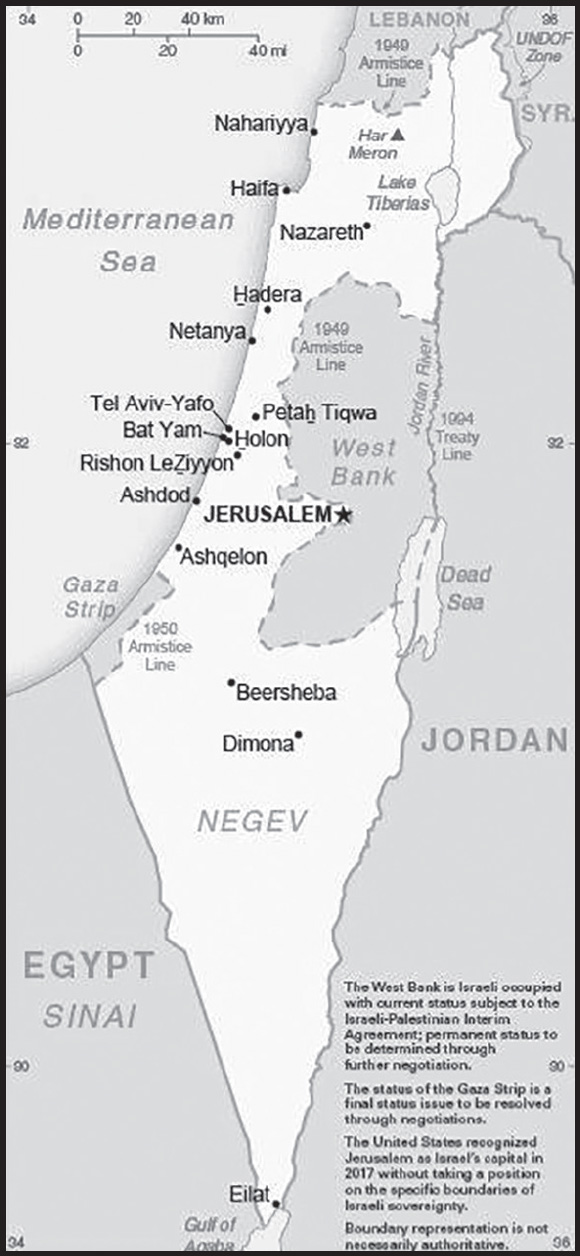
INTRODUCTION
Background: Israel has become a regional economic and military powerhouse, leveraging its prosperous high-tech sector, large defense industry, and concerns about Iran to foster partnerships around the world. The State of Israel was established in 1948. The UN General Assembly had proposed to partition the British Mandate for Palestine into an Arab and Jewish state. Arab states rejected the UN plan and were subsequently defeated militarily in the 1948 war that followed the withdrawal of the British on 14 May 1948. Israel was admitted as a member of the UN in 1949 and saw rapid population growth, primarily due to migration from Europe and the Middle East, over the following years. Israel and its Arab neighbors fought wars in 1967 and 1973 and Israel signed peace treaties with Egypt in 1979 and Jordan in 1994. Israel took control of the West Bank and Gaza Strip in the course of the 1967 war, and subsequently administered those territories through military authorities. Israel and Palestinian officials signed interim agreements in the 1990s that created an interim period of Palestinian self-rule in parts of the West Bank and Gaza. Israel withdrew from Gaza in 2005. While the most recent formal efforts between Israel and the Palestinian Authority to negotiate final status issues occurred in 2013-2014, the US continues its efforts to advance peace. Israel signed the US-brokered normalization agreements (the Abraham Accords) with Bahrain, the UAE, and Morocco in 2020 and reached an agreement with Sudan in 2021. Immigration to Israel continues, with more than 73,000 estimated new immigrants, mostly Jewish, in 2022.
The Israeli economy has undergone a dramatic transformation in the last 30 years, led by cutting-edge, high-tech sectors. Offshore gas discoveries in the Mediterranean, most notably in the Tamar and Leviathan gasfields, place Israel at the center of a potential regional natural gas market. In late 2022, a US-brokered agreement between Israel and Lebanon established their maritime boundary, allowing Israel to begin production on additional gasfields in the Mediterranean. However, Israel’s economic prosperity is not consistently mirrored in the Israeli public’s financial stability. Structural issues such as low labor force participation among religious and minority populations, low workforce productivity, high costs for housing and consumer staples, and high-income inequality, remain a concern for many Israelis and an important consideration for Israeli politicians. Former Prime Minister Benjamin NETANYAHU returned to office in late 2022 continuing his dominance of Israel’s political landscape at the head of Israel’s most rightwing and religious government. NETANYAHU previously served as premier from 2009 to June 2021, becoming Israel’s longest serving prime minister.
On 7 October 2023, Hamas militants inside the Gaza Strip launched a combined unguided rocket and ground attack inside southern Israel, followed soon after by Israeli Defense Forces (IDF) air strikes inside Gaza. The following day, Israeli Prime Minister NETANYAHU formally declared war on Gaza. The IDF, on 28 October, launched a large-scale ground assault inside Gaza.
GEOGRAPHY
Location: Middle East, bordering the Mediterranean Sea, between Egypt and Lebanon
Geographic coordinates: 31 30 N, 34 45 E
Map references: Middle East
Area: total: 21,937 sq km
land: 21,497 sq km
water: 440 sq km
comparison ranking: total 152
Area - comparative: slightly larger than New Jersey
Land boundaries: total: 1,068 km
border countries (6): Egypt 208 km; Gaza Strip 59 km; Jordan 327 km (20 km are within the Dead Sea); Lebanon 81 km; Syria 83 km; West Bank 330 km
Coastline: 273 km
Maritime claims: territorial sea: 12 nm
continental shelf: to depth of exploitation
Climate: temperate; hot and dry in southern and eastern desert areas
Terrain: Negev desert in the south; low coastal plain; central mountains; Jordan Rift Valley
Elevation: highest point: Mitspe Shlagim 2,224 m; note - this is the highest named point, the actual highest point is an unnamed dome slightly to the west of Mitspe Shlagim at 2,236 m; both points are on the northeastern border of Israel, along the southern end of the Anti-Lebanon mountain range
lowest point: Dead Sea -431 m
mean elevation: 508 m
Natural resources: timber, potash, copper ore, natural gas, phosphate rock, magnesium bromide, clays, sand
Land use: agricultural land: 23.8% (2018 est.)
arable land: 13.7% (2018 est.)
permanent crops: 3.8% (2018 est.)
permanent pasture: 6.3% (2018 est.)
forest: 7.1% (2018 est.)
other: 69.1% (2018 est.)
Irrigated land: 2,159 sq km (2020)
Major lakes (area sq km): salt water lake(s): Dead Sea (shared with Jordan and West Bank) - 1,020 sq km
note – endorheic hypersaline lake; 9.6 times saltier than the ocean; lake shore is 431 meters below sea level
Population distribution: population concentrated in and around Tel-Aviv, as well as around the Sea of Galilee; the south remains sparsely populated with the exception of the shore of the Gulf of Aqaba
Natural hazards: sandstorms may occur during spring and summer; droughts; periodic earthquakes
Geography - note: note 1: Lake Tiberias (Sea of Galilee) is an important freshwater source; the Dead Sea is the second saltiest body of water in the world (after Lake Assal in Djibouti)
note 2: the Malham Cave in Mount Sodom is the world’s longest salt cave at 10 km (6 mi); its survey is not complete and its length will undoubtedly increase; Mount Sodom is actually a hill some 220 m (722 ft) high that is 80% salt (multiple salt layers covered by a veneer of rock)
note 3: in March 2019, there were 380 Israeli settlements, to include 213 settlements and 132 outposts in the West Bank, and 35 settlements in East Jerusalem; there are no Israeli settlements in the Gaza Strip, as all were evacuated in 2005 (2019)
PEOPLE AND SOCIETY
Population: 9,043,387 (2023 est.) (includes populations of the Golan Heights or Golan Sub-District and also East Jerusalem, which was annexed by Israel after 1967)
note: approximately 236,600 Israeli settlers live in East Jerusalem (2021); following the March 2019 US recognition of the Golan Heights as being part of Israel, The World Factbook no longer includes Israeli settler population of the Golan Heights (estimated at 23,400 in 2019) in its overall Israeli settler total
comparison ranking: 98
Nationality: noun: Israeli(s)
adjective: Israeli
Ethnic groups: Jewish 73.5% (of which Israel-born 79.7%, Europe/America/Oceania-born 14.3%, Africa-born 3.9%, Asia-born 2.1%), Arab 21.1%, other 5.4% (2022 est.)
Languages: Hebrew (official), Arabic (special status under Israeli law), English (most commonly used foreign language)
major-language sample(s):

(Hebrew)
Religions: Jewish 73.5%, Muslim 18.1%, Christian 1.9%, Druze 1.6%, other 4.9% (2022 est.)
Age structure: 0-14 years: 25.96% (male 1,200,721/female 1,146,556)
15-64 years: 61.66% (male 2,839,124/female 2,737,054)
65 years and over: 12.38% (2023 est.) (male 506,536/female 613,396)
Dependency ratios: total dependency ratio: 66.9
youth dependency ratio: 47
elderly dependency ratio: 19.9
potential support ratio: 5 (2021 est.)
Median age: total: 30.4 years (2020)
male: 29.8 years
female: 31 years
comparison ranking: total 121
Population growth rate: 1.43% (2023 est.)
comparison ranking: 66
Birth rate: 17.3 births/1,000 population (2023 est.)
comparison ranking: 87
Death rate: 5.05 deaths/1,000 population (2023 est.)
comparison ranking: 191
Net migration rate: 1.99 migrant(s)/1,000 population (2023 est.)
comparison ranking: 49
Population distribution: population concentrated in and around Tel-Aviv, as well as around the Sea of Galilee; the south remains sparsely populated with the exception of the shore of the Gulf of Aqaba
Urbanization: urban population: 92.9% of total population (2023)
rate of urbanization: 1.51% annual rate of change (2020-25 est.)
Major urban areas - population: 4.421 million Tel Aviv-Yafo, 1.174 million Haifa, 970,000 JERUSALEM (capital) (2023)
Sex ratio: at birth: 1.05 male(s)/female
0-14 years: 1.05 male(s)/female
15-64 years: 1.04 male(s)/female
65 years and over: 0.83 male(s)/female
total population: 1.01 male(s)/female (2023 est.)
Mother’s mean age at first birth: 27.7 years (2019 est.)
Maternal mortality ratio: 3 deaths/100,000 live births (2020 est.)
comparison ranking: 178
Infant mortality rate: total: 3.49 deaths/1,000 live births (2023 est.)
male: 3.75 deaths/1,000 live births
female: 3.22 deaths/1,000 live births
comparison ranking: total 196
Life expectancy at birth: total population: 83.54 years (2023 est.)
male: 81.65 years
female: 85.53 years
comparison ranking: total population 10
Total fertility rate: 2.54 children born/woman (2023 est.)
comparison ranking: 67
Gross reproduction rate: 1.24 (2023 est.)
Drinking water source: improved:
total: 100% of population
unimproved: total: 0% of population (2020 est.)
Current health expenditure: 8.3% of GDP (2020)
Physicians density: 3.63 physicians/1,000 population (2020)
Hospital bed density: 3 beds/1,000 population (2018)
Sanitation facility access: improved: urban: 100% of population
rural: 99.3% of population
total: 99.9% of population
unimproved: urban: 0% of population
rural: 0.7% of population
total: 0.1% of population (2020 est.)
Major infectious diseases: note: on 31 August 2023, the US Centers for Disease Control and Prevention (CDC) issued a Travel Alert for polio in Asia; Israel is currently considered a high risk to travelers for circulating vaccine-derived polioviruses (cVDPV); vaccine-derived poliovirus (VDPV) is a strain of the weakened poliovirus that was initially included in oral polio vaccine (OPV) and that has changed over time and behaves more like the wild or naturally occurring virus; this means it can be spread more easily to people who are unvaccinated against polio and who come in contact with the stool or respiratory secretions, such as from a sneeze, of an “infected” person who received oral polio vaccine; the CDC recommends that before any international travel, anyone unvaccinated, incompletely vaccinated, or with an unknown polio vaccination status should complete the routine polio vaccine series; before travel to any high-risk destination, the CDC recommends that adults who previously completed the full, routine polio vaccine series receive a single, lifetime booster dose of polio vaccine
Obesity - adult prevalence rate: 26.1% (2016)
comparison ranking: 45
Alcohol consumption per capita: total: 3.07 liters of pure alcohol (2019 est.)
beer: 1.78 liters of pure alcohol (2019 est.)
wine: 0.08 liters of pure alcohol (2019 est.)
spirits: 1.16 liters of pure alcohol (2019 est.)
other alcohols: 0.04 liters of pure alcohol (2019 est.)
comparison ranking: total 112
Tobacco use: total: 21.2% (2020 est.)
male: 28.9% (2020 est.)
female: 13.5% (2020 est.)
comparison ranking: total 77
Currently married women (ages 15-49): 51.7% (2023 est.)
Education expenditures: 7.1% of GDP (2020 est.)
comparison ranking: 19
Literacy: definition: age 15 and over can read and write
total population: 97.8%
male: 98.7%
female: 96.8% (2011)
School life expectancy (primary to tertiary education): total: 16 years
male: 15 years
female: 17 years (2020)
Youth unemployment rate (ages 15-24): total: 8.8% (2021 est.)
male: 8.4%
female: 9.2%
comparison ranking: total 165
ENVIRONMENT
Environment - current issues: limited arable land and restricted natural freshwater resources; desertification; air pollution from industrial and vehicle emissions; groundwater pollution from industrial and domestic waste, chemical fertilizers, and pesticides
Environment - international agreements: party to: Biodiversity, Climate Change, Climate Change-Kyoto Protocol, Climate Change-Paris Agreement, Desertification, Endangered Species, Hazardous Wastes, Nuclear Test Ban, Ozone Layer Protection, Ship Pollution, Wetlands, Whaling
signed, but not ratified: Comprehensive Nuclear Test Ban, Marine Life Conservation
Climate: temperate; hot and dry in southern and eastern desert areas
Land use: agricultural land: 23.8% (2018 est.)
arable land: 13.7% (2018 est.)
permanent crops: 3.8% (2018 est.)
permanent pasture: 6.3% (2018 est.)
forest: 7.1% (2018 est.)
other: 69.1% (2018 est.)
Urbanization: urban population: 92.9% of total population (2023)
rate of urbanization: 1.51% annual rate of change (2020-25 est.)
Revenue from forest resources: 0% of GDP (2018 est.)
comparison ranking: 175
Revenue from coal: 0% of GDP (2018 est.)
comparison ranking: 170
Air pollutants: particulate matter emissions: 19.47 micrograms per cubic meter (2019 est.)
carbon dioxide emissions: 65.17 megatons (2016 est.)
methane emissions: 13.02 megatons (2020 est.)
Waste and recycling: municipal solid waste generated annually: 5.4 million tons (2015 est.)
municipal solid waste recycled annually: 1.35 million tons (2017 est.)
percent of municipal solid waste recycled: 25% (2017 est.)
Major lakes (area sq km): salt water lake(s): Dead Sea (shared with Jordan and West Bank) - 1,020 sq km
note – endorheic hypersaline lake; 9.6 times saltier than the ocean; lake shore is 431 meters below sea level
Total water withdrawal: municipal: 1 billion cubic meters (2020 est.)
industrial: 100 million cubic meters (2020 est.)
agricultural: 1.2 billion cubic meters (2020 est.)
Total renewable water resources: 1.78 billion cubic meters (2020 est.)
GOVERNMENT
Country name: conventional long form: State of Israel
conventional short form: Israel
local long form: Medinat Yisra’el
local short form: Yisra’el
former: Mandatory Palestine
etymology: named after the ancient Kingdom of Israel; according to Biblical tradition, the Jewish patriarch Jacob received the name “Israel” (“He who struggles with God”) after he wrestled an entire night with an angel of the Lord; Jacob’s 12 sons became the ancestors of the Israelites, also known as the Twelve Tribes of Israel, who formed the Kingdom of Israel
Government type: parliamentary democracy
Capital: name: Jerusalem; note - the US recognized Jerusalem as Israel’s capital in December 2017 without taking a position on the specific boundaries of Israeli sovereignty
geographic coordinates: 31 46 N, 35 14 E
time difference: UTC+2 (7 hours ahead of Washington, DC, during Standard Time)
daylight saving time: +1hr, Friday before the last Sunday in March; ends the last Sunday in October
etymology: Jerusalem’s settlement may date back to 2800 B.C.; it is named Urushalim in Egyptian texts of the 14th century B.C.; uru-shalim likely means “foundation of [by] the god Shalim”, and derives from Hebrew/Semitic yry, “to found or lay a cornerstone”, and Shalim, the Canaanite god of dusk and the nether world; Shalim was associated with sunset and peace and the name is based on the same S-L-M root from which Semitic words for “peace” are derived (Salam or Shalom in modern Arabic and Hebrew); this confluence has thus led to naming interpretations such as “The City of Peace” or “The Abode of Peace”
Administrative divisions: 6 districts (mehozot, singular - mehoz); Central, Haifa, Jerusalem, Northern, Southern, Tel Aviv
Independence: 14 May 1948 (following League of Nations mandate under British administration)
National holiday: Independence Day, 14 May (1948); note - Israel declared independence on 14 May 1948, but the Jewish calendar is lunar and the holiday may occur in April or May
Constitution: history: no formal constitution; some functions of a constitution are filled by the Declaration of Establishment (1948), the Basic Laws, and the Law of Return (as amended)
amendments: proposed by Government of Israel ministers or by the Knesset; passage requires a majority vote of Knesset members and subject to Supreme Court judicial review; 11 of the 13 Basic Laws have been amended at least once, latest in 2020 (Basic Law: the Knesset)
Legal system: mixed legal system of English common law, British Mandate regulations, and Jewish, Christian, and Muslim religious laws
International law organization participation: has not submitted an ICJ jurisdiction declaration; withdrew acceptance of ICCt jurisdiction in 2002
Citizenship: citizenship by birth: no
citizenship by descent only: at least one parent must be a citizen of Israel
dual citizenship recognized: yes, but naturalized citizens are not allowed to maintain dual citizenship
residency requirement for naturalization: 3 out of the 5 years preceding the application for naturalization
note: Israeli law (Law of Return, 5 July 1950) provides for the granting of citizenship to any Jew - defined as a person being born to a Jewish mother or having converted to Judaism while renouncing any other religion - who immigrates to and expresses a desire to settle in Israel on the basis of the Right of aliyah; the 1970 amendment of this act extended the right to family members including the spouse of a Jew, any child or grandchild, and the spouses of children and grandchildren
Suffrage: 18 years of age; universal; 17 years of age for municipal elections
Executive branch: chief of state: President Isaac HERZOG (since 7 July 2021)
head of government: Prime Minister Benyamin NETANYAHU (since 29 December 2022)
cabinet: Cabinet selected by prime minister and approved by the Knesset
elections/appointments: president indirectly elected by the Knesset for a single 7-year term; election last held on 2 June 2021 (next to be held in June 2028); following legislative elections, the president, in consultation with party leaders, tasks a Knesset member (usually the member of the largest party) with forming a new government
election results:
2021: Isaac HERZOG elected president; Knesset vote - Isaac HERZOG (independent) 87, Miriam PERETZ (independent) 26, invalid/blank 7
2014: Reuven RIVLIN elected president in second round; Knesset vote - Reuven RIVLIN (Likud) 63, Meir SHEETRIT (The Movement) 53, other/invalid 4
Legislative branch: description: unicameral Knesset (120 seats; members directly elected in a single nationwide constituency by closed party- list proportional representation vote, with a 3.25% vote threshold to gain representation; members serve 4-year terms)
elections: last held on 1 November 2022 (next to be held in November 2026)
election results: percent by party - Likud 23.4%, Yesh Atid 17.8%, Religious Zionism (electoral alliance of Religious Zionist Party, Jewish Strength, and Noam) 10.8%, National Unity 9.1%, Shas 8.2%, UTJ 5.9%, Yisrael Beiteinu 4.5%, United Arab List 4.1%, Hadash-Ta’al 3.8%, Labor 3.7%, Meretz 3.2%, other 1.6%; seats by party - Likud 32, Yesh Atid 24, Religious Zionism 14, National Unity 12, Shas 11, UTJ 7, Yisrael Beiteinu 6, Hadash-Ta’al 5, United Arab List 5, Labor 4; composition - men 91, women 29, percentage of women 24.2%; note - following the 1 November 2022 election, the Religious Zionism Alliance split into three parties in the Knesset: Religious Zionism 7 seats, Jewish Power (Otzma Yehudit) 6, and Noam 1
Judicial branch: highest court(s): Supreme Court (consists of the president, deputy president, 13 justices, and 2 registrars) and normally sits in panels of 3 justices; in special cases, the panel is expanded with an uneven number of justices
judge selection and term of office: judges selected by the 9-member Judicial Selection Committee, consisting of the Minister of Justice (chair), the president of the Supreme Court, two other Supreme Court justices, 1 other Cabinet minister, 2 Knesset members, and 2 representatives of the Israel Bar Association; judges can serve up to mandatory retirement at age 70
subordinate courts: district and magistrate courts; national and regional labor courts; family and juvenile courts; special and Rabbinical courts
Political parties and leaders: Balad [Sami Abu SHEHADEH]
Blue and White [Benny GANTZ]
Hadash [Ayman ODEH]
Jewish Power (Otzma Yehudit) [Ben GVIR]
Joint Arab List [Ayman ODEH] (alliance includes Hadash, Ta’al, Balad)
Labor Party or HaAvoda [Merav MICHAELI]
Likud [Binyamin NETANYAHU]
Meretz [Zehava GAL-ON]
National Unity [alliance includes Blue and White and New Hope]
ope [Gideon SA’AR]
Noam [Rabbi Dror ARYEH]
Religious Zionism [Bezalel SMOTRICH] (election alliance of Religious Zionist Party, Jewish Power (Otzma Yehudit), and Noam)
Religious Zionist Party [Bezalel SMOTRICH]
SHAS [Aryeh DERI]
Ta’al [Ahmad TIBI]
United Arab List [Mansour ABBAS]
United Torah Judaism or UTJ [Moshe GAFNI] (alliance includes Agudat Israel and Degel HaTorah)
Yamina [Ayelet SHAKED]
Yesh Atid [Yair LAPID]
Yisrael Beiteinu [Avigdor LIEBERMAN]
International organization participation: BIS, BSEC (observer), CE (observer), CERN, CICA, EBRD, FAO, IADB, IAEA, IBRD, ICAO, ICC (national committees), ICRM, IDA, IFAD, IFC, IFRCS, ILO, IMF, IMO, IMSO, Interpol, IOC, IOM, IPU, ISO, ITSO, ITU, ITUC (NGOs), MIGA, OAS (observer), OECD, OPCW (signatory), OSCE (partner), Pacific Alliance (observer), Paris Club, PCA, SELEC (observer), UN, UNCTAD, UNESCO, UNHCR, UNIDO, UNWTO, UPU, WCO, WHO, WIPO, WMO, WTO
Diplomatic representation in the US: chief of mission: Ambassador Michael HERZOG (since 1 December 2021)
chancery: 3514 International Drive NW, Washington, DC 20008
telephone: [1] (202) 364-5500
FAX: [1] (202) 364-5607
email address and website:
consular@washington.mfa.gov.il
https://embassies.gov.il/washington/Pages/default.aspx
consulate(s) general: Atlanta, Boston, Chicago, Houston, Los Angeles, Miami, New York, San Francisco
Diplomatic representation from the US: chief of mission: Ambassador Jacob J. LEW (since 5 November 2023)
embassy: 14 David Flusser Street, Jerusalem, 9378322
mailing address: 6350 Jerusalem Place, Washington DC 20521-6350
telephone: [972] (2) 630-4000
FAX: [972] (2) 630-4070
email address and website:
branch office(s): Tel Aviv
note: on 14 May 2018, the US Embassy relocated to Jerusalem from Tel Aviv; on 4 March 2019, Consulate General Jerusalem merged into US Embassy Jerusalem to form a single diplomatic mission
Flag description: white with a blue hexagram (six-pointed linear star) known as the Magen David (Star of David or Shield of David) centered between two equal horizontal blue bands near the top and bottom edges of the flag; the basic design resembles a traditional Jewish prayer shawl (tallit), which is white with blue stripes; the hexagram as a Jewish symbol dates back to medieval times
note: the Israeli flag proclamation states that the flag colors are sky blue and white, but the exact shade of blue has never been set and can vary from a light to a dark blue
National symbol(s): Star of David (Magen David), menorah (seven-branched lampstand); national colors: blue, white
National anthem: name: “Hatikvah” (The Hope)
lyrics/music: Naftali Herz IMBER/traditional, arranged by Samuel COHEN
note: adopted 2004, unofficial since 1948; used as the anthem of the Zionist movement since 1897; the 1888 arrangement by Samuel COHEN is thought to be based on the Romanian folk song “Carul cu boi” (The Ox Driven Cart)
National heritage: total World Heritage Sites: 9 (all cultural)
selected World Heritage Site locales: Masada; Old City of Acre; White City of Tel-Aviv - the Modern Movement; Biblical Tels - Megiddo, Hazor, Beer Sheba; Incense Route - Desert Cities in the Negev; Bahá’i Holy Places; Sites of Human Evolution at Mount Carmel; Caves of Maresha and Bet-Guvrin; Necropolis of Bet She’arim
ECONOMY
Economic overview: high-income, technology- and industrial-based economy; highly dense, fast-growing labor force; recent debt spikes; persistent inequality and poverty; significant tariff and regulatory burdens, especially in agriculture; quantitative easing in effect
Real GDP (purchasing power parity): $393.861 billion (2021 est.)
$362.632 billion (2020 est.)
$369.494 billion (2019 est.)
note: data are in 2017 dollars
comparison ranking: 48
Real GDP growth rate: 8.61% (2021 est.)
-1.86% (2020 est.)
4.16% (2019 est.)
comparison ranking: 34
Real GDP per capita: $42,100 (2021 est.)
$39,400 (2020 est.)
$40,800 (2019 est.)
note: data are in 2017 dollars
comparison ranking: 43
GDP (official exchange rate): $394.93 billion (2019 est.)
Inflation rate (consumer prices): 1.49% (2021 est.)
-0.59% (2020 est.)
0.84% (2019 est.)
comparison ranking: 182
Credit ratings: Fitch rating: A+ (2016)
Moody’s rating: A1 (2008)
Standard & Poors rating: AA- (2018)
note: the year refers to the year in which the current credit rating was first obtained.
GDP - composition, by sector of origin: agriculture: 2.4% (2017 est.)
industry: 26.5% (2017 est.)
services: 69.5% (2017 est.)
comparison rankings: services 73; industry 102; agriculture 163
GDP - composition, by end use: household consumption: 55.1% (2017 est.)
government consumption: 22.8% (2017 est.)
investment in fixed capital: 20.1% (2017 est.)
investment in inventories: 0.7% (2017 est.)
exports of goods and services: 28.9% (2017 est.)
imports of goods and services: -27.5% (2017 est.)
Agricultural products: milk, potatoes, poultry, tomatoes, carrots, turnips, tangerines/mandarins, green chillies/peppers, eggs, vegetables
Industries: high-technology products (including aviation, communications, computer-aided design and manufactures, medical electronics, fiber optics), wood and paper products, potash and phosphates, food, beverages, and tobacco, caustic soda, cement, pharmaceuticals, construction, metal products, chemical products, plastics, cut diamonds, textiles, footwear
Industrial production growth rate: 6.05% (2021 est.)
comparison ranking: 73
Labor force: 4.186 million (2021 est.)
comparison ranking: 96
Labor force - by occupation: agriculture: 1.1%
industry: 17.3%
services: 81.6% (2015 est.)
Unemployment rate: 5.05% (2021 est.)
4.33% (2020 est.)
3.8% (2019 est.)
comparison ranking: 150
Youth unemployment rate (ages 15-24): total: 8.8% (2021 est.)
male: 8.4%
female: 9.2%
comparison ranking: total 165
Population below poverty line: 22% (2014 est.)
note: Israel’s poverty line is $7.30 per person per day
Gini Index coefficient - distribution of family income: 38.6 (2018 est.)
comparison ranking: 66
Average household expenditures: on food: 16.2% of household expenditures (2018 est.)
on alcohol and tobacco: 2.9% of household expenditures (2018 est.)
Household income or consumption by percentage share: lowest 10%: 1.7%
highest 10%: 31.3% (2010)
Budget: revenues: $139.374 billion (2019 est.)
expenditures: $154.927 billion (2019 est.)
Budget surplus (+) or deficit (-): -2% (of GDP) (2017 est.)
comparison ranking: 104
Public debt: 72.6% of GDP (2020 est.)
59.6% of GDP (2019 est.)
60.4% of GDP (2018 est.)
comparison ranking: 52
Taxes and other revenues: 21.9% (of GDP) (2020 est.)
comparison ranking: 72
Fiscal year: calendar year
Current account balance: $21.09 billion (2021 est.)
$22.486 billion (2020 est.)
$14.747 billion (2019 est.)
comparison ranking: 22
Exports: $143.884 billion (2021 est.)
$114.422 billion (2020 est.)
$117.779 billion (2019 est.)
note: data are in current year dollars
comparison ranking: 38
Exports - partners: United States 27%, China 8%, India 4%, Germany 3%, Ireland 3% (2021)
note: Approximately, 6% of Israel’s exports went to the Gaza Strip and West Bank, but official data are not available individually for the Palestinian territories.
Exports - commodities: diamonds, integrated circuits, refined petroleum, medical instruments, packaged medicines, measuring instruments (2021)
Imports: $124.578 billion (2021 est.)
$95.977 billion (2020 est.)
$108.784 billion (2019 est.)
note: data are in current year dollars
comparison ranking: 40
Imports - partners: United States 12%, China 11%, Germany 7.5%, Switzerland 7%, Turkey 6% (2020)
Imports - commodities: diamonds, cars, crude petroleum, refined petroleum, broadcasting equipment (2021)
Reserves of foreign exchange and gold: $212.934 billion (31 December 2021 est.)
$173.292 billion (31 December 2020 est.)
$126.008 billion (31 December 2019 est.)
comparison ranking: 17
Debt - external: $132.5 billion (31 December 2020 est.)
$99.886 billion (2019 est.)
$94.247 billion (2018 est.)
comparison ranking: 48
Exchange rates: new Israeli shekels (ILS) per US dollar -
Exchange rates: 3.23 (2021 est.)
3.442 (2020 est.)
3.565 (2019 est.)
3.591 (2018 est.)
3.6 (2017 est.)
ENERGY
Electricity access: electrification - total population: 100% (2021)
Electricity: installed generating capacity: 18.993 million kW (2020 est.)
consumption: 59,192,500,000 kWh (2019 est.)
exports: 6.243 billion kWh (2020 est.)
imports: 0 kWh (2020 est.)
transmission/distribution losses: 2.642 billion kWh (2019 est.)
comparison rankings: imports 175; exports 30; installed generating capacity 50; transmission/distribution losses 73; consumption 46
Electricity generation sources: fossil fuels: 93.7% of total installed capacity (2020 est.)
solar: 5.9% of total installed capacity (2020 est.)
wind: 0.3% of total installed capacity (2020 est.)
Coal: production: 0 metric tons (2020 est.)
consumption: 5.089 million metric tons (2020 est.)
exports: 0 metric tons (2020 est.)
imports: 5.565 million metric tons (2020 est.)
proven reserves: 0 metric tons (2019 est.)
Petroleum: total petroleum production: 0 bbl/day (2021 est.)
refined petroleum consumption: 232,400 bbl/day (2019 est.)
crude oil and lease condensate exports: 0 bbl/day (2018 est.)
crude oil and lease condensate imports: 232,900 bbl/day (2018 est.)
crude oil estimated reserves: 12.7 million barrels (2021 est.)
Refined petroleum products - production: 294,300 bbl/day (2017 est.)
comparison ranking: 42
Refined petroleum products - exports: 111,700 bbl/day (2017 est.)
comparison ranking: 39
Refined petroleum products - imports: 98,860 bbl/day (2017 est.)
comparison ranking: 54
Natural gas: production: 10.474 billion cubic meters (2019 est.)
consumption: 9.442 billion cubic meters (2019 est.)
exports: 0 cubic meters (2021 est.)
imports: 820.508 million cubic meters (2019 est.)
proven reserves: 176.017 billion cubic meters (2021 est.)
Carbon dioxide emissions: 61.092 million metric tonnes of CO2 (2019 est.)
from coal and metallurgical coke: 13.653 million metric tonnes of CO2 (2019 est.)
from petroleum and other liquids: 29.416 million metric tonnes of CO2 (2019 est.)
from consumed natural gas: 18.023 million metric tonnes of CO2 (2019 est.)
comparison ranking: total emissions 53
Energy consumption per capita: 113.273 million Btu/person (2019 est.)
comparison ranking: 47
COMMUNICATIONS
Telephones - fixed lines: total subscriptions: 3.5 million (2021 est.)
subscriptions per 100 inhabitants: 39 (2021 est.)
comparison ranking: total subscriptions 35
Telephones - mobile cellular: total subscriptions: 12.5 million (2021 est.)
subscriptions per 100 inhabitants: 140 (2021 est.)
comparison ranking: total subscriptions 79
Telecommunication systems: general assessment: Israel’s developed economy largely revolves around high technology products and services, primarily used in the medical, biotechnology, agricultural, materials, and military industries; the country also attracts investment in its cyber-security industry, and has established itself as a hub for thousands of start-up companies; to underpin these developments, Israel has developed a robust telecoms sector; household broadband subscriptions is high, with a focus on fiber-network deployment; LTE services are almost universally available, while the August 2020 multi-frequency bands also enabled the MNOs to provide services based on 5G; 5G will be supported by moves to close down GSM and 3G networks in stages through to the end of 2025, with the physical assets and frequencies to be repurposed for LTE and 5G use (2023)
domestic: fixed-line nearly 39 per 100 and nearly 140 per 100 for mobile-cellular subscriptions (2021)
international: country code - 972; landing points for the MedNautilus Submarine System, Tameres North, Jonah and Lev Submarine System, submarine cables that provide links to Europe, Cyprus, and parts of the Middle East; satellite earth stations - 3 Intelsat (2 Atlantic Ocean and 1 Indian Ocean) (2019)
Broadcast media: the Israel Broadcasting Corporation (est 2015) broadcasts on 3 channels, two in Hebrew and the other in Arabic; multi- channel satellite and cable TV packages provide access to foreign channels; the Israeli Broadcasting Corporation broadcasts on 8 radio networks with multiple repeaters and Israel Defense Forces Radio broadcasts over multiple stations; about 15 privately owned radio stations; overall more than 100 stations and repeater stations (2019)
Internet country code: .il
Internet users: total: 8.01 million (2021 est.)
percent of population: 90% (2021 est.)
comparison ranking: total 74
Broadband - fixed subscriptions: total: 2,602,079 (2020 est.)
subscriptions per 100 inhabitants: 30 (2020 est.)
comparison ranking: total 50
TRANSPORTATION
National air transport system: number of registered air carriers: 6 (2020)
inventory of registered aircraft operated by air carriers: 64
annual passenger traffic on registered air carriers: 7,404,373 (2018)
annual freight traffic on registered air carriers: 994.54 million (2018) mt-km
Civil aircraft registration country code prefix: 4X
Airports: 42 (2021)
comparison ranking: total 101
Airports - with paved runways: 33
note: paved runways have a concrete or asphalt surface but not all have facilities for refueling, maintenance, or air traffic control; the length of a runway required for aircraft to safely operate depends on a number of factors including the type of aircraft, the takeoff weight (including passengers, cargo, and fuel), engine types, flap settings, landing speed, elevation of the airport, and average maximum daily air temperature; paved runways can reach a length of 5,000 m (16,000 ft.), but the “typical” length of a commercial airline runway is between 2,500-4,000 m (8,000-13,000 ft.)
Airports - with unpaved runways: 9
note: unpaved runways have a surface composition such as grass or packed earth and are most suited to the operation of light aircraft; unpaved runways are usually short, often less than 1,000 m (3,280 ft.) in length; airports with unpaved runways often lack facilities for refueling, maintenance, or air traffic control
Heliports: 3 (2021)
Pipelines: 763 km gas, 442 km oil, 261 km refined products (2013)
Railways: total: 1,497 km (2021) (2019)
standard gauge: 1,497 km (2021) 1.435-m gauge
comparison ranking: total 82
Roadways: total: 20,391 km (2021)
paved: 20,391 km (2021) (includes 449 km of expressways)
comparison ranking: total 112
Merchant marine: total: 45 (2022)
by type: container ship 6, general cargo 2, oil tanker 4, other 33
comparison ranking: total 123
Ports and terminals: major seaport(s): Ashdod, Elat (Eilat), Hadera, Haifa
container port(s) (TEUs): Ashdod (1,584,000) (2019)
LNG terminal(s) (import): Hadera
MILITARY AND SECURITY
Military and security forces: Israel Defense Forces (IDF): Ground Forces, Israel Naval Force (IN, includes commandos), Israel Air Force (IAF, includes air defense) (2023)
note 1: the national police, including the border police and the immigration police, are under the authority of the Ministry of Public Security
note 2: the Israeli Security Agency (ISA) is charged with combating terrorism and espionage in Israel and the West Bank and Gaza Strip; it is under the authority of the Prime Minister; ISA forces operating in the West Bank fall under the IDF for operations and operational debriefing
Military expenditures: 4.5% of GDP (2022 est.)
5% of GDP (2021 est.)
5% of GDP (2020 est.)
5.2% of GDP (2019 est.)
5.3% of GDP (2018 est.)
comparison ranking: 12
Military and security service personnel strengths: approximately 170,000 active-duty personnel (130,000 Ground Forces; 10,000 Naval; 30,000 Air Force) (2023)
Military equipment inventories and acquisitions: the majority of the IDF’s inventory is comprised of weapons that are domestically produced or imported from Europe and the US; the US has been the leading supplier of arms in recent years; Israel has a broad defense industrial base that can develop, produce, support, and sustain a wide variety of weapons systems for both domestic use and export, particularly armored vehicles, unmanned aerial systems, air defense, and guided missiles (2023)
Military service age and obligation: 18 years of age for compulsory military service; 17 years of age for voluntary military service; Jews and Druze can be conscripted; Christians, Circassians, and Muslims may volunteer; both sexes are obligated to military service; conscript service obligation is 32 months for enlisted men and about 24 months for enlisted women (varies based on military occupation); officers serve 48 months; Air Force pilots commit to 9 years of service; reserve obligation to age 41-51 (men), age 24 (women) (2023)
note 1: women have served in the Israeli military since its establishment in 1948; as of 2021, women made up about 35% of IDF personnel; more than 90% of military specialties, including combat specialties, were open to women and more than 3,000 women were serving in combat units; the IDF’s first mixed-gender infantry unit, the Caracal Battalion, was established in 2004
note 2: conscripts comprise about 70% of the IDF active-duty ground forces
note 3: the IDF recruits non-Israeli Jews and non-Jews with a minimum of one Jewish grandparent, as well as converts to Judaism; each year the IDF brings in about 800-1,000 foreign recruits from around the world
Military - note: the United Nations Disengagement Observer Force (UNDOF) has operated in the Golan between Israel and Syria since 1974 to monitor the ceasefire following the 1973 Arab-Israeli War and supervise the areas of separation between the two countries; UNDOF consists of about 1,000 military personnel
the IDF is responsible for external defense but also has some domestic security responsibilities; its primary operational focuses include the threat posed by Iran, instability in Syria, and terrorist organizations, including HAMAS and Hizballah, both of which are backed by Iran, Palestine Islamic Jihad (PIJ), and the Islamic State of Iraq and ash-Sham; it has considerable experience in conventional and unconventional warfare; since the country’s founding in 1948, the IDF has been in conflicts against one or more of its Arab neighbors in 1948-49, 1956, 1967, 1967-70 (“War of Attrition”), 1973, 1982, and 2006; it bombed nuclear sites in Iraq in 1981 and Syria in 2007, and since the outbreak of the Syrian civil war in 2011, has conducted numerous air strikes in Syria against Iranian, Iranian-backed militia, and Hizballah forces, and Syrian Government targets; over the same period, the IDF has carried out strikes against Hizballah in Lebanon in response to attacks on Israeli territory; these strikes followed an Israeli invasion of Lebanon in 2006, also to suppress Hizballah attacks; the IDF has conducted operations against HAMAS and PIJ, which operate out of the Gaza Strip and have launched numerous rocket attacks against Israel; HAMAS and Israel fought an 11-day conflict in 2021, which ended in an informal truce, although sporadic clashes continue; the IDF also has conducted security operations against Palestinians in the Israeli-occupied territories of East Jerusalem and the West Bank
since its creation from armed Jewish militias in the midst of the First Arab-Israeli War in 1948-49, the IDF, particularly the Ground Force, has been guided by a requirement to rapidly mobilize and defend the country’s territory from numerically superior neighboring countries; the Ground Force has a relatively small active combat force of approximately 10 armored, mechanized infantry, paratrooper, and commandos/special forces brigades, plus an artillery corps, that is backed up by a large force of trained reserves—more than 400,000 personnel—that can be mobilized rapidly into dozens of combat brigades; the Ground Force also controls Israel’s ballistic missile force; the Air Force has approximately 250 modern US-made combat aircraft, as well as one of the world’s most advanced theater missile defense systems; the Navy is largely a coastal defense force with a small but growing and largely modern inventory; its primary surface warships are seven German- and US-built corvettes, supplemented by a small flotilla of missile attack vessels and six German-made attack submarines
Israel’s primary security partner is the US; consistent with a 10-year (2019-2028) Memorandum of Understanding, the US annually provides over $3 billion in military financing and cooperative military programs, such as missile defense; the US also provides Israel access to US-produced military weapons systems including advanced fighter aircraft; Israel has Major Non-NATO Ally status with the US, a designation under US law that provides foreign partners with certain benefits in the areas of defense trade and security cooperation (2023)
SPACE
Space agency/agencies: Israel Space Agency (ISA; established 1983 under the Ministry of Science and Technology; origins go back to the creation of a National Committee for Space Research, established 1960); Ministry of Defense Space Department (2023)
Space launch site(s): Palmachim Airbase (Central district) (2023)
Space program overview: has one of the most advanced space programs in the region; designs, builds, and operates communications, remote sensing (RS), and scientific satellites; designs, builds, and operates sounding (research) rockets and orbital satellite/space launch vehicles (SLVs); launches satellites on domestic and foreign rockets; researches and develops a range of other space-related capabilities with a focus on lightweight and miniaturized technologies, including small satellites with high resolution RS imaging and communications capabilities; has relations with a variety of foreign space agencies and space industries, including those of Canada, the European Space Agency (and individual member states, such as France, Germany, and Italy), India, Japan, Mexico, and the US; has a substantial commercial space sector, including state-owned enterprises, in areas such as launchers, propulsion, satellite manufacturing, particularly micro- and nano-satellites, payloads and applications, RS, communications, and ground stations (2023)
note: further details about the key activities, programs, and milestones of the country’s space program, as well as government spending estimates on the space sector, appear in Appendix S
TERRORISM
Terrorist group(s): Terrorist group(s): Islamic State of Iraq and ash-Sham (ISIS); Popular Front for the Liberation of Palestine; Palestinian Islamic Jihad; HAMAS
note: details about the history, aims, leadership, organization, areas of operation, tactics, targets, weapons, size, and sources of support of the group(s) appear(s) in Appendix-T
TRANSNATIONAL ISSUES
Disputes - international: Israel-Gaza Strip: Israel withdrew its settlers and military from the Gaza Strip and from four settlements in the West Bank in August 2005
Israel-Syria: Golan Heights is Israeli-controlled (Lebanon claims the Shab’a Farms area of Golan Heights); in March 2019, the US Government recognized Israel’s sovereignty over the Golan Heights; since 1948, about 350 peacekeepers from the UN Truce Supervision Organization headquartered in Jerusalem monitor ceasefires, supervise armistice agreements, prevent isolated incidents from escalating, and assist other UN personnel in the region
Israel-West Bank: West Bank is Israeli-occupied with current status subject to the Israeli-Palestinian Interim Agreement - permanent status to be determined through further negotiation; in 2002, Israel began construction of a “seam line” separation barrier along parts of the Green Line and within the West Bank; as of mid-2020, plans were to continue barrier construction
Refugees and internally displaced persons: refugees (country of origin): 12,181 (Eritrea), 5,061 (Ukraine) (2019)
stateless persons: 35 (2022)
Illicit drugs: increasingly concerned about ecstasy, cocaine, and heroin abuse; drugs arrive in country from Lebanon and, increasingly, from Jordan; money-laundering center
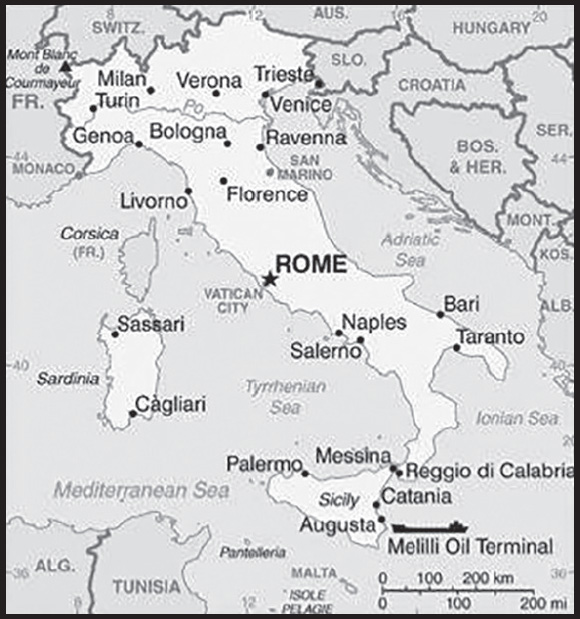
INTRODUCTION
Background: Italy became a nation-state in 1861 when the regional states of the peninsula, along with Sardinia and Sicily, were united under King Victor EMMANUEL II. An era of parliamentary government came to a close in the early 1920s when Benito MUSSOLINI established a Fascist dictatorship. His alliance with Nazi Germany led to Italy’s defeat in World War II. A democratic republic replaced the monarchy in 1946 and economic revival followed. Italy is a charter member of NATO and the European Economic Community (EEC) and its subsequent successors the EC and the EU. It has been at the forefront of European economic and political unification, joining the Economic and Monetary Union in 1999. Persistent problems include sluggish economic growth, high youth and female unemployment, organized crime, corruption, and economic disparities between southern Italy and the more prosperous north.
GEOGRAPHY
Location: Southern Europe, a peninsula extending into the central Mediterranean Sea, northeast of Tunisia
Geographic coordinates: 42 50 N, 12 50 E
Map references: Europe
Area: total: 301,340 sq km
land: 294,140 sq km
water: 7,200 sq km
note: includes Sardinia and Sicily
comparison ranking: total 73
Area - comparative: almost twice the size of Georgia; slightly larger than Arizona
Land boundaries: total: 1,836.4 km
border countries (6): Austria 404 km; France 476 km; Holy See (Vatican City) 3.4 km; San Marino 37 km; Slovenia 218 km; Switzerland 698 km
Coastline: 7,600 km
Maritime claims: territorial sea: 12 nm
continental shelf: 200-m depth or to the depth of exploitation
Climate: predominantly Mediterranean; alpine in far north; hot, dry in south
Terrain: mostly rugged and mountainous; some plains, coastal lowlands
Elevation: highest point: Mont Blanc (Monte Bianco) de Courmayeur (a secondary peak of Mont Blanc) 4,748 m
lowest point: Mediterranean Sea 0 m
mean elevation: 538 m
Natural resources: coal, antimony, mercury, zinc, potash, marble, barite, asbestos, pumice, fluorspar, feldspar, pyrite (sulfur), natural gas and crude oil reserves, fish, arable land
Land use: agricultural land: 47.1% (2018 est.)
arable land: 22.8% (2018 est.)
permanent crops: 8.6% (2018 est.)
permanent pasture: 15.7% (2018 est.)
forest: 31.4% (2018 est.)
other: 21.5% (2018 est.)
Irrigated land: 26,010 sq km (2013)
Major watersheds (area sq km): Atlantic Ocean drainage: Rhine-Maas (198,735 sq km), (Black Sea) Danube (795,656 sq km), (Adriatic Sea) Po (76,997 sq km), (Mediterranean Sea) Rhone (100,543 sq km)
Population distribution: despite a distinctive pattern with an industrial north and an agrarian south, a fairly even population distribution exists throughout most of the country, with coastal areas, the Po River Valley, and urban centers (particularly Milan, Rome, and Naples), attracting larger and denser populations
Natural hazards: regional risks include landslides, mudflows, avalanches, earthquakes, volcanic eruptions, flooding; land subsidence in Venice
volcanism: significant volcanic activity; Etna (3,330 m), which is in eruption as of 2010, is Europe’s most active volcano; flank eruptions pose a threat to nearby Sicilian villages; Etna, along with the famous Vesuvius, which remains a threat to the millions of nearby residents in the Bay of Naples area, have both been deemed Decade Volcanoes by the International Association of Volcanology and Chemistry of the Earth’s Interior, worthy of study due to their explosive history and close proximity to human populations; Stromboli, on its namesake island, has also been continuously active with moderate volcanic activity; other historically active volcanoes include Campi Flegrei, Ischia, Larderello, Pantelleria, Vulcano, and Vulsini
Geography - note: strategic location dominating central Mediterranean as well as southern sea and air approaches to Western Europe
PEOPLE AND SOCIETY: Population
61,021,855 (2023 est.)
comparison ranking: 24
Nationality: noun: Italian(s)
adjective: Italian
Ethnic groups: Italian (includes small clusters of German-, French-, and Slovene-Italians in the north and Albanian-Italians and Greek-Italians in the south)
Languages: Italian (official), German (parts of Trentino-Alto Adige region are predominantly German-speaking), French (small French-speaking minority in Valle d’Aosta region), Slovene (Slovene-speaking minority in the Trieste-Gorizia area)
major-language sample(s): L’Almanacco dei fatti del mondo, l’indispensabile fonte per le informazioni di base. (Italian)
Religions: Christian 80.8% (overwhelmingly Roman Catholic with very small groups of Jehovah’s Witnesses and Protestants), Muslim 4.9%, unaffiliated 13.4%, other 0.9% (2020 est.)
Age structure: 0-14 years: 12.08% (male 3,772,041/female 3,600,946)
15-64 years: 64.61% (male 19,430,217/female 19,997,042)
65 years and over: 23.31% (2023 est.) (male 6,248,663/female 7,972,946)
Dependency ratios: total dependency ratio: 57.1
youth dependency ratio: 19.9
elderly dependency ratio: 37.2
potential support ratio: 2.7 (2021 est.)
Median age: total: 46.5 years (2020)
male: 45.4 years
female: 47.5 years
comparison ranking: total 5
Population growth rate: -0.11% (2023 est.)
comparison ranking: 202
Birth rate: 7 births/1,000 population (2023 est.)
comparison ranking: 223
Death rate: 11.27 deaths/1,000 population (2023 est.)
comparison ranking: 20
Net migration rate: 3.2 migrant(s)/1,000 population (2023 est.)
comparison ranking: 37
Population distribution: despite a distinctive pattern with an industrial north and an agrarian south, a fairly even population distribution exists throughout most of the country, with coastal areas, the Po River Valley, and urban centers (particularly Milan, Rome, and Naples), attracting larger and denser populations
Urbanization: urban population: 72% of total population (2023)
rate of urbanization: 0.27% annual rate of change (2020-25 est.)
Major urban areas - population: 4.316 million ROME (capital), 3.155 million Milan, 2.179 million Naples, 1.802 million Turin, 913,000 Bergamo, 850,000 Palermo (2023)
Sex ratio: at birth: 1.06 male(s)/female
0-14 years: 1.05 male(s)/female
15-64 years: 0.97 male(s)/female
65 years and over: 0.78 male(s)/female
total population: 0.93 male(s)/female (2023 est.)
Mother’s mean age at first birth: 31.4 years (2020 est.)
Maternal mortality ratio: 5 deaths/100,000 live births (2020 est.)
comparison ranking: 165
Infant mortality rate: total: 3.11 deaths/1,000 live births (2023 est.)
male: 3.28 deaths/1,000 live births
female: 2.94 deaths/1,000 live births
comparison ranking: total 209
Life expectancy at birth: total population: 82.79 years (2023 est.)
male: 80.46 years
female: 85.26 years
comparison ranking: total population 20
Total fertility rate: 1.24 children born/woman (2023 est.)
comparison ranking: 222
Gross reproduction rate: 0.6 (2023 est.)
Contraceptive prevalence rate: 65.1% (2013)
note: percent of women aged 18-49
Drinking water source: improved: total: 99.9% of population
unimproved: total: 0.1% of population (2020 est.)
Current health expenditure: 9.6% of GDP (2020)
Physicians density: 3.95 physicians/1,000 population (2020)
Hospital bed density: 3.1 beds/1,000 population (2018)
Sanitation facility access: improved: total: 100% of population
unimproved: total: 0% of population (2020 est.)
Obesity - adult prevalence rate: 19.9% (2016)
comparison ranking: 108
Alcohol consumption per capita: total: 7.65 liters of pure alcohol (2019 est.)
beer: 1.99 liters of pure alcohol (2019 est.)
wine: 4.83 liters of pure alcohol (2019 est.)
spirits: 0.83 liters of pure alcohol (2019 est.)
other alcohols: 0 liters of pure alcohol (2019 est.)
comparison ranking: total 51
Tobacco use: total: 23.1% (2020 est.)
male: 26.6% (2020 est.)
female: 19.5% (2020 est.)
comparison ranking: total 64
Currently married women (ages 15-49): 52.5% (2023 est.)
Education expenditures: 4.3% of GDP (2020 est.)
comparison ranking: 106
Literacy: definition: age 15 and over can read and write
total population: 99.2%
male: 99.4%
female: 99% (2018)
School life expectancy (primary to tertiary education): total: 16 years
male: 16 years
female: 17 years (2020)
Youth unemployment rate (ages 15-24): total: 30.9% (2021 est.)
male: 29.1%
female: 33.8%
comparison ranking: total 34
ENVIRONMENT
Environment - current issues: air pollution from industrial emissions such as sulfur dioxide; coastal and inland rivers polluted from industrial and agricultural effluents; acid rain damaging lakes; inadequate industrial waste treatment and disposal facilities
Environment - international agreements: party to: Air Pollution, Air Pollution-Nitrogen Oxides, Air Pollution-Persistent Organic Pollutants, Air Pollution-Sulphur 85, Air Pollution-Sulphur 94, Air Pollution-Volatile Organic Compounds, Antarctic-Environmental Protection, Antarctic-Marine Living Resources, Antarctic Seals, Antarctic Treaty, Biodiversity, Climate Change, Climate Change-Kyoto Protocol, Climate Change-Paris Agreement, Comprehensive Nuclear Test Ban, Desertification, Endangered Species, Environmental Modification, Hazardous Wastes, Law of the Sea, Marine Dumping-London Convention, Marine Dumping-London Protocol, Nuclear Test Ban, Ozone Layer Protection, Ship Pollution, Tropical Timber 2006, Wetlands, Whaling
signed, but not ratified: Air Pollution-Heavy Metals, Air Pollution-Multi-effect Protocol
Climate: predominantly Mediterranean; alpine in far north; hot, dry in south
Land use: agricultural land: 47.1% (2018 est.)
arable land: 22.8% (2018 est.)
permanent crops: 8.6% (2018 est.)
permanent pasture: 15.7% (2018 est.)
forest: 31.4% (2018 est.)
other: 21.5% (2018 est.)
Urbanization: urban population: 72% of total population (2023)
rate of urbanization: 0.27% annual rate of change (2020-25 est.)
Revenue from forest resources: 0.01% of GDP (2018 est.)
comparison ranking: 150
Revenue from coal: 0% of GDP (2018 est.)
comparison ranking: 85
Air pollutants: particulate matter emissions: 14.22 micrograms per cubic meter (2019 est.)
methane emissions: 41.3 megatons (2020 est.)
Waste and recycling: municipal solid waste generated annually: 29.524 million tons (2015 est.)
municipal solid waste recycled annually: 7,646,716 tons (2015 est.)
percent of municipal solid waste recycled: 25.9% (2015 est.)
Major watersheds (area sq km): Atlantic Ocean drainage: Rhine-Maas (198,735 sq km), (Black Sea) Danube (795,656 sq km), (Adriatic Sea) Po (76,997 sq km), (Mediterranean Sea) Rhone (100,543 sq km)
Total water withdrawal: municipal: 9.19 billion cubic meters (2020 est.)
industrial: 7.7 billion cubic meters (2020 est.)
agricultural: 17 billion cubic meters (2020 est.)
Total renewable water resources: 191.3 billion cubic meters (2020 est.)
GOVERNMENT
Country name: conventional long form: Italian Republic
conventional short form: Italy
local long form: Repubblica Italiana
local short form: Italia
former: Kingdom of Italy
etymology: derivation is unclear, but the Latin “Italia” may come from the Oscan “Viteliu” meaning “[Land] of Young Cattle” (the bull was a symbol of southern Italic tribes)
Government type: parliamentary republic
Capital: name: Rome
geographic coordinates: 41 54 N, 12 29 E
time difference: UTC+1 (6 hours ahead of Washington, DC, during Standard Time)
daylight saving time: +1hr, begins last Sunday in March; ends last Sunday in October
etymology: by tradition, named after Romulus, one of the legendary founders of the city and its first king
Administrative divisions: 15 regions (regioni, singular - regione) and 5 autonomous regions (regioni autonome, singular - regione autonoma)
regions: Abruzzo, Basilicata, Calabria, Campania, Emilia-Romagna, Lazio (Latium), Liguria, Lombardia, Marche, Molise, Piemonte (Piedmont), Puglia (Apulia), Toscana (Tuscany), Umbria, Veneto
autonomous regions: Friuli Venezia Giulia, Sardegna (Sardinia), Sicilia (Sicily), Trentino-Alto Adige (Trentino-South Tyrol) or Trentino-Suedtirol (German), Valle d’Aosta (Aosta Valley) or Vallee d’Aoste (French)
Independence: 17 March 1861 (Kingdom of Italy proclaimed; Italy was not finally unified until 1871)
National holiday: Republic Day, 2 June (1946)
Constitution: history: previous 1848 (originally for the Kingdom of Sardinia and adopted by the Kingdom of Italy in 1861); latest enacted 22 December 1947, adopted 27 December 1947, entered into force 1 January 1948
amendments: proposed by both houses of Parliament; passage requires two successive debates and approval by absolute majority of each house on the second vote; a referendum is only required when requested by one fifth of the members of either house, by voter petition, or by 5 Regional Councils (elected legislative assemblies of the 15 first-level administrative regions and 5 autonomous regions of Italy); referendum not required if an amendment has been approved by a two-thirds majority in each house in the second vote; amended many times, last in 2020
Legal system: civil law system; judicial review of legislation under certain conditions in Constitutional Court
International law organization participation: accepts compulsory ICJ jurisdiction with reservations; accepts ICCt jurisdiction
Citizenship: citizenship by birth: no
citizenship by descent only: at least one parent must be a citizen of Italy
dual citizenship recognized: yes
residency requirement for naturalization: 4 years for EU nationals, 5 years for refugees and specified exceptions, 10 years for all others
Suffrage: 18 years of age; universal except in senatorial elections, where minimum age is 25
Executive branch: chief of state: President Sergio MATTARELLA (since 3 February 2015)
head of government: Prime Minister Giorgia MELONI (since 22 October 2022); the prime minister’s official title is President of the Council of Ministers
cabinet: Council of Ministers proposed by the prime minister, known officially as the President of the Council of Ministers and locally as the Premier; nominated by the president; the current deputy prime ministers, known officially as vice presidents of the Council of Ministers, are Matteo SALVINI (L) and Antonio TAIANI (FI) (since 22 October 2022)
elections/appointments: president indirectly elected by an electoral college consisting of both houses of Parliament and 58 regional representatives for a 7-year term (no term limits); election last held on 24-29 January 2022 (eight rounds) (next to be held in 2029); prime minister appointed by the president, confirmed by parliament
election results:
2022: Sergio MATTARELLA (independent) reelected president; electoral college vote count in eighth round - 759 out of 1,009 (505 vote threshold)
2015: Sergio MATTARELLA (independent) elected president; electoral college vote count in fourth round - 665 out of 995 (505 vote threshold)
Legislative branch: description: bicameral Parliament or Parlamento consists of:
Senate or Senato della Repubblica (200 elected seats; 122 members in multi-seat constituencies directly elected by proportional representation vote, 74 members in single-seat constituencies directly elected by plurality vote, and 4 members in multi-seat constituencies abroad directly elected by proportional representation vote; all members serve 5-year terms)
Chamber of Deputies or Camera dei Deputati (400 seats; 245 members directly elected in multi-seat constituencies by proportional representation vote; 147 members directly elected in single-seat constituencies by plurality vote and 8 members in multi-seat constituencies abroad directly elected by proportional representation vote; members serve 5-year terms)
elections:
Senate - last held on 25 September 2022 (next to be held no later than December 2027)
Chamber of Deputies - last held on 25 September 2022; note - snap elections were called when Prime Minister DRAGHI resigned, and the parliament was dissolved on 21 July 2022 (next to be held on 30 September 2027)
election results:
Senate - percent of vote by party - NA; seats by party - center-right coalition (FdI 65, Lega 30, FI 18), center-left coalition (PD 40, AVS 3), M5S 28, Action-Italia Viva 9, SVP 2, MAIE 1, ScN 1; composition (as of September 2022) - men 131, women 69, percent of women 34.5%
Chamber of Deputies - percent of vote by party - NA; seats by party - center-right coalition (FdI 119, Lega 66, FI 45), center-left coalition (PD 69, AVS 12, +EU 2), M5S 52, Action-Italia Viva 21, SVP 3, MAIE 1, ScN 1; composition (as of September 2022) - men 271, women 129, percent of women 32.3%; note - total Parliament percent of women 33%
note: in October 2019, Italy’s Parliament voted to reduce the number of Senate seats from 315 to 200 and the number of Chamber of Deputies seats from 630 to 400; a referendum to reduce the membership of Parliament held on 20-21 September 2020 was approved, effective for the September 2022 snap election
Judicial branch: highest court(s): Supreme Court of Cassation or Corte Suprema di Cassazione (consists of the first president (chief justice), deputy president, 54 justices presiding over 6 civil and 7 criminal divisions, and 288 judges; an additional 30 judges of lower courts serve as supporting judges; cases normally heard by 5-judge panels; more complex cases heard by 9-judge panels); Constitutional Court or Corte Costituzionale (consists of the court president and 14 judges)
judge selection and term of office: Supreme Court judges appointed by the High Council of the Judiciary, headed by the president of the republic; judges may serve for life; Constitutional Court judges - 5 appointed by the president, 5 elected by Parliament, 5 elected by select higher courts; judges serve up to 9 years
subordinate courts: various lower civil and criminal courts (primary and secondary tribunals and courts of appeal)
Political parties and leaders: Action-Italia Viva [Carlo CALENDA and Matteo RENZI]
Associative Movement of Italians Abroad or MAIE [Ricardo Antonio MERIO]
Brothers of Italy or FdI [Giorgia MELONI]
Democratic Party or PD [Elly SCHLEIN]
Five Star Movement or M5S [Giuseppe CONTE]
Forza Italia or FI [Antonio TAJANI]
Free and Equal (Liberi e Uguali) or LeU [Pietro GRASSO]
Greens and Left Alliance or AVS [Angelo BONELLI]
Italexit [Gianluigi PARAGONE]]
League or Lega [Matteo SALVINI]
More Europe or +EU [Emma BONINO]
Popular Union or PU [Luigi DE MAGISTRIS]
South calls North or ScN [Cateno DE LUCA]
South Tyrolean Peoples Party or SVP [Philipp ACHAMMER]
other minor parties
International organization participation: ADB (nonregional member), AfDB (nonregional member), Arctic Council (observer), Australia Group, BIS, BSEC (observer), CBSS (observer), CD, CDB, CE, CEI, CERN, EAPC, EBRD, ECB, EIB, EITI (implementing country), EMU, ESA, EU, FAO, FATF, G-7, G-8, G-10, G-20, IADB, IAEA, IBRD, ICAO, ICC (national committees), ICCt, ICRM, IDA, IEA, IFAD, IFC, IFRCS, IGAD (partners), IHO, ILO, IMF, IMO, IMSO, Interpol, IOC, IOM, IPU, ISO, ITSO, ITU, ITUC (NGOs), LAIA (observer), MIGA, MINURSO, MINUSMA, NATO, NEA, NSG, OAS (observer), OECD, OPCW, OSCE, Pacific Alliance (observer), Paris Club, PCA, PIF (partner), Schengen Convention, SELEC (observer), SICA (observer), UN, UNCTAD, UNESCO, UNHCR, UNIDO, UNIFIL, Union Latina, UNMOGIP, UNRWA, UNTSO, UNWTO, UPU, Wassenaar Arrangement, WCO, WHO, WIPO, WMO, WTO, ZC
Diplomatic representation in the US: chief of mission: Ambassador Maria Angela ZAPPIA (since 15 September 2021)
chancery: 3000 Whitehaven Street NW, Washington, DC 20008
telephone: [1] (202) 612-4400
FAX: [1] (202) 518-2154
email address and website:
washington.ambasciata@esteri.it
https://ambwashingtondc.esteri.it/ambasciata_washington/en/
consulate(s) general: Boston, Chicago, Detroit, Houston, Miami, New York, Los Angeles, Philadelphia, San Francisco
consulate(s): Charlotte (NC), Cleveland (OH), Detroit (MI), Hattiesburg (MS), Honolulu (HI), New Orleans, Newark (NJ), Norfolk (VA), Pittsburgh (PA), Portland (OR), Seattle
Diplomatic representation from the US: chief of mission: Ambassador Jack Markell (since September 2023); note - also accredited to San Marino
embassy: via Vittorio Veneto 121, 00187 Roma
mailing address: 9500 Rome Place, Washington DC 20521-9500
telephone: [39] 06-46741
FAX: [39] 06-4674-2244
email address and website:
consulate(s) general: Florence, Milan, Naples
Flag description: three equal vertical bands of green (hoist side), white, and red; design inspired by the French flag brought to Italy by Napoleon in 1797; colors are those of Milan (red and white) combined with the green uniform color of the Milanese civic guard
note: similar to the flag of Mexico, which is longer, uses darker shades of green and red, and has its coat of arms centered on the white band; Ireland, which is longer and is green (hoist side), white, and orange; also similar to the flag of the Cote d’Ivoire, which has the colors reversed - orange (hoist side), white, and green
National symbol(s): white, five-pointed star (Stella d’Italia); national colors: red, white, green
National anthem: name: “II Canto degli Italiani” (The Song of the Italians)
lyrics/music: Goffredo MAMELI/Michele NOVARO
note: adopted 1946; the anthem, originally written in 1847, is also known as “L’Inno di Mameli” (Mameli’s Hymn), and “Fratelli D’Italia” (Brothers of Italy)
National heritage: total World Heritage Sites: 58 (53 cultural, 5 natural)
selected World Heritage Site locales: Historic Center of Rome (c); Archaeological Areas of Pompeii, Herculaneum, and Torre Annunziata (c); Venice and its Lagoon (c); Historic Center of Florence (c); Piazza del Duomo, Pisa (c); Historic Centre of Naples (c); Portovenere, Cinque Terre, and the Islands (c); Villa d’Este, Tivoli (c); Mount Etna (n); Rock Drawings in Valcamonica (c); Historic Siena (c)
ECONOMY
Economic overview: core EU economy; strong services, manufacturing, and tourism sectors; hard hit by COVID-19 disruptions but starting to recover; large EU exporter but data skews due to inflated port entry valuation; corruption somewhat stymies foreign direct investment
Real GDP (purchasing power parity): $2.478 trillion (2021 est.)
$2.322 trillion (2020 est.)
$2.553 trillion (2019 est.)
note: data are in 2017 dollars
comparison ranking: 12
Real GDP growth rate: 6.74% (2021 est.)
-9.04% (2020 est.)
0.48% (2019 est.)
comparison ranking: 63
Real GDP per capita: $41,900 (2021 est.)
$39,100 (2020 est.)
$42,700 (2019 est.)
note: data are in 2017 dollars
comparison ranking: 44
GDP (official exchange rate): $2,002,763,000,000 (2019 est.)
Inflation rate (consumer prices): 1.87% (2021 est.)
-0.14% (2020 est.)
0.61% (2019 est.)
comparison ranking: 161
Credit ratings: Fitch rating: BBB- (2020)
Moody’s rating: Baa3 (2018)
Standard & Poors rating: BBB (2017)
note: The year refers to the year in which the current credit rating was first obtained.
GDP - composition, by sector of origin: agriculture: 2.1% (2017 est.)
industry: 23.9% (2017 est.)
services: 73.9% (2017 est.)
comparison rankings: services 52; industry 117; agriculture 172
GDP - composition, by end use: household consumption: 61% (2017 est.)
government consumption: 18.6% (2017 est.)
investment in fixed capital: 17.5% (2017 est.)
investment in inventories: -0.2% (2017 est.)
exports of goods and services: 31.4% (2017 est.)
imports of goods and services: -28.3% (2017 est.)
Agricultural products: milk, grapes, wheat, maize, tomatoes, apples, olives, sugar beets, oranges, rice
Industries: tourism, machinery, iron and steel, chemicals, food processing, textiles, motor vehicles, clothing, footwear, ceramics
Industrial production growth rate: 13.46% (2021 est.)
comparison ranking: 18
Labor force: 25.012 million (2021 est.)
comparison ranking: 26
Labor force - by occupation: agriculture: 3.9%
industry: 28.3%
services: 67.8% (2011)
Unemployment rate: 9.83% (2021 est.)
9.16% (2020 est.)
9.95% (2019 est.)
comparison ranking: 73
Youth unemployment rate (ages 15-24): total: 30.9% (2021 est.)
male: 29.1%
female: 33.8%
comparison ranking: total 34
Population below poverty line: 20.1% (2018 est.)
Gini Index coefficient - distribution of family income: 35.2 (2018 est.)
comparison ranking: 97
Average household expenditures: on food: 14.2% of household expenditures (2018 est.)
on alcohol and tobacco: 4.1% of household expenditures (2018 est.)
Household income or consumption by percentage share: lowest 10%: 2.3%
highest 10%: 26.8% (2000)
Budget: revenues: $901.494 billion (2020 est.)
expenditures: $1.08 trillion (2020 est.)
Budget surplus (+) or deficit (-): -2.3% (of GDP) (2017 est.)
comparison ranking: 110
Public debt: 131.8% of GDP (2017 est.)
132% of GDP (2016 est.)
note: Italy reports its data on public debt according to guidelines set out in the Maastricht Treaty; general government gross debt is defined in the Maastricht Treaty as consolidated general government gross debt at nominal value, outstanding at the end of the year, in the following categories of government liabilities (as defined in ESA95): currency and deposits (AF.2), securities other than shares excluding financial derivatives (AF.3, excluding AF.34), and loans (AF.4); the general government sector comprises central, state, and local government and social security funds
comparison ranking: 8
Taxes and other revenues: 24.77% (of GDP) (2020 est.)
comparison ranking: 50
Fiscal year: calendar year
Current account balance: $64.719 billion (2021 est.)
$74.509 billion (2020 est.)
$66.321 billion (2019 est.)
comparison ranking: 11
Exports: $687.948 billion (2021 est.) note: data are in current year dollars
$559.952 billion (2020 est.) note: data are in current year dollars
$636.153 billion (2019 est.) note: data are in current year dollars
comparison ranking: 11
Exports - partners: Germany 12%, France 11%, United States 10%, United Kingdom 5%, Spain 5%, Switzerland 5% (2019)
Exports - commodities: packaged medicines, cars and vehicle parts, refined petroleum, vaccines and cultures, jewelry, valves (2021)
Imports: $637.934 billion (2021 est.) note: data are in current year dollars
$490.684 billion (2020 est.) note: data are in current year dollars
$568.796 billion (2019 est.) note: data are in current year dollars
comparison ranking: 11
Imports - partners: Germany 16%, France 9%, China 7%, Spain 5%, Netherlands 5%, Belgium 5% (2019)
Imports - commodities: crude petroleum, cars, packaged medicines, natural gas, refined petroleum (2019)
Reserves of foreign exchange and gold: $227.478 billion (31 December 2021 est.)
$210.687 billion (31 December 2020 est.)
$175.398 billion (31 December 2019 est.)
comparison ranking: 16
Debt - external: $2,463,208,000,000 (2019 est.)
$2,533,153,000,000 (2018 est.)
comparison ranking: 10
Exchange rates: euros (EUR) per US dollar -
Exchange rates: 0.845 (2021 est.)
0.876 (2020 est.)
0.893 (2019 est.)
0.847 (2018 est.)
0.885 (2017 est.)
ENERGY
Electricity access: electrification - total population: 100% (2021)
Electricity: installed generating capacity: 121.442 million kW (2020 est.)
consumption: 286.375 billion kWh (2020 est.)
exports: 7.587 billion kWh (2020 est.)
imports: 39.787 billion kWh (2020 est.)
transmission/distribution losses: 17.702 billion kWh (2020 est.)
comparison rankings: transmission/distribution losses 23; imports 3; exports 23; consumption 13; installed generating capacity 11
Electricity generation sources: fossil fuels: 55.9% of total installed capacity (2020 est.)
solar: 9.2% of total installed capacity (2020 est.)
wind: 6.9% of total installed capacity (2020 est.)
hydroelectricity: 17.5% of total installed capacity (2020 est.)
tide and wave: 0.2% of total installed capacity (2020 est.)
geothermal: 2.2% of total installed capacity (2020 est.)
biomass and waste: 8.1% of total installed capacity (2020 est.)
Nuclear energy: Number of operational nuclear reactors: 0
Number of nuclear reactors under construction: 0
Net capacity of operational nuclear reactors: 0GW
Percent of total electricity production: 0%
Percent of total energy produced: 0%
Number of nuclear reactors permanently shut down: 4
Coal: production: 1.456 million metric tons (2020 est.)
consumption: 9.335 million metric tons (2020 est.)
exports: 368,000 metric tons (2020 est.)
imports: 8.235 million metric tons (2020 est.)
proven reserves: 17 million metric tons (2019 est.)
Petroleum: total petroleum production: 107,700 bbl/day (2021 est.)
refined petroleum consumption: 1,255,100 bbl/day (2019 est.)
crude oil and lease condensate exports: 10,100 bbl/day (2018 est.)
crude oil and lease condensate imports: 1.253 million bbl/day (2018 est.)
crude oil estimated reserves: 497.9 million barrels (2021 est.)
Refined petroleum products - production: 1.607 million bbl/day (2017 est.)
comparison ranking: 12
Refined petroleum products - exports: 615,900 bbl/day (2017 est.)
comparison ranking: 13
Refined petroleum products - imports: 422,500 bbl/day (2017 est.)
comparison ranking: 19
Natural gas: production: 3,888,491,000 cubic meters (2020 est.)
consumption: 74,313,109,000 cubic meters (2019 est.)
exports: 314.656 million cubic meters (2020 est.)
imports: 70,908,014,000 cubic meters (2019 est.)
proven reserves: 45.76 billion cubic meters (2021 est.)
Carbon dioxide emissions: 332.041 million metric tonnes of CO2 (2019 est.)
from coal and metallurgical coke: 27.194 million metric tonnes of CO2 (2019 est.)
from petroleum and other liquids: 162.472 million metric tonnes of CO2 (2019 est.)
from consumed natural gas: 142.375 million metric tonnes of CO2 (2019 est.)
comparison ranking: total emissions 19
Energy consumption per capita: 112.606 million Btu/person (2019 est.)
comparison ranking: 49
COMMUNICATIONS
Telephones - fixed lines: total subscriptions: 19,994,902 (2021 est.)
subscriptions per 100 inhabitants: 34 (2021 est.)
comparison ranking: total subscriptions 13
Telephones - mobile cellular: total subscriptions: 78,114,933 (2021 est.)
subscriptions per 100 inhabitants: 132 (2021 est.)
comparison ranking: total subscriptions 21
Telecommunication systems: general assessment: Italy’s large telecom market has one of the most progressive fiber sectors in Europe, with regulatory measures encouraging network sharing; regulatory measures have also been introduced to facilitate access to next generation networks (NGNs), and a number of deals have been brokered which enable the main telcoms to provide bundled services to large numbers of the population; Italy’s vibrant mobile market has one of the highest subscription rates in Europe, though the number of subscribers has fallen in recent years as customers respond to attractive off-net pricing which has reduced the financial benefit of having SIM cards from different providers; network companies were among the first in Europe to trial services based on 5G; the high cost also encouraged the regulator in early 2021 to consider extending the licenses by an additional six years (2021)
domestic: 34 per 100 for fixed-line and nearly 132 per 100 for mobile-cellular subscriptions (2021)
international: country code - 39; landing points for Italy-Monaco, Italy-Libya, Italy-Malta, Italy-Greece-1, Italy-Croatia, BlueMed, Janna, FEA, SeaMeWe-3 & 4 & 5, Trapani-Kelibia, Columbus-III, Didon, GO-1, HANNIBAL System, MENA, Bridge International, Malta-Italy Interconnector, Melita1, IMEWE, VMSCS, AAE-1, and OTEGLOBE, submarine cables that provide links to Asia, the Middle East, Europe, North Africa, Southeast Asia, Australia and US; satellite earth stations - 3 Intelsat (with a total of 5 antennas - 3 for Atlantic Ocean and 2 for Indian Ocean) (2019)
Broadcast media: two Italian media giants dominate with 3 national terrestrial stations and privately owned companies with 3 national terrestrial stations; a large number of private stations, a satellite TV network; 3 AM/FM nationwide radio stations; about 1,300 commercial radio stations
Internet country code: .it
Internet users: total: 44.25 million (2021 est.)
percent of population: 75% (2021 est.)
comparison ranking: total 22
Broadband - fixed subscriptions: total: 18,128,787 (2020 est.)
subscriptions per 100 inhabitants: 30 (2020 est.)
comparison ranking: total 12
TRANSPORTATION
National air transport system: number of registered air carriers: 9 (2020)
inventory of registered aircraft operated by air carriers: 180
annual passenger traffic on registered air carriers: 27,630,435 (2018)
annual freight traffic on registered air carriers: 1.418 billion (2018) mt-km
Civil aircraft registration country code prefix: I
Airports: 129 (2021)
comparison ranking: total 44
Airports - with paved runways: 98
note: paved runways have a concrete or asphalt surface but not all have facilities for refueling, maintenance, or air traffic control; the length of a runway required for aircraft to safely operate depends on a number of factors including the type of aircraft, the takeoff weight (including passengers, cargo, and fuel), engine types, flap settings, landing speed, elevation of the airport, and average maximum daily air temperature; paved runways can reach a length of 5,000 m (16,000 ft.), but the “typical” length of a commercial airline runway is between 2,500-4,000 m (8,000-13,000 ft.)
Airports - with unpaved runways: 31
note: unpaved runways have a surface composition such as grass or packed earth and are most suited to the operation of light aircraft; unpaved runways are usually short, often less than 1,000 m (3,280 ft.) in length; airports with unpaved runways often lack facilities for refueling, maintenance, or air traffic control
Heliports: 5 (2021)
Pipelines: 20,223 km gas, 1,393 km oil, 1,574 km refined products (2013)
Railways: total: 18,475 km (2020) 12,936 km electrified
1289.3 0.950-mm gauge (151.3 km electrified)
comparison ranking: total 15
Roadways: total: 487,700 km (2007)
paved: 487,700 km (2007) (includes 6,700 km of expressways)
comparison ranking: total 16
Waterways: 2,400 km (2012) (used for commercial traffic; of limited overall value compared to road and rail)
comparison ranking: 38
Merchant marine: total: 1,266 (2022)
by type: bulk carrier 20, container ship 6, general cargo 107, oil tanker 102, other 1,031
comparison ranking: total 19
Ports and terminals: major seaport(s): Augusta, Cagliari, Genoa, Livorno, Taranto, Trieste, Venice
oil terminal(s): Melilli (Santa Panagia) oil terminal, Sarroch oil terminal
container port(s) (TEUs): Genoa (2,557,847), Gioia Tauro (3,146,553) (2021)
LNG terminal(s) (import): Panigaglia (La Spezia), Adriatic (Porto Levante), Oristano (Sardinia), Ravenna, Toscana (Livorno)
Transportation - note: Italy operates one PC 5 or 6 class light icebreaker, it is based in the Mediterranean
note - PC indicates a Polar Class vessel: PC 5 - year-round operation in medium first-year ice which may include old ice inclusions (ice thickness up to 70-120 cm); PC 6 - summer/autumn operation in medium first-year ice which may include old ice inclusions (ice thickness up to 30-70 cm)
MILITARY AND SECURITY
Military and security forces: Italian Armed Forces: Army (Esercito Italiano, EI), Navy (Marina Militare Italiana, MMI; includes aviation, marines), Italian Air Force (Aeronautica Militare Italiana, AMI); Carabinieri Corps (Arma dei Carabinieri, CC) (2023)
note 1: the National Police and Carabinieri (gendarmerie or military police) maintain internal security; the National Police reports to the Ministry of Interior while the Carabinieri reports to the Ministry of Defense but is also under the coordination of the Ministry of Interior; the Carabinieri is primarily a domestic police force organized along military lines, with some overseas responsibilities
note 2: the Financial Guard (Guardia di Finanza) under the Ministry of Economy and Finance is a force with military status and nationwide remit for financial crime investigations, including narcotics trafficking, smuggling, and illegal immigration
Military expenditures: 1.5% of GDP (2023 est.)
1.5% of GDP (2022 est.)
1.6% of GDP (2021)
1.6% of GDP (2020)
1.2% of GDP (2019)
comparison ranking: 89
Military and security service personnel strengths: approximately 170,000 active personnel (100,000 Army; 30,000 Navy; 40,000 Air Force); approximately 108,000 Carabinieri (2023)
Military equipment inventories and acquisitions: the military’s inventory includes a mix of domestically manufactured, imported, and jointly produced weapons systems, mostly from Europe and the US; in recent years, the US has been the lead supplier of military hardware to Italy; the Italian defense industry is capable of producing equipment across all the military domains with particular strengths in aircraft, armored vehicles, and naval vessels; it also participates in joint development and production of advanced weapons systems with other European countries and the US (2023)
Military service age and obligation: 17-25 years of age for voluntary military service for men and women (some variations on age depending on the military branch); voluntary service is a minimum of 12 months with the option to extend in the Armed Forces or compete for positions in the Military Corps of the Italian Red Cross, the State Police, the Carabinieri, the Guardia di Finanza, the Penitentiary Police, or the National Fire Brigade; recruits can also volunteer for 4 years military service; conscription abolished 2004 (2023)
note: women may serve in any military branch; as of 2020, women made up about 6% of the military’s full-time personnel
Military deployments: 120 Djibouti; approximately 750 Bulgaria (NATO); approximately 1,000 Middle East (NATO, European Assistance Mission Iraq); 850 Kosovo (NATO/KFOR); 250 Latvia (NATO); 1,000 Lebanon (UNIFIL); 400 Libya; 350 Niger; 250 Romania (NATO); 150 Somalia (EUTM) (2023)
note: in response to Russia’s invasion of Ukraine, some NATO countries, including Italy, have sent additional troops and equipment to the battlegroups deployed in NATO territory in eastern Europe
Military - note: the Italian military is an all-volunteer and professional force responsible for Italy’s national defense and security and fulfilling the country’s commitments to the EU, NATO, and the UN; it also has some domestic security duties; for example, the Army has provided troops for guarding public buildings and for more than a decade several thousand Army and Carabinieri personnel have been deployed domestically to support the National Police as part of a government effort to curb crime in various Italian cities
Italy has been an active member of NATO since its founding in 1948, and the Alliance is a cornerstone of Rome’s national security strategy; it is a strong supporter of European/EU defense cooperation and integration; Italy is an active participant in EU, NATO, UN, and other multinational military, security, and humanitarian operations; key areas of emphasis for Italy’s security policy and multinational cooperation are NATO/Europe’s eastern and southern flanks, including the Mediterranean Sea, East and North Africa, and the Middle East and its adjacent waters; Italy is one of NATO’s leading contributors of military forces and participates in such missions as NATO’s Air Policing in the Baltics, the Enhanced Forward Presence in Eastern Europe, and maritime patrols in the Mediterranean and beyond; it hosts NATO’s Joint Force Command in Naples and a NATO Rapid Deployable Corps headquarters in Milan, as well as the headquarters for the EU’s Mediterranean naval operations force in Rome; since 1960, Italy has committed more than 60,000 troops to UN missions, and it hosts a training center in Vicenza for police personnel destined for peacekeeping missions; in addition, Italy has close defense ties with the US and hosts several US military air, army, and naval bases and facilities
the Italian Army has participated in many colonial engagements, conflicts, major wars, and peacekeeping missions since its establishment in the 1850s and 1860s during Italian unification, from African colonization in the late 1800s to both World Wars and more recently, Afghanistan and Iraq; the current Italian Army is equipped largely with domestically manufactured weapons systems and organized into functional areas (operational, logistic, infrastructural, training, and territorial); the combat forces are under the operational commands, which include the Alpine Command (one divisional headquarters and two alpine/mountain brigades), the Southern Operational Forces Command (five mechanized brigades), the Northern Operational Forces Command (armored, cavalry, and airborne brigades), the Operational Land Forces Support Command (commands for artillery, air defense, engineers, etc), and the Operational Land Forces Command and Army Operational Command (two divisional headquarters, an aviation command with an air mobile brigade, and a special forces command)
the Navy was officially established in 1860; as country with seas on three sides, naval power has long been a key component of Italy’s national security; today, it maintains one of the largest navies in NATO with several functional and regionally based commands and operates globally; in addition to maritime defense, the Navy’s missions include countering illegal trafficking, protecting the marine environment, and assisting with humanitarian and disaster assistance, as well as contributing to civil projects, such as scientific research; its principal warships include two aircraft carriers, four destroyers, 13 frigates, and eight attack submarines, as well as several large amphibious assault ships and a large inventory of patrol vessels; it also has a marine amphibious force, a special operations force, and operates a diverse array of naval fixed-wing, rotary-wing, and unmanned aircraft, including naval fighters and anti-submarine warfare helicopters; the Air Force was established in 1923, but the first air unit was established in 1884; today, it has nearly 500 total aircraft, including around 200 fighters and multirole fighter aircraft; to coordinate the different services, the military has several joint commands, including for operations, space, and special operations (2023)
SPACE
Space agency/agencies: Italian Space Agency (ISA; established 1988); Joint Space Operations Command (Comando Interforze delle Operazioni Spaziali or COS; established 2020) (2023)
Space launch site(s): the Broglio (aka San Marco, Malindi) Space Center, located near Malindi, Kenya, served from 1967 to 1988 as an Italian and international satellite launch facility; in 2020, Kenya concluded a new deal with Italy to conduct rocket launches from the site again in the future; in 2018, the Italian Government designated the Taranto-Grottaglie Airport as a future spaceport and signed framework agreements with commercial space companies that could lead to suborbital and orbital launches from what would be called the Grottaglie Spaceport (2023)
Space program overview: has one of the largest space programs in Europe; is a key member of the European Space Agency (ESA) and one of its largest contributors; designs, builds, launches, and operates communications, remote sensing (RS), and scientific satellites; designs and manufacturers sounding (research) rockets and orbital satellite launch vehicles (SLVs); hosts the ESA Center for Earth Observation; has astronaut cadre in the ESA astronaut corps; researches, develops, and builds a range of other space-related technologies and participates in a wide array of international programs with astronauts, cargo containers, construction, expertise, modules, scientific experiments, and technology; outside of the ESA/EU and their individual member states, has cooperated with a variety of foreign space agencies and industries, including those of Argentina, Brazil, Canada, China, Israel, Japan, Kenya, Mexico, Russia, South Korea, Thailand, the UAE, and the US; participates in international space projects such as the International Space Station (ISS); has a considerable commercial space industrial sector with more than 200 companies encompassing a wide range of capabilities, including manufacturing satellites, satellite payloads, launch vehicles, propulsion systems, cargo containers, and their sub-components (2023)
note: further details about the key activities, programs, and milestones of the country’s space program, as well as government spending estimates on the space sector, appear in Appendix S
TERRORISM
Terrorist group(s): Terrorist group(s): Islamic State of Iraq and ash-Sham (ISIS)
note: details about the history, aims, leadership, organization, areas of operation, tactics, targets, weapons, size, and sources of support of the group(s) appear(s) in Appendix-T
TRANSNATIONAL ISSUES
Disputes - international: Italy’s long coastline and developed economy entices tens of thousands of illegal immigrants from southeastern Europe and northern Africa
Italy-Austria-Switzerland: borders are shifting because glacier peaks that had served as a natural boundary are melting
Refugees and internally displaced persons: refugees (country of origin): 21,441 (Nigeria), 17,706 (Afghanistan), 17,619 (Pakistan), 11,193 (Mali), 8,405 (Somalia), 6,324 (Gambia), 5,768 (Bangladesh), 5,463 (Iraq) (mid-year 2022); 168,725 (Ukraine) (as of 10 November 2023)
stateless persons: 3,000 (2022)
note: 840,958 estimated refugee and migrant arrivals (January 2015-November 2023)
Illicit drugs: important gateway for drug trafficking; organized crime groups allied with Colombian and Spanish groups trafficking cocaine to Europe