J
INTRODUCTION
Background: The island - “discovered” by Christopher COLUMBUS in 1494 - was settled by the Spanish early in the 16th century. The Native Taino, who had inhabited Jamaica for centuries, were gradually exterminated and replaced by African slaves. England seized the island in 1655 and established a plantation economy based on sugar, cocoa, and coffee. The abolition of slavery in 1834 freed a quarter million slaves, many of whom became small farmers. Jamaica gradually increased its independence from Britain. In 1958, it joined other British Caribbean colonies in forming the Federation of the West Indies. Jamaica withdrew from the Federation in 1961 and gained full independence in 1962. Deteriorating economic conditions during the 1970s led to recurrent violence as rival gangs affiliated with the major political parties evolved into powerful organized crime networks involved in international drug smuggling and money laundering. Violent crime, drug trafficking, corruption, the COVID-19 pandemic, and poverty pose significant challenges to the government today. Nonetheless, many rural and resort areas remain relatively safe and contribute substantially to the economy.
GEOGRAPHY
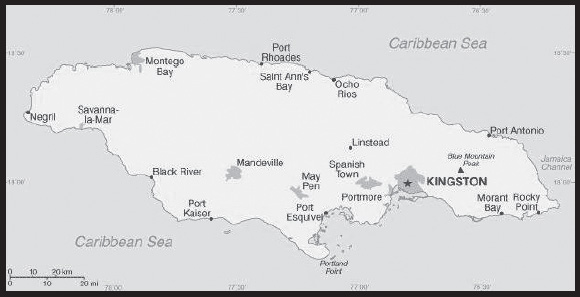
Location: Caribbean, island in the Caribbean Sea, south of Cuba
Geographic coordinates: 18 15 N, 77 30 W
Map references: Central America and the Caribbean
Area: total: 10,991 sq km
land: 10,831 sq km
water: 160 sq km
comparison ranking: total 166
Area - comparative: about half the size of New Jersey; slightly smaller than Connecticut
Land boundaries: total: 0 km
Coastline: 1,022 km
Maritime claims: territorial sea: 12 nm
contiguous zone: 24 nm
exclusive economic zone: 200 nm
continental shelf: 200 nm or to edge of the continental margin measured from claimed archipelagic straight baselines
Climate: tropical; hot, humid; temperate interior
Terrain: mostly mountains, with narrow, discontinuous coastal plain
Elevation: highest point: Blue Mountain Peak 2,256 m
lowest point: Caribbean Sea 0 m
mean elevation: 18 m
Natural resources: bauxite, alumina, gypsum, limestone
Land use: agricultural land: 41.4% (2018 est.)
arable land: 11.1% (2018 est.)
permanent crops: 9.2% (2018 est.)
permanent pasture: 21.1% (2018 est.)
forest: 31.1% (2018 est.)
other: 27.5% (2018 est.)
Irrigated land: 250 sq km (2012)
Population distribution: population density is high throughout, but increases in and around Kingston, Montego Bay, and Port Esquivel
Natural hazards: hurricanes (especially July to November)
Geography - note: third largest island in the Caribbean (after Cuba and Hispaniola); strategic location between Cayman Trench and Jamaica Channel, the main sea lanes for the Panama Canal
PEOPLE AND SOCIETY
Population: 2,820,982 (2023 est.)
comparison ranking: 140
Nationality: noun: Jamaican(s)
adjective: Jamaican
Ethnic groups: Black 92.1%, mixed 6.1%, East Indian 0.8%, other 0.4%, unspecified 0.7% (2011 est.)
Languages: English, Jamaican patois
Religions: Protestant 64.8% (includes Seventh Day Adventist 12.0%, Pentecostal 11.0%, Other Church of God 9.2%, New Testament Church of God 7.2%, Baptist 6.7%, Church of God in Jamaica 4.8%, Church of God of Prophecy 4.5%, Anglican 2.8%, United Church 2.1%, Methodist 1.6%, Revived 1.4%, Brethren 0.9%, and Moravian 0.7%), Roman Catholic 2.2%, Jehovah’s Witness 1.9%, Rastafarian 1.1%, other 6.5%, none 21.3%, unspecified 2.3% (2011 est.)
Age structure: 0-14 years: 24.11% (male 346,566/female 333,673)
15-64 years: 65.8% (male 914,208/female 942,134)
65 years and over: 10.08% (2023 est.) (male 135,388/female 149,013)
Dependency ratios: total dependency ratio: 38
youth dependency ratio: 28
elderly dependency ratio: 13.4
potential support ratio: 7.4 (2021 est.)
Median age: total: 29.4 years (2020)
male: 28.6 years
female: 30.1 years
comparison ranking: total 131
Population growth rate: 0.09% (2023 est.)
comparison ranking: 187
Birth rate: 15.77 births/1,000 population (2023 est.)
comparison ranking: 102
Death rate: 7.44 deaths/1,000 population (2023 est.)
comparison ranking: 106
Net migration rate: -7.42 migrant(s)/1,000 population (2023 est.)
comparison ranking: 219
Population distribution: population density is high throughout, but increases in and around Kingston, Montego Bay, and Port Esquivel
Urbanization: urban population: 57.4% of total population (2023)
rate of urbanization: 0.79% annual rate of change (2020-25 est.)
Major urban areas - population: 597,000 KINGSTON (capital) (2023)
Sex ratio: at birth: 1.05 male(s)/female
0-14 years: 1.04 male(s)/female
15-64 years: 0.97 male(s)/female
65 years and over: 0.91 male(s)/female
total population: 0.98 male(s)/female (2023 est.)
Mother’s mean age at first birth: 21.2 years (2008 est.)
note: data represents median age at first birth among women 25-29
Maternal mortality ratio: 99 deaths/100,000 live births (2020 est.)
comparison ranking: 69
Infant mortality rate: total: 10.92 deaths/1,000 live births (2023 est.)
male: 12.15 deaths/1,000 live births
female: 9.62 deaths/1,000 live births
comparison ranking: total 129
Life expectancy at birth: total population: 76.01 years (2023 est.)
male: 74.25 years
female: 77.85 years
comparison ranking: total population 116
Total fertility rate: 2.05 children born/woman (2023 est.)
comparison ranking: 97
Gross reproduction rate: 1 (2023 est.)
Drinking water source: improved: urban: 98.3% of population
rural: 93.9% of population
total: 96.4% of population
unimproved: urban: 1.7% of population
rural: 6.1% of population
total: 3.6% of population (2020 est.)
Current health expenditure: 6.6% of GDP (2020)
Physicians density: 0.53 physicians/1,000 population (2018)
Hospital bed density: 1.7 beds/1,000 population (2017)
Sanitation facility access: improved: urban: 98.6% of population
rural: 99.4% of population
total: 98.9% of population
unimproved: urban: 1.4% of population
rural: 0.6% of population
total: 1.1% of population (2020 est.)
Obesity - adult prevalence rate: 24.7% (2016)
comparison ranking: 55
Alcohol consumption per capita: total: 3.46 liters of pure alcohol (2019 est.)
beer: 1.19 liters of pure alcohol (2019 est.)
wine: 0.25 liters of pure alcohol (2019 est.)
spirits: 1.66 liters of pure alcohol (2019 est.)
other alcohols: 0.35 liters of pure alcohol (2019 est.)
comparison ranking: total 104
Tobacco use: total: 9.4% (2020 est.)
male: 15% (2020 est.)
female: 3.8% (2020 est.)
comparison ranking: total 137
Children under the age of 5 years underweight: 2.5% (2018/19)
comparison ranking: 96
Currently married women (ages 15-49): 32.7% (2023 est.)
Education expenditures: 6% of GDP (2021 est.)
comparison ranking: 43
Literacy: definition: age 15 and over has ever attended school
total population: 88.7%
male: 84%
female: 93.1% (2015)
School life expectancy (primary to tertiary education): total: 12 years
male: 11 years
female: 13 years (2015)
Youth unemployment rate (ages 15-24): total: 26.1% (2021 est.)
male: 22.1%
female: 31.4%
comparison ranking: total 58
ENVIRONMENT
Environment - current issues: heavy rates of deforestation; coastal waters polluted by industrial waste, sewage, and oil spills; damage to coral reefs; air pollution in Kingston from vehicle emissions; land erosion
Environment - international agreements: party to: Biodiversity, Climate Change, Climate Change-Kyoto Protocol, Climate Change-Paris Agreement, Comprehensive Nuclear Test Ban, Desertification, Endangered Species, Hazardous Wastes, Law of the Sea, Marine Dumping-London Convention, Marine Life Conservation, Nuclear Test Ban, Ozone Layer Protection, Ship Pollution, Wetlands
signed, but not ratified: none of the selected agreements
Climate: tropical; hot, humid; temperate interior
Land use: agricultural land: 41.4% (2018 est.)
arable land: 11.1% (2018 est.)
permanent crops: 9.2% (2018 est.)
permanent pasture: 21.1% (2018 est.)
forest: 31.1% (2018 est.)
other: 27.5% (2018 est.)
Urbanization: urban population: 57.4% of total population (2023)
rate of urbanization: 0.79% annual rate of change (2020-25 est.)
Revenue from forest resources: 0.15% of GDP (2018 est.)
comparison ranking: 102
Revenue from coal: 0% of GDP (2018 est.)
comparison ranking: 94
Air pollutants: particulate matter emissions: 14.83 micrograms per cubic meter (2019 est.)
carbon dioxide emissions: 8.23 megatons (2016 est.)
methane emissions: 1.08 megatons (2020 est.)
Waste and recycling: municipal solid waste generated annually: 1,051,695 tons (2016 est.)
Total water withdrawal: municipal: 140 million cubic meters (2020 est.)
industrial: 1.1 billion cubic meters (2020 est.)
agricultural: 110 million cubic meters (2020 est.)
Total renewable water resources: 10.82 billion cubic meters (2020 est.)
GOVERNMENT
Country name: conventional long form: none
conventional short form: Jamaica
etymology: from the native Taino word “haymaca” meaning “Land of Wood and Water” or possibly “Land of Springs”
Government type: parliamentary democracy (Parliament) under a constitutional monarchy; a Commonwealth realm
Capital: name: Kingston
geographic coordinates: 18 00 N, 76 48 W
time difference: UTC-5 (same time as Washington, DC, during Standard Time)
etymology: the name is a blending of the words “king’s” and “town”; the English king at the time of the city’s founding in 1692 was WILLIAM III (r. 1689-1702)
Administrative divisions: 14 parishes; Clarendon, Hanover, Kingston, Manchester, Portland, Saint Andrew, Saint Ann, Saint Catherine, Saint Elizabeth, Saint James, Saint Mary, Saint Thomas, Trelawny, Westmoreland
note: for local government purposes, Kingston and Saint Andrew were amalgamated in 1923 into the present single corporate body known as the Kingston and Saint Andrew Corporation
Independence: 6 August 1962 (from the UK)
National holiday: Independence Day, 6 August (1962)
Constitution: history: several previous (preindependence); latest drafted 1961-62, submitted to British Parliament 24 July 1962, entered into force 6 August 1962 (at independence)
amendments: proposed by Parliament; passage of amendments to “non-entrenched” constitutional sections, such as lowering the voting age, requires majority vote by the Parliament membership; passage of amendments to “entrenched” sections, such as fundamental rights and freedoms, requires two-thirds majority vote of Parliament; passage of amendments to “specially entrenched” sections such as the dissolution of Parliament or the executive authority of the monarch requires two-thirds approval by Parliament and approval in a referendum; amended many times, last in 2017
Legal system: common law system based on the English model
International law organization participation: has not submitted an ICJ jurisdiction declaration; non-party state to the ICCt
Citizenship: citizenship by birth: yes
citizenship by descent only: yes
dual citizenship recognized: yes
residency requirement for naturalization: 4 out of the previous 5 years
Suffrage: 18 years of age; universal
Executive branch: chief of state: King CHARLES III (since 8 September 2022); represented by Governor General Sir Patrick L. ALLEN (since 26 February 2009); the Jamaican Government, in May 2023, announced plans to transition to a republic and to hold a referendum in 2024 to remain in the Commonwealth or become a republic
head of government: Prime Minister Andrew HOLNESS (since 3 March 2016)
cabinet: Cabinet appointed by the governor general on the advice of the prime minister
elections/appointments: the monarchy is hereditary; governor general appointed by the monarch on the recommendation of the prime minister; following legislative elections, the leader of the majority party or majority coalition in the House of Representatives is appointed prime minister by the governor general
Legislative branch: description: bicameral Parliament consists of:
Senate (21 seats; 13 members appointed by the governor general on the advice of the prime minister and 8 members appointed by the governor general on the advice of the opposition party leader; members serve 5-year terms (no term limits) or until Parliament is dissolved)
House of Representatives (63 seats; members directly elected in single-seat constituencies by simple majority vote to serve 5-year terms (no term limits) or until Parliament is dissolved)
elections: Senate - last full slate of appointments early on 3 September 2020 (next full slate in 2025) House of Representatives - last held on 3 September 2020 (next to be held in 2025)
election results: Senate - percent by party - NA; seats by party - NA; composition (as of June 2021) - men 13, women 8, percent of women 38.1%
House of Representatives - percent of vote by party - JLP 57%, PNP 42.8%, independent 0.2%; seats by party - JLP 48, PNP 15; composition (as of June 2021) - men 45, women 18; percent of women 28.6%; note - total Parliament percent of women 31%
Judicial branch: highest court(s): Court of Appeal (consists of president of the court and a minimum of 4 judges); Supreme Court (40 judges organized in specialized divisions); note - appeals beyond Jamaica’s highest courts are referred to the Judicial Committee of the Privy Council (in London) rather than to the Caribbean Court of Justice (the appellate court for member states of the Caribbean Community)
judge selection and term of office: chief justice of the Supreme Court and president of the Court of Appeal appointed by the governor-general on the advice of the prime minister; other judges of both courts appointed by the governor-general on the advice of the Judicial Service Commission; judges of both courts serve till age 70
subordinate courts: resident magistrate courts, district courts, and petty sessions courts
Political parties and leaders: Jamaica Labor Party or JLP [Andrew Michael HOLNESS]
Jamaica Progressive Party or JPP [Gilbert Alexander EDWARDS]
People’s National Party or PNP [Mark GOLDING]
United Independents’ Congress or UIC [Joseph L. PATTERSON]
International organization participation: ACP, AOSIS, C, Caricom, CDB, CELAC, FAO, G-15, G-77, IADB, IAEA, IBRD, ICAO, ICC (NGOs), ICRM, IDA, IFAD, IFC, IFRCS, IHO, ILO, IMF, IMO, Interpol, IOC, IOM, ISO, ITSO, ITU, LAES, MIGA, NAM, OAS, OPANAL, OPCW, Petrocaribe, UN, UNCTAD, UNESCO, UNIDO, UNITAR, UNWTO, UPU, WCO, WFTU (NGOs), WHO, WIPO, WMO, WTO
Diplomatic representation in the US: chief of mission: Ambassador Audrey Patrice MARKS (since 18 January 2017)
chancery: 1520 New Hampshire Avenue NW, Washington, DC 20036
telephone: [1] (202) 452-0660
FAX: [1] (202) 452-0036
email address and website:
https://www.embassyofjamaica.org/
consulate(s) general: Miami, New York
consulate(s): Atlanta, Boston, Chicago, Concord (MA), Houston, Los Angeles, Philadelphia, Richmond (VA), San Francisco, Seattle
Diplomatic representation from the US: chief of mission: Ambassador N. Nickolas PERRY (since 13 May 2022)
embassy: 142 Old Hope Road, Kingston 6
mailing address: 3210 Kingston Place, Washington DC 20521-3210
telephone: (876) 702-6000 (2018)
FAX: (876) 702-6348 (2018)
email address and website:
Flag description: diagonal yellow cross divides the flag into four triangles - green (top and bottom) and black (hoist side and fly side); green represents hope, vegetation, and agriculture, black reflects hardships overcome and to be faced, and yellow recalls golden sunshine and the island’s natural resources
National symbol(s): green-and-black streamertail (bird), Guaiacum officinale (Guaiacwood); national colors: green, yellow, black
National anthem: name: “Jamaica, Land We Love”
lyrics/music: Hugh Braham SHERLOCK/Robert Charles LIGHTBOURNE
note: adopted 1962
National heritage: total World Heritage Sites: 1 (mixed)
selected World Heritage Site locales: Blue and John Crow Mountains
ECONOMY
Economic overview: upper middle-income Caribbean island economy; ongoing debt restructuring; hurricane-vulnerable economy; high crime, youth unemployment, and poverty; susceptible to commodity shocks from ongoing Russia invasion of Ukraine
Real GDP (purchasing power parity): $27.136 billion (2021 est.)
$25.943 billion (2020 est.)
$28.825 billion (2019 est.)
note: data are in 2017 dollars
comparison ranking: 143
Real GDP growth rate: 4.6% (2021 est.)
-10% (2020 est.)
0.89% (2019 est.)
comparison ranking: 100
Real GDP per capita: $9,600 (2021 est.)
$9,200 (2020 est.)
$10,200 (2019 est.)
note: data are in 2017 dollars
comparison ranking: 145
GDP (official exchange rate): $15.847 billion (2019 est.)
Inflation rate (consumer prices): 5.86% (2021 est.)
5.23% (2020 est.)
3.91% (2019 est.)
comparison ranking: 53
Credit ratings: Fitch rating: B+ (2019)
Moody’s rating: B2 (2019)
Standard & Poors rating: B+ (2019)
note: The year refers to the year in which the current credit rating was first obtained.
GDP - composition, by sector of origin: agriculture: 7% (2017 est.)
industry: 21.1% (2017 est.)
services: 71.9% (2017 est.)
comparison rankings: services 62; industry 139; agriculture 110
GDP - composition, by end use: household consumption: 81.9% (2017 est.)
government consumption: 13.7% (2017 est.)
investment in fixed capital: 21.3% (2017 est.)
investment in inventories: 0.1% (2017 est.)
exports of goods and services: 30.1% (2017 est.)
imports of goods and services: -47.1% (2017 est.)
Agricultural products: sugar cane, goat milk, yams, poultry, coconuts, oranges, bananas, gourds, plantains, grapefruit
Industries: agriculture, mining, manufacture, construction, financial and insurance services, tourism, telecommunications
Industrial production growth rate: 2.38% (2021 est.)
comparison ranking: 131
Labor force: 1.418 million (2021 est.)
comparison ranking: 134
Labor force - by occupation: agriculture: 16.1%
industry: 16%
services: 67.9% (2017)
Unemployment rate: 9.18% (2021 est.)
9.48% (2020 est.)
7.69% (2019 est.)
comparison ranking: 78
Youth unemployment rate (ages 15-24): total: 26.1% (2021 est.)
male: 22.1%
female: 31.4%
comparison ranking: total 58
Population below poverty line: 17.1% (2016 est.)
Gini Index coefficient - distribution of family income: 35 (2016 est.)
comparison ranking: 103
Household income or consumption by percentage share: lowest 10%: 2.6%
highest 10%: 29.3% (2015)
Budget: revenues: $4.029 billion (2020 est.)
expenditures: $4.564 billion (2020 est.)
Budget surplus (+) or deficit (-): 0.5% (of GDP) (2017 est.)
comparison ranking: 37
Public debt: 106.28% of GDP (2020 est.)
92.25% of GDP (2019 est.)
102.46% of GDP (2017 est.)
comparison ranking: 18
Taxes and other revenues: 25.71% (of GDP) (2020 est.)
comparison ranking: 45
Fiscal year: 1 April - 31 March
Current account balance: $125.275 million (2021 est.)
-$61.433 million (2020 est.)
-$350.949 million (2019 est.)
comparison ranking: 66
Exports: $4.385 billion (2021 est.) note: data are in current year dollars
$3.343 billion (2020 est.) note: data are in current year dollars
$5.991 billion (2019 est.)
comparison ranking: 134
Exports - partners: United States 46%, Netherlands 9%, Canada 6%, United Kingdom 4&, Russia 3% (2021)
Exports - commodities: aluminum oxide, refined petroleum, aluminum, rums, fruits, nuts, natural gas, sauces and seasonings (2021)
Imports: $7.414 billion (2021 est.) note: data are in current year dollars
$5.911 billion (2020 est.) note: data are in current year dollars
$8.317 billion (2019 est.)
comparison ranking: 127
Imports - partners: United States 35%, China 13%, Turkey 5%, Trinidad and Tobago 3%, Japan 3% (2021)
Imports - commodities: refined petroleum, natural gas, cars, crude petroleum, iron bars, steel bars (2021)
Reserves of foreign exchange and gold: $4.838 billion (31 December 2021 est.)
$3.938 billion (31 December 2020 est.)
$3.631 billion (31 December 2019 est.)
comparison ranking: 103
Debt - external: $13.876 billion (2019 est.)
$13.912 billion (2018 est.)
comparison ranking: 104
Exchange rates: Jamaican dollars (JMD) per US dollar -
Exchange rates: 150.79 (2021 est.)
142.403 (2020 est.)
133.312 (2019 est.)
128.872 (2018 est.)
127.965 (2017 est.)
ENERGY
Electricity access: electrification - total population: 100% (2021)
Electricity: installed generating capacity: 1.216 million kW (2020 est.)
consumption: 3,050,780,000 kWh (2019 est.)
exports: 0 kWh (2020 est.)
imports: 0 kWh (2020 est.)
transmission/distribution losses: 1.149 billion kWh (2019 est.)
comparison rankings: imports 161; exports 148; installed generating capacity 131; transmission/distribution losses 109; consumption 139
Electricity generation sources: fossil fuels: 87.5% of total installed capacity (2020 est.)
solar: 1.2% of total installed capacity (2020 est.)
wind: 6.8% of total installed capacity (2020 est.)
hydroelectricity: 4% of total installed capacity (2020 est.)
biomass and waste: 0.6% of total installed capacity (2020 est.)
Coal: production: 0 metric tons (2020 est.)
consumption: 61,000 metric tons (2020 est.)
exports: 0 metric tons (2020 est.)
imports: 82,000 metric tons (2020 est.)
proven reserves: 0 metric tons (2019 est.)
Petroleum: total petroleum production: 3,000 bbl/day (2021 est.)
refined petroleum consumption: 61,100 bbl/day (2019 est.)
crude oil and lease condensate exports: 0 bbl/day (2018 est.)
crude oil and lease condensate imports: 20,100 bbl/day (2018 est.)
crude oil estimated reserves: 0 barrels (2021 est.)
Refined petroleum products - production: 24,250 bbl/day (2017 est.)
comparison ranking: 87
Refined petroleum products - exports: 823 bbl/day (2015 est.)
comparison ranking: 109
Refined petroleum products - imports: 30,580 bbl/day (2015 est.)
comparison ranking: 100
Natural gas: production: 0 cubic meters (2021 est.)
consumption: 693.422 million cubic meters (2020 est.)
exports: 0 cubic meters (2021 est.)
imports: 667.115 million cubic meters (2020 est.)
proven reserves: 0 cubic meters (2021 est.)
Carbon dioxide emissions: 10.002 million metric tonnes of CO2 (2019 est.)
from coal and metallurgical coke: 177,000 metric tonnes of CO2 (2019 est.)
from petroleum and other liquids: 9.276 million metric tonnes of CO2 (2019 est.)
from consumed natural gas: 549,000 metric tonnes of CO2 (2019 est.)
comparison ranking: total emissions 106
Energy consumption per capita: 49.7 million Btu/person (2019 est.)
comparison ranking: 101
COMMUNICATIONS
Telephones - fixed lines: total subscriptions: 473,617 (2021 est.)
subscriptions per 100 inhabitants: 17 (2021 est.)
comparison ranking: total subscriptions 95
Telephones - mobile cellular: total subscriptions: 2,905,408 (2021 est.)
subscriptions per 100 inhabitants: 103 (2021 est.)
comparison ranking: total subscriptions 142
Telecommunication systems: general assessment: Jamaica’s telecom sector has for many years been propped up by the mobile sector, which accounts for the vast majority of internet connections and voice lines; it also accounts for just over half of telecom sector revenue; in December 2020, the government announced the rollout of a national broadband network costing up to $237 million; the funding will be spent on improving connectivity in under served areas, improving access to education, and deploying networks to public locations such as hospitals, municipal institutions, and police stations; to aid in this national broadband effort, the government received a donation of 650km of fiber cabling from local cable TV providers and the two main toll road operators; to encourage the use of digital channels as the country deals with the Covid-19 pandemic (2021)
domestic: fixed-line subscriptions nearly 17 per 100, cellular-mobile roughly 103 per 100 subscriptions (2021)
international: country code - 1-876 and 1-658; landing points for the ALBA-1, CFX-1, Fibralink, East-West, and Cayman-Jamaican Fiber System submarine cables providing connections to South America, parts of the Caribbean, Central America and the US; satellite earth stations - 2 Intelsat (Atlantic Ocean) (2019)
Broadcast media: 3 free-to-air TV stations, subscription cable services, and roughly 30 radio stations (2019)
Internet country code: .jm
Internet users: total: 2.296 million (2021 est.)
percent of population: 82% (2021 est.)
comparison ranking: total 131
Broadband - fixed subscriptions: total: 385,603 (2020 est.)
subscriptions per 100 inhabitants: 13 (2020 est.)
comparison ranking: total 99
TRANSPORTATION
National air transport system: number of registered air carriers: 0 (2020)
Civil aircraft registration country code prefix: 6Y
Airports: 28 (2021)
comparison ranking: total 121
Airports - with paved runways: 11
note: paved runways have a concrete or asphalt surface but not all have facilities for refueling, maintenance, or air traffic control; the length of a runway required for aircraft to safely operate depends on a number of factors including the type of aircraft, the takeoff weight (including passengers, cargo, and fuel), engine types, flap settings, landing speed, elevation of the airport, and average maximum daily air temperature; paved runways can reach a length of 5,000 m (16,000 ft.), but the “typical” length of a commercial airline runway is between 2,500-4,000 m (8,000-13,000 ft.)
Airports - with unpaved runways: 17
note: unpaved runways have a surface composition such as grass or packed earth and are most suited to the operation of light aircraft; unpaved runways are usually short, often less than 1,000 m (3,280 ft.) in length; airports with unpaved runways often lack facilities for refueling, maintenance, or air traffic control
Roadways: total: 22,121 km (2011) (includes 44 km of expressways)
paved: 16,148 km (2011)
unpaved: 5,973 km (2011)
comparison ranking: total 109
Merchant marine: total: 36 (2022)
by type: bulk carrier 1, general cargo 9, oil tanker 1, other 25
comparison ranking: total 128
Ports and terminals: major seaport(s): Discovery Bay (Port Rhoades), Kingston, Montego Bay, Port Antonio, Port Esquivel, Port Kaiser, Rocky Point
cruise port(s): Falmouth, Montego Bay, Port Antonio, Ocho Rios,
container port(s) (TEUs): Kingston (2,004,302) (2021)
MILITARY AND SECURITY
Military and security forces: Jamaica Defense Force (JDF): Jamaica Regiment (Ground Forces), Maritime-Air-Cyber Command (includes Coast Guard, Air Wing, Military Intelligence Unit, Special Activities Regiment, and Military Cyber Corps), Support Brigade (logistics, engineers, health service, and military police); Jamaica National Service Corps (JNSC); Jamaica Constabulary Force (JCF) (2023)
note 1: the JCF is the country’s police force; it has primary responsibility for internal security and has units for community policing, special response, intelligence gathering, and internal affairs; both it and the JDF are under the Ministry of National Security
note 2: the JNSC is a third category of service that military recruits can join as a preparatory phase for future careers; JNSC soldiers receive basic military, vocational, and life skills training; upon completion of 12 months of service, soldiers can continue on with the JDF or the JDF reserves or seek opportunities in other public sector entities such as the JCF, the Department of Correctional Services, the Jamaica Fire Brigade, the Jamaica Customs Agency, or the Passport Immigration and Citizenship Agency
Military expenditures: 1.3% of GDP (2022 est.)
1.4% of GDP (2021 est.)
1.7% of GDP (2020 est.)
1.6% of GDP (2019 est.)
1.4% of GDP (2018 est.)
comparison ranking: 104
Military and security service personnel strengths: approximately 5,000 personnel (2023)
Military equipment inventories and acquisitions: the JDF is lightly armed with a limited inventory featuring equipment mostly from Europe and the US (2023)
Military service age and obligation: no conscription; 18-23 for voluntary military service (17 with parental consent) for men and women; 18-28 for the reserves; since 2017, the JDF’s standard mode of recruitment is to enroll recruits ages 18-23 through the Jamaica National Service Corps (JNSC); in the JNSC, soldiers receive basic military, vocational, and life skills training; upon completion of 12 months of service, soldiers can continue on with the JDF or seek other opportunities with other government agencies (2023)
note: as of 2022, women made up about 20% of the JDF’s uniformed personnel
Military - note: in addition to its responsibility of defending against external aggression, the JDF’s primary missions are border, internal, and maritime security, including support to police operations in combating crime and violence; other missions include search and rescue, disaster response, humanitarian assistance, and peacekeeping; it has arrest authority and partners with the Jamaica Constabulary Force (JCF); both the JDF and JCF are under the Ministry of National Security, which directs policy for the security forces; the JDF participates in bilateral and multinational training exercises, including with the militaries of Canada, the UK, the US, and other Caribbean nations
while Jamaica had a militia force as early as the 1660s, the JDF was constituted in 1962 from the West India Regiment (WIR), a British colonial regiment which dates back to 1795; troops for the WIR were recruited from freed slaves from North America, slaves purchased in the West Indies, and slaves from Africa bought off slave ships (2023)
TRANSNATIONAL ISSUES
Disputes - international: none identified
Illicit drugs: Jamaica is the largest Caribbean source of marijuana and a transit point for cocaine trafficked from South America to North America and other international markets; criminal gangs in Jamaica, Haiti, and Central America use marijuana for currency to obtain guns or other contraband from criminal entities in Haiti and Central America
INTRODUCTION
Background: This desolate, arctic, mountainous island was named after a Dutch whaling captain who indisputably discovered it in 1614 (earlier claims are inconclusive). Visited only occasionally by seal hunters and trappers over the following centuries, the island came under Norwegian sovereignty in 1929. The long dormant Beerenberg volcano, the northernmost active volcano on earth, resumed activity in 1970 and the most recent eruption occurred in 1985.
GEOGRAPHY
Location: Northern Europe, island between the Greenland Sea and the Norwegian Sea, northeast of Iceland
Geographic coordinates: 71 00 N, 8 00 W
Map references: Arctic Region
Area: total: 377 sq km
land: 377 sq km
water: 0 sq km
comparison ranking: total 205
Area - comparative: slightly more than twice the size of Washington, DC
Land boundaries: total: 0 km
Coastline: 124.1 km
Maritime claims: territorial sea: 12 nm
contiguous zone: 24 nm
exclusive economic zone: 200 nm
continental shelf: 200-m depth or to the depth of exploitation
Climate: arctic maritime with frequent storms and persistent fog
Terrain: volcanic island, partly covered by glaciers
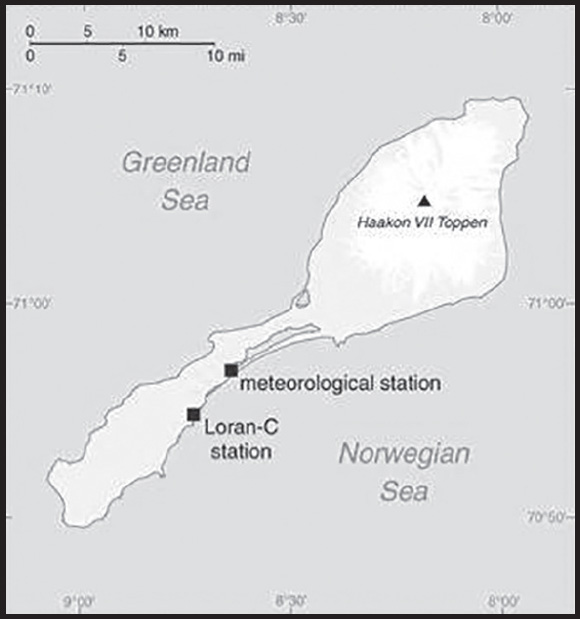
Elevation: highest point: Haakon VII Toppen on Beerenberg 2,277
lowest point: Norwegian Sea 0 m
note: Beerenberg volcano has numerous peaks; the highest point on the volcano rim is named Haakon VII Toppen, after Norway’s first king following the reestablishment of Norwegian independence in 1905
Natural resources: none
Land use: agricultural land: 0% (2011 est.)
other: 100% (2018 est.)
Irrigated land: 0 sq km (2022)
Natural hazards: dominated by the volcano Beerenberg
volcanism: Beerenberg (2,227 m) is Norway’s only active volcano; volcanic activity resumed in 1970; the most recent eruption occurred in 1985
Geography - note: barren volcanic spoon-shaped island with some moss and grass flora; island consists of two parts: a larger northeast Nord-Jan (the spoon “bowl”) and the smaller Sor-Jan (the “handle”), linked by a 2.5 km-wide isthmus (the “stem”) with two large lakes, Sorlaguna (South Lagoon) and Nordlaguna (North Lagoon)
PEOPLE AND SOCIETY
Population: no indigenous inhabitants
note: military personnel operate the the weather and coastal services radio station
ENVIRONMENT
Environment - current issues: pollutants transported from southerly latitudes by winds, ocean currents, and rivers accumulate in the food chains of native animals; climate change
Climate: arctic maritime with frequent storms and persistent fog
Land use: agricultural land: 0% (2011 est.)
other: 100% (2018 est.)
GOVERNMENT
Country name: conventional long form: none
conventional short form: Jan Mayen
etymology: named after Dutch Captain Jan Jacobszoon MAY, one of the first explorers to reach the island in 1614
Dependency status: territory of Norway; since August 1994, administered from Oslo through the county governor (fylkesmann) of Nordland; however, authority has been delegated to a station commander of the Norwegian Defense Communication Service; in 2010, Norway designated the majority of Jan Mayen as a nature reserve
Legal system: the laws of Norway apply where applicable
Flag description: the flag of Norway is used
COMMUNICATIONS
Broadcast media: a coastal radio station has been remotely operated since 1994
TRANSPORTATION
Airports: 1 (2021)
comparison ranking: total 210
Airports - with unpaved runways: 1
note: unpaved runways have a surface composition such as grass or packed earth and are most suited to the operation of light aircraft; unpaved runways are usually short, often less than 1,000 m (3,280 ft.) in length; airports with unpaved runways often lack facilities for refueling, maintenance, or air traffic control
Ports and terminals: none; offshore anchorage only
MILITARY AND SECURITY
Military - note: defense is the responsibility of Norway
TRANSNATIONAL ISSUES
Disputes - international: none identified
INTRODUCTION
Background: In 1603, after decades of civil warfare, the Tokugawa shogunate (a military-led, dynastic government) ushered in a long period of relative political stability and isolation from foreign influence. For more than two centuries this policy enabled Japan to enjoy a flowering of its indigenous culture. Japan opened its ports after signing the Treaty of Kanagawa with the US in 1854 and began to intensively modernize and industrialize. During the late 19th and early 20th centuries, Japan became a regional power that was able to defeat the forces of both China and Russia. It occupied Korea, Formosa (Taiwan), and southern Sakhalin Island. In 1931-32 Japan occupied Manchuria, and in 1937 it launched a full-scale invasion of China. Japan attacked US forces in 1941 - triggering America’s entry into World War II - and soon occupied much of East and Southeast Asia. After its defeat in World War II, Japan recovered to become an economic power and an ally of the US. While the emperor retains his throne as a symbol of national unity, elected politicians hold actual decision-making power. Following three decades of unprecedented growth, Japan’s economy experienced a major slowdown starting in the 1990s, but the country remains an economic power. In March 2011, Japan’s strongest-ever earthquake, and an accompanying tsunami, devastated the northeast part of Honshu island, killed thousands, and damaged several nuclear power plants. Prime Minister ABE Shinzo was reelected to office in December 2012, and embarked on ambitious economic and security reforms to improve Japan’s economy and bolster the country’s international standing. In November 2019, ABE became Japan’s longest-serving post-war prime minister; he resigned in September 2020 and was succeeded by SUGA Yoshihide. KISHIDA Fumio became prime minister in October 2021.
GEOGRAPHY
Location: Eastern Asia, island chain between the North Pacific Ocean and the Sea of Japan, east of the Korean Peninsula
Geographic coordinates: 36 00 N, 138 00 E
Map references: Asia
Area: total: 377,915 sq km
land: 364,485 sq km
water: 13,430 sq km
note: includes Bonin Islands (Ogasawara-gunto), Daito-shoto, Minami-jima, Okino-tori-shima, Ryukyu Islands (Nansei-shoto), and Volcano Islands (Kazan-retto)
comparison ranking: total 63
Area - comparative: slightly smaller than California
Land boundaries: total: 0 km
Coastline: 29,751 km
Maritime claims: territorial sea: 12 nm; between 3 nm and 12 nm in the international straits - La Perouse or Soya, Tsugaru, Osumi, and the Korea and Tsushima Straits
contiguous zone: 24 nm
exclusive economic zone: 200 nm
Climate: varies from tropical in south to cool temperate in north
Terrain: mostly rugged and mountainous
Elevation: highest point: Mount Fuji 3,776 m
lowest point: Hachiro-gata -4 m
mean elevation: 438 m
Natural resources: negligible mineral resources, fish; note - with virtually no natural energy resources, Japan is almost totally dependent on foreign, imported sources of energy
Land use: agricultural land: 12.5% (2018 est.)
arable land: 11.7% (2018 est.)
permanent crops: 0.8% (2018 est.)
permanent pasture: 0% (2018 est.)
forest: 68.5% (2018 est.)
other: 19% (2018 est.)
Irrigated land: 15,730 sq km (2014)
Major lakes (area sq km): fresh water lake(s): Biwa-ko 688 sq km
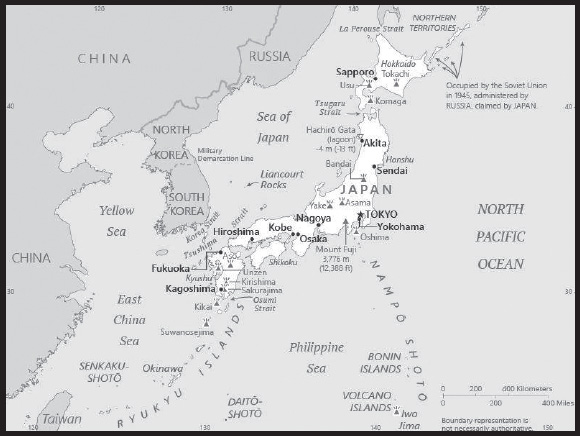
Population distribution: all primary and secondary regions of high population density lie on the coast; one-third of the population resides in and around Tokyo on the central plain (Kanto Plain)
Natural hazards: many dormant and some active volcanoes; about 1,500 seismic occurrences (mostly tremors but occasional severe earthquakes) every year; tsunamis; typhoons
volcanism: both Unzen (1,500 m) and Sakura-jima (1,117 m), which lies near the densely populated city of Kagoshima, have been deemed Decade Volcanoes by the International Association of Volcanology and Chemistry of the Earth’s Interior, worthy of study due to their explosive history and close proximity to human populations; other notable historically active volcanoes include Asama, Honshu Island’s most active volcano, Aso, Bandai, Fuji, Iwo-Jima, Kikai, Kirishima, Komaga-take, Oshima, Suwanosejima, Tokachi, Yake-dake, and Usu; see note 2 under “Geography - note”
Geography - note: note 1: strategic location in northeast Asia; composed of four main islands (the “Home Islands”) - from north: Hokkaido, Honshu (the largest, most populous, and site of Tokyo, the capital), Shikoku, and Kyushu
note 2: a 2023 Geospatial Information Authority of Japan survey technically detected 100,000 islands and islets, but only the 14,125 islands with a circumference of at least 100 m (330 ft) were officially counted; only about 260 of the islands are inhabited
note 3: Japan annually records the most earthquakes in the world; it is one of the countries along the Ring of Fire, a belt of active volcanoes and earthquake epicenters bordering the Pacific Ocean; up to 90% of the world’s earthquakes and some 75% of the world’s volcanoes occur within the Ring of Fire
PEOPLE AND SOCIETY
Population: 123,719,238 (2023 est.)
comparison ranking: 11
Nationality: noun: Japanese (singular and plural)
adjective: Japanese
Ethnic groups: Japanese 97.9%, Chinese 0.6%, Korean 0.4%, other 1.1% (includes Vietnamese, Filipino, and Brazilian) (2017 est.)
note: data represent population by nationality; up to 230,000 Brazilians of Japanese origin migrated to Japan in the 1990s to work in industries; some have returned to Brazil
Languages: Japanese
major-language sample(s):

(Japanese)
Religions: Shintoism 70.5%, Buddhism 67.2%, Christianity 1.5%, other 5.9% (2019 est.)
note: total adherents exceeds 100% because many people practice both Shintoism and Buddhism
Age structure: 0-14 years: 12.29% (male 7,835,474/female 7,370,449)
15-64 years: 58.49% (male 36,378,186/female 35,981,176)
65 years and over: 29.22% (2023 est.) (male 15,909,031/female 20,244,922)
Dependency ratios: total dependency ratio: 71.1
youth dependency ratio: 20.1
elderly dependency ratio: 51
potential support ratio: 2 (2021 est.)
Median age: total: 48.6 years (2020)
male: 47.2 years
female: 50 years
comparison ranking: total 2
Population growth rate: -0.41% (2023 est.)
comparison ranking: 220
Birth rate: 6.9 births/1,000 population (2023 est.)
comparison ranking: 225
Death rate: 11.74 deaths/1,000 population (2023 est.)
comparison ranking: 16
Net migration rate: 0.74 migrant(s)/1,000 population (2023 est.)
comparison ranking: 70
Population distribution: all primary and secondary regions of high population density lie on the coast; one-third of the population resides in and around Tokyo on the central plain (Kanto Plain)
Urbanization: urban population: 92% of total population (2023)
rate of urbanization: -0.25% annual rate of change (2020-25 est.)
Major urban areas - population: 37.194 million TOKYO (capital), 19.013 million Osaka, 9.569 million Nagoya, 5.490 million Kitakyushu-Fukuoka, 2.937 million Shizuoka-Hamamatsu, 2.666 million Sapporo (2023)
Sex ratio: at birth: 1.06 male(s)/female
0-14 years: 1.06 male(s)/female
15-64 years: 1.01 male(s)/female
65 years and over: 0.79 male(s)/female
total population: 0.95 male(s)/female (2023 est.)
Mother’s mean age at first birth: 30.7 years (2018 est.)
Maternal mortality ratio: 4 deaths/100,000 live births (2020 est.)
comparison ranking: 173
Infant mortality rate: total: 1.88 deaths/1,000 live births (2023 est.)
male: 1.99 deaths/1,000 live births
female: 1.77 deaths/1,000 live births
comparison ranking: total 223
Life expectancy at birth: total population: 85 years (2023 est.)
male: 82.11 years
female: 88.06 years
comparison ranking: total population 4
Total fertility rate: 1.39 children born/woman (2023 est.)
comparison ranking: 215
Gross reproduction rate: 0.68 (2023 est.)
Contraceptive prevalence rate: 39.8% (2015)
note: percent of women aged 20-49
Drinking water source: improved: total: 99.1% of population
unimproved: total: 0.1% of population (2020 est.)
Current health expenditure: 10.9% of GDP (2020)
Physicians density: 2.48 physicians/1,000 population (2018)
Hospital bed density: 13 beds/1,000 population (2018)
Sanitation facility access: improved: total: 99.9% of population
unimproved: total: 0.1% of population (2020 est.)
Obesity - adult prevalence rate: 4.3% (2016)
comparison ranking: 186
Alcohol consumption per capita: total: 8.36 liters of pure alcohol (2019 est.)
beer: 1.35 liters of pure alcohol (2019 est.)
wine: 0.29 liters of pure alcohol (2019 est.)
spirits: 1.63 liters of pure alcohol (2019 est.)
other alcohols: 5.09 liters of pure alcohol (2019 est.)
comparison ranking: total 39
Tobacco use: total: 20.1% (2020 est.)
male: 30.1% (2020 est.)
female: 10% (2020 est.)
comparison ranking: total 89
Currently married women (ages 15-49): 46.8% (2023 est.)
Education expenditures: 3.4% of GDP (2020 est.)
comparison ranking: 142
School life expectancy (primary to tertiary education): total: 15 years
male: 15 years
female: 15 years (2019)
Youth unemployment rate (ages 15-24): total: 4.4% (2021 est.)
male: 4.6%
female: 4.1%
comparison ranking: total 191
ENVIRONMENT
Environment - current issues: air pollution from power plant emissions results in acid rain; acidification of lakes and reservoirs degrading water quality and threatening aquatic life; Japan is one of the largest consumers of fish and tropical timber, contributing to the depletion of these resources in Asia and elsewhere; following the 2011 Fukushima nuclear disaster, Japan originally planned to phase out nuclear power, but it has now implemented a new policy of seeking to restart nuclear power plants that meet strict new safety standards; waste management is an ongoing issue; Japanese municipal facilities used to burn high volumes of trash, but air pollution issues forced the government to adopt an aggressive recycling policy
Environment - international agreements: party to: Antarctic-Environmental Protection, Antarctic-Marine Living Resources, Antarctic Seals, Antarctic Treaty, Biodiversity, Climate Change, Climate Change-Kyoto Protocol, Climate Change-Paris Agreement, Comprehensive Nuclear Test Ban, Desertification, Endangered Species, Environmental Modification, Hazardous Wastes, Law of the Sea, Marine Dumping-London Convention, Marine Dumping-London Protocol, Nuclear Test Ban, Ozone Layer Protection, Ship Pollution, Tropical Timber 2006, Wetlands
signed, but not ratified: none of the selected agreements
Climate: varies from tropical in south to cool temperate in north
Land use: agricultural land: 12.5% (2018 est.)
arable land: 11.7% (2018 est.)
permanent crops: 0.8% (2018 est.)
permanent pasture: 0% (2018 est.)
forest: 68.5% (2018 est.)
other: 19% (2018 est.)
Urbanization: urban population: 92% of total population (2023)
rate of urbanization: -0.25% annual rate of change (2020-25 est.)
Revenue from forest resources: 0.02% of GDP (2018 est.)
comparison ranking: 138
Revenue from coal: 0% of GDP (2018 est.)
comparison ranking: 137
Air pollutants: particulate matter emissions: 10.84 micrograms per cubic meter (2019 est.)
carbon dioxide emissions: 1,135.89 megatons (2016 est.)
methane emissions: 29.99 megatons (2020 est.)
Waste and recycling: municipal solid waste generated annually: 43.981 million tons (2015 est.)
municipal solid waste recycled annually: 2,155,069 tons (2015 est.)
percent of municipal solid waste recycled: 4.9% (2015 est.)
Major lakes (area sq km): fresh water lake(s): Biwa-ko 688 sq km
Total water withdrawal: municipal: 14.8 billion cubic meters (2020 est.)
industrial: 10.3 billion cubic meters (2020 est.)
agricultural: 53.3 billion cubic meters (2020 est.)
Total renewable water resources: 430 billion cubic meters (2020 est.)
GOVERNMENT
Country name: conventional long form: none
conventional short form: Japan
local long form: Nihon-koku/Nippon-koku
local short form: Nihon/Nippon
etymology: the English word for Japan comes via the Chinese name for the country “Cipangu”; both Nihon and Nippon mean “where the sun originates” and are frequently translated as “Land of the Rising Sun”
Government type: parliamentary constitutional monarchy
Capital: name: Tokyo
geographic coordinates: 35 41 N, 139 45 E
time difference: UTC+9 (14 hours ahead of Washington, DC, during Standard Time)
etymology: originally known as Edo, meaning “estuary” in Japanese, the name was changed to Tokyo, meaning “eastern capital,” in 1868
Administrative divisions: 47 prefectures; Aichi, Akita, Aomori, Chiba, Ehime, Fukui, Fukuoka, Fukushima, Gifu, Gunma, Hiroshima, Hokkaido, Hyogo, Ibaraki, Ishikawa, Iwate, Kagawa, Kagoshima, Kanagawa, Kochi, Kumamoto, Kyoto, Mie, Miyagi, Miyazaki, Nagano, Nagasaki, Nara, Niigata, Oita, Okayama, Okinawa, Osaka, Saga, Saitama, Shiga, Shimane, Shizuoka, Tochigi, Tokushima, Tokyo, Tottori, Toyama, Wakayama, Yamagata, Yamaguchi, Yamanashi
Independence: 3 May 1947 (current constitution adopted as amendment to Meiji Constitution); notable earlier dates: 11 February 660 B.C. (mythological date of the founding of the nation by Emperor JIMMU); 29 November 1890 (Meiji Constitution provides for constitutional monarchy)
National holiday: Birthday of Emperor NARUHITO, 23 February (1960); note - celebrates the birthday of the current emperor
Constitution: history: previous 1890; latest approved 6 October 1946, adopted 3 November 1946, effective 3 May 1947
amendments: proposed by the Diet; passage requires approval by at least two-thirds majority of both houses of the Diet and approval by majority in a referendum; note - the constitution has not been amended since its enactment in 1947
Legal system: civil law system based on German model; system also reflects Anglo-American influence and Japanese traditions; judicial review of legislative acts in the Supreme Court
International law organization participation: accepts compulsory ICJ jurisdiction with reservations; accepts ICCt jurisdiction
Citizenship: citizenship by birth: no
citizenship by descent only: at least one parent must be a citizen of Japan
dual citizenship recognized: no
residency requirement for naturalization: 5 years
Suffrage: 18 years of age; universal
Executive branch: chief of state: Emperor NARUHITO (since 1 May 2019); note - succeeds his father who abdicated on 30 April 2019
head of government: Prime Minister Fumio KISHIDA (since 4 October 2021)
cabinet: Cabinet appointed by the prime minister
elections/appointments: the monarchy is hereditary; the leader of the majority party or majority coalition in the House of Representatives usually becomes prime minister
election results: Fumio KISHIDA reelected prime minister on 10 November 2021; upper house vote - Fumio KISHIDA (LDP) 141, Yukio EDANO 60 (CDP); lower house vote - Fumio KISHIDA 297, Yukio EDANO 108
Legislative branch: description: bicameral Diet or Kokkai consists of:
House of Councillors or Sangi-in (248 seats; 146 members directly elected in multi-seat districts by simple majority vote and 96 directly elected in a single national constituency by proportional representation vote; members serve 6-year terms with half the membership renewed every 3 years); note - the number of seats increased to 248 at the July 2022 election for renewal of half the membership
House of Representatives or Shugi-in (465 seats; 289 members directly elected in single-seat districts by simple majority vote and 176 directly elected in multi-seat districts by party-list proportional representation vote; members serve 4-year terms)
elections: House of Councillors - last held on 10 July 2022 (next to be held in July 2028)
House of Representatives - last held on 31 October 2021 (next to be held by October 2025)
election results: House of Councillors - percent of vote by party - NA; seats by party - LDP 119, CDP 39, Komeito 27, JCP 11, Osaka Ishin no Kai (Initiatives from Osaka) 21, DPFP 10, Reiwa Shinsengumi 5, NHK 2, DIY 1, SDP 1, independent 12 House of Representatives - percent of vote by party - NA; seats by party - LDP 261, CDP 96, Ishin 41, Komeito 32, DPFP 11, JCP 10, Reiwa 3, SDP 1, independent 10; composition - men 420, women 45, percent of women 9.7%; note - total Diet percent of women 14.7%
note: the Diet in June 2017 redrew Japan’s electoral district boundaries and reduced from 475 to 465 seats in the House of Representatives; the amended electoral law, which cuts 6 seats in single-seat districts and 4 in multi-seat districts, was reportedly intended to reduce voting disparities between densely and sparsely populated voting districts
Judicial branch: highest court(s): Supreme Court or Saiko saibansho (consists of the chief justice and 14 associate justices); note - the Supreme Court has jurisdiction in constitutional issues
judge selection and term of office: Supreme Court chief justice designated by the Cabinet and appointed by the monarch; associate justices appointed by the Cabinet and confirmed by the monarch; all justices are reviewed in a popular referendum at the first general election of the House of Representatives following each judge’s appointment and every 10 years afterward
subordinate courts: 8 High Courts (Koto-saiban-sho), each with a Family Court (Katei-saiban-sho); 50 District Courts (Chiho saibansho), with 203 additional branches; 438 Summary Courts (Kani saibansho)
Political parties and leaders: Constitutional Democratic Party of Japan or CDP [Kenta IZUMI]
Democratic Party for the People Japan or DPFP [Yuichiro TAMAKI]
Group of Reformists [Sakihito OZAWA]
Japan Communist Party or JCP [Kazuo SHII]
Japan Innovation Party or Nippon Ishin no kai or Ishin [Ichiro MATSUI]
Komeito [Natsuo YAMAGUCHI]
Liberal Democratic Party or LDP [Fumio KISHIDA]
Liberal Party [Ichiro OZAWA] (formerly People’s Life Party & Taro Yamamoto and Friends or PLPTYF)
Party of Hope or Kibo no To [Nariaki NAKAYAMA]
Reiwa Shinsengumi [Taro YAMAMOTO]
Seijika Joshi or NHK [Ayaka OTSU (de jure) Takashi TACHIBANA (de facto)]
Sanseito or DIY [Sohei KAMIYA]
Social Democratic Party or SDP [Mizuho FUKUSHIMA]
International organization participation: ADB, AfDB (nonregional member), APEC, Arctic Council (observer), ARF, ASEAN (dialogue partner), Australia Group, BIS, CD, CE (observer), CERN (observer), CICA (observer), CP, CPLP (associate), EAS, EBRD, EITI (implementing country), FAO, FATF, G-5, G-7, G-8, G-10, G-20, IADB, IAEA, IBRD, ICAO, ICC (national committees), ICCt, ICRM, IDA, IEA, IFAD, IFC, IFRCS, IGAD (partners), IHO, ILO, IMF, IMO, IMSO, Interpol, IOC, IOM, IPU, ISO, ITSO, ITU, ITUC (NGOs), LAIA (observer), MIGA, NEA, NSG, OAS (observer), OECD, OPCW, OSCE (partner), Pacific Alliance (observer), Paris Club, PCA, PIF (partner), Quad, SAARC (observer), SELEC (observer), SICA (observer), UN, UNCTAD, UNESCO, UNHCR, UNHRC, UNIDO, UNMISS, UNRWA, UNWTO, UPU, Wassenaar Arrangement, WCO, WFTU (NGOs), WHO, WIPO, WMO, WTO, ZC
Diplomatic representation in the US: chief of mission: Ambassador TOMITA Koji (since 17 February 2021)
chancery: 2520 Massachusetts Avenue NW, Washington, DC 20008
telephone: [1] (202) 238-6700
FAX: [1] (202) 328-2187
email address and website:
https://www.us.emb-japan.go.jp/itprtop_en/index.html
consulate(s) general: Anchorage (AK), Atlanta, Boston, Chicago, Denver (CO), Detroit (MI), Hagatna (Guam), Honolulu, Houston, Los Angeles, Miami, Nashville (TN), New York, Portland (OR), San Francisco, Saipan (Northern Mariana Islands), Seattle (WA)
Diplomatic representation from the US: chief of mission: Ambassador Rahm EMANUEL (since 25 March 2022)
embassy: 1-10-5 Akasaka, Minato-ku, Tokyo 107-8420
mailing address: 9800 Tokyo Place, Washington DC 20521-9800
telephone: [81] (03) 3224-5000
FAX: [81] (03) 3224-5856
email address and website:
consulate(s) general: Naha (Okinawa), Osaka-Kobe, Sapporo
consulate(s): Fukuoka, Nagoya
Flag description: white with a large red disk (representing the sun without rays) in the center
National symbol(s): red sun disc, chrysanthemum; national colors: red, white
Kikumon – the Japanese Family Coat of Arms of the emperor:
National anthem: name: “Kimigayo” (The Emperor’s Reign)
lyrics/music: unknown/Hiromori HAYASHI
note: adopted 1999; unofficial national anthem since 1883; oldest anthem lyrics in the world, dating to the 10th century or earlier; there is some opposition to the anthem because of its association with militarism and worship of the emperor
National heritage: total World Heritage Sites: 25 (20 cultural, 5 natural)
selected World Heritage Site locales: Buddhist Monuments in the Horyu-ji Area (c); Historic Monuments of Ancient Nara (c); Himeji-jo (c); Shiretoko (n); Mozu-Furuichi Kofun Group: Mounded Tombs of Ancient Japan (c); Iwami Ginzan Silver Mine and its Cultural Landscape (c); Jomon Prehistoric Sites in Northern Japan (c); Yakushima (n); Historic Monuments of Ancient Kyoto (c); Hiroshima Peace Memorial (Genbaku Dome) (c)
ECONOMY
Economic overview: fourth-largest, trade-oriented, and diversified economy; highly indebted country; slow wage growth and declining labor force; still heavily hydrocarbon-reliant; central bank keeping negative interest rates amid modest inflation; increased military spending; stagnant tourism sector
Real GDP (purchasing power parity): $5.126 trillion (2021 est.) note: data are in 2017 dollars
$5.042 trillion (2020 est.) note: data are in 2017 dollars
$5.28 trillion (2019 est.)
comparison ranking: 4
Real GDP growth rate: 1.66% (2021 est.)
-4.51% (2020 est.)
-0.24% (2019 est.)
comparison ranking: 170
Real GDP per capita: $40,800 (2021 est.) note: data are in 2017 dollars
$39,900 (2020 est.) note: data are in 2017 dollars
$41,700 (2019 est.)
comparison ranking: 47
GDP (official exchange rate): $5,078,679,000,000 (2019 est.)
Inflation rate (consumer prices): -0.23% (2021 est.)
-0.02% (2020 est.)
0.47% (2019 est.)
comparison ranking: 217
Credit ratings: Fitch rating: A (2015)
Moody’s rating: A1 (2014)
Standard & Poors rating: A+ (2015)
note: The year refers to the year in which the current credit rating was first obtained.
GDP - composition, by sector of origin: agriculture: 1.1% (2017 est.)
industry: 30.1% (2017 est.)
services: 68.7% (2017 est.)
comparison rankings: services 78; industry 76; agriculture 197
GDP - composition, by end use: household consumption: 55.5% (2017 est.)
government consumption: 19.6% (2017 est.)
investment in fixed capital: 24% (2017 est.)
investment in inventories: 0% (2017 est.)
exports of goods and services: 17.7% (2017 est.)
imports of goods and services: -16.8% (2017 est.)
Agricultural products: rice, milk, sugar beets, vegetables, eggs, poultry, potatoes, cabbages, onions, pork
Industries: among world’s largest and most technologically advanced producers of motor vehicles, electronic equipment, machine tools, steel and nonferrous metals, ships, chemicals, textiles, processed foods
Industrial production growth rate: -4.33% (2020 est.)
comparison ranking: 186
Labor force: 68.629 million (2021 est.)
comparison ranking: 9
Labor force - by occupation: agriculture: 2.9%
industry: 26.2%
services: 70.9% (February 2015 est.)
Unemployment rate: 2.8% (2021 est.)
2.8% (2020 est.)
2.4% (2019 est.)
comparison ranking: 199
Youth unemployment rate (ages 15-24): total: 4.4% (2021 est.)
male: 4.6%
female: 4.1%
comparison ranking: total 191
Population below poverty line: 16.1% (2013 est.)
Gini Index coefficient - distribution of family income: 32.9 (2013 est.)
comparison ranking: 126
Average household expenditures: on food: 16% of household expenditures (2018 est.)
on alcohol and tobacco: 2.3% of household expenditures (2018 est.)
Household income or consumption by percentage share: lowest 10%: 2.7%
highest 10%: 24.8% (2008)
Budget: revenues: $1.756 trillion (2019 est.)
expenditures: $1.916 trillion (2019 est.)
Budget surplus (+) or deficit (-): -3.5% (of GDP) (2017 est.)
comparison ranking: 148
Public debt: 216.28% of GDP (2020 est.)
197.8% of GDP (2019 est.)
197.45% of GDP (2018 est.)
comparison ranking: 2
Taxes and other revenues: 35.2% (of GDP) (2017 est.)
comparison ranking: 19
Fiscal year: 1 April - 31 March
Current account balance: $157.743 billion (2021 est.)
$147.948 billion (2020 est.)
$176.61 billion (2019 est.)
comparison ranking: 3
Exports: $919.158 billion (2021 est.) note: data are in current year dollars
$794.291 billion (2020 est.) note: data are in current year dollars
$904.632 billion (2019 est.) note: data are in current year dollars
comparison ranking: 5
Exports - partners: China 21%, US 18%, South Korea 7%, Taiwan 7%, Thailand 4% (2021)
Exports - commodities: cars and vehicle parts, integrated circuits, general machinery, photo lab equipment, construction vehicles, semiconductors (2021)
Imports: $941.671 billion (2021 est.) note: data are in current year dollars
$801.889 billion (2020 est.) note: data are in current year dollars
$913.248 billion (2019 est.) note: data are in current year dollars
comparison ranking: 5
Imports - partners: China 24%, US 10%, Australia 7%, South Korea 4%, Taiwan 4% (2021)
Imports - commodities: crude petroleum, natural gas, integrated circuits, coal, refined petroleum, iron (2021)
Reserves of foreign exchange and gold: $1.406 trillion (31 December 2021 est.)
$1.391 trillion (31 December 2020 est.)
$1.322 trillion (31 December 2019 est.)
comparison ranking: 2
Debt - external: $4,254,271,000,000 (2019 est.)
$3,944,898,000,000 (2018 est.)
comparison ranking: 7
Exchange rates: yen (JPY) per US dollar -
Exchange rates: 109.754 (2021 est.)
106.775 (2020 est.)
109.01 (2019 est.)
110.423 (2018 est.)
112.166 (2017 est.)
ENERGY
Electricity access: electrification - total population: 100% (2021)
Electricity: installed generating capacity: 348.666 million kW (2020 est.)
consumption: 903,698,740,000 kWh (2019 est.)
exports: 0 kWh (2020 est.)
imports: 0 kWh (2020 est.)
transmission/distribution losses: 44.094 billion kWh (2019 est.)
comparison rankings: imports 156; exports 143; installed generating capacity 4; transmission/distribution losses 7; consumption 5
Electricity generation sources: fossil fuels: 73.5% of total installed capacity (2020 est.)
nuclear: 4.8% of total installed capacity (2020 est.)
solar: 8.8% of total installed capacity (2020 est.)
wind: 1% of total installed capacity (2020 est.)
hydroelectricity: 10% of total installed capacity (2020 est.)
geothermal: 0.3% of total installed capacity (2020 est.)
biomass and waste: 1.6% of total installed capacity (2020 est.)
Nuclear energy: Number of operational nuclear reactors: 10 (2023)
Number of nuclear reactors under construction: 2
Net capacity of operational nuclear reactors: 9.49GW (2023)
Percent of total electricity production: 7% (2018)
Percent of total energy produced: 24% (2021)
Number of nuclear reactors permanently shut down: 17
Coal: production: 29.84 million metric tons (2020 est.)
consumption: 210.882 million metric tons (2020 est.)
exports: 3.201 million metric tons (2020 est.)
imports: 174.486 million metric tons (2020 est.)
proven reserves: 350 million metric tons (2019 est.)
Petroleum: total petroleum production: 10,200 bbl/day (2021 est.)
refined petroleum consumption: 3,739,300 bbl/day (2019 est.)
crude oil and lease condensate exports: 0 bbl/day (2018 est.)
crude oil and lease condensate imports: 3,012,800 bbl/day (2018 est.)
crude oil estimated reserves: 44.1 million barrels (2021 est.)
Refined petroleum products - production: 3.467 million bbl/day (2017 est.)
comparison ranking: 5
Refined petroleum products - exports: 370,900 bbl/day (2017 est.)
comparison ranking: 24
Refined petroleum products - imports: 1.1 million bbl/day (2017 est.)
comparison ranking: 5
Natural gas: production: 1,928,431,000 cubic meters (2020 est.)
consumption: 102,108,738,000 cubic meters (2019 est.)
exports: 28,000 cubic meters (2019 est.)
imports: 105,255,103,000 cubic meters (2019 est.)
proven reserves: 20.898 billion cubic meters (2021 est.)
note: Japan had been the largest global liquefied natural gas (LNG) importer until 2021 when it was exceeded by China; prior to 2021, Japan had been the largest importer of LNG for 51 years; Japan has the largest LNG storage tank capacity in the world, or about 643 million cubic feet (MMcf) as of early 2020; in 2019, Japan sourced 28% of its LNG imports from regional suppliers in Southeast Asia and 39% from Australia
Carbon dioxide emissions: 1,103,234,000 metric tonnes of CO2 (2019 est.)
from coal and metallurgical coke: 439.243 million metric tonnes of CO2 (2019 est.)
from petroleum and other liquids: 444.271 million metric tonnes of CO2 (2019 est.)
from consumed natural gas: 219.72 million metric tonnes of CO2 (2019 est.)
comparison ranking: total emissions 5
Energy consumption per capita: 147.107 million Btu/person (2019 est.)
comparison ranking: 35
COMMUNICATIONS
Telephones - fixed lines: total subscriptions: 61,583,600 (2021 est.)
subscriptions per 100 inhabitants: 49 (2021 est.)
comparison ranking: total subscriptions 3
Telephones - mobile cellular: total subscriptions: 200,478,808 (2021 est.)
subscriptions per 100 inhabitants: 161 (2021 est.)
comparison ranking: total subscriptions 7
Telecommunication systems: general assessment: Japan has one of the best developed telecom markets globally, the fixed-line segment remains stagnant and the focus for growth is in the mobile sector; the MNOs have shifted their investment from LTE to 5G, and growth in 5G showed early promise although there have been recent setbacks; these have partly been attributed to the economic difficulties, the impact of restrictions imposed during the pandemic, and unfavorable investment climate (not helped by the delay of the Tokyo Olympics from 2020 to 2021), and to restrictions in the supply of 5G-enabled devices; the fixed broadband market is dominated by fiber, with a strong cable platform also evident; fiber will continue to increase its share of the fixed broadband market, largely at the expense of DSL; the mobile market is dominated by three MNOs, mobile broadband subscriber growth is expected to be relatively low over the next five years, partly due to the high existing subscriptions though growth has been stimulated by measures which have encouraged people to school and work from home; there has also been a boost in accessing entertainment via mobile devices since 2020 (2021)
domestic: 49 per 100 for fixed-line and 161 per 100 for mobile-cellular subscriptions (2021)
international: country code - 81; numerous submarine cables with landing points for HSCS, JIH, RJCN, APCN-2, JUS, EAC-C2C, PC-1, Tata TGN-Pacific, FLAG North Asia Loop/REACH North Asia Loop, APCN-2, FASTER, SJC, SJC2, Unity/EAC-Pacific, JGA-N, APG, ASE, AJC, JUPITER, MOC, Okinawa Cellular Cable, KJCN, GOKI, KJCN, and SeaMeWE-3, submarine cables provide links throughout Asia, Australia, the Middle East, Europe, Southeast Asia, Africa and US; satellite earth stations - 7 Intelsat (Pacific and Indian Oceans), 1 Intersputnik (Indian Ocean region), 2 Inmarsat (Pacific and Indian Ocean regions), and 8 SkyPerfect JSAT (2019)
Broadcast media: a mixture of public and commercial broadcast TV and radio stations; 6 national terrestrial TV networks including 1 public broadcaster; the large number of radio and TV stations available provide a wide range of choices; satellite and cable services provide access to international channels (2019)
Internet country code: .jp
Internet users: total: 99.6 million (2021 est.)
percent of population: 83% (2021 est.)
comparison ranking: total 8
Broadband - fixed subscriptions: total: 44,000,791 (2020 est.)
subscriptions per 100 inhabitants: 35 (2020 est.)
comparison ranking: total 3
TRANSPORTATION
National air transport system: number of registered air carriers: 22 (2020)
inventory of registered aircraft operated by air carriers: 673
annual passenger traffic on registered air carriers: 126,387,527 (2018)
annual freight traffic on registered air carriers: 9,420,660,000 (2018) mt-km
Civil aircraft registration country code prefix: JA
Airports: 175 (2021)
comparison ranking: total 32
Airports - with paved runways: 142
note: paved runways have a concrete or asphalt surface but not all have facilities for refueling, maintenance, or air traffic control; the length of a runway required for aircraft to safely operate depends on a number of factors including the type of aircraft, the takeoff weight (including passengers, cargo, and fuel), engine types, flap settings, landing speed, elevation of the airport, and average maximum daily air temperature; paved runways can reach a length of 5,000 m (16,000 ft.), but the “typical” length of a commercial airline runway is between 2,500-4,000 m (8,000-13,000 ft.)
Airports - with unpaved runways: 33
note: unpaved runways have a surface composition such as grass or packed earth and are most suited to the operation of light aircraft; unpaved runways are usually short, often less than 1,000 m (3,280 ft.) in length; airports with unpaved runways often lack facilities for refueling, maintenance, or air traffic control
Heliports: 16 (2021)
Pipelines: 4,456 km gas, 174 km oil, 104 km oil/gas/water (2013)
Railways: total: 27,311 km (2015)
standard gauge: 4,800 km (2015) 1.435-m gauge (4,800 km electrified)
narrow gauge: 124 km (2015) 1.372-m gauge (124 km electrified)
dual gauge: 132 km (2015) 1.435-1.067-m gauge (132 km electrified)
22,207 km 1.067-mm gauge (15,430 km electrified)
48 km 0.762-m gauge (48 km electrified)
comparison ranking: total 10
Roadways: total: 1,218,772 km (2015)
paved: 992,835 km (2015) (includes 8,428 km of expressways)
unpaved: 225,937 km (2015)
comparison ranking: total 6
Waterways: 1,770 km (2010) (seagoing vessels use inland seas)
comparison ranking: 46
Merchant marine: total: 5,590 (2022)
by type: bulk carrier 149, container ship 47, general cargo 2,071, oil tanker 690, other 2,633
comparison ranking: total 4
Ports and terminals: major seaport(s): Chiba, Kawasaki, Kobe, Mizushima, Moji, Nagoya, Osaka, Tokyo, Tomakomai, Yokohama
container port(s) (TEUs): Kobe (2,823,774), Nagoya (2,725,597), Osaka (2,425,638), Tokyo (4,325,956), Yokohama (2,861,197) (2021)
LNG terminal(s) (import): Chita, Chita Midorihama, Fukuoka, Futtsu, Hachinone, Hakodate, Hatsukaichi, Higashi Ohgishima, Higashi Niigata, Himeiji, Hitachi, Ishikari, Joetsu, Kagoshima, Kawagoe, Hibiki, Mitzushima, Nagasaki, Naoetsu, Negishi, Ohgishima, Oita, Sakai, Sakaide, Senboku, Shin Minato, Shin-Sendai, Sodeshi Shimizu, Sodegaura, Soma, Tobata, Toyama Shinko, Yanai, Yokkaichi, Yoshinoura Okinawa - Nakagusuku
Transportation - note: Japan operates one PC 3 or 4 class medium icebreaker
note - PC indicates a Polar Class vessel: PC 3 - year-round operation in second-year ice which may include multi-year ice inclusions (ice thickness up to 2.5 m); PC 4 - year-round operation in thick first-year ice which may include old ice inclusions (ice thickness up to 120 cm)
MILITARY AND SECURITY
Military and security forces: Japan Self-Defense Force (JSDF): Ground Self-Defense Force (Rikujou Jieitai, GSDF; includes aviation), Maritime Self-Defense Force (Kaijou Jieitai, MSDF; includes naval aviation), Air Self-Defense Force (Koukuu Jieitai, ASDF) (2023)
note: the Coast Guard is under the Ministry of Land, Infrastructure, Transport and Tourism; it is barred by law from operating as a military force, but in times of conflict Article 80 of the 1954 Self-Defense Forces Act permits the transfer of control of the coast guard to the Ministry of Defense with Cabinet approval
Military expenditures: 1.1% of GDP (2023 est.)
1.1% of GDP (2022)
1% of GDP (2021)
1% of GDP (2020)
0.9% of GDP (2019)
note: the Japanese Government in 2022 pledged to increase defense expenditures to 2% of GDP in line with NATO standards by 2028; if the planned increase occurs, Japan would have one of the world’s largest defense budgets comparison ranking: 128
Military and security service personnel strengths: approximately 230-240,000 active personnel (145-150,000 Ground; 40-45,000 Maritime; 40-45,000 Air); 14,000 Coast Guard (2023)
Military equipment inventories and acquisitions: the JSDF is equipped with a mix of imported and domestically produced equipment; Japan has a robust defense industry and is capable of producing a wide range of air, ground, and naval weapons systems; the majority of its weapons imports are from the US and some domestically produced weapons are US-origin and manufactured under license (2023)
Military service age and obligation: 18-32 years of age for voluntary military service for men and women; no conscription (2023)
note: as of 2023, women made up about 9% of the military’s full-time personnel
Military deployments: approximately 200 Djibouti (2023)
Military - note: Japan was disarmed after its defeat in World War II; shortly after the Korean War began in 1950, US occupation forces in Japan created a 75,000-member lightly armed force called the National Police Reserve; the Japan Self-Defense Force (JSDF) was founded in 1954; the current JSDF is a trained and professional military equipped with modern weaponry; its primary concerns are China and North Korea, as well as protecting the country’s territorial waters, countering piracy and terrorism, and conducting humanitarian operations; it exercises regularly with the US military and increasingly with other regional countries, such as Australia; the ground forces are organized into 10 divisions and 11 independent brigades; the independent brigades include airborne, air assault, and amphibious rapid reaction forces; the maritime force is one of the largest and most modern navies in the world; its principal warships include four helicopter carriers (two are undergoing conversion to light aircraft carriers), nearly 50 destroyers and frigates/destroyer escorts, three landing platform/dock (LPD) amphibious assault ships, and more than 20 attack-type submarines; it also has a large force of maritime aircraft, including over 150 for anti-submarine warfare; the Air Self Defense Force has over 300 modern combat aircraft, as well as more than 200 other aircraft for surveillance, early warning, electronic warfare, search and rescue, transportation, and logistics
Japan’s alliance with the US (signed in 1951) is one of the cornerstones of the country’s security, as well as a large part of the US security role in Asia; approximately 55,000 US troops and other military assets, including aircraft and naval ships, are stationed in Japan and have exclusive use of more than 80 bases and facilities; in exchange for their use, the US guarantees Japan’s security; the Japanese Government provides about $2 billion per year to offset the cost of stationing US forces in Japan; in addition, it pays compensation to localities hosting US troops, rent for bases, and costs for new facilities to support the US presence; Japan also has Major Non-NATO Ally (MNNA) status with the US, a designation under US law that provides foreign partners with certain benefits in the areas of defense trade and security cooperation
Article 9 of Japan’s 1947 constitution renounced the use of force as a means of settling international disputes; however, Japan has interpreted Article 9 to mean that it can maintain a military for national defense purposes and, since 1991, has allowed the JSDF to participate in noncombat roles overseas in a number of UN peacekeeping missions and in the US-led coalition in Iraq; in 2014-2015 the Japanese Government reinterpreted the constitution as allowing for “collective self-defense,” described as the use of force on others’ behalf if Japan’s security was threatened; in 2022, the government released three documents that provided a blueprint that could fundamentally reshape Japan’s approach to its security; the documents labeled China as an “unprecedented strategic challenge,” declared Japan’s intention to develop “counterstrike” capabilities, including cruise missiles and armed drones, and outlined plans to increase Japan’s security-related expenditures to 2% of its national gross domestic product (GDP), in line with NATO standards; post-war Japan generally has limited defense spending to 1% of its GDP (2023)
SPACE
Space agency/agencies: Japan Aerospace Exploration Agency (JAXA; established in 2003); JAXA was established from the merger of the Institute of Space and Astronautical Science (ISAS), the National Aerospace Laboratory of Japan (NAL), and National Space Development Agency of Japan (NASDA); the military has a space operations squadron under the Japan Air Self-Defense Force to monitor and counter threats to satellites (2023)
Space launch site(s): Tanegashima Space Center/Yoshinobu Launch Complex (Kagoshima), Uchinoura Space Center (Kagoshima), Noshiro Testing Center (Akita) (2023)
Space program overview: has one of the world’s largest and most advanced space programs with independent capabilities in all areas of space categories except for autonomous manned space flight; designs, builds, launches, and operates the full spectrum of satellites, including communications, remote sensing (RS), astronomical observation, scientific, and navigational/positional; designs, builds, and independently launches satellite/space launch vehicles (SLVs) and other spacecraft, including interplanetary and Lunar probes, space station modules and space labs, and space transportation systems; has a wide range of research and development programs, including reusable SLVs, space-based astronomy, spacecraft components, robotics, solar sails, radio waves, and space plasma; has an astronaut training program; participates in international space programs, including the International Space Station (ISS), leading the Asia-Pacific Regional Space Agency Forum, and co-leading the Global Earth Observation System of Systems; cooperates with a variety of foreign space agencies and industries, including those of Canada, the European Space Agency (ESA) and its individual member states, India, Russia, the UAE, the US, and a range of other countries and space agencies throughout Africa, Europe, and the Asia-Pacific regions; has a substantial commercial space industry that develops an array of space-related capabilities and technologies, including satellites, satellite payloads and subcomponents, and SLVs; in 2018, the Japanese Government announced the establishment of a $950 million venture capital fund to support the development of Japanese space startup companies (2023)
note: further details about the key activities, programs, and milestones of the country’s space program, as well as government spending estimates on the space sector, appear in Appendix S
TRANSNATIONAL ISSUES
Disputes - international: Japan-China-Taiwan: the Japanese-administered Senkaku Islands (Diaoyu Tai) are also claimed by China and Taiwan; Senkaku-shoto is situated near key shipping lanes, rich fishing grounds, and possibly significant oil and natural gas reserves
Japan-Russia: the sovereignty dispute over the islands of Etorofu, Kunashiri, and Shikotan, and the Habomai group, known in Japan as the “Northern Territories” and in Russia as the “Southern Kuril Islands,” occupied by the Soviet Union in 1945, now administered by Russia and claimed by Japan, remains the primary sticking point to signing a peace treaty formally ending World War II hostilities
Japan-South Korea: Japan and South Korea claim Liancourt Rocks (Take-shima/Tok-do) occupied by South Korea since 1954
Refugees and internally displaced persons: stateless persons: 531 (2022)
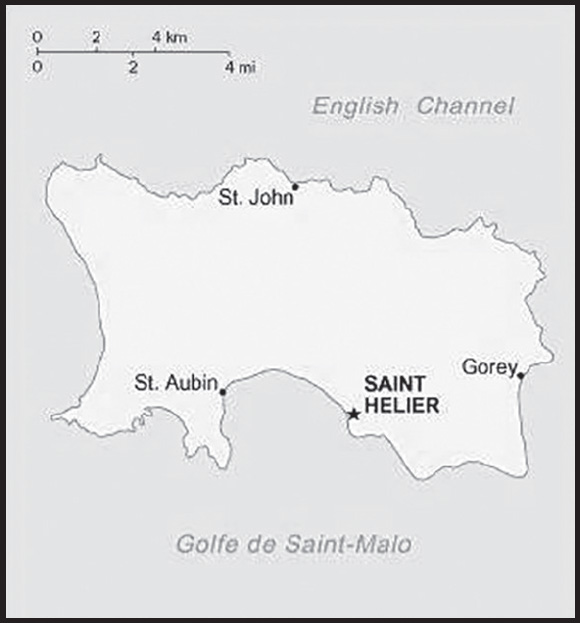
INTRODUCTION
Background: Jersey and the other Channel Islands represent the last remnants of the medieval Duchy of Normandy that held sway in both France and England. These islands were the only British soil occupied by German troops in World War II. The Bailiwick of Jersey is a British Crown dependency, which means that it is not part of the UK but is rather a self-governing possession of the British Crown. However, the UK Government is constitutionally responsible for its defense and international representation.
GEOGRAPHY
Location: Western Europe, island in the English Channel, northwest of France
Geographic coordinates: 49 15 N, 2 10 W
Map references: Europe
Area: total: 116 sq km
land: 116 sq km
water: 0 sq km
comparison ranking: total 224
Area - comparative: about two-thirds the size of Washington, DC
Land boundaries: total: 0 km
Coastline: 70 km
Maritime claims: territorial sea: 12 nm
exclusive fishing zone: 12 nm
Climate: temperate; mild winters and cool summers
Terrain: gently rolling plain with low, rugged hills along north coast
Elevation: highest point: Les Platons 136 m
lowest point: English Channel 0 m
Natural resources: arable land
Land use: agricultural land: 66% (2018 est.)
arable land: 66% (2018 est.)
other: 34% (2018 est.)
Irrigated land: NA
Population distribution: fairly even distribution; no notable trends
Natural hazards: very large tidal variation can be hazardous to navigation
Geography - note: largest and southernmost of Channel Islands; about 30% of population concentrated in Saint Helier
PEOPLE AND SOCIETY
Population: 102,785 (2023 est.)
comparison ranking: 193
Nationality: noun: Channel Islander(s)
adjective: Channel Islander
Ethnic groups: Jersey 44.4%, British 30.5%, Portuguese/Madeiran 9.4%, Polish 3%, Irish 2.1%, other 10.6% (2021 est.)
Languages: English (official) 94.5%, Portuguese 4.6%, other 0.9% (includes French (official) and Jerriais) (2001 est.)
note: data represent main spoken language; the traditional language of Jersey is Jerriais or Jersey French (a Norman language), which was spoken by fewer than 3,000 people as of 2001; two thirds of Jerriais speakers are aged 60 and over
Religions: Protestant (Anglican, Baptist, Congregational New Church, Methodist, Presbyterian), Roman Catholic
Age structure: 0-14 years: 16.89% (male 8,958/female 8,405)
15-64 years: 65.19% (male 33,888/female 33,121)
65 years and over: 17.91% (2023 est.) (male 7,871/female 10,542)
Dependency ratios: total dependency ratio: 44.5
youth dependency ratio: 21.3
elderly dependency ratio: 23.2
potential support ratio: 4.3 (2021 est.)
note: data represent Guernsey and Jersey
Median age: total: 37.5 years (2020)
male: 36 years
female: 39.5 years
comparison ranking: total 69
Population growth rate: 0.61% (2023 est.)
comparison ranking: 141
Birth rate: 12.31 births/1,000 population (2023 est.)
comparison ranking: 146
Death rate: 7.75 deaths/1,000 population (2023 est.)
comparison ranking: 99
Net migration rate: 1.5 migrant(s)/1,000 population (2023 est.)
comparison ranking: 57
Population distribution: fairly even distribution; no notable trends
Urbanization: urban population: 31.2% of total population (2023)
rate of urbanization: 0.68% annual rate of change (2020-25 est.)
note: data include Guernsey and Jersey
Major urban areas - population: 34,000 SAINT HELIER (capital) (2018)
Sex ratio: at birth: 1.06 male(s)/female
0-14 years: 1.07 male(s)/female
15-64 years: 1.02 male(s)/female
65 years and over: 0.75 male(s)/female
total population: 0.97 male(s)/female (2023 est.)
Infant mortality rate: total: 3.81 deaths/1,000 live births (2023 est.)
male: 4.25 deaths/1,000 live births
female: 3.34 deaths/1,000 live births
comparison ranking: total 191
Life expectancy at birth: total population: 82.83 years (2023 est.)
male: 80.34 years
female: 85.47 years
comparison ranking: total population 17
Total fertility rate: 1.66 children born/woman (2023 est.)
comparison ranking: 173
Gross reproduction rate: 0.8 (2023 est.)
Drinking water source: improved: total: 94.2% of population
unimproved: total: 5.9% of population (2017 est.)
note: includes data for Guernsey
Sanitation facility access: improved: total: 98.5% of population
unimproved:
total: 1.5% of population (2017)
Youth unemployment rate (ages 15-24): total: 15.8% (2021 est.)
male: 15.9%
female: 15.6%
comparison ranking: total 109
ENVIRONMENT
Environment - current issues: habitat and species depletion due to human encroachment; water pollution; improper solid waste disposal
Climate: temperate; mild winters and cool summers
Land use: agricultural land: 66% (2018 est.)
arable land: 66% (2018 est.)
other: 34% (2018 est.)
Urbanization: urban population: 31.2% of total population (2023)
rate of urbanization: 0.68% annual rate of change (2020-25 est.)
note: data include Guernsey and Jersey
Waste and recycling: municipal solid waste generated annually: 178,933 tons (2016 est.)
municipal solid waste recycled annually: 50,871 tons (2016 est.)
percent of municipal solid waste recycled: 28.4% (2016 est.)
note: data include combined totals for Guernsey and Jersey.
GOVERNMENT
Country name: conventional long form: Bailiwick of Jersey
conventional short form: Jersey
former: Norman Isles
etymology: the name is of Old Norse origin, but the meaning of the root “Jer(s)” is uncertain; the “-ey” ending means “island”
Government type: parliamentary democracy (Assembly of the States of Jersey)
Dependency status: British crown dependency
Capital: name: Saint Helier
geographic coordinates: 49 11 N, 2 06 W
time difference: UTC 0 (5 hours ahead of Washington, DC, during Standard Time)
daylight saving time: +1hr, begins last Sunday in March; ends last Sunday in October
etymology: named after Saint HELIER, the patron saint of Jersey, who was reputedly martyred on the island in A.D. 555
Administrative divisions: none (British crown dependency); there are no first-order administrative divisions as defined by the US Government, but there are 12 parishes; Grouville, Saint Brelade, Saint Clement, Saint Helier, Saint John, Saint Lawrence, Saint Martin, Saint Mary, Saint Ouen, Saint Peter, Saint Saviour, Trinity
Independence: none (British Crown dependency)
National holiday: Liberation Day, 9 May (1945)
Constitution: history: unwritten; partly statutes, partly common law and practice
amendments: proposed by a government minister to the Assembly of the States of Jersey, by an Assembly member, or by an elected parish head; passage requires several Assembly readings, a majority vote by the Assembly, review by the UK Ministry of Justice, and approval of the British monarch (Royal Assent)
Legal system: the laws of the UK apply where applicable; includes local statutes
Citizenship: see United Kingdom
Suffrage: 16 years of age; universal
Executive branch: chief of state: King CHARLES III (since 8 September 2022); represented by Lieutenant Governor Jerry KYD (since 8 October 2022)
head of government: Chief Minister Kristina MOORE (since 12 July 2022); Bailiff Timothy Le COCQ (since 17 October 2019)
cabinet: Council of Ministers appointed individually by the states
elections/appointments: the monarchy is hereditary; Council of Ministers, including the chief minister, indirectly elected by the Assembly of States; lieutenant governor and bailiff appointed by the monarch
Legislative branch: description: unicameral Assembly of the States of Jersey (49 elected members; 8 senators to serve 4-year terms, and 29 deputies and 12 connetables, or heads of parishes, to serve 4-year terms; 5 non-voting members appointed by the monarch include the bailiff, lieutenant governor, dean of Jersey, attorney general, and the solicitor general)
elections: last held on 22 June 2022 (next to be held in 2026)
election results: percent of vote by party - BW 66.8%, RJ 12.3%, JA 2.0%, PP 2.0%, JLC 4.1%; seats by party - BW 35, RJ 10, JA 1, PP 1, JLC 2; composition - men NA, women NA, percent of women NA
Judicial branch: highest court(s): Jersey Court of Appeal (consists of the bailiff, deputy bailiff, and 12 judges); Royal Court (consists of the bailiff, deputy bailiff, 6 commissioners and lay people referred to as jurats, and is organized into Heritage, Family, Probate, and Samedi Divisions); appeals beyond the Court of Appeal are heard by the Judicial Committee of the Privy Council (in London)
judge selection and term of office: Jersey Court of Appeal bailiffs and judges appointed by the Crown upon the advice of the Secretary of State for Justice; bailiffs and judges appointed for “extent of good behavior;” Royal Court bailiffs appointed by the Crown upon the advice of the Secretary of State for Justice; commissioners appointed by the bailiff; jurats appointed by the Electoral College; bailiffs and commissioners appointed for “extent of good behavior;” jurats appointed until retirement at age 72
subordinate courts: Magistrate’s Court; Youth Court; Petty Debts Court; Parish Hall Enquiries (a process of preliminary investigation into youth and minor adult offenses to determine need for presentation before a court)
Political parties and leaders: Better Way or BW (group of independent candidates)
Jersey Alliance or JA [Mark BOLEAT]
Jersey Liberal Conservatives or JLC [Sir Philip BAILHACHE]
Progress Party or PP [Steve PALLETT]
Reform Jersey or RJ [Sam MEZEC]
note: most deputies sit as independents
International organization participation: UPU
Diplomatic representation in the US: chief of mission: none (British Crown dependency)
Diplomatic representation from the US: embassy: none (British Crown dependency)
Flag description: white with a diagonal red cross extending to the corners of the flag; in the upper quadrant, surmounted by a yellow crown, a red shield with three lions in yellow; according to tradition, the ships of Jersey - in an attempt to differentiate themselves from English ships flying the horizontal cross of St. George - rotated the cross to the “X” (saltire) configuration; because this arrangement still resembled the Irish cross of St. Patrick, the yellow Plantagenet crown and Jersey coat of arms were added
National symbol(s): Jersey cow; national colors: red, white
National anthem: name: “Isle de Siez Nous” (Island Home)
lyrics/music: Gerard LE FEUVRE
note: adopted 2008; serves as a local anthem; as a British Crown dependency, “God Save the King” is official (see United Kingdom)
ECONOMY
Economic overview: British territorial island economy; strong offshore banking and finance sectors; low asset taxation; strong tourism sector prior to COVID-19 and Brexit; one of the most expensive places to live; minimal welfare system; historical cider industry
Real GDP (purchasing power parity): $5.569 billion (2016 est.)
$5.514 billion (2015 est.)
$4.98 billion (2014 est.)
note: data are in 2015 US dollars
comparison ranking: 175
Real GDP growth rate: 1% (2016 est.)
10.7% (2015 est.)
comparison ranking: 186
Real GDP per capita: $56,600 (2016 est.)
$49,500 (2015 est.)
comparison ranking: 21
GDP (official exchange rate): $5.004 billion (2015 est.)
Inflation rate (consumer prices): 3.7% (2006)
comparison ranking: 102
GDP - composition, by sector of origin: agriculture: 2% (2010)
industry: 2% (2010)
services: 96% (2010)
comparison rankings: services 2; industry 223; agriculture 173
Agricultural products: potatoes, cauliflower, tomatoes; beef, dairy products
Industries: tourism, banking and finance, dairy, electronics
Labor force: 86,800 (2021 est.)
comparison ranking: 185
Labor force - by occupation: agriculture: 3%
industry: 12%
services: 85% (2014 est.)
Unemployment rate: 7.37% (2021 est.)
7.69% (2020 est.)
6.41% (2019 est.)
comparison ranking: 106
Youth unemployment rate (ages 15-24): total: 15.8% (2021 est.)
male: 15.9%
female: 15.6%
comparison ranking: total 109
Gini Index coefficient - distribution of family income: 0.3 (2014 est.)
comparison ranking: 178
Budget: revenues: $829 million (2005)
expenditures: $851 million (2005)
Budget surplus (+) or deficit (-): -0.4% (of GDP) (2005)
comparison ranking: 56
Taxes and other revenues: 16.6% (of GDP) (2005)
comparison ranking: 125
Fiscal year: 1 April - 31 March
Exports - partners: almost entirely United Kingdom (2022)
Exports - commodities: refined petroleum, beverages, ships, jewelry, artwork (2022)
Imports - partners: almost entirely United Kingdom (2022)
Imports - commodities: artwork, ships, vegetables, fruits, jewelry (2022)
Exchange rates: Jersey pounds (JEP) per US dollar
Exchange rates: 0.7836 (2017 est.)
0.738 (2016 est.)
0.738 (2015)
0.6542 (2012)
0.6391 (2011 est.)
ENERGY
Electricity access: electrification - total population: 100% (2021)
Carbon dioxide emissions: 450,000 metric tonnes of CO2 (2012 est.)
comparison ranking: total emissions 190
COMMUNICATIONS
Telephones - fixed lines: total subscriptions: 48,122 (2021 est.)
subscriptions per 100 inhabitants: 47 (2021 est.)
comparison ranking: total subscriptions 158
Telephones - mobile cellular: total subscriptions: 124,083 (2021 est.)
subscriptions per 100 inhabitants: 120 (2021 est.)
comparison ranking: total subscriptions 189
Telecommunication systems: general assessment: the telecommunication services comprise of Internet, telephone, broadcasting and postal services, which allow islanders to contact people and receive information; Internet connectivity to the rest of the world is provided by undersea cables linked to Guernsey, the UK and France; (2021)
domestic: fixed-line 47 per 100 and mobile-cellular 120 per 100 subscriptions (2021)
international: country code - 44; landing points for the INGRID, UK-Channel Islands-8, and Guernsey-Jersey-4, submarine cable connectivity to Guernsey, the UK, and France (2019)
Broadcast media: multiple UK terrestrial TV broadcasts are received via a transmitter in Jersey; satellite packages available; BBC Radio Jersey and 1 other radio station operating
Internet country code: .je
Internet users: total: 96,038 (2021 est.)
percent of population: 93% (2021 est.)
comparison ranking: total 188
Broadband - fixed subscriptions: total: 39,699 (2020 est.)
subscriptions per 100 inhabitants: 37 (2020 est.)
comparison ranking: total 145
TRANSPORTATION
National air transport system: number of registered air carriers: 1 (2020) (registered in UK)
inventory of registered aircraft operated by air carriers: 4 (registered in UK)
Airports: 1 (2021)
comparison ranking: total 237
Airports - with paved runways: 1
note: paved runways have a concrete or asphalt surface but not all have facilities for refueling, maintenance, or air traffic control; the length of a runway required for aircraft to safely operate depends on a number of factors including the type of aircraft, the takeoff weight (including passengers, cargo, and fuel), engine types, flap settings, landing speed, elevation of the airport, and average maximum daily air temperature; paved runways can reach a length of 5,000 m (16,000 ft.), but the “typical” length of a commercial airline runway is between 2,500-4,000 m (8,000-13,000 ft.)
Roadways: total: 576 km (2010)
comparison ranking: total 193
Ports and terminals: major seaport(s): Gorey, Saint Aubin, Saint Helier
MILITARY AND SECURITY
Military - note: defense is the responsibility of the UK
TRANSNATIONAL ISSUES
Disputes - international: none identified
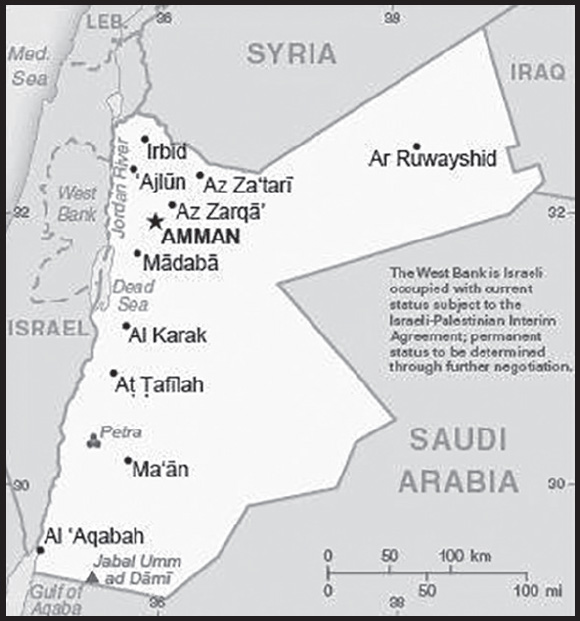
INTRODUCTION
Background: Following World War I and the dissolution of the Ottoman Empire, the League of Nations awarded Britain the mandate to govern much of the Middle East. Britain demarcated a semi-autonomous region of Transjordan from Palestine in 1921 and recognized ABDALLAH I from the Hashemite family as the country’s first leader. The Hashemites also controlled the Hijaz, or the western coastal area of modern-day Saudi Arabia until 1925, when they were pushed out by IBN SAUD and Wahhabi tribes. The country gained its independence in 1946 and thereafter became The Hashemite Kingdom of Jordan.
The country has had four kings. Jordan’s long-time ruler, King HUSSEIN (r. 1953-99), successfully navigated competing pressures from the major powers (US, USSR, and UK), various Arab states, Israel, and Palestinian militants, the latter of which led to a brief civil war in 1970 referred to as “Black September” and ended in King HUSSEIN’s ouster of the militants from Jordan.
Jordan’s borders also have changed since it gained independence. In 1948, Jordan took control of the West Bank and East Jerusalem in the first Arab-Israeli War, eventually annexing those territories in 1950 and granting its new Palestinian residents Jordanian citizenship. In 1967, Jordan lost the West Bank and East Jerusalem to Israel in the Six-Day War but retained administrative claims to the West Bank until 1988 when King HUSSEIN permanently relinquished Jordanian claims to the West Bank in favor of the Palestine Liberation Organization (PLO). King HUSSEIN signed a peace treaty with Israel in 1994, after Israel and the PLO signed the Oslo Accords in 1993.
Jordanian kings continue to claim custodianship of the Muslim holy sites in Jerusalem by virtue of their Hashemite heritage as descendants of the Prophet Mohammad and agreements with Israel and Jerusalem-based religious and Palestinian leaders. After Israel captured East Jerusalem in the 1967 War, it authorized the Jordanian-controlled Islamic Trust, or Waqf, to continue administering affairs at the Al Haram ash Sharif/Temple Mount holy compound, and the Jordan-Israel peace treaty reaffirmed Jordan’s “special role” in administering the Muslim holy shrines in Jerusalem. Jordanian kings claim custodianship of the Christian sites in Jerusalem on the basis of the 7th-century Pact of Omar, when the Muslim leader, after conquering Jerusalem, agreed to permit Christian worship.
King HUSSEIN died in 1999 and was succeeded by his eldest son, ABDALLAH II, who remains the current king. In 2009, King ABDALLAH II designated his son HUSSEIN as the Crown Prince. During his reign, ABDALLAH II has contended with a series of challenges, including the Arab Spring influx of refugees from neighboring states, the COVID-19 pandemic, the effects of the war in Ukraine, and a perennially weak economy.
GEOGRAPHY
Location: Middle East, northwest of Saudi Arabia, between Israel (to the west) and Iraq
Geographic coordinates: 31 00 N, 36 00 E
Map references: Middle East
Area: total: 89,342 sq km
land: 88,802 sq km
water: 540 sq km
comparison ranking: total 112
Area - comparative: about three-quarters the size of Pennsylvania; slightly smaller than Indiana
Land boundaries: total: 1,744 km
border countries (5): Iraq 179 km; Israel 307 km; Saudi Arabia 731 km; Syria 379 km; West Bank 148 km
Coastline: 26 km
Maritime claims: territorial sea: 3 nm
Climate: mostly arid desert; rainy season in west (November to April)
Terrain: mostly arid desert plateau; a great north-south geological rift along the west of the country is the dominant topographical feature and includes the Jordan River Valley, the Dead Sea, and the Jordanian Highlands
Elevation: highest point: Jabal Umm ad Dami 1,854 m
lowest point: Dead Sea -431 m
mean elevation: 812 m
Natural resources: phosphates, potash, shale oil
Land use: agricultural land: 11.4% (2018 est.)
arable land: 2% (2018 est.)
permanent crops: 1% (2018 est.)
permanent pasture: 8.4% (2018 est.)
forest: 1.1% (2018 est.)
other: 87.5% (2018 est.)
Irrigated land: 833 sq km (2020)
Major lakes (area sq km): salt water lake(s): Dead Sea (shared with Israel and West Bank) - 1,020 sq km
note – endorheic hypersaline lake; 9.6 times saltier than the ocean; lake shore is 431 meters below sea level
Major watersheds (area sq km): Indian Ocean drainage: (Persian Gulf) Tigris and Euphrates (918,044 sq km)
Major aquifers: Arabian Aquifer System
Population distribution: population heavily concentrated in the west, and particularly the northwest, in and around the capital of Amman; a sizeable, but smaller population is located in the southwest along the shore of the Gulf of Aqaba
Natural hazards: droughts; periodic earthquakes; flash floods
Geography - note: strategic location at the head of the Gulf of Aqaba and as the Arab country that shares the longest border with Israel and the occupied West Bank; the Dead Sea, the lowest point in Asia and the second saltiest body of water in the world (after Lac Assal in Djibouti), lies on Jordan’s western border with Israel and the West Bank; Jordan is almost landlocked but does have a 26 km southwestern coastline with a single port, Al ’Aqabah (Aqaba)
PEOPLE AND SOCIETY
Population: 11,086,716 (2023 est.)
note: increased estimate reflects revised assumptions about the net migration rate due to the increased flow of Syrian refugees
comparison ranking: 84
Nationality: noun: Jordanian(s)
adjective: Jordanian
Ethnic groups: Jordanian 69.3%, Syrian 13.3%, Palestinian 6.7%, Egyptian 6.7%, Iraqi 1.4%, other 2.6% (2015 est.)
note: data represent population by self-identified nationality in national census
Languages: Arabic (official), English (widely understood among upper and middle classes)
major-language sample(s):
(Arabic)
Religions: Muslim 97.1% (official; predominantly Sunni), Christian 2.1% (majority Greek Orthodox, but some Greek and Roman Catholics, Syrian Orthodox, Coptic Orthodox, Armenian Orthodox, and Protestant denominations), Buddhist 0.4%, Hindu 0.1%, Jewish <0.1%, folk <0.1%, other <0.1%, unaffiliated <0.1% (2020 est.)
Age structure: 0-14 years: 31.42% (male 1,788,882/female 1,694,417)
15-64 years: 64.53% (male 3,802,074/female 3,352,680)
65 years and over: 4.05% (2023 est.) (male 218,218/female 230,445)
Dependency ratios: total dependency ratio: 57.1
youth dependency ratio: 51.2
elderly dependency ratio: 5.8
potential support ratio: 17.1 (2021 est.)
Median age: total: 23.5 years (2020)
male: 23.9 years
female: 22.9 years
comparison ranking: total 176
Population growth rate: 0.79% (2023 est.)
comparison ranking: 116
Birth rate: 22.37 births/1,000 population (2023 est.)
comparison ranking: 51
Death rate: 3.47 deaths/1,000 population (2023 est.)
comparison ranking: 220
Net migration rate: -10.99 migrant(s)/1,000 population (2023 est.)
comparison ranking: 225
Population distribution: population heavily concentrated in the west, and particularly the northwest, in and around the capital of Amman; a sizeable, but smaller population is located in the southwest along the shore of the Gulf of Aqaba
Urbanization: urban population: 92% of total population (2023)
rate of urbanization: 0.98% annual rate of change (2020-25 est.)
Major urban areas - population: 2.232 million AMMAN (capital) (2023)
Sex ratio: at birth: 1.06 male(s)/female
0-14 years: 1.06 male(s)/female
15-64 years: 1.13 male(s)/female
65 years and over: 0.95 male(s)/female
total population: 1.1 male(s)/female (2023 est.)
Mother’s mean age at first birth: 24.6 years (2017/18 est.)
note: data represents median age at first birth among women 25-49
Maternal mortality ratio: 41 deaths/100,000 live births (2020 est.)
comparison ranking: 103
Infant mortality rate: total: 13.56 deaths/1,000 live births (2023 est.)
male: 14.66 deaths/1,000 live births
female: 12.39 deaths/1,000 live births
comparison ranking: total 108
Life expectancy at birth: total population: 76.26 years (2023 est.)
male: 74.77 years
female: 77.84 years
comparison ranking: total population 111
Total fertility rate: 2.91 children born/woman (2023 est.)
comparison ranking: 49
Gross reproduction rate: 1.41 (2023 est.)
Contraceptive prevalence rate: 51.8% (2017/18)
Drinking water source: improved: urban: 99.2% of population
rural: 97.9% of population
total: 99.1% of population
unimproved: urban: 0.8% of population
rural: 2.1% of population
total: 0.9% of population (2020 est.)
Current health expenditure: 7.5% of GDP (2020)
Physicians density: 2.66 physicians/1,000 population (2019)
Hospital bed density: 1.5 beds/1,000 population (2017)
Sanitation facility access: improved: urban: 98.8% of population
rural: 97.8% of population
total: 98.7% of population
unimproved: urban: 1.2% of population
rural: 2.2% of population
total: 1.3% of population (2020 est.)
Obesity - adult prevalence rate: 35.5% (2016)
comparison ranking: 13
Alcohol consumption per capita: total: 0.25 liters of pure alcohol (2019 est.)
beer: 0.06 liters of pure alcohol (2019 est.)
wine: 0 liters of pure alcohol (2019 est.)
spirits: 0.19 liters of pure alcohol (2019 est.)
other alcohols: 0 liters of pure alcohol (2019 est.)
comparison ranking: total 171
Tobacco use: total: 34.8% (2020 est.)
male: 56.8% (2020 est.)
female: 12.8% (2020 est.)
comparison ranking: total 16
Children under the age of 5 years underweight: 2.7% (2019)
comparison ranking: 94
Currently married women (ages 15-49): 55.6% (2023 est.)
Child marriage: women married by age 15: 1.5%
women married by age 18: 9.7%
men married by age 18: 0.1% (2018 est.)
Education expenditures: 3.2% of GDP (2021 est.)
comparison ranking: 151
Literacy: definition: age 15 and over can read and write
total population: 98.4%
male: 98.7%
female: 98.4% (2021)
School life expectancy (primary to tertiary education): total: 11 years
male: 10 years
female: 11 years (2020)
Youth unemployment rate (ages 15-24): total: 40.5% (2021 est.)
male: 37.4%
female: 53.8%
comparison ranking: total 12
ENVIRONMENT
Environment - current issues: limited natural freshwater resources; declining water table; salinity; deforestation; overgrazing; soil erosion; desertification; biodiversity and ecosystem damage/loss
Environment - international agreements: party to: Biodiversity, Climate Change, Climate Change-Kyoto Protocol, Climate Change-Paris Agreement, Comprehensive Nuclear Test Ban, Desertification, Endangered Species, Hazardous Wastes, Law of the Sea, Marine Dumping-London Convention, Nuclear Test Ban, Ozone Layer Protection, Ship Pollution, Wetlands
signed, but not ratified: none of the selected agreements
Climate: mostly arid desert; rainy season in west (November to April)
Land use: agricultural land: 11.4% (2018 est.)
arable land: 2% (2018 est.)
permanent crops: 1% (2018 est.)
permanent pasture: 8.4% (2018 est.)
forest: 1.1% (2018 est.)
other: 87.5% (2018 est.)
Urbanization: urban population: 92% of total population (2023)
rate of urbanization: 0.98% annual rate of change (2020-25 est.)
Revenue from forest resources: 0.02% of GDP (2018 est.)
comparison ranking: 142
Revenue from coal: 0% of GDP (2018 est.)
comparison ranking: 149
Air pollutants: particulate matter emissions: 25.87 micrograms per cubic meter (2019 est.)
carbon dioxide emissions: 25.11 megatons (2016 est.)
methane emissions: 6.04 megatons (2020 est.)
Waste and recycling: municipal solid waste generated annually: 2,529,997 tons (2013 est.)
municipal solid waste recycled annually: 177,100 tons (2014 est.)
percent of municipal solid waste recycled: 7% (2014 est.)
Major lakes (area sq km): salt water lake(s): Dead Sea (shared with Israel and West Bank) - 1,020 sq km
note - endorheic hypersaline lake; 9.6 times saltier than the ocean; lake shore is 431 meters below sea level
Major watersheds (area sq km): Indian Ocean drainage: (Persian Gulf) Tigris and Euphrates (918,044 sq km)
Major aquifers: Arabian Aquifer System
Total water withdrawal: municipal: 500 million cubic meters (2020 est.)
industrial: 40 million cubic meters (2020 est.)
agricultural: 570 million cubic meters (2020 est.)
Total renewable water resources: 940 million cubic meters (2020 est.)
GOVERNMENT
Country name: conventional long form: Hashemite Kingdom of Jordan
conventional short form: Jordan
local long form: Al Mamlakah al Urduniyah al Hashimiyah
local short form: Al Urdun
former: Transjordan
etymology: named for the Jordan River, which makes up part of Jordan’s northwest border
Government type: parliamentary constitutional monarchy
Capital: name: Amman
geographic coordinates: 31 57 N, 35 56 E
time difference: UTC+2 (7 hours ahead of Washington, DC, during Standard Time)
daylight saving time: +1hr, begins last Friday in February; ends last Friday in October
etymology: in the 13th century B.C., the Ammonites named their main city “Rabbath Ammon”; “rabbath” designated “capital,” so the name meant “The Capital of [the] Ammon[ites]”; over time, the “Rabbath” came to be dropped and the city became known simply as “Ammon” and then “Amman”
Administrative divisions: 12 governorates (muhafazat, singular - muhafazah); ’Ajlun, Al ’Aqabah, Al Balqa’, Al Karak, Al Mafraq, Al ‘Asimah (Amman), At Tafilah, Az Zarqa’, Irbid, Jarash, Ma’an, Madaba
Independence: 25 May 1946 (from League of Nations mandate under British administration)
National holiday: Independence Day, 25 May (1946)
Constitution: history: previous 1928 (preindependence); latest initially adopted 28 November 1947, revised and ratified 1 January 1952
amendments: constitutional amendments require at least a two-thirds majority vote of both the Senate and the House and ratification by the king; amended several times, last in 2022
Legal system: mixed system developed from codes instituted by the Ottoman Empire (based on French law), British common law, and Islamic law
International law organization participation: has not submitted an ICJ jurisdiction declaration; accepts ICCt jurisdiction
Citizenship: citizenship by birth: no
citizenship by descent only: the father must be a citizen of Jordan
dual citizenship recognized: yes
residency requirement for naturalization: 15 years
Suffrage: 18 years of age; universal
Executive branch: chief of state: King ABDALLAH II (since 7 February 1999); Heir Apparent Crown Prince HUSSEIN (eldest son of the monarch, born 28 June 1994); the monarchy is hereditary
head of government: Prime Minister Bisher Al-KHASAWNEH (since 7 October 2020)
cabinet: Cabinet appointed by the monarch in consultation with the prime minister
elections/appointments: prime minister appointed by the monarch
Legislative branch: description: bicameral National Assembly or Majlis al-’Umma consists of:
Senate or the House of Notables or Majlis al-Ayan (65 seats; members appointed by the monarch to serve 4-year terms) Chamber of Deputies or House of Representatives or Majlis al-Nuwaab (130 seats; 115 members directly elected in 23 multi-seat constituencies by open-list proportional representation vote and 15 seats for women; 12 of the 115 seats reserved for Christian, Chechen, and Circassian candidates; members serve 4-year terms)
elections: Senate - last appointments on 27 Sep 2020 (next to be held in 2024)
Chamber of Deputies - last held on 10 November 2020 (next anticipated in November 2024)
election results: 2020: Senate - composition men 58, women 7, percent of women 10.8%
2020: Chamber of Deputies; note - tribal, centrist, and pro-government candidates dominated the election; the Islamic Action Front, the political wing of the Muslim Brotherhood, garnered only 10 seats, down from 15 in the previous election; women, who are guaranteed 15 seats by Jordan’s legislative quota system, won 16 seats, down from 20 seats won in the previous election; composition - men 114, women 16, percent of women 12.3%; note - total National Assembly percent of women 11.8%
note: in 2022, a new electoral law - effective for the anticipated 2024 election - will increase the total number of Chamber of Deputies’ seats to 138 from 130; 97 members to be directly elected from multi-seat geographic districts by open list proportional representation vote, with over 7 percent of total votes needed to gain a seat, and 41 members to be directly elected from a single national district by closed party-list proportional representation vote, with over a 2.5 percent of total votes needed to gain a seat
Judicial branch: highest court(s): Court of Cassation or Supreme Court (consists of 15 members, including the chief justice); Constitutional Court (consists of 9 members)
judge selection and term of office: Supreme Court chief justice appointed by the king; other judges nominated by the Judicial Council, an 11-member judicial policymaking body consisting of high-level judicial officials and judges, and approved by the king; judge tenure not limited; Constitutional Court members appointed by the king for 6-year non-renewable terms with one-third of the membership renewed every 2 years
subordinate courts: Courts of Appeal; Great Felonies Court; religious courts; military courts; juvenile courts; Land Settlement Courts; Income Tax Court; Higher Administrative Court; Customs Court; special courts including the State Security Court
Political parties and leaders: political reforms enacted in 2020 require all existing parties to re-register by May 2023, which will result in changes to the number of registered parties and the number of seats held by those parties for the anticipated 2024 election
International organization participation: ABEDA, AFESD, AMF, CAEU, CD, CICA, EBRD, FAO, G-11, G-77, IAEA, IBRD, ICAO, ICC (national committees), ICCt, ICRM, IDA, IDB, IFAD, IFC, IFRCS, ILO, IMF, IMO, IMSO, Interpol, IOC, IOM, IPU, ISO, ITSO, ITU, ITUC (NGOs), LAS, MIGA, MINUSTAH, MINUSMA, MONUSCO, NAM, NATO (partner), OIC, OPCW, OSCE (partner), PCA, UN, UNAMID, UNCTAD, UNESCO, UNHCR, UNIDO, UNISFA, UNMIL, UNMISS, UNOCI, UNRWA, UNWTO, UPU, WCO, WFTU (NGOs), WHO, WIPO, WMO, WTO
Diplomatic representation in the US: chief of mission: Ambassador Dina Khalil Tawfiq KAWAR (since 27 June 2016)
chancery: 3504 International Drive NW, Washington, DC 20008
telephone: [1] (202) 966-2664
FAX: [1] (202) 966-3110
email address and website:
hkjconsular@jordanembassyus.org
http://www.jordanembassyus.org/
Diplomatic representation from the US: chief of mission: Ambassador Yael LEMPERT (since 3 September 2023)
embassy: Abdoun, Al-Umawyeen St., Amman
mailing address: 6050 Amman Place, Washington DC 20521-6050
telephone: [962] (6) 590-6000
FAX: [962] (6) 592-0163
email address and website:
Flag description: three equal horizontal bands of black (top), representing the Abbassid Caliphate, white, representing the Ummayyad Caliphate, and green, representing the Fatimid Caliphate; a red isosceles triangle on the hoist side, representing the Great Arab Revolt of 1916, and bearing a small white seven-pointed star symbolizing the seven verses of the opening Sura (Al-Fatiha) of the Holy Koran; the seven points on the star represent faith in One God, humanity, national spirit, humility, social justice, virtue, and aspirations; design is based on the Arab Revolt flag of World War I
National symbol(s): eagle; national colors: black, white, green, red
National anthem: name: “As-salam al-malaki al-urdoni” (Long Live the King of Jordan)
lyrics/music: Abdul-Mone’m al-RIFAI’/Abdul-Qader al-TANEER
note: adopted 1946; the shortened version of the anthem is used most commonly, while the full version is reserved for special occasions
National heritage: total World Heritage Sites: 6 (5 cultural, 1 mixed)
selected World Heritage Site locales: Petra (c); Quseir Amra (c); Um er-Rasas (Kastrom Mefa’a) (c); Wadi Rum Protected Area (m); Baptism Site “Bethany Beyond the Jordan” (Al-Maghtas) (c); As-Salt - The Place of Tolerance and Urban Hospitality (c)
ECONOMY
Economic overview: low growth, upper middle-income Middle Eastern economy; high debt and unemployment, especially for youth and women; key US foreign assistance recipient; natural resource-poor and import-reliant
Real GDP (purchasing power parity): $102.822 billion (2021 est.)
$100.581 billion (2020 est.)
$102.185 billion (2019 est.)
note: data are in 2017 dollars
comparison ranking: 92
Real GDP growth rate: 2.23% (2021 est.)
-1.57% (2020 est.)
1.93% (2019 est.)
comparison ranking: 159
Real GDP per capita: $9,200 (2021 est.)
$9,200 (2020 est.)
$9,600 (2019 est.)
note: data are in 2017 dollars
comparison ranking: 146
GDP (official exchange rate): $44.568 billion (2019 est.)
Inflation rate (consumer prices): 1.35% (2021 est.)
0.33% (2020 est.)
0.76% (2019 est.)
comparison ranking: 186
Credit ratings: Fitch rating: BB- (2019)
Moody’s rating: B1 (2013)
Standard & Poors rating: B+ (2017)
note: The year refers to the year in which the current credit rating was first obtained.
GDP - composition, by sector of origin: agriculture: 4.5% (2017 est.)
industry: 28.8% (2017 est.)
services: 66.6% (2017 est.)
comparison rankings: services 88; industry 87; agriculture 131
GDP - composition, by end use: household consumption: 80.5% (2017 est.)
government consumption: 19.8% (2017 est.)
investment in fixed capital: 22.8% (2017 est.)
investment in inventories: 0.7% (2017 est.)
exports of goods and services: 34.2% (2017 est.)
imports of goods and services: -58% (2017 est.)
Agricultural products: tomatoes, poultry, olives, milk, potatoes, cucumbers, vegetables, watermelons, green chillies/peppers, peaches/nectarines
Industries: tourism, information technology, clothing, fertilizer, potash, phosphate mining, pharmaceuticals, petroleum refining, cement, inorganic chemicals, light manufacturing
Industrial production growth rate: 3.02% (2021 est.)
comparison ranking: 124
Labor force: 2.865 million (2021 est.)
comparison ranking: 110
Labor force - by occupation: agriculture: 2%
industry: 20%
services: 78% (2013 est.)
Unemployment rate: 19.25% (2021 est.)
19.03% (2020 est.)
16.81% (2019 est.)
note: official rate; unofficial rate is approximately 30%
comparison ranking: 23
Youth unemployment rate (ages 15-24): total: 40.5% (2021 est.)
male: 37.4%
female: 53.8%
comparison ranking: total 12
Population below poverty line: 15.7% (2018 est.)
Gini Index coefficient - distribution of family income: 33.7 (2010 est.)
comparison ranking: 116
Average household expenditures: on food: 29.6% of household expenditures (2018 est.)
on alcohol and tobacco: 4.6% of household expenditures (2018 est.)
Household income or consumption by percentage share: lowest 10%: 3.4%
highest 10%: 28.7% (2010 est.)
Budget: revenues: $10.813 billion (2019 est.)
expenditures: $13.489 billion (2019 est.)
Budget surplus (+) or deficit (-): -5.1% (of GDP) (2017 est.)
comparison ranking: 169
Public debt: 75.14% of GDP (2020 est.)
78.48% of GDP (2019 est.)
75.38% of GDP (2017 est.)
note: data cover central government debt and include debt instruments issued (or owned) by government entities other than the treasury; the data include treasury debt held by foreign entities; the data exclude debt issued by subnational entities, as well as intragovernmental debt; intragovernmental debt consists of treasury borrowings from surpluses in the social funds, such as for retirement, medical care, and unemployment; debt instruments for the social funds are not sold at public auctions
comparison ranking: 47
Taxes and other revenues: 15.81% (of GDP) (2020 est.)
comparison ranking: 137
Fiscal year: calendar year
Current account balance: -$4.03 billion (2021 est.)
-$2.506 billion (2020 est.)
-$773.366 million (2019 est.)
comparison ranking: 180
Exports: $13.864 billion (2021 est.) note: data are in current year dollars
$10.444 billion (2020 est.) note: data are in current year dollars
$16.17 billion (2019 est.)
comparison ranking: 93
Exports - partners: United States 26%, India 13%, Saudi Arabia 11%, Iraq 5%, China 4% (2021)
Exports - commodities: fertilizers, clothing and apparel, calcium phosphates, phosphoric acid, packaged medicines (2021)
Imports: $23.392 billion (2021 est.) note: data are in current year dollars
$18.424 billion (2020 est.) note: data are in current year dollars
$21.964 billion (2019 est.)
comparison ranking: 84
Imports - partners: China 17%, Saudi Arabia 14%, United Arab Emirates 11%, United States 5%, Turkey 3% (2021)
Imports - commodities: cars, refined petroleum, gold, crude petroleum, clothing and apparel, broadcasting equipment, packaged medicines (2021)
Reserves of foreign exchange and gold: $15.56 billion (31 December 2017 est.)
$15.54 billion (31 December 2016 est.)
comparison ranking: 72
Debt - external: $32.088 billion (2019 est.)
$29.916 billion (2018 est.)
comparison ranking: 81
Exchange rates: Jordanian dinars (JOD) per US dollar -
Exchange rates: 0.71 (2021 est.)
0.71 (2020 est.)
0.71 (2019 est.)
0.71 (2018 est.)
0.71 (2017 est.)
ENERGY
Electricity access: population without electricity: (2020) less than 1 million
electrification - total population: 99.9% (2021)
electrification - urban areas: 100% (2021)
electrification - rural areas: 98.8% (2021)
Electricity: installed generating capacity: 5.644 million kW (2020 est.)
consumption: 17.366 billion kWh (2019 est.)
exports: 98 million kWh (2019 est.)
imports: 239 million kWh (2019 est.)
transmission/distribution losses: 2.249 billion kWh (2019 est.)
comparison rankings: installed generating capacity 83; transmission/distribution losses 83; imports 101; exports 92; consumption 75
Electricity generation sources: fossil fuels: 83.5% of total installed capacity (2020 est.)
solar: 11.7% of total installed capacity (2020 est.)
wind: 4.6% of total installed capacity (2020 est.)
hydroelectricity: 0.2% of total installed capacity (2020 est.)
Coal: production: 0 metric tons (2020 est.)
consumption: 219,000 metric tons (2020 est.)
exports: 0 metric tons (2020 est.)
imports: 219,000 metric tons (2020 est.)
proven reserves: 0 metric tons (2019 est.)
Petroleum: total petroleum production: 0 bbl/day (2021 est.)
refined petroleum consumption: 114,800 bbl/day (2019 est.)
crude oil and lease condensate exports: 0 bbl/day (2018 est.)
crude oil and lease condensate imports: 47,400 bbl/day (2018 est.)
crude oil estimated reserves: 1 million barrels (2021 est.)
Refined petroleum products - production: 67,240 bbl/day (2015 est.)
comparison ranking: 73
Refined petroleum products - imports: 68,460 bbl/day (2015 est.)
comparison ranking: 68
Natural gas: production: 115.872 million cubic meters (2019 est.)
consumption: 4.651 billion cubic meters (2019 est.)
exports: 375.849 million cubic meters (2019 est.)
imports: 4.911 billion cubic meters (2019 est.)
proven reserves: 6.031 billion cubic meters (2021 est.)
Carbon dioxide emissions: 23.47 million metric tonnes of CO2 (2019 est.)
from coal and metallurgical coke: 381,000 metric tonnes of CO2 (2019 est.)
from petroleum and other liquids: 15.786 million metric tonnes of CO2 (2019 est.)
from consumed natural gas: 7.303 million metric tonnes of CO2 (2019 est.)
comparison ranking: total emissions 82
Energy consumption per capita: 39.331 million Btu/person (2019 est.)
comparison ranking: 108
COMMUNICATIONS
Telephones - fixed lines: total subscriptions: 427,517 (2021 est.)
subscriptions per 100 inhabitants: 4 (2021 est.)
comparison ranking: total subscriptions 99
Telephones - mobile cellular: total subscriptions: 7,275,563 (2021 est.)
subscriptions per 100 inhabitants: 65 (2021 est.)
comparison ranking: total subscriptions 108
Telecommunication systems: general assessment: Jordan’s government has focused on the use of ICT in a range of sectors, aimed at transforming the relatively small economy through the use of digital services; this policy has helped the country rise in the league tables for digital connectivity and internet readiness, and it has also attracted investment from foreign companies; during the ongoing global pandemic, the start-up sector has been further encouraged to develop solutions to combat the crisis, while other efforts have facilitated e-government services and encouraged businesses to adapt to new methods of working through their own digital transformation; these developments have been supported by the highly developed mobile sector, led by three major regional players which have near-comprehensive LTE network coverage (2022)
domestic: fixed-line stands at nearly 4 per 100 persons and mobile cellular subscriptions at 65 per 100 persons (2021)
international: country code - 962; landing point for the FEA and Taba-Aqaba submarine cable networks providing connectivity to Europe, the Middle East, Southeast Asia and Asia; satellite earth stations - 33 (3 Intelsat, 1 Arabsat, and 29 land and maritime Inmarsat terminals (2019)
Broadcast media: radio and TV dominated by the government-owned Jordan Radio and Television Corporation (JRTV) that operates a main network, a sports network, a film network, and a satellite channel; first independent TV broadcaster aired in 2007; international satellite TV and Israeli and Syrian TV broadcasts are available; roughly 30 radio stations with JRTV operating the main government-owned station; transmissions of multiple international radio broadcasters are available
Internet country code: .jo
Internet users: total: 9.13 million (2021 est.)
percent of population: 83% (2021 est.)
comparison ranking: total 64
Broadband - fixed subscriptions: total: 630,545 (2020 est.)
subscriptions per 100 inhabitants: 6 (2020 est.)
comparison ranking: total 85
TRANSPORTATION
National air transport system: number of registered air carriers: 4 (2020)
inventory of registered aircraft operated by air carriers: 54
annual passenger traffic on registered air carriers: 3,383,805 (2018)
annual freight traffic on registered air carriers: 175.84 million (2018) mt-km
Civil aircraft registration country code prefix: JY
Airports: 18 (2021)
comparison ranking: total 138
Airports - with paved runways: 16
note: paved runways have a concrete or asphalt surface but not all have facilities for refueling, maintenance, or air traffic control; the length of a runway required for aircraft to safely operate depends on a number of factors including the type of aircraft, the takeoff weight (including passengers, cargo, and fuel), engine types, flap settings, landing speed, elevation of the airport, and average maximum daily air temperature; paved runways can reach a length of 5,000 m (16,000 ft.), but the “typical” length of a commercial airline runway is between 2,500-4,000 m (8,000-13,000 ft.)
Airports - with unpaved runways: 2
note: unpaved runways have a surface composition such as grass or packed earth and are most suited to the operation of light aircraft; unpaved runways are usually short, often less than 1,000 m (3,280 ft.) in length; airports with unpaved runways often lack facilities for refueling, maintenance, or air traffic control
Heliports: 1 (2021)
Pipelines: 473 km gas, 49 km oil (2013)
Railways: total: 509 km (2020)
narrow gauge: 509 km (2014) 1.050-m gauge
comparison ranking: total 112
Roadways: total: 7,203 km (2011)
paved: 7,203 km (2011)
comparison ranking: total 141
Merchant marine: total: 35 (2022)
by type: general cargo 6, other 29
comparison ranking: total 130
Ports and terminals: major seaport(s): Al ’Aqabah
MILITARY AND SECURITY
Military and security forces: Jordanian Armed Forces (JAF): Royal Jordanian Army (includes Special Operations Forces, Border Guards, Royal Guard), Royal Jordanian Air Force, Royal Jordanian Coast Guard
Ministry of Interior: Public Security Directorate (includes national police, the Gendarmerie, and the Civil Defense Directorate) (2023)
note: the armed forces report administratively to the minister of defense and have a support role for internal security; the prime minister serves as defense minister, but there is no separate ministry of defense
Military expenditures: 4.5% of GDP (2022 est.)
5% of GDP (2021 est.)
5% of GDP (2020 est.)
5.6% of GDP (2019 est.)
5.6% of GDP (2018 est.)
comparison ranking: 9
Military and security service personnel strengths: approximately 100,000 active-duty armed forces personnel (85,000 Army; 14,000 Air Force; 500-1,000 Coast Guard); approximately 15,000 Gendarmerie Forces (2023)
Military equipment inventories and acquisitions: the JAF inventory is comprised of a wide mix of imported equipment from Europe, some Gulf States, Russia, and the US; in recent years, the Netherlands and the US have been the leading suppliers (2023)
Military service age and obligation: 17 years of age for voluntary military service for men (women can volunteer to serve in noncombat military positions in the Royal Jordanian Arab Army Women’s Corps and RJAF); initial service term is 24 months, with option to reenlist for up to 18 years; conscription was abolished in 1991, but in 2020 Jordan announced the reinstatement of compulsory military service for jobless men aged between 25 and 29 with 12 months of service, made up of 3 months of military training and 9 months of professional and technical training; in 2019, Jordan announced a voluntary 4-month National Military Service program for men and women aged between 18-25 years who have been unemployed for at least 6 months; service would include 1 month for military training with the remaining 3 months dedicated to vocational training in the sectors of construction and tourism (2023)
note: women comprised about 1.5% of the military as of 2019
Military deployments: 330 Mali (MINUSMA) (2023)
Military - note: the JAF traces its origins back to the Arab Legion, which was formed under the British protectorate of Transjordan in the 1920s; it is responsible for territorial defense and border security, but also has a supporting role for internal security; the JAF’s primary concerns are terrorist and criminal threats emanating from its 230-mile border with Syria and 112-mile border with Iraq, as well as the potential impact of Israeli-Palestinian tensions; the terrorist group Hizballah and Iranian-backed militia forces operate in southwestern Syria near Jordan’s border while fighters from the Islamic State of Iraq and ash-Sham (ISIS) terrorist group continue to operate in both Iraq and Syria; ISIS fighters have included Jordanian nationals, some of whom have returned to Jordan; meanwhile, individuals and groups sympathetic to Palestine have planned and conducted terrorist attacks in Jordan
the JAF is a professional military that trains regularly and participates in both bilateral and multinational exercises; in recent years, it has taken part in regional military operations alongside allied forces in Afghanistan, Syria, and Yemen; it also participates in UN peacekeeping missions; the Army is organized and equipped for a mobile territorial defense against conventional threats and rapid responses to unconventional threats such as terrorism; border security forces are backed up by approximately 10 mechanized or armored brigades, plus a rapid reaction/high readiness airborne/ranger brigade; the Army also has a well-regarded special operations/counterterrorism group, and Jordan hosts an international special operations training center; the Air Force maintains about 50 US-made multirole fighter aircraft and approximately 50 attack helicopters; the Coast Guard has a small force of fast, gun- or missile-armed patrol craft for monitoring Jordan’s coastline on the Gulf of Aqaba
the US is a key security partner, and Jordan is one of the largest recipients of US military aid in the region; it cooperates with the US on a number of issues, including border and maritime security, arms transfers, cybersecurity, and counterterrorism; Jordan has Major Non-NATO Ally status with the US, a designation under US law that provides foreign partners with certain benefits in the areas of defense trade and security cooperation (2023)
TERRORISM
Terrorist group(s): Islamic State of Iraq and ash-Sham (ISIS)
note: details about the history, aims, leadership, organization, areas of operation, tactics, targets, weapons, size, and sources of support of the group(s) appear(s) in Appendix-T
TRANSNATIONAL ISSUES
Disputes - international: Jordan-Iraq: the two countries signed a border agreement in 1984; Jordan has ratified the treaty, but it has not been confirmed that Iraq has ratified it; as of 2010, the agreement had not been registered with the UN
Jordan-Israel: none identified
Jordan-Saudi Arabia: Jordan and Saudi Arabia signed an agreement to demarcate their maritime borders in 2007
Jordan-Syria: the two countries signed an agreement in 2005 to settle the border dispute based on a 1931 demarcation accord; the two countries began demarcation in 2006
Jordan-West Bank: none identified
Refugees and internally displaced persons: refugees (country of origin): 2.4 million (Palestinian refugees) (2020); 12,866 (Yemen), 6,013 Sudan (2021); 33,951
(Iraq) (mid-year 2022); 652,842 (Syria) (2023)
stateless persons: 64 (2022)
Illicit drugs: primarily a transshipment country for amphetamine tablets originating in Lebanon and Syria and destined for Saudi Arabia, Israel, and Gulf countries; the government is increasingly concerned about domestic consumption of illicit drugs