INTRODUCTION
Background: The first recorded kingdom (Choson) on the Korean Peninsula dates from approximately 2300 B.C. Over the subsequent centuries, three main kingdoms - Kogoryo, Paekche, and Silla - were established on the Peninsula. By the 5th century A.D., Kogoryo emerged as the most powerful, with control over much of the Peninsula, as well as part of Manchuria (modern-day northeast China). However, Silla allied with the Chinese to create the first unified Korean state in the late 7th century (688). Following the collapse of Silla in the 9th century, Korea was unified under the Koryo (Goryeo; 918-1392) and the Chosen (Joseon; 1392-1910) dynasties.
Korea became the object of intense imperialistic rivalry between the Chinese (its traditional benefactor), Japanese, and Russian empires in the latter half of the 19th and early 20th centuries. Following the Sino-Japanese War (1894-95) and the Russo-Japanese War (1904-1905), Korea was occupied by Imperial Japan. In 1910, Tokyo formally annexed the entire Peninsula. Korea regained its independence following Japan’s surrender to the US and its allies in 1945. After World War II, a democratic government (Republic of Korea, ROK) was set up in the southern half of the Korean Peninsula while a communist-style government was installed in the north (North Korea; aka Democratic People’s Republic of Korea, DPRK). During the Korean War (1950-53), US troops and UN forces fought alongside ROK soldiers to defend South Korea from a North Korean invasion supported by communist China and the Soviet Union. A 1953 armistice split the Peninsula along a demilitarized zone at about the 38th parallel.
Syngman RHEE led the country as its first president from 1948-1960. PARK Chung-hee took over leadership of the country in a 1961 coup. During his regime from 1961 to 1979, South Korea achieved rapid economic growth, with per capita income rising to roughly 17 times the level of North Korea in 1979. PARK was assassinated in 1979, and subsequent years were marked by political turmoil and continued authoritarian rule as the country’s pro-democracy movement grew. South Korea held its first free presidential election under a revised democratic constitution in 1987, with former South Korean Army general ROH Tae-woo winning a close race. In 1993, KIM Young-sam (1993-98) became the first civilian president of South Korea’s new democratic era. President KIM Dae-jung (1998-2003) won the Nobel Peace Prize in 2000 for his contributions to South Korean democracy and his “Sunshine Policy” of engagement with North Korea. President PARK Geun-hye, daughter of former South Korean President PARK Chung-hee, took office in February 2013 as South Korea’s first female leader. In December 2016, the National Assembly passed an impeachment motion against President PARK over her alleged involvement in a corruption and influence-peddling scandal, immediately suspending her presidential authorities. The impeachment was upheld in March 2017, triggering an early presidential election in May 2017 won by MOON Jae-in. In March 2022, longtime prosecutor and political newcomer YOON Suk Yeol won the presidency by .73% of the total vote, the slimmest margin in South Korean history.
Discord and tensions with North Korea, punctuated by North Korean military provocations, missile launches, and nuclear tests, have permeated inter-Korean relations for much of the past decade. Despite a period of respite in 2018-2019 ushered in by North Korea’s participation in the 2018 Winter Olympic and Paralympic Games in South Korea and high-level diplomatic meetings, including historic US-North Korea summits, relations were stagnant as of 2023.
GEOGRAPHY
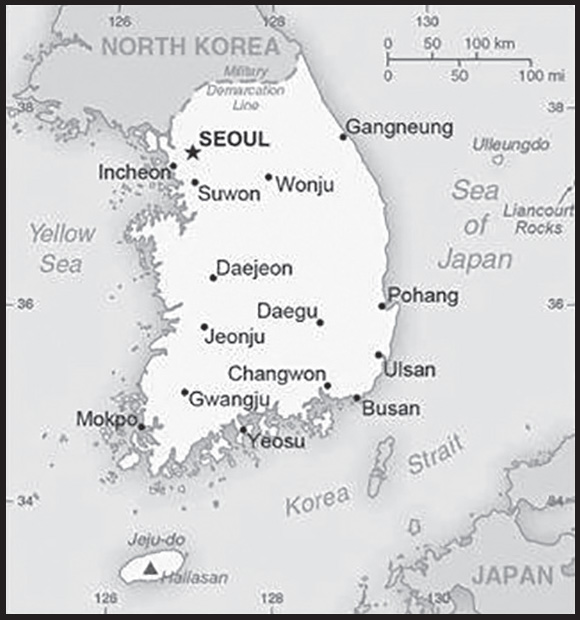
Location: Eastern Asia, southern half of the Korean Peninsula bordering the Sea of Japan and the Yellow Sea
Geographic coordinates: 37 00 N, 127 30 E
Map references: Asia
Area: total: 99,720 sq km
land: 96,920 sq km
water: 2,800 sq km
comparison ranking: total 109
Area - comparative: slightly smaller than Pennsylvania; slightly larger than Indiana
Land boundaries: total: 237 km
border countries (1): North Korea 237 km
Coastline: 2,413 km
Maritime claims: territorial sea: 12 nm; between 3 nm and 12 nm in the Korea Strait
contiguous zone: 24 nm
exclusive economic zone: 200 nm
continental shelf: not specified
Climate: temperate, with rainfall heavier in summer than winter; cold winters
Terrain: mostly hills and mountains; wide coastal plains in west and south
Elevation: highest point: Halla-san 1,950 m
lowest point: Sea of Japan 0 m
mean elevation: 282 m
Natural resources: coal, tungsten, graphite, molybdenum, lead, hydropower potential
Land use: agricultural land: 18.1% (2018 est.)
arable land: 15.3% (2018 est.)
permanent crops: 2.2% (2018 est.)
permanent pasture: 0.6% (2018 est.)
forest: 63.9% (2018 est.)
other: 18% (2018 est.)
Irrigated land: 7,780 sq km (2012)
Population distribution: with approximately 70% of the country considered mountainous, the country’s population is primarily concentrated in the lowland areas, where density is quite high; Gyeonggi Province in the northwest, which surrounds the capital of Seoul and contains the port of Incheon, is the most densely populated province; Gangwon in the northeast is the least populated
Natural hazards: occasional typhoons bring high winds and floods; low-level seismic activity common in southwest
volcanism: Halla (1,950 m) is considered historically active although it has not erupted in many centuries
Geography - note: strategic location on Korea Strait; about 3,000 mostly small and uninhabited islands lie off the western and southern coasts
PEOPLE AND SOCIETY
Population: 51,966,948 (2023 est.)
comparison ranking: 28
Nationality: noun: Korean(s)
adjective: Korean
Ethnic groups: homogeneous
Languages: Korean, English (widely taught in elementary, junior high, and high school)
major-language sample(s):

(Korean)
Religions: Protestant 19.7%, Buddhist 15.5%, Catholic 7.9%, none 56.9% (2015 est.)
note: many people also carry on at least some Confucian traditions and practices
Age structure: 0-14 years: 11.53% (male 3,072,352/female 2,916,984)
15-64 years: 70.1% (male 18,788,714/female 17,639,714)
65 years and over: 18.38% (2023 est.) (male 4,196,789/female 5,352,395)
Dependency ratios: total dependency ratio: 39.9
youth dependency ratio: 16.6
elderly dependency ratio: 23.3
potential support ratio: 4.3 (2021 est.)
Median age: total: 43.2 years (2020)
male: 41.6 years
female: 45 years
comparison ranking: total 29
Population growth rate: 0.23% (2023 est.)
comparison ranking: 174
Birth rate: 6.95 births/1,000 population (2023 est.)
comparison ranking: 224
Death rate: 7.28 deaths/1,000 population (2023 est.)
comparison ranking: 112
Net migration rate: 2.61 migrant(s)/1,000 population (2023 est.)
comparison ranking: 43
Population distribution: with approximately 70% of the country considered mountainous, the country’s population is primarily concentrated in the lowland areas, where density is quite high; Gyeonggi Province in the northwest, which surrounds the capital of Seoul and contains the port of Incheon, is the most densely populated province; Gangwon in the northeast is the least populated
Urbanization: urban population: 81.5% of total population (2023)
rate of urbanization: 0.31% annual rate of change (2020-25 est.)
Major urban areas - population: 9.988 million SEOUL (capital), 3.472 million Busan, 2.849 million Incheon, 2.181 million Daegu (Taegu), 1.577 million Daejon (Taejon), 1.529 million Gwangju (Kwangju) (2023)
Sex ratio: at birth: 1.05 male(s)/female
0-14 years: 1.05 male(s)/female
15-64 years: 1.07 male(s)/female
65 years and over: 0.78 male(s)/female
total population: 1.01 male(s)/female (2023 est.)
Mother’s mean age at first birth: 32.2 years (2019 est.)
Maternal mortality ratio: 8 deaths/100,000 live births (2020 est.)
comparison ranking: 153
Infant mortality rate: total: 2.83 deaths/1,000 live births (2023 est.)
male: 3.04 deaths/1,000 live births
female: 2.6 deaths/1,000 live births
comparison ranking: total 214
Life expectancy at birth: total population: 83.17 years (2023 est.)
male: 80.09 years
female: 86.42 years
comparison ranking: total population 16
Total fertility rate: 1.11 children born/woman (2023 est.)
note: some sources estimate the TFR to be as low as 0.78
comparison ranking: 226
Gross reproduction rate: 0.54 (2023 est.)
Contraceptive prevalence rate: 82.3% (2018)
note: percent of women aged 20-49
Drinking water source: improved: total: 99.9% of population
unimproved: total: 0.1% of population (2020 est.)
Current health expenditure: 8.4% of GDP (2020)
Physicians density: 2.48 physicians/1,000 population (2019)
Hospital bed density: 12.4 beds/1,000 population (2018)
Sanitation facility access: improved: total: 99.9% of population
unimproved:
total: 0.1% of population (2020 est.)
Obesity - adult prevalence rate: 4.7% (2016)
comparison ranking: 184
Alcohol consumption per capita: total: 7.74 liters of pure alcohol (2019 est.)
beer: 1.72 liters of pure alcohol (2019 est.)
wine: 0.15 liters of pure alcohol (2019 est.)
spirits: 0.22 liters of pure alcohol (2019 est.)
other alcohols: 5.66 liters of pure alcohol (2019 est.)
comparison ranking: total 48
Tobacco use: total: 20.8% (2020 est.)
male: 35.7% (2020 est.)
female: 5.9% (2020 est.)
comparison ranking: total 82
Children under the age of 5 years underweight: 0.9% (2019/21) NA
comparison ranking: 118
Currently married women (ages 15-49): 52.9% (2023 est.)
Education expenditures: 4.7% of GDP (2019 est.)
comparison ranking: 90
School life expectancy (primary to tertiary education): total: 17 years
male: 17 years
female: 16 years (2020)
Youth unemployment rate (ages 15-24): total: 7.8% (2021 est.)
male: 8.8%
female: 6.9%
comparison ranking: total 170
ENVIRONMENT
Environment - current issues: air pollution in large cities; acid rain; water pollution from the discharge of sewage and industrial effluents; drift net fishing; solid waste disposal; transboundary air pollution from China
Environment - international agreements: party to: Antarctic-Environmental Protection, Antarctic-Marine Living Resources, Antarctic Treaty, Biodiversity, Climate Change, Climate Change-Kyoto Protocol, Climate Change-Paris Agreement, Comprehensive Nuclear Test Ban, Desertification, Endangered Species, Environmental Modification, Hazardous Wastes, Law of the Sea, Marine Dumping-London Convention, Marine Dumping-London Protocol, Nuclear Test Ban, Ozone Layer Protection, Ship Pollution, Tropical Timber 2006, Wetlands, Whaling
signed, but not ratified: none of the selected agreements
Climate: temperate, with rainfall heavier in summer than winter; cold winters
Land use: agricultural land: 18.1% (2018 est.)
arable land: 15.3% (2018 est.)
permanent crops: 2.2% (2018 est.)
permanent pasture: 0.6% (2018 est.)
forest: 63.9% (2018 est.)
other: 18% (2018 est.)
Urbanization: urban population: 81.5% of total population (2023)
rate of urbanization: 0.31% annual rate of change (2020-25 est.)
Revenue from forest resources: 0.01% of GDP (2018 est.)
comparison ranking: 148
Revenue from coal: 0% of GDP (2018 est.)
comparison ranking: 148
Air pollutants: particulate matter emissions: 24.04 micrograms per cubic meter (2019 est.)
carbon dioxide emissions: 620.3 megatons (2016 est.)
methane emissions: 30.28 megatons (2020 est.)
Waste and recycling: municipal solid waste generated annually: 18,218,975 tons (2014 est.)
municipal solid waste recycled annually: 10,567,006 tons (2014 est.)
percent of municipal solid waste recycled: 58% (2014 est.)
Total water withdrawal: municipal: 6.672 billion cubic meters (2020 est.)
industrial: 4.45 billion cubic meters (2020 est.)
agricultural: 15.96 billion cubic meters (2020 est.)
Total renewable water resources: 69.7 billion cubic meters (2020 est.)
GOVERNMENT
Country name: conventional long form: Republic of Korea
conventional short form: South Korea
local long form: Taehan-min’guk
local short form: Han’guk
abbreviation: ROK
etymology: derived from the Chinese name for Goryeo, which was the Korean dynasty that united the peninsula in the 10th century A.D.; the South Korean name “Han’guk” derives from the long form, “Taehan-min’guk,” which is itself a derivation from “Daehan-je’guk,” which means “the Great Empire of the Han”; “Han” refers to the “Sam’han” or the “Three Han Kingdoms” (Goguryeo, Baekje, and Silla from the Three Kingdoms Era, 1st-7th centuries A.D.)
Government type: presidential republic
Capital: name: Seoul; note - Sejong, located some 120 km (75 mi) south of Seoul, serves as an administrative capital for segments of the South Korean Government
geographic coordinates: 37 33 N, 126 59 E
time difference: UTC+9 (14 hours ahead of Washington, DC, during Standard Time)
etymology: the name originates from the Korean word meaning “capital city” and which is believed to be derived from Seorabeol, the name of the capital of the ancient Korean Kingdom of Silla
Administrative divisions: 9 provinces (do, singular and plural), 6 metropolitan cities (gwangyeoksi, singular and plural), 1 special city (teugbyeolsi), and 1 special self-governing city (teukbyeoljachisi)
provinces: Chungcheongbuk-do (North Chungcheong), Chungcheongnam-do (South Chungcheong), Gangwon-do, Gyeongsangbuk-do (North Gyeongsang), Gyeonggi-do, Gyeongsangnam-do (South Gyeongsang), Jeju-do (Jeju), Jeollabuk-do (North Jeolla), Jeollanam-do (South Jeolla)
metropolitan cities: Busan (Pusan), Daegu (Taegu), Daejeon (Taejon), Gwangju (Kwangju), Incheon (Inch’on), Ulsan
special city: Seoul
special self-governing city: Sejong
Independence: 15 August 1945 (from Japan)
National holiday: Liberation Day, 15 August (1945)
Constitution: history: several previous; latest passed by National Assembly 12 October 1987, approved in referendum 28 October 1987, effective 25 February 1988
amendments: proposed by the president or by majority support of the National Assembly membership; passage requires at least two-thirds majority vote by the Assembly membership, approval in a referendum by more than one half of the votes by more than one half of eligible voters, and promulgation by the president; amended several times, last in 1987
Legal system: mixed legal system combining European civil law, Anglo-American law, and Chinese classical thought
International law organization participation: has not submitted an ICJ jurisdiction declaration; accepts ICCt jurisdiction
Citizenship: citizenship by birth: no
citizenship by descent only: at least one parent must be a citizen of South Korea
dual citizenship recognized: no
residency requirement for naturalization: 5 years
Suffrage: 18 years of age; universal; note - the voting age was lowered from 19 to 18 beginning with the 2020 national election
Executive branch: chief of state: President YOON Suk Yeol (since 10 May 2022); the president is both chief of state and head of government; Prime Minister HAN Duck-soo (since 21 May 2022) serves as the principal executive assistant to the president, similar to the role of a vice president
head of government: President YOON Suk Yeol (since 10 May 2022)
cabinet: State Council appointed by the president on the prime minister’s recommendation
elections/appointments: president directly elected by simple majority popular vote for a single 5-year term; election last held on 9 March 2022 (next to be held in March 2027); prime minister appointed by president with consent of the National Assembly
election results:
2022: YOON Suk-yeol elected president; YOON Suk-yeol (PPP) 48.56%, LEE Jae-myung (DP) 47.83%
2017: MOON Jae-in elected president; MOON Jae-in (DP) 41.09%, HONG Joon-pyo (Liberty Korea Party) 24.04%, AHN Cheol-soo (PP) 21.42%
Legislative branch: description: unicameral National Assembly or Gukhoe (300 seats statutory, current 295; 253 members directly elected in single-seat constituencies by simple majority vote and 47 directly elected in a single national constituency by proportional representation vote; members serve 4-year terms)
elections: last held on 15 April 2020 (next to be held on 10 April 2024)
election results: percent of vote by party/coalition - DPK/Platform Party 49.9%, United Future Party 41.5%, JP 1.7%; seats by party - DPK/Platform Party 180, United Future Party (now PPP) 103, JP 6, ODP 3, PP 3, independent 5; composition as of April 2022 - men 240, women 55, percent of women 18.6%
Judicial branch: highest court(s): Supreme Court (consists of a chief justice and 13 justices); Constitutional Court (consists of a court head and 8 justices)
judge selection and term of office: Supreme Court chief justice appointed by the president with the consent of the National Assembly; other justices appointed by the president upon the recommendation of the chief justice and consent of the National Assembly; position of the chief justice is a 6-year nonrenewable term; other justices serve 6-year renewable terms; Constitutional Court justices appointed - 3 by the president, 3 by the National Assembly, and 3 by the Supreme Court chief justice; court head serves until retirement at age 70, while other justices serve 6-year renewable terms with mandatory retirement at age 65
subordinate courts: High Courts; District Courts; Branch Courts (organized under the District Courts); specialized courts for family and administrative issues
Political parties and leaders: Basic Income Party [SHIN Ji-hye]
Democratic Party of Korea or DPK [LEE Jae-myung] (renamed from Minjoo Party of Korea or MPK in October 2016); includes the former Open Democratic Party [CHOI Kong-wook], which merged with the DP in January 2022 and the Together Citizens’ Party or Platform Party [WOO Hee-jong, CHOI Bae-geun], which merged with the DP in May 2022) Hope of Korea [Yang Hyang-ja]
Justice Party or JP [LEE Jeong-mi]
People Power Party or PPP [KIM Gi-hyeon] (renamed from United Future Party in September 2020, formerly Liberty Korea Party)
Transition Korea [CHO Jung-hun]
note: the DPK is South Korea’s largest party and its main progressive party; the People Power Party (PPP) is a conservative grouping and is South Korea’s second-largest party
International organization participation: ADB, AfDB (nonregional member), APEC, Arctic Council (observer), ARF, ASEAN (dialogue partner), Australia Group, BIS, CD, CICA, CP, EAS, EBRD, FAO, FATF, G-20, IADB, IAEA, IBRD, ICAO, ICC (national committees), ICCt, ICRM, IDA, IEA, IFAD, IFC, IFRCS, IHO, ILO, IMF, IMO, IMSO, Interpol, IOC, IOM, IPU, ISO, ITSO, ITU, ITUC (NGOs), LAIA (observer), MIGA, MINURSO, MINUSTAH, NEA, NSG, OAS (observer), OECD, OPCW, OSCE (partner), Pacific Alliance (observer), Paris Club (associate), PCA, PIF (partner), SAARC (observer), SICA (observer), UN, UNAMID, UNCTAD, UNESCO, UNHCR, UNHRC, UNIDO, UNIFIL, UNISFA, UNMIL, UNMISS, UNMOGIP, UNOCI, UNWTO, UPU, Wassenaar Arrangement, WCO, WHO, WIPO, WMO, WTO, ZC
Diplomatic representation in the US: chief of mission: Ambassador CHO Hyundong (since 19 April 2023)
chancery: 2450 Massachusetts Avenue NW, Washington, DC 20008
telephone: [1] (202) 939-5600
FAX: [1] (202) 797-0595
email address and website:
https://overseas.mofa.go.kr/us-en/index.do
consulate(s) general: Anchorage (AK), Atlanta, Boston, Chicago, Dallas (TX), Hagatna (Guam), Honolulu, Houston, Los Angeles, New York, San Francisco, Seattle, Washington DC
Diplomatic representation from the US: chief of mission: Ambassador Philip S. GOLDBERG (since 29 July 2022)
embassy: 188 Sejong-daero, Jongno-gu, Seoul
mailing address: 9600 Seoul Place, Washington, DC 20521-9600
telephone: [82] (2) 397-4114
FAX: [82] (2) 397-4101
email address and website:
consulate(s): Busan
Flag description: white with a red (top) and blue yin-yang symbol in the center; there is a different black trigram from the ancient I Ching (Book of Changes) in each corner of the white field; the South Korean national flag is called Taegukki; white is a traditional Korean color and represents peace and purity; the blue section represents the negative cosmic forces of the yin, while the red symbolizes the opposite positive forces of the yang; each trigram (kwae) denotes one of the four universal elements, which together express the principle of movement and harmony
National symbol(s): taegeuk (yin yang symbol), Hibiscus syriacus (Rose of Sharon), Siberian tiger; national colors: red, white, blue, black
National anthem: name: “Aegukga” (Patriotic Song)
lyrics/music: YUN Ch’i-Ho or AN Ch’ang-Ho/AHN Eaktay
note: adopted 1948, well-known by 1910; both North Korea’s and South Korea’s anthems share the same name and have a vaguely similar melody but have different lyrics
National heritage: total World Heritage Sites: 16 (14 cultural, 2 natural)
selected World Heritage Site locales: Jeju Volcanic Island and Lava Tubes (n); Changdeokgung Palace Complex (c); Jongmyo Shrine (c); Seokguram Grotto and Bulguksa Temple (c); Gochang, Hwasun, and Ganghwa Dolmen Sites (c); Gyeongju Historic Areas (c); Namhansanseong (c); Baekje Historic Areas (c); Sansa, Buddhist Mountain Monasteries in Korea (c); Royal Tombs of the Joseon Dynasty (c)
ECONOMY
Economic overview: strong export-driven East Asian economy; sustainable and social policy leader; foreign aid financier; automotive manufacturing; app-based developer and exporter; global healthcare technology leader; aging workforce; largest semiconductor producer
Real GDP (purchasing power parity): $2.289 trillion (2021 est.)
$2.198 trillion (2020 est.)
$2.213 trillion (2019 est.)
note: data are in 2017 dollars
comparison ranking: 14
Real GDP growth rate: 4.15% (2021 est.)
-0.71% (2020 est.)
2.24% (2019 est.)
comparison ranking: 115
Real GDP per capita: $44,200 (2021 est.)
$42,400 (2020 est.)
$42,800 (2019 est.)
note: data are in 2017 dollars
comparison ranking: 40
GDP (official exchange rate): $1,646,604,000,000 (2019 est.)
Inflation rate (consumer prices): 2.5% (2021 est.)
0.54% (2020 est.)
0.38% (2019 est.)
comparison ranking: 135
Credit ratings: Fitch rating: AA- (2012)
Moody’s rating: Aa2 (2015)
Standard & Poors rating: AA (2016)
note: The year refers to the year in which the current credit rating was first obtained.
GDP - composition, by sector of origin: agriculture: 2.2% (2017 est.)
industry: 39.3% (2017 est.)
services: 58.3% (2017 est.)
comparison rankings: services 135; industry 31; agriculture 171
GDP - composition, by end use: household consumption: 48.1% (2017 est.)
government consumption: 15.3% (2017 est.)
investment in fixed capital: 31.1% (2017 est.)
investment in inventories: 0% (2017 est.)
exports of goods and services: 43.1% (2017 est.)
imports of goods and services: -37.7% (2017 est.)
Agricultural products: rice, vegetables, cabbages, milk, onions, pork, poultry, eggs, tangerines/mandarins, potatoes
Industries: electronics, telecommunications, automobile production, chemicals, shipbuilding, steel
Industrial production growth rate: 5.09% (2021 est.)
comparison ranking: 88
Labor force: 28.674 million (2021 est.)
comparison ranking: 23
Labor force - by occupation: agriculture: 4.8%
industry: 24.6%
services: 70.6% (2017 est.)
Unemployment rate: 3.53% (2021 est.)
3.93% (2020 est.)
3.75% (2019 est.)
comparison ranking: 188
Youth unemployment rate (ages 15-24): total: 7.8% (2021 est.)
male: 8.8%
female: 6.9%
comparison ranking: total 170
Population below poverty line: 14.4% (2016 est.)
Gini Index coefficient - distribution of family income: 31.4 (2016 est.)
comparison ranking: 139
Average household expenditures: on food: 13.8% of household expenditures (2018 est.)
on alcohol and tobacco: 2.7% of household expenditures (2018 est.)
Household income or consumption by percentage share: lowest 10%: 6.8%
highest 10%: 48.5% (2015 est.)
Budget: revenues: $378.552 billion (2019 est.)
expenditures: $372.412 billion (2019 est.)
Budget surplus (+) or deficit (-): 1.4% (of GDP) (2017 est.)
comparison ranking: 24
Public debt: 46.43% of GDP (2020 est.)
39.97% of GDP (2019 est.)
37.56% of GDP (2018 est.)
comparison ranking: 120
Taxes and other revenues: 14.86% (of GDP) (2020 est.)
comparison ranking: 149
Fiscal year: calendar year
Current account balance: $88.302 billion (2021 est.)
$75.902 billion (2020 est.)
$59.676 billion (2019 est.)
comparison ranking: 5
Exports: $771.202 billion (2021 est.) note: data are in current year dollars
$607.505 billion (2020 est.) note: data are in current year dollars
$660.507 billion (2019 est.) note: data are in current year dollars
comparison ranking: 8
Exports - partners: China 24%, US 15%, Vietnam 9%, Hong Kong 6%, Japan 5% (2021)
Exports - commodities: integrated circuits, cars and vehicle parts, refined petroleum, office machinery, ships, telephones (2021)
Imports: $698.103 billion (2021 est.) note: data are in current year dollars
$541.57 billion (2020 est.) note: data are in current year dollars
$607.54 billion (2019 est.) note: data are in current year dollars
comparison ranking: 10
Imports - partners: China 24%, US 12%, Japan 9%, Vietnam 4%, Taiwan 4% (2021)
Imports - commodities: crude oil, integrated circuits, natural gas, refined petroleum, photo lab equipment, cars, iron (2021)
Reserves of foreign exchange and gold: $463.281 billion (31 December 2021 est.)
$443.463 billion (31 December 2020 est.)
$408.819 billion (31 December 2019 est.)
comparison ranking: 9
Debt - external: $457.745 billion (2019 est.)
$435.98 billion (2018 est.)
comparison ranking: 28
Exchange rates: South Korean won (KRW) per US dollar -
Exchange rates: 1,143.952 (2021 est.)
1,180.266 (2020 est.)
1,165.358 (2019 est.)
1,100.163 (2018 est.)
1,131.001 (2017 est.)
ENERGY
Electricity access: electrification - total population: 100% (2021)
Electricity: installed generating capacity: 135.789 million kW (2020 est.)
consumption: 531.258 billion kWh (2020 est.)
exports: 0 kWh (2020 est.)
imports: 0 kWh (2020 est.)
transmission/distribution losses: 18.61 billion kWh (2020 est.)
comparison rankings: transmission/distribution losses 22; imports 196; exports 194; consumption 8; installed generating capacity 10
Electricity generation sources: fossil fuels: 64.8% of total installed capacity (2020 est.)
nuclear: 27.7% of total installed capacity (2020 est.)
solar: 3.3% of total installed capacity (2020 est.)
wind: 0.6% of total installed capacity (2020 est.)
hydroelectricity: 1.3% of total installed capacity (2020 est.)
tide and wave: 0.7% of total installed capacity (2020 est.)
biomass and waste: 1.7% of total installed capacity (2020 est.)
Nuclear energy: Number of operational nuclear reactors: 25 (2023)
Number of nuclear reactors under construction: 3
Net capacity of operational nuclear reactors: 24.49GW (2021)
Percent of total electricity production: 27.4% (2021)
Percent of total energy produced: 76.5% (2021)
Number of nuclear reactors permanently shut down: 2
Coal: production: 16.364 million metric tons (2020 est.)
consumption: 140.579 million metric tons (2020 est.)
exports: 16,000 metric tons (2020 est.)
imports: 123.784 million metric tons (2020 est.)
proven reserves: 326 million metric tons (2019 est.)
Petroleum: total petroleum production: 37,400 bbl/day (2021 est.)
refined petroleum consumption: 2,598,700 bbl/day (2019 est.)
crude oil and lease condensate exports: 0 bbl/day (2018 est.)
crude oil and lease condensate imports: 3,034,400 bbl/day (2018 est.)
Refined petroleum products - production: 3.302 million bbl/day (2017 est.)
comparison ranking: 6
Refined petroleum products - exports: 1.396 million bbl/day (2017 est.)
comparison ranking: 6
Refined petroleum products - imports: 908,800 bbl/day (2017 est.)
comparison ranking: 6
Natural gas: production: 240.042 million cubic meters (2019 est.)
consumption: 53,419,105,000 cubic meters (2019 est.)
exports: 0 cubic meters (2019 est.)
imports: 55,417,677,000 cubic meters (2019 est.)
proven reserves: 7.079 billion cubic meters (2021 est.)
Carbon dioxide emissions: 686.954 million metric tonnes of CO2 (2019 est.)
from coal and metallurgical coke: 319.383 million metric tonnes of CO2 (2019 est.)
from petroleum and other liquids: 255.518 million metric tonnes of CO2 (2019 est.)
from consumed natural gas: 112.052 million metric tonnes of CO2 (2019 est.)
comparison ranking: total emissions 7
Energy consumption per capita: 242.346 million Btu/person (2019 est.)
comparison ranking: 15
COMMUNICATIONS
Telephones - fixed lines: total subscriptions: 23,213,189 (2021 est.)
subscriptions per 100 inhabitants: 45 (2021 est.)
comparison ranking: total subscriptions 12
Telephones - mobile cellular: total subscriptions: 72,855,492 (2021 est.)
subscriptions per 100 inhabitants: 141 (2021 est.)
comparison ranking: total subscriptions 24
Telecommunication systems: general assessment: South Korea is second only to Hong Kong in the world rankings of telecom market maturity; it is also on the leading edge of the latest telecom technology developments, including around 6G; with its highly urbanized, tech-savvy population, South Korea also enjoys very high communication levels across all segments – fixed-line telephony (44% at the start of 2022), fixed broadband (46%), mobile voice and data (144%), and mobile broadband (120%); the performance of the mobile sector is on a par with other developed markets around the region, but it’s the wire line segment that allows South Korea to stand out from the crowd; this is partly a reflection of the large proportion of its population who live in apartment buildings (around 60%), making fiber and apartment LAN connections relatively easy and cost-effective to deploy; the government’s Ultra Broadband convergence Network (UBcN) had aimed to reach 50% adoption by the end of 2022, but that target may be a few more years away; fixed-line teledensity is also at a very high level compared to most of the rest of the world, but it has been on a sharp decline from a rate of 60% ten years ago; on the mobile front, users have enthusiastically migrated from one generation of mobile platform to the next as each iteration becomes available; there also doesn’t appear to be any great concern about there being a lack of demand for 5G in South Korea (when the country is already well supported by 4G networks), with 30% of all subscribers having already made the switch; part of the reason behind the rapid transition may be the subsidized handsets on offer from each of the MNOs and the MVNOs (2022)
domestic: fixed-line approximately 45 per 100 and mobile-cellular services 141 per 100 persons; rapid assimilation of a full range of telecommunications technologies leading to a boom in e-commerce (2021)
international: country code - 82; landing points for EAC-C2C, FEA, SeaMeWe-3, TPE, APCN-2, APG, FLAG North Asia Loop/REACH North Asia Loop, KJCN, NCP, and SJC2 submarine cables providing links throughout Asia, Australia, the Middle East, Africa, Europe, Southeast Asia and US; satellite earth stations - 66 (2019)
Broadcast media: multiple national TV networks with 2 of the 3 largest networks publicly operated; the largest privately owned network, Seoul Broadcasting Service (SBS), has ties with other commercial TV networks; cable and satellite TV subscription services available; publicly operated radio broadcast networks and many privately owned radio broadcasting networks, each with multiple affiliates, and independent local stations
Internet country code: .kr
Internet users: total: 50.96 million (2021 est.)
percent of population: 98% (2021 est.)
comparison ranking: total 20
Broadband - fixed subscriptions: total: 22,327,182 (2020 est.)
subscriptions per 100 inhabitants: 44 (2020 est.)
comparison ranking: total 10
TRANSPORTATION
National air transport system: number of registered air carriers: 14 (2020)
inventory of registered aircraft operated by air carriers: 424
annual passenger traffic on registered air carriers: 88,157,579 (2018)
annual freight traffic on registered air carriers: 11,929,560,000 (2018) mt-km
Civil aircraft registration country code prefix: HL
Airports: 111 (2021)
comparison ranking: total 52
Airports - with paved runways: 71
civil airports: 6
military airports: 16
joint use (civil-military) airports: 7
other airports: 42
note: paved runways have a concrete or asphalt surface but not all have facilities for refueling, maintenance, or air traffic control; the length of a runway required for aircraft to safely operate depends on a number of factors including the type of aircraft, the takeoff weight (including passengers, cargo, and fuel), engine types, flap settings, landing speed, elevation of the airport, and average maximum daily air temperature; paved runways can reach a length of 5,000 m (16,000 ft.), but the “typical” length of a commercial airline runway is between 2,500-4,000 m (8,000-13,000 ft.)
Airports - with unpaved runways: 40
note: unpaved runways have a surface composition such as grass or packed earth and are most suited to the operation of light aircraft; unpaved runways are usually short, often less than 1,000 m (3,280 ft.) in length; airports with unpaved runways often lack facilities for refueling, maintenance, or air traffic control
Heliports: 466 (2021)
Pipelines: 3,790 km gas, 16 km oil, 889 km refined products (2018)
Railways: total: 3,979 km (2016)
standard gauge: 3,979 km (2016) 1.435-m gauge (2,727 km electrified)
comparison ranking: total 48
Roadways: total: 100,428 km (2016)
paved: 92,795 km (2016) (includes 4,193 km of expressways)
unpaved: 7,633 km (2016)
comparison ranking: total 46
Waterways: 1,600 km (2011) (most navigable only by small craft)
comparison ranking: 52
Merchant marine: total: 2,063 (2022)
by type: bulk carrier 84, container ship 99, general cargo 358, oil tanker 200, other 1,322
comparison ranking: total 10
Ports and terminals: major seaport(s): Busan, Incheon, Gunsan, Kwangyang, Mokpo, Pohang, Ulsan, Yeosu
container port(s) (TEUs): Busan (22,706,130), Incheon (3,353,781), Kwangyang (2,122,903) (2021)
LNG terminal(s) (import): Incheon, Kwangyang, Pyeongtaek, Samcheok, Tongyeong, Yeosu
Transportation - note: South Korea operates one PC 5 or 6 class light icebreaker
note - PC indicates a Polar Class vessel: PC 5 - year-round operation in medium first-year ice which may include old ice inclusions (ice thickness up to 70-120 cm); PC 6 - summer/autumn operation in medium first-year ice which may include old ice inclusions (ice thickness up to 30-70 cm)
MILITARY AND SECURITY
Military and security forces: Armed Forces of the Republic of Korea: Republic of Korea Army (ROKA), Republic of Korea Navy (ROKN, includes Marine Corps, ROKMC), Republic of Korea Air Force (ROKAF)
Ministry of Maritime Affairs and Fisheries: Korea Coast Guard; Ministry of Interior and Safety: Korean National Police Agency (2023)
note 1: in January 2022, the South Korean military announced the formation of a space branch under its Joint Chiefs of Staff to coordinate the development of space and space-enabled capabilities across the Army, Navy and Air Force
note 2: the military reserves include Mobilization Reserve Forces (First Combat Forces) and Homeland Defense Forces (Regional Combat Forces)
Military expenditures: 2.6% of GDP (2023)
2.6% of GDP (2022 est.)
2.6% of GDP (2021)
2.6% of GDP (2020)
2.7% of GDP (2019)
comparison ranking: 37
Military and security service personnel strengths: approximately 500,000 active-duty personnel (365,000 Army; 70,000 Navy, including about 30,000 Marines; 65,000 Air Force) (2023)
Military equipment inventories and acquisitions: the South Korean military is equipped with a mix of domestically produced and imported weapons systems; South Korea has a robust defense industry and production includes armored fighting vehicles, artillery, aircraft, naval ships, and missiles; its weapons are designed to be compatible with US and NATO systems; in recent years the top foreign weapons supplier has been the US, and some domestically produced systems are built under US license (2023)
Military service age and obligation: 18-35 years of age for compulsory military service for all men; minimum conscript service obligation varies by service - 18 months (Army, Marines, auxiliary police), 20 months (Navy, conscripted firefighters), 21 months (Air Force, social service), 36 months for alternative service; 18-29 years of age for voluntary military service for men and women (2023)
note 1: women, in service since 1950, are able to serve in all branches and as of 2022 some 15,000 served in the armed forces, including about 9% of the non-commissioned and commissioned officers
note 2: the military brings on over 200,000 conscripts each year
Military deployments: 250 Lebanon (UNIFIL); 275 South Sudan (UNMISS); 170 United Arab Emirates; note - since 2009, South Korea has kept a naval flotilla with approximately 300 personnel in the waters off of the Horn of Africa and the Arabian Peninsula (2023)
Military - note: the South Korean military is a mixed force of professionals and conscripts equipped largely with modern weapon systems that trains regularly, including bilateral and multinational exercises; the military is primarily focused on the threat from North Korea but also deploys abroad for multinational missions, including peacekeeping and other security operations
South Korea’s primary defense partner is the US, and the 1953 US-South Korea Mutual Defense Treaty is a cornerstone of South Korea’s security; the Treaty committed the US to provide assistance in the event of an attack, particularly from North Korea; in addition, the Treaty gave the US permission to station land, air, and sea forces in and about the territory of South Korea as determined by mutual agreement; the US maintains approximately 28,000 military personnel in the country and conducts bilateral exercises with the South Korean military; South Korea has Major Non-NATO Ally (MNNA) status with the US, a designation under US law that provides foreign partners with certain benefits in the areas of defense trade and security cooperation; the South Korean military has assisted the US in conflicts in Afghanistan (5,000 troops; 2001-2014), Iraq (20,000 troops; 2003-2008), and Vietnam (325,000 troops; 1964-1973)
in 2016, South Korea concluded an agreement with the EU for participation in EU Common Security and Defense Policy (CSDP) missions and operations, such as the EU Naval Force Somalia – Operation Atalanta, which protects maritime shipping and conducts counter-piracy operations off the coast of East Africa
South Korea has been engaged with NATO through dialogue and security cooperation since 2005 and is considered by NATO to be a global partner; in 2022, South Korea established its Mission to NATO to further institutionalize its cooperative relationship; it has participated in NATO-led missions and exercises, including leading an integrated civilian-military reconstruction team in Afghanistan as part of the NATO-led International Security Assistance Force, 2010-2013; it has also cooperated with NATO in countering the threat of piracy in the Gulf of Aden by providing naval vessels as escorts
in addition to the invasion of South Korea and the subsequent Korean War (1950-53), North Korea from the 1960s to the 1980s launched a considerable number of limited military and subversive actions against South Korea using special forces and terrorist tactics; including aggressive skirmishes along the DMZ, overt attempts to assassinate South Korean leaders, kidnappings, the bombing of an airliner, and a failed effort in 1968 to foment an insurrection and conduct a guerrilla war in the South with more than 100 seaborne commandos; from the 1990s until 2010, the North lost two submarines and a semi-submersible boat attempting to insert infiltrators into the South (1996, 1998) and provoked several engagements in the Northwest Islands area along the disputed Northern Limit Line (NLL), including naval skirmishes between patrol boats in 1999 and 2002, the torpedoing and sinking of a South Korean corvette, the Cheonan, in 2010, and the bombardment of a South Korean Marine Corps installation on Yeonpyeong Island, also in 2010; since 2010, further minor incidents continue to occur periodically along the DMZ, where both the North and the South Korean militaries maintain large numbers of troops
the South Korean Army is organized into commands for aviation, ballistic and cruise missile operations, capital defense, ground operations, air and missile defense, and rear area defense operations; the Ground Operations Command has six corps and most of the Army’s ground combat power, which includes 21 combined arms infantry divisions, several of which are mechanized, and about 20 independent armored, artillery, air assault, aviation, and special operations brigades; the active ground forces are backed up by a large reserve force made up of former active duty soldiers
the Navy is a modern force that conducts both coastal and blue water operations; it has three numbered fleets, each assigned to the seas east, west, and south of the country; it also has a submarine command, surface flotillas for specialized missions such as mine warfare and amphibious operations, an aviation wing, a special warfare force, and South Korea’s Marine Corps, which is one of the largest in the World and functions as a rapid reaction, strategic reserve, and island defense force; the Navy’s principal warships include more than 25 destroyers and frigates, two landing platform helicopter (LPH) amphibious assault ships, and nearly 20 attack-type submarines, complemented by a large force of corvettes and coastal patrol vessels
the South Korean Air Force has a largely modern inventory of more than 800 fixed and rotary wing aircraft, including over 500 fighter and multirole fighter aircraft; it is organized into commands for air combat and air mobility/reconnaissance with subordinate wings and squadrons; the Air Force also has commands for ground based air defense (2023)
SPACE
Space agency/agencies: Korea Aerospace Research Institute (KARI; established 1989); Korea Advanced Institute of Science and Technology (KAIST); Korean Astronomy and Space Science Institute (KASI; funded by the South Korean Government); KARI works closely with the Agency for Defense Development (ADD), a national agency for research and development in defense technology established in 1970; established a military space branch in 2022; in 2022, announced plans to form a fully independent space agency for integrated management of both civil and military space programs (2023)
Space launch site(s): Naro Space Center (South Jeolla province) (2023)
Space program overview: has a growing and ambitious space program focused on developing satellites, satellite/space launch vehicles (SLVs), and interplanetary probes; has a national space strategy; manufacturers and operates satellites, including those with communications, remote sensing (RS), scientific, and multipurpose capabilities; manufactures and launches SLVs; developing interplanetary space vehicles, including orbital probes and landers; participates in international space programs and has relations with an array of foreign space agencies and industries, including those of Australia, the European Space Agency (ESA) and its member states (particularly France, Germany, Italy, Spain, UK), India, Israel, Japan, Peru, Russia, UAE, and especially the US; has a robust commercial space industry that works closely with KARI in the development of satellites and space launch capabilities (2023)
note: further details about the key activities, programs, and milestones of the country’s space program, as well as government spending estimates on the space sector, appear in Appendix S
TRANSNATIONAL ISSUES
Disputes - international: South Korea-Japan: South Korea and Japan claim Liancourt Rocks (Tok-do/Take-shima), occupied by South Korea since 1954
South Korea-North Korea: Military Demarcation Line within the 4-km-wide Demilitarized Zone has separated North from South Korea since 1953; periodic incidents with North Korea in the Yellow Sea over the Northern Limit Line, which South Korea claims as a maritime boundary
Refugees and internally displaced persons: stateless persons: 202 (2022)
Illicit drugs: precursor chemicals used for illicit drugs, such as acetic anhydride, pseudoephedrine, and ephedrine, imported from the United States, Japan, India, and China and then either resold within South Korea or smuggled into other countries
INTRODUCTION
Background: The western Balkans were part of the Roman and Byzantine Empires before ethnic Serbs migrated to the territories of modern Kosovo in the 7th century. During the medieval period, Kosovo became the center of a Serbian Empire and saw the construction of many important Serb religious sites, including many architecturally significant Serbian Orthodox monasteries. The defeat of Serbian forces at the Battle of Kosovo in 1389 led to five centuries of Ottoman rule during which large numbers of Turks and Albanians moved to Kosovo. By the end of the 19th century, Albanians replaced Serbs as the dominant ethnic group in Kosovo. Serbia reacquired control over the region from the Ottoman Empire during the First Balkan War of 1912. After World War II, Kosovo’s present-day boundaries were established when Kosovo became an autonomous province of Serbia in the Socialist Federal Republic of Yugoslavia (S.F.R.Y.). Due at least in part to discrimination against ethnic Albanians by Belgrade, Albanian nationalism increased in the 1980s, which led to riots and calls for Kosovo’s independence. In 1989, Belgrade instituted a new constitution revoking Kosovo’s autonomous status. Kosovo’s Albanian leaders responded in 1991 by organizing a referendum declaring Kosovo independent. Belgrade undertook repressive measures against the Kosovo Albanians in the 1990s, provoking a Kosovo Albanian insurgency.
Beginning in 1998, Yugoslavia conducted a brutal counterinsurgency campaign that resulted in massacres and massive expulsions of ethnic Albanians (some 800,000 ethnic Albanians were forced from their homes in Kosovo). After international attempts to mediate the conflict failed, a three-month NATO military operation against Yugoslavia beginning in March 1999 forced Belgrade to agree to withdraw its military and police forces from Kosovo. UN Security Council Resolution 1244 (1999) placed Kosovo under a transitional administration, the UN Interim Administration Mission in Kosovo, pending a determination of Kosovo’s future status. A UN-led process began in late 2005 to determine Kosovo’s final status. The 2006-07 negotiations ended without agreement between Belgrade and Pristina, though the UN issued a comprehensive report on Kosovo’s final status that endorsed independence. On 17 February 2008, the Kosovo Assembly declared Kosovo independent. Since then, close to 100 countries have recognized Kosovo, and it has joined numerous international organizations. In October 2008, Serbia sought an advisory opinion from the International Court of Justice (ICJ) on the legality under international law of Kosovo’s declaration of independence. The ICJ released an advisory opinion in July 2010 affirming that Kosovo’s declaration of independence did not violate general principles of international law, UN Security Council Resolution 1244, or the Constitutive Framework. The opinion was closely tailored to Kosovo’s unique history and circumstances.
Demonstrating Kosovo’s development into a sovereign, multi-ethnic, democratic country, the international community ended the period of Supervised Independence in 2012. Kosovo held its most recent national and municipal elections in 2021, ushering in a government led by the Self-Determination Movement’s (VV) Albin KURTI, a former political prisoner who did not fight in the 1998-99 war. Serbia continues to reject Kosovo’s independence, but the two countries began EU-facilitated discussions in April 2013 to normalize their relations, which produced several subsequent agreements the parties have implemented to varying degrees, though they have not yet reached a comprehensive agreement on the normalization of relations. Kosovo has pursued bilateral recognitions and memberships in international organizations, moves that Serbia strongly opposes. Kosovo signed a Stabilization and Association Agreement with the EU in 2015, and the EU named Kosovo as among the six Western Balkan countries that will be able to join the organization once it meets the criteria to accede. Kosovo also seeks memberships in the UN and in NATO.
GEOGRAPHY
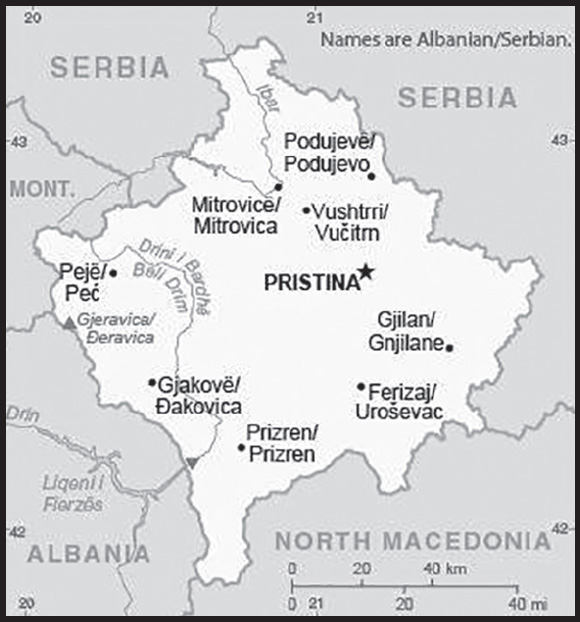
Location: Southeastern Europe, between Serbia and Macedonia
Geographic coordinates: 42 35 N, 21 00 E
Map references: Europe
Area: total: 10,887 sq km
land: 10,887 sq km
water: 0 sq km
comparison ranking: total 167
Area - comparative: slightly larger than Delaware
Land boundaries: total: 714 km
border countries (4): Albania 112 km; North Macedonia 160 km; Montenegro 76 km; Serbia 366 km
Coastline: 0 km (landlocked)
Maritime claims: none (landlocked)
Climate: influenced by continental air masses resulting in relatively cold winters with heavy snowfall and hot, dry summers and autumns; Mediterranean and alpine influences create regional variation; maximum rainfall between October and December
Terrain: flat fluvial basin at an elevation of 400-700 m above sea level surrounded by several high mountain ranges with elevations of 2,000 to 2,500 m
Elevation: highest point: Gjeravica/Deravica 2,656 m
lowest point: Drini i Bardhe/Beli Drim (located on the border with Albania) 297 m
mean elevation: 450 m
Natural resources: nickel, lead, zinc, magnesium, lignite, kaolin, chrome, bauxite
Land use: agricultural land: 52.8% (2018 est.)
arable land: 27.4% (2018 est.)
permanent crops: 1.9% (2018 est.)
permanent pasture: 23.5% (2018 est.)
forest: 41.7% (2018 est.)
other: 5.5% (2018 est.)
Major watersheds (area sq km): Atlantic Ocean drainage: (Black Sea) Danube (795,656 sq km)
Population distribution: population clusters exist throughout the country, the largest being in the east in and around the capital of Pristina
Geography - note: the 41-km long Nerodimka River divides into two branches each of which flows into a different sea: the northern branch flows into the Sitnica River, which via the Ibar, Morava, and Danube Rivers ultimately flows into the Black Sea; the southern branch flows via the Lepenac and Vardar Rivers into the Aegean Sea
PEOPLE AND SOCIETY
Population: 1,964,327 (2023 est.)
comparison ranking: 152
Nationality: noun: Kosovan
adjective: Kosovan
note: Kosovo, a neutral term, is sometimes also used as a noun or adjective as in Kosovo Albanian, Kosovo Serb, Kosovo minority, or Kosovo citizen
Ethnic groups: Albanians 92.9%, Bosniaks 1.6%, Serbs 1.5%, Turk 1.1%, Ashkali 0.9%, Egyptian 0.7%, Gorani 0.6%, Romani 0.5%, other/unspecified 0.2% (2011 est.)
note: these estimates may under-represent Serb, Romani, and some other ethnic minorities because they are based on the 2011 Kosovo national census, which excluded northern Kosovo (a largely Serb-inhabited region) and was partially boycotted by Serb and Romani communities in southern Kosovo
Languages: Albanian (official) 94.5%, Bosnian 1.7%, Serbian (official) 1.6%, Turkish 1.1%, other 0.9% (includes Romani), unspecified 0.1%; note - in municipalities where a community’s mother tongue is not one of Kosovo’s official languages, the language of that community may be given official status according to the 2006 Law on the Use of Languages
note: these estimates may under-represent Serb, Romani, and some other ethnic minority languages because they are based on the 2011 Kosovo national census, which excluded northern Kosovo (a largely Serb-inhabited region) and was partially boycotted by Serb and Romani communities in southern Kosovo (2011 est.)
major-language sample(s): Libri i fakteve boterore, burimi i pazevendesueshem per informacione elementare (Albanian)
Knjiga svetskih činjenica, neophodan izvor osnovnih informacija. (Serbian)
Religions: Muslim 95.6%, Roman Catholic 2.2%, Orthodox 1.5%, other 0.1%, none 0.1%, unspecified 0.6% (2011 est.)
note: these estimates may under-represent Serb, Romani, and some other ethnic minorities because they are based on the 2011 Kosovo national census, which excluded northern Kosovo (a largely Serb-inhabited region) and was partially boycotted by Serb and Romani communities in southern Kosovo
Age structure: 0-14 years: 23.1% (male 235,379/female 218,359)
15-64 years: 68.75% (male 706,495/female 643,982)
65 years and over: 8.15% (2023 est.) (male 69,676/female 90,436)
Dependency ratios: total dependency ratio: 46.9
youth dependency ratio: 32.3
elderly dependency ratio: 14.6
potential support ratio: 6.9 (2021)
Median age: total: 30.5 years (2020)
male: 30.2 years
female: 30.8 years
comparison ranking: total 120
Population growth rate: 0.62% (2023 est.)
comparison ranking: 140
Birth rate: 14.57 births/1,000 population (2023 est.)
comparison ranking: 117
Death rate: 7.65 deaths/1,000 population (2023 est.)
comparison ranking: 101
Net migration rate: -0.71 migrant(s)/1,000 population (2023 est.)
comparison ranking: 134
Population distribution: population clusters exist throughout the country, the largest being in the east in and around the capital of Pristina
Major urban areas - population: 218,782 PRISTINA (capital) (2020)
Sex ratio: at birth: 1.08 male(s)/female
0-14 years: 1.08 male(s)/female
15-64 years: 1.1 male(s)/female
65 years and over: 0.77 male(s)/female
total population: 1.06 male(s)/female (2023 est.)
Infant mortality rate: total: 24.93 deaths/1,000 live births (2023 est.)
male: 26.36 deaths/1,000 live births
female: 23.38 deaths/1,000 live births
comparison ranking: total 66
Life expectancy at birth: total population: 72.15 years (2023 est.)
male: 69.93 years
female: 74.54 years
comparison ranking: total population 163
Total fertility rate: 1.88 children born/woman (2023 est.)
comparison ranking: 131
Gross reproduction rate: 0.91 (2023 est.)
Youth unemployment rate (ages 15-24): total: 48.8% (2020 est.)
male: 44.9%
female: 57.3%
comparison ranking: total 5
ENVIRONMENT
Environment - current issues: air pollution (pollution from power plants and nearby lignite mines take a toll on people’s health); water scarcity and pollution; land degradation
Climate: influenced by continental air masses resulting in relatively cold winters with heavy snowfall and hot, dry summers and autumns; Mediterranean and alpine influences create regional variation; maximum rainfall between October and December
Land use: agricultural land: 52.8% (2018 est.)
arable land: 27.4% (2018 est.)
permanent crops: 1.9% (2018 est.)
permanent pasture: 23.5% (2018 est.)
forest: 41.7% (2018 est.)
other: 5.5% (2018 est.)
Revenue from forest resources: 0% of GDP (2018 est.)
comparison ranking: 165
Revenue from coal: 0.31% of GDP (2018 est.)
comparison ranking: 18
Air pollutants: carbon dioxide emissions: 8.94 megatons (2016 est.)
methane emissions: 0.54 megatons (2020 est.)
Waste and recycling: municipal solid waste generated annually: 319,000 tons (2015 est.)
Major watersheds (area sq km): Atlantic Ocean drainage: (Black Sea) Danube (795,656 sq km)
GOVERNMENT
Country name: conventional long form: Republic of Kosovo
conventional short form: Kosovo
local long form: Republika e Kosoves (Albanian)/ Republika Kosovo (Serbian)
local short form: Kosove (Albanian)/ Kosovo (Serbian)
etymology: name derives from the Serbian “kos” meaning “blackbird,” an ellipsis (linguistic omission) for “kosove polje” or “field of the blackbirds”
Government type: parliamentary republic
Capital: name: Pristina (Prishtine, Prishtina)
geographic coordinates: 42 40 N, 21 10 E
time difference: UTC+1 (6 hours ahead of Washington, DC, during Standard Time)
daylight saving time: +1hr, begins last Sunday in March; ends last Sunday in October
etymology: the name may derive from a Proto-Slavic word reconstructed as “pryshchina,” meaning “spring (of water)”
Administrative divisions: 38 municipalities (komunat, singular - komuna (Albanian); opstine, singular - opstina (Serbian)); Decan (Decani), Dragash (Dragas), Ferizaj (Urosevac), Fushe Kosove (Kosovo Polje), Gjakove (Dakovica), Gjilan (Gnjilane), Gllogovc (Glogovac), Gracanice (Gracanica), Hani i Elezit (Deneral Jankovic), Istog (Istok), Junik, Kacanik, Kamenice (Kamenica), Kline (Klina), Kllokot (Klokot), Leposaviq (Leposavic), Lipjan (Lipljan), Malisheve (Malisevo), Mamushe (Mamusa), Mitrovice e Jugut (Juzna Mitrovica) [South Mitrovica], Mitrovice e Veriut (Severna Mitrovica) [North Mitrovica], Novoberde (Novo Brdo), Obiliq (Obilic), Partesh (Partes), Peje (Pec), Podujeve (Podujevo), Prishtine (Pristina), Prizren, Rahovec (Orahovac), Ranillug (Ranilug), Shterpce (Strpce), Shtime (Stimlje), Skenderaj (Srbica), Suhareke (Suva Reka), Viti (Vitina), Vushtrri (Vucitrn), Zubin Potok, Zvecan
Independence: 17 February 2008 (from Serbia)
National holiday: Independence Day, 17 February (2008)
Constitution: history: previous 1974, 1990; latest (postindependence) draft finalized 2 April 2008, signed 7 April 2008, ratified 9 April 2008, entered into force 15 June 2008; note - amendment 24, passed by the Assembly in August 2015, established the Kosovo Relocated Specialist Institution, referred to as the Kosovo Specialist Chamber or “Specialist Court,” to try war crimes, crimes against humanity, and other crimes under Kosovo law committed during and immediately after the Kosovo War (1998-2000)
amendments: proposed by the government, by the president of the republic, or by one fourth of Assembly deputies; passage requires two-thirds majority vote of the Assembly, including two-thirds majority vote of deputies representing non-majority communities, followed by a favorable Constitutional Court assessment; amended several times, last in 2020
Legal system: civil law system; note - the European Union Rule of Law Mission (EULEX) retained limited executive powers within the Kosovo judiciary for complex cases from 2008 to 2018
International law organization participation: has not submitted an ICJ jurisdiction declaration; non-party state to the ICCt
Citizenship: citizenship by birth: no
citizenship by descent only: at least one parent must be a citizen of Kosovo
dual citizenship recognized: yes
residency requirement for naturalization: 5 years
Suffrage: 18 years of age; universal
Executive branch: chief of state: President Vjosa OSMANI-Sadriu (since 4 April 2021)
head of government: Prime Minister Albin KURTI (since 22 March 2021)
cabinet: Cabinet elected by the Assembly
elections/appointments: president indirectly elected by at least two-thirds majority vote of the Assembly for a 5-year term; if a candidate does not attain a two-thirds threshold in the first two ballots, the candidate winning a simple majority vote in the third ballot is elected (eligible for a second term); election last held on 3-4 April 2021 (next to be held in 2026); prime minister indirectly elected by the Assembly
election results:
2021: Vjosa OSMANI-Sadriu elected president in third ballot; Assembly vote - Vjosa OSMANI-Sadriu (Guxo!) 71 votes; Albin KURTI (LVV) elected prime minister; Assembly vote - 67 for, 30 against
2016: Hashim THACI elected president in third ballot; Assembly vote - Hashim THACI (PDK) 71 votes; Ramush HARADINAJ (AAK) elected prime minister; Assembly vote - 61 for
Legislative branch: description: unicameral Assembly or Kuvendi i Kosoves/Skupstina Kosova (120 seats; 100 members directly elected by open-list proportional representation vote with 20 seats reserved for ethnic minorities - 10 for Serbs and 10 for other ethnic minorities; members serve 4-year terms)
elections: last held on 14 February 2021 (next to be held in 2025)
election results: percent of vote by party - LVV 50%, PDK 16.9%, LDK 12.7%, AAK 7.1%, Serb List 5.1%, other 8.2%; seats by party - LVV 58, PDK 19, LDK 15, Serb List 10, AAK 8, other 10; composition as of December 2021 - men 79, women 41, percent of women 34.2%
Judicial branch: highest court(s): Supreme Court (consists of the court president and 18 judges and organized into Appeals Panel of the Kosovo Property Agency and Special Chamber); Constitutional Court (consists of the court president, vice president, and 7 judges)
judge selection and term of office: Supreme Court judges nominated by the Kosovo Judicial Council, a 13-member independent body staffed by judges and lay members, and also responsible for overall administration of Kosovo’s judicial system; judges appointed by the president of the Republic of Kosovo; judges appointed until mandatory retirement age; Constitutional Court judges nominated by the Kosovo Assembly and appointed by the president of the republic to serve single, 9-year terms
subordinate courts: Court of Appeals (organized into 4 departments: General, Serious Crime, Commercial Matters, and Administrative Matters); Basic Court (located in 7 municipalities, each with several branches)
note: in August 2015, the Kosovo Assembly approved a constitutional amendment that established the Kosovo Relocated Specialist Judicial Institution, also referred to as the Kosovo Specialist Chambers or “Special Court”; the court, located at the Hague in the Netherlands, began operating in late 2016 and has jurisdiction to try crimes against humanity, war crimes, and other crimes under Kosovo law that occurred in the 1998-2000 period
Political parties and leaders: Alliance for the Future of Kosovo or AAK [Ramush HARADINAJ]
Ashkali Party for Integration or PAI [Bekim ARIFI]
Civic Initiative for Freedom, Justice, and Survival [Milan DABIC]
Democratic League of Kosovo or LDK [Lumir ABDIXHIKU]
Democratic Party of Kosovo or PDK [Memli KRASNIQI]
New Democratic Initiative of Kosovo or IRDK [Elbert KRASNIQI]
New Democratic Party or NDS [Emilja REDZEPI]
Progressive Movement of Kosovar Roma or LPRK [Erxhan GALJUSI]
Romani Initiative [Gazmend SALIJEVCI]
Self-Determination Movement (Lëvizja Vetevendosje or Vetevendosie) or LVV or VV [Albin KURTI]
Serb List or SL [Goran RAKIC]
Social Democratic Union or SDU [Duda BALJE]
Turkish Democratic Party of Kosovo or KDTP [Fikrim DAMKA]
Unique Gorani Party or JGP [Adem HODZA]
Vakat Coalition or VAKAT [Bahrim SABANI]
International organization participation: IBRD, IDA, IFC, IMF, ITUC (NGOs), MIGA, OIF (observer)
Diplomatic representation in the US: chief of mission: Ambassador Ilir DUGOLLI (since 13 January 2022)
chancery: 3612 Massachusetts Ave NW, Washington, D.C. 20007
telephone: [1] (202) 450-2130
FAX: [1] (202) 735-0609
email address and website:
U.S. Embassies of the Republic of Kosovo (ambasadat.net)
consulate(s) general: New York
consulate(s): Des Moines (IA)
Diplomatic representation from the US: chief of mission: Ambassador Jeffrey M. HOVENIER (since 10 January 2022)
embassy: Arberia/Dragodan, Rr. 4 KORRIKU Nr. 25, Pristina
mailing address: 9520 Pristina Place, Washington DC 20521-9520
telephone: [383] 38-59-59-3000
FAX: [383] 38-604-890
email address and website:
Flag description: centered on a dark blue field is a gold-colored silhouette of Kosovo surmounted by six white, five-pointed stars arrayed in a slight arc; each star represents one of the major ethnic groups of Kosovo: Albanians, Serbs, Turks, Gorani, Roma, and Bosniaks
note: one of only two national flags that uses a map as a design element; the flag of Cyprus is the other
National symbol(s): six, five-pointed, white stars; national colors: blue, gold, white
National anthem: name: Europe
lyrics/music: no lyrics/Mendi MENGJIQI
note: adopted 2008; Kosovo chose to exclude lyrics in its anthem so as not to offend the country’s minority ethnic groups
National heritage: total World Heritage Sites: 1 (cultural)
selected World Heritage Site locales: Medieval Monuments in Kosovo
ECONOMY
Economic overview: small-but-growing European economy; non-EU member but unilateral euro user; very high unemployment, especially youth; vulnerable reliance on diaspora tourism services, curtailed by COVID-19 disruptions; unclear public loan portfolio health
Real GDP (purchasing power parity): $21.226 billion (2021 est.)
$19.166 billion (2020 est.)
$20.247 billion (2019 est.)
note: data are in 2017 dollars
comparison ranking: 151
Real GDP growth rate: 10.75% (2021 est.)
-5.34% (2020 est.)
4.76% (2019 est.)
comparison ranking: 23
Real GDP per capita: $11,900 (2021 est.)
$10,700 (2020 est.)
$11,300 (2019 est.)
note: data are in 2017 dollars
comparison ranking: 132
GDP (official exchange rate): $7.926 billion (2019 est.)
Inflation rate (consumer prices): 3.35% (2021 est.)
0.2% (2020 est.)
2.68% (2019 est.)
comparison ranking: 113
GDP - composition, by sector of origin: agriculture: 11.9% (2017 est.)
industry: 17.7% (2017 est.)
services: 70.4% (2017 est.)
comparison rankings: services 65; industry 165; agriculture 79
GDP - composition, by end use: household consumption: 84.3% (2017 est.)
government consumption: 13.6% (2017 est.)
investment in fixed capital: 29% (2017 est.)
investment in inventories: 0% (2016 est.)
exports of goods and services: 27% (2017 est.)
imports of goods and services: -53.8% (2017 est.)
Agricultural products: wheat, corn, berries, potatoes, peppers, fruit; dairy, livestock; fish
Industries: mineral mining, construction materials, base metals, leather, machinery, appliances, foodstuffs and beverages, textiles
Industrial production growth rate: 7.76% (2021 est.)
comparison ranking: 55
Labor force: 500,300 (2017 est.)
note: includes those estimated to be employed in the gray economy
comparison ranking: 160
Labor force - by occupation: agriculture: 4.4%
industry: 17.4%
services: 78.2% (2017 est.)
Unemployment rate: 30.5% (2017 est.)
27.5% (2016 est.)
note: Kosovo has a large informal sector that may not be reflected in these data
comparison ranking: 4
Youth unemployment rate (ages 15-24): total: 48.8% (2020 est.)
male: 44.9%
female: 57.3%
comparison ranking: total 5
Population below poverty line: 17.6% (2015 est.)
Gini Index coefficient - distribution of family income: 29 (2017 est.)
comparison ranking: 157
Household income or consumption by percentage share: lowest 10%: 3.8%
highest 10%: 22% (2015 est.)
Budget: revenues: $1.951 billion (2020 est.)
expenditures: $2.547 billion (2020 est.)
Budget surplus (+) or deficit (-): -2.1% (of GDP) (2017 est.)
comparison ranking: 107
Public debt: 21.2% of GDP (2017 est.)
19.4% of GDP (2016 est.)
comparison ranking: 187
Taxes and other revenues: 29% (of GDP) (2017 est.)
comparison ranking: 30
Current account balance: -$818.351 million (2021 est.)
-$541.106 million (2020 est.)
-$447.233 million (2019 est.)
comparison ranking: 135
Exports: $3.138 billion (2021 est.) note: data are in current year dollars
$1.687 billion (2020 est.) note: data are in current year dollars
$2.312 billion (2019 est.) note: data are in current year dollars
comparison ranking: 149
Exports - partners: United States 16%, Albania 15%, North Macedonia 12%, Germany 8%, Italy 8% (2021)
Exports - commodities: mattress materials, iron alloys, metal piping, scrap iron, building plastics, mineral water, seating (2021)
Imports: $6.128 billion (2021 est.) note: data are in current year dollars
$4.187 billion (2020 est.) note: data are in current year dollars
$4.454 billion (2019 est.) note: data are in current year dollars
comparison ranking: 134
Imports - partners: Germany 13%, Turkey 13%, China 10%, Serbia 7%, Italy 6% (2021)
Imports - commodities: refined petroleum, cars, iron rods, electricity, cigars, packaged medicines (2021)
Reserves of foreign exchange and gold: $1.244 billion (31 December 2021 est.)
$1.095 billion (31 December 2020 est.)
$965.832 million (31 December 2019 est.)
comparison ranking: 142
Debt - external: $2.388 billion (2019 est.)
$2.409 billion (2018 est.)
comparison ranking: 150
Exchange rates: euros (EUR) per US dollar -
Exchange rates: 0.845 (2021 est.)
0.877 (2020 est.)
0.893 (2019 est.)
0.847 (2018 est.)
0.885 (2017 est.)
note: Kosovo, which is neither an EU member state nor a party to a formal EU monetary agreement, uses the euro as its de facto currency
ENERGY
Electricity access: electrification - total population: 100% (2020)
Electricity: installed generating capacity: 1.424 million kW (2020 est.)
consumption: 4,860,740,000 kWh (2019 est.)
exports: 2.715 billion kWh (2020 est.)
imports: 2.572 billion kWh (2020 est.)
transmission/distribution losses: 1.145 billion kWh (2019 est.)
comparison rankings: imports 56; exports 44; installed generating capacity 127; transmission/distribution losses 110; consumption 125
Electricity generation sources: fossil fuels: 95.6% of total installed capacity (2020 est.)
solar: 0.1% of total installed capacity (2020 est.)
wind: 1.1% of total installed capacity (2020 est.)
hydroelectricity: 3.2% of total installed capacity (2020 est.)
Coal: production: 8.538 million metric tons (2020 est.)
consumption: 8.549 million metric tons (2020 est.)
exports: 9,000 metric tons (2020 est.)
imports: 20,000 metric tons (2020 est.)
proven reserves: 1.564 billion metric tons (2019 est.)
Petroleum: refined petroleum consumption: 12,800 bbl/day (2019 est.)
Refined petroleum products - exports: 192 bbl/day (2015 est.)
comparison ranking: 117
Refined petroleum products - imports: 14,040 bbl/day (2015 est.)
comparison ranking: 139
Carbon dioxide emissions: 8.009 million metric tonnes of CO2 (2019 est.)
from coal and metallurgical coke: 6.1 million metric tonnes of CO2 (2019 est.)
from petroleum and other liquids: 1.909 million metric tonnes of CO2 (2019 est.)
comparison ranking: total emissions 114
Energy consumption per capita: 51.462 million Btu/person (2019 est.)
comparison ranking: 99
COMMUNICATIONS
Telephones - fixed lines: total subscriptions: 383,763 (2022 est.)
subscriptions per 100 inhabitants: 25 (2022 est.)
comparison ranking: total subscriptions 103
Telephones - mobile cellular: total subscriptions: 1,777,859 (2022 est.)
subscriptions per 100 inhabitants: 98 (2022 est.)
comparison ranking: total subscriptions 157
Telecommunication systems: general assessment: Kosovo has benefited from financial and regulatory assistance as part of the EU pre-accession process; the telecom sector has been liberalized, and legislation has aligned the sector with the EU’s revised regulatory framework; infrastructure development includes WiMax and other municipal wireless internet services; digitalization of TV broadcasting; network upgrades include a 5G roll-out in the coming years (2022)
domestic: fixed-line roughly 25 per 100 and mobile-cellular 98 per 100 persons (2022)
international: country code - 383
Internet country code: .xk; note - assigned as a temporary code under UN Security Council resolution 1244/99
Internet users: total: 1,756,300 (2021 est.)
percent of population: 91% (2021 est.)
comparison ranking: total 139
TRANSPORTATION
National air transport system: number of registered air carriers: 0 (2020)
Civil aircraft registration country code prefix: Z6
Airports: 6 (2021)
comparison ranking: total 172
Airports - with paved runways: 3
note: paved runways have a concrete or asphalt surface but not all have facilities for refueling, maintenance, or air traffic control; the length of a runway required for aircraft to safely operate depends on a number of factors including the type of aircraft, the takeoff weight (including passengers, cargo, and fuel), engine types, flap settings, landing speed, elevation of the airport, and average maximum daily air temperature; paved runways can reach a length of 5,000 m (16,000 ft.), but the “typical” length of a commercial airline runway is between 2,500-4,000 m (8,000-13,000 ft.)
Airports - with unpaved runways: 3
note: unpaved runways have a surface composition such as grass or packed earth and are most suited to the operation of light aircraft; unpaved runways are usually short, often less than 1,000 m (3,280 ft.) in length; airports with unpaved runways often lack facilities for refueling, maintenance, or air traffic control
Heliports: 2 (2021)
Railways: total: 437 km (2020)
comparison ranking: total 116
Roadways: total: 2,012 km (2015)
paved: 1,921 km (2015) (includes 78 km of expressways)
unpaved: 91 km (2015)
comparison ranking: total 172
MILITARY AND SECURITY
Military and security forces: Kosovo Security Force (KSF; Forca e Sigurisë së Kosovës or FSK): Land Force, National Guard (2023)
note: the Kosovo Police are under the Ministry of Internal Affairs
Military expenditures: 2% of GDP (2022 est.)
2% of GDP (2021 est.)
1.1% of GDP (2020 est.)
0.8% of GDP (2019 est.)
0.8% of GDP (2018 est.)
comparison ranking: 60
Military and security service personnel strengths: approximately 3,300 KSF personnel, including about 800 reserves (2023)
Military equipment inventories and acquisitions: the KSF is equipped with small arms and light vehicles and has relied on limited amounts of donated equipment from several countries, particularly Turkey and the US (2023)
Military service age and obligation: any citizen of Kosovo over the age of 18 is eligible to serve in the Kosovo Security Force; upper age for enlisting is 30 for officers, 25 for other ranks, although these may be waived for recruits with key skills considered essential for the KSF (2023)
Military - note: the Kosovo Security Force (KSF) was established in 2009 as a small (1,500 personnel), lightly armed disaster response force; the NATO-led Kosovo Force (KFOR) was charged with assisting in the development of the KSF and bringing it up to standards designated by NATO; the KSF was certified as fully operational by the North Atlantic Council in 2013, indicating the then 2,200-strong KSF was entirely capable of performing the tasks assigned under its mandate, which included non-military security functions that were not appropriate for the police, plus missions such as search and rescue, explosive ordnance disposal, control and clearance of hazardous materials, firefighting, and other humanitarian assistance tasks; in 2019, Kosovo approved legislation that began a process to transition the KSF by 2028 into a multinational and professional armed forces (the Kosovo Armed Forces) led by a General Staff and comprised of a Land Force, a National Guard, a Logistics Command, and a Doctrine and Training Command; it would have a strength of up to 5,000 with about 3,000 reserves; at the same time, the KSF’s mission was expanded to include traditional military functions, such as territorial defense and international peacekeeping; the kSf’s first international mission was the deployment of a small force to Kuwait in 2021
the NATO-led KFOR has operated in the country as a peace support force since 1999; in addition to assisting in the development of the KSF, KFOR is responsible for providing a safe and secure environment and ensuring freedom of movement for all citizens; it numbers about 3,700 troops from 27 countries; Kosovo regards the US as a key ally and security guarantor, and the US has provided considerable support to the KSF, including equipment and training (2023)
TERRORISM
Terrorist group(s): Terrorist group(s): Islamic State of Iraq and ash-Sham (ISIS)
note: details about the history, aims, leadership, organization, areas of operation, tactics, targets, weapons, size, and sources of support of the group(s) appear(s) in Appendix-T
TRANSNATIONAL ISSUES
Disputes - international: NATO-led Kosovo Force peacekeepers under UN Interim Administration Mission in Kosovo authority continue to ensure a safe and secure environment and freedom of movement for all Kosovo citizens
Kosovo-Albania: none identified
Kosovo-Montenegro: their 2015 demarcation agreement was ratified by Montenegro in December 2015 and by Kosovo in March 2018, but the actual demarcation has not been completed; as of March 2021, Kosovo Prime Minister Albin KURTI said that after the new Montenegrin government is formed, he would broach the subject of reopening the agreement
Kosovo-North Macedonia: Kosovo and North Macedonia completed demarcation of their boundary in September 2008; both countries ratified the demarcation documents on October 17, 2009, after high-level consultations resolved the disputed section of border around Debelde/Tanusevci
Kosovo-Serbia: Serbia with several other states protest the US’s and other countries’ recognition of Kosovo’s declaration of its status as a sovereign and independent state in February 2008; ethnic Serbian municipalities along Kosovo’s northern border challenge final status of Kosovo-Serbia boundary; Kosovo’s and Serbia’s temporary agreement on license plates expired on 21 April 2022; the two countries are meeting on 13 May to reach a permanent agreement
Refugees and internally displaced persons: IDPs: 16,000 (primarily ethnic Serbs displaced during the 1998-1999 war fearing reprisals from the majority ethnic-Albanian population; a smaller number of ethnic Serbs, Roma, Ashkali, and Egyptians fled their homes in 2004 as a result of violence) (2022)
note: 9,011 estimated refugee and migrant arrivals (January 2015-August 2023)
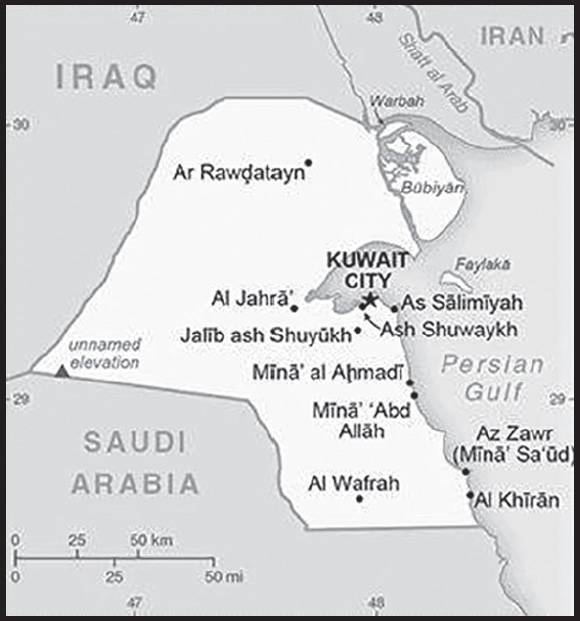
INTRODUCTION
Background: Kuwait has been ruled by the AL-SABAH dynasty since the 18th century. The threat of Ottoman invasion in 1899 prompted Amir Mubarak AL-SABAH to seek protection from Britain, ceding foreign and defense responsibility to Britain until 1961, when the country attained its independence. Kuwait was attacked and overrun by Iraq in August 1990. Following several weeks of aerial bombardment, a US-led UN coalition began a ground assault in February 1991 that liberated Kuwait in four days. In 1992, the Amir reconstituted the parliament that he had dissolved in 1986. Amid the 2010-11 uprisings and protests across the Arab world, stateless Arabs, known as Bidoon, staged small protests in early 2011 demanding citizenship, jobs, and other benefits available to Kuwaiti nationals. Other demographic groups, notably Islamists and Kuwaitis from tribal backgrounds, soon joined the growing protest movements, which culminated in late 2011 with the resignation of the prime minister amidst allegations of corruption. Demonstrations renewed in late 2012 in response to an amiri decree amending the electoral law that lessened the voting power of the tribal blocs.
An opposition coalition of Sunni Islamists, tribal populists, and some liberals, largely boycotted legislative elections in 2012 and 2013, which ushered in a legislature more amenable to the government’s agenda. Faced with the prospect of painful subsidy cuts, oppositionists and independents actively participated in the November 2016 election, winning nearly half of the seats, but a cohesive opposition alliance largely ceased to exist with the 2016 election and the opposition became increasingly factionalized. Between 2006 and his death in 2020, the previous Kuwaiti Amir dissolved the National Assembly on seven occasions (the Constitutional Court annulled the Assembly elections in June 2012 and again in June 2013) and shuffled the cabinet over a dozen times, usually citing political stagnation and gridlock between the legislature and the government.
The current Amir, who assumed his role in 2020, launched a “National Dialogue” in September 2021 meant to resolve political gridlock. As part of the “National Dialogue,” the Amir pardoned several opposition figures who had been living in exile, and they returned to Kuwait. Legislative challenges remain, and the cabinet has been reshuffled six times since late 2020.
GEOGRAPHY
Location: Middle East, bordering the Persian Gulf, between Iraq and Saudi Arabia
Geographic coordinates: 29 30 N, 45 45 E
Map references: Middle East
Area: total: 17,818 sq km
land: 17,818 sq km
water: 0 sq km
comparison ranking: total 157
Area - comparative: slightly smaller than New Jersey
Land boundaries: total: 475 km
border countries (2): Iraq 254 km; Saudi Arabia 221 km
Coastline: 499 km
Maritime claims: territorial sea: 12 nm
Climate: dry desert; intensely hot summers; short, cool winters
Terrain: flat to slightly undulating desert plain
Elevation: highest point: 3.6 km W. of Al-Salmi Border Post 300 m
lowest point: Persian Gulf 0 m
mean elevation: 108 m
Natural resources: petroleum, fish, shrimp, natural gas
Land use: agricultural land: 8.5% (2018 est.)
arable land: 0.6% (2018 est.)
permanent crops: 0.3% (2018 est.)
permanent pasture: 7.6% (2018 est.)
forest: 0.4% (2018 est.)
other: 91.1% (2018 est.)
Irrigated land: 100 sq km (2015)
Major watersheds (area sq km): Indian Ocean drainage: (Persian Gulf) Tigris and Euphrates (918,044 sq km)
Major aquifers: Arabian Aquifer System
Population distribution: densest settlement is along the Persian Gulf, particularly in Kuwait City and on Bubiyan Island; significant population threads extend south and west along highways that radiate from the capital, particularly in the southern half of the country
Natural hazards: sudden cloudbursts are common from October to April and bring heavy rain, which can damage roads and houses; sandstorms and dust storms occur throughout the year but are most common between March and August
Geography - note: strategic location at head of Persian Gulf
PEOPLE AND SOCIETY
Population: 3,103,580 (2023 est.)
note: Kuwait’s Public Authority for Civil Information estimates the country’s total population to be 4,420,110 for 2019, with non-Kuwaitis accounting for nearly 70% of the population
comparison ranking: 136
Nationality: noun: Kuwaiti(s)
adjective: Kuwaiti
Ethnic groups: Kuwaiti 30.4%, other Arab 27.4%, Asian 40.3%, African 1%, other 0.9% (includes European, North American, South American, and Australian) (2018 est.)
Languages: Arabic (official), English widely spoken
major-language sample(s):

(Arabic)
Religions: Muslim (official) 74.6%, Christian 18.2%, other and unspecified 7.2% (2013 est.)
note: data represent the total population; about 72% of the population consists of immigrants
Age structure: 0-14 years: 23.32% (male 377,040/female 346,791)
15-64 years: 73.28% (male 1,371,010/female 903,309)
65 years and over: 3.4% (2023 est.) (male 45,351/female 60,079)
Dependency ratios: total dependency ratio: 34.4
youth dependency ratio: 28.4
elderly dependency ratio: 6
potential support ratio: 24.9 (2021 est.)
Median age: total: 29.7 years (2020)
male: 30.7 years
female: 27.9 years
comparison ranking: total 127
Population growth rate: 1.13% (2023 est.)
comparison ranking: 80
Birth rate: 17.65 births/1,000 population (2023 est.)
comparison ranking: 83
Death rate: 2.27 deaths/1,000 population (2023 est.)
comparison ranking: 227
Net migration rate: -4.07 migrant(s)/1,000 population (2023 est.)
comparison ranking: 194
Population distribution: densest settlement is along the Persian Gulf, particularly in Kuwait City and on Bubiyan Island; significant population threads extend south and west along highways that radiate from the capital, particularly in the southern half of the country
Urbanization: urban population: 100% of total population (2023)
rate of urbanization: 1.35% annual rate of change (2020-25 est.)
Major urban areas - population: 3.298 million KUWAIT (capital) (2023)
Sex ratio: at birth: 1.05 male(s)/female
0-14 years: 1.09 male(s)/female
15-64 years: 1.52 male(s)/female
65 years and over: 0.75 male(s)/female
total population: 1.37 male(s)/female (2023 est.)
Maternal mortality ratio: 7 deaths/100,000 live births (2020 est.)
comparison ranking: 155
Infant mortality rate: total: 7.27 deaths/1,000 live births (2023 est.)
male: 7.57 deaths/1,000 live births
female: 6.96 deaths/1,000 live births
comparison ranking: total 156
Life expectancy at birth: total population: 79.35 years (2023 est.)
male: 77.89 years
female: 80.87 years
comparison ranking: total population 64
Total fertility rate: 2.22 children born/woman (2023 est.)
comparison ranking: 82
Gross reproduction rate: 1.09 (2023 est.)
Contraceptive prevalence rate: NA
Drinking water source: improved: urban: NA
rural: NA
total: 100% of population
unimproved: urban: NA
rural: NA
total: 0% of population (2020 est.)
Current health expenditure: 6.3% of GDP (2020)
Physicians density: 2.34 physicians/1,000 population (2020)
Hospital bed density: 2 beds/1,000 population (2017)
Sanitation facility access: improved: urban: NA
rural: NA
total: 100% of population
unimproved: urban: NA
rural: NA
total: 0% of population (2020 est.)
Obesity - adult prevalence rate: 37.9% (2016)
comparison ranking: 11
Alcohol consumption per capita: total: 0 liters of pure alcohol (2019 est.)
beer: 0 liters of pure alcohol (2019 est.)
wine: 0 liters of pure alcohol (2019 est.)
spirits: 0 liters of pure alcohol (2019 est.)
other alcohols: 0 liters of pure alcohol (2019 est.)
comparison ranking: total 189
Tobacco use: total: 17.9% (2020 est.)
male: 33.5% (2020 est.)
female: 2.2% (2020 est.)
comparison ranking: total 93
Children under the age of 5 years underweight: 2.5% (2020)
comparison ranking: 98
Currently married women (ages 15-49): 59.6% (2023 est.)
Education expenditures: 6.6% of GDP (2020 est.)
comparison ranking: 30
Literacy: definition: age 15 and over can read and write
total population: 96.5%
male: 97.1%
female: 95.4% (2020)
School life expectancy (primary to tertiary education): total: 15 years
male: 13 years
female: 16 years (2015)
Youth unemployment rate (ages 15-24): total: 25.5% (2021 est.)
male: 17.1%
female: 46.2%
comparison ranking: total 62
ENVIRONMENT
Environment - current issues: limited natural freshwater resources; some of world’s largest and most sophisticated desalination facilities provide much of the water; air and water pollution; desertification; loss of biodiversity
Environment - international agreements: party to: Biodiversity, Climate Change, Climate Change-Kyoto Protocol, Climate Change-Paris Agreement, Comprehensive Nuclear Test Ban, Desertification, Endangered Species, Environmental Modification, Hazardous Wastes, Law of the Sea, Nuclear Test Ban, Ozone Layer Protection, Ship Pollution, Wetlands
signed, but not ratified: Marine Dumping-London Convention
Climate: dry desert; intensely hot summers; short, cool winters
Land use: agricultural land: 8.5% (2018 est.)
arable land: 0.6% (2018 est.)
permanent crops: 0.3% (2018 est.)
permanent pasture: 7.6% (2018 est.)
forest: 0.4% (2018 est.)
other: 91.1% (2018 est.)
Urbanization: urban population: 100% of total population (2023)
rate of urbanization: 1.35% annual rate of change (2020-25 est.)
Revenue from forest resources: 0% of GDP (2018 est.)
comparison ranking: 195
Revenue from coal: 0% of GDP (2018 est.)
comparison ranking: 138
Air pollutants: particulate matter emissions: 64.08 micrograms per cubic meter (2019 est.)
carbon dioxide emissions: 98.73 megatons (2016 est.)
methane emissions: 6.21 megatons (2020 est.)
Waste and recycling: municipal solid waste generated annually: 1.75 million tons (2010 est.)
Major watersheds (area sq km): Indian Ocean drainage: (Persian Gulf) Tigris and Euphrates (918,044 sq km)
Major aquifers: Arabian Aquifer System
Total water withdrawal: municipal: 450 million cubic meters (2020 est.)
industrial: 20 million cubic meters (2020 est.)
agricultural: 780 million cubic meters (2020 est.)
Total renewable water resources: 20 million cubic meters (2020 est.)
GOVERNMENT
Country name: conventional long form: State of Kuwait
conventional short form: Kuwait
local long form: Dawlat al Kuwayt
local short form: Al Kuwayt
etymology: the name derives from the capital city, which is from Arabic “al-Kuwayt” a diminutive of “kut” meaning “fortress,” possibly a reference to a small castle built on the current location of Kuwait City by the Beni Khaled tribe in the 17th century
Government type: constitutional monarchy (emirate)
Capital: name: Kuwait City
geographic coordinates: 29 22 N, 47 58 E
time difference: UTC+3 (8 hours ahead of Washington, DC, during Standard Time)
etymology: the name derives from Arabic “al-Kuwayt” a diminutive of “kut” meaning “fortress,” possibly a reference to a small castle built on the current location of Kuwait City by the Beni Khaled tribe in the 17th century
Administrative divisions: 6 governorates (muhafazat, singular - muhafazah); Al Ahmadi, Al ‘Asimah, Al Farwaniyah, Al Jahra’, Hawalli, Mubarak al Kabir
Independence: 19 June 1961 (from the UK)
National holiday: National Day, 25 February (1950)
Constitution: history: approved and promulgated 11 November 1962; suspended 1976 to 1981 (4 articles); 1986 to 1991; May to July 1999
amendments: proposed by the amir or supported by at least one third of the National Assembly; passage requires two- thirds consent of the Assembly membership and promulgation by the amir; constitutional articles on the initiation, approval, and promulgation of general legislation cannot be amended
Legal system: mixed legal system consisting of English common law, French civil law, and Islamic sharia law
International law organization participation: has not submitted an ICJ jurisdiction declaration; non-party state to the ICCt
Citizenship: citizenship by birth: no
citizenship by descent only: at least one parent must be a citizen of Kuwait
dual citizenship recognized: no
residency requirement for naturalization: not specified
Suffrage: 21 years of age and at least 20-year citizenship
Executive branch: chief of state: Amir NAWAF al-Ahmad al-Jabir al-Sabah (since 29 September 2020); Crown Prince MISHAL al-Ahmad al-Sabah, born 27 September 1940, is the brother of Amir NAWAF al-Ahmad al-Jabir al-Sabah
head of government: Prime Minister Sheikh AHMAD AL-NAWAF Al-Ahmad al-Sabah (reappointed 5 March 2023); First Deputy Prime Minister and Minister of Interior Sheikh TALAL al-Khalid Al-Ahmad Al-Sabah (since 16 October 2022); Deputy Prime Minister and Minister of State for Cabinet Affairs Khalid al-FADIL (since 9 April 2022); Deputy Prime Minister and Minister of Oil Bader Hamed Yusef Al-Mula (since 16 October 2022)
cabinet: Council of Ministers appointed by the prime minister, approved by the amir
elections/appointments: amir chosen from within the ruling family, confirmed by the National Assembly; prime minister and deputy prime ministers appointed by the amir; crown prince appointed by the amir and approved by the National Assembly
Legislative branch: description: unicameral National Assembly or Majlis al-Umma (65 seats; 50 members directly elected from 5 multi-seat constituencies by simple majority vote and 15 ex-officio members (cabinet ministers) appointed by the amir; members serve 4-year terms)
elections: snap election held on 6 June 2023 (next to be held in 2027)
election results:
50 non-partisan candidates, including 29 oppositionists; composition of elected members - 49 men, 1 woman, percent of women 2%
Note: on 17 April 2023, Crown Prince Mishal al-AHMAD al-Sabah dissolved the National Assembly, which had been reinstated in March at the direction of the Constitutional Court, following its annulment of the September 2022 election; the Assembly was formally dissolved by royal decree on 1 May 2023, and a new election was held on 6 June
Judicial branch: highest court(s): Constitutional Court (consists of 5 judges); Supreme Court or Court of Cassation (organized into several circuits, each with 5 judges)
judge selection and term of office: all Kuwaiti judges appointed by the Amir upon recommendation of the Supreme Judicial Council, a consultative body comprised of Kuwaiti judges and Ministry of Justice officials
subordinate courts: High Court of Appeal; Court of First Instance; Summary Court
Political parties and leaders: none; the government does not recognize any political parties or allow their formation, although no formal law bans political parties
International organization participation: ABEDA, AfDB (nonregional member), AFESD, AMF, BDEAC, CAEU, CD, FAO, G-77, GCC, IAEA, IBRD, ICAO, ICC (national committees), ICRM, IDA, IDB, IFAD, IFC, IFRCS, IHO, ILO, IMF, IMO, IMSO, Interpol, IOC, IPU, ISO, ITSO, ITU, ITUC (NGOs), LAS, MIGA, NAM, OAPEC, OIC, OPCW, OPEC, Paris Club (associate), PCA, UN, UNCTAD, UNESCO, UNIDO, UNRWA, UN Security Council (temporary), UNWTO, UPU, WCO, WFTU (NGOs), WHO, WIPO, WMO, WTO
Diplomatic representation in the US: chief of mission: Alzain Sabah Naser Saud ALSABAH (since 19 April 2023)
chancery: 2940 Tilden Street NW, Washington, DC 20008 (po)
telephone: [1] (202) 966-0702
FAX: [1] (202) 966-8468
email address and website:
consulate(s) general: Beverly Hills (CA), New York
Diplomatic representation from the US: chief of mission: Ambassador (vacant); Chargé d’Affaires James HOLTSNIDER (since July 2021)
embassy: P.O. Box 77, Safat 13001
mailing address: 6200 Kuwait Place, Washington DC 20521-6200
telephone: [00] (965) 2259-1001
FAX: [00] (965) 2538-0282
email address and website:
Flag description: three equal horizontal bands of green (top), white, and red with a black trapezoid based on the hoist side; colors and design are based on the Arab Revolt flag of World War I; green represents fertile fields, white stands for purity, red denotes blood on Kuwaiti swords, black signifies the defeat of the enemy
National symbol(s): golden falcon; national colors: green, white, red, black
National anthem: name: “Al-Nasheed Al-Watani” (National Anthem)
lyrics/music: Ahmad MUSHARI al-Adwani/Ibrahim Nasir al-SOULA
note: adopted 1978; the anthem is only used on formal occasions
ECONOMY
Economic overview: small, high-income, oil-based Middle East economy; renewable energy proponent; regional finance and investment leader; maintains oldest sovereign wealth fund; emerging space and tourism industries; mid-way through 25-year development program
Real GDP (purchasing power parity): $191.522 billion (2020 est.)
$210.13 billion (2019 est.)
$211.296 billion (2018 est.)
note: data are in 2017 dollars
comparison ranking: 68
Real GDP growth rate: -8.86% (2020 est.)
-0.55% (2019 est.)
2.43% (2018 est.)
comparison ranking: 219
Real GDP per capita: $43,900 (2020 est.) note: data are in 2017 dollars
$47,300 (2019 est.) note: data are in 2017 dollars
$48,900 (2018 est.)
comparison ranking: 41
GDP (official exchange rate): $134.638 billion (2019 est.)
Inflation rate (consumer prices): 3.42% (2021 est.)
2.1% (2020 est.)
1.09% (2019 est.)
comparison ranking: 110
Credit ratings: Fitch rating: AA (2008)
Moody’s rating: A1 (2020)
Standard & Poors rating: AA- (2020)
note: The year refers to the year in which the current credit rating was first obtained.
GDP - composition, by sector of origin: agriculture: 0.4% (2017 est.)
industry: 58.7% (2017 est.)
services: 40.9% (2017 est.)
comparison rankings: services 207; industry 2; agriculture 210
GDP - composition, by end use: household consumption: 43.1% (2017 est.)
government consumption: 24.5% (2017 est.)
investment in fixed capital: 26.5% (2017 est.)
investment in inventories: 3.5% (2017 est.)
exports of goods and services: 49.4% (2017 est.)
imports of goods and services: -47% (2017 est.)
Agricultural products: eggs, dates, tomatoes, cucumbers, poultry, milk, mutton, potatoes, vegetables, eggplants
Industries: petroleum, petrochemicals, cement, shipbuilding and repair, water desalination, food processing, construction materials
Industrial production growth rate: -12.2% (2020 est.)
comparison ranking: 202
Labor force: 2.363 million (2021 est.)
note: non-Kuwaitis represent about 60% of the labor force
comparison ranking: 119
Labor force - by occupation: agriculture: NA
industry: NA
services: NA
Unemployment rate: 3.71% (2021 est.)
3.54% (2020 est.)
2.17% (2019 est.)
comparison ranking: 182
Youth unemployment rate (ages 15-24): total: 25.5% (2021 est.)
male: 17.1%
female: 46.2%
comparison ranking: total 62
Population below poverty line: NA
Average household expenditures: on food: 19.2% of household expenditures (2018 est.)
on alcohol and tobacco: 0.2% of household expenditures (2018 est.)
Household income or consumption by percentage share: lowest 10%: NA
highest 10%: NA
Budget: revenues: $77.988 billion (2019 est.)
expenditures: $72.03 billion (2019 est.)
Budget surplus (+) or deficit (-): -10% (of GDP) (2017 est.)
comparison ranking: 210
Public debt: 20.6% of GDP (2017 est.)
9.9% of GDP (2016 est.)
comparison ranking: 189
Taxes and other revenues: 41.8% (of GDP) (2017 est.)
comparison ranking: 9
Fiscal year: 1 April - 31 March
Current account balance: $34.943 billion (2021 est.)
$22.03 billion (2020 est.)
$30.255 billion (2019 est.)
comparison ranking: 16
Exports: $77.121 billion (2021 est.) note: data are in current year dollars
$47.416 billion (2020 est.) note: data are in current year dollars
$72.833 billion (2019 est.)
comparison ranking: 53
Exports - partners: China 20%, South Korea 16%, India 15%, Japan 10%, Taiwan 6%, Vietnam 5% (2019)
Exports - commodities: crude petroleum, refined petroleum, natural gas, industrial hydrocarbon products, industrial alcohols (2021)
Imports: $48.954 billion (2021 est.) note: data are in current year dollars
$44.015 billion (2020 est.) note: data are in current year dollars
$59.654 billion (2019 est.)
comparison ranking: 65
Imports - partners: China 14%, United Arab Emirates 12%, United States 10%, Saudi Arabia 6%, Japan 6%, Germany 5%, India 5% (2019)
Imports - commodities: cars, broadcasting equipment, natural gas, packaged medicines, jewelry (2019)
Reserves of foreign exchange and gold: $49.525 billion (31 December 2021 est.)
$52.919 billion (31 December 2020 est.)
$43.668 billion (31 December 2019 est.)
comparison ranking: 45
Debt - external: $47.24 billion (31 December 2017 est.)
$38.34 billion (31 December 2016 est.)
comparison ranking: 71
Exchange rates: Kuwaiti dinars (KD) per US dollar -
Exchange rates: 0.302 (2021 est.)
0.306 (2020 est.)
0.304 (2019 est.)
0.302 (2018 est.)
0.303 (2017 est.)
ENERGY
Electricity access: electrification - total population: 100% (2021)
Electricity: installed generating capacity: 19.371 million kW (2020 est.)
consumption: 63,802,360,000 kWh (2019 est.)
exports: 0 kWh (2019 est.)
imports: 0 kWh (2019 est.)
transmission/distribution losses: 6.701 billion kWh (2019 est.)
comparison rankings: installed generating capacity 49; transmission/distribution losses 41; imports 130; exports 111; consumption 44
Electricity generation sources: fossil fuels: 99.9% of total installed capacity (2020 est.)
nuclear: 0% of total installed capacity (2020 est.)
solar: 0% of total installed capacity (2020 est.)
wind: 0.1% of total installed capacity (2020 est.)
hydroelectricity: 0% of total installed capacity (2020 est.)
tide and wave: 0% of total installed capacity (2020 est.)
geothermal: 0% of total installed capacity (2020 est.)
biomass and waste: 0% of total installed capacity (2020 est.)
Coal: production: 0 metric tons (2020 est.)
consumption: 68,000 metric tons (2020 est.)
exports: 0 metric tons (2020 est.)
imports: 68,000 metric tons (2020 est.)
proven reserves: 0 metric tons (2019 est.)
Petroleum: total petroleum production: 2,720,500 bbl/day (2021 est.)
refined petroleum consumption: 342,000 bbl/day (2019 est.)
crude oil and lease condensate exports: 1,837,900 bbl/day (2018 est.)
crude oil and lease condensate imports: 0 bbl/day (2018 est.)
crude oil estimated reserves: 101.5 billion barrels (2021 est.)
Refined petroleum products - production: 915,800 bbl/day (2015 est.)
comparison ranking: 22
Refined petroleum products - exports: 705,500 bbl/day (2015 est.)
comparison ranking: 11
Refined petroleum products - imports: 0 bbl/day (2015 est.)
comparison ranking: 212
Natural gas: production: 19,509,907,000 cubic meters (2019 est.)
consumption: 24,322,970,000 cubic meters (2019 est.)
exports: 0 cubic meters (2021 est.)
imports: 4,805,531,000 cubic meters (2019 est.)
proven reserves: 1,783,958,000,000 cubic meters (2021 est.)
Carbon dioxide emissions: 92.582 million metric tonnes of CO2 (2019 est.)
from coal and metallurgical coke: 578,000 metric tonnes of CO2 (2019 est.)
from petroleum and other liquids: 44.288 million metric tonnes of CO2 (2019 est.)
from consumed natural gas: 47.715 million metric tonnes of CO2 (2019 est.)
comparison ranking: total emissions 45
Energy consumption per capita: 381.985 million Btu/person (2019 est.)
comparison ranking: 7
COMMUNICATIONS
Telephones - fixed lines: total subscriptions: 580,000 (2020 est.)
subscriptions per 100 inhabitants: 13 (2020 est.)
comparison ranking: total subscriptions 86
Telephones - mobile cellular: total subscriptions: 6,918,180 (2021 est.)
subscriptions per 100 inhabitants: 163 (2021 est.)
comparison ranking: total subscriptions 111
Telecommunication systems: general assessment: Kuwait’s telecom infrastructure is well developed, with a focus on mobile infrastructure and services; the telecom sector is important to the country’s economy, and this will become more pronounced in coming years as the economy is purposefully transitioned away from a dependence on oil and gas to one which is increasingly knowledge-based and focused on ICT and related services; the MNOs have focused investment on 5G networks, which support and promote the growth of data traffic; this in turn has been a catalyst for revenue growth in recent quarters; while Kuwait’s mobile sector shows considerable progress; the country’s fixed broadband system is the lowest in the region; the government has stepped up efforts to build up fixed broadband networks, and ultimately this sector offers a potential future growth opportunity; improvements to the fixed broadband infrastructure will help develop sectors such as e-commerce, along with smart infrastructure developments, and tech start-ups (2022)
domestic: fixed-line subscriptions are nearly 13 per 100 and mobile-cellular stands at nearly 163 per 100 subscriptions (2021)
international: country code - 965; landing points for the FOG, GBICS, MENA, Kuwait-Iran, and FALCON submarine cables linking Africa, the Middle East, and Asia; microwave radio relay to Saudi Arabia; satellite earth stations - 6 (3 Intelsat - 1 Atlantic Ocean and 2 Indian Ocean, 1 Inmarsat - Atlantic Ocean, and 2 Arabsat) (2019)
Broadcast media: state-owned TV broadcaster operates 4 networks and a satellite channel; several private TV broadcasters have emerged; satellite TV available and pan-Arab TV stations are especially popular; state-owned Radio Kuwait broadcasts on a number of channels in Arabic and English; first private radio station emerged in 2005; transmissions of at least 2 international radio broadcasters are available (2019)
Internet country code: .kw
Internet users: total: 4.3 million (2021 est.)
percent of population: 100% (2021 est.)
comparison ranking: total 106
Broadband - fixed subscriptions: total: 73,948 (2020 est.)
subscriptions per 100 inhabitants: 2 (2020 est.)
comparison ranking: total 133
TRANSPORTATION
National air transport system: number of registered air carriers: 2 (2020)
inventory of registered aircraft operated by air carriers: 44
annual passenger traffic on registered air carriers: 6,464,847 (2018)
annual freight traffic on registered air carriers: 392.36 million (2018) mt-km
Civil aircraft registration country code prefix: 9K
Airports: 7 (2021)
comparison ranking: total 169
Airports - with paved runways: 4
note: paved runways have a concrete or asphalt surface but not all have facilities for refueling, maintenance, or air traffic control; the length of a runway required for aircraft to safely operate depends on a number of factors including the type of aircraft, the takeoff weight (including passengers, cargo, and fuel), engine types, flap settings, landing speed, elevation of the airport, and average maximum daily air temperature; paved runways can reach a length of 5,000 m (16,000 ft.), but the “typical” length of a commercial airline runway is between 2,500-4,000 m (8,000-13,000 ft.)
Airports - with unpaved runways: 3
note: unpaved runways have a surface composition such as grass or packed earth and are most suited to the operation of light aircraft; unpaved runways are usually short, often less than 1,000 m (3,280 ft.) in length; airports with unpaved runways often lack facilities for refueling, maintenance, or air traffic control
Heliports: 4 (2021)
Pipelines: 261 km gas, 540 km oil, 57 km refined products (2013)
Roadways: total: 5,749 km (2018)
paved: 4,887 km (2018)
unpaved: 862 km (2018)
comparison ranking: total 145
Merchant marine: total: 166 (2022)
by type: general cargo 15, oil tanker 29, other 122
comparison ranking: total 71
Ports and terminals: major seaport(s): Ash Shu’aybah, Ash Shuwaykh, Az Zawr (Mina’ Sa’ud), Mina’ ‘Abd Allah, Mina’ al Ahmadi
MILITARY AND SECURITY
Military and security forces: Kuwaiti Armed Forces (KAF): Kuwaiti Land Forces (KLF), Kuwaiti Navy, Kuwaiti Air Force (Al-Quwwat al-Jawwiya al- Kuwaitiya; includes Kuwaiti Air Defense Force, KADF), 25th Commando Brigade, and the Kuwait Emiri Guard Authority; Kuwaiti National Guard (KNG) (2023)
note 1: the Emiri Guard Authority and the 25th Commando Brigade exercise independent command authority within the Kuwaiti Armed Forces, although activities such as training and equipment procurement are often coordinated with the other services; the 25th Commando Brigade is Kuwait’s leading special forces unit; the Emiri Guard Authority (aka Emiri Guard Brigade) is responsible for protecting Kuwait’s heads of state
note 2: the Kuwaiti National Guard reports directly to the prime minister and the amir and possesses an independent command structure, equipment inventory, and logistics corps separate from the Ministry of Defense, the regular armed services, and the Ministry of Interior; it is responsible for protecting critical infrastructure and providing support for the Ministries of Interior and Defense as required
note 3: the police, Kuwait State Security, and Coast Guard are under the Ministry of Interior
Military expenditures: 4.5% of GDP (2022 est.)
6.8% of GDP (2021 est.)
6.3% of GDP (2020 est.)
5.6% of GDP (2019 est.)
5.1% of GDP (2018 est.)
comparison ranking: 13
Military and security service personnel strengths: approximately 17,000 active-duty armed forces personnel (12,500 Army, including the Amiri Guard and 25th Commando Brigade; 2,000 Navy; 2,500 Air Force); approximately 7,000 National Guard (2023)
Military equipment inventories and acquisitions: the military’s inventory consists of weapons from a wide variety of sources, including Western Europe, Russia, and the US; the US has been the leading supplier of arms to Kuwait (2023)
Military service age and obligation: 18-55 years of age for voluntary military service; Kuwait reintroduced 12-month mandatory service for men aged 18-35 in May 2017 after having suspended conscription in 2001; mandatory service is divided in two phases – 4 months for training and 8 months for military service; women were allowed to volunteer in 2021 (2023)
note: the National Guard is restricted to citizens, but in 2018, the Army began allowing non-Kuwaitis to join on contract or as non-commissioned officers; that same year, it also began allowing stateless people (Bidoon) to join
Military - note: the Kuwaiti Armed Forces (KAF) are responsible for external defense; the independent National Guard is responsible for protecting critical infrastructure and providing support for the Ministries of Interior and Defense as required; the National Guard and the Ministry of Interior are the Kuwaiti Government’s lead counterterrorism organizations; Kuwait’s primary security concerns are potential threats emanating from Iran, including regional militias loyal to Iran, and Islamic terrorist groups
the KAF is a professional military that participates in bilateral and multilateral exercises, as well as a limited number of multinational security operations such as maritime patrols in the Persian Gulf; it also provided a few fighter aircraft to the Saudi-led coalition in Yemen in 2015; the KAF is part of the military arm of the Gulf Cooperation Council; the Land Forces have approximately 6 small armored or mechanized brigades, plus the separate Emiri Guard and Commando brigades; the National Guard, which would support the Land Forces in a conflict, is comprised of a mix of security, light armored, and special forces battalions; the Air Force has less than 50 combat aircraft, while the Navy and Coast Guard operate a small force of missile-armed patrol craft and patrol boats
Kuwait’s key security partner since the 1991 Gulf War has been the US; the US has approximately 13,000 military personnel as well as logistics and training facilities in Kuwait as part of a 1991 Defense Cooperation Agreement and a 2013 Acquisition and Cross-Servicing Agreement; the KAF conducts bilateral exercises with the US military and would look to US assistance in the event of an external attack; Kuwait has Major Non-NATO Ally status with the US, a designation under US law that provides (2023)
TRANSNATIONAL ISSUES
Disputes - international: Kuwait-Iraq: no maritime boundary exists with Iraq in the Persian Gulf
Kuwait-Saudi Arabia: their maritime boundary was established in 2000 and has a neutral zone but its extension to Iran’s maritime boundary has not been negotiated
Refugees and internally displaced persons: stateless persons: 92,000 (2022); note - Kuwait’s 1959 Nationality Law defined citizens as persons who settled in the country before 1920 and who had maintained normal residence since then; one-third of the population, descendants of Bedouin tribes, missed the window of opportunity to register for nationality rights after Kuwait became independent in 1961 and were classified as bidun (meaning “without”); since the 1980s Kuwait’s bidun have progressively lost their rights, including opportunities for employment and education, amid official claims that they are nationals of other countries who have destroyed their identification documents in hopes of gaining Kuwaiti citizenship; Kuwaiti authorities have delayed processing citizenship applications and labeled biduns as “illegal residents,” denying them access to civil documentation, such as birth and marriage certificates
Trafficking in persons: tier rating: Tier 2 Watch List — Kuwait does not fully meet the minimum standards for the elimination of trafficking but is making significant efforts to do so; officials assisted more vulnerable migrant workers at the government shelter, launched an online platform for domestic workers to file grievances, and continued to hold fraudulent recruitment agencies accountable; however, the government did not demonstrate overall increasing efforts, compared to the previous year, to expand its anti-trafficking capacity; there were fewer investigations of alleged trafficking crimes and no prosecutions or convictions of traffickers; fewer victims were identified, and some officials continued to use arbitration and administrative penalties instead of investigating cases as potential human trafficking crimes; Kuwait did not implement procedures to identify and prevent trafficking, nor regularly use standard operating procedures to identify and refer victims to services; officials continued to detain, prosecute, and deport potential trafficking victims, including those fleeing forced labor or in commercial sex, without screening for trafficking indicators; the government did not take any new steps to reform its visa sponsorship system, leaving migrant workers highly vulnerable to exploitation and trafficking; therefore, Kuwait remained on Tier 2 Watch List for the second consecutive year (2023)
trafficking profile: human traffickers exploit foreign victims in Kuwait; men and women migrate primarily from Bangladesh, Egypt, India, Pakistan, the Philippines, Sri Lanka, and other countries in South and Southeast Asia and the Middle East to work predominantly in the service, sanitation, construction, transportation, security, hospitality, and domestic service sectors, and, most recently, nurses working for medical supply companies; unskilled laborers and female domestic workers are especially vulnerable to forced labor and physical and sexual abuse; undocumented Bidoon (stateless residents of Arab heritage) face challenges gaining lawful employment and remain vulnerable to trafficking; many labor-source countries, including Bhutan, Burundi, Burkina Faso, Cameroon, Chad, Cote d’Ivoire, Democratic Republic of the Congo, Djibouti, Ethiopia, Ghana, Guinea, Guinea-Bissau, Indonesia, Kenya, Madagascar, Malawi, Niger, Nigeria, Senegal, Sierra Leone, Tanzania, Togo, Uganda, and Zimbabwe continue to restrict their female nationals from domestic employment in Kuwait due to the high risk they face; some visa sponsors subject migrants to forced labor and, to a much lesser extent, sex trafficking; some officials allegedly take bribes or sell work permits to illegal recruiting companies or directly to migrants; Cuban nationals working in Kuwait may have been forced to work by the Cuban government; Kuwait’s sponsorship law restricts workers’ movements and penalizes them for leaving abusive workplaces; domestic workers are particularly vulnerable to forced labor inside private homes; reports indicate some workers fleeing abusive employers are exploited in sex trafficking by recruiters or criminals (2023)
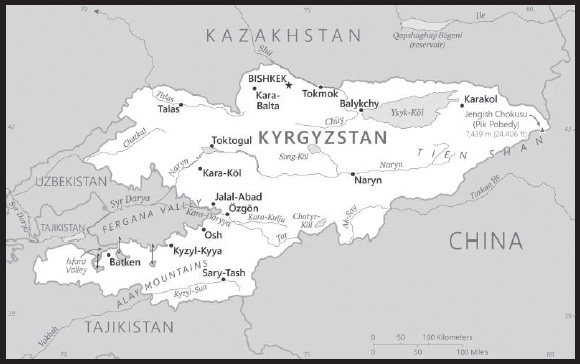
INTRODUCTION
Background: A Central Asian country of incredible natural beauty and proud nomadic traditions, most of the territory of present-day Kyrgyzstan was formally annexed by the Russian Empire in 1876. The Kyrgyz staged a major revolt against the Tsarist Empire in 1916 in which almost one-sixth of the Kyrgyz population was killed. Kyrgyzstan became a Soviet republic in 1926 and achieved independence in 1991 when the USSR dissolved. Nationwide demonstrations in 2005 and 2010 resulted in the ouster of the country’s first two presidents, Askar AKAEV and Kurmanbek BAKIEV. Interim President Roza OTUNBAEVA led a transitional government and following a nation-wide election, President Almazbek ATAMBAEV was sworn in as president in 2011. In 2017, ATAMBAEV became the first Kyrgyzstani president to step down after serving one full six-year term as required at the time in the country’s constitution. Former prime minister and ruling Social-Democratic Party of Kyrgyzstan member, Sooronbay JEENBEKOV, replaced him after winning the 2017 presidential election, which was the most competitive in the country’s history, although international and local election observers noted cases of vote buying and abuse of public resources. In October 2020, protests against legislative election results spread across Kyrgyzstan, leading to JEENBEKOV’s resignation from the presidency, and catapulting previously imprisoned Sadyr JAPAROV to acting president. In January 2021, Kyrgyzstanis formerly elected JAPAROV as president and approved a referendum to move Kyrgyzstan from a parliamentary to a presidential system. In April 2021, Kyrgyzstanis voted in favor of draft constitutional changes that consolidated power in the presidency. Pro-government parties won a majority in the Jogorku Kenesh (Kyrgyzstan’s legislature) in November 2021 elections. Continuing concerns for Kyrgyzstan include the trajectory of democratization, endemic corruption, a history of tense, and at times violent, interethnic relations, border security vulnerabilities, and potential terrorist threats.
GEOGRAPHY
Location: Central Asia, west of China, south of Kazakhstan
Geographic coordinates: 41 00 N, 75 00 E
Map references: Asia
Area: total: 199,951 sq km
land: 191,801 sq km
water: 8,150 sq km
comparison ranking: total 87
Area - comparative: slightly smaller than South Dakota
Land boundaries: total: 4,573 km
border countries (4): China 1,063 km; Kazakhstan 1,212 km; Tajikistan 984 km; Uzbekistan 1,314 km
Coastline: 0 km (landlocked)
Maritime claims: none (landlocked)
Climate: dry continental to polar in high Tien Shan Mountains; subtropical in southwest (Fergana Valley); temperate in northern foothill zone
Terrain: peaks of the Tien Shan mountain range and associated valleys and basins encompass the entire country
Elevation: highest point: Jengish Chokusu (Pik Pobedy) 7,439 m
lowest point: Kara-Daryya (Karadar’ya) 132 m
mean elevation: 2,988 m
Natural resources: abundant hydropower; gold, rare earth metals; locally exploitable coal, oil, and natural gas; other deposits of nepheline, mercury, bismuth, lead, and zinc
Land use: agricultural land: 55.4% (2018 est.)
arable land: 6.7% (2018 est.)
permanent crops: 0.4% (2018 est.)
permanent pasture: 48.3% (2018 est.)
forest: 5.1% (2018 est.)
other: 39.5% (2018 est.)
Irrigated land: 10,043 sq km (2020)
Major lakes (area sq km): salt water lake(s): Ozero Issyk-Kul 6,240 sq km
note - second largest saline lake after the Caspian Sea; second highest mountain lake after Lake Titicaca; it is an endorheic mountain basin; although surrounded by snow capped mountains it never freezes
Major rivers (by length in km): Syr Darya river source (shared with Tajikistan, Uzbekistan, and Kazakhstan [m]) - 3,078 km note – [s] after country name indicates river source; [m] after country name indicates river mouth
Major watersheds (area sq km): Internal (endorheic basin) drainage: Tarim Basin (1,152,448 sq km), (Aral Sea basin) Amu Darya (534,739 sq km), Syr Darya (782,617 sq km)
Population distribution: the vast majority of Kyrgyzstanis live in rural areas; densest population settlement is to the north in and around the capital, Bishkek, followed by Osh in the west; the least densely populated area is the east, southeast in the Tien Shan mountains
Natural hazards: major flooding during snow melt; prone to earthquakes
Geography - note: landlocked; entirely mountainous, dominated by the Tien Shan range; 94% of the country is 1,000 m above sea level with an average elevation of 2,750 m; many tall peaks, glaciers, and high-altitude lakes
PEOPLE AND SOCIETY
Population: 6,122,781 (2023 est.)
comparison ranking: 112
Nationality: noun: Kyrgyzstani(s)
adjective: Kyrgyzstani
Ethnic groups: Kyrgyz 73.8%, Uzbek 14.8%, Russian 5.1%, Dungan 1.1%, other 5.2% (includes Uyghur, Tajik, Turk, Kazakh, Tatar, Ukrainian, Korean, German) (2021 est.)
Languages: Kyrgyz (official) 71.4%, Uzbek 14.4%, Russian (official) 9%, other 5.2% (2009 est.)
major-language sample(s):

(Kyrgyz)
Religions: Muslim 90% (majority Sunni), Christian 7% (Russian Orthodox 3%), other 3% (includes Jewish, Buddhist, Baha’i) (2017 est.)
Demographic profile: Kyrgyzstan is a sparsely populated country whose population is unevenly distributed. More than 50% of the population lives in or around the two cities of Bishkek and Osh and their surrounding districts, which together account for about 12% of the country’s area. Kyrgyzstan’s population continues to grow rapidly owing to its high fertility rate and the traditional preference for larger families, a low mortality rate, a growing share of women of reproductive age, and measures to support families with children. The country has a youthful age structure; over 45% of the population is under the age of 25 as of 2022. Nevertheless, Kyrgyzstan is transitioning from an agricultural society with high fertility and mortality rates to an industrial society with lower fertility and mortality rates.
As part of the USSR, Kyrgyzstan’s rapid population growth was not problematic because its needs were redistributed among the Soviet States. As an independent state, however, population growth became burdensome. International labor migration continues to serve as a safety valve that decreases pressure on the labor market and resources (healthcare, education, and pensions), while also reducing poverty through much-needed remittances. The main destinations for labor migrants are Russia and Kazakhstan, where wages are higher; almost a third of Kyrgyzstan’s working-age population migrates to Russia alone. Outmigration was most pronounced in the 1990s, after the collapse of the USSR, when ethnic Russians, Ukrainians, and Germans left Kyrgyzstan, changing the proportion of ethnic Kyrgyz in the country from barely 50% in 1992 to almost three-quarters today.
While Kyrgyzstan is a net emigration country, it does receive immigrants. The majority of immigrants are from the Commonwealth of Independent States – particularly Kazakhstan, Russia, and Uzbekistan – but more recent arrivals also include persons from China, Turkey, and Turkmenistan. Chinese immigrants work primarily in construction and gold mining, while Turkish immigrants mainly work in construction, trade, education, and services. Border areas between Kyrgyzstan, Tajikistan, and Uzbekistan experience irregular migration, but many of these migrants plan to move on to Europe.
Age structure: 0-14 years: 29.54% (male 928,876/female 879,729)
15-64 years: 63.86% (male 1,914,277/female 1,995,500)
65 years and over: 6.6% (2023 est.) (male 154,684/female 249,715)
Dependency ratios: total dependency ratio: 63.5
youth dependency ratio: 56.4
elderly dependency ratio: 7.2
potential support ratio: 13.9 (2021 est.)
Median age: total: 27.3 years (2020)
male: 26.1 years
female: 28.5 years
comparison ranking: total 148
Population growth rate: 0.82% (2023 est.)
comparison ranking: 110
Birth rate: 19.08 births/1,000 population (2023 est.)
comparison ranking: 72
Death rate: 6.07 deaths/1,000 population (2023 est.)
comparison ranking: 151
Net migration rate: -4.83 migrant(s)/1,000 population (2023 est.)
comparison ranking: 201
Population distribution: the vast majority of Kyrgyzstanis live in rural areas; densest population settlement is to the north in and around the capital, Bishkek, followed by Osh in the west; the least densely populated area is the east, southeast in the Tien Shan mountains
Urbanization: urban population: 37.8% of total population (2023)
rate of urbanization: 2.05% annual rate of change (2020-25 est.)
Major urban areas - population: 1.105 million BISHKEK (capital) (2023)
Sex ratio: at birth: 1.07 male(s)/female
0-14 years: 1.06 male(s)/female
15-64 years: 0.96 male(s)/female
65 years and over: 0.62 male(s)/female
total population: 0.96 male(s)/female (2023 est.)
Mother’s mean age at first birth: 22.6 years (2019 est.)
Maternal mortality ratio: 50 deaths/100,000 live births (2020 est.)
comparison ranking: 97
Infant mortality rate: total: 25.08 deaths/1,000 live births (2023 est.)
male: 29.19 deaths/1,000 live births
female: 20.7 deaths/1,000 live births
comparison ranking: total 63
Life expectancy at birth: total population: 72.63 years (2023 est.)
male: 68.57 years
female: 76.96 years
comparison ranking: total population 159
Total fertility rate: 2.47 children born/woman (2023 est.)
comparison ranking: 69
Gross reproduction rate: 1.2 (2023 est.)
Contraceptive prevalence rate: 39.4% (2018)
Drinking water source: improved: urban: 100% of population
rural: 89.9% of population
total: 93.6% of population
unimproved: urban: 0% of population
rural: 10.1% of population
total: 6.4% of population (2020 est.)
Current health expenditure: 5.3% of GDP (2020)
Physicians density: 2.21 physicians/1,000 population (2014)
Hospital bed density: 4.4 beds/1,000 population (2014)
Sanitation facility access: improved: urban: 100% of population
rural: 100% of population
total: 100% of population
unimproved: urban: 0% of population
rural: 0% of population
total: 0% of population (2020 est.)
Obesity - adult prevalence rate: 16.6% (2016)
comparison ranking: 122
Alcohol consumption per capita: total: 4.02 liters of pure alcohol (2019 est.)
beer: 0.43 liters of pure alcohol (2019 est.)
wine: 0.23 liters of pure alcohol (2019 est.)
spirits: 3.35 liters of pure alcohol (2019 est.)
other alcohols: 0 liters of pure alcohol (2019 est.)
comparison ranking: total 96
Tobacco use: total: 25.4% (2020 est.)
male: 48% (2020 est.)
female: 2.8% (2020 est.)
comparison ranking: total 48
Children under the age of 5 years underweight: 1.8% (2018)
comparison ranking: 110
Currently married women (ages 15-49): 66.2% (2023 est.)
Child marriage: women married by age 15: 0.3%
women married by age 18: 12.9% (2018 est.)
Education expenditures: 6.2% of GDP (2020 est.)
comparison ranking: 37
Literacy: definition: age 15 and over can read and write
total population: 99.6%
male: 99.7%
female: 99.5% (2018)
School life expectancy (primary to tertiary education): total: 14 years
male: 13 years
female: 14 years (2021)
Youth unemployment rate (ages 15-24): total: 19.3% (2021 est.)
male: 15.6%
female: 27.3%
comparison ranking: total 87
ENVIRONMENT
Environment - current issues: water pollution; many people get their water directly from contaminated streams and wells; as a result, water-borne diseases are prevalent; increasing soil salinity from faulty irrigation practices; air pollution due to rapid increase of traffic
Environment - international agreements: party to: Air Pollution, Biodiversity, Climate Change, Climate Change-Kyoto Protocol, Climate Change-Paris Agreement, Comprehensive Nuclear Test Ban, Desertification, Endangered Species, Environmental Modification, Hazardous Wastes, Ozone Layer Protection, Wetlands
signed, but not ratified: none of the selected agreements
Climate: dry continental to polar in high Tien Shan Mountains; subtropical in southwest (Fergana Valley); temperate in northern foothill zone
arable land: 6.7% (2018 est.)
permanent crops: 0.4% (2018 est.)
permanent pasture: 48.3% (2018 est.)
forest: 5.1% (2018 est.)
other: 39.5% (2018 est.)
Urbanization: urban population: 37.8% of total population (2023)
rate of urbanization: 2.05% annual rate of change (2020-25 est.)
Revenue from forest resources: 0.01% of GDP (2018 est.)
comparison ranking: 146
Revenue from coal: 0.21% of GDP (2018 est.)
comparison ranking: 21
Air pollutants: particulate matter emissions: 37.58 micrograms per cubic meter (2019 est.)
carbon dioxide emissions: 9.79 megatons (2016 est.)
methane emissions: 4.47 megatons (2020 est.)
Waste and recycling: municipal solid waste generated annually: 1,113,300 tons (2015 est.)
Major lakes (area sq km): salt water lake(s): Ozero Issyk-Kul 6,240 sq km
note - second largest saline lake after the Caspian Sea; second highest mountain lake after Lake Titicaca; it is an endorheic mountain basin; although surrounded by snow capped mountains it never freezes
Major rivers (by length in km): Syr Darya river source (shared with Tajikistan, Uzbekistan, and Kazakhstan [m]) - 3,078 km
note –[s] after country name indicates river source; [m] after country name indicates river mouth
Major watersheds (area sq km): Internal (endorheic basin) drainage: Tarim Basin (1,152,448 sq km), (Aral Sea basin) Amu Darya (534,739 sq km), Syr Darya (782,617 sq km)
Total water withdrawal: municipal: 220 million cubic meters (2020 est.)
industrial: 340 million cubic meters (2020 est.)
agricultural: 7.1 billion cubic meters (2020 est.)
Total renewable water resources: 23.62 billion cubic meters (2020 est.)
GOVERNMENT
Country name: conventional long form: Kyrgyz Republic
conventional short form: Kyrgyzstan
local long form: Kyrgyz Respublikasy
local short form: Kyrgyzstan
former: Kirghiz Soviet Socialist Republic
etymology: a combination of the Turkic words “kyrg” (forty) and “-yz” (tribes) with the Persian suffix “-stan” (country) creating the meaning “Land of the Forty Tribes”; the name refers to the 40 clans united by the mythic Kyrgyz hero, MANAS
Government type: parliamentary republic
Capital: name: Bishkek
geographic coordinates: 42 52 N, 74 36 E
time difference: UTC+6 (11 hours ahead of Washington, DC, during Standard Time)
etymology: founded in 1868 as a Russian settlement on the site of a previously destroyed fortress named “Pishpek”; the name was retained and overtime became “Bishkek”
Administrative divisions: 7 provinces (oblustar, singular - oblus) and 2 cities* (shaarlar, singular - shaar); Batken Oblusu, Bishkek Shaary*, Chuy Oblusu (Bishkek), Jalal-Abad Oblusu, Naryn Oblusu, Osh Oblusu, Osh Shaary*, Talas Oblusu, Ysyk-Kol Oblusu (Karakol)
note: administrative divisions have the same names as their administrative centers (exceptions have the administrative center name following in parentheses)
Independence: 31 August 1991 (from the Soviet Union)
National holiday: Independence Day, 31 August (1991)
Constitution: history: previous 1993, 2007, 2010; latest approved by referendum in April 2021 that transitioned Kyrgyzstan from a parliamentary to a presidential system, and implemented changes that allow the president to serve for two 5-year terms rather than one 6-year term, reduced the number of seats in Kyrgyzstan’s legislature from 120 to 90, and established a Kurultay - a public advisory council
amendments: proposed as a draft law by the majority of the Supreme Council membership or by petition of 300,000 voters; passage requires at least two-thirds majority vote of the Council membership in each of at least three readings of the draft two months apart; the draft may be submitted to a referendum if approved by two thirds of the Council membership; adoption requires the signature of the president
Legal system: civil law system, which includes features of French civil law and Russian Federation laws
International law organization participation: has not submitted an ICJ jurisdiction declaration; non-party state to the ICCt
Citizenship: citizenship by birth: no
citizenship by descent only: at least one parent must be a citizen of Kyrgyzstan
dual citizenship recognized: yes, but only if a mutual treaty on dual citizenship is in force
residency requirement for naturalization: 5 years
Suffrage: 18 years of age; universal
Executive branch: chief of state: President Sadyr JAPAROV (since 28 January 2021); note - the president is both chief of state and head of government
head of government: President Sadyr JAPAROV (since 28 January 2021)
cabinet: Cabinet of Ministers appointed by the president
elections/appointments: president directly elected by absolute majority popular vote in 2 rounds if needed for a five-year term (eligible for a second term); election last held on 10 January 2021 (next to be held in 2027)
election results:
2021: Sadyr JAPAROV elected president in first round; percent of vote - Sadyr JAPAROV (Mekenchil) 79.2%, Adakhan MADUMAROV (United Kyrgyzstan) 6.8%, other 14%
2017: Sooronbay JEENBEKOV elected president; Sooronbay JEENBEKOV (Social Democratic Party of Kyrgyzstan) 54.7%, Omurbek BABANOV (independent) 33.8%, Adakhan MADUMAROV (United Kyrgyzstan) 6.6%, other 4.9%
note: the President is both Chief of State and Head of Government.
Legislative branch: description: unicameral Supreme Council or Jogorku Kenesh (90 seats statutory, current 88; 54 seats allocated for proportional division among political party lists from the national vote and 36 seats allocated for candidates running in single-seat constituencies; members serve 5-year terms; parties must receive 5% of the vote to win seats in the Council)
elections: last held on 28 November 2021 (next to be held in 2026)
election results: percent of vote by party - Ata-Jurt Kyrgyzstan or AJK 17.3%, Ishenim 15%, Yntymak 12.1%, Alyns 9.2%, Butun Kyrgyzstan 7.8%, Yiman Nuru 6.8%, other 30%; seats by party - AJK 15, Ishenim 12, Yntymak 9, Alyns 7, Butun Kyrgyzstan 6, Yiman Nuru 5, other 36; composition - men 70, women 18, percent of women 20%
Judicial branch: highest court(s): Supreme Court (consists of 25 judges); Constitutional Chamber of the Supreme Court (consists of the chairperson, deputy chairperson, and 9 judges)
judge selection and term of office: Supreme Court and Constitutional Court judges appointed by the Supreme Council on the recommendation of the president; Supreme Court judges serve for 10 years, Constitutional Court judges serve for 15 years; mandatory retirement at age 70 for judges of both courts
subordinate courts: Higher Court of Arbitration; oblast (provincial) and city courts
Political parties and leaders: Alyans (Alliance) [Mirlan JEENCHOROEV]
Ata-Jurt Kyrgyzstan (Homeland) or AJK [Aybek MATKERIMOV]
Butun Kyrgyzstan (United) [Adakhan MADUMAROV]
Ishenim (Trust) [Rysbat AMATOV and Azamat DOROYEV]
Social Democrats or SDK [Temirlan SULTANBEKOV]
Yntymak (Unity) [Marlen MAMATALIEV]
Yiman Nuru (Light of Faith) [Nurjigit KADYRBEKOV]
International organization participation: ADB, CICA, CIS, CSTO, EAEU, EAPC, EBRD, ECO, EITI (compliant country), FAO, GCTU, IAEA, IBRD, ICAO, ICC (NGOs), ICRM, IDA, IDB, IFAD, IFC, IFRCS, ILO, IMF, Interpol, IOC, IOM, IPU, ISO (correspondent), ITSO, ITU, MIGA, NAM (observer), OIC, OPCW, OSCE, PCA, PFP, SCO, UN, UNAMID, UNCTAD, UNESCO, UNIDO, UNISFA, UNMIL, UNMISS, UNWTO, UPU, WCO, WFTU (NGOs), WHO, WIPO, WMO, WTO
Diplomatic representation in the US: chief of mission: Ambassador Baktybek AMANBAEV (since 7 July 2021)
chancery: 2360 Massachusetts Avenue NW, Washington, DC 20008
telephone: [1] (202) 449-9822
FAX: [1] (202) 449-8275
email address and website:
Embassy of the Kyrgyz Republic in the USA and Canada (mfa.gov.kg)
Diplomatic representation from the US: chief of mission: Ambassador Lesslie VIGUERIE (since 29 December 2022)
embassy: 171 Prospect Mira, Bishkek 720016
mailing address: 7040 Bishkek Place, Washington DC 20521-7040
telephone: [996] (312) 597-000
FAX: [996] (312) 597-744
email address and website:
Flag description: red field with a yellow sun in the center having 40 rays representing the 40 Kyrgyz tribes; on the obverse side the rays run counterclockwise, on the reverse, clockwise; in the center of the sun is a red ring crossed by two sets of three lines, a stylized representation of a “tunduk” - the crown of a traditional Kyrgyz yurt; red symbolizes bravery and valor, the sun evinces peace and wealth
National symbol(s): white falcon; national colors: red, yellow
National anthem: name: “Kyrgyz Respublikasynyn Mamlekettik Gimni” (National Anthem of the Kyrgyz Republic)
lyrics/music: Djamil SADYKOV and Eshmambet KULUEV/Nasyr DAVLESOV and Kalyi MOLDOBASANOV
note: adopted 1992
National heritage: total World Heritage Sites: 3 (2 cultural, 1 natural)
selected World Heritage Site locales: Sulaiman-Too Sacred Mountain (c); Silk Roads: the Chang’an-Tianshan Corridor (c); Western Tien Shan (n)
ECONOMY
Economic overview: landlocked, lower-middle-income Central Asian economy; natural resource rich; growing hydroelectricity and tourism; high remittances; corruption limits investment; COVID-19 and political turmoil hurt GDP, limited public revenues, and increased spending
Real GDP (purchasing power parity): $32.221 billion (2021 est.)
$31.098 billion (2020 est.)
$33.949 billion (2019 est.)
note: data are in 2017 dollars
comparison ranking: 137
Real GDP growth rate: 3.61% (2021 est.)
-8.4% (2020 est.)
4.6% (2019 est.)
comparison ranking: 132
Real GDP per capita: $4,800 (2021 est.)
$4,700 (2020 est.)
$5,300 (2019 est.)
note: data are in 2017 dollars
comparison ranking: 180
GDP (official exchange rate): $8.442 billion (2019 est.)
Inflation rate (consumer prices): 11.91% (2021 est.)
6.33% (2020 est.)
1.13% (2019 est.)
comparison ranking: 20
Credit ratings: Moody’s rating: B2 (2015)
Standard & Poors rating: NR (2016)
note: The year refers to the year in which the current credit rating was first obtained.
GDP - composition, by sector of origin: agriculture: 14.6% (2017 est.)
industry: 31.2% (2017 est.)
services: 54.2% (2017 est.)
comparison rankings: services 161; industry 70; agriculture 66
GDP - composition, by end use: household consumption: 85.4% (2017 est.)
government consumption: 18.9% (2017 est.)
investment in fixed capital: 33.2% (2017 est.)
investment in inventories: 1.8% (2017 est.)
exports of goods and services: 39.7% (2017 est.)
imports of goods and services: -79% (2017 est.)
Agricultural products: milk, potatoes, sugar beets, maize, wheat, barley, tomatoes, watermelons, onions, carrots/turnips
Industries: small machinery, textiles, food processing, cement, shoes, lumber, refrigerators, furniture, electric motors, gold, rare earth metals
Industrial production growth rate: 3.1% (2021 est.)
comparison ranking: 123
Labor force: 2.478 million (2021 est.)
comparison ranking: 117
Labor force - by occupation: agriculture: 48%
industry: 12.5%
services: 39.5% (2005 est.)
Unemployment rate: 9.1% (2021 est.)
8.71% (2020 est.)
6.92% (2019 est.)
comparison ranking: 80
Youth unemployment rate (ages 15-24): total: 19.3% (2021 est.)
male: 15.6%
female: 27.3%
comparison ranking: total 87
Population below poverty line: 20.1% (2019 est.)
Gini Index coefficient - distribution of family income: 29 (2020 est.)
comparison ranking: 158
Household income or consumption by percentage share: lowest 10%: 4.4%
highest 10%: 22.9% (2014 est.)
Budget: revenues: $2.878 billion (2019 est.)
expenditures: $2.89 billion (2019 est.)
Budget surplus (+) or deficit (-): -3.2% (of GDP) (2017 est.)
comparison ranking: 138
Public debt: 72.23% of GDP (2020 est.)
54.23% of GDP (2019 est.)
51.66% of GDP (2018 est.)
comparison ranking: 54
Taxes and other revenues: 14.92% (of GDP) (2020 est.)
comparison ranking: 144
Fiscal year: calendar year
Current account balance: -$743.363 million (2021 est.)
$374.257 million (2020 est.)
-$1.067 billion (2019 est.)
comparison ranking: 131
Exports: $3.35 billion (2021 est.) note: data are in current year dollars
$2.435 billion (2020 est.) note: data are in current year dollars
$3.108 billion (2019 est.)
comparison ranking: 141
Exports - partners: United Kingdom 56%, Kazakhstan 13%, Russia 13%, Uzbekistan 5% (2019)
Exports - commodities: gold, float glass, precious metals, kidney beans, refined petroleum, scrap copper, dried fruits (2021)
Imports: $5.919 billion (2021 est.) note: data are in current year dollars
$4.051 billion (2020 est.) note: data are in current year dollars
$5.67 billion (2019 est.)
comparison ranking: 138
Imports - partners: China 53%, Russia 17%, Kazakhstan 7%, Uzbekistan 7%, Turkey 5% (2019)
Imports - commodities: refined petroleum, footwear, clothing and apparel, broadcasting equipment, walnuts (2019)
Reserves of foreign exchange and gold: $2.983 billion (31 December 2021 est.)
$2.812 billion (31 December 2020 est.)
$2.429 billion (31 December 2019 est.)
comparison ranking: 119
Debt - external: $8.372 billion (2019 est.)
$8.066 billion (2018 est.)
comparison ranking: 119
Exchange rates: soms (KGS) per US dollar -
Exchange rates: 84.641 (2021 est.)
77.346 (2020 est.)
69.789 (2019 est.)
68.84 (2018 est.)
68.867 (2017 est.)
ENERGY
Electricity access: electrification - total population: 99.6% (2021)
electrification - urban areas: 99.8% (2021)
electrification - rural areas: 99.5% (2021)
Electricity: installed generating capacity: 4.626 million kW (2020 est.)
consumption: 12,324,140,000 kWh (2019 est.)
exports: 271 million kWh (2019 est.)
imports: 269 million kWh (2019 est.)
transmission/distribution losses: 2.514 billion kWh (2019 est.)
comparison rankings: installed generating capacity 91; transmission/distribution losses 76; imports 98; exports 82; consumption 91
Electricity generation sources: fossil fuels: 8.5% of total installed capacity (2020 est.)
nuclear: 0% of total installed capacity (2020 est.)
solar: 0% of total installed capacity (2020 est.)
wind: 0% of total installed capacity (2020 est.)
hydroelectricity: 91.5% of total installed capacity (2020 est.)
tide and wave: 0% of total installed capacity (2020 est.)
geothermal: 0% of total installed capacity (2020 est.)
biomass and waste: 0% of total installed capacity (2020 est.)
Coal: production: 2.287 million metric tons (2020 est.)
consumption: 1.717 million metric tons (2020 est.)
exports: 984,000 metric tons (2020 est.)
imports: 481,000 metric tons (2020 est.)
proven reserves: 971 million metric tons (2019 est.)
Petroleum: total petroleum production: 700 bbl/day (2021 est.)
refined petroleum consumption: 32,100 bbl/day (2019 est.)
crude oil and lease condensate exports: 1,400 bbl/day (2018 est.)
crude oil and lease condensate imports: 8,200 bbl/day (2018 est.)
crude oil estimated reserves: 40 million barrels (2021 est.)
Refined petroleum products - production: 6,996 bbl/day (2015 est.)
comparison ranking: 102
Refined petroleum products - exports: 2,290 bbl/day (2015 est.)
comparison ranking: 103
Refined petroleum products - imports: 34,280 bbl/day (2015 est.)
comparison ranking: 96
Natural gas: production: 25.542 million cubic meters (2019 est.)
consumption: 207.845 million cubic meters (2019 est.)
exports: 0 cubic meters (2021 est.)
imports: 191.478 million cubic meters (2019 est.)
proven reserves: 5.663 billion cubic meters (2021 est.)
Carbon dioxide emissions: 7.88 million metric tonnes of CO2 (2019 est.)
from coal and metallurgical coke: 2.967 million metric tonnes of CO2 (2019 est.)
from petroleum and other liquids: 4.505 million metric tonnes of CO2 (2019 est.)
from consumed natural gas: 408,000 metric tonnes of CO2 (2019 est.)
comparison ranking: total emissions 118
Energy consumption per capita: 35.059 million Btu/person (2019 est.)
comparison ranking: 115
COMMUNICATIONS
Telephones - fixed lines: total subscriptions: 300,000 (2021 est.)
subscriptions per 100 inhabitants: 5 (2021 est.)
comparison ranking: total subscriptions 110
Telephones - mobile cellular: total subscriptions: 8.5 million (2021 est.)
subscriptions per 100 inhabitants: 130 (2021 est.)
comparison ranking: total subscriptions 98
Telecommunication systems: general assessment: the country’s telecom sector (specifically the mobile segment) has been able to prosper; Kyrgyzstan has opened up its telecom market to competition; the mobile market has achieved high levels of penetration (140% in 2021) along with a fairly competitive operating environment with four major players; mobile broadband has come along strongly, reaching over 125% penetration in 2019 before falling back slightly during the Covid-19 crisis; slow-to-moderate growth is expected for both segments in coming years, supported by the anticipated rollout of 5G services which began testing in 2022 with a pilot service to follow some time in 2023 (2022)
domestic: fixed-line subscriptions 5 per 100; mobile-cellular subscribership up to over 130 per 100 persons (2021)
international: country code - 996; connections with other CIS (Commonwealth of Independent States, 9 members post-Soviet Republics in EU) countries by landline or microwave radio relay and with other countries by leased connections with Moscow international gateway switch and by satellite; satellite earth stations - 2 (1 Intersputnik, 1 Intelsat) (2019)
Broadcast media: state-funded public TV broadcaster KTRK has nationwide coverage; also operates Ala-Too 24 news channel which broadcasts 24/7 and 4 other educational, cultural, and sports channels; ELTR and Channel 5 are state-owned stations with national reach; the switchover to digital TV in 2017 resulted in private TV station growth; approximately 20 stations are struggling to increase their own content up to 50% of airtime, as required by law, instead of rebroadcasting primarily programs from Russian channels or airing unlicensed movies and music; 3 Russian TV stations also broadcast; state-funded radio stations and about 10 significant private radio stations also exist (2019)
Internet country code: .kg
Internet users: total: 5.07 million (2021 est.)
percent of population: 78% (2021 est.)
comparison ranking: total 92
Broadband - fixed subscriptions: total: 289,000 (2020 est.)
subscriptions per 100 inhabitants: 4 (2020 est.)
comparison ranking: total 109
TRANSPORTATION
National air transport system: number of registered air carriers: 5 (2020)
inventory of registered aircraft operated by air carriers: 17
annual passenger traffic on registered air carriers: 709,198 (2018)
Civil aircraft registration country code prefix: EX
Airports: 28 (2021)
comparison ranking: total 120
Airports - with paved runways: 18
note: paved runways have a concrete or asphalt surface but not all have facilities for refueling, maintenance, or air traffic control; the length of a runway required for aircraft to safely operate depends on a number of factors including the type of aircraft, the takeoff weight (including passengers, cargo, and fuel), engine types, flap settings, landing speed, elevation of the airport, and average maximum daily air temperature; paved runways can reach a length of 5,000 m (16,000 ft.), but the “typical” length of a commercial airline runway is between 2,500-4,000 m (8,000-13,000 ft.)
Airports - with unpaved runways: 10
note: unpaved runways have a surface composition such as grass or packed earth and are most suited to the operation of light aircraft; unpaved runways are usually short, often less than 1,000 m (3,280 ft.) in length; airports with unpaved runways often lack facilities for refueling, maintenance, or air traffic control
Pipelines: 4,195 km gas (2022), 16 km oil (2022) (2022)
Railways: total: 424 km (2022)
broad gauge: 424 km (2018) 1.520-m gauge
comparison ranking: total 118
Roadways: total: 34,000 km (2022)
comparison ranking: total 93
Waterways: 576 km (2022)
comparison ranking: 89
Ports and terminals: lake port(s): Balykchy (Ysyk-Kol or Rybach’ye)(Lake Ysyk-Kol)
MILITARY AND SECURITY
Military and security forces: Armed Forces of the Kyrgyz Republic: Land Forces, Air Defense Forces, National Guard; Internal Troops; State Committee for National Security (GKNB): State Border Service (2023)
Military expenditures: 1.5% of GDP (2022 est.)
1.7% of GDP (2021 est.)
1.8% of GDP (2020 est.)
2.3% of GDP (2019 est.)
2.3% of GDP (2018 est.)
comparison ranking: 91
Military and security service personnel strengths: approximately 15,000 active-duty troops (9,000 Land Forces; 3,000 Air Force/Air Defense; 3,000 National Guard) (2023)
Military equipment inventories and acquisitions: the Kyrgyz military inventory is comprised of mostly older Russian and Soviet-era equipment; Russia is the leading supplier of armaments (2023)
Military service age and obligation: 18-27 years of age for compulsory or voluntary service for men in the Armed Forces or Interior Ministry; 12-month service obligation (9 months for university graduates), with optional fee-based 3-year service in the call-up mobilization reserve; women may volunteer at age 19; 16-17 years of age for military cadets, who cannot take part in military operations (2023)
Military - note: Kyrgyzstan has been a member of the Collective Security Treaty Organization (CSTO) since 1994 and contributes troops to cSTO’s rapid reaction force; it also started a relationship with NATO in 1992 and joined NATO’s Partnership for Peace program in 1994
the Kyrgyz military’s primary responsibility is defense of the country’s sovereignty and territory, although it also has some internal security duties; elements of the military were called out in 2020 to respond to post-election demonstrations for example, and the National Guard’s missions include counterterrorism, responding to emergencies, and the protection of government facilities; the military also participates in UN and CSTO peacekeeping missions; border disputes with Tajikistan and Uzbekistan, as well as the threat posed by militant Islamic groups, have been particular areas of concern for both the military and internal security forces; the military’s closest security partner is Russia, which provides training and material assistance, and maintains a presence in the country, including an airbase; the military also conducts training with other regional countries such as India, traditionally with a focus on counterterrorism
the Kyrgyz military was formed in 1992 from Soviet Army units then based in Kyrgyzstan following the dissolution of the USSR; while the current organization continues to be based on those former Soviet formations, specific information is limited and varied; the Army’s principal combat units are reportedly a few small Soviet-style “motor rifle” (mechanized) infantry brigades, plus brigades of mountain infantry, special forces, and artillery; the National Guard has some rapid reaction and special forces units; the Air Defense Forces reportedly have only a few operational combat helicopters (2023)
TERRORISM
Terrorist group(s): Terrorist group(s): US-designated foreign terrorist groups such as the Islamic Jihad Union, the Islamic Movement of Uzbekistan, and the Islamic State of Iraq and ash-Sham-Khorasan Province have operated in the area where the Uzbek, Kyrgyz, and Tajik borders converge and ill-defined and porous borders allow for the relatively free movement of people and illicit goods
TRANSNATIONAL ISSUES
Disputes - international: Kyrgyzstan-China: a 2009 treaty settled a border dispute, with Kyrgyzstan receiving the Khan Tengri Peak and Kyrgyzstan ceding to China the Uzengi-Kush area
Kyrgyzstan-Kazakhstan: in January 2019, Kyrgyzstan ratified the 2017 agreement on the demarcation of the Kyrgyzstan-Kazakhstan border
Kyrgyzstan-Tajikistan: as the last major Central Asian boundary dispute with lengthy undelimited sections, the lowland (NE part) of the Kyrgz-Tajik line seems intractable despite recent Kyrgyz-Uzbek compromises and agreements on delimitation and demarcation
Kyrgyzstan-Uzbekistan: delimitation of approximately 15% or 200 km of border with Uzbekistan is hampered by serious disputes over enclaves and other areas; Kyrgyz and Uzbek officials signed an agreement in March 2021 on the final delimitation and demarcation of the Kyrgyzstan-Uzbekistan border; the accord included several land swaps that gave Kyrgyzstan more territory but was offset by Uzbekistan retaining use of reservoirs on Kyrgyz land; although a Kyrgyz official returned from the March 2021 meetings and said the decades-old border dispute was 100% resolved, his talks with residents in some affected areas showed that agreement had not been reached on all border segments
Refugees and internally displaced persons: stateless persons: 482 (2022)
Illicit drugs: a prime transit route and transshipment route for illegal drugs transiting north from Afghanistan to Russia and Europe; illicit drugs are primarily smuggled into the country from Tajikistan