INTRODUCTION
Background: Berbers have inhabited central north Africa since ancient times, but the region has been settled and ruled by Phoenicians, Greeks, Carthaginians, Persians, Egyptians, Romans, and Vandals. In the 7th century, Islam spread through the region; in the mid-16th century, Ottoman rule began. The Italians supplanted the Ottoman Turks in the area around Tripoli in 1911 and did not relinquish their hold until 1943 when they were defeated in World War II. Libya then passed to UN administration and achieved independence in 1951. Following a 1969 military coup, Col. Muammar al-QADHAFI assumed leadership and began to espouse his political system at home, which was a combination of socialism and Islam. During the 1970s, QADHAFI used oil revenues to promote his ideology outside Libya, supporting subversive and terrorist activities that included the downing of two airliners - one over Scotland, another in Northern Africa - and a discotheque bombing in Berlin. UN sanctions in 1992 isolated QADHAFI politically and economically following the attacks; sanctions were lifted in 2003 following Libyan acceptance of responsibility for the bombings and agreement to claimant compensation. QADHAFI also agreed to end Libya’s program to develop weapons of mass destruction, and he made significant strides in normalizing relations with Western nations.
Unrest that began in several Middle Eastern and North African countries in late 2010 erupted in Libyan cities in early 2011. QADHAFI’s brutal crackdown on protesters spawned an eight-month civil war that saw the emergence of a National Transitional Council (NTC), UN authorization of air and naval intervention by the international community, and the toppling of the QADHAFI regime. In 2012, the NTC handed power to an elected parliament, the General National Congress (GNC). Voters chose a new parliament to replace the GNC in June 2014 - the House of Representatives (HoR) - which relocated to the eastern city of Tobruk after fighting broke out in Tripoli and Benghazi in July 2014.
In December 2015, the UN brokered an agreement among a broad array of Libyan political parties and social groups - known as the Libyan Political Agreement (LPA) - establishing an interim executive body, the Government of National Accord (GNA). However, the HoR and defunct-GNC-affiliated political hardliners continued to oppose the GNA and hamper the LPA’s implementation, leaving Libya with eastern and western-based rival governments. In September 2017, UN Special Representative Ghassan SALAME announced a new roadmap for national political reconciliation. In November 2018, the international community supported SALAME’s recalibrated Action Plan for Libya that aimed to break the political deadlock by holding a National Conference in early 2019. These plans, however, were derailed when the eastern-based self-described Libyan National Army (LNA) launched an offensive to seize Tripoli in April 2019. Several countries sent armed personnel and advanced military equipment into Libya. The LNA’s offensive collapsed in June 2020, and a subsequent UN-sponsored cease-fire in October 2020 helped formalize the pause in fighting between rival camps, although some foreign forces, fighters, and mercenaries that aided eastern and western factions during the fighting remain in Libya.
In early 2021, the UN-facilitated Libyan Political Dialogue Forum selected a new prime minister for an interim government, the Government of National Unity (GNU), and a new presidential council charged with preparing for presidential and parliamentary elections in December 2021 and uniting the country’s state institutions. The HoR approved the GNU and its cabinet in March 2021, providing Libya with its first unified government since 2014. On 22 December 2021, Libya’s parliament postponed the first round of the presidential election to an undetermined date in the future. In March 2022, Libya’s HoR voted to replace the GNU’s interim Prime Minister, Abdul Hamid DUBAYBAH, with a government led by Fathi BASHAGHA. GNU allegations of an illegitimate HoR vote have allowed Prime Minister DUBAYBAH to remain in office and rebuff BASHAGHA’s attempts to seat his government in Tripoli. In late February 2023, Special Representative of the UN Security-General to Libya and Head of the United Nations Support Mission in Libya, Abdoulaye BATHILY, announced a plan to enable Libyan presidential and legislative elections by the end of 2023.
GEOGRAPHY
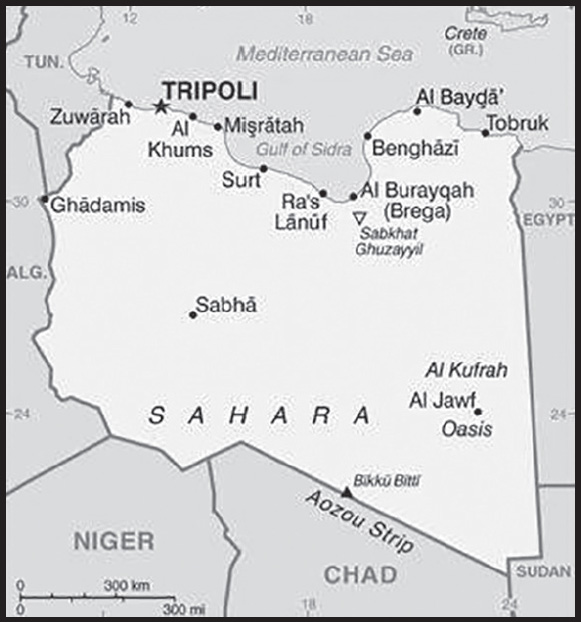
Location: Northern Africa, bordering the Mediterranean Sea, between Egypt, Tunisia, and Algeria
Geographic coordinates: 25 00 N, 17 00 E
Map references: Africa
Area: total: 1,759,540 sq km
land: 1,759,540 sq km
water: 0 sq km
comparison ranking: total 18
Area - comparative: about 2.5 times the size of Texas; slightly larger than Alaska
Land boundaries: total: 4,339 km
border countries (6): Algeria 989 km; Chad 1,050 km; Egypt 1,115 km; Niger 342 km; Sudan 382 km; Tunisia 461 km
Coastline: 1,770 km
Maritime claims: territorial sea: 12 nm
exclusive fishing zone: 62 nm
note: Gulf of Sidra closing line - 32 degrees, 30 minutes north
Climate: Mediterranean along coast; dry, extreme desert interior
Terrain: mostly barren, flat to undulating plains, plateaus, depressions
Elevation: highest point: Bikku Bitti 2,267 m
lowest point: Sabkhat Ghuzayyil -47 m
mean elevation: 423 m
Natural resources: petroleum, natural gas, gypsum
Land use: agricultural land: 8.8% (2018 est.)
arable land: 1% (2018 est.)
permanent crops: 0.2% (2018 est.)
permanent pasture: 7.6% (2018 est.)
forest: 0.1% (2018 est.)
other: 91.1% (2018 est.)
Irrigated land: 4,700 sq km (2012)
Major watersheds (area sq km): Internal (endorheic basin) drainage: Lake Chad (2,497,738 sq km)
Major aquifers: Nubian Aquifer System, North Western Sahara Aquifer System, Murzuk-Djado Basin
Population distribution: well over 90% of the population lives along the Mediterranean coast in and between Tripoli to the west and Al Bayda to the east; the interior remains vastly underpopulated due to the Sahara and lack of surface water as shown in this population distribution map
Natural hazards: hot, dry, dust-laden ghibli is a southern wind lasting one to four days in spring and fall; dust storms, sandstorms
Geography - note: note 1: more than 90% of the country is desert or semidesert
note 2: the volcano Waw an Namus lies in south central Libya in the middle of the Sahara; the caldera is an oasis - the name means “oasis of mosquitoes” - containing several small lakes surrounded by vegetation and hosting various insects and a large diversity of birds
PEOPLE AND SOCIETY
Population: 7,252,573 (2023 est.)
note: immigrants make up just over 12% of the total population, according to UN data (2019)
comparison ranking: 106
Nationality: noun: Libyan(s)
adjective: Libyan
Ethnic groups: Berber and Arab 97%, other 3% (includes Egyptian, Greek, Indian, Italian, Maltese, Pakistani, Tunisian, and Turkish)
Languages: Arabic (official), Italian, English (all widely understood in the major cities); Berber (Nafusi, Ghadamis, Suknah, Awjilah, Tamasheq)
major-language sample(s):
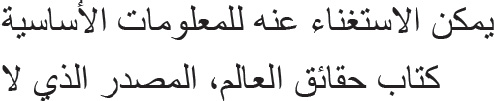
(Arabic)
Religions: Muslim (official; virtually all Sunni) 96.6%, Christian 2.7%, Buddhist <1%, Hindu <1%, Jewish <1%, folk religion <1%, other <1%, unafilliated <1% (2020 est.)
note: non-Sunni Muslims include native Ibadhi Muslims (<1% of the population) and foreign Muslims
Demographic profile: Despite continuing unrest, Libya remains a destination country for economic migrants. It is also a hub for transit migration to Europe because of its proximity to southern Europe and its lax border controls. Labor migrants have been drawn to Libya since the development of its oil sector in the 1960s. Until the latter part of the 1990s, most migrants to Libya were Arab (primarily Egyptians and Sudanese). However, international isolation stemming from Libya’s involvement in international terrorism and a perceived lack of support from Arab countries led QADHAFI in 1998 to adopt a decade-long pan-African policy that enabled large numbers of Sub-Saharan migrants to enter Libya without visas to work in the construction and agricultural industries. Although Sub-Saharan Africans provided a cheap labor source, they were poorly treated and were subjected to periodic mass expulsions.
By the mid-2000s, domestic animosity toward African migrants and a desire to reintegrate into the international community motivated QADHAFI to impose entry visas on Arab and African immigrants and to agree to joint maritime patrols and migrant repatriations with Italy, the main recipient of illegal migrants departing Libya. As his regime neared collapse in 2011, QADHAFI reversed his policy of cooperating with Italy to curb illegal migration and sent boats loaded with migrants and asylum seekers to strain European resources. Libya’s 2011 revolution decreased immigration drastically and prompted nearly 800,000 migrants to flee to third countries, mainly Tunisia and Egypt, or to their countries of origin. The inflow of migrants declined in 2012 but returned to normal levels by 2013, despite continued hostility toward Sub-Saharan Africans and a less-inviting job market.
While Libya is not an appealing destination for migrants, since 2014, transiting migrants – primarily from East and West Africa – continue to exploit its political instability and weak border controls and use it as a primary departure area to migrate across the central Mediterranean to Europe in growing numbers. In addition, approximately 135,000 people were displaced internally as of August 2022 by fighting between armed groups in eastern and western Libya and, to a lesser extent, by inter-tribal clashes in the country’s south.
Age structure: 0-14 years: 32.81% (male 1,213,850/female 1,166,039)
15-64 years: 62.8% (male 2,340,685/female 2,213,782)
65 years and over: 4.39% (2023 est.) (male 143,737/female 174,480)
Dependency ratios: total dependency ratio: 50.8
youth dependency ratio: 43.5
elderly dependency ratio: 7.3
potential support ratio: 13.8 (2021 est.)
Median age: total: 25.8 years (2020)
male: 25.9 years
female: 25.7 years
comparison ranking: total 156
Population growth rate: 1.54% (2023 est.)
comparison ranking: 63
Birth rate: 20.88 births/1,000 population (2023 est.)
comparison ranking: 63
Death rate: 3.45 deaths/1,000 population (2023 est.)
comparison ranking: 222
Net migration rate: -2.05 migrant(s)/1,000 population (2023 est.)
comparison ranking: 171
Population distribution: well over 90% of the population lives along the Mediterranean coast in and between Tripoli to the west and Al Bayda to the east; the interior remains vastly underpopulated due to the Sahara and lack of surface water as shown in this population distribution map
Urbanization: urban population: 81.6% of total population (2023)
rate of urbanization: 1.45% annual rate of change (2020-25 est.)
Major urban areas - population: 1.183 million TRIPOLI (capital), 984,000 Misratah, 859,000 Benghazi (2023)
Sex ratio: at birth: 1.05 male(s)/female
0-14 years: 1.04 male(s)/female
15-64 years: 1.06 male(s)/female
65 years and over: 0.82 male(s)/female
total population: 1.04 male(s)/female (2023 est.)
Maternal mortality ratio: 72 deaths/100,000 live births (2020 est.)
comparison ranking: 84
Infant mortality rate: total: 10.95 deaths/1,000 live births (2023 est.)
male: 12.36 deaths/1,000 live births
female: 9.48 deaths/1,000 live births
comparison ranking: total 128
Life expectancy at birth: total population: 77.42 years (2023 est.)
male: 75.2 years
female: 79.76 years
comparison ranking: total population 93
Total fertility rate: 3.04 children born/woman (2023 est.)
comparison ranking: 46
Gross reproduction rate: 1.48 (2023 est.)
Contraceptive prevalence rate: 27.7% (2014)
Drinking water source: improved:
total: 99.9% of population
unimproved:
total: 0.1% of population (2020 est.)
Physicians density: 2.09 physicians/1,000 population (2017)
Hospital bed density: 3.2 beds/1,000 population (2017)
Sanitation facility access: improved: total: 99.3% of population
unimproved: total: 0.7% of population (2020 est.)
Obesity - adult prevalence rate: 32.5% (2016)
comparison ranking: 16
Alcohol consumption per capita: total: 0.01 liters of pure alcohol (2019 est.)
beer: 0 liters of pure alcohol (2019 est.)
wine: 0.01 liters of pure alcohol (2019 est.)
spirits: 0 liters of pure alcohol (2019 est.)
other alcohols: 0 liters of pure alcohol (2019 est.)
comparison ranking: total 184
Children under the age of 5 years underweight: 11.7% (2014)
comparison ranking: 48
Currently married women (ages 15-49): 59.2% (2023 est.)
Literacy: definition: age 15 and over can read and write
total population: 91%
male: 96.7%
female: 85.6% (2015)
Youth unemployment rate (ages 15-24): total: 50.5% (2021 est.)
male: 41.4%
female: 73.8%
comparison ranking: total 4
ENVIRONMENT
Environment - current issues: desertification; limited natural freshwater resources; the Great Manmade River Project, the largest water development scheme in the world, brings water from large aquifers under the Sahara to coastal cities; water pollution is a significant problem; the combined impact of sewage, oil byproducts, and industrial waste threatens Libya’s coast and the Mediterranean Sea
Environment - international agreements: party to: Biodiversity, Climate Change, Climate Change-Kyoto Protocol, Comprehensive Nuclear Test Ban, Desertification, Endangered Species, Hazardous Wastes, Marine Dumping-London Convention, Nuclear Test Ban, Ozone Layer Protection, Ship Pollution, Wetlands
signed, but not ratified: Climate Change-Paris Agreement, Law of the Sea
Climate: Mediterranean along coast; dry, extreme desert interior
Land use: agricultural land: 8.8% (2018 est.)
arable land: 1% (2018 est.)
permanent crops: 0.2% (2018 est.)
permanent pasture: 7.6% (2018 est.)
forest: 0.1% (2018 est.)
other: 91.1% (2018 est.)
Urbanization: urban population: 81.6% of total population (2023)
rate of urbanization: 1.45% annual rate of change (2020-25 est.)
Food insecurity: severe localized food insecurity: due to civil insecurity, economic and political instability, and high food prices - an estimated 800,000 people, 10% of the population, need humanitarian assistance, of which 500,000 require food assistance; the country relies heavily on imports (up to 90%) to cover its cereal consumption requirements (mostly wheat for human consumption and barley for feed); between 2016 and 2020, the country sourced over 30% of its wheat imports from Ukraine, and 20% from the Russian Federation; almost 65% of total maize imports of 650,000 mt, and 50% of total barley imports of 1 million mt originated from Ukraine, making the Libya vulnerable to disruptions in shipments from the Black Sea region (2022)
Revenue from forest resources: 0.06% of GDP (2018 est.)
comparison ranking: 124
Revenue from coal: 0% of GDP (2018 est.)
comparison ranking: 97
Air pollutants: particulate matter emissions: 29.84 micrograms per cubic meter (2019 est.)
carbon dioxide emissions: 50.56 megatons (2016 est.)
methane emissions: 45.76 megatons (2020 est.)
Waste and recycling: municipal solid waste generated annually: 2,147,596 tons (2011 est.)
Major watersheds (area sq km): Internal (endorheic basin) drainage: Lake Chad (2,497,738 sq km)
Major aquifers: Nubian Aquifer System, North Western Sahara Aquifer System, Murzuk-Djado Basin
Total water withdrawal: municipal: 700 million cubic meters (2020 est.)
industrial: 280 million cubic meters (2020 est.)
agricultural: 4.85 billion cubic meters (2020 est.)
Total renewable water resources: 700 million cubic meters (2020 est.)
GOVERNMENT
Country name: conventional long form: State of Libya
conventional short form: Libya
local long form: Dawiat Libiya
local short form: Libiya
etymology: name derives from the Libu, an ancient Libyan tribe first mentioned in texts from the 13th century B.C.
Government type: in transition
Capital: name: Tripoli (Tarabulus)
geographic coordinates: 32 53 N, 13 10 E
time difference: UTC+2 (7 hours ahead of Washington, DC, during Standard Time)
etymology: originally founded by the Phoenicians as Oea in the 7th century B.C., the city changed rulers many times over the successive centuries; by the beginning of the 3rd century A.D. the region around the city was referred to as Regio Tripolitana by the Romans, meaning “region of the three cities” - namely Oea (i.e., modern Tripoli), Sabratha (to the west), and Leptis Magna (to the east); over time, the shortened name of “Tripoli” came to refer to just Oea, which derives from the Greek words tria and polis meaning “three cities”
Administrative divisions: 22 governorates (muhafazah, singular - muhafazat); Al Butnan, Al Jabal al Akhdar, Al Jabal al Gharbi, Al Jafarah, Al Jufrah, Al Kufrah, Al Marj, Al Marqab, Al Wahat, An Nuqat al Khams, Az Zawiyah, Banghazi (Benghazi), Darnah, Ghat, Misratah, Murzuq, Nalut, Sabha, Surt, Tarabulus (Tripoli), Wadi al Hayat, Wadi ash Shati
Independence: 24 December 1951 (from UN trusteeship)
National holiday: Liberation Day, 23 October (2011)
Constitution: history: previous 1951, 1977; in July 2017, the Constitutional Assembly completed and approved a draft of a new permanent constitution; in September 2018, the House of Representatives passed a constitutional referendum law in a session with contested reports of the quorum needed to pass the vote, and submitted it to the High National Elections Commission in December to begin preparations for a constitutional referendum; the referendum is planned in 2022, following the presidential election
Legal system: Libya’s post-revolution legal system is in flux and driven by state and non-state entities
International law organization participation: has not submitted an ICJ jurisdiction declaration; non-party state to the ICCt
Citizenship: citizenship by birth: no
citizenship by descent only: at least one parent or grandparent must be a citizen of Libya
dual citizenship recognized: no
residency requirement for naturalization: varies from 3 to 5 years
Suffrage: 18 years of age, universal
Executive branch: chief of state: Chairman, Presidential Council, Mohammed Al MENFI (since 5 February 2021)
head of government: Interim Prime Minister Abdul Hamid DUBAYBAH (since 5 February 2021)
elections/appointments:
Libya’s first direct presidential election, scheduled for 24 December 2021, was not held
Legislative branch: description: unicameral House of Representatives (Majlis Al Nuwab) or HoR (200 seats including 32 reserved for women; members directly elected by majority vote; member term NA); note - the High State Council serves as an advisory group for the HoR
elections: last held on 25 June 2014
election results: percent of vote by party - NA; seats by party - NA; composition; note - only 188 of the 200 seats were filled in the June 2014 election because of boycotts and lack of security at some polling stations; some elected members of the HoR also boycotted the election
Judicial branch: highest court(s): Libya’s judicial system consists of a supreme court, central high courts (in Tripoli, Benghazi, and Sabha), and a series of lower courts; the judicial system is factious given the ongoing tension between Libya’s eastern and western regions; since 2011, Libyan political factions and armed groups have targeted judges and courthouses
Political parties and leaders: NA
International organization participation: ABEDA, AfDB, AFESD, AMF, AMU, AU, BDEAC, CAEU, COMESA, FAO, G-77, IAEA, IBRD, ICAO, ICC (NGOs), ICRM, IDA, IDB, IFAD, IFC, IFRCS, ILO, IMF, IMO, IMSO, Interpol, IOC, IOM, IPU, ISO, ITSO, ITU, LAS, LCBC, MIGA, NAM, OAPEC, OIC, OPCW, OPEC, PCA, UN, UNCTAD, UNESCO, UNHRC, UNIDO, UNSMIL, UNWTO, UPU, WCO, WFTU (NGOs), WHO, WIPO, WMO, WTO (observer)
Diplomatic representation in the US: chief of mission: Ambassador (vacant); Chargé d’Affaires Fadil S M OMAR (since 17 July 2023)
chancery: 1460 Dahlia Street NW, Washington, DC 20012
telephone: [1] (202) 944-9601
FAX: [1] (202) 944-9606
email address and website:
https://www.embassyoflibyadc.org/
Diplomatic representation from the US: chief of mission: Ambassador (vacant); Ambassador Richard B. NORLAND, US Special Envoy for Libya (since 8 September 2022)
embassy: operations suspended
mailing address: 8850 Tripoli Place, Washington, DC 20521-8850
telephone: [216] 71-107-000
email address and website:
note: the US Embassy in Tripoli closed in July 2014 due to fighting near the embassy related to Libyan civil unrest; embassy staff and operations temporarily first relocated to Valetta, Malta and currently are temporarily relocated to Tunis, Tunisia
Flag description: three horizontal bands of red (top), black (double width), and green with a white crescent and star centered on the black stripe; the National Transitional Council reintroduced this flag design of the former Kingdom of Libya (1951-1969) on 27 February 2011; it replaced the former all-green banner promulgated by the QADHAFI regime in 1977; the colors represent the three major regions of the country: red stands for Fezzan, black symbolizes Cyrenaica, and green denotes Tripolitania; the crescent and star represent Islam, the main religion of the country
National symbol(s): star and crescent, hawk; national colors: red, black, green
National anthem: name: “Libya, Libya, Libya”
lyrics/music: Al Bashir AL AREBI/Mohamad Abdel WAHAB
note: also known as “Ya Beladi” or “Oh, My Country!”; adopted 1951; readopted 2011 with some modification to the lyrics; during the QADHAFI years between 1969 and 2011, the anthem was “Allahu Akbar,” (God is Great) a marching song of the Egyptian Army in the 1956 Suez War
National heritage: total World Heritage Sites: 5 (all cultural)
selected World Heritage Site locales: Archaeological Site of Cyrene; Archaeological Site of Leptis Magna, Archaeological Site of Sabratha; Rock-Art Sites of Tadrart Acacus; Old Town of Ghadamès
ECONOMY
Economic overview: upper middle-income, fossil fuel-based North African economy; 31% economic contraction due to COVID-19 and 2020 oil blockade; reduced government spending; central bank had to devalue currency; public wages are over 60% of expenditures
Real GDP (purchasing power parity): $147.942 billion (2021 est.)
$112.612 billion (2020 est.)
$148.037 billion (2019 est.)
note: data are in 2017 dollars
comparison ranking: 78
Real GDP growth rate: 31.37% (2021 est.)
-23.93% (2020 est.)
-11.2% (2019 est.)
comparison ranking: 2
Real GDP per capita: $22,000 (2021 est.)
$16,900 (2020 est.)
$22,500 (2019 est.)
note: data are in 2017 dollars
comparison ranking: 84
GDP (official exchange rate): $52.259 billion (2019 est.)
Inflation rate (consumer prices): 28.5% (2017 est.)
25.9% (2016 est.)
comparison ranking: 8
GDP - composition, by sector of origin: agriculture: 1.3% (2017 est.)
industry: 52.3% (2017 est.)
services: 46.4% (2017 est.)
comparison rankings: services 193; industry 8; agriculture 192
GDP - composition, by end use: household consumption: 71.6% (2017 est.)
government consumption: 19.4% (2017 est.)
investment in fixed capital: 2.7% (2017 est.)
investment in inventories: 1.3% (2016 est.)
exports of goods and services: 38.8% (2017 est.)
imports of goods and services: -33.8% (2017 est.)
Agricultural products: potatoes, watermelons, tomatoes, onions, dates, milk, olives, wheat, poultry, vegetables
Industries: petroleum, petrochemicals, aluminum, iron and steel, food processing, textiles, handicrafts, cement
Industrial production growth rate: -10.57% (2019 est.)
comparison ranking: 200
Labor force: 2.28 million (2021 est.)
comparison ranking: 121
Labor force - by occupation: agriculture: 17%
industry: 23%
services: 59% (2004 est.)
Unemployment rate: 19.58% (2021 est.)
20.07% (2020 est.)
19.66% (2019 est.)
comparison ranking: 22
Youth unemployment rate (ages 15-24): total: 50.5% (2021 est.)
male: 41.4%
female: 73.8%
comparison ranking: total 4
Population below poverty line: note: about one-third of Libyans live at or below the national poverty line
Budget: revenues: $28.005 billion (2019 est.)
expenditures: $37.475 billion (2019 est.)
Budget surplus (+) or deficit (-): -25.1% (of GDP) (2017 est.)
comparison ranking: 219
Public debt: 4.7% of GDP (2017 est.)
7.5% of GDP (2016 est.)
comparison ranking: 204
Taxes and other revenues: 51.6% (of GDP) (2017 est.)
comparison ranking: 5
Fiscal year: calendar year
Current account balance: -$4.78 billion (2020 est.)
$4.817 billion (2019 est.)
$11.276 billion (2018 est.)
comparison ranking: 186
Exports: $9.537 billion (2020 est.) note: data are in current year dollars
$29.326 billion (2019 est.)
$29.964 billion (2018 est.)
comparison ranking: 107
Exports - partners: Italy 18%, China 16%, Germany 15%, Spain 15%, United Arab Emirates 6%, France 6%, United States 5% (2019)
Exports - commodities: crude petroleum, natural gas, refined petroleum, scrap iron, gold (2021)
Imports: $14.334 billion (2020 est.) note: data are in current year dollars
$25.368 billion (2019 est.)
$18.849 billion (2018 est.)
comparison ranking: 101
Imports - partners: China 16%, Turkey 14%, Italy 9%, United Arab Emirates 9%, Egypt 5% (2019)
Imports - commodities: refined petroleum, cars, broadcasting equipment, cigarettes, jewelry (2019)
Reserves of foreign exchange and gold: $82.262 billion (31 December 2021 est.)
$79.656 billion (31 December 2020 est.)
$84.664 billion (31 December 2019 est.)
comparison ranking: 32
Debt - external: $3.02 billion (31 December 2017 est.)
$3.116 billion (31 December 2016 est.)
comparison ranking: 144
Exchange rates: Libyan dinars (LYD) per US dollar -
Exchange rates:: 4.514 (2021 est.)
1.389 (2020 est.)
1.398 (2019 est.)
1.365 (2018 est.)
1.394 (2017 est.)
ENERGY
Electricity access: electrification - total population: 70.2% (2021)
electrification - urban areas: 100% (2021)
Electricity: installed generating capacity: 10.516 million kW (2020 est.)
consumption: 25,360,340,000 kWh (2019 est.)
exports: 0 kWh (2019 est.)
imports: 465 million kWh (2019 est.)
transmission/distribution losses: 6.801 billion kWh (2019 est.)
comparison rankings: installed generating capacity 64; transmission/distribution losses 39; imports 90; exports 192; consumption 69
Electricity generation sources: fossil fuels: 100% of total installed capacity (2020 est.)
Petroleum: total petroleum production: 1,252,800 bbl/day (2021 est.)
refined petroleum consumption: 219,700 bbl/day (2019 est.)
crude oil and lease condensate exports: 1,067,400 bbl/day (2018 est.)
crude oil and lease condensate imports: 0 bbl/day (2018 est.)
crude oil estimated reserves: 48.363 billion barrels (2021 est.)
Refined petroleum products - production: 89,620 bbl/day (2015 est.)
comparison ranking: 69
Refined petroleum products - exports: 16,880 bbl/day (2015 est.)
comparison ranking: 71
Refined petroleum products - imports: 168,200 bbl/day (2015 est.)
comparison ranking: 36
Natural gas: production: 12,414,736,000 cubic meters (2020 est.)
consumption: 7,669,690,000 cubic meters (2019 est.)
exports: 4,441,150,000 cubic meters (2020 est.)
imports: 0 cubic meters (2021 est.)
proven reserves: 1,504,868,000,000 cubic meters (2021 est.)
Carbon dioxide emissions: 38.297 million metric tonnes of CO2 (2019 est.)
from coal and metallurgical coke: 0 metric tonnes of CO2 (2019 est.)
from petroleum and other liquids: 30.018 million metric tonnes of CO2 (2019 est.)
from consumed natural gas: 8.279 million metric tonnes of CO2 (2019 est.)
comparison ranking: total emissions 68
Energy consumption per capita: 107.118 million Btu/person (2019 est.)
comparison ranking: 53
COMMUNICATIONS
Telephones - fixed lines: total subscriptions: 1.6 million (2021 est.)
subscriptions per 100 inhabitants: 23 (2021 est.)
comparison ranking: total subscriptions 59
Telephones - mobile cellular: total subscriptions: 2.9 million (2021 est.)
subscriptions per 100 inhabitants: 43 (2021 est.)
comparison ranking: total subscriptions 143
Telecommunication systems: general assessment: political and security instability in Libya has disrupted its telecom sector; much of its infrastructure remains superior to that in most other African countries; rival operators fight for control; investment in fiber backbone and upgrades to international cables; limited LTE and 5G service; some satellite broadband; in 2021 Libya signed deals and projects with US firms to upgrade portions of its infrastructure, increasing the diversity of its telecommunications networks (2022)
domestic: nearly 23 per 100 fixed-line and over 43 per 100 mobile-cellular subscriptions; service generally adequate (2021)
international: country code - 218; landing points for LFON, EIG, Italy-Libya, Silphium and Tobrok-Emasaed submarine cable system connecting Europe, Africa, the Middle East and Asia; satellite earth stations - 4 Intelsat, Arabsat, and Intersputnik; microwave radio relay to Tunisia and Egypt; tropospheric scatter to Greece; participant in Medarabtel (2019)
Broadcast media: state-funded and private TV stations; some provinces operate local TV stations; pan-Arab satellite TV stations are available; state-funded radio (2019)
Internet country code: .ly
Internet users: total: 3,095,400 (2021 est.)
percent of population: 46.2% (2021 est.)
comparison ranking: total 117
Broadband - fixed subscriptions: total: 332,000 (2020 est.)
subscriptions per 100 inhabitants: 5 (2020 est.)
comparison ranking: total 104
TRANSPORTATION
National air transport system: number of registered air carriers: 9 (2020)
inventory of registered aircraft operated by air carriers: 55
annual passenger traffic on registered air carriers: 927,153 (2018)
Civil aircraft registration country code prefix: 5A
Airports: 146 (2021)
comparison ranking: total 39
Airports - with paved runways: 68
note: paved runways have a concrete or asphalt surface but not all have facilities for refueling, maintenance, or air traffic control; the length of a runway required for aircraft to safely operate depends on a number of factors including the type of aircraft, the takeoff weight (including passengers, cargo, and fuel), engine types, flap settings, landing speed, elevation of the airport, and average maximum daily air temperature; paved runways can reach a length of 5,000 m (16,000 ft.), but the “typical” length of a commercial airline runway is between 2,500-4,000 m (8,000-13,000 ft.)
Airports - with unpaved runways: 78
note: unpaved runways have a surface composition such as grass or packed earth and are most suited to the operation of light aircraft; unpaved runways are usually short, often less than 1,000 m (3,280 ft.) in length; airports with unpaved runways often lack facilities for refueling, maintenance, or air traffic control
Heliports: 2 (2021)
Pipelines: 882 km condensate, 3,743 km gas, 7,005 km oil (2013)
Roadways: total: 37,000 km (2010)
paved: 34,000 km (2010)
unpaved: 3,000 km (2010)
comparison ranking: total 91
Merchant marine: total: 94 (2022)
by type: general cargo 2, oil tanker 12, other 80
comparison ranking: total 93
Ports and terminals: major seaport(s): Marsa al Burayqah (Marsa el Brega), Tripoli
oil terminal(s): Az Zawiyah, Ra’s Lanuf
LNG terminal(s) (export): Marsa el Brega
MILITARY AND SECURITY
Military and security forces: the Government of National Unity (GNU) has access to various ground, air, and naval/coast guard forces comprised of a mix of formations and equipment from the QADHAFI regime, semi-regular and nominally integrated units, tribal armed groups/militias, civilian volunteers, and foreign private military contractors and mercenaries; the GNU has a Ministry of Defense, but has limited control over its security forces
the self-styled Libyan National Army (LNA), under de facto LNA commander Khalifa HAFTER, also includes various ground, air, and naval forces comprised of semi-regular military personnel, militias, and foreign private military contractors and mercenaries; the LNA operates independently from the GNU and exerts influence throughout eastern, central, and southern Libya (2023)
note 1: the Stabilization Support Authority (SSA) is a state-funded militia established in January 2021 by the GNU; it is tasked with securing government buildings and officials, participating in combat operations, apprehending those suspected of national security crimes, and cooperating with other security bodies
note 2: the national police force under the Ministry of Interior oversees internal security (with support from military forces under the Ministry of Defense), but much of Libya’s security-related police work generally falls to informal armed groups, which receive government salaries but lack formal training, supervision, or consistent accountability
Military expenditures: not available
Military and security service personnel strengths: estimates not available
Military equipment inventories and acquisitions: both the forces aligned with the GNU and the LNA are largely equipped with weapons of Russian or Soviet origin; in recent years, Turkey has the been the primary supplier of arms to the GNU, while the LNA has received quantities from Russia and the United Arab Emirates (2023)
Military service age and obligation: not available
Military - note: Turkey has provided military advisers to trained and assist western/GNU Libyan forces and thousands of Syrian mercenaries to Libya, as well as ammunition, weapons, and aerial drones; Russia, the United Arab Emirates, and Egypt have been the main supporters of the LNA; Russia has provided as many as 2,000 private military contractors; the LNA has also used fighters from other countries, including Chad, Sudan, and Syria; GNU and LNA forces are separated by a fortified line of control running roughly from the coastal city of Sirte south to the vicinity of Al Jufra and Brak (2023)
TERRORISM
Terrorist group(s): Terrorist group(s): Ansar al-Sharia groups; Islamic State of Iraq and ash-Sham - Libya (ISIS-L); al-Mulathamun Battalion (al-Mourabitoun); al-Qa’ida in the Islamic Maghreb (AQIM)
note: details about the history, aims, leadership, organization, areas of operation, tactics, targets, weapons, size, and sources of support of the group(s) appear(s) in Appendix-T
TRANSNATIONAL ISSUES
Disputes - international: Libya-Algeria: dormant disputes include Libyan claims of about 32,000 sq km still reflected on its maps of southeastern Algeria
Libya-Chad: various Chadian rebels from the Aozou region reside in southern Libya; Libyan forces clashed with Chadian rebels in September 2021
Libya-Egypt: none identified
Libya-Niger: the boundary is poorly defined but has never been disputed by either country
Libya-Sudan: none identified
Libya-Tunisia: none identified
Refugees and internally displaced persons: refugees (country of origin): 24,887 (Sudan) (refugees and asylum seekers), 11,623 (Syria) (refugees and asylum seekers), 8,302 (Eritrea) (2023)
IDPs: 125,802 (conflict between pro-QADHAFI and anti-QADHAFI forces in 2011; post-QADHAFI tribal clashes 2014) (2023)
INTRODUCTION
Background: The Principality of Liechtenstein was established within the Holy Roman Empire in 1719. Occupied by both French and Russian troops during the Napoleonic Wars, it became a sovereign state in 1806 and joined the German Confederation in 1815. Liechtenstein became fully independent in 1866 when the Confederation dissolved. Until the end of World War I, it was closely tied to Austria, but the economic devastation caused by that conflict forced Liechtenstein to enter into a customs and monetary union with Switzerland. Since World War II (in which Liechtenstein remained neutral), the country’s low taxes have spurred outstanding economic growth. In 2000, shortcomings in banking regulatory oversight resulted in concerns about the use of financial institutions for money laundering. However, Liechtenstein implemented anti-money laundering legislation and a Mutual Legal Assistance Treaty with the US that went into effect in 2003.
GEOGRAPHY
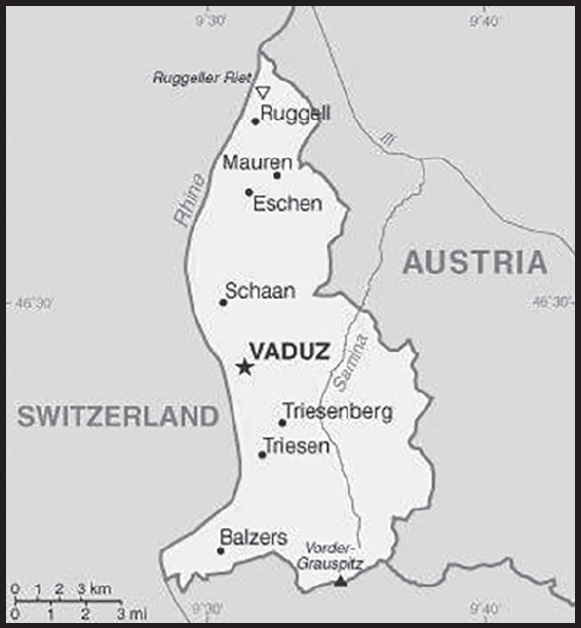
Location: Central Europe, between Austria and Switzerland
Geographic coordinates: 47 16 N, 9 32 E
Map references: Europe
Area: total: 160 sq km
land: 160 sq km
water: 0 sq km
comparison ranking: total 218
Area - comparative: about 0.9 times the size of Washington, DC
Land boundaries: total: 75 km
border countries (2): Austria 34 km; Switzerland 41 km
Coastline: 0 km (doubly landlocked)
Maritime claims: none (landlocked)
Climate: continental; cold, cloudy winters with frequent snow or rain; cool to moderately warm, cloudy, humid summers
Terrain: mostly mountainous (Alps) with Rhine Valley in western third
Elevation: highest point: Vorder-Grauspitz 2,599 m
lowest point: Ruggeller Riet 430 m
Natural resources: hydroelectric potential, arable land
Land use: agricultural land: 37.6% (2018 est.)
arable land: 18.8% (2018 est.)
permanent crops: 0% (2018 est.)
permanent pasture: 18.8% (2018 est.)
forest: 43.1% (2018 est.)
other: 19.3% (2018 est.)
Irrigated land: 0 sq km (2012)
Major watersheds (area sq km): Atlantic Ocean drainage: Rhine-Maas (198,735 sq km)
Population distribution: most of the population is found in the western half of the country along the Rhine River
Natural hazards: avalanches, landslides
Geography - note: along with Uzbekistan, one of only two doubly landlocked countries in the world; variety of microclimatic variations based on elevation
PEOPLE AND SOCIETY
Population: 39,993 (2023 est.)
note: immigrants make up 67% of the total population, according to UN data (2019)
comparison ranking: 212
Nationality: noun: Liechtensteiner(s)
adjective: Liechtenstein
Ethnic groups: Liechtensteiner 65.6%, Swiss 9.6%, Austrian 5.8%, German 4.5%, Italian 3.1%, other 11.4% (2021 est.)
note: data represent population by nationality
Languages: German 91.5% (official) (Alemannic is the main dialect), Italian 1.5%, Turkish 1.3%, Portuguese 1.1%, other 4.6% (2015 est.)
major-language sample(s):
Das World Factbook, die unverzichtbare Quelle für grundlegende Informationen. (German)
Religions: Roman Catholic (official) 73.4%, Protestant Reformed 6.3%, Muslim 5.9%, Christian Orthodox 1.3%, Lutheran 1.2%, other Protestant 0.7%, other Christian 0.3%, other 0.8%, none 7%, unspecified 3.3% (2015 est.)
Age structure: 0-14 years: 15.27% (male 3,389/female 2,718)
15-64 years: 64.38% (male 12,800/female 12,947)
65 years and over: 20.35% (2023 est.) (male 3,738/female 4,401)
Dependency ratios: total dependency ratio: 50.2
youth dependency ratio: 21.8
elderly dependency ratio: 28.3
potential support ratio: 3.5 (2021)
Median age: total: 43.7 years (2020)
male: 42 years
female: 45.3 years
comparison ranking: total 22
Population growth rate: 0.7% (2023 est.)
comparison ranking: 126
Birth rate: 10.3 births/1,000 population (2023 est.)
comparison ranking: 183
Death rate: 8.05 deaths/1,000 population (2023 est.)
comparison ranking: 85
Net migration rate: 4.78 migrant(s)/1,000 population (2023 est.)
comparison ranking: 22
Population distribution: most of the population is found in the western half of the country along the Rhine River
Urbanization: urban population: 14.6% of total population (2023)
rate of urbanization: 1.15% annual rate of change (2020-25 est.)
Major urban areas - population: 5,000 VADUZ (capital) (2018)
Sex ratio: at birth: 1.25 male(s)/female
0-14 years: 1.25 male(s)/female
15-64 years: 0.99 male(s)/female
65 years and over: 0.85 male(s)/female
total population: 0.99 male(s)/female (2023 est.)
Mother’s mean age at first birth: 31.3 years (2017)
Infant mortality rate: total: 3.98 deaths/1,000 live births (2023 est.)
male: 4.34 deaths/1,000 live births
female: 3.53 deaths/1,000 live births
comparison ranking: total 188
Life expectancy at birth: total population: 82.76 years (2023 est.)
male: 80.54 years
female: 85.56 years
comparison ranking: total population 22
Total fertility rate: 1.69 children born/woman (2023 est.)
comparison ranking: 171
Gross reproduction rate: 0.75 (2023 est.)
Drinking water source: improved: total: 100% of population
unimproved: total: 0% of population (2020)
Sanitation facility access: improved: total: 100% of population
unimproved: total: 0% of population (2020)
Currently married women (ages 15-49): 65.2% (2023 est.)
Education expenditures: 2.6% of GDP (2011 est.)
comparison ranking: 173
School life expectancy (primary to tertiary education): total: 15 years
male: 16 years
female: 14 years (2020)
ENVIRONMENT
Environment - current issues: some air pollution generated locally, some carried over from surrounding countries
Environment - international agreements: party to: Air Pollution, Air Pollution-Heavy Metals, Air Pollution-Nitrogen Oxides, Air Pollution-Persistent Organic Pollutants, Air Pollution-Sulphur 85, Air Pollution-Sulphur 94, Air Pollution-Volatile Organic Compounds, Biodiversity, Climate Change, Climate Change-Kyoto Protocol, Climate Change-Paris Agreement, Comprehensive Nuclear Test Ban, Desertification, Endangered Species, Hazardous Wastes, Ozone Layer Protection, Wetlands
signed, but not ratified: Air Pollution-Multi-effect Protocol, Law of the Sea
Climate: continental; cold, cloudy winters with frequent snow or rain; cool to moderately warm, cloudy, humid summers
Land use: agricultural land: 37.6% (2018 est.)
arable land: 18.8% (2018 est.)
permanent crops: 0% (2018 est.)
permanent pasture: 18.8% (2018 est.)
forest: 43.1% (2018 est.)
other: 19.3% (2018 est.)
Urbanization: urban population: 14.6% of total population (2023)
rate of urbanization: 1.15% annual rate of change (2020-25 est.)
Revenue from forest resources: 0% of GDP (2017 est.)
comparison ranking: 184
Air pollutants: carbon dioxide emissions: 0.05 megatons (2016 est.)
methane emissions: 0.02 megatons (2020 est.)
Waste and recycling: municipal solid waste generated annually: 32,382 tons (2015 est.)
municipal solid waste recycled annually: 20,919 tons (2015 est.)
percent of municipal solid waste recycled: 64.6% (2015 est.)
Major watersheds (area sq km): Atlantic Ocean drainage: Rhine-Maas (198,735 sq km)
Total water withdrawal: municipal: 10 million cubic meters (2020 est.)
Total renewable water resources: 0 cubic meters (2017 est.)
GOVERNMENT
Country name: conventional long form: Principality of Liechtenstein
conventional short form: Liechtenstein
local long form: Fuerstentum Liechtenstein
local short form: Liechtenstein
etymology: named after the Liechtenstein dynasty that purchased and united the counties of Schellenburg and Vaduz and that was allowed by the Holy Roman Emperor in 1719 to rename the new property after their family; the name in German means “light (bright) stone”
Government type: constitutional monarchy
Capital: name: Vaduz
geographic coordinates: 47 08 N, 9 31 E
time difference: UTC+1 (6 hours ahead of Washington, DC, during Standard Time)
daylight saving time: +1hr, begins last Sunday in March; ends last Sunday in October
etymology: may be a conflation from the Latin vallis (valley) and the High German diutisk (meaning “German”) to produce Valdutsch (“German valley”), which over time simplified and came to refer specifically to Vaduz, the town
Administrative divisions: 11 communes (Gemeinden, singular - Gemeinde); Balzers, Eschen, Gamprin, Mauren, Planken, Ruggell, Schaan, Schellenberg, Triesen, Triesenberg, Vaduz
Independence: 23 January 1719 (Principality of Liechtenstein established); 12 July 1806 (independence from the Holy Roman Empire); 24 August 1866 (independence from the German Confederation)
National holiday: National Day, 15 August (1940); note - a National Day was originally established in 1940 to combine celebrations for the Feast of the Assumption (15 August) with those honoring the birthday of former Prince FRANZ JOSEF II (1906-1989) whose birth fell on 16 August; after the prince’s death, National Day became the official national holiday by law in 1990
Constitution: history: previous 1862; latest adopted 5 October 1921
amendments: proposed by Parliament, by the reigning prince (in the form of “Government” proposals), by petition of at least 1,500 qualified voters, or by at least four communes; passage requires unanimous approval of Parliament members in one sitting or three-quarters majority vote in two successive sittings; referendum required only if petitioned by at least 1,500 voters or by at least four communes; passage by referendum requires absolute majority of votes cast; amended many times, last in 2020
Legal system: civil law system influenced by Swiss, Austrian, and German law
International law organization participation: accepts compulsory ICJ jurisdiction with reservations; accepts ICCt jurisdiction
Citizenship: citizenship by birth: no
citizenship by descent only: the father must be a citizen of Liechtenstein; in the case of a child born out of wedlock, the mother must be a citizen
dual citizenship recognized: no
residency requirement for naturalization: 5 years
Suffrage: 18 years of age; universal
Executive branch: chief of state: Prince HANS-ADAM II (since 13 November 1989, assumed executive powers on 26 August 1984); Heir Apparent and Regent of Liechtenstein Prince ALOIS (son of the monarch, born 11 June 1968); note - on 15 August 2004, HANS-ADAM II transferred the official duties of the ruling prince to ALOIS, but HANS-ADAM II retains status of chief of state
head of government: Prime Minister Daniel RISCH; Deputy Prime Minister Sabine MONAUNI (both since 25 March 2021)
cabinet: Cabinet elected by the Parliament, confirmed by the monarch
elections/appointments: the monarchy is hereditary; following legislative elections, the leader of the majority party in Parliament usually appointed the head of government by the monarch, and the leader of the largest minority party in the Landtag usually appointed the deputy head of government by the monarch if there is a coalition government
Legislative branch: description: unicameral Parliament or Landtag (25 seats; members directly elected in 2 multi-seat constituencies by open-list proportional representation vote to serve 4-year terms)
elections: last held on 7 February 2021 (next to be held on 7 February 2025)
election results: percent of vote by party - FBP 40%, VU 40%, FL 12%, DpL 8%; seats by party - FBP 10, VU 10, FL 3, DpL 2; composition - men 18, women 7, percent of women 28%
Judicial branch: highest court(s): Supreme Court or Supreme Court or Fürstlicher Oberster Gerichtshof (consists of 5 judges and 5 substitutes); Constitutional Court or Staatsgerichtshof (consists of 5 judges, and 5 alternates)
judge selection and term of office: judges of both courts elected by the Landtag and appointed by the monarch; Supreme Court judges serve 4-year renewable terms; Constitutional Court judges appointed for renewable 5-year terms
subordinate courts: Court of Appeal (second instance), Regional Court (first instance), Administrative Court, Tribunal Court, district courts
Political parties and leaders: Democrats for Liechtenstein (Demokraten pro Liechtenstein) or DpL [Thomas REHAK]
Fatherland Union (Vaterlaendische Union) or VU [Thomas ZWIEFELHOFER]
Progressive Citizens’ Party (Fortschrittliche Buergerpartei) or FBP [Rainer GOPP]
The Free List (Die Freie Liste) or FL [Daniel WALSER, Joy WALSER, Mauela HALDNER-SCHIERSCHER, Sebastian MEIER, Stefan BECKER]
The Independents (Die Unabhaengigen) or DU [Harald “Harry” QUADERER]
International organization participation: CD, CE, EBRD, EFTA, IAEA, ICCt, ICRM, IFRCS, Interpol, IOC, IPU, ITSO, ITU, ITUC (NGOs), OAS (observer), OPCW, OSCE, PCA, Schengen Convention, UN, UNCTAD, UPU, WIPO, WTO
Diplomatic representation in the US: chief of mission: Ambassador Georg SPARBER (since 1 December 2021)
chancery: 2900 K Street NW, Suite 602B, Washington, DC 20007
telephone: [1] (202) 331-0590
FAX: [1] (202) 331-3221
email address and website:
https://www.liechtensteinusa.org/
Diplomatic representation from the US: embassy: the US does not have an embassy in Liechtenstein; the US Ambassador to Switzerland is accredited to Liechtenstein
Flag description: two equal horizontal bands of blue (top) and red with a gold crown on the hoist side of the blue band; the colors may derive from the blue and red livery design used in the principality’s household in the 18th century; the prince’s crown was introduced in 1937 to distinguish the flag from that of Haiti
National symbol(s): princely hat (crown); national colors: blue, red
National anthem: name: “Oben am jungen Rhein” (High Above the Young Rhine)
lyrics/music: Jakob Joseph JAUCH/Josef FROMMELT
note: adopted 1850, revised 1963; uses the tune of “God Save the King”
ECONOMY
Economic overview: high-income European economy; Schengen Area participant; key European financial leader; integrated with Swiss economy and franc currency user; one of the highest GDP per capita countries; relies on US and Eurozone markets for exports
Real GDP (purchasing power parity): $4.978 billion (2014 est.)
$3.2 billion (2009 est.)
$3.216 billion (2008 est.)
comparison ranking: 180
Real GDP growth rate: 1.8% (2012 est.)
-0.5% (2011 est.)
3.1% (2007 est.)
comparison ranking: 168
Real GDP per capita: $139,100 (2009 est.)
$90,100 (2008 est.)
$91,300 (2007 est.)
comparison ranking: 1
GDP (official exchange rate): $6.672 billion (2014 est.)
Inflation rate (consumer prices): -0.4% (2016 est.)
-0.2% (2013)
comparison ranking: 220
Credit ratings: Standard & Poors rating: AAA (1996)
note: The year refers to the year in which the current credit rating was first obtained.
GDP - composition, by sector of origin: agriculture: 7% (2014)
industry: 41% (2014)
services: 52% (2014)
comparison rankings: services 168; industry 25; agriculture 109
Agricultural products: wheat, barley, corn, potatoes; livestock, dairy products
Industries: electronics, metal manufacturing, dental products, ceramics, pharmaceuticals, food products, precision instruments, tourism, optical instruments
Labor force: 38,520 (2015 est.) (2012)
note: 51% of the labor force in Liechtenstein commute daily from Austria, Switzerland, and Germany
comparison ranking: 200
Labor force - by occupation: agriculture: 0.8%
industry: 36.9%
services: 62.3% (2015)
Unemployment rate: 2.4% (2015)
2.4% (2014)
comparison ranking: 206
Budget: revenues: $995.3 million (2012 est.)
expenditures: $890.4 million (2011 est.)
Budget surplus (+) or deficit (-): 1.6% (of GDP) (2012 est.)
comparison ranking: 20
Taxes and other revenues: 14.9% (of GDP) (2012 est.)
comparison ranking: 146
Fiscal year: calendar year
Exports: $3.217 billion (2015 est.)
$3.774 billion (2014 est.)
note: trade data exclude trade with Switzerland
comparison ranking: 143
Exports - commodities: small specialty machinery, connectors for audio and video, parts for motor vehicles, dental products, hardware, prepared foodstuffs, electronic equipment, optical products
Imports: $2.23 billion (2014 est.)
note: trade data exclude trade with Switzerland
Imports - commodities: agricultural products, raw materials, energy products, machinery, metal goods, textiles, foodstuffs, motor vehicles
Debt - external: $0 (2015 est.)
note: public external debt only; private external debt unavailable
comparison ranking: 207
Exchange rates: Swiss francs (CHF) per US dollar -
Exchange rates:: 0.9875 (2017 est.)
0.9852 (2016 est.)
0.9852 (2015 est.)
0.9627 (2014 est.)
0.9152 (2013 est.)
ENERGY
Electricity access: electrification - total population: 100% (2021)
COMMUNICATIONS
Telephones - fixed lines: total subscriptions: 11,712 (2021 est.)
subscriptions per 100 inhabitants: 30 (2021 est.)
comparison ranking: total subscriptions 186
Telephones - mobile cellular: total subscriptions: 49,264 (2021 est.)
subscriptions per 100 inhabitants: 126 (2021 est.)
comparison ranking: total subscriptions 207
Telecommunication systems: general assessment: possesses a number of modern communications systems, some of which are shared with the neighboring country of Switzerland (2022)
domestic: fixed-line roughly 30 per 100 and mobile-cellular services 126 per 100 (2021)
international: country code - 423; linked to Swiss networks by cable and microwave radio relay
Broadcast media: relies on foreign terrestrial and satellite broadcasters for most broadcast media services; first Liechtenstein-based TV station established August 2008; Radio Liechtenstein operates multiple radio stations; a Swiss-based broadcaster operates one radio station in Liechtenstein
Internet country code: .li
Internet users: total: 37,440 (2021 est.)
percent of population: 96% (2021 est.)
comparison ranking: total 206
Broadband - fixed subscriptions: total: 18,050 (2020 est.)
subscriptions per 100 inhabitants: 47 (2020 est.)
comparison ranking: total 170
TRANSPORTATION
Civil aircraft registration country code prefix: HB
Pipelines: 434.5 km gas (2018)
Railways: total: 9 km (2018)
standard gauge: 9 km (2018) 1.435-m gauge (electrified)
note: belongs to the Austrian Railway System connecting Austria and Switzerland
comparison ranking: total 137
Roadways: total: 630 km (2019)
paved: (2019)
comparison ranking: total 192
Waterways: 28 km (2010)
comparison ranking: 116
Merchant marine: total: 20 (2022)
by type: bulk carrier 16, general cargo 1, other 3 (includes Switzerland)
comparison ranking: total 148
MILITARY AND SECURITY
Military and security forces: no regular military forces; the National Police maintain internal security and report to the Department of Civil Defense
TRANSNATIONAL ISSUES
Disputes - international: none
Illicit drugs: has strengthened money laundering controls, but money laundering remains a concern due to Liechtenstein’s sophisticated offshore financial services sector
INTRODUCTION
Background: Lithuanian lands were united under MINDAUGAS in 1236; over the next century, through alliances and conquest, Lithuania extended its territory to include most of present-day Belarus and Ukraine. By the end of the 14th century Lithuania was the largest state in Europe. An alliance with Poland in 1386 led the two countries into a union through the person of a common ruler. In 1569, Lithuania and Poland formally united into a single dual state, the Polish-Lithuanian Commonwealth. This entity survived until 1795 when its remnants were partitioned by surrounding countries. Lithuania regained its independence following World War I but was annexed by the USSR in 1940 - an action never recognized by the US and many other countries. On 11 March 1990, Lithuania became the first of the Soviet republics to declare its independence, but Moscow did not recognize this proclamation until September of 1991 (following the abortive coup in Moscow). The last Russian troops withdrew in 1993. Lithuania subsequently restructured its economy for integration into West European institutions; it joined both NATO and the EU in the spring of 2004. In 2015, Lithuania joined the euro zone, and it joined the Organization for Economic Cooperation and Development in 2018.
GEOGRAPHY
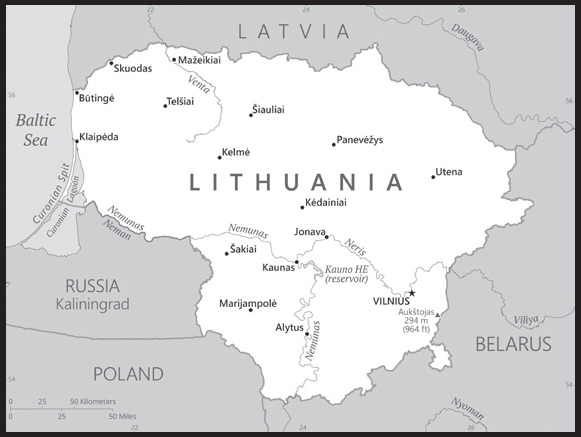
Location: Eastern Europe, bordering the Baltic Sea, between Latvia and Russia, west of Belarus
Geographic coordinates: 56 00 N, 24 00 E
Map references: Europe
Area: total: 65,300 sq km
land: 62,680 sq km
water: 2,620 sq km
comparison ranking: total 123
Area - comparative: slightly larger than West Virginia
Land boundaries: total: 1,545 km
border countries (4): Belarus 640 km; Latvia 544 km; Poland 100 km; Russia (Kaliningrad) 261 km
Coastline: 90 km
Maritime claims: territorial sea: 12 nm
Climate: transitional, between maritime and continental; wet, moderate winters and summers
Terrain: lowland, many scattered small lakes, fertile soil
Elevation: highest point: Aukstojas 294 m
lowest point: Baltic Sea 0 m
mean elevation: 110 m
Natural resources: peat, arable land, amber
Land use: agricultural land: 44.8% (2018 est.)
arable land: 34.9% (2018 est.)
permanent crops: 0.5% (2018 est.)
permanent pasture: 9.4% (2018 est.)
forest: 34.6% (2018 est.)
other: 20.6% (2018 est.)
Irrigated land: 16 sq km (2013)
Major lakes (area sq km): salt water lake(s): Curonian Lagoon (shared with Russia) - 1,620 sq km
Population distribution: fairly even population distribution throughout the country, but somewhat greater concentrations in the southern cities of Vilnius and Kaunas, and the western port of Klaipeda
Natural hazards: occasional floods, droughts
Geography - note: fertile central plains are separated by hilly uplands that are ancient glacial deposits
PEOPLE AND SOCIETY
Population: 2,655,755 (2023 est.)
comparison ranking: 142
Nationality: noun: Lithuanian(s)
adjective: Lithuanian
Ethnic groups: Lithuanian 84.6%, Polish 6.5%, Russian 5%, Belarusian 1%, other 1.1%, unspecified 1.8% (2021 est.)
Languages: Lithuanian (official) 85.3%, Russian 6.8%, Polish 5.1%, other 1.1%, two mother tongues 1.7% (2021 est.)
major-language sample(s):
Pasaulio enciklopedija – naudingas bendrosios informacijos šaltinis. (Lithuanian)
Religions: Roman Catholic 74.2%, Russian Orthodox 3.7%, Old Believer 0.6%, Evangelical Lutheran 0.6%, Evangelical Reformist 0.2%, other (including Sunni Muslim, Jewish, Greek Catholic, and Karaite) 0.9%, none 6.1%, unspecified 13.7% (2021 est.)
Age structure: 0-14 years: 15.3% (male 208,669/female 197,728)
15-64 years: 63.11% (male 821,319/female 854,763)
65 years and over: 21.59% (2023 est.) (male 197,217/female 376,059)
Dependency ratios: total dependency ratio: 55.7
youth dependency ratio: 23.6
elderly dependency ratio: 32.1
potential support ratio: 3.1 (2021 est.)
Median age: total: 44.5 years (2020)
male: 40.2 years
female: 48.2 years
comparison ranking: total 15
Population growth rate: -1.04% (2023 est.)
comparison ranking: 230
Birth rate: 9.09 births/1,000 population (2023 est.)
comparison ranking: 198
Death rate: 15.17 deaths/1,000 population (2023 est.)
comparison ranking: 1
Net migration rate: -4.34 migrant(s)/1,000 population (2023 est.)
comparison ranking: 197
Population distribution: fairly even population distribution throughout the country, but somewhat greater concentrations in the southern cities of Vilnius and Kaunas, and the western port of Klaipeda
Urbanization: urban population: 68.7% of total population (2023)
rate of urbanization: -0.12% annual rate of change (2020-25 est.)
Major urban areas - population: 541,000 VILNIUS (capital) (2023)
Sex ratio: at birth: 1.06 male(s)/female
0-14 years: 1.06 male(s)/female
15-64 years: 0.96 male(s)/female
65 years and over: 0.52 male(s)/female
total population: 0.86 male(s)/female (2023 est.)
Mother’s mean age at first birth: 28.2 years (2020 est.)
Maternal mortality ratio: 9 deaths/100,000 live births (2020 est.)
comparison ranking: 146
Infant mortality rate: total: 3.61 deaths/1,000 live births (2023 est.)
male: 4.06 deaths/1,000 live births
female: 3.12 deaths/1,000 live births
comparison ranking: total 193
Life expectancy at birth: total population: 75.95 years (2023 est.)
male: 70.62 years
female: 81.59 years
comparison ranking: total population 118
Total fertility rate: 1.61 children born/woman (2023 est.)
comparison ranking: 184
Gross reproduction rate: 0.78 (2023 est.)
Drinking water source: improved: urban: 100% of population
rural: 93.8% of population
total: 98% of population
unimproved: urban: 0% of population
rural: 6.2% of population
total: 2% of population (2020 est.)
Current health expenditure: 7.5% of GDP (2020)
Physicians density: 5.08 physicians/1,000 population (2020)
Hospital bed density: 6.4 beds/1,000 population (2018)
Sanitation facility access: improved: urban: 99.5% of population
rural: 88.7% of population
total: 96% of population
unimproved: urban: 0.5% of population
rural: 11.3% of population
total: 4% of population (2020 est.)
Major infectious diseases: degree of risk: intermediate (2023)
vectorborne diseases: tickborne encephalitis
Obesity - adult prevalence rate: 26.3% (2016)
comparison ranking: 43
Alcohol consumption per capita: total: 11.93 liters of pure alcohol (2019 est.)
beer: 4.61 liters of pure alcohol (2019 est.)
wine: 0.88 liters of pure alcohol (2019 est.)
spirits: 4.96 liters of pure alcohol (2019 est.)
other alcohols: 1.48 liters of pure alcohol (2019 est.)
comparison ranking: total 4
Tobacco use: total: 32% (2020 est.)
male: 42.1% (2020 est.)
female: 21.8% (2020 est.)
comparison ranking: total 20
Children under the age of 5 years underweight: 2.5% (2021)
comparison ranking: 97
Currently married women (ages 15-49): 53.4% (2023 est.)
Child marriage: women married by age 18: 0.3% (2021 est.)
Education expenditures: 4% of GDP (2019 est.)
comparison ranking: 116
Literacy: definition: age 15 and over can read and write
total population: 99.8%
male: 99.8%
female: 99.8% (2021)
School life expectancy (primary to tertiary education): total: 16 years
male: 16 years
female: 17 years (2020)
Youth unemployment rate (ages 15-24): total: 19% (2021 est.)
male: 18.5%
female: 19.6%
comparison ranking: total 88
ENVIRONMENT
Environment - current issues: water pollution; air pollution; deforestation; threatened animal and plant species; chemicals and waste materials released into the environment contaminate soil and groundwater; soil degradation and erosion
Environment - international agreements: party to: Air Pollution, Air Pollution-Heavy Metals, Air Pollution-Multi-effect Protocol, Air Pollution-Nitrogen Oxides, Air Pollution-Persistent Organic Pollutants, Air Pollution-Sulphur 85, Air Pollution-Sulphur 94, Air Pollution-Volatile Organic Compounds, Biodiversity, Climate Change, Climate Change-Kyoto Protocol, Climate Change-Paris Agreement, Comprehensive Nuclear Test Ban, Desertification, Endangered Species, Environmental Modification, Hazardous Wastes, Law of the Sea, Ozone Layer Protection, Ship Pollution, Tropical Timber 2006, Wetlands, Whaling
signed, but not ratified: none of the selected agreements
Climate: transitional, between maritime and continental; wet, moderate winters and summers
Land use: agricultural land: 44.8% (2018 est.)
arable land: 34.9% (2018 est.)
permanent crops: 0.5% (2018 est.)
permanent pasture: 9.4% (2018 est.)
forest: 34.6% (2018 est.)
other: 20.6% (2018 est.)
Urbanization: urban population: 68.7% of total population (2023)
rate of urbanization: -0.12% annual rate of change (2020-25 est.)
Revenue from forest resources: 0.31% of GDP (2018 est.)
comparison ranking: 80
Revenue from coal: 0% of GDP (2018 est.)
comparison ranking: 141
Air pollutants: particulate matter emissions: 10.37 micrograms per cubic meter (2019 est.)
carbon dioxide emissions: 12.96 megatons (2016 est.)
methane emissions: 3.15 megatons (2020 est.)
Waste and recycling: municipal solid waste generated annually: 1.3 million tons (2015 est.)
municipal solid waste recycled annually: 297,960 tons (2015 est.)
percent of municipal solid waste recycled: 22.9% (2015 est.)
Major lakes (area sq km): salt water lake(s): Curonian Lagoon (shared with Russia) - 1,620 sq km
Total water withdrawal: municipal: 140 million cubic meters (2020 est.)
industrial: 60 million cubic meters (2020 est.)
agricultural: 60 million cubic meters (2020 est.)
Total renewable water resources: 24.5 billion cubic meters (2020 est.)
GOVERNMENT
Country name: conventional long form: Republic of Lithuania
conventional short form: Lithuania
local long form: Lietuvos Respublika
local short form: Lietuva
former: Lithuanian Soviet Socialist Republic (while occupied by the USSR)
etymology: meaning of the name “Lietuva” remains unclear and is debated by scholars; it may derive from the Lietava, a stream in east central Lithuania
Government type: semi-presidential republic
Capital: name: Vilnius
geographic coordinates: 54 41 N, 25 19 E
time difference: UTC+2 (7 hours ahead of Washington, DC, during Standard Time)
daylight saving time: +1hr, begins last Sunday in March; ends last Sunday in October
etymology: named after the Vilnia River, which flows into the Neris River at Vilnius; the river name derives from the Lithuanian word “vilnis” meaning “a surge”
Administrative divisions: 60 municipalities (savivaldybe, singular - savivaldybe); Akmene, Alytaus Miestas, Alytus, Anksciai, Birstonas, Birzai, Druskininkai, Elektrenai, Ignalina, Jonava, Joniskis, Jurbarkas, Kaisiadorys, Kalvarija, Kauno Miestas, Kaunas, Kazlu Rudos, Kedainiai, Kelme, Klaipedos Miestas, Klaipeda, Kretinga, Kupiskis, Lazdijai, Marijampole, Mazeikiai, Moletai, Neringa, Pagegiai, Pakruojis, Palangos Miestas, Panevezio Miestas, Panevezys, Pasvalys, Plunge, Prienai, Radviliskis, Raseiniai, Rietavas, Rokiskis, Sakiai, Salcininkai, Siauliu Miestas, Siauliai, Silale, Silute, Sirvintos, Skuodas, Svencionys, Taurage, Telsiai, Trakai, Ukmerge, Utena, Varena, Vilkaviskis, Vilniaus Miestas, Vilnius, Visaginas, Zarasai
Independence: 16 February 1918 (from Soviet Russia and Germany); 11 March 1990 (declared from the Soviet Union); 6 September 1991 (recognized by the Soviet Union); notable earlier dates: 6 July 1253 (coronation of MINDAUGAS, traditional founding date); 1 July 1569 (Polish-Lithuanian Commonwealth created)
National holiday: Independence Day (or National Day), 16 February (1918); note - 16 February 1918 was the date Lithuania established its statehood and its concomitant independence from Soviet Russia and Germany; 11 March 1990 was the date it declared the restoration of Lithuanian statehood and its concomitant independence from the Soviet Union
Constitution: history: several previous; latest adopted by referendum 25 October 1992, entered into force 2 November 1992
amendments: proposed by at least one fourth of all Parliament members or by petition of at least 300,000 voters voters; passage requires two-thirds majority vote of Parliament in each of two readings three months apart and a presidential signature; amendments to constitutional articles on national sovereignty and constitutional amendment procedure also require three-fourths voter approval in a referendum; amended many times, last in 2019
Legal system: civil law system; legislative acts can be appealed to the Constitutional Court
International law organization participation: accepts compulsory ICJ jurisdiction with reservations; accepts ICCt jurisdiction
Citizenship: citizenship by birth: no
citizenship by descent only: at least one parent must be a citizen of Lithuania
dual citizenship recognized: no
residency requirement for naturalization: 10 years
Suffrage: 18 years of age; universal
Executive branch: chief of state: President Gitanas NAUSEDA (since 12 July 2019)
head of government: Prime Minister Ingrida SIMONYTE (since 24 November 2020)
cabinet: Council of Ministers nominated by the prime minister, appointed by the president, approved by Parliament
elections/appointments: president directly elected by absolute majority popular vote in 2 rounds if needed for a 5-year term (eligible for a second term); election last held on 12 and 26 May 2019 (next to be held in May 2024); prime minister appointed by the president, approved by Parliament
election results:
2019: Gitanas NAUSEDA elected president in second round; percent of vote - Gitanas NAUSEDA (independent) 66.7%, Ingrida SIMONYTE (independent) 33.3%
2014: Dalia GRYBAUSKAITE elected president; percent of vote - Dalia GRYBAUSKAITE (independent) 59.1%, Zigmantas BALCYTIS (Social Democratic Party) 40.9%
Legislative branch: description: unicameral Parliament or Seimas (141 seats; 71 members directly elected in single-seat constituencies by absolute majority vote and 70 directly elected in a single nationwide constituency by proportional representation vote; members serve 4-year terms)
elections: last held on 11 and 25 October 2020 (next to be held in October 2024)
election results: percent of vote by party - NA; seats by party - TS-LKD 50, LVZS 32, LSDP 13, LRLS 13, LP 11, DP 10, LLRA-KSS 3, LSDDP 3, LT 1, LZP 1, independent 4; composition as of April 2023 - men 101, women 40, women 28 percent
Judicial branch: highest court(s): Supreme Court (consists of 37 judges); Constitutional Court (consists of 9 judges)
judge selection and term of office: Supreme Court judges nominated by the president and appointed by the Seimas; judges serve 5-year renewable terms; Constitutional Court judges appointed by the Seimas from nominations - 3 each by the president of the republic, the Seimas chairperson, and the Supreme Court president; judges serve 9-year, nonrenewable terms; one-third of membership reconstituted every 3 years
subordinate courts: Court of Appeals; district and local courts
Political parties and leaders: Democrats for Lithuania [Saulius SKVERNELIS]
Electoral Action of Lithuanian Poles or LLRA [Valdemar TOMASEVSKI]
Freedom and Justice Party or LT [Remigijus ZEMAITAITIS] (formerly Lithuanian Freedom Union (Liberals))
Freedom Party or LP [Ausrine ARMONAITE]
Homeland Union-Lithuanian Christian Democrats or TS-LKD [Gabrielius LANDSBERGIS]
Labor Party or DP [Andrius MAZURONIS]
Lithuanian Center Party or LCP [Naglis PUTEIKIS]
Lithuanian Farmers and Greens Union or LVZS [Ramunas KARBAUSKIS]
Lithuanian Green Party or LZP [Remigijus LAPINSKAS]
Lithuanian Liberal Movement or LS or LRLS [Viktorija CMILYTE-NIELSEN]
Lithuanian List or LL [Darius KUOLYS]
Lithuanian Regions Party or LRP [Jonas PINSKUS] (formerly Lithuanian Social Democratic Labor Party or LSDDP)
Lithuanian Social Democratic Party or LSDP [Vilija BLINKEVICIUTE]
International organization participation: Australia Group, BA, BIS, CBSS, CD, CE, EAPC, EBRD, ECB, EIB, EU, FAO, IAEA, IBRD, ICAO, ICC (national committees), ICCt, ICRM, IDA, IFC, IFRCS, ILO, IMF, IMO, Interpol, IOC, IOM, IPU, ISO, ITU, ITUC (NGOs), MIGA, NATO, NIB, NSG, OAS (observer), OECD, OIF (observer), OPCW, OSCE, PCA, Schengen Convention, UN, UNCTAD, UNESCO, UNHRC, UNIDO, UNWTO, UPU, Wassenaar Arrangement, WCO, WHO, WIPO, WMO, WTO
Diplomatic representation in the US: chief of mission: Ambassador Audra PLEPYTE (since 7 July 2021)
chancery: 2622 16th Street NW, Washington, DC 20009
telephone: [1] (202) 234-5860
FAX: [1] (202) 328-0466
email address and website:
consulate(s) general: Chicago, Los Angeles, New York
Diplomatic representation from the US: chief of mission: Ambassador (vacant); Chargé d’Affaires Tamir WASER (since 12 August 2023)
embassy: Akmenu gatve 6, Vilnius, LT-03106
mailing address: 4510 Vilnius Place, Washington DC 20521-4510
telephone: [370] (5) 266-5500
FAX: [370] (5) 266-5510
email address and website:
Flag description: three equal horizontal bands of yellow (top), green, and red; yellow symbolizes golden fields, as well as the sun, light, and goodness; green represents the forests of the countryside, in addition to nature, freedom, and hope; red stands for courage and the blood spilled in defense of the homeland
National symbol(s): mounted knight known as Vytis (the Chaser), white stork; national colors: yellow, green, red
National anthem: name: “Tautiska giesme” (The National Song)
lyrics/music: Vincas KUDIRKA
note: adopted 1918, restored 1990; written in 1898 while Lithuania was a part of Russia; banned during the Soviet occupation from 1940 to 1990
National heritage: total World Heritage Sites: 5 (all cultural)
selected World Heritage Site locales: Vilnius Historic Center; Curonian Spit; Kernave Archaeological Site; Struve Geodetic Arc; Modernist Kaunas: Architecture of Optimism, 1919-1939
ECONOMY
Economic overview: high-income, EU-member, largest Baltic economy; privatized most state-owned enterprises; unmoved youth emigration; systemic corruption; issued Europe’s first bank-backed digital coin (LBCOIN); highly educated workforce; lowest EU household debt
Real GDP (purchasing power parity): $110.089 billion (2021 est.)
$103.876 billion (2020 est.)
$103.898 billion (2019 est.)
note: data are in 2017 dollars
comparison ranking: 87
Real GDP growth rate: 5.98% (2021 est.)
-0.02% (2020 est.)
4.63% (2019 est.)
comparison ranking: 74
Real GDP per capita: $39,300 (2021 est.)
$37,200 (2020 est.)
$37,200 (2019 est.)
note: data are in 2017 dollars
comparison ranking: 51
GDP (official exchange rate): $54.597 billion (2019 est.)
Inflation rate (consumer prices): 4.68% (2021 est.)
1.2% (2020 est.)
2.33% (2019 est.)
comparison ranking: 73
Credit ratings: Fitch rating: A (2020)
Moody’s rating: A3 (2015)
Standard & Poors rating: A+ (2020)
note: The year refers to the year in which the current credit rating was first obtained.
GDP - composition, by sector of origin: agriculture: 3.5% (2017 est.)
industry: 29.4% (2017 est.)
services: 67.2% (2017 est.)
comparison rankings: services 86; industry 81; agriculture 146
GDP - composition, by end use: household consumption: 63.9% (2017 est.)
government consumption: 16.6% (2017 est.)
investment in fixed capital: 18.8% (2017 est.)
investment in inventories: -1.3% (2017 est.)
exports of goods and services: 81.6% (2017 est.)
imports of goods and services: -79.3% (2017 est.)
Agricultural products: wheat, milk, sugar beets, rapeseeds, barley, triticale, potatoes, oats, peas, beans
Industries: metal-cutting machine tools, electric motors, televisions, refrigerators and freezers, petroleum refining, shipbuilding (small ships), furniture, textiles, food processing, fertilizer, agricultural machinery, optical equipment, lasers, electronic components, computers, amber jewelry, information technology, video game development, app/software development, biotechnology
Industrial production growth rate: 8.58% (2021 est.)
comparison ranking: 42
Labor force: 1.476 million (2021 est.)
comparison ranking: 133
Labor force - by occupation: agriculture: 9.1%
industry: 25.2%
services: 65.8% (2015 est.)
Unemployment rate: 7.9% (2021 est.)
8.49% (2020 est.)
6.26% (2019 est.)
comparison ranking: 97
Youth unemployment rate (ages 15-24): total: 19% (2021 est.)
male: 18.5%
female: 19.6%
comparison ranking: total 88
Population below poverty line: 20.6% (2018 est.)
Gini Index coefficient - distribution of family income: 35.3 (2019 est.)
comparison ranking: 96
Average household expenditures: on food: 21.2% of household expenditures (2018 est.)
on alcohol and tobacco: 5.9% of household expenditures (2018 est.)
Household income or consumption by percentage share: lowest 10%: 2.2%
highest 10%: 28.8% (2015)
Budget: revenues: $18.636 billion (2019 est.)
expenditures: $18.491 billion (2019 est.)
Budget surplus (+) or deficit (-): 0.5% (of GDP) (2017 est.)
comparison ranking: 38
Public debt: 53.28% of GDP (2020 est.)
42.66% of GDP (2019 est.)
39% of GDP (2018 est.)
note: official data; data cover general government debt and include debt instruments issued (or owned) by government entities other than the treasury; the data include treasury debt held by foreign entities, debt issued by subnational entities, as well as intragovernmental debt; intragovernmental debt consists of treasury borrowings from surpluses in the social funds, such as for retirement, medical care, and unemployment; debt instruments for the social funds are sold at public auctions
comparison ranking: 96
Taxes and other revenues: 19.88% (of GDP) (2020 est.)
comparison ranking: 92
Fiscal year: calendar year
Current account balance: $756.476 million (2021 est.)
$4.165 billion (2020 est.)
$1.929 billion (2019 est.)
comparison ranking: 55
Exports: $53.397 billion (2021 est.) note: data are in current year dollars
$41.721 billion (2020 est.) note: data are in current year dollars
$42.323 billion (2019 est.) note: data are in current year dollars
comparison ranking: 59
Exports - partners: Russia 10%, Latvia 9%, Germany 8%, Poland 7%, United States 6% (2021)
Exports - commodities: refined petroleum, wooden furniture, wheat, laboratory reagents, cigarettes (2021)
Imports: $50.377 billion (2021 est.) note: data are in current year dollars
$36.414 billion (2020 est.) note: data are in current year dollars
$39.419 billion (2019 est.) note: data are in current year dollars
comparison ranking: 61
Imports - partners: Poland 12%, Germany 12%, Russia 11%, Latvia 8%, Netherlands 5% (2021)
Imports - commodities: crude petroleum, cars, electricity, packaged medicines, broadcasting equipment, natural gas (2021)
Reserves of foreign exchange and gold: $5.58 billion (31 December 2021 est.)
$4.847 billion (31 December 2020 est.)
$5.085 billion (31 December 2019 est.)
comparison ranking: 99
Debt - external: $37.859 billion (2019 est.)
$41.999 billion (2018 est.)
comparison ranking: 78
Exchange rates: euros (EUR) per US dollar -
Exchange rates:: 0.845 (2021 est.)
0.876 (2020 est.)
0.893 (2019 est.)
0.847 (2018 est.)
0.885 (2017 est.)
ENERGY
Electricity access: electrification - total population: 100% (2021)
Electricity: installed generating capacity: 3.512 million kW (2020 est.)
consumption: 11.063 billion kWh (2020 est.)
exports: 4.105 billion kWh (2020 est.)
imports: 12.013 billion kWh (2020 est.)
transmission/distribution losses: 951 million kWh (2020 est.)
comparison rankings: transmission/distribution losses 114; imports 21; exports 40; consumption 96; installed generating capacity 102
Electricity generation sources: fossil fuels: 38% of total installed capacity (2020 est.)
solar: 3% of total installed capacity (2020 est.)
wind: 35.5% of total installed capacity (2020 est.)
hydroelectricity: 6.9% of total installed capacity (2020 est.)
biomass and waste: 16.7% of total installed capacity (2020 est.)
Nuclear energy: Number of operational nuclear reactors: 0
Number of nuclear reactors under construction: 0
Net capacity of operational nuclear reactors: 0GW
Percent of total electricity production: 0%
Percent of total energy produced: 0%
Number of nuclear reactors permanently shut down: 2
Coal: production: 0 metric tons (2020 est.)
consumption: 221,000 metric tons (2020 est.)
exports: 75,000 metric tons (2020 est.)
imports: 268,000 metric tons (2020 est.)
proven reserves: 0 metric tons (2019 est.)
Petroleum: total petroleum production: 4,000 bbl/day (2021 est.)
refined petroleum consumption: 68,000 bbl/day (2019 est.)
crude oil and lease condensate exports: 900 bbl/day (2018 est.)
crude oil and lease condensate imports: 194,900 bbl/day (2018 est.)
crude oil estimated reserves: 12 million barrels (2021 est.)
Refined petroleum products - production: 196,500 bbl/day (2015 est.)
comparison ranking: 51
Refined petroleum products - exports: 174,800 bbl/day (2015 est.)
comparison ranking: 32
Refined petroleum products - imports: 42,490 bbl/day (2015 est.)
comparison ranking: 87
Natural gas: production: 0 cubic meters (2021 est.)
consumption: 2.231 billion cubic meters (2019 est.)
exports: 497.923 million cubic meters (2020 est.)
imports: 2.819 billion cubic meters (2020 est.)
proven reserves: 0 cubic meters (2021 est.)
Carbon dioxide emissions: 14.503 million metric tonnes of CO2 (2019 est.)
from coal and metallurgical coke: 693,000 metric tonnes of CO2 (2019 est.)
from petroleum and other liquids: 9.488 million metric tonnes of CO2 (2019 est.)
from consumed natural gas: 4.322 million metric tonnes of CO2 (2019 est.)
comparison ranking: total emissions 96
Energy consumption per capita: 101.651 million Btu/person (2019 est.)
comparison ranking: 58
COMMUNICATIONS
Telephones - fixed lines: total subscriptions: 290,711 (2021 est.)
subscriptions per 100 inhabitants: 10 (2021 est.)
comparison ranking: total subscriptions 112
Telephones - mobile cellular: total subscriptions: 3,726,653 (2021 est.)
subscriptions per 100 inhabitants: 134 (2021 est.)
comparison ranking: total subscriptions 136
Telecommunication systems: general assessment: Lithuania’s small telecoms market is among the more advanced in Europe, particularly given the universal access to LTE infrastructure and the extensive fiber footprint; investment has been focused on fiber broadband and mobile network upgrades; SIM card penetration is relatively high for the region, with a growing proportion of subscribers being on higher-Average Revenue Per User (ARPU) contract plans; while LTE services are available nationally, operators have made steady investments in 5G; the regulator has helped the network operators to develop 5G by allowing them to repurpose spectrum in the 2.1GHz and 2.4GHz bands; the regulator in mid-2022 completed auctions of spectrum in the 700MHz and 3.4GHz bands; service obligations on the licensees include the provision of services to the five main cities by the end of 2023 (2023)
domestic: nearly 10 per 100 for fixed-line subscriptions; mobile-cellular subscriptions at 134 per 100 persons (2021)
international: country code - 370; landing points for the BCS East, BCS East-West Interlink and NordBalt connecting Lithuania to Sweden, and Latvia ; further transmission by satellite; landline connections to Latvia and Poland (2019)
Broadcast media: public broadcaster operates 3 channels with the third channel - a satellite channel - introduced in 2007; various privately owned commercial TV broadcasters operate national and multiple regional channels; many privately owned local TV stations; multi-channel cable and satellite TV services available; publicly owned broadcaster operates 3 radio networks; many privately owned commercial broadcasters, with repeater stations in various regions throughout the country
Internet country code: .lt
Internet users: total: 2.436 million (2021 est.)
percent of population: 87% (2021 est.)
comparison ranking: total 130
Broadband - fixed subscriptions: total: 796,814 (2020 est.)
subscriptions per 100 inhabitants: 29 (2020 est.)
comparison ranking: total 77
TRANSPORTATION
National air transport system: number of registered air carriers: 3 (2020)
inventory of registered aircraft operated by air carriers: 50
annual passenger traffic on registered air carriers: 26,031 (2018)
Civil aircraft registration country code prefix: LY
Airports: 61 (2021)
comparison ranking: total 80
Airports - with paved runways: 22
note: paved runways have a concrete or asphalt surface but not all have facilities for refueling, maintenance, or air traffic control; the length of a runway required for aircraft to safely operate depends on a number of factors including the type of aircraft, the takeoff weight (including passengers, cargo, and fuel), engine types, flap settings, landing speed, elevation of the airport, and average maximum daily air temperature; paved runways can reach a length of 5,000 m (16,000 ft.), but the “typical” length of a commercial airline runway is between 2,500-4,000 m (8,000-13,000 ft.)
Airports - with unpaved runways: 39
note: unpaved runways have a surface composition such as grass or packed earth and are most suited to the operation of light aircraft; unpaved runways are usually short, often less than 1,000 m (3,280 ft.) in length; airports with unpaved runways often lack facilities for refueling, maintenance, or air traffic control
Pipelines: 1,921 km gas, 121 km refined products (2013)
Railways: total: 1,911 km (2020) 152 km electrified
comparison ranking: total 74
Roadways: total: 84,166 km (2012)
paved: 72,297 km (2012) (includes 312 km of expressways)
unpaved: 11,869 km (2012)
comparison ranking: total 58
Waterways: 441 km (2007) (navigable year-round)
comparison ranking: 94
Merchant marine: total: 62 (2022)
by type: container ship 4, general cargo 22, oil tanker 2, other 34
comparison ranking: total 112
Ports and terminals: major seaport(s): Klaipeda
oil terminal(s): Butinge oil terminal
LNG terminal(s) (import): Klaipeda
MILITARY AND SECURITY
Military and security forces: Lithuanian Armed Forces (Lietuvos Ginkluotosios Pajegos): Land Forces (Sausumos Pajegos), Naval Forces (Karines Juru Pajegos), Air Forces (Karines Oro Pajegos), Special Operations Forces (Specialiuju Operaciju Pajegos); National Defense Volunteer Forces (Krašto Apsaugos Savanorių Pajegos or KASP); National Riflemen’s Union (Lietuvos šaulių sąjunga) (2023)
note 1: the National Rifleman’s Union is a civilian paramilitary organization supported by the Lithuanian Government that cooperates with the military but is not part of it; however, in a state of war, its armed formations would fall under the armed forces
note 2: the Lithuanian Police and State Border Guard Service are under the Ministry of Interior; in wartime, the State Border Guard Service becomes part of the armed forces
Military expenditures: 2.5% of GDP (2023 est.)
2.5% of GDP (2022 est.)
2% of GDP (2021)
2.1% of GDP (2020)
2% of GDP (2019) (approximately $1.7 billion)
comparison ranking: 43
Military and security service personnel strengths: approximately 17,000 active-duty personnel (13,000 Army, including about 5,000 National Defense Voluntary Forces and 2,500 conscripts); 500 Navy; 1,000 Air Force; 2,500 other, including special operations forces, logistics support, training, etc) (2023)
Military equipment inventories and acquisitions: the military’s inventory is a mix of Soviet-era and more modern European and US equipment; Germany and the US have been the leading suppliers in recent years (2023)
Military service age and obligation: 19-26 years of age for conscripted military service for men; 9-month service obligation; in 2015, Lithuania reinstated conscription after having converted to a professional military in 2008; 18-38 for voluntary service for men and women (2023)
note 1: Lithuania conscripts up to 4,000 males each year; conscripts are selected using an automated lottery system
note 2: as of 2020, women comprised about 12% of the military’s full-time personnel
Military deployments: note: contributes about 350-550 troops to the Lithuania, Poland, and Ukraine joint military brigade (LITPOLUKRBRIG), which was established in 2014; the brigade is headquartered in Poland and is comprised of an international staff, three battalions, and specialized units; units affiliated with the multinational brigade remain within the structures of the armed forces of their respective countries until the brigade is activated for participation in an international operation
Military - note: the Lithuanian Armed Forces are responsible for the defense of the country’s interests, sovereignty, and territory, fulfilling Lithuania’s commitments to NATO and European security, and contributing to UN international peacekeeping efforts; Russia is Lithuania’s primary security focus, which has only increased since the Russian seizure of Crimea in 2014 and subsequent full-scale attack on Ukraine in 2022; Lithuania has been a member of NATO since 2004 and is reliant on the Alliance as the country’s security guarantor; it is actively engaged in both NATO and EU security, as well as bilaterally with allies such as the other Baltic States, Germany, Poland, the UK, Ukraine, and the US; the Lithuanian military has participated in NATO and EU missions abroad and regularly conducts training and exercises with NATO and EU partner forces; it hosts NATO forces, is a member of the UK-led Joint Expeditionary Force, and contributes troops to a multinational brigade with Poland and Ukraine; Lithuania participated in its first UN peacekeeping mission in 1994
the Land Forces form the backbone of the country’s defense force; the active Land Forces comprise a mechanized infantry brigade and a motorized infantry brigade; they are supplemented by the part-time National Defense Volunteer Forces, which are organized into six district-based territorial units; since 2017, Lithuania has hosted a German-led multinational NATO ground force battlegroup as part of the Alliance’s Enhanced Forward Presence initiative
Lithuania has no combat aircraft but has a ground air defense unit, and NATO has provided air protection for Lithuania since 2004 through its Air Policing mission; NATO member countries that possess air combat capabilities voluntarily contribute to the mission on four-month rotations; NATO fighter aircraft are hosted at Lithuania’s Šiauliai Air Base; Lithuania’s Naval Forces have small patrol vessel and mine warfare squadrons; the Special Operations Forces have air, ground, and naval units for missions such as counterterrorism, direct action, hostage rescue, military assistance, and reconnaissance (2023)
SPACE
Space agency/agencies: Lithuanian Space Office (established 2019; operates under the Agency for Science, Innovation and Technology and focuses on developing links between Lithuanian space business, science, and public sectors, as well as the international space community); Lithuanian Space Association (established 2009; is an association of public and state-funded scientific and technology research institutes and private businesses behind much of Lithuania’s space program, including satellite development and ties to international space programs) (2023)
Space program overview: has a small but growing space program; operates satellites; manufactures small satellites; conducts research and development of other space-related capabilities, including in propulsion system components, infrared-based technologies, remote sensing applications, opto-electronics, and radio frequency systems, as well as those related to astronomy (has one of the oldest observatories in Europe located in Vilnius) and space applications for life and physical sciences; participates in international space programs; associate member of the European Space Agency (ESA); has cooperated with space agencies and industries of China, India, Russia, Ukraine, and the US, as well as individual ESA/EU member states; has a small commercial space sector that participates in space supply chains and small satellite production (2023)
note: further details about the key activities, programs, and milestones of the country’s space program, as well as government spending estimates on the space sector, appear in Appendix S
TRANSNATIONAL ISSUES
Disputes - international: Lithuania-Belarus: as of January 2007, ground demarcation of the boundary with Belarus was complete and mapped with final ratification documents in preparation
Lithuania-Lativa: boundary demarcated with Latvia was completed in 1998
Lithuania-Russia: Lithuania and Russia committed to demarcating their boundary in 2006 in accordance with the land and maritime treaty ratified by Russia in May 2003 and by Lithuania in 1999; Lithuania operates a simplified transit regime for Russian nationals traveling from the Kaliningrad coastal exclave into Russia, while still conforming, as a EU member state having an external border with a non-EU member, to strict Schengen border rules; in January 2018, demarcation of the Lithuania-Russia border was completed
Refugees and internally displaced persons: refugees (country of origin): 50,690 (Ukraine) (as of 10 November 2023)
stateless persons: 2,720 (2022)
Illicit drugs: source country for amphetamine tablets
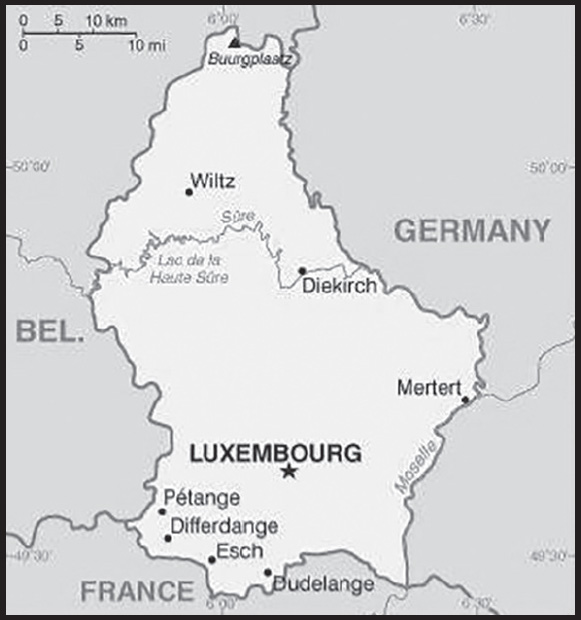
INTRODUCTION
Background: Founded in 963, Luxembourg became a grand duchy in 1815 and an independent state under the Netherlands. It lost more than half of its territory to Belgium in 1839 but gained a larger measure of autonomy. In 1867, Luxembourg attained full independence under the condition that it promise perpetual neutrality. Overrun by Germany in both world wars, it ended its neutrality in 1948 when it entered into the Benelux Customs Union and when it joined NATO the following year. In 1957, Luxembourg became one of the six founding countries of the EEC (later the EU), and in 1999 it joined the euro currency zone.
GEOGRAPHY
Location: Western Europe, between France and Germany
Geographic coordinates: 49 45 N, 6 10 E
Map references: Europe
Area: total: 2,586 sq km
land: 2,586 sq km
water: 0 sq km
comparison ranking: total 178
Area - comparative: slightly smaller than Rhode Island; about half the size of Delaware
Land boundaries: total: 327 km
border countries (3): Belgium 130 km; France 69 km; Germany 128 km
Coastline: 0 km (landlocked)
Maritime claims: none (landlocked)
Climate: modified continental with mild winters, cool summers
Terrain: mostly gently rolling uplands with broad, shallow valleys; uplands to slightly mountainous in the north; steep slope down to Moselle flood plain in the southeast
Elevation: highest point: Buurgplaatz 559 m
lowest point: Moselle River 133 m
mean elevation: 325 m
Natural resources: iron ore (no longer exploited), arable land
Land use: agricultural land: 50.7% (2018 est.)
arable land: 24% (2018 est.)
permanent crops: 0.6% (2018 est.)
permanent pasture: 26.1% (2018 est.)
forest: 33.5% (2018 est.)
other: 15.8% (2018 est.)
Irrigated land: 0 sq km (2012)
Major watersheds (area sq km): Atlantic Ocean drainage: Rhine-Maas (198,735 sq km)
Population distribution: most people live in the south, on or near the border with France
Natural hazards: occasional flooding
Geography - note: landlocked; the only grand duchy in the world
PEOPLE AND SOCIETY
Population: 660,924 (2023 est.)
comparison ranking: 168
Nationality: noun: Luxembourger(s)
adjective: Luxembourg
Ethnic groups: Luxembourger 52.9%, Portuguese 14.5%, French 7.6%, Italian 3.7%, Belgian 3%, German 2%, Spanish 1.3%, Romania 1%, other 14% (2022 est.)
note: data represent population by nationality
Languages: Luxembourgish (official administrative and judicial language and national language (spoken vernacular)) 55.8%, Portuguese 15.7%, French (official administrative, judicial, and legislative language) 12.1%, German (official administrative and judicial language) 3.1%, Italian 2.9%, English 2.1%, other 8.4% (2011 est.)
Religions: Christian (predominantly Roman Catholic) 70.6%, Muslim 2.3%, other (includes Buddhist, folk religions, Hindu, Jewish) 0.4%, unaffiliated 26.7% (2020 est.)
Age structure: 0-14 years: 16.73% (male 57,006/female 53,593)
15-64 years: 67.38% (male 228,427/female 216,912)
65 years and over: 15.88% (2023 est.) (male 47,951/female 57,035)
Dependency ratios: total dependency ratio: 44.2
youth dependency ratio: 23
elderly dependency ratio: 21.3
potential support ratio: 4.7 (2021 est.)
Median age: total: 39.5 years (2020)
male: 38.9 years
female: 40 years
comparison ranking: total 57
Population growth rate: 1.58% (2023 est.)
comparison ranking: 60
Birth rate: 11.59 births/1,000 population (2023 est.)
comparison ranking: 160
Death rate: 7.17 deaths/1,000 population (2023 est.)
comparison ranking: 113
Net migration rate: 11.39 migrant(s)/1,000 population (2023 est.)
comparison ranking: 7
Population distribution: most people live in the south, on or near the border with France
Urbanization: urban population: 92.1% of total population (2023)
rate of urbanization: 1.43% annual rate of change (2020-25 est.)
Major urban areas - population: 120,000 LUXEMBOURG (capital) (2018)
Sex ratio: at birth: 1.06 male(s)/female
0-14 years: 1.06 male(s)/female
15-64 years: 1.05 male(s)/female
65 years and over: 0.84 male(s)/female
total population: 1.02 male(s)/female (2023 est.)
Mother’s mean age at first birth: 31 years (2020 est.)
Maternal mortality ratio: 6 deaths/100,000 live births (2020 est.)
comparison ranking: 159
Infant mortality rate: total: 3.21 deaths/1,000 live births (2023 est.)
male: 3.6 deaths/1,000 live births
female: 2.79 deaths/1,000 live births
comparison ranking: total 204
Life expectancy at birth: total population: 83.17 years (2023 est.)
male: 80.73 years
female: 85.76 years
comparison ranking: total population 15
Total fertility rate: 1.63 children born/woman (2023 est.)
comparison ranking: 178
Gross reproduction rate: 0.79 (2023 est.)
Drinking water source: improved: urban: 100% of population
rural: 98.6% of population
total: 99.9% of population
unimproved: urban: 0% of population
rural: 1.4% of population
total: 0.1% of population (2020 est.)
Current health expenditure: 5.8% of GDP (2020)
Physicians density: 3.01 physicians/1,000 population (2017)
Hospital bed density: 4.3 beds/1,000 population (2019)
Sanitation facility access: improved: urban: 100% of population
rural: 99.9% of population
total: 100% of population
unimproved: urban: 0% of population
rural: 0.1% of population
total: 0% of population (2020 est.)
Obesity - adult prevalence rate: 22.6% (2016)
comparison ranking: 74
Alcohol consumption per capita: total: 11 liters of pure alcohol (2019 est.)
beer: 4.04 liters of pure alcohol (2019 est.)
wine: 4.73 liters of pure alcohol (2019 est.)
spirits: 2.14 liters of pure alcohol (2019 est.)
other alcohols: 0 liters of pure alcohol (2019 est.)
comparison ranking: total 11
Tobacco use: total: 21.1% (2020 est.)
male: 22.4% (2020 est.)
female: 19.8% (2020 est.)
comparison ranking: total 78
Currently married women (ages 15-49): 51.4% (2023 est.)
Education expenditures: 5% of GDP (2020 est.)
comparison ranking: 78
School life expectancy (primary to tertiary education): total: 15 years
male: 15 years
female: 15 years (2020)
Youth unemployment rate (ages 15-24): total: 15.2% (2021 est.)
male: 16.3%
female: 14.1%
comparison ranking: total 116
ENVIRONMENT
Environment - current issues: air and water pollution in urban areas, soil pollution of farmland; unsustainable patterns of consumption (transport, energy, recreation, space) threaten biodiversity and landscapes
Environment - international agreements: party to: Air Pollution, Air Pollution-Heavy Metals, Air Pollution-Multi-effect Protocol, Air Pollution-Nitrogen Oxides, Air Pollution-Persistent Organic Pollutants, Air Pollution-Sulphur 85, Air Pollution-Sulphur 94, Air Pollution-Volatile Organic Compounds, Biodiversity, Climate Change, Climate Change-Kyoto Protocol, Climate Change-Paris Agreement, Comprehensive Nuclear Test Ban, Desertification, Endangered Species, Hazardous Wastes, Law of the Sea, Marine Dumping-London Convention, Marine Dumping-London Protocol, Nuclear Test Ban, Ozone Layer Protection, Ship Pollution, Tropical Timber 2006, Wetlands, Whaling
signed, but not ratified: Environmental Modification
Climate: modified continental with mild winters, cool summers
Land use: agricultural land: 50.7% (2018 est.)
arable land: 24% (2018 est.)
permanent crops: 0.6% (2018 est.)
permanent pasture: 26.1% (2018 est.)
forest: 33.5% (2018 est.)
other: 15.8% (2018 est.)
Urbanization: urban population: 92.1% of total population (2023)
rate of urbanization: 1.43% annual rate of change (2020-25 est.)
Revenue from forest resources: 0.01% of GDP (2018 est.)
comparison ranking: 155
Revenue from coal: 0% of GDP (2018 est.)
comparison ranking: 81
Air pollutants: particulate matter emissions: 8.89 micrograms per cubic meter (2019 est.)
carbon dioxide emissions: 8.99 megatons (2016 est.)
methane emissions: 0.61 megatons (2020 est.)
Waste and recycling: municipal solid waste generated annually: 356,000 tons (2015 est.)
municipal solid waste recycled annually: 100,997 tons (2015 est.)
percent of municipal solid waste recycled: 28.4% (2015 est.)
Major watersheds (area sq km): Atlantic Ocean drainage: Rhine-Maas (198,735 sq km)
Total water withdrawal: municipal: 50 million cubic meters (2020 est.)
industrial: 1.6 million cubic meters (2017 est.)
agricultural: 400,000 cubic meters (2017 est.)
Total renewable water resources: 3.5 billion cubic meters (2020 est.)
GOVERNMENT
Country name: conventional long form: Grand Duchy of Luxembourg
conventional short form: Luxembourg
local long form: Grand Duche de Luxembourg
local short form: Luxembourg
etymology: the name derives from the Celtic “lucilem” (little) and the German “burg” (castle or fortress) to produce the meaning of the “little castle”; the name is actually ironic, since for centuries the Fortress of Luxembourg was one of Europe’s most formidable fortifications; the name passed to the surrounding city and then to the country itself
Government type: constitutional monarchy
Capital: name: Luxembourg
geographic coordinates: 49 36 N, 6 07 E
time difference: UTC+1 (6 hours ahead of Washington, DC, during Standard Time)
daylight saving time: +1hr, begins last Sunday in March; ends last Sunday in October
etymology: the name derives from the Celtic lucilem (little) and the German burg (castle or fortress) to produce the meaning of the “little castle”; the name is actually ironic, since for centuries the Fortress of Luxembourg was one of Europe’s most formidable fortifications; the name passed to the city that grew around the fortress
Administrative divisions: 12 cantons (cantons, singular - canton); Capellen, Clervaux, Diekirch, Echternach, Esch-sur-Alzette, Grevenmacher, Luxembourg, Mersch, Redange, Remich, Vianden, Wiltz
Independence: 1839 (from the Netherlands)
National holiday: National Day (birthday of Grand Duke HENRI), 23 June; note - this date of birth is not the true date of birth for any of the Royals, but the national festivities were shifted in 1962 to allow observance during a more favorable time of year
Constitution: history: previous 1842 (heavily amended 1848, 1856); latest effective 17 October 1868
amendments: proposed by the Chamber of Deputies or by the monarch to the Chamber; passage requires at least two- thirds majority vote by the Chamber in two successive readings three months apart; a referendum can be substituted for the second reading if approved by more than a quarter of the Chamber members or by 25,000 valid voters; adoption by referendum requires a majority of all valid voters; amended many times, last in 2020
Legal system: civil law system
International law organization participation: accepts compulsory ICJ jurisdiction; accepts ICCt jurisdiction
Citizenship: citizenship by birth: limited to situations where the parents are either unknown, stateless, or when the nationality law of the parents’ state of origin does not permit acquisition of citizenship by descent when the birth occurs outside of national territory
citizenship by descent only: at least one parent must be a citizen of Luxembourg
dual citizenship recognized: yes
residency requirement for naturalization: 7 years
Suffrage: 18 years of age; universal and compulsory
Executive branch: chief of state: Grand Duke HENRI (since 7 October 2000); Heir Apparent Prince GUILLAUME (son of the monarch, born 11 November 1981)
head of government: Prime Minister Luc FRIEDEN (since 17 November 2023); Deputy Prime Minister Xavier BETTEL (since 17 November 2023)
cabinet: Council of Ministers recommended by the prime minister, appointed by the monarch
elections/appointments: the monarchy is hereditary; following elections to the Chamber of Deputies, the leader of the majority party or majority coalition usually appointed prime minister by the monarch; deputy prime minister appointed by the monarch; prime minister and deputy prime minister are responsible to the Chamber of Deputies
Legislative branch: description: unicameral Chamber of Deputies or Chambre des Deputes (60 seats; members directly elected in multiseat constituencies by party-list proportional representation vote; members serve 5-year terms); note - a 21-member Council of State appointed by the Grand Duke on the advice of the prime minister serves as an advisory body to the Chamber of Deputies
elections: last held on 8 October 2023 (next to be held by 31 October 2028)
election results: percent of vote by party - CSV 29.2%, LSAP 18.9%, DP 18.7%, ADR 9.3%, Green Party 8.6%, Pirate Party 6.7%, The Left 3.9%; seats by party - CSV 21, DP 14, LSAP 11, ADR 5, Green Party 4, Pirate Party 3, The Left 2; composition (as of October 2023) - men 42, women 18, percent of women 30%
Judicial branch: highest court(s): Supreme Court of Justice includes Court of Appeal and Court of Cassation (consists of 27 judges on 9 benches); Constitutional Court (consists of 9 members)
judge selection and term of office: judges of both courts appointed by the monarch for life
subordinate courts: Court of Accounts; district and local tribunals and courts
Political parties and leaders: Alternative Democratic Reform Party or ADR [Fred KEUP]
Christian Social People’s Party or CSV [Claude WISELER]
Democratic Party or DP [Lex DELLES]
Green Party [Djuna BERNARD, Meris SEHOVIC]
Luxembourg Socialist Workers’ Party or LSAP [Dan BIANCALANA, Francine CLOSENER]
Pirate Party [Starsky FLOR, Rebecca LAU]
The Left (dei Lenk/la Gauche) [collective leadership, Central Committee]
International organization participation: ADB (nonregional member), Australia Group, Benelux, BIS, CD, CE, EAPC, EBRD, ECB, EIB, EMU, ESA, EU, FAO, FATF, IAEA, IBRD, ICAO, ICC (national committees), ICCt, ICRM, IDA, IEA, IFAD, IFC, IFRCS, ILO, IMF, IMO, Interpol, IOC, IOM, IPU, ISO, ITSO, ITU, ITUC (NGOs), MIGA, NATO, NEA, NSG, OAS (observer), OECD, OIF, OPCW, OSCE, PCA, Schengen Convention, UN, UNCTAD, UNESCO, UNHCR, UNHRC, UNIDO, UNRWA, UPU, Wassenaar Arrangement, WCO, WHO, WIPO, WMO, WTO, ZC
Diplomatic representation in the US: chief of mission: Ambassador Nicole BINTNER-BAKSHIAN (since 15 August 2021)
chancery: 2200 Massachusetts Avenue NW, Washington, DC 20008
telephone: [1] (202) 265-4171
FAX: [1] (202) 328-8270
email address and website:
https://washington.mae.lu/en.html
consulate(s) general: New York, San Francisco
Diplomatic representation from the US: chief of mission: Ambassador Thomas M. BARRETT (since 10 February 2022)
embassy: 22 Boulevard Emmanuel Servais, L-2535 Luxembourg City
mailing address: 5380 Luxembourg Place, Washington DC 20521-5380
telephone: [352] 46-01-23-00
FAX: [352] 46-14-01
email address and website: Luxembourgconsular@state.gov
Flag description: three equal horizontal bands of red (top), white, and light blue; similar to the flag of the Netherlands, which uses a darker blue and is shorter; the coloring is derived from the Grand Duke’s coat of arms (a red lion on a white and blue striped field)
National symbol(s): red, rampant lion; national colors: red, white, light blue
National anthem: name: “Ons Heemecht” (Our Motherland); “De Wilhelmus” (The William)
lyrics/music: Michel LENTZ/Jean-Antoine ZINNEN; Nikolaus WELTER/unknown
note: “Ons Heemecht,” adopted 1864, is the national anthem, while “De Wilhelmus,” adopted 1919, serves as a royal anthem for use when members of the grand ducal family enter or exit a ceremony in Luxembourg
National heritage: total World Heritage Sites: 1 (cultural)
selected World Heritage Site locales: Luxembourg City Old Quarters and Fortifications
ECONOMY
Economic overview: high-income, EU-member European economy; global financial and information storage leader; high government spending; one of highest GDP per capita countries; unique audit accountancy based on company sizing; aging labor force; hit by COVID-19
Real GDP (purchasing power parity): $74.045 billion (2021 est.)
$70.45 billion (2020 est.)
$71.016 billion (2019 est.)
note: data are in 2017 dollars
comparison ranking: 99
Real GDP growth rate: 5.1% (2021 est.)
-0.8% (2020 est.)
2.32% (2019 est.)
comparison ranking: 88
Real GDP per capita: $115,700 (2021 est.)
$111,800 (2020 est.)
$114,500 (2019 est.)
note: data are in 2017 dollars
comparison ranking: 3
GDP (official exchange rate): $71.089 billion (2019 est.)
Inflation rate (consumer prices): 2.53% (2021 est.)
0.82% (2020 est.)
1.74% (2019 est.)
comparison ranking: 133
Credit ratings: Fitch rating: AAA (1994)
Moody’s rating: Aaa (1989)
Standard & Poors rating: AAA (1994)
note: The year refers to the year in which the current credit rating was first obtained.
GDP - composition, by sector of origin: agriculture: 0.3% (2017 est.)
industry: 12.8% (2017 est.)
services: 86.9% (2017 est.)
comparison rankings: services 14; industry 195; agriculture 214
GDP - composition, by end use: household consumption: 30.2% (2017 est.)
government consumption: 16.5% (2017 est.)
investment in fixed capital: 16.2% (2017 est.)
investment in inventories: 1.1% (2017 est.)
exports of goods and services: 230% (2017 est.)
imports of goods and services: -194% (2017 est.)
Agricultural products: milk, wheat, barley, triticale, potatoes, pork, beef, grapes, rapeseed, oats
Industries: banking and financial services, construction, real estate services, iron, metals, and steel, information technology, telecommunications, cargo transportation and logistics, chemicals, engineering, tires, glass, aluminum, tourism, biotechnology
Industrial production growth rate: 2.87% (2021 est.)
comparison ranking: 125
Labor force: 333,900 (2021 est.)
note: data exclude foreign workers; in addition to the figure for domestic labor force, about 150,000 workers commute daily from France, Belgium, and Germany
comparison ranking: 166
Labor force - by occupation: agriculture: 1.1%
industry: 20%
services: 78.9% (2013 est.)
Unemployment rate: 5.23% (2021 est.)
6.77% (2020 est.)
5.59% (2019 est.)
comparison ranking: 144
Youth unemployment rate (ages 15-24): total: 15.2% (2021 est.)
male: 16.3%
female: 14.1%
comparison ranking: total 116
Population below poverty line: 17.5% (2018 est.)
Gini Index coefficient - distribution of family income: 34.2 (2019 est.)
comparison ranking: 113
Household income or consumption by percentage share: lowest 10%: 3.5%
highest 10%: 23.8% (2000)
Budget: revenues: $31.74 billion (2019 est.)
expenditures: $30.014 billion (2019 est.)
Budget surplus (+) or deficit (-): 1.5% (of GDP) (2017 est.)
comparison ranking: 22
Public debt: 23% of GDP (2017 est.)
20.8% of GDP (2016 est.)
note: data cover general government debt and include debt instruments issued (or owned) by government entities other than the treasury; the data include treasury debt held by foreign entities; the data include debt issued by subnational entities, as well as intragovernmental debt; intragovernmental debt consists of treasury borrowings from surpluses in the social funds, such as for retirement, medical care, and unemployment; debt instruments for the social funds are not sold at public auctions
comparison ranking: 184
Taxes and other revenues: 25.13% (of GDP) (2020 est.)
comparison ranking: 48
Fiscal year: calendar year
Current account balance: $4.141 billion (2021 est.)
$3.496 billion (2020 est.)
$2.459 billion (2019 est.)
comparison ranking: 34
Exports: $177.831 billion (2021 est.) note: data are in current year dollars
$145.417 billion (2020 est.) note: data are in current year dollars
$139.559 billion (2019 est.) note: data are in current year dollars
comparison ranking: 36
Exports - partners: Germany 23%, France 13%, Belgium 12%, Netherlands 6%, Italy 5% (2019)
Exports - commodities: iron products, cars and vehicle parts, tires, gas turbines, adhesive plastics (2021)
Imports: $148.15 billion (2021 est.) note: data are in current year dollars
$121.328 billion (2020 est.) note: data are in current year dollars
$116.803 billion (2019 est.) note: data are in current year dollars
comparison ranking: 35
Imports - partners: Belgium 27%, Germany 24%, France 11%, Netherlands 5% (2019)
Imports - commodities: cars, refined petroleum, broadcasting equipment, scrap iron, aircraft (2019)
Reserves of foreign exchange and gold: $2.921 billion (31 December 2021 est.)
$1.119 billion (31 December 2020 est.)
$1.055 billion (31 December 2019 est.)
comparison ranking: 120
Debt - external: $4,266,792,000,000 (2019 est.)
$4,581,617,000,000 (2018 est.)
comparison ranking: 6
Exchange rates: euros (EUR) per US dollar -
Exchange rates:: 0.845 (2021 est.)
0.876 (2020 est.)
0.893 (2019 est.)
0.847 (2018 est.)
0.885 (2017 est.)
ENERGY
Electricity access: electrification - total population: 100% (2021)
Electricity: installed generating capacity: 1.899 million kW (2020 est.)
consumption: 6.188 billion kWh (2020 est.)
exports: 1.079 billion kWh (2020 est.)
imports: 6.543 billion kWh (2020 est.)
transmission/distribution losses: 156 million kWh (2020 est.)
comparison rankings: transmission/distribution losses 152; imports 35; exports 59; consumption 117; installed generating capacity 120
Electricity generation sources: fossil fuels: 13.8% of total installed capacity (2020 est.)
solar: 14.6% of total installed capacity (2020 est.)
wind: 27.7% of total installed capacity (2020 est.)
hydroelectricity: 7.5% of total installed capacity (2020 est.)
biomass and waste: 36.4% of total installed capacity (2020 est.)
Coal: production: 0 metric tons (2020 est.)
consumption: 65,000 metric tons (2020 est.)
exports: 0 metric tons (2020 est.)
imports: 74,000 metric tons (2020 est.)
proven reserves: 0 metric tons (2019 est.)
Petroleum: total petroleum production: 0 bbl/day (2021 est.)
refined petroleum consumption: 63,900 bbl/day (2019 est.)
Refined petroleum products - imports: 59,020 bbl/day (2017 est.)
comparison ranking: 73
Natural gas: production: 0 cubic meters (2021 est.)
consumption: 776.022 million cubic meters (2019 est.)
exports: 0 cubic meters (2021 est.)
imports: 772.624 million cubic meters (2019 est.)
proven reserves: 0 cubic meters (2021 est.)
Carbon dioxide emissions: 11.308 million metric tonnes of CO2 (2019 est.)
from coal and metallurgical coke: 149,000 metric tonnes of CO2 (2019 est.)
from petroleum and other liquids: 9.564 million metric tonnes of CO2 (2019 est.)
from consumed natural gas: 1.594 million metric tonnes of CO2 (2019 est.)
comparison ranking: total emissions 102
Energy consumption per capita: 310.068 million Btu/person (2019 est.)
comparison ranking: 10
COMMUNICATIONS
Telephones - fixed lines: total subscriptions: 270,000 (2021 est.)
subscriptions per 100 inhabitants: 42 (2021 est.)
comparison ranking: total subscriptions 113
Telephones - mobile cellular: total subscriptions: 880,000 (2021 est.)
subscriptions per 100 inhabitants: 140 (2021 est.)
comparison ranking: total subscriptions 165
Telecommunication systems: general assessment: Luxembourg has a small telecom sector; there remains some pressure from regulatory measures, though no further reductions to fixed and mobile interconnection tariffs have been imposed through to 2024; high mobile penetration has slowed subscriber growth in the mobile market since 2005, though a recent law requiring SIM card registration has not had an adverse effect on the number of mobile subscribers despite network operators deactivating unregistered cards (2021)
domestic: fixed-line teledensity about 42 per 100 persons; 140 per 100 mobile-cellular subscriptions (2021)
international: country code - 352
Broadcast media: Luxembourg has a long tradition of operating radio and TV services for pan-European audiences and is home to Europe’s largest privately owned broadcast media group, the RTL Group, which operates 46 TV stations and 29 radio stations in Europe; also home to Europe’s largest satellite operator, Societe Europeenne des Satellites (SES); domestically, the RTL Group operates TV and radio networks; other domestic private radio and TV operators and French and German stations available; satellite and cable TV services available
Internet country code: .lu
Internet users: total: 633,600 (2021 est.)
percent of population: 99% (2021 est.)
comparison ranking: total 163
Broadband - fixed subscriptions: total: 235,155 (2020 est.)
subscriptions per 100 inhabitants: 38 (2020 est.)
comparison ranking: total 113
TRANSPORTATION
National air transport system: number of registered air carriers: 4 (2020)
inventory of registered aircraft operated by air carriers: 66
annual passenger traffic on registered air carriers: 2,099,102 (2018)
annual freight traffic on registered air carriers: 7,323,040,000 (2018) mt-km
Civil aircraft registration country code prefix: LX
Airports: 2 (2021)
comparison ranking: total 206
Airports - with paved runways: 1
note: paved runways have a concrete or asphalt surface but not all have facilities for refueling, maintenance, or air traffic control; the length of a runway required for aircraft to safely operate depends on a number of factors including the type of aircraft, the takeoff weight (including passengers, cargo, and fuel), engine types, flap settings, landing speed, elevation of the airport, and average maximum daily air temperature; paved runways can reach a length of 5,000 m (16,000 ft.), but the “typical” length of a commercial airline runway is between 2,500-4,000 m (8,000-13,000 ft.)
Airports - with unpaved runways: 1
note: unpaved runways have a surface composition such as grass or packed earth and are most suited to the operation of light aircraft; unpaved runways are usually short, often less than 1,000 m (3,280 ft.) in length; airports with unpaved runways often lack facilities for refueling, maintenance, or air traffic control
Heliports: 1 (2021)
Pipelines: 142 km gas, 27 km refined products (2013)
Railways: total: 271 km (2020) 262 km electrified
comparison ranking: total 125
Roadways: total: 2,875 km (2019)
paved: (2011)
comparison ranking: total 166
Waterways: 37 km (2010) (on Moselle River)
comparison ranking: 115
Merchant marine: total: 149 (2022)
by type: bulk carrier 4, container ship 1, general cargo 27, oil tanker 3, other 114
comparison ranking: total 74
Ports and terminals: river port(s): Mertert (Moselle)
MILITARY AND SECURITY
Military and security forces: Luxembourg Army (l’Armée Luxembourgeoise) (2023)
note: the Grand Ducal Police maintain internal security and report to the Ministry of Internal Security
Military expenditures: 0.7% of GDP (2023 est.)
0.6% of GDP (2022 est.)
0.5% of GDP (2021)
0.6% of GDP (2020)
0.6% of GDP (2019)
comparison ranking: 149
Military and security service personnel strengths: approximately 900 active personnel (2023)
Military equipment inventories and acquisitions: the inventory of Luxembourg’s Army is a small mix of Western origin equipment (2023)
Military service age and obligation: 18-26 years of age for voluntary military service for men and women; no conscription (abolished 1969) (2023)
note 1: since 2003, the Army has allowed EU citizens 18-24 years of age who have been a resident in the country for at least 36 months to volunteer
note 2: 2023, women made up about 12% of the military’s full-time personnel
Military - note: founded in 1881, the Luxembourg Army is responsible for the defense of the country and fulfilling the Grand Duchy’s commitments to NATO, European security, and international peacekeeping, as well as providing support to civil authorities in the event of emergencies, such as floods or disease outbreaks; the Army is an active participant in EU, NATO, and UN missions and has contributed small numbers of troops to multinational operations in such places as Afghanistan, Bosnia and Herzegovina, Chad, Croatia, the Democratic Republic of the Congo, Iraq, Kosovo, Lebanon, North Macedonia, Mali, Mozambique, and Uganda; it trains and exercises regularly with EU and NATO partners and has contributed to the NATO battlegroup forward deployed in Lithuania since 2017; Luxembourg was one of the original 12 countries to sign the North Atlantic Treaty (also known as the Washington Treaty) establishing NATO in 1949
the combat forces of the Luxembourg Army are two companies of infantry and reconnaissance troops; the Army has no combat aircraft; in 2015, Belgium, the Netherlands, and Luxembourg signed an agreement to conduct joint air policing of their territories; under the agreement, which went into effect in January 2017, the Belgian and Dutch Air Forces trade responsibility for patrolling the skies over the three countries (2023)
SPACE
Space agency/agencies: the Luxembourg Space Agency (LSA; established 2018) (2023)
Space program overview: aims to be the commercial space hub for Europe; LSA established largely to develop space policy, encourage and coordinate commercial space ventures, support space education, and to promote the country’s space-related capabilities internationally; has set up policy and funding initiatives aimed at encouraging innovation and entrepreneurship and attracting space-based industries; focused on developing commercial satellites and infrastructure (Luxembourg is home to some of the largest commercial satellite companies in the world), as well as other space sector capabilities and technologies, such as autonomous vehicles, robotics, remote sensing (RS), communications, and software; member of the European Space Agency (ESA), participates in ESA programs, and cooperates with individual ESA and EU member states; also has relations with other foreign space agencies and industries, including those of Canada, China, Japan, New Zealand, South Korea, the UAE, and the US (2023)
note: further details about the key activities, programs, and milestones of the country’s space program, as well as government spending estimates on the space sector, appear in Appendix S
TRANSNATIONAL ISSUES
Disputes - international: none identified
Refugees and internally displaced persons: refugees (country of origin): 6,065 (Ukraine) (as of 11 August 2023)
stateless persons: 174 (2022)