M
MACAU
INTRODUCTION
Background: Colonized by the Portuguese in the 16th century, Macau was the first European settlement in the Far East. Pursuant to an agreement signed by China and Portugal on 13 April 1987, Macau became the Macau Special Administrative Region of the People’s Republic of China on 20 December 1999. In this agreement, China promised that, under its “one country, two systems” formula, China’s political and economic system would not be imposed on Macau, and that Macau would enjoy a “high degree of autonomy” in all matters except foreign affairs and defense for the subsequent 50 years. However, following a multi-year crackdown by China against a pro-democracy movement in nearby Hong Kong, the governments of China and the Macao Special Administrative Region similarly worked to limit Macao’s political autonomy by suppressing opposition activity in the 2021 legislative elections.
GEOGRAPHY
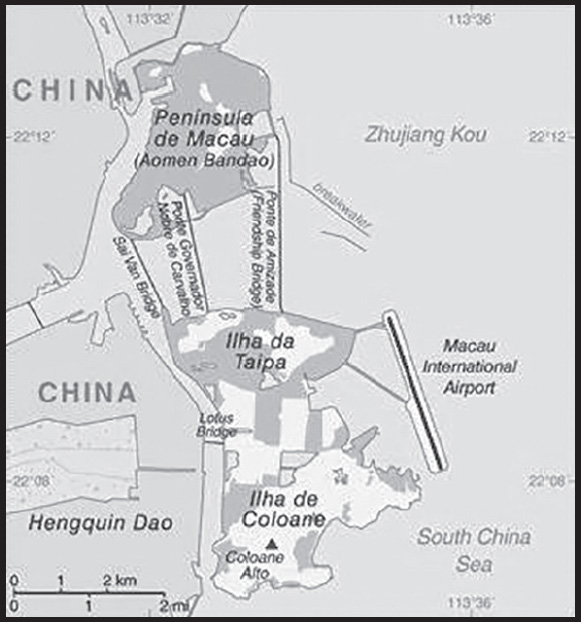
Location: Eastern Asia, bordering the South China Sea and China
Geographic coordinates: 22 10 N, 113 33 E
Map references: Southeast Asia
Area: total: 28 sq km
land: 28.2 sq km
water: 0 sq km
comparison ranking: total 236
Area - comparative: less than one-sixth the size of Washington, DC
Land boundaries: total: 3 km
regional borders (1): China 3 km
Coastline: 41 km
Maritime claims: not specified
Climate: subtropical; marine with cool winters, warm summers
Terrain: generally flat
Elevation: highest point: Alto Coloane 172 m
lowest point: South China Sea 0 m
Natural resources: NEGL
Land use: agricultural land: 0% (2018 est.)
other: 100% (2018 est.)
Irrigated land: 0 sq km (2012)
Population distribution: population fairly equally distributed
Natural hazards: typhoons
Geography - note: essentially urban; an area of land reclaimed from the sea measuring 5.2 sq km and known as Cotai now connects the islands of Coloane and Taipa; the island area is connected to the mainland peninsula by three bridges
PEOPLE AND SOCIETY
Population: 639,971 (2023 est.)
comparison ranking: 169
Nationality: noun: Chinese
adjective: Chinese
Ethnic groups: Chinese 88.7%, Portuguese 1.1%, mixed 1.1%, other 9.2% (includes Macanese - mixed Portuguese and Asian ancestry) (2016 est.)
Languages: Cantonese 80.1%, Mandarin 5.5%, other Chinese dialects 5.3%, Tagalog 3%, English 2.8%, Portuguese 0.6%, other 2.8%; note - Chinese and Portuguese are official languages; Macanese, a Portuguese-based Creole, is also spoken (2016 est.)
major-language sample(s):

(Cantonese)
Religions: folk religion 58.9%, Buddhist 17.3%, Christian 7.2%, other 1.2%, none 15.4% (2020 est.)
Age structure: 0-14 years: 14.42% (male 47,202/female 45,056)
15-64 years: 70.73% (male 211,278/female 241,366)
65 years and over: 14.86% (2023 est.) (male 44,657/female 50,412)
Dependency ratios: total dependency ratio: 36.9
youth dependency ratio: 20
elderly dependency ratio: 16.9
potential support ratio: 5.9 (2021 est.)
Median age: total: 40.8 years (2020)
male: 40.7 years
female: 40.9 years
comparison ranking: total 49
Population growth rate: 0.71% (2023 est.)
comparison ranking: 125
Birth rate: 8.82 births/1,000 population (2023 est.)
comparison ranking: 204
Death rate: 4.81 deaths/1,000 population (2023 est.)
comparison ranking: 201
Net migration rate: 3.13 migrant(s)/1,000 population (2023 est.)
comparison ranking: 38
Population distribution: population fairly equally distributed
Urbanization: urban population: 100% of total population (2023)
rate of urbanization: 1.46% annual rate of change (2020-25 est.)
Major urban areas - population: 682,000 Macau (2023)
Sex ratio: at birth: 1.05 male(s)/female
0-14 years: 1.05 male(s)/female
15-64 years: 0.88 male(s)/female
65 years and over: 0.89 male(s)/female
total population: 0.9 male(s)/female (2023 est.)
Infant mortality rate: total: 4.5 deaths/1,000 live births (2023 est.)
male: 4.59 deaths/1,000 live births
female: 4.41 deaths/1,000 live births
comparison ranking: total 181
Life expectancy at birth: total population: 85.16 years (2023 est.)
male: 82.28 years
female: 88.18 years
comparison ranking: total population 3
Total fertility rate: 1.23 children born/woman (2023 est.)
comparison ranking: 223
Gross reproduction rate: 0.6 (2023 est.)
Drinking water source: improved:
total: 100% of population
unimproved:
total: 0% of population (2020)
Currently married women (ages 15-49): 53.5% (2023 est.)
Education expenditures: 6.3% of GDP (2020 est.)
comparison ranking: 36
Literacy: definition: age 15 and over can read and write
total population: 97.1%
male: 98.5%
female: 95.9% (2021)
School life expectancy (primary to tertiary education): total: 18 years
male: 17 years
female: 19 years (2021)
Youth unemployment rate (ages 15-24): total: 9.2% (2021 est.)
male: 11.7%
female: 6.6%
comparison ranking: total 162
ENVIRONMENT
Environment - current issues: air pollution; coastal waters pollution; insufficient policies in reducing and recycling solid wastes; increasing population density worsening noise pollution
Climate: subtropical; marine with cool winters, warm summers
Land use: agricultural land: 0% (2018 est.)
other: 100% (2018 est.)
Urbanization: urban population: 100% of total population (2023)
rate of urbanization: 1.46% annual rate of change (2020-25 est.)
Revenue from forest resources: 0% of GDP (2018 est.)
comparison ranking: 204
Revenue from coal: 0% of GDP (2018 est.)
comparison ranking: 120
Air pollutants: carbon dioxide emissions: 2.07 megatons (2016 est.)
Waste and recycling: municipal solid waste generated annually: 377,942 tons (2016 est.)
municipal solid waste recycled annually: 75,588 tons (2014 est.)
percent of municipal solid waste recycled: 20% (2014 est.)
GOVERNMENT
Country name: conventional long form: Macau Special Administrative Region
conventional short form: Macau
official long form: Aomen Tebie Xingzhengqu (Chinese)/ Regiao Administrativa Especial de Macau (Portuguese)
official short form: Aomen (Chinese)/ Macau (Portuguese)
etymology: name is thought to derive from the A-Ma Temple - built in 1488 and dedicated to Mazu, the goddess of seafarers and fishermen - which is referred to locally as “Maa Gok” - and in Portuguese became “Macau”; the Chinese name Aomen means “inlet gates”
Government type: executive-led limited democracy; a special administrative region of the People’s Republic of China
Dependency status: special administrative region of the People’s Republic of China
Administrative divisions: none (special administrative region of the People’s Republic of China)
Independence: none (special administrative region of China)
National holiday: National Day (anniversary of the Founding of the People’s Republic of China), 1 October (1949); note - 20 December (1999) is celebrated as Macau Special Administrative Region Establishment Day
Constitution: history: previous 1976 (Organic Statute of Macau, under Portuguese authority); latest adopted 31 March 1993, effective 20 December 1999 (Basic Law of the Macau Special Administrative Region of the People’s Republic of China serves as Macau’s constitution)
amendments: proposed by the Standing Committee of the National People’s Congress (NPC), the People’s Republic of China State Council, and the Macau Special Administrative Region; submittal of proposals to the NPC requires two- thirds majority vote by the Legislative Assembly of Macau, approval by two thirds of Macau’s deputies to the NPC, and consent of the Macau chief executive; final passage requires approval by the NPC; amended 2005, 2012
Legal system: civil law system based on the Portuguese model
Citizenship: see China
Suffrage: 18 years of age in direct elections for some legislative positions, universal for permanent residents living in Macau for the past 7 years; note - indirect elections are limited to organizations registered as “corporate voters” and an election committee for the chief executive drawn from broad regional groupings, municipal organizations, central government bodies, and elected Macau officials
Executive branch: chief of state: President of China XI Jinping (since 14 March 2013)
head of government: Chief Executive HO lat Seng (since 20 December 2019)
cabinet: Executive Council appointed by the chief executive
elections/appointments: president indirectly elected by National People’s Congress for a 5-year term (eligible for a second term); election last held on 10 March 2023 (next to be held in March 2028); chief executive chosen by a 400- member Election Committee for a 5-year term (eligible for a second term); election last held on 24 August 2019 (next to be held in 2024)
election results: 2019: HO lat Seng (unopposed; received 392 out of 400 votes)
2014: Fernando CHUI Sai (unopposed; received 380 of 396 votes)
Legislative branch: description: unicameral Legislative Assembly or Regiao Administrativa Especial de Macau (33 seats; 14 members directly elected by proportional representation vote, 12 indirectly elected by an electoral college of professional and commercial interest groups, and 7 appointed by the chief executive; members serve 4-year terms)
elections: last held on 12 September 2021 (next to be held in September 2025)
election results: percent of vote - ACUM 20.1%, UPD 18%, NE 13.8%, UMG 12.7%, UPP 11.4%, ABL 10.8%, PS 6.6%, other 6.6%; seats by political group - ACUM 3, UPD 2, UMG 2, UPP 2, ABL 2, NE 2, PS 1; composition NA
Judicial branch: highest court(s): Court of Final Appeal of Macau Special Administrative Region (consists of the court president and 2 associate justices)
judge selection and term of office: justices appointed by the Macau chief executive upon the recommendation of an independent commission of judges, lawyers, and “eminent” persons; judge tenure NA
subordinate courts: Court of Second Instance; Court of First instance; Lower Court; Administrative Court
Political parties and leaders: Alliance for a Happy Home or ABL [WONG Kit-cheng]
Association of Synergy of Macao (“Synergy Power” or Poder da Singeria) or PS [Vitor VAI]
Macau-Guangdong Union or UGM [MAK Soi-kun]
New Hope or NE [José Maria Pereira COUTINHO]
Union for Development or UPD [HO Sut Heng]
Union for Promoting Progress or UPP or UNIPRO [HO Ion-sang]
United Citizens Association of Macau or ACUM [CHAN Meng-kam]
Women’s General Association of Macau or AGMM [HO Teng-iat]
note: there is no political party ordinance, so there are no registered political parties; politically active groups register as societies or companies
International organization participation: ICC (national committees), IHO, IMF, IMO (associate), Interpol (subbureau), ISO (correspondent), UNESCO (associate), UNWTO (associate), UPU, WCO, WMO, WTO
Diplomatic representation in the US: none (Special Administrative Region of China)
Diplomatic representation from the US: embassy: the US has no offices in Macau; US Consulate General in Hong Kong is accredited to Macau
Flag description: green with a lotus flower above a stylized bridge and water in white, beneath an arc of five gold, five-pointed stars: one large in the center of the arc and two smaller on either side; the lotus is the floral emblem of Macau, the three petals represent the peninsula and two islands that make up Macau; the five stars echo those on the flag of China
National symbol(s): lotus blossom; national colors: green, white, yellow
National anthem: note: as a Special Administrative Region of China, “Yiyongjun Jinxingqu” is the official anthem (see China)
ECONOMY
Economic overview: high-income, Chinese special administrative region economy; known for apparel exports and gambling tourism; currency pegged to Hong Kong dollar; significant recession due to 2015 Chinese anticorruption campaign; COVID-19 further halved economic activity
Real GDP (purchasing power parity): $44.49 billion (2021 est.)
$37.303 billion (2020 est.)
$81.511 billion (2019 est.)
note: data are in 2017 dollars
comparison ranking: 117
Real GDP growth rate: 19.27% (2021 est.)
-54.24% (2020 est.)
-2.51% (2019 est.)
comparison ranking: 6
Real GDP per capita: $64,800 (2021 est.)
$55,200 (2020 est.)
$122,800 (2019 est.)
note: data are in 2017 dollars
comparison ranking: 14
GDP (official exchange rate): $53.841 billion (2019 est.)
Inflation rate (consumer prices): 0.81% (2020 est.)
2.75% (2019 est.)
3% (2018 est.)
comparison ranking: 204
Credit ratings
Fitch rating: AA (2018)
Moody’s rating: Aa3 (2016)
note: The year refers to the year in which the current credit rating was first obtained.
GDP - composition, by sector of origin: agriculture: 0% (2016 est.)
industry: 6.3% (2017 est.)
services: 93.7% (2017 est.)
comparison rankings: services 4; industry 219; agriculture 223
GDP - composition, by end use: household consumption: 24.2% (2017 est.)
government consumption: 9.9% (2017 est.)
investment in fixed capital: 18.5% (2017 est.)
investment in inventories: 0.8% (2017 est.)
exports of goods and services: 79.4% (2017 est.)
imports of goods and services: -32% (2017 est.)
Agricultural products: pork, poultry, beef, pig fat, pig offals, eggs, pepper, cattle offals, cattle hides, goose/guinea fowl meat
Industries: tourism, gambling, clothing, textiles, electronics, footwear, toys
Industrial production growth rate: 5.17% (2021 est.)
comparison ranking: 86
Labor force: 404,500 (2021 est.)
comparison ranking: 161
Labor force - by occupation: agriculture: 2.5%
industry: 9.8%
services: 4.4%
industry and services: 12.4%
agriculture/fishing/forestry/mining: 15%
manufacturing: 25.9%
construction: 7.1%
transportation and utilities: 2.6%
commerce: 20.3% (2013 est.)
Unemployment rate: 3.01% (2021 est.)
2.57% (2020 est.)
1.75% (2019 est.)
comparison ranking: 194
Youth unemployment rate (ages 15-24): total: 9.2% (2021 est.)
male: 11.7%
female: 6.6%
comparison ranking: total 162
Gini Index coefficient - distribution of family income: 35 (2013 est.)
comparison ranking: 102
Budget: revenues: $18.119 billion (2019 est.)
expenditures: $10.165 billion (2019 est.)
Budget surplus (+) or deficit (-): 10% (of GDP) (2017 est.)
comparison ranking: 2
Public debt: 0% of GDP (2017 est.)
0% of GDP (2016 est.)
comparison ranking: 210
Taxes and other revenues: 21.73% (of GDP) (2020 est.)
comparison ranking: 76
Fiscal year: calendar year
Current account balance: $2.956 billion (2021 est.)
$3.926 billion (2020 est.)
$18.714 billion (2019 est.)
comparison ranking: 36
Exports: $26.625 billion (2021 est.) note: data are in current year dollars
$15.807 billion (2020 est.) note: data are in current year dollars
$45.557 billion (2019 est.)
note: includes reexports
comparison ranking: 77
Exports - partners: Hong Kong 66%, China 9% (2019)
Exports - commodities: jewelry, broadcasting equipment, watches, telephones, clothing and apparel (2021)
Imports: $22.788 billion (2021 est.) note: data are in current year dollars
$15.216 billion (2020 est.) note: data are in current year dollars
$17.594 billion (2019 est.)
comparison ranking: 86
Imports - partners: China 33%, Hong Kong 31%, France 5% (2019)
Imports - commodities: jewelry, watches, electricity, aircraft, cars (2019)
Reserves of foreign exchange and gold: $26.665 billion (31 December 2021 est.)
$25.145 billion (31 December 2020 est.)
$22.215 billion (31 December 2019 est.)
note: the Fiscal Reserves Act that came into force on 1 January 2012 requires the fiscal reserves to be separated from the foreign exchange reserves and to be managed separately; the transfer of assets took place in February 2012
comparison ranking: 62
Debt - external: $0 (31 December 2013)
$0 (31 December 2012)
comparison ranking: 203
Exchange rates: patacas (MOP) per US dollar -
Exchange rates: 8.006 (2021 est.)
7.989 (2020 est.)
8.07 (2019 est.)
8.073 (2018 est.)
8.026 (2017 est.)
ENERGY
Electricity access: electrification - total population: 100% (2021)
Electricity: installed generating capacity: 478,000 kW (2020 est.)
consumption: 5,278,600,000 kWh (2020 est.)
exports: 0 kWh (2020 est.)
imports: 4,852,600,000 kWh (2020 est.)
transmission/distribution losses: 136 million kWh (2020 est.)
comparison rankings: transmission/distribution losses 155; imports 42; exports 168; consumption 123; installed generating capacity 151
Electricity generation sources: fossil fuels: 66.4% of total installed capacity (2020 est.)
biomass and waste: 33.6% of total installed capacity (2020 est.)
Petroleum: total petroleum production: 0 bbl/day (2021 est.)
refined petroleum consumption: 14,300 bbl/day (2019 est.)
Refined petroleum products - imports: 14,180 bbl/day (2015 est.)
comparison ranking: 137
Natural gas: production: 0 cubic meters (2021 est.)
consumption: 136.714 million cubic meters (2019 est.)
exports: 0 cubic meters (2021 est.)
imports: 133.712 million cubic meters (2019 est.)
proven reserves: 0 cubic meters (2021 est.)
Carbon dioxide emissions: 2.012 million metric tonnes of CO2 (2019 est.)
from petroleum and other liquids: 1.744 million metric tonnes of CO2 (2019 est.)
from consumed natural gas: 268,000 metric tonnes of CO2 (2019 est.)
comparison ranking: total emissions 159
Energy consumption per capita: 81.407 million Btu/person (2019 est.)
comparison ranking: 73
COMMUNICATIONS
Telephones - fixed lines: total subscriptions: 110,000 (2021 est.)
subscriptions per 100 inhabitants: 16 (2021 est.)
comparison ranking: total subscriptions 135
Telephones - mobile cellular: total subscriptions: 2.8 million (2021 est.)
subscriptions per 100 inhabitants: 410 (2021 est.)
comparison ranking: total subscriptions 144
Telecommunication systems: general assessment: Macau’s economy and GDP have been on a roller coaster ride since the start of the Covid-19 pandemic in 2020; the Special Administrative Region (SAR) of China is heavily dependent on tourists coming from the mainland and Hong Kong to play in Macau’s many casinos, but the ensuing lock downs contributed to a dramatic fall in visitor numbers as well as income; this too, has had a major effect on the telecom sector (particularly in the mobile segment) with short-stay visitors as well as foreign workers on temporary-stay visas being forced to stay away.; total mobile subscription numbers are estimated to have dropped from a high of 2.8 million in 2019 (representing a whopping 442% penetration rate in a region with a population of just 700,000) to less than half that by the end of 2021: 1.3 million subscribers; Macau had almost the highest mobile penetration rate in the world; it is now sitting at a more ‘reasonable’ level of 200%; a significant bounce back can be expected to follow the easing of travel restrictions, although perhaps not up to the same lofty heights achieved in 2019; asecond factor behind the steep fall in 2020 was the introduction of a Cyber Security Law that required all prepaid SIM cards to become registered or face being deactivated in October 2020; the combined effect of the pandemic and the new restrictions meant that prepaid subscriber numbers fell by more than 80%; postpaid accounts, largely the domain of Macau’s permanent residents, were barely affected by the external upheaval; they continued to increase in number, year-on-year, and provided better returns to the operators thanks to substantially increased data usage during the lock downs; the mobile broadband market has experienced the same dramatic fluctuations as the broader mobile segment over the last two years, at least in terms of subscriber numbers; but this is largely because mobile broadband uptake is inextricably tied to the base mobile offering in Macau; with total mobile broadband data traffic going up, not down, between 2019 and 2021, that again points to the strength of the contract segment helping to drive future growth in Macau’s telecom sector (2022)
domestic: fixed-line nearly 16 per 100 and mobile-cellular roughly 410 per 100 persons (2021)
international: country code - 853; landing point for the SEA-ME-WE-3 submarine cable network that provides links to Asia, Africa, Australia, the Middle East, and Europe; HF radiotelephone communication facility; satellite earth station - 1 Intelsat (Indian Ocean) (2019)
Broadcast media: local government dominates broadcast media; 2 television stations operated by the government with one broadcasting in Portuguese and the other in Cantonese and Mandarin; 1 cable TV and 4 satellite TV services available; 3 radio stations broadcasting, of which 2 are government-operated (2019)
Internet country code: .mo
Internet users: total: 607,200 (2021 est.)
percent of population: 88% (2021 est.)
comparison ranking: total 164
Broadband - fixed subscriptions: total: 208,000 (2020 est.)
subscriptions per 100 inhabitants: 32 (2020 est.)
comparison ranking: total 119
TRANSPORTATION
National air transport system: number of registered air carriers: 1 (2020) (registered in China)
inventory of registered aircraft operated by air carriers: 21 (registered in China)
annual passenger traffic on registered air carriers: 3,157,724 (2018)
annual freight traffic on registered air carriers: 31.84 million (2018) mt-km
Civil aircraft registration country code prefix: B-M
Airports: 1 (2021)
comparison ranking: total 209
Airports - with paved runways: 1
note: paved runways have a concrete or asphalt surface but not all have facilities for refueling, maintenance, or air traffic control; the length of a runway required for aircraft to safely operate depends on a number of factors including the type of aircraft, the takeoff weight (including passengers, cargo, and fuel), engine types, flap settings, landing speed, elevation of the airport, and average maximum daily air temperature; paved runways can reach a length of 5,000 m (16,000 ft.), but the “typical” length of a commercial airline runway is between 2,500-4,000 m (8,000-13,000 ft.)
Heliports: 2 (2021)
Roadways: total: 428 km (2017)
paved: 428 km (2017)
comparison ranking: total 199
Merchant marine: total: 1 (2022)
by type: other 1
comparison ranking: total 181
Ports and terminals: major seaport(s): Macau
MILITARY AND SECURITY
Military and security forces: no regular indigenous military forces; Macau Public Security Police Force (includes the Police Intervention Tactical Unit or UTIP for counterterrorism operations)
Military - note: defense is the responsibility of China; the Chinese People’s Liberation Army (PLA) maintains a garrison in Macau
TRANSNATIONAL ISSUES
Disputes - international: none identified
Trafficking in persons: tier rating: Tier 3 — Macau does not fully meet the minimum standards for the elimination of trafficking and is not making significant efforts to do so, therefore Macau was downgraded to Tier 3; the government took some steps to address trafficking, including investigating one potential case, disseminating awareness-raising materials, and maintaining guidelines for identifying and referring victims to services; however, for the third consecutive year officials did not identify or provide services to any victims, nor initiate any prosecutions; Macau has not convicted a trafficker since 2019 and has never identified a victim of forced labor (2022)
trafficking profile: human traffickers exploit foreign victims in Macau; traffickers recruit most victims from mainland China, Russia, and Southeast Asia using false job offers; adult and child victims are forced into commercial sex in casinos, hotels, and private homes, and sometimes have their documents confiscated; Casinos and other establishments reportedly allow staff to partner with criminal networks to facilitate sex trafficking; migrant construction and domestic workers, primarily from mainland China, Indonesia, and the Philippines may be vulnerable to forced labor in Macau (2022)
Illicit drugs: Asian organized crime groups involved in drug trafficking and money laundering
MADAGASCAR
INTRODUCTION
Background: Madagascar was one of the last major habitable landmasses on earth settled by humans. While there is some evidence of human presence on the island in the millennia B.C., large-scale settlement began between A.D. 350 and 550 with settlers from present-day Indonesia. The island attracted Arab and Persian traders as early as the 7th century, and migrants from Africa arrived around A.D. 1000. Madagascar was a pirate stronghold during the late 17th and early 18th centuries, and served as a slave trading center into the 19th century. From the 16th to the late 19th century, a native Merina Kingdom dominated much of Madagascar. The island was conquered by the French in 1896 who made it a colony; independence was regained in 1960.
During 1992-93, free presidential and National Assembly elections were held ending 17 years of single-party rule. In 1997, in the second presidential race, Didier RATSIRAKA, the leader during the 1970s and 1980s, returned to the presidency. The 2001 presidential election was contested between the followers of Didier RATSIRAKA and Marc RAVALOMANANA, nearly causing secession of half of the country. In 2002, the High Constitutional Court announced RAVALOMANANA the winner. RAVALOMANANA won a second term in 2006 but, following protests in 2009, handed over power to the military, which then conferred the presidency on the mayor of Antananarivo, Andry RAJOELINA, in what amounted to a coup d’etat. Following a lengthy mediation process led by the Southern African Development Community, Madagascar held UN-supported presidential and parliamentary elections in 2013. Former de facto finance minister Hery RAJAONARIMAMPIANINA won a runoff election in December 2013 and was inaugurated in January 2014. In January 2019, RAJOELINA was declared the winner of a runoff election against RAVALOMANANA; both RATSIRAKA and RAJAONARIMAMPIANINA also ran in the first round of the election, which took place in November 2018.
GEOGRAPHY
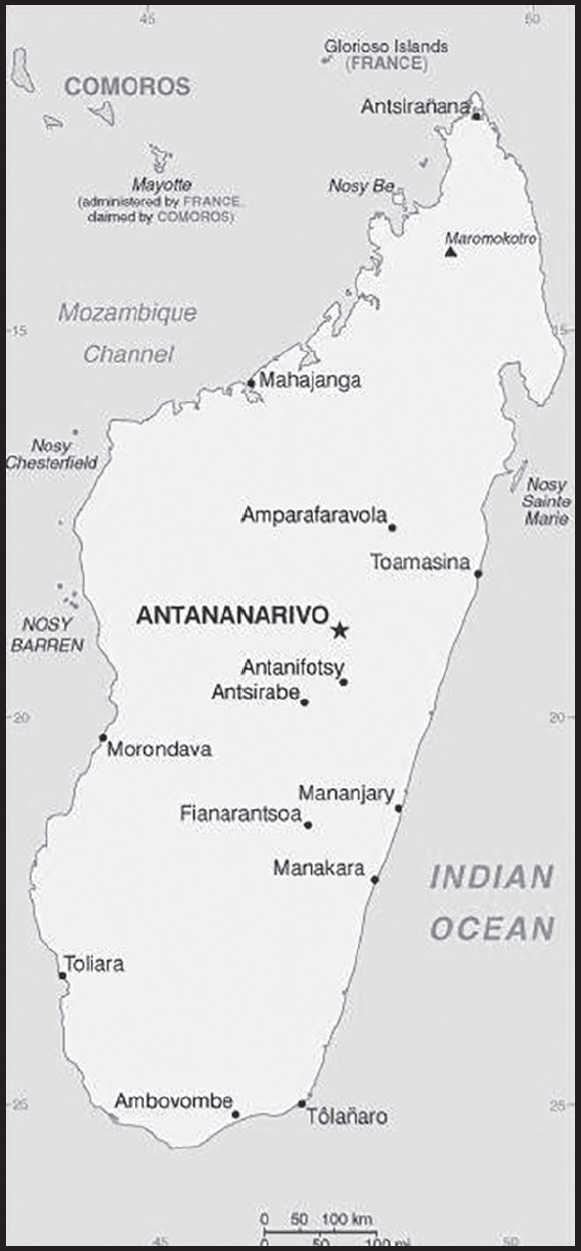
Location: Southern Africa, island in the Indian Ocean, east of Mozambique
Geographic coordinates: 20 00 S, 47 00 E
Map references: Africa
Area: total: 587,041 sq km
land: 581,540 sq km
water: 5,501 sq km
comparison ranking: total 49
Area - comparative: almost four times the size of Georgia; slightly less than twice the size of Arizona
Land boundaries: total: 0 km
Coastline: 4,828 km
Maritime claims: territorial sea: 12 nm
contiguous zone: 24 nm
exclusive economic zone: 200 nm
continental shelf: 200 nm or 100 nm from the 2,500-m isobath
Climate: tropical along coast, temperate inland, arid in south
Terrain: narrow coastal plain, high plateau and mountains in center
Elevation: highest point: Maromokotro 2,876 m
lowest point: Indian Ocean 0 m
mean elevation: 615 m
Natural resources: graphite, chromite, coal, bauxite, rare earth elements, salt, quartz, tar sands, semiprecious stones, mica, fish, hydropower
Land use: agricultural land: 71.1% (2018 est.)
arable land: 6% (2018 est.)
permanent crops: 1% (2018 est.)
permanent pasture: 64.1% (2018 est.)
forest: 21.5% (2018 est.)
other: 7.4% (2018 est.)
Irrigated land: 10,860 sq km (2012)
Population distribution: most of population lives on the eastern half of the island; significant clustering is found in the central highlands and eastern coastline as shown in this population distribution map
Natural hazards: periodic cyclones; drought; and locust infestation
volcanism: Madagascar’s volcanoes have not erupted in historical times
Geography - note: world’s fourth-largest island; strategic location along Mozambique Channel; despite Madagascar’s close proximity to the African continent, ocean currents isolate the island resulting in high rates of endemic plant and animal species; approximately 90% of the flora and fauna on the island are found nowhere else
PEOPLE AND SOCIETY
Population: 28,812,195 (2023 est.)
comparison ranking: 53
Nationality: noun: Malagasy (singular and plural)
adjective: Malagasy
Ethnic groups: Malayo-Indonesian (Merina and related Betsileo), Cotiers (mixed African, Malayo-Indonesian, and Arab ancestry - Betsimisaraka, Tsimihety, Antaisaka, Sakalava), French, Indian, Creole, Comoran
Languages: Malagasy (official) 99.9%, French (official) 23.6%, English 8.2%, other 0.6% (2018 est.)
note: shares sum to more than 100% because some respondents gave more than one answer on the census
Religions: Church of Jesus Christ in Madagascar/Malagasy Lutheran Church/Anglican Church 34%, Roman Catholic 32.3%, other Christian 8.1%, traditional/Animist 1.7%, Muslim 1.4%, other 0.6%, none 21.9% (2021 est.)
Demographic profile: Madagascar’s youthful population – nearly 60% are under the age of 25 as of 2020 – and moderately high total fertility rate of more than 3.6 children per woman ensures that the Malagasy population will continue its rapid growth trajectory for the foreseeable future. The population is predominantly rural and poor; chronic malnutrition is prevalent, and large families are the norm. Many young Malagasy girls are withdrawn from school, marry early (often pressured to do so by their parents), and soon begin having children. Early childbearing, coupled with Madagascar’s widespread poverty and lack of access to skilled health care providers during delivery, increases the risk of death and serious health problems for young mothers and their babies.
Child marriage perpetuates gender inequality and is prevalent among the poor, the uneducated, and rural households – as of 2018, 40% of Malagasy women aged 20 to 24 were married. Although the legal age for marriage is 18, parental consent is often given for earlier marriages or the law is flouted, especially in rural areas that make up approximately 60% of the country. Forms of arranged marriage whereby young girls are married to older men in exchange for oxen or money are traditional. If a union does not work out, a girl can be placed in another marriage, but the dowry paid to her family diminishes with each unsuccessful marriage.
Madagascar’s population consists of 18 main ethnic groups, all of whom speak the same Malagasy language. Most Malagasy are multi-ethnic, however, reflecting the island’s diversity of settlers and historical contacts (see Background). Madagascar’s legacy of hierarchical societies practicing domestic slavery (most notably the Merina Kingdom of the 16th to the 19th century) is evident today in persistent class tension, with some ethnic groups maintaining a caste system. Slave descendants are vulnerable to unequal access to education and jobs, despite Madagascar’s constitutional guarantee of free compulsory primary education and its being party to several international conventions on human rights. Historical distinctions also remain between central highlanders and coastal people.
Age structure: 0-14 years: 37.47% (male 5,451,018/female 5,343,865)
15-64 years: 58.72% (male 8,481,873/female 8,437,644)
65 years and over: 3.81% (2023 est.) (male 506,495/female 591,300)
Dependency ratios: total dependency ratio: 74.5
youth dependency ratio: 68.8
elderly dependency ratio: 5.8
potential support ratio: 17.4 (2021 est.)
Median age: total: 20.3 years (2020)
male: 20.1 years
female: 20.5 years
comparison ranking: total 192
Population growth rate: 2.22% (2023 est.)
comparison ranking: 34
Birth rate: 28.14 births/1,000 population (2023 est.)
comparison ranking: 32
Death rate: 5.92 deaths/1,000 population (2023 est.)
comparison ranking: 160
Net migration rate: 0 migrant(s)/1,000 population (2023 est.)
comparison ranking: 87
Population distribution: most of population lives on the eastern half of the island; significant clustering is found in the central highlands and eastern coastline as shown in this population distribution map
Urbanization: urban population: 40.6% of total population (2023)
rate of urbanization: 4.26% annual rate of change (2020-25 est.)
Major urban areas - population: 3.872 million ANTANANARIVO (capital) (2023)
Sex ratio: at birth: 1.03 male(s)/female
0-14 years: 1.02 male(s)/female
15-64 years: 1.01 male(s)/female
65 years and over: 0.86 male(s)/female
total population: 1 male(s)/female (2023 est.)
Mother’s mean age at first birth: 19.5 years (2021 est.)
note: data represents median age at first birth among women 25-29
Maternal mortality ratio: 392 deaths/100,000 live births (2020 est.)
comparison ranking: 24
Infant mortality rate: total: 38.27 deaths/1,000 live births (2023 est.)
male: 41.61 deaths/1,000 live births
female: 34.83 deaths/1,000 live births
comparison ranking: total 33
Life expectancy at birth: total population: 68.47 years (2023 est.)
male: 67.06 years
female: 69.92 years
comparison ranking: total population 185
Total fertility rate: 3.55 children born/woman (2023 est.)
comparison ranking: 34
Gross reproduction rate: 1.75 (2023 est.)
Contraceptive prevalence rate: 49.7% (2020)
Drinking water source: improved: urban: 85% of population
rural: 38% of population
total: 56.1% of population
unimproved: urban: 15% of population
rural: 62% of population
total: 43.9% of population (2020 est.)
Current health expenditure: 3.9% of GDP (2020)
Physicians density: 0.2 physicians/1,000 population (2018)
Hospital bed density: 0.2 beds/1,000 population
Sanitation facility access: improved: urban: 49.2% of population
rural: 22.1% of population
total: 32.6% of population
unimproved: urban: 50.8% of population
rural: 77.9% of population
total: 67.4% of population (2020 est.)
Major infectious diseases: degree of risk: very high (2023)
food or waterborne diseases: bacterial diarrhea, hepatitis A, and typhoid fever
vectorborne diseases: malaria and dengue fever
water contact diseases: schistosomiasis
animal contact diseases: rabies
note: on 31 August 2023, the US Centers for Disease Control and Prevention (CDC) issued a Travel Alert for polio in Africa; Madagascar is currently considered a high risk to travelers for circulating vaccine-derived polioviruses (cVDPV); vaccine-derived poliovirus (VDPV) is a strain of the weakened poliovirus that was initially included in oral polio vaccine (OPV) and that has changed over time and behaves more like the wild or naturally occurring virus; this means it can be spread more easily to people who are unvaccinated against polio and who come in contact with the stool or respiratory secretions, such as from a sneeze, of an “infected” person who received oral polio vaccine; the CDC recommends that before any international travel, anyone unvaccinated, incompletely vaccinated, or with an unknown polio vaccination status should complete the routine polio vaccine series; before travel to any high-risk destination, the CDC recommends that adults who previously completed the full, routine polio vaccine series receive a single, lifetime booster dose of polio vaccine
Obesity - adult prevalence rate: 5.3% (2016)
comparison ranking: 181
Alcohol consumption per capita: total: 0.89 liters of pure alcohol (2019 est.)
beer: 0.5 liters of pure alcohol (2019 est.)
wine: 0.07 liters of pure alcohol (2019 est.)
spirits: 0.32 liters of pure alcohol (2019 est.)
other alcohols: 0 liters of pure alcohol (2019 est.)
comparison ranking: total 155
Tobacco use: total: 27.8% (2020 est.)
male: 42.7% (2020 est.)
female: 12.8% (2020 est.)
comparison ranking: total 38
Children under the age of 5 years underweight: 22.6% (2021)
comparison ranking: 9
Currently married women (ages 15-49): 60.1% (2023 est.)
Child marriage: women married by age 15: 12.7%
women married by age 18: 38.8%
men married by age 18: 11.2% (2021 est.)
Education expenditures: 3.1% of GDP (2020 est.)
comparison ranking: 157
Literacy: definition: age 15 and over can read and write
total population: 77.3%
male: 78.8%
female: 75.8% (2021)
School life expectancy (primary to tertiary education): total: 10 years
male: 10 years
female: 10 years (2018)
Youth unemployment rate (ages 15-24): total: 4.8% (2021 est.)
male: 5.2%
female: 4.4%
comparison ranking: total 189
ENVIRONMENT
Environment - current issues: erosion and soil degredation results from deforestation and overgrazing; desertification; agricultural fires; surface water contaminated with raw sewage and other organic wastes; wildlife preservation (endangered species of flora and fauna unique to the island)
Environment - international agreements: party to: Biodiversity, Climate Change, Climate Change-Kyoto Protocol, Climate Change-Paris Agreement, Comprehensive Nuclear Test Ban, Desertification, Endangered Species, Hazardous Wastes, Law of the Sea, Marine Dumping-London Protocol, Marine Life Conservation, Nuclear Test Ban, Ozone Layer Protection, Ship Pollution, Tropical Timber 2006, Wetlands
signed, but not ratified: none of the selected agreements
Climate: tropical along coast, temperate inland, arid in south
Land use: agricultural land: 71.1% (2018 est.)
arable land: 6% (2018 est.)
permanent crops: 1% (2018 est.)
permanent pasture: 64.1% (2018 est.)
forest: 21.5% (2018 est.)
other: 7.4% (2018 est.)
Urbanization: urban population: 40.6% of total population (2023)
rate of urbanization: 4.26% annual rate of change (2020-25 est.)
Food insecurity: severe localized food insecurity: due to the effects of extreme weather events and slow economic recovery - according to the latest May 2022 analysis, the prevalence of food insecurity in the southern regions is projected to peak at 2.1 million people by December 2022 until at least March 2023; overall, the number of people requiring humanitarian assistance by the end of 2022 is expected to be about 30 percent higher compared to the peak number in 2021; the poor food security situation is mainly the consequence of six consecutive poor agricultural seasons that culminated in very tight food supplies for rural households and curbed incomes from crop sales; high rates of poverty and increased prices of essential food commodities, combined with a high reliance on market supplies due to low harvests for own consumption, are also contributing to the high rates of food insecurity across the southern regions (2022)
Revenue from forest resources: 4.34% of GDP (2018 est.)
comparison ranking: 17
Revenue from coal: 0% of GDP (2018 est.)
comparison ranking: 155
Air pollutants: particulate matter emissions: 16.02 micrograms per cubic meter (2019 est.)
carbon dioxide emissions: 3.91 megatons (2016 est.)
methane emissions: 10.14 megatons (2020 est.)
Waste and recycling: municipal solid waste generated annually: 3,768,759 tons (2016 est.)
Total water withdrawal: municipal: 400 million cubic meters (2020 est.)
industrial: 160 million cubic meters (2020 est.)
agricultural: 13 billion cubic meters (2020 est.)
Total renewable water resources: 337 billion cubic meters (2020 est.)
GOVERNMENT
Country name: conventional long form: Republic of Madagascar
conventional short form: Madagascar
local long form: Republique de Madagascar/Repoblikan’i Madagasikara
local short form: Madagascar/Madagasikara
former: Malagasy Republic
etymology: the name “Madageiscar” was first used by the 13th-century Venetian explorer Marco POLO, as a corrupted transliteration of Mogadishu, the Somali port with which POLO confused the island
Government type: semi-presidential republic
Capital: name: Antananarivo
geographic coordinates: 18 55 S, 47 31 E
time difference: UTC+3 (8 hours ahead of Washington, DC, during Standard Time)
etymology: the name, which means “City of the Thousand,” was bestowed by 17th century King ADRIANJAKAKING to honor the soldiers assigned to guard the city
Administrative divisions: 6 provinces (faritany); Antananarivo, Antsiranana, Fianarantsoa, Mahajanga, Toamasina, Toliara
Independence: 26 June 1960 (from France)
National holiday: Independence Day, 26 June (1960)
Constitution: history: previous 1992; latest passed by referendum 17 November 2010, promulgated 11 December 2010
amendments: proposed by the president of the republic in consultation with the cabinet or supported by a least two thirds of both the Senate and National Assembly membership; passage requires at least three-fourths approval of both the Senate and National Assembly and approval in a referendum; constitutional articles, including the form and powers of government, the sovereignty of the state, and the autonomy of Madagascar’s collectivities, cannot be amended
Legal system: civil law system based on the old French civil code and customary law in matters of marriage, family, and obligation
International law organization participation: accepts compulsory ICJ jurisdiction with reservations; accepts ICCt jurisdiction
Citizenship: citizenship by birth: no
citizenship by descent only: the father must be a citizen of Madagascar; in the case of a child born out of wedlock, the mother must be a citizen
dual citizenship recognized: no
residency requirement for naturalization: unknown
Suffrage: 18 years of age; universal
Executive branch: chief of state: President Andry RAJOELINA (since 21 January 2019)
head of government: Prime Minister Christian NTSAY (since 6 June 2018)
cabinet: Council of Ministers appointed by the prime minister
elections/appointments: president directly elected by absolute majority popular vote in 2 rounds if needed for a 5-year term (eligible for a second term); election last held on 7 November and 19 December 2018 (next to be held on 16 November 2023); prime minister nominated by the National Assembly, appointed by the president
election results:
2018: Andry RAJOELINA elected president in second round; percent of vote in first round - Andry RAJOELINA (TGV) 39.2%, Marc RAVALOMANANA (TIM) 35.4%, other 25.4%; percent of vote in second round - Andry RAJOELINA 55.7%, Marc RAVALOMANANA 44.3%
2013: Hery Martial RAJAONARIMAMPIANINA elected president in second round; percent of vote in first round - Hery Martial RAJAONARIMAMPIANINA (HVM) 15.9%, Jean Louis ROBINSON (AVANA) 21.1%, other 63%; percent of vote in second round - Hery Martial RAJAONARIMAMPIANINA 53.5%, Jean Louis ROBINSON 46.5%
Legislative branch: description: bicameral Parliament consists of:
Senate or Antenimierandoholona (18 seats; 12 members indirectly elected by an electoral college of municipal, communal, regional, and provincial leaders and 6 appointed by the president; members serve 5-year terms) National Assembly or Antenimierampirenena (151 seats; 87 members directly elected in single-seat constituencies by simple majority vote and 64 directly elected in multi-seat constituencies by closed-list proportional representation vote; members serve 5-year terms)
elections: Senate - last held on 11 December 2020 (next to be held in December 2025) National Assembly - last held on 27 May 2019 (next to be held in May 2024)
election results:
2020: Senate - percent of vote by party - NA; elected seats by party - Irmar 10, Malagasy Miara Miainga 2; composition - men 16, women 2, percent of women 11.1%
2019: National Assembly - percent of vote by party - TGV 30.9%, TIM 9.7%, MATITA 1.1%, MTS 0.4%, GJMP 0.3%, MDM 0.2%, RPSD Vaovao 0.1%, Independents 50%, Other 7.3%; composition - men 123, women 28, percent of women 18.5%; note - total Parliament percent of women 17.8%
Judicial branch: highest court(s): Supreme Court or Cour Supreme (consists of 11 members; addresses judicial administration issues only); High Constitutional Court or Haute Cour Constitutionnelle (consists of 9 members); High Court of Justice (consists of 11 members; addresses cases brought against the president of Madagascar and high officials for high treason, grave violations of the Constitution, or breach of duties incompatible with the exercise of the presidential mandate)
judge selection and term of office: Supreme Court heads elected by the president and judiciary officials to serve 3-year, single renewable terms; High Constitutional Court members appointed - 3 each by the president, by both legislative bodies, and by the Council of Magistrates; members serve single, 7-year terms; High Court of Justice members include: first president of the Supreme Court; 2 presidents from the Court of Cassation; 2 presidents from the Court of Appeal; 2 deputies from the National Assembly; 2 senators from the Senate; 2 members from the High Council for the Defense of Democracy and the State of law
subordinate courts: Courts of Appeal; Court of Cassation; Courts of First Instance; military courts; traditional (dina) courts; Trade Court
Political parties and leaders: Group of Young Malagasy Patriots (Groupe des Jeunes Malgaches Patriotes) or GJMP
I Love Madagascar (Tiako I Madagasikara) or TIM [Marc RAVALOMANANA]
Malagasy Aware (Malagasy Tonga Saina) or MTS [Roland RATSIRAKA]
Malagasy Tia Tanindrazana or MATITA or ANGADY [Hyacinthe Befeno TODIMANANA]
Movement for Democracy in Madagascar (Mouvement pour la Démocratie à Madagascar) or MDM [Pierrot RAJAONARIVELO]
Rally for Democratic Socialism (Rassemblement pour Socialisme Démocratique - Nauveau) or RPSD Vaovao [Evariste MARSON]
Young Malagasies Determined (Tanora Malagasy Vonona) or TGV [Andry RAJOELINA]
Note: Only parties with seats in the National Assembly included
International organization participation: ACP, AfDB, AU, CD, COMESA, EITI (candidate country), FAO, G-77, IAEA, IBRD, ICAO, ICC (NGOs), ICCt, ICRM, IDA, IFAD, IFC, IFRCS, ILO, IMF, IMO, InOC, Interpol, IOC, IOM, IPU, ISO (correspondent), ITSO, ITU, ITUC (NGOs), MIGA, NAM, OIF, OPCW, PCA, SADC, UN, UNCTAD, UNESCO, UNHCR, UNIDO, UNWTO, UPU, WCO, WFTU (NGOs), WHO, WIPO, WMO, WTO
Diplomatic representation in the US: chief of mission: Ambassador (vacant); Chargé d’Affaires Amielle Pelenne NIRINIAVISOA MARCEDA (since 31 October 2019)
chancery: 2374 Massachusetts Avenue NW, Washington, DC 20008
telephone: [1] (202) 265-5525
FAX: [1] (202) 265-3034
email address and website:
contact@us-madagascar-embassy.org
https://us-madagascar-embassy.org/
consulate(s) general: New York
Diplomatic representation from the US: chief of mission: Ambassador Claire PIERANGELO (since 2 May 2022)
embassy: Lot 207A, Andranoro, Antehiroka, 105 Antananarivo - Madagascar
mailing address: 2040 Antananarivo Place, Washington DC 20521-2040
telephone: [261] 33-44-320-00
FAX: [261] 33-44-320-35
email address and website:
Flag description: two equal horizontal bands of red (top) and green with a vertical white band of the same width on hoist side; by tradition, red stands for sovereignty, green for hope, white for purity
National symbol(s): traveller’s palm, zebu; national colors: red, green, white
National anthem: name: “Ry Tanindraza nay malala o” (Oh, Our Beloved Fatherland)
lyrics/music: Pasteur RAHAJASON/Norbert RAHARISOA
note: adopted 1959
National heritage: total World Heritage Sites: 3 (1 cultural, 2 natural)
selected World Heritage Site locales: Tsingy de Bemaraha Strict Nature Reserve (n); Ambohimanga Royal Hill (c); Atsinanana Rainforests (n)
ECONOMY
Economic overview: low-income East African island economy; natural resource rich; extreme poverty; return of political stability has helped growth; sharp tax revenue drop due to COVID-19; leading vanilla producer; environmentally fragile
Real GDP (purchasing power parity): $42.322 billion (2021 est.)
$40.537 billion (2020 est.)
$43.653 billion (2019 est.)
note: data are in 2017 dollars
comparison ranking: 119
Real GDP growth rate: 4.4% (2021 est.)
-7.14% (2020 est.)
4.41% (2019 est.)
comparison ranking: 104
Real GDP per capita: $1,500 (2021 est.)
$1,400 (2020 est.)
$1,600 (2019 est.)
note: data are in 2017 dollars
comparison ranking: 221
GDP (official exchange rate): $13.964 billion (2019 est.)
Inflation rate (consumer prices): 5.81% (2021 est.)
4.2% (2020 est.)
5.61% (2019 est.)
comparison ranking: 54
GDP - composition, by sector of origin: agriculture: 24% (2017 est.)
industry: 19.5% (2017 est.)
services: 56.4% (2017 est.)
comparison rankings: services 150; industry 153; agriculture 32
GDP - composition, by end use: household consumption: 67.1% (2017 est.)
government consumption: 11.2% (2017 est.)
investment in fixed capital: 15.1% (2017 est.)
investment in inventories: 8.8% (2017 est.)
exports of goods and services: 31.5% (2017 est.)
imports of goods and services: -33.7% (2017 est.)
Agricultural products: rice, sugar cane, cassava, sweet potatoes, milk, vegetables, bananas, mangoes/guavas, tropical fruit, potatoes
Industries: meat processing, seafood, soap, beer, leather, sugar, textiles, glassware, cement, automobile assembly plant, paper, petroleum, tourism, mining
Industrial production growth rate: -21.56% (2020 est.)
comparison ranking: 207
Labor force: 14.813 million (2021 est.)
comparison ranking: 41
Unemployment rate: 2.59% (2021 est.)
2.47% (2020 est.)
1.86% (2019 est.)
comparison ranking: 203
Youth unemployment rate (ages 15-24): total: 4.8% (2021 est.)
male: 5.2%
female: 4.4%
comparison ranking: total 189
Population below poverty line: 70.7% (2012 est.)
Gini Index coefficient - distribution of family income: 42.6 (2012 est.)
comparison ranking: 37
Household income or consumption by percentage share: lowest 10%: 2.2%
highest 10%: 34.7% (2010 est.)
Budget: revenues: $1.51 billion (2020 est.)
expenditures: $2.09 billion (2020 est.)
Budget surplus (+) or deficit (-): -2.7% (of GDP) (2017 est.)
comparison ranking: 118
Public debt: 36% of GDP (2017 est.)
38.4% of GDP (2016 est.)
comparison ranking: 150
Taxes and other revenues: 9.52% (of GDP) (2020 est.)
comparison ranking: 195
Fiscal year: calendar year
Current account balance: -$732.252 million (2021 est.)
-$623.149 million (2020 est.)
-$302.357 million (2019 est.)
comparison ranking: 129
Exports: $3.341 billion (2021 est.) note: data are in current year dollars
$2.589 billion (2020 est.) note: data are in current year dollars
$4.082 billion (2019 est.)
comparison ranking: 142
Exports - partners: United States 19%, France 18%, United Arab Emirates 7%, China 6%, Japan 6%, Germany 5%, India 5% (2019)
Exports - commodities: vanilla, nickel, clothing and apparel, titanium, gold, cloves (2021)
Imports: $4.768 billion (2021 est.) note: data are in current year dollars
$3.718 billion (2020 est.) note: data are in current year dollars
$4.685 billion (2019 est.)
comparison ranking: 146
Imports - partners: China 24%, France 11%, United Arab Emirates 9%, India 7%, South Africa 5% (2019)
Imports - commodities: refined petroleum, rice, cars, packaged medicines, clothing and apparel (2019)
Reserves of foreign exchange and gold: $2.335 billion (31 December 2021 est.)
$1.981 billion (31 December 2020 est.)
$1.693 billion (31 December 2019 est.)
comparison ranking: 128
Debt - external: $3.085 billion (2019 est.)
$4.107 billion (2018 est.)
comparison ranking: 142
Exchange rates: Malagasy ariary (MGA) per US dollar -
Exchange rates: 3,829.978 (2021 est.)
3,787.754 (2020 est.)
3,618.322 (2019 est.)
3,334.752 (2018 est.)
3,116.11 (2017 est.)
ENERGY
Electricity access: population without electricity: 20 million (2020)
electrification - total population: 35.1% (2021)
electrification - urban areas: 72.6% (2021)
electrification - rural areas: 10.9% (2021)
Electricity: installed generating capacity: 587,000 kW (2020 est.)
consumption: 1,720,140,000 kWh (2019 est.)
exports: 0 kWh (2020 est.)
imports: 0 kWh (2020 est.)
transmission/distribution losses: 131 million kWh (2019 est.)
comparison rankings: imports 192; exports 189; installed generating capacity 147; transmission/distribution losses 156; consumption 150
Electricity generation sources: fossil fuels: 59.8% of total installed capacity (2020 est.)
solar: 1.1% of total installed capacity (2020 est.)
hydroelectricity: 38.2% of total installed capacity (2020 est.)
biomass and waste: 1% of total installed capacity (2020 est.)
Coal: production: 0 metric tons (2020 est.)
consumption: 107,000 metric tons (2020 est.)
exports: 0 metric tons (2020 est.)
imports: 115,000 metric tons (2020 est.)
proven reserves: 0 metric tons (2019 est.)
Petroleum: total petroleum production: 0 bbl/day (2021 est.)
refined petroleum consumption: 21,100 bbl/day (2019 est.)
Refined petroleum products - imports: 18,880 bbl/day (2015 est.)
comparison ranking: 125
Carbon dioxide emissions: 4.218 million metric tonnes of CO2 (2019 est.)
from coal and metallurgical coke: 1.044 million metric tonnes of CO2 (2019 est.)
from petroleum and other liquids: 3.175 million metric tonnes of CO2 (2019 est.)
comparison ranking: total emissions 140
Energy consumption per capita: 2.307 million Btu/person (2019 est.)
comparison ranking: 186
COMMUNICATIONS
Telephones - fixed lines: total subscriptions: 26,271 (2021 est.)
subscriptions per 100 inhabitants: (2021 est.) less than 1
comparison ranking: total subscriptions 169
Telephones - mobile cellular: total subscriptions: 16,279,633 (2021 est.)
subscriptions per 100 inhabitants: 56 (2021 est.)
comparison ranking: total subscriptions 68
Telecommunication systems: general assessment: telecom services in Madagascar have benefited from intensifying competition between the main operators; there have been positive developments with the country’s link to international submarine cables, particularly the METISS cable connecting to South Africa and Mauritius; in addition, the country’s connection to the Africa-1 cable, expected in late 2023, will provide it with links to Kenya, Djibouti, countries in north and south Africa, as well Pakistan, the UAE, Saudi Arabia, and France; a national fiber backbone has been implemented connecting the major cities; in addition, the government has progressed with its five-year plan to develop a digital platform running to 2024; various schemes within the program have been managed by a unit within the President’s office; penetration rates in all market sectors remain below the average for the African region, and so there remains considerable growth potential; much progress was made in 2020, stimulated by the particular conditions related to the pandemic, which encouraged greater use of voice and data services (2022)
domestic: less than 1 per 100 for fixed-line and mobile-cellular teledensity about 56 per 100 persons (2021)
international: country code - 261; landing points for the EASSy, METISS, and LION fiber-optic submarine cable systems connecting to numerous Indian Ocean Islands, South Africa, and Eastern African countries; satellite earth stations - 2 (1 Intelsat - Indian Ocean, 1 Intersputnik - Atlantic Ocean region) (2019)
Broadcast media: state-owned Radio Nationale Malagasy (RNM) and Television Malagasy (TVM) have an extensive national network reach; privately owned radio and TV broadcasters in cities and major towns; state-run radio dominates in rural areas; relays of 2 international broadcasters are available in Antananarivo (2019)
Internet country code: .mg
Internet users: total: 5.8 million (2021 est.)
percent of population: 20% (2021 est.)
comparison ranking: total 82
Broadband - fixed subscriptions: total: 32,000 (2020 est.)
subscriptions per 100 inhabitants: 0.1 (2020 est.)
comparison ranking: total 151
TRANSPORTATION
National air transport system: number of registered air carriers: 4 (2020)
inventory of registered aircraft operated by air carriers: 18
annual passenger traffic on registered air carriers: 541,290 (2018)
annual freight traffic on registered air carriers: 16.25 million (2018) mt-km
Civil aircraft registration country code prefix: 5R
Airports: 83 (2021)
comparison ranking: total 66
Airports - with paved runways: 26
note: paved runways have a concrete or asphalt surface but not all have facilities for refueling, maintenance, or air traffic control; the length of a runway required for aircraft to safely operate depends on a number of factors including the type of aircraft, the takeoff weight (including passengers, cargo, and fuel), engine types, flap settings, landing speed, elevation of the airport, and average maximum daily air temperature; paved runways can reach a length of 5,000 m (16,000 ft.), but the “typical” length of a commercial airline runway is between 2,500-4,000 m (8,000-13,000 ft.)
Airports - with unpaved runways: 57
note: unpaved runways have a surface composition such as grass or packed earth and are most suited to the operation of light aircraft; unpaved runways are usually short, often less than 1,000 m (3,280 ft.) in length; airports with unpaved runways often lack facilities for refueling, maintenance, or air traffic control
Railways: total: 836 km (2018)
narrow gauge: 836 km (2018) 1.000-m gauge
comparison ranking: total 95
Roadways: total: 31,640 km (2018)
comparison ranking: total 95
Waterways: 600 km (2011) (432 km navigable)
comparison ranking: 86
Merchant marine: total: 28 (2022)
by type: general cargo 15, oil tanker 2, other 11
comparison ranking: total 137
Ports and terminals: major seaport(s): Antsiranana (Diego Suarez), Mahajanga, Toamasina, Toliara (Tulear)
MILITARY AND SECURITY
Military and security forces: Madagascar People’s Armed Forces (PAF): Army, Navy, Air Force; National Gendarmerie (2023)
note: the National Gendarmerie is separate from the PAF under the Ministry of Defense and is responsible for maintaining law and order in rural areas at the village level, protecting government facilities, and operating a maritime police contingent; the National Police under the Ministry of Security is responsible for maintaining law and order in urban areas
Military expenditures: 0.7% of GDP (2022 est.)
0.7% of GDP (2021 est.)
0.7% of GDP (2020 est.)
0.5% of GDP (2019 est.)
0.5% of GDP (2018 est.)
comparison ranking: 141
Military and security service personnel strengths: estimated 13,000 personnel (12,000 Army; 500 Navy; 500 Air Force); estimated 10,000 Gendarmerie (2023)
Military equipment inventories and acquisitions: the PAF’s inventory consists mostly of aging Soviet-era equipment; in recent years, it has received small amounts of secondhand equipment from South Africa and the UAE (2023)
Military service age and obligation: 18-25 years of age for men and women; service obligation 18 months; no conscription; women are permitted to serve in all branches (2022)
Military - note: the PAF’s responsibilities include ensuring sovereignty and territorial integrity and protecting Madagascar’s maritime domain, particularly against piracy, drug trafficking, and smuggling; it also assists the Gendarmerie with maintaining law and order in rural areas, largely in areas affected by banditry, cattle rustling, and criminal groups; the PAF has a history of having influence in domestic politics and a lack of accountability; members of the Army and the Gendarmerie were arrested for coup plotting as recently as 2021; its closest defense partners have been India and Russia; the PAF’s small Navy has traditionally looked to India for assistance with maritime security (2023)
TRANSNATIONAL ISSUES
Disputes - international: Madagascar-France: claims Bassas da India, Europa Island, Glorioso Islands, and Juan de Nova Island (all administered by France); the vegetated drying cays of Banc du Geyser, which were claimed by Madagascar in 1976, also fall within the EEZ claim of France
Madagascar-Comoros: the vegetated drying cays of Banc du Geyser, which were claimed by Madagascar in 1976, also fall within the EEZ claim of the Comoros
Trafficking in persons: tier rating: Tier 2 Watch List — Madagascar does not fully meet the minimum standards for the elimination of trafficking but is making significant efforts to do so; officials identified and provided services to more victims, launched an updated National Action Plan, took steps to reduce the demand for child sex tourism, and worked with an international organization to monitor Malagasy migrant workers’ conditions in Jordan; however, the government did not demonstrate overall increasing efforts, compared with the previous year, to expand its anti-trafficking capacity; officials investigated fewer trafficking cases and did not report any prosecutions or convictions of suspected traffickers for the second consecutive year; the government did not hold complicit officials accountable nor investigate reports of officials facilitating child sex trafficking within Madagascar or labor trafficking of Malagasy workers abroad; for the third consecutive year, the government did not disburse funds to the National Office to Combat Human Trafficking, hindering nationwide progress and coordination; efforts to address internal crimes, including domestic servitude, forced begging, and child sex trafficking, remained inadequate, and officials continued to conflate human trafficking with other crimes including gender-based violence and sexual exploitation; therefore, Madagascar remained on Tier 2 Watch List for the second consecutive year (2023)
trafficking profile: human traffickers exploit domestic and foreign victims in Madagascar, as well as victims from Madagascar abroad; traffickers exploit Malagasy children in child sex trafficking and forced labor in domestic service in homes and businesses, mining, street vending, agriculture, textile factories, and fishing; most child sex trafficking occurs in tourist destinations, urban cities, vanilla-growing regions, and around mining sites with the involvement and encouragement of family members; tourist operators, hotels, taxi drivers, massage parlor owners, and local adults involved in commercial sex also facilitate child sex trafficking; girls and boys as young as 12 are exploited in child sex tourism in coastal areas and major cities, often openly in bars, nightclubs, massage parlors, hotels, and private homes; Malagasy men exploit the majority of child sex trafficking victims, while most foreign sex tourists are French and Italian nationals, or to a lesser extent from other Western European countries and Comoros; government officials are reportedly complicit in providing false documents to facilitate illicit recruitment of Malagasy women to work in Gulf states; many Malagasy women are employed as domestic workers in China, Kuwait, Lebanon, and Saudi Arabia, where they are at risk of trafficking; traffickers acting as labor recruiters send Malagasy women to China with false identity cards, where they are exploited in forced labor in agriculture or domestic servitude; Malagasy men may be exploited in forced labor in the services and construction industries in the Middle East and domestic servitude in China; Chinese nationals working at China’s Belt and Road Initiative projects in Madagascar were vulnerable to forced labor (2023)
Illicit drugs: illicit producer of cannabis (cultivated and wild varieties) used mostly for domestic consumption; transshipment point for Southwest Asian heroin
MALAWI
INTRODUCTION
Background: Malawi shares its name with the Chewa word for flames and is linked to the Maravi people from whom the Chewa language originated. The Maravi settled in what is now Malawi around 1400 during one of the later waves of Bantu migration across central and southern Africa. Several of Malawi’s ethnic groups trace their origins to different Maravi lineages. A powerful Maravi kingdom, established around 1500, reached its zenith around 1700, when it controlled what is now southern and central Malawi as well as portions of neighboring Mozambique and Zambia before beginning to decline because of destabilization from the escalating global trade in enslaved people. In the early 1800s, widespread conflict in southern Africa displaced various ethnic Ngoni groups, some of which moved into Malawi and further undermined the Maravi. Members of the Yao ethnic group - which had long traded with Malawi from Mozambique - introduced Islam and began to settle in Malawi in significant numbers in the mid-1800s; in the late 1800s, members of the Lomwe ethnic group also moved into southern Malawi from Mozambique. British missionary and trading activity increased in the area around Lake Nyasa in the mid-1800s, and Britain declared a protectorate, called British Central Africa, over what is now Malawi in 1891 and eliminated various political entities that sought to retain their autonomy over the subsequent decade. The British renamed the territory Nyasaland in 1907 and it was part of the colonial Federation of Rhodesia and Nyasaland - including present-day Zambia and Zimbabwe - from 1953 to 1963 before gaining independence as Malawi in 1964.
Hastings Kamuzu BANDA served as prime minister at independence and, when the country became a republic in 1966, he became president. He later instituted one-party rule under his Malawi Congress Party (MCP) and was declared president for life. After three decades of one-party rule, the country held multiparty presidential and parliamentary elections in 1994 under a provisional constitution that came into full effect the following year. Bakili MULUZI of the United Democratic Front party became the first freely elected president of Malawi when he defeated BANDA at the polls in 1994; he won reelection in 1999. President Bingu wa MUTHARIKA was elected in 2004 and subsequently started his own party, the Democratic Progressive Party, in 2005. MUTHARIKA was reelected to a second term in 2009. He died abruptly in 2012 and was succeeded by Vice President Joyce BANDA, who had earlier started her own party, the People’s Party. MUTHARIKA’s brother, Peter MUTHARIKA, defeated BANDA in the election in 2014. Peter MUTHARIKA was reelected in a disputed election in 2019 that resulted in countrywide protests. The courts ordered a new the election, and in 2020 Lazarus CHAKWERA of the MCP was elected president after defeating MUTHARIKA as head of a coalition of opposition parties. Population growth, increasing pressure on agricultural lands, corruption, and the scourge of HIV/AIDS pose major problems for Malawi.
GEOGRAPHY
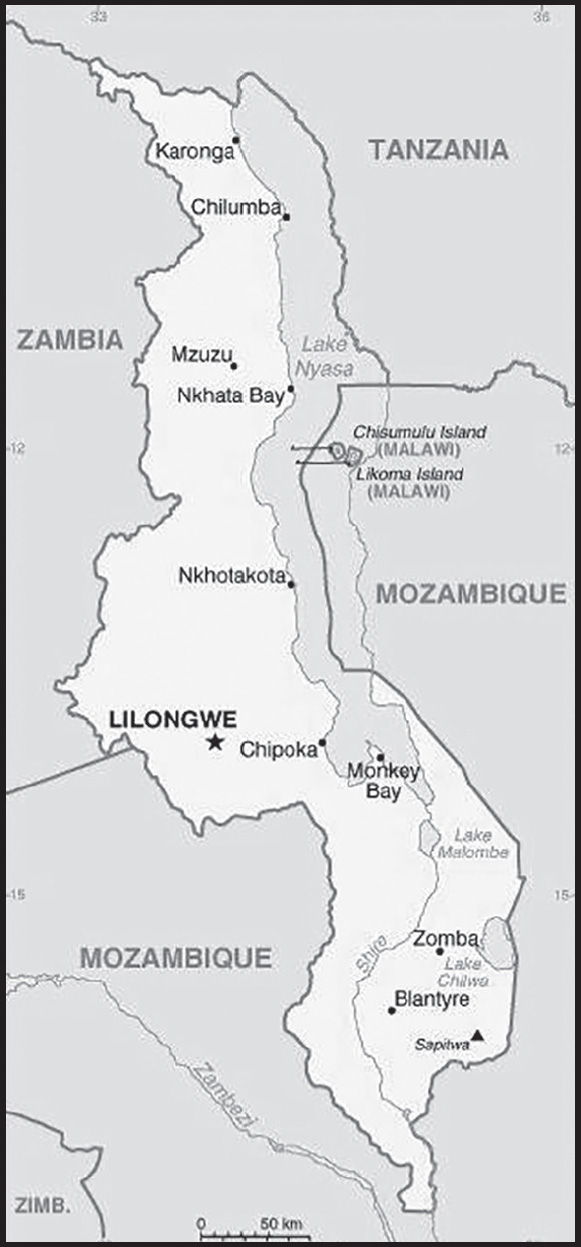
Location: Southern Africa, east of Zambia, west and north of Mozambique
Geographic coordinates: 13 30 S, 34 00 E
Map references: Africa
Area: total: 118,484 sq km
land: 94,080 sq km
water: 24,404 sq km
comparison ranking: total 100
Area - comparative: slightly smaller than Pennsylvania
Land boundaries: total: 2,857 km
border countries (3): Mozambique 1,498 km; Tanzania 512 km; Zambia 847 km
Coastline: 0 km (landlocked)
Maritime claims: none (landlocked)
Climate: sub-tropical; rainy season (November to May); dry season (May to November)
Terrain: narrow elongated plateau with rolling plains, rounded hills, some mountains
Elevation: highest point: Sapitwa (Mount Mlanje) 3,002 m
lowest point: junction of the Shire River and international boundary with Mozambique 37 m
mean elevation: 779 m
Natural resources: limestone, arable land, hydropower, unexploited deposits of uranium, coal, and bauxite
Land use: agricultural land: 59.2% (2018 est.)
arable land: 38.2% (2018 est.)
permanent crops: 1.4% (2018 est.)
permanent pasture: 19.6% (2018 est.)
forest: 34% (2018 est.)
other: 6.8% (2018 est.)
Irrigated land: 740 sq km (2012)
Major lakes (area sq km): fresh water lake(s): Lake Malawi (shared with Mozambique and Tanzania) - 22,490
salt water lake(s): Lake Chilwa - 1,040 sq km
Major rivers (by length in km): Zambezi (shared with Zambia [s], Angola, Zimbabwe, Namibia, Tanzania, and Mozambique [m]) - 2,740 km note – [s] after country name indicates river source; [m] after country name indicates river mouth
Major watersheds (area sq km): Atlantic Ocean drainage: Congo (3,730,881 sq km)
Indian Ocean drainage: Zambezi (1,332,412 sq km)
Population distribution: population density is highest south of Lake Nyasa as shown in this population distribution map
Natural hazards: flooding; droughts; earthquakes
Geography - note: landlocked; Lake Nyasa, some 580 km long, is the country’s most prominent physical feature; it contains more fish species than any other lake on earth
PEOPLE AND SOCIETY
Population: 21,279,597 (2023 est.)
comparison ranking: 62
Nationality: noun: Malawian(s)
adjective: Malawian
Ethnic groups: Chewa 34.3%, Lomwe 18.8%, Yao 13.2%, Ngoni 10.4%, Tumbuka 9.2%, Sena 3.8%, Mang’anja 3.2%, Tonga 1.8%, Nyanja 1.8%, Nkhonde 1%, other 2.2%, foreign 0.3% (2018 est.)
Languages: English (official), Chewa (common), Lambya, Lomwe, Ngoni, Nkhonde, Nyakyusa, Nyanja, Sena, Tonga, Tumbuka, Yao
note: Chewa and Nyanja are mutually intelligible dialects; Nkhonde and Nyakyusa are mutually intelligible dialects
Religions: Protestant 33.5% (includes Church of Central Africa Presbyterian 14.2%, Seventh Day Adventist/Baptist 9.4%, Pentecostal 7.6%, Anglican 2.3%), Roman Catholic 17.2%, other Christian 26.6%, Muslim 13.8%, traditionalist 1.1%, other 5.6%, none 2.1% (2018 est.)
Demographic profile: Malawi has made great improvements in maternal and child health, but has made less progress in reducing its high fertility rate. In both rural and urban areas, very high proportions of mothers are receiving prenatal care and skilled birth assistance, and most children are being vaccinated. Malawi’s fertility rate, however, has only declined slowly, decreasing from more than 7 children per woman in the 1980s to about 5.5 today. Nonetheless, Malawians prefer smaller families than in the past, and women are increasingly using contraceptives to prevent or space pregnancies. Rapid population growth and high population density is putting pressure on Malawi’s land, water, and forest resources. Reduced plot sizes and increasing vulnerability to climate change, further threaten the sustainability of Malawi’s agriculturally based economy and will worsen food shortages. About 80% of the population is employed in agriculture.
Historically, Malawians migrated abroad in search of work, primarily to South Africa and present-day Zimbabwe, but international migration became uncommon after the 1970s, and most migration in recent years has been internal. During the colonial period, Malawians regularly migrated to southern Africa as contract farm laborers, miners, and domestic servants. In the decade and a half after independence in 1964, the Malawian Government sought to transform its economy from one dependent on small-scale farms to one based on estate agriculture. The resulting demand for wage labor induced more than 300,000 Malawians to return home between the mid-1960s and the mid-1970s. In recent times, internal migration has generally been local, motivated more by marriage than economic reasons.
Age structure: 0-14 years: 38.54% (male 4,073,674/female 4,128,035)
15-64 years: 57.64% (male 6,001,150/female 6,264,749)
65 years and over: 3.82% (2023 est.) (male 362,428/female 449,561)
Dependency ratios: total dependency ratio: 84.7
youth dependency ratio: 79.7
elderly dependency ratio: 5
potential support ratio: 20.1 (2021 est.)
Median age: total: 16.8 years (2020)
male: 16.7 years
female: 16.9 years
comparison ranking: total 221
Population growth rate: 2.28% (2023 est.)
comparison ranking: 31
Birth rate: 27.29 births/1,000 population (2023 est.)
comparison ranking: 38
Death rate: 4.51 deaths/1,000 population (2023 est.)
comparison ranking: 205
Net migration rate: 0 migrant(s)/1,000 population (2023 est.)
comparison ranking: 90
Population distribution: population density is highest south of Lake Nyasa as shown in this population distribution map
Urbanization: urban population: 18.3% of total population (2023)
rate of urbanization: 4.41% annual rate of change (2020-25 est.)
Major urban areas - population: 1.276 million LILONGWE (capital), 1.031 million Blantyre-Limbe (2023)
Sex ratio: at birth: 1.02 male(s)/female
0-14 years: 0.99 male(s)/female
15-64 years: 0.96 male(s)/female
65 years and over: 0.81 male(s)/female
total population: 0.96 male(s)/female (2023 est.)
Mother’s mean age at first birth: 19.1 years (2015/16 est.)
note: data represents median age at first birth among women 20-49
Maternal mortality ratio: 381 deaths/100,000 live births (2020 est.)
comparison ranking: 25
Infant mortality rate: total: 32.68 deaths/1,000 live births (2023 est.)
male: 37.12 deaths/1,000 live births
female: 28.16 deaths/1,000 live births
comparison ranking: total 42
Life expectancy at birth: total population: 72.71 years (2023 est.)
male: 69.62 years
female: 75.85 years
comparison ranking: total population 157
Total fertility rate: 3.3 children born/woman (2023 est.)
comparison ranking: 41
Gross reproduction rate: 1.64 (2023 est.)
Contraceptive prevalence rate: 65.6% (2019/20)
Drinking water source: improved: urban: 96.7% of population
rural: 91% of population
total: 92% of population
unimproved: urban: 3.3% of population
rural: 9% of population
total: 8% of population (2020 est.)
Current health expenditure: 5.4% of GDP (2020)
Physicians density: 0.05 physicians/1,000 population (2020)
Hospital bed density: 1.3 beds/1,000 population (2011)
Sanitation facility access: improved: urban: 59.9% of population
rural: 35.9% of population
total: 40% of population
unimproved: urban: 40.1% of population
rural: 64.1% of population
total: 60% of population (2020 est.)
Major infectious diseases: degree of risk: very high (2023)
food or waterborne diseases: bacterial and protozoal diarrhea, hepatitis A, and typhoid fever
vectorborne diseases: malaria and dengue fever
water contact diseases: schistosomiasis
animal contact diseases: rabies
note: on 31 August 2023, the US Centers for Disease Control and Prevention (CDC) issued a Travel Alert for polio in Africa; Malawi is currently considered a high risk to travelers for circulating vaccine-derived polioviruses (cVDPV); vaccine-derived poliovirus (VDPV) is a strain of the weakened poliovirus that was initially included in oral polio vaccine (OPV) and that has changed over time and behaves more like the wild or naturally occurring virus; this means it can be spread more easily to people who are unvaccinated against polio and who come in contact with the stool or respiratory secretions, such as from a sneeze, of an “infected” person who received oral polio vaccine; the CDC recommends that before any international travel, anyone unvaccinated, incompletely vaccinated, or with an unknown polio vaccination status should complete the routine polio vaccine series; before travel to any high-risk destination, the CDC recommends that adults who previously completed the full, routine polio vaccine series receive a single, lifetime booster dose of polio vaccine
Obesity - adult prevalence rate: 5.8% (2016)
comparison ranking: 174
Alcohol consumption per capita: total: 2.04 liters of pure alcohol (2019 est.)
beer: 0.08 liters of pure alcohol (2019 est.)
wine: 0 liters of pure alcohol (2019 est.)
spirits: 0.25 liters of pure alcohol (2019 est.)
other alcohols: 1.7 liters of pure alcohol (2019 est.)
comparison ranking: total 129
Tobacco use: total: 10.8% (2020 est.)
male: 17.5% (2020 est.)
female: 4.1% (2020 est.)
comparison ranking: total 132
Children under the age of 5 years underweight: 11.7% (2020)
comparison ranking: 47
Currently married women (ages 15-49): 60.7% (2022 est.)
Child marriage: women married by age 15: 7.5%
women married by age 18: 37.7%
men married by age 18: 7% (2020 est.)
Education expenditures: 2.9% of GDP (2020 est.)
comparison ranking: 160
Literacy: definition: age 15 and over can read and write
total population: 67.3%
male: 71.2%
female: 63.7% (2021)
School life expectancy (primary to tertiary education): total: 11 years
male: 11 years
female: 11 years (2011)
Youth unemployment rate (ages 15-24): total: 9.9% (2021 est.)
male: 7.6%
female: 12.2%
comparison ranking: total 153
ENVIRONMENT
Environment - current issues: deforestation; land degradation; water pollution from agricultural runoff, sewage, industrial wastes; siltation of spawning grounds endangers fish populations; negative effects of climate change (extreme high temperatures, changing precipitation patterns)
Environment - international agreements: party to: Biodiversity, Climate Change, Climate Change-Kyoto Protocol, Climate Change-Paris Agreement, Comprehensive Nuclear Test Ban, Desertification, Endangered Species, Environmental Modification, Hazardous Wastes, Law of the Sea, Marine Life Conservation, Nuclear Test Ban, Ozone Layer Protection, Ship Pollution, Wetlands
signed, but not ratified: none of the selected agreements
Climate: sub-tropical; rainy season (November to May); dry season (May to November)
Land use: agricultural land: 59.2% (2018 est.)
arable land: 38.2% (2018 est.)
permanent crops: 1.4% (2018 est.)
permanent pasture: 19.6% (2018 est.)
forest: 34% (2018 est.)
other: 6.8% (2018 est.)
Urbanization: urban population: 18.3% of total population (2023)
rate of urbanization: 4.41% annual rate of change (2020-25 est.)
Food insecurity: widespread lack of access: due to weather extremes and high food prices - the latest analysis indicates that about 3.8 million people (20 percent of the population) are estimated to have faced high levels of acute food insecurity between January and March 2023; this figure is more than double the number in the corresponding months of 2022; high food prices are the key reason for the deterioration in food insecurity, which, in the absence of a substantial increase in incomes, are severely constraining households’ economic access to food; production shortfalls in southern districts in 2022, areas that have the highest prevalence of food insecurity, are a further contributing factor; the impact of Cyclone Freddy (February-March 2023) on southern districts, including crop losses and destruction of infrastructure as well as high food prices, are expected to aggravate food insecurity conditions in 2023 (2023)
Revenue from forest resources: 6.19% of GDP (2018 est.)
comparison ranking: 10
Revenue from coal: 0.03% of GDP (2018 est.)
comparison ranking: 37
Air pollutants: particulate matter emissions: 18.57 micrograms per cubic meter (2019 est.)
carbon dioxide emissions: 1.3 megatons (2016 est.)
methane emissions: 11.12 megatons (2020 est.)
Waste and recycling: municipal solid waste generated annually: 1,297,844 tons (2013 est.)
Major lakes (area sq km): fresh water lake(s): Lake Malawi (shared with Mozambique and Tanzania) - 22,490
salt water lake(s): Lake Chilwa - 1,040 sq km
Major rivers (by length in km): Zambezi (shared with Zambia [s], Angola, Zimbabwe, Namibia, Tanzania, and Mozambique [m]) - 2,740 km
note – [s] after country name indicates river source; [m] after country name indicates river mouth
Major watersheds (area sq km): Atlantic Ocean drainage: Congo (3,730,881 sq km)
Indian Ocean drainage: Zambezi (1,332,412 sq km)
Total water withdrawal: municipal: 140 million cubic meters (2020 est.)
industrial: 50 million cubic meters (2020 est.)
agricultural: 1.17 billion cubic meters (2020 est.)
Total renewable water resources: 17.28 billion cubic meters (2020 est.)
GOVERNMENT
Country name: conventional long form: Republic of Malawi
conventional short form: Malawi
local long form: Dziko la Malawi
local short form: Malawi
former: British Central African Protectorate, Nyasaland Protectorate, Nyasaland
etymology: named for the East African Maravi Kingdom of the 16th century; the word “maravi” means “fire flames”
Government type: presidential republic
Capital: name: Lilongwe
geographic coordinates: 13 58 S, 33 47 E
time difference: UTC+2 (7 hours ahead of Washington, DC, during Standard Time)
etymology: named after the Lilongwe River that flows through the city
Administrative divisions: 28 districts; Balaka, Blantyre, Chikwawa, Chiradzulu, Chitipa, Dedza, Dowa, Karonga, Kasungu, Likoma, Lilongwe, Machinga, Mangochi, Mchinji, Mulanje, Mwanza, Mzimba, Neno, Ntcheu, Nkhata Bay, Nkhotakota, Nsanje, Ntchisi, Phalombe, Rumphi, Salima, Thyolo, Zomba
Independence: 6 July 1964 (from the UK)
National holiday: Independence Day, 6 July (1964); note - also called Republic Day since 6 July 1966
Constitution: history: previous 1953 (preindependence), 1964, 1966; latest drafted January to May 1994, approved 16 May 1994, entered into force 18 May 1995
amendments: proposed by the National Assembly; passage of amendments affecting constitutional articles, including the sovereignty and territory of the state, fundamental constitutional principles, human rights, voting rights, and the judiciary, requires majority approval in a referendum and majority approval by the Assembly; passage of other amendments requires at least two-thirds majority vote of the Assembly; amended several times, last in 2017
Legal system: mixed legal system of English common law and customary law; judicial review of legislative acts in the Supreme Court of Appeal
International law organization participation: accepts compulsory ICJ jurisdiction with reservations; accepts ICCt jurisdiction
Citizenship: citizenship by birth: no
citizenship by descent only: at least one parent must be a citizen of Malawi
dual citizenship recognized: no
residency requirement for naturalization: 7 years
Suffrage: 18 years of age; universal
Executive branch: chief of state: President Lazarus CHAKWERA (since 28 June 2020); Vice President Saulos CHILIMA (since 3 February 2020); note - the president is both chief of state and head of government
head of government: President Lazarus CHAKWERA (since 28 June 2020); Vice President Saulos CHILIMA (since 3 February 2020)
cabinet: Cabinet named by the president
elections/appointments: president directly elected by simple majority popular vote for a 5-year term (eligible for a second term); election last held on 23 June 2020 (next to be held in 2025)
election results:
2020: Lazarus CHAKWERA elected president; Lazarus CHAKWERA (MCP) 59.3%, Peter Mutharika (DPP) 39.9%, other 0.8%
2014: Peter MUTHARIKA elected president; percent of vote - Peter MUTHARIKA (DPP) 36.4%, Lazarus CHAKWERA (MCP) 27.8%, Joyce BANDA (PP) 20.2%, Atupele MULUZI (UDF) 13.7%, other 1.9%
Legislative branch: description: unicameral National Assembly (193 seats; members directly elected in single-seat constituencies by simple majority vote to serve 5-year terms)
elections: last held on 21 May 2019 (next to be held in May 2024)
election results: percent of vote by party - n/a; seats by party - DPP 62, MCP 55, UDF 10, PP 5, other 5, independent 55, vacant 1; composition - men 161, women 32, percent of women 16.6%
Judicial branch: highest court(s): Supreme Court of Appeal (consists of the chief justice and at least 3 judges)
judge selection and term of office: Supreme Court chief justice appointed by the president and confirmed by the National Assembly; other judges appointed by the president upon the recommendation of the Judicial Service Commission, which regulates judicial officers; judges serve until age 65
subordinate courts: High Court; magistrate courts; Industrial Relations Court; district and city traditional or local courts
Political parties and leaders: Democratic Progressive Party or DPP [Peter MUTHARIKA]
Malawi Congress Party or MCP [Lazarus CHAKWERA]
People’s Party or PP [Joyce BANDA]
United Democratic Front or UDF
United Transformation Movement or UTM [Saulos CHILIMA]
International organization participation: ACP, AfDB, AU, C, CD, COMESA, FAO, G-77, IAEA, IBRD, ICAO, ICCt, ICRM, IDA, IFAD, IFC, IFRCS, ILO, IMF, IMO, Interpol, IOC, IOM, IPU, ISO (correspondent), ITSO, ITU, ITUC (NGOs), MIGA, MINURSO, MONUSCO, NAM, OPCW, SADC, UN, UNCTAD, UNESCO, UNHRC, UNIDO, UNISFA, UNOCI, UNWTO, UPU, WCO, WFTU (NGOs), WHO, WIPO, WMO, WTO
Diplomatic representation in the US: chief of mission: Ambassador Esme Jynet CHOMBO (since 19 April 2022)
chancery: 2408 Massachusetts Avenue NW, Washington, DC 20008
telephone: [1] (202) 721-0270
FAX: [1] (202) 721-0288
email address and website:
http://www.malawiembassy-dc.org/
Diplomatic representation from the US: chief of mission: Ambassador David YOUNG (since 5 May 2022)
embassy: 16 Jomo Kenyatta Road, Lilongwe 3
mailing address: 2280 Lilongwe Place, Washington DC 20521-2280
telephone: [265] (0) 177-3166
FAX: [265] (0) 177-0471
email address and website:
Flag description: three equal horizontal bands of black (top), red, and green with a radiant, rising, red sun centered on the black band; black represents the native peoples, red the blood shed in their struggle for freedom, and green the color of nature; the rising sun represents the hope of freedom for the continent of Africa
National symbol(s): lion; national colors: black, red, green
National anthem: name: “Mulungu dalitsa Malawi” (Oh God Bless Our Land of Malawi)
lyrics/music: Michael-Fredrick Paul SAUKA
note: adopted 1964
National heritage: total World Heritage Sites: 2 (1 cultural, 1 natural)
selected World Heritage Site locales: Lake Malawi National Park (n); Chongoni Rock-Art Area (c)
ECONOMY
Economic overview: low-income East African economy; primarily agrarian; investing in human capital; urban poverty increasing due to COVID-19; high public debt; endemic corruption and poor property rights; poor hydroelectric grid; localized pharmaceutical industry
Real GDP (purchasing power parity): $29.658 billion (2021 est.)
$28.864 billion (2020 est.)
$28.635 billion (2019 est.)
note: data are in 2017 dollars
comparison ranking: 140
Real GDP growth rate: 2.75% (2021 est.)
0.8% (2020 est.)
5.45% (2019 est.)
comparison ranking: 148
Real GDP per capita: $1,500 (2021 est.)
$1,500 (2020 est.)
$1,500 (2019 est.)
note: data are in 2017 dollars
comparison ranking: 220
GDP (official exchange rate): $7.766 billion (2019 est.)
Inflation rate (consumer prices): 8.63% (2020 est.)
9.37% (2019 est.)
12.42% (2018 est.)
comparison ranking: 31
GDP - composition, by sector of origin: agriculture: 28.6% (2017 est.)
industry: 15.4% (2017 est.)
services: 56% (2017 est.)
comparison rankings: services 151; industry 179; agriculture 19
GDP - composition, by end use: household consumption: 84.3% (2017 est.)
government consumption: 16.3% (2017 est.)
investment in fixed capital: 15.3% (2017 est.)
investment in inventories: 0% (2017 est.)
exports of goods and services: 27.9% (2017 est.)
imports of goods and services: -43.8% (2017 est.)
Agricultural products: sweet potatoes, cassava, sugar cane, maize, mangoes/guavas, potatoes, tomatoes, pigeon peas, bananas, plantains
Industries: tobacco, tea, sugar, sawmill products, cement, consumer goods
Industrial production growth rate: 1.9% (2021 est.)
comparison ranking: 137
Labor force: 8.551 million (2021 est.)
comparison ranking: 61
Labor force - by occupation: agriculture: 76.9%
industry: 4.1%
services: 19% (2013 est.)
Unemployment rate: 7.02% (2021 est.)
6.7% (2020 est.)
5.75% (2019 est.)
comparison ranking: 112
Youth unemployment rate (ages 15-24): total: 9.9% (2021 est.)
male: 7.6%
female: 12.2%
comparison ranking: total 153
Population below poverty line: 51.5% (2016 est.)
Gini Index coefficient - distribution of family income: 38.5 (2019 est.)
comparison ranking: 68
Household income or consumption by percentage share: lowest 10%: 2.2%
highest 10%: 37.5% (2010 est.)
Budget: revenues: $1.628 billion (2019 est.)
expenditures: $2.129 billion (2019 est.)
Budget surplus (+) or deficit (-): -3.4% (of GDP) (2017 est.)
comparison ranking: 142
Public debt: 44.89% of GDP (2019 est.)
41.7% of GDP (2018 est.)
34.29% of GDP (2017 est.)
comparison ranking: 125
Taxes and other revenues: 11.72% (of GDP) (2020 est.)
comparison ranking: 179
Fiscal year: 1 April - 31 March
Current account balance: -$1.543 billion (2021 est.)
-$1.466 billion (2020 est.)
-$1.321 billion (2019 est.)
comparison ranking: 148
Exports: $1.538 billion (2021 est.) note: data are in current year dollars
$1.268 billion (2020 est.) note: data are in current year dollars
$1.447 billion (2019 est.)
comparison ranking: 166
Exports - partners: Belgium 16%, United States 8%, Egypt 7%, South Africa 6%, Germany 6%, Kenya 5%, United Arab Emirates 5% (2019)
Exports - commodities: tobacco, gold, soybeans, raw sugar, tea, dried legumes and nuts (2021)
Imports: $3.582 billion (2021 est.) note: data are in current year dollars
$3.208 billion (2020 est.) note: data are in current year dollars
$3.266 billion (2019 est.)
comparison ranking: 156
Imports - partners: South Africa 17%, China 16%, United Arab Emirates 9%, India 9%, United Kingdom 8% (2019)
Imports - commodities: postage stamps, refined petroleum, packaged medicines, fertilizers, office machinery/parts (2019)
Reserves of foreign exchange and gold: $594,498,500 (31 December 2020 est.)
$846,839,800 (31 December 2019 est.)
$766,154,800 (31 December 2018 est.)
comparison ranking: 164
Debt - external: $2.102 billion (31 December 2017 est.)
$1.5 billion (31 December 2016 est.)
comparison ranking: 152
Exchange rates: Malawian kwachas (MWK) per US dollar -
Exchange rates: 749.527 (2020 est.)
745.541 (2019 est.)
732.333 (2018 est.)
730.273 (2017 est.)
718.005 (2016 est.)
ENERGY
Electricity access: population without electricity: 17 million (2020)
electrification - total population: 14.1% (2021)
electrification - urban areas: 54.2% (2021)
electrification - rural areas: 5.5% (2021)
Electricity: installed generating capacity: 618,000 kW (2020 est.)
consumption: 1,117,378,000 kWh (2019 est.)
exports: 0 kWh (2019 est.)
imports: 0 kWh (2019 est.)
transmission/distribution losses: 460 million kWh (2019 est.)
comparison rankings: installed generating capacity 145; transmission/distribution losses 132; imports 211; exports 211; consumption 156
Electricity generation sources: fossil fuels: 11.8% of total installed capacity (2020 est.)
solar: 3.2% of total installed capacity (2020 est.)
hydroelectricity: 81.9% of total installed capacity (2020 est.)
biomass and waste: 3.2% of total installed capacity (2020 est.)
Coal: production: 48,000 metric tons (2020 est.)
consumption: 47,000 metric tons (2020 est.)
exports: 0 metric tons (2020 est.)
imports: 0 metric tons (2020 est.)
proven reserves: 2 million metric tons (2019 est.)
Petroleum: total petroleum production: 0 bbl/day (2021 est.)
refined petroleum consumption: 9,400 bbl/day (2019 est.)
Refined petroleum products - imports: 4,769 bbl/day (2015 est.)
comparison ranking: 173
Carbon dioxide emissions: 1.542 million metric tonnes of CO2 (2019 est.)
from coal and metallurgical coke: 203,000 metric tonnes of CO2 (2019 est.)
from petroleum and other liquids: 1.339 million metric tonnes of CO2 (2019 est.)
comparison ranking: total emissions 165
Energy consumption per capita: 1.809 million Btu/person (2019 est.)
comparison ranking: 187
COMMUNICATIONS
Telephones - fixed lines: total subscriptions: 12,465 (2021 est.)
subscriptions per 100 inhabitants: (2021 est.) less than 1
comparison ranking: total subscriptions 184
Telephones - mobile cellular: total subscriptions: 11,940,135 (2021 est.)
subscriptions per 100 inhabitants: 60 (2021 est.)
comparison ranking: total subscriptions 83
Telecommunication systems: general assessment: with few resources, Malawi is one of the world’s least developed countries; there has been little investment in fixed-line telecom infrastructure, and as a result, the country’s two mobile networks Airtel Malawi and TMN provide the vast majority of connections for voice and data services; both operators have invested in LTE technologies to improve the quality of data services; the lack of market competition, together with limited international internet bandwidth, has also resulted in some of the highest prices for telecom services in the region; the government in late 2020 secured an average 80% reduction in the cost of data bundles offered by the MNOs; following continuing customer complaints, the regulator in mid-2021 ensured that costs were again reduced, this time by about a third; mobile penetration remains low in comparison to the regional average and so there are considerable opportunities for further growth, particularly in the mobile broadband sector; low penetration is partly attributed to the lack of competition, though there is the possibility that a new play come launch services by the end of 2022; the internet sector is reasonably competitive, with about 50 licensed ISPs, though the limited availability and high cost of international bandwidth has held back growth and kept broadband access prices among the highest in the region; these limitations are being addressed, with the second phase of the national fiber backbone having started in mid-2021 (2022)
domestic: limited fixed-line subscribership less than 1 per 100 households; mobile-cellular subscribership roughly 60 per 100 households (2021)
international: country code - 265; satellite earth stations - 2 Intelsat (1 Indian Ocean, 1 Atlantic Ocean) (2019)
Broadcast media: radio is the main broadcast medium; privately owned Zodiak radio has the widest national broadcasting reach, followed by state-run radio; numerous private and community radio stations broadcast in cities and towns around the country; the largest TV network is government-owned, but at least 4 private TV networks broadcast in urban areas; relays of multiple international broadcasters are available (2019)
Internet country code: .mw
Internet users: total: 4.8 million (2021 est.)
percent of population: 24% (2021 est.)
comparison ranking: total 99
Broadband - fixed subscriptions: total: 12,255 (2020 est.)
subscriptions per 100 inhabitants: 0.1 (2020 est.)
comparison ranking: total 176
TRANSPORTATION
National air transport system: number of registered air carriers: 2 (2020)
inventory of registered aircraft operated by air carriers: 9
annual passenger traffic on registered air carriers: 10,545 (2018)
annual freight traffic on registered air carriers: 10,000 (2018) mt-km
Civil aircraft registration country code prefix: 7Q
Airports: 32 (2021)
comparison ranking: total 112
Airports - with paved runways: 7
note: paved runways have a concrete or asphalt surface but not all have facilities for refueling, maintenance, or air traffic control; the length of a runway required for aircraft to safely operate depends on a number of factors including the type of aircraft, the takeoff weight (including passengers, cargo, and fuel), engine types, flap settings, landing speed, elevation of the airport, and average maximum daily air temperature; paved runways can reach a length of 5,000 m (16,000 ft.), but the “typical” length of a commercial airline runway is between 2,500-4,000 m (8,000-13,000 ft.)
Airports - with unpaved runways: 25
note: unpaved runways have a surface composition such as grass or packed earth and are most suited to the operation of light aircraft; unpaved runways are usually short, often less than 1,000 m (3,280 ft.) in length; airports with unpaved runways often lack facilities for refueling, maintenance, or air traffic control
Railways: total: 767 km (2014)
narrow gauge: 767 km (2014) 1.067-m gauge
comparison ranking: total 97
Roadways: total: 15,452 km (2015)
paved: 4,074 km (2015)
unpaved: 11,378 km (2015)
comparison ranking: total 122
Waterways: 700 km (2010) (on Lake Nyasa [Lake Malawi] and Shire River)
comparison ranking: 82
Ports and terminals: lake port(s): Chipoka, Monkey Bay, Nkhata Bay, Nkhotakota, Chilumba (Lake Nyasa)
MILITARY AND SECURITY
Military and security forces: Malawi Defense Force (MDF): Army, Maritime Force, Air Force, National Service (reserve force) (2023)
note: the MDF reports directly to the president as commander in chief; the Malawi Ministry of Defense was abolished in 2011; the Malawi Police Service is under the Ministry of Homeland Security
Military expenditures: 0.7% of GDP (2022 est.)
0.9% of GDP (2021 est.)
0.9% of GDP (2020 est.)
1.1% of GDP (2019 est.)
0.8% of GDP (2018 est.)
comparison ranking: 145
Military and security service personnel strengths: estimated 10,000 active military personnel (2023)
Military equipment inventories and acquisitions: the MDF’s inventory is comprised of mostly obsolescent or secondhand equipment originating from such countries as France and South Africa; in recent years, it has received small amounts of armaments from a few countries, including China (2023)
Military service age and obligation: 18-30 years of age for men and women for voluntary military service; high school equivalent required for enlisted recruits and college equivalent for officer recruits; initial engagement is 7 years for enlisted personnel and 10 years for officers (2023)
Military deployments: 750 Democratic Republic of the Congo (MONUSCO) (2023)
Military - note: the MDF’s primary responsibility is external security; it is also tasked as necessary with providing support to civilian authorities during emergencies, supporting the Police Service, protecting national forest reserves, and participating in regional peacekeeping missions, as well as assisting with infrastructure development; it is generally considered to be a professional and effective service, although most of its equipment is aging and obsolescent; Malawi contributes regularly to African Union and UN peace support operations; the Army is the dominant service and has 3 infantry brigades while its subordinate maritime force has a few patrol boats for monitoring Lake Malawi
the MDF was established in 1964 from elements of the Kings African Rifles (KAR), a British colonial regiment raised from Great Britain’s various possessions in East Africa from 1902 until independence in the 1960s; the KAR conducted both military and internal security functions within the colonial territories, and served outside the territories during the World Wars (2023)
TRANSNATIONAL ISSUES
Disputes - international: Malawi-Mozambique: the two countries have held exercises to reaffirm boundaries a number of times
Malawi-Tanzania: dispute with Tanzania over the boundary in Lake Nyasa (Lake Malawi) and the meandering Songwe River; Malawi contends that the entire lake up to the Tanzanian shoreline is its territory, while Tanzania claims the border is in the center of the lake; the conflict was reignited in 2012 when Malawi awarded a license to a British company for oil exploration in the lake
Malawi-Zambia: border demarcation was completed in 2011; in 2018, the redemarcation exercise determined that some parts of Malawi actually belonged to Zambia
Refugees and internally displaced persons: refugees (country of origin): 34,030 (Democratic Republic of the Congo) (refugees and asylum seekers) 11,502 (Burundi) (refugees and asylum seekers), 6,594 (Rwanda) (refugees and asylum seekers) (2023)
Illicit drugs: NA
MALAYSIA
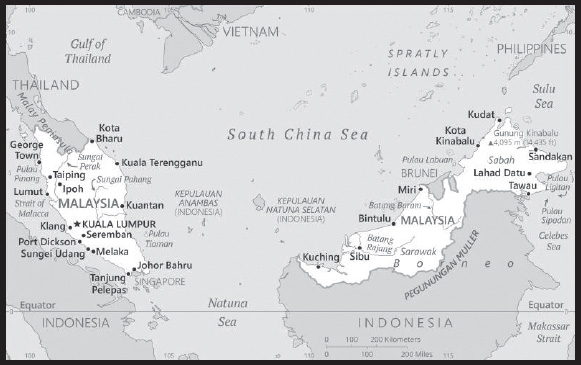
INTRODUCTION
Background: Malaysia’s location has long made it an important cultural, economic, historical, social, and trade link between the islands of Southeast Asia and the mainland. Through the Strait of Malacca, which separates the Malay Peninsula from the archipelago, flowed maritime trade and with it influences from China, India, the Middle East, and the east coast of Africa. Prior to the 14th century, several powerful maritime empires existed in what is modern-day Malaysia, including the Srivijayan, which controlled much of the southern part of the peninsula between the 7th and 13th centuries, and the Majapahit Empire, which took control over most of the peninsula and the Malay Archipelago between the 13th and 14th centuries. The adoption of Islam between the 13th and 17th centuries also saw the rise of a number of powerful maritime states and sultanates on the Malay Peninsula and the island of Borneo, such as the port city of Malacca (Melaka), which at its height in the 15th century had a navy and hosted thousands of Chinese, Arab, Persian, and Indian merchants.
The Portuguese in the 16th century and the Dutch in the 17th century were the first European colonial powers to establish themselves on the Malay Peninsula and Southeast Asia. However, it was the British who ultimately secured their hegemony across the territory and during the late 18th and 19th centuries established colonies and protectorates in the area that is now Malaysia. These holdings were occupied by Japan from 1942 to 1945. In 1948, the British-ruled territories on the Malay Peninsula except Singapore formed the Federation of Malaya, which became independent in 1957. Malaysia was formed in 1963 when the former British colonies of Singapore, as well as Sabah and Sarawak on the northern coast of Borneo, joined the Federation. The first several years of the country’s independence were marred by a communist insurgency, Indonesian confrontation with Malaysia, Philippine claims to Sabah, and Singapore’s expulsion in 1965. During the 22-year term of Prime Minister MAHATHIR Mohamad (1981-2003), Malaysia was successful in diversifying its economy from dependence on exports of raw materials to the development of manufacturing, services, and tourism. Former Prime Minister MAHATHIR and a newly formed coalition of opposition parties defeated Prime Minister Mohamed NAJIB bin Abdul Razak’s United Malays National Organization (UMNO) in May 2018, ending over 60 years of uninterrupted rule by UMNO. Since 2018, Malaysia has undergone considerable political upheaval with a succession of coalition governments holding power. Following legislative elections in 2022, Anwar IBRAHIM was appointed prime minister after more than 20 years in opposition. His ruling coalition holds a two-thirds majority in the Malaysian parliament.
GEOGRAPHY
Location: Southeastern Asia, peninsula bordering Thailand and northern one-third of the island of Borneo, bordering Indonesia, Brunei, and the South China Sea, south of Vietnam
Geographic coordinates: 2 30 N, 112 30 E
Map references: Southeast Asia
Area: total: 329,847 sq km
land: 328,657 sq km
water: 1,190 sq km
comparison ranking: total 68
Area - comparative: slightly larger than New Mexico
Land boundaries: total: 2,742 km
border countries (3): Brunei 266 km; Indonesia 1,881 km; Thailand 595 km
Coastline: 4,675 km (Peninsular Malaysia 2,068 km, East Malaysia 2,607 km)
Maritime claims: territorial sea: 12 nm
exclusive economic zone: 200 nm
continental shelf: 200-m depth or to the depth of exploitation; specified boundary in the South China Sea
Climate: tropical; annual southwest (April to October) and northeast (October to February) monsoons
Terrain: coastal plains rising to hills and mountains
Elevation: highest point: Gunung Kinabalu 4,095 m
lowest point: Indian Ocean 0 m
mean elevation: 419 m
Natural resources: tin, petroleum, timber, copper, iron ore, natural gas, bauxite
Land use: agricultural land: 23.2% (2018 est.)
arable land: 2.9% (2018 est.)
permanent crops: 19.4% (2018 est.)
permanent pasture: 0.9% (2018 est.)
forest: 62% (2018 est.)
other: 14.8% (2018 est.)
Irrigated land: 4,420 sq km (2020)
Population distribution: a highly uneven distribution with over 80% of the population residing on the Malay Peninsula
Natural hazards: flooding; landslides; forest fires
Geography - note: strategic location along Strait of Malacca and southern South China Sea
PEOPLE AND SOCIETY
Population: 34,219,975 (2023 est.)
comparison ranking: 43
Nationality: noun: Malaysian(s)
adjective: Malaysian
Ethnic groups: Bumiputera 62.5% (Malays and indigenous peoples, including Orang Asli, Dayak, Anak Negeri), Chinese 20.6%, Indian 6.2%, other 0.9%, non-citizens 9.8% (2019 est.)
Languages: Bahasa Malaysia (official), English, Chinese (Cantonese, Mandarin, Hokkien, Hakka, Hainan, Foochow), Tamil, Telugu, Malayalam, Panjabi, Thai; note - Malaysia has 134 living languages - 112 indigenous languages and 22 non-indigenous languages; in East Malaysia, there are several indigenous languages; the most widely spoken are Iban and Kadazan
major-language sample(s):
Buku Fakta Dunia, sumber yang diperlukan untuk maklumat asas. (Bahasa Malaysia)
Religions: Muslim (official) 61.3%, Buddhist 19.8%, Christian 9.2%, Hindu 6.3%, Confucianism, Taoism, other traditional Chinese religions 1.3%, other 0.4%, none 0.8%, unspecified 1% (2010 est.)
Demographic profile: Malaysia’s multi-ethnic population consists of the bumiputera – Malays and other indigenous peoples – (62%), ethnic Chinese (21%), ethnic Indians (6%), and foreigners (10%). The majority of Malaysia’s ethnic Chinese and Indians trace their roots to the British colonialists’ recruitment of hundreds of thousands of Chinese and Indians as mine and plantation workers between the early-19th century and the 1930s. Most Malays have maintained their rural lifestyle, while the entrepreneurial Chinese have achieved greater wealth and economic dominance. In order to eradicate Malay poverty, the Malaysian Government in 1971 adopted policies that gave preference to the bumiputera in public university admissions, government jobs and contracts, and property ownership. Affirmative action continues to benefit well-off urban bumiputera but has done little to alleviate poverty for their more numerous rural counterparts. The policies have pushed ethnic Chinese and Indians to study at private or foreign universities (many do not return) and have created and sustained one of the world’s largest civil services, which is 85-90% Malay.
The country’s age structure has changed significantly since the 1960s, as fertility and mortality rates have declined. Malaysia’s total fertility rate (TFR) has dropped from 5 children per woman in 1970, to 3 in 1998, to 2.1 in 2015 as a result of increased educational attainment and labor participation among women, later marriages, increased use of contraception, and changes in family size preference related to urbanization. The TFR is higher among Malays, rural residents (who are mainly Malay), the poor, and the less-educated. Despite the reduced fertility rate, Malaysia’s population will continue to grow, albeit at a decreasing rate, for the next few decades because of its large number of reproductive-age women. The youth population has been shrinking, and the working-age population (15-64 year olds) has been growing steadily. Malaysia’s labor market has successfully absorbed the increasing number of job seekers, leading to sustained economic growth. However, the favorable age structure is changing, and around 2020, Malaysia will start to become a rapidly aging society. As the population ages, Malaysia will need to better educate and train its labor force, raise productivity, and continue to increase the number of women workers in order to further develop its economy.
More than 1.8 million Malaysians lived abroad as of 2015, including anywhere from 350,000 to 785,000 workers, more than half of whom have an advanced level of education. The vast majority of emigrants are ethnic Chinese, seeking better educational and job opportunities abroad because of institutionalized ethnic discrimination favoring the Malays. The primary destination country is nearby Singapore, followed by Bangladesh and Australia. Hundreds of thousands of Malaysians also commute across the causeway to Singapore daily for work.
Brain drain is an impediment to Malaysia’s goal of becoming a high-income country. The situation is compounded by a migrant inflow that is composed almost entirely of low-skilled laborers who work mainly in manufacturing, agriculture, and construction. Officially, Malaysia had about 1.8 million legal foreign workers as of mid-year 2017 – largely from Indonesia, Nepal, the Philippines, and Bangladesh – but as many as 3 to 4 million are estimated to be in the country illegally. Immigrants outnumber ethnic Indians and could supplant the ethnic Chinese as Malaysia’s second largest population group around 2035.
Age structure: 0-14 years: 22.46% (male 3,952,311/female 3,734,607)
15-64 years: 69.42% (male 12,198,930/female 11,556,399)
65 years and over: 8.12% (2023 est.) (male 1,345,767/female 1,431,961)
Dependency ratios: total dependency ratio: 43.3
youth dependency ratio: 32.9
elderly dependency ratio: 10.4
potential support ratio: 9.6 (2021 est.)
Median age: total: 29.2 years (2020)
male: 28.9 years
female: 29.6 years
comparison ranking: total 133
Population growth rate: 1.01% (2023 est.)
comparison ranking: 92
Birth rate: 14.39 births/1,000 population (2023 est.)
comparison ranking: 119
Death rate: 5.72 deaths/1,000 population (2023 est.)
comparison ranking: 169
Net migration rate: 1.46 migrant(s)/1,000 population (2023 est.)
comparison ranking: 58
Population distribution: a highly uneven distribution with over 80% of the population residing on the Malay Peninsula
Urbanization: urban population: 78.7% of total population (2023)
rate of urbanization: 1.87% annual rate of change (2020-25 est.)
Major urban areas - population: 8.622 million KUALA LUMPUR (capital), 1.086 million Johor Bahru, 857,000 Ipoh (2023)
Sex ratio: at birth: 1.07 male(s)/female
0-14 years: 1.06 male(s)/female
15-64 years: 1.06 male(s)/female
65 years and over: 0.94 male(s)/female
total population: 1.05 male(s)/female (2023 est.)
Maternal mortality ratio: 21 deaths/100,000 live births (2020 est.)
comparison ranking: 124
Infant mortality rate: total: 6.49 deaths/1,000 live births (2023 est.)
male: 6.87 deaths/1,000 live births
female: 6.08 deaths/1,000 live births
comparison ranking: total 163
Life expectancy at birth: total population: 76.38 years (2023 est.)
male: 74.77 years
female: 78.12 years
comparison ranking: total population 107
Total fertility rate: 1.74 children born/woman (2023 est.)
comparison ranking: 157
Gross reproduction rate: 0.84 (2023 est.)
Contraceptive prevalence rate: 52.2% (2014)
Drinking water source: improved: urban: 99.4% of population
rural: 90.7% of population
total: 97.5% of population
unimproved: urban: 0.6% of population
rural: 9.3% of population
total: 2.5% of population (2020 est.)
Current health expenditure: 4.1% of GDP (2020)
Physicians density: 1.54 physicians/1,000 population (2020)
Hospital bed density: 1.9 beds/1,000 population (2017)
Sanitation facility access: improved: urban: 99% of population
unimproved: urban: 0.1% of population
Major infectious diseases: degree of risk: intermediate (2023)
food or waterborne diseases: bacterial diarrhea
vectorborne diseases: dengue fever
water contact diseases: leptospirosis
Obesity - adult prevalence rate: 15.6% (2016)
comparison ranking: 125
Alcohol consumption per capita: total: 0.64 liters of pure alcohol (2019 est.)
beer: 0.48 liters of pure alcohol (2019 est.)
wine: 0.04 liters of pure alcohol (2019 est.)
spirits: 0.11 liters of pure alcohol (2019 est.)
other alcohols: 0.01 liters of pure alcohol (2019 est.)
comparison ranking: total 158
Tobacco use: total: 22.5% (2020 est.)
male: 43.8% (2020 est.)
female: 1.1% (2020 est.)
comparison ranking: total 68
Children under the age of 5 years underweight: 14.1% (2019)
comparison ranking: 38
Currently married women (ages 15-49): 59.3% (2023 est.)
Education expenditures: 3.9% of GDP (2020 est.)
comparison ranking: 124
Literacy: definition: age 15 and over can read and write
total population: 95%
male: 96.2%
female: 93.6% (2019)
School life expectancy (primary to tertiary education): total: 13 years
male: 13 years
female: 14 years (2020)
Youth unemployment rate (ages 15-24): total: 15.6% (2021 est.)
male: 14.2%
female: 17.8%
comparison ranking: total 111
ENVIRONMENT
Environment - current issues: air pollution from industrial and vehicular emissions; water pollution from raw sewage; deforestation; smoke/haze from Indonesian forest fires; endangered species; coastal reclamation damaging mangroves and turtle nesting sites
Environment - international agreements: party to: Antarctic-Environmental Protection, Antarctic Treaty, Biodiversity, Climate Change, Climate Change-Kyoto Protocol, Climate Change-Paris Agreement, Comprehensive Nuclear Test Ban, Desertification, Endangered Species, Hazardous Wastes, Law of the Sea, Marine Life Conservation, Nuclear Test Ban, Ozone Layer Protection, Ship Pollution, Tropical Timber 2006, Wetlands
signed, but not ratified: none of the selected agreements
Climate: tropical; annual southwest (April to October) and northeast (October to February) monsoons
Land use: agricultural land: 23.2% (2018 est.)
arable land: 2.9% (2018 est.)
permanent crops: 19.4% (2018 est.)
permanent pasture: 0.9% (2018 est.)
forest: 62% (2018 est.)
other: 14.8% (2018 est.)
Urbanization: urban population: 78.7% of total population (2023)
rate of urbanization: 1.87% annual rate of change (2020-25 est.)
Revenue from forest resources: 1.57% of GDP (2018 est.)
comparison ranking: 40
Revenue from coal: 0.02% of GDP (2018 est.)
comparison ranking: 45
Air pollutants: particulate matter emissions: 21.52 micrograms per cubic meter (2019 est.)
carbon dioxide emissions: 248.29 megatons (2016 est.)
methane emissions: 51.51 megatons (2020 est.)
Waste and recycling: municipal solid waste generated annually: 12,982,685 tons (2014 est.)
municipal solid waste recycled annually: 2,271,970 tons (2016 est.)
percent of municipal solid waste recycled: 17.5% (2016 est.)
Total water withdrawal: municipal: 1.34 billion cubic meters (2020 est.)
industrial: 1.64 billion cubic meters (2020 est.)
agricultural: 2.51 billion cubic meters (2020 est.)
Total renewable water resources: 580 billion cubic meters (2020 est.)
GOVERNMENT
Country name: conventional long form: none
conventional short form: Malaysia
local long form: none
local short form: Malaysia
former: British Malaya, Malayan Union, Federation of Malaya
etymology: the name means “Land of the Malays”
Government type: federal parliamentary constitutional monarchy
note: all Peninsular Malaysian states have hereditary rulers (commonly referred to as sultans) except Melaka (Malacca) and Pulau Pinang (Penang); those two states along with Sabah and Sarawak in East Malaysia have governors appointed by government; powers of state governments are limited by the federal constitution; under terms of federation, Sabah and Sarawak retain certain constitutional prerogatives (e.g., right to maintain their own immigration controls)
Capital: name: Kuala Lumpur; note - nearby Putrajaya is referred to as a federal government administrative center but not the capital; Parliament meets in Kuala Lumpur
geographic coordinates: 3 10 N, 101 42 E
time difference: UTC+8 (13 hours ahead of Washington, DC, during Standard Time)
etymology: the Malay word for “river junction or estuary” is kuala and lumpur means “mud”; together the words render the meaning of “muddy confluence”
Administrative divisions: 13 states (negeri-negeri, singular - negeri); Johor, Kedah, Kelantan, Melaka, Negeri Sembilan, Pahang, Perak, Perlis, Pulau Pinang, Sabah, Sarawak, Selangor, Terengganu; and 1 federal territory (Wilayah Persekutuan) with 3 components, Kuala Lumpur, Labuan, and Putrajaya
Independence: 31 August 1957 (from the UK)
National holiday: Independence Day (or Merdeka Day), 31 August (1957) (independence of Malaya); Malaysia Day, 16 September (1963) (formation of Malaysia)
Constitution: history: previous 1948; latest drafted 21 February 1957, effective 27 August 1957
amendments: proposed as a bill by Parliament; passage requires at least two-thirds majority vote by the Parliament membership in the bill’s second and third readings; a number of constitutional sections are excluded from amendment or repeal; amended many times, last in 2019
Legal system: mixed legal system of English common law, Islamic law (sharia), and customary law; judicial review of legislative acts in the Federal Court at request of supreme head of the federation
International law organization participation: has not submitted an ICJ jurisdiction declaration; non-party state to the ICCt
Citizenship: citizenship by birth: no
citizenship by descent only: at least one parent must be a citizen of Malaysia
dual citizenship recognized: no
residency requirement for naturalization: 10 out 12 years preceding application
Suffrage: 18 years of age; universal (2019)
Executive branch: chief of state: King Sultan ABDULLAH Sultan Ahmad Shah (since 24 January 2019); note - King MUHAMMAD V (formerly known as TUANKU Muhammad FARIS Petra) (selected on 14 October 2016; installed on 13 December 2016) resigned on 6 January 2019; the position of the king is primarily ceremonial, but he is the final arbiter on the appointment of the prime minister
head of government: Prime Minister ANWAR Ibrahim (since 25 November 2022)
cabinet: Cabinet appointed by the prime minister from among members of Parliament with the consent of the king
elections/appointments: king elected by and from the hereditary rulers of 9 states for a 5-year term; election is on a rotational basis among rulers of the 9 states; election last held on 24 January 2019 (next to be held in January 2024); prime minister designated from among members of the House of Representatives; following legislative elections, the leader who commands support of the majority of members in the House becomes prime minister
Legislative branch: description: bicameral Parliament of Malaysia or Parlimen Malaysia consists of:
Senate or Dewan Negara (70 seats; 44 members appointed by the king and 26 indirectly elected by 13 state legislatures; members serve 3-year terms)
House of Representatives or Dewan Rakyat (222 seats; members directly elected in single-seat constituencies by simple majority vote to serve 5-year terms) (2016)
elections: Senate - appointed
House of Representatives - last held on 19 Nov 2022 (next to be held in 2027)
election results: Senate - appointed; composition - men 54, women 14, percent of women 20.6%
2022: House of Representatives - percent of vote by party/coalition - PH 37.5%, PN 30.4%, BN 22.4%, GPS 4%, WARISAN 1.8%, GRS 1.3%, other 2.6%; seats by party/coalition - PH 81, PN 73, BN 30, GPS 23, GRS 6, WARISAN 3, PBM 1, KDM 1, MUDA 1, independents/unaffiliated 3
2018: House of Representatives - percent of vote by party/coalition - PH 45.6%, BN 33.8%, PAS 16.9%, WARISAN 2.3%, other 1.4%; seats by party/coalition - PH 113, BN 79, PAS 18, WARISAN 8, USA 1, independent 3; composition - men 199, women 23, percent of women 10.4%; note - total Parliament percent of women 12.8%
note: as of May 2022, seats by party/coalition - PH 90, PN 50, BN 42, GPS 18, WARISAN 7, PEJUANG 4, PBM 3, PSB 1, MUDA 1, independent 4, vacant 2
Judicial branch: highest court(s): Federal Court (consists of the chief justice, president of the Court of Appeal, chief justice of the High Court of Malaya, chief judge of the High Court of Sabah and Sarawak, 8 judges, and 1 “additional” judge); note - Malaysia has a dual judicial hierarchy of civil and religious (sharia) courts
judge selection and term of office: Federal Court justices appointed by the monarch on advice of the prime minister; judges serve until mandatory retirement at age 66 with the possibility of a single 6-month extension
subordinate courts: Court of Appeal; High Court; Sessions Court; Magistrates’ Court
Political parties and leaders: National Front (Barisan Nasional) or BN [Ahmad ZAHID Hamidi]:
All Malaysia Indian Progressive Front or IPF (Barisan Kemajuan India Se-Malaysia) or AMIPF [LOGANATHAN Thoraisamy]
Love Malaysia Party (Parti Cinta Malaysia) or PCM [HUAN Cheng Guan]
Malaysian Chinese Association (Persatuan Cina Malaysia) or MCA [WEE Ka Siong]
Malaysian Indian Congress (Kongres India Malaysia) or MIC [VIGNESWARAN Sanasee]
Malaysian Indian Muslim Congress (Kongres India Muslim Malaysia) or KIMMA [Syed IMBRAHIM Kader]
Malaysia Makkal Sakti Party (Parti Makkal Sakti Malaysia) or MMSP [R.S. THANENTHIRAN]
United Malays National Organization (Pertubuhan Kebansaan Melayu Bersatu) or UMNO [Ahmad ZAHID Hamidi]
United Sabah People’s Party (Parti Bersatu Rakyat Sabah) or PBRS [Arthur Joseph KURUP]
Alliance of Hope (Pakatan Harapan) or PH [ANWAR Ibrahim]: Democratic Action Party (Parti Tindakan Demokratik) or DAP [Anthony LOKE Siew Fook]
Malaysian United Democratic Alliance (Ikatan Demokratik Malaysia) or MUDA [Syed SADDIQ Syed Adbdul Rahman]
National Trust Party (Parti Amanah Negara) or AMANAH [MOHAMAD Sabu]
People’s Justice Party (Parti Keadilan Rakyat) or PKR [ANWAR Ibrahim]
United Progressive Kinabalu Organization (Pertubuhan Kinabalu Progresif Bersatu) or UPKO [EWON Benedick]
National Alliance (Perikatan Nasional) or PN [MUHYIDDIN Yassin]: Malaysian People’s Movement Party (Parti Gerakan Rakyat Malaysia) or GERAKAN or PGRM [LAU Hoe Chai]
Malaysian United Indigenous Party (Parti Pribumi Bersatu Malaysia) or PPBM or BERSATU [MUHYIDDIN Yassin]
Pan-Malaysian Islamic Party (Parti Islam Se-Malaysia) or PAS [Abdul HADI Awang]
Sabah People’s Alliance (Gabungan Rakya Sabah) or GRS [HAJIJI Noor]: Homeland Solidarity Party (Parti Solidariti Tanah Airku) or STAR [Jeffrey KITINGAN]
Sabah People’s Ideas Party (Parti Gagasan Rakyat Sabah) or GAGASAN or PGRS [HAJIJI Noor]
Sabah Progressive Party (Parti Maju Sabah) or SAPP [Yong Teck Lee]
United Sabah National Organization (Pertubuhan Kebangsaan Sabah Bersatu ((Baru)) or USNO (Baru) [PANDIKAR Amin Mulia]
United Sabah Party (Parti Bersatu Sabah) or PBS [Maximus Johnity ONGKILI]
Sarawak Parties Alliance (Gabungan Parti Sarawak) or GPS [Abang Abdul Rahman Zohari Abang Openg or ABANG JOHARI or “Abang Jo”]: Progressive Democratic Party (Parti Demokratik Progresif) or PDP [TIONG King Sing]
Sarawak People’s Party (Parti Rakyat Sarawak) or PRS [Joseph SALANG Gandum]
Sarawak United People’s Party (Parti Rakyat Bersatu Sarawak) or SUPP [SIM Kui Hian]
United Bumiputera Heritage Party (Parti Pesaka Bumiputera Bersata) or PBB [Abang Abdul Rahman Zohari Abang Openg or ABANG JOHARI or “Abang Jo”]
Others receiving votes in 2022 general election:
Malaysian Nation Party (Parti Bangsa Malaysia) or PBM [Larry SNG Wei Shein]
Heritage Party (Parti Warisan) or WARISAN [SHAFIE Apdal]
Social Democratic Harmony Party (Parti Kesejahteraan Demokratik Masyarakat) or KDM [PETER Anthony]
Malaysian United Democratic Alliance (Ikatan Demokratik Malaysia) or MUDA [Syed SADDIQ]
International organization participation: ADB, APEC, ARF, ASEAN, BIS, C, CICA (observer), CP, D-8, EAS, FAO, G-15, G-77, IAEA, IBRD, ICAO, ICC (national committees), ICRM, IDA, IDB, IFAD, IFC, IFRCS, IHO, ILO, IMF, IMO, IMSO, Interpol, IOC, IPU, ISO, ITSO, ITU, ITUC (NGOs), MIGA, MINURSO, MONUSCO, NAM, OIC, OPCW, PCA, PIF (partner), UN, UNAMID, UNCTAD, UNESCO, UNHRC, UNIDO, UNIFIL, UNISFA, UNMIL, UNWTO, UPU, WCO, WFTU (NGOs), WHO, WIPO, WMO, WTO
Diplomatic representation in the US: chief of mission: Ambassador Mohamed NAZRI Bin Abdul Aziz (since 19 April 2023)
chancery: 3516 International Court NW, Washington, DC 20008
telephone: [1] (202) 572-9700
FAX: [1] (202) 572-9882
email address and website:
https://www.kln.gov.my/web/usa_washington/home
consulate(s) general: Los Angeles, New York
Diplomatic representation from the US: chief of mission: Ambassador (vacant); Chargé d’Affaires Manu BHALLA (since August 2023)
embassy: 376 Jalan Tun Razak, 50400 Kuala Lumpur
mailing address: 4210 Kuala Lumpur, Washington DC 20521-4210
telephone: [60] (3) 2168-5000
FAX: [60] (3) 2142-2207
email address and website:
Flag description: 14 equal horizontal stripes of red (top) alternating with white (bottom); there is a dark blue rectangle in the upper hoistside corner bearing a yellow crescent and a yellow 14-pointed star; the flag is often referred to as Jalur Gemilang (Stripes of Glory); the 14 stripes stand for the equal status in the federation of the 13 member states and the federal government; the 14 points on the star represent the unity between these entities; the crescent is a traditional symbol of Islam; blue symbolizes the unity of the Malay people and yellow is the royal color of Malay rulers
note: the design is based on the flag of the US
National symbol(s): tiger, hibiscus; national colors: gold, black
National anthem: name: “Negaraku” (My Country)
lyrics/music: collective, led by Tunku ABDUL RAHMAN/Pierre Jean DE BERANGER
note: adopted 1957; full version only performed in the presence of the king; the tune, which was adopted from a popular French melody titled “La Rosalie,” was originally the anthem of Perak, one of Malaysia’s 13 states
National heritage: total World Heritage Sites: 4 (2 cultural, 2 natural)
selected World Heritage Site locales: Gunung Mulu National Park (n); Kinabalu Park (n); Malacca and George Town, Historic Cities of the Straits of Malacca (c); Archaeological Heritage of the Lenggong Valley (c)
ECONOMY
Economic overview: upper middle-income Southeast Asian economy; implementing key anticorruption policies; major electronics, oil, and chemicals exporter; trade sector employs over 40% of jobs; key economic equity initiative; high labor productivity
Real GDP (purchasing power parity): $884.106 billion (2021 est.)
$857.588 billion (2020 est.)
$907.832 billion (2019 est.)
note: data are in 2017 dollars
comparison ranking: 31
Real GDP growth rate: 3.09% (2021 est.)
-5.53% (2020 est.)
4.41% (2019 est.)
comparison ranking: 141
Real GDP per capita: $26,300 (2021 est.)
$25,800 (2020 est.)
$27,700 (2019 est.)
note: data are in 2017 dollars
comparison ranking: 77
GDP (official exchange rate): $364.631 billion (2019 est.)
Inflation rate (consumer prices): 2.48% (2021 est.)
-1.14% (2020 est.)
0.66% (2019 est.)
note: approximately 30% of goods are price-controlled
comparison ranking: 137
Credit ratings: Fitch rating: BBB+ (2020)
Moody’s rating: A3 (2004)
Standard & Poors rating: A- (2003)
note: The year refers to the year in which the current credit rating was first obtained.
GDP - composition, by sector of origin: agriculture: 8.8% (2017 est.)
industry: 37.6% (2017 est.)
services: 53.6% (2017 est.)
comparison rankings: services 164; industry 40; agriculture 97
GDP - composition, by end use: household consumption: 55.3% (2017 est.)
government consumption: 12.2% (2017 est.)
investment in fixed capital: 25.3% (2017 est.)
investment in inventories: 0.3% (2017 est.)
exports of goods and services: 71.4% (2017 est.)
imports of goods and services: -64.4% (2017 est.)
Agricultural products: oil palm fruit, rice, poultry, eggs, vegetables, rubber, coconuts, bananas, pineapples, pork
Industries: Peninsular Malaysia - rubber and oil palm processing and manufacturing, petroleum and natural gas, light manufacturing, pharmaceuticals, medical technology, electronics and semiconductors, timber processing; Sabah - logging, petroleum and natural gas production;Sarawak - agriculture processing, petroleum and natural gas production, logging
Industrial production growth rate: 5.65% (2021 est.)
comparison ranking: 78
Labor force: 16.74 million (2021 est.)
comparison ranking: 39
Labor force - by occupation: agriculture: 11%
industry: 36%
services: 53% (2012 est.)
Unemployment rate: 4.61% (2021 est.)
4.5% (2020 est.)
3.26% (2019 est.)
comparison ranking: 162
Youth unemployment rate (ages 15-24): total: 15.6% (2021 est.)
male: 14.2%
female: 17.8%
comparison ranking: total 111
Population below poverty line: 5.6% (2018 est.)
Gini Index coefficient - distribution of family income: 41.1 (2015 est.)
comparison ranking: 48
Average household expenditures: on food: 21.5% of household expenditures (2018 est.)
on alcohol and tobacco: 1.8% of household expenditures (2018 est.)
Household income or consumption by percentage share: lowest 10%: 1.8%
highest 10%: 34.7% (2009 est.)
Budget: revenues: $77.736 billion (2019 est.)
expenditures: $85.851 billion (2019 est.)
Budget surplus (+) or deficit (-): -3% (of GDP) (2017 est.)
comparison ranking: 132
Public debt: 62.03% of GDP (2020 est.)
52.42% of GDP (2019 est.)
51.19% of GDP (2018 est.)
note: this figure is based on the amount of federal government debt, RM501.6 billion ($167.2 billion) in 2012; this includes Malaysian Treasury bills and other government securities, as well as loans raised externally and bonds and notes issued overseas; this figure excludes debt issued by non-financial public enterprises and guaranteed by the federal government, which was an additional $47.7 billion in 2012
comparison ranking: 79
Taxes and other revenues: 10.89% (of GDP) (2020 est.)
comparison ranking: 186
Fiscal year: calendar year
Current account balance: $14.143 billion (2021 est.)
$14.138 billion (2020 est.)
$12.795 billion (2019 est.)
comparison ranking: 24
Exports: $256.659 billion (2021 est.) note: data are in current year dollars
$208.217 billion (2020 est.) note: data are in current year dollars
$238.361 billion (2019 est.) note: data are in current year dollars
comparison ranking: 31
Exports - partners: Singapore 15%, China 14%, US 13%, Hong Kong 6%, Japan 6% (2021)
Exports - commodities: integrated circuits, refined petroleum, palm oil, rubber apparel, natural gas, semiconductors (2021)
Imports: $230.188 billion (2021 est.) note: data are in current year dollars
$186.613 billion (2020 est.) note: data are in current year dollars
$210.86 billion (2019 est.) note: data are in current year dollars
comparison ranking: 30
Imports - partners: China 29%, Singapore 11%, Japan 6%, US 6%, Taiwan 6% (2021)
Imports - commodities: integrated circuits, refined petroleum, crude petroleum, coal, gold, semiconductors (2021)
Reserves of foreign exchange and gold: $116.916 billion (31 December 2021 est.)
$107.644 billion (31 December 2020 est.)
$103.63 billion (31 December 2019 est.)
comparison ranking: 25
Debt - external: $224.596 billion (2019 est.)
$226.901 billion (2018 est.)
comparison ranking: 36
Exchange rates: ringgits (MYR) per US dollar -
Exchange rates: 4.143 (2021 est.)
4.203 (2020 est.)
4.142 (2019 est.)
4.035 (2018 est.)
4.3 (2017 est.)
ENERGY
Electricity access: electrification - total population: 100% (2021)
Electricity: installed generating capacity: 34.959 million kW (2020 est.)
consumption: 150.062 billion kWh (2019 est.)
exports: 669 million kWh (2019 est.)
imports: 19 million kWh (2019 est.)
transmission/distribution losses: 12.124 billion kWh (2019 est.)
comparison rankings: installed generating capacity 33; transmission/distribution losses 29; imports 116; exports 69; consumption 24
Electricity generation sources: fossil fuels: 87.5% of total installed capacity (2020 est.)
solar: 0.7% of total installed capacity (2020 est.)
hydroelectricity: 10.9% of total installed capacity (2020 est.)
biomass and waste: 1% of total installed capacity (2020 est.)
Coal: production: 2.977 million metric tons (2020 est.)
consumption: 35.268 million metric tons (2020 est.)
exports: 17,000 metric tons (2020 est.)
imports: 37.295 million metric tons (2020 est.)
proven reserves: 226 million metric tons (2019 est.)
Petroleum: total petroleum production: 593,800 bbl/day (2021 est.)
refined petroleum consumption: 718,600 bbl/day (2019 est.)
crude oil and lease condensate exports: 303,600 bbl/day (2018 est.)
crude oil and lease condensate imports: 182,300 bbl/day (2018 est.)
crude oil estimated reserves: 3.6 billion barrels (2021 est.)
Refined petroleum products - production: 528,300 bbl/day (2015 est.)
comparison ranking: 32
Refined petroleum products - exports: 208,400 bbl/day (2015 est.)
comparison ranking: 31
Refined petroleum products - imports: 304,600 bbl/day (2015 est.)
comparison ranking: 24
Natural gas: production: 74,985,350,000 cubic meters (2019 est.)
consumption: 39,586,915,000 cubic meters (2019 est.)
exports: 34,197,548,000 cubic meters (2020 est.)
imports: 4,008,073,000 cubic meters (2020 est.)
proven reserves: 1,189,306,000,000 cubic meters (2021 est.)
Carbon dioxide emissions: 254.764 million metric tonnes of CO2 (2019 est.)
from coal and metallurgical coke: 81.726 million metric tonnes of CO2 (2019 est.)
from petroleum and other liquids: 94.934 million metric tonnes of CO2 (2019 est.)
from consumed natural gas: 78.104 million metric tonnes of CO2 (2019 est.)
comparison ranking: total emissions 26
Energy consumption per capita: 123.755 million Btu/person (2019 est.)
comparison ranking: 44
COMMUNICATIONS
Telephones - fixed lines: total subscriptions: 8,247,100 (2021 est.)
subscriptions per 100 inhabitants: 25 (2021 est.)
comparison ranking: total subscriptions 20
Telephones - mobile cellular: total subscriptions: 47,201,700 (2021 est.)
subscriptions per 100 inhabitants: 141 (2021 est.)
comparison ranking: total subscriptions 34
Telecommunication systems: general assessment: as part of a diverse range of initiatives designed to move the country from developing to developed status by 2025, Malaysia has enabled and encouraged open competition in its telecommunications market; the result is very high penetration levels in both the mobile (147%) and mobile broadband (127%) segments, and nearuniversal coverage of 4G LTE networks; steady growth is occurring as more fiber optic cable networks are being deployed around the country; consumers are the main beneficiaries of the highly competitive market; they enjoy widespread access to high-speed mobile services as well as attractive offers on bundles to keep data use up but prices low; the downside is that most of Malaysia’s MNOs and MVNOs have struggled to increase revenue in line with growth in subscriber numbers as well as demand for broadband data; while the operators have been very successful in moving a significant proportion (now over 30%) of customers from prepaid over to higher-value postpaid accounts, ARPU continues to fall year after year as a result of competitive pricing pressures; the mobile market, in particular, has become overcrowded and the government is keen to see further rationalization and consolidation with the operators; while customers will no doubt continue to enjoy high quality services at competitive rates, the new entity will be hopeful of squeezing better margins through improved economies of scale; the government’s next move is to encourage the private mobile operators to sign up to the country’s wholesale 5G network; this will develop and deploy the 5G infrastructure across the country; the government’s stated intent was to avoid duplication of networks and infrastructure, and thus reduce investment costs for the operators; to date, no MNO has agreed to the deal and are instead demanding the development of a dual wholesale network model (one that no doubt offers more flexible terms, at least in the eyes of the MNOs); Malaysia’s 5G rollout has, in effect, come to a standstill while the government tries to find a way to restart negotiations (2022)
domestic: fixed-line roughly 25 per 100 and mobile-cellular teledensity roughly 141 per 100 persons (2021)
international: country code - 60; landing points for BBG, FEA, SAFE, SeaMeWe-3 & 4 & 5, AAE-1, JASUKA, BDM, Dumai-Melaka Cable System, BRCS, aCe, AAG, East-West Submarine Cable System, SEAX-1, SKR1M, APCN-2, APG, BtoBe, BaSICS, and Labuan-Brunei Submarine and MCT submarine cables providing connectivity to Asia, the Middle East, Southeast Asia, Australia and Europe; satellite earth stations - 2 Intelsat (1 Indian Ocean, 1 Pacific Ocean); launch of Kacific-1 satellite in 2019 (2019)
Broadcast media: state-owned TV broadcaster operates 2 TV networks with relays throughout the country, and the leading private commercial media group operates 4 TV stations with numerous relays throughout the country; satellite TV subscription service is available; state-owned radio broadcaster operates multiple national networks, as well as regional and local stations; many private commercial radio broadcasters and some subscription satellite radio services are available; about 55 radio stations overall (2019)
Internet country code: .my
Internet users: total: 32.98 million (2021 est.)
percent of population: 97% (2021 est.)
comparison ranking: total 29
Broadband - fixed subscriptions: total: 3,358,800 (2020 est.)
subscriptions per 100 inhabitants: 10 (2020 est.)
comparison ranking: total 43
TRANSPORTATION
National air transport system: number of registered air carriers: 13 (2020)
inventory of registered aircraft operated by air carriers: 270
annual passenger traffic on registered air carriers: 60,481,772 (2018)
annual freight traffic on registered air carriers: 1,404,410,000 (2018) mt-km
Civil aircraft registration country code prefix: 9M
Airports: 114 (2021)
comparison ranking: total 50
Airports - with paved runways: 39
note: paved runways have a concrete or asphalt surface but not all have facilities for refueling, maintenance, or air traffic control; the length of a runway required for aircraft to safely operate depends on a number of factors including the type of aircraft, the takeoff weight (including passengers, cargo, and fuel), engine types, flap settings, landing speed, elevation of the airport, and average maximum daily air temperature; paved runways can reach a length of 5,000 m (16,000 ft.), but the “typical” length of a commercial airline runway is between 2,500-4,000 m (8,000-13,000 ft.)
Airports - with unpaved runways: 75
note: unpaved runways have a surface composition such as grass or packed earth and are most suited to the operation of light aircraft; unpaved runways are usually short, often less than 1,000 m (3,280 ft.) in length; airports with unpaved runways often lack facilities for refueling, maintenance, or air traffic control
Heliports: 4 (2021)
Pipelines: 354 km condensate, 6,439 km gas, 155 km liquid petroleum gas, 1,937 km oil, 43 km oil/gas/water, 114 km refined products, 26 km water (2013)
Railways: total: 1,851 km (2014)
standard gauge: 59 km (2014) 1.435-m gauge (59 km electrified)
narrow gauge: 1,792 km (2014) 1.000-m gauge (339 km electrified)
comparison ranking: total 76
Roadways: total: 144,403 km (2010) (excludes local roads)
paved: 116,169 km (2010) (includes 1,821 km of expressways)
unpaved: 28,234 km (2010)
comparison ranking: total 36
Waterways: 7,200 km (2011) (Peninsular Malaysia 3,200 km; Sabah 1,500 km; Sarawak 2,500 km)
comparison ranking: 21
Merchant marine: total: 1,790 (2022)
by type: bulk carrier 14, container ship 33, general cargo 181, oil tanker 156, other 1,406
comparison ranking: total 16
Ports and terminals: major seaport(s): Bintulu, Johor Bahru, George Town (Penang), Pelabuhan Klang (Port Klang), Tanjung Pelepas
container port(s) (TEUs): Port Kelang (Port Klang) (13,724,460), Tanjung Pelepas (11,200,000) (2021)
LNG terminal(s) (export): Bintulu (Sarawak)
LNG terminal(s) (import): Sungei Udang
MILITARY AND SECURITY
Military and security forces: Malaysian Armed Forces (Angkatan Tentera Malaysia, ATM): Malaysian Army (Tentera Darat Malaysia), Royal Malaysian Navy (Tentera Laut Diraja Malaysia, TLDM), Royal Malaysian Air Force (Tentera Udara Diraja Malaysia, TUDM) (2023)
note 1: the Royal Malaysian Police (PRMD) are under the Ministry of Home Affairs; the PRMD includes the General Operations Force, a paramilitary force with a variety of roles, including patrolling borders, counter-terrorism, maritime security, and counterinsurgency; the Ministry of Home Affairs also includes the Malaysian Maritime Enforcement Agency (MMEA; aka Malaysian Coast Guard)
note 2: Malaysia created a National Special Operations Force in 2016 for combating terrorism threats; the force is comprised of personnel from the ATM, the PRMD, and the MMEA
Military expenditures: 1.1% of GDP (2022 est.)
1% of GDP (2021)
1.1% of GDP (2020)
1% of GDP (2019)
1% of GDP (2018)
comparison ranking: 119
Military and security service personnel strengths: approximately 110,000 active-duty troops (80,000 Army; 15,000 Navy; 15,000 Air Force) (2023)
Military equipment inventories and acquisitions: the military fields a diverse array of mostly older weapons systems along with a modest mix of modern equipment; its inventory originates from a wide variety of suppliers across Europe, Asia, and the US; in recent years it has received military equipment from approximately 20 countries with South Korea as one of the leading suppliers (2023)
Military service age and obligation: 17 years 6 months of age for voluntary military service for men and women (younger with parental consent and proof of age); maximum age of 27 to enlist; mandatory retirement age 60; no conscription (2023)
note: in 2020, the military announced a goal of having 10% of the active force comprised of women
Military deployments: 830 Lebanon (UNIFIL) (2023)
Military - note: the Malaysian military is a professional force primarily focused on internal and maritime security and responding to natural disasters; maritime security has received increased emphasis in recent years, particularly anti-piracy operations in the Strait of Malacca and countering Chinese incursions in Malaysia’s Economic Exclusion Zone, as well as addressing identified shortfalls in maritime capabilities; as such, Malaysia has undertaken efforts to procure more modern ships, improve air and maritime surveillance, expand the Navy’s support infrastructure (particularly bases/ports) and domestic ship-building capacities, restructure naval command and control, and increase naval cooperation with regional and international partners; as of 2023, for example, the Navy had five frigates on order (due in 2026-2029), which would increase the number of operational frigates from two to seven, and complement its small inventory of littoral combat ships (comparable to light frigates in capabilities) and offshore patrol vessels, as well as its two attack-type submarines; in addition, the Navy conducts air and naval patrols with Indonesia and the Philippines; it also cooperates with the US military, including on maritime surveillance and training; the Army’s force structure reflects its traditional focus on counterinsurgency operations and terrorist threats; its four divisional commands are comprised largely of infantry brigades; it also has two security brigades, an airborne brigade that serves as a rapid-reaction force, and a special operations brigade; Malaysia does not have a marine corps, but places considerable emphasis on amphibious capabilities for some of its Army ground units; the Air Force has a mix of about 50 combat aircraft and helicopters
Malaysia is a member of the Five Powers Defense Arrangements (FPDA), a series of mutual assistance agreements reached in 1971 embracing Australia, Malaysia, New Zealand, Singapore, and the UK; the FPDA commits the members to consult with one another in the event or threat of an armed attack on any of the members and to mutually decide what measures should be taken, jointly or separately; there is no specific obligation to intervene militarily (2023)
SPACE
Space agency/agencies: Malaysian Space Agency (MYSA); MYSA was established in 2019 through the merging of the National Space Agency (ANGKASA; established 2002) and Malaysian Remote Sensing Agency (MRSA; established 1998); Astronautic Technology Sd Bhd (ATSB; established 1995) (2023)
Space program overview: has a growing space program focused on the areas of remote sensing (RS), communication, and navigational services to support domestic economic sectors; also seeks to promote a domestic space industry; acquires, manufactures, and operates satellites; conducts research in RS capabilities and space sciences such as astronomy, atmospherics, space environment, and weather; has an astronaut training exchange program with Russia and has relations with a variety of foreign space agencies and industries, including those of the European Space Agency and some of its individual member states, India, Japan, Russia, South Korea, the UK, and the US (2023)
note: further details about the key activities, programs, and milestones of the country’s space program, as well as government spending estimates on the space sector, appear in Appendix S
TERRORISM
Terrorist group(s): Terrorist group(s): Islamic State of Iraq and ash-Sham (ISIS); Jemaah Islamiyah (JI); Abu Sayyaf Group (ASG)
note: details about the history, aims, leadership, organization, areas of operation, tactics, targets, weapons, size, and sources of support of the group(s) appear(s) in Appendix-T
TRANSNATIONAL ISSUES
Disputes - international: piracy remains a problem in the Malacca Strait
Malaysia-Brunei: per Letters of Exchange signed in 2009, Malaysia in 2010 ceded two hydrocarbon concession blocks to Brunei; in 2009, the media reported that Brunei had dropped its claims to the Limbang corridor, but Brunei responded that the subject had never been discussed during recent talks between the two countries
Malaysia-China-Philippines-Vietnam: while the 2002 “Declaration on the Conduct of Parties in the South China Sea” has eased tensions over the Spratly Islands, it is not the legally binding “code of conduct” sought by some parties, which is currently being negotiated between China and ASEAN; Malaysia was not party to the March 2005 joint accord among the national oil companies of China, the Philippines, and Vietnam on conducting marine seismic activities in the Spratly Islands
Malaysia-Indonesia: land and maritime negotiations with Indonesia are ongoing, and disputed areas include the controversial Tanjung Datu and Camar Wulan border area in Borneo and the maritime boundary in the Ambalat oil block in the Celebes Sea
Malaysia-Philippines: Philippines retains a dormant claim to the eastern part of Malaysia’s Sabah State in northern Borneo
Malaysia-Singapore: disputes continue over deliveries of fresh water to Singapore, Singapore’s land reclamation, bridge construction, and maritime boundaries in the Johor and Singapore Straits; in 2008, the International Court of Justice awarded sovereignty of Pedra Branca (Pulau Batu Puteh/Horsburgh Island) to Singapore, and Middle Rocks to Malaysia but did not rule on maritime regimes, boundaries, or disposition of South Ledge
Malaysia-Thailand: in 2008, separatist violence in Thailand’s predominantly Muslim southern provinces prompts Malaysia to take measures to close and to monitor the border with Thailand to stem terrorist activities
Refugees and internally displaced persons: refugees (country of origin): 157,731 (Burma) (refugees and asylum seekers) (2023)
stateless persons: 113,930 (2022); note - Malaysia’s stateless population consists of Rohingya refugees from Burma, ethnic Indians, and the children of Filipino and Indonesian illegal migrants; Burma stripped the Rohingya of their nationality in 1982; Filipino and Indonesian children who have not been registered for birth certificates by their parents or who received birth certificates stamped “foreigner” are not eligible to attend government schools; these children are vulnerable to statelessness should they not be able to apply to their parents’ country of origin for passports
Trafficking in persons: tier rating: Tier 2 Watch List — Malaysia does not fully meet the minimum standards for the elimination of trafficking but is making significant efforts to do so; the government made key achievements during the reporting period, therefore Malaysia was upgraded to Tier 2 Watch List; officials initiated more investigations, prosecuted and convicted more traffickers, and prosecuted complicit officials; the government identified more victims, funded efforts to raise awareness of trafficking and increase victim access to services and shelters, and increased training for officials and victim service providers; however, the government did not sufficiently press criminal prosecution of labor traffickers in several sectors; Standard Operating Procedures were not systematically implemented countrywide to identify victims, including those who came in contact with officials during law enforcement raids or other situations; authorities likely detained, arrested, and deported some victims; delays in prosecution, insufficient interagency coordination, and inadequate services for victims discouraged victim participation in criminal proceedings and hindered anti-trafficking law enforcement efforts (2023)
trafficking profile: human traffickers exploit domestic and foreign victims in Malaysia and Malaysians abroad; most victims in Malaysia are documented and undocumented migrant workers from Bangladesh, Burma, Cambodia, China, India, Indonesia, Laos, Nepal, Pakistan, the Philippines, Sri Lanka, Thailand, and Vietnam; employers and agents exploit some migrants through debt-based coercion, and large organized crime syndicates are involved in some trafficking; Chinese nationals working for Chinese state-affiliated construction projects in Malaysia are vulnerable to forced labor; some young foreign women and girls—mainly from Southeast Asia, although also from Nigeria, Tanzania, and Uganda—are forced into commercial sex work in Malaysia after false recruitment for work in restaurants, hotels, beauty salons, or brokered marriages; refugees, Rohingya and other asylum-seekers, and stateless individuals are vulnerable to sex and labor trafficking; traffickers force Malaysian orphans and children to beg, and exploit Malaysian women and children in forced labor; corrupt immigration officials facilitate trafficking by accepting bribes from brokers and smugglers at the borders and airports, and other government officials profit from bribes or extortion from and exploitation of migrants (2023)
Illicit drugs: not a source country for illicit drugs bound for the United States but is a significant transit country for drugs destined for Australia; drugs trafficked to Malaysia include crystal methamphetamine and lesser quantities of MDMA (ecstasy), cannabis, heroin, and ketamine; significant number of the population abuse drugs especially methamphetamine
MALDIVES
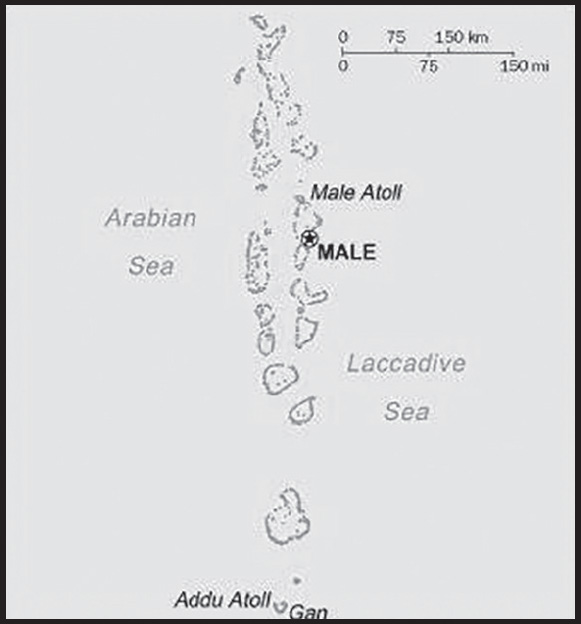
INTRODUCTION
Background: A sultanate since the 12th century, the Maldives became a British protectorate in 1887. The islands became a republic in 1968, three years after independence. President Maumoon Abdul GAYOOM dominated Maldives’ political scene for 30 years, elected to six successive terms by single-party referendums. Following political demonstrations in the capital Male in August 2003, GAYOOM and his government pledged to embark upon a process of liberalization and democratic reforms, including a more representative political system and expanded political freedoms. Political parties were legalized in 2005.
In June 2008, a constituent assembly - termed the “Special Majlis” - finalized a new constitution ratified by GAYOOM in August 2008. The first-ever presidential elections under a multi-candidate, multi-party system were held in October 2008. GAYOOM was defeated in a runoff poll by Mohamed NASHEED, a political activist who had been jailed several years earlier by the GAYOOM regime. In early February 2012, after several weeks of street protests in response to his ordering the arrest of a top judge, NASHEED purportedly resigned the presidency and handed over power to Vice President Mohammed WAHEED Hassan Maniku. A government-appointed Commission of National Inquiry concluded there was no evidence of a coup, but NASHEED contends that police and military personnel forced him to resign. NASHEED, WAHEED, and Abdulla YAMEEN Abdul Gayoom ran in the 2013 elections with YAMEEN ultimately winning the presidency after three rounds of voting. As president, YAMEEN weakened democratic institutions, curtailed civil liberties, jailed his political opponents, restricted the press, and exerted control over the judiciary to strengthen his hold on power and limit dissent. In September 2018, YAMEEN lost his reelection bid to Ibrahim Mohamed SOLIH, a parliamentarian of the Maldivian Democratic Party (MDP), who had the support of a coalition of four parties that came together to defeat YAMEEN and restore democratic norms to Maldives. In April 2019, SOLIH’s MDP won 65 of 87 seats in parliament. YAMEEN was arrested and jailed in December 2022 on corruption charges; however, he remains his party’s candidate to challenge SOLIH in the presidential election, scheduled for 9 September 2023.
GEOGRAPHY
Location: Southern Asia, group of atolls in the Indian Ocean, south-southwest of India
Geographic coordinates: 3 15 N, 73 00 E
Map references: Asia
Area: total: 298 sq km
land: 298 sq km
water: 0 sq km
comparison ranking: total 209
Area - comparative: about 1.7 times the size of Washington, DC
Land boundaries: total: 0 km
Coastline: 644 km
Maritime claims: territorial sea: 12 nm
contiguous zone: 24 nm
exclusive economic zone: 200 nm measured from claimed archipelagic straight baselines
Climate: tropical; hot, humid; dry, northeast monsoon (November to March); rainy, southwest monsoon (June to August)
Terrain: flat coral atolls, with white sandy beaches; sits atop the submarine volcanic Chagos-Laccadive Ridge
Elevation: highest point: 8th tee, golf course, Villingi Island 5 m
lowest point: Indian Ocean 0 m
mean elevation: 2 m
Natural resources: fish
Land use: agricultural land: 23.3% (2018 est.)
arable land: 10% (2018 est.)
permanent crops: 10% (2018 est.)
permanent pasture: 3.3% (2018 est.)
forest: 3% (2018 est.)
other: 73.7% (2018 est.)
Irrigated land: 0 sq km (2012)
Population distribution: about a third of the population lives in the centrally located capital city of Male and almost a tenth in southern Addu City; the remainder of the populace is spread over the 200 or so populated islands of the archipelago
Natural hazards: tsunamis; low elevation of islands makes them sensitive to sea level rise
Geography - note: smallest Asian country; archipelago of 1,190 coral islands grouped into 26 atolls (200 inhabited islands, plus 80 islands with tourist resorts); strategic location astride and along major sea lanes in Indian Ocean
PEOPLE AND SOCIETY
Population: 389,568 (2023 est.)
comparison ranking: 176
Nationality: noun: Maldivian(s)
adjective: Maldivian
Ethnic groups: homogeneous mixture of Sinhalese, Dravidian, Arab, Australasian, and African resulting from historical changes in regional hegemony over marine trade routes
Languages: Dhivehi (official, dialect of Sinhala, script derived from Arabic), English (spoken by most government officials)
Religions: Sunni Muslim (official)
Age structure: 0-14 years: 22.25% (male 44,185/female 42,495)
15-64 years: 71.97% (male 146,154/female 134,233)
65 years and over: 5.78% (2023 est.) (male 9,866/female 12,635)
Dependency ratios: total dependency ratio: 35.6
youth dependency ratio: 29.5
elderly dependency ratio: 6.2
potential support ratio: 16.2 (2021 est.)
Median age: total: 29.5 years (2020)
male: 29.2 years
female: 30 years
comparison ranking: total 129
Population growth rate: -0.17% (2023 est.)
comparison ranking: 208
Birth rate: 15.33 births/1,000 population (2023 est.)
comparison ranking: 107
Death rate: 4.2 deaths/1,000 population (2023 est.)
comparison ranking: 211
Net migration rate: -12.8 migrant(s)/1,000 population (2023 est.)
comparison ranking: 226
Population distribution: about a third of the population lives in the centrally located capital city of Male and almost a tenth in southern Addu City; the remainder of the populace is spread over the 200 or so populated islands of the archipelago
Urbanization: urban population: 42% of total population (2023)
rate of urbanization: 2.34% annual rate of change (2020-25 est.)
Major urban areas - population: 177,000 MALE (capital) (2018)
Sex ratio: at birth: 1.05 male(s)/female
0-14 years: 1.04 male(s)/female
15-64 years: 1.09 male(s)/female
65 years and over: 0.78 male(s)/female
total population: 1.06 male(s)/female (2023 est.)
Mother’s mean age at first birth: 23.2 years (2016/17 est.)
note: data represents median age at first birth among women 25-49
Maternal mortality ratio: 57 deaths/100,000 live births (2020 est.)
comparison ranking: 95
Infant mortality rate: total: 25.02 deaths/1,000 live births (2023 est.)
male: 28 deaths/1,000 live births
female: 21.89 deaths/1,000 live births
comparison ranking: total 64
Life expectancy at birth: total population: 77.19 years (2023 est.)
male: 74.84 years
female: 79.66 years
comparison ranking: total population 96
Total fertility rate: 1.7 children born/woman (2023 est.)
comparison ranking: 169
Gross reproduction rate: 0.83 (2023 est.)
Contraceptive prevalence rate: 18.8% (2016/17)
Drinking water source: improved: urban: 99% of population
rural: 100% of population
total: 99.6% of population
unimproved: urban: 1% of population
rural: 0% of population
total: 0.4% of population (2020 est.)
Current health expenditure: 11.4% of GDP (2020)
Physicians density: 2.05 physicians/1,000 population (2019)
Hospital bed density: 4.3 beds/1,000 population
Sanitation facility access: improved: urban: 100% of population
rural: 99.1% of population
total: 99.5% of population
unimproved: urban: 0% of population
rural: 0.9% of population
total: 0.5% of population (2020 est.)
Obesity - adult prevalence rate: 8.6% (2016)
comparison ranking: 149
Alcohol consumption per capita: total: 1.38 liters of pure alcohol (2019 est.)
beer: 0.33 liters of pure alcohol (2019 est.)
wine: 0.59 liters of pure alcohol (2019 est.)
spirits: 0.45 liters of pure alcohol (2019 est.)
other alcohols: 0 liters of pure alcohol (2019 est.)
comparison ranking: total 142
Tobacco use: total: 25.2% (2020 est.)
male: 44.4% (2020 est.)
female: 6% (2020 est.)
comparison ranking: total 50
Children under the age of 5 years underweight: 14.8% (2016/17)
comparison ranking: 34
Currently married women (ages 15-49): 71.9% (2023 est.)
Child marriage: women married by age 18: 2.2%
men married by age 18: 2.2% (2017 est.)
Education expenditures: 5.8% of GDP (2020 est.)
comparison ranking: 50
Literacy: definition: age 15 and over can read and write
total population: 97.9%
male: 97.6%
female: 98.4% (2021)
School life expectancy (primary to tertiary education): total: 13 years
male: 12 years
female: 14 years (2019)
Youth unemployment rate (ages 15-24): total: 17.7% (2021 est.)
male: 19.9%
female: 12.6%
comparison ranking: total 96
ENVIRONMENT
Environment - current issues: rising sea levels threaten land; depletion of freshwater aquifers threatens water supplies; inadequate sewage treatment; coral reef bleaching
Environment - international agreements: party to: Biodiversity, Climate Change, Climate Change-Kyoto Protocol, Climate Change-Paris Agreement, Comprehensive Nuclear Test Ban, Desertification, Endangered Species, Hazardous Wastes, Law of the Sea, Ozone Layer Protection, Ship Pollution
signed, but not ratified: none of the selected agreements
Climate: tropical; hot, humid; dry, northeast monsoon (November to March); rainy, southwest monsoon (June to August)
Land use: agricultural land: 23.3% (2018 est.)
arable land: 10% (2018 est.)
permanent crops: 10% (2018 est.)
permanent pasture: 3.3% (2018 est.)
forest: 3% (2018 est.)
other: 73.7% (2018 est.)
Urbanization: urban population: 42% of total population (2023)
rate of urbanization: 2.34% annual rate of change (2020-25 est.)
Revenue from forest resources: 0% of GDP (2018 est.)
comparison ranking: 183
Revenue from coal: 0% of GDP (2018 est.)
comparison ranking: 79
Air pollutants: particulate matter emissions: 13 micrograms per cubic meter (2019 est.)
carbon dioxide emissions: 1.44 megatons (2016 est.)
methane emissions: 0.14 megatons (2020 est.)
Waste and recycling: municipal solid waste generated annually: 211,506 tons (2015 est.)
Total water withdrawal: municipal: 10 million cubic meters (2020 est.)
industrial: 300,000 cubic meters (2017 est.)
agricultural: 0 cubic meters (2017 est.)
Total renewable water resources: 30 million cubic meters (2020 est.)
GOVERNMENT
Country name: conventional long form: Republic of Maldives
conventional short form: Maldives
local long form: Dhivehi Raajjeyge Jumhooriyyaa
local short form: Dhivehi Raajje
etymology: archipelago apparently named after the main island (and capital) of Male; the word “Maldives” means “the islands (dives) of Male”; alternatively, the name may derive from the Sanskrit word “maladvipa” meaning “garland of islands”; Dhivehi Raajje in Dhivehi means “Kingdom of the Dhivehi people”
Government type: presidential republic
Capital: name: Male
geographic coordinates: 4 10 N, 73 30 E
time difference: UTC+5 (10 hours ahead of Washington, DC, during Standard Time)
etymology: derived from the Sanskrit word “mahaalay” meaning “big house”
Administrative divisions: 21 administrative atolls (atholhuthah, singular - atholhu); Addu (Addu City), Ariatholhu Dhekunuburi (South Ari Atoll), Ariatholhu Uthuruburi (North Ari Atoll), Faadhippolhu, Felidhuatholhu (Felidhu Atoll), Fuvammulah, Hahdhunmathi, Huvadhuatholhu Dhekunuburi (South Huvadhu Atoll), Huvadhuatholhu Uthuruburi (North Huvadhu Atoll), Kolhumadulu, Maale (Male), Maaleatholhu (Male Atoll), Maalhosmadulu Dhekunuburi (South Maalhosmadulu), Maalhosmadulu Uthuruburi (North Maalhosmadulu), Miladhunmadulu Dhekunuburi (South Miladhunmadulu), Miladhunmadulu Uthuruburi (North Miladhunmadulu), Mulakatholhu (Mulaku Atoll), Nilandheatholhu Dhekunuburi (South Nilandhe Atoll), Nilandheatholhu Uthuruburi (North Nilandhe Atoll), Thiladhunmathee Dhekunuburi (South Thiladhunmathi), Thiladhunmathee Uthuruburi (North Thiladhunmathi)
Independence: 26 July 1965 (from the UK)
National holiday: Independence Day, 26 July (1965)
Constitution: history: many previous; latest ratified 7 August 2008
amendments: proposed by Parliament; passage requires at least three-quarters majority vote by its membership and the signature of the president of the republic; passage of amendments to constitutional articles on rights and freedoms and the terms of office of Parliament and of the president also requires a majority vote in a referendum; amended 2015
Legal system: Islamic (sharia) legal system with English common law influences, primarily in commercial matters
International law organization participation: has not submitted an ICJ jurisdiction declaration; accepts ICCt jurisdiction
Citizenship: citizenship by birth: no
citizenship by descent only: at least one parent must be a citizen of Maldives
dual citizenship recognized: yes
residency requirement for naturalization: unknown
Suffrage: 18 years of age; universal
Executive branch: chief of state: President Mohamed MUIZZI (sworn in 17 November 2023); Vice President-elect Hussain Mohamed LATHEEF (since 30 September 2023); the president is both chief of state and head of government; inauguration scheduled for 17 November 2023
head of government: President Mohamed MUIZZI ((sworn in 17 November 2023); Vice President-elect Hussain Mohamed LATHEEF (since 30 September 2023)
cabinet: Cabinet of Ministers appointed by the president, approved by Parliament
elections/appointments: president directly elected by absolute majority popular vote in 2 rounds if needed for a 5-year term (eligible for a second term); first round held on 9 September 2023 and runoff held on 30 September 2023 (next to be held in 2028)
election results:
2023: first round results - Mohamed MUIZZI 46.1%, Ibrahim Mohamed SOLIH 39.1%, Ilyas LEBEEB 7.1%, other 7.7%; Mohamed MUZZI elected president in second round; Mohamed MUZZI (PNC) 54%, Ibrahim Mohamed SOLIH (MDP) 46%
2018: Ibrahim Mohamed SOLIH elected president in first round; Ibrahim Mohamed SOLIH (MDP) 58.3%, Abdulla YAMEEN Abdul Gayoom (PPM) 41.7%
Legislative branch: description: unicameral Parliament or People’s Majlis (87 seats - includes 2 seats added by the Elections Commission in late 2018; members directly elected in single-seat constituencies by simple majority vote to serve 5-year terms)
elections: last held on 6 April 2019 (next to be held in April 2024)
election results: percent of vote - MDP 44.7%, JP 10.8%, PPM 8.7%, PNC 6.4%, MDA 2.8%, other 5.6%, independent 21%; seats by party - MDP 65, JP 5, PPM 5, PNC 3, MDA 2, independent 7; composition - men 83, women 4, percent of women 4.6%
Judicial branch: highest court(s): Supreme Court (consists of the chief justice and 6 justices
judge selection and term of office: Supreme Court judges appointed by the president in consultation with the Judicial Service Commission - a 10-member body of selected high government officials and the public - and upon confirmation by voting members of the People’s Majlis; judges serve until mandatory retirement at age 70
subordinate courts: High Court; Criminal, Civil, Family, Juvenile, and Drug Courts; Magistrate Courts (on each of the inhabited islands)
Political parties and leaders: Adhaalath (Justice) Party or AP [Sheikh Imran ABDULLA]
Dhivehi Rayyithunge Party or DRP [Abdulla JABIR]
Maldives Development Alliance or MDA [Ahmed Shiyam MOHAMED]
Maldivian Democratic Party or MDP [Mohamed NASHEED]
Maldives Labor and Social Democratic Party or MLSDP [Ahmed SHIHAM]
Maldives Third Way Democrats or MTD [Ahmed ADEEB]
Maumoon/Maldives Reform Movement or MRM [Ahmed Faris MAUMOON]
National Democratic Congress [Yousuf MAANIU]
People’s National Congress or PNC [Abdul Raheem ABDULLA]
Progressive Party of Maldives or PPM [Abdulla YAMEEN Abdul Gayoom, founder]
Republican (Jumhooree) Party or JP [Qasim IBRAHIM]
(2020)
International organization participation: ADB, AOSIS, C, CP, FAO, G-77, IBRD, ICAO, ICC (NGOs), ICCt, IDA, IDB, IFAD, IFC, IFRCS, ILO, IMF, IMO, Interpol, IOC, IOM, IPU, ITU, MIGA, NAM, OIC, OPCW, SAARC, SACEP, UN, UNCTAD, UNESCO, UNIDO, UNWTO, UPU, WCO, WHO, WIPO, WMO, WTO
Diplomatic representation in the US: chief of mission:
Maldives has no embassy in the US, but its Permanent Representative to the UN in New York, Abdul GHAFOOR Mohamed (since 12 December 2022), is accredited to the US and serves as ambassador
chancery: 801 Second Avenue, Suite 202E, New York, NY 10017
telephone: [1] (212) 599-6194; [1] (212) 599-6195
FAX: [1] (212) 661-6405
email address and website:
http://www.maldivesmission.com/
Diplomatic representation from the US: chief of mission: Ambassador Hugo Yue-Ho YON (since 6 September 2023); note - Ambassador YON is the first resident US ambassador to the Republic of Maldives
embassy: 210 Galle Road, Colombo 03, Sri Lanka; note - as of early November 2023, the US has no consular or diplomatic offices in Maldives; the US Mission to Maldives operates from US Embassy Colombo, Sri Lanka
telephone: [94] (11) 249-8500
FAX: [94] (11) 243-7345
Flag description: red with a large green rectangle in the center bearing a vertical white crescent moon; the closed side of the crescent is on the hoist side of the flag; red recalls those who have sacrificed their lives in defense of their country, the green rectangle represents peace and prosperity, and the white crescent signifies Islam
National symbol(s): coconut palm, yellowfin tuna; national colors: red, green, white
National anthem: name: “Gaumee Salaam” (National Salute)
lyrics/music: Mohamed Jameel DIDI/Wannakuwattawaduge DON AMARADEVA
note: lyrics adopted 1948, music adopted 1972; between 1948 and 1972, the lyrics were sung to the tune of “Auld Lang Syne”
ECONOMY
Economic overview: upper middle-income Indian Ocean island economy; major tourism, fishing, and shipping industries; high public debt; systemic corruption; crippled by COVID-19; ongoing deflation; poverty has tripled since pandemic began
Real GDP (purchasing power parity): $9.785 billion (2021 est.)
$6.903 billion (2020 est.)
$10.38 billion (2019 est.)
note: data are in 2017 dollars
comparison ranking: 163
Real GDP growth rate: 41.75% (2021 est.)
-33.49% (2020 est.)
7.1% (2019 est.)
comparison ranking: 1
Real GDP per capita: $18,800 (2021 est.)
$13,400 (2020 est.)
$20,600 (2019 est.)
note: data are in 2017 dollars
comparison ranking: 96
GDP (official exchange rate): $4.505 billion (2017 est.)
Inflation rate (consumer prices): 0.54% (2021 est.)
-1.37% (2020 est.)
0.22% (2019 est.)
comparison ranking: 208
Credit ratings: Fitch rating: CCC (2020)
Moody’s rating: B3 (2020)
note: The year refers to the year in which the current credit rating was first obtained.
GDP - composition, by sector of origin: agriculture: 3% (2015 est.)
industry: 16% (2015 est.)
services: 81% (2015 est.)
comparison rankings: services 30; industry 174; agriculture 149
GDP - composition, by end use: exports of goods and services: 93.6% (2016 est.)
imports of goods and services: 89% (2016 est.)
Agricultural products: papayas, vegetables, roots/tubers nes, nuts, fruit, other meat, tomatoes, coconuts, bananas, maize
Industries: tourism, fish processing, shipping, boat building, coconut processing, woven mats, rope, handicrafts, coral and sand mining
Industrial production growth rate: 4.51% (2021 est.)
comparison ranking: 97
Labor force: 229,300 (2021 est.)
comparison ranking: 173
Labor force - by occupation: agriculture: 7.7%
industry: 22.8%
services: 69.5% (2017 est.)
Unemployment rate: 6.08% (2021 est.)
6.33% (2020 est.)
5.34% (2019 est.)
comparison ranking: 128
Youth unemployment rate (ages 15-24): total: 17.7% (2021 est.)
male: 19.9%
female: 12.6%
comparison ranking: total 96
Population below poverty line: 8.2% (2016 est.)
Gini Index coefficient - distribution of family income: 29.3 (2019 est.) comparison ranking: 154
Household income or consumption by percentage share: lowest 10%: 1.2%
highest 10%: 33.3% (FY09/10)
Budget: revenues: $993 million (2020 est.)
expenditures: $1.797 billion (2020 est.)
Budget surplus (+) or deficit (-): -10.1% (of GDP) (2016 est.)
comparison ranking: 211
Public debt: 63.9% of GDP (2017 est.)
61.7% of GDP (2016 est.)
comparison ranking: 71
Taxes and other revenues: 26.4% (of GDP) (2016 est.)
comparison ranking: 40
Fiscal year: calendar year
Current account balance: -$457.562 million (2021 est.)
-$1.327 billion (2020 est.)
-$1.49 billion (2019 est.)
comparison ranking: 116
Exports: $3.95 billion (2021 est.) note: data are in current year dollars
$1.787 billion (2020 est.) note: data are in current year dollars
$3.742 billion (2019 est.)
comparison ranking: 137
Exports - partners: Thailand 24%, United States 13%, China 12%, France 11%, Germany 11%, Italy 5%, United Kingdom 5% (2019)
Exports - commodities: skipjack and stripe-bellied bonito, fish fillets, propane, tuna, butane, scrap iron (2021)
Imports: $3.501 billion (2021 est.) note: data are in current year dollars
$2.449 billion (2020 est.) note: data are in current year dollars
$4.09 billion (2019 est.)
comparison ranking: 158
Imports - partners: United Arab Emirates 24%, China 16%, Singapore 14%, India 11%, Malaysia 6%, Thailand 5% (2019)
Imports - commodities: refined petroleum, fruits, furniture, broadcasting equipment, lumber (2019)
Reserves of foreign exchange and gold: $805,808,200 (31 December 2021 est.)
$984,930,700 (31 December 2020 est.)
$753,496,300 (31 December 2019 est.)
comparison ranking: 154
Debt - external: $848.8 million (31 December 2016 est.)
$696.2 million (31 December 2015 est.)
comparison ranking: 167
Exchange rates: rufiyaa (MVR) per US dollar -
Exchange rates: 15.373 (2021 est.)
15.381 (2020 est.)
15.382 (2019 est.)
15.391 (2018 est.)
15.387 (2017 est.)
ENERGY
Electricity access: electrification - total population: 100% (2021)
Electricity: installed generating capacity: 545,000 kW (2020 est.)
consumption: 586.5 million kWh (2019 est.)
exports: 0 kWh (2020 est.)
imports: 0 kWh (2020 est.)
transmission/distribution losses: 21 million kWh (2019 est.)
comparison rankings: imports 137; exports 120; installed generating capacity 149; transmission/distribution losses 184; consumption 167
Electricity generation sources: fossil fuels: 99.6% of total installed capacity (2020 est.)
wind: 0.4% of total installed capacity (2020 est.)
Petroleum: total petroleum production: 0 bbl/day (2021 est.)
refined petroleum consumption: 15,300 bbl/day (2019 est.)
Refined petroleum products - imports: 10,840 bbl/day (2015 est.)
comparison ranking: 144
Carbon dioxide emissions: 2.286 million metric tonnes of CO2 (2019 est.)
from petroleum and other liquids: 2.286 million metric tonnes of CO2 (2019 est.)
comparison ranking: total emissions 157
Energy consumption per capita: 59.69 million Btu/person (2019 est.)
comparison ranking: 92
COMMUNICATIONS
Telephones - fixed lines: total subscriptions: 14,005 (2021 est.)
subscriptions per 100 inhabitants: 3 (2021 est.)
comparison ranking: total subscriptions 182
Telephones - mobile cellular: total subscriptions: 706,043 (2021 est.)
subscriptions per 100 inhabitants: 135 (2021 est.)
comparison ranking: total subscriptions 169
Telecommunication systems: general assessment: with its economy so heavily dependent on tourism, the Maldives has suffered heavy economic as well as health casualties during the pandemic; the country had a relatively short period of lock down and was willing to welcome visitors back as early as July 2020; but the effective shutdown of international air travel for most of the year resulted in the bottom falling out of the Maldives’ tourism industry, taking GDP down 32% in the process; the economy fared better in 2021, with a return to growth, yet it may still be a few years before the country’s key industries can return to the same level of prosperity that they previously enjoyed; the country’s high number of tourists and expatriate workers has inflated the penetration rate for mobile services, making it one of the highest in the world; that rate crashed in 2020 as demand for SIM cards (primarily prepaid) dried up; however, the number of contract subscribers increased as locals took advantage of competitive pricing offers from operators; everything now rests on a fast return to normality, with tourists helping to boost the nation’s coffers as well as buying up those prepaid SIM cards; with commercial 5G services already launched and fiber networks rapidly expanding around the country, the Maldives is primed to deliver world-class telecommunications services to its domestic and international customers (2021)
domestic: fixed-line is at nearly 3 per 100 persons and mobile-cellular subscriptions stands at nearly 135 per 100 persons (2021)
international: country code - 960; landing points for Dhiraagu Cable Network, NaSCOM, Dhiraagu-SLT Submarine Cable Networks and WARF submarine cables providing connections to 8 points in Maldives, India, and Sri Lanka; satellite earth station - 3 Intelsat (Indian Ocean) (2019)
Broadcast media: state-owned radio and TV monopoly until recently; 4 state-operated and 7 privately owned TV stations and 4 state-operated and 7 privately owned radio stations (2019)
Internet country code: .mv
Internet users: total: 447,200 (2021 est.)
percent of population: 86% (2021 est.)
comparison ranking: total 169
Broadband - fixed subscriptions: total: 63,685 (2020 est.)
subscriptions per 100 inhabitants: 12 (2020 est.)
comparison ranking: total 139
TRANSPORTATION
National air transport system: number of registered air carriers: 3 (2020)
inventory of registered aircraft operated by air carriers: 36
annual passenger traffic on registered air carriers: 1,147,247 (2018)
annual freight traffic on registered air carriers: 7.75 million (2018)
Civil aircraft registration country code prefix: 8Q
Airports: 9 (2021)
comparison ranking: total 157
Airports - with paved runways: 7
note: paved runways have a concrete or asphalt surface but not all have facilities for refueling, maintenance, or air traffic control; the length of a runway required for aircraft to safely operate depends on a number of factors including the type of aircraft, the takeoff weight (including passengers, cargo, and fuel), engine types, flap settings, landing speed, elevation of the airport, and average maximum daily air temperature; paved runways can reach a length of 5,000 m (16,000 ft.), but the “typical” length of a commercial airline runway is between 2,500-4,000 m (8,000-13,000 ft.)
Airports - with unpaved runways: 2
note: unpaved runways have a surface composition such as grass or packed earth and are most suited to the operation of light aircraft; unpaved runways are usually short, often less than 1,000 m (3,280 ft.) in length; airports with unpaved runways often lack facilities for refueling, maintenance, or air traffic control
Roadways: total: 93 km (2018)
paved: 93 km (2018) - 60 km in Malée; 16 km on Addu Atolis; 17 km on Laamu
note: island roads are mainly compacted coral
comparison ranking: total 214
Merchant marine: total: 80 (2022)
by type: general cargo 30, oil tanker 20, other 30
comparison ranking: total 102
Ports and terminals: major seaport(s): Male
MILITARY AND SECURITY
Military and security forces: Maldives National Defense Force (MNDF): the MNDF has combined force structure with seven services divided into Combat and Maneuver Forces (Coast Guard, Marine Corps, and Fire and Rescue Service) and Support Services (Service Corps, Defense Intelligence Service, Medical Corps, Adjutant General’s Corps); there is also a separate Special Forces command and a Special Protection Service (2023)
note: the Maldives Police Service is responsible for internal security and reports to the Ministry of Home Affairs
Military expenditures: not available
Military and security service personnel strengths: approximately 3-4,000 personnel (2023)
Military equipment inventories and acquisitions: India has provided most of the equipment in the MNDF’s inventory (2023)
Military service age and obligation: 18-28 years of age for voluntary service; no conscription; 10th grade or equivalent education required; must not be a member of a political party (2022)
Military - note: the Maldives National Defense Force (MNDF) is responsible for defending and safeguarding the Maldives’ territorial integrity, economic exclusion zone, and people; it is also responsible for disaster relief, and if requested, assisting the Maldives Police Service in maintaining internal security and law and order; the MNDF is organized into four area commands and a functional Special Forces command; the head of the MNDF reports to the Minister of Defense (2023)
TERRORISM
Terrorist group(s): Terrorist group(s): Islamic State of Iraq and ash-Sham (ISIS)
note: details about the history, aims, leadership, organization, areas of operation, tactics, targets, weapons, size, and sources of support of the group(s) appear(s) in Appendix-T
TRANSNATIONAL ISSUES
Disputes - international: none identified
Illicit drugs: NA