MEXICO
INTRODUCTION
Background: The site of several advanced Amerindian civilizations - including the Olmec, Toltec, Teotihuacan, Zapotec, Maya, and Aztec - Mexico was conquered and colonized by Spain in the early 16th century. Administered as the Viceroyalty of New Spain for three centuries, it achieved independence early in the 19th century. Elections held in 2000 marked the first time since the 1910 Mexican Revolution that an opposition candidate - Vicente FOX of the National Action Party (PAN) - defeated the party in government, the Institutional Revolutionary Party (PRI). He was succeeded in 2006 by another PAN candidate Felipe CALDERON, but Enrique PEÑA NIETO regained the presidency for the PRI in 2012. Left-leaning anti-establishment politician and former mayor of Mexico City (2000-05) Andrés Manuel LÓPEZ OBRADOR, from the National Regeneration Movement (MORENA), became president in December 2018.
Mexico is currently the second-largest (after Canada) goods trading partner of the US with nearly $780 billion in two-way goods trade in 2022. Mexico’s GDP contracted by 8.2% in 2020 due to pandemic-induced closures, its lowest level since the Great Depression. Mexico’s economy is rebounding; it grew by 4.8% in 2021, driven largely by increased remittances, despite supply chain and pandemic-related challenges, and grew by 3% in 2022.
The US-Mexico-Canada Agreement (USMCA, or T-MEC by its Spanish acronym) entered into force on 1 July 2020 and replaced its predecessor, the North American Free Trade Agreement (NAFTA). Mexico amended its constitution on 1 May 2019 to facilitate the implementation of the labor components of USMCA.
Ongoing economic and social concerns include low real wages, high underemployment, inequitable income distribution, and few advancement opportunities, particularly for the largely indigenous population in the impoverished southern states. Since 2007, Mexico’s powerful transnational criminal organizations have engaged in a struggle to control criminal markets, resulting in tens of thousands of drug-related homicides and forced disappearances.
GEOGRAPHY
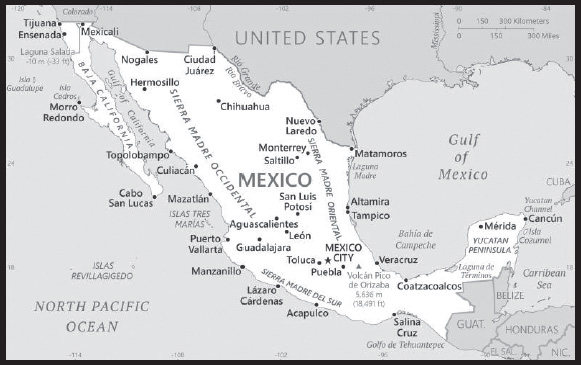
Location: North America, bordering the Caribbean Sea and the Gulf of Mexico, between Belize and the United States and bordering the North Pacific Ocean, between Guatemala and the United States
Geographic coordinates: 23 00 N, 102 00 W
Map references: North America
Area: total: 1,964,375 sq km
land: 1,943,945 sq km
water: 20,430 sq km
comparison ranking: total 15
Area - comparative: slightly less than three times the size of Texas
Land boundaries: total: 4,389 km
border countries (3): Belize 276 km; Guatemala 958 km; US 3,155 km
Coastline: 9,330 km
Maritime claims: territorial sea: 12 nm
contiguous zone: 24 nm
exclusive economic zone: 200 nm
continental shelf: 200 nm or to the edge of the continental margin
Climate: varies from tropical to desert
Terrain: high, rugged mountains; low coastal plains; high plateaus; desert
Elevation: highest point: Volcan Pico de Orizaba 5,636 m
lowest point: Laguna Salada -10 m
mean elevation: 1,111 m
Natural resources: petroleum, silver, antimony, copper, gold, lead, zinc, natural gas, timber
Land use: agricultural land: 54.9% (2018 est.)
arable land: 11.8% (2018 est.)
permanent crops: 1.4% (2018 est.)
permanent pasture: 41.7% (2018 est.)
forest: 33.3% (2018 est.)
other: 11.8% (2018 est.)
Irrigated land: 60,620 sq km (2020)
Major lakes (area sq km): fresh water lake(s): Laguna de Chapala - 1,140 sq km
salt water lake(s): Laguna de Terminos - 1,550 sq km
Major rivers (by length in km): Rio Grande river mouth (shared with US [s]) - 3,057 km; Colorado river mouth (shared with US [s]) - 2,333 km
note – [s] after country name indicates river source; [m] after country name indicates river mouth
Major watersheds (area sq km): Atlantic Ocean drainage: (Gulf of Mexico) Rio Grande/Bravo (607,965 sq km)
Pacific Ocean drainage: (Gulf of California) Colorado (703,148 sq km)
Major aquifers: Atlantic and Gulf Coastal Plains Aquifer
Population distribution: most of the population is found in the middle of the country between the states of Jalisco and Veracruz; approximately a quarter of the population lives in and around Mexico City
Natural hazards: tsunamis along the Pacific coast, volcanoes and destructive earthquakes in the center and south, and hurricanes on the Pacific, Gulf of Mexico, and Caribbean coasts
volcanism: volcanic activity in the central-southern part of the country; the volcanoes in Baja California are mostly dormant; Colima (3,850 m), which erupted in 2010, is Mexico’s most active volcano and is responsible for causing periodic evacuations of nearby villagers; it has been deemed a Decade Volcano by the International Association of Volcanology and Chemistry of the Earth’s Interior, worthy of study due to its explosive history and close proximity to human populations; Popocatepetl (5,426 m) poses a threat to Mexico City; other historically active volcanoes include Barcena, Ceboruco, El Chichon, Michoacan-Guanajuato, Pico de Orizaba, San Martin, Socorro, and Tacana; see note 2 under “Geography - note”
Geography - note: note 1: strategic location on southern border of the US; Mexico is one of the countries along the Ring of Fire, a belt of active volcanoes and earthquake epicenters bordering the Pacific Ocean; up to 90% of the world’s earthquakes and some 75% of the world’s volcanoes occur within the Ring of Fire
note 2: some of the world’s most important food crops were first domesticated in Mexico; the “Three Sisters” companion plants - winter squash, maize (corn), and climbing beans - served as the main agricultural crops for various North American Indian groups; all three apparently originated in Mexico but then were widely disseminated through much of North America; avocado, amaranth, and chili peppers also emanate from Mexico, as does vanilla, the world’s most popular aroma and flavor spice; although cherry tomatoes originated in Ecuador, their domestication in Mexico transformed them into the larger modern tomato
note 3: the Sac Actun cave system at 348 km (216 mi) is the longest underwater cave in the world and the second longest cave worldwide, after Mammoth Cave in the United States (see “Geography - note” under United States)
note 4: the prominent Yucatán Peninsula that divides the Gulf of Mexico from the Caribbean Sea is shared by Mexico, Guatemala, and Belize; just on the northern coast of Yucatan, near the town of Chicxulub (pronounce cheek-sha-loob), lie the remnants of a massive crater (some 150 km in diameter and extending well out into the Gulf of Mexico); formed by an asteroid or comet when it struck the earth 66 million years ago, the impact is now widely accepted as initiating a worldwide climate disruption that caused a mass extinction of 75% of all the earth’s plant and animal species - including the non-avian dinosaurs
PEOPLE AND SOCIETY
Population: 129,875,529 (2023 est.)
comparison ranking: 10
Nationality: noun: Mexican(s)
adjective: Mexican
Ethnic groups: Mestizo (Amerindian-Spanish) 62%, predominantly Amerindian 21%, Amerindian 7%, other 10% (mostly European) (2012 est.)
note: Mexico does not collect census data on ethnicity
Languages: Spanish only 93.8%, Spanish and indigenous languages 5.4%, indigenous only 0.6%, unspecified 0.2%; note - indigenous languages include various Mayan, Nahuatl, and other regional languages (2020 est.)
major-language sample(s):
La Libreta Informativa del Mundo, la fuente indispensable de información básica. (Spanish)
Religions: Roman Catholic 78%, Protestant/evangelical Christian 11.2%, other 0.002%, unaffiliated (includes atheism) 10.6% (2020 est.)
Age structure: 0-14 years: 23.76% (male 15,844,300/female 15,009,047)
15-64 years: 68.22% (male 43,086,673/female 45,518,891)
65 years and over: 8.02% (2023 est.) (male 4,560,225/female 5,856,393)
Dependency ratios: total dependency ratio: 49.4
youth dependency ratio: 37.3
elderly dependency ratio: 12.2
potential support ratio: 8.2 (2021 est.)
Median age: total: 29.3 years (2020)
male: 28.2 years
female: 30.4 years
comparison ranking: total 132
Population growth rate: 0.61% (2023 est.)
comparison ranking: 142
Birth rate: 13.95 births/1,000 population (2023 est.)
comparison ranking: 126
Death rate: 7.07 deaths/1,000 population (2023 est.)
comparison ranking: 117
Net migration rate: -0.77 migrant(s)/1,000 population (2023 est.)
comparison ranking: 136
Population distribution: most of the population is found in the middle of the country between the states of Jalisco and Veracruz; approximately a quarter of the population lives in and around Mexico City
Urbanization: urban population: 81.6% of total population (2023)
rate of urbanization: 1.4% annual rate of change (2020-25 est.)
Major urban areas - population: 22.281 million MEXICO CITY (capital), 5.420 million Guadalajara, 5.117 million Monterrey, 3.345 million Puebla, 2.626 million Toluca de Lerdo, 2.260 million Tijuana (2023)
Sex ratio: at birth: 1.05 male(s)/female
0-14 years: 1.06 male(s)/female
15-64 years: 0.95 male(s)/female
65 years and over: 0.78 male(s)/female
total population: 0.96 male(s)/female (2023 est.)
Mother’s mean age at first birth: 21.3 years (2008 est.)
Maternal mortality ratio: 59 deaths/100,000 live births (2020 est.)
comparison ranking: 94
Infant mortality rate: total: 12 deaths/1,000 live births (2023 est.)
male: 13.23 deaths/1,000 live births
female: 10.71 deaths/1,000 live births
comparison ranking: total 114
Life expectancy at birth: total population: 73.46 years (2023 est.)
male: 70.29 years
female: 76.79 years
comparison ranking: total population 148
Total fertility rate: 1.73 children born/woman (2023 est.)
comparison ranking: 160
Gross reproduction rate: 0.85 (2023 est.)
Contraceptive prevalence rate: 73.1% (2018)
Drinking water source: improved: urban: 100% of population
rural: 98.3% of population
total: 99.7% of population
unimproved: urban: 0% of population
rural: 1.7% of population
total: 0.3% of population (2020 est.)
Current health expenditure: 6.2% of GDP (2020)
Physicians density: 2.43 physicians/1,000 population (2019)
Hospital bed density: 1 beds/1,000 population (2018)
Sanitation facility access: improved: urban: 99.9% of population
rural: 96.4% of population
total: 99.2% of population
unimproved: urban: 0.1% of population
rural: 3.6% of population
total: 0.8% of population (2020 est.)
Major infectious diseases: degree of risk: intermediate (2023)
food or waterborne diseases: bacterial diarrhea and hepatitis A
vectorborne diseases: dengue fever
Obesity - adult prevalence rate: 28.9% (2016)
comparison ranking: 28
Alcohol consumption per capita: total: 4.25 liters of pure alcohol (2019 est.)
beer: 3.72 liters of pure alcohol (2019 est.)
wine: 0.19 liters of pure alcohol (2019 est.)
spirits: 0.19 liters of pure alcohol (2019 est.)
other alcohols: 0.15 liters of pure alcohol (2019 est.)
comparison ranking: total 91
Tobacco use: total: 13.1% (2020 est.)
male: 19.9% (2020 est.)
female: 6.2% (2020 est.)
comparison ranking: total 116
Children under the age of 5 years underweight: 4.2% (2021)
comparison ranking: 79
Currently married women (ages 15-49): 56.6% (2023 est.)
Child marriage: women married by age 15: 3.6%
women married by age 18: 20.7% (2018 est.)
Education expenditures: 4.3% of GDP (2018 est.)
comparison ranking: 107
Literacy: definition: age 15 and over can read and write
total population: 95.2%
male: 96.1%
female: 94.5% (2020)
School life expectancy (primary to tertiary education): total: 15 years
male: 15 years
female: 15 years (2020)
Youth unemployment rate (ages 15-24): total: 8.1% (2021 est.)
male: 7.9%
female: 8.6%
comparison ranking: total 169
ENVIRONMENT
Environment - current issues: scarcity of hazardous waste disposal facilities; rural to urban migration; natural freshwater resources scarce and polluted in north, inaccessible and poor quality in center and extreme southeast; raw sewage and industrial effluents polluting rivers in urban areas; deforestation; widespread erosion; desertification; deteriorating agricultural lands; serious air and water pollution in the national capital and urban centers along US-Mexico border; land subsidence in Valley of Mexico caused by groundwater depletion
note: the government considers the lack of clean water and deforestation national security issues
Environment - international agreements: party to: Biodiversity, Climate Change, Climate Change-Kyoto Protocol, Climate Change-Paris Agreement, Comprehensive Nuclear Test Ban, Desertification, Endangered Species, Hazardous Wastes, Law of the Sea, Marine Dumping-London Convention, Marine Dumping-London Protocol, Marine Life Conservation, Nuclear Test Ban, Ozone Layer Protection, Ship Pollution, Tropical Timber 2006, Wetlands, Whaling
signed, but not ratified: none of the selected agreements
Climate: varies from tropical to desert
Land use: agricultural land: 54.9% (2018 est.)
arable land: 11.8% (2018 est.)
permanent crops: 1.4% (2018 est.)
permanent pasture: 41.7% (2018 est.)
forest: 33.3% (2018 est.)
other: 11.8% (2018 est.)
Urbanization: urban population: 81.6% of total population (2023)
rate of urbanization: 1.4% annual rate of change (2020-25 est.)
Revenue from forest resources: 0.1% of GDP (2018 est.)
comparison ranking: 111
Revenue from coal: 0.03% of GDP (2018 est.)
comparison ranking: 36
Air pollutants: particulate matter emissions: 17.83 micrograms per cubic meter (2019 est.)
carbon dioxide emissions: 486.41 megatons (2016 est.)
methane emissions: 135.77 megatons (2020 est.)
Waste and recycling: municipal solid waste generated annually: 53.1 million tons (2015 est.)
municipal solid waste recycled annually: 2.655 million tons (2013 est.)
percent of municipal solid waste recycled: 5% (2013 est.)
Major lakes (area sq km): fresh water lake(s): Laguna de Chapala - 1,140 sq km
salt water lake(s): Laguna de Terminos - 1,550 sq km
Major rivers (by length in km): Rio Grande river mouth (shared with US [s]) - 3,057 km; Colorado river mouth (shared with US [s]) - 2,333 km
note – [s] after country name indicates river source; [m] after country name indicates river mouth
Major watersheds (area sq km): Atlantic Ocean drainage: (Gulf of Mexico) Rio Grande/Bravo (607,965 sq km)
Pacific Ocean drainage: (Gulf of California) Colorado (703,148 sq km)
Major aquifers: Atlantic and Gulf Coastal Plains Aquifer
Total water withdrawal: municipal: 13.17 billion cubic meters (2020 est.)
industrial: 8.56 billion cubic meters (2020 est.)
agricultural: 67.83 billion cubic meters (2020 est.)
Total renewable water resources: 461.89 billion cubic meters (2020 est.)
GOVERNMENT
Country name: conventional long form: United Mexican States
conventional short form: Mexico
local long form: Estados Unidos Mexicanos
local short form: Mexico
former: Mexican Republic, Mexican Empire
etymology: named after the capital city, whose name stems from the Mexica, the largest and most powerful branch of the Aztecs; the meaning of the name is uncertain
Government type: federal presidential republic
Capital: name: Mexico City (Ciudad de Mexico)
geographic coordinates: 19 26 N, 99 08 W
time difference: UTC-6 (1 hour behind Washington, DC, during Standard Time)
daylight saving time: +1hr, begins first Sunday in April; ends last Sunday in October
time zone note: Mexico has four time zones
etymology: named after the Mexica, the largest and most powerful branch of the Aztecs; the meaning of the name is uncertain
Administrative divisions: 32 states (estados, singular - estado); Aguascalientes, Baja California, Baja California Sur, Campeche, Chiapas, Chihuahua, Coahuila, Colima, Cuidad de Mexico, Durango, Guanajuato, Guerrero, Hidalgo, Jalisco, Mexico, Michoacan, Morelos, Nayarit, Nuevo Leon, Oaxaca, Puebla, Queretaro, Quintana Roo, San Luis Potosi, Sinaloa, Sonora, Tabasco, Tamaulipas, Tlaxcala, Veracruz, Yucatan, Zacatecas
Independence: 16 September 1810 (declared independence from Spain); 27 September 1821 (recognized by Spain)
National holiday: Independence Day, 16 September (1810)
Constitution: history: several previous; latest approved 5 February 1917
amendments: proposed by the Congress of the Union; passage requires approval by at least two thirds of the members present and approval by a majority of the state legislatures; amended many times, last in 2020
Legal system: civil law system with US constitutional law influence; judicial review of legislative acts
International law organization participation: accepts compulsory ICJ jurisdiction with reservations; accepts ICCt jurisdiction
Citizenship: citizenship by birth: yes
citizenship by descent only: yes
dual citizenship recognized: not specified
residency requirement for naturalization: 5 years
Suffrage: 18 years of age; universal and compulsory
Executive branch: chief of state: President Andrés Manuel LÓPEZ OBRADOR (since 1 December 2018); note - the president is both chief of state and head of government
head of government: President Andrés Manuel LÓPEZ OBRADOR (since 1 December 2018)
cabinet: Cabinet appointed by the president
elections/appointments: president directly elected by simple majority popular vote for a single 6-year term; election last held on 1 July 2018 (next to be held in July 2024)
election results:
2018:Andrés Manuel LÓPEZ OBRADOR elected president; percent of vote - Andrés Manuel LÓPEZ OBRADOR (MORENA) 53.2%, Ricardo ANAYA Cortés (PAN) 22.3%, José Antonio MEADE Kuribreña (PRI) 16.4%, Jaime RODRÍGUEZ Calderón 5.2% (independent), other 2.9%
2012: Enrique PEÑA NIETO elected president; percent of vote - Enrique PEÑA NIETO (PRI) 38.2%, Andrés Manuel LÓPEZ OBRADOR (PRD) 31.6%, Josefina Eugenia VÁZQUEZ Mota (PAN) 25.4%, other 4.8%
Legislative branch: description:
bicameral National Congress or Congreso de la Unión consists of:
Senate or Cámara de Senadores (128 seats; 96 members directly elected in multi-seat constituencies by simple majority vote and 32 directly elected in a single, nationwide constituency by proportional representation vote; members serve 6-year terms)
Chamber of Deputies or Cámara de Diputados (500 seats; 300 members directly elected in single-seat constituencies by simple majority vote and 200 directly elected in a single, nationwide constituency by proportional representation vote; members serve 3-year terms)
elections:
Senate - last held on 1 July 2018 (next to be held in July 2024)
Chamber of Deputies - last held on 6 June 2021 (next to be held in July 2024)
election results:
Senate - percent of vote by party - percent of vote by party - NA; seats by party - MORENA 58, PAN 22, PRI 14, PRD 9, MC 7, PT 7, PES 5, PVEM 5, PNA/PANAL 1; composition (as of July 2018) - men 65, women 63, percent of women 49.2%
Chamber of Deputies - percent of vote by party - NA; seats by party - MORENA 197, PAN 111, PRI 69, PVEM 44, PT 38, MC 25, PRD 16; composition - men 250, women 250, percent of women 50%; note - overall percent of women in National Congress 49.8%
note: as of the 2018 election, senators will be eligible for a second term and deputies up to 4 consecutive terms
Judicial branch: highest court(s): Supreme Court of Justice or Suprema Corte de Justicia de la Nación (consists of the chief justice and 11 justices and organized into civil, criminal, administrative, and labor panels) and the Electoral Tribunal of the Federal Judiciary (organized into the superior court, with 7 judges including the court president, and 5 regional courts, each with 3 judges)
judge selection and term of office: Supreme Court justices nominated by the president of the republic and approved by two-thirds vote of the members present in the Senate; justices serve 15-year terms; Electoral Tribunal superior and regional court judges nominated by the Supreme Court and elected by two-thirds vote of members present in the Senate; superior court president elected from among its members to hold office for a 4-year term; other judges of the superior and regional courts serve staggered, 9-year terms
subordinate courts: federal level includes circuit, collegiate, and unitary courts; state and district level courts
note: in April 2021, the Mexican congress passed a judicial reform which changed 7 articles of the constitution and preceded a new Organic Law on the Judicial Branch of the Federation
Political parties and leaders: Citizen’s Movement (Movimiento Ciudadano) or MC [Clemente CASTAÑEDA Hoeflich]
Institutional Revolutionary Party (Partido Revolucionario Institucional) or PRI [Claudia RUIZ Massieu]
Labor Party (Partido del Trabajo) or PT [Alberto ANAYA Gutiérrez]
Mexican Green Ecological Party (Partido Verde Ecologista de México) or PVEM [Karen CASTREJÓN Trujillo]
Movement for National Regeneration (Movimiento Regeneración Nacional) or MORENA [Mario DELGADO Carillo]
National Action Party (Partido Acción Nacional) or PAN [Antonio CORTÉS Mendoza]
Party of the Democratic Revolution (Partido de la Revolución Democrática) or PRD [Jesús ZAMBRANO Grijalva]
This Is For Mexico (Va Por México) (alliance that includes PAN, PRI, and PRD)
Together We Make History (Juntos Hacemos Historia) (alliance that included MORENA, PT, PVEM) (dissolved 23 December 2020)
International organization participation: APEC, Australia Group, BCIE, BIS, CAN (observer), Caricom (observer), CD, CDB, CE (observer), CELAC, CSN (observer), EBRD, FAO, FATF, G-3, G-15, G-20, G-24, G-5, IADB, IAEA, IBRD, ICAO, ICC (national committees), ICCt, ICRM, IDA, IFAD, IFC, IFRCS, IHO, ILO, IMF, IMO, IMSO, Interpol, IOC, IOM, IPU, ISO, ITSO, ITU, ITUC (NGOs), LAES, LAIA, MIGA, NAFTA, NAM (observer), NEA, NSG, OAS, OECD, OPANAL, OPCW, Pacific Alliance, Paris Club (associate), PCA, SICA (observer), UN, UNASUR (observer), UNCTAD, UNESCO, UNHCR, UNHRC, UNIDO, Union Latina (observer), UNWTO, UPU, USMCA, Wassenaar Arrangement, WCO, WFTU (NGOs), WHO, WIPO, WMO, WTO
Diplomatic representation in the US: chief of mission: Ambassador Esteban MOCTEZUMA Barragán (since 20 April 2021)
chancery: 1911 Pennsylvania Avenue NW, Washington, DC 20006
telephone: [1] (202) 728-1600
FAX: [1] (202) 728-1698
email address and website:
https://embamex.sre.gob.mx/eua/index.php/en/
consulate(s) general: Atlanta (GA), Austin (TX), Boston (MA), Chicago (IL), Dallas (TX), Denver (GA), El Paso (TX), Houston (TX), Laredo (TX), Miami (FL), New York (NY), Nogales (AZ), Phoenix (AZ), Raleigh (NC), Sacramento (CA), San Antonio (TX), San Diego (CA), San Francisco (CA), San Jose (CA), San Juan (Puerto Rico)
consulate(s): Albuquerque (NM), Boise (ID), Brownsville (TX), Calexico (CA), Del Rio (TX), Detroit (MI), Douglas (AZ), Eagle Pass (TX), Fresno (CA), Indianapolis (IN), Kansas City (MO), Las Vegas (NV), Little Rock (AR), Los Angeles (CA), McAllen (TX), Milwaukee (WI), New Orleans (LA), Omaha (NE), Orlando (FL), Oxnard (CA), Philadelphia (PA), Portland (OR), Presidio (TX), Salt Lake City (UT), San Bernardino (CA), Santa Ana (CA), Seattle (WA), St. Paul (MN), Tucson (AZ), Yuma (AZ)
Diplomatic representation from the US: chief of mission: Ambassador Ken SALAZAR (since 14 September 2021)
embassy: Paseo de la Reforma 305, Colonia Cuauhtémoc, 06500 Mexico, CDMX
mailing address: 8700 Mexico City Place, Washington DC 20521-8700
telephone: (011) [52]-55-5080-2000
FAX: (011) 52-55-5080-2005
email address and website:
consulate(s) general: Ciudad Juárez, Guadalajara, Hermosillo, Matamoros, Mérida, Monterrey, Nogales, Nuevo Laredo, Tijuana
Flag description: three equal vertical bands of green (hoist side), white, and red; Mexico’s coat of arms (an eagle with a snake in its beak perched on a cactus) is centered in the white band; green signifies hope, joy, and love; white represents peace and honesty; red stands for hardiness, bravery, strength, and valor; the coat of arms is derived from a legend that the wandering Aztec people were to settle at a location where they would see an eagle on a cactus eating a snake; the city they founded, Tenochtitlan, is now Mexico City
note: similar to the flag of Italy, which is shorter, uses lighter shades of green and red, and does not display anything in its white band
National symbol(s): golden eagle, dahlia; national colors: green, white, red
National anthem: name: “Himno Nacional Mexicano”(National Anthem of Mexico)
lyrics/music: Francisco Gonzalez BOCANEGRA/Jaime Nuno ROCA
note: adopted 1943, in use since 1854; also known as “Mexicanos, al grito de Guerra” (Mexicans, to the War Cry); according to tradition, Francisco Gonzalez BOCANEGRA, an accomplished poet, was uninterested in submitting lyrics to a national anthem contest; his fiancee locked him in a room and refused to release him until the lyrics were completed
National heritage: total World Heritage Sites: 35 (27 cultural, 6 natural, 2 mixed)
selected World Heritage Site locales: Historic Mexico City (c); Earliest 16th-Century Monasteries on the Slopes of Popocatepetl (c); Teotihuacan (c); Whale Sanctuary of El Vizcaino (n); Monarch Butterfly Biosphere Reserve (n); Tehuacán-Cuicatlán Valley (m); Historic Puebla (c); El Tajin (c); Historic Tlacotalpan (c); Historic Oaxaca and Monte Albán (c); Palenque (c); Chichen-Itza (c); Uxmal (c)
ECONOMY
Economic overview: one of the world’s largest economies; USMCA buttresses its manufacturing sector; has underperformed growth targets for three decades; COVID-19 disrupted export-based economy; corruption and cartel-based violence undermine economic stability
Real GDP (purchasing power parity): $2.418 trillion (2021 est.)
$2.309 trillion (2020 est.)
$2.51 trillion (2019 est.)
note: data are in 2017 dollars
comparison ranking: 13
Real GDP growth rate: 4.72% (2021 est.)
-7.99% (2020 est.)
-0.2% (2019 est.)
comparison ranking: 96
Real GDP per capita: $19,100 (2021 est.)
$18,300 (2020 est.)
$20,100 (2019 est.)
note: data are in 2017 dollars
comparison ranking: 94
GDP (official exchange rate): $1,269,956,000,000 (2019 est.)
Inflation rate (consumer prices): 5.69% (2021 est.)
3.4% (2020 est.)
3.64% (2019 est.)
comparison ranking: 57
Credit ratings: Fitch rating: BBB- (2020)
Moody’s rating: Baa1 (2020)
Standard & Poors rating: BBB (2020)
note: The year refers to the year in which the current credit rating was first obtained.
GDP - composition, by sector of origin: agriculture: 3.6% (2017 est.)
industry: 31.9% (2017 est.)
services: 64.5% (2017 est.)
comparison rankings: services 97; industry 68; agriculture 144
GDP - composition, by end use: household consumption: 67% (2017 est.)
government consumption: 11.8% (2017 est.)
investment in fixed capital: 22.3% (2017 est.)
investment in inventories: 0.8% (2017 est.)
exports of goods and services: 37.8% (2017 est.)
imports of goods and services: -39.7% (2017 est.)
Agricultural products: sugarcane, maize, milk, oranges, sorghum, tomatoes, poultry, wheat, green chillies/peppers, eggs
Industries: food and beverages, tobacco, chemicals, iron and steel, petroleum, mining, textiles, clothing, motor vehicles, consumer durables, tourism
Industrial production growth rate: 5.44% (2021 est.)
comparison ranking: 82
Labor force: 56.132 million (2021 est.)
comparison ranking: 13
Labor force - by occupation: agriculture: 13.4%
industry: 24.1%
services: 61.9% (2011)
Unemployment rate: 4.38% (2021 est.)
4.45% (2020 est.)
3.48% (2019 est.)
note: underemployment may be as high as 25%
comparison ranking: 167
Youth unemployment rate (ages 15-24): total: 8.1% (2021 est.)
male: 7.9%
female: 8.6%
comparison ranking: total 169
Population below poverty line: 41.9% (2018 est.)
Gini Index coefficient - distribution of family income: 45.4 (2020 est.)
comparison ranking: 25
Average household expenditures: on food: 23.4% of household expenditures (2018 est.)
on alcohol and tobacco: 2.8% of household expenditures (2018 est.)
Household income or consumption by percentage share: lowest 10%: 2%
highest 10%: 40% (2014)
Budget: revenues: $264.261 billion (2020 est.)
expenditures: $313.358 billion (2020 est.)
Budget surplus (+) or deficit (-): -1.1% (of GDP) (2017 est.)
comparison ranking: 83
Public debt: 54.3% of GDP (2017 est.)
56.8% of GDP (2016 est.)
comparison ranking: 90
Taxes and other revenues: 14.29% (of GDP) (2020 est.)
comparison ranking: 154
Fiscal year: calendar year
Current account balance: -$4.817 billion (2021 est.)
$27.103 billion (2020 est.)
-$3.406 billion (2019 est.)
comparison ranking: 187
Exports: $522.235 billion (2021 est.) note: data are in current year dollars
$434.366 billion (2020 est.) note: data are in current year dollars
$492.657 billion (2019 est.) note: data are in current year dollars
comparison ranking: 17
Exports - partners: United States 75% (2019)
Exports - commodities: cars and vehicle parts, computers, delivery trucks, crude petroleum, video displays, insulated wiring (2021)
Imports: $544.752 billion (2021 est.) note: data are in current year dollars
$411.458 billion (2020 est.) note: data are in current year dollars
$495.391 billion (2019 est.) note: data are in current year dollars
comparison ranking: 14
Imports - partners: United States 54%, China 14% (2019)
Imports - commodities: integrated circuits, refined petroleum, cars and vehicle parts, office machinery/parts, telephones (2019)
Reserves of foreign exchange and gold: $207.799 billion (31 December 2021 est.)
$199.069 billion (31 December 2020 est.)
$183.056 billion (31 December 2019 est.)
note: Mexico also maintains access to an $88 million Flexible Credit Line with the IMF
comparison ranking: 18
Debt - external: $456.713 billion (2019 est.)
$448.268 billion (2018 est.)
comparison ranking: 29
Exchange rates: Mexican pesos (MXN) per US dollar -
Exchange rates: 20.272 (2021 est.)
21.486 (2020 est.)
19.264 (2019 est.)
19.244 (2018 est.)
18.927 (2017 est.)
ENERGY
Electricity access: electrification - total population: 100% (2021)
Electricity: installed generating capacity: 93.43 million kW (2020 est.)
consumption: 267.34 billion kWh (2020 est.)
exports: 5.954 billion kWh (2020 est.)
imports: 9.965 billion kWh (2020 est.)
transmission/distribution losses: 42.121 billion kWh (2020 est.)
comparison rankings: transmission/distribution losses 8; imports 24; exports 32; consumption 16; installed generating capacity 15
Electricity generation sources: fossil fuels: 75.7% of total installed capacity (2020 est.)
nuclear: 3.6% of total installed capacity (2020 est.)
solar: 4.4% of total installed capacity (2020 est.)
wind: 6.5% of total installed capacity (2020 est.)
hydroelectricity: 7.6% of total installed capacity (2020 est.)
geothermal: 1.5% of total installed capacity (2020 est.)
biomass and waste: 0.8% of total installed capacity (2020 est.)
Nuclear energy: Number of operational nuclear reactors: 2 (2023)
Number of nuclear reactors under construction: 0
Net capacity of operational nuclear reactors: 1.55GW (2023)
Percent of total electricity production: 5.3% (2021)
Percent of total energy produced: 1.9% (2021)
Number of nuclear reactors permanently shut down: 0
Coal: production: 9.886 million metric tons (2020 est.)
consumption: 10.241 million metric tons (2020 est.)
exports: 3,000 metric tons (2020 est.)
imports: 5.182 million metric tons (2020 est.)
proven reserves: 1.211 billion metric tons (2019 est.)
Petroleum: total petroleum production: 1,905,500 bbl/day (2021 est.)
refined petroleum consumption: 1,928,800 bbl/day (2019 est.)
crude oil and lease condensate exports: 1,283,300 bbl/day (2018 est.)
crude oil and lease condensate imports: 3,900 bbl/day (2018 est.)
crude oil estimated reserves: 5,786,100,000 barrels (2021 est.)
Refined petroleum products - production: 844,600 bbl/day (2017 est.)
comparison ranking: 23
Refined petroleum products - exports: 155,800 bbl/day (2017 est.)
comparison ranking: 35
Refined petroleum products - imports: 867,500 bbl/day (2017 est.)
comparison ranking: 10
Natural gas: production: 27,037,730,000 cubic meters (2019 est.)
consumption: 86,101,223,000 cubic meters (2019 est.)
exports: 53.037 million cubic meters (2019 est.)
imports: 59,119,362,000 cubic meters (2019 est.)
proven reserves: 180.321 billion cubic meters (2021 est.)
Carbon dioxide emissions: 463.739 million metric tonnes of CO2 (2019 est.)
from coal and metallurgical coke: 43.24 million metric tonnes of CO2 (2019 est.)
from petroleum and other liquids: 260.311 million metric tonnes of CO2 (2019 est.)
from consumed natural gas: 160.188 million metric tonnes of CO2 (2019 est.)
comparison ranking: total emissions 13
Energy consumption per capita: 61.597 million Btu/person (2019 est.)
comparison ranking: 90
COMMUNICATIONS
Telephones - fixed lines: total subscriptions: 24,366,595 (2021 est.)
subscriptions per 100 inhabitants: 19 (2021 est.)
comparison ranking: total subscriptions 9
Telephones - mobile cellular: total subscriptions: 123,920,752 (2021 est.)
subscriptions per 100 inhabitants: 98 (2021 est.)
comparison ranking: total subscriptions 14
Telecommunication systems: general assessment: with a large population and relatively low broadband and mobile penetration, (86 lines for mobile broadband for every 100 habitants in June 2021) Mexico’s telecom sector has potential for growth; adequate telephone service for business and government; improving quality and increasing mobile cellular availability, with mobile subscribers far outnumbering fixed-line subscribers (24.6 million fixed line subscribers and 125 million mobile line subscribers in June 2021); relatively low broadband and mobile penetration, potential for growth and international investment; extensive microwave radio relay network; considerable use of fiber-optic cable and coaxial cable; 5G development slow in part due to high costs (2021)
domestic: fixed-line teledensity 19 lines per every 100; mobile-cellular teledensity is 98 per 100 persons (2021)
international: country code - 52; Columbus-2 fiber-optic submarine cable with access to the US, Virgin Islands, Canary Islands, Spain, and Italy; the ARCOS-1 and the MAYA-1 submarine cable system together provide access to Central America, parts of South America and the Caribbean, and the U.S.; Pan-American Crossing (PAC) submarine cable system provides access to Panama, California, U.S., and Costa Rica; Lazaro Cardenas-Manzanillo Santiago submarines cable system (LCMSSCS) provides access to Michoacan, Guerrero, and Colima, Mexico; AMX-1 submarine cable system with access to Colombia, Brazil, Puerto Rico, Gulf of California Cable submarine cable systems that connects La Paz, Baja California Sur and Topolobambo, Sinaloa; and Aurora submarine cable system provides access to Guatemala, Panama, Ecuador, Colombia, Mexico, and the U.S. satellite earth stations - 124 (36 Intelsat, 1 Solidaridad (giving Mexico improved access to South America, Central America, and much of the US as well as enhancing domestic communications), 9 Panamsat, numerous Inmarsat mobile earth stations); linked to Central American Microwave System of trunk connections (2022)
Broadcast media: telecom reform in 2013 enabled the creation of new broadcast television channels after decades of a quasi-monopoly; Mexico has 885 TV stations and 1,841 radio stations and most are privately owned; the Televisa group once had a virtual monopoly in TV broadcasting, but new broadcasting groups and foreign satellite and cable operators are now available; in 2016, Mexico became the first country in Latin America to complete the transition from analog to digital transmissions, allowing for better image and audio quality and a wider selection of programming from networks (2022)
Internet country code: .mx
Internet users: total: 98.8 million (2021 est.)
percent of population: 76% (2021 est.)
comparison ranking: total 9
Broadband - fixed subscriptions: total: 21,936,131 (2020 est.)
subscriptions per 100 inhabitants: 17 (2020 est.)
comparison ranking: total 11
TRANSPORTATION
National air transport system: number of registered air carriers: 16 (2020)
inventory of registered aircraft operated by air carriers: 370
annual passenger traffic on registered air carriers: 64,569,640 (2018)
annual freight traffic on registered air carriers: 1,090,380,000 (2018) mt-km
Civil aircraft registration country code prefix: XA
Airports: 1,714 (2021)
comparison ranking: total 3
Airports - with paved runways: 243
note: paved runways have a concrete or asphalt surface but not all have facilities for refueling, maintenance, or air traffic control; the length of a runway required for aircraft to safely operate depends on a number of factors including the type of aircraft, the takeoff weight (including passengers, cargo, and fuel), engine types, flap settings, landing speed, elevation of the airport, and average maximum daily air temperature; paved runways can reach a length of 5,000 m (16,000 ft.), but the “typical” length of a commercial airline runway is between 2,500-4,000 m (8,000-13,000 ft.)
Airports - with unpaved runways: 1,471
note: unpaved runways have a surface composition such as grass or packed earth and are most suited to the operation of light aircraft; unpaved runways are usually short, often less than 1,000 m (3,280 ft.) in length; airports with unpaved runways often lack facilities for refueling, maintenance, or air traffic control
Heliports: 1 (2021)
Pipelines: 17,210 km natural gas (2022), 9,757 km oil (2017), 10,237 km refined products (2020)
Railways: total: 23,389 km (2017)
standard gauge: 23,389 km (2017) 1.435-m gauge (27 km electrified)
comparison ranking: total 11
Roadways: total: 704,884 km (2017)
paved: 175,526 km (2017) (includes 10,845 km of expressways)
unpaved: 529,358 km (2017)
comparison ranking: total 12
Waterways: 2,900 km (2012) (navigable rivers and coastal canals mostly connected with ports on the country’s east coast)
comparison ranking: 35
Merchant marine: total: 669 (2022)
by type: container ship 1, bulk carrier 5, general cargo 10, oil tanker 32, other 621
comparison ranking: total 34
Ports and terminals: major seaport(s): Altamira, Coatzacoalcos, Lazaro Cardenas, Manzanillo, Veracruz
oil terminal(s): Cayo Arcas terminal, Dos Bocas terminal
cruise port(s): Cancun, Cozumel, Ensenada
container port(s) (TEUs): Lazaro Cardenas (1,686,076), Manzanillo (3,371,400), Veracruz (1,165,043) (2021)
LNG terminal(s) (import): Altamira, Ensenada
MILITARY AND SECURITY
Military and security forces: the Mexican Armed Forces (Fuerzas Armadas de México) are divided between the Secretariat of National Defense and the Secretariat of the Navy:
Secretariat of National Defense (Secretaria de Defensa Nacional, SEDENA): Army (Ejercito), Mexican Air Force (Fuerza Aerea Mexicana, FAM), National Guard; Secretariat of the Navy (Secretaria de Marina, SEMAR): Mexican Navy (Armada de Mexico (ARM), includes Naval Air Force (FAN), Mexican Naval Infantry Corps (Cuerpo de Infanteria de Marina, Mexmar or CIM)) (2023)
note: the National Guard was formed in 2019 of personnel from the former Federal Police (disbanded in December 2019) and military police units of the Army and Navy; up until September 2022, the Guard was under the civilian-led Secretariat of Security and Civilian Protection, while the SEDENA had day-to-day operational control and provided the commanders and the training; in September 2022, complete control of the Guard was handed over to the SEDENA/Mexican Army; the Guard, along with state and municipal police, is responsible for enforcing the law and maintaining order; the regular military also actively supports police operations
Military expenditures: 0.7% of GDP (2022 est.)
0.7% of GDP (2021)
0.6% of GDP (2020)
0.5% of GDP (2019)
0.5% of GDP (2018)
comparison ranking: 150
Military and security service personnel strengths: information varies; approximately 225,000 armed forces personnel (165,000 Army; 10,000 Air Force; 50,000 Navy, including about 20,000 marines); approximately 110,000 National Guard personnel (2023)
Military equipment inventories and acquisitions: the Mexican military inventory includes a mix of domestically produced and imported equipment from a variety of mostly Western suppliers; the US has been the leading supplier of military hardware to Mexico in recent years; Mexico’s defense industry produces naval vessels and light armored vehicles, as well as small arms and other miscellaneous equipment (2023)
Military service age and obligation: 18 years of age (16 with parental consent) for voluntary enlistment for men and women; 18 years of age for compulsory military service for men (selection for service determined by lottery); conscript service obligation is 12 months; those selected serve on Saturdays in a Batallón del Servicio Militar Nacional (National Military Service Battalion) composed entirely of 12-month Servicio Militar Nacional (SMN) conscripts; conscripts remain in reserve status until the age of 40; cadets enrolled in military schools from the age of 15 are considered members of the armed forces; National Guard: single men and women 18-30 years of age may volunteer (2023)
note: as of 2022, women comprised about 15% of the active duty military
Military - note: the Mexican military is responsible for defending the independence, integrity, and sovereignty of Mexico, as well as providing for internal security, disaster response, humanitarian assistance, and socio-economic development; in recent years, internal security duties have been a key focus, particularly in countering narcotics trafficking and organized crime groups, as well as border control and immigration enforcement; the constitution was amended in 2019 to grant the president the authority to use the armed forces to protect internal and national security, and courts have upheld the legality of the armed forces’ role in law enforcement activities in support of civilian authorities through 2028; the military also provides security for strategic facilities, such as oil production infrastructure, and administers most of the country’s land and sea ports and customs services, plus the approximately 2,700 branches of a state-owned development bank; in addition, President LOPEZ OBRADOR has placed the military in charge of a growing number of infrastructure projects, such as building and operating a new airport for Mexico City and sections of a train line in the country’s southeast
the Mexican Army is a lightly armed force comprised largely of infantry supplemented by mechanized or motorized forces; it is primarily focused on internal security operations vice conventional warfare, and its posture and composition reflects an internal focus over external threats; much of the force is deployed throughout the country in 12 military regional commands and 48 subordinate military zones, giving the Army a country-wide presence and the ability to respond immediately to a crisis; force strengths in each zone vary according to the security situation, from a single infantry battalion to over 10 infantry battalions and small motorized cavalry regiments, plus other units on rotation; the Army’s principal mobile combat forces are approximately 10 light or mechanized/motorized infantry brigades, three special forces brigades, and a paratrooper brigade, which are separate from the units under the military zones; the National Guard has up to 12 military police brigades; the Air Force’s inventory reflects its chief roles of supporting the Army, conducting counter-narcotics operations, and providing assistance during natural disasters; its fixed-wing combat aircraft include a handful of US-made fighters acquired in the 1980s and about 30 light attack planes; the Air Force also has more than 30 transport aircraft, as well as about 100 multipurpose helicopters
the Mexican Navy is largely a coastal patrol force but has a growing blue water capability; it has a range of missions including maritime law enforcement, security of maritime facilities, resources, and the environment, humanitarian assistance, and search and rescue; it has fleet commands for both the Pacific and Caribbean Sea/Gulf of Mexico, plus naval aviation, and naval infantry forces; the Navy’s warships include five frigates and more than 100 patrol vessels of varying sizes and capabilities; the Naval Infantry Corps (Cuerpo de Infantería de Marina) has both external and internal security responsibilities, including providing port security, protecting the coastal fringe, and patrolling major waterways; it also has had a significant role in combating narcotics trafficking and organized crime; the Corps has more than 30 combat battalions, which include amphibious, commando, infantry, paratrooper, security, and special operations forces (2023)
SPACE
Space agency/agencies: Mexican Space Agency (Agencia Espacial Mexicana or AEM; established 2010 and began operating in 2013); predecessor organization, the National Space Commission (Comisión Nacional del Espacio Exterior or CONEE was established in 1962 and terminated in 1977) (2023)
Space program overview: the AEM’s focus is on coordinating Mexico’s space policy and the country’s commercial space sector, including developing specialists, technologies, and infrastructure, and acquiring satellites; manufactures and operates communications and scientific satellites; conducts research in a range of space-related capabilities and technologies, including satellites and satellite payloads, telecommunications, remote sensing, Earth and weather sciences, astronomy, and astrophysics; has relations with a variety of foreign space agencies and commercial space industries, including those of Argentina, Brazil, Chile, the European Space Agency (ESA) and its member states (particularly France, Germany, and the UK), India, Peru, Russia, Ukraine, and the US; leading member of the Latin American and Caribbean Space Agency (ALCE) (2023)
note: further details about the key activities, programs, and milestones of the country’s space program, as well as government spending estimates on the space sector, appear in Appendix S
TRANSNATIONAL ISSUES
Disputes - international: Mexico-Belize: Mexico and Belize are working to solve minor border demarcation discrepancies arising from inaccuracies in the 1898 border treaty
Mexico-Guatemala: Mexico must deal with thousands of impoverished Guatemalans and other Central Americans who cross the porous border looking for work in Mexico and the US
Mexico-US: the US has intensified security measures to monitor and control legal and illegal persons, transport, and commodities across its border with Mexico
Refugees and internally displaced persons: refugees (country of origin): 35,755 (Honduras), 13,531 (El Salvador) (mid-year 2022); 91,359 (Venezuela) (economic and political crisis; includes Venezuelans who have claimed asylum, are recognized as refugees, or have received alternative legal stay) (2022)
IDPs: 386,000 (government’s quashing of Zapatista uprising in 1994 in eastern Chiapas Region; drug cartel violence and government’s military response since 2007; violence between and within indigenous groups) (2022)
stateless persons: 13 (2022)
Illicit drugs: significant source and transit country for fentanyl, fentanyl-laced counterfeit pills, other synthetic opioids, cocaine from South America, heroin, marijuana, and methamphetamine destined for the United States; a destination for synthetic drug precursor chemicals from China, India, and other countries
MICRONESIA, FEDERATED STATES OF
INTRODUCTION
Background: Each of the four states that compose the Federated States of Micronesia (FSM) - Chuuk, Kosrae, Pohnpei, and Yap - has its own unique history and cultural traditions. The first humans arrived in what is now the FSM in the second millennium B.C. In the 800s A.D., construction of the artificial islets at the Nan Madol complex in Pohnpei began, with the main architecture being built around 1200. At its height, Nan Madol united the approximately 25,000 people of Pohnpei under the Saudeleur Dynasty. Around the same time, Kosrae was united in a kingdom centered in Leluh by 1250. Yap’s society became strictly hierarchical, with chiefs receiving tributes from islands up to 1,100 km (700 mi) away. Widespread human settlement in Chuuk began in the 1300s, and the different islands in the Chuuk Lagoon were frequently at war with one another.
Portuguese and Spanish explorers visited a few of the islands in the 1500s and Spain began exerting nominal, but not day-to-day, control over some of the islands - which they named the Caroline Islands - in the 1600s. Christian missionaries arrived in the 1800s, in particular to Chuuk and Kosrae. By the 1870s, nearly every Kosraean had converted to Christianity and religion continues to play an important role in daily life on the island. In 1899, Spain sold all of the FSM to Germany. Japan seized the islands in 1914 and was granted a League of Nations mandate to administer them in 1920. The Japanese navy built bases across most of the islands and headquartered their Pacific naval operations in Chuuk. The US bombed Chuuk in 1944, but largely bypassed the islands in its leapfrog campaign across the Pacific. The US military largely bypassed the other islands in its leapfrog campaign across the Pacific.
The FSM came under US administration as part of the Trust Territory of the Pacific Islands in 1947, which comprised six districts: Chuuk, the Marshall Islands, the Northern Mariana Islands, Palau, Pohnpei, and Yap; Kosrae was separated from Pohnpei into a separate district in 1977. In 1979, Chuuk, Kosrae, Pohnpei, and Yap ratified the FSM Constitution and declared independence while the other three districts opted to pursue separate political statuses. In 1982, the FSM signed a Compact of Free Association (COFA) with the US, which granted the FSM financial assistance and access to many US domestic programs in exchange for exclusive US military access and defense responsibilities; the COFA entered into force in 1986 and its funding was renewed in 2003. There are significant inter-island rivalries stemming from their different histories and cultures. Chuuk, the most populous but poorest state, has pushed for secession, but an independence referendum has been repeatedly postponed and may not be held.
Eligible Micronesians can live, work, and study in any part of the US and its territories without a visa - this privilege reduces stresses on the island economy and the environment. Micronesians serve in the US armed forces and military recruiting from the FSM, per capita, is higher than many US states.
GEOGRAPHY
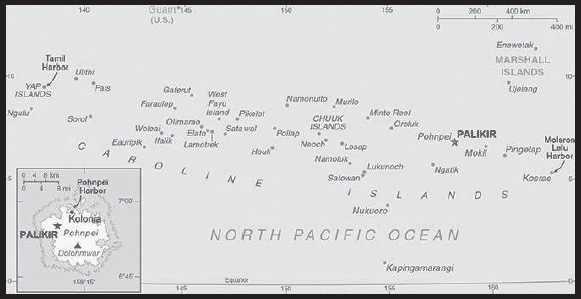
Location: Oceania, island group in the North Pacific Ocean, about three-quarters of the way from Hawaii to Indonesia
Geographic coordinates: 6 55 N, 158 15 E
Map references: Oceania
Area: total: 702 sq km
land: 702 sq km
water: 0 sq km (fresh water only)
note: includes Pohnpei (Ponape), Chuuk (Truk) Islands, Yap Islands, and Kosrae (Kosaie)
comparison ranking: total 191
Area - comparative: four times the size of Washington, DC (land area only)
Land boundaries: total: 0 km
Coastline: 6,112 km
Maritime claims: territorial sea: 12 nm
exclusive economic zone: 200 nm
Climate: tropical; heavy year-round rainfall, especially in the eastern islands; located on southern edge of the typhoon belt with occasionally severe damage
Terrain: islands vary geologically from high mountainous islands to low, coral atolls; volcanic outcroppings on Pohnpei, Kosrae, and Chuuk
Elevation: highest point: Nanlaud on Pohnpei 782 m
lowest point: Pacific Ocean 0 m
Natural resources: timber, marine products, deep-seabed minerals, phosphate
Land use: agricultural land: 25.5% (2018 est.)
arable land: 2.3% (2018 est.)
permanent crops: 19.7% (2018 est.)
permanent pasture: 3.5% (2018 est.)
forest: 74.5% (2018 est.)
other: 0% (2018 est.)
Irrigated land: 0 sq km (2022)
Population distribution: the majority of the populaton lives in the coastal areas of the high islands; the mountainous interior is largely uninhabited; less than half of the population lives in urban areas
Natural hazards: typhoons (June to December)
Geography - note: composed of four major island groups totaling 607 islands
PEOPLE AND SOCIETY
Population: 100,319 (2023 est.)
comparison ranking: 196
Nationality: noun: Micronesian(s)
adjective: Micronesian; Chuukese, Kosraen(s), Pohnpeian(s), Yapese
Ethnic groups: Chuukese/Mortlockese 49.3%, Pohnpeian 29.8%, Kosraean 6.3%, Yapese 5.7%, Yap outer islanders 5.1%, Polynesian 1.6%, Asian 1.4%, other 0.8% (2010 est.)
Languages: English (official and common language), Chuukese, Kosrean, Pohnpeian, Yapese, Ulithian, Woleaian, Nukuoro, Kapingamarangi
Religions: Roman Catholic 54.7%, Protestant 41.1% (includes Congregational 38.5%, Baptist 1.1%, Seventh Day Adventist 0.8%, Assembly of God 0.7%), Church of Jesus Christ 1.5%, other 1.9%, none 0.7%, unspecified 0.1% (2010 est.)
Age structure: 0-14 years: 27.41% (male 13,968/female 13,527)
15-64 years: 67.13% (male 32,721/female 34,627)
65 years and over: 5.46% (2023 est.) (male 2,433/female 3,043)
Dependency ratios: total dependency ratio: 57.7
youth dependency ratio: 48.4
elderly dependency ratio: 9.3
potential support ratio: 10.8 (2021 est.)
Median age: total: 26.3 years (2020)
male: 25.5 years
female: 27.1 years
comparison ranking: total 154
Population growth rate: -0.7% (2023 est.)
comparison ranking: 227
Birth rate: 18.12 births/1,000 population (2023 est.)
comparison ranking: 78
Death rate: 4.2 deaths/1,000 population (2023 est.)
comparison ranking: 210
Net migration rate: -20.92 migrant(s)/1,000 population (2023 est.)
comparison ranking: 229
Population distribution: the majority of the populaton lives in the coastal areas of the high islands; the mountainous interior is largely uninhabited; less than half of the population lives in urban areas
Urbanization: urban population: 23.4% of total population (2023)
rate of urbanization: 1.52% annual rate of change (2020-25 est.)
Major urban areas - population: 7,000 PALIKIR (capital) (2018)
Sex ratio: at birth: 1.05 male(s)/female
0-14 years: 1.03 male(s)/female
15-64 years: 0.94 male(s)/female
65 years and over: 0.8 male(s)/female
total population: 0.96 male(s)/female (2023 est.)
Maternal mortality ratio: 74 deaths/100,000 live births (2020 est.)
comparison ranking: 81
Infant mortality rate: total: 21.37 deaths/1,000 live births (2023 est.)
male: 24.4 deaths/1,000 live births
female: 18.19 deaths/1,000 live births
comparison ranking: total 76
Life expectancy at birth: total population: 74.71 years (2023 est.)
male: 72.61 years
female: 76.91 years
comparison ranking: total population 138
Total fertility rate: 2.22 children born/woman (2023 est.)
comparison ranking: 81
Gross reproduction rate: 1.08 (2023 est.)
Drinking water source: improved: total: 78.6% of population
unimproved: total: 21.4% of population (2017 est.)
Current health expenditure: 11.6% of GDP (2020)
Physicians density: (2020)
Hospital bed density: 3.2 beds/1,000 population
Sanitation facility access: improved:
total: 88.3% of population
unimproved: total: 11.7% of population (2017 est.)
Obesity - adult prevalence rate: 45.8% (2016)
comparison ranking: 10
Alcohol consumption per capita: total: 1.59 liters of pure alcohol (2019 est.)
beer: 0.92 liters of pure alcohol (2019 est.)
wine: 0.13 liters of pure alcohol (2019 est.)
spirits: 0.52 liters of pure alcohol (2019 est.)
other alcohols: 0.01 liters of pure alcohol (2019 est.)
comparison ranking: total 138
Currently married women (ages 15-49): 51.7% (2023 est.)
Education expenditures: 9.7% of GDP (2018 est.)
comparison ranking: 6
Youth unemployment rate (ages 15-24): total: 18.9% (2014)
male: 10.4%
female: 29.9%
comparison ranking: total 89
ENVIRONMENT
Environment - current issues: overfishing; sea level rise due to climate change threatens land; water pollution, toxic pollution from mining; solid waste disposal
Environment - international agreements: party to: Biodiversity, Climate Change, Climate Change-Kyoto Protocol, Climate Change-Paris Agreement, Comprehensive Nuclear Test Ban, Desertification, Hazardous Wastes, Law of the Sea, Ozone Layer Protection
signed, but not ratified: none of the selected agreements
Climate: tropical; heavy year-round rainfall, especially in the eastern islands; located on southern edge of the typhoon belt with occasionally severe damage
Land use: agricultural land: 25.5% (2018 est.)
arable land: 2.3% (2018 est.)
permanent crops: 19.7% (2018 est.)
permanent pasture: 3.5% (2018 est.)
forest: 74.5% (2018 est.)
other: 0% (2018 est.)
Urbanization: urban population: 23.4% of total population (2023)
rate of urbanization: 1.52% annual rate of change (2020-25 est.)
Revenue from forest resources: 0.02% of GDP (2018 est.)
comparison ranking: 141
Air pollutants: particulate matter emissions: 7.79 micrograms per cubic meter (2019 est.)
carbon dioxide emissions: 0.14 megatons (2016 est.)
methane emissions: 0.02 megatons (2020 est.)
Waste and recycling: municipal solid waste generated annually: 26,040 tons (2016 est.)
Total renewable water resources: 0 cubic meters (2017 est.)
GOVERNMENT
Country name: conventional long form: Federated States of Micronesia
conventional short form: none
local long form: Federated States of Micronesia
local short form: none
former: New Philippines; Caroline Islands; Trust Territory of the Pacific Islands, Ponape, Truk, and Yap Districts
abbreviation: FSM
etymology: the term “Micronesia” is a 19th-century construct of two Greek words, “micro” (small) and “nesoi” (islands), and refers to thousands of small islands in the western Pacific Ocean
Government type: federal republic in free association with the US
Capital: name: Palikir
geographic coordinates: 6 55 N, 158 09 E
time difference: UTC+11 (16 hours ahead of Washington, DC, during Standard Time)
time zone note: Micronesia has two time zones
note: Palikir became the new capital of the country in 1989, three years after independence; Kolonia, the former capital, remains the site for many foreign embassies; it also serves as the Pohnpei state capital
Administrative divisions: 4 states; Chuuk (Truk), Kosrae (Kosaie), Pohnpei (Ponape), Yap
Independence: 3 November 1986 (from the US-administered UN trusteeship)
National holiday: Constitution Day, 10 May (1979)
Constitution: history: drafted June 1975, ratified 1 October 1978, entered into force 10 May 1979
amendments: proposed by Congress, by a constitutional convention, or by public petition; passage requires approval by at least three-fourths majority vote in at least three fourths of the states; amended 1990; note – at least every 10 years as part of a general or special election, voters are asked whether to hold a constitution convention; a majority of affirmative votes is required to proceed; amended many times, last in 2019 (approval by referendum to hold a constitutional convention)
Legal system: mixed legal system of common and customary law
International law organization participation: has not submitted an ICJ jurisdiction declaration; non-party state to the ICCt
Citizenship: citizenship by birth: no
citizenship by descent only: at least one parent must be a citizen of FSM
dual citizenship recognized: no
residency requirement for naturalization: 5 years
Suffrage: 18 years of age; universal
Executive branch: chief of state: President Wesley W. SIMINA (since 12 May 2023); Vice President Aren B. PALIK (since 12 May 2023); note - the president is both chief of state and head of government
head of government: President Wesley W. SIMINA (since 12 May 2023); Vice President Aren B. PALIK (since 12 May 2023)
cabinet: Cabinet includes the vice president and the heads of the 8 executive departments
elections/appointments: president and vice president indirectly elected by Congress from among the 4 ‘at large’ senators for a 4-year term (eligible for a second term); election last held on 12 May 2023 (next to be held in 2027)
election results: David W. PANUELO elected president by Congress; Yosiwo P. GEORGE reelected vice president
Legislative branch: description: unicameral Congress (14 seats; 10 members directly elected in single-seat constituencies by simple majority vote to serve 2-year terms and 4 at- large members directly elected from each of the 4 states by proportional representation vote to serve 4-year terms)
elections: last held on 7 March 2023 (next to be held in March 2025)
election results: percent of vote - NA; seats - independent 14; composition as of March 2023 - men 14, women 0
Judicial branch: highest court(s): Federated States of Micronesia (FSM) Supreme Court (consists of the chief justice and not more than 5 associate justices and organized into appellate and criminal divisions)
judge selection and term of office: justices appointed by the FSM president with the approval of two-thirds of Congress; justices appointed for life
subordinate courts: the highest state-level courts are: Chuuk Supreme Court; Korsae State Court; Pohnpei State Court; Yap State Court
Political parties and leaders: no formal parties
International organization participation: ACP, ADB, AOSIS, FAO, G-77, IBRD, ICAO, ICRM, IDA, IFC, IFRCS, IMF, IOC, IOM, IPU, ITSO, ITU, MIGA, OPCW, PIF, Sparteca, SPC, UN, UNCTAD, UNESCO, WHO, WMO
Diplomatic representation in the US: chief of mission: Ambassador (vacant); Chargé d’Affaires Jackson SORAM (since 31 March 2023)
chancery: 1725 N Street NW, Washington, DC 20036
telephone: [1] (202) 223-4383
FAX: [1] (202) 223-4391
email address and website:
consulate(s) general: Honolulu, Portland (OR), Tamuning (Guam)
Diplomatic representation from the US: chief of mission: Ambassador Jennifer JOHNSON (since 13 September 2023)
embassy: 1286 US Embassy Place, Kolonia, Pohnpei, FM 96941
mailing address: 4120 Kolonia Place, Washington, D.C. 20521-4120
telephone: [691] 320-2187
FAX: [691] 320-2186
email address and website:
Flag description: light blue with four white five-pointed stars centered; the stars are arranged in a diamond pattern; blue symbolizes the Pacific Ocean, the stars represent the four island groups of Chuuk, Kosrae, Pohnpei, and Yap
National symbol(s): four, five-pointed, white stars on a light blue field, hibiscus flower; national colors: light blue, white
National anthem: name: “Patriots of Micronesia”
lyrics/music: unknown/August Daniel BINZER
note: adopted 1991; also known as “Across All Micronesia”; the music is based on the 1820 German patriotic song “Ich hab mich ergeben”, which was the West German national anthem from 1949-1950; variants of this tune are used in Johannes BRAHMS’ “Festival Overture” and Gustav MAHLER’s “Third Symphony”
National heritage: total World Heritage Sites: 1 (cultural)
selected World Heritage Site locales: Nan Madol: Ceremonial Center of Eastern Micronesia
ECONOMY
Economic overview: lower middle-income Pacific island economy; US aid reliance, sunsetting in 2024; low entrepreneurship; mostly fishing and farming; US dollar user; no patent laws; tourism remains underdeveloped; significant corruption
Real GDP (purchasing power parity): $375.055 million (2021 est.)
$387.407 million (2020 est.)
$394.369 million (2019 est.)
note: data are in 2017 dollars
comparison ranking: 215
Real GDP growth rate: -3.19% (2021 est.)
-1.77% (2020 est.)
1.17% (2019 est.)
comparison ranking: 209
Real GDP per capita: $3,300 (2021 est.) note: data are in 2017 dollars
$3,500 (2020 est.) note: data are in 2017 dollars
$3,500 (2019 est.)
comparison ranking: 193
GDP (official exchange rate): $328 million (2017 est.)
Inflation rate (consumer prices): 0.55% (2020 est.)
1.54% (2019 est.)
1.79% (2018 est.)
comparison ranking: 207
GDP - composition, by sector of origin: agriculture: 26.3% (2013 est.)
industry: 18.9% (2013 est.)
services: 54.8% (2013 est.)
comparison rankings: services 158; industry 160; agriculture 26
GDP - composition, by end use: household consumption: 83.5% (2013 est.)
government consumption: 48.4% (2016 est.)
investment in fixed capital: 29.5% (2016 est.)
investment in inventories: 1.9% (2016 est.)
exports of goods and services: 27.5% (2016 est.)
imports of goods and services: -77% (2016 est.)
Agricultural products: coconuts, cassava, vegetables, sweet potatoes, bananas, pork, plantains, fruit, eggs, beef
Industries: tourism, construction; specialized aquaculture, craft items (shell and wood)
Industrial production growth rate: -8.33% (2021 est.)
comparison ranking: 196
Labor force: 37,920 (2010 est.)
comparison ranking: 201
Labor force - by occupation: agriculture: 0.9%
industry: 5.2%
services: 93.9% (2013 est.)
note: two-thirds of the labor force are government employees
Unemployment rate: 16.2% (2010 est.)
comparison ranking: 31
Youth unemployment rate (ages 15-24): total: 18.9% (2014)
male: 10.4%
female: 29.9%
comparison ranking: total 89
Population below poverty line: 41.2% (2013 est.)
Gini Index coefficient - distribution of family income: 40.1 (2013 est.)
comparison ranking: 57
Budget: revenues: $320 million (2018 est.)
expenditures: $223 million (2018 est.)
Budget surplus (+) or deficit (-): 6.6% (of GDP) (FY12/13 est.)
comparison ranking: 4
Public debt: 25.4% of GDP (2020 est.)
23.1% of GDP (2019 est.)
23.11% of GDP (2018 est.)
comparison ranking: 178
Taxes and other revenues: 6.43% (of GDP) (2020 est.)
comparison ranking: 216
Fiscal year: 1 October - 30 September
Current account balance: $12 million (2017 est.)
$11 million (2016 est.)
comparison ranking: 73
Exports: $179 million (2021 est.)
$122 million (2020 est.)
$130 million (2019 est.)
comparison ranking: 203
Exports - partners: Thailand 81%, China 9%, Japan 4%, Philippines 4%, United States 1% (2021)
Exports - commodities: skipjack, tuna, fish fillets, aircraft, scrap iron (2021)
Imports: $126 million (2021 est.)
$133 million (2020 est.)
$121 million (2019 est.)
comparison ranking: 215
Imports - partners: United States 34%, China 16%, Japan 11%, Taiwan 7%, South Korea 6% (2021)
Imports - commodities: poultry meats, broadcasting equipment, other meats, cars, fish products, rice, lumber (2021)
Reserves of foreign exchange and gold: $497,434,100 (31 December 2021 est.)
$451,912,600 (31 December 2020 est.)
$397,158,200 (31 December 2019 est.)
comparison ranking: 167
Debt - external: $93.6 million (2013 est.)
$93.5 million (2012 est.)
comparison ranking: 194
Exchange rates: 1 (2021 est.)
1 (2020 est.)
1 (2019 est.)
1 (2018 est.)
1 (2017 est.)
the US dollar is used
ENERGY
Electricity access: electrification - total population: 83.6% (2021)
electrification - urban areas: 97.5% (2021)
electrification - rural areas: 79.4% (2021)
Petroleum: refined petroleum consumption: 1,200 bbl/day (2019 est.)
Carbon dioxide emissions: 177,000 metric tonnes of CO2 (2019 est.)
from petroleum and other liquids: 177,000 metric tonnes of CO2 (2019 est.)
comparison ranking: total emissions 204
Energy consumption per capita: 0 Btu/person (2019 est.)
comparison ranking: 203
COMMUNICATIONS
Telephones - fixed lines: total subscriptions: 7,000 (2021 est.)
subscriptions per 100 inhabitants: 6 (2021 est.)
comparison ranking: total subscriptions 199
Telephones - mobile cellular: total subscriptions: 22,000 (2021 est.)
subscriptions per 100 inhabitants: 19 (2021 est.)
comparison ranking: total subscriptions 215
Telecommunication systems: general assessment: Australia, Japan, and the United States are committed to working in partnership with the Federated States of Micronesia (FSM), Kiribati, and Nauru to improve internet connectivity to these three Pacific nations by providing funding to build a new undersea cable; the proposed undersea cable will provide faster, higher quality, and more reliable and secure communications to approximately 100,000 people across three countries; this will support increased economic growth, drive development opportunities, and help to improve living standards as the region recovers from the severe impacts of COVID-19; the new cable will connect Kosrae (FSM), Nauru, and Tarawa (Kiribati) with the existing HANTRU-1 cable at Pohnpei (FSM), providing internet connectivity through a submarine cable for the first time
(2021)
domestic: fixed line teledensity roughly 6 per 100 and mobile-cellular nearly 19 per 100 (2021)
international: country code - 691; landing points for the Chuukk-Pohnpei Cable and HANTRU-1 submarine cable system linking the Federated States of Micronesia and the US; satellite earth stations - 5 Intelsat (Pacific Ocean) (2019)
Broadcast media: no TV broadcast stations; each state has a multi-channel cable service with TV transmissions carrying roughly 95% imported programming and 5% local programming; about a half-dozen radio stations (2009)
Internet country code: .fm
Internet users: total: 44,000 (2021 est.)
percent of population: 40% (2021 est.)
comparison ranking: total 202
Broadband - fixed subscriptions: total: 6,000 (2020 est.)
subscriptions per 100 inhabitants: 5 (2020 est.)
comparison ranking: total 183
TRANSPORTATION
Civil aircraft registration country code prefix: V6
Airports: 6 (2021)
comparison ranking: total 174
Airports - with paved runways: 6
note: paved runways have a concrete or asphalt surface but not all have facilities for refueling, maintenance, or air traffic control; the length of a runway required for aircraft to safely operate depends on a number of factors including the type of aircraft, the takeoff weight (including passengers, cargo, and fuel), engine types, flap settings, landing speed, elevation of the airport, and average maximum daily air temperature; paved runways can reach a length of 5,000 m (16,000 ft.), but the “typical” length of a commercial airline runway is between 2,500-4,000 m (8,000-13,000 ft.)
Roadways: total: (2015)
paved: (2015)
unpaved: (2015)
note - paved and unpaved circumferential roads, most interior roads are unpaved
Merchant marine: total: 37 (2022)
by type: general cargo 19, oil tanker 4, other 14
comparison ranking: total 127
Ports and terminals: major seaport(s): Colonia (Tamil Harbor), Molsron Lele Harbor, Pohnepi Harbor
MILITARY AND SECURITY
Military and security forces: no military forces; Federated States of Micronesia National Police (includes a maritime wing); the Department of Justice oversees the National Police; State police forces are responsible for law enforcement in their respective states and are under the jurisdiction of each state’s director of public safety (2023)
Military - note: defense is the responsibility of the US
Micronesia has a “shiprider” agreement with the US, which allows local maritime law enforcement officers to embark on US Coast Guard (USCG) and US Navy (USN) vessels, including to board and search vessels suspected of violating laws or regulations within Micronesia’s designated exclusive economic zone (EEZ) or on the high seas; “shiprider” agreements also enable USCG personnel and USN vessels with embarked USCG law enforcement personnel to work with host nations to protect critical regional resources (2023)
TRANSNATIONAL ISSUES
Disputes - international: none identified
Illicit drugs: major consumer of cannabis
MOLDOVA
INTRODUCTION
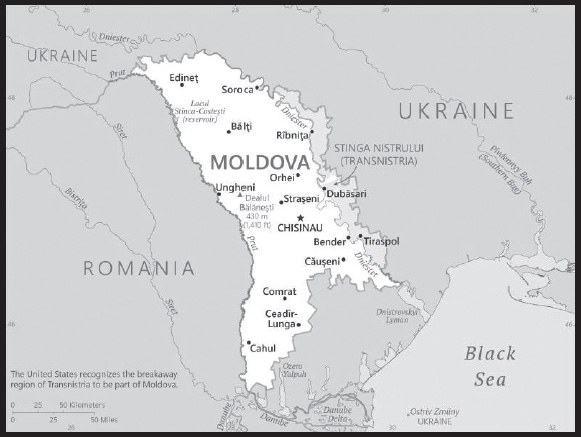
Background: A large portion of present day Moldovan territory became a province of the Russian Empire in 1812 and then unified with Romania in 1918 in the aftermath of World War I. This territory was then incorporated into the Soviet Union at the close of World War II. Although Moldova has been independent from the Soviet Union since 1991, Russian forces have remained on Moldovan territory east of the Nistru River in the breakaway region of Transnistria.
Years of Communist Party rule in Moldova from 2001-09 ultimately ended with election-related violent protests and a rerun of parliamentary elections in 2009. A series of pro-Europe ruling coalitions governed Moldova from 2010-19, but pro-Russia Igor DODON won the presidency in 2016 and his Socialist Party of the Republic of Moldova won a plurality in the legislative election in 2019. Pro-EU reformist candidate Maia SANDU defeated DODON in his reelection bid in November 2020 and the Party of Action and Solidarity, which SANDU founded in 2015, won a parliamentary majority in an early legislative election in July 2021. Prime Minister Natalia GAVRILITA and her cabinet took office in August 2021. In February 2023, Moldova’s parliament confirmed a new cabinet led by Prime Minister Dorin RECEAN, which retained the majority of the former ministers.
GEOGRAPHY
Location: Eastern Europe, northeast of Romania
Geographic coordinates: 47 00 N, 29 00 E
Map references: Europe
Area: total: 33,851 sq km
land: 32,891 sq km
water: 960 sq km
comparison ranking: total 139
Area - comparative: slightly larger than Maryland
Land boundaries: total: 1,885 km
border countries (2): Romania 683 km; Ukraine 1202 km
Coastline: 0 km (landlocked)
Maritime claims: none (landlocked)
Climate: moderate winters, warm summers
Terrain: rolling steppe, gradual slope south to Black Sea
Elevation: highest point: Dealul Balanesti 430 m
lowest point: Dniester (Nistru) 2 m
mean elevation: 139 m
Natural resources: lignite, phosphorites, gypsum, limestone, arable land
Land use: agricultural land: 74.9% (2018 est.)
arable land: 55.1% (2018 est.)
permanent crops: 9.1% (2018 est.)
permanent pasture: 10.7% (2018 est.)
forest: 11.9% (2018 est.)
other: 13.2% (2018 est.)
Irrigated land: 2,155 sq km (2020)
Major rivers (by length in km): Dunărea (Danube) (shared with Germany [s], Austria, Slovakia, Czechia, Hungary, Croatia, Serbia, Bulgaria, Ukraine, and Romania [m]) - 2,888 km; Nistru (Dniester) (shared with Ukraine [s/m]) - 1,411 km note – [s] after country name indicates river source; [m] after country name indicates river mouth
Major watersheds (area sq km): Atlantic Ocean drainage: (Black Sea) Danube (795,656 sq km)
Population distribution: pockets of agglomeration exist throughout the country, the largest being in the center of the country around the capital of Chisinau, followed by Tiraspol and Balti
Natural hazards: landslides
Geography - note: landlocked; well endowed with various sedimentary rocks and minerals including sand, gravel, gypsum, and limestone
PEOPLE AND SOCIETY
Population: 3,250,532 (2023 est.)
comparison ranking: 134
Nationality: noun: Moldovan(s)
adjective: Moldovan
Ethnic groups: Moldovan 75.1%, Romanian 7%, Ukrainian 6.6%, Gagauz 4.6%, Russian 4.1%, Bulgarian 1.9%, other 0.8% (2014 est.)
Languages: Moldovan/Romanian 80.2% (official) (56.7% identify their mother tongue as Moldovan, which is virtually the same as Romanian; 23.5% identify Romanian as their mother tongue), Russian 9.7%, Gagauz 4.2% (a Turkish language), Ukrainian 3.9%, Bulgarian 1.5%, Romani 0.3%, other 0.2% (2014 est.); note - data represent mother tongue; as of March 2023, Romanian replaced Moldovan as the name of Moldova’s official language
major-language sample(s):
Cartea informativa a lumii, sursa indispensabila pentru informatii de baza. (Moldovan/Romanian)
Religions: Orthodox 90.1%, other Christian 2.6%, other 0.1%, agnostic <0.1%, atheist 0.2%, unspecified 6.9% (2014 est.)
Age structure: 0-14 years: 18.01% (male 301,432/female 284,034)
15-64 years: 66.37% (male 1,087,397/female 1,069,902)
65 years and over: 15.62% (2023 est.) (male 203,889/female 303,878)
Dependency ratios: total dependency ratio: 39.6
youth dependency ratio: 29.7
elderly dependency ratio: 20.4
potential support ratio: 4.9 (2021 est.)
Median age: total: 37.7 years (2020)
male: 36.2 years
female: 39.5 years
comparison ranking: total 68
Population growth rate: -1.14% (2023 est.)
comparison ranking: 232
Birth rate: 9.94 births/1,000 population (2023 est.)
comparison ranking: 188
Death rate: 12.51 deaths/1,000 population (2023 est.)
comparison ranking: 12
Net migration rate: -8.8 migrant(s)/1,000 population (2023 est.)
comparison ranking: 220
Population distribution: pockets of agglomeration exist throughout the country, the largest being in the center of the country around the capital of Chisinau, followed by Tiraspol and Balti
Urbanization: urban population: 43.4% of total population (2023)
rate of urbanization: 0.09% annual rate of change (2020-25 est.)
Major urban areas - population: 488,000 CHISINAU (capital) (2023)
Sex ratio: at birth: 1.06 male(s)/female
0-14 years: 1.06 male(s)/female
15-64 years: 1.02 male(s)/female
65 years and over: 0.67 male(s)/female
total population: 0.96 male(s)/female (2023 est.)
Mother’s mean age at first birth: 25.2 years (2019 est.)
Maternal mortality ratio: 12 deaths/100,000 live births (2020 est.)
comparison ranking: 140
Infant mortality rate: total: 11.38 deaths/1,000 live births (2023 est.)
male: 13.29 deaths/1,000 live births
female: 9.35 deaths/1,000 live births
comparison ranking: total 123
Life expectancy at birth: total population: 72.72 years (2023 est.)
male: 68.9 years
female: 76.77 years
comparison ranking: total population 155
Total fertility rate: 1.59 children born/woman (2023 est.)
comparison ranking: 189
Gross reproduction rate: 0.77 (2023 est.)
Contraceptive prevalence rate: 56% (2020)
Drinking water source: improved: urban: 98.9% of population
rural: 87% of population
total: 92.1% of population
unimproved: urban: 1.1% of population
rural: 13% of population
total: 7.9% of population (2020 est.)
Current health expenditure: 6.8% of GDP (2020)
Physicians density: 3.1 physicians/1,000 population (2020)
Hospital bed density: 5.7 beds/1,000 population (2014)
Sanitation facility access: improved: urban: 99% of population
rural: 83.1% of population
total: 89.9% of population
unimproved: urban: 1% of population
rural: 16.9% of population
total: 10.1% of population (2020 est.)
Obesity - adult prevalence rate: 18.9% (2016)
comparison ranking: 113
Alcohol consumption per capita: total: 7.45 liters of pure alcohol (2019 est.)
beer: 1.53 liters of pure alcohol (2019 est.)
wine: 3.57 liters of pure alcohol (2019 est.)
spirits: 2.25 liters of pure alcohol (2019 est.)
other alcohols: 0.1 liters of pure alcohol (2019 est.)
comparison ranking: total 54
Tobacco use: total: 29% (2020 est.)
male: 51.7% (2020 est.)
female: 6.2% (2020 est.)
comparison ranking: total 35
Currently married women (ages 15-49): 67% (2023 est.)
Education expenditures: 6.4% of GDP (2020 est.)
comparison ranking: 33
Literacy: definition: age 15 and over can read and write
total population: 99.6%
male: 99.7%
female: 99.5% (2021)
School life expectancy (primary to tertiary education): total: 14 years
male: 14 years
female: 15 years (2021)
Youth unemployment rate (ages 15-24): total: 8.6% (2021 est.)
male: 5.3%
female: 14.7%
comparison ranking: total 166
ENVIRONMENT
Environment - current issues: heavy use of agricultural chemicals has contaminated soil and groundwater; extensive soil erosion and declining soil fertility from poor farming methods
Environment - international agreements: party to: Air Pollution, Air Pollution-Heavy Metals, Air Pollution-Persistent Organic Pollutants, Biodiversity, Climate Change, Climate Change-Kyoto Protocol, Climate Change-Paris Agreement, Comprehensive Nuclear Test Ban, Desertification, Endangered Species, Hazardous Wastes, Law of the Sea, Ozone Layer Protection, Ship Pollution, Wetlands
signed, but not ratified: Air Pollution-Multi-effect Protocol
Climate: moderate winters, warm summers
Land use: agricultural land: 74.9% (2018 est.)
arable land: 55.1% (2018 est.)
permanent crops: 9.1% (2018 est.)
permanent pasture: 10.7% (2018 est.)
forest: 11.9% (2018 est.)
other: 13.2% (2018 est.)
Urbanization: urban population: 43.4% of total population (2023)
rate of urbanization: 0.09% annual rate of change (2020-25 est.)
Revenue from forest resources: 0.26% of GDP (2018 est.)
comparison ranking: 86
Revenue from coal: 0% of GDP (2018 est.)
comparison ranking: 146
Air pollutants: particulate matter emissions: 12.37 micrograms per cubic meter (2019 est.)
carbon dioxide emissions: 5.12 megatons (2016 est.)
methane emissions: 3.29 megatons (2020 est.)
Waste and recycling: municipal solid waste generated annually: 3,981,200 tons (2015 est.)
municipal solid waste recycled annually: 609,920 tons (2015 est.)
percent of municipal solid waste recycled: 15.3% (2015 est.)
Major rivers (by length in km): Dunărea (Danube) (shared with Germany [s], Austria, Slovakia, Czechia, Hungary, Croatia, Serbia, Bulgaria, Ukraine, and Romania [m]) - 2,888 km; Nistru (Dniester) (shared with Ukraine [s/m]) - 1,411 km note – [s] after country name indicates river source; [m] after country name indicates river mouth
Major watersheds (area sq km): Atlantic Ocean drainage: (Black Sea) Danube (795,656 sq km)
Total water withdrawal: municipal: 160 million cubic meters (2020 est.)
industrial: 580 million cubic meters (2020 est.)
agricultural: 60 million cubic meters (2020 est.)
Total renewable water resources: 12.27 billion cubic meters (2020 est.)
GOVERNMENT
Country name: conventional long form: Republic of Moldova
conventional short form: Moldova
local long form: Republica Moldova
local short form: Moldova
former: Moldavian Soviet Socialist Republic, Moldovan Soviet Socialist Republic
etymology: named for the Moldova River in neighboring eastern Romania
Government type: parliamentary republic
Capital: name: Chisinau in Romanian (Kishinev in Russian)
geographic coordinates: 47 00 N, 28 51 E
time difference: UTC+2 (7 hours ahead of Washington, DC, during Standard Time)
daylight saving time: +1hr, begins last Sunday in March; ends last Sunday in October
etymology: origin unclear but may derive from the archaic Romanian word chisla (“spring” or “water source”) and noua (“new”) because the original settlement was built at the site of a small spring
note: pronounced KEE-shee-now (KIH-shi-nyov)
Administrative divisions: 32 raions (raioane, singular - raion), 3 municipalities (municipii, singular - municipiul), 1 autonomous territorial unit (unitatea teritoriala autonoma), and 1 territorial unit (unitatea teritoriala)
raions: Anenii Noi, Basarabeasca, Briceni, Cahul, Cantemir, Calarasi, Causeni, Cimislia, Criuleni, Donduseni, Drochia, Dubasari, Edinet, Falesti, Floresti, Glodeni, Hincesti, Ialoveni, Leova, Nisporeni, Ocnita, Orhei, Rezina, Riscani, Singerei, Soldanesti, Soroca, Stefan Voda, Straseni, Taraclia, Telenesti, Ungheni
municipalities: Balti, Bender, Chisinau
autonomous territorial unit: Gagauzia
territorial unit: Stinga Nistrului (Transnistria)
Independence: 27 August 1991 (from the Soviet Union)
National holiday: Independence Day, 27 August (1991)
Constitution: history: previous 1978; latest adopted 29 July 1994, effective 27 August 1994
amendments: proposed by voter petition (at least 200,000 eligible voters), by at least one third of Parliament members, or by the government; passage requires two-thirds majority vote of Parliament within one year of initial proposal; revisions to constitutional articles on sovereignty, independence, and neutrality require majority vote by referendum; articles on fundamental rights and freedoms cannot be amended; amended many times, last in 2018
Legal system: civil law system with Germanic law influences; Constitutional Court review of legislative acts
International law organization participation: has not submitted an ICJ jurisdiction declaration; accepts ICCt jurisdiction
Citizenship: citizenship by birth: no
citizenship by descent only: at least one parent must be a citizen of Moldova
dual citizenship recognized: no
residency requirement for naturalization: 10 years
Suffrage: 18 years of age; universal
Executive branch: chief of state: President Maia SANDU (since 24 December 2020)
head of government: Prime Minister Dorin RECEAN (since 16 February 2023)
cabinet: Cabinet proposed by the prime minister-designate, nominated by the president, approved through a vote of confidence in Parliament
elections/appointments: president directly elected for a 4-year term (eligible for a second term); election last held on 15 November 2020 (next to be held in fall 2024); prime minister designated by the president upon consultation with Parliament; within 15 days from designation, the prime minister-designate must request a vote of confidence for his/her proposed work program from the Parliament
election results:
2020: Maia SANDU elected president; percent of vote (second round results) - Maia SANDU (PAS) 57.7%, Igor DODON (PSRM) 42.3%
2016: Igor DODON elected president; percent of vote 52.1%, and Maia SANDU 47.9%
Legislative branch: description: unicameral Parliament (101 seats; 51 members directly elected in single-seat constituencies by simple majority vote and 50 members directly elected in a single, nationwide constituency by closed party-list proportional representation vote; all members serve 4-year terms
elections: last held on 11 July 2021 (next scheduled in July 2025)
election results:
2021: percent of vote by party - PAS 52.8%, BECS (PSRM+PCRM) 27.1%, SOR 5.7%; seats by party - PAS 63, BECS 32, SOR 6; composition as of April 2023 - men 62, women 39, percent of women 38.6%
Judicial branch: highest court(s): Supreme Court of Justice (consists of the chief judge, 3 deputy-chief judges, 45 judges, and 7 assistant judges); Constitutional Court (consists of the court president and 6 judges); note - the Constitutional Court is autonomous to the other branches of government; the Court interprets the Constitution and reviews the constitutionality of parliamentary laws and decisions, decrees of the president, and acts of the government
judge selection and term of office: Supreme Court of Justice judges appointed by the president upon the recommendation of the Superior Council of Magistracy, an 11-member body of judicial officials; all judges serve 4-year renewable terms; Constitutional Court judges appointed 2 each by Parliament, the president, and the Higher Council of Magistracy for 6-year terms; court president elected by other court judges for a 3-year term
subordinate courts: Courts of Appeal; Court of Business Audit; municipal courts
Political parties and leaders: Party of Action and Solidarity or PAS [Igor GROSU]
Communist Party or PCRM [Vladimir VORONIN]
Socialist Party or PSRM [Igor DODON]
SOR Party [llan SHOR]
International organization participation: BSEC, CD, CE, CEI, CIS, EAEU (observer), EAPC, EBRD, FAO, GCTU, GUAM, IAEA, IBRD, ICAO, ICC (NGOs), ICCt, ICRM, IDA, IFAD, IFC, IFRCS, ILO, IMF, IMO, Interpol, IOC, IOM, IPU, ISO (correspondent), ITU, ITUC (NGOs), MIGA, OIF, OPCW, OSCE, PFP, SELEC, UN, UNCTAD, UNESCO, UNHCR, UNIDO, Union Latina, UNMIL, UNMISS, UNOCI, UNWTO, UPU, WCO, WHO, WIPO, WMO, WTO
note: Moldova is an EU candidate country whose satisfactory completion of accession criteria is required before being granted full EU membership
Diplomatic representation in the US: chief of mission: Ambassador Viorel URSU (since 12 December 2022)
chancery: 2101 S Street NW, Washington, DC 20008
telephone: [1] (202) 667-1130
FAX: [1] (202) 667-2624
email address and website:
Diplomatic representation from the US: chief of mission: Ambassador Kent D. LOGSDON (since 16 February 2022)
embassy: 103 Mateevici Street, Chisinau MD-2009
mailing address: 7080 Chisinau Place, Washington DC 20521-7080
telephone: [373] (22) 408-300
FAX: [373] (22) 233-044
email address and website:
Flag description: three equal vertical bands of Prussian blue (hoist side), chrome yellow, and vermilion red; emblem in center of flag is of a Roman eagle of dark gold (brown) outlined in black with a red beak and talons carrying a yellow cross in its beak and a green olive branch in its right talons and a yellow scepter in its left talons; on its breast is a shield divided horizontally red over blue with a stylized aurochs head, star, rose, and crescent all in black-outlined yellow; based on the color scheme of the flag of Romania - with which Moldova shares a history and culture - but Moldova’s blue band is lighter; the reverse of the flag displays a mirrored image of the coat of arms
note: one of only three national flags that differ on their obverse and reverse sides - the others are Paraguay and Saudi Arabia
National symbol(s): aurochs (a type of wild cattle); national colors: blue, yellow, red
National anthem: name: “Limba noastra” (Our Language)
lyrics/music: Alexei MATEEVICI/Alexandru CRISTEA
note: adopted 1994
National heritage: total World Heritage Sites: 1 (cultural)
selected World Heritage Site locales: Struve Geodetic Arc
ECONOMY
Economic overview: upper middle-income Eastern European economy; sustained growth reversed by COVID-19; significant remittances;
Russian energy and regional dependence; agricultural exporter; declining workforce due to emigration and low fertility
Real GDP (purchasing power parity): $36.637 billion (2021 est.)
$32.153 billion (2020 est.)
$34.715 billion (2019 est.)
note: data are in 2017 dollars
comparison ranking: 129
Real GDP growth rate: 13.94% (2021 est.)
-7.38% (2020 est.)
3.68% (2019 est.)
comparison ranking: 10
Real GDP per capita: $14,000 (2021 est.)
$12,200 (2020 est.)
$13,000 (2019 est.)
note: data are in 2017 dollars
comparison ranking: 116
GDP (official exchange rate): $11.982 billion (2019 est.)
Inflation rate (consumer prices): 5.11% (2021 est.)
3.77% (2020 est.)
4.84% (2019 est.)
comparison ranking: 63
Credit ratings: Moody’s rating: B3 (2010)
note: The year refers to the year in which the current credit rating was first obtained.
GDP - composition, by sector of origin: agriculture: 17.7% (2017 est.)
industry: 20.3% (2017 est.)
services: 62% (2017 est.)
comparison rankings: services 108; industry 147; agriculture 56
GDP - composition, by end use: household consumption: 85.8% (2017 est.)
government consumption: 19% (2017 est.)
investment in fixed capital: 21.9% (2017 est.)
investment in inventories: 1.4% (2017 est.)
exports of goods and services: 42.5% (2017 est.)
imports of goods and services: -70.7% (2017 est.)
Agricultural products: maize, wheat, sunflower seeds, grapes, apples, sugar beets, milk, potatoes, barley, plums/sloes
Industries: sugar processing, vegetable oil, food processing, agricultural machinery; foundry equipment, refrigerators and freezers, washing machines; hosiery, shoes, textiles
Industrial production growth rate: -0.67% (2021 est.)
comparison ranking: 164
Labor force: 810,000 (2021 est.)
comparison ranking: 152
Labor force - by occupation: agriculture: 32.3%
industry: 12%
services: 55.7% (2017 est.)
Unemployment rate: 3.96% (2021 est.)
3.82% (2020 est.)
5.1% (2019 est.)
comparison ranking: 178
Youth unemployment rate (ages 15-24): total: 8.6% (2021 est.)
male: 5.3%
female: 14.7%
comparison ranking: total 166
Population below poverty line: 7.3% (2018 est.)
Gini Index coefficient - distribution of family income: 26 (2019 est.)
comparison ranking: 169
Household income or consumption by percentage share: lowest 10%: 4.2%
highest 10%: 22.1% (2014 est.)
Budget: revenues: $3.582 billion (2019 est.)
expenditures: $3.754 billion (2019 est.)
note: National Public Budget
Budget surplus (+) or deficit (-): -0.6% (of GDP) (2017 est.)
comparison ranking: 66
Public debt: 33.01% of GDP (2020 est.)
24.95% of GDP (2019 est.)
27.02% of GDP (2018 est.)
comparison ranking: 164
Taxes and other revenues: 17.41% (of GDP) (2020 est.)
comparison ranking: 115
Fiscal year: calendar year
Current account balance: -$1.699 billion (2021 est.)
-$886.899 million (2020 est.)
-$1.106 billion (2019 est.)
comparison ranking: 149
Exports: $4.197 billion (2021 est.) note: data are in current year dollars
$3.222 billion (2020 est.) note: data are in current year dollars
$3.662 billion (2019 est.) note: data are in current year dollars
comparison ranking: 135
Exports - partners: Romania 27%, Russia 9%, Italy 9%, Germany 9%, Turkey 6%, Poland 5% (2019)
Exports - commodities: insulated wiring, wheat, sunflower seeds, rolled iron, wine, corn, seats (2021)
Imports: $7.915 billion (2021 est.) note: data are in current year dollars
$5.918 billion (2020 est.) note: data are in current year dollars
$6.608 billion (2019 est.) note: data are in current year dollars
comparison ranking: 125
Imports - partners: Romania 20%, Russia 10%, Ukraine 9%, Germany 8%, China 7%, Turkey 6%, Italy 6% (2019)
Imports - commodities: refined petroleum, cars, insulated wiring, packaged medicines, broadcasting equipment (2019)
Reserves of foreign exchange and gold: $3.902 billion (31 December 2021 est.)
$3.784 billion (31 December 2020 est.)
$3.06 billion (31 December 2019 est.)
comparison ranking: 111
Debt - external: $7.232 billion (2019 est.)
$7.16 billion (2018 est.)
comparison ranking: 123
Exchange rates: Moldovan lei (MDL) per US dollar -
Exchange rates: 17.68 (2021 est.)
17.322 (2020 est.)
17.573 (2019 est.)
16.802 (2018 est.)
18.499 (2017 est.)
ENERGY
Electricity access: electrification - total population: 100% (2021)
Electricity: installed generating capacity: 594,000 kW (2020 est.)
consumption: 4.591 billion kWh (2019 est.)
exports: 0 kWh (2020 est.)
imports: 629 million kWh (2020 est.)
transmission/distribution losses: 571 million kWh (2019 est.)
comparison rankings: imports 82; exports 129; installed generating capacity 146; transmission/distribution losses 126; consumption 129
Electricity generation sources: fossil fuels: 93.6% of total installed capacity (2020 est.)
solar: 0.1% of total installed capacity (2020 est.)
wind: 1.2% of total installed capacity (2020 est.)
hydroelectricity: 4.5% of total installed capacity (2020 est.)
biomass and waste: 0.6% of total installed capacity (2020 est.)
Coal: production: 0 metric tons (2020 est.)
consumption: 133,000 metric tons (2020 est.)
exports: 0 metric tons (2020 est.)
imports: 133,000 metric tons (2020 est.)
proven reserves: 0 metric tons (2019 est.)
Petroleum: total petroleum production: 0 bbl/day (2021 est.)
refined petroleum consumption: 22,000 bbl/day (2019 est.)
Refined petroleum products - production: 232 bbl/day (2015 est.)
comparison ranking: 107
Refined petroleum products - exports: 275 bbl/day (2015 est.)
comparison ranking: 116
Refined petroleum products - imports: 18,160 bbl/day (2015 est.)
comparison ranking: 130
Natural gas: production: 57,000 cubic meters (2019 est.)
consumption: 2.802 billion cubic meters (2019 est.)
exports: 0 cubic meters (2021 est.)
imports: 2.802 billion cubic meters (2019 est.)
proven reserves: 0 cubic meters (2021 est.)
Carbon dioxide emissions: 8.114 million metric tonnes of CO2 (2019 est.)
from coal and metallurgical coke: 374,000 metric tonnes of CO2 (2019 est.)
from petroleum and other liquids: 2.968 million metric tonnes of CO2 (2019 est.)
from consumed natural gas: 4.773 million metric tonnes of CO2 (2019 est.)
comparison ranking: total emissions 112
Energy consumption per capita: 40.398 million Btu/person (2019 est.)
comparison ranking: 105
COMMUNICATIONS
Telephones - fixed lines: total subscriptions: 1,000,228 (2021 est.)
subscriptions per 100 inhabitants: 33 (2021 est.)
comparison ranking: total subscriptions 71
Telephones - mobile cellular: total subscriptions: 3,900,179 (2021 est.)
subscriptions per 100 inhabitants: 127 (2021 est.)
comparison ranking: total subscriptions 133
Telecommunication systems: general assessment: the telecom market has been affected by a combination of high unemployment and economic difficulties which have led to constraints on consumer spending; this has resulted in telecom revenue having fallen steadily in recent years; this decline continued into 2020, with a 6.3% in revenue from the important mobile sector alone, year-on-year; Moldova’s aspirations to join the EU have encouraged the government and regulator to adopt a range of measures to bring the country’s telecoms sector into line with EU principles and standards; in July 2017 the Electronic Communications Act was amended to accommodate the 2009 European regulatory framework, while further amendments were adopted in December 2017 and additional changes were proposed in 2019; Moldova is also part of the Eastern Partnership group of countries, and as such has set in train a glide path to reducing roaming charges, effective between 2022 and 2026; the country’s broadband strategy through to 2025 has been supported by the ITU and industry counterparts from South Korea; the internet market is developing rapidly; the market is highly competitive, with 101 active ISPs as of early 2021; the number of cable broadband subscribers is increasing steadily, though fiber is now by far the strongest sector; by the end of 2020 fiber accounted for about 72.3% of all fixed broadband connections; the mobile market has also grown rapidly; the near comprehensive geographical reach of their mobile networks, market brand recognition and existing customer relationships will make for steady subscriber growth in coming years (2022)
domestic: fixed-line service is 33 per 100; mobile-cellular teledensity is 127 per 100 persons (2021)
international: country code - 373; service through Romania and Russia via landline; satellite earth stations - at least 3 - Intelsat, Eutelsat, and Intersputnik
Broadcast media: state-owned national radio-TV broadcaster operates 1 TV and 1 radio station; a total of nearly 70 terrestrial TV channels and some 50 radio stations are in operation; Russian and Romanian channels also are available (2019)
Internet country code: .md
Internet users: total: 1.891 million (2021 est.)
percent of population: 61% (2021 est.)
comparison ranking: total 135
Broadband - fixed subscriptions: total: 719,001 (2020 est.)
subscriptions per 100 inhabitants: 18 (2020 est.)
comparison ranking: total 80
TRANSPORTATION
National air transport system: number of registered air carriers: 6 (2020)
inventory of registered aircraft operated by air carriers: 21
annual passenger traffic on registered air carriers: 1,135,999 (2018)
annual freight traffic on registered air carriers: 640,000 (2018) mt-km
Civil aircraft registration country code prefix: ER
Airports: 7 (2021)
comparison ranking: total 168
Airports - with paved runways: 5
note: paved runways have a concrete or asphalt surface but not all have facilities for refueling, maintenance, or air traffic control; the length of a runway required for aircraft to safely operate depends on a number of factors including the type of aircraft, the takeoff weight (including passengers, cargo, and fuel), engine types, flap settings, landing speed, elevation of the airport, and average maximum daily air temperature; paved runways can reach a length of 5,000 m (16,000 ft.), but the “typical” length of a commercial airline runway is between 2,500-4,000 m (8,000-13,000 ft.)
Airports - with unpaved runways: 2
note: unpaved runways have a surface composition such as grass or packed earth and are most suited to the operation of light aircraft; unpaved runways are usually short, often less than 1,000 m (3,280 ft.) in length; airports with unpaved runways often lack facilities for refueling, maintenance, or air traffic control
Pipelines: 2,026 km gas (2021) (2021)
Railways: total: 1,171 km (2014)
standard gauge: 14 km (2014) 1.435-m gauge
broad gauge: 1,157 km (2014) 1.520-m gauge
comparison ranking: total 87
Roadways: total: 9,352 km (2012)
paved: 8,835 km (2012)
unpaved: 517 km (2012)
comparison ranking: total 136
Waterways: 558 km (2011) (in public use on Danube, Dniester and Prut Rivers)
comparison ranking: 90
Merchant marine: total: 126 (2022)
by type: bulk carrier 5, container ship 2, general cargo 79, oil tanker 7, other 33
comparison ranking: total 79
MILITARY AND SECURITY
Military and security forces: Armed Forces of the Republic of Moldova (Fort¸ele Armate ale Republicii Moldova): National Army (comprised of a General Staff, a Land Forces Command, and an Air Force Command); Ministry of Internal Affairs: General Carabinieri Inspectorate (aka Carabinieri Troops or Trupele de Carabinieri) (2023)
note 1: the Carabinieri is a quasi-militarized gendarmerie responsible for protecting public buildings, maintaining public order, and other national security functions
note 2: the national police force reports to the Ministry of Internal Affairs and is the primary law enforcement body, responsible for internal security, public order, traffic, border security, and criminal investigations; the Moldovan Border Police (Poliției de Frontiera) are under the Ministry of Internal Affairs; prior to 2012, Border Police were under the armed forces and known as the Border Troops
Military expenditures: 0.4% of GDP (2022 est.)
0.4% of GDP (2021 est.)
0.4% of GDP (2020 est.)
0.4% of GDP (2019 est.)
0.4% of GDP (2018 est.)
comparison ranking: 163
Military and security service personnel strengths: approximately 6,500 active troops; approximately 2,000 Carabinieri (2023)
Military equipment inventories and acquisitions: the military’s inventory is limited and almost entirely comprised of older Russian and Soviet-era equipment; in recent years, it has received small amounts of donated material from other nations, including the US (2023)
Military service age and obligation: 18-27 years of age for compulsory or voluntary military service; male registration required at age 16; 12-month service obligation (2023)
note: as of 2019, women made up about 20% of the military’s full-time personnel
Military - note: the National Army is responsible for defense against external aggression, suppressing illegal military violence along the state border or inside the country, and supporting other internal security forces in maintaining public order if necessary; its primary focuses are Transnistrian separatist forces and their Russian backers; the 1992 war between Moldovan forces and the Transnistrian separatists backed by Russian troops ended with a cease-fire; the separatists maintain several armed paramilitary combat units, plus other security forces and reserves; Russia maintains approximately 1,500 troops in the breakaway region, including some Transnistrian locals who serve as Russian troops; some troops are under the authority of a peacekeeping force known as a Joint Control Commission that also includes Moldovan and separatist personnel, while the remainder of the Russian contingent (Operational Group of Russian Forces - Transnistria or OGF-T) guard a depot of Soviet-era ammunition and train Transnistrian separatist forces
the National Army is equipped almost entirely with outdated Soviet-era material; following the Russian invasion of Ukraine in 2022, Moldova announced that the National Army would undergo a process to modernize and professionalize while declaring that it had been largely neglected since its formation in the early 1990s; some Western countries have provided gear and equipment; the National Army is comprised of a Land Force Command and an Air Force Command with a General Staff exercising operational leadership of the force; the Land Force’s combat units include three small motorized infantry brigades and a designated peacekeeping battalion, plus artillery and special forces; the Air Force does not have any combat aircraft; the Carabinieri Troops under the Ministry of Internal Affairs are organized into three regions with five subordinate military units
Moldova is constitutionally neutral but has maintained a relationship with NATO since 1992; bilateral cooperation started when Moldova joined NATO’s Partnership for Peace program in 1994; Moldova has contributed small numbers of troops to NATO’s Kosovo Force (KFOR) since 2014, and a civilian NATO liaison office was established in Moldova in 2017 at the request of the Moldovan Government to promote practical cooperation and facilitate support (2023)
TRANSNATIONAL ISSUES
Disputes - international: Moldova-Romania: none identified
Moldova-Ukraine: Ukraine and Moldova signed an agreement officially delimiting their border in 1999, but the border has not been demarcated due to Moldova’s difficulties with the break-away region of Transnistria; Moldova and Ukraine operate joint customs posts to monitor the transit of people and commodities through Moldova’s break-away Transnistria region, which remains under the auspices of an Organization for Security and Cooperation in Europe-mandated peacekeeping mission comprised of Moldovan, Transnistrian, Russian, and Ukrainian troops
Refugees and internally displaced persons: refugees (country of origin): 113,130 (Ukraine) (as of 19 November 2023)
stateless persons: 1,701 (2022)
Illicit drugs: limited cultivation of opium poppy and cannabis, mostly for CIS consumption; transshipment point for illicit drugs from Southwest Asia via Central Asia to Russia, Western Europe, and possibly the US; widespread crime and underground economic activity
MONACO
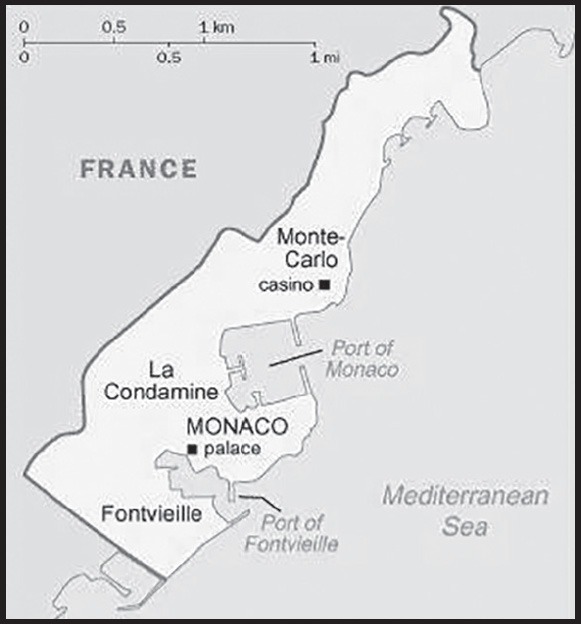
INTRODUCTION
Background: The Genoese built a fortress on the site of present-day Monaco in 1215. The current ruling GRIMALDI family first seized control in 1297 but was not able to permanently secure its holding until 1419. Economic development was spurred in the late 19th century with a railroad linkup to France and the opening of a casino. Since then, the principality’s mild climate, coastal Mediterranean scenery, and gambling facilities have made Monaco world famous as a tourist and recreation center.
GEOGRAPHY
Location: Western Europe, bordering the Mediterranean Sea on the southern coast of France, near the border with Italy
Geographic coordinates: 43 44 N, 7 24 E
Map references: Europe
Area: total: 2 sq km
land: 2 sq km
water: 0 sq km
comparison ranking: total 254
Area - comparative: about three times the size of the National Mall in Washington, DC
Land boundaries: total: 6 km
border countries (1): France 6 km
Coastline: 4.1 km
Maritime claims: territorial sea: 12 nm
exclusive economic zone: 12 nm
Climate: Mediterranean with mild, wet winters and hot, dry summers
Terrain: hilly, rugged, rocky
Elevation: highest point: Chemin des Revoires on Mont Agel 162 m
lowest point: Mediterranean Sea 0 m
Natural resources: none
Land use: agricultural land: 1% (2018 est.)
arable land: 0% (2018 est.)
permanent crops: 1% (2018 est.)
permanent pasture: 0% (2018 est.)
forest: 0% (2018 est.)
other: 99% (2018 est.)
Irrigated land: 0 sq km (2022)
Population distribution: the second most densely populated country in the world (after Macau); its entire population living on 2 square km
Natural hazards: none
Geography - note: second-smallest independent state in the world (after the Holy See); smallest country with a coastline; almost entirely urban
PEOPLE AND SOCIETY
Population: 31,597 (2023 est.)
note: immigrants make up almost 68% of the total population, according to UN data (2019)
comparison ranking: 216
Nationality: noun: Monegasque(s) or Monacan(s)
adjective: Monegasque or Monacan
Ethnic groups: Monegasque 32.1%, French 19.9%, Italian 15.3%, British 5%, Belgian 2.3%, Swiss 2%, German 1.9%, Russian 1.8%, American 1.1%, Dutch 1.1%, Moroccan 1%, other 16.6% (2016 est.)
note: data represent population by country of birth
Languages: French (official), English, Italian, Monegasque
major-language sample(s):
The World Factbook, une source indispensable d’informations de base. (French)
Religions: Roman Catholic 90% (official), other 10%
Age structure: 0-14 years: 9.4% (male 1,522/female 1,448)
15-64 years: 54.42% (male 8,638/female 8,558)
65 years and over: 36.18% (2023 est.) (male 5,114/female 6,317)
Dependency ratios: total dependency ratio: 95.2
youth dependency ratio: 25
elderly dependency ratio: 70.2
potential support ratio: 1.4 (2021)
Median age: total: 55.4 years (2020)
male: 53.7 years
female: 57 years
comparison ranking: total 1
Population growth rate: 0.66% (2023 est.)
comparison ranking: 130
Birth rate: 6.61 births/1,000 population (2023 est.)
comparison ranking: 227
Death rate: 10.92 deaths/1,000 population (2023 est.)
comparison ranking: 22
Net migration rate: 10.89 migrant(s)/1,000 population (2023 est.)
comparison ranking: 8
Population distribution: the second most densely populated country in the world (after Macau); its entire population living on 2 square km
Urbanization: urban population: 100% of total population (2023)
rate of urbanization: 0.5% annual rate of change (2020-25 est.)
Major urban areas - population: 39,000 MONACO (capital) (2018)
Sex ratio: at birth: 1.04 male(s)/female
0-14 years: 1.05 male(s)/female
15-64 years: 1.01 male(s)/female
65 years and over: 0.81 male(s)/female
total population: 0.94 male(s)/female (2023 est.)
Infant mortality rate: total: 1.75 deaths/1,000 live births (2023 est.)
male: 2.05 deaths/1,000 live births
female: 1.44 deaths/1,000 live births
comparison ranking: total 224
Life expectancy at birth: total population: 89.64 years (2023 est.)
male: 85.84 years
female: 93.59 years
comparison ranking: total population 1
Total fertility rate: 1.53 children born/woman (2023 est.)
comparison ranking: 198
Gross reproduction rate: 0.75 (2023 est.)
Drinking water source: improved:
total: 100% of population
unimproved:
total: 0% of population (2020 est.)
Current health expenditure: 1.7% of GDP (2020)
Physicians density: 7.51 physicians/1,000 population (2014)
Hospital bed density: 13.8 beds/1,000 population (2012)
Sanitation facility access: improved:
total: 100% of population
unimproved:
total: 0% of population (2020 est.)
Education expenditures: 1.2% of GDP (2019 est.)
comparison ranking: 195
Youth unemployment rate (ages 15-24): total: 26.6% (2016 est.)
male: 25.7%
female: 27.9%
comparison ranking: total 54
ENVIRONMENT
Environment - current issues: no serious issues; actively monitors pollution levels in air and water
Environment - international agreements: party to: Air Pollution, Air Pollution-Heavy Metals, Air Pollution-Sulphur 94, Air Pollution-Volatile Organic Compounds, Antarctic-Environmental Protection, Antarctic Treaty, Biodiversity, Climate Change, Climate Change-Kyoto Protocol, Climate Change-Paris Agreement, Comprehensive Nuclear Test Ban, Desertification, Endangered Species, Hazardous Wastes, Law of the Sea, Marine Dumping-London Convention, Ozone Layer Protection, Ship Pollution, Wetlands, Whaling
signed, but not ratified: none of the selected agreements
Climate: Mediterranean with mild, wet winters and hot, dry summers
Land use: agricultural land: 1% (2018 est.)
arable land: 0% (2018 est.)
permanent crops: 1% (2018 est.)
permanent pasture: 0% (2018 est.)
forest: 0% (2018 est.)
other: 99% (2018 est.)
Urbanization: urban population: 100% of total population (2023)
rate of urbanization: 0.5% annual rate of change (2020-25 est.)
Revenue from forest resources: 0% of GDP (2018 est.)
comparison ranking: 196
Air pollutants: particulate matter emissions: 9.21 micrograms per cubic meter (2019 est.)
methane emissions: 0.05 megatons (2020 est.)
Waste and recycling: municipal solid waste generated annually: 46,000 tons (2012 est.)
municipal solid waste recycled annually: 2,484 tons (2012 est.)
percent of municipal solid waste recycled: 5.4% (2012 est.)
Total water withdrawal: municipal: 10 million cubic meters (2020 est.)
industrial: 0 cubic meters (2017 est.)
agricultural: 0 cubic meters (2017 est.)
GOVERNMENT
Country name: conventional long form: Principality of Monaco
conventional short form: Monaco
local long form: Principaute de Monaco
local short form: Monaco
etymology: founded as a Greek colony in the 6th century B.C., the name derives from two Greek words “monos” (single, alone) and “oikos” (house) to convey the sense of a people “living apart” or in a “single habitation”
Government type: constitutional monarchy
Capital: name: Monaco
geographic coordinates: 43 44 N, 7 25 E
time difference: UTC+1 (6 hours ahead of Washington, DC, during Standard Time)
daylight saving time: +1hr, begins last Sunday in March; ends last Sunday in October
etymology: founded as a Greek colony in the 6th century B.C., the name derives from two Greek words monos (single, alone) and oikos (house) to convey the sense of a people “living apart” or in a “single habitation”
Administrative divisions: none; there are no first-order administrative divisions as defined by the US Government, but there are 4 quarters (quartiers, singular - quartier); Fontvieille, La Condamine, Monaco-Ville, Monte-Carlo; note - Moneghetti, a part of La Condamine, is sometimes called the 5th quarter of Monaco
Independence: 1419 (beginning of permanent rule by the House of GRIMALDI)
National holiday: National Day (Saint Rainier’s Day), 19 November (1857)
Constitution: history: previous 1911 (suspended 1959); latest adopted 17 December 1962
amendments: proposed by joint agreement of the chief of state (the prince) and the National Council; passage requires two-thirds majority vote of National Council members; amended 2002
Legal system: civil law system influenced by French legal tradition
International law organization participation: has not submitted an ICJ jurisdiction declaration; non-party state to the ICCt
Citizenship: citizenship by birth: no
citizenship by descent only: the father must be a citizen of Monaco; in the case of a child born out of wedlock, the mother must be a citizen and father unknown
dual citizenship recognized: no
residency requirement for naturalization: 10 years
Suffrage: 18 years of age; universal
Executive branch: chief of state: Prince ALBERT II (since 6 April 2005)
head of government: Minister of State Pierre DARTOUT (since 1 September 2020)
cabinet: Council of Government under the authority of the monarch
elections/appointments: the monarchy is hereditary; minister of state appointed by the monarch from a list of three French national candidates presented by the French Government
Legislative branch: description: unicameral National Council or Conseil National (24 seats; 16 members directly elected in multi-seat constituencies by simple majority vote and 8 directly elected by proportional representation vote; members serve 5-year terms)
elections: last held on 5 February 2023 (next to be held in February 2028)
election results: percent of vote by coalition - Monegasque National Union 100%; seats by coalition - Monegasque National Union 24; composition - men 13, women 11, percent of women 45.8%
Judicial branch: highest court(s): Supreme Court (consists of 5 permanent members and 2 substitutes)
judge selection and term of office: Supreme Court members appointed by the monarch upon the proposals of the National Council, State Council, Crown Council, Court of Appeal, and Trial Court
subordinate courts: Court of Appeal; Civil Court of First Instance
Political parties and leaders: Monegasque National Union [Brigitte BOCCONE-PAGES] (includes Horizon Monaco, Primo!, Union Monegasque)
Horizon Monaco [Laurent NOUVION]
Priorite Monaco or Primo! [Stephane VALERI]
Union Monegasque [Jean-Francois ROBILLON]
International organization participation: CD, CE, FAO, IAEA, ICAO, ICC (national committees), ICRM, IFRCS, IHO, IMO, IMSO, Interpol, IOC, IPU, ITSO, ITU, OAS (observer), OIF, OPCW, OSCE, Schengen Convention (de facto member), UN, UNCTAD, UNESCO, UNIDO, Union Latina, UNWTO, UPU, WHO, WIPO, WMO
Diplomatic representation in the US: chief of mission: Ambassador Maguy MACCARIO-DOYLE (since 3 December 2013)
chancery: 888 17th Street NW, Washington, DC 20006
telephone: [1] (202) 234-1530
FAX: [1] (202) 244-7656
email address and website:
https://monacodc.org/index.html
consulate(s) general: New York
Diplomatic representation from the US: embassy: US does not have an embassy in Monaco; the US Ambassador to France is accredited to Monaco; the US Consul General in Marseille (France), under the authority of the US Ambassador to France, handles diplomatic and consular matters concerning Monaco; +(33)(1) 43-12-22-22, enter zero “0” after the automated greeting; US Embassy Paris, 2 Avenue Gabriel, 75008 Paris, France
Flag description: two equal horizontal bands of red (top) and white; the colors are those of the ruling House of Grimaldi and have been in use since 1339, making the flag one of the world’s oldest national banners
note: similar to the flag of Indonesia which is longer and the flag of Poland which is white (top) and red
National symbol(s): red and white lozenges (diamond shapes); national colors: red, white
National anthem: name: “A Marcia de Muneghu” (The March of Monaco)
lyrics/music: Louis NOTARI/Charles ALBRECHT
note: music adopted 1867, lyrics adopted 1931; although French is commonly spoken, only the Monegasque lyrics are official; the French version is known as “Hymne Monegasque” (Monegasque Anthem); the words are generally only sung on official occasions
ECONOMY
Economic overview: high-income European economy; non-EU euro user; considered a tax haven; tourism and banking are largest sectors; negatively impacted by COVID-19; major oceanographic museum; among most expensive real estate; major state-owned enterprises
Real GDP (purchasing power parity): $7.672 billion (2015 est.)
$7.279 billion (2014 est.)
$6.79 billion (2013 est.)
note: data are in 2015 US dollars
comparison ranking: 169
Real GDP growth rate: 21.55% (2021 est.)
-12.97% (2020 est.)
6.91% (2019 est.)
comparison ranking: 4
Real GDP per capita: $115,700 (2015 est.)
$109,200 (2014 est.)
$101,900 (2013 est.)
comparison ranking: 2
GDP (official exchange rate): $6.006 billion (2015 est.)
Inflation rate (consumer prices): 1.5% (2010)
comparison ranking: 181
GDP - composition, by sector of origin: agriculture: 0% (2013)
industry: 14% (2013)
services: 86% (2013)
comparison rankings: services 16; industry 187; agriculture 221
Agricultural products: none
Industries: banking, insurance, tourism, construction, small-scale industrial and consumer products
Industrial production growth rate: 6.8% (2015)
comparison ranking: 63
Labor force: 52,000 (2014 est.)
note: includes all foreign workers
comparison ranking: 191
Labor force - by occupation: agriculture: 0%
industry: 16.1%
services: 83.9% (2012 est.)
Unemployment rate: 2% (2012)
comparison ranking: 213
Youth unemployment rate (ages 15-24): total: 26.6% (2016 est.)
male: 25.7%
female: 27.9%
comparison ranking: total 54
Budget: revenues: $896.3 million (2011 est.)
expenditures: $953.6 million (2011 est.)
Budget surplus (+) or deficit (-): -1% (of GDP) (2011 est.)
comparison ranking: 81
Taxes and other revenues: 14.9% (of GDP) (2011 est.)
comparison ranking: 145
Fiscal year: calendar year
Exports: $964.6 million (2017 est.)
$1.115 billion (2011)
note: full customs integration with France, which collects and rebates Monegasque trade duties; also participates in EU market system through customs union with France
comparison ranking: 178
Exports - partners: Italy, Switzerland, Germany, Belgium, Spain
(2021)
Exports - commodities: jewelry, perfumes, watches, packaged medicines, cars (2021)
Imports: $1.371 billion (2017 est.)
$1.162 billion (2011 est.)
note: full customs integration with France, which collects and rebates Monegasque trade duties; also participates in EU market system through customs union with France
comparison ranking: 182
Imports - partners: Italy, Switzerland, United Kingdom, Germany, China (2021)
Imports - commodities: jewelry, cars and vehicle parts, recreational boats, plastic products, artwork (2021)
Exchange rates: euros (EUR) per US dollar -
Exchange rates: 0.885 (2017 est.)
0.903 (2016 est.)
0.9214 (2015 est.)
0.885 (2014 est.)
0.7634 (2013 est.)
note: while not an EU member state, Monaco, due to its preexisting monetary and banking agreements with France, has a 1998 monetary agreement with the EU to produce limited euro coinage—but not banknotes—that began enforcement in January 2002 and superseded by a new EU agreement in 2012
ENERGY
Electricity access: electrification - total population: 100% (2021)
COMMUNICATIONS
Telephones - fixed lines: total subscriptions: 42,812 (2021 est.)
subscriptions per 100 inhabitants: 117 (2021 est.)
comparison ranking: total subscriptions 161
Telephones - mobile cellular: total subscriptions: 36,255 (2021 est.)
subscriptions per 100 inhabitants: 99 (2021 est.)
comparison ranking: total subscriptions 209
Telecommunication systems: general assessment: modern automatic telephone system: the country’s sole fixed-line operator offers a full range of services to residential and business customers; competitive mobile telephony market; 4G LTE widely available (2020)
domestic: fixed-line a little over 117 per 100 and mobile-cellular teledensity is 99 per 100 persons (2021)
international: country code - 377; landing points for the EIG and Italy-Monaco submarine cables connecting Monaco to Europe, Africa, the Middle East and Asia; no satellite earth stations; connected by cable into the French communications system (2019)
Broadcast media: TV Monte-Carlo operates a TV network; cable TV available; Radio Monte-Carlo has extensive radio networks in France and Italy with French-language broadcasts to France beginning in the 1960s and Italian-language broadcasts to Italy beginning in the 1970s; other radio stations include Riviera Radio and Radio Monaco
Internet country code: .mc
Internet users: total: 31,820 (2021 est.)
percent of population: 86% (2021 est.)
comparison ranking: total 208
Broadband - fixed subscriptions: total: 20,877 (2020 est.)
subscriptions per 100 inhabitants: 53 (2020 est.)
comparison ranking: total 166
TRANSPORTATION
Civil aircraft registration country code prefix: 3A
Heliports: 1 (2021)
Railways: note: Monaco has a single railway station but does not operate its own train service; the French operator SNCF operates rail services in Monaco
Roadways: total: (2010)
paved: (2010)
Ports and terminals: major seaport(s): Hercules Port
MILITARY AND SECURITY
Military and security forces: no regular military forces; Ministry of Interior: Compagnie des Carabiniers du Prince (Prince’s Company of Carabiniers), Corps des Sapeurs-pompiers de Monaco (Fire and Emergency), Police Department (2023)
note: the primary responsibility for the Compagnie des Carabiniers du Prince is guarding the palace; the Police maintain public order
Military service age and obligation: the Compagnie des Carabiniers du Prince is staffed by French nationals (2023)
Military - note: defense is the responsibility of France
TRANSNATIONAL ISSUES
Disputes - international: none identified
MONGOLIA
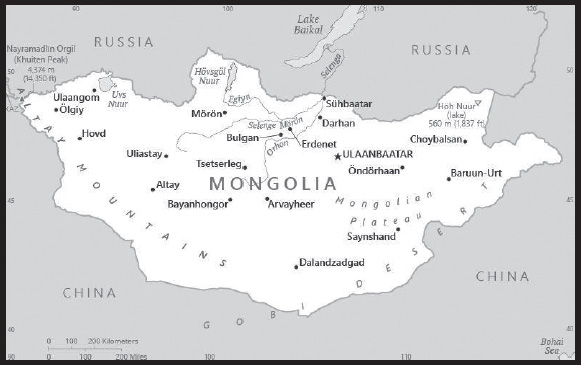
INTRODUCTION
Background: The peoples of Mongolia have a long history under a number of nomadic empires dating back to the period of the Xiongnu in the 4th century B.C. The name Mongol goes back to at least the 11th century A.D. The most famous Mongol, TEMÜÜJIN (aka Genghis Khan) emerged as the ruler of all Mongols in the early 1200s. By the time of his death in 1227, he had created through conquest a Mongol Empire that extended across much of Eurasia. His descendants, including ÖGÖDEI and KHUBILAI (aka Kublai Khan), continued military campaigns of conquest, taking control of Eastern Europe, the Middle East, and the rest of China where KHUBILAI established the Yuan Dynasty in the 1270s. The Mongols attempted to invade Japan and Java before their empire broke apart in the 14th century. In the 17th century, Mongolia fell under the rule of the Manchus of the Chinese Qing Dynasty. Following the collapse of the Manchus in 1911, Mongolia declared its independence, achieving it with help from the Soviet Union in 1921. Mongolia became a socialist state (the Mongolian People’s Republic) in 1924. Following independence and until the collapse of the Soviet Union in 1989, the country was a Soviet satellite state, and heavily reliant on economic, military, and political assistance from Moscow. The period also was marked by purges, political repression, economic stagnation, and tensions with China.
Mongolia peacefully transitioned to an independent democracy in 1990. In 1992, it adopted a new constitution and established a free market economy. Since the country’s transition, it has conducted a series of successful presidential and legislative elections. Throughout the period, the ex-communist Mongolian People’s Revolutionary Party (MPRP) - which took the name Mongolian People’s Party (MPP) in 2010 - has competed for political power with the Democratic Party (DP) and several other smaller parties. In the 2016 parliamentary elections, the MPP won overwhelming control of the Parliament over the DP, which had overseen a sharp decline in Mongolia’s economy during its control of the Parliament in the preceding years. Mongolians elected a DP member, Khaltmaa BATTULGA, as president in 2017. The June 2020 parliamentary elections left the MPP with continued dominant control of the parliament. Mongolians elected former prime minister and MPP member Ukhnaa KHURELSUKH as president in 2021.
Mongolia maintains close cultural, political, and military ties with Russia while China is its largest economic partner. Mongolia’s foreign relations are focused on preserving its autonomy by balancing relations with China and Russia, as well as its other major partners, Japan, South Korea, and the US.
GEOGRAPHY
Location: Northern Asia, between China and Russia
Geographic coordinates: 46 00 N, 105 00 E
Map references: Asia
Area: total: 1,564,116 sq km
land: 1,553,556 sq km
water: 10,560 sq km
comparison ranking: total 20
Area - comparative: slightly smaller than Alaska; more than twice the size of Texas
Land boundaries: total: 8,082 km
border countries (2): China 4,630 km; Russia 3,452 km
Coastline: 0 km (landlocked)
Maritime claims: none (landlocked)
Climate: desert; continental (large daily and seasonal temperature ranges)
Terrain: vast semidesert and desert plains, grassy steppe, mountains in west and southwest; Gobi Desert in south-central
Elevation: highest point: Nayramadlin Orgil (Khuiten Peak) 4,374 m
lowest point: Hoh Nuur 560 m
mean elevation: 1,528 m
Natural resources: oil, coal, copper, molybdenum, tungsten, phosphates, tin, nickel, zinc, fluorspar, gold, silver, iron
Land use: agricultural land: 73% (2018 est.)
arable land: 0.4% (2018 est.)
permanent crops: 0% (2018 est.)
permanent pasture: 72.6% (2018 est.)
forest: 7% (2018 est.)
other: 20% (2018 est.)
Irrigated land: 602 sq km (2020)
Major lakes (area sq km): fresh water lake(s): Hovsgol Nuur - 2,620 sq km; Har Us Nuur - 1,760 sq km;
salt water lake(s): Uvs Nuur - 3,350 sq km; Hyargas Nuur - 1,360 sq km
Major rivers (by length in km): Amur (shared with China [s] and Russia [m]) - 4,444 km
note – [s] after country name indicates river source; [m] after country name indicates river mouth
Population distribution: sparsely distributed population throughout the country; the capital of Ulaanbaatar and the northern city of Darhan support the highest population densities
Natural hazards: dust storms; grassland and forest fires; drought; “zud,” which is harsh winter conditions
Geography - note: landlocked; strategic location between China and Russia
PEOPLE AND SOCIETY
Population: 3,255,468 (2023 est.)
note: Mongolia is one of the least densely populated countries in the world (2 people per sq km); twice as many ethnic Mongols (some 6 million) live in Inner Mongolia (Nei Mongol) in neighboring China
comparison ranking: 133
Nationality: noun: Mongolian(s)
adjective: Mongolian
Ethnic groups: Khalkh 83.8%, Kazak 3.8%, Durvud 2.6%, Bayad 2%, Buriad 1.4%, Zakhchin 1.2%, Dariganga 1.1%, other 4.1% (2020 est.)
Languages: Mongolian 90% (official) (Khalkha dialect is predominant), Turkic, Russian (1999)
major-language sample(s):

(Mongolian)
Religions: Buddhist 51.7%, Muslim 3.2%, Shamanist 2.5%, Christian 1.3%, other 0.7%, none 40.6% (2020 est.)
Age structure: 0-14 years: 26.16% (male 434,400/female 417,335)
15-64 years: 68.24% (male 1,076,692/female 1,144,759)
65 years and over: 5.6% (2023 est.) (male 73,245/female 109,037)
Dependency ratios: total dependency ratio: 58.4
youth dependency ratio: 51.4
elderly dependency ratio: 7
potential support ratio: 14.3 (2021 est.)
Median age: total: 29.8 years (2020)
male: 28.8 years
female: 30.7 years
comparison ranking: total 126
Population growth rate: 0.83% (2023 est.)
comparison ranking: 109
Birth rate: 15.37 births/1,000 population (2023 est.)
comparison ranking: 106
Death rate: 6.33 deaths/1,000 population (2023 est.)
comparison ranking: 142
Net migration rate: -0.77 migrant(s)/1,000 population (2023 est.)
comparison ranking: 137
Population distribution: sparsely distributed population throughout the country; the capital of Ulaanbaatar and the northern city of Darhan support the highest population densities
Urbanization: urban population: 69.1% of total population (2023)
rate of urbanization: 1.4% annual rate of change (2020-25 est.)
Major urban areas - population: 1.673 million ULAANBAATAR (capital) (2023)
Sex ratio: at birth: 1.05 male(s)/female
0-14 years: 1.04 male(s)/female
15-64 years: 0.94 male(s)/female
65 years and over: 0.67 male(s)/female
total population: 0.95 male(s)/female (2023 est.)
Mother’s mean age at first birth: 20.5 years (2008 est.)
note: data represents median age at first birth among women 20-24
Maternal mortality ratio: 39 deaths/100,000 live births (2020 est.)
comparison ranking: 104
Infant mortality rate: total: 19.77 deaths/1,000 live births (2023 est.)
male: 22.81 deaths/1,000 live births
female: 16.59 deaths/1,000 live births
comparison ranking: total 79
Life expectancy at birth: total population: 71.65 years (2023 est.)
male: 67.49 years
female: 76.02 years
comparison ranking: total population 167
Total fertility rate: 1.89 children born/woman (2023 est.)
comparison ranking: 125
Gross reproduction rate: 0.92 (2023 est.)
Contraceptive prevalence rate: 48.1% (2018)
Drinking water source: improved: urban: 98.4% of population
rural: 64.2% of population
total: 87.6% of population
unimproved: urban: 1.6% of population
rural: 35.8% of population
total: 12.4% of population (2020 est.)
Current health expenditure: 4.9% of GDP (2020)
Physicians density: 3.85 physicians/1,000 population (2018)
Hospital bed density: 8 beds/1,000 population (2017)
Sanitation facility access: improved: urban: 97.4% of population
rural: 69.9% of population
total: 88.8% of population
unimproved: urban: 2.6% of population
rural: 30.1% of population
total: 11.2% of population (2020 est.)
Obesity - adult prevalence rate: 20.6% (2016)
comparison ranking: 97
Alcohol consumption per capita: total: 5.46 liters of pure alcohol (2019 est.)
beer: 2.18 liters of pure alcohol (2019 est.)
wine: 1.46 liters of pure alcohol (2019 est.)
spirits: 1.82 liters of pure alcohol (2019 est.)
other alcohols: 0 liters of pure alcohol (2019 est.)
comparison ranking: total 80
Tobacco use: total: 29.4% (2020 est.)
male: 51.7% (2020 est.)
female: 7.1% (2020 est.)
comparison ranking: total 33
Children under the age of 5 years underweight: 1.8% (2018)
comparison ranking: 108
Currently married women (ages 15-49): 58.9% (2023 est.)
Child marriage: women married by age 15: 0.9%
women married by age 18: 12%
men married by age 18: 2.1% (2018 est.)
Education expenditures: 4.7% of GDP (2020 est.)
comparison ranking: 88
Literacy: definition: age 15 and over can read and write
total population: 99.2%
male: 99.1%
female: 99.2% (2020)
School life expectancy (primary to tertiary education): total: 15 years
male: 14 years
female: 16 years (2019)
Youth unemployment rate (ages 15-24): total: 21% (2021 est.)
male: 20.1%
female: 22.4%
comparison ranking: total 77
ENVIRONMENT
Environment - current issues: limited natural freshwater resources in some areas; the burning of soft coal in power plants and the lack of enforcement of environmental laws leads to air pollution in Ulaanbaatar; deforestation and overgrazing increase soil erosion from wind and rain; water pollution; desertification and mining activities have a deleterious effect on the environment
Environment - international agreements: party to: Antarctic Treaty, Biodiversity, Climate Change, Climate Change-Kyoto Protocol, Climate Change-Paris Agreement, Comprehensive Nuclear Test Ban, Desertification, Endangered Species, Environmental Modification, Hazardous Wastes, Law of the Sea, Nuclear Test Ban, Ozone Layer Protection, Ship Pollution, Wetlands, Whaling
signed, but not ratified: none of the selected agreements
Climate: desert; continental (large daily and seasonal temperature ranges)
Land use: agricultural land: 73% (2018 est.)
arable land: 0.4% (2018 est.)
permanent crops: 0% (2018 est.)
permanent pasture: 72.6% (2018 est.)
forest: 7% (2018 est.)
other: 20% (2018 est.)
Urbanization: urban population: 69.1% of total population (2023)
rate of urbanization: 1.4% annual rate of change (2020-25 est.)
Revenue from forest resources: 0.14% of GDP (2018 est.)
comparison ranking: 104
Revenue from coal: 8.62% of GDP (2018 est.)
comparison ranking: 1
Air pollutants: particulate matter emissions: 41.3 micrograms per cubic meter (2019 est.)
carbon dioxide emissions: 25.37 megatons (2016 est.)
methane emissions: 13.72 megatons (2020 est.)
Waste and recycling: municipal solid waste generated annually: 2.9 million tons (2016 est.)
Major lakes (area sq km): fresh water lake(s): Hovsgol Nuur - 2,620 sq km; Har Us Nuur - 1,760 sq km;
salt water lake(s): Uvs Nuur - 3,350 sq km; Hyargas Nuur - 1,360 sq km
Major rivers (by length in km): Amur (shared with China [s] and Russia [m]) - 4,444 km
note – [s] after country name indicates river source; [m] after country name indicates river mouth
Total water withdrawal: municipal: 50 million cubic meters (2020 est.)
industrial: 170 million cubic meters (2020 est.)
agricultural: 250 million cubic meters (2020 est.)
Total renewable water resources: 34.8 billion cubic meters (2020 est.)
GOVERNMENT
Country name: conventional long form: none
conventional short form: Mongolia
local long form: none
local short form: Mongol Uls
former: Outer Mongolia, Mongolian People’s Republic
etymology: the name means “Land of the Mongols” in Latin; the Mongolian name Mongol Uls translates as “Mongol State”
Government type: semi-presidential republic
Capital: name: Ulaanbaatar
geographic coordinates: 47 55 N, 106 55 E
time difference: UTC+8 (13 hours ahead of Washington, DC, during Standard Time)
daylight saving time: +1hr, begins last Saturday in March; ends last Saturday in September
time zone note: Mongolia has two time zones - Ulaanbaatar Time (8 hours in advance of UTC) and Hovd Time (7 hours in advance of UTC)
etymology: the name means “red hero” in Mongolian and honors national hero Damdin SUKHBAATAR, leader of the partisan army that with Soviet Red Army help, liberated Mongolia from Chinese occupation in the early 1920s
Administrative divisions: 21 provinces (aymguud, singular - aymag) and 1 municipality* (singular - hot); Arhangay, Bayanhongor, Bayan-Olgiy, Bulgan, Darhan-Uul, Dornod, Dornogovi, Dundgovi, Dzavhan (Zavkhan), Govi-Altay, Govisumber, Hentiy, Hovd, Hovsgol, Omnogovi, Orhon, Ovorhangay, Selenge, Suhbaatar, Tov, Ulaanbaatar*, Uvs
Independence: 29 December 1911 (independence declared from China; in actuality, autonomy attained); 11 July 1921 (from China)
National holiday: Naadam (games) holiday (commemorates independence from China in the 1921 Revolution), 11-15 July; Constitution Day (marks the date that the Mongolian People’s Republic was created under a new constitution), 26 November (1924)
Constitution: history: several previous; latest adopted 13 January 1992, effective 12 February 1992
amendments: proposed by the State Great Hural, by the president of the republic, by the government, or by petition submitted to the State Great Hural by the Constitutional Court; conducting referenda on proposed amendments requires at least two-thirds majority vote of the State Great Hural; passage of amendments by the State Great Hural requires at least three-quarters majority vote; passage by referendum requires majority participation of qualified voters and a majority of votes; amended 1999, 2000, 2019, 2023; note - an amendment passed in a referendum held in May 2023 increased the seats in the State Great Hural from 76 to 126
Legal system: civil law system influenced by Soviet and Romano-Germanic legal systems; constitution ambiguous on judicial review of legislative acts
International law organization participation: has not submitted an ICJ jurisdiction declaration; accepts ICCt jurisdiction
Citizenship: citizenship by birth: no
citizenship by descent only: both parents must be citizens of Mongolia; one parent if born within Mongolia
dual citizenship recognized: no
residency requirement for naturalization: 5 years
Suffrage: 18 years of age; universal
Executive branch: chief of state: President Ukhnaagiin KHURELSUKH (since 25 June 2021)
head of government: Prime Minister Luvsannamsrai OYUN-ERDENE (since 27 January 2021); Deputy Prime Minister Sainbuyen AMARSAIKHAN (since 8 September 2022)
cabinet: directly appointed by the prime minister following a constitutional amendment ratified in November 2019; prior to the amendment, the cabinet was nominated by the prime minister in consultation with the president and confirmed by the State Great Hural (parliament)
elections/appointments: presidential candidates nominated by political parties represented in the State Great Hural and directly elected by simple majority popular vote for one 6-year term; election last held on 9 June 2021 (next election in 2027); following legislative elections, the leader of the majority party or majority coalition is usually elected prime minister by the State Great Hural
election results: Ukhnaagiin KHURELSUKH elected president in first round; percent of vote - Ukhnaagiin KHURELSUKH (MPP) 72%, Dangaasuren ENKHBAT (RPEC) 21.6%, Sodnomzundui ERDENE (DP) 6.4%
Legislative branch: description: unicameral State Great Hural or Ulsyn Ikh Khural (126 seats; 78 members directly elected in a selected constituency by simple majority vote and 48 members directly elected by proportional representation vote; members serve 4-year terms); note - a constitutional referendum passed in May 2023 increased the number of seats to 126 from 76
elections: last held on 24 June 2020 (next to be held in 2024)
election results: percent of vote by party - MPP 44.9%, DP 24.5%, Our Coalition 8.1%, independent 8.7%, Right Person Electorate Coalition 5.2%, other 8.5%; seats by party - MPP 62, DP 11, Our Coalition 1, Right Person Electorate Coalition 1; independent 1; composition - 63 men, 13 women; percent of women 17.1%
Judicial branch: highest court(s): Supreme Court (consists of the Chief Justice and 24 judges organized into civil, criminal, and administrative chambers); Constitutional Court or Tsets (consists of the chairman and 8 members)
judge selection and term of office: Supreme Court chief justice and judges appointed by the president upon recommendation by the General Council of Courts - a 14-member body of judges and judicial officials - to the State Great Hural; appointment is for life; chairman of the Constitutional Court elected from among its members; members appointed from nominations by the State Great Hural - 3 each by the president, the State Great Hural, and the Supreme Court; appointment is 6 years; chairmanship limited to a single renewable 3-year term
subordinate courts: aimag (provincial) and capital city appellate courts; soum, inter-soum, and district courts; Administrative Cases Courts
Political parties and leaders: 36 parties registered for the 2020 legislative elections to the State Great Hural; among them, the following parties won seats:
Democratic Party or DP [Sodnomzunduin ERDENE]
Mongolian People’s Party or MPP [Ukhnaagiin KHURELSUKH]
others include:
Civil Will-Green Party or CWGP [Tserendorj GANKHUYAG]
Justice Party [Batbayar NASANBILEG]
Mongolian National Democratic Party or MNDP [Bayanjargal TSOGTGEREL]
Mongolian People’s Revolutionary Party or MPRP [Nambaryn ENKHBAYAR]
Mongolian Social Democratic Party or MSDP [Adiya GANBAATAR]
Mongolian Traditionally United Party or MTUP [Batdelgeriin BATBOLD]
National Labor Party or HUN [Togmidyn DORJKHAND]
Coalitions:
Our Coalition (MPRP, CWGP, and MTUP)
Right Person Electorate Coalition or RPEC (HUN, MSDP, Justice Party) [Togmidyn DORJKHAND]
International organization participation: ADB, ARF, CD, CICA, CP, EBRD, EITI (compliant country), FAO, G-77, IAEA, IBRD, ICAO, ICC (NGOs), ICCt, ICRM, IDA, IFAD, IFC, IFRCS, ILO, IMF, IMO, IMSO, Interpol, IOC, IOM, IPU, ISO, ITSO, ITU, ITUC, MIGA, MINURSO, MONUSCO, NAM, OPCW, OSCE, SCO (observer), UN, UNAMID, UNCTAD, UNESCO, UNIDO, UNISFA, UNMISS, UNWTO, UPU, WCO, WHO, WIPO, WMO, WTO
Diplomatic representation in the US: chief of mission: Ambassador BATBAYAR Ulziidelger (since 1 December 2021)
chancery: 2833 M Street NW, Washington, DC 20007
telephone: [1] (202) 333-7117
FAX: [1] (202) 298-9227
email address and website:
consulate(s) general: New York, San Francisco
Diplomatic representation from the US: chief of mission: Ambassador Richard L. BUANGAN (since November 2022)
embassy: Denver Street #3, 11th Micro-District, Ulaanbaatar 14190
mailing address: 4410 Ulaanbaatar Place, Washington DC 20521-4410
telephone: [976] 7007-6001
FAX: [976] 7007-6174
email address and website:
Flag description: three, equal vertical bands of red (hoist side), blue, and red; centered on the hoist-side red band in yellow is the national emblem (“soyombo” - a columnar arrangement of abstract and geometric representation for fire, sun, moon, earth, water, and the yin-yang symbol); blue represents the sky, red symbolizes progress and prosperity
National symbol(s): soyombo emblem; national colors: red, blue, yellow
National anthem: name: “Mongol ulsyn toriin duulal” (National Anthem of Mongolia)
lyrics/music: Tsendiin DAMDINSUREN/Bilegiin DAMDINSUREN and Luvsanjamts MURJORJ
note: music adopted 1950, lyrics adopted 2006; lyrics altered on numerous occasions
National heritage: total World Heritage Sites: 6 (4 cultural, 2 natural)
selected World Heritage Site locales: Uvs Nuur Basin (n); Orkhon Valley Cultural Landscape (c); Petroglyphic Complexes of the Mongolian Altai (c); Great Burkhan Khaldun Mountain and surrounding sacred landscape (c); Landscapes of Dauria (n); Deer Stone Monuments and Related Bronze Age Sites (c)
ECONOMY
Economic overview: lower middle-income East Asian economy; large human capital improvements over last 3 decades; agricultural and natural resource rich; export and consumption-led growth; high inflation due to supply bottlenecks and increased food and energy prices; currency depreciation
Real GDP (purchasing power parity): $39.063 billion (2021 est.)
$38.434 billion (2020 est.)
$40.27 billion (2019 est.)
note: data are in 2017 dollars
comparison ranking: 124
Real GDP growth rate: 1.64% (2021 est.)
-4.56% (2020 est.)
5.6% (2019 est.)
comparison ranking: 171
Real GDP per capita: $11,700 (2021 est.)
$11,700 (2020 est.)
$12,500 (2019 est.)
note: data are in 2017 dollars
comparison ranking: 133
GDP (official exchange rate): $11.14 billion (2017 est.)
Inflation rate (consumer prices): 7.35% (2021 est.)
3.8% (2020 est.)
7.3% (2019 est.)
comparison ranking: 42
Credit ratings: Fitch rating: B (2018)
Moody’s rating: B3 (2018)
Standard & Poors rating: B (2018)
note: The year refers to the year in which the current credit rating was first obtained.
GDP - composition, by sector of origin: agriculture: 12.1% (2017 est.)
industry: 38.2% (2017 est.)
services: 49.7% (2017 est.)
comparison rankings: services 179; industry 38; agriculture 76
GDP - composition, by end use: household consumption: 49.2% (2017 est.)
government consumption: 12.3% (2017 est.)
investment in fixed capital: 23.8% (2017 est.)
investment in inventories: 12.4% (2017 est.)
exports of goods and services: 59.5% (2017 est.)
imports of goods and services: -57.1% (2017 est.)
Agricultural products: milk, wheat, goat milk, potatoes, mutton, sheep milk, beef, goat meat, horse meat, carrots/turnips
Industries: construction and construction materials; mining (coal, copper, molybdenum, fluorspar, tin, tungsten, gold); oil; food and beverages; processing of animal products, cashmere and natural fiber manufacturing
Industrial production growth rate: -2.22% (2021 est.)
comparison ranking: 176
Labor force: 1.331 million (2021 est.)
comparison ranking: 136
Labor force - by occupation: agriculture: 31.1%
industry: 18.5%
services: 50.5% (2016)
Unemployment rate: 7.08% (2021 est.)
7.01% (2020 est.)
5.44% (2019 est.)
comparison ranking: 111
Youth unemployment rate (ages 15-24): total: 21% (2021 est.)
male: 20.1%
female: 22.4%
comparison ranking: total 77
Population below poverty line: 28.4% (2018 est.)
Gini Index coefficient - distribution of family income: 32.7 (2018 est.)
comparison ranking: 130
Household income or consumption by percentage share: lowest 10%: 13.7%
highest 10%: 5.7% (2017)
Budget: revenues: $3.699 billion (2020 est.)
expenditures: $4.979 billion (2020 est.)
Budget surplus (+) or deficit (-): -6.4% (of GDP) (2017 est.)
comparison ranking: 187
Public debt: 73.94% of GDP (2020 est.)
60.84% of GDP (2019 est.)
65.97% of GDP (2018 est.)
comparison ranking: 49
Taxes and other revenues: 14.15% (of GDP) (2020 est.)
comparison ranking: 161
Fiscal year: calendar year
Current account balance: -$2.108 billion (2021 est.)
-$674.612 million (2020 est.)
-$2.162 billion (2019 est.)
comparison ranking: 159
Exports: $8.95 billion (2021 est.) note: data are in current year dollars
$7.646 billion (2020 est.) note: data are in current year dollars
$8.416 billion (2019 est.) note: data are in current year dollars
comparison ranking: 110
Exports - partners: China 73%, Switzerland 19%, Singapore 2%, South Korea 2%, Russia 1% (2021)
Exports - commodities: copper, coal, gold, iron, animal hair, crude petroleum, zinc (2021)
Imports: $9.256 billion (2021 est.) note: data are in current year dollars
$7.34 billion (2020 est.) note: data are in current year dollars
$9.249 billion (2019 est.) note: data are in current year dollars
comparison ranking: 117
Imports - partners: China 31%, Russia 29%, Japan 10%, South Korea 5% (2019)
Imports - commodities: refined petroleum, cars, delivery trucks, construction vehicles, aircraft (2019)
Reserves of foreign exchange and gold: $4.38 billion (31 December 2021 est.)
$4.545 billion (31 December 2020 est.)
$4.364 billion (31 December 2019 est.)
comparison ranking: 106
Debt - external: $29.945 billion (2019 est.)
$28.046 billion (2018 est.)
comparison ranking: 84
Exchange rates: togrog/tugriks (MNT) per US dollar -
Exchange rates: 2,849.289 (2021 est.)
2,813.29 (2020 est.)
2,663.541 (2019 est.)
2,472.484 (2018 est.)
2,439.777 (2017 est.)
ENERGY
Electricity access: electrification - total population: 100% (2021)
Electricity: installed generating capacity: 1.479 million kW (2020 est.)
consumption: 7,336,520,000 kWh (2019 est.)
exports: 24 million kWh (2019 est.)
imports: 1.723 billion kWh (2019 est.)
transmission/distribution losses: 892 million kWh (2019 est.)
comparison rankings: installed generating capacity 126; transmission/distribution losses 116; imports 61; exports 94; consumption 109
Electricity generation sources: fossil fuels: 89.2% of total installed capacity (2020 est.)
solar: 1.3% of total installed capacity (2020 est.)
wind: 8.1% of total installed capacity (2020 est.)
hydroelectricity: 1.3% of total installed capacity (2020 est.)
Coal: production: 43.904 million metric tons (2020 est.)
consumption: 8.818 million metric tons (2020 est.)
exports: 28.551 million metric tons (2020 est.)
imports: 1,000 metric tons (2020 est.)
proven reserves: 2.52 billion metric tons (2019 est.)
Petroleum: total petroleum production: 16,700 bbl/day (2021 est.)
refined petroleum consumption: 35,800 bbl/day (2019 est.)
crude oil and lease condensate exports: 14,700 bbl/day (2018 est.)
crude oil and lease condensate imports: 0 bbl/day (2018 est.)
Refined petroleum products - imports: 24,190 bbl/day (2015 est.)
comparison ranking: 109
Carbon dioxide emissions: 22.74 million metric tonnes of CO2 (2019 est.)
from coal and metallurgical coke: 17.445 million metric tonnes of CO2 (2019 est.)
from petroleum and other liquids: 5.295 million metric tonnes of CO2 (2019 est.)
comparison ranking: total emissions 83
Energy consumption per capita: 83.045 million Btu/person (2019 est.)
comparison ranking: 69
COMMUNICATIONS
Telephones - fixed lines: total subscriptions: 399,237 (2021 est.)
subscriptions per 100 inhabitants: 12 (2021 est.)
comparison ranking: total subscriptions 102
Telephones - mobile cellular: total subscriptions: 4,687,304 (2021 est.)
subscriptions per 100 inhabitants: 140 (2021 est.)
comparison ranking: total subscriptions 127
Telecommunication systems: general assessment: liberalized and competitive telecoms market comprises of a number of operators; fixed-line penetration increased steadily in the years to 2018 as more people took on fixed-line access for voice calls and to access copper-based broadband services; the number of lines fell in 2019, and again and more sharply in 2020, partly through the economic consequences of the pandemic (GDP fell 5.3% in 2020, year-on-year) and partly due to the migration to the mobile platform and to VoIP; fixed broadband penetration remains low, mainly due to a limited number of fixed lines and the dominance of the mobile platform; the attraction of fixed broadband as a preferred access where it is available is waning as the mobile networks are upgraded with greater capacity and capabilities; the growing popularity of mobile broadband continues to underpin overall broadband and telecom sector growth, with Mongolia’s market very much being dominated by mobile services, supported by widely available LTE; this will largely determine and shape the future direction of Mongolia’s developing digital economy (2021)
domestic: fixed-line teledensity of 12 per 100; mobile-cellular subscribership is 140 per 100 persons (2021)
international: country code - 976; satellite earth stations - 7 (2016)
Broadcast media: following a law passed in 2005, Mongolia’s state-run radio and TV provider converted to a public service provider; also available are 68 radio and 160 TV stations, including multi-channel satellite and cable TV providers; transmissions of multiple international broadcasters are available (2019)
Internet country code: .mn
Internet users: total: 2.772 million (2021 est.)
percent of population: 84% (2021 est.)
comparison ranking: total 124
Broadband - fixed subscriptions: total: 307,166 (2020 est.)
subscriptions per 100 inhabitants: 9 (2020 est.)
comparison ranking: total 106
TRANSPORTATION
National air transport system: number of registered air carriers: 4 (2020)
inventory of registered aircraft operated by air carriers: 12
annual passenger traffic on registered air carriers: 670,360 (2018)
annual freight traffic on registered air carriers: 7.82 million (2018) mt-km
Civil aircraft registration country code prefix: JU
Airports: 44 (2021)
comparison ranking: total 98
Airports - with paved runways: 15
note: paved runways have a concrete or asphalt surface but not all have facilities for refueling, maintenance, or air traffic control; the length of a runway required for aircraft to safely operate depends on a number of factors including the type of aircraft, the takeoff weight (including passengers, cargo, and fuel), engine types, flap settings, landing speed, elevation of the airport, and average maximum daily air temperature; paved runways can reach a length of 5,000 m (16,000 ft.), but the “typical” length of a commercial airline runway is between 2,500-4,000 m (8,000-13,000 ft.)
Airports - with unpaved runways: 29
note: unpaved runways have a surface composition such as grass or packed earth and are most suited to the operation of light aircraft; unpaved runways are usually short, often less than 1,000 m (3,280 ft.) in length; airports with unpaved runways often lack facilities for refueling, maintenance, or air traffic control
Heliports: 1 (2021)
Railways: total: 1,815 km (2017)
broad gauge: 1,815 km (2017) 1.520-m gauge
note: national operator Ulaanbaatar Railway is jointly owned by the Mongolian Government and by the Russian State Railway
comparison ranking: total 77
Roadways: total: 113,200 km (2017)
paved: 10,600 km (2017)
unpaved: 102,600 km (2017)
comparison ranking: total 44
Waterways: 580 km (2010) (the only waterway in operation is Lake Hovsgol) (135 km); Selenge River (270 km) and Orhon River (175 km) are navigable but carry little traffic; lakes and rivers ice-free from May to September)
comparison ranking: 88
Merchant marine: total: 314 (2022)
by type: bulk carrier 3, container ship 6, general cargo 151, oil tanker 57, other 97
comparison ranking: total 53
MILITARY AND SECURITY
Military and security forces: Mongolian Armed Forces (MAF): Mongolian Ground Force (aka General Purpose Troops), Mongolian Air/Air Defense Force, Cyber Security Forces, Special Forces, Civil Engineering Forces, Civil Defense Forces (2023)
note: the National Police Agency and the General Authority for Border Protection, which operate under the Ministry of Justice and Home Affairs, are primarily responsible for internal security; they are assisted by the General Intelligence Agency under the prime minister; the MAF assists the internal security forces in providing domestic emergency assistance and disaster relief
Military expenditures: 0.6% of GDP (2022 est.)
0.8% of GDP (2021 est.)
0.8% of GDP (2020 est.)
0.7% of GDP (2019 est.)
0.7% of GDP (2018 est.)
comparison ranking: 155
Military and security service personnel strengths: information varies; approximately 9,000 active duty troops (2023)
Military equipment inventories and acquisitions: the MAF’s inventory is comprised of Soviet-era and Russian equipment (2023)
Military service age and obligation: 18-27 years of age for compulsory and voluntary military service (can enter military schools at age 17); 12-month conscript service obligation for men in the army, air forces, or police (can be extended 3 months under special circumstances); conscription service can be exchanged for a 24-month stint in the civil service or a cash payment determined by the Mongolian Government; after conscription, soldiers can contract into military service for 2 or 4 years; volunteer military service for men and women is 24 months, which can be extended for another two years up to the age of 31 (2023)
Military deployments: 860 South Sudan (UNMISS) (2023)
note: from 2003 to July 2021, some 3,300 Mongolian troops served in Afghanistan, including about 1,300 under the NATO-led Resolute Support Mission (2015 to 2021); since 2002, Mongolia has deployed more than 19,000 peacekeepers and observers to UN operations in more than a dozen countries
Military - note: the MAF does not face any significant external military threats and focuses instead on counterterrorism, disaster response, and international peacekeeping; the Ground Force is the military’s primary service and is centered on a motorized infantry brigade equipped largely with Soviet-era equipment; it also has a battalion devoted to peacekeeping duties and hosts an annual international peacekeeping exercise known as “Khaan Quest”; Mongolia’s primary military partner is Russia, and in addition to receiving Russian military equipment, the MAF participates in Russia’s large “Vostok” exercise, which is conducted every four years
Mongolia has been engaged in dialogue and cooperation with NATO since 2005 and is considered by NATO to be a global partner; Mongolia supported the NATO-led Kosovo Force from 2005-2007 and contributed troops to the NATO-led International Security Assistance Force in Afghanistan from 2009-2014, as well as to the follow-on Resolute Support Mission that provided training, advice, and other assistance to the Afghan security forces (2015-2021) (2023)
SPACE
Space agency/agencies: National Remote Sensing Center (NRSC; established 1987; under the Ministry of Infrastructure); Mongolian Space Technology Association (established 2019); Mongolian Communication and Information Technologies Authority (ACTI), Mongolian Digital Development and Communications Ministry (2023)
Space program overview: has a space program dating back to the country’s ties to the Soviet Union; modern day program focused on acquiring and manufacturing satellites; operates satellites and jointly builds them with foreign partners; developing capabilities to independently manufacture satellites with communications and remote sensing (RS) payloads; has a national strategy to acquire digital communications satellites and make use of RS satellite imagery data for economic development, environmental monitoring, natural disaster response, security, and weather forecasting; the strategy also includes promoting Mongolia’s domestic space industry and international cooperation in space technologies; has relations or cooperation agreements with a variety of foreign space agencies and industries, including those of China, France, India, Japan, Russia, and the US (2023)
note: further details about the key activities, programs, and milestones of the country’s space program, as well as government spending estimates on the space sector, appear in Appendix S
TRANSNATIONAL ISSUES
Disputes - international: none identified
Refugees and internally displaced persons: stateless persons: 17 (2022)
Illicit drugs: NA