R
ROMANIA
INTRODUCTION
Background: The principalities of Wallachia and Moldavia - for centuries under the suzerainty of the Turkish Ottoman Empire - secured their autonomy in 1856; they were de facto linked in 1859 and formally united in 1862 under the new name of Romania. The country gained recognition of its independence in 1878. It joined the Allied Powers in World War I and acquired new territories - most notably Transylvania - following the conflict. In 1940, Romania allied with the Axis powers and participated in the 1941 German invasion of the USSR. Three years later, overrun by the Soviets, Romania signed an armistice. The post-war Soviet occupation led to the formation of a communist “people’s republic” in 1947 and the abdication of the king. The decades-long rule of dictator Nicolae CEAUSESCU, who took power in 1965, and his Securitate police state became increasingly oppressive and draconian through the 1980s. CEAUSESCU was overthrown and executed in late 1989. Former communists dominated the government until 1996 when they were swept from power. Romania joined NATO in 2004 and the EU in 2007.
GEOGRAPHY
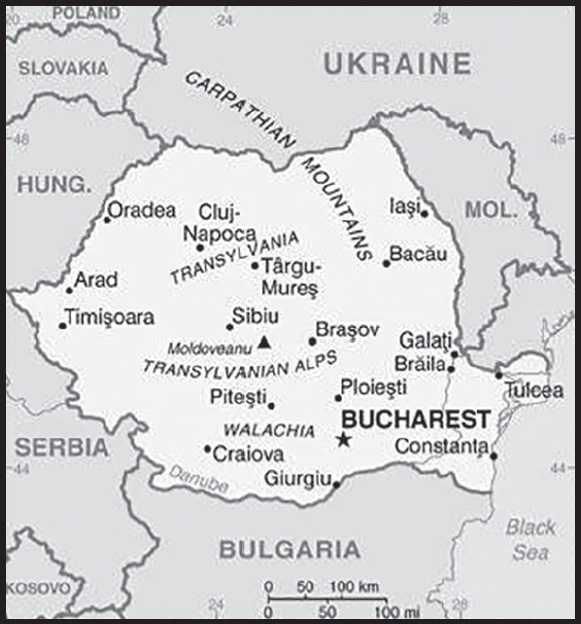
Location: Southeastern Europe, bordering the Black Sea, between Bulgaria and Ukraine
Geographic coordinates: 46 00 N, 25 00 E
Map references: Europe
Area: total: 238,391 sq km
land: 229,891 sq km
water: 8,500 sq km
comparison ranking: total 83
Area - comparative: twice the size of Pennsylvania; slightly smaller than Oregon
Land boundaries: total: 2,844 km
border countries (5): Bulgaria 605 km; Hungary 424 km; Moldova 683 km; Serbia 531 km; Ukraine 601 km
Coastline: 225 km
Maritime claims: territorial sea: 12 nm
contiguous zone: 24 nm
exclusive economic zone: 200 nm
continental shelf: 200-m depth or to the depth of exploitation
Climate: temperate; cold, cloudy winters with frequent snow and fog; sunny summers with frequent showers and thunderstorms
Terrain: central Transylvanian Basin is separated from the Moldavian Plateau on the east by the Eastern Carpathian Mountains and separated from the Walachian Plain on the south by the Transylvanian Alps
Elevation: highest point: Moldoveanu 2,544 m
lowest point: Black Sea 0 m
mean elevation: 414 m
Natural resources: petroleum (reserves declining), timber, natural gas, coal, iron ore, salt, arable land, hydropower
Land use: agricultural land: 60.7% (2018 est.)
arable land: 39.1% (2018 est.)
permanent crops: 1.9% (2018 est.)
permanent pasture: 19.7% (2018 est.)
forest: 28.7% (2018 est.)
other: 10.6% (2018 est.)
Irrigated land: 4,730 sq km (2020)
Major rivers (by length in km): Dunărea (Danube) river mouth (shared with Germany [s], Austria, Slovakia, Czechia, Hungary, Croatia, Serbia, Bulgaria, Moldova, and Ukraine) - 2,888 km
note – [s] after country name indicates river source; [m] after country name indicates river mouth
Major watersheds (area sq km): Atlantic Ocean drainage: (Black Sea) Danube (795,656 sq km)
Population distribution: urbanization is not particularly high, and a fairly even population distribution can be found throughout most of the country, with urban areas attracting larger and denser populations; Hungarians, the country’s largest minority, have a particularly strong presence in eastern Transylvania
Natural hazards: earthquakes, most severe in south and southwest; geologic structure and climate promote landslides
Geography - note: controls the most easily traversable land route between the Balkans, Moldova, and Ukraine; the Carpathian Mountains dominate the center of the country, while the Danube River forms much of the southern boundary with Serbia and Bulgaria
PEOPLE AND SOCIETY
Population: 18,326,327 (2023 est.)
comparison ranking: 68
Nationality: noun: Romanian(s)
adjective: Romanian
Ethnic groups: Romanian 89.3%, Hungarian 6%, Romani 3.4%, Ukrainian 0.3%, German 0.1%, other 0.9% (2021 est.)
note: data represent individuals who declared an ethnic group in the 2021 national census; 13% did not respond; Romani populations are usually underestimated in official statistics and may represent 5–11% of Romania’s population
Languages: Romanian (official) 91.6%, Hungarian 6.3%, Romani 1.2%, other 0.7% (2021 est.)
note: data represent individuals who declared a maternal language in the 2021 national census; 13.1% did not respond
major-language sample(s):
Cartea informativa a lumii, sursa indispensabila pentru informatii de baza. (Romanian)
Religions: Romanian Orthodox 85.3%, Roman Catholic 4.5%, Reformed 3%, Pentecostal 2.5, other 4.7% (2021 est.)
note: data represent individuals who declared a religion in the 2021 national census; 13.9% did not respond
Age structure: 0-14 years: 15.63% (male 1,472,449/female 1,391,671)
15-64 years: 62.13% (male 5,689,908/female 5,696,224)
65 years and over: 22.24% (2023 est.) (male 1,682,695/female 2,393,380)
Dependency ratios: total dependency ratio: 53.7
youth dependency ratio: 24.6
elderly dependency ratio: 29.1
potential support ratio: 3.4 (2021 est.)
Median age: total: 42.5 years (2020)
male: 41 years
female: 44 years
comparison ranking: total 34
Population growth rate: -1.01% (2023 est.)
comparison ranking: 229
Birth rate: 8.63 births/1,000 population (2023 est.)
comparison ranking: 207
Death rate: 14.92 deaths/1,000 population (2023 est.)
comparison ranking: 3
Net migration rate: -3.86 migrant(s)/1,000 population (2023 est.)
comparison ranking: 192
Population distribution: urbanization is not particularly high, and a fairly even population distribution can be found throughout most of the country, with urban areas attracting larger and denser populations; Hungarians, the country’s largest minority, have a particularly strong presence in eastern Transylvania
Urbanization: urban population: 54.7% of total population (2023)
rate of urbanization: -0.15% annual rate of change (2020-25 est.)
Major urban areas - population: 1.776 million BUCHAREST (capital) (2023)
Sex ratio: at birth: 1.06 male(s)/female
0-14 years: 1.06 male(s)/female
15-64 years: 1 male(s)/female
65 years and over: 0.7 male(s)/female
total population: 0.93 male(s)/female (2023 est.)
Mother’s mean age at first birth: 27.1 years (2020 est.)
Maternal mortality ratio: 10 deaths/100,000 live births (2020 est.)
comparison ranking: 144
Infant mortality rate: total: 5.65 deaths/1,000 live births (2023 est.)
male: 5.91 deaths/1,000 live births
female: 5.37 deaths/1,000 live births
comparison ranking: total 172
Life expectancy at birth: total population: 76.31 years (2023 est.)
male: 72.87 years
female: 79.95 years
comparison ranking: total population 110
Total fertility rate: 1.63 children born/woman (2023 est.)
comparison ranking: 179
Gross reproduction rate: 0.79 (2023 est.)
Drinking water source: improved: total: 100% of population
unimproved: total: 0% of population (2020 est.)
Current health expenditure: 6.3% of GDP (2020)
Physicians density: 2.98 physicians/1,000 population (2017)
Hospital bed density: 6.9 beds/1,000 population (2017)
Sanitation facility access: improved: urban: 96.9% of population
rural: 76% of population
total: 87.3% of population
unimproved: urban: 3.1% of population
rural: 24% of population
total: 12.7% of population (2020 est.)
Obesity - adult prevalence rate: 22.5% (2016)
comparison ranking: 76
Alcohol consumption per capita: total: 10.96 liters of pure alcohol (2019 est.)
beer: 5.33 liters of pure alcohol (2019 est.)
wine: 3.38 liters of pure alcohol (2019 est.)
spirits: 2.25 liters of pure alcohol (2019 est.)
other alcohols: 0 liters of pure alcohol (2019 est.)
comparison ranking: total 14
Tobacco use: total: 28% (2020 est.)
male: 35.9% (2020 est.)
female: 20% (2020 est.)
comparison ranking: total 37
Currently married women (ages 15-49): 54.8% (2023)
Education expenditures: 3.7% of GDP (2020 est.)
comparison ranking: 130
Literacy: definition: age 15 and over can read and write
total population: 98.9%
male: 99.1%
female: 98.7% (2021)
School life expectancy (primary to tertiary education): total: 14 years
male: 14 years
female: 15 years (2020)
Youth unemployment rate (ages 15-24): total: 20.6% (2021 est.)
male: 20.9%
female: 20.1%
comparison ranking: total 80
ENVIRONMENT
Environment - current issues: soil erosion, degradation, and desertification; water pollution; air pollution in south from industrial effluents; contamination of Danube delta wetlands
Environment - international agreements: party to: Air Pollution, Air Pollution-Heavy Metals, Air Pollution-Multi-effect Protocol, Air Pollution-Persistent Organic Pollutants, Antarctic-Environmental Protection, Antarctic Treaty, Biodiversity, Climate Change, Climate Change-Kyoto Protocol, Climate Change-Paris Agreement, Comprehensive Nuclear Test Ban, Desertification, Endangered Species, Environmental Modification, Hazardous Wastes, Law of the Sea, Nuclear Test Ban, Ozone Layer Protection, Ship Pollution, Tropical Timber 2006, Wetlands, Whaling
signed, but not ratified: none of the selected agreements
Climate: temperate; cold, cloudy winters with frequent snow and fog; sunny summers with frequent showers and thunderstorms
Land use: agricultural land: 60.7% (2018 est.)
arable land: 39.1% (2018 est.)
permanent crops: 1.9% (2018 est.)
permanent pasture: 19.7% (2018 est.)
forest: 28.7% (2018 est.)
other: 10.6% (2018 est.)
Urbanization: urban population: 54.7% of total population (2023)
rate of urbanization: -0.15% annual rate of change (2020-25 est.)
Revenue from forest resources: 0.16% of GDP (2018 est.)
comparison ranking: 99
Revenue from coal: 0.03% of GDP (2018 est.)
comparison ranking: 39
Air pollutants: particulate matter emissions: 13.3 micrograms per cubic meter (2019 est.)
carbon dioxide emissions: 69.26 megatons (2016 est.)
methane emissions: 27.62 megatons (2020 est.)
Waste and recycling: municipal solid waste generated annually: 4.895 million tons (2015 est.)
municipal solid waste recycled annually: 277,547 tons (2015 est.)
percent of municipal solid waste recycled: 5.7% (2015 est.)
Major rivers (by length in km): Dunărea (Danube) river mouth (shared with Germany [s], Austria, Slovakia, Czechia, Hungary, Croatia, Serbia, Bulgaria, Moldova, and Ukraine) - 2,888 km note – [s] after country name indicates river source; [m] after country name indicates river mouth
Major watersheds (area sq km): Atlantic Ocean drainage: (Black Sea) Danube (795,656 sq km)
Total water withdrawal: municipal: 1.09 billion cubic meters (2020 est.)
industrial: 3.9 billion cubic meters (2020 est.)
agricultural: 1.43 billion cubic meters (2020 est.)
Total renewable water resources: 212 billion cubic meters (2020 est.)
GOVERNMENT
Country name: conventional long form: none
conventional short form: Romania
local long form: none
local short form: Romania
former: Kingdom of Romania, Romanian People’s Republic, Socialist Republic of Romania
etymology: the name derives from the Latin “Romanus” meaning “citizen of Rome” and was used to stress the common ancient heritage of Romania’s three main regions - Moldavia, Transylvania, and Wallachia - during their gradual unification between the mid-19th century and early 20th century
Government type: semi-presidential republic
Capital: name: Bucharest
geographic coordinates: 44 26 N, 26 06 E
time difference: UTC+2 (7 hours ahead of Washington, DC, during Standard Time)
daylight saving time: +1hr, begins last Sunday in March; ends last Sunday in October
etymology: related to the Romanian word “bucura” that is believed to be of Dacian origin and whose meaning is “to be glad (happy)”; Bucharest’s meaning is thus akin to “city of joy”
Administrative divisions: 41 counties (judete, singular - judet) and 1 municipality* (municipiu); Alba, Arad, Arges, Bacau, Bihor, Bistrita-Nasaud, Botosani, Braila, Brasov, Bucuresti (Bucharest)*, Buzau, Calarasi, Caras-Severin, Cluj, Constanta, Covasna, Dambovita, Dolj, Galati, Gorj, Giurgiu, Harghita, Hunedoara, Ialomita, Iasi, Ilfov, Maramures, Mehedinti, Mures, Neamt, Olt, Prahova, Salaj, Satu Mare, Sibiu, Suceava, Teleorman, Timis, Tulcea, Vaslui, Valcea, Vrancea
Independence: 9 May 1877 (independence proclaimed from the Ottoman Empire; 13 July 1878 (independence recognized by the Treaty of Berlin); 26 March 1881 (kingdom proclaimed); 30 December 1947 (republic proclaimed)
National holiday: Unification Day (unification of Romania and Transylvania), 1 December (1918)
Constitution: history: several previous; latest adopted 21 November 1991, approved by referendum and effective 8 December 1991
amendments: initiated by the president of Romania through a proposal by the government, by at least one fourth of deputies or senators in Parliament, or by petition of eligible voters representing at least half of Romania’s counties; passage requires at least two-thirds majority vote by both chambers or – if mediation is required - by three-fourths majority vote in a joint session, followed by approval in a referendum; articles, including those on national sovereignty, form of government, political pluralism, and fundamental rights and freedoms cannot be amended; amended 2003
Legal system: civil law system
International law organization participation: accepts compulsory ICJ jurisdiction with reservations; accepts ICCt jurisdiction
Citizenship: citizenship by birth: no
citizenship by descent only: at least one parent must be a citizen of Romania
dual citizenship recognized: yes
residency requirement for naturalization: 5 years
Suffrage: 18 years of age; universal
Executive branch: chief of state: President Klaus Werner IOHANNIS (since 21 December 2014)
head of government: Prime Minister Marcel CIOLACU (since 15 June 2023); Deputy Prime Ministers Sorin GRINDEANU (since 25 November 2021) and Hunor KELEMEN (since 23 December 2020)
cabinet: Council of Ministers appointed by the prime minister
elections/appointments: president directly elected by absolute majority popular vote in 2 rounds if needed for a 5-year term (eligible for a second term); election last held on 10 November 2019 with a runoff on 24 November 2019 (next to be held in November 2024); prime minister appointed by the president with consent of Parliament
election results:
2019: Klaus IOHANNIS reelected president in second round; percent of vote - Klaus IOHANNIS (PNL) 66.1%, Viorica DANCILA (PSD) 33.9%
2014: Klaus IOHANNIS elected president in second round; percent of vote - Klaus IOHANNIS (PNL) 54.4%, Victor PONTA (PSD) 45.6%
Legislative branch: description: bicameral Parliament or Parlament consists of:
Senate or Senat (136 seats; members directly elected in single- and multi-seat constituencies - including 2 seats for diaspora - by party-list, proportional representation vote; members serve 4-year terms)
Chamber of Deputies or Camera Deputatilor (330 seats; members directly elected in single- and multi-seat constituencies - including 4 seats for diaspora - by party-list, proportional representation vote; members serve 4-year terms)
elections:
Senate - last held on 6 December 2020 (next to be held in 2024)
Chamber of Deputies - last held on 6 December 2020 (next to be held in 2024)
election results:
Senate - percent of vote by party - PSD 29.3%, PNL 25.6%, 2020 USR-PLUS Alliance 15.9%, AUR 9.2%, UDMR 5.9%, other 14.1%; seats by party - PSD 47, PNL 41, 2020 USR-PLUS Alliance 25, AUR 14, UDMR 9; composition - men 111, women 25, percent of women 18.4%
Chamber of Deputies - percent of vote by party - PSD 28.9%, PNL 25.2%, 2020 USR-PLUS Alliance 15.4%, AUR 9.1%, UDMR 5.7%, other 15.7%; seats by party - PSD 110, PNL 93, 2020 USR-PLUS Alliance 55, AUR 33, UDMR 21, other 18; composition - men 267, women 63, percent of women 19.1%; note - total Parliament percent of women 18.9%
Judicial branch: highest court(s): High Court of Cassation and Justice (consists of 111 judges organized into civil, penal, commercial, contentious administrative and fiscal business, and joint sections); Supreme Constitutional Court (consists of 9 members)
judge selection and term of office: High Court of Cassation and Justice judges appointed by the president upon nomination by the Superior Council of Magistracy, a 19-member body of judges, prosecutors, and law specialists; judges appointed for 6-year renewable terms; Constitutional Court members - 6 elected by Parliament and 3 appointed by the president; members serve 9-year, nonrenewable terms
subordinate courts: Courts of Appeal; regional tribunals; first instance courts; military and arbitration courts
Political parties and leaders: 2020 USR-PLUS Alliance [Dan BARNA and Dacian CIOLOS] (dissolved 16 April 2021)
Alliance for the Fatherland or APP [Codrin STEFANESCU]
Alliance for the Unity of Romanians or AUR [George SIMION]
Christian-Democratic National Peasants’ Party or PNT-CD [Aurelian PAVELESCU]
Civic Hungarian Party [Zsolt BIRO]
Democratic Union of Hungarians in Romania or UDMR [Hunor KELEMEN]
Ecologist Party of Romania or PER [Danut POP]
Force of the Right or FD [Ludovic ORBAN]
Greater Romania Party or PRM [Victor IOVICI]
Green Party [Marius LAZAR and Lavinia COSMA]
National Liberal Party or PNL [Nicolae CIUCA]
Party of Liberty, Unity, and Solidarity or PLUS [Dacian CIOLOS] (dissolved 16 April 2021)
Popular Movement Party or PMP [Eugen TOMAC]
PRO Romania or PRO [Victor PONTA]
Romanian Nationhood Party or PNR [Ninel PEIA]
Save Romania Union Party or USR [Catalin DRULA]
Social Democratic Party or PSD [Marcel CIOLACU]
Social Liberal Humanist Party or PUSL [Daniel IONASCU] (formerly Humanist Power Party (Social-Liberal) or PPU-SL)
S.O.S. Romania [Diana IOVANOVICI-SOSOACA]
The Right Alternative or AD [Adela MIRZA]
United Romania Party or PRU [Robert BUGA]
We are Renewing the European Project in Romania or REPER [Dacian CIOLOS; Ramona STRUGARIU; Dragos PISLARU]
International organization participation: Australia Group, BIS, BSEC, CBSS (observer), CD, CE, CEI, EAPC, EBRD, ECB, EIB, ESA, EU, FAO, G-9, IAEA, IBRD, ICAO, ICC (national committees), ICCt, ICRM, IDA, IFAD, IFC, IFRCS, IHO, ILO, IMF, IMO, IMSO, Interpol, IOC, IOM, IPU, ISO, ITSO, ITU, ITUC (NGOs), LAIA (observer), MIGA, MONUSCO, NATO, NSG, OAS (observer), OIF, OPCW, OSCE, PCA, SELEC, UN, UNCTAD, UNESCO, UNHCR, UNIDO, Union Latina, UNMIL, UNMISS, UNOCI, UNWTO, UPU, Wassenaar Arrangement, WCO, WFTU (NGOs), WHO, WIPO, WMO, WTO, ZC
Diplomatic representation in the US: chief of mission: Ambassador Dan Andrei MURARU (since 15 September 2021)
chancery: 1607 23rd Street NW, Washington, DC 20008
telephone: [1] (202) 332-4829; [1] (202) 332-4846
FAX: [1] (202) 232-4748
email address and website:
washington@mae.ro; office@roembus.org
Embassy of Romania - Washington, DC (roembus.org)
consulate(s) general: Chicago, Los Angeles, Miami, New York
Diplomatic representation from the US: chief of mission: Ambassador Kathleen KAVALEC (since 14 February 2023)
embassy: 4-6, Dr. Liviu Librescu Blvd., District 1, Bucharest, 015118
mailing address: 5260 Bucharest Place, Washington, DC 20521-5260
telephone: [40] (21) 200-3300
FAX: [40] (21) 200-3442
email address and website:
Flag description: three equal vertical bands of cobalt blue (hoist side), chrome yellow, and vermilion red; modeled after the flag of France, the colors are those of the principalities of Walachia (red and yellow) and Moldavia (red and blue), which united in 1862 to form Romania; the national coat of arms that used to be centered in the yellow band has been removed
note: now similar to the flag of Chad, whose blue band is darker; also resembles the flags of Andorra and Moldova
National symbol(s): golden eagle; national colors: blue, yellow, red
National anthem: name: “Desteapta-te romane!” (Wake up, Romanian!)
lyrics/music: Andrei MURESIANU/Anton PANN
note: adopted 1990; the anthem was written during the 1848 Revolution
National heritage: total World Heritage Sites: 9 (7 cultural, 2 natural)
selected World Heritage Site locales: Danube Delta (n); Churches of Moldavia (c); Monastery of Horezu (c); Villages with Fortified Churches in Transylvania (c); Dacian Fortresses of the Orastie Mountains (c); Historic Center of Sighişoara (c); Wooden Churches of Maramureş (c); Ancient and Primeval Beech Forests of the Carpathians (n); Roșia Montană Mining Landscape (c)
ECONOMY
Economic overview: high-income, service- and industrial-based European economy; EU member but non-euro user until convergence criteria met; sustained growth prior to COVID-19; major FDI recipient; flat taxation structure; digital hub of Eastern Europe
Real GDP (purchasing power parity): $588.451 billion (2021 est.)
$559.896 billion (2020 est.)
$581.272 billion (2019 est.)
note: data are in 2017 dollars
comparison ranking: 37
Real GDP growth rate: 5.1% (2021 est.)
-3.68% (2020 est.)
3.85% (2019 est.)
comparison ranking: 89
Real GDP per capita: $30,800 (2021 est.)
$29,100 (2020 est.)
$30,000 (2019 est.)
note: data are in 2017 dollars
comparison ranking: 70
GDP (official exchange rate): $249.543 billion (2019 est.)
Inflation rate (consumer prices): 5.05% (2021 est.)
2.63% (2020 est.)
3.83% (2019 est.)
comparison ranking: 67
Credit ratings:
Fitch rating: BBB- (2011)
Moody’s rating: Baa3 (2006)
Standard & Poors rating: BBB- (2014)
note: The year refers to the year in which the current credit rating was first obtained.
GDP - composition, by sector of origin: agriculture: 4.2% (2017 est.)
industry: 33.2% (2017 est.)
services: 62.6% (2017 est.)
comparison rankings: services 103; industry 55; agriculture 134
GDP - composition, by end use: household consumption: 70% (2017 est.)
government consumption: 7.7% (2017 est.)
investment in fixed capital: 22.6% (2017 est.)
investment in inventories: 1.9% (2017 est.)
exports of goods and services: 41.4% (2017 est.)
imports of goods and services: -43.6% (2017 est.)
Agricultural products: maize, wheat, milk, sunflower seed, potatoes, barley, grapes, sugar beet, rapeseed, plums/sloes
Industries: electric machinery and equipment, auto assembly, textiles and footwear, light machinery, metallurgy, chemicals, food processing, petroleum refining, mining, timber, construction materials
Industrial production growth rate: 4.07% (2021 est.)
comparison ranking: 102
Labor force: 8.381 million (2021 est.)
comparison ranking: 63
Labor force - by occupation: agriculture: 28.3%
industry: 28.9%
services: 42.8% (2014)
Unemployment rate: 5.17% (2021 est.)
5.03% (2020 est.)
3.91% (2019 est.)
comparison ranking: 146
Youth unemployment rate (ages 15-24): total: 20.6% (2021 est.)
male: 20.9%
female: 20.1%
comparison ranking: total 80
Population below poverty line: 23.8% (2018 est.)
Gini Index coefficient - distribution of family income: 34.8 (2019 est.)
comparison ranking: 104
Average household expenditures: on food: 27.3% of household expenditures (2018 est.)
on alcohol and tobacco: 5.7% of household expenditures (2018 est.)
Household income or consumption by percentage share: lowest 10%: 15.3%
highest 10%: 7.6% (2014 est.)
Budget: revenues: $72.193 billion (2019 est.)
expenditures: $83.59 billion (2019 est.)
Budget surplus (+) or deficit (-): -2.8% (of GDP) (2017 est.)
comparison ranking: 125
Public debt: 57.11% of GDP (2020 est.)
43.21% of GDP (2019 est.)
42.56% of GDP (2018 est.)
note: defined by the EU’s Maastricht Treaty as consolidated general government gross debt at nominal value, outstanding at the end of the year in the following categories of government liabilities: currency and deposits, securities other than shares excluding financial derivatives, and loans; general government sector comprises the subsectors: central government, state government, local government, and social security funds
comparison ranking: 87
Taxes and other revenues: 14.18% (of GDP) (2020 est.)
comparison ranking: 159
Fiscal year: calendar year
Current account balance: -$20.627 billion (2021 est.)
-$12.535 billion (2020 est.)
-$12.184 billion (2019 est.)
comparison ranking: 205
Exports: $115.879 billion (2021 est.) note: data are in current year dollars
$93.024 billion (2020 est.) note: data are in current year dollars
$100.901 billion (2019 est.) note: data are in current year dollars
comparison ranking: 41
Exports - partners: Germany 22%, Italy 10%, France 7% (2019)
Exports - commodities: cars and vehicle parts, insulated wiring, refined petroleum, electrical control boards, seats (2019)
Imports: $132.056 billion (2021 est.) note: data are in current year dollars
$103.899 billion (2020 est.) note: data are in current year dollars
$111.184 billion (2019 est.) note: data are in current year dollars
comparison ranking: 38
Imports - partners: Germany 19%, Italy 9%, Hungary 7%, Poland 6%, China 5%, France 5% (2019)
Imports - commodities: cars and vehicle parts, crude petroleum, packaged medicines, insulated wiring, broadcasting equipment (2019)
Reserves of foreign exchange and gold: $51.886 billion (31 December 2021 est.)
$52.191 billion (31 December 2020 est.)
$42.007 billion (31 December 2019 est.)
comparison ranking: 43
Debt - external: $117.829 billion (2019 est.)
$115.803 billion (2018 est.)
comparison ranking: 50
Exchange rates: lei (RON) per US dollar -
Exchange rates:: 4.16 (2021 est.)
4.244 (2020 est.)
4.238 (2019 est.)
3.942 (2018 est.)
4.052 (2017 est.)
ENERGY
Electricity access: electrification - total population: 100% (2021)
Electricity: installed generating capacity: 20.528 million kW (2020 est.)
consumption: 50,039,421,000 kWh (2019 est.)
exports: 5.459 billion kWh (2020 est.)
imports: 8.252 billion kWh (2020 est.)
transmission/distribution losses: 6.501 billion kWh (2019 est.)
comparison rankings: imports 28; exports 35; installed generating capacity 46; transmission/distribution losses 42; consumption 50
Electricity generation sources: fossil fuels: 32.1% of total installed capacity (2020 est.)
nuclear: 20.4% of total installed capacity (2020 est.)
solar: 3.4% of total installed capacity (2020 est.)
wind: 13.4% of total installed capacity (2020 est.)
hydroelectricity: 29.9% of total installed capacity (2020 est.)
biomass and waste: 0.9% of total installed capacity (2020 est.)
Nuclear energy: Number of operational nuclear reactors: 2 (2023)
Number of nuclear reactors under construction: 0
Net capacity of operational nuclear reactors: 1.3GW (2023)
Percent of total electricity production: 18.5% (2021)
Percent of total energy produced: 12.9% (2021)
Number of nuclear reactors permanently shut down: 0
Coal: production: 15.002 million metric tons (2020 est.)
consumption: 16.412 million metric tons (2020 est.)
exports: 2,000 metric tons (2020 est.)
imports: 1.384 million metric tons (2020 est.)
proven reserves: 291 million metric tons (2019 est.)
Petroleum: total petroleum production: 74,000 bbl/day (2021 est.)
refined petroleum consumption: 222,200 bbl/day (2019 est.)
crude oil and lease condensate exports: 1,400 bbl/day (2018 est.)
crude oil and lease condensate imports: 161,600 bbl/day (2018 est.)
crude oil estimated reserves: 600 million barrels (2021 est.)
Refined petroleum products - production: 232,600 bbl/day (2015 est.)
comparison ranking: 47
Refined petroleum products - exports: 103,000 bbl/day (2015 est.)
comparison ranking: 44
Refined petroleum products - imports: 49,420 bbl/day (2015 est.)
comparison ranking: 81
Natural gas: production: 10,367,941,000 cubic meters (2019 est.)
consumption: 11,087,528,000 cubic meters (2019 est.)
exports: 11.185 million cubic meters (2019 est.)
imports: 2,800,985,000 cubic meters (2019 est.)
proven reserves: 105.48 billion cubic meters (2021 est.)
Carbon dioxide emissions: 68.746 million metric tonnes of CO2 (2019 est.)
from coal and metallurgical coke: 20.891 million metric tonnes of CO2 (2019 est.)
from petroleum and other liquids: 27.268 million metric tonnes of CO2 (2019 est.)
from consumed natural gas: 20.588 million metric tonnes of CO2 (2019 est.)
comparison ranking: total emissions 51
Energy consumption per capita: 71.736 million Btu/person (2019 est.)
comparison ranking: 84
COMMUNICATIONS
Telephones - fixed lines: total subscriptions: 2.606 million (2021 est.)
subscriptions per 100 inhabitants: 13 (2021 est.)
comparison ranking: total subscriptions 47
Telephones - mobile cellular: total subscriptions: 22.929 million (2021 est.)
subscriptions per 100 inhabitants: 119 (2021 est.)
comparison ranking: total subscriptions 55
Telecommunication systems: general assessment: Romania’s telecom market has undergone several significant changes in recent years; the mobile market is served by network operators that have extensive LTE networks in place, while services based on 5G have been offered under their existing spectrum concessions since 2019; the delayed multi-spectrum auction, expected to be completed later in 2021, will enable the operators to expand 5G network capacity and enable consumers to make far greater use of the technology’s potential; in line with legislation passed in July 2021 the MNOs will have to replace equipment provided by vendors deemed to be a security risk (2021)
domestic: fixed-line teledensity is 13 telephones per 100 persons; mobile-cellular teledensity is119 telephones per 100 persons (2021)
international: country code - 40; landing point for the Diamond Link Global submarine cable linking Romania with Georgia; satellite earth stations - 10; digital, international, direct-dial exchanges operate in Bucharest (2019)
Broadcast media: a mixture of public and private TV stations; there are 7 public TV stations (2 national, 5 regional) using terrestrial broadcasting and 187 private TV stations (out of which 171 offer local coverage) using terrestrial broadcasting, plus 11 public TV stations using satellite broadcasting and 86 private TV stations using satellite broadcasting; state-owned public radio broadcaster operates 4 national networks and regional and local stations, having in total 20 public radio stations by terrestrial broadcasting plus 4 public radio stations by satellite broadcasting; there are 502 operational private radio stations using terrestrial broadcasting and 26 private radio stations using satellite broadcasting
Internet country code: .ro
Internet users: total: 15.96 million (2021 est.)
percent of population: 84% (2021 est.)
comparison ranking: total 47
Broadband - fixed subscriptions: total: 5,684,782 (2020 est.)
subscriptions per 100 inhabitants: 30 (2020 est.)
comparison ranking: total 32
TRANSPORTATION
National air transport system: number of registered air carriers: 8 (2020)
inventory of registered aircraft operated by air carriers: 60
annual passenger traffic on registered air carriers: 4,908,235 (2018)
annual freight traffic on registered air carriers: 2.71 million (2018) mt-km
Civil aircraft registration country code prefix: YR
Airports: 45 (2021)
comparison ranking: total 95
Airports - with paved runways: 26
note: paved runways have a concrete or asphalt surface but not all have facilities for refueling, maintenance, or air traffic control; the length of a runway required for aircraft to safely operate depends on a number of factors including the type of aircraft, the takeoff weight (including passengers, cargo, and fuel), engine types, flap settings, landing speed, elevation of the airport, and average maximum daily air temperature; paved runways can reach a length of 5,000 m (16,000 ft.), but the “typical” length of a commercial airline runway is between 2,500-4,000 m (8,000-13,000 ft.)
Airports - with unpaved runways: 19
note: unpaved runways have a surface composition such as grass or packed earth and are most suited to the operation of light aircraft; unpaved runways are usually short, often less than 1,000 m (3,280 ft.) in length; airports with unpaved runways often lack facilities for refueling, maintenance, or air traffic control
Heliports: 2 (2021)
Pipelines: 3,726 km gas, 2,451 km oil (2013)
Railways: total: 10,628 km (2020) 4,030 km electrified
comparison ranking: total 23
Roadways: total: 84,185 km (2012)
paved: 49,873 km (2012) (includes 337 km of expressways)
unpaved: 34,312 km (2012)
comparison ranking: total 57
Waterways: 1,731 km (2010) (includes 1,075 km on the Danube River, 524 km on secondary branches, and 132 km on canals)
comparison ranking: 47
Merchant marine: total: 125 (2022)
by type: general cargo 11, oil tanker 6, other 108
comparison ranking: total 80
Ports and terminals: major seaport(s): Constanta, Midia
river port(s): Braila, Galati (Galatz), Mancanului (Giurgiu), Tulcea (Danube River)
MILITARY AND SECURITY
Military and security forces: Romanian Armed Forces (Forțele Armate Române or Armata Română): Land Forces, Naval Forces, Air Force
Ministry of Internal Affairs: General Inspectorate of the Romanian Police, the Romanian Gendarmerie (Jandarmeria Română), the Romanian Border Police, the General Directorate for Internal Protection, and the Directorate General for Anticorruption (2023)
Military expenditures: 2.4% of GDP (2023 est.)
1.7% of GDP (2022 est.)
1.9% of GDP (2021)
2% of GDP (2020)
1.8% of GDP (2019)
comparison ranking: 46
Military and security service personnel strengths: approximately 75,000 active-duty military personnel (58,000 Land Forces; 7,000 Naval Forces; 10,000 Air Force) (2023)
Military equipment inventories and acquisitions: the military’s inventory is comprised mostly of Soviet-era and older domestically produced weapons systems, although in recent years it has launched an effort to acquire more Western-origin equipment from European countries and the US, including aircraft and armored vehicles (2023)
Military service age and obligation: 18 years of age for voluntary service for men and women; all military inductees contract for an initial 5-year term of service, with subsequent successive 3-year terms until age 36; conscription ended in 2006 (2023)
Military deployments: up to 120 Poland (NATO) (2023)
Military - note: the Romanian Armed Forces are responsible for territorial defense, fulfilling Romania’s commitments to European security, and contributing to multinational peacekeeping operations; the military has a variety of concerns, including cyber attacks and terrorism, but its primary focus is Russian aggression against neighboring Ukraine and its activities in the Black Sea and Romania’s other eastern neighbor, Moldova; Romania joined NATO in 2004, and the Alliance forms a key pillar of the country’s defense policy; it hosts a NATO multinational divisional headquarters (Multinational Division Southeast) and a French-led ground force battlegroup as part of NATO’s Enhanced Forward Presence initiative in the southeastern part of the Alliance, which came about in response to Russia’s 2022 invasion of Ukraine; NATO allies have also sent detachments of fighters to augment the Romanian Air Force since 2014 because of aggressive Russian activity in the Black Sea region; the Romanian military trains regularly with NATO and its member states and participates in NATO- and EU-led multinational missions in Bosnia and Herzegovina, Kosovo, and Poland
the military is a professional and all-volunteer force equipped largely with Soviet-era or other aging weapons systems, although since joining NATO it has embarked on an effort to acquire more modern, NATO-compatible weapons systems, such as armored vehicles, combat aircraft, and naval vessels; the main combat formations of the Land Forces are two combined arms infantry divisions, each comprised of three or four mechanized and mountain infantry brigades, plus artillery, reconnaissance, and other combat support forces; the Army also has a tactical missile brigade; the military’s special operations forces were consolidated into a special operations command in 2018
the Romanian Navy operates on the Black Sea and the Danube River; the Black Sea fleet command has three frigates and seven corvettes organized into flotillas and divisions, as well as divisions of mine warfare vessels, naval missiles, and coastal defense; the Danube River flotilla has gunboats and a marine infantry regiment
the Air Force had approximately 400 Soviet-made combat aircraft when Romania was a member of the Warsaw Pact, but by the 2020s the number was down to a few dozen that were being replaced by secondhand US-origin F-16 fighter aircraft acquired from NATO partners; in 2023, Romania retired the last of its Soviet-era fighters and signed a contract to acquire about 30 additional F-16s from Norway (2023)
SPACE
Space agency/agencies: Romanian Space Agency (Agentia Spatiala Romania, ROSA; established 1991) (2023)
Space program overview: space program is integrated into the European Space Agency (ESA) and dates back to the 1960s; program is involved in the development and production of a wide range of capabilities and technologies, including satellites, satellite/space launch vehicles (SLVs), remote sensing, human space flight, navigation, telecommunications, and other space-related applications; in addition to the ESA/EU and their member states (particularly Bulgaria, France, Germany, Hungary, Italy), it cooperates with a variety of other space agencies and commercial space entities, including those of Azerbaijan, China, Japan, Russia, and the US; also participates in international programs; has an active space industry sector with over 50 entities involved in space-related activities (2023)
note: further details about the key activities, programs, and milestones of the country’s space program, as well as government spending estimates on the space sector, appear in Appendix S
TERRORISM
Terrorist group(s): Islamic State of Iraq and ash-Sham (ISIS)
note: details about the history, aims, leadership, organization, areas of operation, tactics, targets, weapons, size, and sources of support of the group(s) appear(s) in Appendix-T
TRANSNATIONAL ISSUES
Disputes - international: Romania-Bulgaria: none identified
Romania-Hungary: none identified
Romania-Moldova: none identified
Romania-Serbia: none identified
Romania-Ukraine: the International Court of Justice ruled largely in favor of Romania in its dispute submitted in 2004 over Ukrainian-administered Zmiyinyy/Serpilor (Snake) Island and Black Sea maritime boundary delimitation; in 2007, Romania opposed Ukraine’s construction of a navigation canal from the Danube border through Ukraine to the Black Sea, arguing that it runs through a unique ecological area, the Danube Delta
Refugees and internally displaced persons: refugees (country of origin): 83,280 (Ukraine) (as of 12 November 2023)
stateless persons: 297 (2022)
note: 15,377 estimated refugee and migrant arrivals (January 2015-November 2023)
Illicit drugs: a source country for cannabis
RUSSIA
INTRODUCTION
Background: Founded in the 12th century, the Principality of Muscovy was able to emerge from over 200 years of Mongol domination (13th-15th centuries) and to gradually conquer and absorb surrounding principalities. In the early 17th century, a new ROMANOV Dynasty continued this policy of expansion across Siberia to the Pacific. Under PETER I (ruled 1682-1725), hegemony was extended to the Baltic Sea and the country was renamed the Russian Empire. During the 19th century, more territorial acquisitions were made in Europe and Asia. Defeat in the Russo-Japanese War of 1904-05 contributed to the Revolution of 1905, which resulted in the formation of a parliament and other reforms. Devastating defeats and food shortages in World War I led to widespread rioting in the major cities of the Russian Empire and to the overthrow in 1917 of the ROMANOV Dynasty. The communists under Vladimir LENIN seized power soon after and formed the USSR. The brutal rule of Iosif STALIN (1928-53) strengthened communist rule and Russian dominance of the Soviet Union at a cost of tens of millions of lives. After defeating Germany in World War II as part of an alliance with the US (1939-1945), the USSR expanded its territory and influence in Eastern Europe and emerged as a global power. The USSR was the principal adversary of the US during the Cold War (1947-1991). The Soviet economy and society stagnated in the decades following Stalin’s rule, until General Secretary Mikhail GORBACHEV (1985-91) introduced glasnost (openness) and perestroika (restructuring) in an attempt to modernize communism, but his initiatives inadvertently released forces that by December 1991 led to the dissolution of the USSR into Russia and 14 other independent states.
Following economic and political turmoil during President Boris YELTSIN’s term (1991-99), Russia shifted toward a centralized authoritarian state under President Vladimir PUTIN (2000-2008, 2012-present) in which the regime seeks to legitimize its rule through managed elections, populist appeals, a foreign policy focused on enhancing the country’s geopolitical influence, and commodity-based economic growth.
In 2014, Russia annexed Ukraine’s Crimean Peninsula as well as large portions of two eastern Ukrainian oblasts. In desultory fighting over the next eight years, more than 14,000 civilians were killed or wounded as a result of the Russian intervention in eastern Ukraine. On 24 February 2022, Russia escalated its conflict with Ukraine by invading the country on several fronts in what has become the largest conventional military attack on a sovereign state in Europe since World War II. The invasion has received near universal international condemnation, and many countries have imposed sanctions on Russia and supplied humanitarian and military aid to Ukraine. Russia made substantial gains in the early weeks of the invasion but underestimated Ukrainian resolve and combat capabilities. By the end of 2022, Ukrainian forces had regained all territories in the north and northeast of their country and made some advances in the east and south. Nonetheless, Russia in late September 2022 unilaterally declared its annexation of four Ukrainian oblasts - Donetsk, Kherson, Luhansk, and Zaporizhzhia - even though none was fully under Russian control. The annexations remain unrecognized by the international community.
GEOGRAPHY
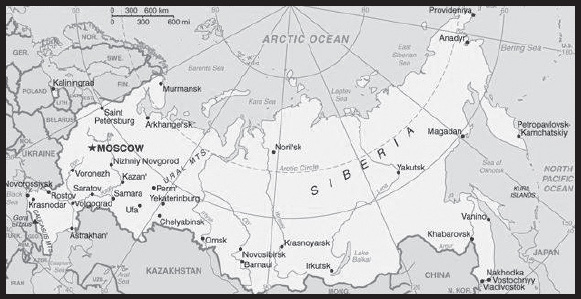
Location: North Asia bordering the Arctic Ocean, extending from Eastern Europe (the portion west of the Urals) to the North Pacific Ocean
Geographic coordinates: 60 00 N, 100 00 E
Map references: Asia
Area: total: 17,098,242 sq km
land: 16,377,742 sq km
water: 720,500 sq km
comparison ranking: total 1
Area - comparative: approximately 1.8 times the size of the US
Land boundaries: total: 22,407 km
border countries (14): Azerbaijan 338 km; Belarus 1,312 km; China (southeast) 4,133 km and China (south) 46 km; Estonia 324 km; Finland 1,309 km; Georgia 894 km; Kazakhstan 7,644 km; North Korea 18 km; Latvia 332 km; Lithuania (Kaliningrad Oblast) 261 km; Mongolia 3,452 km; Norway 191 km; Poland (Kaliningrad Oblast) 209 km; Ukraine 1,944 km
Coastline: 37,653 km
Maritime claims: territorial sea: 12 nm
contiguous zone: 24 nm
exclusive economic zone: 200 nm
continental shelf: 200-m depth or to the depth of exploitation
Climate: ranges from steppes in the south through humid continental in much of European Russia; subarctic in Siberia to tundra climate in the polar north; winters vary from cool along Black Sea coast to frigid in Siberia; summers vary from warm in the steppes to cool along Arctic coast
Terrain: broad plain with low hills west of Urals; vast coniferous forest and tundra in Siberia; uplands and mountains along southern border regions
Elevation: highest point: Gora El’brus (highest point in Europe) 5,642 m
lowest point: Caspian Sea -28 m
mean elevation: 600 m
Natural resources: wide natural resource base including major deposits of oil, natural gas, coal, and many strategic minerals, bauxite, reserves of rare earth elements, timber, note, formidable obstacles of climate, terrain, and distance hinder exploitation of natural resources
Land use: agricultural land: 13.1% (2018 est.)
arable land: 7.3% (2018 est.)
permanent crops: 0.1% (2018 est.)
permanent pasture: 5.7% (2018 est.)
forest: 49.4% (2018 est.)
other: 37.5% (2018 est.)
Irrigated land: 43,000 sq km (2012)
Major lakes (area sq km): fresh water lake(s): Lake Baikal - 31,500 sq km; Lake Ladoga - 18,130 sq km; Lake Onega - 9,720 sq km; Lake Khanka (shared with China) - 5,010 sq km; Lake Peipus - 4,300 sq km (shared with Estonia); Ozero Vygozero - 1,250 sq km; Ozero Beloye - 1,120 sq km
salt water lake(s): Caspian Sea (shared with Iran, Azerbaijan, Turkmenistan, and Kazakhstan) - 374,000 sq km; Ozero Malyye Chany - 2,500 sq km; Curonian Lagoon (shared with Lithuania) - 1,620 sq km note - the Caspian Sea is the World’s largest lake
Major rivers (by length in km): Yenisey-Angara - 5,539 km; Ob-Irtysh - 5,410 km; Amur river mouth (shared with China [s] and Mongolia) - 4,444 km; Lena - 4,400 km; Volga - 3,645 km; Kolyma - 2,513 km; Ural river source (shared with Kazakhstan [m]) - 2,428 km; Dnepr (Dnieper) river source (shared with Belarus and Ukraine [m]) - 2,287 km; Don - 1,870 km; Pechora - 1,809 km
note – [s] after country name indicates river source; [m] after country name indicates river mouth
Major watersheds (area sq km): Arctic Ocean drainage: Kolyma (679,934 sq km), Lena (2,306,743 sq km), Ob (2,972,493 sq km), Pechora (289,532 sq km), Yenisei (2,554,388 sq km)
Atlantic Ocean drainage: (Black Sea) Don (458,694 sq km), Dnieper (533,966 sq km)
Pacific Ocean drainage: Amur (1,929,955 sq km)
Internal (endorheic basin) drainage: (Caspian Sea basin) Volga (1,410,951 sq km)
Major aquifers: Angara-Lena Basin, Pechora Basin, North Caucasus Basin, East European Aquifer System, West Siberian Basin, Tunguss Basin, Yakut Basin
Population distribution: population is heavily concentrated in the westernmost fifth of the country extending from the Baltic Sea, south to the Caspian Sea, and eastward parallel to the Kazakh border; elsewhere, sizeable pockets are isolated and generally found in the south
Natural hazards: permafrost over much of Siberia is a major impediment to development; volcanic activity in the Kuril Islands; volcanoes and earthquakes on the Kamchatka Peninsula; spring floods and summer/autumn forest fires throughout Siberia and parts of European Russia
volcanism: significant volcanic activity on the Kamchatka Peninsula and Kuril Islands; the peninsula alone is home to some 29 historically active volcanoes, with dozens more in the Kuril Islands; Kliuchevskoi (4,835 m), which erupted in 2007 and 2010, is Kamchatka’s most active volcano; Avachinsky and Koryaksky volcanoes, which pose a threat to the city of Petropavlovsk-Kamchatsky, have been deemed Decade Volcanoes by the International Association of Volcanology and Chemistry of the Earth’s Interior, worthy of study due to their explosive history and close proximity to human populations; other notable historically active volcanoes include Bezymianny, Chikurachki, Ebeko, Gorely, Grozny, Karymsky, Ketoi, Kronotsky, Ksudach, Medvezhia, Mutnovsky, Sarychev Peak, Shiveluch, Tiatia, Tolbachik, and Zheltovsky; see note 2 under “Geography - note”
Geography - note: note 1: largest country in the world in terms of area but unfavorably located in relation to major sea lanes of the world; despite its size, much of the country lacks proper soils and climates (either too cold or too dry) for agriculture
note 2: Russia’s far east, particularly the Kamchatka Peninsula, lies along the Ring of Fire, a belt of active volcanoes and earthquake epicenters bordering the Pacific Ocean; up to 90% of the world’s earthquakes and some 75% of the world’s volcanoes occur within the Ring of Fire
note 3: Mount El’brus is Europe’s tallest peak; Lake Baikal, the deepest lake in the world, is estimated to hold one fifth of the world’s fresh surface water
note 4: Kaliningrad oblast is an exclave annexed from Germany following World War II (it was formerly part of East Prussia); its capital city of Kaliningrad - formerly Koenigsberg - is the only Baltic port in Russia that remains ice free in the winter
PEOPLE AND SOCIETY
Population: 141,698,923 (2023 est.)
comparison ranking: 9
Nationality: noun: Russian(s)
adjective: Russian
Ethnic groups: Russian 77.7%, Tatar 3.7%, Ukrainian 1.4%, Bashkir 1.1%, Chuvash 1%, Chechen 1%, other 10.2%, unspecified 3.9% (2010 est.)
note: nearly 200 national and/or ethnic groups are represented in Russia’s 2010 census
Languages: Russian (official) 85.7%, Tatar 3.2%, Chechen 1%, other 10.1%; note - data represent native language spoken (2010 est.)
major-language sample(s):

Religions: Russian Orthodox 15-20%, Muslim 10-15%, other Christian 2% (2006 est.)
note: estimates are of practicing worshipers; Russia has large populations of non-practicing believers and non-believers, a legacy of over seven decades of official atheism under Soviet rule; Russia officially recognizes Orthodox Christianity, Islam, Judaism, and Buddhism as the country’s traditional religions
Age structure: 0-14 years: 16.86% (male 12,270,830/female 11,614,990)
15-64 years: 65.99% (male 45,292,734/female 48,217,551)
65 years and over: 17.15% (2023 est.) (male 8,008,126/female 16,294,692)
Dependency ratios: total dependency ratio: 50
youth dependency ratio: 26.6
elderly dependency ratio: 23.4
potential support ratio: 4.3 (2021 est.)
Median age: total: 40.3 years (2020)
male: 37.5 years
female: 43.2 years
comparison ranking: total 52
Population growth rate: -0.24% (2023 est.)
comparison ranking: 212
Birth rate: 9.22 births/1,000 population (2023 est.)
comparison ranking: 197
Death rate: 13.27 deaths/1,000 population (2023 est.)
comparison ranking: 7
Net migration rate: 1.7 migrant(s)/1,000 population (2023 est.)
comparison ranking: 53
Population distribution: population is heavily concentrated in the westernmost fifth of the country extending from the Baltic Sea, south to the Caspian Sea, and eastward parallel to the Kazakh border; elsewhere, sizeable pockets are isolated and generally found in the south
Urbanization: urban population: 75.3% of total population (2023)
rate of urbanization: 0.11% annual rate of change (2020-25 est.)
Major urban areas - population: 12.680 million MOSCOW (capital), 5.561 million Saint Petersburg, 1.695 million Novosibirsk, 1.528 million Yekaterinburg, 1.292 million Kazan, 1.251 million Nizhniy Novgorod (2023)
Sex ratio: at birth: 1.06 male(s)/female
0-14 years: 1.06 male(s)/female
15-64 years: 0.94 male(s)/female
65 years and over: 0.49 male(s)/female
total population: 0.86 male(s)/female (2023 est.)
Mother’s mean age at first birth: 25.2 years (2013 est.)
Maternal mortality ratio: 14 deaths/100,000 live births (2020 est.)
comparison ranking: 138
Infant mortality rate: total: 6.33 deaths/1,000 live births (2023 est.)
male: 7.19 deaths/1,000 live births
female: 5.41 deaths/1,000 live births
comparison ranking: total 168
Life expectancy at birth: total population: 72.72 years (2023 est.)
male: 67.22 years
female: 78.54 years
comparison ranking: total population 156
Total fertility rate: 1.6 children born/woman (2023 est.)
comparison ranking: 185
Gross reproduction rate: 0.78 (2023 est.)
Contraceptive prevalence rate: 68% (2011)
note: percent of women aged 15-44
Drinking water source: improved: urban: 99.1% of population
rural: 93.1% of population
total: 97.6% of population
unimproved: urban: 0.9% of population
rural: 6.9% of population
total: 2.4% of population (2020 est.)
Current health expenditure: 7.6% of GDP (2020)
Physicians density: 3.82 physicians/1,000 population (2020)
Hospital bed density: 7.1 beds/1,000 population (2018)
Sanitation facility access: improved: urban: 95.2% of population
rural: 72.3% of population
total: 89.4% of population
unimproved: urban: 4.8% of population
rural: 27.7% of population
total: 10.6% of population (2020 est.)
Major infectious diseases: degree of risk: intermediate (2023)
food or waterborne diseases: bacterial diarrhea
vectorborne diseases: Crimean-Congo hemorrhagic fever, tickborne encephalitis
Obesity - adult prevalence rate: 23.1% (2016)
comparison ranking: 70
Alcohol consumption per capita: total: 7.29 liters of pure alcohol (2019 est.)
beer: 3.04 liters of pure alcohol (2019 est.)
wine: 0.97 liters of pure alcohol (2019 est.)
spirits: 3.16 liters of pure alcohol (2019 est.)
other alcohols: 0.12 liters of pure alcohol (2019 est.)
comparison ranking: total 56
Tobacco use: total: 26.8% (2020 est.)
male: 40.8% (2020 est.)
female: 12.8% (2020 est.)
comparison ranking: total 41
Currently married women (ages 15-49): 53.1% (2023 est.)
Child marriage: women married by age 15: 0.3%
women married by age 18: 6.2% (2017 est.)
Education expenditures: 3.7% of GDP (2020 est.)
comparison ranking: 132
Literacy: definition: age 15 and over can read and write
total population: 99.7%
male: 99.7%
female: 99.7% (2018)
School life expectancy (primary to tertiary education): total: 16 years
male: 16 years
female: 16 years (2019)
Youth unemployment rate (ages 15-24): total: 16.9% (2021 est.)
male: 15.7%
female: 18.4%
comparison ranking: total 102
ENVIRONMENT
Environment - current issues: air pollution from heavy industry, emissions of coal-fired electric plants, and transportation in major cities; industrial, municipal, and agricultural pollution of inland waterways and seacoasts; deforestation; soil erosion; soil contamination from improper application of agricultural chemicals; nuclear waste disposal; scattered areas of sometimes intense radioactive contamination; groundwater contamination from toxic waste; urban solid waste management; abandoned stocks of obsolete pesticides
Environment - international agreements: party to: Air Pollution, Air Pollution-Nitrogen Oxides, Air Pollution-Sulphur 85, Antarctic-Environmental Protection, Antarctic-Marine Living Resources, Antarctic Seals, Antarctic Treaty, Biodiversity, Climate Change, Climate Change- Kyoto Protocol, Climate Change-Paris Agreement, Comprehensive Nuclear Test Ban, Desertification, Endangered Species, Environmental Modification, Hazardous Wastes, Law of the Sea, Marine Dumping-London Convention, Nuclear Test Ban, Ozone Layer Protection, Ship Pollution, Wetlands, Whaling
signed, but not ratified: Air Pollution-Sulfur 94
Climate: ranges from steppes in the south through humid continental in much of European Russia; subarctic in Siberia to tundra climate in the polar north; winters vary from cool along Black Sea coast to frigid in Siberia; summers vary from warm in the steppes to cool along Arctic coast
Land use: agricultural land: 13.1% (2018 est.)
arable land: 7.3% (2018 est.)
permanent crops: 0.1% (2018 est.)
permanent pasture: 5.7% (2018 est.)
forest: 49.4% (2018 est.)
other: 37.5% (2018 est.)
Urbanization: urban population: 75.3% of total population (2023)
rate of urbanization: 0.11% annual rate of change (2020-25 est.)
Revenue from forest resources: 0.29% of GDP (2018 est.)
comparison ranking: 81
Revenue from coal: 0.53% of GDP (2018 est.)
comparison ranking: 11
Air pollutants: particulate matter emissions: 8.88 micrograms per cubic meter (2019 est.)
carbon dioxide emissions: 1,732.03 megatons (2016 est.)
methane emissions: 851.52 megatons (2020 est.)
Waste and recycling: municipal solid waste generated annually: 60 million tons (2012 est.)
municipal solid waste recycled annually: 2.7 million tons (2012 est.)
percent of municipal solid waste recycled: 4.5% (2012 est.)
Major lakes (area sq km): fresh water lake(s): Lake Baikal - 31,500 sq km; Lake Ladoga - 18,130 sq km; Lake Onega - 9,720 sq km; Lake Khanka (shared with China) - 5,010 sq km; Lake Peipus - 4,300 sq km (shared with Estonia); Ozero Vygozero - 1,250 sq km; Ozero Beloye - 1,120 sq km
salt water lake(s): Caspian Sea (shared with Iran, Azerbaijan, Turkmenistan, and Kazakhstan) - 374,000 sq km; Ozero Malyye Chany - 2,500 sq km; Curonian Lagoon (shared with Lithuania) - 1,620 sq km note - the Caspian Sea is the World’s largest lake
Major rivers (by length in km): Yenisey-Angara - 5,539 km; Ob-Irtysh - 5,410 km; Amur river mouth (shared with China [s] and Mongolia) - 4,444 km; Lena - 4,400 km; Volga - 3,645 km; Kolyma - 2,513 km; Ural river source (shared with Kazakhstan [m]) - 2,428 km; Dnepr (Dnieper) river source (shared with Belarus and Ukraine [m]) - 2,287 km; Don - 1,870 km; Pechora - 1,809 km
note – [s] after country name indicates river source; [m] after country name indicates river mouth
Major watersheds (area sq km): Arctic Ocean drainage: Kolyma (679,934 sq km), Lena (2,306,743 sq km), Ob (2,972,493 sq km), Pechora (289,532 sq km), Yenisei (2,554,388 sq km)
Atlantic Ocean drainage: (Black Sea) Don (458,694 sq km), Dnieper (533,966 sq km)
Pacific Ocean drainage: Amur (1,929,955 sq km)
Internal (endorheic basin) drainage: (Caspian Sea basin) Volga (1,410,951 sq km)
Major aquifers: Angara-Lena Basin, Pechora Basin, North Caucasus Basin, East European Aquifer System, West Siberian Basin, Tunguss Basin, Yakut Basin
Total water withdrawal: municipal: 17.15 billion cubic meters (2020 est.)
industrial: 29.03 billion cubic meters (2020 est.)
agricultural: 18.64 billion cubic meters (2020 est.)
Total renewable water resources: 4.53 trillion cubic meters (2020 est.)
GOVERNMENT
Country name: conventional long form: Russian Federation
conventional short form: Russia
local long form: Rossiyskaya Federatsiya
local short form: Rossiya
former: Russian Empire, Russian Soviet Federative Socialist Republic
etymology: Russian lands were generally referred to as Muscovy until PETER I officially declared the Russian Empire in 1721; the new name sought to invoke the patrimony of the medieval eastern European Rus state centered on Kyiv in present-day Ukraine; the Rus were a Varangian (eastern Viking) elite that imposed their rule and eventually their name on their Slavic subjects
Government type: semi-presidential federation
Capital: name: Moscow
geographic coordinates: 55 45 N, 37 36 E
time difference: UTC+3 (8 hours ahead of Washington, DC, during Standard Time)
daylight saving time: does not observe daylight savings time (DST)
time zone note: Russia has 11 time zones, the largest number of contiguous time zones of any country in the world; in 2014, two time zones were added and DST dropped
etymology: named after the Moskva River; the origin of the river’s name is obscure but may derive from the appellation “Mustajoki” given to the river by the Finno-Ugric people who originally inhabited the area and whose meaning may have been “dark” or “turbid”
Administrative divisions: 46 provinces (oblasti, singular - oblast), 21 republics (respubliki, singular - respublika), 4 autonomous okrugs (avtonomnyye okrugi, singular - avtonomnyy okrug), 9 krays (kraya, singular - kray), 2 federal cities (goroda, singular - gorod), and 1 autonomous oblast (avtonomnaya oblast’)
oblasts: Amur (Blagoveshchensk), Arkhangelsk, Astrakhan, Belgorod, Bryansk, Chelyabinsk, Irkutsk, Ivanovo, Kaliningrad, Kaluga, Kemerovo, Kirov, Kostroma, Kurgan, Kursk, Leningrad (Gatchina), Lipetsk, Magadan, Moscow, Murmansk, Nizhniy Novgorod, Novgorod, Novosibirsk, Omsk, Orenburg, Orel, Penza, Pskov, Rostov, Ryazan, Sakhalin (Yuzhno-Sakhalinsk), Samara, Saratov, Smolensk, Sverdlovsk (Yekaterinburg), Tambov, Tomsk, Tula, Tver, Tyumen, Ulyanovsk, Vladimir, Volgograd, Vologda, Voronezh, Yaroslavl
republics: Adygeya (Maykop), Altay (Gorno-Altaysk), Bashkortostan (Ufa), Buryatiya (Ulan-Ude), Chechnya (Groznyy), Chuvashiya (Cheboksary), Dagestan (Makhachkala), Ingushetiya (Magas), Kabardino-Balkariya (Nal’chik), Kalmykiya (Elista), Karachayevo- Cherkesiya (Cherkessk), Kareliya (Petrozavodsk), Khakasiya (Abakan), Komi (Syktyvkar), Mariy-El (Yoshkar-Ola), Mordoviya (Saransk), North Ossetia (Vladikavkaz), Sakha [Yakutiya] (Yakutsk), Tatarstan (Kazan), Tyva (Kyzyl), Udmurtiya (Izhevsk)
autonomous okrugs: Chukotka (Anadyr’), Khanty-Mansi-Yugra (Khanty-Mansiysk), Nenets (Nar’yan-Mar), Yamalo-Nenets (Salekhard)
krays: Altay (Barnaul), Kamchatka (Petropavlovsk-Kamchatskiy), Khabarovsk, Krasnodar, Krasnoyarsk, Perm, Primorskiy [Maritime] (Vladivostok), Stavropol, Zabaykalsk [Transbaikal] (Chita)
federal cities: Moscow [Moskva], Saint Petersburg [Sankt-Peterburg]
autonomous oblast: Yevreyskaya [Jewish] (Birobidzhan)
note 1: administrative divisions have the same names as their administrative centers (exceptions have the administrative center name following in parentheses)
note 2: the United States does not recognize Russia’s annexation of Ukraine’s Autonomous Republic of Crimea and the municipality of Sevastopol, nor their redesignation as the “Republic of Crimea” and the “Federal City of Sevastopol”; it similarly does not recognize the annexation of the Ukrainian oblasts Donetsk, Luhansk, Zaporizhzhia, and Kherson
Independence: 25 December 1991 (from the Soviet Union; Russian SFSR renamed Russian Federation); notable earlier dates: 1157 (Principality of Vladimir-Suzdal created); 16 January 1547 (Tsardom of Muscovy established); 22 October 1721 (Russian Empire proclaimed); 30 December 1922 (Soviet Union established)
National holiday: Russia Day, 12 June (1990); note - commemorates the adoption of the Declaration of State Sovereignty of the Russian Soviet Federative Socialist Republic (RSFSR)
Constitution: history: several previous (during Russian Empire and Soviet era); latest drafted 12 July 1993, adopted by referendum 12 December 1993, effective 25 December 1993
amendments: proposed by the president of the Russian Federation, by either house of the Federal Assembly, by the government of the Russian Federation, or by legislative (representative) bodies of the Federation’s constituent entities; proposals to amend the government’s constitutional system, human and civil rights and freedoms, and procedures for amending or drafting a new constitution require formation of a Constitutional Assembly; passage of such amendments requires two-thirds majority vote of its total membership; passage in a referendum requires participation of an absolute majority of eligible voters and an absolute majority of valid votes; approval of proposed amendments to the government structure, authorities, and procedures requires approval by the legislative bodies of at least two thirds of the Russian Federation’s constituent entities; amended several times, last in 2020 (major revisions)
Legal system: civil law system; judicial review of legislative acts
International law organization participation: has not submitted an ICJ jurisdiction declaration; non-party state to the ICCt
Citizenship: citizenship by birth: no
citizenship by descent only: at least one parent must be a citizen of Russia
dual citizenship recognized: yes
residency requirement for naturalization: 3-5 years
Suffrage: 18 years of age; universal
Executive branch: chief of state: President Vladimir Vladimirovich PUTIN (since 7 May 2012); no vice president position
head of government: Premier Mikhail MISHUSTIN (since 16 January 2020); First Deputy Premier Andrey Removich BELOUSOV (since 21 January 2020); Deputy Premiers Yuriy TRUTNEV (since 31 August 2013), Tatiana Alekseyevna GOLIKOVA (since 18 May 2018), Dmitriy Yuriyevich GRIGORENKO, Viktoriya Valeriyevna ABRAMCHENKO, Aleksey Logvinovich OVERCHUK, Marat Shakirzyanovich KHUSNULLIN, Dmitriy Nikolayevich CHERNYSHENKO (since 21 January 2020), Aleksandr NOVAK (since 10 November 2020), Denis Valentinovich MANTUROV (since 15 July 2022)
cabinet: the “Government” is composed of the premier, his deputies, and ministers, all appointed by the president; the premier is also confirmed by the Duma
elections/appointments: president directly elected by absolute majority popular vote in 2 rounds if needed for a 6-year term (2020 constitutional amendments allow a second consecutive term); election last held on 18 March 2018 (next to be held in March 2024); note - for the 2024 presidential election, previous presidential terms are discounted
election results:
2018: Vladimir PUTIN reelected president; percent of vote - Vladimir PUTIN (independent) 77.5%, Pavel GRUDININ (CPRF) 11.9%, Vladimir ZHIRINOVSKIY (LDPR) 5.7%, other 4.9%; Mikhail MISHUSTIN (independent) approved as premier by Duma; vote - 383 to 0
2012: Vladimir PUTIN elected president; percent of vote - Vladimir PUTIN (United Russia) 63.6%, Gennadiy ZYUGANOV (CPRF) 17.2%, Mikhail PROKHOROV (CP) 8%, Vladimir ZHIRINOVSKIY (LDPR) 6.2%, Sergey MIRONOV (A Just Russia) 3.9%, other 1.1%; Dmitriy MEDVEDEV (United Russia) approved as premier by Duma; vote - 299 to 144
note: there is also a Presidential Administration that provides staff and policy support to the president, drafts presidential decrees, and coordinates policy among government agencies; a Security Council also reports directly to the president
Legislative branch: description: bicameral Federal Assembly or Federalnoye Sobraniye consists of:
Federation Council or Sovet Federatsii (170 seats statutory, 169 as of April 2023; 2 members in each of the 83 federal administrative units (see note below) - oblasts, krays, republics, autonomous okrugs and oblasts, and federal cities of Moscow and Saint Petersburg - appointed by the top executive and legislative officials; members serve 4-year terms) State Duma or Gosudarstvennaya Duma (450 seats (see note below); as of February 2014, the electoral system reverted to a mixed electoral system for the 2016 election, in which one-half of the members are directly elected by simple majority vote and one-half directly elected by proportional representation vote; members serve 5-year terms)
elections:
State Duma - last held 17 - 19 September 2021 (next to be held in September 2026)
election results:
Federation Council (members appointed); composition (as of April 2023) - men 133, women 36, percent of women 21.3%
State Duma - United Russia 50.9%, CPRF 19.3%, LDPR 7.7%, A Just Russia 7.6%, New People 5.3% other minor parties and independents 9.2%; seats by party - United Russia 324, CPRF 57, LDPR 21, A Just Russia 27, New People 13; Rodina 1, CP 1, Party of Growth 1, independent 5; composition as of April 2023 - men 376, women 74, percent of women 16.4%; note - total Federal Assembly percent of women 17.8%
note 1: the State Duma now includes 3 representatives from the “Republic of Crimea,” while the Federation Council includes 2 each from the “Republic of Crimea” and the “Federal City of Sevastopol,” both regions that Russia occupied and attempted to annex from Ukraine and that the US does not recognize as part of Russia
Judicial branch: highest court(s): Supreme Court of the Russian Federation (consists of 170 members organized into the Judicial Panel for Civil Affairs, the Judicial Panel for Criminal Affairs, and the Military Panel); Constitutional Court (consists of 11 members, including the chairperson and deputy); note - in February 2014, Russia’s Higher Court of Arbitration was abolished and its former authorities transferred to the Supreme Court, which in addition is the country’s highest judicial authority for appeals, civil, criminal, administrative, and military cases, and the disciplinary judicial board, which has jurisdiction over economic disputes
judge selection and term of office: all members of Russia’s 3 highest courts nominated by the president and appointed by the Federation Council (the upper house of the legislature); members of all 3 courts appointed for life
subordinate courts: regional (kray) and provincial (oblast) courts; Moscow and St. Petersburg city courts; autonomous province and district courts; note - the 21 Russian Republics have court systems specified by their own constitutions
Political parties and leaders: A Just Russia or SRZP [Sergey MIRONOV]
Civic Platform or CP [Rifat SHAYKHUTDINOV]
Communist Party of the Russian Federation or CPRF [Gennadiy ZYUGANOV]
Liberal Democratic Party of Russia or LDPR [Leonid SLUTSKY]
New People [Alexey NECHAYEV]
Party of Growth [Boris TITOV]
Rodina [Aleksei ZHURAVLYOV]
United Russia [Dmitriy MEDVEDEV]
note: 31 political parties are registered with Russia’s Ministry of Justice (as of September 2021); 14 participated in the 2021 election, but only 8 parties maintain representation in Russia’s national legislature
International organization participation: APEC, Arctic Council, ARF, ASEAN (dialogue partner), BIS, BRICS, BSEC, CBSS, CD, CE, CERN (observer), CICA, CIS, CSTO, EAEC, EAEU, EAPC, EAS, EBRD, FAO, FATF, G-20, GCTU, IAEA, IBRD, ICAO, ICC (national committees), ICRM, IDA, IFAD, IFC, IFRCS, IHO, ILO, IMF, IMO, IMSO, Interpol, IOC, IOM (observer), IPU, ISO, ITSO, ITU, ITUC (NGOs), LAIA (observer), MIGA, MINURSO, MONUSCO, NEA, NSG, OAS (observer), OIC (observer), OPCW, OSCE, Paris Club, PCA, PFP, SCO, UN, UNCTAD, UNESCO, UNHCR, UNIDO, UNISFA, UNMIL, UNMISS, UNOCI, UN Security Council (permanent), UNTSO, UNWTO, UPU, Wassenaar Arrangement, WCO, WFTU (NGOs), WHO, WIPO, WMO, WTO, ZC
Diplomatic representation in the US: chief of mission: Ambassador Anatoly Ivanovich ANTONOV (since 8 September 2017)
chancery: 2650 Wisconsin Avenue NW, Washington, DC 20007
telephone: [1] (202) 298-5700
FAX: [1] (202) 298-5735
email address and website:
consulate(s) general: Houston, New York
Diplomatic representation from the US: chief of mission: Ambassador Lynne M. TRACY (30 January 2023)
embassy: 55,75566° N, 37,58028° E
mailing address: 5430 Moscow Place, Washington DC 20521-5430
telephone: [7] (495) 728-5000
FAX: [7] (495) 728-5090
email address and website:
consulate(s) general: Vladivostok (suspended status), Yekaterinburg (suspended status)
Flag description: three equal horizontal bands of white (top), blue, and red
note: the Russian flag was created when Russia built its first naval vessels, and was used mostly as a naval ensign until the nineteenth century; the colors may have been based on those of the Dutch flag; despite many popular interpretations, there is no official meaning assigned to the colors of the Russian flag; the flag inspired several other Slavic countries to adopt horizontal tricolors of the same colors but in different arrangements, and so red, blue, and white became the Pan-Slav colors
National symbol(s): bear, double-headed eagle; national colors: white, blue, red
Coat of Arms of Russia:: National anthem
name: “Gimn Rossiyskoy Federatsii” (National Anthem of the Russian Federation)
lyrics/music: Sergey Vladimirovich MIKHALKOV/Aleksandr Vasilyevich ALEKSANDROV
note: in 2000, Russia adopted the tune of the anthem of the former Soviet Union (composed in 1939); the lyrics, also adopted in 2000, were written by the same person who authored the Soviet lyrics in 1943
National heritage: total World Heritage Sites: 31 (20 cultural, 11 natural)
selected World Heritage Site locales: Kremlin and Red Square, Moscow (c); Historic Saint Petersburg (c);
Novodevichy Convent (c); Historic Monuments of Novgorod (c); Trinity Sergius Lavra in Sergiev Posad (c); Volcanoes of Kamchatka (n); Lake Baikal (n); Central Sikhote-Alin (n); Historic Derbent (c); Kazan Kremlin (c)
ECONOMY
Economic overview: natural resource-rich Eurasian economy; leading energy exporter to Europe and Asia; decreased oil export reliance; endemic corruption, Ukrainian invasion, and lack of green infrastructure limit investment and have led to sanctions
Real GDP (purchasing power parity): $4.078 trillion (2021 est.)
$3.893 trillion (2020 est.)
$4 trillion (2019 est.)
note: data are in 2017 dollars
comparison ranking: 6
Real GDP growth rate: 4.75% (2021 est.)
-2.66% (2020 est.)
2.2% (2019 est.)
comparison ranking: 95
Real GDP per capita: $28,000 (2021 est.)
$26,600 (2020 est.)
$27,300 (2019 est.)
note: data are in 2017 dollars
comparison ranking: 75
GDP (official exchange rate): $1,702,361,000,000 (2019 est.)
Inflation rate (consumer prices): 6.69% (2021 est.)
3.38% (2020 est.)
4.47% (2019 est.)
comparison ranking: 48
Credit ratings:
Fitch rating: BBB (2019)
Moody’s rating: Baa3 (2019)
Standard & Poors rating: BBB- (2018)
note: The year refers to the year in which the current credit rating was first obtained.
GDP - composition, by sector of origin: agriculture: 4.7% (2017 est.)
industry: 32.4% (2017 est.)
services: 62.3% (2017 est.)
comparison rankings: services 105; industry 64; agriculture 130
GDP - composition, by end use: household consumption: 52.4% (2017 est.)
government consumption: 18% (2017 est.)
investment in fixed capital: 21.6% (2017 est.)
investment in inventories: 2.3% (2017 est.)
exports of goods and services: 26.2% (2017 est.)
imports of goods and services: -20.6% (2017 est.)
Agricultural products: wheat, sugar beets, milk, potatoes, barley, sunflower seed, maize, poultry, oats, soybeans
Industries: complete range of mining and extractive industries producing coal, oil, gas, chemicals, and metals; all forms of machine building from rolling mills to high-performance aircraft and space vehicles; defense industries (including radar, missile production, advanced electronic components), shipbuilding; road and rail transportation equipment; communications equipment; agricultural machinery, tractors, and construction equipment; electric power generating and transmitting equipment; medical and scientific instruments; consumer durables, textiles, foodstuffs, handicrafts
Industrial production growth rate: 4.9% (2021 est.)
comparison ranking: 94
Labor force: 72.444 million (2021 est.)
comparison ranking: 7
Labor force - by occupation: agriculture: 9.4%
industry: 27.6%
services: 63% (2016 est.)
Unemployment rate: 5.01% (2021 est.)
5.59% (2020 est.)
4.5% (2019 est.)
comparison ranking: 152
Youth unemployment rate (ages 15-24): total: 16.9% (2021 est.)
male: 15.7%
female: 18.4%
comparison ranking: total 102
Population below poverty line: 12.6% (2018 est.)
Gini Index coefficient - distribution of family income: 36 (2020 est.)
comparison ranking: 88
Average household expenditures: on food: 28% of household expenditures (2018 est.)
on alcohol and tobacco: 7.4% of household expenditures (2018 est.)
Household income or consumption by percentage share: lowest 10%: 2.3%
highest 10%: 32.2% (2012 est.)
Budget: revenues: $604.135 billion (2019 est.)
expenditures: $571.465 billion (2019 est.)
Budget surplus (+) or deficit (-): -1.4% (of GDP) (2017 est.)
comparison ranking: 88
Public debt: 23.05% of GDP (2020 est.)
17.28% of GDP (2019 est.)
16.17% of GDP (2018 est.)
note: data cover general government debt and include debt instruments issued (or owned) by government entities other than the treasury; the data include treasury debt held by foreign entities; the data include debt issued by subnational entities, as well as intragovernmental debt; intragovernmental debt consists of treasury borrowings from surpluses in the social funds, such as for retirement, medical care, and unemployment, debt instruments for the social funds are not sold at public auctions
comparison ranking: 183
Taxes and other revenues: 10.83% (of GDP) (2020 est.)
comparison ranking: 189
Fiscal year: calendar year
Current account balance: $122.27 billion (2021 est.)
$35.373 billion (2020 est.)
$65.627 billion (2019 est.)
comparison ranking: 4
Exports: $550.035 billion (2021 est.) note: data are in current year dollars
$381.49 billion (2020 est.) note: data are in current year dollars
$481.686 billion (2019 est.) note: data are in current year dollars
comparison ranking: 16
Exports - partners: China 14%, Netherlands 10%, Belarus 5%, Germany 5% (2019)
Exports - commodities: crude petroleum, refined petroleum, natural gas, coal, wheat, iron (2019)
Imports: $379.947 billion (2021 est.) note: data are in current year dollars
$304.837 billion (2020 est.) note: data are in current year dollars
$352.358 billion (2019 est.) note: data are in current year dollars
comparison ranking: 20
Imports - partners: China 20%, Germany 13%, Belarus 6% (2019)
Imports - commodities: cars and vehicle parts, packaged medicines, broadcasting equipment, aircraft, computers (2019)
Reserves of foreign exchange and gold: $632.242 billion (31 December 2021 est.)
$596.77 billion (31 December 2020 est.)
$555.179 billion (31 December 2019 est.)
comparison ranking: 6
Debt - external: $479.844 billion (2019 est.)
$484.355 billion (2018 est.)
comparison ranking: 26
Exchange rates: Russian rubles (RUB) per US dollar -
Exchange rates:: 73.654 (2021 est.)
72.105 (2020 est.)
64.738 (2019 est.)
62.668 (2018 est.)
58.343 (2017 est.)
ENERGY
Electricity access: electrification - total population: 100% (2021)
Electricity: installed generating capacity: 276.463 million kW (2020 est.)
consumption: 942.895 billion kWh (2019 est.)
exports: 12.116 billion kWh (2020 est.)
imports: 1.377 billion kWh (2020 est.)
transmission/distribution losses: 99.077 billion kWh (2019 est.)
comparison rankings: imports 66; exports 19; installed generating capacity 5; transmission/distribution losses 5; consumption 4
Electricity generation sources: fossil fuels: 59.4% of total installed capacity (2020 est.)
nuclear: 21% of total installed capacity (2020 est.)
solar: 0.2% of total installed capacity (2020 est.)
hydroelectricity: 19.1% of total installed capacity (2020 est.)
biomass and waste: 0.3% of total installed capacity (2020 est.)
Nuclear energy: Number of operational nuclear reactors: 37 (2023)
Number of nuclear reactors under construction: 3
Net capacity of operational nuclear reactors: 27.73GW (2021)
Percent of total electricity production: 20.7% (2021)
Percent of total energy produced: 3.6% (2021)
Number of nuclear reactors permanently shut down: 4
Coal: production: 447.332 million metric tons (2020 est.)
consumption: 266.038 million metric tons (2020 est.)
exports: 224.324 million metric tons (2020 est.)
imports: 24.027 million metric tons (2020 est.)
proven reserves: 162.166 billion metric tons (2019 est.)
Petroleum: total petroleum production: 10,749,500 bbl/day (2021 est.)
refined petroleum consumption: 3.699 million bbl/day (2019 est.)
crude oil and lease condensate exports: 5.196 million bbl/day (2018 est.)
crude oil and lease condensate imports: 14,200 bbl/day (2018 est.)
crude oil estimated reserves: 80 billion barrels (2021 est.)
Refined petroleum products - production: 6.076 million bbl/day (2015 est.)
comparison ranking: 3
Refined petroleum products - exports: 2.671 million bbl/day (2015 est.)
comparison ranking: 2
Refined petroleum products - imports: 41,920 bbl/day (2015 est.)
comparison ranking: 88
Natural gas: production: 701.544 billion cubic meters (2021 est.)
consumption: 460.612 billion cubic meters (2020 est.)
exports: 250.855 billion cubic meters (2021 est.)
imports: 16.112 billion cubic meters (2019 est.)
proven reserves: 47.805 trillion cubic meters (2021 est.)
Carbon dioxide emissions: 1,848,070,000 metric tonnes of CO2 (2019 est.)
from coal and metallurgical coke: 456.033 million metric tonnes of CO2 (2019 est.)
from petroleum and other liquids: 470.289 million metric tonnes of CO2 (2019 est.)
from consumed natural gas: 921.748 million metric tonnes of CO2 (2019 est.)
comparison ranking: total emissions 4
Energy consumption per capita: 227.898 million Btu/person (2019 est.)
comparison ranking: 18
COMMUNICATIONS
Telephones - fixed lines: total subscriptions: 24 million (2021 est.)
subscriptions per 100 inhabitants: 16 (2021 est.)
comparison ranking: total subscriptions 10
Telephones - mobile cellular: total subscriptions: 250 million (2021 est.)
subscriptions per 100 inhabitants: 170 (2021 est.)
comparison ranking: total subscriptions 5
Telecommunication systems: general assessment: the telecom market is the largest in Europe, supported by a population approaching 147 million; the overall market is dominated by the western regions, particularly Moscow and St Petersburg which are the main cities and economic centers; all sectors of the market have been liberalized, with competition most prevalent in the two largest regional markets; the fiber broadband sector has shown considerable growth, supported by the government’s program to extend the reach of broadband to outlying regions; the development of 5G services has been stymied by the lack of spectrum; although MNOs have licenses to use 700MHz spectrum for 5G, this spectrum has yet to be released by broadcasters; spectrum in the 3.4GHz range commonly used for 5G in Europe has been restricted for use in Russia by the military and intelligence agencies; despite these limitations, the four principal MNOs each have an equal share in a joint venture aimed at developing a strategy to deploy 5G using shared network and spectrum assets (2022)
domestic: 16 per 100 for fixed-line and mobile-cellular is 170 per 100 persons (2021)
international: country code - 7; landing points for the Far East Submarine Cable System, HSCS, Sakhalin-Kuril Island Cable, RSCN, BCS North-Phase 2, Kerch Strait Cable and the Georgia-Russian submarine cable system connecting Russia, Japan, Finland, Georgia and Ukraine; satellite earth stations provide access to Intelsat, Intersputnik, Eutelsat, Inmarsat, and Orbita systems (2019)
Broadcast media: 13 national TV stations with the federal government owning 1 and holding a controlling interest in a second; state-owned Gazprom maintains a controlling interest in 2 of the national channels; government-affiliated Bank Rossiya owns controlling interest in a fourth and fifth, while a sixth national channel is owned by the Moscow city administration; the Russian Orthodox Church and the Russian military, respectively, own 2 additional national channels; roughly 3,300 national, regional, and local TV stations with over two-thirds completely or partially controlled by the federal or local governments; satellite TV services are available; 2 state-run national radio networks with a third majority-owned by Gazprom; roughly 2,400 public and commercial radio stations
Internet country code: .ru; note - Russia also has responsibility for a legacy domain “.su” that was allocated to the Soviet Union and is being phased out
Internet users: total: 132 million (2021 est.)
percent of population: 88% (2021 est.)
comparison ranking: total 6
Broadband - fixed subscriptions: total: 33,893,305 (2020 est.)
subscriptions per 100 inhabitants: 23 (2020 est.)
comparison ranking: total 6
TRANSPORTATION
National air transport system: number of registered air carriers: 32 (2020)
inventory of registered aircraft operated by air carriers: 958
annual passenger traffic on registered air carriers: 99,327,311 (2018)
annual freight traffic on registered air carriers: 6,810,610,000 (2018) mt-km
Civil aircraft registration country code prefix: RA
Airports: 1,218 (2021)
comparison ranking: total 5
Airports - with paved runways: 594
civil airports: 93
military airports: 105
joint use (civil-military) airports: 28
other airports: 368
note: paved runways have a concrete or asphalt surface but not all have facilities for refueling, maintenance, or air traffic control; the length of a runway required for aircraft to safely operate depends on a number of factors including the type of aircraft, the takeoff weight (including passengers, cargo, and fuel), engine types, flap settings, landing speed, elevation of the airport, and average maximum daily air temperature; paved runways can reach a length of 5,000 m (16,000 ft.), but the “typical” length of a commercial airline runway is between 2,500-4,000 m (8,000-13,000 ft.)
Airports - with unpaved runways: 624
note: unpaved runways have a surface composition such as grass or packed earth and are most suited to the operation of light aircraft; unpaved runways are usually short, often less than 1,000 m (3,280 ft.) in length; airports with unpaved runways often lack facilities for refueling, maintenance, or air traffic control
Heliports: 49 (2021)
Pipelines: 177,700 km gas, 54,800 km oil, 19,300 km refined products (2017)
Railways: total: 85,494 km (2019)
narrow gauge: 957 km
comparison ranking: total 3
Roadways: total: 1,283,387 km (2012)
paved: 927,721 km (2012) (includes 39,143 km of expressways)
unpaved: 355,666 km (2012)
comparison ranking: total 5
Waterways: 102,000 km (2009) (including 48,000 km with guaranteed depth; the 72,000-km system in European Russia links Baltic Sea, White Sea, Caspian Sea, Sea of Azov, and Black Sea)
comparison ranking: 1
Merchant marine: total: 2,917 (2022)
by type: bulk carrier 12, container ship 18, general cargo 987, oil tanker 392, other 1,508
comparison ranking: total 8
Ports and terminals: major seaport(s):
Arctic Ocean: Arkhangelsk, Murmansk
Baltic Sea: Kaliningrad, Primorsk, Saint Petersburg
Black Sea: Novorossiysk
Pacific Ocean: Nakhodka, Vladivostok, Vostochnyy
oil terminal(s): Kavkaz oil terminal, Primorsk
container port(s) (TEUs): Saint Petersburg (2,042,358) (2021)
LNG terminal(s) (export): Sabetta, Sakhalin Island
river port(s): Astrakhan, Kazan (Volga River); Rostov-on-Don (Don River); Saint Petersburg (Neva River)
Transportation - note: Russia operates the largest polar class icebreaker fleet in the World with 52 vessels, including the World’s only seven nuclear powered heavy icebreakers; the primary missions of Russia’s fleet includes keeping open the Northern Sea Route (NSR) in the Arctic Ocean (see Arctic Ocean map) along with Russia’s Arctic ports and terminals, maintaining shipping lanes in the Baltic Sea, and supporting ports, terminals, and shipping in the Russian Far East including the Sea of Okhotsk; Russia operates seven PC 1 or 2 heavy icebreakers, 31 PC 3 or 4 medium icebreakers, and 14 PC 5 or 6 light icebreakers
note - PC indicates a Polar Class vessel: PC 1 - year-round operation in all polar waters (ice thickness >3 m); PC 2 - year-round operation in moderate multi-year ice conditions (ice thickness up to 3 m); PC 3 - year-round operation in second-year ice which may include multi-year ice inclusions (ice thickness up to 2.5 m); PC 4 - year-round operation in thick first-year ice which may include old ice inclusions (ice thickness up to 120 cm); PC 5 - year-round operation in medium first-year ice which may include old ice inclusions (ice thickness up to 70-120 cm); PC 6 - summer/autumn operation in medium first-year ice which may include old ice inclusions (ice thickness up to 30-70 cm)
MILITARY AND SECURITY
Military and security forces: Armed Forces of the Russian Federation: Ground Troops (Sukhoputnyye Voyskia, SV), Navy (Voyenno-Morskoy Flot, VMF), Aerospace Forces (Vozdushno-Kosmicheskiye Sily, VKS); Airborne Troops (Vozdushno-Desantnyye Voyska, VDV), and Missile Troops of Strategic Purpose (Raketnyye Voyska Strategicheskogo Naznacheniya, RVSN) referred to commonly as Strategic Rocket Forces, are independent “combat arms,” not subordinate to any of the three branches
Federal National Guard Troops Service of the Russian Federation (FSVNG, National Guard, Russian Guard, or Rosgvardiya)
Federal Security Services (FSB): Federal Border Guard Service (includes land and maritime forces) (2023)
note 1: the Air Force and Aerospace Defense Forces were merged into the VKS in 2015; VKS responsibilities also include launching military and dual-use satellites, maintaining military satellites, and monitoring and defending against space threats
note 2: the Ministry of Internal Affairs, Federal Security Service, Investigative Committee, Office of the Prosecutor General, and National Guard are responsible for law enforcement; the Federal Security Service is responsible for state security, counterintelligence, and counterterrorism, as well as for fighting organized crime and corruption; the national police force, under the Ministry of Internal Affairs, is responsible for combating all crime
note 3: the National Guard was created in 2016 as an independent agency for internal/regime security, combating terrorism and narcotics trafficking, protecting important state facilities and government personnel, and supporting border security; it also participates in armed defense of the country’s territory in coordination with the Armed Forces; forces under the National Guard include the Special Purpose Mobile Units (OMON), Special Rapid Response Detachment (SOBR), and Interior Troops (VV); these troops were originally under the command of the Interior Ministry (MVD); also nominally under the National Guard’s command are the forces of Chechen Republic head Ramzan KADYROV
Military expenditures: 4% of GDP (2022 est.)
4% of GDP (2021 est.)
4% of GDP (2020 est.)
3.8% of GDP (2019 est.)
3.7% of GDP (2018 est.)
comparison ranking: 18
Military and security service personnel strengths: prior to Russia’s full-scale invasion of Ukraine in February 2022, approximately 900,000 active-duty troops (350,000 Ground Troops; 40,000 Airborne Troops; 150,000 Navy; 160,000 Aerospace Forces; 70,000 Strategic Rocket Forces; approximately 20,000 special operations forces; approximately 100,000 other uniformed personnel (command and control, cyber, support, logistics, security, etc.); estimated 350,000-plus Federal National Guard Troops (2023)
note 1: in December 2022, the Russian Government announced a target level of 1.15 million total troops and subsequently announced further plans to expand the size of the armed forces to 1.5 million by 2026
Military equipment inventories and acquisitions: the Russian Federation’s military and paramilitary services are equipped with domestically produced weapons systems, although in recent years Russia has imported limited amounts of military hardware from external suppliers; the Russian defense industry is capable of designing, developing, and producing a full range of advanced air, land, missile, and naval systems; Russia is the world’s second largest exporter of military hardware (2023)
Military service age and obligation: 18-27 years of age for compulsory service for men; 18-40 for voluntary/contractual service; women and non-Russian citizens (18-30) may volunteer; men are registered for the draft at 17 years of age; 12-month service obligation (Russia offers the option of serving on a 24-month contract instead of completing a 12-month conscription period); reserve obligation for non-officers to age 50 (Russian men who have completed their compulsory service to re-enter the army up to the age of 55); enrollment in military schools from the age of 16 (2023)
note 1: in May 2022, Russia’s parliament approved a law removing the upper age limit for contractual service in the military; in November 2022, President Vladimir PUTIN signed a decree allowing dual-national Russians and those with permanent residency status in foreign countries to be drafted into the army for military service
note 2: the Russian military takes on about 260,000 conscripts each year in two semi-annual drafts (Spring and Fall); as of 2021, conscripts comprised an estimated 30% of the Russian military’s active duty personnel and most reserve personnel were former conscripts; in April of 2019, the Russian Government pledged its intent to end conscription as part of a decade-long effort to shift from a large, conscript-based military to a smaller, more professional force; an existing law allows for a 21-month alternative civil service for conscripts in hospitals, nursing homes and other facilities for those who view military duty as incompatible with their beliefs, but military conscription offices reportedly often broadly ignore requests for such service
note 3: as of 2020, women made up about 5% of the active-duty military
note 4: since 2015, foreigners 18-30 with a good command of Russian have been allowed to join the military on 5-year contracts and become eligible for Russian citizenship after serving 3 years; in October 2022, the Interior Ministry opened up recruitment centers for foreigners to sign a 1-year service contract with the armed forces, other troops, or military formations participating in the invasion of Ukraine with the promise of simplifying the process of obtaining Russian citizenship
Military deployments: information varies; approximately 3,000 Armenia; approximately 2,000 Armenia/Azerbaijan (peacekeepers for Nagorno- Karabakh); up to 5,000 Belarus; up to 10,000 Georgia; approximately 500 Kyrgyzstan; approximately 1,500 Moldova (Transnistria); estimated 2,000-5,000 Syria; approximately 3-5,000 Tajikistan (2023)
note 1: in February 2022, Russia invaded Ukraine with an estimated 150,000 troops; prior to the invasion, it maintained an estimated 30,000 troops in areas of Ukraine occupied since 2014
note 2: as of 2023, Russia was assessed to have about 3,000-5,000 private military contractors conducting military and security operations in Africa and the Middle East, including in the Central African Republic, Libya, Mali, Sudan, and Syria
Military - note: the Russian military is a mixed force of conscripts and professionals (contract servicemen) that is capable of conducting the full range of air, land, maritime, and strategic missile operations; it is also active in the areas of cyber warfare, electronic warfare, and space; in addition to protecting Russia’s sovereignty and territorial integrity, the military supports Moscow’s national security objectives, which include maintaining and projecting influence and power outside Russia, particularly in the former Soviet republics, and deterring perceived external threats from the US and NATO; in recent years, the Russian military has conducted combat operations in both Syria and Ukraine; in February 2022, Russia launched an unprovoked full-scale invasion of Ukraine, and the military, particularly the ground forces, continues to be heavily engaged there in what is the largest war in Europe since World War II ended in 1945; Russia has occupied Ukraine’s province of Crimea and backed separatist forces in the Donbas region of Ukraine since 2014 with arms, equipment, and training, as well as special operations forces and troops, although Moscow denied their presence prior to 2022; Russia intervened in the Syrian civil war at the request of the ASAD government in September 2015 in what was Moscow’s first overseas expeditionary operation since the Soviet era; Russian assistance has included air support, arms and equipment, intelligence, military advisors, private military contractors, special operations forces, and training; it seized the Georgian regions of Abkhazia and South Ossetia in 2008; separately, Russia has provided military personnel and private military contractors to conduct missions in Africa, including in the Central African Republic, Libya, Mali, and Sudan
Russian forces are organized into five military districts and operational/joint strategic commands; the Ground Troops are configured into at least 11 combined arms armies, one tank army, and four army corps, each comprised of a mixture of tank or “motorized rifle” (mechanized or motorized infantry) division and brigade structures supplemented by artillery, tactical missile, and air defense forces; the most capable ground forces are the special forces (Spetsial’noye naznacheniye or Spetsnaz) brigades and Airborne and Air Assault Troops (VDV), which are considered strategic-level assets; the Spetsnaz forces have eight brigades, while the VDV has two airborne and two air assault divisions, plus some independent air assault and Spetsnaz brigades the Navy conducts operations globally and has four fleets (Baltic, Black Sea, Pacific, and Northern), as well as a flotilla in the Caspian Sea; the principal surface warships are an aircraft carrier (under repair until at least 2024), four battlecruisers or cruisers, and over 20 destroyers and frigates; the backbone of the Navy is its submarine force, which has approximately 50-60 nuclear ballistic missile, nuclear cruise missile, nuclear attack-type, and conventional attack submarines; the ballistic missile submarines are an essential arm of Russia’s nuclear triad; the Navy has an aviation force with fighters, multipurpose fighters, and surface attack aircraft, as well as anti-submarine warfare and attack helicopters; it also has coastal defense forces and a ground force of several naval infantry brigades, which have been used as ground troops in Ukraine
the Aerospace Forces include as sub-branches the Air Force, the Air and Missile Defense Forces, and Space Forces; the Air and Air/Missile Defense elements are typically organized into armies, commands, bases, brigades, and regiments; the Air Forces are some of the largest in the world, and prior to the 2022 invasion of Ukraine included nearly 1,500 fighters, multirole fighters, and bombers, as well as nearly 1,500 combat helicopters
the Strategic Rocket Forces have both road-mobile and silo-based intercontinental ballistic missiles (ICBMs) and are organized into three armies with 12 subordinate divisions, each further broken down into regiments
the paramilitary Russian National Guard is organized into regions or districts with subordinate divisions and brigades, which include a mix of security, special purpose, protective, and motorized units, as well as some artillery and aviation forces (2023)
SPACE
Space agency/agencies: State Space Corporation of the Russian Federation (Roscosmos); Roscosmos was established in 2015 from a merger of the Federal Space Agency and the state-owned United Rocket and Space Corporation; began as the Russian Space Agency (RSA or RKA) in 1992 and restructured in 1999 and 2004 as the Russian Aviation and Space Agency and then the Federal Space Agency); the Russian Space Forces (Kosmicheskie voyska Rossii, KV) are part of the Russian Aerospace Forces (Vozdushno-Kosmicheskiye Sily, VKS) (2023)
note: Russia’s space strategy is defined jointly by Roscosmos and the Ministry of Defense; prior to the breakup of the Soviet Union in 1991, the USSR’s space program was dispersed amongst several civil and military organizations
Space launch site(s): Baikonur Cosmodrome (Kazakhstan; Russia leases the enclave for approximately $115 million annually); Vostochny Cosmodrome (Amur Oblast; first launch was in 2016); Plesetsk Cosmodrome (Arkhangel’sk Oblast) (2023)
Space program overview: has one of the world’s largest space programs and is active across all areas of the space sector; builds, launches, and operates rockets/space launch vehicles (SLVs), satellites, space stations, interplanetary probes, and manned, robotic, and re-usable spacecraft; has astronaut (cosmonaut) training program and conducts human space flight; researching and developing a broad range of other space-related technologies; participates in international space programs such as the International Space Station (ISS); prior to Russia’s 2022 full-scale invasion of Ukraine, Russia had relations with dozens of foreign space agencies and commercial entities, including those of China, the European Space Agency (ESA), India, Japan, and the US; Roscosmos and its public subsidiaries comprise the majority of the Russian space industry; Roscosmos has eight operating areas, including manned space flights, launch systems, unmanned spacecraft, rocket propulsion, military missiles, space avionics, special military space systems, and flight control systems; private companies are also involved in a range of space systems, including satellites, telecommunications, remote-sensing, and geo-spatial services (2023)
note: further details about the key activities, programs, and milestones of the country’s space program, as well as government spending estimates on the space sector, appear in Appendix S
TERRORISM
Terrorist group(s): Terrorist group(s): Islamic State of Iraq and ash-Sham (ISIS)
note: details about the history, aims, leadership, organization, areas of operation, tactics, targets, weapons, size, and sources of support of the group(s) appear(s) in Appendix-T
TRANSNATIONAL ISSUES
Disputes - international: Russia remains concerned about the smuggling of poppy derivatives from Afghanistan through Central Asian countries
Russia-China: Russia and China have demarcated the once disputed islands at the Amur and Ussuri confluence and in the Argun River in accordance with the 2004 Agreement, ending their centuries-long border disputes
Russia-Denmark-Norway: Denmark (Greenland) and Norway have made submissions to the Commission on the Limits of the Continental Shelf (CLCS), and Russia is collecting additional data to augment its 2001 CLCS submission
Russia and Estonia: Russia and Estonia signed a technical border agreement in May 2005, but Russia recalled its signature in June 2005 after the Estonian parliament added to its domestic ratification act a historical preamble referencing the Soviet occupation and Estonia’s pre-war borders under the 1920 Treaty of Tartu; Russia contends that the preamble allows Estonia to make territorial claims on Russia in the future, while Estonian officials deny that the preamble has any legal impact on the treaty text; negotiations were reopened in 2012, and a treaty was signed in 2014 without the disputed preamble, but neither country has ratified it as of 2020
Russia-Finland: various groups in Finland advocate restoration of Karelia (Kareliya) and other areas ceded to the Soviet Union following World War II but the Finnish Government asserts no territorial demands
Russia-Georgia: Russia’s military support and subsequent recognition of Abkhazia and South Ossetia independence in 2008 continue to sour relations with Georgia; in 2011, Russia began to put up fences and barbed wire to fortify South Ossetia, physically dividing villages in the process; Russia continues to move the South Ossetia border fences further into Georgian territory
Russia-Japan: the sovereignty dispute over the islands of Etorofu, Kunashiri, Shikotan, and the Habomai group, known in Japan as the “Northern Territories” and in Russia as the “Southern Kurils,” occupied by the Soviet Union in 1945, now administered by Russia, and claimed by Japan, remains the primary sticking point to signing a peace treaty formally ending World War II hostilities
Russia-Kazakhstan: Russia boundary delimitation was ratified on November 2005; field demarcation commenced in 2007 and was expected to be completed by 2013
Russia-Lithuania: Russia and Lithuania committed to demarcating their boundary in 2006 in accordance with the land and maritime treaty ratified by Russia in May 2003 and by Lithuania in 1999; border demarcation was completed in 2018; Lithuania operates a simplified transit regime for Russian nationals traveling from the Kaliningrad coastal exclave into Russia, while still conforming, as an EU member state with an EU external border, where strict Schengen border rules apply
Russia-North Korea: none identified
Russia-Norway: Russia and Norway signed a comprehensive maritime boundary agreement in 2010, opening the disputed territory for oil and natural gas exploration; a visa-free travel agreement for persons living near the border went into effect in May 2012
Russia-Ukraine: Russia remains involved in the conflict in eastern Ukraine while also occupying Ukraine’s territory of Crimea; preparations for the demarcation delimitation of land boundary with Ukraine have commenced; the dispute over the boundary between Russia and Ukraine through the Kerch Strait and Sea of Azov is suspended due to the occupation of Crimea by Russia
Russia-US: Russian Duma has not yet ratified 1990 Bering Sea Maritime Boundary Agreement with the US; the southwesterly “Western Limit” places about 70% of the Bering Sea under U.S. maritime jurisdiction
Russia-various: Azerbaijan, Kazakhstan, and Russia ratified Caspian seabed delimitation treaties based on equidistance, while Iran continues to insist on a one-fifth slice of the sea
Refugees and internally displaced persons: refugees (country of origin): 1,244,180 (Ukraine) (as of 30 June 2023)
IDPs: 7,500 (2022)
stateless persons: 56,960 (mid-year 2021); note - Russia’s stateless population consists of Roma, Meskhetian Turks, and ex-Soviet citizens from the former republics; between 2003 and 2010 more than 600,000 stateless people were naturalized; most Meskhetian Turks, followers of Islam with origins in Georgia, fled or were evacuated from Uzbekistan after a 1989 pogrom and have lived in Russia for more than the required five-year residency period; they continue to be denied registration for citizenship and basic rights by local Krasnodar Krai authorities on the grounds that they are temporary illegal migrants
Trafficking in persons: tier rating: Tier 3 — Russia does not fully meet the minimum standards for the elimination of trafficking, is not making significant efforts to do, and remained on Tier 3; the government took some steps to address trafficking by prosecuting and convicting more traffickers, extending work and residence permits for foreign workers in response to the pandemic, and facilitating the return of Russian children from Iraq and Syria; however, there was a government policy or pattern of trafficking, including forced labor of North Korean workers; officials did not identify any trafficking victims and efforts to prosecute and convict traffickers remained weak; authorities penalized potential victims and prosecuted sex trafficking victims for crimes without screening for signs of trafficking; the government offered no funding or programs to provide services for trafficking victims and took steps to limit or ban such action by civil society groups; no national anti-trafficking strategy has been drafted, and government agencies have not been assigned roles or responsibilities; Russia’s invasion of Ukraine in February 2022 created significant risks of trafficking for the millions of refugees fleeing Ukraine (2022)
trafficking profile: human traffickers exploit domestic and foreign victims in Russia, and Russians abroad; although labor trafficking is the predominant problem, sex trafficking also occurs; victims from Russia and other countries in Europe, Central Asia, Southeast Asia, China, and North Korea are subjected to forced labor in Russia’s construction, manufacturing, agriculture, maritime, grocery and retail store, restaurant, and domestic services industries, as well as forced begging and drug manufacturing and trafficking; the government increased the use of convict labor to offset a shortage of labor migrants; Russian women and children were reported to be victims of sex trafficking in Russia, Northeast Asia, Europe, Central Asia, Africa, the United States, and the Middle East; Russian-led forces in Syria reportedly recruit Syrian children to fight in Libya, and Russian-led forces in Ukraine reportedly forcibly conscript adults to fight against their country and recruit children for fighting or support roles in eastern Ukraine; Ukrainians forcibly displaced to Russia following the invasion of Ukraine, and Ukrainians in Russian-controlled eastern Ukraine, are highly vulnerable to trafficking (2022)
Illicit drugs: a destination country for heroin and other Afghan opiates; a transit country for cocaine from South America, especially Ecuador to Europe, Belgium and Netherlands; synthetic drugs are produced in clandestine drug laboratories throughout the country; marijuana cultivated in Russian Far East and the North Caucasus; the majority of hashish is smuggled in from Northern Africa
RWANDA
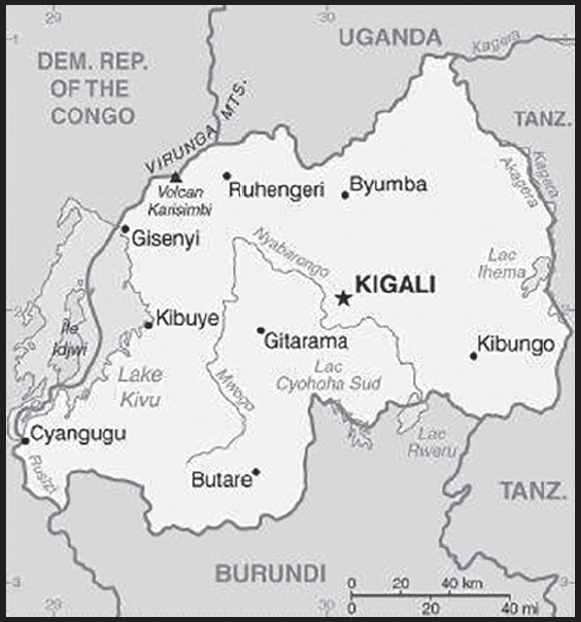
INTRODUCTION
Background: Rwanda - a small and centralized country dominated by rugged hills and fertile volcanic soil - has exerted disproportionate influence over the African Great Lakes region for centuries. A Rwandan kingdom increasingly dominated the region from the mid-18th century onward, with the Tutsi monarchs gradually extending the power of the royal court into peripheral areas and expanding their borders through military conquest. While the current ethnic labels Hutu and Tutsi predate colonial rule, their flexibility and importance have varied significantly over time and often manifested more as a hierarchical class distinction than an ethnic or cultural distinction. The majority Hutu and minority Tutsi have long shared a common language and culture, and intermarriage was not rare. The Rwandan royal court centered on the Tutsi king (mwami), who relied on an extensive hierarchy of political, cultural, and economic relationships that intertwined Rwanda’s social groups. Social categories became more rigid during the reign of RWABUGIRI (1860-1895), who focused on aggressive expansion and solidifying Rwanda’s bureaucratic structures. German colonial conquest began in the late 1890s, but the territory was ceded to Belgian forces in 1916 during World War I. Both European nations quickly realized the benefits of ruling through the already centralized Rwandan Tutsi kingdom. Colonial rule reinforced existing trends toward autocratic and exclusionary rule, leading to the elimination of traditional positions of authority for Hutus and a calcification of ethnic identities. Belgian administrators significantly increased requirements for communal labor and instituted harsh taxes, increasing frustration and inequality. Changing political attitudes in Belgium contributed to colonial and Catholic officials shifting their support from Tutsi to Hutu leaders in the years leading up to independence.
Newly mobilized political parties and simmering resentment of minority rule exploded in 1959, three years before independence from Belgium, when Hutus overthrew the Tutsi king. Thousands of Tutsis were killed over the next several years, and some 150,000 were driven into exile in neighboring countries. Army Chief of Staff Juvenal HABYARIMANA seized power in a coup in 1973 and ruled Rwanda as a single-party state for two decades. HABYARIMANA increasingly discriminated against Tutsi and extremist Hutu factions that gained prominence after multiple parties were introduced in the early 1990s. The children of Tutsi exiles later formed a rebel group, the Rwandan Patriotic Front (RPF) and began a civil war in 1990. The civil war exacerbated ethnic tensions and culminated in the shooting down of HABYARIMANA’s private jet in April 1994. The event sparked a state-orchestrated genocide in which Rwandans killed approximately 800,000 of their fellow citizens, including approximately three-quarters of the Tutsi population. The genocide ended later that same year when the predominantly Tutsi RPF, operating out of Uganda and northern Rwanda, defeated the national army and Hutu militias and established an RPF-led government of national unity. Rwanda held its first local elections in 1999 and its first post-genocide presidential and legislative elections in 2003, formalizing President Paul KAGAME’s de facto role as head of government. KAGAME was formally elected in 2010, and again in 2017 after changing the constitution to allow him to run for a third term.
GEOGRAPHY
Location: Central Africa, east of the Democratic Republic of the Congo, north of Burundi
Geographic coordinates: 2 00 S, 30 00 E
Map references: Africa
Area: total: 26,338 sq km
land: 24,668 sq km
water: 1,670 sq km
comparison ranking: total 148
Area - comparative: slightly smaller than Maryland
Land boundaries: total: 930 km
border countries (4): Burundi 315 km; Democratic Republic of the Congo 221 km; Tanzania 222 km; Uganda 172 km
Coastline: 0 km (landlocked)
Maritime claims: none (landlocked)
Climate: temperate; two rainy seasons (February to April, November to January); mild in mountains with frost and snow possible
Terrain: mostly grassy uplands and hills; relief is mountainous with altitude declining from west to east
Elevation: highest point: Volcan Karisimbi 4,519 m
lowest point: Rusizi River 950 m
mean elevation: 1,598 m
Natural resources: gold, cassiterite (tin ore), wolframite (tungsten ore), methane, hydropower, arable land
Land use: agricultural land: 74.5% (2018 est.)
arable land: 47% (2018 est.)
permanent crops: 10.1% (2018 est.)
permanent pasture: 17.4% (2018 est.)
forest: 18% (2018 est.)
other: 7.5% (2018 est.)
Irrigated land: 96 sq km (2012)
Major lakes (area sq km): fresh water lake(s): Lake Kivu (shared with Democratic Republic of Congo) - 2,220 sq km
Major rivers (by length in km): Nile river source (shared with Tanzania, Uganda, South Sudan, Sudan, and Egypt [m]) - 6,650 km
note – [s] after country name indicates river source; [m] after country name indicates river mouth
Major watersheds (area sq km): Atlantic Ocean drainage: Congo (3,730,881 sq km), (Mediterranean Sea) Nile (3,254,853 sq km)
Population distribution: one of Africa’s most densely populated countries; large concentrations tend to be in the central regions and along the shore of Lake Kivu in the west as shown in this population distribution map
Natural hazards: periodic droughts; the volcanic Virunga Mountains are in the northwest along the border with Democratic Republic of the Congo
volcanism: Visoke (3,711 m), located on the border with the Democratic Republic of the Congo, is the country’s only historically active volcano
Geography - note: landlocked; most of the country is intensively cultivated and rugged with the population predominantly rural
PEOPLE AND SOCIETY
Population: 13,400,541 (2023 est.)
comparison ranking: 76
Nationality: noun: Rwandan(s)
adjective: Rwandan
Ethnic groups: Hutu, Tutsi, Twa
Languages: Kinyarwanda (official, universal Bantu vernacular) 93.2%, French (official) <0.1, English (official) <0.1, Swahili/Kiswahili (official, used in commercial centers) <0.1, more than one language, other 6.3%, unspecified 0.3% (2002 est.)
major-language sample(s):
Inkoranya nzimbuzi y’isi, isoko fatizo y’amakuru y’ibanze. (Kinyarwanda)
Religions: Protestant 57.7% (includes Adventist 12.6%), Roman Catholic 38.2%, Muslim 2.1%, other 1% (includes traditional, Jehovah’s Witness), none 1.1% (2019-20 est.)
Demographic profile: Rwanda’s fertility rate declined sharply during the last decade, as a result of the government’s commitment to family planning, the increased use of contraceptives, and a downward trend in ideal family size. Increases in educational attainment, particularly among girls, and exposure to social media also contributed to the reduction in the birth rate. The average number of births per woman decreased from a 5.6 in 2005 to 4.5 in 2016 and 3.3 in 2022. Despite these significant strides in reducing fertility, Rwanda’s birth rate remains very high and will continue to for an extended period of time because of its large population entering reproductive age. Because Rwanda is one of the most densely populated countries in Africa, its persistent high population growth and increasingly small agricultural landholdings will put additional strain on families’ ability to raise foodstuffs and access potable water. These conditions will also hinder the government’s efforts to reduce poverty and prevent environmental degradation.
The UNHCR recommended that effective 30 June 2013 countries invoke a cessation of refugee status for those Rwandans who fled their homeland between 1959 and 1998, including the 1994 genocide, on the grounds that the conditions that drove them to seek protection abroad no longer exist. The UNHCR’s decision is controversial because many Rwandan refugees still fear persecution if they return home, concerns that are supported by the number of Rwandans granted asylum since 1998 and by the number exempted from the cessation. Rwandan refugees can still seek an exemption or local integration, but host countries are anxious to send the refugees back to Rwanda and are likely to avoid options that enable them to stay. Conversely, Rwanda itself hosts approximately 125,000 refugees as of 2022; virtually all of them fleeing conflict in neighboring Burundi and the Democratic Republic of the Congo.
Age structure: 0-14 years: 37.95% (male 2,569,106/female 2,515,849)
15-64 years: 59.1% (male 3,844,259/female 4,075,978)
65 years and over: 2.95% (2023 est.) (male 158,647/female 236,702)
Dependency ratios: total dependency ratio: 72.5
youth dependency ratio: 67.1
elderly dependency ratio: 5.4
potential support ratio: 18.4 (2021 est.)
Median age: total: 19.7 years (2020)
male: 18.9 years
female: 20.4 years
comparison ranking: total 199
Population growth rate: 1.68% (2023 est.)
comparison ranking: 54
Birth rate: 25.7 births/1,000 population (2023 est.)
comparison ranking: 44
Death rate: 5.77 deaths/1,000 population (2023 est.)
comparison ranking: 167
Net migration rate: -3.16 migrant(s)/1,000 population (2023 est.)
comparison ranking: 183
Population distribution: one of Africa’s most densely populated countries; large concentrations tend to be in the central regions and along the shore of Lake Kivu in the west as shown in this population distribution map
Urbanization: urban population: 17.9% of total population (2023)
rate of urbanization: 3.07% annual rate of change (2020-25 est.)
Major urban areas - population: 1.248 million KIGALI (capital) (2023)
Sex ratio: at birth: 1.03 male(s)/female
0-14 years: 1.02 male(s)/female
15-64 years: 0.94 male(s)/female
65 years and over: 0.67 male(s)/female
total population: 0.96 male(s)/female (2023 est.)
Mother’s mean age at first birth: 23 years (2019/20 est.)
note: data represents median age at first birth among women 25-49
Maternal mortality ratio: 259 deaths/100,000 live births (2020 est.)
comparison ranking: 37
Infant mortality rate: total: 25.64 deaths/1,000 live births (2023 est.)
male: 28.08 deaths/1,000 live births
female: 23.13 deaths/1,000 live births
comparison ranking: total 60
Life expectancy at birth: total population: 66.21 years (2023 est.)
male: 64.23 years
female: 68.24 years
comparison ranking: total population 199
Total fertility rate: 3.23 children born/woman (2023 est.)
comparison ranking: 43
Gross reproduction rate: 1.59 (2023 est.)
Contraceptive prevalence rate: 64.1% (2019/20)
Drinking water source: improved: urban: 92.3% of population
rural: 80.7% of population
total: 82.7% of population
unimproved: urban: 7.7% of population
rural: 19.3% of population
total: 17.3% of population (2020 est.)
Current health expenditure: 7.3% of GDP (2020)
Physicians density: 0.12 physicians/1,000 population (2019)
Sanitation facility access: improved: urban: 89.1% of population
rural: 83.2% of population
total: 84.2% of population
unimproved: urban: 10.9% of population
rural: 16.8% of population
total: 15.8% of population (2020 est.)
Major infectious diseases: degree of risk: very high (2023)
food or waterborne diseases: bacterial diarrhea, hepatitis A, and typhoid fever
vectorborne diseases: malaria and dengue fever
animal contact diseases: rabies
Obesity - adult prevalence rate: 5.8% (2016)
comparison ranking: 172
Alcohol consumption per capita: total: 6.35 liters of pure alcohol (2019 est.)
beer: 0.23 liters of pure alcohol (2019 est.)
wine: 0.03 liters of pure alcohol (2019 est.)
spirits: 0.09 liters of pure alcohol (2019 est.)
other alcohols: 6 liters of pure alcohol (2019 est.)
comparison ranking: total 65
Tobacco use: total: 13.7% (2020 est.)
male: 20.1% (2020 est.)
female: 7.2% (2020 est.)
comparison ranking: total 112
Children under the age of 5 years underweight: 7.7% (2019/20)
comparison ranking: 61
Currently married women (ages 15-49): 50.4% (2023 est.)
Child marriage: women married by age 18: 0.4% (2020 est.)
Education expenditures: 3.8% of GDP (2021 est.)
comparison ranking: 127
Literacy: definition: age 15 and over can read and write
total population: 75.9%
male: 78.7%
female: 73.3% (2021)
School life expectancy (primary to tertiary education): total: 11 years
male: 11 years
female: 11 years (2019)
Youth unemployment rate (ages 15-24): total: 2.9% (2021 est.)
male: 2.2%
female: 3.6%
comparison ranking: total 198
ENVIRONMENT
Environment - current issues: deforestation results from uncontrolled cutting of trees for fuel; overgrazing; land degradation; soil erosion; a decline in soil fertility (soil exhaustion); wetland degradation and loss of biodiversity; widespread poaching
Environment - international agreements: party to: Biodiversity, Climate Change, Climate Change-Kyoto Protocol, Comprehensive Nuclear Test Ban, Desertification, Endangered Species, Hazardous Wastes, Nuclear Test Ban, Ozone Layer Protection, Wetlands
signed, but not ratified: Law of the Sea
Climate: temperate; two rainy seasons (February to April, November to January); mild in mountains with frost and snow possible
Land use: agricultural land: 74.5% (2018 est.)
arable land: 47% (2018 est.)
permanent crops: 10.1% (2018 est.)
permanent pasture: 17.4% (2018 est.)
forest: 18% (2018 est.)
other: 7.5% (2018 est.)
Urbanization: urban population: 17.9% of total population (2023)
rate of urbanization: 3.07% annual rate of change (2020-25 est.)
Revenue from forest resources: 3.75% of GDP (2018 est.)
comparison ranking: 20
Revenue from coal: 0% of GDP (2018 est.)
comparison ranking: 168
Air pollutants: particulate matter emissions: 35.66 micrograms per cubic meter (2019 est.)
carbon dioxide emissions: 1.11 megatons (2016 est.)
methane emissions: 2.92 megatons (2020 est.)
Waste and recycling: municipal solid waste generated annually: 4,384,969 tons (2016 est.)
Major lakes (area sq km): fresh water lake(s): Lake Kivu (shared with Democratic Republic of Congo) - 2,220 sq km
Major rivers (by length in km): Nile river source (shared with Tanzania, Uganda, South Sudan, Sudan, and Egypt [m]) - 6,650 km
note – [s] after country name indicates river source; [m] after country name indicates river mouth
Major watersheds (area sq km): Atlantic Ocean drainage: Congo (3,730,881 sq km), (Mediterranean Sea) Nile (3,254,853 sq km)
Total water withdrawal: municipal: 230 million cubic meters (2020 est.)
industrial: 10 million cubic meters (2020 est.)
agricultural: 360 million cubic meters (2020 est.)
Total renewable water resources: 13.3 billion cubic meters (2020 est.)
GOVERNMENT
Country name: conventional long form: Republic of Rwanda
conventional short form: Rwanda
local long form: Republika y’u Rwanda
local short form: Rwanda
former: Kingdom of Rwanda, Ruanda, German East Africa
etymology: the name translates as “domain” in the native Kinyarwanda language
Government type: presidential republic
Capital: name: Kigali
geographic coordinates: 1 57 S, 30 03 E
time difference: UTC+2 (7 hours ahead of Washington, DC, during Standard Time)
etymology: the city takes its name from nearby Mount Kigali; the name “Kigali” is composed of the Bantu prefix ki and the Rwandan gali meaning “broad” and likely refers to the broad, sprawling hill that has been dignified with the title of “mount”
Administrative divisions: 4 provinces (in French - provinces, singular - province; in Kinyarwanda - intara for singular and plural) and 1 city* (in French - ville; in Kinyarwanda - umujyi); Est (Eastern), Kigali*, Nord (Northern), Ouest (Western), Sud (Southern)
Independence: 1 July 1962 (from Belgium-administered UN trusteeship)
National holiday: Independence Day, 1 July (1962)
Constitution: history: several previous; latest adopted by referendum 26 May 2003, effective 4 June 2003
amendments: proposed by the president of the republic (with Council of Ministers approval) or by two-thirds majority vote of both houses of Parliament; passage requires at least three-quarters majority vote in both houses; changes to constitutional articles on national sovereignty, the presidential term, the form and system of government, and political pluralism also require approval in a referendum; amended several times, last in 2015
Legal system: mixed legal system of civil law, based on German and Belgian models, and customary law; judicial review of legislative acts in the Supreme Court
International law organization participation: has not submitted an ICJ jurisdiction declaration; non-party state to the ICCt
Citizenship: citizenship by birth: no
citizenship by descent only: the father must be a citizen of Rwanda; if the father is stateless or unknown, the mother must be a citizen
dual citizenship recognized: no
residency requirement for naturalization: 10 years
Suffrage: 18 years of age; universal
Executive branch: chief of state: President Paul KAGAME (since 22 April 2000)
head of government: Prime Minister Edouard NGIRENTE (since 30 August 2017)
cabinet: Council of Ministers appointed by the president
elections/appointments: president directly elected by simple majority popular -vote for a 5-year term (eligible for a second term); note - a constitutional amendment approved in December 2016 reduced the presidential term from 7 to 5 years but included an exception that allowed President KAGAME to serve another 7-year term in 2017, potentially followed by two additional 5-year terms; election last held on 4 August 2017 (next to be held in August 2024); prime minister appointed by the president
election results:
2017: Paul KAGAME reelected president; Paul KAGAME (RPF) 98.8%, Philippe MPAYIMANA (independent), other 1.2%
2010: Paul KAGAME reelected president; Paul KAGAME (RPF) 93.1%, Jean NTAWUKURIRYAYO (PSD) 5.1%, other 1.8%
Legislative branch: description: bicameral Parliament consists of:
Senate or Senat (26 seats; 12 members indirectly elected by local councils, 8 appointed by the president, 4 appointed by the Political Organizations Forum - a body of registered political parties, and 2 selected by institutions of higher learning; members serve 8-year terms)
Chamber of Deputies or Chambre des Deputes (80 seats; 53 members directly elected by proportional representation vote, 24 women selected by special interest groups, and 3 selected by youth and disability organizations; members serve 5-year terms)
elections:
Senate - last held on 16-18 September 2019 (next to be held in 2027)
Chamber of Deputies - last held on 3 September 2018 (next to be held in August 2024)
election results:
Senate - percent of vote by party - NA; seats by party - NA; composition - men 17, women 9, percent of women 34.6%
Chamber of Deputies - percent of vote by party - NA; seats by party - Rwandan Patriotic Front Coalition 40, PSD 5, PL 4, other 4 indirectly elected 27; composition - men 31, women 49, percent of women 54.7%; note - total Parliament percent of women 54.7%
Judicial branch: highest court(s): Supreme Court (consists of the chief and deputy chief justices and 15 judges; normally organized into 3-judge panels); High Court (consists of the court president, vice president, and a minimum of 24 judges and organized into 5 chambers)
judge selection and term of office: Supreme Court judges nominated by the president after consultation with the Cabinet and the Superior Council of the Judiciary (SCJ), a 27-member body of judges, other judicial officials, and legal professionals) and approved by the Senate; chief and deputy chief justices appointed for 8-year nonrenewable terms; tenure of judges NA; High Court president and vice president appointed by the president of the republic upon approval by the Senate; judges appointed by the Supreme Court chief justice upon approval of the SCJ; judge tenure NA
subordinate courts: High Court of the Republic; commercial courts including the High Commercial Court; intermediate courts; primary courts; and military specialized courts
Political parties and leaders: Democratic Green Party of Rwanda or DGPR [Frank HABINEZA]
Liberal Party or PL [Donatille MUKABALISA]
Party for Progress and Concord or PPC [Dr. Alivera MUKABARAMBA]
Rwandan Patriotic Front or RPF [Paul KAGAME]
Rwandan Patriotic Front Coalition (includes RPF, PPC) [Paul KAGAME]
Social Democratic Party or PSD [Vincent BIRUTA]
Social Party Imberakuri or PS-Imberakuri [Christine MUKABUNANI]
International organization participation: ACP, AfDB, AU, C, CEPGL, COMESA, EAC, EADB, FAO, G-77, IAEA, IBRD, ICAO, ICRM, IDA, IFAD, IFC, IFRCS, ILO, IMF, Interpol, IOC, IOM, IPU, ISO, ITSO, ITU, ITUC (NGOs), MIGA, MINUSMA, NAM, OIF, OPCW, PCA, UN, UNCTAD, UNESCO, UNHCR, UNIDO, UNISFA, UNMISS, UNWTO, UPU, WCO, WHO, WIPO, WMO, WTO
Diplomatic representation in the US: chief of mission: Ambassador Mathilde MUKANTABANA (since 18 July 2013)
chancery: 1714 New Hampshire Avenue NW, Washington, DC 20009
telephone: [1] (202) 232-2882
FAX: [1] (202) 232-4544
email address and website:
Diplomatic representation from the US: chief of mission: Ambassador Eric KNEEDLER (since 3 October 2023)
embassy: 2657 Avenue de la Gendarmerie (Kaciyiru), P. O. Box 28 Kigali
mailing address: 2210 Kigali Place, Washington DC 20521-2210
telephone: [250] 252 596-400
FAX: [250] 252 580-325
email address and website:
Flag description: three horizontal bands of sky blue (top, double width), yellow, and green, with a golden sun with 24 rays near the fly end of the blue band; blue represents happiness and peace, yellow economic development and mineral wealth, green hope of prosperity and natural resources; the sun symbolizes unity, as well as enlightenment and transparency from ignorance
National symbol(s): traditional woven basket with peaked lid; national colors: blue, yellow, green
National anthem: name: “Rwanda nziza” (Rwanda, Our Beautiful Country)
lyrics/music: Faustin MURIGO/Jean-Bosco HASHAKAIMANA
note: adopted 2001
ECONOMY
Economic overview: fast-growing Sub-Saharan economy; major public investments; trade and tourism hit hard by COVID-19; increasing poverty after 2 decades of declines; Ugandan competition for regional influence; major coffee exporter; contested GDP figures
Real GDP (purchasing power parity): $30.141 billion (2021 est.)
$27.182 billion (2020 est.)
$28.127 billion (2019 est.)
note: data are in 2017 dollars
comparison ranking: 138
Real GDP growth rate: 10.88% (2021 est.)
-3.36% (2020 est.)
9.46% (2019 est.)
comparison ranking: 22
Real GDP per capita: $2,200 (2021 est.)
$2,100 (2020 est.)
$2,200 (2019 est.)
note: data are in 2017 dollars
comparison ranking: 206
GDP (official exchange rate): $9.136 billion (2017 est.)
Inflation rate (consumer prices): -0.39% (2021 est.)
9.85% (2020 est.)
3.35% (2019 est.)
comparison ranking: 219
Credit ratings:
Fitch rating: B+ (2014)
Moody’s rating: B2 (2016)
Standard & Poors rating: B+ (2019)
note: The year refers to the year in which the current credit rating was first obtained.
GDP - composition, by sector of origin: agriculture: 30.9% (2017 est.)
industry: 17.6% (2017 est.)
services: 51.5% (2017 est.)
comparison rankings: services 172; industry 166; agriculture 17
GDP - composition, by end use: household consumption: 75.9% (2017 est.)
government consumption: 15.2% (2017 est.)
investment in fixed capital: 22.9% (2017 est.)
investment in inventories: 0.5% (2017 est.)
exports of goods and services: 18.2% (2017 est.)
imports of goods and services: -32.8% (2017 est.)
Agricultural products: bananas, sweet potatoes, cassava, potatoes, plantains, beans, maize, gourds, milk, taro
Industries: cement, agricultural products, small-scale beverages, soap, furniture, shoes, plastic goods, textiles, cigarettes
Industrial production growth rate: 13.4% (2021 est.)
comparison ranking: 19
Labor force: 6.776 million (2021 est.)
comparison ranking: 70
Labor force - by occupation: agriculture: 75.3%
industry: 6.7%
services: 18% (2012 est.)
Unemployment rate: 1.61% (2021 est.)
1.49% (2020 est.)
1.1% (2019 est.)
comparison ranking: 218
Youth unemployment rate (ages 15-24): total: 2.9% (2021 est.)
male: 2.2%
female: 3.6%
comparison ranking: total 198
Population below poverty line: 38.2% (2016 est.)
Gini Index coefficient - distribution of family income: 43.7 (2016 est.)
comparison ranking: 32
Household income or consumption by percentage share: lowest 10%: 2.1%
highest 10%: 43.2% (2011 est.)
Budget: revenues: $2.393 billion (2019 est.)
expenditures: $2.919 billion (2019 est.)
Budget surplus (+) or deficit (-): -4.3% (of GDP) (2017 est.)
comparison ranking: 160
Public debt: 40.5% of GDP (2017 est.)
37.3% of GDP (2016 est.)
comparison ranking: 134
Taxes and other revenues: 15.06% (of GDP) (2020 est.)
comparison ranking: 142
Fiscal year: calendar year
Current account balance: -$1.209 billion (2021 est.)
-$1.228 billion (2020 est.)
-$1.231 billion (2019 est.)
comparison ranking: 139
Exports: $2.11 billion (2021 est.) note: data are in current year dollars
$1.929 billion (2020 est.) note: data are in current year dollars
$2.255 billion (2019 est.)
comparison ranking: 159
Exports - partners: United Arab Emirates 35%, Democratic Republic of the Congo 28%, Uganda 5% (2019)
Exports - commodities: gold, refined petroleum, coffee, tea, tin (2019)
Imports: $3.856 billion (2021 est.) note: data are in current year dollars
$3.578 billion (2020 est.) note: data are in current year dollars
$3.737 billion (2019 est.)
comparison ranking: 154
Imports - partners: China 17%, Kenya 10%, Tanzania 9%, United Arab Emirates 9%, India 7%, Saudi Arabia 5% (2019)
Imports - commodities: refined petroleum, gold, raw sugar, packaged medicines, broadcasting equipment (2019)
Reserves of foreign exchange and gold: $1.895 billion (31 December 2021 est.)
$1.806 billion (31 December 2020 est.)
$1.465 billion (31 December 2019 est.)
comparison ranking: 132
Debt - external: $3.258 billion (31 December 2017 est.)
$2.611 billion (31 December 2016 est.)
comparison ranking: 141
Exchange rates: Rwandan francs (RWF) per US dollar -
Exchange rates:: 988.625 (2021 est.)
943.278 (2020 est.)
899.351 (2019 est.)
861.093 (2018 est.)
831.554 (2017 est.)
ENERGY
Electricity access: population without electricity: 5.8 million (2020)
electrification - total population: 48.7% (2021)
electrification - urban areas: 97.9% (2021)
electrification - rural areas: 38.1% (2021)
Electricity: installed generating capacity: 265,000 kW (2020 est.)
consumption: 1,007,300,000 kWh (2019 est.)
exports: 4.5 million kWh (2019 est.)
imports: 93.96 million kWh (2019 est.)
transmission/distribution losses: 142 million kWh (2019 est.)
comparison rankings: installed generating capacity 165; transmission/distribution losses 154; imports 109; exports 96; consumption 158
Electricity generation sources: fossil fuels: 39% of total installed capacity (2020 est.)
solar: 6.5% of total installed capacity (2020 est.)
hydroelectricity: 53.9% of total installed capacity (2020 est.)
biomass and waste: 0.6% of total installed capacity (2020 est.)
Petroleum: total petroleum production: 0 bbl/day (2021 est.)
refined petroleum consumption: 8,300 bbl/day (2019 est.)
Refined petroleum products - imports: 6,628 bbl/day (2015 est.)
comparison ranking: 162
Natural gas: proven reserves: 56.634 billion cubic meters (2021 est.)
Carbon dioxide emissions: 1.189 million metric tonnes of CO2 (2019 est.)
from petroleum and other liquids: 1.189 million metric tonnes of CO2 (2019 est.)
comparison ranking: total emissions 170
Energy consumption per capita: 1.704 million Btu/person (2019 est.)
comparison ranking: 189
COMMUNICATIONS
Telephones - fixed lines: total subscriptions: 11,893 (2021 est.)
subscriptions per 100 inhabitants: (2021 est.) less than 1
comparison ranking: total subscriptions 185
Telephones - mobile cellular: total subscriptions: 10,902,989 (2021 est.)
subscriptions per 100 inhabitants: 81 (2021 est.)
comparison ranking: total subscriptions 89
Telecommunication systems: general assessment: Rwanda was slow to liberalize the mobile sector; there was effective competition among three operators; the fixed broadband sector has suffered from limited fixed-line infrastructure and high prices; operators are rolling out national backbone networks which also allow them to connect to the international submarine cables on Africa’s east coast; these cables gave the entire region greater internet bandwidth and ended the dependency on satellites; while the country also has a new cable link with Tanzania, and via Tanzania’s national broadband backbone it has gained connectivity to the networks of several other countries in the region; the number of subscribers on LTE infrastructure has increased sharply, helped by national LTE coverage achieved in mid-2018; mobile remains the dominant platform for voice and data services; the regulator noted that the number of mobile subscribers increased 2.7% in 2021, year-on-year; there was a slight fall in the beginning of 2022 (2022)
domestic: fixed-line less than 1 per 100 and mobile-cellular telephone density is 81 telephones per 100 persons (2021)
international: country code - 250; international connections employ microwave radio relay to neighboring countries and satellite communications to more distant countries; satellite earth stations - 1 Intelsat (Indian Ocean) in Kigali (includes telex and telefax service); international submarine fiber-optic cables on the African east coast has brought international bandwidth and lessened the dependency on satellites
Broadcast media: 13 TV stations; 35 radio stations registered, including international broadcasters, government owns most popular TV and radio stations; regional satellite-based TV services available
Internet country code: .rw
Internet users: total: 3.9 million (2021 est.)
percent of population: 30% (2021 est.)
comparison ranking: total 112
Broadband - fixed subscriptions: total: 17,685 (2020 est.)
subscriptions per 100 inhabitants: 0.1 (2020 est.)
comparison ranking: total 171
TRANSPORTATION
National air transport system: number of registered air carriers: 1 (2020)
inventory of registered aircraft operated by air carriers: 12
annual passenger traffic on registered air carriers: 1,073,528 (2018)
Civil aircraft registration country code prefix: 9XR
Airports: 7 (2021)
comparison ranking: total 167
Airports - with paved runways: 4
note: paved runways have a concrete or asphalt surface but not all have facilities for refueling, maintenance, or air traffic control; the length of a runway required for aircraft to safely operate depends on a number of factors including the type of aircraft, the takeoff weight (including passengers, cargo, and fuel), engine types, flap settings, landing speed, elevation of the airport, and average maximum daily air temperature; paved runways can reach a length of 5,000 m (16,000 ft.), but the “typical” length of a commercial airline runway is between 2,500-4,000 m (8,000-13,000 ft.)
Airports - with unpaved runways: 3
note: unpaved runways have a surface composition such as grass or packed earth and are most suited to the operation of light aircraft; unpaved runways are usually short, often less than 1,000 m (3,280 ft.) in length; airports with unpaved runways often lack facilities for refueling, maintenance, or air traffic control
Roadways: total: 4,700 km (2012)
paved: 1,207 km (2012)
unpaved: 3,493 km (2012)
comparison ranking: total 148
Waterways: 90 km (2022) (Lake Kivu navigable by shallow-draft barges and native craft)
comparison ranking: 112
Ports and terminals: lake port(s): Cyangugu, Gisenyi, Kibuye (Lake Kivu)
MILITARY AND SECURITY
Military and security forces: Rwanda Defense Force (RDF; Ingabo z’u Rwanda): Rwanda Army (Rwanda Land Force), Rwanda Air Force (Force Aerienne Rwandaise, FAR), Rwanda Reserve Force, Special Units; Ministry of Internal Security: Rwanda National Police (2023)
Military expenditures: 1.4% of GDP (2022 est.)
1.4% of GDP (2021 est.)
1.3% of GDP (2020 est.)
1.2% of GDP (2019 est.)
1.2% of GDP (2018 est.)
comparison ranking: 93
Military and security service personnel strengths: approximately 33,000 active RDF personnel (32,000 Army; 1,000 Air Force) (2023)
Military equipment inventories and acquisitions: the RDF’s inventory includes mostly Soviet-era and older Western--largely French and South African--equipment; in recent years, Russia has been the top supplier of arms to Rwanda (2023)
Military service age and obligation: 18 years of age for men and women for voluntary military service; no conscription; Rwandan citizenship is required; enlistment is either as contract (5-years, renewable twice) or career (2023)
note: as of 2022, women comprised approximately 6% of the Rwanda Defense Force
Military deployments: 4,000 Central African Republic (approximately 2,800 for MINUSCA, including 700 police; an additional 1,200 troops sent separately under a bilateral arrangement to support and train Central African military forces); up to 3,000 Mozambique (deployed mid-2021 under a bilateral agreement to assist with combating an insurgency; includes both military and police forces); 2,600 (plus about 400 police) South Sudan (UNMISS) (2023)
Military - note: the RDF is lightly equipped and widely regarded as one of East Africa’s best trained, experienced, and most professional militaries; the Army is relatively large with 4 divisions that are mostly comprised of light infantry brigades; it also has separate artillery, presidential guard, and special operations brigades; the Air Force has a small inventory of combat helicopters and a handful of transport aircraft the RDF’s principle responsibilities are ensuring territorial integrity and national sovereignty and preventing infiltrations of illegal armed groups from neighboring countries, particularly the Democratic Republic of the Congo (DRC); since 2021, Rwanda has deployed troops to the border with the DRC to combat the rebel Democratic Forces for the Liberation of Rwanda (FDLR), which it has accused the DRC of backing; the RDF has been accused by the DRC Government of making incursions into the DRC and providing material support to the March 23 Movement (M23, aka Congolese Revolutionary Army) rebel group, which has been fighting with DRC troops and UN peacekeeping forces; the RDF also participates in UN and regional military operations; over 6,000 RDF personnel are deployed in the Central African Republic, Mozambique, and South Sudan
the Rwandan Armed Forces (FAR) were established following independence in 1962; after the 1990-1994 civil war and genocide, the victorious Tutsi-dominated Rwandan Patriotic Front’s military wing, the Rwandan Patriotic Army (RPA), became the country’s military force; the RPA participated in the First (1996-1997) and Second (1998-2003) Congolese Wars; the RPA was renamed the Rwanda Defense Force (RDF) in 2003, by which time it had assumed a more national character with the inclusion of many former Hutu officers as well as newly recruited soldiers (2023)
SPACE
Space agency/agencies: Rwanda Space Agency (RSA; established 2020 and approved by legislature in 2021) (2023)
Space program overview: has a small program focused on developing and utilizing space technologies, such as satellite imagery for socioeconomic development and security purposes; operates communications and remote sensing (RS) satellites; the RSA is responsible for regulating and coordinating the country’s space activities and encouraging commercial and industrial development; has established ties with the space agencies or industries of several countries, including France, Israel, Japan, the UAE, and the US (2023)
note: further details about the key activities, programs, and milestones of the country’s space program, as well as government spending estimates on the space sector, appear in Appendix S
TRANSNATIONAL ISSUES
Disputes - international: Rwanda-Burundi: Burundi’s Ngozi province and Rwanda’s Butare province dispute the two-kilometer-square hilly farmed area of Sabanerwa in the Rukurazi Valley where the Akanyaru/Kanyaru River shifted its course southward after heavy rains in 1965 around Kibinga Hill in Rwanda’s Butare Province
Rwanda-Democratic Republic of Congo (DRC): the 2005 DRC and Rwanda border verification mechanism to stem rebel actions on both sides of the border remains in place
Rwanda-Uganda: a joint technical committee established in 2007 to demarcate sections of the border
Refugees and internally displaced persons: refugees (country of origin): 79,606 (Democratic Republic of the Congo), 48,214 (Burundi) (2023)
stateless persons: 9,500 (2022)