T
TAIWAN
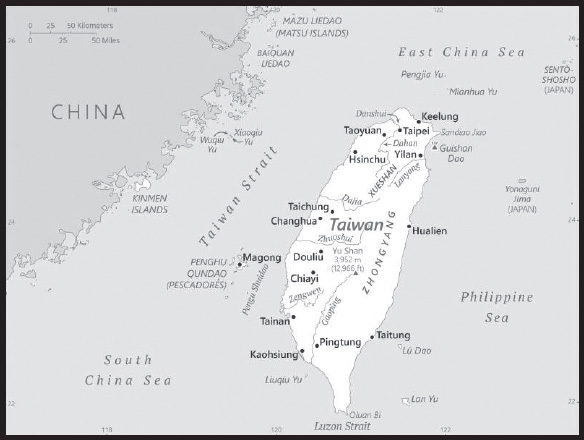
INTRODUCTION
Background: First inhabited by Austronesian people, Taiwan became home to Han immigrants beginning in the late Ming Dynasty (17th century). In 1895, military defeat forced China’s Qing Dynasty to cede Taiwan to Japan, which then governed Taiwan for 50 years. Taiwan came under Chinese Nationalist (Kuomintang, KMT) control after World War II. With the communist victory in the Chinese civil war in 1949, the Nationalist-controlled Republic of China government and 2 million Nationalists fled to Taiwan and continued to claim to be the legitimate government for mainland China and Taiwan based on a 1947 constitution drawn up for all of China. Until 1987, however, the Nationalist Government ruled Taiwan under a civil war martial law declaration dating to 1948. Beginning in the 1970s, Nationalist authorities gradually began to incorporate the native population into the governing structure beyond the local level. The democratization process expanded rapidly in the 1980s, leading to the then illegal founding of the Democratic Progressive Party (DPP), Taiwan’s first opposition party, in 1986 and the lifting of martial law the following year. Taiwan held legislative elections in 1992, the first in over 40 years, and its first direct presidential election in 1996. In the 2000 presidential elections, Taiwan underwent its first peaceful transfer of power with the KMT loss to the DPP and afterwards experienced two additional democratic transfers of power in 2008 and 2016. Throughout this period, the island prospered, became one of East Asia’s economic “Tigers,” and after 2000 became a major investor in mainland China as cross-Strait ties matured. The dominant political issues continue to be economic reform and growth as well as management of sensitive relations between Taiwan and China.
GEOGRAPHY
Location: Eastern Asia, islands bordering the East China Sea, Philippine Sea, South China Sea, and Taiwan Strait, north of the Philippines, off the southeastern coast of China
Geographic coordinates: 23 30 N, 121 00 E
Map references: Southeast Asia
Area: total: 35,980 sq km
land: 32,260 sq km
water: 3,720 sq km
note: includes the Pescadores, Matsu, and Kinmen islands
comparison ranking: total 138
Area - comparative: slightly smaller than Maryland and Delaware combined
Land boundaries: total: 0 km
Coastline: 1,566.3 km
Maritime claims: territorial sea: 12 nm
exclusive economic zone: 200 nm
Climate: tropical; marine; rainy season during southwest monsoon (June to August); persistent and extensive cloudiness all year
Terrain: eastern two-thirds mostly rugged mountains; flat to gently rolling plains in west
Elevation: highest point: Yu Shan 3,952 m
lowest point: South China Sea 0 m
mean elevation: 1,150 m
Natural resources: small deposits of coal, natural gas, limestone, marble, asbestos, arable land
Land use: agricultural land: 22.7% (2018 est.)
arable land: 16.9% (2018 est.)
permanent crops: 5.8% (2018 est.)
other: 77.3% (2018 est.)
Irrigated land: 3,820 sq km (2012)
Population distribution: distribution exhibits a peripheral coastal settlement pattern, with the largest populations on the north and west coasts
Natural hazards: earthquakes; typhoons
volcanism: Kueishantao Island (401 m), east of Taiwan, is its only historically active volcano, although it has not erupted in centuries
Geography - note: strategic location adjacent to both the Taiwan Strait and the Luzon Strait
PEOPLE AND SOCIETY
Population: 23,588,613 (2023 est.)
comparison ranking: 57
Nationality: noun: Taiwan (singular and plural)
adjective: Taiwan (or Taiwanese)
note: example - he or she is from Taiwan; they are from Taiwan
Ethnic groups: Han Chinese (including Holo, who compose approximately 70% of Taiwan’s population, Hakka, and other groups originating in mainland China) more than 95%, indigenous Malayo-Polynesian peoples 2.3%
note 1: there are 16 officially recognized indigenous groups: Amis, Atayal, Bunun, Hla’alua, Kanakaravu, Kavalan, Paiwan, Puyuma, Rukai, Saisiyat, Sakizaya, Seediq, Thao, Truku, Tsou, and Yami; Amis, Paiwan, and Atayal are the largest and account for roughly 70% of the indigenous population
note 2: although not definitive, the majority of current genetic, archeological, and linguistic data support the theory that Taiwan is the ultimate source for the spread of humans across the Pacific to Polynesia; the expansion (ca. 3000 B.C. to A.D. 1200) took place via the Philippines and eastern Indonesia and reached Fiji and Tonga by about 900 B.C.; from there voyagers spread across the rest of the Pacific islands over the next two millennia
Languages: Mandarin (official), Min Nan, Hakka dialects, approximately 16 indigenous languages
major-language sample(s):

Religions: Buddhist 35.3%, Taoist 33.2%, Christian 3.9%, folk religion (includes Confucian) approximately 10%, none or unspecified 18.2% (2005 est.)
Age structure: 0-14 years: 12.22% (male 1,482,120/female 1,399,336)
15-64 years: 69.72% (male 8,211,973/female 8,233,667)
65 years and over: 18.07% (2023 est.) (male 1,922,365/female 2,339,152)
Dependency ratios: total dependency ratio: 40.2
youth dependency ratio: 17.8
elderly dependency ratio: 22.4
potential support ratio: 4.5 (2021 est.)
Median age: total: 44 years (2023 est.)
male: 43 years
female: 45 years
comparison ranking: total 30
Population growth rate: 0.03% (2023 est.)
comparison ranking: 191
Birth rate: 7.3 births/1,000 population (2023 est.)
comparison ranking: 220
Death rate: 8 deaths/1,000 population (2023 est.)
comparison ranking: 90
Net migration rate: 1 migrant(s)/1,000 population (2023 est.)
comparison ranking: 69
Population distribution: distribution exhibits a peripheral coastal settlement pattern, with the largest populations on the north and west coasts
Urbanization: urban population: 80.1% of total population (2023)
rate of urbanization: 0.65% annual rate of change (2020-25 est.)
Major urban areas - population: 4.504 million New Taipei City, 2.754 million TAIPEI (capital), 2.319 million Taoyuan, 1.553 million Kaohsiung, 1.369 million Taichung, 863,000 Tainan (2023)
Sex ratio: at birth: 1.06 male(s)/female
0-14 years: 1.06 male(s)/female
15-64 years: 1 male(s)/female
65 years and over: 0.82 male(s)/female
total population: 0.97 male(s)/female (2023 est.)
Infant mortality rate: total: 3.9 deaths/1,000 live births (2023 est.)
male: 4.2 deaths/1,000 live births
female: 3.6 deaths/1,000 live births
comparison ranking: total 190
Life expectancy at birth: total population: 81.4 years (2023 est.)
male: 78.4 years
female: 84.5 years
comparison ranking: total population 43
Total fertility rate: 1.09 children born/woman (2023 est.)
comparison ranking: 227
Gross reproduction rate: 0.53 (2023 est.)
Contraceptive prevalence rate: 75.2% (2016)
note: percent of women aged 20-52
Currently married women (ages 15-49): 51% (2023 est.)
Literacy: definition: age 15 and over can read and write
total population: 98.5%
male: 99.7%
female: 97.3% (2014)
ENVIRONMENT
Environment - current issues: air pollution; water pollution from industrial emissions, raw sewage; contamination of drinking water supplies; trade in endangered species; low-level radioactive waste disposal
Climate: tropical; marine; rainy season during southwest monsoon (June to August); persistent and extensive cloudiness all year
Land use: agricultural land: 22.7% (2018 est.)
arable land: 16.9% (2018 est.)
permanent crops: 5.8% (2018 est.)
other: 77.3% (2018 est.)
Urbanization: urban population: 80.1% of total population (2023)
rate of urbanization: 0.65% annual rate of change (2020-25 est.)
Waste and recycling: municipal solid waste generated annually: 7.336 million tons (2015 est.)
Total renewable water resources: 67 cubic meters (2011)
GOVERNMENT
Country name: conventional long form: none
conventional short form: Taiwan
local long form: none
local short form: Taiwan
former: Formosa
etymology: “Tayowan” was the name of the coastal sandbank where the Dutch erected their colonial headquarters on the island in the 17th century; the former name “Formosa” means “beautiful” in Portuguese
Government type: semi-presidential republic
Capital: name: Taipei
geographic coordinates: 25 02 N, 121 31 E
time difference: UTC+8 (13 hours ahead of Washington, DC, during Standard Time)
etymology: the Chinese meaning is “Northern Taiwan,” reflecting the city’s position in the far north of the island
Administrative divisions: includes main island of Taiwan plus smaller islands nearby and off coast of China’s Fujian Province; Taiwan is divided into 13 counties (xian, singular and plural), 3 cities (shi, singular and plural), and 6 special municipalities directly under the jurisdiction of the Executive Yuan
counties: Changhua, Chiayi, Hsinchu, Hualien, Kinmen, Lienchiang, Miaoli, Nantou, Penghu, Pingtung, Taitung, Yilan, Yunlin
cities: Chiayi, Hsinchu, Keelung
special municipalities: Kaohsiung (city), New Taipei (city), Taichung (city), Tainan (city), Taipei (city), Taoyuan (city)
note: Taiwan uses a variety of romanization systems; while a modified Wade-Giles system still dominates, the city of Taipei has adopted a Pinyin romanization for street and place names within its boundaries; other local authorities use different romanization systems
National holiday: Republic Day (National Day), 10 October (1911); note - celebrates the anniversary of the Chinese Revolution, also known as Double Ten (10-10) Day
Constitution: history: previous 1912, 1931; latest adopted 25 December 1946, promulgated 1 January 1947, effective 25 December 1947
amendments: proposed by at least one fourth of the Legislative Yuan membership; passage requires approval by at least three-fourths majority vote of at least three fourths of the Legislative Yuan membership and approval in a referendum by more than half of eligible voters; revised several times, last in 2005
Legal system: civil law system
International law organization participation: has not submitted an ICJ jurisdiction declaration; non-party state to the ICCt
Citizenship: citizenship by birth: no
citizenship by descent only: at least one parent must be a citizen of Taiwan
dual citizenship recognized: yes, except that citizens of Taiwan are not recognized as dual citizens of the People’s Republic of China
residency requirement for naturalization: 5 years
Suffrage: 20 years of age; universal; note - in March 2022, the Legislative Yuan approved lowering the voting age to 18, but the change will require a constitutional amendment that must be submitted to a referendum
Executive branch: chief of state: President TSAI Ing-wen (since 20 May 2016); Vice President LAI Ching-te (since 20 May 2020)
head of government: Premier CHEN Chien-jen (President of the Executive Yuan) (since 25 January 2023); Vice Premier CHENG Wen-tsan (Vice President of the Executive Yuan) (since 25 January 2023)
cabinet: Executive Yuan - ministers appointed by president on recommendation of premier
elections/appointments: president and vice president directly elected on the same ballot by simple majority popular vote for a 4-year term (eligible for a second term); election last held on 11 January 2020 (next to be held on 13 January 2024); premier appointed by the president; vice premiers appointed by the president on the recommendation of the premier
election results: 2020: TSAI Ing-wen reelected president; percent of vote - TSAI Ing-wen (DPP) 57.1%, HAN Kuo-yu (KMT) 38.6%, James SOONG (PFP) 4.2%; note - TSAI is the first woman elected president of Taiwan
2016: TSAI Ing-wen elected president; percent of vote - TSAI Ing-wen (DPP) 56.1%, Eric CHU (KMT) 31%, James SOONG (PFP) 12.8%
Legislative branch: description: unicameral Legislative Yuan (113 seats; 73 members directly elected in single-seat constituencies by simple majority vote, 34 directly elected in a single island-wide constituency by proportional representation vote, and 6 directly elected in multi-seat aboriginal constituencies by proportional representation vote; members serve 4-year terms)
elections: last held on 11 January 2020 (next to be held on 13 January 2024)
election results: percent of vote by party - Democratic Progressive Party (DPP) 34.0%, Kuomintang (KMT) 33.4%, Taiwan People’s Party (TPP) 11.2%, New Power Party (NPP) 7.5%; seats by party - DPP 61, KMT 38, TPP 5, NPP 3; composition as of early 2020 - men 64, women 48, percent of women 42.5%
Judicial branch: highest court(s): Supreme Court (consists of the court president, vice president, and approximately 100 judges organized into 8 civil and 12 criminal divisions, each with a division chief justice and 4 associate justices); Constitutional Court (consists of the court president, vice president, and 13 justices)
judge selection and term of office: Supreme Court justices appointed by the president; Constitutional Court justices appointed by the president, with approval of the Legislative Yuan; Supreme Court justices serve for life; Constitutional Court justices appointed for 8-year terms, with half the membership renewed every 4 years
subordinate courts: high courts; district courts; hierarchy of administrative courts
Political parties and leaders: Democratic Progressive Party or DPP [LAI Ching-te]
Kuomintang or KMT (Nationalist Party) [Eric CHU Chi-luan]
New Power Party or NPP [CHEN Jiau-hua]
People First Party or PFP [James SOONG]
Taiwan People’s Party or TPP [KO Wen-je]
Taiwan Statebuilding Party or TSP [CHEN Yi-chi]
note: the DPP and the KMT are the two major political parties; there are hundreds of registered minor parties
International organization participation: ADB (Taipei, China), APEC (Chinese Taipei), BCIE, IOC, ITUC (NGOs), SICA (observer), WTO (Taipei, China);
note - separate customs territory of Taiwan, Penghu, Kinmen, and Matsu
Diplomatic representation in the US: chief of mission: none; commercial and cultural relations with its citizens in the US are maintained through an unofficial instrumentality, the Taipei Economic and Cultural Representative Office in the United States (TECRO), a private nonprofit corporation that performs citizen and consular services similar to those at diplomatic posts, represented by HSIAO Bi-khim (since 20 July 2020); office: 4201 Wisconsin Avenue NW, Washington, DC 20016; telephone: [1] (202) 895-1800; fax: [1] (202) 363-0999
Taipei Economic and Cultural Offices (branch offices): Atlanta, Boston, Chicago, Denver (CO), Houston, Honolulu, Los Angeles, Miami, New York, San Francisco, Seattle
Diplomatic representation from the US: chief of mission: the US does not have an embassy in Taiwan; commercial and cultural relations with the people of Taiwan are maintained through an unofficial instrumentality, the American Institute in Taiwan (AIT), a private nonprofit corporation that performs citizen and consular services similar to those at diplomatic posts; it is managed by Director Sandra OUDKIRK (since July 2021)
mailing address: 4170 AIT Taipei Place, Washington DC 20521-4170
telephone: [886] 2-2162-2000
FAX: [886] 2-2162-2251
email address and website: TaipeiACS@state.gov
branch office(s): American Institute in Taiwan
No. 100, Jinhu Road,
Neihu District 11461, Taipei City
other offices: Kaohsiung (Branch Office)
Flag description: red field with a dark blue rectangle in the upper hoist-side corner bearing a white sun with 12 triangular rays; the blue and white design of the canton (symbolizing the sun of progress) dates to 1895; it was later adopted as the flag of the Kuomintang Party; blue signifies liberty, justice, and democracy, red stands for fraternity, sacrifice, and nationalism, and white represents equality, frankness, and the people’s livelihood; the 12 rays of the sun are those of the months and the twelve traditional Chinese hours (each ray equals two hours)
note: similar to the flag of Samoa
National symbol(s): white, 12-rayed sun on blue field; national colors: blue, white, red
National anthem: name: “Zhonghua Minguo guoge” (National Anthem of the Republic of China)
lyrics/music: HU Han-min, TAI Chi-t’ao, and LIAO Chung-k’ai/CHENG Mao-yun
note: adopted 1930; also the song of the Kuomintang Party; it is informally known as “San Min Chu I” or “San Min Zhu Yi” (Three Principles of the People); because of political pressure from China, “Guo Qi Ge” (National Banner Song) is used at international events rather than the official anthem of Taiwan; the “National Banner Song” has gained popularity in Taiwan and is commonly used during flag raisings
ECONOMY
Economic overview: high-income East Asian economy; most technologically advanced computer microchip manufacturing; increasing Chinese interference threatens market capabilities; minimum wages rising; longstanding regional socioeconomic inequality
Real GDP (purchasing power parity): $1.143 trillion (2019 est.)
$1.113 trillion (2018 est.)
$1.083 trillion (2017 est.)
note: data are in 2010 dollars
comparison ranking: 24
Real GDP growth rate: 2.71% (2019 est.)
2.75% (2018 est.)
3.31% (2017 est.)
comparison ranking: 149
Real GDP per capita: $47,800 (2019 est.)
$46,600 (2018 est.)
$45,400 (2017 est.)
note: data are in 2017 dollars
comparison ranking: 34
GDP (official exchange rate): $611.391 billion (2019 est.)
Inflation rate (consumer prices): 0.5% (2019 est.)
1.3% (2018 est.)
0.6% (2017 est.)
comparison ranking: 209
Credit ratings:
Fitch rating: AA- (2016)
Moody’s rating: Aa3 (1994)
Standard & Poors rating: AA- (2002)
note: The year refers to the year in which the current credit rating was first obtained.
GDP - composition, by sector of origin: agriculture: 1.8% (2017 est.)
industry: 36% (2017 est.)
services: 62.1% (2017 est.)
comparison rankings: services 106; industry 43; agriculture 182
GDP - composition, by end use: household consumption: 53% (2017 est.)
government consumption: 14.1% (2017 est.)
investment in fixed capital: 20.5% (2017 est.)
investment in inventories: -0.2% (2017 est.)
exports of goods and services: 65.2% (2017 est.)
imports of goods and services: -52.6% (2017 est.)
Agricultural products: rice, vegetables, pork, cabbages, poultry, sugar cane, milk, eggs, pineapples, tropical fruit
Industries: electronics, communications and information technology products, petroleum refining, chemicals, textiles, iron and steel, machinery, cement, food processing, vehicles, consumer products, pharmaceuticals
Industrial production growth rate: 3.9% (2017 est.)
comparison ranking: 105
Labor force: 11.498 million (2020 est.)
comparison ranking: 51
Labor force - by occupation: agriculture: 4.9%
industry: 35.9%
services: 59.2% (2016 est.)
Unemployment rate: 3.73% (2019 est.)
3.69% (2018 est.)
comparison ranking: 180
Population below poverty line: 1.5% (2012 est.)
Gini Index coefficient - distribution of family income: 33.6 (2014)
comparison ranking: 120
Average household expenditures: on food: 14.7% of household expenditures (2018 est.)
on alcohol and tobacco: 2.3% of household expenditures (2018 est.)
Household income or consumption by percentage share: lowest 10%: 6.4% (2010)
highest 10%: 40.3% (2010)
Budget: revenues: $94.943 billion (2019 est.)
expenditures: $105.833 billion (2019 est.)
Budget surplus (+) or deficit (-): -0.1% (of GDP) (2017 est.)
comparison ranking: 48
Public debt: 35.7% of GDP (2017 est.)
36.2% of GDP (2016 est.)
note: data for central government
comparison ranking: 151
Taxes and other revenues: 16% (of GDP) (2017 est.)
comparison ranking: 136
Fiscal year: calendar year
Current account balance: $65.173 billion (2019 est.)
$70.843 billion (2018 est.)
comparison ranking: 10
Exports: $388.49 billion (2019 est.)
$383.484 billion (2018 est.)
$382.736 billion (2017 est.)
comparison ranking: 22
Exports - partners: China 26%, United States 14%, Hong Kong 12%, Japan 7%, Singapore 7%, South Korea 5% (2019)
Exports - commodities: integrated circuits, office machinery/parts, computers, refined petroleum, liquid crystal displays (2019)
Imports: $308.744 billion (2019 est.)
$305.428 billion (2018 est.)
$303.067 billion (2017 est.)
comparison ranking: 22
Imports - partners: China 21%, Japan 16%, United States 11%, South Korea 6% (2019)
Imports - commodities: integrated circuits, crude petroleum, photography equipment, natural gas, refined petroleum (2019)
Reserves of foreign exchange and gold: $456.7 billion (31 December 2017 est.)
$439 billion (31 December 2016 est.)
comparison ranking: 10
Debt - external: $189.684 billion (2019 est.)
$196.276 billion (2018 est.)
comparison ranking: 42
Exchange rates: New Taiwan dollars (TWD) per US dollar -
Exchange rates: 28.211 (2020 est.)
30.472 (2019 est.)
30.8395 (2018 est.)
31.911 (2014 est.)
30.363 (2013 est.)
ENERGY
Electricity: installed generating capacity: 57.738 million kW (2020 est.)
consumption: 269,570,325,000 kWh (2020 est.)
exports: 0 kWh (2020 est.)
imports: 0 kWh (2020 est.)
transmission/distribution losses: 9.484 billion kWh (2020 est.)
comparison rankings: transmission/distribution losses 36; imports 119; exports 99; consumption 15; installed generating capacity 23
Electricity generation sources: fossil fuels: 82.2% of total installed capacity (2020 est.)
nuclear: 11.2% of total installed capacity (2020 est.)
solar: 2.2% of total installed capacity (2020 est.)
wind: 0.9% of total installed capacity (2020 est.)
hydroelectricity: 2.2% of total installed capacity (2020 est.)
biomass and waste: 1.3% of total installed capacity (2020 est.)
Nuclear energy: Number of operational nuclear reactors: 2 (2023)
Number of nuclear reactors under construction: 0
Net capacity of operational nuclear reactors: 1.87GW (2023)
Percent of total electricity production: 11% (2021)
Percent of total energy produced: 63.9% (2021)
Number of nuclear reactors permanently shut down: 2
Coal: production: 5.955 million metric tons (2020 est.)
consumption: 67.985 million metric tons (2020 est.)
exports: 118,000 metric tons (2020 est.)
imports: 63.523 million metric tons (2020 est.)
proven reserves: 1 million metric tons (2019 est.)
Petroleum: total petroleum production: 800 bbl/day (2021 est.)
refined petroleum consumption: 998,100 bbl/day (2019 est.)
crude oil and lease condensate exports: 0 bbl/day (2018 est.)
crude oil and lease condensate imports: 886,200 bbl/day (2018 est.)
crude oil estimated reserves: 2.4 million barrels (2021 est.)
Refined petroleum products - production: 924,000 bbl/day (2015 est.)
comparison ranking: 21
Refined petroleum products - exports: 349,600 bbl/day (2015 est.)
comparison ranking: 26
Refined petroleum products - imports: 418,300 bbl/day (2015 est.)
comparison ranking: 20
Natural gas: production: 150.589 million cubic meters (2019 est.)
consumption: 22,002,493,000 cubic meters (2019 est.)
exports: 0 cubic meters (2021 est.)
imports: 22,172,507,000 cubic meters (2019 est.)
proven reserves: 6.23 billion cubic meters (2021 est.)
Carbon dioxide emissions: 279.206 million metric tonnes of CO2 (2019 est.)
from coal and metallurgical coke: 141.445 million metric tonnes of CO2 (2019 est.)
from petroleum and other liquids: 92.207 million metric tonnes of CO2 (2019 est.)
from consumed natural gas: 45.554 million metric tonnes of CO2 (2019 est.)
comparison ranking: total emissions 23
Energy consumption per capita: 160.669 million Btu/person (2019 est.)
comparison ranking: 32
COMMUNICATIONS
Telephones - fixed lines: total subscriptions: 13 million (2021 est.)
subscriptions per 100 inhabitants: 53 (2021 est.)
comparison ranking: total subscriptions 15
Telephones - mobile cellular: total subscriptions: 30 million (2021 est.)
subscriptions per 100 inhabitants: 120 (2021 est.)
comparison ranking: total subscriptions 47
Telecommunication systems: general assessment: Taiwan has a highly developed telecoms sector in both the fixed-line and mobile segments; in part this is due to the country’s early moves to liberalize the market, allowing vigorous competition to flourish; the government has also made concerted efforts to take advantage of Taiwan’s strengths in the development of high-tech, export-oriented industries to encourage and enable the rapid adoption of advanced telecom platforms, while simultaneously leveraging the same telecoms infrastructure to push even further ahead with the country’s industrial development plans; Taiwan has one of the highest teledensities in the region; while fixed-line subscriber numbers are trending downwards, the rate of decline has been slowed by the major fixed-line provider investing strongly in building out a widespread fiber network to allow customers to maintain a terrestrial voice connection as part of a fixed broadband package; fiber is the dominant platform in Taiwan’s fixed broadband market; cable services have retained an unusually strong following thanks to the success of cable providers in delivering competitive cable TV and telephony services as a way to get around Chunghwa Telecom’s control of the last mile for its copper and fiber networks; Taiwan also has high penetration rates in its mobile and mobile broadband segments, growth in both markets is almost at a standstill because the country reached 100% penetration very early on – way back when GSM was first introduced, in mobile’s case; the MNOs moved quickly to roll out 4G and 5G networks and services in rapid succession, but subscriber numbers (and market share) has barely changed; the improved quality and performance available with the new platforms will drive increased usage and ARPU; fierce competition following the launch of 4G saw the opposite happen, with price wars causing telco revenues to fall instead; it is possible that the same problem can be avoided with 5G allowing Taiwan to reach the target of 50% of subscribers on 5G by mid-2023 (2022)
domestic: fixed-line over 53 per 100 and mobile-cellular roughly 120 per 100 (2021)
international: country code - 886; landing points for the EAC-C2C, APCN-2, FASTER, SJC2, TSE-1, TPE, APG, SeaMeWe-3, FLAG North Asia Loop/REACH North Asia Loop, HKA, NCP, and PLCN submarine fiber cables provide links throughout Asia, Australia, the Middle East, Europe, Africa and the US; satellite earth stations - 2 (2019)
Broadcast media: 5 nationwide television networks operating roughly 22 TV stations; more than 300 satellite TV channels are available; about 60% of households utilize multi-channel cable TV; 99.9% of households subscribe to digital cable TV; national and regional radio networks with about 171 radio stations (2019)
Internet country code: .tw
Internet users: total: 21.6 million (2021 est.)
percent of population: 90% (2021 est.)
comparison ranking: total 40
Broadband - fixed subscriptions: total: 5,831,470 (2019 est.)
subscriptions per 100 inhabitants: 25 (2019 est.)
comparison ranking: total 31
TRANSPORTATION
National air transport system: number of registered air carriers: 7 (2020)
inventory of registered aircraft operated by air carriers: 216
Civil aircraft registration country code prefix: B
Airports: 37 (2021)
comparison ranking: total 107
Airports - with paved runways: 35
note: paved runways have a concrete or asphalt surface but not all have facilities for refueling, maintenance, or air traffic control; the length of a runway required for aircraft to safely operate depends on a number of factors including the type of aircraft, the takeoff weight (including passengers, cargo, and fuel), engine types, flap settings, landing speed, elevation of the airport, and average maximum daily air temperature; paved runways can reach a length of 5,000 m (16,000 ft.), but the “typical” length of a commercial airline runway is between 2,500-4,000 m (8,000-13,000 ft.)
Airports - with unpaved runways: 2
note: unpaved runways have a surface composition such as grass or packed earth and are most suited to the operation of light aircraft; unpaved runways are usually short, often less than 1,000 m (3,280 ft.) in length; airports with unpaved runways often lack facilities for refueling, maintenance, or air traffic control
Heliports: 31 (2021)
Pipelines: 25 km condensate, 2,200 km gas, 13,500 km oil (2018)
Railways: total: 1,613.1 km (2018)
standard gauge: 345 km (2018) 1.435-m gauge (345 km electrified)
narrow gauge: 1,118.1 km (2018) 1.067-m gauge (793.9 km electrified)
150 0.762-m gauge note: the 0.762-gauge track belongs to three entities: the Forestry Bureau, Taiwan Cement, and TaiPower
comparison ranking: total 80
Roadways: total: 43,206 km (2017)
paved: 42,793 km (2017) (includes 1,348 km of highways and 737 km of expressways)
unpaved: 413 km (2017)
comparison ranking: total 87
Merchant marine: total: 450 (2022)
by type: bulk carrier 34, container ship 53, general cargo 58, oil tanker 34, other 271
comparison ranking: total 44
Ports and terminals: major seaport(s): Keelung (Chi-lung), Kaohsiung, Hualian, Taichung
container port(s) (TEUs): Kaohsiung (9,864,448), Taichung (1,979,222), Taipei (2,091,132) (2021)
LNG terminal(s) (import): Yung An (Kaohsiung), Taichung
MILITARY AND SECURITY
Military and security forces: Taiwan Armed Forces: Army, Navy (includes Marine Corps), Air Force
Ocean Affairs Council: Coast Guard Administration (CGA)
Ministry of Interior: National Police (2023)
note: the CGA is a law enforcement organization with homeland security functions during peacetime and national defense missions during wartime; it was established in 2000 from the integration of the Coast Guard Command (formerly under the Ministry of Defense), the Marine Police Bureau (formerly under the National Police), and several cutters from the Taiwan Directorate General of Customs (Ministry of Finance)
Military expenditures: 2.1% of GDP (2023 est.)
2.1% of GDP (2022)
2.1% of GDP (2021)
2.1% of GDP (2020)
1.8% of GDP (2019)
comparison ranking: 52
Military and security service personnel strengths: approximately 170,000 active-duty troops (90,000 Army; 40,000 Navy, including approximately 10,000 marines; 40,000 Air Force) (2023)
note: Taiwan trains about 120,000 reservists annually, but in 2022 announced intentions to increase that figure to 260,000
Military equipment inventories and acquisitions: the military is armed mostly with secondhand weapons and equipment provided by the US, and the US has continued to be the largest provider of arms in recent years; Taiwan also has a domestic defense industry capable of building and upgrading a range of weapons systems, including surface ships and submarines (2023)
Military service age and obligation: starting with those born in 1994, men 18-36 years of age may volunteer or must complete 4 months of compulsory military service; civil service can be substituted for military service in some cases; men born before December 1993 are required to complete compulsory service for 12 months (military or civil); men are subject to training recalls up to four times for periods not to exceed 20 days for 8 years after discharge; women may enlist but are restricted to noncombat roles in most cases; as part of its transition to an all-volunteer military, the last cohort of 12-month military conscripts completed their service obligations in December 2018 (2023)
note 1: compulsory service is 5 weeks of basic training followed by 11 weeks of specialized training with field units; in 2022, the Taiwan announced that compulsory service would be extended from 4 to 12 months beginning in January 2024 for men born in 2005
note 2: as of 2023, women made up about 15% of the active-duty military
Military - note: the military’s primary responsibility is external security, including the defense of the country’s sovereignty and territory, and the protection of Taiwan’s air space, maritime claims, and sea lanes of communication; its main focus is the challenge posed by the People’s Republic of China; the military trains regularly and conducts multiservice exercises; the Army’s primary combat forces include nine mechanized or motorized infantry brigades, four armored brigades, and three artillery brigades; it also has an aviation and special forces command that includes several squadrons of attack helicopters; the Air Force has nearly 300 fighter and multipurpose fighter aircraft organized, plus squadrons for antisubmarine and electronic warfare, early warning, and surveillance; the Navy’s warship inventory includes four destroyers, 22 frigates, more than 40 corvettes, patrol vessels, and missile-armed attack craft, and two combat-capable attack submarines; it also has three marine infantry brigades the US Taiwan Relations Act of April 1979 states that the US shall provide Taiwan with arms of a defensive character and shall maintain the capacity of the US to resist any resort to force or other forms of coercion that would jeopardize the security, or social or economic system, of the people of Taiwan (2023)
SPACE
Space agency/agencies: Taiwan Space Agency (TASA; renamed from the National Space Program Organization, which was renamed in 2005 from the National Space Program Office, established in 1991); TASA is subordinate to the National Science and Technology Council (2023)
Space launch site(s): sounding rockets launched from Jui Peng Air Base (Pingtung); in 2021, announced intentions to build future rocket launch site (2023)
Space program overview: space program focused on the acquisition of satellites and the development of independent space capabilities; manufactures and operates remote sensing (RS) and scientific/research satellites; manufactures and tests sounding rockets and small satellite launch vehicles (SLVs); researching and developing other space technologies, including communications satellites, small satellites, satellite payloads and ground station components, spacecraft components, optical RS and telecommunications, navigational control, and rocket propulsion systems; has bi-lateral relations with the space programs of India and the US but is blocked from participating in most international and regional space organizations due to political pressure from China; has a commercial space industry that provides components and expertise for TASA and is independently developing satellites and satellite launch vehicles (2023)
note: further details about the key activities, programs, and milestones of the country’s space program, as well as government spending estimates on the space sector, appear in Appendix S
TRANSNATIONAL ISSUES
Disputes - international: Taiwan-Brunei-China-Malaysia-Philippines-Vietnam: involved in complex dispute over the Spratly Islands in the South China Sea that are thought to have large oil and natural gas reserves, as well as being located amidst prime fishing grounds and busy commercial shipping traffic; the Spratly Islands also are in a strategic position for establishing a military presence to monitor activity in the South China Sea; the 2002 “Declaration on the Conduct of Parties in the South China Sea” has eased tensions but falls short of a legally binding “code of conduct” desired by several of the disputants
Taiwan-China-Philippines: border dispute over the Scarborough Reef in the South China Sea; Scarborough Reef, like the Spratly Islands, is strategically located and is surrounded by abundant fishing grounds; it may also be ripe for oil and natural gas exploration
Taiwan-China-Vietnam: the Paracel Islands are occupied by China but claimed by Taiwan and Vietnam
Taiwan-Japan-China: in 2003, China and Taiwan became more vocal in rejecting both Japan’s claims to the uninhabited islands of the Senkaku-shoto (Diaoyu Tai) and Japan’s unilaterally declared exclusive economic zone in the East China Sea where all parties engage in hydrocarbon prospecting; Senkaku-shoto is situated near key shipping lanes, rich fishing grounds, and possibly significant oil and natural gas reserves
Illicit drugs: major source of precursor chemicals used in the production of illicit narcotics
TAJIKISTAN
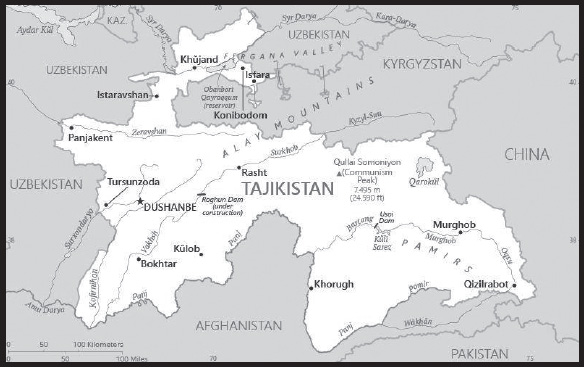
INTRODUCTION
Background: The Tajik people came under Russian imperial rule in the 1860s and 1870s, but Russia’s hold on Central Asia weakened following the Revolution of 1917. At that time, bands of indigenous guerrillas (known as “basmachi”) fiercely contested Bolshevik control of the area, which was not fully reestablished until 1925. Tajikistan was first created as an autonomous republic within Uzbekistan in 1924, but in 1929 the USSR designated Tajikistan a separate republic and transferred to it much of present-day Sughd Province. Ethnic Uzbeks form a substantial minority in Tajikistan, and ethnic Tajiks an even larger minority in Uzbekistan. Tajikistan became independent in 1991 following the breakup of the Soviet Union, and experienced a civil war between political, regional, and religious factions from 1992 to 1997.
Though the country holds general elections for both the presidency (once every seven years) and legislature (once every five years), observers note an electoral system rife with irregularities and abuse, with results that are neither free nor fair. President Emomali RAHMON, who came to power in 1992 during the civil war and was first elected president in 1994, used an attack planned by a disaffected deputy defense minister in 2015 to ban the last major opposition political party in Tajikistan. In December 2015, RAHMON further strengthened his position by having himself declared “Founder of Peace and National Unity, Leader of the Nation,” with limitless terms and lifelong immunity through constitutional amendments ratified in a referendum. The referendum also lowered the minimum age required to run for president from 35 to 30, which made RAHMON’s first-born son Rustam EMOMALI, the mayor of the capital city of Dushanbe, eligible to run for president in 2020. In April 2020, RAHMON orchestrated EMOMALI’s selection as chairman of the Majlisi Milli (Tajikistan’s senate), positioning EMOMALI as next in line of succession for the presidency. RAHMON opted to run in the presidential election in October 2020 and received 91% of the vote.
The country remains the poorest in the former Soviet sphere. Tajikistan became a member of the WTO in March 2013. However, its economy continues to face major challenges, including dependence on remittances from Tajikistani migrant laborers working in Russia and Kazakhstan, pervasive corruption, and the opiate trade and other destabilizing violence emanating from neighboring Afghanistan. Tajikistan has endured several domestic security incidents since 2010, including armed conflict between government forces and local strongmen in the Rasht Valley and between government forces and residents and informal leaders in Gorno-Badakhshan Autonomous Oblast. Tajikistan suffered its first ISIS-claimed attack in 2018, when assailants attacked a group of Western bicyclists with vehicles and knives, killing four.
GEOGRAPHY
Location: Central Asia, west of China, south of Kyrgyzstan
Geographic coordinates: 39 00 N, 71 00 E
Map references: Asia
Area: total: 144,100 sq km
land: 141,510 sq km
water: 2,590 sq km
comparison ranking: total 96
Area - comparative: slightly smaller than Wisconsin
Land boundaries: total: 4,130 km
border countries (4): Afghanistan 1,357 km; China 477 km; Kyrgyzstan 984 km; Uzbekistan 1,312 km
Coastline: 0 km (landlocked)
Maritime claims: none (landlocked)
Climate: mid-latitude continental, hot summers, mild winters; semiarid to polar in Pamir Mountains
Terrain: mountainous region dominated by the Alay Mountains in the north and the Pamirs in the southeast; western Fergana Valley in north, Kofirnihon and Vakhsh Valleys in southwest
Elevation: highest point: Qullai Somoniyon 7,495 m
lowest point: Syr Darya (Sirdaryo) 300 m
mean elevation: 3,186 m
Natural resources: hydropower, some petroleum, uranium, mercury, brown coal, lead, zinc, antimony, tungsten, silver, gold
Land use: agricultural land: 34.7% (2018 est.)
arable land: 6.1% (2018 est.)
permanent crops: 0.9% (2018 est.)
permanent pasture: 27.7% (2018 est.)
forest: 2.9% (2018 est.)
other: 62.4% (2018 est.)
Irrigated land: 5,690 sq km (2020)
Major rivers (by length in km): Syr Darya (shared with Kyrgyzstan [s], Uzbekistan, and Kazakhstan [m]) - 3,078 km; Amu Darya river source (shared with Turkmenistan, Afghanistan, and Uzbekistan [m]) - 2,620 km
note – [s] after country name indicates river source; [m] after country name indicates river mouth
Major watersheds (area sq km): Internal (endorheic basin) drainage: Tarim Basin (1,152,448 sq km), (Aral Sea Basin) Amu Darya (534,739 sq km), Syr Darya (782,617 sq km)
Population distribution: the country’s population is concentrated at lower elevations, with perhaps as much as 90% of the people living in valleys; overall density increases from east to west
Natural hazards: earthquakes; floods
Geography - note: landlocked; highest point, Qullai Ismoili Somoni (formerly Communism Peak), was the tallest mountain in the former USSR
PEOPLE AND SOCIETY
Population: 9,245,937 (2023 est.)
comparison ranking: 97
Nationality: noun: Tajikistani(s)
adjective: Tajikistani
Ethnic groups: Tajik 84.3% (includes Pamiri and Yagnobi), Uzbek 13.8%, other 2% (includes Kyrgyz, Russian, Turkmen, Tatar, Arab) (2014 est.)
Languages: Tajik (official) 84.4%, Uzbek 11.9%, Kyrgyz 0.8%, Russian 0.5%, other 2.4% (2010 est.)
major-language sample(s): 
 (Tajik)
note: Russian widely used in government and business
Religions: Muslim 98% (Sunni 95%, Shia 3%) other 2% (2014 est.)
Demographic profile: Tajikistan has a youthful age structure with almost 50% of the population under the age of 25. As a Soviet republic, Tajikistan had the highest fertility rate in the Soviet Union. The total fertility rate – the average number of births per woman – was highest in the mid-1970s, when it reached 6.3. In an effort to expand populations to meet economic goals, the Soviets provided resources that made large families affordable. The fertility rate decreased to 5 by the time of independence in 1991 and continued to decline thereafter. In 1996, the Tajik Government discontinued subsidies for large families and having several children became too expensive. The loss of subsidies, the 5-year civil war that followed independence, and other factors caused fertility to continue to fall steadily, but it remains above replacement level at 2.5. The availability of healthcare providers and family planning services is limited, contributing to couples having more children than they would like. As of 2017, 21% of women were using contraceptives.
Tajikistan’s ethnic make-up changed with the Soviet’s introduction of industrialization. Large numbers of Russian and Ukrainian immigrants arrived in the mid-1920s. Some were forced to immigrate while others came voluntarily to work in the cotton industry and in Tajikistan’s Soviet Government. The Russian and Ukrainian immigrants formed urban communities, while Tajiks and Uzbeks continued to live predominantly in rural areas. In addition, thousands of Tatars and Germans were deported to Tajikistan, accused of Nazi complicity during WWII.
Tajikistan’s ethnic composition was later shaped by the post-independence civil war from 1992-1997 and the economic devastation that followed. Most non-Tajik ethnic groups, including Uzbeks, Russians, Kyrgyz, and Ukrainians, fled to Russia and other former Soviet republics and many never returned, making the country overwhelming Tajik; approximately 80% of the population was Tajik by 2000.
Since the mid-1990s, labor has probably been Tajikistan’s main export. Remittances accounted for 30% of GDP in 2018 and are Tajikistan’s largest source of external income. Poverty, a lack of jobs, and higher wages abroad push Tajiks to emigrate. Russia – particularly Moscow – is the main destination, while a smaller number of religious Muslims, usually of Uzbek ancestry, migrate to Uzbekistan. The vast majority of labor migrants are unskilled or low-skilled young men who work primarily in construction but also agriculture, transportation, and retail. Many Tajik families are dependent on the money they send home for necessities, such as food and clothing, as well as for education and weddings rather than investment.
Age structure: 0-14 years: 29.98% (male 1,411,335/female 1,360,882)
15-64 years: 65.84% (male 3,025,782/female 3,061,836)
65 years and over: 4.18% (2023 est.) (male 159,728/female 226,374)
Dependency ratios: total dependency ratio: 65.9
youth dependency ratio: 60.4
elderly dependency ratio: 5.5
potential support ratio: 18.1 (2021 est.)
Median age: total: 22.7 years (2023 est.)
male: 22.3 years
female: 23.2 years
comparison ranking: total 179
Population growth rate: 1.94% (2023 est.)
comparison ranking: 45
Birth rate: 26.4 births/1,000 population (2023 est.)
comparison ranking: 42
Death rate: 4.9 deaths/1,000 population (2023 est.)
comparison ranking: 202
Net migration rate: -2 migrant(s)/1,000 population (2023 est.)
comparison ranking: 170
Population distribution: the country’s population is concentrated at lower elevations, with perhaps as much as 90% of the people living in valleys; overall density increases from east to west
Urbanization: urban population: 28.2% of total population (2023)
rate of urbanization: 2.73% annual rate of change (2020-25 est.)
Major urban areas - population: 987,000 DUSHANBE (capital) (2023)
Sex ratio: at birth: 1.05 male(s)/female
0-14 years: 1.04 male(s)/female
15-64 years: 0.99 male(s)/female
65 years and over: 0.71 male(s)/female
total population: 1.01 male(s)/female (2023 est.)
Mother’s mean age at first birth: 23.2 years (2017 est.)
Maternal mortality ratio: 17 deaths/100,000 live births (2020 est.)
comparison ranking: 131
Infant mortality rate: total: 23.1 deaths/1,000 live births (2023 est.)
male: 26 deaths/1,000 live births
female: 20.2 deaths/1,000 live births
comparison ranking: total 68
Life expectancy at birth: total population: 71.1 years (2023 est.)
male: 69.2 years
female: 73.1 years
comparison ranking: total population 167
Total fertility rate: 3.6 children born/woman (2023 est.)
comparison ranking: 33
Gross reproduction rate: 1.75 (2023 est.)
Contraceptive prevalence rate: 29.3% (2017)
Drinking water source: improved: urban: 96.5% of population
rural: 79.9% of population
total: 84.4% of population
unimproved: urban: 3.5% of population
rural: 20.1% of population
total: 15.6% of population (2020 est.)
Current health expenditure: 8.2% of GDP (2020)
Physicians density: 1.72 physicians/1,000 population (2014)
Hospital bed density: 4.7 beds/1,000 population (2014)
Sanitation facility access: improved: urban: 98.9% of population
rural: 99.6% of population
total: 99.4% of population
unimproved: urban: 1.1% of population
rural: 0.4% of population
total: 0.6% of population (2020 est.)
Major infectious diseases: degree of risk: high (2023)
food or waterborne diseases: bacterial diarrhea, hepatitis A, and typhoid fever
Obesity - adult prevalence rate: 14.2% (2016)
comparison ranking: 128
Alcohol consumption per capita: total: 0.85 liters of pure alcohol (2019 est.)
beer: 0.38 liters of pure alcohol (2019 est.)
wine: 0.01 liters of pure alcohol (2019 est.)
spirits: 0.45 liters of pure alcohol (2019 est.)
other alcohols: 0 liters of pure alcohol (2019 est.)
comparison ranking: total 156
Children under the age of 5 years underweight: 7.6% (2017)
comparison ranking: 63
Currently married women (ages 15-49): 72% (2023 est.)
Child marriage: women married by age 15: 0.1%
women married by age 18: 8.7% (2017 est.)
Education expenditures: 5.9% of GDP (2020 est.)
comparison ranking: 47
Literacy: definition: age 15 and over can read and write
total population: 99.8%
male: 99.8%
female: 99.7% (2015)
School life expectancy (primary to tertiary education): total: 11 years
male: 12 years
female: 11 years (2013)
Youth unemployment rate (ages 15-24): total: 17.4% (2021 est.)
male: 19.4%
female: 14.4%
comparison ranking: total 97
ENVIRONMENT
Environment - current issues: areas of high air pollution from motor vehicles and industry; water pollution from agricultural runoff and disposal of untreated industrial waste and sewage; poor management of water resources; soil erosion; increasing levels of soil salinity
Environment - international agreements: party to: Biodiversity, Climate Change, Climate Change-Kyoto Protocol, Climate Change-Paris Agreement, Comprehensive Nuclear Test Ban, Desertification, Endangered Species, Environmental Modification, Hazardous Wastes, Ozone Layer Protection, Ship Pollution, Wetlands
signed, but not ratified: none of the selected agreements
Climate: mid-latitude continental, hot summers, mild winters; semiarid to polar in Pamir Mountains
Land use: agricultural land: 34.7% (2018 est.)
arable land: 6.1% (2018 est.)
permanent crops: 0.9% (2018 est.)
permanent pasture: 27.7% (2018 est.)
forest: 2.9% (2018 est.)
other: 62.4% (2018 est.)
Urbanization: urban population: 28.2% of total population (2023)
rate of urbanization: 2.73% annual rate of change (2020-25 est.)
Revenue from forest resources: 1.12% of GDP (2018 est.)
comparison ranking: 51
Revenue from coal: 0.54% of GDP (2018 est.)
comparison ranking: 10
Air pollutants: particulate matter emissions: 53.65 micrograms per cubic meter (2019 est.)
carbon dioxide emissions: 5.31 megatons (2016 est.)
methane emissions: 4.87 megatons (2020 est.)
Waste and recycling: municipal solid waste generated annually: 1,787,400 tons (2013 est.)
Major rivers (by length in km): Syr Darya (shared with Kyrgyzstan [s], Uzbekistan, and Kazakhstan [m]) - 3,078 km; Amu Darya river source (shared with Turkmenistan, Afghanistan, and Uzbekistan [m]) - 2,620 km
note – [s] after country name indicates river source; [m] after country name indicates river mouth
Major watersheds (area sq km): Internal (endorheic basin) drainage: Tarim Basin (1,152,448 sq km), (Aral Sea Basin) Amu Darya (534,739 sq km), Syr Darya (782,617 sq km)
Total water withdrawal: municipal: 910 million cubic meters (2020 est.)
industrial: 1.61 billion cubic meters (2020 est.)
agricultural: 7.38 billion cubic meters (2020 est.)
Total renewable water resources: 21.91 billion cubic meters (2020 est.)
GOVERNMENT
Country name: conventional long form: Republic of Tajikistan
conventional short form: Tajikistan
local long form: Jumhurii Tojikiston
local short form: Tojikiston
former: Tajik Soviet Socialist Republic
etymology: the Persian suffix “-stan” means “place of” or “country,” so the word Tajikistan literally means “Land of the Tajik [people]”
Government type: presidential republic
Capital: name: Dushanbe
geographic coordinates: 38 33 N, 68 46 E
time difference: UTC+5 (10 hours ahead of Washington, DC, during Standard Time)
etymology: today’s city was originally at the crossroads where a large bazaar occurred on Mondays, hence the name Dushanbe, which in Persian means Monday, i.e., the second day (du) after Saturday (shambe)
Administrative divisions: 2 provinces (viloyatho, singular - viloyat), 1 autonomous province* (viloyati mukhtor), 1 capital region** (viloyati poytakht), and 1 area referred to as Districts Under Republic Administration***; Dushanbe**, Khatlon (Bokhtar), Kuhistoni Badakhshon [Gorno-Badakhshan]* (Khorugh), Nohiyahoi Tobei Jumhuri***, Sughd (Khujand)
note: the administrative center name follows in parentheses
Independence: 9 September 1991 (from the Soviet Union)
National holiday: Independence Day (or National Day), 9 September (1991)
Constitution: history: several previous; latest adopted 6 November 1994
amendments: proposed by the president of the republic or by at least one third of the total membership of both houses of the Supreme Assembly; adoption of any amendment requires a referendum, which includes approval of the president or approval by at least two-thirds majority of the Assembly of Representatives; passage in a referendum requires participation of an absolute majority of eligible voters and an absolute majority of votes; constitutional articles, including Tajikistan’s form of government, its territory, and its democratic nature, cannot be amended; amended 1999, 2003, 2016
Legal system: civil law system
International law organization participation: has not submitted an ICJ jurisdiction declaration; accepts ICCt jurisdiction
Citizenship: citizenship by birth: no
citizenship by descent only: at least one parent must be a citizen of Tajikistan
dual citizenship recognized: no
residency requirement for naturalization: 5 years or 3 years of continuous residence prior to application
Suffrage: 18 years of age; universal
Executive branch: chief of state: President Emomali RAHMON (since 6 November 1994; head of state and Supreme Assembly Chairman since 19 November 1992)
head of government: Prime Minister Qohir RASULZODA (since 23 November 2013)
cabinet: Council of Ministers appointed by the president, approved by the Supreme Assembly
elections/appointments: president directly elected by simple majority popular vote for a 7-year term (two-term limit); however, as the “Leader of the Nation” President RAHMON can run an unlimited number of times; election last held on 11 October 2020 (next to be held in 2027); prime minister appointed by the president
election results: 2020: Emomali RAHMON reelected president; percent of vote - Emomali RAHMON (PDPT) 92.1%, Rustam LATIFZODA (APT) 3.1%, and other 4.8%
2013: Emomali RAHMOND reelected president; percent of vote - Emomali RAHMOND (PDPT) 84%, Ismoil TALBAKOV CPT) 5%, other 11%
Legislative branch: description: bicameral Supreme Assembly or Majlisi Oli consists of:
National Assembly or Majlisi Milli (34 seats; 25 members indirectly elected by local representative assemblies or majlisi, 8 appointed by the president, and 1 reserved for each living former president; members serve 5-year terms)
Assembly of Representatives or Majlisi Namoyandagon (63 seats; 41 members directly elected in single-seat constituencies by 2-round absolute majority vote and 22 directly elected in a single nationwide constituency by closed-list proportional representation vote; members serve 5-year terms)
elections: National Assembly - last held on 1 March 2020 (next to be held in 2025)
Assembly of Representatives - last held on 1 March 2020 (next to be held in 2025)
election results: National Assembly - percent of vote by party - NA; seats by party - NA; composition as of mid-2202 (31 members) - men 23, women 8, percent of women 25.8%
Assembly of Representatives - percent of vote by party - PDPT 50.4%, PERT 16.6%, APT 16.5%, SPT 5.2%, DPT 5.1%, CPT 3.1%, other 3.1%; seats by party - PDPT 47, APT 7, PERT 5, CPT 2, SPT 1, DPT 1; composition as of mid 2022 - men 46, women 17, percent of women 27%; note - total Supreme Assembly percent of women 26.6%
Judicial branch: highest court(s): Supreme Court (consists of the chairman, deputy chairmen, and 34 judges organized into civil, family, criminal, administrative offense, and military chambers); Constitutional Court (consists of the court chairman, deputy chairman, and 5 judges); High Economic Court (consists of 16 judicial positions)
judge selection and term of office: Supreme Court, Constitutional Court, and High Economic Court judges nominated by the president and approved by the National Assembly; judges of all 3 courts appointed for 10-year renewable terms with no term limits, but the last appointment must occur before the age of 65
subordinate courts: regional and district courts; Dushanbe City Court; viloyat (province level) courts; Court of Gorno-Badakhshan Autonomous Region
Political parties and leaders: Agrarian Party of Tajikistan or APT [Rustam LATIFZODA]
Communist Party of Tajikistan or CPT [Miroj ABDULLOEV]
Democratic Party of Tajikistan or DPT [Saidjafar USMONZODA]
Party of Economic Reform of Tajikistan or PERT [Rustam RAHMATZODA]
People’s Democratic Party of Tajikistan or PDPT [Emomali RAHMON]
Social Democratic Party of Tajikistan or SDPT (vacant)
Socialist Party of Tajikistan or SPT [Abduhalim GHAFFORZODA]
International organization participation: ADB, CICA, CIS, CSTO, EAEC, EAPC, EBRD, ECO, EITI (candidate country), FAO, G-77, GCTU, IAEA, IBRD, ICAO, ICC (NGOs), ICCt, ICRM, IDA, IDB, IFAD, IFC, IFRCS, ILO, IMF, Interpol, IOC, IOM, IPU, ISO (correspondent), ITSO, ITU, MIGA, NAM (observer), OIC, OPCW, OSCE, PFP, SCO, UN, UNCTAD, UNESCO, UNIDO, UNISFA, UNWTO, UPU, WCO, WFTU (NGOs), WHO, WIPO, WMO, WTO
Diplomatic representation in the US: chief of mission: Ambassador Farrukh HAMRALIZODA (since 17 February 2021)
chancery: 1005 New Hampshire Avenue NW, Washington, DC 20037
telephone: [1] (202) 223-6090
FAX: [1] (202) 223-6091
email address and website: tajemus@mfa.tj; tajikistan@verizon.net
Diplomatic representation from the US: chief of mission: Ambassador Manuel P. MICALLER JR (since 9 March 2023)
embassy: 109-A Ismoili Somoni Avenue (Zarafshon district), Dushanbe 734019
mailing address: 7090 Dushanbe Place, Washington DC 20521-7090
telephone: [992] (37) 229-20-00
FAX: [992] (37) 229-20-50
email address and website: DushanbeConsular@state.gov
Flag description: three horizontal stripes of red (top), a wider stripe of white, and green; a gold crown surmounted by seven gold, five-pointed stars is located in the center of the white stripe; red represents the sun, victory, and the unity of the nation, white stands for purity, cotton, and mountain snows, while green is the color of Islam and the bounty of nature; the crown symbolizes the Tajik people; the seven stars signify the Tajik magic number “seven” - a symbol of perfection and the embodiment of happiness
National symbol(s): crown surmounted by an arc of seven, five-pointed stars; snow leopard; national colors: red, white, green
National anthem: name: “Surudi milli” (National Anthem)
lyrics/music: Gulnazar KELDI/Sulaimon YUDAKOV
note: adopted 1991; after the fall of the Soviet Union, Tajikistan kept the music of the anthem from its time as a Soviet republic but adopted new lyrics
National heritage: total World Heritage Sites: 3 (2 cultural, 1 natural)
selected World Heritage Site locales: Proto-urban Site of Sarazm (c); Tajik National Park (Mountains of the Pamirs) (n);
Silk Roads: Zarafshan-Karakum Corridor (c)
ECONOMY
Economic overview: lower middle-income Central Asian economy; key gold, cotton, and aluminum exporter; declining poverty; sustained high growth; very limited private sector; substantial illicit drug trade; significant remittances; environmentally fragile
Real GDP (purchasing power parity): $38.058 billion (2021 est.)
$34.851 billion (2020 est.)
$33.382 billion (2019 est.)
note: data are in 2017 dollars
comparison ranking: 127
Real GDP growth rate: 9.2% (2021 est.)
4.4% (2020 est.)
7.4% (2019 est.)
comparison ranking: 31
Real GDP per capita: $3,900 (2021 est.)
$3,700 (2020 est.)
$3,600 (2019 est.)
note: data are in 2017 dollars
comparison ranking: 185
GDP (official exchange rate): $2.522 billion (2019 est.)
Inflation rate (consumer prices): 7.7% (2019 est.)
3.9% (2018 est.)
7.3% (2017 est.)
comparison ranking: 39
Credit ratings:
Moody’s rating: B3 (2017)
Standard & Poors rating: B- (2017)
note: The year refers to the year in which the current credit rating was first obtained.
GDP - composition, by sector of origin: agriculture: 28.6% (2017 est.)
industry: 25.5% (2017 est.)
services: 45.9% (2017 est.)
comparison rankings: services 194; industry 109; agriculture 20
GDP - composition, by end use: household consumption: 98.4% (2017 est.)
government consumption: 13.3% (2017 est.)
investment in fixed capital: 11.7% (2017 est.)
investment in inventories: 2.5% (2017 est.)
exports of goods and services: 10.7% (2017 est.)
imports of goods and services: -36.6% (2017 est.)
Agricultural products: milk, potatoes, wheat, watermelons, onions, tomatoes, vegetables, cotton, carrots/turnips, beef
Industries: aluminum, cement, coal, gold, silver, antimony, textile, vegetable oil
Industrial production growth rate: 22.04% (2021 est.)
comparison ranking: 3
Labor force: 2.5 million (2021 est.)
comparison ranking: 116
Labor force - by occupation: agriculture: 43%
industry: 10.6%
services: 46.4% (2016 est.)
Unemployment rate: 7.75% (2021 est.)
7.58% (2020 est.)
7.06% (2019 est.)
note: official rate; actual unemployment is much higher
comparison ranking: 98
Youth unemployment rate (ages 15-24): total: 17.4% (2021 est.)
male: 19.4%
female: 14.4%
comparison ranking: total 97
Population below poverty line: 26.3% (2019 est.)
Gini Index coefficient - distribution of family income: 34 (2015 est.)
comparison ranking: 114
Budget: revenues: $2.222 billion (2019 est.)
expenditures: $2.393 billion (2019 est.)
Budget surplus (+) or deficit (-): -1.5% (of GDP) (2017 est.)
comparison ranking: 90
Public debt: 50.4% of GDP (2017 est.)
42% of GDP (2016 est.)
comparison ranking: 106
Taxes and other revenues: 31.8% (of GDP) (2017 est.)
comparison ranking: 24
Fiscal year: calendar year
Current account balance: $734.735 million (2021 est.)
$335.906 million (2020 est.)
-$185.295 million (2019 est.)
comparison ranking: 57
Exports: $2.161 billion (2021 est.) note: data are in current year dollars
$1.409 billion (2020 est.) note: data are in current year dollars
$1.243 billion (2019 est.) note: data are in current year dollars
comparison ranking: 157
Exports - partners: Turkey 24%, Switzerland 22%, Uzbekistan 16%, Kazakhstan 12%, China 10% (2019)
Exports - commodities: gold, aluminum, cotton, zinc, antimony, lead (2019)
Imports: $4.258 billion (2021 est.) note: data are in current year dollars
$3.125 billion (2020 est.) note: data are in current year dollars
$3.409 billion (2019 est.) note: data are in current year dollars
comparison ranking: 149
Imports - partners: China 40%, Russia 38%, Kazakhstan 19%, Uzbekistan 5% (2019)
Imports - commodities: refined petroleum, wheat, natural gas, bauxite, aircraft (2019)
Reserves of foreign exchange and gold: $2.499 billion (31 December 2021 est.)
$2.238 billion (31 December 2020 est.)
$1.466 billion (31 December 2019 est.)
comparison ranking: 124
Debt - external: $6.47 billion (2019 est.)
$5.849 billion (2018 est.)
comparison ranking: 127
Exchange rates: Tajikistani somoni (TJS) per US dollar -
Exchange rates: 11.309 (2021 est.)
10.322 (2020 est.)
9.53 (2019 est.)
9.151 (2018 est.)
8.55 (2017 est.)
ENERGY
Electricity access: electrification - total population: 99.5% (2021)
electrification - urban areas: 98.9% (2021)
electrification - rural areas: 99.8% (2021)
Electricity: installed generating capacity: 7.114 million kW (2020 est.)
consumption: 15.071 billion kWh (2019 est.)
exports: 3.175 billion kWh (2019 est.)
imports: 281 million kWh (2019 est.)
transmission/distribution losses: 2.429 billion kWh (2019 est.)
comparison rankings: installed generating capacity 78; transmission/distribution losses 79; imports 96; exports 43; consumption 82
Electricity generation sources: fossil fuels: 8.7% of total installed capacity (2020 est.)
hydroelectricity: 91.3% of total installed capacity (2020 est.)
Coal: production: 2.103 million metric tons (2020 est.)
consumption: 2.16 million metric tons (2020 est.)
exports: 0 metric tons (2020 est.)
imports: 57,000 metric tons (2020 est.)
proven reserves: 375 million metric tons (2019 est.)
Petroleum: total petroleum production: 300 bbl/day (2021 est.)
refined petroleum consumption: 26,200 bbl/day (2019 est.)
crude oil and lease condensate exports: 0 bbl/day (2018 est.)
crude oil and lease condensate imports: 900 bbl/day (2018 est.)
crude oil estimated reserves: 12 million barrels (2021 est.)
Refined petroleum products - production: 172 bbl/day (2015 est.)
comparison ranking: 108
Refined petroleum products - exports: 0 bbl/day (2015 est.)
comparison ranking: 151
Refined petroleum products - imports: 22,460 bbl/day (2015 est.)
comparison ranking: 114
Natural gas: production: 18.208 million cubic meters (2019 est.)
consumption: 157.611 million cubic meters (2019 est.)
exports: 0 cubic meters (2021 est.)
imports: 139.375 million cubic meters (2019 est.)
proven reserves: 5.663 billion cubic meters (2021 est.)
Carbon dioxide emissions: 7.643 million metric tonnes of CO2 (2019 est.)
from coal and metallurgical coke: 4.362 million metric tonnes of CO2 (2019 est.)
from petroleum and other liquids: 2.971 million metric tonnes of CO2 (2019 est.)
from consumed natural gas: 309,000 metric tonnes of CO2 (2019 est.)
comparison ranking: total emissions 121
Energy consumption per capita: 27.651 million Btu/person (2019 est.)
comparison ranking: 124
COMMUNICATIONS
Telephones - fixed lines: total subscriptions: 500,000 (2021 est.)
subscriptions per 100 inhabitants: 5 (2021 est.)
comparison ranking: total subscriptions 92
Telephones - mobile cellular: total subscriptions: 12 million (2021 est.)
subscriptions per 100 inhabitants: 120 (2021 est.)
comparison ranking: total subscriptions 82
Telecommunication systems: general assessment: the nation of Tajikistan has had to struggle through economic hardship following the onset of the Covid-19 pandemic; the strain on financial resources inevitably means a continuation of the absence of any meaningful investment or development programs for telecommunications infrastructure; the fixed line telephony and fixed broadband markets continue to languish far behind the mobile sector in terms of teledensity and penetration; with only around 6,000 fixed broadband customers (0.07% penetration), there would appear to be growth potential, but the limited fixed line infrastructure in the country suggests there’s little likelihood of that occurring any time soon; the size of Tajikistan’s mobile market dwarfs the fixed line segment, with an estimated penetration rate of nearly 120%; with a number of private sector companies active in the mobile market, there been more commitment to investment in network upgrades and expansion; three MNOs have all launched commercial 5G services, initially in areas of the capital city Dushanbe; the move towards higher speed mobile services should further underpin the growth in the nascent mobile broadband market, which is still estimated to be at a relatively low penetration level of 42% (at least relative to most other Asian nations) but is predicted to be a strong compound annual growth rate of more than 8% for at least the next five years (2021)
domestic: fixed-line over 5 per 100 and mobile-cellular over 120 per 100 (2021)
international: country code - 992; linked by cable and microwave radio relay to other CIS republics and by leased connections to the Moscow international gateway switch; Dushanbe linked by Intelsat to international gateway switch in Ankara (Turkey); 3 satellite earth stations - 2 Intelsat and 1 Orbita
Broadcast media: state-run TV broadcasters transmit nationally on 9 TV and 10 radio stations, and regionally on 4 stations; 31 independent TV and 20 radio stations broadcast locally and regionally; many households are able to receive Russian and other foreign stations via cable and satellite (2016)
Internet country code: .tj
Internet users: total: 3,009,054 (2022 est.)
percent of population: 30.4% (2022 est.)
comparison ranking: total 121
Broadband - fixed subscriptions: total: 6,000 (2020 est.)
subscriptions per 100 inhabitants: 0.1 (2020 est.)
comparison ranking: total 184
TRANSPORTATION
National air transport system: number of registered air carriers: 2 (2020)
inventory of registered aircraft operated by air carriers: 6
annual passenger traffic on registered air carriers: 492,320 (2018)
annual freight traffic on registered air carriers: 2.34 million (2018) mt-km
Civil aircraft registration country code prefix: EY
Airports: 24 (2021)
comparison ranking: total 129
Airports - with paved runways: 17
note: paved runways have a concrete or asphalt surface but not all have facilities for refueling, maintenance, or air traffic control; the length of a runway required for aircraft to safely operate depends on a number of factors including the type of aircraft, the takeoff weight (including passengers, cargo, and fuel), engine types, flap settings, landing speed, elevation of the airport, and average maximum daily air temperature; paved runways can reach a length of 5,000 m (16,000 ft.), but the “typical” length of a commercial airline runway is between 2,500-4,000 m (8,000-13,000 ft.)
Airports - with unpaved runways: 7
note: unpaved runways have a surface composition such as grass or packed earth and are most suited to the operation of light aircraft; unpaved runways are usually short, often less than 1,000 m (3,280 ft.) in length; airports with unpaved runways often lack facilities for refueling, maintenance, or air traffic control
Pipelines: 549 km gas, 38 km oil (2013)
Railways: total: 680 km (2014)
broad gauge: 680 km (2014) 1.520-m gauge
comparison ranking: total 102
Roadways: total: 30,000 km (2018)
comparison ranking: total 98
Waterways: 200 km (2011) (along Vakhsh River)
comparison ranking: 108
MILITARY AND SECURITY
Military and security forces: Armed Forces of the Republic of Tajikistan: Land Forces, Mobile Forces, Air and Air Defense Forces; National Guard
Ministry of Internal Affairs: Internal Troops (reserves for Armed Forces in wartime), police
State Committee on National Security: Border Guard Forces (2023)
note: the National Guard, formerly the Presidential Guard, is tasked with ensuring public safety and security, similar to the tasks of the Internal Troops; it also takes part in ceremonial duties
Military expenditures: 1.1% of GDP (2022 est.)
1.2% of GDP (2021 est.)
1% of GDP (2020 est.)
2.1% of GDP (2019 est.)
2.1% of GDP (2018 est.)
comparison ranking: 127
Military and security service personnel strengths: approximately 10,000 active-duty troops (8,000 Land and Mobile Forces; 2,000 Air and Air Defense Forces) (2023)
Military equipment inventories and acquisitions: the military’s inventory is comprised of older Russian and Soviet-era equipment; it has received limited quantities of weapons systems in recent years, most of which was secondhand material from Russia (2023)
Military service age and obligation: 18-27 years of age for compulsory (men only) or voluntary (men and women) military service; 24-month conscript service obligation; in August 2021, the Tajik Government began allowing men to pay a fee in order to avoid conscription (2023)
Military - note: Tajikistan is the only former Soviet republic that did not form its armed forces from old Soviet Army units following the collapse of the USSR in 1991; rather, Russia retained command of the Soviet units there while the Tajik government raised a military from scratch; the first ground forces were officially created in 1993 from groups that fought for the government during the Tajik Civil War
the military is a small and limited force equipped largely with Soviet-era weapons; its primary concerns are terrorism, border security, territorial defense, and instability in neighboring countries; following the 2021 Taliban takeover in Afghanistan, Tajikistan deployed thousands of troops to the Afghan border and conducted exercises focused on border-related scenarios; since 2012, Tajikistan has had more than 100 border-related clashes with Kyrgyzstan, triggered mostly by disputes over water, roads, or land along a poorly-defined frontier; the most recent in September 2022 saw the use of armored vehicles and artillery and resulted in about 100 killed; the Tajik Land and Mobile Forces have together an estimated 5 combat brigades of mechanized infantry, light/mountain infantry, air assault and special forces, and artillery; the Air and Air Defense force has a small number attack and multipurpose helicopters
Russia is Tajikistan’s primary security partner; approximately 5-7,000 Russian soldiers are stationed in the country, primarily at the 201st military base, which is leased until at least 2042; the Russian forces include combat troops and combat aircraft; Russia and Tajikistan have a joint air defense system and they conduct periodic joint exercises; Tajikistan has been a member of the Russian-led Collective Security Treaty Organization (CSTO) since 1994 and contributes troops to CSTO’s rapid reaction force (2023)
TERRORISM
Terrorist group(s): Terrorist group(s): Islamic State of Iraq and ash-Sham (ISIS)
note 1: US-designated foreign terrorist groups such as the Islamic Jihad Union, the Islamic Movement of Uzbekistan, and the Islamic State of Iraq and ash-Sham-Khorasan Province have operated in the area where the Uzbek, Kyrgyz, and Tajik borders converge and ill-defined and porous borders allow for the relatively free movement of people and illicit goods
note 2: details about the history, aims, leadership, organization, areas of operation, tactics, targets, weapons, size, and sources of support of the group(s) appear(s) in Appendix-T
TRANSNATIONAL ISSUES
Disputes - international: Tajikistan-Afghanistan: none identified
Tajikistan-China: in 2006, China and Tajikistan pledged to commence demarcation of the revised boundary agreed to in the delimitation of 2002; in 2011, Tajikistan and China ratified the 2002 border demarcation agreement whereby Tajikistan ceded approximately 1,100 square kilometers in the Pamirs to China
Tajikistan-Kyrgyzstan: disputes in Isfara Valley delay delimitation with Kyrgyzstan; in May 2021, both countries agreed to a ceasefire following recent clashes at their border
Tajikistan-Uzbekistan: talks continue with Uzbekistan to delimit border and clear minefields; as of January 2020, Uzbekistan reported that it had cleared all mines along its side of the border
Refugees and internally displaced persons: refugees (country of origin): 6,775 (Afghanistan) (mid-year 2021)
stateless persons: 4,898 (2022)
Illicit drugs: Tajikistan is a primary transit country along the “Northern Route” for Afghanistan-sourced opiates and cannabis for the Russian and Eastern European markets and beyond; minimal domestic recreational drug use though it is increasing
TANZANIA
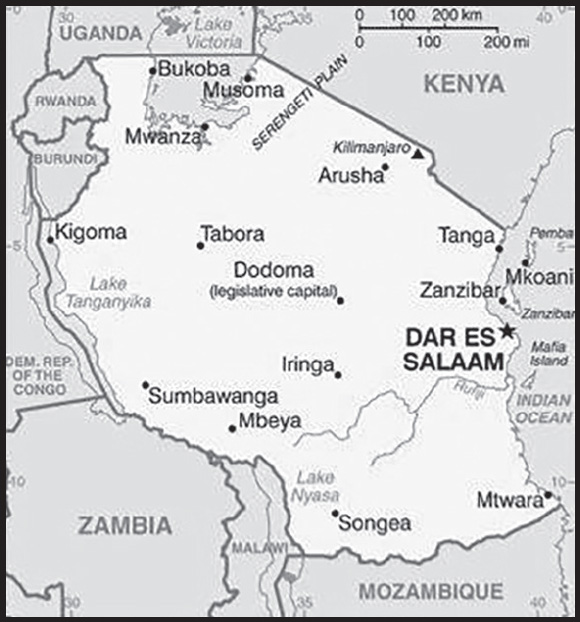
INTRODUCTION
Background: Tanzania contains some of Africa’s most iconic national parks and famous paleoanthropological sites, and its diverse cultural heritage reflects the multiple ethnolinguistic groups that live in the country. Its long history of integration into trade networks spanning the Indian Ocean and the African interior led to the development of Swahili as a common language in much of east Africa and the introduction of Islam into the region. A number of independent coastal and island trading posts in what is now Tanzania came under Portuguese control after 1498 when they began to take control of much of the coast and Indian Ocean trade. By 1700, the Sultanate of Oman had become the dominant power in the region after ousting the Portuguese who were also facing a series of local uprisings. During the following hundred years, Zanzibar - an archipelago off the coast of Tanzania - became a hub of Indian Ocean trade, with Arab and Indian traders establishing and consolidating trade routes with communities in mainland Tanzania that contributed to the expansion of the slave trade. Zanzibar briefly become the capital of the Sultanate of Oman before it split into separate Omani and Zanzibar Sultanates in 1856. Beginning in the mid-1800s, European explorers, traders, and Christian missionaries became more active in the region. The Germans eventually established control over mainland Tanzania - which they called Tanganyika - and the British established control over Zanzibar. Tanganyika later came under British administration after the German defeat in World War I.
Tanganyika gained independence from Great Britain in 1961, and Zanzibar followed in 1963 as a constitutional monarchy. In Tanganyika, Julius NYERERE, a charismatic and idealistic socialist, established a one-party political system that centralized power and encouraged national self-reliance and rural development. In 1964, a popular uprising overthrew the Sultan in Zanzibar and either killed or expelled many of the Arabs and Indians who had dominated the isles for more than 200 years. Later that year, Tanganyika and Zanzibar combined to form the United Republic of Tanzania, but Zanzibar retained considerable autonomy. Their two ruling parties combined to form the Chama Cha Mapinduzi (CCM) party in 1977, which has won every presidential election to date. NYERERE handed over power to Ali Hassan MWINYI in 1985 and remained CCM chair until 1990. Tanzania held its first multi-party elections in 1995, but CCM candidates have continued to dominate politics. Political opposition in Zanzibar has led to four contentious elections since 1995, in which the ruling party claimed victory despite international observers’ claims of voting irregularities. In 2001, 35 people in Zanzibar died when soldiers fired on protestors following the 2000 election. John MAGUFULI won the 2015 presidential election, and the CCM won a two-thirds majority in Parliament. He was reelected in 2020 and the CCM increased its majority in an election that was also critiqued by observers. MAGUFULI died in March 2021 while in office and was constitutionally succeeded by his vice president, Samia Suluhu HASSAN.
GEOGRAPHY
Location: Eastern Africa, bordering the Indian Ocean, between Kenya and Mozambique
Geographic coordinates: 6 00 S, 35 00 E
Map references: Africa
Area: total: 947,300 sq km
land: 885,800 sq km
water: 61,500 sq km
note: includes the islands of Mafia, Pemba, and Zanzibar
comparison ranking: total 32
Area - comparative: more than six times the size of Georgia; slightly larger than twice the size of California
Land boundaries: total: 4,161 km
border countries (8): Burundi 589 km; Democratic Republic of the Congo 479 km; Kenya 775 km; Malawi 512 km; Mozambique 840 km; Rwanda 222 km; Uganda 391 km; Zambia 353 km
Coastline: 1,424 km
Maritime claims: territorial sea: 12 nm
exclusive economic zone: 200 nm
Climate: varies from tropical along coast to temperate in highlands
Terrain: plains along coast; central plateau; highlands in north, south
Elevation: highest point: Kilimanjaro (highest point in Africa) 5,895 m
lowest point: Indian Ocean 0 m
mean elevation: 1,018 m
Natural resources: hydropower, tin, phosphates, iron ore, coal, diamonds, gemstones (including tanzanite, found only in Tanzania), gold, natural gas, nickel
Land use: agricultural land: 43.7% (2018 est.)
arable land: 14.3% (2018 est.)
permanent crops: 2.3% (2018 est.)
permanent pasture: 27.1% (2018 est.)
forest: 37.3% (2018 est.)
other: 19% (2018 est.)
Irrigated land: 1,840 sq km (2012)
Major lakes (area sq km): fresh water lake(s): Lake Victoria (shared with Uganda and Kenya) - 62,940 sq km; Lake Tanganyika (shared with Democratic Republic of Congo, Burundi, and Zambia) - 32,000 sq km; Lake Malawi (shared with Mozambique and Malawi) - 22,490
salt water lake(s): Lake Rukwa - 5,760 sq km
Major rivers (by length in km): Nile (shared with Rwanda [s], Uganda, South Sudan, Sudan, and Egypt [m]) - 6,650 km
note – [s] after country name indicates river source; [m] after country name indicates river mouth
Major watersheds (area sq km): Atlantic Ocean drainage: Congo (3,730,881 sq km), (Mediterranean Sea) Nile (3,254,853 sq km)
Indian Ocean drainage: Zambezi (1,332,412 sq km)
Population distribution: the largest and most populous East African country; population distribution is extremely uneven, but greater population clusters occur in the northern half of country and along the east coast as shown in this population distribution map
Natural hazards: flooding on the central plateau during the rainy season; drought
volcanism: limited volcanic activity; Ol Doinyo Lengai (2,962 m) has emitted lava in recent years; other historically active volcanoes include Kieyo and Meru
Geography - note: Kilimanjaro is the highest point in Africa and one of only three mountain ranges on the continent that has glaciers (the others are Mount Kenya [in Kenya] and the Ruwenzori Mountains [on the Uganda-Democratic Republic of the Congo border]); Tanzania is bordered by three of the largest lakes on the continent: Lake Victoria (the world’s second-largest freshwater lake) in the north, Lake Tanganyika (the world’s second deepest) in the west, and Lake Nyasa (Lake Malawi) in the southwest
PEOPLE AND SOCIETY
Population: 65,642,682 (2023 est.)
comparison ranking: 23
Nationality: noun: Tanzanian(s)
adjective: Tanzanian
Ethnic groups: mainland - African 99% (of which 95% are Bantu consisting of more than 130 tribes), other 1% (consisting of Asian, European, and Arab); Zanzibar - Arab, African, mixed Arab and African
Languages: Kiswahili or Swahili (official), Kiunguja (name for Swahili in Zanzibar), English (official, primary language of commerce, administration, and higher education), Arabic (widely spoken in Zanzibar), many local languages; note - Kiswahili (Swahili) is the mother tongue of the Bantu people living in Zanzibar and nearby coastal Tanzania; although Kiswahili is Bantu in structure and origin, its vocabulary draws on a variety of sources including Arabic and English; it has become the lingua franca of central and eastern Africa; the first language of most people is one of the local languages
major-language sample(s): The World Factbook, Chanzo cha Lazima Kuhusu Habari ya Msingi. (Kiswahili)
Religions: Christian 63.1%, Muslim 34.1%, folk religion 1.1%, Buddhist <1%, Hindu <1%, Jewish <1%, other <1%, unspecified 1.6% (2020 est.)
note: Zanzibar is almost entirely Muslim
Demographic profile: Tanzania has the largest population in East Africa and the lowest population density; more than a third of the population is urban. Tanzania’s youthful population – over 60% of the population is under 25 as of 2020 – is growing rapidly because of the high total fertility rate of 4.4 children per woman, as of 2022. Progress in reducing the birth rate has stalled, sustaining the country’s nearly 3% annual growth rate. The maternal mortality rate has improved since 2000, yet it remains very high because of early and frequent pregnancies, inadequate maternal health services, and a lack of skilled birth attendants – problems that are worse among poor and rural women. Tanzania has made strides in reducing under-5 and infant mortality rates, but a recent drop in immunization threatens to undermine gains in child health. Malaria is a leading killer of children under 5, while HIV is the main source of adult mortality.
For Tanzania, most migration is internal, rural to urban movement, while some temporary labor migration from towns to plantations takes place seasonally for harvests. Tanzania was Africa’s largest refugee-hosting country for decades, hosting hundreds of thousands of refugees from the Great Lakes region, primarily Burundi, over the last fifty years. However, the assisted repatriation and naturalization of tens of thousands of Burundian refugees between 2002 and 2014 dramatically reduced the refugee population. Tanzania is increasingly a transit country for illegal migrants from the Horn of Africa and the Great Lakes region who are heading to southern Africa for security reasons and/or economic opportunities. Some of these migrants choose to settle in Tanzania.
Age structure: 0-14 years: 41.5% (male 13,765,789/female 13,475,555)
15-64 years: 55.15% (male 18,076,988/female 18,123,677)
65 years and over: 3.35% (2023 est.) (male 933,786/female 1,266,887)
Dependency ratios: total dependency ratio: 87.7
youth dependency ratio: 81.9
elderly dependency ratio: 5.9
potential support ratio: 20.4 (2021 est.)
Median age: total: 18.9 years (2023 est.)
male: 18.7 years
female: 19.2 years
comparison ranking: total 213
Population growth rate: 2.75% (2023 est.)
comparison ranking: 13
Birth rate: 32.9 births/1,000 population (2023 est.)
comparison ranking: 20
Death rate: 5 deaths/1,000 population (2023 est.)
comparison ranking: 194
Net migration rate: -0.4 migrant(s)/1,000 population (2023 est.)
comparison ranking: 122
Population distribution: the largest and most populous East African country; population distribution is extremely uneven, but greater population clusters occur in the northern half of country and along the east coast as shown in this population distribution map
Urbanization: urban population: 37.4% of total population (2023)
rate of urbanization: 4.89% annual rate of change (2020-25 est.)
Major urban areas - population: 262,000 Dodoma (legislative capital) (2018), 7.776 million DAR ES SALAAM (administrative capital), 1.311 million Mwanza, 800,000 Zanzibar (2023)
Sex ratio: at birth: 1.03 male(s)/female
0-14 years: 1.02 male(s)/female
15-64 years: 1 male(s)/female
65 years and over: 0.74 male(s)/female
total population: 1 male(s)/female (2023 est.)
Mother’s mean age at first birth: 19.8 years (2015/16 est.)
note: data represents median age at first birth among women 20-49
Maternal mortality ratio: 238 deaths/100,000 live births (2020 est.)
comparison ranking: 38
Infant mortality rate: total: 30.3 deaths/1,000 live births (2023 est.)
male: 33 deaths/1,000 live births
female: 27.4 deaths/1,000 live births
comparison ranking: total 50
Life expectancy at birth: total population: 70.5 years (2023 est.)
male: 68.7 years
female: 72.3 years
comparison ranking: total population 171
Total fertility rate: 4.33 children born/woman (2023 est.)
comparison ranking: 19
Gross reproduction rate: 2.13 (2023 est.)
Contraceptive prevalence rate: 38.4% (2015/16)
Drinking water source: improved: urban: 95.1% of population
rural: 59.4% of population
total: 72% of population
unimproved: urban: 4.9% of population
rural: 40.6% of population
total: 28% of population (2020 est.)
Current health expenditure: 3.8% of GDP (2020)
Physicians density: 0.05 physicians/1,000 population (2018)
Hospital bed density: 0.7 beds/1,000 population
Sanitation facility access: improved: urban: 89.4% of population
rural: 29.2% of population
total: 50.4% of population
unimproved: urban: 10.6% of population
rural: 70.8% of population
total: 49.6% of population (2020 est.)
Major infectious diseases: degree of risk: very high (2023)
food or waterborne diseases: bacterial diarrhea, hepatitis A, and typhoid fever
vectorborne diseases: malaria, dengue fever, and Rift Valley fever
water contact diseases: schistosomiasis
animal contact diseases: rabies
Obesity - adult prevalence rate: 8.4% (2016)
comparison ranking: 152
Alcohol consumption per capita: total: 7.81 liters of pure alcohol (2019 est.)
beer: 0.74 liters of pure alcohol (2019 est.)
wine: 0.09 liters of pure alcohol (2019 est.)
spirits: 0.38 liters of pure alcohol (2019 est.)
other alcohols: 6.6 liters of pure alcohol (2019 est.)
comparison ranking: total 46
Tobacco use: total: 8.7% (2020 est.)
male: 14% (2020 est.)
female: 3.4% (2020 est.)
comparison ranking: total 141
Children under the age of 5 years underweight: 12.1% (2022)
comparison ranking: 43
Currently married women (ages 15-49): 59.5% (2023 est.)
Child marriage: women married by age 15: 5.2%
women married by age 18: 30.5%
men married by age 18: 3.9% (2016 est.)
Education expenditures: 3.3% of GDP (2021 est.)
comparison ranking: 146
Literacy: definition: age 15 and over can read and write Kiswahili (Swahili), English, or Arabic
total population: 81.8%
male: 85.5%
female: 78.2% (2021)
School life expectancy (primary to tertiary education): total: 9 years
male: 9 years
female: 9 years (2021)
Youth unemployment rate (ages 15-24): total: 4.6% (2021 est.)
male: 3.7%
female: 5.5%
comparison ranking: total 190
ENVIRONMENT
Environment - current issues: water pollution; improper management of liquid waste; indoor air pollution caused by the burning of fuel wood or charcoal for cooking and heating is a large environmental health issue; soil degradation; deforestation; desertification; destruction of coral reefs threatens marine habitats; wildlife threatened by illegal hunting and trade, especially for ivory; loss of biodiversity; solid waste disposal
Environment - international agreements: party to: Biodiversity, Climate Change, Climate Change-Kyoto Protocol, Climate Change-Paris Agreement, Comprehensive Nuclear Test Ban, Desertification, Endangered Species, Hazardous Wastes, Law of the Sea, Marine Dumping-London Convention, Nuclear Test Ban, Ozone Layer Protection, Ship Pollution, Wetlands, Whaling
signed, but not ratified: none of the selected agreements
Climate: varies from tropical along coast to temperate in highlands
Land use: agricultural land: 43.7% (2018 est.)
arable land: 14.3% (2018 est.)
permanent crops: 2.3% (2018 est.)
permanent pasture: 27.1% (2018 est.)
forest: 37.3% (2018 est.)
other: 19% (2018 est.)
Urbanization: urban population: 37.4% of total population (2023)
rate of urbanization: 4.89% annual rate of change (2020-25 est.)
Food insecurity: severe localized food insecurity: due to localized shortfalls in staple food production - about 592,000 people are estimated to be in need of humanitarian assistance between May and September 2022, mainly located in northeastern regions, reflecting crop losses during the October–December “Vuli” 2021 and March–May “Masika” 2022 seasons due to poor rains; high food prices are also constraining households’ economic access to food (2022)
Revenue from forest resources: 2.19% of GDP (2018 est.)
comparison ranking: 32
Revenue from coal: 0.02% of GDP (2018 est.)
comparison ranking: 42
Air pollutants: particulate matter emissions: 15.36 micrograms per cubic meter (2019 est.)
carbon dioxide emissions: 11.97 megatons (2016 est.)
methane emissions: 59.08 megatons (2020 est.)
Waste and recycling: municipal solid waste generated annually: 9,276,995 tons (2012 est.)
Major lakes (area sq km): fresh water lake(s): Lake Victoria (shared with Uganda and Kenya) - 62,940 sq km; Lake Tanganyika (shared with Democratic Republic of Congo, Burundi, and Zambia) - 32,000 sq km; Lake Malawi (shared with Mozambique and Malawi) - 22,490
salt water lake(s): Lake Rukwa - 5,760 sq km
Major rivers (by length in km): Nile (shared with Rwanda [s], Uganda, South Sudan, Sudan, and Egypt [m]) - 6,650 km
note – [s] after country name indicates river source; [m] after country name indicates river mouth
Major watersheds (area sq km): Atlantic Ocean drainage: Congo (3,730,881 sq km), (Mediterranean Sea) Nile (3,254,853 sq km)
Indian Ocean drainage: Zambezi (1,332,412 sq km)
Total water withdrawal: municipal: 530 million cubic meters (2020 est.)
industrial: 30 million cubic meters (2020 est.)
agricultural: 4.63 billion cubic meters (2020 est.)
Total renewable water resources: 96.3 billion cubic meters (2019 est.)
GOVERNMENT
Country name: conventional long form: United Republic of Tanzania
conventional short form: Tanzania
local long form: Jamhuri ya Muungano wa Tanzania
local short form: Tanzania
former: German East Africa, Trust Territory of Tanganyika, Republic of Tanganyika, People’s Republic of Zanzibar, United Republic of Tanganyika and Zanzibar
etymology: the country’s name is a combination of the first letters of Tanganyika and Zanzibar, the two states that merged to form Tanzania in 1964
Government type: presidential republic
Capital: name: Dodoma; note - Dodoma was designated the national capital in 1996; Dar es Salaam, the original national capital, is the country’s largest city and commercial center
geographic coordinates: 6 48 S, 39 17 E
time difference: UTC+3 (8 hours ahead of Washington, DC, during Standard Time)
etymology: Dodoma, in the native Gogo language, means “it has sunk”; supposedly, one day during the rainy season, an elephant drowned in the area; the villagers in that place were so struck by what had occurred, that ever since the locale has been referred to as the place where “it (the elephant) sunk”
Administrative divisions: 31 regions; Arusha, Dar es Salaam, Dodoma, Geita, Iringa, Kagera, Kaskazini Pemba (Pemba North), Kaskazini Unguja (Zanzibar North), Katavi, Kigoma, Kilimanjaro, Kusini Pemba (Pemba South), Kusini Unguja (Zanzibar Central/South), Lindi, Manyara, Mara, Mbeya, Mjini Magharibi (Zanzibar Urban/West), Morogoro, Mtwara, Mwanza, Njombe, Pwani (Coast), Rukwa, Ruvuma, Shinyanga, Simiyu, Singida, Songwe, Tabora, Tanga
Independence: 26 April 1964 (Tanganyika united with Zanzibar to form the United Republic of Tanganyika and Zanzibar); 29 October 1964 (renamed United Republic of Tanzania); notable earlier dates: 9 December 1961 (Tanganyika became independent from UK-administered UN trusteeship); 10 December 1963 (Zanzibar became independent from UK)
National holiday: Union Day (Tanganyika and Zanzibar), 26 April (1964)
Constitution: history: several previous; latest adopted 25 April 1977; note - progress enacting a new constitution drafted in 2014 by the Constituent Assembly has stalled
amendments: proposed by the National Assembly; passage of amendments to constitutional articles including those on sovereignty of the United Republic, the authorities and powers of the government, the president, the Assembly, and the High Court requires two-thirds majority vote of the mainland Assembly membership and of the Zanzibar House of Representatives membership; House of Representatives approval of other amendments is not required; amended several times, last in 2017
Legal system: English common law; judicial review of legislative acts limited to matters of interpretation
International law organization participation: has not submitted an ICJ jurisdiction declaration; accepts ICCt jurisdiction
Citizenship: citizenship by birth: no
citizenship by descent only: at least one parent must be a citizen of Tanzania; if a child is born abroad, the father must be a citizen of Tanzania
dual citizenship recognized: no
residency requirement for naturalization: 5 years
Suffrage: 18 years of age; universal
Executive branch: chief of state: President Samia Suluhu HASSAN (since 19 March 2021); note - the president is both chief of state and head of government; note - following the death of President John MAGUFULI in March 2021, then Vice President Samia Suluhu HASSAN assumed the presidency; Vice President Philip MPANGO (since 31 March 2021)
head of government: President Samia Suluhu HASSAN (since 19 March 2021); Vice President Philip MPANGO; Prime Minister Kassim MAJALIWA (since 20 November 2015) has authority over the day-to-day functions of the government, is the leader of government business in the National Assembly, and is head of the Cabinet
cabinet: Cabinet appointed by the president from among members of the National Assembly
elections/appointments: president and vice president directly elected on the same ballot by simple majority popular vote for a 5-year term (eligible for a second term); election last held on 28 October 2020 (next to be held in October 2025); prime minister appointed by the president
election results: 2020: John MAGUFULI reelected president; percent of vote - John MAGUFULI (CCM) 84.4%, Tundu LISSU (CHADEMA) 13%, other 2.6%; note - President MAGUFULI died on 17 March 2021 and his Vice President, Samia Suluhu HASSAN, assumed the office of the President on 19 March 2021
2015: John MAGUFULI elected president; percent of vote - John MAGUFULI (CCM) 58.5%, Edward LOWASSA (CHADEMA) 40%, other 1.5%
note: Zanzibar elects a president as head of government for internal matters; elections were held on 28 October 2020; Hussein MWINYI (CCM) 76.3%, Maalim Seif SHARIF (ACT-Wazalendo) 19.9%, other 3.8%
Legislative branch: description: unicameral National Assembly or Parliament (Bunge) (393 seats; 264 members directly elected in singleseat constituencies by simple majority vote, 113 women indirectly elected by proportional representation vote, 5 indirectly elected by simple majority vote by the Zanzibar House of Representatives, 10 appointed by the president, and 1 seat reserved for the attorney general; members serve 5-year terms); note - in addition to enacting laws that apply to the entire United Republic of Tanzania, the National Assembly enacts laws that apply only to the mainland; Zanzibar has its own House of Representatives or Baraza La Wawakilishi (82 seats; 50 members directly elected in single-seat constituencies by simple majority vote, 20 women directly elected by proportional representation vote, 10 appointed by the Zanzibar president, 1 seat for the House speaker, and 1 ex-officio seat for the attorney general; elected members serve a 5-year term)
elections: Tanzania National Assembly and Zanzibar House of Representatives - elections last held on 28 October 2020 (next National Assembly election to be held in October 2025; next Zanzibar election NA)
election results: National Assembly - percent of vote by party - NA; seats by party - CCM 350, Chadema 20, ACT-Wazalendo 4, CUF 3; composition as of early 2021 (388 members) - men 245, women 143, percent of women 36.9%
Zanzibar House of Representatives - percent of vote by party - NA; seats by party - NA; composition - NA
Judicial branch: highest court(s): Court of Appeal of the United Republic of Tanzania (consists of the chief justice and 14 justices); High Court of the United Republic for Mainland Tanzania (consists of the principal judge and 30 judges organized into commercial, land, and labor courts); High Court of Zanzibar (consists of the chief justice and 10 justices)
judge selection and term of office: Court of Appeal and High Court justices appointed by the national president after consultation with the Judicial Service Commission for Tanzania, a judicial body of high level judges and 2 members appointed by the national president; Court of Appeal and High Court judges serve until mandatory retirement at age 60, but terms can be extended; High Court of Zanzibar judges appointed by the national president after consultation with the Judicial Commission of Zanzibar; judges can serve until mandatory retirement at age 65
subordinate courts: Resident Magistrates Courts; Kadhi courts (for Islamic family matters); district and primary courts
Political parties and leaders: Alliance for Change and Transparency (Wazalendo) or ACT-Wazalendo [Zitto Zuberi KABWE]
Civic United Front (Chama Cha Wananchi) or CUF [Ibrahim Haruna LIPUMBA]
Party of Democracy and Development (Chama Cha Demokrasia na Maendeleo) or CHADEMA [Freeman Aikael MBOWE]
Revolutionary Party of Tanzania (Chama Cha Mapinduzi) or CCM [Samia Suluhu HASSAN
note: only parties with seats in the National Assembly listed
International organization participation: ACP, AfDB, AU, C, CD, EAC, EADB, EITI, FAO, G-77, IAEA, IBRD, ICAO, ICC (NGOs), ICCt, ICRM, IDA, IFAD, IFC, IFRCS, ILO, IMF, IMO, IMSO, Interpol, IOC, IOM, IPU, ISO, ITSO, ITU, ITUC (NGOs), MIGA, MONUSCO, NAM, OPCW, SADC, UN, UNAMID, UNCTAD, UNESCO, UNHCR, UNIDO, UNIFIL, UNISFA, UNMISS, UNWTO, UPU, WCO, WFTU (NGOs), WHO, WIPO, WMO, WTO
Diplomatic representation in the US: chief of mission: Ambassador Elsie Sia KANZA (since 1 December 2021)
chancery: 1232 22nd Street NW, Washington, DC 20037
telephone: [1] (202) 884-1080
FAX: [1] (202) 797-7408
email address and website: ubalozi@tanzaniaembassy-us.org
Diplomatic representation from the US: chief of mission: Ambassador Michael A. BATTLE Sr. (since 27 February 2023)
embassy: 686 Old Bagamoyo Road, Msasani, P.O. Box 9123, Dar es Salaam
mailing address: 2140 Dar es Salaam Place, Washington, DC 20521-2140
telephone: [255] (22) 229-4000
FAX: [255] (22) 229-4721
email address and website: DRSACS@state.gov
Flag description: divided diagonally by a yellow-edged black band from the lower hoist-side corner; the upper triangle (hoist side) is green and the lower triangle is blue; the banner combines colors found on the flags of Tanganyika and Zanzibar; green represents the natural vegetation of the country, gold its rich mineral deposits, black the native Swahili people, and blue the country’s many lakes and rivers, as well as the Indian Ocean
National symbol(s): Uhuru (Freedom) torch, giraffe; national colors: green, yellow, blue, black
National anthem: name: “Mungu ibariki Afrika” (God Bless Africa)
lyrics/music: collective/Enoch Mankayi SONTONGA
note: adopted 1961; the anthem, which is also a popular song in Africa, shares the same melody with that of Zambia but has different lyrics; the melody is also incorporated into South Africa’s anthem
National heritage: total World Heritage Sites: 7 (3 cultural, 3 natural, 1 mixed)
selected World Heritage Site locales: Ngorongoro Conservation Area (m); Ruins of Kilwa Kisiwani and Songo Mnara (c); Serengeti National Park (n); Selous Game Reserve (n); Kilimanjaro National Park (n); Stone Town of Zanzibar (c); Kondoa Rock-Art Sites (c)
ECONOMY
Economic overview: emerging lower middle-income East African economy; resource-rich and growing tourism; strong post-pandemic recovery from hospitality, electricity, mining, and transit sectors; declining poverty; stable inflation; gender-based violence economic and labor force disruptions
Real GDP (purchasing power parity): $159.326 billion (2021 est.)
$152.788 billion (2020 est.)
$149.798 billion (2019 est.)
note: data are in 2017 dollars
comparison ranking: 75
Real GDP growth rate: 4.28% (2021 est.)
2% (2020 est.)
5.8% (2019 est.)
comparison ranking: 109
Real GDP per capita: $2,600 (2021 est.)
$2,600 (2020 est.)
$2,600 (2019 est.)
note: data are in 2017 dollars
comparison ranking: 200
GDP (official exchange rate): $60.633 billion (2019 est.)
Inflation rate (consumer prices): 3.69% (2021 est.)
3.29% (2020 est.)
3.46% (2019 est.)
comparison ranking: 103
Credit ratings:
Moody’s rating: B2 (2020)
note: The year refers to the year in which the current credit rating was first obtained.
GDP - composition, by sector of origin: agriculture: 23.4% (2017 est.)
industry: 28.6% (2017 est.)
services: 47.6% (2017 est.)
comparison rankings: services 190; industry 88; agriculture 35
GDP - composition, by end use: household consumption: 62.4% (2017 est.)
government consumption: 12.5% (2017 est.)
investment in fixed capital: 36.1% (2017 est.)
investment in inventories: -8.7% (2017 est.)
exports of goods and services: 18.1% (2017 est.)
imports of goods and services: -20.5% (2017 est.)
Agricultural products: cassava, maize, sweet potatoes, sugar cane, rice, bananas, vegetables, milk, beans, sunflower seed
Industries: agricultural processing (sugar, beer, cigarettes, sisal twine); mining (diamonds, gold, and iron), salt, soda ash; cement, oil refining, shoes, apparel, wood products, fertilizer
Industrial production growth rate: 6.5% (2021 est.)
comparison ranking: 67
Labor force: 29.863 million (2021 est.)
comparison ranking: 22
Labor force - by occupation: agriculture: 66.9%
industry: 6.4%
services: 26.6% (2014 est.)
Unemployment rate: 2.65% (2021 est.)
2.53% (2020 est.)
2.22% (2019 est.)
comparison ranking: 202
Youth unemployment rate (ages 15-24): total: 4.6% (2021 est.)
male: 3.7%
female: 5.5%
comparison ranking: total 190
Population below poverty line: 26.4% (2017 est.)
Gini Index coefficient - distribution of family income: 40.5 (2017 est.)
comparison ranking: 54
Average household expenditures: on food: 33.1% of household expenditures (2018 est.)
on alcohol and tobacco: 4.2% of household expenditures (2018 est.)
Household income or consumption by percentage share: lowest 10%: 2.8%
highest 10%: 29.6% (2007)
Budget: revenues: $8.968 billion (2019 est.)
expenditures: $10.017 billion (2019 est.)
Budget surplus (+) or deficit (-): -1.8% (of GDP) (2017 est.)
comparison ranking: 99
Public debt: 37% of GDP (2017 est.)
38% of GDP (2016 est.)
comparison ranking: 146
Taxes and other revenues: 11.7% (of GDP) (2018 est.)
comparison ranking: 180
Fiscal year: 1 July - 30 June
Current account balance: -$1.122 billion (2020 est.)
-$1.512 billion (2019 est.)
-$2.262 billion (2018 est.)
comparison ranking: 138
Exports: $8.555 billion (2020 est.) note: data are in current year dollars
$9.659 billion (2019 est.) note: data are in current year dollars
$8.307 billion (2018 est.)
comparison ranking: 112
Exports - partners: India 15%, United Arab Emirates 15%, Switzerland 14%, Uganda 12%, China 7% (2020)
Exports - commodities: gold, cashews, copper, precious metals, legumes (2020)
Imports: $9.181 billion (2020 est.) note: data are in current year dollars
$10.576 billion (2019 est.) note: data are in current year dollars
$10.399 billion (2018 est.)
comparison ranking: 119
Imports - partners: China 34%, Democratic Republic of the Congo 14%, India 12%, United Arab Emirates 6%, South Africa 3% (2020)
Imports - commodities: copper, refined petroleum, packaged medicines, palm oil, wheat (2020)
Reserves of foreign exchange and gold: $5.05 billion (31 December 2018 est.)
$5.888 billion (31 December 2017 est.)
$4.067 billion (31 December 2016 est.)
note: excludes gold
comparison ranking: 101
Debt - external: $22.054 billion (2019 est.)
$20.569 billion (2018 est.)
comparison ranking: 92
Exchange rates: Tanzanian shillings (TZS) per US dollar -
Exchange rates: 2,297.764 (2021 est.)
2,294.146 (2020 est.)
2,288.207 (2019 est.)
2,263.782 (2018 est.)
2,228.857 (2017 est.)
ENERGY
Electricity access: population without electricity: (2020) 37 million
electrification - total population: 42.7% (2021)
electrification - urban areas: 77.3% (2021)
electrification - rural areas: 23.3% (2021)
Electricity: installed generating capacity: 1.623 million kW (2020 est.)
consumption: 6,522,440,000 kWh (2019 est.)
exports: 0 kWh (2019 est.)
imports: 113 million kWh (2019 est.)
transmission/distribution losses: 974 million kWh (2019 est.)
comparison rankings: installed generating capacity 125; transmission/distribution losses 113; imports 106; exports 158; consumption 113
Electricity generation sources: fossil fuels: 65% of total installed capacity (2020 est.)
solar: 1.3% of total installed capacity (2020 est.)
hydroelectricity: 32.8% of total installed capacity (2020 est.)
biomass and waste: 1% of total installed capacity (2020 est.)
Coal: production: 712,000 metric tons (2020 est.)
consumption: 577,000 metric tons (2020 est.)
exports: 126,000 metric tons (2020 est.)
imports: 0 metric tons (2020 est.)
proven reserves: 269 million metric tons (2019 est.)
Petroleum: total petroleum production: 0 bbl/day (2021 est.)
refined petroleum consumption: 52,800 bbl/day (2019 est.)
Refined petroleum products - imports: 67,830 bbl/day (2015 est.)
comparison ranking: 69
Natural gas: production: 1,378,773,000 cubic meters (2019 est.)
consumption: 1,378,773,000 cubic meters (2019 est.)
exports: 0 cubic meters (2021 est.)
imports: 0 cubic meters (2021 est.)
proven reserves: 6.513 billion cubic meters (2021 est.)
Carbon dioxide emissions: 11.491 million metric tonnes of CO2 (2019 est.)
from coal and metallurgical coke: 1.32 million metric tonnes of CO2 (2019 est.)
from petroleum and other liquids: 7.466 million metric tonnes of CO2 (2019 est.)
from consumed natural gas: 2.705 million metric tonnes of CO2 (2019 est.)
comparison ranking: total emissions 101
Energy consumption per capita: 3.334 million Btu/person (2019 est.)
comparison ranking: 178
COMMUNICATIONS
Telephones - fixed lines: total subscriptions: 72,000 (2021 est.)
subscriptions per 100 inhabitants: (2021 est.) less than 1
comparison ranking: total subscriptions 144
Telephones - mobile cellular: total subscriptions: 54 million (2021 est.)
subscriptions per 100 inhabitants: 85 (2021 est.)
comparison ranking: total subscriptions 31
Telecommunication systems: general assessment: Tanzania’s telecom sector enjoys effective competition, particularly in the mobile segment; the government has encouraged foreign participation to promote economic growth and social development, and policy reforms have led to the country having one of the most liberal telecom sectors in Africa; the government has sought to increase broadband penetration by a range of measures, including the reduction in VAT charged on the sale of smartphones and other devices, and reductions in the cost of data; the MNOs became the leading ISPs following the launch of mobile broadband services based on 3G and LTE technologies; operators are hoping for revenue growth in the mobile data services market, given that the voice market is almost entirely prepaid; the MNOs have invested in network upgrades, which in turn has supported m-mobile data use, as well as m-money transfer services and banking services. Together, these have become a fast-developing source of revenue; the landing of the first international submarine cables in the country some years ago revolutionized the telecom market, which up to that point had entirely depended on expensive satellite connections; the government aims to complete a national fiber backbone network, having signed an agreement; in late 2021, the government announced plans to extend the national backbone network from about 8,300km to 15,000km by 2023, and to provide ongoing connectivity to more countries in the region (2022)
domestic: fixed-line telephone network less than 1 connection per 100 persons; mobile-cellular service is 85 telephones per 100 persons (2021)
international: country code - 255; landing points for the EASSy, SEACOM/Tata TGN-Eurasia, and SEAS fiber-optic submarine cable system linking East Africa with the Middle East; satellite earth stations - 2 Intelsat (1 Indian Ocean, 1 Atlantic Ocean) (2019)
Broadcast media: according to statistics from the Tanzania Communications Regulatory Authority (TCRA), Tanzania had 45 television stations as of 2020; 13 of those stations provided national content services (commercially broadcasting free-to-air television); there are 196 radio stations, most operating at the district level, but also including 5 independent nationally broadcasting stations and 1 state-owned national radio station; international broadcasting is available through satellite television which is becoming increasingly widespread; there are 3 major satellite TV providers (2020)
Internet country code: .tz
Internet users: total: 20.48 million (2021 est.)
percent of population: 32% (2021 est.)
comparison ranking: total 43
Broadband - fixed subscriptions: total: 1,135,608 (2020 est.)
subscriptions per 100 inhabitants: 2 (2020 est.)
comparison ranking: total 70
TRANSPORTATION
National air transport system: number of registered air carriers: 11 (2020)
inventory of registered aircraft operated by air carriers: 91
annual passenger traffic on registered air carriers: 1,481,557 (2018)
annual freight traffic on registered air carriers: 390,000 (2018) mt-km
Civil aircraft registration country code prefix: 5H
Airports: 166 (2021)
comparison ranking: total 33
Airports - with paved runways: 10
note: paved runways have a concrete or asphalt surface but not all have facilities for refueling, maintenance, or air traffic control; the length of a runway required for aircraft to safely operate depends on a number of factors including the type of aircraft, the takeoff weight (including passengers, cargo, and fuel), engine types, flap settings, landing speed, elevation of the airport, and average maximum daily air temperature; paved runways can reach a length of 5,000 m (16,000 ft.), but the “typical” length of a commercial airline runway is between 2,500-4,000 m (8,000-13,000 ft.)
Airports - with unpaved runways: 156
note: unpaved runways have a surface composition such as grass or packed earth and are most suited to the operation of light aircraft; unpaved runways are usually short, often less than 1,000 m (3,280 ft.) in length; airports with unpaved runways often lack facilities for refueling, maintenance, or air traffic control
Pipelines: 311 km gas, 891 km oil, 8 km refined products (2013)
Railways: total: 4,097 km (2022)
standard gauge: 421 km (2022)
narrow gauge: 969 km (2022) 1.067 m gauge
broad gauge: 2,707 km (2022) 1.000 m guage
comparison ranking: total 44
Roadways: total: 145,203 km (2022)
paved: 11,201 km (2022)
unpaved: 134,002 km (2022)
comparison ranking: total 35
Waterways: 1,594 km (2022) (Lake Tanganyika 673 km, Lake Victoria 337 km, and Lake Nyasa (Lake Malawi) 584 km are the principal avenues of commerce with neighboring countries; the rivers are not navigable)
comparison ranking: 53
Merchant marine: total: 322 (2022)
by type: bulk carrier 4, container ship 9, general cargo 148, oil tanker 46, other 115
comparison ranking: total 52
Ports and terminals: major seaport(s): Dar es Salaam, Zanzibar
MILITARY AND SECURITY
Military and security forces: Tanzania People’s Defense Forces (TPDF or Jeshi la Wananchi la Tanzania, JWTZ): Land Forces, Naval Forces, Air Force, National Building Army (Jeshi la Kujenga Taifa, JKT), People’s Militia (Reserves)
Ministry of Home Affairs: Tanzania Police Force (2023)
note 1: the National Building Army (aka National Services) is a paramilitary organization under the Defense Forces that provides six months of military and vocational training to individuals as part of their two years of public service; after completion of training, some graduates join the regular Defense Forces while the remainder become part of the People’s (or Citizen’s) Militia
note 2: the Tanzania Police Force includes the Police Field Force (aka Field Force Unit), a special police division with the responsibility for controlling unlawful demonstrations and riots
Military expenditures: 1.2% of GDP (2022 est.)
1.1% of GDP (2021 est.)
1.2% of GDP (2020 est.)
1.1% of GDP (2019 est.)
1.2% of GDP (2018 est.)
comparison ranking: 109
Military and security service personnel strengths: approximately 25,000 active-duty personnel (21,000 Land Forces; 1,000 Naval Forces; 3,000 Air Force) (2023)
Military equipment inventories and acquisitions: the TPDF’s inventory includes mostly Soviet-era and Chinese equipment; in recent years, China has been the leading supplier of arms and equipment (2023)
Military service age and obligation: 18-25 years of age for voluntary military service for men and women; 6-year commitment (2-year contracts afterwards); selective conscription for 2 years of public service (2023)
Military deployments: 575 Central African Republic (MINUSCA); 850 Democratic Republic of the Congo (MONUSCO); 125 Lebanon (UNIFIL) (2023)
note: in 2021, Tanzania began contributing troops to the Southern African Development Community (SADC) intervention force that was assisting the Mozambique Government’s fight against Islamic militants
Military - note: the TDPF’s primary concerns are maritime piracy and smuggling, border security, terrorism, animal poaching, and spillover from instability in neighboring countries, particularly Mozambique and the Democratic Republic of the Congo (DRC); it participates in multinational training exercises, regional peacekeeping deployments, and has ties with a variety of foreign militaries, including those of China and the US; it has contributed troops to the UN’s Force Intervention Brigade in the DRC and to the Southern African Development Community intervention force in Mozambique; since 2020, the TPDF has deployed additional troops to its border with Mozambique following several cross-border attacks by fighters from the Islamic State of Iraq and ash-Sham operating in Mozambique; the TPDF’s principal ground forces are 5 infantry brigades and an armored brigade; the Naval Forces operate patrol and fast attack boats, while the Air Force inventory includes small numbers of combat aircraft and helicopters (2023)
TERRORISM
Terrorist group(s): Terrorist group(s): Islamic State of Iraq and ash-Sham - Mozambique (ISIS-M)
note: details about the history, aims, leadership, organization, areas of operation, tactics, targets, weapons, size, and sources of support of the group(s) appear(s) in Appendix-T
TRANSNATIONAL ISSUES
Disputes - international: Tanzania-Burundi: none identified
Tanzania-Democratic Republic of the Congo: none identified
Tanzania-Kenya: none identified
Tanzania-Malawi: dispute with Malawi over the boundary in Lake Nyasa (Lake Malawi) and the meandering Songwe River; Malawi contends that the entire lake up to the Tanzanian shoreline is its territory, while Tanzania claims the border is in the center of the lake
Tanzania-Mozambique: none identified
Tanzania-Rwanda: none identified
Tanzania-Uganda: none identified
Refugees and internally displaced persons: refugees (country of origin): 114,743 (Burundi), 89,017 (Democratic Republic of the Congo) (2023)
Illicit drugs: significant transit country for illicit drugs in East Africa; international drug trafficking organizations and courier networks transit illicit drugs through mainland Tanzania to markets in Europe and North America; cultivates cannabis and khat for domestic consumption and regional and international distribution; domestic drug use continues increasing including methamphetamine use (2021)
THAILAND
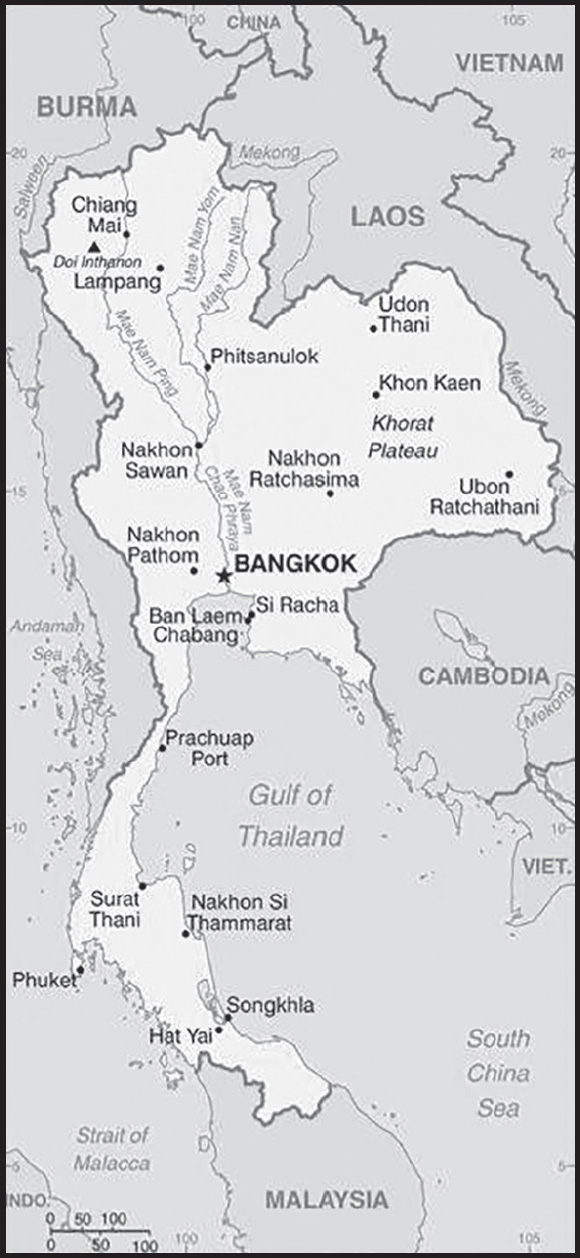
INTRODUCTION
Background: Two unified Thai kingdoms emerged in the mid-13th century. The Sukhothai, located in the south-central plains, gained its independence from the Khmer Empire to the east. By the late 13th century, Sukhothai’s territory extended into present-day Burma and Laos. Sukhothai lasted until the mid-15th century. The Thai Lan Na Kingdom was established in the north with its capital at Chang Mai. Lan Na was conquered by the Burmese in the 16th century. The Ayutthaya Kingdom (14th-18th centuries) succeeded the Sukhothai and would become known as the Siamese Kingdom. During the Ayutthaya period, the Thai/Siamese peoples consolidated their hold on what is present-day central and north-central Thailand. Following a military defeat at the hands of the Burmese in 1767, the Siamese Kingdom rose to new heights under the military ruler TAKSIN, who defeated the Burmese occupiers and expanded the kingdom’s territory into modern-day northern Thailand (formerly the Lan Na Kingdom), Cambodia, Laos, and the Malay Peninsula. The kingdom fought off additional Burmese invasions and raids in the late 1700s and early 1800s. In the mid-1800s, Western pressure led to Siam signing trade treaties that reduced the country’s sovereignty and independence. In the 1890s and 1900s, the British and French forced the kingdom to cede Cambodian, Laotian, and Malay territories that had been under Siamese control.
A bloodless revolution in 1932 led to the establishment of a constitutional monarchy. After the Japanese invaded Thailand in 1941, the government split into a pro-Japan faction and a pro-Allied faction backed by the king. Thailand became a US treaty ally in 1954 after sending troops to Korea and later fighting alongside the US in Vietnam. Thailand since 2005 has experienced several rounds of
political turmoil including a military coup in 2006 that ousted then Prime Minister THAKSIN Chinnawat, followed by large-scale street protests by competing political factions in 2008, 2009, and 2010. THAKSIN’s youngest sister, YINGLAK Chinnawat, in 2011 led the Puea Thai Party to an electoral win and assumed control of the government.
In early May 2014, after months of large-scale anti-government protests in Bangkok beginning in November 2013, YINGLAK was removed from office by the Constitutional Court and in late May 2014 the Royal Thai Army, led by Gen. PRAYUT Chan-ocha, staged a coup against the caretaker government. The military-affiliated National Council for Peace and Order (NCPO), led by PRAYUT as the appointed minister, ruled the country for more than four years, during which time the NCPO drafted a new constitution guaranteeing military sway over Thai politics in future elections by allowing the military to appoint the entire 250-member Senate and requiring a joint meeting of the House and Senate to select the prime minister, effectively giving the military a veto over the choice for the top executive. King PHUMIPHON Adunyadet passed away in October 2016 after 70 years on the throne; his only son, WACHIRALONGKON (aka King RAMA X), formally ascended the throne in December 2019. He signed the new constitution in April 2017. A long-delayed election in March 2019, disputed and widely viewed as skewed in favor of the party aligned with the military, allowed PRAYUT to continue his premiership. The country experienced large-scale anti-government protests in 2020. Following the 2023 elections, Srettha THRAVISIN replaced PRAYUT as prime minister when PRAYUT’s supporting royalist-military parties were defeated by a coalition of populist and progressive parties.
GEOGRAPHY
Location: Southeastern Asia, bordering the Andaman Sea and the Gulf of Thailand, southeast of Burma
Geographic coordinates: 15 00 N, 100 00 E
Map references: Southeast Asia
Area: total: 513,120 sq km
land: 510,890 sq km
water: 2,230 sq km
comparison ranking: total 53
Area - comparative: about three times the size of Florida; slightly more than twice the size of Wyoming
Land boundaries: total: 5,673 km
border countries (4): Burma 2,416 km; Cambodia 817 km; Laos 1,845 km; Malaysia 595 km
Coastline: 3,219 km
Maritime claims: territorial sea: 12 nm
exclusive economic zone: 200 nm
continental shelf: 200-m depth or to the depth of exploitation
Climate: tropical; rainy, warm, cloudy southwest monsoon (mid-May to September); dry, cool northeast monsoon (November to mid-March); southern isthmus always hot and humid
Terrain: central plain; Khorat Plateau in the east; mountains elsewhere
Elevation: highest point: Doi Inthanon 2,565 m
lowest point: Gulf of Thailand 0 m
mean elevation: 287 m
Natural resources: tin, rubber, natural gas, tungsten, tantalum, timber, lead, fish, gypsum, lignite, fluorite, arable land
Land use: agricultural land: 41.2% (2018 est.)
arable land: 30.8% (2018 est.)
permanent crops: 8.8% (2018 est.)
permanent pasture: 1.6% (2018 est.)
forest: 37.2% (2018 est.)
other: 21.6% (2018 est.)
Irrigated land: 64,150 sq km (2012)
Major lakes (area sq km): salt water lake(s): Thalesap Songkhla - 1,290 sq km
Major rivers (by length in km): Mae Nam Khong (Mekong) (shared with China [s], Burma, Laos, Cambodia, and Vietnam [m]) - 4,350 km; Salween (shared with China [s] and Burma [m]) - 3,060 km; Mun - 1,162 km
note – [s] after country name indicates river source; [m] after country name indicates river mouth
Major watersheds (area sq km): Indian Ocean drainage: Salween (271,914 sq km)
Pacific Ocean drainage: Mekong (805,604 sq km)
Population distribution: highest population density is found in and around Bangkok; significant population clusters found througout large parts of the country, particularly north and northeast of Bangkok and in the extreme southern region of the country
Natural hazards: land subsidence in Bangkok area resulting from the depletion of the water table; droughts
Geography - note: controls only land route from Asia to Malaysia and Singapore; ideas for the construction of a canal across the Kra Isthmus that would create a bypass to the Strait of Malacca and shorten shipping times around Asia continue to be discussed
PEOPLE AND SOCIETY
Population: 69,794,997 (2023 est.)
comparison ranking: 20
Nationality: noun: Thai (singular and plural)
adjective: Thai
Ethnic groups: Thai 97.5%, Burmese 1.3%, other 1.1%, unspecified <0.1% (2015 est.)
note: data represent population by nationality
Languages: Thai (official) only 90.7%, Thai and other languages 6.4%, only other languages 2.9% (includes Malay, Burmese); note - data represent population by language(s) spoken at home; English is a secondary language of the elite (2010 est.)
major-language sample(s):

Religions: Buddhist 92.5%, Muslim 5.4%, Christian 1.2%, other 0.9% (includes animist, Confucian, Hindu, Jewish, Sikh, and Taoist) (2021 est.)
Demographic profile: Thailand has experienced a substantial fertility decline since the 1960s largely due to the nationwide success of its voluntary family planning program. In just one generation, the total fertility rate (TFR) shrank from 6.5 children per woman in the 1960s to below the replacement level of 2.1 in the late 1980s. Reduced fertility occurred among all segments of the Thai population, despite disparities between urban and rural areas in terms of income, education, and access to public services. The country’s “reproductive revolution” gained momentum in the 1970s as a result of the government’s launch of an official population policy to reduce population growth, the introduction of new forms of birth control, and the assistance of foreign non-government organizations. Contraceptive use rapidly increased as new ways were developed to deliver family planning services to Thailand’s then overwhelmingly rural population. The contraceptive prevalence rate increased from just 14% in 1970 to 58% in 1981 and has remained about 80% since 2000.
Thailand’s receptiveness to family planning reflects the predominant faith, Theravada Buddhism, which emphasizes individualism, personal responsibility, and independent decision-making. Thai women have more independence and a higher status than women in many other developing countries and are not usually pressured by their husbands or other family members about family planning decisions. Thailand’s relatively egalitarian society also does not have the son preference found in a number of other Asian countries; most Thai ideally want one child of each sex.
Because of its low fertility rate, increasing life expectancy, and growing elderly population, Thailand has become an aging society that will face growing labor shortages. The proportion of the population under 15 years of age has shrunk dramatically, the proportion of working-age individuals has peaked and is starting to decrease, and the proportion of elderly is growing rapidly. In the short-term, Thailand will have to improve educational quality to increase the productivity of its workforce and to compete globally in skills-based industries. An increasing reliance on migrant workers will be necessary to mitigate labor shortfalls.
Thailand is a destination, transit, and source country for migrants. It has 3-4 million migrant workers as of 2017, mainly providing low-skilled labor in the construction, agriculture, manufacturing, services, and fishing and seafood processing sectors. Migrant workers from other Southeast Asian countries with lower wages – primarily Burma and, to a lesser extent, Laos and Cambodia – have been coming to Thailand for decades to work in labor-intensive industries. Many are undocumented and are vulnerable to human trafficking for forced labor, especially in the fisheries industry, or sexual exploitation. A July 2017 migrant worker law stiffening fines on undocumented workers and their employers, prompted tens of thousands of migrants to go home. Fearing a labor shortage, the Thai Government has postponed implementation of the law until January 2018 and is rapidly registering workers. Thailand has also hosted ethnic minority refugees from Burma for more than 30 years; as of 2016, approximately 105,000 mainly Karen refugees from Burma were living in nine camps along the Thailand-Burma border.
Thailand has a significant amount of internal migration, most often from rural areas to urban centers, where there are more job opportunities. Low- and semi-skilled Thais also go abroad to work, mainly in Asia and a smaller number in the Middle East and Africa, primarily to more economically developed countries where they can earn higher wages.
Age structure: 0-14 years: 16% (male 5,720,842/female 5,443,981)
15-64 years: 69.53% (male 23,797,302/female 24,734,505)
65 years and over: 14.47% (2023 est.) (male 4,500,808/female 5,597,559)
Dependency ratios: total dependency ratio: 43.5
youth dependency ratio: 22.7
elderly dependency ratio: 18.4
potential support ratio: 4.8 (2021 est.)
Median age: total: 41 years (2023 est.)
male: 39.8 years
female: 42.2 years
comparison ranking: total 53
Population growth rate: 0.2% (2023 est.)
comparison ranking: 178
Birth rate: 10 births/1,000 population (2023 est.)
comparison ranking: 189
Death rate: 7.9 deaths/1,000 population (2023 est.)
comparison ranking: 92
Net migration rate: -0.2 migrant(s)/1,000 population (2023 est.)
comparison ranking: 112
Population distribution: highest population density is found in and around Bangkok; significant population clusters found througout large parts of the country, particularly north and northeast of Bangkok and in the extreme southern region of the country
Urbanization: urban population: 53.6% of total population (2023)
rate of urbanization: 1.43% annual rate of change (2020-25 est.)
Major urban areas - population: 11.070 million BANGKOK (capital), 1.454 Chon Buri, 1.359 million Samut Prakan, 1.213 million Chiang Mai, 1.005 million Songkla, 1.001 million Nothaburi (2023)
Sex ratio: at birth: 1.05 male(s)/female
0-14 years: 1.05 male(s)/female
15-64 years: 0.96 male(s)/female
65 years and over: 0.8 male(s)/female
total population: 0.95 male(s)/female (2023 est.)
Mother’s mean age at first birth: 23.3 years (2009 est.)
Maternal mortality ratio: 29 deaths/100,000 live births (2020 est.)
comparison ranking: 113
Infant mortality rate: total: 6.4 deaths/1,000 live births (2023 est.)
male: 7 deaths/1,000 live births
female: 5.7 deaths/1,000 live births
comparison ranking: total 167
Life expectancy at birth: total population: 77.9 years (2023 est.)
male: 74.9 years
female: 81.1 years
comparison ranking: total population 82
Total fertility rate: 1.54 children born/woman (2023 est.)
comparison ranking: 194
Gross reproduction rate: 0.75 (2023 est.)
Contraceptive prevalence rate: 73% (2019)
Drinking water source: improved: total: 100% of population
unimproved: total: 0% of population (2020 est.)
Current health expenditure: 4.4% of GDP (2020)
Physicians density: 0.95 physicians/1,000 population (2020)
Sanitation facility access: improved: urban: 99.9% of population
rural: 100% of population
total: 100% of population
unimproved: urban: 0.1% of population
rural: 0% of population
total: 0% of population (2020 est.)
Major infectious diseases: degree of risk: high (2023)
food or waterborne diseases: bacterial diarrhea
vectorborne diseases: dengue fever, Japanese encephalitis, and malaria
Obesity - adult prevalence rate: 10% (2016)
comparison ranking: 140
Alcohol consumption per capita: total: 6.86 liters of pure alcohol (2019 est.)
beer: 1.85 liters of pure alcohol (2019 est.)
wine: 0.23 liters of pure alcohol (2019 est.)
spirits: 4.78 liters of pure alcohol (2019 est.)
other alcohols: 0 liters of pure alcohol (2019 est.)
comparison ranking: total 60
Tobacco use: total: 22.1% (2020 est.)
male: 41.3% (2020 est.)
female: 2.9% (2020 est.)
comparison ranking: total 71
Children under the age of 5 years underweight: 7.7% (2019)
comparison ranking: 62
Currently married women (ages 15-49): 60.8% (2023 est.)
Child marriage: women married by age 15: 3%
women married by age 18: 20.2%
men married by age 18: 9.8% (2019 est.)
Education expenditures: 3.2% of GDP (2020 est.)
comparison ranking: 148
Literacy: definition: age 15 and over can read and write
total population: 94.1%
male: 95.5%
female: 92.8% (2021)
School life expectancy (primary to tertiary education): total: 15 years
male: 15 years
female: 16 years (2016)
Youth unemployment rate (ages 15-24): total: 7% (2021 est.)
male: 6.2%
female: 8.1%
comparison ranking: total 179
ENVIRONMENT
Environment - current issues: air pollution from vehicle emissions; water pollution from organic and factory wastes; water scarcity; deforestation; soil erosion; wildlife populations threatened by illegal hunting; hazardous waste disposal
Environment - international agreements: party to: Biodiversity, Climate Change, Climate Change-Kyoto Protocol, Climate Change-Paris Agreement, Comprehensive Nuclear Test Ban, Desertification, Endangered Species, Hazardous Wastes, Law of the Sea, Marine Life Conservation, Nuclear Test Ban, Ozone Layer Protection, Ship Pollution, Tropical Timber 2006, Wetlands
signed, but not ratified: none of the selected agreements
Climate: tropical; rainy, warm, cloudy southwest monsoon (mid-May to September); dry, cool northeast monsoon (November to mid-March); southern isthmus always hot and humid
Land use: agricultural land: 41.2% (2018 est.)
arable land: 30.8% (2018 est.)
permanent crops: 8.8% (2018 est.)
permanent pasture: 1.6% (2018 est.)
forest: 37.2% (2018 est.)
other: 21.6% (2018 est.)
Urbanization: urban population: 53.6% of total population (2023)
rate of urbanization: 1.43% annual rate of change (2020-25 est.)
Revenue from forest resources: 0.34% of GDP (2018 est.)
comparison ranking: 76
Revenue from coal: 0.03% of GDP (2018 est.)
comparison ranking: 35
Air pollutants: particulate matter emissions: 24.64 micrograms per cubic meter (2019 est.)
carbon dioxide emissions: 283.76 megatons (2016 est.)
methane emissions: 86.98 megatons (2020 est.)
Waste and recycling: municipal solid waste generated annually: 26,853,366 tons (2015 est.)
municipal solid waste recycled annually: 5,128,993 tons (2012 est.)
percent of municipal solid waste recycled: 19.1% (2012 est.)
Major lakes (area sq km): salt water lake(s): Thalesap Songkhla - 1,290 sq km
Major rivers (by length in km): Mae Nam Khong (Mekong) (shared with China [s], Burma, Laos, Cambodia, and Vietnam [m]) - 4,350 km; Salween (shared with China [s] and Burma [m]) - 3,060 km; Mun - 1,162 km
note – [s] after country name indicates river source; [m] after country name indicates river mouth
Major watersheds (area sq km): Indian Ocean drainage: Salween (271,914 sq km)
Pacific Ocean drainage: Mekong (805,604 sq km)
Total water withdrawal: municipal: 2.74 billion cubic meters (2020 est.)
industrial: 2.78 billion cubic meters (2020 est.)
agricultural: 51.79 billion cubic meters (2020 est.)
Total renewable water resources: 438.61 billion cubic meters (2020 est.)
GOVERNMENT
Country name: conventional long form: Kingdom of Thailand
conventional short form: Thailand
local long form: Ratcha Anachak Thai
local short form: Prathet Thai
former: Siam
etymology: Land of the Tai [People]”; the meaning of “tai” is uncertain, but may originally have meant “human beings,” “people,” or “free people’’
Government type: constitutional monarchy
Capital: name: Bangkok
geographic coordinates: 13 45 N, 100 31 E
time difference: UTC+7 (12 hours ahead of Washington, DC, during Standard Time)
etymology: Bangkok was likely originally a colloquial name, but one that was widely adopted by foreign visitors; the name may derive from bang ko, where bang is the Thai word for “village on a stream” and ko means “island,” both referencing the area’s landscape, which was carved by rivers and canals; alternatively, the name may come from bang makok, where makok is the name of the Java plum, a plant bearing olive-like fruit; this possibility is supported by the former name of Wat Arun, a historic temple in the area, that used to be called Wat Makok;
Krung Thep Maha Nakhon, the city’s Thai name, means “City of Angels, Great City” or simply “Great City of Angels” and is a shortening of the full ceremonial name: Krungthepmahanakhon Amonrattanakosin Mahintharayutthaya Mahadilokphop Noppharatratchathaniburirom Udomratchaniwetmahasathan Amonphimanawatansathit Sakkathattiyawitsanukamprasit; translated the meaning is: “City of angels, great city of immortals, magnificent city of the nine gems, seat of the king, city of royal palaces, home of gods incarnate, erected by Vishvakarman at Indra’s behest”; it holds the world’s record as the longest place name (169 letters); Krung Thep is used colloquially
Administrative divisions: 76 provinces (changwat, singular and plural) and 1 municipality* (maha nakhon); Amnat Charoen, Ang Thong, Bueng Kan, Buri Ram, Chachoengsao, Chai Nat, Chaiyaphum, Chanthaburi, Chiang Mai, Chiang Rai, Chon Buri, Chumphon, Kalasin, Kamphaeng Phet, Kanchanaburi, Khon Kaen, Krabi, Krung Thep* (Bangkok), Lampang, Lamphun, Loei, Lop Buri, Mae Hong Son, Maha Sarakham, Mukdahan, Nakhon Nayok, Nakhon Pathom, Nakhon Phanom, Nakhon Ratchasima, Nakhon Sawan, Nakhon Si Thammarat, Nan, Narathiwat, Nong Bua Lamphu, Nong Khai, Nonthaburi, Pathum Thani, Pattani, Phangnga, Phatthalung, Phayao, Phetchabun, Phetchaburi, Phichit, Phitsanulok, Phra Nakhon Si Ayutthaya, Phrae, Phuket, Prachin Buri, Prachuap Khiri Khan, Ranong, Ratchaburi, Rayong, Roi Et, Sa Kaeo, Sakon Nakhon, Samut Prakan, Samut Sakhon, Samut Songkhram, Saraburi, Satun, Sing Buri, Si Sa Ket, Songkhla, Sukhothai, Suphan Buri, Surat Thani, Surin, Tak, Trang, Trat, Ubon Ratchathani, Udon Thani, Uthai Thani, Uttaradit, Yala, Yasothon
Independence: 1238 (traditional founding date; never colonized)
National holiday: Birthday of King WACHIRALONGKON, 28 July (1952)
Constitution: history: many previous; latest drafted and presented 29 March 2016, approved by referendum 7 August 2016, signed into law by the king on 6 April 2017
amendments: amendments require a majority vote in a joint session of the House and Senate and further require at least one fifth of opposition House members and one third of the Senate vote in favor; a national referendum is additionally required for certain amendments; all amendments require signature by the king; Thailand’s 2017 constitution was amended in November 2021 to increase the number of constituency members of parliament (MPs) from 350 to 400, reduce the number of party-list MPs from 150 to 100, and change the election to a two-ballot system
Legal system: civil law system with common law influences
International law organization participation: has not submitted an ICJ jurisdiction declaration; non-party state to the ICCt
Citizenship: citizenship by birth: no
citizenship by descent only: at least one parent must be a citizen of Thailand
dual citizenship recognized: no
residency requirement for naturalization: 5 years
Suffrage: 18 years of age; universal and compulsory
Executive branch: chief of state: King WACHIRALONGKON, also spelled Vajiralongkorn (since 1 December 2016)
head of government: Prime Minister SETTHA Thawisin (since 5 September 2023)
cabinet: Council of Ministers nominated by the prime minister, appointed by the king; a Privy Council advises the king
elections/appointments: the monarchy is hereditary; prime minister candidate approved by the House of Representatives and Senate and appointed by the king; starting in 2024, approval of prime minister needed only by the House of Representatives
Legislative branch: description: bicameral National Assembly or Ratthasapha consists of:
Senate or Wuthisapha (currently 250 seats; members appointed by the National Council for Peace and Order to serve 5-year terms; the Senate appointed in 2024 will consist of 200 members elected from various groups of professionals for a 5-year term)
House of Representatives or Saphaphuthan Ratsadon (500 seats; 400 members directly elected in single-seat constituencies by simple majority vote and 100 members elected in a single nationwide constituency by party-list proportional representation vote; members serve 4-year terms)
elections: Senate - last selections held on 14 May 2019 (next to be held in 2024)
House of Representatives - last held on 14 May 2023 (next to be held in May 2027)
election results: Senate - percent of vote by party - NA; seats by party - NA; composition (248 members as of mid-2022) - men 222, women 26, percent of women 10.5%
House of Representatives - percent of vote by party in 2023 election - MFP 36.2%, PTP 27.7%, UTN 11.9%, PJT 2.9%, DP 2.3%, PPRP 1.4%, PCC 1.5%, other 16%; seats by party - MFP 152, PTP 141, PJT 70, PPRP 41, UTN 36, DP 24, PCC 9, CTP 10, Thai Sang Thai 6, other 11
House of Representatives - percent of vote by party in 2019 election- PPRP 23.7%, PTP 22.2%, FFP* 17.8%, DP 11.1%, PJT 10.5%, TLP 2.3%, CTP 2.2%, NEP 1.4%, PCC 1.4%, ACT 1.2%, PCP 1.2%, other 5.1%; seats by party - PTP 136, PPRP 116, FFP 81, DP 53, PJT 51, CTP 10, TLP 10, PCC 7, PCP 5, NEP 6, ACT 5, other 20; composition (489 members as of mid-2022) - men 412, women 77, percent of women 15.8%; note(s) - total National Assembly percent of women 14%
Judicial branch: highest court(s): Supreme Court of Justice (consists of the court president, 6 vice presidents, 60-70 judges, and organized into 10 divisions); Constitutional Court (consists of the court president and 8 judges); Supreme Administrative Court (number of judges determined by Judicial Commission of the Administrative Courts)
judge selection and term of office: Supreme Court judges selected by the Judicial Commission of the Courts of Justice and approved by the monarch; judge term determined by the monarch; Constitutional Court justices - 3 judges drawn from the Supreme Court, 2 judges drawn from the Administrative Court, and 4 judge candidates selected by the Selective Committee for Judges of the Constitutional Court, and confirmed by the Senate; judges appointed by the monarch serve single 9-year terms; Supreme Administrative Court judges selected by the Judicial Commission of the Administrative Courts and appointed by the monarch; judges serve for life
subordinate courts: courts of first instance and appeals courts within both the judicial and administrative systems; military courts
Political parties and leaders: Action Coalition Party or ACP [ANEK Laothammathast]
Bhumjaithai Party (aka Phumchai Thai Party or PJT; aka Thai Pride Party) or BJT [ANUTIN Chanwirakun]
Chat Phatthana Kla arty (National Development Party) [KON Chatikawanit]
Chat Thai Phatthana Party (Thai Nation Development Party) or CTP [VARAWUT Silpa-archa]
New Economics Party or NEP [MANUN Siwaphiromrat]
Move Forward Party or MFP [CHAITHAWAT Tulathon]
Palang Pracharat Party (People’s State Power Party) or PPRP [PRAWIT Wongsuwan]
Prachachat Party or PCC [WAN Muhamad NOOR Matha]
Prachathipat Party (Democrat Party) or DP [JURIN Laksanawisit]
Puea Chat Party (For Nation Party) or PCP [SARUNWUT Sarunket]
Puea Thai Party (For Thais Party) or PTP [Chusak SIRINIL]
Puea Tham Party (For Dharma Party) [NALINI Thawisin]
Seri Ruam Thai Party (Thai Liberal Party or TLP) [SERIPHISUT Temiyawet]
Thai Civilized Party or TCL [MONGKOLKIT Suksintharanon]
Thai Local Power Party or TLP [CHATCHAWAI Kong-udom]
Thai People Power Party or TLPT [NIKHOM Bunwiset]
Thai Sang Thai Party [SUDARAT Keyuraphan]
United Thai Nation (Ruam Thai Sang Chat) or UTN [PHIRAPHAN Saliratthawiphak]
International organization participation: ADB, APEC, ARF, ASEAN, BIMSTEC, BIS, CD, CICA, CP, EAS, FAO, G-77, IAEA, IBRD, ICAO, ICC (national committees), ICRM, IDA, IFAD, IFC, IFRCS, IHO, ILO, IMF, IMO, IMSO, Interpol, IOC, IOM, IPU, ISO, ITSO, ITU, ITUC (NGOs), MIGA, NAM, OAS (observer), OIC (observer), OIF (observer), OPCW, OSCE (partner), PCA, PIF (partner), UN, UNAMID, UNCTAD, UNESCO, UNHCR, UNIDO, UNMOGIP, UNOCI, UNWTO, UPU, WCO, WFTU (NGOs), WHO, WIPO, WMO, WTO
Diplomatic representation in the US: chief of mission: Ambassador Tanee SANGRAT (since 12 December 2022)
chancery: 1024 Wisconsin Avenue NW, Suite 401, Washington, DC 20007
telephone: [1] (202) 944-3600
FAX: [1] (202) 944-3611
email address and website: thai.wsn@thaiembdc.org
consulate(s) general: Chicago, Los Angeles, New York
Diplomatic representation from the US: chief of mission: Ambassador Robert F. GODEC (since 7 October 2022)
embassy: 95 Wireless Road, Bangkok 10330
mailing address: 7200 Bangkok Place, Washington DC 20521-7200
telephone: [66] 2-205-4000
FAX: [66] 2-205-4103
email address and website: acsbkk@state.gov
consulate(s) general: Chiang Mai
Flag description: five horizontal bands of red (top), white, blue (double width), white, and red; the red color symbolizes the nation and the blood of life, white represents religion and the purity of Buddhism, and blue stands for the monarchy
note: similar to the flag of Costa Rica but with the blue and red colors reversed
National symbol(s): garuda (mythical half-man, half-bird figure), elephant; national colors: red, white, blue
National anthem: name: “Phleng Chat Thai” (National Anthem of Thailand)
lyrics/music: Luang SARANUPRAPAN/Phra JENDURIYANG
note: music adopted 1932, lyrics adopted 1939; by law, people are required to stand for the national anthem at 0800 and 1800 every day; the anthem is played in schools, offices, theaters, and on television and radio during this time; “Phleng Sanlasoen Phra Barami” (A Salute to the Monarch) serves as the royal anthem and is played in the presence of the royal family and during certain state ceremonies
National heritage: total World Heritage Sites: 6 (3 cultural, 3 natural)
selected World Heritage Site locales: Historic City of Ayutthaya (c); Historic Sukhothai and Associated Historic Towns (c); Thungyai-Huai Kha Khaeng Wildlife Sanctuaries (n); Ban Chiang Archaeological Site (c); Dong Phayayen-Khao Yai Forest Complex (n); Kaeng Krachan Forest Complex (n)
ECONOMY
Economic overview: upper middle-income Southeast Asian economy; substantial infrastructure; major electronics, food, and automobile parts exporter; globally used currency; extremely low unemployment, even amid COVID-19; ongoing Thailand 4.0 economic development
Real GDP (purchasing power parity): $1.223 trillion (2021 est.)
$1.204 trillion (2020 est.)
$1.284 trillion (2019 est.)
note: data are in 2017 dollars
comparison ranking: 22
Real GDP growth rate: 1.53% (2021 est.)
-6.2% (2020 est.)
2.15% (2019 est.)
comparison ranking: 173
Real GDP per capita: $17,100 (2021 est.)
$16,800 (2020 est.)
$18,000 (2019 est.)
note: data are in 2017 dollars
comparison ranking: 101
GDP (official exchange rate): $543.798 billion (2019 est.)
Inflation rate (consumer prices): 1.23% (2021 est.)
-0.85% (2020 est.)
0.71% (2019 est.)
comparison ranking: 191
Credit ratings:
Fitch rating: BBB+ (2013)
Moody’s rating: Baa1 (2003)
Standard & Poors rating: BBB+ (2004)
note: The year refers to the year in which the current credit rating was first obtained.
GDP - composition, by sector of origin: agriculture: 8.2% (2017 est.)
industry: 36.2% (2017 est.)
services: 55.6% (2017 est.)
comparison rankings: services 153; industry 42; agriculture 99
GDP - composition, by end use: household consumption: 48.8% (2017 est.)
government consumption: 16.4% (2017 est.)
investment in fixed capital: 23.2% (2017 est.)
investment in inventories: -0.4% (2017 est.)
exports of goods and services: 68.2% (2017 est.)
imports of goods and services: -54.6% (2017 est.)
Agricultural products: sugar cane, cassava, rice, oil palm fruit, rubber, maize, tropical fruit, poultry, pineapples, mangoes/guavas
Industries: tourism, textiles and garments, agricultural processing, beverages, tobacco, cement, light manufacturing such as jewelry and electric appliances, computers and parts, integrated circuits, furniture, plastics, automobiles and automotive parts, agricultural machinery, air conditioning and refrigeration, ceramics, aluminum, chemical, environmental management, glass, granite and marble, leather, machinery and metal work, petrochemical, petroleum refining, pharmaceuticals, printing, pulp and paper, rubber, sugar, rice, fishing, cassava, world’s second-largest tungsten producer and third-largest tin producer
Industrial production growth rate: 3.34% (2021 est.)
comparison ranking: 117
Labor force: 40.213 million (2021 est.)
comparison ranking: 16
Labor force - by occupation: agriculture: 31.8%
industry: 16.7%
services: 51.5% (2015 est.)
Unemployment rate: 1.42% (2021 est.)
1.1% (2020 est.)
0.72% (2019 est.)
comparison ranking: 220
Youth unemployment rate (ages 15-24): total: 7% (2021 est.)
male: 6.2%
female: 8.1%
comparison ranking: total 179
Population below poverty line: 9.9% (2018 est.)
Gini Index coefficient - distribution of family income: 35 (2020 est.)
comparison ranking: 101
Average household expenditures: on food: 24.3% of household expenditures (2018 est.)
on alcohol and tobacco: 3.4% of household expenditures (2018 est.)
Household income or consumption by percentage share: lowest 10%: 2.8%
highest 10%: 31.5% (2009 est.)
Budget: revenues: $104.689 billion (2020 est.)
expenditures: $128.581 billion (2020 est.)
Budget surplus (+) or deficit (-): -3.5% (of GDP) (2017 est.)
comparison ranking: 147
Public debt: 50.4% of GDP (2020 est.)
40.13% of GDP (2019 est.)
39.25% of GDP (2018 est.)
note: data cover general government debt and include debt instruments issued (or owned) by government entities other than the treasury; the data include treasury debt held by foreign entities; the data include debt issued by subnational entities, as well as intragovernmental debt; intragovernmental debt consists of treasury borrowings from surpluses in the social funds, such as for retirement, medical care, and unemployment; debt instruments for the social funds are sold at public auctions
comparison ranking: 107
Taxes and other revenues: 14.48% (of GDP) (2020 est.)
comparison ranking: 151
Fiscal year: 1 October - 30 September
Current account balance: -$10.345 billion (2021 est.)
$21.058 billion (2020 est.)
$38.256 billion (2019 est.)
comparison ranking: 195
Exports: $296.002 billion (2021 est.) note: data are in current year dollars
$257.981 billion (2020 est.) note: data are in current year dollars
$323.878 billion (2019 est.) note: data are in current year dollars
comparison ranking: 26
Exports - partners: United States 16%, China 13%, Japan 9%, Vietnam 4%, Australia 4% (2021)
Exports - commodities: office machinery/parts, cars and vehicle parts, integrated circuits, delivery trucks, refined petroleum, rubber (2021)
Imports: $295.78 billion (2021 est.) note: data are in current year dollars
$232.039 billion (2020 est.) note: data are in current year dollars
$272.831 billion (2019 est.) note: data are in current year dollars
comparison ranking: 25
Imports - partners: China 22%, Japan 14%, United States 7%, Malaysia 6% (2019)
Imports - commodities: crude petroleum, integrated circuits, natural gas, vehicle parts, gold (2019)
Reserves of foreign exchange and gold: $246.025 billion (31 December 2021 est.)
$258.104 billion (31 December 2020 est.)
$224.356 billion (31 December 2019 est.)
comparison ranking: 14
Debt - external: $167.89 billion (2019 est.)
$158.964 billion (2018 est.)
comparison ranking: 44
Exchange rates: baht per US dollar -
Exchange rates: 31.977 (2021 est.)
31.294 (2020 est.)
31.048 (2019 est.)
32.31 (2018 est.)
33.94 (2017 est.)
ENERGY
Electricity access: electrification - total population: 100% (2021)
Electricity: installed generating capacity: 53.13 million kW (2020 est.)
consumption: 190,569,262,000 kWh (2019 est.)
exports: 2,617,583,000 kWh (2020 est.)
imports: 29,550,571,000 kWh (2020 est.)
transmission/distribution losses: 13.286 billion kWh (2019 est.)
comparison rankings: imports 4; exports 45; installed generating capacity 25; transmission/distribution losses 27; consumption 23
Electricity generation sources: fossil fuels: 83.3% of total installed capacity (2020 est.)
solar: 2.8% of total installed capacity (2020 est.)
wind: 1.7% of total installed capacity (2020 est.)
hydroelectricity: 2.6% of total installed capacity (2020 est.)
biomass and waste: 9.6% of total installed capacity (2020 est.)
Coal: production: 13.251 million metric tons (2020 est.)
consumption: 35.761 million metric tons (2020 est.)
exports: 63,000 metric tons (2020 est.)
imports: 23.899 million metric tons (2020 est.)
proven reserves: 1.063 billion metric tons (2019 est.)
Petroleum: total petroleum production: 438,200 bbl/day (2021 est.)
refined petroleum consumption: 1,284,800 bbl/day (2019 est.)
crude oil and lease condensate exports: 28,600 bbl/day (2018 est.)
crude oil and lease condensate imports: 979,800 bbl/day (2018 est.)
crude oil estimated reserves: 252.8 million barrels (2021 est.)
Refined petroleum products - production: 1.328 million bbl/day (2015 est.)
comparison ranking: 14
Refined petroleum products - exports: 278,300 bbl/day (2015 est.)
comparison ranking: 29
Refined petroleum products - imports: 134,200 bbl/day (2015 est.)
comparison ranking: 44
Natural gas: production: 38,420,517,000 cubic meters (2019 est.)
consumption: 54,802,466,000 cubic meters (2019 est.)
exports: 0 cubic meters (2021 est.)
imports: 14,944,842,000 cubic meters (2019 est.)
proven reserves: 138.243 billion cubic meters (2021 est.)
Carbon dioxide emissions: 305.273 million metric tonnes of CO2 (2019 est.)
from coal and metallurgical coke: 58.78 million metric tonnes of CO2 (2019 est.)
from petroleum and other liquids: 146.172 million metric tonnes of CO2 (2019 est.)
from consumed natural gas: 100.321 million metric tonnes of CO2 (2019 est.)
comparison ranking: total emissions 20
Energy consumption per capita: 76.714 million Btu/person (2019 est.)
comparison ranking: 79
COMMUNICATIONS
Telephones - fixed lines: total subscriptions: 4.6 million (2021 est.)
subscriptions per 100 inhabitants: 7 (2021 est.)
comparison ranking: total subscriptions 31
Telephones - mobile cellular: total subscriptions: 120 million (2021 est.)
subscriptions per 100 inhabitants: 170 (2021 est.)
comparison ranking: total subscriptions 15
Telecommunication systems: general assessment: Thailand’s telecom sector is relatively mature and hosts a mix of public and private sector players; the mobile market is highly developed and has experienced strong growth over the last seven years; the market returned to growth in 2021 after it contracted in 2020 driven by the Covid-19 pandemic, and a steep decline in inbound tourism; it remains highly saturated, owing to overall maturity and the popularity of multiple SIM card use, which has resulted in a particularly high penetration rate; in general, the sector retains considerable potential given the impetus of 5G, the recent spectrum auctions, and continued network deployments by the country’s network operators; further auctions of spectrum in the 700MHz band (being repurposed from digital TV broadcasting), and in the 3.6GHz range will further improve network capacity; in the wire line segment, the decline in fixed-line penetration is expected to continue as subscribers migrate to mobile networks for voice and data services; the emphasis among operators has been to bolster their fiber footprints in key high-value areas; the transition to fiber from DSL and cable has also been facilitated by changes to the regulatory structure that have removed some barriers to investment; this is supporting the cannibalization of older copper-based DSL lines by fiber; the returns from this investment remain a long-term prospect as consumers still favor entry-level packages; there is also strong interest from the government, as well as private vendors, in establishing Thailand as a data center hub to serve the region; the size, capacity and spread of existing data centers in the Greater Mekong Subregion (GMS) outside of Thailand is small; Thailand retains some advantages to attract investment, including improved fiber connectivity and international bandwidth; increasing submarine capacity, such as the SJC2 cable to come online later in 2023, will considerably improve Thailand’s potential as a regional hub (2022)
domestic: fixed-line is 7 per 100 and mobile-cellular is 170 per 100 (2021)
international: country code - 66; landing points for the AAE-1, FEA, SeaMeWe-3,-4, APG, SJC2, TIS, MCT and AAG submarine cable systems providing links throughout Asia, Australia, Africa, Middle East, Europe, and US; satellite earth stations - 2 Intelsat (1 Indian Ocean, 1 Pacific Ocean) (2019)
Broadcast media: 26 digital TV stations in Bangkok broadcast nationally, 6 terrestrial TV stations in Bangkok broadcast nationally via relay stations - 2 of the stations are owned by the military, the other 4 are government-owned or controlled, leased to private enterprise, and all are required to broadcast government-produced news programs twice a day; multi-channel satellite and cable TV subscription services are available; radio frequencies have been allotted for more than 500 government and commercial radio stations; many small community radio stations operate with low-power transmitters (2017)
Internet country code: .th
Internet users: total: 61.2 million (2021 est.)
percent of population: 85% (2021 est.)
comparison ranking: total 17
Broadband - fixed subscriptions: total: 11,478,265 (2020 est.)
subscriptions per 100 inhabitants: 16 (2020 est.)
comparison ranking: total 18
TRANSPORTATION
National air transport system: number of registered air carriers: 15 (2020)
inventory of registered aircraft operated by air carriers: 283
annual passenger traffic on registered air carriers: 76,053,042 (2018)
annual freight traffic on registered air carriers: 2,666,260,000 (2018) mt-km
Civil aircraft registration country code prefix: HS
Airports: 101 (2021)
comparison ranking: total 56
Airports - with paved runways: 63
note: paved runways have a concrete or asphalt surface but not all have facilities for refueling, maintenance, or air traffic control; the length of a runway required for aircraft to safely operate depends on a number of factors including the type of aircraft, the takeoff weight (including passengers, cargo, and fuel), engine types, flap settings, landing speed, elevation of the airport, and average maximum daily air temperature; paved runways can reach a length of 5,000 m (16,000 ft.), but the “typical” length of a commercial airline runway is between 2,500-4,000 m (8,000-13,000 ft.)
Airports - with unpaved runways: 38
note: unpaved runways have a surface composition such as grass or packed earth and are most suited to the operation of light aircraft; unpaved runways are usually short, often less than 1,000 m (3,280 ft.) in length; airports with unpaved runways often lack facilities for refueling, maintenance, or air traffic control
Heliports: 7 (2021)
Pipelines: 2 km condensate, 5,900 km gas, 85 km liquid petroleum gas, 1 km oil, 1,097 km refined products (2013)
Railways: total: 4,127 km (2017)
standard gauge: 84 km (2017) 1.435-m gauge (84 km electrified)
narrow gauge: 4,043 km (2017) 1.000-m gauge
comparison ranking: total 43
Roadways: total: 180,053 km (2006) (includes 450 km of expressways)
comparison ranking: total 30
Waterways: 4,000 km (2011) (3,701 km navigable by boats with drafts up to 0.9 m)
comparison ranking: 28
Merchant marine: total: 829 (2022)
by type: bulk carrier 26, container ship 28, general cargo 91, oil tanker 246, other 438 comparison ranking: total 29
Ports and terminals: major seaport(s): Bangkok, Laem Chabang, Map Ta Phut, Prachuap Port, Si Racha
container port(s) (TEUs): Laem Chabang (8,335,384) (2021)
LNG terminal(s) (import): Map Ta Phut
MILITARY AND SECURITY
Military and security forces: Royal Thai Armed Forces (Kongthap Thai, RTARF): Royal Thai Army (Kongthap Bok Thai, RTA), Royal Thai Navy (Kongthap Ruea Thai, RTN; includes Royal Thai Marine Corps), Royal Thai Air Force (Kongthap Akaat Thai, RTAF)
Office of the Prime Minister: Royal Thai Police (2023)
note 1: the Thai Internal Security Operations Command (ISOC) oversees counter-insurgency operations, as well as countering terrorism, narcotics and weapons trafficking, and other internal security duties; it is primarily run by the Army
note 2: official paramilitary forces in Thailand include the Thai Rangers (Thahan Phran or “Hunter Soldiers”) under the Army; the Paramilitary Marines under the Navy; the Border Patrol Police (BPP) under the Royal Thai Police; the Volunteer Defense Corps (VDC or O So) and National Defense Volunteers (NDV), both under the Ministry of Interior; there are also several government-backed volunteer militias created to provide village security against insurgents in the deep south or to assist the ISOC
Military expenditures: 1.3% of GDP (2022 est.)
1.3% of GDP (2021)
1.4% of GDP (2020)
1.3% of GDP (2019)
1.3% of GDP (2018)
comparison ranking: 102
Military and security service personnel strengths: estimated 350,000 active-duty personnel (250,000 Army; 70,000 Navy; 30,000 Air Force); approximately 230,000 Royal Thai Police (2023)
Military equipment inventories and acquisitions: the RTARF has a diverse array of foreign-supplied weapons systems, including a considerable amount of older US equipment; over the past decade, Thailand has received arms from nearly 20 countries, with China, South Korea, Ukraine, and the US being among the leading suppliers; in recent years, Thailand has been making efforts to increase its domestic defense production capabilities in such areas as armored vehicles, unmanned aerial systems, and other military technologies (2023)
Military service age and obligation: 18 years of age for voluntary military service for men and women; 21 years of age for compulsory military service for men; men register at 18 years of age; volunteer service obligation may be as short as 6 or 12 months, depending on educational qualifications; conscript service obligation also varies by educational qualifications, but is typically 24 months (2023)
note 1: serving in the armed forces is a national duty of all Thai citizens; conscription was introduced in 1905; it includes women, however, only men over the age of 21 who have not gone through reserve training are conscripted; conscripts are chosen by lottery (on draft day, eligible draftees can request volunteer service, or they may choose to stay for the conscription lottery); approximately 75-100,000 men are drafted for military service each year and conscripts reportedly comprise as much as 50% of the armed forces
note 2: as of 2020, women comprised about 8% of active-duty military personnel
Military deployments: 275 South Sudan (UNMISS) (2023)
Military - note: the RTARF’s missions include defending the country’s territory and sovereignty, protecting the monarchy, ensuring internal security, and responding to natural disasters; it also plays a large role in domestic politics and has attempted more than 20 coups since the fall of absolute monarchy in 1932, the most recent being in 2014; the Army, formed in 1874, is the dominant service and has 15 combat divisions spread across 4 military regions; ten of the divisions are infantry, while the others are armored/mechanized cavalry, special forces, and artillery; established in 1906, the Navy’s principal warships include a light aircraft/helicopter carrier, a landing platform dock (LPD) amphibious assault ship, and nearly 20 frigates, corvettes, and offshore patrol vessels; it also has a marine infantry division; the Air Force, established in 1913, is one of the oldest in Southeast Asia and has around 100 combat aircraft
since 2004, the military has fought against separatist insurgents in the southern provinces of Pattani, Yala, and Narathiwat, as well as parts of Songkhla; the insurgency is rooted in ethnic Malay nationalist resistance to Thai rule that followed the extension of Siamese sovereignty over the Patani Sultanate in the 18th century; the insurgency consists of several armed groups, the largest of which is the Barisan Revolusi Nasional-Koordinasi (BRN-C): since 2020, Thai officials have been negotiating with BRN, and has parallel talks with an umbrella organization, MARA Pattani, that claims to represent the insurgency groups; since 2004, violence associated with the insurgency has claimed more than 7,300 lives (as of 2023); the Thai Government has had as many as 100,000 military and paramilitary forces deployed in the south to combat the insurgency
Thailand has Major Non-NATO Ally (MNNA) status with the US, a designation under US law that provides foreign partners with certain benefits in the areas of defense trade and security cooperation; the Thai and US militaries host the annual “Cobra Gold” multinational military exercises in Thailand; the exercise is one of the largest multinational exercises in the Pacific region (2023)
SPACE
Space agency/agencies: Geo-Informatics and Space Technology Development Agency (GISTDA, under the Ministry of Science and Technology; created in 2000 from the Thailand Remote Sensing Center that was established in 1979); National Space Policy Committee (NSPC; advisory body to the prime minister) (2023)
Space launch site(s): none, although as of 2023 the Thai Government was reviewing a proposal to build a spaceport (2023)
Space program overview: has an ambitious and growing space program focused on the acquisition and operation of satellites, as well as the development of related technologies; operates communications and remote sensing (RS) satellites; manufactures scientific/research/testing cube satellites and developing the capabilities to produce RS satellites (has historically built satellites with foreign assistance); cooperates with a range of foreign space agencies and industries, including those of other ASEAN countries, China, France, India, the Netherlands, Pakistan, Russia, South Korea, and the US; founding member of the China-led Asia-Pacific Space Cooperation Organization (APSCO); has a growing space industry, including Southeast Asia’s first dedicated satellite manufacturing facility, which opened in 2021 (2023)
note: further details about the key activities, programs, and milestones of the country’s space program, as well as government spending estimates on the space sector, appear in Appendix S
TRANSNATIONAL ISSUES
Disputes - international: Thailand-Burma: in 2016, Thailand expressed its interest in investing in Burma’s Hatgyi Dam project on the Salween River near the Thai-Burma border; the dam has the potential to supply electricity and water during the drought season; approximately 100,000 mostly Karen refugees fleeing civil strife, political upheaval, and economic stagnation in Burma live in nine remote camps in Thailand near the border
Thailand-Cambodia: Cambodia and Thailand dispute sections of their border; in 2011, Thailand and Cambodia resorted to arms in the dispute over the location of the boundary on the precipice surmounted by Preah Vihear temple ruins, awarded to Cambodia by ICJ decision in 1962 and part of a planned UN World Heritage site; in 2013, the International Court of Justice ruled that the land with the temple was Cambodian territory but that a nearby hill belonged to Thailand
Thailand-Laos: talks continue on completion of demarcation with Laos but disputes remain over several islands in the Mekong River
Thailand-Malaysia: separatist violence in Thailand’s predominantly Malay-Muslim southern provinces prompt border closures and controls with Malaysia to stem insurgent activities; disputed areas are the Bukit Jeli area at the headwaters of the Golok River and the continental shelf boundary in the Gulf of Thailand
Refugees and internally displaced persons: refugees (country of origin): 91,339 (Burma) (refugees and asylum seekers) (2023)
IDPs: 41,000 (2022)
stateless persons: 566,900 (2022) (estimate represents stateless persons registered with the Thai Government; actual number may be as high as 3.5 million); note - about half of Thailand’s northern hill tribe people do not have citizenship and make up the bulk of Thailand’s stateless population; most lack documentation showing they or one of their parents were born in Thailand; children born to Burmese refugees are not eligible for Burmese or Thai citizenship and are stateless; most Chao Lay, maritime nomadic peoples, who travel from island to island in the Andaman Sea west of Thailand are also stateless; stateless Rohingya refugees from Burma are considered illegal migrants by Thai authorities and are detained in inhumane conditions or expelled; stateless persons are denied access to voting, property, education, employment, healthcare, and driving
note: Thai nationality was granted to more than 23,000 stateless persons between 2012 and 2016 and more than 18,000 between 2018 and 2021; in 2016, the Government of Thailand approved changes to its citizenship laws that could make 80,000 stateless persons eligible for citizenship, as part of its effort to achieve zero statelessness by 2024 (2021)
Illicit drugs: not a cultivator or producer of significant quantities of opiates, methamphetamine, or other illicit drugs; not a significant source or transit country for drugs entering the United States; drugs smuggled through Thailand heading for Indo-Pacific region markets; large influx of methamphetamine and heroin from neighboring Burma to other markets, but also consumed domestically, most of which transits through Thailand to other markets, but is also consumed domestically; a major source of precursor or essential chemicals used in the production of illicit narcotics