U
UGANDA
INTRODUCTION
Background: An ancient crossroads for various migrations, Uganda has as many as 65 ethnic groups that speak languages from three of Africa’s four major linguistic families. As early as 1200, fertile soils and regular rainfall in the south fostered the formation of several large centralized kingdoms, including Buganda, from which the country derives its name. Muslim traders from Egypt reached northern Uganda in the 1820s, and Swahili merchants from the Indian Ocean coast arrived in the south by the 1840s. The area attracted the attention of British explorers seeking the source of the Nile River in the 1860s, and this influence expanded in subsequent decades with the arrival of Christian missionaries and trade agreements; Uganda was declared a British protectorate in 1894. Buganda and other southern kingdoms negotiated agreements with Britain to secure privileges and a level of autonomy that were rare during the colonial period in Africa. The colonial boundaries demarcating Uganda grouped together a wide range of ethnic groups with different political systems and cultures, and the disparities between how Britain governed southern and northern areas compounded these differences, complicating efforts to establish a cohesive independent country.
Uganda gained independence in 1962 with one of the more developed economies and one of the strongest education systems in Sub-Saharan Africa, but it descended within a few years into political turmoil and internal conflict that lasted more than two decades. In 1966, Prime Minister Milton OBOTE suspended the constitution and violently deposed President Edward MUTESA, who was also the king of Buganda. Idi AMIN seized power in 1971 through a military coup and led the country into economic ruin and rampant mass atrocities that killed as many as 500,000 civilians. AMIN’s annexation of Tanzanian territory in 1979 provoked Tanzania to invade Uganda, depose AMIN, and install a coalition government. In the aftermath, Uganda continued to experience atrocities, looting, and political instability and had four different heads of state between 1979 and 1980. OBOTE regained the presidency in 1980 through a controversial election that sparked renewed guerrilla warfare, killing as an estimated 300,000 civilians. Gen. Tito OKELLO seized power in a coup in 1985, but his rule was short-lived, with Yoweri MUSEVENI becoming president in 1986 after his insurgency captured the capital. MUSEVENI is widely credited with restoring relative stability and economic growth to Uganda but has resisted calls to leave office. In 2017, parliament approved the removal of presidential age limits, making it possible for MUSEVENI to remain in office for life. Uganda faces numerous challenges that could affect future stability, including explosive population growth, power and infrastructure constraints, corruption, underdeveloped democratic institutions, and human rights deficits.
GEOGRAPHY
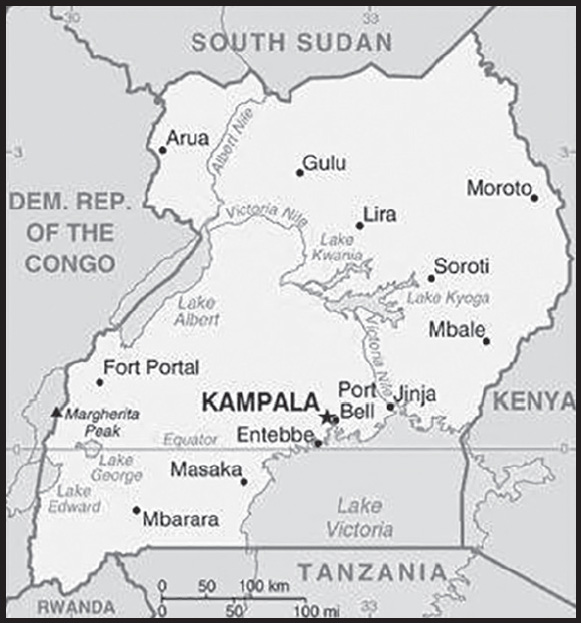
Location: East-Central Africa, west of Kenya, east of the Democratic Republic of the Congo
Geographic coordinates: 1 00 N, 32 00 E
Map references: Africa
Area: total: 241,038 sq km
land: 197,100 sq km
water: 43,938 sq km
comparison ranking: total 81
Area - comparative: slightly more than two times the size of Pennsylvania; slightly smaller than Oregon
Land boundaries: total: 2,729 km
border countries (5): Democratic Republic of the Congo 877 km; Kenya 814 km; Rwanda 172 km; South Sudan 475 km; Tanzania 391 km
Coastline: 0 km (landlocked)
Maritime claims: none (landlocked)
Climate: tropical; generally rainy with two dry seasons (December to February, June to August); semiarid in northeast
Terrain: mostly plateau with rim of mountains
Elevation: highest point: Margherita Peak on Mount Stanley 5,110 m
lowest point: Albert Nile 614 m
Natural resources: copper, cobalt, hydropower, limestone, salt, arable land, gold
Land use: agricultural land: 71.2% (2018 est.)
arable land: 34.3% (2018 est.)
permanent crops: 11.3% (2018 est.)
permanent pasture: 25.6% (2018 est.)
forest: 14.5% (2018 est.)
other: 14.3% (2018 est.)
Irrigated land: 105 sq km (2013)
Major lakes (area sq km): fresh water lake(s): Lake Victoria (shared with Tanzania and Kenya) - 62,940 sq km; Lake Albert (shared with Democratic Republic of Congo) - 5,590 sq km; Lake Kyoga - 4,430 sq km; Lake Edward (shared with Democratic Republic of Congo) - 2,150 sq km
Major rivers (by length in km): Nile (shared with Rwanda [s], Tanzania, South Sudan, Sudan, and Egypt [m]) - 6,650 km
note – [s] after country name indicates river source; [m] after country name indicates river mouth
Major watersheds (area sq km): Atlantic Ocean drainage: Congo (3,730,881 sq km), (Mediterranean Sea) Nile (3,254,853 sq km)
Population distribution: population density is relatively high in comparison to other African nations; most of the population is concentrated in the central and southern parts of the country, particularly along the shores of Lake Victoria and Lake Albert; the northeast is least populated as shown in this population distribution map
Natural hazards: droughts; floods; earthquakes; landslides; hailstorms
Geography - note: landlocked; fertile, well-watered country with many lakes and rivers; Lake Victoria, the world’s largest tropical lake and the second largest fresh water lake, is shared among three countries: Kenya, Tanzania, and Uganda
PEOPLE AND SOCIETY
Population: 47,729,952 (2023 est.)
comparison ranking: 31
Nationality: noun: Ugandan(s)
adjective: Ugandan
Ethnic groups: Baganda 16.5%, Banyankole 9.6%, Basoga 8.8%, Bakiga 7.1%, Iteso 7%, Langi 6.3%, Bagisu 4.9%, Acholi 4.4%, Lugbara 3.3%, other 32.1% (2014 est.)
Languages: English (official language, taught in schools, used in courts of law and by most newspapers and some radio broadcasts), Ganda or Luganda (most widely used of the Niger-Congo languages and the language used most often in the capital), other Niger-Congo languages, Nilo-Saharan languages, Swahili (official), Arabic
Religions: Protestant 45.1% (Anglican 32.0%, Pentecostal/Born Again/Evangelical 11.1%, Seventh Day Adventist 1.7%, Baptist .3%), Roman Catholic 39.3%, Muslim 13.7%, other 1.6%, none 0.2% (2014 est.)
Demographic profile: Uganda has one of the youngest and most rapidly growing populations in the world; its total fertility rate is among the world’s highest at close to 5.5 children per woman in 2022. Except in urban areas, actual fertility exceeds women’s desired fertility by one or two children, which is indicative of the widespread unmet need for contraception, lack of government support for family planning, and a cultural preference for large families. High numbers of births, short birth intervals, and the early age of childbearing contribute to Uganda’s high maternal mortality rate. Gender inequities also make fertility reduction difficult; women on average are less-educated, participate less in paid employment, and often have little say in decisions over childbearing and their own reproductive health. However, even if the birth rate were significantly reduced, Uganda’s large pool of women entering reproductive age ensures rapid population growth for decades to come.
Unchecked, population increase will further strain the availability of arable land and natural resources and overwhelm the country’s limited means for providing food, employment, education, health care, housing, and basic services. The country’s north and northeast lag even further behind developmentally than the rest of the country as a result of long-term conflict (the Ugandan Bush War 1981-1986 and more than 20 years of fighting between the Lord’s Resistance Army (LRA) and Ugandan Government forces), ongoing inter-communal violence, and periodic natural disasters.
Uganda has been both a source of refugees and migrants and a host country for refugees. In 1972, then President Idi AMIN, in his drive to return Uganda to Ugandans, expelled the South Asian population that composed a large share of the country’s business people and bankers. Since the 1970s, thousands of Ugandans have emigrated, mainly to southern Africa or the West, for security reasons, to escape poverty, to search for jobs, and for access to natural resources. The emigration of Ugandan doctors and nurses due to low wages is a particular concern given the country’s shortage of skilled health care workers. Africans escaping conflicts in neighboring states have found refuge in Uganda since the 1950s; the country currently struggles to host tens of thousands from the Democratic Republic of the Congo, South Sudan, and other nearby countries.
Age structure: 0-14 years: 47.3% (male 11,439,303/female 11,136,111)
15-64 years: 50.31% (male 11,335,543/female 12,679,044)
65 years and over: 2.39% (2023 est.) (male 484,782/female 655,169)
Dependency ratios: total dependency ratio: 88.2
youth dependency ratio: 85.1
elderly dependency ratio: 3.2
potential support ratio: 31.7 (2021 est.)
Median age: total: 16.1 years (2023 est.)
male: 15.3 years
female: 16.9 years
comparison ranking: total 226
Population growth rate: 3.22% (2023 est.)
comparison ranking: 8
Birth rate: 40.3 births/1,000 population (2023 est.)
comparison ranking: 5
Death rate: 4.9 deaths/1,000 population (2023 est.)
comparison ranking: 203
Net migration rate: -3.2 migrant(s)/1,000 population (2023 est.)
comparison ranking: 186
Population distribution: population density is relatively high in comparison to other African nations; most of the population is concentrated in the central and southern parts of the country, particularly along the shores of Lake Victoria and Lake Albert; the northeast is least populated as shown in this population distribution map
Urbanization: urban population: 26.8% of total population (2023)
rate of urbanization: 5.41% annual rate of change (2020-25 est.)
Major urban areas - population: 3.846 million KAMPALA (capital) (2023)
Sex ratio: at birth: 1.03 male(s)/female
0-14 years: 1.03 male(s)/female
15-64 years: 0.89 male(s)/female
65 years and over: 0.74 male(s)/female
total population: 0.95 male(s)/female (2023 est.)
Mother’s mean age at first birth: 19.4 years (2016 est.)
note: data represents median age at first birth among women 20-49
Maternal mortality ratio: 284 deaths/100,000 live births (2020 est.)
comparison ranking: 29
Infant mortality rate: total: 29.4 deaths/1,000 live births (2023 est.)
male: 32.8 deaths/1,000 live births
female: 26 deaths/1,000 live births
comparison ranking: total 53
Life expectancy at birth: total population: 69.3 years (2023 est.)
male: 67.1 years
female: 71.6 years
comparison ranking: total population 182
Total fertility rate: 5.26 children born/woman (2023 est.)
comparison ranking: 7
Gross reproduction rate: 2.59 (2023 est.)
Contraceptive prevalence rate: 50.2% (2021)
Drinking water source: improved: urban: 92.5% of population
rural: 80% of population
total: 83.1% of population
unimproved: urban: 7.5% of population
rural: 20% of population
total: 16.9% of population (2020 est.)
Current health expenditure: 4% of GDP (2020)
Physicians density: 0.15 physicians/1,000 population (2020)
Hospital bed density: 0.5 beds/1,000 population
Sanitation facility access: improved: urban: 67.3% of population
rural: 27.5% of population
total: 37.4% of population
unimproved: urban: 32.7% of population
rural: 72.5% of population
total: 62.6% of population (2020 est.)
Major infectious diseases: degree of risk: very high (2023)
food or waterborne diseases: bacterial and protozoal diarrhea, hepatitis A and E, and typhoid fever
vectorborne diseases: malaria, dengue fever, and Trypanosomiasis-Gambiense (African sleeping sickness)
water contact diseases: schistosomiasis
animal contact diseases: rabies
Obesity - adult prevalence rate: 5.3% (2016)
comparison ranking: 180
Alcohol consumption per capita: total: 6.82 liters of pure alcohol (2019 est.)
beer: 0.85 liters of pure alcohol (2019 est.)
wine: 0.01 liters of pure alcohol (2019 est.)
spirits: 0.5 liters of pure alcohol (2019 est.)
other alcohols: 5.46 liters of pure alcohol (2019 est.)
comparison ranking: total 61
Tobacco use: total: 8.4% (2020 est.)
male: 13% (2020 est.)
female: 3.7% (2020 est.)
comparison ranking: total 145
Children under the age of 5 years underweight: 7.6% (2019/20)
comparison ranking: 64
Currently married women (ages 15-49): 58.3% (2023 est.)
Child marriage: women married by age 15: 7.3%
women married by age 18: 34%
men married by age 18: 5.5% (2016 est.)
Education expenditures: 2.7% of GDP (2021 est.)
comparison ranking: 169
Literacy: definition: age 15 and over can read and write
total population: 79%
male: 84%
female: 74.3% (2021)
Youth unemployment rate (ages 15-24): total: 4.3% (2021 est.)
male: 3.4%
female: 5.3%
comparison ranking: total 192
ENVIRONMENT
Environment - current issues: draining of wetlands for agricultural use; deforestation; overgrazing; soil erosion; water pollution from industrial discharge and water hyacinth infestation in Lake Victoria; widespread poaching
Environment - international agreements: party to: Biodiversity, Climate Change, Climate Change-Kyoto Protocol, Climate Change-Paris Agreement, Comprehensive Nuclear Test Ban, Desertification, Endangered Species, Hazardous Wastes, Law of the Sea, Marine Life Conservation, Nuclear Test Ban, Ozone Layer Protection, Ship Pollution, Wetlands
signed, but not ratified: Environmental Modification
Climate: tropical; generally rainy with two dry seasons (December to February, June to August); semiarid in northeast
Land use: agricultural land: 71.2% (2018 est.)
arable land: 34.3% (2018 est.)
permanent crops: 11.3% (2018 est.)
permanent pasture: 25.6% (2018 est.)
forest: 14.5% (2018 est.)
other: 14.3% (2018 est.)
Urbanization: urban population: 26.8% of total population (2023)
rate of urbanization: 5.41% annual rate of change (2020-25 est.)
Food insecurity: severe localized food insecurity: due to weather extremes, civil insecurity, and high food prices- in Karamoja Region, about 518,000 people, 41% of the population, are estimated to be severely food insecure between March and July 2022, as a result of consecutive poor rainy seasons that adversely affected crop and livestock production, frequent episodes of cattle rustling leading to the loss of productive assets, and high food prices (2022)
Revenue from forest resources: 7.32% of GDP (2018 est.)
comparison ranking: 7
Revenue from coal: 0% of GDP (2018 est.)
comparison ranking: 92
Air pollutants: particulate matter emissions: 31.31 micrograms per cubic meter (2019 est.)
carbon dioxide emissions: 5.68 megatons (2016 est.)
methane emissions: 30.24 megatons (2020 est.)
Waste and recycling: municipal solid waste generated annually: 7,045,050 tons (2016 est.)
municipal solid waste recycled annually: 422,703 tons (2017 est.)
percent of municipal solid waste recycled: 6% (2017 est.)
Major lakes (area sq km): fresh water lake(s): Lake Victoria (shared with Tanzania and Kenya) - 62,940 sq km; Lake Albert (shared with Democratic Republic of Congo) - 5,590 sq km; Lake Kyoga - 4,430 sq km; Lake Edward (shared with Democratic Republic of Congo) - 2,150 sq km
Major rivers (by length in km): Nile (shared with Rwanda [s], Tanzania, South Sudan, Sudan, and Egypt [m]) - 6,650 km
note – [s] after country name indicates river source; [m] after country name indicates river mouth
Major watersheds (area sq km): Atlantic Ocean drainage: Congo (3,730,881 sq km), (Mediterranean Sea) Nile (3,254,853 sq km)
Total water withdrawal: municipal: 330 million cubic meters (2020 est.)
industrial: 50 million cubic meters (2020 est.)
agricultural: 260 million cubic meters (2020 est.)
Total renewable water resources: 60.1 billion cubic meters (2020 est.)
GOVERNMENT
Country name: conventional long form: Republic of Uganda
conventional short form: Uganda
etymology: from the name “Buganda,” adopted by the British as the designation for their East African colony in 1894; Buganda had been a powerful East African state during the 18th and 19th centuries
Government type: presidential republic
Capital: name: Kampala
geographic coordinates: 0 19 N, 32 33 E
time difference: UTC+3 (8 hours ahead of Washington, DC, during Standard Time)
etymology: the site of the original British settlement was referred to by its native name as Akasozi ke’Empala (“hill of the impala” [plural]); over time this designation was shortened to K’empala and finally Kampala
Administrative divisions: 134 districts and 1 capital city*; Abim, Adjumani, Agago, Alebtong, Amolatar, Amudat, Amuria, Amuru, Apac, Arua, Budaka, Bududa, Bugiri, Bugweri, Buhweju, Buikwe, Bukedea, Bukomansimbi, Bukwo, Bulambuli, Buliisa, Bundibugyo, Bunyangabu, Bushenyi, Busia, Butaleja, Butambala, Butebo, Buvuma, Buyende, Dokolo, Gomba, Gulu, Hoima, Ibanda, Iganga, Isingiro, Jinja, Kaabong, Kabale, Kabarole, Kaberamaido, Kagadi, Kakumiro, Kalaki, Kalangala, Kaliro, Kalungu, Kampala*, Kamuli, Kamwenge, Kanungu, Kapchorwa, Kapelebyong, Karenga, Kasese, Kasanda, Katakwi, Kayunga, Kazo, Kibaale, Kiboga, Kibuku, Kikuube, Kiruhura, Kiryandongo, Kisoro, Kitagwenda, Kitgum, Koboko, Kole, Kotido, Kumi, Kwania, Kween, Kyankwanzi, Kyegegwa, Kyenjojo, Kyotera, Lamwo, Lira, Luuka, Luwero, Lwengo, Lyantonde, Madi-Okollo, Manafwa, Maracha, Masaka, Masindi, Mayuge, Mbale, Mbarara, Mitooma, Mityana, Moroto, Moyo, Mpigi, Mubende, Mukono, Nabilatuk, Nakapiripirit, Nakaseke, Nakasongola, Namayingo, Namisindwa, Namutumba, Napak, Nebbi, Ngora, Ntoroko, Ntungamo, Nwoya, Obongi, Omoro, Otuke, Oyam, Pader, Pakwach, Pallisa, Rakai, Rubanda, Rubirizi, Rukiga, Rukungiri, Rwampara, Sembabule, Serere, Sheema, Sironko, Soroti, Tororo, Wakiso, Yumbe, Zombo
Independence: 9 October 1962 (from the UK)
National holiday: Independence Day, 9 October (1962)
Constitution: history: several previous; latest adopted 27 September 1995, promulgated 8 October 1995
amendments: proposed by the National Assembly; passage requires at least two-thirds majority vote of the Assembly membership in the second and third readings; proposals affecting “entrenched clauses,” including the sovereignty of the people, supremacy of the constitution, human rights and freedoms, the democratic and multiparty form of government, presidential term of office, independence of the judiciary, and the institutions of traditional or cultural leaders, also requires passage by referendum, ratification by at least two-thirds majority vote of district council members in at least two thirds of Uganda’s districts, and assent of the president of the republic; amended several times, last in 2018
Legal system: mixed legal system of English common law and customary law
International law organization participation: accepts compulsory ICJ jurisdiction; accepts ICCt jurisdiction
Citizenship: citizenship by birth: no
citizenship by descent only: at least one parent or grandparent must be a native-born citizen of Uganda
dual citizenship recognized: yes
residency requirement for naturalization: an aggregate of 20 years and continuously for the last 2 years prior to applying for citizenship
Suffrage: 18 years of age; universal
Executive branch: chief of state: President Yoweri Kaguta MUSEVENI (since 26 January 1986); Vice President Jessica Rose Epel ALUPO (since 21 June 2021); Prime Minister Robinah NABBANJA (since 21 June 2021); First Deputy Prime Minister Rebecca KADAGA (since 24 June 2021); Second Deputy Prime Minister Moses ALI (since 21 June 2021); note - the president is both chief of state and head of government
head of government: President Yoweri Kaguta MUSEVENI (since 26 January 1986); Vice President Jessica Rose Epel ALUPO (since 21 June 2021); Prime Minister Robinah NABBANJA (since 21 June 2021); First Deputy Prime Minister Rebecca KADAGA (since 24 June 2021); Second Deputy Prime Minister Moses ALI (since 21 June 2021)
cabinet: Cabinet appointed by the president from among elected members of the National Assembly or persons who qualify to be elected as members of the National Assembly
elections/appointments: president directly elected by absolute majority popular vote in 2 rounds if needed for a 5-year term (no term limits); election last held on 14 January 2021 (next to be held in 2026)
election results: 2021: Yoweri Kaguta MUSEVENI reelected president in the first round; percent of vote - Yoweri Kaguta MUSEVENI (NRM) 58.6%, Bobi WINE (NUP) 34.8%, Patrick Oboi AMURIAT (FDC) 3.2%, other 3.4%
2016: Yoweri Kaguta MUSEVENI reelected president in the first round; percent of vote - Yoweri Kaguta MUSEVENI (NRM) 60.6%, Kizza BESIGYE (FDC) 35.6%, other 3.8%
Legislative branch: description: unicameral National Assembly or Parliament (556 seats; 353 members directly elected in single-seat constituencies by simple majority vote, 146 for women directly elected in single-seat districts by simple majority vote, and 30 “representatives” reserved for special interest groups - army 10, disabled 5, youth 5, labor 5, older persons 5; 27 ex officio members appointed by the president; members serve 5-year terms)
elections: last held on 14 January 2021 (next to be held in February 2026)
election results: percent of vote by party - NA; seats by party - NRM 336, NUP 57, FDC 32, DP 9, UPDF 10, UPC 9, independent 76 (excludes 27 ex-officio members); composition - men 368, women 188, percent of women 33.8%
Judicial branch: highest court(s): Supreme Court of Uganda (consists of the chief justice and at least 6 justices)
judge selection and term of office: justices appointed by the president of the republic in consultation with the Judicial Service Commission, an 8-member independent advisory body, and approved by the National Assembly; justices serve until mandatory retirement at age 70
subordinate courts: Court of Appeal (also acts as the Constitutional Court); High Court (includes 12 High Court Circuits and 8 High Court Divisions); Industrial Court; Chief Magistrate Grade One and Grade Two Courts throughout the country; qadhis courts; local council courts; family and children courts
Political parties and leaders: Democratic Party or DP [Norbert MAO]
Forum for Democratic Change or FDC [Patrick Oboi AMURIAT]
Justice Forum or JEEMA [Asuman BASALIRWA]
National Resistance Movement or NRM [Yoweri MUSEVENI]
National Unity Platform [Robert Kyagulanyi SSENTAMU, known as Bobi WINE]
People’s Progressive Party or PPP [Jaberi Bidandi SSALI]
Uganda People’s Congress or UPC [James AKENA]
note: only parties with seats in Parliament listed
International organization participation: ACP, AfDB, ATMIS, AU, C, COMESA, EAC, EADB, FAO, G-77, IAEA, IBRD, ICAO, ICC (national committees), ICCt, IDA, IDB, IFAD, IFC, IFRCS, IGAD, ILO, IMF, IMO, Interpol, IOC, IOM, IPU, ISO (correspondent), ITC, ITSO, ITU, ITUC (NGOs), MIGA, NAM, OIC, OPCW, PCA, UN, UNCDF, UNCTAD, UNECA, UNDP, UNFPA, UNESCO, UNHCR, UNICEF, UNIDO, UNISFA, UNOCI, UNOPS, UNSOM, UNWTO, UPU, WCO, WFP, WFTU (NGOs), WHO, WIPO, WMO, WTO
Diplomatic representation in the US: chief of mission: Ambassador Robinah KAKONGE (since 12 December 2022)
chancery: 5911 16th Street NW, Washington, DC 20011
telephone: [1] (202) 726-7100
FAX: [1] (202) 726-1727
email address and website: washington@mofa.go.ug; info@ugandaembassyus.org
https://washington.mofa.go.ug/
Diplomatic representation from the US: chief of mission: Ambassador Natalie E. BROWN (since 17 November 2020)
embassy: 1577 Ggaba Road, Kampala
mailing address: 2190 Kampala Place, Washington DC 20521-2190
telephone: [256] (0) 312-306-001
FAX: [256] (0) 414-259-794
email address and website: KampalaUScitizen@state.gov
Flag description: six equal horizontal bands of black (top), yellow, red, black, yellow, and red; a white disk is superimposed at the center and depicts a grey crowned crane (the national symbol) facing the hoist side; black symbolizes the African people, yellow sunshine and vitality, red African brotherhood; the crane was the military badge of Ugandan soldiers under the UK
National symbol(s): grey crowned crane; national colors: black, yellow, red
National anthem: name: “Oh Uganda, Land of Beauty!”
lyrics/music: George Wilberforce KAKOMOA
note: adopted 1962
National heritage: total World Heritage Sites: 3 (1 cultural, 2 natural)
selected World Heritage Site locales: Bwindi Impenetrable National Park (n); Rwenzori Mountains National Park (n); Tombs of Buganda Kings at Kasubi (c)
ECONOMY
Economic overview: low-income, primarily agrarian East African economy; COVID-19 hurt economic growth and poverty reduction; lower oil prices threaten prior sector investments; endemic corruption; natural resource rich; high female labor force participation but undervalued
Real GDP (purchasing power parity): $103.007 billion (2021 est.)
$99.488 billion (2020 est.)
$96.636 billion (2019 est.)
note: data are in 2017 dollars
comparison ranking: 90
Real GDP growth rate: 3.54% (2021 est.)
2.95% (2020 est.)
6.44% (2019 est.)
comparison ranking: 133
Real GDP per capita: $2,200 (2021 est.)
$2,200 (2020 est.)
$2,300 (2019 est.)
note: data are in 2017 dollars
comparison ranking: 207
GDP (official exchange rate): $34.683 billion (2019 est.)
Inflation rate (consumer prices): 2.2% (2021 est.)
3.31% (2020 est.)
2.87% (2019 est.)
comparison ranking: 150
Credit ratings:
Fitch rating: B+ (2015)
Moody’s rating: B2 (2016)
Standard & Poors rating: B (2014)
note: The year refers to the year in which the current credit rating was first obtained.
GDP - composition, by sector of origin: agriculture: 28.2% (2017 est.)
industry: 21.1% (2017 est.)
services: 50.7% (2017 est.)
comparison rankings: services 176; industry 140; agriculture 21
GDP - composition, by end use: household consumption: 74.3% (2017 est.)
government consumption: 8% (2017 est.)
investment in fixed capital: 23.9% (2017 est.)
investment in inventories: 0.3% (2017 est.)
exports of goods and services: 18.8% (2017 est.)
imports of goods and services: -25.1% (2017 est.)
Agricultural products: sugar cane, plantains, cassava, maize, sweet potatoes, milk, vegetables, beans, bananas, sorghum
Industries: sugar processing, brewing, tobacco, cotton textiles; cement, steel production
Industrial production growth rate: 3.47% (2021 est.)
comparison ranking: 112
Labor force: 16.995 million (2021 est.)
comparison ranking: 37
Labor force - by occupation: agriculture: 71%
industry: 7%
services: 22% (2013 est.)
Unemployment rate: 2.94% (2021 est.)
2.77% (2020 est.)
1.92% (2019 est.)
comparison ranking: 196
Youth unemployment rate (ages 15-24): total: 4.3% (2021 est.)
male: 3.4%
female: 5.3%
comparison ranking: total 192
Population below poverty line: 21.4% (2016 est.)
Gini Index coefficient - distribution of family income: 42.7 (2019 est.)
comparison ranking: 36
Average household expenditures: on food: 44.2% of household expenditures (2018 est.)
on alcohol and tobacco: 1% of household expenditures (2018 est.)
Household income or consumption by percentage share: lowest 10%: 2.4%
highest 10%: 36.1% (2009 est.)
Budget: revenues: $5.088 billion (2019 est.)
expenditures: $6.896 billion (2019 est.)
Budget surplus (+) or deficit (-): -4.1% (of GDP) (2017 est.)
comparison ranking: 157
Public debt: 44.19% of GDP (2020 est.)
38.48% of GDP (2019 est.)
34.67% of GDP (2018 est.)
comparison ranking: 126
Taxes and other revenues: 11.39% (of GDP) (2020 est.)
comparison ranking: 183
Fiscal year: 1 July - 30 June
Current account balance: -$3.553 billion (2021 est.)
-$3.552 billion (2020 est.)
-$2.508 billion (2019 est.)
comparison ranking: 176
Exports: $6.177 billion (2021 est.) note: data are in current year dollars
$5.562 billion (2020 est.) note: data are in current year dollars
$6.172 billion (2019 est.)
comparison ranking: 122
Exports - partners: United Arab Emirates 58%, Kenya 9% (2019)
Exports - commodities: gold, coffee, milk, fish and fish products, tobacco (2019)
Imports: $10.705 billion (2021 est.) note: data are in current year dollars
$10.197 billion (2020 est.) note: data are in current year dollars
$9.795 billion (2019 est.)
comparison ranking: 109
Imports - partners: China 19%, India 17%, Kenya 16%, United Arab Emirates 7%, Japan 5% (2019)
Imports - commodities: packaged medicines, aircraft, delivery trucks, cars, wheat (2019)
Reserves of foreign exchange and gold: $3.359 billion (31 December 2018 est.)
$3.721 billion (31 December 2017 est.)
note: excludes gold
comparison ranking: 115
Debt - external: $13.85 billion (2019 est.)
$12.187 billion (2018 est.)
$6.241 billion (31 December 2016 est.)
comparison ranking: 128
Exchange rates: Ugandan shillings (UGX) per US dollar -
Exchange rates: 3,587.052 (2021 est.)
3,718.249 (2020 est.)
3,704.049 (2019 est.)
3,727.069 (2018 est.)
3,611.224 (2017 est.)
ENERGY
Electricity access: population without electricity: (2020) 34 million
electrification - total population: 45.2% (2021)
electrification - urban areas: 72.2% (2021)
electrification - rural areas: 35.9% (2021)
Electricity: installed generating capacity: 2.397 million kW (2020 est.)
consumption: 4,207,040,000 kWh (2019 est.)
exports: 299.2 million kWh (2019 est.)
imports: 104.2 million kWh (2019 est.)
transmission/distribution losses: 1.157 billion kWh (2019 est.)
comparison rankings: installed generating capacity 115; transmission/distribution losses 108; imports 107; exports 81; consumption 131
Electricity generation sources: fossil fuels: 1.3% of total installed capacity (2020 est.)
solar: 1.6% of total installed capacity (2020 est.)
hydroelectricity: 86.4% of total installed capacity (2020 est.)
biomass and waste: 10.8% of total installed capacity (2020 est.)
Petroleum: total petroleum production: 0 bbl/day (2021 est.)
refined petroleum consumption: 40,900 bbl/day (2019 est.)
crude oil and lease condensate exports: 0 bbl/day (2018 est.)
crude oil and lease condensate imports: 0 bbl/day (2018 est.)
crude oil estimated reserves: 2.5 billion barrels (2021 est.)
Refined petroleum products - imports: 31,490 bbl/day (2015 est.)
comparison ranking: 99
proven reserves: 14.158 billion cubic meters (2021 est.)
Carbon dioxide emissions: 5.841 million metric tonnes of CO2 (2019 est.)
from petroleum and other liquids: 5.841 million metric tonnes of CO2 (2019 est.)
comparison ranking: total emissions 133
Energy consumption per capita: 2.943 million Btu/person (2019 est.)
comparison ranking: 183
COMMUNICATIONS
Telephones - fixed lines: total subscriptions: 110,000 (2021 est.)
subscriptions per 100 inhabitants: (2021 est.) less than 1
comparison ranking: total subscriptions 134
Telephones - mobile cellular: total subscriptions: 30 million (2021 est.)
subscriptions per 100 inhabitants: 66 (2021 est.)
comparison ranking: total subscriptions 46
Telecommunication systems: general assessment: a series of reforms within Uganda’s telecom sector have provided the country with one of the most competitive markets in the region; in line with the regulator’s licensing requirements by which Uganda-based companies should be broadly owned by Ugandans by mid-2022; fixed-line infrastructure remains poor, with low penetration, and as a result fixed-line broadband penetration is also particularly low; consumers have largely depended on mobile infrastructure to provide voice and broadband services; there is sufficient capacity with LTE infrastructure to match data demand during the next few years; Uganda has anticipated the migration to 5G, having held trials in early 2020 though the roll out of 5G is not expected until later in 2022 (2022)
domestic: fixed-line less than 1 per 100 and mobile cellular systems teledensity is 66 per 100 persons (2021)
international: country code - 256; satellite earth stations - 1 Intelsat (Atlantic Ocean) and 1 Inmarsat; analog and digital links to Kenya and Tanzania
Broadcast media: public broadcaster, Uganda Broadcasting Corporation (UBC), operates radio and TV networks; 31 Free-To-Air (FTA) TV stations, 2 digital terrestrial TV stations, 3 cable TV stations, and 5 digital satellite TV stations; 258 operational FM stations
Internet country code: .ug
Internet users: total: 4.6 million (2021 est.)
percent of population: 10% (2021 est.)
comparison ranking: total 102
Broadband - fixed subscriptions: total: 58,594 (2020 est.)
subscriptions per 100 inhabitants: 0.1 (2020 est.)
comparison ranking: total 140
TRANSPORTATION
National air transport system: number of registered air carriers: 6 (2020)
inventory of registered aircraft operated by air carriers: 26
annual passenger traffic on registered air carriers: 21,537 (2018)
Civil aircraft registration country code prefix: 5X
Airports: 47 (2021)
comparison ranking: total 92
Airports - with paved runways: 5
note: paved runways have a concrete or asphalt surface but not all have facilities for refueling, maintenance, or air traffic control; the length of a runway required for aircraft to safely operate depends on a number of factors including the type of aircraft, the takeoff weight (including passengers, cargo, and fuel), engine types, flap settings, landing speed, elevation of the airport, and average maximum daily air temperature; paved runways can reach a length of 5,000 m (16,000 ft.), but the “typical” length of a commercial airline runway is between 2,500-4,000 m (8,000-13,000 ft.)
Airports - with unpaved runways: 42
note: unpaved runways have a surface composition such as grass or packed earth and are most suited to the operation of light aircraft; unpaved runways are usually short, often less than 1,000 m (3,280 ft.) in length; airports with unpaved runways often lack facilities for refueling, maintenance, or air traffic control
Railways: total: 1,244 km (2014)
narrow gauge: 1,244 km (2014) 1.000-m gauge
comparison ranking: total 85
Roadways: total: 20,544 km (2017) (excludes local roads)
paved: 4,257 km (2017)
unpaved: 16,287 km (2017)
comparison ranking: total 111
Waterways: 907 km (2022) (there are no long navigable stretches of river in Uganda; parts of the Albert Nile (210 km) that flow out of Lake Albert (160 km) in the northwestern part of the country are navigable; several lakes including Lake Victoria (337 km) and Lake Kyoga (199.5) have substantial traffic; Lake Albert is navigable along a 200-km stretch from its northern tip to its southern shores)
comparison ranking: 74
Ports and terminals: lake port(s): Entebbe, Jinja, Port Bell (Lake Victoria)
MILITARY AND SECURITY
Military and security forces: Uganda People’s Defense Force (UPDF): Land Force (includes marines), Air Force, Special Forces Command, Reserve Force
Ministry of Internal Affairs: Uganda Police Force (2023)
note 1: the Special Forces Command is a separate branch within the UPDF; it evolved from the former Presidential Guard Brigade and has continued to retain presidential protection duties in addition to its traditional missions, such as counterinsurgency
note 2: the Uganda Police Force includes air, field, territorial, and marine units, as well as a presidential guard force
note 3: in 2018, President MUSEVENI created a volunteer force of Local Defense Units under the military to beef up local security in designated parts of the country
Military expenditures: 2.2% of GDP (2022 est.)
2.5% of GDP (2021 est.)
2.5% of GDP (2020 est.)
1.7% of GDP (2019 est.)
1.2% of GDP (2018 est.)
comparison ranking: 51
Military and security service personnel strengths: approximately 45-50,000 active-duty troops (2023)
Military equipment inventories and acquisitions: the UPDF’s inventory is mostly older Russian/Soviet-era equipment with a limited mix of more modern Russian- and Western-origin arms; in recent years, Belarus and Russia have been the leading supplier of arms to the UPDF; Uganda has a small but growing defense industry that can manufacture light armored vehicles and perform maintenance on some military equipment, including its Russian-made helicopters (2023)
Military service age and obligation: 18-25 years of age for voluntary military duty for men and women; 18-30 for those with degrees/diplomas in specialized fields such as medicine, engineering, chemistry, and education, or possess qualifications in some vocational skills; 9-year service obligation (2023)
Military deployments: approximately 6,500 Somalia (625 for UNSOM; the remainder under ATMIS; note - foreign troop contingents in Somalia under ATMIS are drawing down towards a final withdrawal in December 2024); 250 Equatorial Guinea (training mission) (2023)
note: in December 2022, Uganda sent approximately 1,000 troops to the eastern part of the Democratic Republic of the Congo (DRC) as part of a newly formed East Africa Community Regional Force (EACRF) to assist the DRC military against the rebel group M23
Military - note: the UPDF’s missions include defending the sovereignty and territorial integrity of Uganda, assisting the civilian authorities in emergencies and natural disasters, and participating in socio-economic development projects; it supports the police in maintaining internal security and participates in African and UN peacekeeping missions; it is a key contributor to the East Africa Standby Force; the UPDF also has considerable political influence; it is constitutionally granted seats in parliament and is widely viewed as a key constituency for MUSEVENI; it has been used by MUSEVENI and his political party to break up rallies, raid opposition offices, and surveil rival candidates
the UPDF is viewed as a well-equipped force with considerable operational experience; from 2012-2017, it led regional efforts to pursue the Lord’s Resistance Army (LRA), a small, violent group of Ugandan origin that conducted widespread attacks against civilians in much of Central Africa; Uganda intervened in the South Sudan civil war in 2013-2016, and UPDF forces have clashed with South Sudanese forces along the border as recently as 2020; it is also conducting operations along the border with the Democratic Republic of the Congo (DRC) against a DRC-based (and formerly based in western Uganda) Ugandan rebel group, the Allied Democratic Front (ADF), which has been designated by the US as the Islamic State of Iraq and ash-Sham in the DRC (see Appendix T); in December 2022, Uganda sent about 1,000 UPDF troops to the DRC as part of a regional force to assist the DRC Government in combating the M23 rebel group; in addition, elements of the UPDF are deployed in the northeast region of Karamoja against cattle rustlers and criminal gangs
the Land Force has 5 light infantry divisions, including one trained for mountain warfare; it also has independent armored, artillery, and motorized infantry brigades, as well as a marine force for patrolling Uganda’s lakes and rivers; the special forces command has armor, artillery, commandos, motorized infantry, and presidential guard forces; the Air Force has small numbers of largely Russian-made combat aircraft and helicopters
the military traces its history back to the formation of the Uganda Rifles in 1895 under the British colonial government; the Uganda Rifles were merged with the Central Africa Regiment and the East Africa Rifles to form the King’s African Rifles (KAR) in 1902, which participated in both world wars, as well as the Mau Mau rebellion in Kenya (1952-1960); in 1962, the Ugandan battalion of the KAR was transformed into the country’s first military force, the Uganda Rifles, which was subsequently renamed the Uganda Army; the UPDF was established in 1995 from the former rebel National Resistance Army following the enactment of the 1995 Constitution of Uganda (2023)
SPACE
Space agency/agencies: no national agency; the space program resides under the Ministry of Science, Technologies, and Innovation (MoSTI) (2023)
Space program overview: has a nascent program focused on acquiring remote sensing (RS) satellites for monitoring agricultural usage, land, natural disasters, water bodies, and weather, as well as border security, infrastructure planning, and mineral mapping; has sent personnel to universities in Japan and Russia for technical training for space applications; building a ground station at Mpoma in Mukono for command, control, and management of satellites (2023)
note: further details about the key activities, programs, and milestones of the country’s space program, as well as government spending estimates on the space sector, appear in Appendix S
TERRORISM
Terrorist group(s): Terrorist group(s): al-Shabaab; Islamic State of Iraq and ash-Sham - Democratic Republic of Congo (ISIS-DRC)
note: details about the history, aims, leadership, organization, areas of operation, tactics, targets, weapons, size, and sources of support of the group(s) appear(s) in Appendix-T
TRANSNATIONAL ISSUES
Disputes - international: Uganda is subject to armed fighting among hostile ethnic groups, rebels, armed gangs, militias, and various government forces that extend across its borders
Uganda-Kenya: Kenya and Uganda began a joint demarcation of the boundary in 2021; Uganda and Kenya both claim Migingo Island, a tiny island in the middle of Lake Victoria, which offers good fishing
Uganda-Rwanda: a joint technical committee established in 2007 to demarcate sections of the border
Uganda-Democratic Republic of Congo (DROC): Uganda rejects the DROC claim to Margherita Peak in the Rwenzori mountains and considers it a boundary divide; there is tension and violence on Lake Albert over prospective oil reserves at the mouth of the Semliki River; Rukwanzi Island in Lake Albert is claimed by both countries
Uganda-South Sudan: Government of South Sudan protests Lord’s Resistance Army operations in western Equatorial State, displacing and driving out local populations and stealing grain stores
Uganda-Sudan: none identified
Refugees and internally displaced persons: refugees (country of origin): 905,568 (South Sudan) (refugees and asylum seekers), 502,487 (Democratic Republic of the Congo), 41,246 (Somalia), 38,880 (Burundi), 34,368 (Eritrea), 23,388 (Rwanda), 8,936 (Ethiopia), 5,776 (Sudan) (2023)
stateless persons: 67,000 (2022)
UKRAINE
INTRODUCTION
Background: Ukraine was the center of the first eastern Slavic state, Kyivan Rus, which during the 10th and 11th centuries was the largest and most powerful state in Europe. Weakened by internecine quarrels and Mongol invasions, Kyivan Rus was incorporated into the Grand Duchy of Lithuania and eventually into the Polish-Lithuanian Commonwealth. The cultural and religious legacy of Kyivan Rus laid the foundation for Ukrainian nationalism through subsequent centuries. A new Ukrainian state, the Cossack Hetmanate, was established during the mid-17th century after an uprising against the Poles. Despite continuous Muscovite pressure, the Hetmanate managed to remain autonomous for well over 100 years. During the latter part of the 18th century, most Ukrainian ethnographic territory was absorbed by the Russian Empire. Following the collapse of czarist Russia in 1917, Ukraine achieved a short-lived period of independence (1917-20) but was reconquered and endured a brutal Soviet rule that engineered two forced famines (1921-22 and 1932-33) in which over 8 million died. In World War II, German and Soviet armies were responsible for 7 to 8 million more deaths. Although Ukraine overwhelmingly voted for independence in 1991 around the time of the dissolution of the USSR, democracy and prosperity remained elusive as the legacy of state control, patronage politics, and endemic corruption stalled efforts at economic reform, privatization, and civil liberties.
A peaceful mass protest referred to as the “Orange Revolution” in the closing months of 2004 and early 2005 forced the authorities to overturn a rigged presidential election and to allow a new internationally monitored vote that swept into power a reformist slate under Viktor YUSHCHENKO. Subsequent internal squabbles in the YUSHCHENKO camp allowed his rival Viktor YANUKOVYCH to stage a comeback in legislative (Rada) elections, become prime minister in August 2006, and be elected president in February 2010. In October 2012, Ukraine held Rada elections, widely criticized by Western observers as flawed due to use of government resources to favor ruling party candidates, interference with media access, and harassment of opposition candidates. President YANUKOVYCH’s backtracking on a trade and cooperation agreement with the EU in November 2013 - in favor of closer economic ties with Russia - and subsequent use of force against students, civil society activists, and other civilians in favor of the agreement and fed up with blatant corruption led to a three-month protest occupation of Kyiv’s central square. The government’s use of violence to break up the protest camp in February 2014 led to all out pitched battles, scores of deaths, international condemnation, a failed political deal, and the president’s abrupt departure for Russia. New elections in the spring allowed pro-West president Petro POROSHENKO to assume office in June 2014; he was succeeded by Volodymyr ZELENSKY in May 2019.
Shortly after YANUKOVYCH’s departure in late February 2014, Russian President PUTIN ordered the invasion of Ukraine’s Crimean Peninsula falsely claiming the action was to protect ethnic Russians living there. Two weeks later, a “referendum” was held regarding the integration of Crimea into the Russian Federation. The “referendum” was condemned as illegitimate by the Ukrainian Government, the EU, the US, and the UN General Assembly (UNGA). In response to Russia’s illegal annexation of Crimea, 100 members of the UN passed UNGA resolution 68/262, rejecting the “referendum” as baseless and invalid and confirming the sovereignty, political independence, unity, and territorial integrity of Ukraine. In mid-2014, Russia began supplying proxies in two of Ukraine’s eastern provinces with manpower, funding, and materiel beginning an armed conflict with the Ukrainian Government. Representatives from Ukraine, Russia, and the unrecognized Russian proxy republics signed the Minsk Protocol and Memorandum in September 2014 with the aim of ending the conflict. However, this agreement failed to stop the fighting or find a political solution. In a renewed attempt to alleviate ongoing clashes, leaders of Ukraine, Russia, France, and Germany negotiated a follow-on Package of Measures in February 2015 to implement the Minsk agreements, but this effort failed as well. By early 2022, more than 14,000 civilians were killed or wounded as a result of the Russian intervention in eastern Ukraine.
On 24 February 2022, Russia escalated its conflict with Ukraine by launching a full-scale invasion of the country on several fronts in what has become the largest conventional military attack on a sovereign state in Europe since World War II. The invasion has received near universal international condemnation, and many countries have imposed sanctions on Russia and supplied humanitarian and military aid to Ukraine. Russia made substantial gains in the early weeks of the invasion but underestimated Ukrainian resolve and combat capabilities. By the end of 2022, Ukrainian forces had regained all territories in the north and northeast and made some advances in the east and south. Nonetheless, Russia in late September 2022 unilaterally declared its annexation of four Ukrainian oblasts - Donetsk, Kherson, Luhansk, and Zaporizhzhia - even though none was fully under Russian control. The annexations remain unrecognized by the international community.
The invasion has also created Europe’s largest refugee crisis since World War II. As of 28 November 2023, there were 6.3 million Ukrainian refugees recorded globally, and 3.67 million people were internally displaced as of September 2023. Nearly 27,800 civilian casualties had been reported, as of 8 October 2023. The invasion of Ukraine remains one of the two largest displacement crises worldwide (the other is the conflict in Syria).
The Ukrainian people continue to fiercely resist Russia’s full-scale invasion, which has targeted civilian and critical infrastructure - including energy - to try to break the Ukrainian will. President ZELENSKYY has focused on the civic identity of Ukrainians, regardless of ethnic or linguistic background, to unite the country behind the goals of ending the war by regaining as much territory as possible and advancing Ukraine’s candidacy for membership in the European Union (EU). Support for joining the EU and NATO has grown significantly, overcoming the historical, and sometimes artificial, divide between eastern and western Ukraine.
GEOGRAPHY
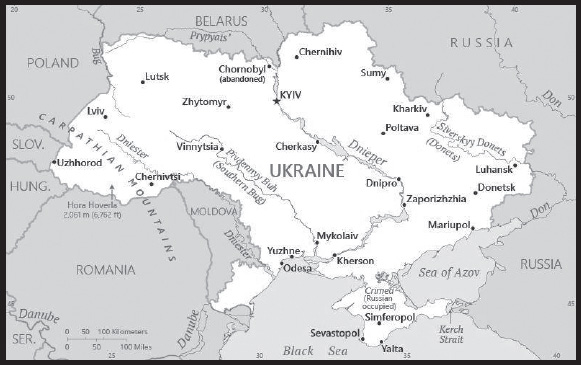
Location: Eastern Europe, bordering the Black Sea, between Poland, Romania, and Moldova in the west and Russia in the east
Geographic coordinates: 49 00 N, 32 00 E
Map references: AsiaEurope
Area: total: 603,550 sq km
land: 579,330 sq km
water: 24,220 sq km
note: approximately 43,133 sq km, or about 7.1% of Ukraine’s area, is Russian occupied; the seized area includes all of Crimea and about one-third of both Luhans’k and Donets’k oblasts
comparison ranking: total 48
Area - comparative: almost four times the size of Georgia; slightly smaller than Texas
Land boundaries: total: 5,581 km
border countries (6): Belarus 1,111 km; Hungary 128 km; Moldova 1,202 km; Poland 498 km; Romania 601 km; Russia 1,944 km, Slovakia 97 km
Coastline: 2,782 km
Maritime claims: territorial sea: 12 nm
exclusive economic zone: 200 nm
continental shelf: 200 m or to the depth of exploitation
Climate: temperate continental; Mediterranean only on the southern Crimean coast; precipitation disproportionately distributed, highest in west and north, lesser in east and southeast; winters vary from cool along the Black Sea to cold farther inland; warm summers across the greater part of the country, hot in the south
Terrain: mostly fertile plains (steppes) and plateaus, with mountains found only in the west (the Carpathians) or in the extreme south of the Crimean Peninsula
Elevation: highest point: Hora Hoverla 2,061 m
lowest point: Black Sea 0 m
mean elevation: 175 m
Natural resources: iron ore, coal, manganese, natural gas, oil, salt, sulfur, graphite, titanium, magnesium, kaolin, nickel, mercury, timber, arable land
Land use: agricultural land: 71.2% (2018 est.)
arable land: 56.1% (2018 est.)
permanent crops: 1.5% (2018 est.)
permanent pasture: 13.6% (2018 est.)
forest: 16.8% (2018 est.)
other: 12% (2018 est.)
Irrigated land: 4,350 sq km (2020)
Major rivers (by length in km): Dunay (Danube) (shared with Germany [s], Austria, Slovakia, Czechia, Hungary, Croatia, Serbia, Bulgaria, Moldova, and Romania [m]) - 2,888 km; Dnipro (Dnieper) river mouth (shared with Russia [s] and Belarus) - 2,287 km; Dnister (Dniester) river source and mouth (shared with Moldova) - 1,411 km; Vistula (shared with Poland [s/m] and Belarus) - 1,213 km
note – [s] after country name indicates river source; [m] after country name indicates river mouth
Major watersheds (area sq km): Atlantic Ocean drainage: (Black Sea) Danube (795,656 sq km), Don (458,694 sq km), Dnieper (533,966 sq km)
Population distribution: densest settlement in the eastern (Donbas) and western regions; noteable concentrations in and around major urban areas of Kyiv, Kharkiv, Donets’k, Dnipropetrovs’k, and Odesa
Natural hazards: occasional floods; occasional droughts
Geography - note: strategic position at the crossroads between Europe and Asia; second-largest country in Europe after Russia
PEOPLE AND SOCIETY
Population: 43,306,477 (2023 est.)
comparison ranking: 35
Nationality: noun: Ukrainian(s)
adjective: Ukrainian
Ethnic groups: Ukrainian 77.8%, Russian 17.3%, Belarusian 0.6%, Moldovan 0.5%, Crimean Tatar 0.5%, Bulgarian 0.4%, Hungarian 0.3%, Romanian 0.3%, Polish 0.3%, Jewish 0.2%, other 1.8% (2001 est.)
Languages: Ukrainian (official) 67.5%, Russian (regional language) 29.6%, other (includes small Crimean Tatar-, Moldovan/Romanian-, and Hungarian-speaking minorities) 2.9% (2001 est.); note - in February 2018, the Constitutional Court ruled that 2012 language legislation entitling a language spoken by at least 10% of an oblast’s population to be given the status of “regional language” - allowing for its use in courts, schools, and other government institutions - was unconstitutional, thus making the law invalid; Ukrainian remains the country’s only official nationwide language
major-language sample(s):

Religions: Orthodox (includes the Orthodox Church of Ukraine (OCU), Ukrainian Autocephalous Orthodox Church (UAOC), and the Ukrainian Orthodox - Moscow Patriarchate (UOC-MP)), Ukrainian Greek Catholic, Roman Catholic, Protestant, Muslim, Jewish (2013 est.)
note: Ukraine’s population is overwhelmingly Christian; the vast majority - up to two thirds - identify themselves as Orthodox, but many do not specify a particular branch; the OCU and the UOC-MP each represent less than a quarter of the country’s population, the Ukrainian Greek Catholic Church accounts for 8-10%, and the UAOC accounts for 1-2%; Muslim and Jewish adherents each compose less than 1% of the total population
Age structure: 0-14 years: 15.9% (male 3,549,814/female 3,334,617)
15-64 years: 65.95% (male 13,856,470/female 14,705,547)
65 years and over: 18.15% (2023 est.) (male 2,680,500/female 5,179,529)
Dependency ratios: total dependency ratio: 48.4
youth dependency ratio: 22.6
elderly dependency ratio: 25.8
potential support ratio: 3.9 (2021 est.)
note: data include Crimea
Median age: total: 45.3 years (2023 est.)
male: 41.3 years
female: 50 years
comparison ranking: total 15
Population growth rate: 2.33% (2023 est.)
comparison ranking: 30
Birth rate: 5.8 births/1,000 population (2023 est.)
comparison ranking: 228
Death rate: 19.8 deaths/1,000 population (2023 est.)
comparison ranking: 1
Net migration rate: 37.3 migrant(s)/1,000 population (2023 est.)
comparison ranking: 2
Population distribution: densest settlement in the eastern (Donbas) and western regions; noteable concentrations in and around major urban areas of Kyiv, Kharkiv, Donets’k, Dnipropetrovs’k, and Odesa
Urbanization: urban population: 70.1% of total population (2023)
rate of urbanization: -0.27% annual rate of change (2020-25 est.)
Major urban areas - population: 3.017 million KYIV (capital), 1.421 million Kharkiv, 1.008 million Odesa, 942,000 Dnipropetrovsk, 888,000 Donetsk (2023)
Sex ratio: at birth: 1.06 male(s)/female
0-14 years: 1.06 male(s)/female
15-64 years: 0.94 male(s)/female
65 years and over: 0.52 male(s)/female
total population: 1 male(s)/female (2023 est.)
Mother’s mean age at first birth: 26.2 years (2019 est.)
Maternal mortality ratio: 17 deaths/100,000 live births (2020 est.)
comparison ranking: 133
Infant mortality rate: total: 9 deaths/1,000 live births (2023 est.)
male: 10.1 deaths/1,000 live births
female: 7.9 deaths/1,000 live births
comparison ranking: total 141
Life expectancy at birth: total population: 69.8 years (2023 est.)
male: 64.5 years
female: 75.4 years
comparison ranking: total population 178
Total fertility rate: 1.22 children born/woman (2023 est.)
comparison ranking: 224
Gross reproduction rate: 0.59 (2023 est.)
Contraceptive prevalence rate: 65.4% (2012)
Drinking water source: improved: urban: 99.4% of population
rural: 100% of population
total: 99.6% of population
unimproved: urban: 0.6% of population
rural: 0% of population
total: 0.4% of population (2020 est.)
Current health expenditure: 7.6% of GDP (2020)
Physicians density: 2.99 physicians/1,000 population (2014)
Hospital bed density: 7.5 beds/1,000 population (2014)
Sanitation facility access: improved: total: 100% of population
unimproved: total: 0% of population (2020 est.)
Obesity - adult prevalence rate: 24.1% (2016)
comparison ranking: 61
Alcohol consumption per capita: total: 5.69 liters of pure alcohol (2019 est.)
beer: 2.44 liters of pure alcohol (2019 est.)
wine: 0.32 liters of pure alcohol (2019 est.)
spirits: 2.88 liters of pure alcohol (2019 est.)
other alcohols: 0.05 liters of pure alcohol (2019 est.)
comparison ranking: total 77
Tobacco use: total: 25.8% (2020 est.)
male: 40% (2020 est.)
female: 11.5% (2020 est.)
comparison ranking: total 43
Currently married women (ages 15-49): 61.6% (2023 est.)
Education expenditures: 5.4% of GDP (2020 est.)
comparison ranking: 63
Literacy: definition: age 15 and over can read and write
total population: 100%
male: 100%
female: 100% (2021)
School life expectancy (primary to tertiary education): total: 15 years
male: 15 years
female: 15 years (2014)
Youth unemployment rate (ages 15-24): total: 16.5% (2021 est.)
male: 16.3%
female: 16.7%
comparison ranking: total 103
ENVIRONMENT
Environment - current issues: air and water pollution; land degradation; solid waste management; biodiversity loss; deforestation; radiation contamination in the northeast from 1986 accident at Chornobyl’ Nuclear Power Plant
Environment - international agreements: party to: Air Pollution, Air Pollution-Nitrogen Oxides, Air Pollution-Sulphur 85, Antarctic-Environmental Protection, Antarctic-Marine Living Resources, Antarctic Treaty, Biodiversity, Climate Change, Climate Change-Kyoto Protocol, Climate Change-Paris Agreement, Comprehensive Nuclear Test Ban, Desertification, Endangered Species, Environmental Modification, Hazardous Wastes, Law of the Sea, Marine Dumping-London Convention, Nuclear Test Ban, Ozone Layer Protection, Ship Pollution, Wetlands
signed, but not ratified: Air Pollution-Heavy Metals, Air Pollution-Persistent Organic Pollutants, Air Pollution-Sulfur 94, Air Pollution-Volatile Organic Compounds
Climate: temperate continental; Mediterranean only on the southern Crimean coast; precipitation disproportionately distributed, highest in west and north, lesser in east and southeast; winters vary from cool along the Black Sea to cold farther inland; warm summers across the greater part of the country, hot in the south
Land use: agricultural land: 71.2% (2018 est.)
arable land: 56.1% (2018 est.)
permanent crops: 1.5% (2018 est.)
permanent pasture: 13.6% (2018 est.)
forest: 16.8% (2018 est.)
other: 12% (2018 est.)
Urbanization: urban population: 70.1% of total population (2023)
rate of urbanization: -0.27% annual rate of change (2020-25 est.)
Food insecurity: severe localized food insecurity: due to conflict - Ukraine continues to be a significant supplier of food commodities for the world; however, according to a 2023 analysis, at least 17.6 million people are estimated to be in need of multi-sectoral humanitarian assistance in 2023 due to the war, including over 11 million in need of food security and livelihood interventions; the harvest of the 2023 winter cereal crops, mostly wheat, is onging and will be concluded by August; as a result of a smaller planted area, the 2023 wheat harvest in areas under government control is estimated at 18.5 million mt, about 8% below the already war-affected 2022 output; despite decreased cereal production, food availability at the national level is reported to be adequate, but access remains a major challenge; the country has already experienced elevated levels of food price inflation in the past, due to the economic impact of the conflict in eastern areas; in addition, rising energy costs, amidst high unemployment rates and limited livelihood opportunities, are reducing households’ purchasing power and driving more people into poverty (2023)
Revenue from forest resources: 0.34% of GDP (2018 est.)
comparison ranking: 77
Revenue from coal: 0.42% of GDP (2018 est.)
comparison ranking: 14
Air pollutants: particulate matter emissions: 13.51 micrograms per cubic meter (2019 est.)
carbon dioxide emissions: 202.25 megatons (2016 est.)
methane emissions: 63.37 megatons (2020 est.)
Waste and recycling: municipal solid waste generated annually: 15,242,025 tons (2016 est.)
municipal solid waste recycled annually: 487,745 tons (2015 est.)
percent of municipal solid waste recycled: 3.2% (2015 est.)
Major rivers (by length in km): Dunay (Danube) (shared with Germany [s], Austria, Slovakia, Czechia, Hungary, Croatia, Serbia, Bulgaria, Moldova, and Romania [m]) - 2,888 km; Dnipro (Dnieper) river mouth (shared with Russia [s] and Belarus) - 2,287 km; Dnister (Dniester) river source and mouth (shared with Moldova) - 1,411 km; Vistula (shared with Poland [s/m] and Belarus) - 1,213 km
note – [s] after country name indicates river source; [m] after country name indicates river mouth
Major watersheds (area sq km): Atlantic Ocean drainage: (Black Sea) Danube (795,656 sq km), Don (458,694 sq km), Dnieper (533,966 sq km)
Total water withdrawal: municipal: 2.77 billion cubic meters (2020 est.)
industrial: 4.04 billion cubic meters (2020 est.)
agricultural: 3.06 billion cubic meters (2020 est.)
Total renewable water resources: 175.28 billion cubic meters (2020 est.)
GOVERNMENT
Country name: conventional long form: none
conventional short form: Ukraine
local long form: none
local short form: Ukraina
former: Ukrainian National Republic, Ukrainian State, Ukrainian Soviet Socialist Republic
etymology: name derives from the Old East Slavic word “ukraina” meaning “borderland or march (militarized border region)” and began to be used extensively in the 19th century; originally Ukrainians referred to themselves as Rusyny (Rusyns, Ruthenians, or Ruthenes), an endonym derived from the medieval Rus state (Kyivan Rus)
Government type: semi-presidential republic
Capital: name: Kyiv (Kiev as the transliteration from Russian)
geographic coordinates: 50 26 N, 30 31 E
time difference: UTC+2 (7 hours ahead of Washington, DC, during Standard Time)
daylight saving time: +1hr, begins last Sunday in March; ends last Sunday in October
etymology: the name is associated with that of Kyi, who along with his brothers Shchek and Khoryv, and their sister Lybid, are the legendary founders of the medieval city of Kyiv; Kyi being the eldest brother, the city was named after him
note: pronounced KAY-yiv
Administrative divisions: 24 provinces (oblasti, singular - oblast’), 1 autonomous republic* (avtonomna respublika), and 2 municipalities** (mista, singular - misto) with oblast status; Cherkasy, Chernihiv, Chernivtsi, Crimea or Avtonomna Respublika Krym* (Simferopol), Dnipropetrovsk (Dnipro), Donetsk, Ivano-Frankivsk, Kharkiv, Kherson, Khmelnytskyi, Kirovohrad (Kropyvnytskyi), Kyiv**, Kyiv, Luhansk, Lviv, Mykolaiv, Odesa, Poltava, Rivne, Sevastopol**, Sumy, Ternopil, Vinnytsia, Volyn (Lutsk), Zakarpattia (Uzhhorod), Zaporizhzhia, Zhytomyr
note 1: administrative divisions have the same names as their administrative centers (exceptions have the administrative center name following in parentheses); plans include the eventual renaming of Dnipropetrovsk and Kirovohrad oblasts, but because these names are mentioned in the Constitution of Ukraine, the change will require a constitutional amendment
note 2: the US Government does not recognize Russia’s illegal annexation of Ukraine’s Autonomous Republic of Crimea and the municipality of Sevastopol, nor their redesignation as the “Republic of Crimea” and the “Federal City of Sevastopol”; neither does the US Government recognize Russia’s claimed annexation of Donetsk, Kherson, Luhansk, and Zaporizhzhia oblasts
Independence: 24 August 1991 (from the Soviet Union); notable earlier dates: ca. 982 (VOLODYMYR I consolidates Kyivan Rus); 1199 (Principality (later Kingdom) of Ruthenia formed); 1648 (establishment of the Cossack Hetmanate); 22 January 1918 (from Soviet Russia)
National holiday: Independence Day, 24 August (1991); note - 22 January 1918, the day Ukraine first declared its independence from Soviet Russia, and the date the short-lived Western and Greater (Eastern) Ukrainian republics united (1919), is now celebrated as Unity Day
Constitution: history: several previous; latest adopted and ratified 28 June 1996
amendments: proposed by the president of Ukraine or by at least one third of the Supreme Council members; adoption requires simple majority vote by the Council and at least two-thirds majority vote in its next regular session; adoption of proposals relating to general constitutional principles, elections, and amendment procedures requires two-thirds majority vote by the Council and approval in a referendum; constitutional articles on personal rights and freedoms, national independence, and territorial integrity cannot be amended; amended several times, last in 2019
Legal system: civil law system; judicial review of legislative acts
International law organization participation: has not submitted an ICJ jurisdiction declaration; non-party state to the ICCt
Citizenship: citizenship by birth: no
citizenship by descent only: at least one parent must be a citizen of Ukraine
dual citizenship recognized: no
residency requirement for naturalization: 5 years
Suffrage: 18 years of age; universal
Executive branch: chief of state: President Volodymyr ZELENSKYY (since 20 May 2019)
head of government: Prime Minister Denys SHMYHAL (since 4 March 2020)
cabinet: Cabinet of Ministers nominated by the prime minister, approved by the Verkhovna Rada
elections/appointments: president directly elected by absolute majority popular vote in 2 rounds if needed for a 5-year term (eligible for a second term); election last held on 31 March and 21 April 2019 (next to be held in March 2024); prime minister selected by the Verkhovna Rada
election results: 2019: Volodymyr ZELENSKYY elected president; percent of vote in first round - Volodymyr ZELENSKYY (Servant of the People) 30.2%, Petro POROSHENKO (BPP-Solidarity) 15.6%, Yuliya TYMOSHENKO (Fatherland) 13.4%, Yuriy BOYKO (Opposition Platform-For Life) 11.7%, 35 other candidates 29.1%; percent of vote in the second round - Volodymyr ZELENSKYY 73.2%, Petro POROSHENKO 24.5%, other 2.3%; Denys SHMYHAL (independent) elected prime minister; Verkhovna Rada vote - 291-59
2014: Petro POROSHENKO elected president in first round; percent of vote - Petro POROSHENKO (independent) 54.5%, Yuliya TYMOSHENKO (Fatherland) 12.9%, Oleh LYASHKO (Radical Party) 8.4%, other 24.2%; Volodymyr HROYSMAN (BPP) elected prime minister; Verkhovna Rada vote - 257-50
note: there is also a National Security and Defense Council or NSDC originally created in 1992 as the National Security Council; the NSDC staff is tasked with developing national security policy on domestic and international matters and advising the president; a presidential administration helps draft presidential edicts and provides policy support to the president
Legislative branch: description: unicameral Supreme Council or Verkhovna Rada (450 seats; 225 members directly elected in single-seat constituencies by simple majority vote and 225 directly elected in a single nationwide constituency by closed, party-list proportional representation vote; members serve 5-year terms)
elections: last held on 21 July 2019 (next to be held on 29 October 2023)
election results: percent of vote by party - Servant of the People 43.2%, Opposition Platform-For Life 13.1%, Batkivshchyna 8.2%, European Solidarity 8.1%, Voice 5.8%, other 21.6%; Servant of the People 254, Opposition Platform for Life 43, Batkivshchyna 26, European Solidarity 25, Voice 20, Opposition Bloc 6, Svoboda 1, Self Reliance 1, United Centre 1, Bila Tserkva Together 1, Independents 46; note - voting not held in Crimea and parts of two Russian-occupied eastern oblasts leaving 26 seats vacant; although this brings the total to 424 elected members (of 450 potential), article 83 of the constitution mandates that a parliamentary majority consists of 226 seats
note: Legislative and presidential elections cannot be held under martial law.;the Verkhovna Rada declared martial law in February 2022 following Russia’s full-scale invasion
Judicial branch: highest court(s): Supreme Court of Ukraine or SCU (consists of 100 judges, organized into civil, criminal, commercial and administrative chambers, and a grand chamber); Constitutional Court (consists of 18 justices); High Anti-Corruption Court (consists of 39 judges, including 12 in the Appeals Chamber)
judge selection and term of office: Supreme Court judges recommended by the High Qualification Commission of Judges (a 16-member state body responsible for judicial candidate testing and assessment and judicial administration), submitted to the High Council of Justice, a 21-member independent body of judicial officials responsible for judicial self-governance and administration, and appointed by the president; judges serve until mandatory retirement at age 65; High Anti-Corruption Court judges are selected by the same process as Supreme Court justices, with one addition – a majority of a combined High Qualification Commission of Judges and a 6-member Public Council of International Experts must vote in favor of potential judges in order to recommend their nomination to the High Council of Justice; this majority must include at least 3 members of the Public Council of International Experts; Constitutional Court justices appointed - 6 each by the president, by the Congress of Judges, and by the Verkhovna Rada; judges serve 9-year nonrenewable terms
subordinate courts: Courts of Appeal; district courts
note: specialized courts were abolished as part of Ukraine’s judicial reform program; in November 2019, President ZELENSKYY signed a bill on legal reforms
Political parties and leaders: Batkivshchyna (Fatherland) [Yuliya TYMOSHENKO]
European Solidarity or YeS [Petro POROSHENKO]
Holos (Voice or Vote) [Kira RUDYK]
Opposition Bloc [Evgeny MURAYEV] (formerly known as Opposition Bloc — Party for Peace and Development, successor of the Industrial Party of Ukraine, and resulted from a schism in the original Opposition Bloc in 2019; banned in court June 2022; ceased to exist in July 2022)
Opposition Bloc or OB (divided into Opposition Bloc - Party for Peace and Development and Opposition Platform - For Life in 2019; ceased to exist in July 2022)
Opposition Platform - For Life [Yuriy BOYKO] (resulted from a schism in the original Opposition Bloc in 2019; activities suspended by the National Security and Defense Council in March 2022; dissolved in April 2022)
Platform for Life and Peace [Yuriy BOYKO]
Radical Party or RPOL [Oleh LYASHKO]
Samopomich (Self Reliance) [Oksana Ivanivna SYROYID]
Servant of the People [Olena Oleksiivna SHULIAK]
Svoboda (Freedom) [Oleh TYAHNYBOK]
International organization participation: Australia Group, BSEC, CBSS (observer), CD, CE, CEI, CICA (observer), CIS (participating member, has not signed the 1993 CIS charter), EAEC (observer), EAPC, EBRD, FAO, GCTU, GUAM, IAEA, IBRD, ICAO, ICC (national committees), ICRM, IDA, IFC, IFRCS, IHO, ILO, IMF, IMO, IMSO, Interpol, IOC, IOM, IPU, ISO, ITU, ITUC (NGOs), LAIA (observer), MIGA, MONUSCO, NAM (observer), NSG, OAS (observer), OIF (observer), OPCW, OSCE, PCA, PFP, SELEC (observer), UN, UNCTAD, UNESCO, UNFICYP, UNHRC, UNIDO, UNISFA, UNMIL, UNMISS, UNOCI, UNWTO, UPU, Wassenaar Arrangement, WCO, WFTU (NGOs), WHO, WIPO, WMO, WTO, ZC
note: Ukraine is an EU candidate country whose satisfactory completion of accession criteria is required before being granted full EU membership
Diplomatic representation in the US: chief of mission: Ambassador Oksana MARKAROVA (since 7 July 2021)
chancery: 3350 M Street NW, Washington, DC 20007
telephone: [1] (202) 349-2963
FAX: [1] (202) 333-0817
email address and website: emb_us@mfa.gov.ua
consulate(s) general: Chicago, New York, San Francisco
Diplomatic representation from the US: chief of mission: Ambassador Bridget A. BRINK (since 2 June 2022)
embassy: 4 A. I. Igor Sikorsky Street, 04112 Kyiv
mailing address: 5850 Kyiv Place, Washington, DC 20521-5850
telephone: [380] (44) 521-5000
FAX: [380] (44) 521-5544
email address and website: kyivacs@state.gov
Flag description: two equal horizontal bands of azure (top) and golden yellow; although the colors date back to medieval heraldry, in modern times they are sometimes claimed to represent grain fields under a blue sky
National symbol(s): tryzub (trident), sunflower; national colors: blue, yellow
National anthem: name: “Shche ne vmerla Ukraina” (Ukraine Has Not Yet Perished)
lyrics/music: Paul CHUBYNSKYI/Mikhail VERBYTSKYI
note: music adopted 1991, lyrics adopted 2003; song first performed in 1864 at the Ukraine Theatre in Lviv; the lyrics, originally written in 1862, were revised in 2003
National heritage: total World Heritage Sites: 7 (6 cultural, 1 natural)
selected World Heritage Site locales: Kyiv: Saint Sophia Cathedral and Related Monastic Buildings, Kyiv Pechersk Lavra (c); Lviv Historic Center (c); Residence of Bukovinian and Dalmatian Metropolitans, Chernivtsi (c); Ancient City of Tauric Chersonese, Sevastopol (c); Wooden Tserkvas of the Carpathian Region (c); Ancient and Primeval Beech Forests of the Carpathians (n); Struve Geodetic Arc (c)
ECONOMY
Economic overview: lower middle-income non-EU Eastern European economy; key wheat, corn, and industrials exporter; emerging electronics producer; war-related massive labor shortages and displacement, as well as environmental destruction of agricultural areas; critical humanitarian and military aid recipient; large inflation and poverty increases; wartime data collection inconsistencies for Western areas
Real GDP (purchasing power parity): $379.893 billion (2022 est.)
$535.579 billion (2021 est.)
$517.968 billion (2020 est.)
note: data are in 2017 dollars
comparison ranking: 50
Real GDP growth rate: 3.4% (2021 est.)
-3.75% (2020 est.)
3.2% (2019 est.)
comparison ranking: 136
Real GDP per capita: $10,700 (2022 est.)
$12,900 (2021 est.)
$12,400 (2020 est.)
note: data are in 2017 dollars
comparison ranking: 140
GDP (official exchange rate): $155.082 billion (2019 est.)
Inflation rate (consumer prices): 9.36% (2021 est.)
2.73% (2020 est.)
7.89% (2019 est.)
note: Excluding the temporarily occupied territories of the Autonomous Republic of Crimea, the city of Sevastopol and part of the anti-terrorist operation zone
comparison ranking: 28
Credit ratings:
Fitch rating: CC (2022)
Moody’s rating: Ca (2023)
Standard & Poors rating: CCC (2023)
note: The year refers to the year in which the current credit rating was first obtained.
GDP - composition, by sector of origin: agriculture: 12.2% (2017 est.)
industry: 28.6% (2017 est.)
services: 60% (2017 est.)
comparison rankings: services 127; industry 89; agriculture 75
GDP - composition, by end use: household consumption: 66.5% (2017 est.)
government consumption: 20.4% (2017 est.)
investment in fixed capital: 16% (2017 est.)
investment in inventories: 4.7% (2017 est.)
exports of goods and services: 47.9% (2017 est.)
imports of goods and services: -55.6% (2017 est.)
Agricultural products: sunflower seed, maize, wheat, rapeseed, barley, poultry meats, soybeans
Industries: industrial machinery, ferrous and nonferrous metals, automotive and aircraft components, electronics, chemicals, textiles, mining, construction
Industrial production growth rate: 2.57% (2021 est.)
comparison ranking: 127
Labor force: 20.463 million (2021 est.)
comparison ranking: 33
Labor force - by occupation: agriculture: 5.8%
industry: 26.5%
services: 67.8% (2014)
Unemployment rate: 8.88% (2021 est.)
9.13% (2020 est.)
8.19% (2019 est.)
note: officially registered workers; large number of unregistered or underemployed workers
comparison ranking: 82
Youth unemployment rate (ages 15-24): total: 16.5% (2021 est.)
male: 16.3%
female: 16.7%
comparison ranking: total 103
Population below poverty line: 1.1% (2019 est.)
Gini Index coefficient - distribution of family income: 25.6 (2020 est.)
comparison ranking: 171
Average household expenditures: on food: 42.2% of household expenditures (2018 est.)
on alcohol and tobacco: 7.7% of household expenditures (2018 est.)
Household income or consumption by percentage share: lowest 10%: 4.2%
highest 10%: 21.6% (2015 est.)
Budget: revenues: $29 billion (2021 est.)
expenditures: $35.75 billion (2021 est.)
Budget surplus (+) or deficit (-): -5.5% (of GDP) (2021 est.)
comparison ranking: 171
Public debt: 58.72% of GDP (2020 est.)
48.33% of GDP (2019 est.)
56.91% of GDP (2018 est.)
note: the total public debt of $64.5 billion consists of: domestic public debt ($23.8 billion); external public debt ($26.1 billion); and sovereign guarantees ($14.6 billion)
comparison ranking: 83
Taxes and other revenues: 19.15% (of GDP) (2020 est.)
comparison ranking: 98
Fiscal year: calendar year
Current account balance: $8.005 billion (2022 est.)
-$3.249 billion (2021 est.)
$5.267 billion (2020 est.)
comparison ranking: 30
Exports: $81.504 billion (2021 est.) note: data are in current year dollars
$60.707 billion (2020 est.) note: data are in current year dollars
$63.556 billion (2019 est.) note: data are in current year dollars
comparison ranking: 51
Exports - partners: China 12%, Poland 7%, Turkey 6%, Russia 5%, Italy 5% (2021)
Exports - commodities: iron and iron products, sunflower seed oils, wheat, corn, insulated wiring, rapeseed (2021)
Imports: $84.175 billion (2021 est.) note: data are in current year dollars
$63.085 billion (2020 est.) note: data are in current year dollars
$76.067 billion (2019 est.) note: data are in current year dollars
comparison ranking: 50
Imports - partners: China 14%, Russia 11%, Poland 9%, Germany 9%, Belarus 6% (2021)
Imports - commodities: refined petroleum, cars, natural gas, packaged medicines, coal, broadcasting equipment (2021)
Reserves of foreign exchange and gold: $30.967 billion (31 December 2021 est.)
$29.138 billion (31 December 2020 est.)
$25.317 billion (31 December 2019 est.)
comparison ranking: 60
Debt - external: $117.41 billion (2019 est.)
$114.449 billion (2018 est.)
comparison ranking: 51
Exchange rates: hryvnia (UAH) per US dollar -
Exchange rates: 27.286 (2021 est.)
26.958 (2020 est.)
25.846 (2019 est.)
27.2 (2018 est.)
26.597 (2017 est.)
ENERGY
Electricity access: electrification - total population: 100% (2021)
note: pre-war numbers
Electricity: installed generating capacity: 56.816 million kW (2020 est.)
consumption: 124,533,790,000 kWh (2019 est.)
exports: 5.139 billion kWh (2020 est.)
imports: 2.72 billion kWh (2020 est.)
transmission/distribution losses: 16.434 billion kWh (2019 est.)
comparison rankings: imports 55; exports 36; installed generating capacity 24; transmission/distribution losses 25; consumption 28
Electricity generation sources: fossil fuels: 37.6% of total installed capacity (2020 est.)
nuclear: 55.9% of total installed capacity (2020 est.)
solar: 1.2% of total installed capacity (2020 est.)
wind: 1.4% of total installed capacity (2020 est.)
hydroelectricity: 3.6% of total installed capacity (2020 est.)
biomass and waste: 0.3% of total installed capacity (2020 est.)
Nuclear energy: Number of operational nuclear reactors: 15 (2023)
Number of nuclear reactors under construction: 2
Net capacity of operational nuclear reactors: 13.11GW (2023)
Percent of total electricity production: 53.9% (2019)
Percent of total energy produced: 37% (2021)
note - This information does not take into account the effects from the current conflict in Ukraine and should be considered the prewar status
Coal: production: 23.908 million metric tons (2020 est.)
consumption: 41.181 million metric tons (2020 est.)
exports: 61,000 metric tons (2020 est.)
imports: 17.333 million metric tons (2020 est.)
proven reserves: 34.375 billion metric tons (2019 est.)
Petroleum: total petroleum production: 57,700 bbl/day (2021 est.)
refined petroleum consumption: 248,100 bbl/day (2019 est.)
crude oil and lease condensate exports: 700 bbl/day (2018 est.)
crude oil and lease condensate imports: 6,500 bbl/day (2018 est.)
crude oil estimated reserves: 395 million barrels (2021 est.)
Refined petroleum products - production: 63,670 bbl/day (2017 est.)
comparison ranking: 77
Refined petroleum products - exports: 1,828 bbl/day (2015 est.)
comparison ranking: 105
Refined petroleum products - imports: 167,000 bbl/day (2015 est.)
comparison ranking: 37
Natural gas: production: 19,511,040,000 cubic meters (2019 est.)
consumption: 26,413,486,000 cubic meters (2019 est.)
exports: 0 cubic meters (2021 est.)
imports: 10,740,619,000 cubic meters (2019 est.)
proven reserves: 1,104,355,000,000 cubic meters (2021 est.)
Carbon dioxide emissions: 185.686 million metric tonnes of CO2 (2019 est.)
from coal and metallurgical coke: 105.929 million metric tonnes of CO2 (2019 est.)
from petroleum and other liquids: 30.365 million metric tonnes of CO2 (2019 est.)
from consumed natural gas: 49.392 million metric tonnes of CO2 (2019 est.)
comparison ranking: total emissions 33
Energy consumption per capita: 82.571 million Btu/person (2019 est.)
comparison ranking: 70
COMMUNICATIONS
Telephones - fixed lines: total subscriptions: 2.3 million (2021 est.)
subscriptions per 100 inhabitants: 6 (2021 est.)
comparison ranking: total subscriptions 52
Telephones - mobile cellular: total subscriptions: 56 million (2021 est.)
subscriptions per 100 inhabitants: 140 (2021 est.)
comparison ranking: total subscriptions 30
Telecommunication systems: general assessment: there has been considerable damage and destruction to the communications infrastructure in more than 10 out of 24 regions of Ukraine since the war started (2023)
domestic: fixed-line teledensity is 6 per 100; the mobile-cellular telephone is 140 mobile phones per 100 persons (2021)
international: country code - 380; landing point for the Kerch Strait Cable connecting Ukraine to Russia; 2 new domestic trunk lines are a part of the fiber-optic TAE system and 3 Ukrainian links have been installed in the fiber-optic TEL project that connects 18 countries; additional international service is provided by the Italy-Turkey-Ukraine-Russia (ITUR) fiberoptic submarine cable and by an unknown number of earth stations in the Intelsat, Inmarsat, and Intersputnik satellite systems
Broadcast media: Ukraine’s media landscape is dominated by oligarch-owned news outlets, which are often politically motivated and at odds with one another and/or the government; while polls suggest most Ukrainians still receive news from traditional media sources, social media is a crucial component of information dissemination in Ukraine; almost all Ukrainian politicians and opinion leaders communicate with the public via social media and maintain at least one social media page, if not more; this allows them direct communication with audiences, and news often breaks on Facebook or Twitter before being picked up by traditional news outlets; Kyiv created a unified news platform to broadcast news about the war following Russia’s full-scale invasion; the government’s “United News” television marathon is a round-the clock framework which untied the Ukrainian public broadcaster and top commercial TV channels’ programming; Ukraine television serves as the principal source of news; the largest national networks are controlled by oligarchs: Studio 1+1 is owned by Ihor Kolomoyskyy; Inter is owned by Dmytro Firtash and Serhiy Lyovochkin; and StarlightMedia channels (ICTV, STB, and Novyi Kanal) are owned by Victor Pinchuk; a set of 24-hour news channels also have clear political affiliations: pro-Ukrainian government Channel 5 and Pryamyi are linked to President Petro Poroshenko; 24 is owned by opposition, but not pro-Russian, politicians; UA: Suspilne is a public television station under the umbrella of the National Public Broadcasting Company of Ukraine; while it is often praised by media experts for balanced coverage, it lags in popularity; Ukrainian Radio, institutionally linked to UA: Suspilne, is one of only two national talk radio networks, with the other being the privately owned Radio NV (2021)
Internet country code: .ua
Internet users: total: 34,596,356 (2021 est.)
percent of population: 79% (2021 est.)
comparison ranking: total 29
Broadband - fixed subscriptions: total: 7,769,401 (2020 est.)
subscriptions per 100 inhabitants: 19 (2020 est.)
comparison ranking: total 27
Communications - note: a sorting code to expeditiously handle large volumes of mail was first set up in Ukraine in the 1930s (then the Ukrainian Soviet Socialist Republic, part of the Soviet Union); the sophisticated, three-part (number-letter-number) postal code system, referred to as an “index,” was the world’s first postal zip code; the system functioned well and was in use from 1932 to 1939 when it was abruptly discontinued
TRANSPORTATION
National air transport system: number of registered air carriers: 14 (2020)
inventory of registered aircraft operated by air carriers: 126
annual passenger traffic on registered air carriers: 7,854,842 (2018)
annual freight traffic on registered air carriers: 75.26 million (2018) mt-km
Civil aircraft registration country code prefix: UR
Airports: 215 (2021)
comparison ranking: total 26
Airports - with paved runways: 108
civil airports: 17
military airports: 15
joint use (civil-military) airports: 4
other airports: 72
note: paved runways have a concrete or asphalt surface but not all have facilities for refueling, maintenance, or air traffic control; the length of a runway required for aircraft to safely operate depends on a number of factors including the type of aircraft, the takeoff weight (including passengers, cargo, and fuel), engine types, flap settings, landing speed, elevation of the airport, and average maximum daily air temperature; paved runways can reach a length of 5,000 m (16,000 ft.), but the “typical” length of a commercial airline runway is between 2,500-4,000 m (8,000-13,000 ft.)
Airports - with unpaved runways: 79
note: unpaved runways have a surface composition such as grass or packed earth and are most suited to the operation of light aircraft; unpaved runways are usually short, often less than 1,000 m (3,280 ft.) in length; airports with unpaved runways often lack facilities for refueling, maintenance, or air traffic control
Heliports: 9 (2021)
Pipelines: 36,720 km gas, 4,514 km oil, 4,363 km refined products (2013)
Railways: total: 21,733 km (2014)
standard gauge: 49 km (2014) 1.435-m gauge (49 km electrified)
broad gauge: 21,684 km (2014) 1.524-m gauge (9,250 km electrified)
comparison ranking: total 12
Roadways: total: 169,694 km (2012)
paved: 166,095 km (2012) (includes 17 km of expressways)
unpaved: 3,599 km (2012)
comparison ranking: total 31
Waterways: 1,672 km (2012) (most on Dnieper River)
comparison ranking: 48
Merchant marine: total: 410 (2022)
by type: bulk carrier 1, container ship 1, general cargo 84, oil tanker 15, other 309
comparison ranking: total 47
Ports and terminals: major seaport(s): Feodosiia, Chornomorsk, Mariupol, Mykolaiv, Odesa, Yuzhne
river port(s): Kherson, Kyiv (Dnieper River), Mykolaiv (Pivdennyy Buh River)
MILITARY AND SECURITY
Military and security forces: Armed Forces of Ukraine (AFU; Zbroyni Syly Ukrayiny or ZSU): Ground Forces (Sukhoputni Viys’ka), Naval Forces (Viys’kovo-Mors’ki Syly, VMS), Air Forces (Povitryani Syly, PS), Air Assault Forces (Desantno-shturmovi Viyska, DShV), Ukrainian Special Operations Forces (UASOF), Territorial Defense Forces (Reserves)
Ministry of Internal Affairs: National Guard of Ukraine, State Border Guard Service of Ukraine (includes Maritime Border Guard or Sea Guard) (2023)
note 1: in the event that martial law is declared, all National Guard units, with certain exceptions such as those tasked with providing for diplomatic security of embassies and consulates, would come under the command of the Ministry of Defense as auxiliary forces to the Armed Forces
note 2: the Territorial Defense Forces (TDF) were formally established in July 2021; the TDF evolved from former Territorial Defense Battalions and other volunteer militia and paramilitary units that were organized in 2014-2015 to fight Russian-backed separatists in the Donbas; in January 2022, the TDF was activated as a separate military branch; it is organized into 25 brigades of varying size representing each of the 24 oblasts, plus the city of Kyiv
Military expenditures: 4% of GDP (2021 est.)
4% of GDP (2020 est.)
3.4% of GDP (2019 est.)
3.1% of GDP (2018 est.)
3.1% of GDP (2017 est.)
comparison ranking: 17
Military and security service personnel strengths: up to 700,000 active-duty personnel, including the Armed Forces, Territorial Defense Forces, National Guard, and State Border Guard (July 2022)
note 1: following the Russian invasion of Ukraine in February 2022, President ZELENSKY announced a general mobilization of the country; prior to the invasion, approximately 200,000 active Armed Forces troops (125,000 Army; 25,000 Airborne/Air Assault Forces; 2,000 Special Operations Forces; 10,000 Navy; 40,000 Air Force); approximately 50,000 National Guard; approximately 40,000 State Border Guard
Military equipment inventories and acquisitions: the Ukrainian military is equipped largely with Russian-origin and Soviet-era weapons systems, although it has a growing inventory of Western-origin equipment; since the full-scale Russian invasion in February 2022, it has received considerable quantities of weapons, including Soviet-era and more modern Western systems, from European countries and the US; Ukraine has a broad defense industry capable of building, maintaining, and upgrading a variety of its Russian/Soviet-era weapons systems, including armored vehicles, combat aircraft, missiles, and air defense systems (2023)
Military service age and obligation: conscription abolished in 2012, but reintroduced in 2014; 20-27 years of age for compulsory military service; prior to the Russian invasion of February 2022, conscript service obligation was 12-18 months, depending on the service (2023)
note 1: following the Russian invasion in 2022, all nonexempt men ages 18 to 60 were required to register with their local recruitment offices and undergo medical screening for possible service; the Territorial Defense Forces (TDF) accepts volunteers, 18-60 years of age; since the invasion, hundreds of thousands of Ukrainians have volunteered for the regular armed forces, the TDF, or to work in civilian defense activities
note 2: women have been able to volunteer for military service since 1993; as of 2023, approximately 60,000 women were serving in the armed forces
note 3: since 2015, the Ukrainian military has allowed foreigners and stateless persons, 18-45 (in special cases up to 60), to join on 3-5-year contracts, based on qualifications; following the Russian invasion in 2022, the military began accepting medically fit foreign volunteers on a larger scale, with an emphasis on persons with combat experience; wartime volunteers typically serve for 6 months
Military deployments: note: prior to the Russian invasion in 2022, Ukraine had committed about 500 troops to the Lithuania, Poland, and Ukraine joint military brigade (LITPOLUKRBRIG), which was established in 2014; the brigade is headquartered in Poland and is comprised of an international staff, three battalions, and specialized units; units affiliated with the multinational brigade remain within the structures of the armed forces of their respective countries until the brigade is activated for participation in an international operation
Military - note: the primary focus of the Ukrainian Armed Forces (UAF) is defense against Russian aggression; in February 2022, Russia launched an unprovoked full-scale invasion of Ukraine in what is the largest conflict in Europe since the end of World War II in 1945; as of 2023, the front line of the fighting stretched about 1,000 kilometers (some 600 miles) north and south in eastern and southern Ukraine; Russia’s forces have also launched missile and armed drone strikes throughout Ukraine, hitting critical infrastructure, including power, water, and heating facilities, as well as other civilian targets; Russia first invaded Ukraine in 2014, occupying Ukraine’s province of Crimea and backing separatist forces in the Donbas region with arms, equipment, and training, as well as special operations forces and troops, although Moscow denied their presence prior to 2022; the UAF has received considerable outside military assistance since the Russian invasion, including equipment and training, chiefly from Europe and the US
Ukraine has a relationship with NATO dating back to the early 1990s, when Ukraine joined the North Atlantic Cooperation Council (1991) and the Partnership for Peace program (1994); the relationship intensified in the wake of the 2014 Russia-Ukraine conflict and Russian seizure of Crimea to include NATO support for Ukrainian military capabilities development and capacity-building; NATO further increased its support to the Ukrainian military following Russia’s fullscale invasion in 2022
the UAF Ground Forces have air defense, armored, artillery, aviation, infantry, mechanized, motorized, and rocket forces; the basic structure of the Ground Forces and the Territorial Defense Forces is the brigade; there are also regionally based (east, north, south, west) Operational Commands and a handful of corps-level commands; the combat brigades are assigned amongst the commands and corps based on operational requirements; the separate Air Assault Forces and Special Operations Forces are organized into brigades and regiments and considered the UAF’s elite units; prior to the 2022 Russian invasion, the UAF Air Force had over 100 combat aircraft, as well as ground-based air defenses, typically organized into brigades under regional commands; the Navy is a coastal defense force and includes naval infantry brigades that have been used as ground forces in the war with Russia (2023)
SPACE
Space agency/agencies: State Space Agency of Ukraine (SSAU; established 1992 as the National Space Agency of Ukraine or NSAU; renamed in 2010) (2023)
Space launch site(s): none (leases elsewhere for launches); from 1995-2014, a multinational (Norway, Russia, Ukraine, and the US) commercial space launch company used a mobile maritime launch platform for equatorial launches of commercial payloads on Zenit-3SL rockets from a former floating oil drilling rig (2023)
Space program overview: SSAU/NSAU inherited a large and well-developed space program when it took over all of the former Soviet defense/space industrial industry that was located on the territory of Ukraine upon the country’s declaration of independence in 1991; prior to the 2014 Russia takeover of Crimea and support for separatists in Ukraine’s Donbas region, Ukraine’s space efforts largely provided support to the Russian space program, including the production of satellite/space launch vehicles (SLVs)/rocket carriers and their components; today, it develops and produces SLVs/rocket carriers, spacecraft, satellites, and satellite sub-components both independently and jointly with numerous foreign space agencies and private space industry companies, including those of Brazil, Canada, China, the European Space Agency (ESA) and its member states (particularly Italy and Poland), Japan, Kazakhstan, Russia (curtailed after 2014), Turkey, and the US; prior to the full scale Russian invasion in February 2022, Ukraine was producing more than 100 SLVs, SLV stages, or SLV engines annually, and since 1991, over 160 rockets and more than 370 spacecraft had been manufactured by Ukraine or produced with its participation; as of 2022, SSAU had 16,000 employees and controlled 20 state-run corporations in Ukraine’s “space cluster,” a region between the cities of Dnipro, Kharkiv, and Kyiv (note – Dnipro, known as Ukraine’s “Rocket City,” was one of the Soviet Union’s main centers for space, nuclear, and military industries and played a crucial role in the development and manufacture of both civilian and military rockets); in 2019, the Ukrainian Parliament began allowing private companies to engage in space endeavors, including launching rockets into space and allowing companies to negotiate with foreign companies without the state’s approval; previously, only state-owned companies could do so (2023)
note: further details about the key activities, programs, and milestones of the country’s space program, as well as government spending estimates on the space sector, appear in Appendix S
TRANSNATIONAL ISSUES
Disputes - international: Ukraine-Belarus: in 1997, Ukraine and Belarus signed a boundary delimitation treaty; the instruments of ratification were exchanged in 2013; a joint commission should be established to enable the actual demarcation to begin
Ukraine-Hungary: hundreds of thousands of Ukrainian refugees are crossing the border to Hungary to escape the Russian invasion in their country
Ukraine-Moldova: hundreds of thousands of Ukrainian refugees are crossing the border to Moldova to escape the Russian invasion in their country; Ukraine and Moldova signed an agreement officially delimiting their border in 1999, but the border has not been demarcated due to Moldova’s difficulties with the break-away region of Transnistria; Moldova and Ukraine operate joint customs posts to monitor transit of people and commodities through Moldova’s Transnistria Region, which remains under the auspices of an Organization for Security and Cooperation in Europe-mandated peacekeeping mission comprised of Moldovan, Transnistrian, Russian, and Ukrainian troops
Ukraine-Poland: hundreds of thousands of Ukrainian refugees are crossing the border to Poland to escape the Russian invasion in their country
Ukraine-Romania: hundreds of thousands of Ukrainian refugees are crossing the border to Romania to escape the Russian invasion in their country, the ICJ in 2009 ruled largely in favor of Romania in its dispute submitted in 2004 over Ukrainian-administered Zmiyinyy/Serpilor (Snake) Island and Black Sea maritime boundary delimitation; Romania opposes Ukraine’s reopening of a navigation canal from the Danube border through Ukraine to the Black Sea
Ukraine-Russia: the dispute over the boundary between Russia and Ukraine through the Kerch Strait and Sea of Azov is suspended due to the occupation of Crimea by Russia
Ukraine-Slovakia: tens of thousands of Ukrainian refugees are crossing the border to Slovakia to escape the Russian invasion of their country
Refugees and internally displaced persons: IDPs: 1,461,700 (Russian-sponsored separatist violence in Crimea and eastern Ukraine) (2021); 3.67 million (2023) (since Russian invasion that started in February 2022); note – the more recent invasion total may reflect some double counting, since it is impossible to determine how many of the recent IDPs may also include IDPs from the earlier Russian-sponsored violence in Crimea and eastern Ukraine
stateless persons: 36,459 (2022); note - citizens of the former USSR who were permanently resident in Ukraine were granted citizenship upon Ukraine’s independence in 1991, but some missed this window of opportunity; people arriving after 1991, Crimean Tatars, ethnic Koreans, people with expired Soviet passports, and people with no documents have difficulty acquiring Ukrainian citizenship; following the fall of the Soviet Union in 1989, thousands of Crimean Tatars and their descendants deported from Ukraine under the STALIN regime returned to their homeland, some being stateless and others holding the citizenship of Uzbekistan or other former Soviet republics; a 1998 bilateral agreement between Ukraine and Uzbekistan simplified the process of renouncing Uzbek citizenship and obtaining Ukrainian citizenship
Illicit drugs: a transit country for non-domestically produced drugs, such as cocaine and heroin, bound for consumer markets in the European Union and Russia; overland corridors for the movement of these drugs exists, but Ukraine’s southern ports on the Black Sea, notably Odesa and Pivdennyi, are disrupted due to the war; domestically produced amphetamine, methamphetamine, methadone, alpha-PVP, and new psychoactive substances (NPS) remain threats to Ukrainian society; production and consumption of cannabis remains significant
UNITED ARAB EMIRATES
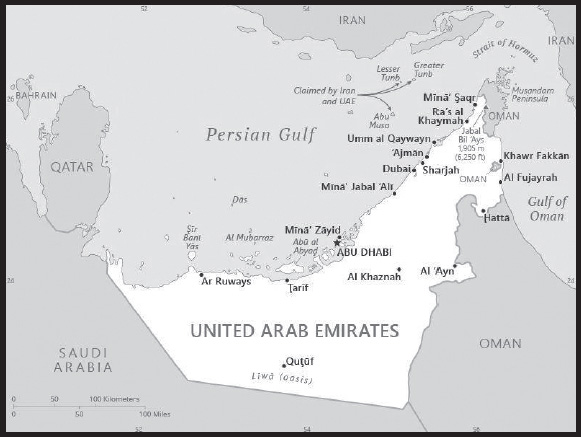
INTRODUCTION
Background: The Trucial States of the Persian Gulf coast granted the UK control of their defense and foreign affairs in 19th century treaties. In 1971, six of these states - Abu Dhabi, ‘Ajman, Al Fujayrah, Ash Shariqah, Dubayy, and Umm al Qaywayn - merged to form the United Arab Emirates (UAE). They were joined in 1972 by Ra’s al Khaymah. The UAE’s per capita GDP is on par with those of leading West European nations. For more than three decades, oil and global finance drove the UAE’s economy. In 2008-09, the confluence of falling oil prices, collapsing real estate prices, and the international banking crisis hit the UAE especially hard. The UAE did not experience the “Arab Spring” unrest seen elsewhere in the Middle East in 2010-11, partly because of the government’s multi-year, $1.6-billion infrastructure investment plan for the poorer northern emirates, and its aggressive pursuit of advocates of political reform. The UAE in recent years has played a growing role in regional affairs. In addition to donating billions of dollars in economic aid to help stabilize Egypt, the UAE was one of the first countries to join the Defeat-ISIS coalition, and to participate as a key partner in a Saudi-led military campaign in Yemen. On 15 September 2020, the UAE and Bahrain signed a peace agreement (the Abraham Accords) with Israel – brokered by the US – in Washington DC. The UAE and Bahrain thus became the third and fourth Middle Eastern countries, along with Egypt and Jordan, to recognize Israel.
GEOGRAPHY
Location: Middle East, bordering the Gulf of Oman and the Persian Gulf, between Oman and Saudi Arabia
Geographic coordinates: 24 00 N, 54 00 E
Map references: Middle East
Area: total: 83,600 sq km
land: 83,600 sq km
water: 0 sq km
comparison ranking: total 115
Area - comparative: slightly larger than South Carolina; slightly smaller than Maine
Land boundaries: total: 1,066 km
border countries (2): Oman 609 km; Saudi Arabia 457 km
Coastline: 1,318 km
Maritime claims: territorial sea: 12 nm
contiguous zone: 24 nm
exclusive economic zone: 200 nm
continental shelf: 200 nm or to the edge of the continental margin
Climate: desert; cooler in eastern mountains
Terrain: flat, barren coastal plain merging into rolling sand dunes of vast desert; mountains in east
Elevation: highest point: Jabal Bil ‘Ays 1,905 m
lowest point: Persian Gulf 0 m
mean elevation: 149 m
Natural resources: petroleum, natural gas
Land use: agricultural land: 4.6% (2018 est.)
arable land: 0.5% (2018 est.)
permanent crops: 0.5% (2018 est.)
permanent pasture: 3.6% (2018 est.)
forest: 3.8% (2018 est.)
other: 91.6% (2018 est.)
Irrigated land: 898 sq km (2020)
Population distribution: population is heavily concentrated to the northeast on the Musandam Peninsula; the three largest emirates - Abu Dhabi, Dubai, and Sharjah - are home to nearly 85% of the population
Natural hazards: frequent sand and dust storms
Geography - note: strategic location along southern approaches to Strait of Hormuz, a vital transit point for world crude oil; Abu Zaby (Abu Dhabi) and Dubayy (Dubai) together account for over 90% of the area of the country and two-thirds of the population
PEOPLE AND SOCIETY
Population: 9,973,449 (2023 est.)
note: the UN estimated the country’s total population was 10,082,000 as of 2022; immigrants make up 88.1% of the total population, according to UN data (2020)
comparison ranking: 92
Nationality: noun: Emirati(s)
adjective: Emirati
Ethnic groups: Emirati 11.6%, South Asian 59.4% (includes Indian 38.2%, Bangladeshi 9.5%, Pakistani 9.4%, other 2.3%), Egyptian 10.2%, Filipino 6.1%, other 12.8% (2015 est.)
note: data represent the total population; as of 2019, immigrants make up about 87.9% of the total population, according to UN data
Languages: Arabic (official), English, Hindi, Malayam, Urdu, Pashto, Tagalog, Persian
major-language sample(s):

(Arabic)
Religions: Muslim (official) 76%, Christian 9%, other (primarily Hindu and Buddhist, less than 5% of the population consists of Parsi, Baha’i, Druze, Sikh, Ahmadi, Ismaili, Dawoodi Bohra Muslim, and Jewish) 15% (2005 est.)
note: data represent the total population; as of 2020, immigrants make up about 88.1% of the total population, according to UN data
Age structure: 0-14 years: 16.23% (male 829,266/female 789,187)
15-64 years: 81.77% (male 5,840,920/female 2,314,683)
65 years and over: 2% (2023 est.) (male 15,1340/female 48,053)
Dependency ratios: total dependency ratio: 20.3
youth dependency ratio: 18.2
elderly dependency ratio: 2.1
potential support ratio: 47.3 (2021 est.)
Median age: total: 35.7 years (2023 est.)
male: 37.9 years
female: 29.9 years
comparison ranking: total 92
Population growth rate: 0.58% (2023 est.)
comparison ranking: 147
Birth rate: 10.8 births/1,000 population (2023 est.)
comparison ranking: 171
Death rate: 1.6 deaths/1,000 population (2023 est.)
comparison ranking: 228
Net migration rate: -3.4 migrant(s)/1,000 population (2023 est.)
comparison ranking: 187
Population distribution: population is heavily concentrated to the northeast on the Musandam Peninsula; the three largest emirates - Abu Dhabi, Dubai, and Sharjah - are home to nearly 85% of the population
Urbanization: urban population: 87.8% of total population (2023)
rate of urbanization: 1.5% annual rate of change (2020-25 est.)
Major urban areas - population: 3.008 million Dubai, 1.831 million Sharjah, 1.567 million ABU DHABI (capital) (2023)
Sex ratio: at birth: 1.06 male(s)/female
0-14 years: 1.05 male(s)/female
15-64 years: 2.52 male(s)/female
65 years and over: 3.15 male(s)/female
total population: 2.16 male(s)/female (2023 est.)
Maternal mortality ratio: 9 deaths/100,000 live births (2020 est.)
comparison ranking: 147
Infant mortality rate: total: 5.1 deaths/1,000 live births (2023 est.)
male: 5.6 deaths/1,000 live births
female: 4.5 deaths/1,000 live births
comparison ranking: total 176
Life expectancy at birth: total population: 79.8 years (2023 est.)
male: 78.4 years
female: 81.2 years
comparison ranking: total population 58
Total fertility rate: 1.62 children born/woman (2023 est.)
comparison ranking: 179
Gross reproduction rate: 0.79 (2023 est.)
Drinking water source: improved: total: 100% of population
unimproved: total: 0% of population (2020 est.)
Current health expenditure: 5.5% of GDP (2020)
Physicians density: 2.6 physicians/1,000 population (2019)
Hospital bed density: 1.4 beds/1,000 population (2017)
Sanitation facility access: improved: total: 100% of population
unimproved: total: 0% of population (2020 est.)
Obesity - adult prevalence rate: 31.7% (2016)
comparison ranking: 20
Alcohol consumption per capita: total: 2.03 liters of pure alcohol (2019 est.)
beer: 0.21 liters of pure alcohol (2019 est.)
wine: 0.14 liters of pure alcohol (2019 est.)
spirits: 1.65 liters of pure alcohol (2019 est.)
other alcohols: 0.02 liters of pure alcohol (2019 est.)
comparison ranking: total 130
Currently married women (ages 15-49): 72.4% (2023 est.)
Education expenditures: 3.9% of GDP (2020 est.)
comparison ranking: 122
Literacy: definition: age 15 and over can read and write
total population: 98.1%
male: 98.8%
female: 97.2% (2021)
School life expectancy (primary to tertiary education): total: 16 years
male: 15 years
female: 17 years (2020)
Youth unemployment rate (ages 15-24): total: 10.7% (2021 est.)
male: 7.9%
female: 19.9%
comparison ranking: total 149
ENVIRONMENT
Environment - current issues: air pollution; rapid population growth and high energy demand contribute to water scarcity; lack of natural freshwater resources compensated by desalination plants; land degradation and desertification; waste generation, beach pollution from oil spills
Environment - international agreements: party to: Biodiversity, Climate Change, Climate Change-Kyoto Protocol, Climate Change-Paris Agreement, Comprehensive Nuclear Test Ban, Desertification, Endangered Species, Hazardous Wastes, Marine Dumping-London Convention, Ozone Layer Protection, Ship Pollution, Wetlands
signed, but not ratified: Law of the Sea
Climate: desert; cooler in eastern mountains
Land use: agricultural land: 4.6% (2018 est.)
arable land: 0.5% (2018 est.)
permanent crops: 0.5% (2018 est.)
permanent pasture: 3.6% (2018 est.)
forest: 3.8% (2018 est.)
other: 91.6% (2018 est.)
Urbanization: urban population: 87.8% of total population (2023)
rate of urbanization: 1.5% annual rate of change (2020-25 est.)
Revenue from forest resources: 0% of GDP (2018 est.)
comparison ranking: 159
Revenue from coal: 0% of GDP (2018 est.)
comparison ranking: 57
Air pollutants: particulate matter emissions: 41.75 micrograms per cubic meter (2019 est.)
carbon dioxide emissions: 206.32 megatons (2016 est.)
methane emissions: 56.55 megatons (2020 est.)
Waste and recycling: municipal solid waste generated annually: 5,413,453 tons (2015 est.)
municipal solid waste recycled annually: 1,082,691 tons (2015 est.)
percent of municipal solid waste recycled: 20% (2015 est.)
Total water withdrawal: municipal: 2.63 billion cubic meters (2020 est.)
industrial: 69 million cubic meters (2020 est.)
agricultural: 2.32 billion cubic meters (2020 est.)
Total renewable water resources: 150 million cubic meters (2020 est.)
GOVERNMENT
Country name: conventional long form: United Arab Emirates
conventional short form: none
local long form: Al Imarat al Arabiyah al Muttahidah
local short form: none
former: Trucial Oman, Trucial States
abbreviation: UAE
etymology: self-descriptive country name; the name “Arabia” can be traced back many centuries B.C., the ancient Egyptians referred to the region as “Ar Rabi”; “emirates” derives from “amir” the Arabic word for “commander,” “lord,” or “prince”
Government type: federation of monarchies
Capital: name: Abu Dhabi
geographic coordinates: 24 28 N, 54 22 E
time difference: UTC+4 (9 hours ahead of Washington, DC, during Standard Time)
etymology: in Arabic, abu means “father” and dhabi refers to “gazelle”; the name may derive from an abundance of gazelles that used to live in the area, as well as a folk tale involving the “Father of the Gazelle,” Shakhbut BIN DHIYAB AL NAHYAN, whose hunting party tracked a gazelle to a spring on the island where Abu Dhabi was founded
Administrative divisions: 7 emirates (imarat, singular - imarah); Abu Zaby (Abu Dhabi), ‘Ajman, Al Fujayrah, Ash Shariqah (Sharjah), Dubayy (Dubai), Ra’s al Khaymah, Umm al Qaywayn
Independence: 2 December 1971 (from the UK)
National holiday: Independence Day (National Day), 2 December (1971)
Constitution: history: previous 1971 (provisional); latest drafted in 1979, became permanent May 1996
amendments: proposed by the Supreme Council and submitted to the Federal National Council; passage requires at least a two-thirds majority vote of Federal National Council members present and approval of the Supreme Council president; amended 2009
Legal system: mixed legal system of Islamic (sharia) law and civil law
International law organization participation: has not submitted an ICJ jurisdiction declaration; non-party state to the ICCt
Citizenship: citizenship by birth: no
citizenship by descent only: the father must be a citizen of the United Arab Emirates; if the father is unknown, the mother must be a citizen
dual citizenship recognized: no
residency requirement for naturalization: 30 years
Suffrage: limited; note - rulers of the seven emirates each select a proportion of voters for the Federal National Council (FNC) that together account for about 12 percent of Emirati citizens
Executive branch: chief of state: President MUHAMMAD BIN ZAYID Al Nuhayyan (since 14 May 2022); Co-Vice President MUHAMMAD BIN RASHID Al Maktum (since 5 January 2006); Co-Vice President MANSUR bin Zayid Al Nuhayyan (since 29 March 2023); Crown Prince KHALID bin Muhammad Al Nuhayyan, the eldest son of the monarch, born 14 November 1982; note - MUHAMMAD BIN ZAYID Al Nuhayyan elected president by the Federal Supreme Council following the death of President KHALIFA bin Zayid Al nNuhayyan on 13 May 2022
head of government: Prime Minister and Co-Vice President MUHAMMAD BIN RASHID Al Maktum (since 5 January 2006); Deputy Prime Ministers SAIF bin Zayid Al Nuhayyan, MANSUR bin Zayid Al Nuhayyan (both since 11 May 2009), and MAKTUM bin Muhammad bin Rashid Al Maktum (since 25 September 2021)
cabinet: Council of Ministers announced by the prime minister and approved by the president
elections/appointments: president and vice president indirectly elected by the Federal Supreme Council - composed of the rulers of the 7 emirates - for a 5-year term (no term limits); unscheduled election held on 14 May 2022, following the death of President KHALIFA bin Zayid Al-Nuhayyan (next election expected in 2027); prime minister and deputy prime minister appointed by the president
election results: MUHAMMAD BIN ZAYID Al-Nuhayyan elected president; Federal Supreme Council vote - NA
note: the Federal Supreme Council (FSC) is composed of the 7 emirate rulers and is the highest constitutional authority in the UAE; the FSC establishes general policies and sanctions federal legislation; meets 4 times a year; Abu Zaby (Abu Dhabi) and Dubayy (Dubai) rulers have effective veto power
Legislative branch: description: unicameral Federal National Council (FNC) or Majlis al-Ittihad al-Watani (40 seats; 20 members indirectly elected using single non-transferable vote by an electoral college whose members are selected by each emirate ruler proportional to its FNC membership, and 20 members appointed by the rulers of the 7 constituent states; members serve 4-year terms)
elections: last held for indirectly elected members on 7 October 2023 (next to be held in October 2027); last held for appointed members in October 2019 (next appointments expected in late 2023)
election results: all candidates ran as independents; seats by emirate - Abu Dhabi 4, Dubai 4, Sharjah 3, Ras al-Khaimah 3, Ajman 2, Fujairah 2, Umm al-Quwain 2; composition (preliminary) - 13 men, 7 women, percent of elected women 35%; note - to attain overall FNC gender parity, 13 women and 7 men will be appointed; overall FNC percent of women 50%
Judicial branch: highest court(s): Federal Supreme Court (consists of the court president and 4 judges; jurisdiction limited to federal cases)
judge selection and term of office: judges appointed by the federal president following approval by the Federal Supreme Council, the highest executive and legislative authority consisting of the 7 emirate rulers; judges serve until retirement age or the expiry of their appointment terms
subordinate courts: Federal Court of Cassation (determines the constitutionality of laws promulgated at the federal and emirate level; federal level courts of first instance and appeals courts); the emirates of Abu Dhabi, Dubai, and Ra’s al Khaymah have parallel court systems; the other 4 emirates have incorporated their courts into the federal system; note - the Abu Dhabi Global Market Courts and the Dubai International Financial Center Courts, the country’s two largest financial free zones, both adjudicate civil and commercial disputes.
Political parties and leaders: none; political parties are banned
International organization participation: ABEDA, AfDB (nonregional member), AFESD, AMF, BIS, CAEU, CICA, FAO, G-77, GCC, IAEA, IBRD, ICAO, ICC (national committees), ICRM, IDA, IDB, IFAD, IFC, IFRCS, IHO, ILO, IMF, IMO, IMSO, Interpol, IOC, IPU, ISO, ITSO, ITU, LAS, MIGA, NAM, OAPEC, OIC, OIF (observer), OPCW, OPEC, PCA, UN, UNCTAD, UNESCO, UNHRC, UNIDO, UNRWA, UNWTO, UPU, WCO, WHO, WIPO, WMO, WTO
Diplomatic representation in the US: chief of mission: Ambassador Yousif Mana Saeed Ahmed AL OTAIBA (since 28 July 2008)
chancery: 3522 International Court NW, Suite 400, Washington, DC 20008
telephone: [1] (202) 243-2400
FAX: [1] (202) 243-2408
email address and website: info@uaeembassy-usa.org
consulate(s) general: Boston, Los Angeles, New York
Diplomatic representation from the US: chief of mission: Ambassador Martina A. STRONG (since 4 October 2023)
embassy: Embassies District, Plot 38, Sector W59-02, Street No. 4, Abu Dhabi
mailing address: 6010 Abu Dhabi Place, Washington DC 20521-6010
telephone: [971] (2) 414-2200
FAX: [971] (2) 414-2241
email address and website: abudhabiacs@state.gov
consulate(s) general: Dubai
Flag description: three equal horizontal bands of green (top), white, and black with a wider vertical red band on the hoist side; the flag incorporates all four Pan-Arab colors, which in this case represent fertility (green), neutrality (white), petroleum resources (black), and unity (red); red was the traditional color incorporated into all flags of the emirates before their unification
National symbol(s): golden falcon; national colors: green, white, black, red
National anthem: name: “Nashid al-watani al-imarati” (National Anthem of the UAE)
lyrics/music: AREF Al Sheikh Abdullah Al Hassan/Mohamad Abdel WAHAB
note: music adopted 1971, lyrics adopted 1996; Mohamad Abdel WAHAB also composed the music for the anthem of Tunisia
National heritage: total World Heritage Sites: 1 (cultural)
selected World Heritage Site locales: Cultural Sites of Al Ain (Hafit, Hili, Bidaa Bint Saud, and Oases Areas)
ECONOMY
Economic overview: historically oil-driven Middle Eastern economy; diversifying into a trade-oriented logistics and supply chain leader; weak domestic business growth; declining real estate sector; new Israeli technology trade improving resilience; key aid donor
Real GDP (purchasing power parity): $653.067 billion (2021 est.)
$628.455 billion (2020 est.)
$661.233 billion (2019 est.)
note: data are in 2017 dollars
comparison ranking: 34
Real GDP growth rate: 3.92% (2021 est.)
-4.96% (2020 est.)
1.11% (2019 est.)
comparison ranking: 123
Real GDP per capita: $69,700 (2021 est.) note: data are in 2017 dollars
$67,700 (2020 est.) note: data are in 2017 dollars
$71,800 (2019 est.)
comparison ranking: 11
GDP (official exchange rate): $421.077 billion (2019 est.)
Inflation rate (consumer prices): -2.08% (2020 est.)
-1.93% (2019 est.)
3.07% (2018 est.)
comparison ranking: 227
Credit ratings:
Fitch rating: AA- (2020)
Moody’s rating: Aa2 (2007)
Standard & Poors rating: AA (2007)
note: The year refers to the year in which the current credit rating was first obtained.
GDP - composition, by sector of origin: agriculture: 0.9% (2017 est.)
industry: 49.8% (2017 est.)
services: 49.2% (2017 est.)
comparison rankings: services 182; industry 13; agriculture 201
GDP - composition, by end use: household consumption: 34.9% (2017 est.)
government consumption: 12.3% (2017 est.)
investment in fixed capital: 23% (2017 est.)
investment in inventories: 1.8% (2017 est.)
exports of goods and services: 100.4% (2017 est.)
imports of goods and services: -72.4% (2017 est.)
Agricultural products: dates, cucumbers, tomatoes, goat meat, eggs, milk, poultry, carrots/turnips, goat milk, sheep milk
Industries: petroleum and petrochemicals; fishing, aluminum, cement, fertilizer, commercial ship repair, construction materials, handicrafts, textiles
Industrial production growth rate: 2.54% (2021 est.)
comparison ranking: 128
Labor force: 6.074 million (2021 est.)
note: expatriates account for about 85% of the workforce
comparison ranking: 74
Labor force - by occupation: agriculture: 7%
industry: 15%
services: 78% (2000 est.)
Unemployment rate: 3.36% (2021 est.)
3.19% (2020 est.)
2.23% (2019 est.)
comparison ranking: 192
Youth unemployment rate (ages 15-24): total: 10.7% (2021 est.)
male: 7.9%
female: 19.9%
comparison ranking: total 149
Population below poverty line: 19.5% (2003 est.)
Gini Index coefficient - distribution of family income: 26 (2018 est.)
comparison ranking: 170
Average household expenditures: on food: 13.7% of household expenditures (2018 est.)
on alcohol and tobacco: 0.4% of household expenditures (2018 est.)
Budget: revenues: $129.741 billion (2019 est.)
expenditures: $127.262 billion (2019 est.)
note: the UAE federal budget does not account for emirate-level spending in Abu Dhabi and Dubai
Budget surplus (+) or deficit (-): -0.2% (of GDP) (2017 est.)
comparison ranking: 51
Public debt: 19.7% of GDP (2017 est.)
20.2% of GDP (2016 est.)
comparison ranking: 191
Taxes and other revenues: 0.68% (of GDP) (2020 est.)
comparison ranking: 221
Fiscal year: calendar year
Current account balance: $26.47 billion (2017 est.)
$13.23 billion (2016 est.)
comparison ranking: 19
Exports: $335.238 billion (2020 est.)
$308.5 billion (2017 est.)
$298.6 billion (2016 est.)
comparison ranking: 24
Exports - partners: India 14%, Japan 8%, China 8%, Saudi Arabia 8%, Iraq 5% (2021)
Exports - commodities: crude petroleum, refined petroleum, gold, broadcasting equipment, diamonds, natural gas, jewelry, aluminum (2021)
Imports: $246.886 billion (2020 est.)
$229.2 billion (2017 est.)
$226.5 billion (2016 est.)
comparison ranking: 29
Imports - partners: China 17%, India 9%, United States 6%, Saudi Arabia 5%, Germany 3% (2021)
Imports - commodities: gold, broadcasting equipment, refined petroleum, diamonds, cars, jewelry, computers (2021)
Reserves of foreign exchange and gold: $131.117 billion (31 December 2021 est.)
$106.702 billion (31 December 2020 est.)
$108.359 billion (31 December 2019 est.)
comparison ranking: 23
Debt - external: $237.6 billion (31 December 2017 est.)
$218.7 billion (31 December 2016 est.)
comparison ranking: 34
Exchange rates: Emirati dirhams (AED) per US dollar -
Exchange rates: 3.673 (2021 est.)
3.673 (2020 est.)
3.673 (2019 est.)
3.673 (2018 est.)
3.673 (2017 est.)
ENERGY
Electricity access: electrification - total population: 100% (2021)
Electricity: installed generating capacity: 35.173 million kW (2020 est.)
consumption: 122.386 billion kWh (2019 est.)
exports: 257 million kWh (2019 est.)
imports: 245 million kWh (2019 est.)
transmission/distribution losses: 7.011 billion kWh (2019 est.)
comparison rankings: installed generating capacity 32; transmission/distribution losses 38; imports 99; exports 84; consumption 30
Electricity generation sources: fossil fuels: 95.7% of total installed capacity (2020 est.)
nuclear: 1.3% of total installed capacity (2020 est.)
solar: 3% of total installed capacity (2020 est.)
Nuclear energy: Number of operational nuclear reactors: 3 (2023)
Number of nuclear reactors under construction: 1
Net capacity of operational nuclear reactors: 4.01GW (2023)
Percent of total electricity production: 1.3% (2021)
Percent of total energy produced: 0.17% (2021)
Number of nuclear reactors permanently shut down: 0
Coal: production: 0 metric tons (2020 est.)
consumption: 2.563 million metric tons (2020 est.)
exports: 2,000 metric tons (2020 est.)
imports: 2.565 million metric tons (2020 est.)
proven reserves: 0 metric tons (2019 est.)
Petroleum: total petroleum production: 3,769,100 bbl/day (2021 est.)
refined petroleum consumption: 863,700 bbl/day (2019 est.)
crude oil and lease condensate exports: 2,427,200 bbl/day (2018 est.)
crude oil and lease condensate imports: 172,900 bbl/day (2018 est.)
crude oil estimated reserves: 97.8 billion barrels (2021 est.)
Refined petroleum products - production: 943,500 bbl/day (2017 est.)
comparison ranking: 19
Refined petroleum products - exports: 817,700 bbl/day (2015 est.)
comparison ranking: 10
Refined petroleum products - imports: 392,000 bbl/day (2015 est.)
comparison ranking: 23
Natural gas: production: 62,889,064,000 cubic meters (2019 est.)
consumption: 73,750,936,000 cubic meters (2019 est.)
exports: 7,673,768,000 cubic meters (2019 est.)
imports: 20,041,951,000 cubic meters (2019 est.)
proven reserves: 6,090,887,000,000 cubic meters (2021 est.)
Carbon dioxide emissions: 276.236 million metric tonnes of CO2 (2019 est.)
from coal and metallurgical coke: 5.032 million metric tonnes of CO2 (2019 est.)
from petroleum and other liquids: 126.524 million metric tonnes of CO2 (2019 est.)
from consumed natural gas: 144.681 million metric tonnes of CO2 (2019 est.)
comparison ranking: total emissions 24
Energy consumption per capita: 471.788 million Btu/person (2019 est.)
comparison ranking: 4
COMMUNICATIONS
Telephones - fixed lines: total subscriptions: 2.2 million (2021 est.)
subscriptions per 100 inhabitants: 24 (2021 est.)
comparison ranking: total subscriptions 54
Telephones - mobile cellular: total subscriptions: 18 million (2021 est.)
subscriptions per 100 inhabitants: 190 (2021 est.)
comparison ranking: total subscriptions 63
Telecommunication systems: general assessment: the UAE has a strong mobile market; while the 5G penetration rate is the second highest globally after China; this has underpinned growth in the mobile broadband sector, and has enabled the strong development in the take-up of rich content and applications, as well as m-commerce; to help increase the capacity of 5G networks in coming years, and so keep up with data demand, the government has allowed for the GSM networks to be closed down and for spectrum and other assets to be re-purposed for 5G by the end of 2022; the fixed-broadband network in the UAE is dominated by fiber, with DSL having a minor and declining presence; this focus on a fully fiber infrastructure has also facilitated growth in e-commerce, and has supported the government’s long-term aim of transitioning the economy from its dependence on oil to being knowledge-based and supported by digital services; the country stands to benefit from having signed the Abraham Accord Declaration with Israel, which aims to normalize relations between the two countries; such benefits can be seen in the agreement to enable local ISPs to access Bezeq International’s submarine cable infrastructure, and so improve direct connectivity to Europe, South East Asia, and Africa; the UAE’s ISPs can also access Bezeq International’s data center in Tel Aviv, improving internet services (2022)
domestic: fixed-line is 24 per 100 and mobile-cellular is 190 per 100 (2021)
international: country code - 971; landing points for the FLAG, SEA-ME-WE-3,-4 & -5, Qater UAE Submarine Cable System, FALCON, FOG, Tat TGN-Gulf, OMRAN/EPEG Cable System, AAE-1, BBG, EIG, FEA, GBICS/MENA, IMEWE, Orient Express, TEAMS, TW1 and the UAE-Iran submarine cables, linking to Europe, Africa, the Middle East, Asia, Southeast Asia and Australia; satellite earth stations - 3 Intelsat (1 Atlantic Ocean and 2 Indian) (2020)
Broadcast media: except for the many organizations now operating in media free zones in Abu Dhabi and Dubai, most TV and radio stations remain government-owned; widespread use of satellite dishes provides access to pan-Arab and other international broadcasts; restrictions since June 2017 on some satellite channels and websites originating from or otherwise linked to Qatar, but in early 2023 Abu Dhabi unblocked several sites, including Al Jazeera (2022)
Internet country code: .ae
Internet users: total: 9.4 million (2021 est.)
percent of population: 100% (2021 est.)
comparison ranking: total 61
Broadband - fixed subscriptions: total: 3,245,123 (2020 est.)
subscriptions per 100 inhabitants: 33 (2020 est.)
comparison ranking: total 45
TRANSPORTATION
National air transport system: number of registered air carriers: 10 (2020)
inventory of registered aircraft operated by air carriers: 497
annual passenger traffic on registered air carriers: 95,533,069 (2018)
annual freight traffic on registered air carriers: 15,962,900,000 (2018) mt-km
Civil aircraft registration country code prefix: A6
Airports: 43 (2021)
comparison ranking: total 99
Airports - with paved runways: 25
note: paved runways have a concrete or asphalt surface but not all have facilities for refueling, maintenance, or air traffic control; the length of a runway required for aircraft to safely operate depends on a number of factors including the type of aircraft, the takeoff weight (including passengers, cargo, and fuel), engine types, flap settings, landing speed, elevation of the airport, and average maximum daily air temperature; paved runways can reach a length of 5,000 m (16,000 ft.), but the “typical” length of a commercial airline runway is between 2,500-4,000 m (8,000-13,000 ft.)
Airports - with unpaved runways: 18
note: unpaved runways have a surface composition such as grass or packed earth and are most suited to the operation of light aircraft; unpaved runways are usually short, often less than 1,000 m (3,280 ft.) in length; airports with unpaved runways often lack facilities for refueling, maintenance, or air traffic control
Heliports: 5 (2021)
Pipelines: 533 km condensate, 3,277 km gas, 300 km liquid petroleum gas, 3287 km oil, 24 km oil/gas/water, 218 km refined products, 99 km water (2013)
Roadways: total: 4,080 km (2008)
paved: 4,080 km (2008) (includes 253 km of expressways)
comparison ranking: total 154
Merchant marine: total: 636 (2022)
by type: bulk carrier 2, container ship 3, general cargo 121, oil tanker 16, other 494
comparison ranking: total 36
Ports and terminals: major seaport(s): Al Fujayrah, Mina’ Jabal ‘Ali (Dubai), Khor Fakkan (Khawr Fakkan) (Sharjah), Mubarraz Island (Abu Dhabi), Mina’ Rashid (Dubai), Mina’ Saqr (Ra’s al Khaymah)
container port(s) (TEUs): Dubai Port (13,742,000) (2021)
LNG terminal(s) (export): Das Island
Aerial view of the busy seaport of Mina’ Jabal ‘Ali, United Arab Emirates.:
MILITARY AND SECURITY
Military and security forces: United Arab Emirates Armed Forces: Land Forces, Navy Forces, Air Force, Presidential Guard (includes special operations forces)
Ministry of Interior: Coast Guard Forces, Critical Infrastructure and Coastal Patrol Agency (CICPA) (2023)
note: each emirate maintains a local police force called a general directorate, which is officially a branch of the federal Ministry of Interior; all emirate-level general directorates of police enforce their respective emirate’s laws autonomously; they also enforce federal laws within their emirate in coordination with one another under the federal ministry; the State Security Directorate (SSD) in Abu Dhabi and Dubai State Security (DSS) have primary responsible for counterterrorism law enforcement efforts; local, emirate-level police forces, especially the Abu Dhabi Police and Dubai Police, are the first responders in such cases and provide technical assistance to SSD and DSS
Military expenditures: 4% of GDP (2022 est.)
5% of GDP (2021 est.)
5.6% of GDP (2020 est.)
5.4% of GDP (2019 est.)
5.5% of GDP (2018 est.)
comparison ranking: 19
Military and security service personnel strengths: approximately 65,000 active personnel (45,000 Land Forces; 3,000 Navy; 5,000 Air Force; 12,000 Presidential Guard) (2023)
Military equipment inventories and acquisitions: the military’s inventory is comprised of a wide variety of mostly modern imported equipment; over the past decade, the UAE has acquired military equipment from more than 20 countries with the US as the leading supplier; in recent years, the UAE has tried to boost its domestic defense industry (2023)
Military service age and obligation: 18-30 years of age for compulsory military service for men (compulsory service initiated in 2014); 18-40 for voluntary service; 36-month service obligation for men without a secondary education and 11 months for secondary school graduates; women may volunteer (11-month service obligation regardless of education) (2023)
note 1: compulsory service may be completed in the uniformed military, the Ministry of Interior, or other security institutions designated by the military leadership
note 2: the UAE military employs a considerable number of foreign personnel on contracted service
Military deployments: continues to maintain a small force in Yemen; also maintains some troops at military bases in Eritrea and Somalia (Somaliland) (2023)
note: in 2015, UAE intervened militarily in Yemen as part of the Saudi-led coalition in support of the Republic of Yemen Government with an estimated 3,500 troops, as well as supporting air and naval forces; UAE withdrew its main military force from Yemen in 2019, but has retained a small military presence while working with proxies in southern Yemen, most notably the Southern Transitional Council (STC)
Military - note: the UAE Armed Forces (UAEAF) are responsible for external defense and supporting the UAE’s foreign policy objectives; the military’s primary concerns include terrorism, regional instability, particularly in neighboring Yemen, and Iran, including a territorial dispute over 3 islands in the Strait of Hormuz and Iranian support to proxy forces in the region; in recent years, the UAE has undertaken a large military modernization program to go along with an assertive security policy which has included military interventions in Libya, Syria, and Yemen, as well as peacekeeping missions in Afghanistan and Somalia; the UAEAF has organized, trained, and equipped tens of thousands of militia forces in Yemen and offered training and equipment to several countries in Africa; the UAE also hosts the region’s first military school for women, which has trained female peacekeepers for deployment in Africa and Asia
the UAE has strong security ties to France and the US; it hosts a multi-service French military base, which includes the French naval command for the Indian Ocean (ALINDIEN); the UAE has a defense cooperation agreement with the US and hosts about 3,500 US troops, mostly air and naval personnel; it also has defense ties with a variety of other countries, including Australia, China, Egypt, Israel, Jordan, Malaysia, South Korea, and the UK, as well as fellow members of the Gulf Cooperation Council, particularly Saudi Arabia, and NATO
the UAEAF traces its origins to the establishment of the Trucial Oman Scouts in 1951, a joint UK-Abu Dhabi organization modeled after Jordan’s Arab Legion, which became the Abu Dhabi Defense Force in 1965; the modern UAEAF were formed in 1976; today, the UAE’s military is considered to be one of the best-trained and most capable forces in the Persian Gulf region; the Land Forces have approximately 5 brigades of armored, light infantry, and mechanized forces, plus supporting artillery units; the Presidential Guard, considered the elite of the Land Forces, has a mechanized brigade and a special operations command; the Air Forces and the Joint Aviation Command together have nearly 150 French-and US-made combat aircraft with more advanced US multipurpose fighters on order; the Navy’s principal warships include nearly 15 corvettes and offshore patrol vessels, also with more on order (2023)
SPACE
Space agency/agencies: UAE Space Agency (created in 2014); Mohammed bin Rashid Space Centre (MBRSC; established 2006); in 2015, MBRSC combined with the Emirates Institution for Advanced Science and Technology (EIAST; established 2006) (2023)
Space program overview: has an ambitious and growing space program and is recognized as one of the leading programs in the region; focused on satellite development, including communications, remote sensing, and navigational; also placing emphasis on building expertise, infrastructure, ground stations, technology, and research and development capabilities to support its space program domestically; rather than building its own launch capabilities, has elected to utilize foreign partners to launch payloads from spaceports abroad; invests heavily in foreign commercial space companies and has sought to encourage global partnerships; has a foreign-assisted astronaut training program; seeking to establish UAE as an international hub for space education; has signed more than 25 cooperation agreements or memorandums of understanding with major global and regional players in the space sector, including the Arab Space Cooperation Group, China, the European Space Agency (ESA), France, Germany, India, Japan, Russia, South Korea, the UK, and the US; sees the development of its commercial space industry as a key pillar for diversifying and developing the country’s nonoil economy; approximately 60 space companies and entities operate in the UAE, including international and start-ups, and five space science research centers (2023)
note: further details about the key activities, programs, and milestones of the country’s space program, as well as government spending estimates on the space sector, appear in Appendix S
TRANSNATIONAL ISSUES
Disputes - international: UAE-Oman: boundary agreement was signed and ratified with Oman in 2003 for entire border, including Oman’s Musandam Peninsula and Al Madhah enclaves, but contents of the agreement and detailed maps showing the alignment have not been published
UAE-Iran: Iran and UAE dispute Tunb Islands and Abu Musa Island near the Strait of Hormuz, which Iran has occupied since 1971
UAE-Saudi Arabia: the UAE has differences with Saudi Arabia over their border and the sharing of a major oilfield there, although the issue is seldom mentioned publically
Refugees and internally displaced persons: stateless persons: 5 (mid-year 2021)
Illicit drugs: major source of precursor chemicals used in the production of illicit narcotics
UNITED KINGDOM
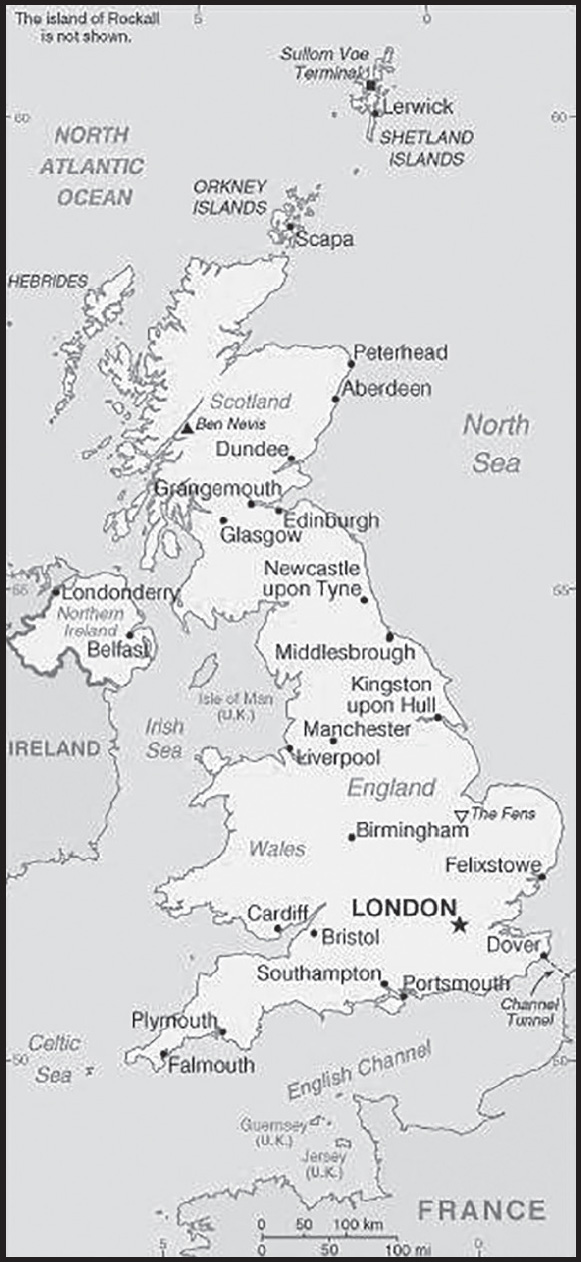
INTRODUCTION
Background: The United Kingdom of Great Britain and Northern Ireland was born of the unification of the Kingdoms of England and Scotland, which previously had been distinct states joined in a personal union, under the 1701 Acts of Union. The island of Ireland, also joined via a personal union, was incorporated under the 1800 Acts of Union, while Wales had been part of the Kingdom of England since the 16th century. The United Kingdom has historically played a leading role in developing parliamentary democracy and in advancing literature and science. The 18th and 19th centuries saw the rapid expansion of the British Empire despite the loss of the Thirteen Colonies, and at its zenith in the early 20th century, the British Empire stretched over one-fourth of the earth’s surface. The first half of the 20th century saw two World Wars seriously deplete the UK’s strength and the Irish Republic withdraw from the union. The second half witnessed the dismantling of the Empire and the UK rebuilding itself into a modern and prosperous European nation. As one of five permanent members of the UN Security Council and a founding member of NATO and the Commonwealth of Nations, the UK pursues a global approach to foreign policy. The devolved Scottish Parliament, the National Assembly for Wales, and the Northern Ireland Assembly were established in 1998.
The UK was an active member of the EU after its accession in 1973, although it chose to remain outside the Economic and Monetary Union. However, motivated in part by frustration at a remote bureaucracy in Brussels and massive migration into the country, UK citizens on 23 June 2016 voted by 52 to 48 percent to leave the EU. The UK became the only country to depart the EU on 31 January 2020, after prolonged negotiations on EU-UK economic and security relationships had been hammered out.
GEOGRAPHY
Location: Western Europe, islands - including the northern one-sixth of the island of Ireland - between the North Atlantic Ocean and the North Sea; northwest of France
Geographic coordinates: 54 00 N, 2 00 W
Map references: Europe
Area: total: 243,610 sq km
land: 241,930 sq km
water: 1,680 sq km
note 1: the percentage area breakdown of the four UK countries is: England 53%, Scotland 32%, Wales 9%, and Northern Ireland 6%
note 2: includes Rockall and the Shetland Islands, which are part of Scotland
comparison ranking: total 80
Area - comparative: twice the size of Pennsylvania; slightly smaller than Oregon
Land boundaries: total: 499 km
border countries (1): Ireland 499 km
Coastline: 12,429 km
Maritime claims: territorial sea: 12 nm
continental shelf: as defined in continental shelf orders or in accordance with agreed upon boundaries
exclusive fishing zone: 200 nm
Climate: temperate; moderated by prevailing southwest winds over the North Atlantic Current; more than one-half of the days are overcast
Terrain: mostly rugged hills and low mountains; level to rolling plains in east and southeast
Elevation: highest point: Ben Nevis 1,345 m
lowest point: The Fens -4 m
mean elevation: 162 m
Natural resources: coal, petroleum, natural gas, iron ore, lead, zinc, gold, tin, limestone, salt, clay, chalk, gypsum, potash, silica sand, slate, arable land
Land use: agricultural land: 71% (2018 est.)
arable land: 25.1% (2018 est.)
permanent crops: 0.2% (2018 est.)
permanent pasture: 45.7% (2018 est.)
forest: 11.9% (2018 est.)
other: 17.1% (2018 est.)
Irrigated land: 718 sq km (2018)
Population distribution: the core of the population lies in and around London, with significant clusters found in central Britain around Manchester and Liverpool, in the Scottish lowlands between Edinburgh and Glasgow, southern Wales in and around Cardiff, and far eastern Northern Ireland centered on Belfast
Natural hazards: winter windstorms; floods
Geography - note: lies near vital North Atlantic sea lanes; only 35 km from France and linked by tunnel under the English Channel (the Channel Tunnel or Chunnel); because of heavily indented coastline, no location is more than 125 km from tidal waters
PEOPLE AND SOCIETY
Population: 68,138,484 (2023 est.) United Kingdom
constituent countries by percentage of total population: England 84.3%
Scotland 8.2%
Wales 4.6%
Northern Ireland 2.8%
comparison ranking: 22
Nationality: noun: Briton(s), British (collective plural)
adjective: British
Ethnic groups: White 87.2%, Black/African/Caribbean/black British 3%, Asian/Asian British: Indian 2.3%, Asian/Asian British: Pakistani 1.9%, mixed 2%, other 3.7% (2011 est.)
Languages: English
note: the following are recognized regional languages: Scots (about 30% of the population of Scotland), Scottish Gaelic (about 60,000 speakers in Scotland), Welsh (about 20% of the population of Wales), Irish (about 10% of the population of Northern Ireland), Cornish (some 2,000 to 3,000 people in Cornwall) (2012 est.)
Religions: Christian (includes Anglican, Roman Catholic, Presbyterian, Methodist) 59.5%, Muslim 4.4%, Hindu 1.3%, other 2%, unspecified 7.2%, none 25.7% (2011 est.)
Age structure: 0-14 years: 16.91% (male 5,901,611/female 5,620,070)
15-64 years: 64.03% (male 21,997,962/female 21,628,742)
65 years and over: 19.06% (2023 est.) (male 5,953,187/female 7,036,912)
Dependency ratios: total dependency ratio: 57.7
youth dependency ratio: 27.8
elderly dependency ratio: 29.8
potential support ratio: 3.4 (2021 est.)
Median age: total: 40.6 years (2023 est.)
male: 39.9 years
female: 41.4 years
comparison ranking: total 58
Population growth rate: 0.49% (2023 est.)
comparison ranking: 153
Birth rate: 10.8 births/1,000 population (2023 est.)
comparison ranking: 170
Death rate: 9.1 deaths/1,000 population (2023 est.)
comparison ranking: 59
Net migration rate: 3.2 migrant(s)/1,000 population (2023 est.)
comparison ranking: 41
Population distribution: the core of the population lies in and around London, with significant clusters found in central Britain around Manchester and Liverpool, in the Scottish lowlands between Edinburgh and Glasgow, southern Wales in and around Cardiff, and far eastern Northern Ireland centered on Belfast
Urbanization: urban population: 84.6% of total population (2023)
rate of urbanization: 0.8% annual rate of change (2020-25 est.)
Major urban areas - population: 9.648 million LONDON (capital), 2.791 million Manchester, 2.665 million Birmingham, 1.929 million West Yorkshire, 1.698 million Glasgow, 952,000 Southampton/Portsmouth (2023)
Sex ratio: at birth: 1.05 male(s)/female
0-14 years: 1.05 male(s)/female
15-64 years: 1.02 male(s)/female
65 years and over: 0.85 male(s)/female
total population: 0.99 male(s)/female (2023 est.)
Mother’s mean age at first birth: 29 years (2018 est.)
note: data represents England and Wales only
Maternal mortality ratio: 10 deaths/100,000 live births (2020 est.)
comparison ranking: 145
Infant mortality rate: total: 3.8 deaths/1,000 live births (2023 est.)
male: 4.3 deaths/1,000 live births
female: 3.3 deaths/1,000 live births
comparison ranking: total 192
Life expectancy at birth: total population: 82.1 years (2023 est.)
male: 80 years
female: 84.2 years
comparison ranking: total population 32
Total fertility rate: 1.63 children born/woman (2023 est.)
comparison ranking: 177
Gross reproduction rate: 0.79 (2023 est.)
Contraceptive prevalence rate: 76.1% (2010/12)
note: percent of women aged 16-49
Drinking water source: improved: total: 100% of population
unimproved: total: 0% of population (2020 est.)
Current health expenditure: 12% of GDP (2020)
Physicians density: 3 physicians/1,000 population (2020)
Hospital bed density: 2.5 beds/1,000 population (2019)
Sanitation facility access: improved: total: 99.8% of population
unimproved: total: 0.2% of population (2020 est.)
Major infectious diseases: note: on 31 August 2023, the US Centers for Disease Control and Prevention (CDC) issued an updated Travel Alert for polio in Europe; the United Kingdom is currently considered a high risk to travelers for circulating vaccine-derived polioviruses (cVDPV); vaccine-derived poliovirus (VDPV) is a strain of the weakened poliovirus that was initially included in oral polio vaccine (OPV) and that has changed over time and behaves more like the wild or naturally occurring virus; this means it can be spread more easily to people who are unvaccinated against polio and who come in contact with the stool or respiratory secretions, such as from a sneeze, of an “infected” person who received oral polio vaccine; the CDC recommends that before any international travel, anyone unvaccinated, incompletely vaccinated, or with an unknown polio vaccination status should complete the routine polio vaccine series; before travel to any high-risk destination, the CDC recommends that adults who previously completed the full, routine polio vaccine series receive a single, lifetime booster dose of polio vaccine
Obesity - adult prevalence rate: 27.8% (2016)
comparison ranking: 36
Alcohol consumption per capita: total: 9.8 liters of pure alcohol (2019 est.)
beer: 3.53 liters of pure alcohol (2019 est.)
wine: 3.3 liters of pure alcohol (2019 est.)
spirits: 2.35 liters of pure alcohol (2019 est.)
other alcohols: 0.61 liters of pure alcohol (2019 est.)
comparison ranking: total 24
Tobacco use: total: 15.4% (2020 est.)
male: 17.3% (2020 est.)
female: 13.5% (2020 est.)
comparison ranking: total 102
Currently married women (ages 15-49): 50.7% (2023 est.)
Child marriage: women married by age 18: 0.1% (2020 est.)
Education expenditures: 5.5% of GDP (2020 est.)
comparison ranking: 55
School life expectancy (primary to tertiary education): total: 17 years
male: 17 years
female: 18 years (2020)
Youth unemployment rate (ages 15-24): total: 13.2% (2021 est.)
male: 14.6%
female: 11.8%
comparison ranking: total 133
ENVIRONMENT
Environment - current issues: air pollution improved but remains a concern, particularly in the London region; soil pollution from pesticides and heavy metals; decline in marine and coastal habitats brought on by pressures from housing, tourism, and industry
Environment - international agreements: party to: Air Pollution, Air Pollution-Heavy Metals, Air Pollution-Multi-effect Protocol, Air Pollution-Nitrogen Oxides, Air Pollution-Persistent Organic Pollutants, Air Pollution-Sulphur 94, Air Pollution-Volatile Organic Compounds, Antarctic-Environmental Protection, Antarctic-Marine Living Resources, Antarctic Seals, Antarctic Treaty, Biodiversity, Climate Change, Climate Change-Kyoto Protocol, Climate Change-Paris Agreement, Comprehensive Nuclear Test Ban, Desertification, Endangered Species, Environmental Modification, Hazardous Wastes, Law of the Sea, Marine Dumping-London Convention, Marine Dumping-London Protocol, Marine Life Conservation, Nuclear Test Ban, Ozone Layer Protection, Ship Pollution, Tropical Timber 2006, Wetlands, Whaling
signed, but not ratified: none of the selected agreements
Climate: temperate; moderated by prevailing southwest winds over the North Atlantic Current; more than one-half of the days are overcast
Land use: agricultural land: 71% (2018 est.)
arable land: 25.1% (2018 est.)
permanent crops: 0.2% (2018 est.)
permanent pasture: 45.7% (2018 est.)
forest: 11.9% (2018 est.)
other: 17.1% (2018 est.)
Urbanization: urban population: 84.6% of total population (2023)
rate of urbanization: 0.8% annual rate of change (2020-25 est.)
Revenue from forest resources: 0.01% of GDP (2018 est.)
comparison ranking: 154
Revenue from coal: 0% of GDP (2018 est.)
comparison ranking: 181
Air pollutants: particulate matter emissions: 9.52 micrograms per cubic meter (2019 est.)
carbon dioxide emissions: 379.02 megatons (2016 est.)
methane emissions: 49.16 megatons (2020 est.)
Waste and recycling: municipal solid waste generated annually: 31.567 million tons (2014 est.)
municipal solid waste recycled annually: 8,602,008 tons (2015 est.)
percent of municipal solid waste recycled: 27.3% (2015 est.)
Total water withdrawal: municipal: 6.23 billion cubic meters (2020 est.)
industrial: 1.01 billion cubic meters (2020 est.)
agricultural: 1.18 billion cubic meters (2020 est.)
Total renewable water resources: 147 billion cubic meters (2020 est.)
GOVERNMENT
Country name: conventional long form: United Kingdom of Great Britain and Northern Ireland; note - the island of Great Britain includes England, Scotland, and Wales
conventional short form: United Kingdom
abbreviation: UK
etymology: self-descriptive country name; the designation “Great Britain,” in the sense of “Larger Britain,” dates back to medieval times and was used to distinguish the island from “Little Britain,” or Brittany in modern France; the name Ireland derives from the Gaelic “Eriu,” the matron goddess of Ireland (goddess of the land)
Government type: parliamentary constitutional monarchy; a Commonwealth realm
Capital: name: London
geographic coordinates: 51 30 N, 0 05 W
time difference: UTC 0 (5 hours ahead of Washington, DC, during Standard Time)
daylight saving time: +1hr, begins last Sunday in March; ends last Sunday in October
time zone note: the time statements apply to the United Kingdom proper, not to its crown dependencies or overseas territories
etymology: the name derives from the Roman settlement of Londinium, established on the current site of London around A.D. 43; the original meaning of the name is uncertain
Administrative divisions: England: 24 two-tier counties, 32 London boroughs and 1 City of London or Greater London, 36 metropolitan districts, 59 unitary authorities (including 4 single-tier counties*);
two-tier counties: Cambridgeshire, Cumbria, Derbyshire, Devon, East Sussex, Essex, Gloucestershire, Hampshire, Hertfordshire, Kent, Lancashire, Leicestershire, Lincolnshire, Norfolk, North Yorkshire, Nottinghamshire, Oxfordshire, Somerset, Staffordshire, Suffolk, Surrey, Warwickshire, West Sussex, Worcestershire
London boroughs and City of London or Greater London: Barking and Dagenham, Barnet, Bexley, Brent, Bromley, Camden, Croydon, Ealing, Enfield, Greenwich, Hackney, Hammersmith and Fulham, Haringey, Harrow, Havering, Hillingdon, Hounslow, Islington, Kensington and Chelsea, Kingston upon Thames, Lambeth, Lewisham, City of London, Merton, Newham, Redbridge, Richmond upon Thames, Southwark, Sutton, Tower Hamlets, Waltham Forest, Wandsworth, Westminster
metropolitan districts: Barnsley, Birmingham, Bolton, Bradford, Bury, Calderdale, Coventry, Doncaster, Dudley, Gateshead, Kirklees, Knowlsey, Leeds, Liverpool, Manchester, Newcastle upon Tyne, North Tyneside, Oldham, Rochdale, Rotherham, Salford, Sandwell, Sefton, Sheffield, Solihull, South Tyneside, St. Helens, Stockport, Sunderland, Tameside, Trafford, Wakefield, Walsall, Wigan, Wirral, Wolverhampton
unitary authorities: Bath and North East Somerset; Bedford; Blackburn with Darwen; Blackpool; Bournemouth, Christchurch and Poole; Bracknell Forest; Brighton and Hove; City of Bristol; Buckinghamshire; Central Bedfordshire; Cheshire East; Cheshire West and Chester; Cornwall; Darlington; Derby; Dorset; Durham County*; East Riding of Yorkshire; Halton; Hartlepool; Herefordshire*; Isle of Wight*; Isles of Scilly; City of Kingston upon Hull; Leicester; Luton; Medway; Middlesbrough; Milton Keynes; North East Lincolnshire; North Lincolnshire; North Northamptonshire; North Somerset; Northumberland*; Nottingham; Peterborough; Plymouth; Portsmouth; Reading; Redcar and Cleveland; Rutland; Shropshire; Slough; South Gloucestershire; Southampton; Southend-on-Sea; Stockton-on-Tees; Stoke-on-Trent; Swindon; Telford and Wrekin; Thurrock; Torbay; Warrington; West Berkshire; West Northamptonshire; Wiltshire; Windsor and Maidenhead; Wokingham; York
Northern Ireland: 5 borough councils, 4 district councils, 2 city councils;
borough councils: Antrim and Newtownabbey; Ards and North Down; Armagh City, Banbridge, and Craigavon; Causeway Coast and Glens; Mid and East Antrim
district councils: Derry City and Strabane; Fermanagh and Omagh; Mid Ulster; Newry, Murne, and Down
city councils: Belfast; Lisburn and Castlereagh
Scotland: 32 council areas;
council areas: Aberdeen City, Aberdeenshire, Angus, Argyll and Bute, Clackmannanshire, Dumfries and Galloway, Dundee City, East Ayrshire, East Dunbartonshire, East Lothian, East Renfrewshire, City of Edinburgh, Eilean Siar (Western Isles), Falkirk, Fife, Glasgow City, Highland, Inverclyde, Midlothian, Moray, North Ayrshire, North Lanarkshire, Orkney Islands, Perth and Kinross, Renfrewshire, Shetland Islands, South Ayrshire, South Lanarkshire, Stirling, The Scottish Borders, West Dunbartonshire, West Lothian
Wales: 22 unitary authorities;
unitary authorities: Blaenau Gwent, Bridgend, Caerphilly, Cardiff, Carmarthenshire, Ceredigion, Conwy, Denbighshire, Flintshire, Gwynedd, Isle of Anglesey, Merthyr Tydfil, Monmouthshire, Neath Port Talbot, Newport, Pembrokeshire, Powys, Rhondda Cynon Taff, Swansea, The Vale of Glamorgan, Torfaen, Wrexham
Dependent areas: Anguilla; Bermuda; British Indian Ocean Territory; British Virgin Islands; Cayman Islands; Falkland Islands; Gibraltar; Montserrat; Pitcairn Islands; Saint Helena, Ascension, and Tristan da Cunha; South Georgia and the South Sandwich Islands; Turks and Caicos Islands (12)
Independence: no official date of independence: 927 (minor English kingdoms unite); 3 March 1284 (enactment of the Statute of Rhuddlan uniting England and Wales); 1536 (Act of Union formally incorporates England and Wales); 1 May 1707 (Acts of Union formally unite England, Scotland, and Wales as Great Britain); 1 January 1801 (Acts of Union formally unite Great Britain and Ireland as the United Kingdom of Great Britain and Ireland); 6 December 1921 (Anglo-Irish Treaty formalizes partition of Ireland; six counties remain part of the United Kingdom and Northern Ireland); 12 April 1927 (Royal and Parliamentary Titles Act establishes current name of the United Kingdom of Great Britain and Northern Ireland)
National holiday: the UK does not celebrate one particular national holiday
Constitution: history: uncoded; partly statutes, partly common law and practice
amendments: proposed as a bill for an Act of Parliament by the government, by the House of Commons, or by the House of Lords; passage requires agreement by both houses and by the monarch (Royal Assent); many previous, last in 2020 - The European Union (Withdrawal Agreement) Act 2020, European Union (Future Relationship) Act 2020
Legal system: common law system; has nonbinding judicial review of Acts of Parliament under the Human Rights Act of 1998
International law organization participation: accepts compulsory ICJ jurisdiction with reservations; accepts ICCt jurisdiction
Citizenship: citizenship by birth: no
citizenship by descent only: at least one parent must be a citizen of the United Kingdom
dual citizenship recognized: yes
residency requirement for naturalization: 5 years
Suffrage: 18 years of age; universal
Executive branch: chief of state: King CHARLES III (since 8 September 2022); Heir Apparent Prince WILLIAM (son of the king, born 21 June 1982); note - CHARLES succeeded his mother, Queen ELIZABETH II, after serving as Prince of Wales (heir apparent) for over 64 years - the longest such tenure in British history
head of government: Prime Minister Rishi SUNAK (Conservative) (since 25 October 2022)
cabinet: Cabinet appointed by the prime minister
elections/appointments: the monarchy is hereditary; following legislative elections, the leader of the majority party or majority coalition usually becomes the prime minister; election last held on 12 December 2019 (next to be held no later than 28 January 2025)
note: in addition to serving as the UK head of state, the British sovereign is the constitutional monarch for 14 additional Commonwealth countries (these 15 states are each referred to as a Commonwealth realm)
Legislative branch: description: bicameral Parliament consists of:
House of Lords (membership not fixed; as of October 2023, 778 lords were eligible to participate in the work of the House of Lords - 663 life peers, 90 hereditary peers, and 25 clergy; members are appointed by the monarch on the advice of the prime minister and non-party political members recommended by the House of Lords Appointments Commission); note - House of Lords total does not include ineligible members or members on leave of absence House of Commons (650 seats; members directly elected in single-seat constituencies by simple majority popular vote to serve 5-year terms unless the House is dissolved earlier)
elections: House of Lords - no elections; note - in 1999, as provided by the House of Lords Act, elections were held in the House of Lords to determine the 92 hereditary peers who would remain; elections held only as vacancies in the hereditary peerage arise)
House of Commons - last held on 12 December 2019 (next to be held no later than 28 January 2025)
election results: House of Lords - composition - men 552, women 226, percent of women 29%
House of Commons - percent of vote by party - Conservative 54.9%, Labor 30.8%, SNP 6.8%, Lib Dems 2.2%, DUP 1.2%, Sinn Fein 1.1%, Plaid Cymru .6%, other 2.5%; seats by party - Conservative 365, Labor 202, SNP 48, Lib Dems 11, DUP 8, Sinn Fein 7, Plaid Cymru 4, other 5; composition - men 425, women 225, percent of women 34.6%; total Parliament percent of women 31.3%
Judicial branch: highest court(s): Supreme Court (consists of 12 justices, including the court president and deputy president); note - the Supreme Court was established by the Constitutional Reform Act 2005 and implemented in 2009, replacing the Appellate Committee of the House of Lords as the highest court in the United Kingdom
judge selection and term of office: judge candidates selected by an independent committee of several judicial commissions, followed by their recommendations to the prime minister, and appointed by the monarch; justices serve for life
subordinate courts: England and Wales: Court of Appeal (civil and criminal divisions); High Court; Crown Court; County Courts; Magistrates’ Courts; Scotland: Court of Sessions; Sheriff Courts; High Court of Justiciary; tribunals; Northern Ireland: Court of Appeal in Northern Ireland; High Court; county courts; magistrates’ courts; specialized tribunals
Political parties and leaders: Alliance Party (Northern Ireland) [Naomi LONG]
Conservative and Unionist Party [Rishi SUNAK]
Democratic Unionist Party or DUP (Northern Ireland) [Sir Jeffrey DONALDSON]
Green Party of England and Wales or Greens [Carla DENYER and Adrian RAMSAY]
Labor (Labour) Party [Sir Keir STARMER]
Liberal Democrats (Lib Dems) [Sir Ed DAVEY]
Party of Wales (Plaid Cymru) [Llyr GRUFFYDD]
Scottish National Party or SNP [Humza YOUSAF]
Sinn Fein (Northern Ireland) [Mary Lou MCDONALD]
Social Democratic and Labor Party or SDLP (Northern Ireland) [Colum EASTWOOD]
UK Independence Party or UKIP [Neil HAMILTON]
Ulster Unionist Party or UUP (Northern Ireland) [Doug BEATTIE]
International organization participation: ADB (nonregional member), AfDB (nonregional member), Arctic Council (observer), Australia Group, BIS, C, CBSS (observer), CD, CDB, CE, CERN, EAPC, EBRD, ECB, EIB, EITI (implementing country), ESA, EU, FAO, FATF, G-5, G-7, G-8, G-10, G-20, IADB, IAEA, IBRD, ICAO, ICC (national committees), ICCt, ICRM, IDA, IEA, IFAD, IFC, IFRCS, IGAD (partners), IHO, ILO, IMF, IMO, IMSO, Interpol, IOC, IOM, IPU, ISO, ITSO, ITU, ITUC (NGOs), MIGA, MINUSMA, MONUSCO, NATO, NEA, NSG, OAS (observer), OECD, OPCW, OSCE, Pacific Alliance (observer), Paris Club, PCA, PIF (partner), SELEC (observer), SICA (observer), UN, UNCTAD, UNESCO, UNFICYP, UNHCR, UNHRC, UNMISS, UNRWA, UN Security Council (permanent), UNSOM, UPU, Wassenaar Arrangement, WCO, WHO, WIPO, WMO, WTO, ZC
Diplomatic representation in the US: chief of mission: Ambassador Karen Elizabeth PIERCE (since 8 April 2020)
chancery: 3100 Massachusetts Avenue NW, Washington, DC 20008
telephone: [1] (202) 588-6500
FAX: [1] (202) 588-7870
email address and website: britishembassyenquiries@gmail.com
https://www.gov.uk/world/organisations/british-embassy-washington
consulate(s) general: Atlanta, Boston, Chicago, Denver, Houston, Los Angeles, Miami, New York, San Francisco
consulate(s): Orlando (FL), San Juan (Puerto Rico)
Diplomatic representation from the US: chief of mission: Ambassador Jane HARTLEY (since 19 July 2022)
embassy: 33 Nine Elms Lane, London, SW11 7US
mailing address: 8400 London Place, Washington DC 20521-8400
telephone: [44] (0) 20-7499-9000
FAX: [44] (0) 20-7891-3845
email address and website: SCSLondon@state.gov
consulate(s) general: Belfast, Edinburgh
Flag description: blue field with the red cross of Saint George (patron saint of England) edged in white superimposed on the diagonal red cross of Saint Patrick (patron saint of Ireland), which is superimposed on the diagonal white cross of Saint Andrew (patron saint of Scotland); properly known as the Union Flag, but commonly called the Union Jack; the design and colors (especially the Blue Ensign) have been the basis for a number of other flags including other Commonwealth countries and their constituent states or provinces, and British overseas territories
National symbol(s): lion (Britain in general); lion, Tudor rose, oak (England); lion, unicorn, thistle (Scotland); dragon, daffodil, leek (Wales); shamrock, flax (Northern Ireland); national colors: red, white, blue (Britain in general); red, white (England); blue, white (Scotland); red, white, green (Wales)
National anthem: name: “God Save the King”
lyrics/music: unknown
note: in use since 1745; by tradition, the song serves as both the national and royal anthem of the UK; it is known as either “God Save the Queen” or “God Save the King,” depending on the gender of the reigning monarch; it also serves as the royal anthem of many Commonwealth nations
National heritage: total World Heritage Sites: 33 (28 cultural, 4 natural, 1 mixed); note - includes one site in Bermuda
selected World Heritage Site locales: Giant’s Causeway and Causeway Coast (n); Ironbridge Gorge (c); Stonehenge, Avebury, and Associated Sites (c); Castles and Town Walls of King Edward in Gwynedd (c); Blenheim Palace (c); City of Bath (c); Tower of London (c); St Kilda (m); Maritime Greenwich (c); Old and New Towns of Edinburgh (c); Royal Botanic Gardens, Kew (c); The English Lake District (c)
ECONOMY
Economic overview: high-income, diversified non-EU European economy; sixth-largest importer and exporter; global financial and diplomatic leader; nominal consumption-led growth; high inflation and increased interest rates eroding purchasing power despite real wage growth
Real GDP (purchasing power parity): $3.136 trillion (2022 est.)
$3.028 trillion (2021 est.)
$2.816 trillion (2020 est.)
note: data are in 2017 dollars
comparison ranking: 8
Real GDP growth rate: 4.1% (2022 est.)
7.52% (2021 est.)
-11.03% (2020 est.)
comparison ranking: 117
Real GDP per capita: $46,800 (2022 est.)
$45,000 (2021 est.)
$42,000 (2020 est.)
note: data are in 2017 dollars
comparison ranking: 35
GDP (official exchange rate): $2,827,918,000,000 (2019 est.)
Inflation rate (consumer prices): 2.52% (2021 est.)
0.99% (2020 est.)
1.74% (2019 est.)
comparison ranking: 134
Credit ratings:
Fitch rating: AA- (2020)
Moody’s rating: Aaa (2020)
Standard & Poors rating: AA (2016)
note: The year refers to the year in which the current credit rating was first obtained.
GDP - composition, by sector of origin: agriculture: 0.7% (2017 est.)
industry: 20.2% (2017 est.)
services: 79.2% (2017 est.)
comparison rankings: services 33; industry 148; agriculture 205
GDP - composition, by end use: household consumption: 65.8% (2017 est.)
government consumption: 18.3% (2017 est.)
investment in fixed capital: 17.2% (2017 est.)
investment in inventories: 0.2% (2017 est.)
exports of goods and services: 30.2% (2017 est.)
imports of goods and services: -31.5% (2017 est.)
Agricultural products: wheat, milk, barley, sugar beets, potatoes, rapeseed, poultry, oats, pork, beef
Industries: machine tools, electric power equipment, automation equipment, railroad equipment, shipbuilding, aircraft, motor vehicles and parts, electronics and communications equipment, metals, chemicals, coal, petroleum, paper and paper products, food processing, textiles, clothing, other consumer goods
Industrial production growth rate: 9.12% (2021 est.)
comparison ranking: 35
Labor force: 34.637 million (2021 est.)
comparison ranking: 17
Labor force - by occupation: agriculture: 1.3%
industry: 15.2%
services: 83.5% (2014 est.)
Unemployment rate: 4.53% (2021 est.)
4.47% (2020 est.)
3.74% (2019 est.)
comparison ranking: 163
Youth unemployment rate (ages 15-24): total: 13.2% (2021 est.)
male: 14.6%
female: 11.8%
comparison ranking: total 133
Population below poverty line: 18.6% (2017 est.)
Gini Index coefficient - distribution of family income: 35.1 (2017 est.)
comparison ranking: 99
Average household expenditures: on food: 8.1% of household expenditures (2018 est.)
on alcohol and tobacco: 3.2% of household expenditures (2018 est.)
Household income or consumption by percentage share: lowest 10%: 1.7%
highest 10%: 31.1% (2012)
Budget: revenues: $998.006 billion (2020 est.)
expenditures: $1.362 trillion (2020 est.)
Budget surplus (+) or deficit (-): -1.9% (of GDP) (2017 est.)
comparison ranking: 100
Public debt: 195.39% of GDP (2020 est.)
160.02% of GDP (2019 est.)
157.8% of GDP (2018 est.)
note: data cover general government debt and include debt instruments issued (or owned) by government entities other than the treasury; the data include treasury debt held by foreign entities; the data include debt issued by subnational entities, as well as intragovernmental debt; intragovernmental debt consists of treasury borrowings from surpluses in the social funds, such as for retirement, medical care, and unemployment; debt instruments for the social funds are not sold at public auctions
comparison ranking: 3
Taxes and other revenues: 24.73% (of GDP) (2020 est.)
comparison ranking: 52
Fiscal year: 6 April - 5 April
Current account balance: -$62.941 billion (2021 est.)
-$87.814 billion (2020 est.)
-$80.779 billion (2019 est.)
comparison ranking: 208
Exports: $874.5 billion (2021 est.) note: data are in current year dollars
$791.7 billion (2020 est.) note: data are in current year dollars
$893.1 billion (2019 est.) note: data are in current year dollars
comparison ranking: 6
Exports - partners: United States 13%, Germany 9%, Netherlands 8%, Ireland 7%, Switzerland 6% (2021)
Exports - commodities: cars, gold, gas turbines, crude petroleum, packaged medicines (2021)
Imports: $898.719 billion (2021 est.) note: data are in current year dollars
$783.438 billion (2020 est.) note: data are in current year dollars
$939.349 billion (2019 est.) note: data are in current year dollars
comparison ranking: 6
Imports - partners: China 13%, Germany 11%, United States 8%, Netherlands 6%, Norway 5% (2021)
Imports - commodities: gold, cars, natural gas, crude petroleum, packaged medicines (2021)
Reserves of foreign exchange and gold: $194.181 billion (31 December 2021 est.)
$180.054 billion (31 December 2020 est.)
$173.569 billion (31 December 2019 est.)
comparison ranking: 19
Debt - external: $8.722 trillion (2019 est.)
$8.697 trillion (2018 est.)
comparison ranking: 2
Exchange rates: British pounds (GBP) per US dollar -
Exchange rates: 0.727 (2021 est.)
0.78 (2020 est.)
0.783 (2019 est.)
0.75 (2018 est.)
0.777 (2017 est.)
ENERGY
Electricity access: electrification - total population: 100% (2021)
Electricity: installed generating capacity: 113.153 million kW (2020 est.)
consumption: 289.688 billion kWh (2020 est.)
exports: 4.481 billion kWh (2020 est.)
imports: 22.391 billion kWh (2020 est.)
transmission/distribution losses: 27.746 billion kWh (2020 est.)
comparison rankings: transmission/distribution losses 15; imports 8; exports 39; consumption 12; installed generating capacity 13
Electricity generation sources: fossil fuels: 37.8% of total installed capacity (2020 est.)
nuclear: 15.2% of total installed capacity (2020 est.)
solar: 4.3% of total installed capacity (2020 est.)
wind: 25.2% of total installed capacity (2020 est.)
hydroelectricity: 2.6% of total installed capacity (2020 est.)
biomass and waste: 15% of total installed capacity (2020 est.)
Nuclear energy: Number of operational nuclear reactors: 9 (2023)
Number of nuclear reactors under construction: 2
Net capacity of operational nuclear reactors: 5.88GW (2023)
Percent of total electricity production: 14.8% (2021)
Percent of total energy produced: 8% (2021)
Number of nuclear reactors permanently shut down: 8
Coal: production: 2.892 million metric tons (2020 est.)
consumption: 9.401 million metric tons (2020 est.)
exports: 1.309 million metric tons (2020 est.)
imports: 5.537 million metric tons (2020 est.)
proven reserves: 26 million metric tons (2019 est.)
Petroleum: total petroleum production: 890,400 bbl/day (2021 est.)
refined petroleum consumption: 1,578,100 bbl/day (2019 est.)
crude oil and lease condensate exports: 818,200 bbl/day (2018 est.)
crude oil and lease condensate imports: 891,700 bbl/day (2018 est.)
crude oil estimated reserves: 2.5 billion barrels (2021 est.)
Refined petroleum products - production: 1.29 million bbl/day (2017 est.)
comparison ranking: 16
Refined petroleum products - exports: 613,800 bbl/day (2017 est.)
comparison ranking: 14
Refined petroleum products - imports: 907,500 bbl/day (2017 est.)
comparison ranking: 7
Natural gas: production: 32.48 billion cubic meters (2021 est.)
consumption: 75.7 billion cubic meters (2021 est.)
exports: 6.873 billion cubic meters (2021 est.)
imports: 51,050,178,000 cubic meters (2021 est.)
proven reserves: 180.661 billion cubic meters (2021 est.)
Carbon dioxide emissions: 398.084 million metric tonnes of CO2 (2019 est.)
from coal and metallurgical coke: 23.5 million metric tonnes of CO2 (2019 est.)
from petroleum and other liquids: 216.237 million metric tonnes of CO2 (2019 est.)
from consumed natural gas: 158.346 million metric tonnes of CO2 (2019 est.)
comparison ranking: total emissions 16
Energy consumption per capita: 119.894 million Btu/person (2019 est.)
comparison ranking: 46
COMMUNICATIONS
Telephones - fixed lines: total subscriptions: 33 million (2021 est.)
subscriptions per 100 inhabitants: 48 (2021 est.)
comparison ranking: total subscriptions 6
Telephones - mobile cellular: total subscriptions: 80 million (2021 est.)
subscriptions per 100 inhabitants: 120 (2021 est.)
comparison ranking: total subscriptions 20
Telecommunication systems: general assessment: UK’s telecom market remains one of the largest in Europe, characterized by competition, affordable pricing, and its technologically advanced systems; mobile penetration above the EU average; government to invest in infrastructure and 5G technologies with ambition for a fully-fibered nation by 2033; operators expanded the reach of 5G services in 2020; super-fast broadband available to about 95% of customers; London is developing smart city technology, in collaboration with private, tech, and academic sectors (2021)
domestic: fixed-line is 48 per 100 and mobile-cellular is 120 per 100 (2021)
international: country code - 44; Landing points for the GTT Atlantic, Scotland-Northern Ireland -1, & -2, Lanis 1,-2, &-3, Sirius North, BT-MT-1, SHEFA-2, BT Highlands and Islands Submarine Cable System, Northern Lights, FARICE-1, Celtic Norse, Tampnet Offshore FOC Network, England Cable, CC-2, E-LLan, Sirius South, ESAT -1 & -2, Rockabill, Geo-Eirgrid, UK-Netherlands-14, Circle North & South, Ulysses2, Conceto, Farland North, Pan European Crossing, Solas, Swansea-Bream, GTT Express, Tata TGN-Atlantic & -Western Europe, Apollo, EIG, Glo-1, TAT-14, Yellow, Celtic, FLAG Atlantic-1, FEA, Isle of Scilly Cable, UK-Channel Islands-8 and SeaMeWe-3 submarine cables providing links throughout Europe, Asia, Africa, the Middle East, Southeast Asia, Australia, and US; satellite earth stations - 10 Intelsat (7 Atlantic Ocean and 3 Indian Ocean), 1 Inmarsat (Atlantic Ocean region), and 1 Eutelsat; at least 8 large international switching centers (2019)
Broadcast media: public service broadcaster, British Broadcasting Corporation (BBC), is the largest broadcasting corporation in the world; BBC operates multiple TV networks with regional and local TV service; a mixed system of public and commercial TV broadcasters along with satellite and cable systems provide access to hundreds of TV stations throughout the world; BBC operates multiple national, regional, and local radio networks with multiple transmission sites; a large number of commercial radio stations, as well as satellite radio services are available (2018)
Internet country code: .uk
Internet users: total: 64.99 million (2021 est.)
percent of population: 97% (2021 est.)
comparison ranking: total 16
Broadband - fixed subscriptions: total: 27,330,297 (2020 est.)
subscriptions per 100 inhabitants: 40 (2020 est.)
comparison ranking: total 8
Communications - note: note 1: the British Library claims to be the largest library in the world with well over 150 million items and in most known languages; it receives copies of all books produced in the UK or Ireland, as well as a significant proportion of overseas titles distributed in the UK; in addition to books (print and digital), holdings include: journals, manuscripts, newspapers, magazines, sound and music recordings, videos, maps, prints, patents, and drawings
note 2: on 1 May 1840, the United Kingdom led the world with the introduction of postage stamps; the Austrian Empire had examined the idea of an “adhesive tax postmark” for the prepayment of postage in 1835; while the suggestion was reviewed in detail, it was rejected for the time being; other countries (including Austria) soon followed the UK’s example with their own postage stamps; by the 1860s, most countries were issuing stamps; originally, stamps had to be cut from sheets; the UK issued the first postage stamps with perforations in 1854
TRANSPORTATION
National air transport system: number of registered air carriers: 20 (2020)
inventory of registered aircraft operated by air carriers: 794
annual passenger traffic on registered air carriers: 165,388,610 (2018)
annual freight traffic on registered air carriers: 6,198,370,000 (2018) mt-km
Civil aircraft registration country code prefix: G
Airports: 460 (2021)
comparison ranking: total 16
Airports - with paved runways: 271
civil airports: 51
military airports: 25
joint use (civil-military) airports: 1
other airports: 194
note: paved runways have a concrete or asphalt surface but not all have facilities for refueling, maintenance, or air traffic control; the length of a runway required for aircraft to safely operate depends on a number of factors including the type of aircraft, the takeoff weight (including passengers, cargo, and fuel), engine types, flap settings, landing speed, elevation of the airport, and average maximum daily air temperature; paved runways can reach a length of 5,000 m (16,000 ft.), but the “typical” length of a commercial airline runway is between 2,500-4,000 m (8,000-13,000 ft.)
Airports - with unpaved runways: 189
note: unpaved runways have a surface composition such as grass or packed earth and are most suited to the operation of light aircraft; unpaved runways are usually short, often less than 1,000 m (3,280 ft.) in length; airports with unpaved runways often lack facilities for refueling, maintenance, or air traffic control
Heliports: 9 (2021)
Pipelines: 502 km condensate, 9 km condensate/gas, 28,603 km gas, 59 km liquid petroleum gas, 5,256 km oil, 175 km oil/gas /water, 4,919 km refined products, 255 km water (2013)
Railways: total: 16,390 km (2020) 6,167 km electrified
comparison ranking: total 18
Roadways: total: 394,428 km (2009)
paved: 394,428 km (2009) (includes 3,519 km of expressways)
comparison ranking: total 19
Waterways: 3,200 km (2009) (620 km used for commerce)
comparison ranking: 33
Merchant marine: total: 1,174 (2022)
by type: bulk carrier 133, container ship 58, general cargo 97, oil tanker 73, other 813
comparison ranking: total 23
Ports and terminals: major seaport(s): Dover, Felixstowe, Immingham, Liverpool, London, Southampton, Teesport (England); Forth Ports (Scotland); Milford Haven (Wales)
oil terminal(s): Fawley Marine terminal, Liverpool Bay terminal (England); Braefoot Bay terminal, Finnart oil terminal, Hound Point terminal (Scotland)
container port(s) (TEUs): Felixstowe (3,700,000), London (3,111,000), Southampton (1,871,081) (2021)
LNG terminal(s) (import): Dragon, Isle of Grain, South Hook, Teesside
Transportation - note: note 1: begun in 1988 and completed in 1994, the Channel Tunnel (nicknamed the Chunnel) is a 50.5-km (31.4-mi) rail tunnel beneath the English Channel at the Strait of Dover that runs from Folkestone, Kent, England to Coquelles, Pas-de-Calais in northern France; it is the only fixed link between the island of Great Britain and mainland Europe
note 2: the UK operates one PC 3 or 4 class medium icebreaker in the South Atlantic in support of operations in Antarctica
note - PC indicates a Polar Class vessel: PC 3 - year-round operation in second-year ice which may include multi-year ice inclusions (ice thickness up to 2.5 m); PC 4 - year-round operation in thick first-year ice which may include old ice inclusions (ice thickness up to 120 cm)
MILITARY AND SECURITY
Military and security forces: United Kingdom Armed Forces (aka British Armed Forces, aka His Majesty’s Armed Forces): British Army, Royal Navy (includes Royal Marines), Royal Air Force (2023)
Military expenditures: 2.1% of GDP (2023 est.)
2.2% of GDP (2022 est.)
2.3% of GDP (2021)
2.4% of GDP (2020)
2.1% of GDP (2019)
comparison ranking: 56
Military and security service personnel strengths: approximately 150,000 regular forces (82,000 Army including the Gurkhas; 34,000 Navy including the Royal Marines; 34,000 Air Force) (2023)
note: the military also has approximately 40-45,000 reserves and other personnel on active duty
Military equipment inventories and acquisitions: the inventory of the British military is comprised of a mix of domestically produced and imported Western weapons systems; in recent years, the US has been the leading supplier of armaments to the UK; the UK defense industry is capable of producing a wide variety of air, land, and sea weapons systems and is one of the world’s top weapons suppliers (2023)
Military service age and obligation: some variations by service, but generally 16-36 years of age for enlisted (with parental consent under 18) and 18-29 for officers; minimum length of service 4 years; women serve in all military services including combat roles; conscription abolished in 1963 (2023)
note 1: women made up over 11% of the military’s full-time personnel in 2023
note 2: the British military allows Commonwealth nationals who are current UK residents and have been in the country for at least 5 years to apply; it also accepts Irish citizens
note 3: the British Army has continued the historic practice of recruiting Gurkhas from Nepal to serve in the Brigade of Gurkhas; the British began to recruit Nepalese citizens (Gurkhas) into the East India Company Army during the Anglo-Nepalese War (1814-1816); the Gurkhas subsequently were brought into the British Indian Army and by 1914, there were 10 Gurkha regiments, collectively known as the Gurkha Brigade; following the partition of India in 1947, an agreement between Nepal, India, and Great Britain allowed for the transfer of the 10 regiments from the British Indian Army to the separate British and Indian armies; four of the regiments were transferred to the British Army, where they have since served continuously as the Brigade of Gurkhas
Military deployments: approximately 1,000 Brunei; approximately 400 Canada (BATUS); approximately 2,500 Cyprus (250 for UNFICYP); approximately 1,000 Estonia (NATO); approximately 1,200 Falkland Islands; approximately 200 Germany; 570 Gibraltar; more than 1,000 Middle East (counter-ISIS campaign); up to 350 Kenya (BATUK); approximately 300 Mali (MINUSMA); 150 Poland (NATO) (2023)
note: in response to Russia’s 2022 invasion of Ukraine, some NATO countries, including the UK, have sent additional troops and equipment to the battlegroups deployed in NATO territory in eastern Europe; as of 2023, UK had about 8,000 troops deployed in various countries in Europe supporting NATO and European security through exercises and task forces, including in Estonia, Finland, Germany, Lithuania, and North Macedonia
Military - note: the British military is a highly regarded, experienced, and professional force with a long history, a global presence, and a wide range of missions and responsibilities; these responsibilities include protecting the UK, its territories, national interests, and values, preventing conflict, providing humanitarian assistance, participating in international peacekeeping, building relationships, and fulfilling the UK’s alliance and treaty commitments; in addition to its role in the UN, the UK is a leading member of NATO and has made considerable military contributions to NATO missions in such places as Afghanistan, the Baltics, and Iraq, as well the Baltic and Mediterranean seas and the waters of the North Atlantic; it is also a member of the Five Power Defense Arrangements (FPDA), a series of mutual assistance agreements reached in 1971 embracing Australia, Malaysia, New Zealand, Singapore, and the UK; in 2014, the UK led the formation of the Joint Expeditionary Force (JEF), a pool of high-readiness military forces from Baltic and Scandinavian countries able to respond to a wide range of contingencies both in peacetime and in times of crisis or conflict; the UK military also has strong bilateral ties with a variety of foreign militaries, particularly the US, with which it has a mutual defense treaty; British and US military forces have routinely operated side-by-side across a wide range of operations; other close military relationships include Australia, France, and the Netherlands; in 2010, for example, France and the UK signed a declaration on defense and security cooperation that included greater military interoperability and a Combined Joint Expeditionary Force (CJEF), a deployable, combined Anglo-French military force for use in a wide range of crisis scenarios, up to and including high intensity combat operations
the Army is divided into a Field Army and a Home Command; the Field Army has three divisions, including one comprised of light forces and designed for expeditionary operations, a heavy division considered the heart of the British Army with armored and mechanized brigades, and a specialized division that brings together special operations, intelligence, reconnaissance, electronic warfare, and information operations capabilities; the Army also has some independent brigades and aviation forces
the Royal Navy is a blue water capable force that conducts operations globally, with a sustained presence in the Baltic, Caribbean, and Mediterranean seas, the Middle East, and the South Atlantic Ocean, and increasingly in the Pacific Ocean; its missions include preventing conflict, providing security and protecting UK interests, particularly the UK’s reliance on maritime trade, building international partnerships and assisting with international relations, and providing humanitarian assistance; the Navy is organized into a surface fleet, a submarine service, a fleet air arm, marines, and a fleet auxiliary, which is a civilian support branch that provides logistical and operational support to military operations; the heart of the surface fleet are two aircraft carriers, the largest and most advanced warships ever built for the Royal Navy, which serve as the fleet’s flagships; the carriers are complemented by six destroyers and 14 frigates, as well as two large amphibious assault ships and flotillas of patrol and mine warfare vessels; the Navy also has nine attack submarines and four ballistic missile submarines that form the UK’s strategic nuclear deterrent force; the air arm has advanced US-made multirole fighter aircraft, as well as anti-submarine capable of helicopters; the Royal Marines have an amphibious infantry/commando brigade and special forces
the Royal Air Force also conducts operations globally and has a wide variety of aircraft types and capabilities, including fighter, surface attack, airborne early warning and control, intelligence, surveillance, target acquisition, reconnaissance, signals intelligence, maritime patrol, air-to-air refueling, and transport organized into groups, stations, and squadrons; it has a mix of more than 150 modern European- and US-made multirole fighter aircraft
in addition, the British military has a Space Command (established in 2021) staffed by Army, Navy, and Air Force personnel, as well as civilians and key members of the commercial sector to manage space operations, training, and capabilities; it established a joint service National Cyber Force in 2020; in 2019, the UK formed the joint service Strategic Command to develop and manage the British military’s medical services, training and education, defense intelligence, and information systems, as well as joint overseas operations; national-level special forces (UK Special Forces, UKSF) also fall under the Strategic Command
the British Armed Forces were formed in 1707 as the armed forces of the Kingdom of Great Britain when England and Scotland merged under the terms of the Treaty of Union; while the origins of the armed forces of England and Scotland stretch back to the Middle Ages, the first standing armies for England and Scotland were organized in the 1600s while the navies were formed in the 1500s; the Royal Marines were established in 1755; the Royal Air Force was created in April 1918 by the merger of the British Army’s Royal Flying Corps and the Admiralty’s Royal Naval Air Service (2023)
SPACE
Space agency/agencies: UK Space Agency (UKSA; established in 2010); the UKSA replaced the British National Space Center (BNSC; organized in 1985); UK Space Command (formed 2021) (2023)
Space launch site(s): preparing commercial space ports at SaxaVord (Shetland Islands) and Sutherland (Cornwall); a 2021 national space strategy called for additional space launch facilities in Argyll, Prestwick, Outer Hebrides (Scotland), and Snowdonia (Wales) (2023)
Space program overview: has a comprehensive space program and is active across all areas of the space sector outside of launching humans into space, including satellite/space launch vehicles (SLVs)/rockets and their components, space probes, satellites and satellite subcomponents, space sensors, spaceports, and various other space-related technologies; as a founding member of the European Space Agency (ESA), it is heavily involved in ESA programs and has bi-lateral relations with many members; is a close partner of the US NASA and since 2016 has forged over 350 relationships with international organizations across nearly 50 developing countries; has an extensive commercial space sector that produces SLVs, SLV components, satellites, satellite subcomponents and sensors, and other space-related technologies; the UK’s space sector generates revenues of over $20 billion per year (2023)
note: further details about the key activities, programs, and milestones of the country’s space program, as well as government spending estimates on the space sector, appear in Appendix S
TERRORISM
Terrorist group(s): Terrorist group(s): Continuity Irish Republican Army; Islamic State of Iraq and ash-Sham (ISIS); New Irish Republican Army; al-Qa’ida
note: details about the history, aims, leadership, organization, areas of operation, tactics, targets, weapons, size, and sources of support of the group(s) appear(s) in Appendix-T
TRANSNATIONAL ISSUES
Disputes - international: UK-Argentina: UK rejects sovereignty talks requested by Argentina, which still claims the Falkland Islands (Islas Malvinas) and South Georgia and the South Sandwich Islands
UK-Argentina-Chile: the UK’s territorial claim in Antarctica (British Antarctic Territory) overlaps Argentine claim and partially overlaps Chilean claim
UK-Denmark: the UK, Iceland, and Ireland dispute Denmark’s claim that the Faroe Islands’ continental shelf extends beyond 200 nm; Iceland, Norway, and the Faroe Islands signed an agreement in 2019 extending the Faroe Islands’ northern continental shelf area
UK (Gibraltar)-Spain: in 2002, Gibraltar residents voted overwhelmingly by referendum to reject any “shared sovereignty” arrangement between the UK and Spain; the Government of Gibraltar insisted on equal participation in talks between the two countries; Spain disapproved of UK plans to grant Gibraltar greater autonomy; London and Madrid reached a temporary agreement at the end of 2020 that allowed Gibraltar to be part of the passport-free Schengen zone; talks are expected to continue in 2022
UK-Mauritius-Seychelles: Mauritius and Seychelles claim the Chagos Archipelago (British Indian Ocean Territory); in 2001, the former inhabitants of the archipelago, evicted 1967 - 1973, were granted UK citizenship and the right of return, followed by Orders in Council in 2004 that banned rehabitation, a High Court ruling reversed the ban, a Court of Appeal refusal to hear the case, and a Law Lords’ decision in 2008 denied the right of return; in addition, the UK created the world’s largest marine protection area around the Chagos Islands prohibiting the extraction of any natural resources therein
Refugees and internally displaced persons: refugees (country of origin): 21,904 (Iran), 15,615 (Eritrea), 11,371 (Sudan), 12,155 (Syria), 10,259 (Afghanistan), 8,009 (Pakistan), 7,699 (Iraq) (mid-year 2022); 248,260 (Ukraine) (as of 7 November 2023)
stateless persons: 5,483 (2022)
Illicit drugs: a major consumer and transshipment point, though not a source, for illicit drugs; among the highest consumer of heroin and cocaine in Europe; one of the largest markets for cannabis; a major source of precursor or essential chemicals used in the production of illicit narcotics