V
VANUATU
INTRODUCTION
Background: Vanuatu was first settled around 2000 B.C. by Austronesian speakers from Solomon Islands. By around 1000, localized chieftain systems began to develop on the islands. In the mid-1400s, the Kuwae Volcano erupted, causing frequent conflict and internal strife amid declining food availability, especially on Efate Island. Around 1600, Chief ROI MATA united Efate under his rule. In 1606, Portuguese explorer Pedro Fernandes de QUEIROS was the first European to see the Banks Islands and Espiritu Santo, setting up a short-lived settlement on the latter. The next European explorers arrived in the 1760s, and in 1774, British navigator James COOK named the islands the New Hebrides. The islands were frequented by whalers in the 1800s and interest in harvesting the islands’ sandalwood trees caused conflict between Europeans and local Ni-Vanuatu. Catholic and Protestant missionaries arrived in the 1840s but faced difficulties converting the locals. In the 1860s, European planters in Australia, Fiji, New Caledonia, and Samoa needed labor and kidnapped almost half the adult males of the islands and forced them to work as indentured servants.
With growing and overlapping interests in the islands, France and the UK agreed that the New Hebrides would be neutral in 1878 and established a joint naval commission in 1887. In 1906, the two countries created the British-French Condominium to jointly administer the islands and they established separate laws, police forces, currencies, and education and health systems. The condominium arrangement was dysfunctional and the UK used France’s defeat to Germany in World War II to assert greater control over the islands. As Japan pushed into Melanesia, the US stationed up to 50,000 soldiers in Vanuatu to prevent further advances. In 1945, US troops withdrew and sold their equipment, leading to the rise of political and religious cargo cults, such as the John Frum movement.
The France-UK condominium was reestablished after World War II. The UK was interested in moving the condominium toward independence in the 1960s, but France was hesitant and political parties agitating independence began to form, largely divided along linguistic lines. France eventually relented and elections were held in 1974 with independence granted in 1980 as Vanuatu under English-speaking Prime Minister Walter LINI. At independence, the Nagriamel Movement, with support from French-speaking landowners, declared Espiritu Santo independent, but the short-lived state was dissolved 12 weeks later. Linguistic divisions have lessened over time but highly fractious political parties have led to weak coalition governments that require support from both Anglophone and Francophone parties. Since 2008, prime ministers have been ousted through no-confidence motions or temporary procedural issues more than a dozen times.
GEOGRAPHY
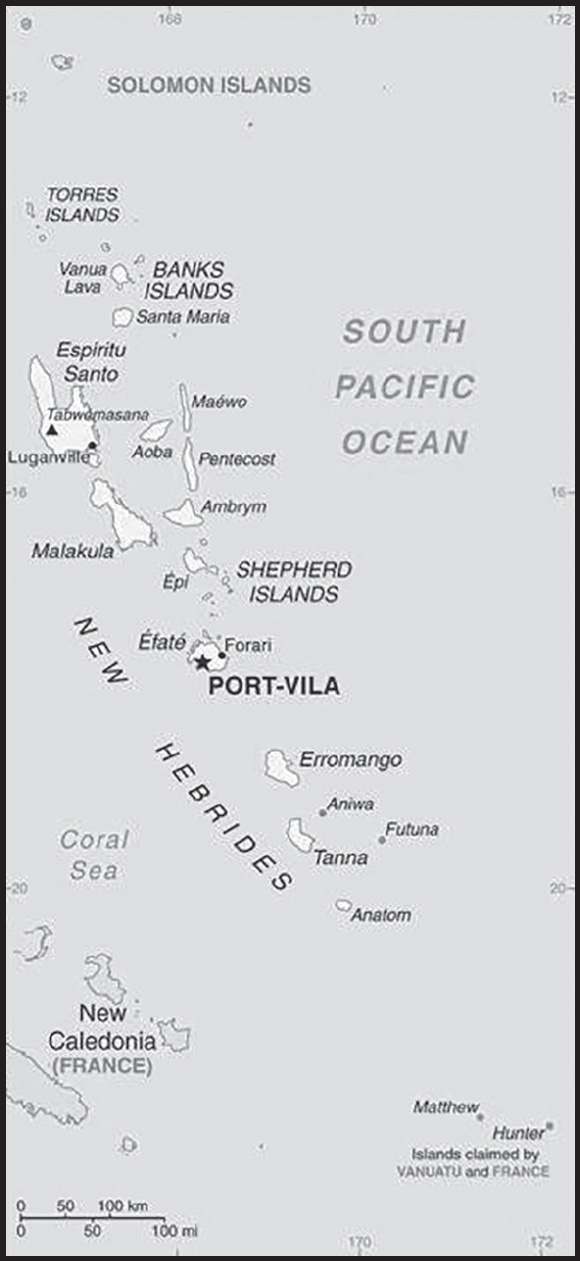
Location: Oceania, group of islands in the South Pacific Ocean, about three-quarters of the way from Hawaii to Australia
Geographic coordinates: 16 00 S, 167 00 E
Map references: Oceania
Area: total: 12,189 sq km
land: 12,189 sq km
water: 0 sq km
note: includes more than 80 islands, about 65 of which are inhabited
comparison ranking: total 162
Area - comparative: slightly larger than Connecticut
Land boundaries: total: 0 km
Coastline: 2,528 km
Maritime claims: territorial sea: 12 nm
contiguous zone: 24 nm
exclusive economic zone: 200 nm
continental shelf: 200 nm or to the edge of the continental margin
measured from claimed archipelagic baselines
Climate: tropical; moderated by southeast trade winds from May to October; moderate rainfall from November to April; may be affected by cyclones from December to April
Terrain: mostly mountainous islands of volcanic origin; narrow coastal plains
Elevation: highest point: Tabwemasana 1,877 m
lowest point: Pacific Ocean 0 m
Natural resources: manganese, hardwood forests, fish
Land use: agricultural land: 15.3% (2018 est.)
arable land: 1.6% (2018 est.)
permanent crops: 10.3% (2018 est.)
permanent pasture: 3.4% (2018 est.)
forest: 36.1% (2018 est.)
other: 48.6% (2018 est.)
Irrigated land: 0 sq km (2022)
Population distribution: three-quarters of the population lives in rural areas; the urban populace lives primarily in two cities, Port-Vila and Lugenville; three largest islands - Espiritu Santo, Malakula, and Efate - accomodate over half of the populace
Natural hazards: tropical cyclones (January to April); volcanic eruption on Aoba (Ambae) island began on 27 November 2005, volcanism also causes minor earthquakes; tsunamis
volcanism: significant volcanic activity with multiple eruptions in recent years; Yasur (361 m), one of the world’s most active volcanoes, has experienced continuous activity in recent centuries; other historically active volcanoes include Aoba, Ambrym, Epi, Gaua, Kuwae, Lopevi, Suretamatai, and Traitor’s Head
Geography - note: a Y-shaped chain of four main islands and 80 smaller islands; several of the islands have active volcanoes and there are several underwater volcanoes as well
PEOPLE AND SOCIETY
Population: 313,046 (2023 est.)
comparison ranking: 179
Nationality: noun: Ni-Vanuatu (singular and plural)
adjective: Ni-Vanuatu
Ethnic groups: Ni-Vanuatu 99%, other 1% (European, Asian, other Melanesian, Polynesian, Micronesian, other) (2020 est.)
Languages: Indigenous languages (more than 100) 82.6%, Bislama (official; creole) 14.5%, English (official) 2.1%, French (official) 0.8% (2020 est.)
note: data represent first language spoken for population aged 3 years and above
Religions: Protestant 39.9% (Presbyterian 27.2%, Seventh Day Adventist 14.8%, Anglican 12%, Churches of Christ 5%, Assemblies of God 4.9%, Neil Thomas Ministry/Inner Life Ministry 3.2%), Roman Catholic 12.1%, Apostolic 2.3%, Church of Jesus Christ 1.8%, customary beliefs (including Jon Frum cargo cult) 3.1%, other 12%, none 1.4%, unspecified 0.1% (2020 est.)
Age structure: 0-14 years: 31.73% (male 50,721/female 48,607)
15-64 years: 63.41% (male 97,376/female 101,135)
65 years and over: 4.86% (2023 est.) (male 7,486/female 7,721)
Dependency ratios: total dependency ratio: 76.5
youth dependency ratio: 69.9
elderly dependency ratio: 12.3
potential support ratio: 15.2 (2021 est.)
Median age: total: 24.2 years (2023 est.)
male: 23.7 years
female: 24.6 years
comparison ranking: total 174
Population growth rate: 1.59% (2023 est.)
comparison ranking: 62
Birth rate: 21.2 births/1,000 population (2023 est.)
comparison ranking: 64
Death rate: 4 deaths/1,000 population (2023 est.)
comparison ranking: 216
Net migration rate: -1.3 migrant(s)/1,000 population (2023 est.)
comparison ranking: 152
Population distribution: three-quarters of the population lives in rural areas; the urban populace lives primarily in two cities, Port-Vila and Lugenville; three largest islands - Espiritu Santo, Malakula, and Efate - accomodate over half of the populace
Urbanization: urban population: 26% of total population (2023)
rate of urbanization: 2.55% annual rate of change (2020-25 est.)
Major urban areas - population: 53,000 PORT-VILA (capital) (2018)
Sex ratio: at birth: 1.05 male(s)/female
0-14 years: 1.04 male(s)/female
15-64 years: 0.96 male(s)/female
65 years and over: 0.97 male(s)/female
total population: 0.99 male(s)/female (2023 est.)
Maternal mortality ratio: 94 deaths/100,000 live births (2020 est.)
comparison ranking: 72
Infant mortality rate: total: 14 deaths/1,000 live births (2023 est.)
male: 15.4 deaths/1,000 live births
female: 12.6 deaths/1,000 live births
comparison ranking: total 103
Life expectancy at birth: total population: 75.4 years (2023 est.)
male: 73.7 years
female: 77.2 years
comparison ranking: total population 122
Total fertility rate: 2.59 children born/woman (2023 est.)
comparison ranking: 66
Gross reproduction rate: 1.26 (2023 est.)
Contraceptive prevalence rate: 49% (2013)
Drinking water source: improved: urban: 100% of population
rural: 89.7% of population
total: 92.3% of population
unimproved: urban: 0% of population
rural: 10.3% of population
total: 7.7% of population (2020 est.)
Current health expenditure: 4% of GDP (2020)
Physicians density: 0.17 physicians/1,000 population (2016)
Sanitation facility access: improved: urban: 91.1% of population
rural: 60.4% of population
total: 68.2% of population
unimproved: urban: 8.9% of population
rural: 39.6% of population
total: 31.8% of population (2020 est.)
Obesity - adult prevalence rate: 25.2% (2016)
comparison ranking: 52
Alcohol consumption per capita: total: 1.6 liters of pure alcohol (2019 est.)
beer: 0.34 liters of pure alcohol (2019 est.)
wine: 0.39 liters of pure alcohol (2019 est.)
spirits: 0.87 liters of pure alcohol (2019 est.)
other alcohols: 0 liters of pure alcohol (2019 est.)
comparison ranking: total 136
Tobacco use: total: 17.8% (2020 est.)
male: 33% (2020 est.)
female: 2.6% (2020 est.)
comparison ranking: total 94
Children under the age of 5 years underweight: 11.7% (2013)
comparison ranking: 49
Currently married women (ages 15-49): 69.2% (2023 est.)
Education expenditures: 2.2% of GDP (2020 est.)
comparison ranking: 180
Literacy: definition: age 15 and over can read and write
total population: 89.1%
male: 89.8%
female: 88.4% (2021)
Youth unemployment rate (ages 15-24): total: 5.4% (2021 est.)
male: 5.2%
female: 5.6%
comparison ranking: total 186
ENVIRONMENT
Environment - current issues: population growth; water pollution, most of the population does not have access to a reliable supply of potable water; inadequate sanitation; deforestation
Environment - international agreements: party to: Antarctic-Marine Living Resources, Biodiversity, Climate Change, Climate Change-Kyoto Protocol, Climate Change-Paris Agreement, Comprehensive Nuclear Test Ban, Desertification, Endangered Species, Hazardous Wastes, Law of the Sea, Marine Dumping-London Convention, Marine Dumping-London Protocol, Ozone Layer Protection, Ship Pollution, Wetlands
signed, but not ratified: none of the selected agreements
Climate: tropical; moderated by southeast trade winds from May to October; moderate rainfall from November to April; may be affected by cyclones from December to April
Land use: agricultural land: 15.3% (2018 est.)
arable land: 1.6% (2018 est.)
permanent crops: 10.3% (2018 est.)
permanent pasture: 3.4% (2018 est.)
forest: 36.1% (2018 est.)
other: 48.6% (2018 est.)
Urbanization: urban population: 26% of total population (2023)
rate of urbanization: 2.55% annual rate of change (2020-25 est.)
Revenue from forest resources: 0.54% of GDP (2018 est.)
comparison ranking: 64
Revenue from coal: 0% of GDP (2018 est.)
comparison ranking: 144
Air pollutants: particulate matter emissions: 8.42 micrograms per cubic meter (2019 est.)
carbon dioxide emissions: 0.15 megatons (2016 est.)
methane emissions: 0.5 megatons (2020 est.)
Waste and recycling: municipal solid waste generated annually: 70,225 tons (2012 est.)
municipal solid waste recycled annually: 25,983 tons (2013 est.)
percent of municipal solid waste recycled: 37% (2013 est.)
Total renewable water resources: 10 billion cubic meters (2020 est.)
GOVERNMENT
Country name: conventional long form: Republic of Vanuatu
conventional short form: Vanuatu
local long form: Ripablik blong Vanuatu
local short form: Vanuatu
former: New Hebrides
etymology: derived from the words “vanua” (home or land) and “tu” (stand) that occur in several of the Austonesian languages spoken on the islands and which provide a meaning of “the land remains” but which also convey a sense of “independence” or “our land”
Government type: parliamentary republic
Capital: name: Port-Vila (on Efate)
geographic coordinates: 17 44 S, 168 19 E
time difference: UTC+11 (16 hours ahead of Washington, DC, during Standard Time)
etymology: there are two possibilities for the origin of the name: early European settlers were Portuguese and “vila” means “village or town” in Portuguese, hence “Port-Vila” would mean “Port Town”; alternatively, the site of the capital is referred to as “Efil” or “Ifira” in native languages, “Vila” is a likely corruption of these names
Administrative divisions: 6 provinces; Malampa, Penama, Sanma, Shefa, Tafea, Torba
Independence: 30 July 1980 (from France and the UK)
National holiday: Independence Day, 30 July (1980)
Constitution: history: draft completed August 1979, finalized by constitution conference 19 September 1979, ratified by French and British Governments 23 October 1979, effective 30 July 1980 at independence
amendments: proposed by the prime minister or by the Parliament membership; passage requires at least two-thirds majority vote by Parliament in special session with at least three fourths of the membership; passage of amendments affecting the national and official languages, or the electoral and parliamentary system also requires approval in a referendum; amended several times, last in 2013
Legal system: mixed legal system of English common law, French law, and customary law
International law organization participation: has not submitted an ICJ jurisdiction declaration; accepts ICCt jurisdiction
Citizenship: citizenship by birth: no
citizenship by descent only: both parents must be citizens of Vanuatu; in the case of only one parent, it must be the father who is a citizen
dual citizenship recognized: no
residency requirement for naturalization: 10 years
Suffrage: 18 years of age; universal
Executive branch: chief of state: President Nikenike VUROBARAVU (since 23 July 2022)
head of government: Prime Minister Charlot SALWAI (since 6 October 2023)
cabinet: Council of Ministers appointed by the prime minister, responsible to Parliament
elections/appointments: president indirectly elected by an electoral college consisting of Parliament and presidents of the 6 provinces; Vanuatu president serves a 5-year term; election last held on 23 July 2022 (next to be held in 2027); following legislative elections, the leader of the majority party or majority coalition usually elected prime minister by Parliament from among its members; election for prime minister last held on 20 April 2020 (next to be held following general elections in 2024)
election results: Nikenike VUROBARAVU elected president in eighth round on 23 July 2022 with 48 votes; Sato KILMAN defeated as prime minister in no-confidence vote on 6 October 2023; Charlot SALWAI elected prime minister on 6 October 2023, 29 votes for - 0 against
Legislative branch: description: unicameral Parliament (52 seats; members directly elected in 8 single-seat and 9 multi-seat constituencies by single non-transferable vote to serve 4-year terms (candidates in multi-seat constituencies can be elected with only 4% of the vote)
elections: last held on 13 October 2022 (next to be held in 2026)
election results: percent of vote by party - NA; seats by party - UMP 7, VP 7, LPV 5, RMC 5, GJP 4, NUP 4, RDP 4, IG 3, PPP 2, VNDP 2, NAG 1, VLM 1, other 6, independent 1; composition - men 51, women 1; percent of women 2%; note - political party associations are fluid
note: the National Council of Chiefs advises on matters of culture and language
Judicial branch: highest court(s): Court of Appeal (consists of 2 or more judges of the Supreme Court designated by the chief justice); Supreme Court (consists of the chief justice and 6 puisne judges - 3 local and 3 expatriate)
judge selection and term of office: Supreme Court chief justice appointed by the president after consultation with the prime minister and the leader of the opposition; other judges appointed by the president on the advice of the Judicial Service Commission, a 4-member advisory body; judges serve until the age of retirement
subordinate courts: Magistrates Courts; Island Courts
Political parties and leaders: Green Confederation or GC [Moana CARCASSES Kalosil]
Iauko Group or IG [Tony NARI]
Land and Justice Party (Graon mo Jastis Pati) or GJP [Ralph REGENVANU]
Leaders Party of Vanuatu or LVP [Nikenike VUROBARAVU]
Melanesian Progressive Party or MPP [Barak SOPE]
Nagriamel Movement or NAG [Frankie STEVENS]
Natatok Indigenous People’s Democratic Party or NATATOK or NIPDP [Alfred Roland CARLOT]
National United Party or NUP [Ham LINI]
People’s Progressive Party or PPP [Sato KILMAN]
People’s Service Party or PSP [Don KEN]
Reunification of Movement for Change or RMC [Charlot SALWAI]
Rural Development Party or RDP [Jay NGWELE, spokesman]
Union of Moderate Parties or UMP [Alatoi Ishmael KALSAKAU]
Vanua’aku Pati (Our Land Party) or VP [Bob LOUGHMAN]
Vanuatu Democratic Party [Maxime Carlot KORMAN]
Vanuatu First or Vanuatu [Russel NARI]
Vanuatu Liberal Democratic Party or VLDP [Tapangararua WILLIE]
Vanuatu Liberal Movement or VLM [Gaetan PIKIOUNE]
Vanuatu National Development Party or VNDP [Robert Bohn SIKOL]
Vanuatu National Party or VNP [Issac HAMARILIU]
Vanuatu Republican Party or VRP [Marcellino PIPITE]
International organization participation: ACP, ADB, AOSIS, C, FAO, G-77, IBRD, ICAO, ICRM, IDA, IFC, IFRCS, ILO, IMF, IMO, IMSO, IOC, IOM, ITU, ITUC (NGOs), MIGA, NAM, OAS (observer), OIF, OPCW, PIF, Sparteca, SPC, UN, UNCTAD, UNESCO, UNIDO, UNWTO, UPU, WCO, WFTU (NGOs), WHO, WIPO, WMO, WTO
Diplomatic representation in the US: chief of mission: Ambassador Odo TEVI (since 8 September 2017)
note - also Permanent Representative to the UN
chancery: 800 Second Avenue, Suite 400B, New York, NY 10017
telephone: [1] (212) 661-4323
FAX: [1] (212) 422-3427
email address and website: vanunmis@aol.com
note - the Vanuatu Permanent Mission to the UN serves as the embassy
Diplomatic representation from the US: embassy: the US does not have an embassy in Vanuatu; the US Ambassador to Papua New Guinea is accredited to Vanuatu
Flag description: two equal horizontal bands of red (top) and green with a black isosceles triangle (based on the hoist side) all separated by a black-edged yellow stripe in the shape of a horizontal Y (the two points of the Y face the hoist side and enclose the triangle); centered in the triangle is a boar’s tusk encircling two crossed namele fern fronds, all in yellow; red represents the blood of boars and men, as well as unity, green the richness of the islands, and black the ni-Vanuatu people; the yellow Y-shape - which reflects the pattern of the islands in the Pacific Ocean - symbolizes the light of the Gospel spreading through the islands; the boar’s tusk is a symbol of prosperity frequently worn as a pendant on the islands; the fern fronds represent peace
note: one of several flags where a prominent component of the design reflects the shape of the country; other such flags are those of Bosnia and Herzegovina, Brazil, and Eritrea
National symbol(s): boar’s tusk with crossed fern fronds; national colors: red, black, green, yellow
National anthem: name: “Yumi, Yumi, Yumi” (We, We, We)
lyrics/music: Francois Vincent AYSSAV
note: adopted 1980; the anthem is written in Bislama, a Creole language that mixes Pidgin English and French
National heritage: total World Heritage Sites: 1 (cultural)
selected World Heritage Site locales: Chief Roi Mata’s Domain
ECONOMY
Economic overview: lower-middle income Pacific island economy; extremely reliant on subsistence agriculture and tourism; environmentally fragile; struggling post-pandemic and Tropical Cyclone Harold rebound; sizeable inflation; road infrastructure aid from Australia
Real GDP (purchasing power parity): $888.165 million (2021 est.)
$884.192 million (2020 est.)
$934.627 million (2019 est.)
note: data are in 2017 dollars
comparison ranking: 208
Real GDP growth rate: 0.45% (2021 est.)
-5.4% (2020 est.)
3.24% (2019 est.)
comparison ranking: 188
Real GDP per capita: $2,800 (2021 est.)
$2,800 (2020 est.)
$3,100 (2019 est.)
note: data are in 2017 dollars
comparison ranking: 199
GDP (official exchange rate): $870 million (2017 est.)
Inflation rate (consumer prices): 2.34% (2021 est.)
5.33% (2020 est.)
2.76% (2019 est.)
comparison ranking: 143
GDP - composition, by sector of origin: agriculture: 27.3% (2017 est.)
industry: 11.8% (2017 est.)
services: 60.8% (2017 est.)
comparison rankings: services 115; industry 201; agriculture 24
GDP - composition, by end use: household consumption: 59.9% (2017 est.)
government consumption: 17.4% (2017 est.)
investment in fixed capital: 28.7% (2017 est.)
investment in inventories: 0% (2017 est.)
exports of goods and services: 42.5% (2017 est.)
imports of goods and services: -48.5% (2017 est.)
Agricultural products: coconuts, roots/tubers, bananas, vegetables, pork, fruit, milk, beef, groundnuts, cocoa
Industries: food and fish freezing, wood processing, meat canning
Industrial production growth rate: 4.92% (2018 est.)
comparison ranking: 93
Labor force: 132,700 (2021 est.)
comparison ranking: 180
Labor force - by occupation: agriculture: 65%
industry: 5%
services: 30% (2000 est.)
Unemployment rate: 2.18% (2021 est.)
2.12% (2020 est.)
1.8% (2019 est.)
comparison ranking: 208
Youth unemployment rate (ages 15-24): total: 5.4% (2021 est.)
male: 5.2%
female: 5.6%
comparison ranking: total 186
Gini Index coefficient - distribution of family income: 32.3 (2019 est.)
comparison ranking: 134
Budget: revenues: $398 million (2019 est.)
expenditures: $355 million (2019 est.)
Budget surplus (+) or deficit (-): -0.9% (of GDP) (2017 est.)
comparison ranking: 71
Public debt: 48.4% of GDP (2017 est.)
46.1% of GDP (2016 est.)
comparison ranking: 113
Taxes and other revenues: 14.24% (of GDP) (2020 est.)
comparison ranking: 155
Fiscal year: calendar year
Current account balance: $1.893 million (2021 est.)
$60.619 million (2020 est.)
$215.521 million (2019 est.)
comparison ranking: 76
Exports: $88.805 million (2021 est.) note: data are in current year dollars
$141.534 million (2020 est.) note: data are in current year dollars
$372.711 million (2019 est.)
comparison ranking: 211
Exports - partners: Thailand 54%, Japan 18%, South Korea 6%, Cyprus 5%, China 4% (2021)
Exports - commodities: tuna, floating platforms, cargo ships, perfume plants, mollusks, copra (2021)
Imports: $495.858 million (2021 est.) note: data are in current year dollars
$429.601 million (2020 est.) note: data are in current year dollars
$488.795 million (2019 est.)
comparison ranking: 200
Imports - partners: China 26%, Australia 16%, New Zealand 15%, Fiji 8%, Singapore 7% (2021)
Imports - commodities: refined petroleum, fishing ships, poultry meats, delivery trucks, lumber, rice, broadcasting equipment (2021)
Reserves of foreign exchange and gold: $664.751 million (31 December 2021 est.)
$613.637 million (31 December 2020 est.)
$511.546 million (31 December 2019 est.)
comparison ranking: 161
Debt - external: $200.5 million (31 December 2017 est.)
$182.5 million (31 December 2016 est.)
comparison ranking: 188
Exchange rates: vatu (VUV) per US dollar -
Exchange rates: 109.453 (2021 est.)
115.38 (2020 est.)
114.733 (2019 est.)
110.165 (2018 est.)
107.821 (2017 est.)
ENERGY
Electricity access: electrification - total population: 70% (2021)
electrification - urban areas: 97% (2021)
electrification - rural areas: 60.7% (2021)
Electricity: installed generating capacity: 35,000 kW (2020 est.)
consumption: 62.926 million kWh (2019 est.)
exports: 0 kWh (2020 est.)
imports: 0 kWh (2020 est.)
transmission/distribution losses: 5 million kWh (2019 est.)
comparison rankings: imports 153; exports 141; installed generating capacity 198; transmission/distribution losses 202; consumption 200
Electricity generation sources: fossil fuels: 84.5% of total installed capacity (2020 est.)
solar: 8.2% of total installed capacity (2020 est.)
wind: 7.4% of total installed capacity (2020 est.)
Petroleum: total petroleum production: 0 bbl/day (2021 est.)
refined petroleum consumption: 1,500 bbl/day (2019 est.)
Refined petroleum products - imports: 1,073 bbl/day (2015 est.)
comparison ranking: 200
Carbon dioxide emissions: 225,000 metric tonnes of CO2 (2019 est.)
from petroleum and other liquids: 225,000 metric tonnes of CO2 (2019 est.)
comparison ranking: total emissions 201
Energy consumption per capita: 10.878 million Btu/person (2019 est.)
comparison ranking: 153
COMMUNICATIONS
Telephones - fixed lines: total subscriptions: 3,600 (2021 est.)
subscriptions per 100 inhabitants: 1 (2021 est.)
comparison ranking: total subscriptions 210
Telephones - mobile cellular: total subscriptions: 250,000 (2021 est.)
subscriptions per 100 inhabitants: 78 (2021 est.)
comparison ranking: total subscriptions 182
Telecommunication systems: general assessment: for many years, 2G Global System for Mobile Communications was the primary mobile technology for Vanuatu’s 300,000 people; recent infrastructure projects have improved access technologies, with a transition to 3G and, to a limited degree, to LTE; Vanuatu has also benefited from the ICN1 submarine cable and the launch of the Kacific-1 satellite, both of which have considerably improved access to telecom services in recent years; Vanuatu’s telecom sector is liberalized, with the two prominent mobile operators; while fixed broadband penetration remains low, the incumbent operator is slowly exchanging copper fixed-lines for fiber; a number of ongoing submarine cable developments will also assist in increasing data rates and reduce internet pricing in coming years (2021)
domestic: fixed-line teledensity is 1 per 100 and mobile-cellular 78 per 100 (2021)
international: country code - 678; landing points for the ICN1 & ICN2 submarine cables providing connectivity to the Solomon Islands and Fiji; cables helped end-users with Internet bandwidth; satellite earth station - 1 Intelsat (Pacific Ocean) (2020)
Broadcast media: 1 state-owned TV station; multi-channel pay TV is available; state-owned Radio Vanuatu operates 2 radio stations; 2 privately owned radio broadcasters; programming from multiple international broadcasters is available
Internet country code: .vu
Internet users: total: 211,200 (2021 est.)
percent of population: 66% (2021 est.)
comparison ranking: total 181
Broadband - fixed subscriptions: total: 2,785 (2020 est.)
subscriptions per 100 inhabitants: 1 (2020 est.)
comparison ranking: total 194
TRANSPORTATION
National air transport system: number of registered air carriers: 1 (2020)
inventory of registered aircraft operated by air carriers: 8
annual passenger traffic on registered air carriers: 374,603 (2018)
annual freight traffic on registered air carriers: 1.66 million (2018) mt-km
Civil aircraft registration country code prefix: YJ
Airports: 31 (2021)
comparison ranking: total 113
Airports - with paved runways: 3
note: paved runways have a concrete or asphalt surface but not all have facilities for refueling, maintenance, or air traffic control; the length of a runway required for aircraft to safely operate depends on a number of factors including the type of aircraft, the takeoff weight (including passengers, cargo, and fuel), engine types, flap settings, landing speed, elevation of the airport, and average maximum daily air temperature; paved runways can reach a length of 5,000 m (16,000 ft.), but the “typical” length of a commercial airline runway is between 2,500-4,000 m (8,000-13,000 ft.)
Airports - with unpaved runways: 28
note: unpaved runways have a surface composition such as grass or packed earth and are most suited to the operation of light aircraft; unpaved runways are usually short, often less than 1,000 m (3,280 ft.) in length; airports with unpaved runways often lack facilities for refueling, maintenance, or air traffic control
Roadways: total: 1,070 km (2000)
paved: 256 km (2000)
unpaved: 814 km (2000)
comparison ranking: total 184
Merchant marine: total: 331 (2022)
by type: bulk carrier 16, container ship 4, general cargo 87, oil tanker 2, other 222
comparison ranking: total 51
Ports and terminals: major seaport(s): Forari Bay, Luganville (Santo, Espiritu Santo), Port-Vila
MILITARY AND SECURITY
Military and security forces: no regular military forces; Ministry of Internal Affairs: Vanuatu Police Force (VPF) (2023)
note: the VPF includes the Vanuatu Mobile Force (VMF) and Police Maritime Wing (VPMW); the paramilitary VMF also has external security responsibilities
Military - note: the separate British and French police forces were unified in 1980 under Ni-Vanuatu officers as the New Hebrides Constabulary; the force retained some British and French officers as advisors; the Constabulary was subsequently renamed the Vanuatu Police Force later in 1980 the Vanuatu Mobile Force has received training and other support from Australia, China, France, New Zealand, and the US
Vanuatu has a “shiprider” agreement with the US, which allows local maritime law enforcement officers to embark on US Coast Guard (USCG) and US Navy (USN) vessels, including to board and search vessels suspected of violating laws or regulations within Vanuatu’s designated exclusive economic zone (EEZ) or on the high seas; “shiprider” agreements also enable USCG personnel and USN vessels with embarked USCG law enforcement personnel to work with host nations to protect critical regional resources (2023)
TRANSNATIONAL ISSUES
Disputes - international: Vanuatu-France: Matthew and Hunter Islands, two uninhabited islands east of New Caledonia, claimed by Vanuatu and France; in January 2019, a French naval mission landed officers on the islands to reinforce France’s sovereignty; in November 2021, French vessels fishing near the islands raised tensions
Trafficking in persons: tier rating: Tier 2 Watch List — Vanuatu does not fully meet the minimum standards for the elimination of trafficking but is making significant efforts to do so; these efforts included sentencing four traffickers to prison, following their conviction in the previous reporting period; however, the government did not demonstrate overall increasing efforts, compared with the previous reporting period, to expand its anti-trafficking capacity; for the fourth consecutive year, authorities did not identify any trafficking victims and did not provide protection services to victims; for the third consecutive year, officials did not investigate any trafficking crimes; the government also did not conduct public awareness campaigns or administer anti-trafficking training for law enforcement officials; therefore, Vanuatu was downgraded to Tier 2 Watch List (2023)
trafficking profile: human traffickers exploit domestic and foreign victims in Vanuatu, and traffickers exploit victims from Vanuatu abroad; individuals from Bangladesh, China, the Philippines, and Thailand are exploited in Vanuatu; workers from China may have been forced to work in Vanuatu at projects run by Chinese companies; traffickers target migrant women in the hospitality and tourism sectors and low-skilled foreign workers in high-risk sectors, such as agriculture, mining, fishing, logging, construction, and domestic service; Chinese and South Asian migrant women are at risk for labor trafficking in bars, beauty salons, and massage parlors; Bangladeshi criminal groups lure Bangladeshis with false promises of jobs in Australia, then exploit them in forced labor in construction in Vanuatu; women and girls may be at risk of debt-based coercion in sex trafficking and domestic servitude to pay back the husband’s family for the “bride-price payments” they made to the bride’s family; children are exploited through “child-swapping” used to pay off debts, or by taxi drivers who may facilitate their exploitation in commercial sex; forced labor and child sex trafficking occur on fishing vessels in Vanuatu; LGBTQI+ individuals are vulnerable to trafficking; children may experience conditions indicative of forced labor in the illegal logging industry and in newspaper sales (2023)
VENEZUELA
INTRODUCTION
Background: Venezuela was one of three countries that emerged from the collapse of Gran Colombia in 1830 (the others being Ecuador and New Granada, which became Colombia). For most of the first half of the 20th century, Venezuela was ruled by military strongmen who promoted the oil industry and allowed for some social reforms. Although democratically elected governments largely held sway since 1959, the executive branch under Hugo CHAVEZ, president from 1999 to 2013, exercised increasingly authoritarian control over other branches of government. This undemocratic trend continued in 2018 when Nicolas MADURO claimed the presidency for his second term in an election boycotted by most opposition parties and widely viewed as fraudulent.
The last democratically-elected institution is the 2015 National Assembly. In 2020, legislative elections were held for a new National Assembly, which the opposition boycotted, and which were widely condemned as fraudulent. The resulting assembly is viewed by most opposition parties and many international actors as illegitimate. In November 2021, most opposition parties broke a three-year election boycott to participate in mayoral and gubernatorial elections, despite flawed conditions. As a result, the opposition more than doubled its representation at the mayoral level and retained four of 23 governorships. The 2021 regional elections marked the first time since 2006 that the EU was allowed to send an electoral observation mission to Venezuela.
The MADURO regime places strong restrictions on freedoms of expression and the press. Since CHAVEZ, the ruling party’s economic policies expanded the state’s role in the economy through expropriations of major enterprises, strict currency exchange and price controls that discourage private sector investment and production, and overdependence on the petroleum industry for revenues, among others. Years of economic mismanagement left Venezuela ill-prepared to weather the global drop in oil prices in 2014, sparking an economic decline that has resulted in reduced government social spending, shortages of basic goods, and high inflation. Worsened living conditions have prompted over 7 million Venezuelans to migrate, mainly settling in nearby countries. Since 2017, the US has imposed financial and sectoral sanctions on the MADURO regime, and the regime’s mismanagement and lack of investment in infrastructure has debilitated the country’s oil sector. Caracas has more recently relaxed some economic controls to mitigate the impact of its sustained economic crisis, such as allowing increased currency and liberalizing import flexibility for private citizens and companies. Other concerns include human rights abuses, rampant violent crime, political manipulation of the judicial and electoral systems, and corruption.
GEOGRAPHY
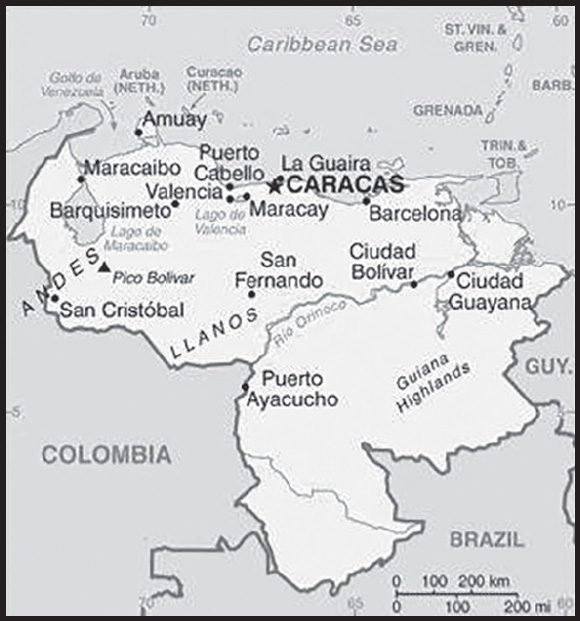
Location: Northern South America, bordering the Caribbean Sea and the North Atlantic Ocean, between Colombia and Guyana
Geographic coordinates: 8 00 N, 66 00 W
Map references: South America
Area: total: 912,050 sq km
land: 882,050 sq km
water: 30,000 sq km
comparison ranking: total 34
Area - comparative: almost six times the size of Georgia; slightly more than twice the size of California
Land boundaries: total: 5,267 km
border countries (3): Brazil 2,137 km; Colombia 2,341 km; Guyana 789 km
Coastline: 2,800 km
Maritime claims: territorial sea: 12 nm
contiguous zone: 15 nm
exclusive economic zone: 200 nm
continental shelf: 200-m depth or to the depth of exploitation
Climate: tropical; hot, humid; more moderate in highlands
Terrain: Andes Mountains and Maracaibo Lowlands in northwest; central plains (llanos); Guiana Highlands in southeast
Elevation: highest point: Pico Bolivar 4,978 m
lowest point: Caribbean Sea 0 m
mean elevation: 450 m
Natural resources: petroleum, natural gas, iron ore, gold, bauxite, other minerals, hydropower, diamonds
Land use: agricultural land: 24.5% (2018 est.)
arable land: 3.1% (2018 est.)
permanent crops: 0.8% (2018 est.)
permanent pasture: 20.6% (2018 est.)
forest: 52.1% (2018 est.)
other: 23.4% (2018 est.)
Irrigated land: 10,550 sq km (2012)
Major lakes (area sq km): salt water lake(s): Lago de Maracaibo - 13,010 sq km
Major rivers (by length in km): Rio Negro (shared with Colombia [s] and Brazil [m]) - 2,250 km; Orinoco river source and mouth (shared with Colombia) - 2,101 km
note – [s] after country name indicates river source; [m] after country name indicates river mouth
Major watersheds (area sq km): Atlantic Ocean drainage: Amazon (6,145,186 sq km), Orinoco (953,675 sq km)
Population distribution: most of the population is concentrated in the northern and western highlands along an eastern spur at the northern end of the Andes, an area that includes the capital of Caracas
Natural hazards: subject to floods, rockslides, mudslides; periodic droughts
Geography - note: note 1: the country lies on major sea and air routes linking North and South America
note 2: Venezuela has some of the most unique geology in the world; tepuis are massive table-top mountains of the western Guiana Highlands that tend to be isolated and thus support unique endemic plant and animal species; their sheer cliffsides account for some of the most spectacular waterfalls in the world including Angel Falls, the world’s highest (979 m) that drops off Auyan Tepui
PEOPLE AND SOCIETY
Population: 30,518,260 (2023 est.)
comparison ranking: 50
Nationality: noun: Venezuelan(s)
adjective: Venezuelan
Ethnic groups: unspecified Spanish, Italian, Portuguese, Arab, German, African, Indigenous
Languages: Spanish (official), numerous indigenous dialects
major-language sample(s): La Libreta Informativa del Mundo, la fuente indispensable de información básica. (Spanish)
Religions: Roman Catholic 96%, Protestant 2%, other 2%
Demographic profile: Social investment in Venezuela during the CHAVEZ administration reduced poverty from nearly 50% in 1999 to about 27% in 2011, increased school enrollment, substantially decreased infant and child mortality, and improved access to potable water and sanitation through social investment. “Missions” dedicated to education, nutrition, healthcare, and sanitation were funded through petroleum revenues. The sustainability of this progress remains questionable, however, as the continuation of these social programs depends on the prosperity of Venezuela’s oil industry. In the long-term, education and health care spending may increase economic growth and reduce income inequality, but rising costs and the staffing of new health care jobs with foreigners are slowing development.
While CHAVEZ was in power, more than one million predominantly middle- and upper-class Venezuelans are estimated to have emigrated. The brain drain is attributed to a repressive political system, lack of economic opportunities, steep inflation, a high crime rate, and corruption. Thousands of oil engineers emigrated to Canada, Colombia, and the United States following CHAVEZ’s firing of over 20,000 employees of the state-owned petroleum company during a 2002-03 oil strike. Additionally, thousands of Venezuelans of European descent have taken up residence in their ancestral homelands. Nevertheless, Venezuela has attracted hundreds of thousands of immigrants from South America and southern Europe because of its lenient migration policy and the availability of education and health care. Venezuela also has been a fairly accommodating host to Colombian refugees, numbering about 170,000 as of year-end 2016. However, since 2014, falling oil prices have driven a major economic crisis that has pushed Venezuelans from all walks of life to migrate or to seek asylum abroad to escape severe shortages of food, water, and medicine; soaring inflation; unemployment; and violence. As of September 2022, an estimated 7.1 million Venezuelans were refugees or migrants worldwide, with almost 80% taking refuge in Latin America and the Caribbean (notably Colombia, Peru, Chile, Ecuador, Argentina, and Brazil, as well as the Dominican Republic, Aruba, and Curacao). Asylum applications increased significantly in the US and Brazil in 2016 and 2017. Several receiving countries are making efforts to increase immigration restrictions and to deport illegal Venezuelan migrants - Ecuador and Peru in August 2018 began requiring valid passports for entry, which are difficult to obtain for Venezuelans. Nevertheless, Venezuelans continue to migrate to avoid economic collapse at home.
Age structure: 0-14 years: 25.13% (male 3,920,774/female 3,748,241)
15-64 years: 65.98% (male 10,029,127/female 10,105,332)
65 years and over: 8.9% (2023 est.) (male 1,239,205/female 1,475,581)
Dependency ratios: total dependency ratio: 57.5
youth dependency ratio: 44.4
elderly dependency ratio: 13.1
potential support ratio: 7.6 (2021 est.)
Median age: total: 30.8 years (2023 est.)
male: 30.1 years
female: 31.5 years
comparison ranking: total 126
Population growth rate: 2.4% (2023 est.)
comparison ranking: 26
Birth rate: 17 births/1,000 population (2023 est.)
comparison ranking: 94
Death rate: 6.6 deaths/1,000 population (2023 est.)
comparison ranking: 135
Net migration rate: 13.6 migrant(s)/1,000 population (2023 est.)
comparison ranking: 4
Population distribution: most of the population is concentrated in the northern and western highlands along an eastern spur at the northern end of the Andes, an area that includes the capital of Caracas
Urbanization: urban population: 88.4% of total population (2023)
rate of urbanization: 1.16% annual rate of change (2020-25 est.)
Major urban areas - population: 2.972 million CARACAS (capital), 2.368 million Maracaibo, 1.983 million Valencia, 1.254 million Barquisimeto, 1.243 million Maracay, 964,000 Ciudad Guayana (2023)
Sex ratio: at birth: 1.05 male(s)/female
0-14 years: 1.05 male(s)/female
15-64 years: 0.99 male(s)/female
65 years and over: 0.84 male(s)/female
total population: 0.99 male(s)/female (2023 est.)
Maternal mortality ratio: 259 deaths/100,000 live births (2020 est.)
comparison ranking: 36
Infant mortality rate: total: 14.1 deaths/1,000 live births (2023 est.)
male: 15.7 deaths/1,000 live births
female: 12.5 deaths/1,000 live births
comparison ranking: total 102
Life expectancy at birth: total population: 74.3 years (2023 est.)
male: 71.2 years
female: 77.5 years
comparison ranking: total population 141
Total fertility rate: 2.2 children born/woman (2023 est.)
comparison ranking: 87
Gross reproduction rate: 1.07 (2023 est.)
Contraceptive prevalence rate: 75% (2010)
Drinking water source: improved: total: 94.2% of population
unimproved: total: 5.8% of population (2020 est.)
Current health expenditure: 3.8% of GDP (2020)
Physicians density: 1.73 physicians/1,000 population (2017)
Hospital bed density: 0.9 beds/1,000 population (2017)
Sanitation facility access: improved: total: 95.8% of population
unimproved: total: 4.2% of population (2020 est.)
Major infectious diseases: degree of risk: high (2023)
food or waterborne diseases: bacterial diarrhea and hepatitis A
vectorborne diseases: dengue fever and malaria
Obesity - adult prevalence rate: 25.6% (2016)
comparison ranking: 49
Alcohol consumption per capita: total: 2.51 liters of pure alcohol (2019 est.)
beer: 1.54 liters of pure alcohol (2019 est.)
wine: 0.01 liters of pure alcohol (2019 est.)
spirits: 0.92 liters of pure alcohol (2019 est.)
other alcohols: 0.03 liters of pure alcohol (2019 est.)
comparison ranking: total 123
Currently married women (ages 15-49): 51.5% (2023 est.)
Education expenditures: 1.3% of GDP (2017 est.)
comparison ranking: 194
Literacy: definition: age 15 and over can read and write
total population: 97.5%
male: 97.4%
female: 97.7% (2021)
Youth unemployment rate (ages 15-24): total: 14.9% (2021 est.)
male: 13.4%
female: 19.3%
comparison ranking: total 118
ENVIRONMENT
Environment - current issues: sewage pollution of Lago de Valencia; oil and urban pollution of Lago de Maracaibo; deforestation; soil degradation; urban and industrial pollution, especially along the Caribbean coast; threat to the rainforest ecosystem from irresponsible mining operations
Environment - international agreements: party to: Antarctic-Environmental Protection, Antarctic Treaty, Biodiversity, Climate Change, Climate Change-Kyoto Protocol, Climate Change-Paris Agreement, Comprehensive Nuclear Test Ban, Desertification, Endangered Species, Hazardous Wastes, Marine Life Conservation, Nuclear Test Ban, Ozone Layer Protection, Ship Pollution, Tropical Timber 2006, Wetlands
signed, but not ratified: none of the selected agreements
Climate: tropical; hot, humid; more moderate in highlands
Land use: agricultural land: 24.5% (2018 est.)
arable land: 3.1% (2018 est.)
permanent crops: 0.8% (2018 est.)
permanent pasture: 20.6% (2018 est.)
forest: 52.1% (2018 est.)
other: 23.4% (2018 est.)
Urbanization: urban population: 88.4% of total population (2023)
rate of urbanization: 1.16% annual rate of change (2020-25 est.)
Food insecurity: widespread lack of access: due to severe economic crisis - the national economy, highly dependent on oil production and exports, was forecast to contract in 2021 for the eighth consecutive year; with the persistent negative effects of the COVID-19 pandemic that have compounded the already severe macro-economic crisis, the access to food of the most vulnerable households is expected to deteriorate throughout 2021 and into 2022 due to widespread losses of income-generating activities and soaring food prices (2022)
Air pollutants: particulate matter emissions: 16.21 micrograms per cubic meter (2019 est.)
carbon dioxide emissions: 164.18 megatons (2016 est.)
methane emissions: 68.66 megatons (2020 est.)
Waste and recycling: municipal solid waste generated annually: 9,779,093 tons (2010 est.)
Major lakes (area sq km): salt water lake(s): Lago de Maracaibo - 13,010 sq km
Major rivers (by length in km): Rio Negro (shared with Colombia [s] and Brazil [m]) - 2,250 km; Orinoco river source and mouth (shared with Colombia) - 2,101 km
note – [s] after country name indicates river source; [m] after country name indicates river mouth
Major watersheds (area sq km): Atlantic Ocean drainage: Amazon (6,145,186 sq km), Orinoco (953,675 sq km)
Total water withdrawal: municipal: 5.12 billion cubic meters (2020 est.)
industrial: 790 million cubic meters (2020 est.)
agricultural: 16.71 billion cubic meters (2020 est.)
Total renewable water resources: 1.33 trillion cubic meters (2020 est.)
GOVERNMENT
Country name: conventional long form: Bolivarian Republic of Venezuela
conventional short form: Venezuela
local long form: República Bolivariana de Venezuela
local short form: Venezuela
former: State of Venezuela, Republic of Venezuela, United States of Venezuela
etymology: native stilt-houses built on Lake Maracaibo reminded early explorers Alonso de OJEDA and Amerigo VESPUCCI in 1499 of buildings in Venice and so they named the region “Venezuola,” which in Italian means “Little Venice”
Government type: federal presidential republic
Capital: name: Caracas
geographic coordinates: 10 29 N, 66 52 W
time difference: UTC-4 (1 hour ahead of Washington, DC, during Standard Time)
etymology: named for the native Caracas tribe that originally settled in the city’s valley site near the Caribbean coast
Administrative divisions: 23 states (estados, singular - estado), 1 capital district* (distrito capital), and 1 federal dependency** (dependencia federal); Amazonas, Anzoategui, Apure, Aragua, Barinas, Bolivar, Carabobo, Cojedes, Delta Amacuro, Dependencias Federales (Federal Dependencies)**, Distrito Capital (Capital District)*, Falcon, Guarico, La Guaira, Lara, Merida, Miranda, Monagas, Nueva Esparta, Portuguesa, Sucre, Tachira, Trujillo, Yaracuy, Zulia
note: the federal dependency consists of 11 federally controlled island groups with a total of 72 individual islands
Independence: 5 July 1811 (from Spain)
National holiday: Independence Day, 5 July (1811)
Constitution: history: many previous; latest adopted 15 December 1999, effective 30 December 1999
amendments: proposed through agreement by at least 39% of the National Assembly membership, by the president of the republic in session with the cabinet of ministers, or by petition of at least 15% of registered voters; passage requires simple majority vote by the Assembly and simple majority approval in a referendum; amended 2009; note - in 2016, President MADURO issued a decree to hold an election to form a constituent assembly to change the constitution; the election in July 2017 approved the formation of a 545-member constituent assembly and elected its delegates, empowering them to change the constitution and dismiss government institutions and officials
Legal system: civil law system based on the Spanish civil code
International law organization participation: has not submitted an ICJ jurisdiction declaration; accepts ICCt jurisdiction
Citizenship: citizenship by birth: yes
citizenship by descent only: yes
dual citizenship recognized: yes
residency requirement for naturalization: 10 years; reduced to five years in the case of applicants from Spain, Portugal, Italy, or a Latin American or Caribbean country
Suffrage: 18 years of age; universal
Executive branch: chief of state: Notification Statement: the United States does not recognize Nicolas MADURO Moros as president of Venezuela
President Nicolas MADURO Moros (since 19 April 2013); Executive Vice President Delcy RODRIGUEZ Gomez (since 14 June 2018); note - the president is both chief of state and head of government
head of government: President Nicolas MADURO Moros (since 19 April 2013); Executive Vice President Delcy RODRIGUEZ Gomez (since 14 June 2018)
cabinet: Council of Ministers appointed by the president
elections/appointments: president directly elected by simple majority popular vote for a 6-year term (no term limits); election last held on 20 May 2018 (next to be held in the second half of 2024)
election results: 2018: Nicolas MADURO Moros reelected president; percent of vote - Nicolas MADURO Moros (PSUV) 68%, Henri FALCON (AP) 21%, Javier BERTUCCI 11%; note - the election was reportedly marred by serious shortcomings and electoral fraud
2013: Nicolas MADURO Moros elected president; percent of vote - Nicolas MADURO Moros (PSUV) 50.6%, Henrique CAPRILES Radonski (PJ) 49.1%, other 0.3%
Legislative branch: description: unicameral National Assembly or Asamblea Nacional (277 seats; 3 seats reserved for indigenous peoples of Venezuela; members serve 5-year terms); note - in 2020, the National Electoral Council increased the number of seats in the National Assembly from 167 to 277 for the 6 December 2020 election
elections: last held on 6 December 2020 (next to be held in December 2025)
election results: percent of vote by party - GPP (pro-government) 69.3%, Democratic Alliance (opposition coalition) 17.7%, other 13%; seats by party - GPP 253, Democratic Alliance 18, indigenous peoples 3, other 3; composition - NA
Judicial branch: highest court(s): Supreme Tribunal of Justice (consists of 32 judges organized into constitutional, political-administrative, electoral, civil appeals, criminal appeals, and social divisions)
judge selection and term of office: judges proposed by the Committee of Judicial Postulation (an independent body of organizations dealing with legal issues and of the organs of citizen power) and appointed by the National Assembly; judges serve nonrenewable 12-year terms; note - in July 2017, the National Assembly named 33 judges to the court to replace a series of judges, it argued, had been illegally appointed in late 2015 by the outgoing, socialist-party-led Assembly; the Government of President MADURO and the Socialist Party-appointed judges refused to recognize these appointments, however, and many of the new judges have since been imprisoned or forced into exile
subordinate courts: Superior or Appeals Courts (Tribunales Superiores); District Tribunals (Tribunales de Distrito); Courts of First Instance (Tribunales de Primera Instancia); Parish Courts (Tribunales de Parroquia); Justices of the Peace (Justicia de Paz) Network
Political parties and leaders: A New Era (Un Nuevo Tiempo) or UNT [Omar Enrique BARBOZA Gutierrez]
Brave People’s Alliance or ABP [Antonio LEDEZMA]
Cambiemos Movimiento Ciudadano or CMC [Timoteo ZAMBRANO]
Christian Democrats or COPEI [Juan Carlos ALVARADO Prato, Roberto ENRIQUEZ]
Citizens Encounter or EC [Delsa SOLORZANO]
Clear Accounts or CC [Enzo SCARANO]
Coalition of parties loyal to Nicolas MADURO - Great Patriotic Pole or GPP [Nicolas MADURO]
Coalition of opposition parties - Democratic Alliance (Alianza Democratica) (includes AD, EL CAMBIO, COPEI, CMC, and AP)
Come Venezuela (Vente Venezuela) or VV [Maria Corina MACHADO]
Communist Party of Venezuela or PCV [Oscar FIGUERA]
Consenso en la Zona or Conenzo [Enzo SCARANO and Leon JURADO]
Convergencia [Juan Jose CALDERA]
Democratic Action or AD [Jose Bernabe GUTIERREZ Parra]
Fatherland for All (Patria para Todos) or PPT [Ilenia MEDINA]
Fuerza Vecinal or FV [leaders include mayors Gustavo DUQUE, Darwin GONZALEZ, Elias SAYEGH, Manuel FERREIRA, Josy FERNANDEZ, and Morel David RODRIGUEZ]; note - national spokesman David UZCATEGUI
Hope for Change (Esperanza por el Cambio) or EL CAMBIO [Javier Alejandro BERTUCCI Carrero]
Justice First (Primero Justicia) or PJ [Tomas GUANIPA]
LAPIZ [Antonio Domingo ECARRI Angola]
Movement to Socialism (Movimiento al Socialismo) or MAS [Segundo MELENDEZ]
Popular Will (Voluntad Popular) or VP [Leopoldo LOPEZ]
Progressive Advance (Avanzada Progresista) or AP [Henri FALCON]
The Radical Cause or La Causa R [Andres VELAZQUEZ]
United Socialist Party of Venezuela or PSUV [Nicolas MADURO]
Venezuela First (Primero Venezuela) or PV [Luis PARRA]
Venezuelan Progressive Movement or MPV [Simon CALZADILLA]
Venezuela Project or PV [Carlos BERRIZBEITIA]
International organization participation: Caricom (observer), CD, CDB, CELAC, FAO, G-15, G-24, G-77, IADB, IAEA, IBRD, ICAO, ICC (national committees), ICCt (signatory), ICRM, IDA, IFAD, IFC, IFRCS, IHO, ILO, IMF, IMO, IMSO, Interpol, IOC, IOM, IPU, ITSO, ITU, ITUC (NGOs), LAES, LAIA, LAS (observer), MIGA, NAM, OAS, OPANAL, OPCW, OPEC, PCA, Petrocaribe, UN, UNASUR, UNCTAD, UNESCO, UNHCR, UNHRC, UNIDO, Union Latina, UNWTO, UPU, WCO, WFTU (NGOs), WHO, WIPO, WMO, WTO
Diplomatic representation in the US: chief of mission: Ambassador (vacant); note - the embassy, which had been run by the Venezuelan political opposition, announced on 5 January 2023, that it had ended all embassy functions
chancery: 1099 30th Street NW, Washington, DC 20007; note - closed since 5 January 2023
telephone: [1] (202) 342-2214; note - closed since 5 January 2023
FAX: [1] (202) 342-6820; note - closed since 5 January 2023
email address and website: despacho.embveus@mppre.gob.ve
Diplomatic representation from the US: chief of mission: Ambassador (vacant); as of 19 May 2023, Francisco L. PALMIERI serves as the chief of mission of the Venezuelan Affairs Unit, located at the United States Embassy, Bogota, Colombia
embassy: Venezuela Affairs Unit, Carrera 45 N. 24B-27, Bogota
previously - F St. and Suapure St.; Urb. Colinas de Valle Arriba; Caracas 1080
mailing address: 3140 Caracas Place, Washington DC 20521-3140
telephone: 1-888-407-4747
email address and website: ACSBogota@state.gov
Flag description: three equal horizontal bands of yellow (top), blue, and red with the coat of arms on the hoist side of the yellow band and an arc of eight white five-pointed stars centered in the blue band; the flag retains the three equal horizontal bands and three main colors of the banner of Gran Colombia, the South American republic that broke up in 1830; yellow is interpreted as standing for the riches of the land, blue for the courage of its people, and red for the blood shed in attaining independence; the seven stars on the original flag represented the seven provinces in Venezuela that united in the war of independence; in 2006, then President Hugo CHAVEZ ordered an eighth star added to the star arc - a decision that sparked much controversy - to conform with the flag proclaimed by Simon Bolivar in 1827 and to represent the historic province of Guayana
National symbol(s): troupial (bird); national colors: yellow, blue, red
National anthem: name: “Gloria al bravo pueblo” (Glory to the Brave People)
lyrics/music: Vicente SALIAS/Juan Jose LANDAETA
note: adopted 1881; lyrics written in 1810, the music some years later; both SALIAS and LANDAETA were executed in 1814 during Venezuela’s struggle for independence
National heritage: total World Heritage Sites: 3 (2 cultural, 1 natural)
selected World Heritage Site locales: Coro and its Port (c); Canaima National Park (n); Ciudad Universitaria de Caracas (c)
ECONOMY
Economic overview: South American economy; ongoing hyperinflation since mid-2010s; chaotic economy due to political corruption, infrastructure cuts, and human rights abuses; in debt default; oil exporter; hydropower consumer; rising Chinese relations
Real GDP (purchasing power parity): $269.068 billion (2018 est.)
$381.6 billion (2017 est.)
$334.751 billion (2017 est.)
note: data are in 2017 dollars
comparison ranking: 61
Real GDP growth rate: -19.67% (2018 est.)
-14% (2017 est.)
-15.76% (2017 est.)
comparison ranking: 223
Real GDP per capita: $7,704 (2018 est.)
$12,500 (2017 est.)
$9,417 (2017 est.)
note: data are in 2017 dollars
comparison ranking: 158
GDP (official exchange rate): $210.1 billion (2017 est.)
Inflation rate (consumer prices): 146,101.7% (2019 est.)
45,518.1% (2018 est.)
416.8% (2017 est.)
comparison ranking: 1
Credit ratings:
Fitch rating: RD (2017)
Moody’s rating: WR (2019)
Standard & Poors rating: SD (2017)
note: The year refers to the year in which the current credit rating was first obtained.
GDP - composition, by sector of origin: agriculture: 4.7% (2017 est.)
industry: 40.4% (2017 est.)
services: 54.9% (2017 est.)
comparison rankings: services 156; industry 29; agriculture 129
GDP - composition, by end use: household consumption: 68.5% (2017 est.)
government consumption: 19.6% (2017 est.)
investment in fixed capital: 13.9% (2017 est.)
investment in inventories: 1.7% (2017 est.)
exports of goods and services: 7% (2017 est.)
imports of goods and services: -10.7% (2017 est.)
Agricultural products: sugar cane, maize, milk, rice, plantains, bananas, pineapples, potatoes, beef, poultry
Industries: agricultural products, livestock, raw materials, machinery and equipment, transport equipment, construction materials, medical equipment, pharmaceuticals, chemicals, iron and steel products, crude oil and petroleum products
Industrial production growth rate: -2% (2017 est.)
comparison ranking: 173
Labor force: 10.245 million (2021 est.)
comparison ranking: 53
Labor force - by occupation: agriculture: 7.3%
industry: 21.8%
services: 70.9% (4th quarter, 2011 est.)
Unemployment rate: 6.41% (2021 est.)
6.63% (2020 est.)
5.1% (2019 est.)
comparison ranking: 123
Youth unemployment rate (ages 15-24): total: 14.9% (2021 est.)
male: 13.4%
female: 19.3%
comparison ranking: total 118
Population below poverty line: 33.1% (2015 est.)
Gini Index coefficient - distribution of family income: 39 (2011 est.)
comparison ranking: 62
Average household expenditures: on food: 19.1% of household expenditures (2018 est.)
on alcohol and tobacco: 3.8% of household expenditures (2018 est.)
Household income or consumption by percentage share: lowest 10%: 1.7%
highest 10%: 32.7% (2006)
Budget: revenues: $30 million (2017 est.)
expenditures: $76 million (2017 est.)
Budget surplus (+) or deficit (-): -46.1% (of GDP) (2017 est.)
comparison ranking: 220
Public debt: 38.9% of GDP (2017 est.)
31.3% of GDP (2016 est.)
note: data cover central government debt, as well as the debt of state-owned oil company PDVSA; the data include treasury debt held by foreign entities; the data include some debt issued by subnational entities, as well as intragovernmental debt; intragovernmental debt consists of treasury borrowings from surpluses in the social funds, such as for retirement, medical care, and unemployment; some debt instruments for the social funds are sold at public auctions
comparison ranking: 140
Taxes and other revenues: 44.2% (of GDP) (2017 est.)
comparison ranking: 8
Fiscal year: calendar year
Current account balance: -$3.87 billion (2016 est.)
-$3.87 billion (2016 est.)
comparison ranking: 179
Exports: $83.401 billion (2018 est.)
$93.485 billion (2017 est.)
comparison ranking: 50
Exports - partners: India 34%, China 28%, United States 12%, Spain 6% (2019)
Exports - commodities: crude petroleum, refined petroleum, industrial alcohols, gold, iron (2019)
Imports: $18.432 billion (2018 est.)
$18.376 billion (2017 est.)
comparison ranking: 93
Imports - partners: China 28%, United States 22%, Brazil 8%, Spain 6%, Mexico 6% (2019)
Imports - commodities: refined petroleum, rice, corn, tires, soybean meal, wheat (2019)
Reserves of foreign exchange and gold: $9.794 billion (31 December 2017 est.)
$11 billion (31 December 2016 est.)
comparison ranking: 79
Debt - external: $100.3 billion (31 December 2017 est.)
$109.8 billion (31 December 2016 est.)
comparison ranking: 56
Exchange rates: bolivars (VEB) per US dollar -
Exchange rates: 9.975 (2017 est.)
9.257 (2016 est.)
6.284 (2015 est.)
6.284 (2014 est.)
6.048 (2013 est.)
ENERGY
Electricity access: population without electricity: (2020) less than 1 million
electrification - total population: 99.9% (2021)
electrification - urban areas: 100% (2021)
electrification - rural areas: 99.8% (2021)
Electricity: installed generating capacity: 32.956 million kW (2020 est.)
consumption: 78,082,020,000 kWh (2019 est.)
exports: 870 million kWh (2019 est.)
imports: 0 kWh (2019 est.)
transmission/distribution losses: 26.452 billion kWh (2019 est.)
comparison rankings: installed generating capacity 34; transmission/distribution losses 16; imports 157; exports 66; consumption 38
Electricity generation sources: fossil fuels: 30.5% of total installed capacity (2020 est.)
wind: 0.1% of total installed capacity (2020 est.)
hydroelectricity: 69.4% of total installed capacity (2020 est.)
Coal: production: 396,000 metric tons (2020 est.)
consumption: 33,000 metric tons (2020 est.)
exports: 685,000 metric tons (2020 est.)
imports: 1,000 metric tons (2020 est.)
proven reserves: 731 million metric tons (2019 est.)
Petroleum: total petroleum production: 604,800 bbl/day (2021 est.)
refined petroleum consumption: 470,600 bbl/day (2019 est.)
crude oil and lease condensate exports: 1,002,700 bbl/day (2018 est.)
crude oil and lease condensate imports: 0 bbl/day (2018 est.)
crude oil estimated reserves: 303.806 billion barrels (2021 est.)
Refined petroleum products - production: 926,300 bbl/day (2015 est.)
comparison ranking: 20
Refined petroleum products - exports: 325,800 bbl/day (2015 est.)
comparison ranking: 27
Refined petroleum products - imports: 20,640 bbl/day (2015 est.)
comparison ranking: 117
Natural gas: production: 22,694,584,000 cubic meters (2019 est.)
consumption: 22,694,584,000 cubic meters (2019 est.)
exports: 0 cubic meters (2021 est.)
imports: 0 cubic meters (2020 est.)
proven reserves: 5,673,894,000,000 cubic meters (2021 est.)
Carbon dioxide emissions: 103.708 million metric tonnes of CO2 (2019 est.)
from coal and metallurgical coke: 108,000 metric tonnes of CO2 (2019 est.)
from petroleum and other liquids: 57.378 million metric tonnes of CO2 (2019 est.)
from consumed natural gas: 46.222 million metric tonnes of CO2 (2019 est.)
comparison ranking: total emissions 41
Energy consumption per capita: 85.829 million Btu/person (2019 est.)
comparison ranking: 67
COMMUNICATIONS
Telephones - fixed lines: total subscriptions: 3.2 million (2021 est.)
subscriptions per 100 inhabitants: 11 (2021 est.)
comparison ranking: total subscriptions 38
Telephones - mobile cellular: total subscriptions: 17 million (2021 est.)
subscriptions per 100 inhabitants: 60 (2021 est.)
comparison ranking: total subscriptions 64
Telecommunication systems: general assessment: Venezuela’s fixed-line teledensity was relatively high for the region before the steady growth in the number of lines came to an end in 2015; since then, the number of lines has plummeted, and by late 2021 teledensity had fallen to about 17.3%; the cause is largely linked to the country’s ongoing economic troubles, which have compelled many people to terminate fixed-line telecom services and others still to flee the country; these pressures have also distorted sector revenue and have placed into disarray operators’ investment plans aimed at improving networks and expanding the reach and capabilities of new technologies and services; the fixed broadband penetration rate is lower than the regional average, while data speeds are also relatively low; there is no effective competition in the provision of DSL, and as a result the state-owned incumbent CANTV has had little incentive to improve services from its meager revenue streams; mobile penetration in Venezuela is also below the regional average; the number of mobile subscribers fell by an estimated 2.4% in 2020, year-on-year, as subscribers terminated services in a bid to reduce discretionary spending, this decline is expected to continue into 2022, with subscriber growth not returning until 2023 (2021)
domestic: fixed-line is 11 per 100 and mobile-cellular telephone subscribership is 60 per 100 persons (2021)
international: country code - 58; landing points for the Venezuela Festoon, ARCOS, PAN-AM, SAC, GlobeNet, ALBA-1 and Americas II submarine cable system providing connectivity to the Caribbean, Central and South America, and US; satellite earth stations - 1 Intelsat (Atlantic Ocean) and 1 PanAmSat (2020)
Broadcast media: Venezuela has a mixture of state-run and private broadcast media that are subject to high levels of regime control, including the shuttering of opposition-leaning media outlets; 13 public service networks, 61 privately owned TV networks, a privately owned news channel with limited national coverage, and a regime-backed Pan-American channel; 3 regimerun radio networks officially control roughly 65 news stations and another 30 stations targeted at specific audiences; regime-sponsored community broadcasters include 235 radio stations and 44 TV stations; the number of private broadcast radio stations has been declining, but many still remain in operation (2021)
Internet country code: .ve
Internet users: total: 22,734,162 (2022 est.)
percent of population: 78.7% (2022 est.)
comparison ranking: total 38
Broadband - fixed subscriptions: total: 2,561,556 (2020 est.)
subscriptions per 100 inhabitants: 9 (2020 est.)
comparison ranking: total 52
TRANSPORTATION
National air transport system: number of registered air carriers: 12 (2020)
inventory of registered aircraft operated by air carriers: 75
annual passenger traffic on registered air carriers: 2,137,771 (2018)
annual freight traffic on registered air carriers: 1.55 million (2018) mt-km
Civil aircraft registration country code prefix: YV
Airports: 444 (2021)
comparison ranking: total 17
Airports - with paved runways: 127
note: paved runways have a concrete or asphalt surface but not all have facilities for refueling, maintenance, or air traffic control; the length of a runway required for aircraft to safely operate depends on a number of factors including the type of aircraft, the takeoff weight (including passengers, cargo, and fuel), engine types, flap settings, landing speed, elevation of the airport, and average maximum daily air temperature; paved runways can reach a length of 5,000 m (16,000 ft.), but the “typical” length of a commercial airline runway is between 2,500-4,000 m (8,000-13,000 ft.)
Airports - with unpaved runways: 317
note: unpaved runways have a surface composition such as grass or packed earth and are most suited to the operation of light aircraft; unpaved runways are usually short, often less than 1,000 m (3,280 ft.) in length; airports with unpaved runways often lack facilities for refueling, maintenance, or air traffic control
Heliports: 3 (2021)
Pipelines: 981 km extra heavy crude, 5941 km gas, 7,588 km oil, 1,778 km refined products (2013)
Railways: total: 447 km (2014)
standard gauge: 447 km (2014) 1.435-m gauge (41.4 km electrified)
comparison ranking: total 114
Roadways: total: 96,189 km (2014)
comparison ranking: total 49
Waterways: 7,100 km (2011) (Orinoco River (400 km) and Lake de Maracaibo navigable by oceangoing vessels)
comparison ranking: 22
Merchant marine: total: 272 (2022)
by type: bulk carrier 3, container ship 1, general cargo 25, oil tanker 17, other 226
comparison ranking: total 58
Ports and terminals: major seaport(s): La Guaira, Maracaibo, Puerto Cabello, Punta Cardon
oil terminal(s): Jose terminal
MILITARY AND SECURITY
Military and security forces: Bolivarian National Armed Forces (Fuerza Armada Nacional Bolivariana, FANB): Bolivarian Army (Ejercito Bolivariano, EB), Bolivarian Navy (Armada Bolivariana, AB; includes marines, Coast Guard), Bolivarian Military Aviation (Aviacion Militar Bolivariana, AMB; includes a joint-service Aerospace Defense Command (Comando de Defensa Aeroespacial Integral, CODAI), Bolivarian Militia (Milicia Bolivariana), Bolivarian National Guard (Guardia Nacional Bolivaria, GNB)
Ministry of Interior, Justice, and Peace: Bolivarian National Police (Policía Nacional Bolivariana, PNB) (2023)
note 1: the Bolivarian Militia was added as a “special component” to the FANB in 2020; it is comprised of armed civilians who receive periodic training in exchange for a small stipend
note 2: the National Guard, established in 1937 and made a component of the FANB in 2007, is responsible for maintaining public order, guarding the exterior of key government installations and prisons, conducting counter-narcotics operations, monitoring borders, and providing law enforcement in remote areas; it reports to both the Ministry of Defense and the Ministry of Interior, Justice, and Peace
note 3: the PNB is a federal force created by Hugo CHAVEZ in 2008 as a “preventative police force,” separate from state and local ones; the PNB largely focuses on policing Caracas’ Libertador municipality, patrolling Caracas-area highways, railways, and metro system, and protecting diplomatic missions; the PNB includes the Special Action Forces (Fuerzas de Acciones Especiales, FAES), a paramilitary unit created by President MADURO to bolster internal security after the 2017 anti-government protests; it has been accused of multiple human rights abuses
Military expenditures: 5.2% of GDP (2019 est.)
4.4% of GDP (2018 est.)
2.9% of GDP (2017 est.)
2.2% of GDP (2016 est.)
1.8% of GDP (2015 est.)
comparison ranking: 6
Military and security service personnel strengths: information varies; approximately 125-150,000 active military personnel, including about 25-30,000 National Guard; approximately 200-225,000 Bolivarian Militia; approximately 45,000 National Police (2022)
note: in December 2022, President Nicolas MADURO announced that the National Police would be increased to 100,000 in 2024
Military equipment inventories and acquisitions: the FANB inventory is mainly of Chinese and Russian origin with a smaller mix of mostly older equipment from Western countries, including the US; in recent years, suppliers have included China, the Netherlands, and Spain (2023)
note: the US prohibited the sale or transfer of military arms or technology to Venezuela in 2006
Military service age and obligation: 18-30 (25 for women) for voluntary service; the minimum service obligation is 24-30 months; all citizens of military service age (18-50) are obligated to register for military service and subject to military training, although “forcible recruitment” is forbidden (2023)
Military - note: the armed forces (FANB) are responsible for ensuring Venezuela’s independence, sovereignty, and territorial integrity but also have a domestic role, including assisting with maintaining internal order and law enforcement, contributing to national socio-economic development, and providing disaster/humanitarian assistance; the military conducts security operations in large parts of the country and has been deployed against illegal armed groups operating in the Colombian border region and other areas of the country to combat organized crime gangs involved in narcotics trafficking and illegal mining
the military has a large role in the country’s economy and political sectors; between 2013 and 2017, Venezuela established at least a dozen military-led firms in economic areas, such as agriculture, banking, construction, insurance, the media, mining, oil, and tourism; military officers reportedly lead as many as 60 state-owned companies; as of 2023, 14 of 32 government ministries were controlled by the military, including the ministries of agriculture, food, petroleum, and water
the FANB is deployed throughout the country in one maritime and seven geographical regional commands known as Integral Strategic Defense Regions (Regiones Estrategicas de Defensa Integral or REDI) that are mandated to provide for the defense, security, social, and economic needs of their respective areas of responsibility; the REDIs are further broken down into zones and state commands; the Army has six divisional headquarters and approximately 21 combat brigades spread amongst the seven geographical REDIs; the brigades are a mix of armored, artillery, infantry, military police, motorized cavalry, and special operations forces; some infantry brigades are mechanized or are specialized for airborne, jungle, mountain, or security operations; the Army also has an aviation brigade; the Navy is a coastal defense force and includes commands for operations, aviation, and the coast guard; the operational readiness of the Navy’s ship inventory has been affected by Venezuela’s economic problems; its principal operational warships include two frigates and approximately four ocean-going patrol ships; it also has two attack submarines although they are not assessed to be operational; the Navy has a marine infantry force that includes several amphibious or riverine brigades and a special operations brigade; the Air Force has less than 50 US- and Russian-made fighters and multirole fighter aircraft; the National Guard is organized into nine regional commands which control battalion and regimental size units; the Bolivarian Militia is reportedly divided into a reserve service, a territorial guard component comprised of local battalions and detachments, and a coastal guard force
members of the terrorist organizations National Liberation Army (ELN) and Revolutionary Armed Forces of Colombia dissidents (FARC-People’s Army and Segundo Marquetalia - see Appendix T) operate in Venezuela, mostly in the states of Amazonas, Apure, Bolivar, Guarico, Tachira, and Zulia; the ELN is assessed to be present in 12 of Venezuela’s 23 states; the groups are particularly active in Apure state; the Venezuelan military has been deployed to the border region to patrol border crossings and has clashed with both the ELN and the FARC dissident groups (2023)
SPACE
Space agency/agencies: Bolivarian Agency for Space Activities (Agencia Bolivariana para Actividades Espaciales, ABAE; formed 2007); ABAE was originally known as the Venezuelan Space Center (CEV; created 2005); the ABAE is under the Ministry of Science, Technology, and Innovation (2023)
Space program overview: has a small program primarily focused on the acquisition of satellites and developing the country’s space engineering and sciences capabilities; operates satellites and maintains two satellite ground control stations; has received technical assistance from China (2023)
note: further details about the key activities, programs, and milestones of the country’s space program, as well as government spending estimates on the space sector, appear in Appendix S
TERRORISM
Terrorist group(s): Terrorist group(s): National Liberation Army (ELN); Revolutionary Armed Forces of Colombia-People’s Army (FARC-EP); Segundo Marquetalia
note: details about the history, aims, leadership, organization, areas of operation, tactics, targets, weapons, size, and sources of support of the group(s) appear(s) in Appendix-T
TRANSNATIONAL ISSUES
Disputes - international: Venezuela-Brazil: none identified
Venezuela-Colombia: dispute with Colombia over maritime boundary and Venezuelan administered Los Monjes Islands near the Gulf of Venezuela; Colombian-organized illegal narcotics and paramilitary activities penetrate Venezuela’s shared border region; the border between the two countries was closed from March 2020 to October 2021 due to COVID, but goods and people fleeing poverty and violence continued to be smuggled from Venezuela into Colombia, and illegal narcotics and armed men flowed into Venezuela from Colombia; since the FARC disarmed in 2016, some former members have formed armed dissident groups that operate along the border
Venezuela-Guyana: claims all of the area west of the Essequibo River in Guyana, preventing any discussion of a maritime boundary; Guyana has expressed its intention to join Barbados in asserting claims before the UN Convention on the Law of the Sea that Trinidad and Tobago’s maritime boundary with Venezuela extends into their waters; in 2018, Guyana initiated proceedings against Venezuela with the International Court of Justice (ICJ); Venezuela requested a direct dialogue to settle the dispute; the ICJ ruled that it had jurisdiction to hear the case in December 2020; in September 2021, Venezuelan officials issued a statement reasserting dominion over three-quarters of Guyana, which Guyana stated was a threat to its sovereignty and territorial integrity; in December 2023, the Venezuelan Government conducted a public referendum asking its citizens to support establishing a state in the disputed territory, granting citizenship to current and future area residents, and rejecting the jurisdiction of the ICJ
Venezuela-various: Venezuela claims Aves Island and thereby an economic exclusion Zone/continental shelf extending over a large portion of the eastern Caribbean Sea; Venezuela’s claim to Aves Island is disputed by Dominica and several other countries because the island has rich guano deposits useful in producing fertilizer and gunpowder, as well as large fish stocks and natural gas reserves; contraband smuggling (narcotics and arms), illegal migration, trafficking in animals, plants, lumber, illegal exploitation of mineral resources
Refugees and internally displaced persons: refugees (country of origin): 39,185 (Colombia) (mid-year 2022)
note: As of May 2023, approximately 7.32 Venezuelan refugees and migrants reside worldwide with 83.9% in Latin America and the Caribbean
Trafficking in persons: tier rating: Tier 3 — Venezuela does not fully meet the minimum standards for the elimination of trafficking and is not making any efforts to do so, therefore Venezuela remained on Tier 3; the Maduro regime (which is not recognized by the United States) took some steps to address trafficking, arresting some complicit individuals and issuing a decree to develop a national action plan; however, the regime did not report assisting victims or prosecuting or convicting traffickers; the regime continued to provide support and a permissive environment to non-state armed groups that recruited and used child soldiers and engaged in sex trafficking and forced labor with impunity; representatives did not make sufficient efforts to curb forced recruitment of children by non-state armed groups (2022)
trafficking profile: human traffickers exploit domestic and foreign victims in Venezuela, as well as Venezuelans abroad; more than six million Venezuelans, facing deteriorating economic conditions at home, have fled to neighboring countries are at risk of human trafficking; traffickers exploit Venezuelans in Aruba, The Bahamas, Bolivia, Brazil, Chile, China, Colombia, Costa Rica, Curacao, Dominican Republic, Ecuador, Egypt, Germany, Guyana, Haiti, Iceland, Macau, Mexico, Panama, Peru, Spain, Suriname, and Trinidad and Tobago; Venezuelan women and girls are at risk of sex trafficking in Colombia, Ecuador, and Trinidad and Tobago; women, including transgender women, have been lured to Spain and Germany with fraudulent employment offers and exploited in commercial sex; men are exploited in forced labor in other countries, including Aruba and Curacao; Venezuelan women and girls are subjected to sex trafficking and child sex tourism; children are exploited in sex trafficking and forced labor, including in farming, domestic service, construction, mining, and criminal groups; non-state armed groups—including illegal Colombian groups near border regions—force some Venezuelans into criminal acts, forced labor, sex trafficking, and use as child soldiers, which is reportedly tolerated by the Maduro regime; sex and labor trafficking victims from South America, Caribbean, Asian, and African countries have been reported in Venezuela; the Cuban government may be exploiting Cuban workers in medical missions in Venezuela (2022)
Illicit drugs: a major drug-transit country and trafficking route in the Western Hemisphere for illegal drugs mainly cocaine; government depends on rents from narco-trafficking, along with other illicit activities, to maintain power; evidence of coca cultivation and cocaine production in domestic drug laboratories suggests the country is now also an illicit drug-producing country; a major source of precursor or essential chemicals used in the production of illicit narcotics
VIETNAM
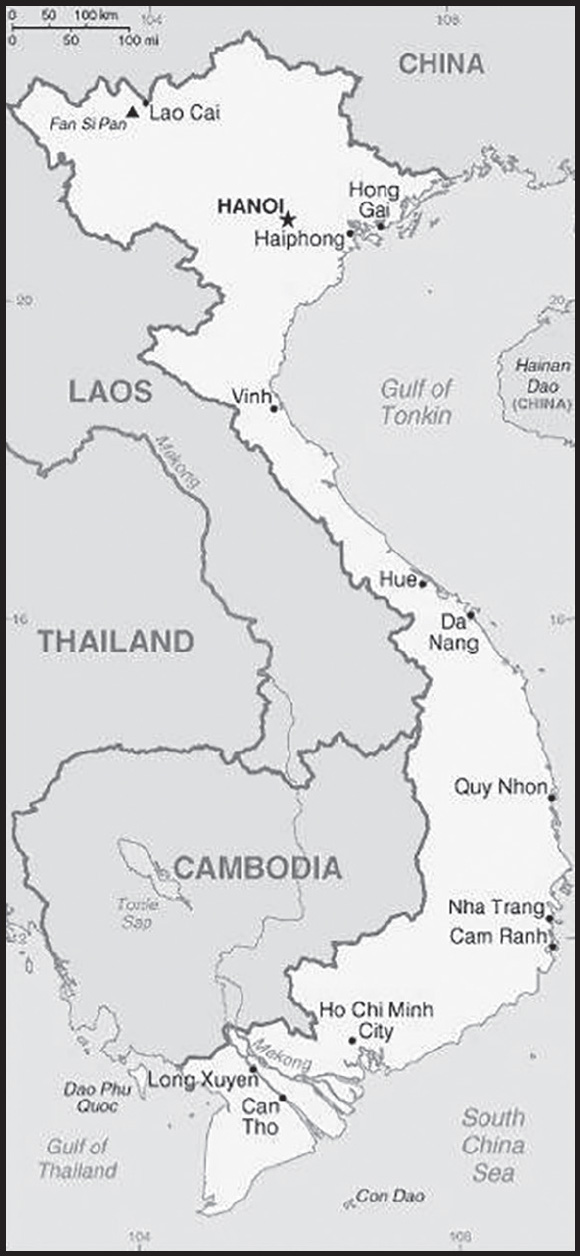
INTRODUCTION
Background: Vietnam’s early history comprises of periods of occupation by outside forces and eventual power consolidation under Vietnamese dynastic families. Ancient Vietnam was centered on the Red River Valley and was ruled by a succession of Han Chinese emperors until approximately the 10th century. The Ly Dynasty (11th-13th century) ruled the first independent Vietnamese state, which was known as Dai Viet, and established their capital at Thang Long (Hanoi). Under the Tran Dynasty (13th-15th century), Dai Viet forces led by one of Vietnam’s national heroes, TRAN Hang Dao, fought off Mongol invaders in 1279. Following a brief Chinese occupation in the early 1400s, the leader of Vietnamese resistance, LE Thai To, made himself emperor and established the Le Dynasty, which lasted until the late 18th century, although not without decades of political turmoil, civil war, and division. During this period, Dai Viet expanded southward to the Central Highlands and Mekong Delta, reaching the approximate boundaries of modern-day Vietnam by the 1750s. Dai Viet suffered additional civil war and division in the latter half of the 18th century, but was reunited and renamed Vietnam under Emperor NGUYEN Phuc Anh (aka Gia Long) in 1802.
The Nguyen Dynasty would be the last Vietnamese dynasty before the conquest by France, which began in 1858 and was completed by 1884. Vietnam became part of French Indochina in 1887. It declared independence after World War II, but France continued to rule until its 1954 defeat by communist forces under Ho Chi MINH. Under the Geneva Accords of 1954, Vietnam was divided into the communist North and anti-communist South. Fighting erupted between the two governments shortly afterwards with the North supporting communist rebels in the South and eventually committing thousands of combat troops, while the US provided large amounts of economic and military assistance, including combat forces, to the South. The US military presence reached a peak strength of over 500,000 troops in 1968. US forces were withdrawn following a cease-fire agreement in 1973. Two years later, North Vietnamese forces overran the South reuniting the country under communist rule. The conflict, known as the Second Indochina War (1955-1975), devastated the country, spilled over into the neighboring countries of Cambodia and Laos, and is estimated to have resulted in the deaths of up to 3 million Vietnamese civilians and soldiers. Despite the return of peace, for over a decade the country experienced little economic growth because of its diplomatic isolation, its conservative leadership policies, and the persecution and mass exodus of individuals, many of them successful South Vietnamese merchants. However, since the enactment of Vietnam’s “doi moi” (renovation) policy in 1986, Vietnamese authorities have committed to increased economic liberalization and enacted structural reforms needed to modernize the economy and to produce more competitive, export-driven industries. Since implementation, the economy has seen strong growth, particularly in agricultural and industrial production, construction, exports, and foreign investment. Increased tourism has also become a key component of economic growth. Nevertheless, the Communist Party maintains tight political and social control of the country, and Vietnam faces considerable challenges including rising income inequality, corruption, inadequate social welfare, and a poor human rights record.
Since withdrawing its military occupation forces from Cambodia in the late 1980s and the end of Soviet aid by 1991, Vietnam has practiced a non-aligned foreign policy that emphasizes friendly ties with all members of the international community. Relatedly, Vietnam adheres to a security doctrine called the “Four Nos” (no alliances, no siding with one country against another, no foreign bases, and no using force in international relations). Despite longstanding tensions with Beijing regarding its expansive claims that overlap with Hanoi’s own claimed maritime boundaries in the South China Sea, Vietnam puts a priority on stable relations with China, given its proximity, size, and status as Vietnam’s largest trading partner.
GEOGRAPHY
Location: Southeastern Asia, bordering the Gulf of Thailand, Gulf of Tonkin, and South China Sea, as well as China, Laos, and Cambodia
Geographic coordinates: 16 10 N, 107 50 E
Map references: Southeast Asia
Area: total: 331,210 sq km
land: 310,070 sq km
water: 21,140 sq km
comparison ranking: total 67
Area - comparative: about three times the size of Tennessee; slightly larger than New Mexico
Land boundaries: total: 4,616 km
border countries (3): Cambodia 1,158 km; China 1,297 km; Laos 2,161 km
Coastline: 3,444 km (excludes islands)
Maritime claims: territorial sea: 12 nm
contiguous zone: 24 nm
exclusive economic zone: 200 nm
continental shelf: 200 nm or to the edge of the continental margin
Climate: tropical in south; monsoonal in north with hot, rainy season (May to September) and warm, dry season (October to March)
Terrain: low, flat delta in south and north; central highlands; hilly, mountainous in far north and northwest
Elevation: highest point: Fan Si Pan 3,144 m
lowest point: South China Sea 0 m
mean elevation: 398 m
Natural resources: antimony, phosphates, coal, manganese, rare earth elements, bauxite, chromate, offshore oil and gas deposits, timber, hydropower, arable land
Land use: agricultural land: 34.8% (2018 est.)
arable land: 20.6% (2018 est.)
permanent crops: 12.1% (2018 est.)
permanent pasture: 2.1% (2018 est.)
forest: 45% (2018 est.)
other: 20.2% (2018 est.)
Irrigated land: 46,000 sq km (2012)
Major rivers (by length in km): Sông Tiên Giang (Mekong) river mouth (shared with China [s], Burma, Laos, Thailand, Cambodia) - 4,350 km; Pearl river source (shared with China [m]) - 2,200 km; Red river mouth (shared with China [s]) - 1,149 km note – [s] after country name indicates river source; [m] after country name indicates river mouth
Major watersheds (area sq km): Pacific Ocean drainage: Mekong (805,604 sq km)
Population distribution: though it has one of the highest population densities in the world, the population is not evenly dispersed; clustering is heaviest along the South China Sea and Gulf of Tonkin, with the Mekong Delta (in the south) and the Red River Valley (in the north) having the largest concentrations of people
Natural hazards: occasional typhoons (May to January) with extensive flooding, especially in the Mekong River delta
Geography - note: note 1: extending 1,650 km north to south, the country is only 50 km across at its narrowest point
note 2: Son Doong in Phong Nha-Ke Bang National Park is the world’s largest cave (greatest cross sectional area) and is the largest known cave passage in the world by volume; it currently measures a total of 38.5 million cu m (about 1.35 billion cu ft); it connects to Thung cave (but not yet officially); when recognized, it will add an additional 1.6 million cu m in volume; Son Doong is so massive that it contains its own jungle, underground river, and localized weather system; clouds form inside the cave and spew out from its exits and two dolines (openings (sinkhole skylights) created by collapsed ceilings that allow sunlight to stream in)
PEOPLE AND SOCIETY
Population: 104,799,174 (2023 est.)
comparison ranking: 16
Nationality: noun: Vietnamese (singular and plural)
adjective: Vietnamese
Ethnic groups: Kinh (Viet) 85.3%, Tay 1.9%, Thai 1.9%, Muong 1.5%, Khmer 1.4%, Mong 1.4%, Nung 1.1%, other 5.5% (2019 est.)
note: 54 ethnic groups are recognized by the Vietnamese Government
Languages: Vietnamese (official), English (increasingly favored as a second language), some French, Chinese, and Khmer, mountain area languages (Mon-Khmer and Malayo-Polynesian)
major-language sample(s):  , là
 . (Vietnamese)
Religions: Catholic 6.1%, Buddhist 5.8%, Protestant 1%, other 0.8%, none 86.3% (2019 est.)
note: most Vietnamese are culturally Buddhist
Demographic profile: When Vietnam was reunified in 1975, the country had a youthful age structure and a high fertility rate. The population growth rate slowed dramatically during the next 25 years, as fertility declined and infant mortality and life expectancy improved. The country’s adoption of a one-or-two-child policy in 1988 led to increased rates of contraception and abortion. The total fertility rate dropped rapidly from nearly 5 in 1979 to 2.1 or replacement level in 1990, and at 1.8 is below replacement level today. Fertility is higher in the more rural central highlands and northern uplands, which are inhabited primarily by poorer ethnic minorities, and is lower among the majority Kinh, ethnic Chinese, and a few other ethnic groups, particularly in urban centers. With more than two-thirds of the population of working age (15-64), Vietnam has the potential to reap a demographic dividend for approximately three decades (between 2010 and 2040). However, its ability to do so will depend on improving the quality of education and training for its workforce and creating jobs. The Vietnamese Government is also considering changes to the country’s population policy because if the country’s fertility rate remains below replacement level, it could lead to a worker shortage in the future.
Vietnam has experienced both internal migration and net emigration, both for humanitarian and economic reasons, for the last several decades. Internal migration – rural-rural and rural-urban, temporary and permanent – continues to be a means of coping with Vietnam’s extreme weather and flooding. Although Vietnam’s population is still mainly rural, increasing numbers of young men and women have been drawn to the country’s urban centers where they are more likely to find steady jobs and higher pay in the growing industrial and service sectors.
The aftermath of the Vietnam War in 1975 resulted in an outpouring of approximately 1.6 million Vietnamese refugees over the next two decades. Between 1975 and 1997, programs such as the Orderly Departure Program and the Comprehensive Plan of Action resettled hundreds of thousands of Vietnamese refugees abroad, including the United States (880,000), China (260,000, mainly ethnic Chinese Hoa), Canada (160,000), Australia (155,000), and European countries (150,000).
In the 1980s, some Vietnamese students and workers began to migrate to allied communist countries, including the Soviet Union, Czechoslovakia, Bulgaria, and East Germany. The vast majority returned home following the fall of communism in Eastern Europe in the early 1990s. Since that time, Vietnamese labor migrants instead started to pursue opportunities in Asia and the Middle East. They often perform low-skilled jobs under harsh conditions for low pay and are vulnerable to forced labor, including debt bondage to the private brokers who arrange the work contracts. Despite Vietnam’s current labor surplus, the country has in recent years attracted some foreign workers, mainly from China and other Asian countries.
Age structure: 0-14 years: 23.44% (male 12,975,791/female 11,593,157)
15-64 years: 68.69% (male 36,280,449/female 35,705,586)
65 years and over: 7.87% (2023 est.) (male 3,346,804/female 4,897,387)
Dependency ratios: total dependency ratio: 45.6
youth dependency ratio: 32.8
elderly dependency ratio: 12.7
potential support ratio: 7.8 (2021 est.)
Median age: total: 32.7 years (2023 est.)
male: 31.6 years
female: 33.8 years
comparison ranking: total 111
Population growth rate: 0.93% (2023 est.)
comparison ranking: 102
Birth rate: 15.3 births/1,000 population (2023 est.)
comparison ranking: 110
Death rate: 5.8 deaths/1,000 population (2023 est.)
comparison ranking: 170
Net migration rate: -0.2 migrant(s)/1,000 population (2023 est.)
comparison ranking: 108
Population distribution: though it has one of the highest population densities in the world, the population is not evenly dispersed; clustering is heaviest along the South China Sea and Gulf of Tonkin, with the Mekong Delta (in the south) and the Red River Valley (in the north) having the largest concentrations of people
Urbanization: urban population: 39.5% of total population (2023)
rate of urbanization: 2.7% annual rate of change (2020-25 est.)
Major urban areas - population: 9.321 million Ho Chi Minh City, 5.253 million HANOI (capital), 1.865 million Can Tho, 1.423 million Hai Phong, 1.221 million Da Nang, 1.111 million Bien Hoa (2023)
Sex ratio: at birth: 1.1 male(s)/female
0-14 years: 1.12 male(s)/female
15-64 years: 1.02 male(s)/female
65 years and over: 0.68 male(s)/female
total population: 1.01 male(s)/female (2023 est.)
Maternal mortality ratio: 124 deaths/100,000 live births (2020 est.)
comparison ranking: 62
Infant mortality rate: total: 14.4 deaths/1,000 live births (2023 est.)
male: 14.8 deaths/1,000 live births
female: 14.1 deaths/1,000 live births
comparison ranking: total 99
Life expectancy at birth: total population: 75.8 years (2023 est.)
male: 73.2 years
female: 78.6 years
comparison ranking: total population 116
Total fertility rate: 2.04 children born/woman (2023 est.)
comparison ranking: 102
Gross reproduction rate: 0.97 (2023 est.)
Contraceptive prevalence rate: 72.8% (2020)
Drinking water source: improved: urban: 99.2% of population
rural: 95.5% of population
total: 96.9% of population
unimproved: urban: 0.8% of population
rural: 4.5% of population
total: 3.1% of population (2020 est.)
Current health expenditure: 4.7% of GDP (2020)
Physicians density: 0.83 physicians/1,000 population (2016)
Hospital bed density: 3.2 beds/1,000 population (2013)
Sanitation facility access: improved: urban: 98.7% of population
rural: 90% of population
total: 93.3% of population
unimproved: urban: 1.3% of population
rural: 10% of population
total: 6.7% of population (2020 est.)
Major infectious diseases: degree of risk: very high (2023)
food or waterborne diseases: bacterial diarrhea, hepatitis A, and typhoid fever
vectorborne diseases: dengue fever, malaria, and Japanese encephalitis
note: On 20 September 2023, the CDC issued a travel notice for an outbreak of diphtheria in several provinces in Vietnam (see attached map); vaccination against diphtheria is essential to protect against disease; if you are traveling to an affected area, you should be up to date with your diphtheria vaccines; Diphtheria is a serious infection caused by strains of bacteria called Corynebacterium diphtheriae that make a toxin; Diphtheria bacteria spread from person to person, usually through respiratory droplets, like from coughing or sneezing
Obesity - adult prevalence rate: 2.1% (2016)
comparison ranking: 192
Alcohol consumption per capita: total: 3.41 liters of pure alcohol (2019 est.)
beer: 3.18 liters of pure alcohol (2019 est.)
wine: 0.02 liters of pure alcohol (2019 est.)
spirits: 0.21 liters of pure alcohol (2019 est.)
other alcohols: 0 liters of pure alcohol (2019 est.)
comparison ranking: total 105
Tobacco use: total: 24.8% (2020 est.)
male: 47.4% (2020 est.)
female: 2.2% (2020 est.)
comparison ranking: total 51
Children under the age of 5 years underweight: 11.6% (2020)
comparison ranking: 51
Currently married women (ages 15-49): 72.6% (2023 est.)
Child marriage: women married by age 15: 1.1%
women married by age 18: 14.6%
men married by age 18: 1.9% (2021 est.)
Education expenditures: 4.1% of GDP (2020 est.)
comparison ranking: 113
Literacy: definition: age 15 and over can read and write
total population: 95.8%
male: 97%
female: 94.6% (2019)
Youth unemployment rate (ages 15-24): total: 7.2% (2021 est.)
male: 7.1%
female: 7.5%
comparison ranking: total 177
ENVIRONMENT
Environment - current issues: logging and slash-and-burn agricultural practices contribute to deforestation and soil degradation; water pollution and overfishing threaten marine life populations; groundwater contamination limits potable water supply; air pollution; growing urban industrialization and population migration are rapidly degrading environment in Hanoi and Ho Chi Minh City
Environment - international agreements: party to: Biodiversity, Climate Change, Climate Change-Kyoto Protocol, Climate Change-Paris Agreement, Comprehensive Nuclear Test Ban, Desertification, Endangered Species, Environmental Modification, Hazardous Wastes, Law of the Sea, Ozone Layer Protection, Ship Pollution, Tropical Timber 2006, Wetlands
signed, but not ratified: none of the selected agreements
Climate: tropical in south; monsoonal in north with hot, rainy season (May to September) and warm, dry season (October to March)
Land use: agricultural land: 34.8% (2018 est.)
arable land: 20.6% (2018 est.)
permanent crops: 12.1% (2018 est.)
permanent pasture: 2.1% (2018 est.)
forest: 45% (2018 est.)
other: 20.2% (2018 est.)
Urbanization: urban population: 39.5% of total population (2023)
rate of urbanization: 2.7% annual rate of change (2020-25 est.)
Revenue from forest resources: 1.49% of GDP (2018 est.)
comparison ranking: 43
Revenue from coal: 0.35% of GDP (2018 est.)
comparison ranking: 16
Air pollutants: particulate matter emissions: 20.89 micrograms per cubic meter (2019 est.)
carbon dioxide emissions: 192.67 megatons (2016 est.)
methane emissions: 110.4 megatons (2020 est.)
Waste and recycling: municipal solid waste generated annually: 9,570,300 tons (2011 est.)
municipal solid waste recycled annually: 2,201,169 tons (2014 est.)
percent of municipal solid waste recycled: 23% (2014 est.)
Major rivers (by length in km): Sông Tiên Giang (Mekong) river mouth (shared with China [s], Burma, Laos, Thailand, Cambodia) - 4,350 km; Pearl river source (shared with China [m]) - 2,200 km; Red river mouth (shared with China [s]) - 1,149 km note – [s] after country name indicates river source; [m] after country name indicates river mouth
Major watersheds (area sq km): Pacific Ocean drainage: Mekong (805,604 sq km)
Total water withdrawal: municipal: 1.21 billion cubic meters (2020 est.)
industrial: 3.07 billion cubic meters (2020 est.)
agricultural: 77.75 billion cubic meters (2020 est.)
Total renewable water resources: 884.12 billion cubic meters (2020 est.)
GOVERNMENT
Country name: conventional long form: Socialist Republic of Vietnam
conventional short form: Vietnam
local long form: Cong Hoa Xa Hoi Chu Nghia Viet Nam
local short form: Viet Nam
former: Democratic Republic of Vietnam (North Vietnam), Republic of Vietnam (South Vietnam)
abbreviation: SRV
etymology: “Viet nam” translates as “Viet south,” where “Viet” is an ethnic self identification dating to a second century B.C. kingdom and “nam” refers to its location in relation to other Viet kingdoms
Government type: communist state
Capital: name: Hanoi (Ha Noi)
geographic coordinates: 21 02 N, 105 51 E
time difference: UTC+7 (12 hours ahead of Washington, DC, during Standard Time)
etymology: the city has had many names in its history going back to A.D. 1010 when it first became the capital of imperial Vietnam; in 1831, it received its current name of Ha Noi, meaning “between the rivers,” which refers to its geographic location
Administrative divisions: 58 provinces (tinh, singular and plural) and 5 municipalities (thanh pho, singular and plural)
provinces: An Giang, Bac Giang, Bac Kan, Bac Lieu, Bac Ninh, Ba Ria-Vung Tau, Ben Tre, Binh Dinh, Binh Duong, Binh Phuoc, Binh Thuan, Ca Mau, Cao Bang, Dak Lak, Dak Nong, Dien Bien, Dong Nai, Dong Thap, Gia Lai, Ha Giang, Ha Nam, Ha Tinh, Hai Duong, Hau Giang, Hoa Binh, Hung Yen, Khanh Hoa, Kien Giang, Kon Tum, Lai Chau, Lam Dong, Lang Son, Lao Cai, Long An, Nam Dinh, Nghe An, Ninh Binh, Ninh Thuan, Phu Tho, Phu Yen, Quang Binh, Quang Nam, Quang Ngai, Quang Ninh, Quang Tri, Soc Trang, Son La, Tay Ninh, Thai Binh, Thai Nguyen, Thanh Hoa, Thua Thien-Hue, Tien Giang, Tra Vinh, Tuyen Quang, Vinh Long, Vinh Phuc, Yen Bai
municipalities: Can Tho, Da Nang, Ha Noi (Hanoi), Hai Phong, Ho Chi Minh City (Saigon)
Independence: 2 September 1945 (from France)
National holiday: Independence Day (National Day), 2 September (1945)
Constitution: history: several previous; latest adopted 28 November 2013, effective 1 January 2014
amendments: proposed by the president, by the National Assembly’s Standing Committee, or by at least two thirds of the National Assembly membership; a decision to draft an amendment requires approval by at least a two-thirds majority vote of the Assembly membership, followed by the formation of a constitutional drafting committee to write a draft and collect citizens’ opinions; passage requires at least two-thirds majority of the Assembly membership; the Assembly can opt to conduct a referendum
Legal system: civil law system; note - the civil code of 2005 reflects a European-style civil law
International law organization participation: has not submitted an ICJ jurisdiction declaration; non-party state to the ICCt
Citizenship: citizenship by birth: no
citizenship by descent only: at least one parent must be a citizen of Vietnam
dual citizenship recognized: no
residency requirement for naturalization: 5 years
Suffrage: 18 years of age; universal
Executive branch: chief of state: President Vo Van THUONG (since 2 March 2023)
head of government: Prime Minister Pham Minh CHINH (since 26 July 2021)
cabinet: Cabinet proposed by the prime minister, confirmed by the National Assembly, and appointed by the president
elections/appointments: president indirectly elected by the National Assembly from among its members for a single 5-year term; prime minister recommended by the president and confirmed by the National Assembly; deputy prime ministers confirmed by the National Assembly and appointed by the president
election results: 2021: Nguyen Xuan PHUC (CPV) elected president; Pham Minh CHINH (CPV) confirmed as prime minister
2018: NGUYEN Phu TRONG (CPV) elected president
2016: NGUYEN Xuan PHUC (CPV) confirmed as prime minister
note: Nguyen Phu TRONG is the General Secretary of the Vietnam Communist Party
Legislative branch: description: unicameral National Assembly or Quoc Hoi (500 seats - number following 2021 election - 499; members directly elected in multi-seat constituencies by absolute majority vote; members serve 5-year terms)
elections: last held on 23 May 2021 (next to be held in spring 2026)
election results: percent of vote in 2016 election by party -CPV 95.8%, non-party members 4.2%; seats by party - CPV 474, non-party CPV-approved 20, self-nominated 2; note - 494 candidates elected, 2 CPV candidates-elect were disqualified; composition - men 364, women 122, percent of women 26.6%
Judicial branch: highest court(s): Supreme People’s Court (consists of the chief justice and 13 judges)
judge selection and term of office: chief justice elected by the National Assembly upon the recommendation of the president for a 5-year, renewable term; deputy chief justice appointed by the president from among the judges for a 5-year term; judges appointed by the president and confirmed by the National Assembly for 5-year terms
subordinate courts: High Courts (administrative, civil, criminal, economic, labor, family, juvenile); provincial courts; district courts; Military Court; note - the National Assembly Standing Committee can establish special tribunals upon the recommendation of the chief justice
Political parties and leaders: Communist Party of Vietnam or CPV [General Secretary Nguyen Phu TRONG]
note: other parties proscribed
International organization participation: ADB, APEC, ARF, ASEAN, CICA, CP, EAS, FAO, G-77, IAEA, IBRD, ICAO, ICC (NGOs), ICRM, IDA, IFAD, IFC, IFRCS, ILO, IMF, IMO, IMSO, Interpol, IOC, IOM, IPU, ISO, ITSO, ITU, MIGA, NAM, OIF, OPCW, PCA, UN, UNCTAD, UNESCO, UNIDO, UNWTO, UPU, WCO, WFTU (NGOs), WHO, WIPO, WMO, WTO
Diplomatic representation in the US: chief of mission: Ambassador Nguyen Quoc DUNG (since 19 April 2022)
chancery: 1233 20th Street NW, Suite 400, Washington, DC 20036
telephone: [1] (202) 861-0737
FAX: [1] (202) 861-0917
email address and website: vanphong@vietnamembassy.us
http://vietnamembassy-usa.org/
consulate(s) general: Houston, San Francisco
consulate(s): New York
Diplomatic representation from the US: chief of mission: Ambassador Marc KNAPPER (since 11 February 2022)
embassy: 7 Lang Ha Street, Hanoi
mailing address: 4550 Hanoi Place, Washington, DC 20521-4550
telephone: [84] (24) 3850-5000
FAX: [84] (24) 3850-5010
email address and website: ACShanoi@state.gov
consulate(s) general: Ho Chi Minh City
Flag description: red field with a large yellow five-pointed star in the center; red symbolizes revolution and blood, the five-pointed star represents the five elements of the populace - peasants, workers, intellectuals, traders, and soldiers - that unite to build socialism
National symbol(s): yellow, five-pointed star on red field; lotus blossom; national colors: red, yellow
National anthem: name: “Tien quan ca” (The Song of the Marching Troops)
lyrics/music: Nguyen Van CAO
note: adopted as the national anthem of the Democratic Republic of Vietnam in 1945; it became the national anthem of the unified Socialist Republic of Vietnam in 1976; although it consists of two verses, only the first is used as the official anthem
National heritage: total World Heritage Sites: 8 (5 cultural, 2 natural, 1 mixed)
selected World Heritage Site locales: Complex of Hué Monuments (c); Ha Long Bay (n); Hoi An Ancient Town (c); My Son Sanctuary (c); Phong Nha-Ke Bang National Park (n); Imperial Citadel of Thang Long - Hanoi (c); Citadel of the Ho Dynasty (c); Trang An Landscape Complex (m)
ECONOMY
Economic overview: lower middle-income socialist East Asian economy; rapid economic growth since  reforms; strong investment and productivity growth; tourism and manufacturing hub; TPP signatory; declining poverty aside from ethnic minorities; systemic corruption
Real GDP (purchasing power parity): $1.036 trillion (2021 est.)
$1.01 trillion (2020 est.)
$981.903 billion (2019 est.)
note: data are in 2017 dollars
comparison ranking: 26
Real GDP growth rate: 2.56% (2021 est.)
2.87% (2020 est.)
7.36% (2019 est.)
comparison ranking: 153
Real GDP per capita: $10,600 (2021 est.)
$10,500 (2020 est.)
$10,300 (2019 est.)
note: data are in 2017 dollars
comparison ranking: 142
GDP (official exchange rate): $259.957 billion (2019 est.)
Inflation rate (consumer prices): 1.83% (2021 est.)
3.22% (2020 est.)
2.8% (2019 est.)
comparison ranking: 165
Credit ratings:
Fitch rating: BB (2018)
Moody’s rating: Ba3 (2018)
Standard & Poors rating: BB (2019)
note: The year refers to the year in which the current credit rating was first obtained.
GDP - composition, by sector of origin: agriculture: 15.3% (2017 est.)
industry: 33.3% (2017 est.)
services: 51.3% (2017 est.)
comparison rankings: services 173; industry 53; agriculture 65
GDP - composition, by end use: household consumption: 66.9% (2017 est.)
government consumption: 6.5% (2017 est.)
investment in fixed capital: 24.2% (2017 est.)
investment in inventories: 2.8% (2017 est.)
exports of goods and services: 100% (2017 est.)
imports of goods and services: -101% (2017 est.)
Agricultural products: rice, vegetables, sugar cane, cassava, maize, pork, fruit, bananas, coffee, coconuts
Industries: food processing, garments, shoes, machine-building; mining, coal, steel; cement, chemical fertilizer, glass, tires, oil, mobile phones
Industrial production growth rate: 3.58% (2021 est.)
comparison ranking: 109
Labor force: 56.203 million (2021 est.)
comparison ranking: 12
Labor force - by occupation: agriculture: 40.3%
industry: 25.7%
services: 34% (2017)
Unemployment rate: 2.17% (2021 est.)
2.39% (2020 est.)
2.04% (2019 est.)
comparison ranking: 210
Youth unemployment rate (ages 15-24): total: 7.2% (2021 est.)
male: 7.1%
female: 7.5%
comparison ranking: total 177
Population below poverty line: 6.7% (2018 est.)
Gini Index coefficient - distribution of family income: 35.7 (2018 est.)
comparison ranking: 93
Average household expenditures: on food: 38.8% of household expenditures (2018 est.)
on alcohol and tobacco: 2.3% of household expenditures (2018 est.)
Household income or consumption by percentage share: lowest 10%: 2.7%
highest 10%: 26.8% (2014)
Budget: revenues: $64.895 billion (2019 est.)
expenditures: $75.834 billion (2019 est.)
Budget surplus (+) or deficit (-): -6.7% (of GDP) (2017 est.)
comparison ranking: 191
Public debt: 58.5% of GDP (2017 est.)
59.9% of GDP (2016 est.)
note: official data; data cover general government debt and include debt instruments issued (or owned) by government entities other than the treasury; the data include treasury debt held by foreign entities; the data include debt issued by subnational entities, as well as intragovernmental debt; intragovernmental debt consists of treasury borrowings from surpluses in the social funds, such as for retirement, medical care, and unemployment; debt instruments for the social funds are not sold at public auctions
comparison ranking: 84
Taxes and other revenues: 24.8% (of GDP) (2017 est.)
comparison ranking: 49
Fiscal year: calendar year
Current account balance: -$3.812 billion (2021 est.)
$15.06 billion (2020 est.)
$13.101 billion (2019 est.)
comparison ranking: 178
Exports: $339.984 billion (2021 est.) note: data are in current year dollars
$290.229 billion (2020 est.) note: data are in current year dollars
$280.826 billion (2019 est.)
comparison ranking: 23
Exports - partners: US 28%, China 17%, South Korea 6%, Japan 6%, Hong Kong 4% (2021)
Exports - commodities: broadcasting equipment, telephones, integrated circuits, office machinery, footwear, furniture (2021)
Imports: $338.021 billion (2021 est.) note: data are in current year dollars
$269.808 billion (2020 est.) note: data are in current year dollars
$261.683 billion (2019 est.)
comparison ranking: 21
Imports - partners: China 39%, South Korea 17%, Japan 5%, Taiwan 4%, Thailand 4% (2021)
Imports - commodities: integrated circuits, telephones, clothing and apparel, broadcasting accessories, refined petroleum, iron sheeting (2021)
Reserves of foreign exchange and gold: $109.371 billion (31 December 2021 est.)
$94.834 billion (31 December 2020 est.)
$78.335 billion (31 December 2019 est.)
comparison ranking: 27
Debt - external: $96.58 billion (31 December 2017 est.)
$84.34 billion (31 December 2016 est.)
comparison ranking: 58
Exchange rates: dong (VND) per US dollar -
Exchange rates: 23,159.783 (2021 est.)
23,208.368 (2020 est.)
23,050.242 (2019 est.)
22,602.05 (2018 est.)
22,370.087 (2017 est.)
ENERGY
Electricity access: electrification - total population: 100% (2021)
Electricity: installed generating capacity: 65.283 million kW (2020 est.)
consumption: 199,846,440,000 kWh (2019 est.)
exports: 2.067 billion kWh (2019 est.)
imports: 3.316 billion kWh (2019 est.)
transmission/distribution losses: 15.479 billion kWh (2019 est.)
comparison rankings: installed generating capacity 20; transmission/distribution losses 26; imports 49; exports 51; consumption 22
Electricity generation sources: fossil fuels: 70.7% of total installed capacity (2020 est.)
solar: 2.4% of total installed capacity (2020 est.)
wind: 0.4% of total installed capacity (2020 est.)
hydroelectricity: 25.2% of total installed capacity (2020 est.)
biomass and waste: 1.4% of total installed capacity (2020 est.)
Coal: production: 47.789 million metric tons (2020 est.)
consumption: 80.568 million metric tons (2020 est.)
exports: 902,000 metric tons (2020 est.)
imports: 55 million metric tons (2020 est.)
proven reserves: 3.36 billion metric tons (2019 est.)
Petroleum: total petroleum production: 197,700 bbl/day (2021 est.)
refined petroleum consumption: 495,500 bbl/day (2019 est.)
crude oil and lease condensate exports: 66,900 bbl/day (2018 est.)
crude oil and lease condensate imports: 103,500 bbl/day (2018 est.)
crude oil estimated reserves: 4.4 billion barrels (2021 est.)
Refined petroleum products - production: 153,800 bbl/day (2015 est.)
comparison ranking: 58
Refined petroleum products - exports: 25,620 bbl/day (2015 est.)
comparison ranking: 67
Refined petroleum products - imports: 282,800 bbl/day (2015 est.)
comparison ranking: 25
Natural gas: production: 8,438,095,000 cubic meters (2019 est.)
consumption: 8,438,095,000 cubic meters (2019 est.)
exports: 0 cubic meters (2021 est.)
imports: 0 cubic meters (2021 est.)
proven reserves: 699.425 billion cubic meters (2021 est.)
Carbon dioxide emissions: 249.929 million metric tonnes of CO2 (2019 est.)
from coal and metallurgical coke: 165.775 million metric tonnes of CO2 (2019 est.)
from petroleum and other liquids: 67.775 million metric tonnes of CO2 (2019 est.)
from consumed natural gas: 16.379 million metric tonnes of CO2 (2019 est.)
comparison ranking: total emissions 27
Energy consumption per capita: 36.392 million Btu/person (2019 est.)
comparison ranking: 113
COMMUNICATIONS
Telephones - fixed lines: total subscriptions: 3.1 million (2021 est.)
subscriptions per 100 inhabitants: 3 (2021 est.)
comparison ranking: total subscriptions 39
Telephones - mobile cellular: total subscriptions: 140 million (2021 est.)
subscriptions per 100 inhabitants: 140 (2021 est.)
comparison ranking: total subscriptions 12
Telecommunication systems: general assessment: even with Covid-19 pandemic-related mobility restrictions in place, Vietnam’s economy has continued to outperform the rest of the region in 2020 and 2021; the telecom sector essentially spent most of this period in a holding pattern, focusing on maintaining service throughout the crisis while preparing for some major changes to come in the mobile market in 2022; both fixed-line telephony and mobile have experienced small drops in subscriber numbers since the start of the pandemic, but the similarities between the two markets end there; fixed-line teledensity continued its downwards trajectory towards virtual oblivion, with just 3% penetration (around 3 million subscribers) at the start of 2021; the mobile market has lost about the same number of subscribers since the end of 2019, but has been sitting on much higher penetration levels around 130% for many years; growth is expected to kick in again in 2022 following the anticipated launch of commercial 5G mobile services along with a range of government-led schemes to move consumers completely off 2G and 3G; one example is the planned redistribution of GSM/3G bandwidth to LTE; in addition to propelling Vietnam into having one of the most advanced mobile markets in the world, this should also spur on the mobile broadband segment; with a penetration level of just over 70%, mobile broadband has considerable room to grow; increasing economic prosperity coupled with the latest smartphone technology and networks should see mobile broadband underwriting the country’s telecommunications sector for at least the next few years; this report includes the regulator’s market data to July 2021, telcos’ financial and operating data updates to June 2021, Telecom Maturity Index charts and analyses, assessment of the global impact of Covid-19 on the telecoms sector, and other recent market developments (2021)
domestic: fixed-line is 3 per 100 and mobile-cellular is 140 per 100 (2021)
international: country code - 84; landing points for the SeaMeWe-3, APG, SJC2, AAE-1, AAG and the TGN-IA submarine cable system providing connectivity to Europe, Africa, the Middle East, Asia, Southeast Asia, Australia, and the US; satellite earth stations - 2 Intersputnik (Indian Ocean region) (2020)
Broadcast media: government controls all broadcast media exercising oversight through the Ministry of Information and Communication (MIC); government-controlled national TV provider, Vietnam Television (VTV), operates a network of several channels with regional broadcasting centers; programming is relayed nationwide via a network of provincial and municipal TV stations; law limits access to satellite TV but many households are able to access foreign programming via home satellite equipment; government-controlled Voice of Vietnam, the national radio broadcaster, broadcasts on several channels and is repeated on AM, FM, and shortwave stations throughout Vietnam (2018)
Internet country code: .vn
Internet users: total: 71.78 million (2021 est.)
percent of population: 74% (2021 est.)
comparison ranking: total 12
Broadband - fixed subscriptions: total: 16,699,249 (2020 est.)
subscriptions per 100 inhabitants: 17 (2020 est.)
comparison ranking: total 14
TRANSPORTATION
National air transport system: number of registered air carriers: 5 (2020)
inventory of registered aircraft operated by air carriers: 224
annual passenger traffic on registered air carriers: 47,049,671 (2018)
annual freight traffic on registered air carriers: 481.37 million (2018) mt-km
Civil aircraft registration country code prefix: VN
Airports: 45 (2021)
comparison ranking: total 96
Airports - with paved runways: 38
note: paved runways have a concrete or asphalt surface but not all have facilities for refueling, maintenance, or air traffic control; the length of a runway required for aircraft to safely operate depends on a number of factors including the type of aircraft, the takeoff weight (including passengers, cargo, and fuel), engine types, flap settings, landing speed, elevation of the airport, and average maximum daily air temperature; paved runways can reach a length of 5,000 m (16,000 ft.), but the “typical” length of a commercial airline runway is between 2,500-4,000 m (8,000-13,000 ft.)
Airports - with unpaved runways: 7
note: unpaved runways have a surface composition such as grass or packed earth and are most suited to the operation of light aircraft; unpaved runways are usually short, often less than 1,000 m (3,280 ft.) in length; airports with unpaved runways often lack facilities for refueling, maintenance, or air traffic control
Heliports: 1 (2021)
Pipelines: 72 km condensate, 398 km condensate/gas, 955 km gas, 128 km oil, 33 km oil/gas/water, 206 km refined products, 13 km water (2013)
Railways: total: 2,600 km (2014)
standard gauge: 178 km (2014) 1.435-m gauge; 253 km mixed gauge
narrow gauge: 2,169 km (2014) 1.000-m gauge
comparison ranking: total 64
Roadways: total: 195,468 km (2013)
paved: 148,338 km (2013)
unpaved: 47,130 km (2013)
comparison ranking: total 28
Waterways: 47,130 km (2011) (30,831 km weight under 50 tons)
comparison ranking: 3
Merchant marine: total: 1,975 (2022)
by type: bulk carrier 116, container ship 42, general cargo 1,194, oil tanker 137, other 486
comparison ranking: total 12
Ports and terminals: major seaport(s): Cam Pha Port, Da Nang, Haiphong, Phu My, Quy Nhon
container port(s) (TEUs): Saigon (7,956,133), Cai Mep (5,385,289), Haiphong (5,695,839) (2021)
river port(s): Ho Chi Minh (Mekong)
MILITARY AND SECURITY
Military and security forces: People’s Army of Vietnam (PAVN; aka Vietnam People’s Army, VPA): Ground Forces, Navy (includes naval infantry), Air Force and Air Defense, Border Defense Force, Vietnam Coast Guard
Vietnam People’s Public Security Ministry; Vietnam Civil Defense Force (2023)
note 1: the People’s Public Security Ministry is responsible for internal security and controls the national police, a special national security investigative agency, and other internal security units, including specialized riot police regiments
note 2: the Vietnam Coast Guard was established in 1998 as the Vietnam Marine Police and renamed in 2013; Vietnam officially established a maritime self-defense force (civilian militia) in 2010 after the National Assembly passed the Law on Militia and Self-Defense Forces in 2009; the Vietnam Fisheries Resources Surveillance (VFRS), established in 2013, is responsible for patrolling, monitoring for fishing violations, and carrying out fishery inspections; it is armed, allowed to use force if necessary, and works in tandem with the Vietnam Coast Guard
Military expenditures: 2.3% of GDP (2022 est.)
2.4% of GDP (2021 est.)
2.4% of GDP (2020 est.)
2.3% of GDP (2019 est.)
2.3% of GDP (2018 est.)
comparison ranking: 48
Military and security service personnel strengths: information is limited and varied; estimated 450,000 active-duty troops; estimated 40,000 Border Defense Force and Coast Guard (2023)
Military equipment inventories and acquisitions: the PAVN is armed largely with weapons and equipment from Russia and the former Soviet Union; in recent years, Russia has remained the most important supplier of newer PAVN military equipment, but Vietnam has diversified arms purchases to include more than a dozen other countries including Belarus, Israel, the Netherlands, South Korea, and the US; Vietnam has a limited domestic defense industry (2023)
Military service age and obligation: 18-27 years of age for compulsory and voluntary military service for men and women (in practice only men are drafted); service obligation is between 24 (Army, Air Defense) and 36 (Navy and Air Force) months (2023)
Military deployments: 190 Abyei/South Sudan/Sudan (UNISFA) (2023)
Military - note: the PAVN is the military arm of the ruling Communist Party of Vietnam (CPV) and responsible to the Central Military Commission (CMC), the highest party organ on military policy; the CMC is led by the CPV General Secretary
the PAVN is one of the region’s largest militaries and has participated in numerous conflicts since its founding in the mid-1940s, including the First (1946-54) and Second (1950s-1975) Indochina Wars, the Cambodian-Vietnamese War (1978-1989), and the Sino-Vietnamese War (1979); the PAVN’s current missions include protecting the country’s independence, sovereignty, territorial integrity, and national interests; in recent years, it has increased focus on protecting the country’s maritime economy and sovereignty; it also assists with natural disasters and is heavily involved in economic projects, including electrical infrastructure, oil and gas services, hydroelectric projects, aviation and seaport services, telecommunications, and the shipbuilding industry, while military-owned factories and enterprises produce weapons and equipment; the Ground Forces are spread throughout the country in approximately eight regional commands, four operational corps, and dozens of divisions and brigades, including some that are maintained at cadre strength and filled in wartime by an estimated five million reserves; the Navy in recent years has received increased government focus for procurement efforts because of the rise in territorial disputes in the South China Sea and has a growing combat force of about 20 frigates, corvettes, and fast-attack surface vessels, plus eight attack submarines; the Air Force has a mix of approximately 75 Soviet-era and Russian-made combat aircraft (2023)
SPACE
Space agency/agencies: Vietnam National Space Center (VNSC; established 2011; formerly known as the Vietnam National Satellite Center); Space Technology Institute (STI; established 2006); both the VNSC and the STI operate under the Vietnamese Academy of Science and Technology (VAST); Ministry of Science and Technology (2023)
Space program overview: has a growing space program focused on acquiring, operating, and exploiting satellites, as well as expanding domestic capabilities in satellites and associated sub-system production, space sciences, and technology applications; builds and operates communications and remote sensing satellites; conducting research and development on space science and applied space technologies, such as advanced optics and space data exploitation; has worked closely with Japan’s Aerospace Exploration Agency (JAXA) and Japanese companies and universities on its space program since inception; cooperation has included funding, loans, training, technical expertise, and data sharing; has also established relationships with the space agencies or commercial space sectors of some European countries (such as France), India, and the US (2023)
note: further details about the key activities, programs, and milestones of the country’s space program, as well as government spending estimates on the space sector, appear in Appendix S
TRANSNATIONAL ISSUES
Disputes - international: Vietnam-Cambodia: Cambodia accuses Vietnam of a wide variety of illicit cross-border activities; issues include casinos built in Cambodia near the border, narcotics trafficking, trafficking of women and children, petrol smuggling, illegal logging, and illegal migration; progress on a joint development area with Cambodia is hampered by an unresolved dispute over sovereignty of offshore islands; in December 2021, leaders from the two countries agreed to fully complete the remaining border demarcation and the upgrading of border checkpoints
Vietnam-Cambodia-Laos: Cambodia and Laos protest Vietnamese squatters and armed encroachments along border; Cambodia accuses Vietnam of a wide variety of illicit cross-border activities
Vietnam-China: an estimated 300,000 Vietnamese refugees reside in China; the decade-long demarcation of the China-Vietnam land boundary was completed in 2009; small territorial exchanges were made during the demarcation; China occupies the Paracel Islands also claimed by Vietnam and Taiwan; cross border trafficking in women and children and illegal wildlife trade are problems along this border; In December 2021, China tightened its border controls over COVID concerns, restricting an important trade route for Vietnam
Vietnam-Laos: Laos opened a strategically important international border crossing with Vietnam in 2021, which will shorten the distance for goods and people transiting between Thailand and Vietnam
Refugees and internally displaced persons: stateless persons: 35,475 (2022); note - Vietnam’s stateless ethnic Chinese Cambodian population dates to the 1970s when thousands of Cambodians fled to Vietnam to escape the Khmer Rouge and were no longer recognized as Cambodian citizens; Vietnamese women who gave up their citizenship to marry foreign men have found themselves stateless after divorcing and returning home to Vietnam; the government addressed this problem in 2009, and Vietnamese women are beginning to reclaim their citizenship
Trafficking in persons: tier rating: Tier 2 Watch List — Vietnam does not fully meet the minimum standards for the elimination of trafficking but is making significant efforts to do so; the government made key achievements during the reporting period, therefore Vietnam was upgraded to Tier 2 Watch List; Vietnam initiated more investigations, prosecuted and convicted more traffickers, increased international law enforcement cooperation, and initiated criminal proceedings against allegedly complicit officials; officials also identified and assisted more victims and implemented protection for overseas workers; despite these achievements, the government did not proactively identify trafficking victims forced to work in cyber scams or provide services, including foreign national victims in Vietnam; authorities inspected thousands of the most at-risk establishments for sex trafficking but only identified two victims (2023)
trafficking profile: human traffickers exploit domestic and foreign victims in Vietnam, as well as Vietnamese abroad; 55% of workers work in the informal economy where labor laws are not effectively enforced, increasing vulnerability to trafficking; Vietnamese men and women who migrate abroad, using illicit brokerage networks operated by Vietnamese nationals based abroad or state-owned or state-regulated recruitment enterprises, are vulnerable to debt bondage or other forms of exploitation; victims are subjected to forced labor in construction, agriculture, mining, maritime industries, logging, and manufacturing primarily in Japan, Laos, Malaysia, South Korea, and in some parts of the Middle East, the UK, and other countries in Europe; reports have increased of Vietnamese labor trafficking victims in Taiwan, continental Europe, the Middle East, Africa, and in Pacific maritime industries; Vietnamese traffickers, including members of Vietnam’s diplomatic service, reportedly have exploited Vietnamese nationals in forced labor in Saudi Arabia; many Vietnamese are subjected to forced labor under the auspices of Japan’s Technical Intern Training Program and in agricultural education programs in Israel; other Vietnamese are exploited at Chinese-owned factories associated with China’s Belt and Road Initiative in the Balkan region; widespread social stigma increases LGBTQI+ individuals’ vulnerability to trafficking; traffickers lure Vietnamese women and children with fraudulent job opportunities and send them to brothels on the borders of Cambodia, China, and Laos or elsewhere in Asia, West Africa, and Europe; Vietnamese women and girls are also exploited in sex trafficking in Vietnam, as well as Burma; sometimes family members or small-scale networks exploit Vietnamese men, women, and children—including street children and children with disabilities—in forced labor; child sex tourists from Asia, the UK, other countries in Europe, Australia, Canada, and the US exploit children in Vietnam (2023)
Illicit drugs: a transshipment and destination country for all types of illegal drugs; most transshipments destined for other Asian countries and not the United States; heroin transits from Thailand, Laos, and Burma for domestic use and shipping to r countries in Southeast Asia, Oceania, China and Taiwan; methamphetamine and amphetamine type stimulants from Burma locally consumed and shipped; South American cocaine locally consumed and distributed to Southeast Asia and Oceania
VIRGIN ISLANDS
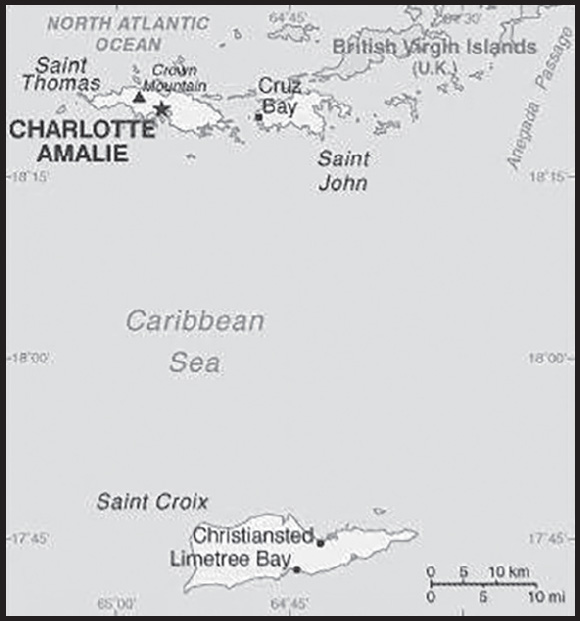
INTRODUCTION
Background: The Danes secured control over the southern Virgin Islands of Saint Thomas, Saint John, and Saint Croix during the 17th and early 18th centuries. Sugarcane, produced by African slave labor, drove the islands’ economy during the 18th and early 19th centuries. In 1917, the US purchased the Danish holdings, which had been in economic decline since the abolition of slavery in 1848. On 6 September 2017, Hurricane Irma passed over the northern Virgin Islands of Saint Thomas and Saint John and inflicted severe damage to structures, roads, the airport on Saint Thomas, communications, and electricity. Less than two weeks later, Hurricane Maria passed over the island of Saint Croix in the southern Virgin Islands, inflicting considerable damage with heavy winds and flooding rains.
GEOGRAPHY
Location: Caribbean, islands between the Caribbean Sea and the North Atlantic Ocean, east of Puerto Rico
Geographic coordinates: 18 20 N, 64 50 W
Map references: Central America and the Caribbean
Area: total: 1,910 sq km
land: 346 sq km
water: 1,564 sq km
comparison ranking: total 181
Area - comparative: twice the size of Washington, DC
Land boundaries: total: 0 km
Coastline: 188 km
Maritime claims: territorial sea: 12 nm
exclusive economic zone: 200 nm
Climate: subtropical, tempered by easterly trade winds, relatively low humidity, little seasonal temperature variation; rainy season September to November
Terrain: mostly hilly to rugged and mountainous with little flat land
Elevation: highest point: Crown Mountain 474 m
lowest point: Caribbean Sea 0 m
Natural resources: pleasant climate, beaches foster tourism
Land use: agricultural land: 11.5% (2018 est.)
arable land: 2.9% (2018 est.)
permanent crops: 2.9% (2018 est.)
permanent pasture: 5.7% (2018 est.)
forest: 57.4% (2018 est.)
other: 31.1% (2018 est.)
Irrigated land: 1 sq km (2012)
Population distribution: while overall population density throughout the islands is relatively low, concentrations appear around Charlotte Amalie on St. Thomas and Christiansted on St. Croix
Natural hazards: several hurricanes in recent years; frequent and severe droughts and floods; occasional earthquakes
Geography - note: important location along the Anegada Passage - a key shipping lane for the Panama Canal; Saint Thomas has one of the best natural deepwater harbors in the Caribbean
PEOPLE AND SOCIETY
Population: 104,917 (2023 est.)
comparison ranking: 192
Nationality: noun: Virgin Islander(s) (US citizens)
adjective: Virgin Islander
Ethnic groups: Black 76%, White 15.6%, Asian 1.4%, other 4.9%, mixed 2.1% (2010 est.)
note: 17.4% self-identify as Latino
Languages: English 71.6%, Spanish or Spanish Creole 17.2%, French or French Creole 8.6%, other 2.5% (2010 est.)
Religions: Protestant 65.5%, Roman Catholic 27.1%, other Christians 2.2%, other 1.5%, none 3.7% (2010 est.)
Age structure: 0-14 years: 19.07% (male 10,224/female 9,779)
15-64 years: 60.04% (male 29,796/female 33,197)
65 years and over: 20.89% (2023 est.) (male 9805/female 12,116)
Dependency ratios: total dependency ratio: 64.6
youth dependency ratio: 32
elderly dependency ratio: 34
potential support ratio: 3 (2021 est.)
Median age: total: 42.7 years (2023 est.)
male: 41.7 years
female: 43.7 years
comparison ranking: total 37
Population growth rate: -0.49% (2023 est.)
comparison ranking: 222
Birth rate: 11.4 births/1,000 population (2023 est.)
comparison ranking: 160
Death rate: 9 deaths/1,000 population (2023 est.)
comparison ranking: 62
Net migration rate: -7.3 migrant(s)/1,000 population (2023 est.)
comparison ranking: 219
Population distribution: while overall population density throughout the islands is relatively low, concentrations appear around Charlotte Amalie on St. Thomas and Christiansted on St. Croix
Urbanization: urban population: 96.2% of total population (2023)
rate of urbanization: -0.11% annual rate of change (2020-25 est.)
Major urban areas - population: 52,000 CHARLOTTE AMALIE (capital) (2018)
Sex ratio: at birth: 1.06 male(s)/female
0-14 years: 1.05 male(s)/female
15-64 years: 0.9 male(s)/female
65 years and over: 0.81 male(s)/female
total population: 0.9 male(s)/female (2023 est.)
Infant mortality rate: total: 7.5 deaths/1,000 live births (2023 est.)
male: 8.5 deaths/1,000 live births
female: 6.4 deaths/1,000 live births
comparison ranking: total 153
Life expectancy at birth: total population: 80.5 years (2023 est.)
male: 77.3 years
female: 83.9 years
comparison ranking: total population 51
Total fertility rate: 1.98 children born/woman (2023 est.)
comparison ranking: 110
Gross reproduction rate: 0.96 (2023 est.)
Drinking water source: improved: total: 98.7% of population
unimproved: total: 1.3% of population (2020 est.)
Sanitation facility access: improved: total: 99.4% of population
unimproved: total: 0.6% of population (2020 est.)
Currently married women (ages 15-49): 27.4% (2023)
Youth unemployment rate (ages 15-24): total: 27% (2021 est.)
male: 24.1%
female: 37.3%
comparison ranking: total 52
ENVIRONMENT
Environment - current issues: lack of natural freshwater resources; protection of coral reefs; solid waste management; coastal development; increased boating and overfishing
Climate: subtropical, tempered by easterly trade winds, relatively low humidity, little seasonal temperature variation; rainy season September to November
Land use: agricultural land: 11.5% (2018 est.)
arable land: 2.9% (2018 est.)
permanent crops: 2.9% (2018 est.)
permanent pasture: 5.7% (2018 est.)
forest: 57.4% (2018 est.)
other: 31.1% (2018 est.)
Urbanization: urban population: 96.2% of total population (2023)
rate of urbanization: -0.11% annual rate of change (2020-25 est.)
Revenue from forest resources: 0% of GDP (2017 est.)
comparison ranking: 203
Waste and recycling: municipal solid waste generated annually: 146,500 tons (2012 est.)
GOVERNMENT
Country name: conventional long form: none
conventional short form: Virgin Islands
former: Danish West Indies
abbreviation: VI
etymology: the myriad islets, cays, and rocks surrounding the major islands reminded Christopher COLUMBUS in 1493 of Saint Ursula and her 11,000 virgin followers (Santa Ursula y las Once Mil Virgenes), which over time shortened to the Virgins (las Virgenes)
Government type: unincorporated organized territory of the US with local self-government; republican form of territorial government with separate executive, legislative, and judicial branches
Dependency status: unincorporated organized territory of the US with policy relations between the Virgin Islands and the US Federal Government under the jurisdiction of the Office of Insular Affairs, US Department of the Interior, Washington, DC
Capital: name: Charlotte Amalie
geographic coordinates: 18 21 N, 64 56 W
time difference: UTC-4 (1 hour ahead of Washington, DC, during Standard Time)
etymology: originally called Taphus in Danish - meaning “tap house” or “beer house” because of its many beer halls - the town received a more dignified name in 1691 when it was named Charlotte Amalie in honor of Danish King CHRISTIAN V’s wife, Charlotte AMALIE of Hesse-Kassel (1650–1714)
Administrative divisions: none (territory of the US); there are no first-order administrative divisions as defined by the US Government, but there are 3 islands at the second order; Saint Croix, Saint John, Saint Thomas
Independence: none (territory of the US)
National holiday: Transfer Day (from Denmark to the US), 31 March (1917)
Constitution: history: 22 July 1954 - the Revised Organic Act of the Virgin Islands functions as a constitution for this US territory
amendments: amended several times, last in 2012
Legal system: US common law
Citizenship: see United States
Suffrage: 18 years of age; universal; note - island residents are US citizens but do not vote in US presidential elections
Executive branch: chief of state: President Joseph R. BIDEN, Jr. (since 20 January 2021); Vice President Kamala D. HARRIS (since 20 January 2021)
head of government: Governor Albert BRYAN, Jr. (since 7 January 2019), Lieutenant Governor Tregenza ROACH (since 7 January 2019)
cabinet: Territorial Cabinet appointed by the governor and confirmed by the Senate
elections/appointments: president and vice president indirectly elected on the same ballot by an Electoral College of ‘electors’ chosen from each state; president and vice president serve a 4-year term (eligible for a second term); under the US Constitution, residents of the Virgin Islands do not vote in elections for US president and vice president; however, they may vote in the Democratic and Republican presidential primary elections; governor and lieutenant governor directly elected on the same ballot by absolute majority vote in 2 rounds if needed for a 4-year term (eligible for a second term); election last held on 8 November 2022 (next to be held in November 2026)
election results: Albert BRYAN, Jr. reelected governor; percent of vote - Albert BRYAN, Jr. (Democratic Party) 56%, Kurt VIALET (independent) 38%
Legislative branch: description: unicameral Legislature of the Virgin Islands (15 seats; senators directly elected in single- and multi-seat constituencies by simple majority popular vote to serve 2-year terms)
the Virgin Islands directly elects 1 delegate to the US House of Representatives by simple majority vote to serve a 2-year term
elections: Legislature of the Virgin Islands last held on 8 November 2022 (next to be held in November 2024)
Delegate to the US House of Representatives last held on 8 November 2022 (next to be held on 5 November 2024)
election results: Legislature of the Virgin Islands - percent of vote by party - NA; seats by party - Democratic Party 9, independent 6; composition - men 9, women 6, percent of women 40%
delegate to US House of Representatives - seat by party - Democratic Party 1; composition - 1 woman
note: the Virgin Islands delegate to the US House of Representatives can vote when serving on a committee and when the House meets as the Committee of the Whole House, but not when legislation is submitted for a “full floor” House vote
Judicial branch: highest court(s): Supreme Court of the Virgin Islands (consists of the chief justice and 2 associate justices); note - court established by the US Congress in 2004 and assumed appellate jurisdiction in 2007
judge selection and term of office: justices appointed by the governor and confirmed by the Virgin Islands Senate; justices serve initial 10-year terms and upon reconfirmation, during the extent of good behavior; chief justice elected to position by peers for a 3-year term
subordinate courts: Superior Court (Territorial Court renamed in 2004); US Court of Appeals for the Third Circuit (has appellate jurisdiction over the District Court of the Virgin Islands; it is a territorial court and is not associated with a US federal judicial district); District Court of the Virgin Islands
Political parties and leaders: Democratic Party [Stacey PLASKETT]
Independent Citizens’ Movement or ICM [Dale BLYDEN]
Republican Party [John CANEGATA]
International organization participation: AOSIS (observer), Interpol (subbureau), IOC, UPU, WFTU (NGOs)
Diplomatic representation in the US: none (territory of the US)
Diplomatic representation from the US: none (territory of the US)
Flag description: white field with a modified US coat of arms in the center between the large blue initials V and I; the coat of arms shows a yellow eagle holding an olive branch in its right talon and three arrows in the left with a superimposed shield of seven red and six white vertical stripes below a blue panel; white is a symbol of purity, the letters stand for the Virgin Islands
National anthem: name: “Virgin Islands March”
lyrics/music: multiple/Alton Augustus ADAMS, Sr.
note: adopted 1963; serves as a local anthem; as a territory of the US, “The Star-Spangled Banner” is official (see United States)
ECONOMY
Economic overview: high-income, tourism-based American territorial economy; severe COVID-19 economic disruptions; major rum distillery; high public debt; sluggish reopening of large oil refinery; environmentally susceptible to hurricanes; many informal industries
Real GDP (purchasing power parity): $3.872 billion (2016 est.)
$3.759 billion (2015 est.)
$3.622 billion (2014 est.)
note: data are in 2013 dollars
comparison ranking: 184
Real GDP growth rate: -2.15% (2020 est.)
2.78% (2019 est.)
1.9% (2018 est.)
comparison ranking: 205
Real GDP per capita: $37,000 (2016 est.)
$35,800 (2015 est.)
$34,500 (2014 est.)
comparison ranking: 55
GDP (official exchange rate): $5.182 billion (2016 est.)
Inflation rate (consumer prices): 1% (2016 est.)
2.6% (2015 est.)
comparison ranking: 200
GDP - composition, by sector of origin: agriculture: 2% (2012 est.)
industry: 20% (2012 est.)
services: 78% (2012 est.)
comparison rankings: services 37; industry 149; agriculture 175
GDP - composition, by end use: household consumption: 68.2% (2016 est.)
government consumption: 26.8% (2016 est.)
investment in fixed capital: 7.5% (2016 est.)
investment in inventories: 15% (2016 est.) NA
exports of goods and services: 46.7% (2016 est.)
imports of goods and services: -64.3% (2016 est.)
Agricultural products: fruit, vegetables, sorghum; Senepol cattle
Industries: tourism, watch assembly, rum distilling, construction, pharmaceuticals, electronics
Industrial production growth rate: NA
Labor force: 42,200 (2021 est.)
comparison ranking: 195
Labor force - by occupation: agriculture: 1%
industry: 19%
services: 80% (2003 est.)
Unemployment rate: 13.27% (2021 est.)
13.55% (2020 est.)
12.47% (2019 est.)
comparison ranking: 48
Youth unemployment rate (ages 15-24): total: 27% (2021 est.)
male: 24.1%
female: 37.3%
comparison ranking: total 52
Population below poverty line: 28.9% (2002 est.)
Household income or consumption by percentage share: lowest 10%: NA
highest 10%: NA
Budget: revenues: $1.496 billion (2016 est.)
expenditures: $1.518 billion (2016 est.)
Budget surplus (+) or deficit (-): -0.4% (of GDP) (2016 est.)
comparison ranking: 59
Public debt: 53.3% of GDP (2016 est.)
45.9% of GDP (2014 est.)
comparison ranking: 95
Taxes and other revenues: 28.9% (of GDP) (2016 est.)
comparison ranking: 32
Fiscal year: 1 October - 30 September
Exports: $1.81 billion (2016 est.)
$1.537 billion (2015 est.)
comparison ranking: 163
Exports - partners: Haiti 14%, Guadeloupe 7%, Malaysia 7%, Martinique 7%, Barbados 7%, British Virgin Islands 5% (2019)
Exports - commodities: refined petroleum, jewelry, recreational boats, watches, rum (2019)
Imports: $2.489 billion (2016 est.)
$1.549 billion (2015 est.)
comparison ranking: 164
Imports - partners: India 18%, Algeria 14%, South Korea 9%, Argentina 9%, Sweden 7%, Brazil 5% (2019)
Imports - commodities: refined petroleum, crude petroleum, rubber piping, jewelry, beer (2019)
Debt - external: NA
Exchange rates: the US dollar is used
ENERGY
Electricity access: electrification - total population: 100% (2021)
Electricity: installed generating capacity: 321,000 kW (2020 est.)
consumption: 561.24 million kWh (2019 est.)
exports: 0 kWh (2020 est.)
imports: 0 kWh (2020 est.)
transmission/distribution losses: 51 million kWh (2019 est.)
comparison rankings: imports 200; exports 199; installed generating capacity 159; transmission/distribution losses 171; consumption 168
Electricity generation sources: fossil fuels: 98.9% of total installed capacity (2020 est.)
solar: 1.1% of total installed capacity (2020 est.)
Petroleum: total petroleum production: 0 bbl/day (2021 est.)
refined petroleum consumption: 16,400 bbl/day (2019 est.)
Refined petroleum products - exports: 3,285 bbl/day (2015 est.)
comparison ranking: 97
Refined petroleum products - imports: 23,480 bbl/day (2015 est.)
comparison ranking: 112
Carbon dioxide emissions: 2.438 million metric tonnes of CO2 (2019 est.)
from petroleum and other liquids: 2.438 million metric tonnes of CO2 (2019 est.)
comparison ranking: total emissions 154
COMMUNICATIONS
Telephones - fixed lines: total subscriptions: 76,000 (2021 est.)
subscriptions per 100 inhabitants: 76 (2021 est.)
comparison ranking: total subscriptions 143
Telephones - mobile cellular: total subscriptions: 80,000 (2021 est.)
subscriptions per 100 inhabitants: 80 (2021 est.)
comparison ranking: total subscriptions 195
Telecommunication systems: general assessment: modern system with total digital switching, uses fiber-optic cable and microwave radio relay; good interisland and international connections; broadband access; expansion of FttP (Fiber to the Home) markets; LTE launches; regulatory development and expansion in several markets point to investment and focus on data (2020)
domestic: fixed-line 76 per 100 persons, with mobile-cellular 80 per 100 (2021)
international: country code - 1-340; landing points for the BSCS, St Thomas-ST Croix System, Southern Caribbean Fiber, Americas II, GCN, MAC, PAN-AM and SAC submarine cable connections to US, the Caribbean, Central and South America; satellite earth stations - NA (2020)
Broadcast media: about a dozen TV broadcast stations including 1 public TV station; multi-channel cable and satellite TV services are available; 24 radio stations
Internet country code: .vi
Internet users: total: 67,508 (2022 est.)
percent of population: 64.8% (2022 est.)
comparison ranking: total 196
TRANSPORTATION
Airports: 2 (2021)
comparison ranking: total 207
Airports - with paved runways: 2
note: paved runways have a concrete or asphalt surface but not all have facilities for refueling, maintenance, or air traffic control; the length of a runway required for aircraft to safely operate depends on a number of factors including the type of aircraft, the takeoff weight (including passengers, cargo, and fuel), engine types, flap settings, landing speed, elevation of the airport, and average maximum daily air temperature; paved runways can reach a length of 5,000 m (16,000 ft.), but the “typical” length of a commercial airline runway is between 2,500-4,000 m (8,000-13,000 ft.)
Roadways: total: 1,260 km (2008)
comparison ranking: total 178
Merchant marine: total: 1,868 (2019)
by type: bulk carrier 91, container ship 39, general cargo 1,205, oil tanker 118, other 415
comparison ranking: total 13
Ports and terminals: major seaport(s): Charlotte Amalie, Christiansted, Cruz Bay, Frederiksted, Limetree Bay
MILITARY AND SECURITY
Military - note: defense is the responsibility of the US
TRANSNATIONAL ISSUES
Disputes - international: none identified